
Linamar to Buy Terex's Genie Aerial Work Platform Business for $1.4 Billion
Linamar Corp. has agreed to buy the Genie aerial work platform business from Terex Corp. for $1.4 billion, a deal that will make the Canadian manufacturer one of the largest owners of access equipment brands in North America. The two companies announced the definitive agreement after markets closed on Nov. 23, with Linamar issuing its release from Guelph, Ontario, and Terex from Norwalk, Connecticut. The transaction ends Terex's yearlong effort to exit the aerials business and is expected to close in the first half of 2027.
Key developments
- Linamar will acquire Genie, which Terex reports as its Aerials segment, for about $1.4 billion in cash, subject to customary adjustments, according to both companies.
- Genie brings more than 4,200 employees and manufacturing operations in the United States, Mexico, Italy, China and India, plus a global parts, service and reconditioning network.
- Linamar said Genie generated about $2.3 billion in revenue over the last twelve months, which will be added to its Industrial segment.
- Genie will be combined with Linamar's Skyjack unit to form a new Linamar Access Group, while the two brands keep separate sales and service organizations.
- Linamar will fund the purchase through a new credit facility arranged by National Bank of Canada. Closing requires regulatory approvals and other customary conditions.
Industry background
Aerial work platforms, the boom lifts, scissor lifts and telehandlers that lift workers and materials on construction sites, warehouses and factories, are a core product category for equipment rental companies. Rental fleets buy most of these machines, which makes demand closely tied to nonresidential construction cycles and to the timing of fleet replacement. Genie is one of the best known brands in the segment, with a product line that spans boom lifts, scissor lifts, telehandlers and vertical material lifts.
Terex first signaled its intention to part with Genie in October 2025, when it agreed to merge with REV Group, the maker of fire trucks, ambulances and specialty vehicles. At the time, Terex said it was assessing a sale or spin-off of the aerials business to reduce its exposure to cyclical end markets, Equipment World reported. Genie sales had fallen 13.2% year over year in the third quarter of 2025, according to the same report. Terex said the REV Group combination closed earlier this year, and its board unanimously approved the Genie sale after a strategic review.
Linamar, best known as a supplier of machined components and driveline systems to automakers, has spent years building a second business in industrial equipment. Its brands include Skyjack in access equipment and MacDon, Salford and Bourgault in agriculture. The company reported sales of more than $10.2 billion in 2025 and employs over 36,000 people across 86 manufacturing locations in 19 countries.
Industry implications
The deal pairs two of the most recognizable names in aerial work platforms under one owner. Skyjack has historically been strongest in scissor lifts, while Linamar described Genie as a technological leader in boom lifts with complementary scissor and telehandler products. Combining them gives Linamar a broader catalog to offer rental companies, which typically prefer to source full fleets from a small number of suppliers.
Linamar said it will keep Genie and Skyjack as independently positioned brands with their own sales and service teams. That approach suggests the company wants to avoid alienating rental customers that deliberately split purchases between the two manufacturers. It also signals that most of the integration work will take place behind the scenes, in purchasing, engineering, logistics and shared services, rather than in how the brands go to market.
For Terex, the sale completes a sharp change in identity. Chief Executive Simon Meester said the company will become a high-mix, low-volume specialty equipment manufacturer, with Environmental Solutions, Materials Processing and Specialty Vehicles as its remaining segments after closing.
Competitive and supply chain implications
The access equipment field has been led for years by a few large players, including JLG, owned by Oshkosh Corp., and Genie. Bringing Genie into the same group as Skyjack creates a larger competitor with more purchasing power for steel, hydraulic components, engines, batteries and electronic controls. Linamar's background in high-volume automotive machining could give it more options to produce components in-house rather than buying them from outside suppliers.
The manufacturing footprint also matters. Genie's plants in the United States, Mexico, Italy, China and India give Linamar production close to most major rental markets. That spread may help the combined group manage tariffs and freight costs as trade policy keeps shifting, although Linamar did not say whether it plans to change where any products are built. Linamar cited infrastructure investment, manufacturing reshoring, power generation projects, data center construction and rental fleet replacement as sources of demand for access equipment.
Regional implications
In North America, the deal creates a Canadian-owned group with significant U.S. manufacturing, as Linamar noted that thousands of Genie employees work in the United States. U.S. rental companies, the largest buyers of aerial equipment, will now deal with a single parent for two major brands. Canada gains another sizable industrial platform headquartered in Ontario, alongside Linamar's existing automotive and agricultural operations.
Outside North America, Genie's plants in Italy, China and India extend Linamar's reach into European and Asian markets where Skyjack has a smaller presence. The deal also affects Genie's dealer and distribution network in regions such as the Middle East and Africa, where independent dealers sell and service the brand. Regulators in several jurisdictions are likely to review the transaction, though neither company named the agencies involved.
Credence Research analysis
The transaction shows how auto suppliers are using industrial acquisitions to reduce their dependence on light vehicle production. Linamar has pursued this diversification for years, and Genie is a large step in that direction. Linamar Executive Chair Linda Hasenfratz called the purchase a compelling next step in the company's diversification strategy. Access equipment follows a different demand cycle from passenger vehicles, so the deal could help smooth Linamar's earnings when auto production slows. The trade-off is greater exposure to construction and rental spending, which can drop sharply in a downturn, the very cyclicality Terex has now chosen to leave behind.
The most important execution question is whether Linamar can capture cost savings without disrupting two brands that compete for the same rental customers. Keeping separate sales organizations limits the risk of losing customers, but it also limits how much the company can consolidate. Linamar's manufacturing discipline in automotive machining is relevant here, since much of the potential improvement lies in components, procurement and plant efficiency. Terex, for its part, will exit 2027 as a smaller, more specialized company focused on refuse trucks, materials processing and emergency vehicles, a portfolio it argues is less exposed to construction cycles.
What comes next
- Linamar scheduled a conference call and webcast for 9 a.m. Eastern time on Nov. 24 to discuss the acquisition.
- Both companies will seek the required regulatory approvals, which have not been identified publicly.
- Linamar expects to complete the purchase in the first half of 2027.
- After closing, Genie and Skyjack will begin operating as the Linamar Access Group within Linamar's Industrial segment.
- Terex will continue with three segments: Environmental Solutions, Materials Processing and Specialty Vehicles.
Sources
- Linamar Corporation: Linamar Corporation to Acquire Genie from Terex Corporation (GlobeNewswire, Nov. 23, 2026)
- Terex Corporation: Terex Announces Definitive Agreement to Sell its Aerials Segment to Linamar (PR Newswire, Nov. 23, 2026)
- Equipment World: Terex to Merge with REV Group, Exit Genie Aerial Business (Oct. 30, 2025)
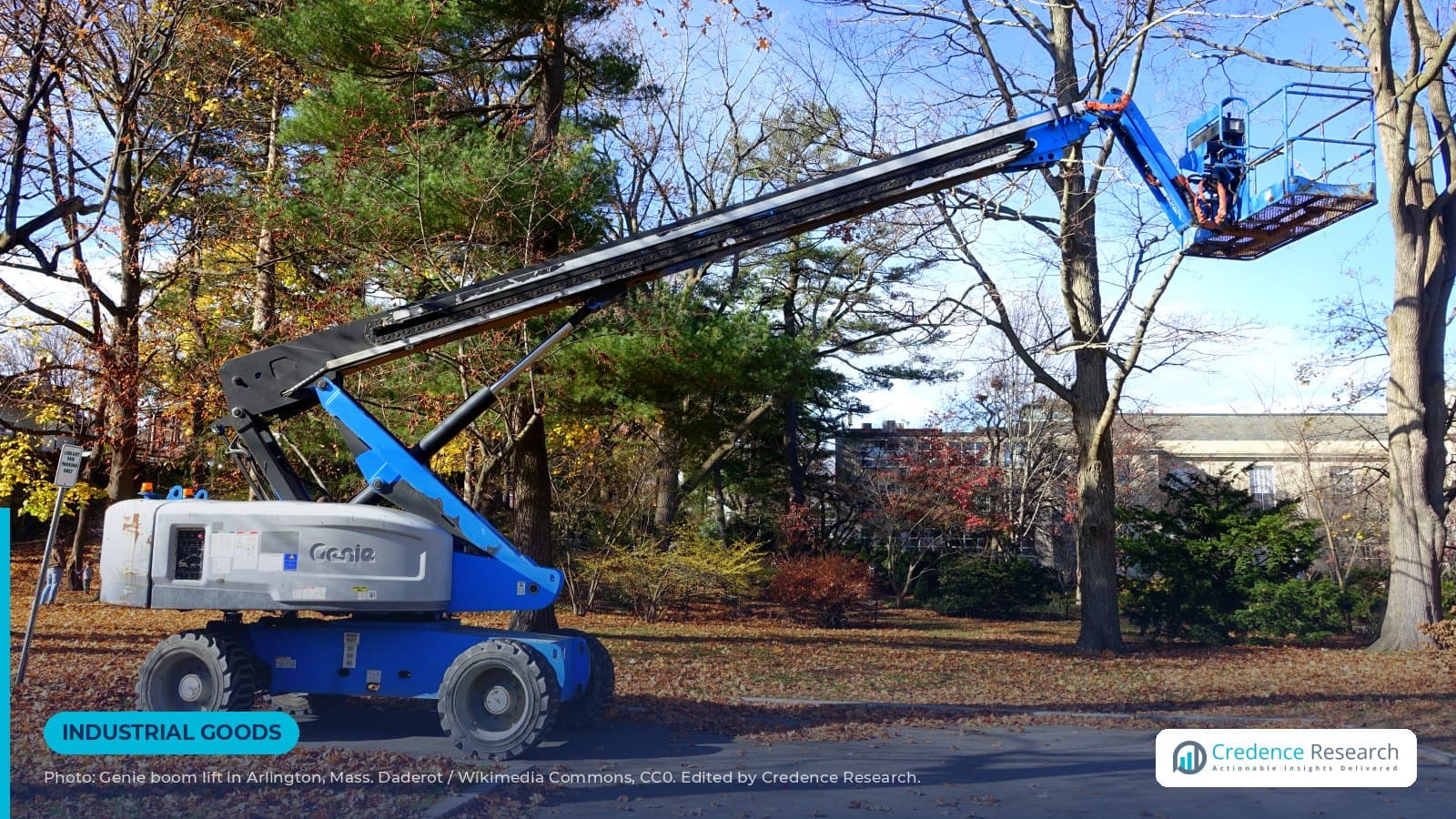
Image: Genie boom lift in Arlington, Massachusetts, by Daderot via Wikimedia Commons, CC0. Cropped and edited by Credence Research.

About the Author

Senior News Editor at Credence Research Inc