
China buys most machines while India adds capacity fastest
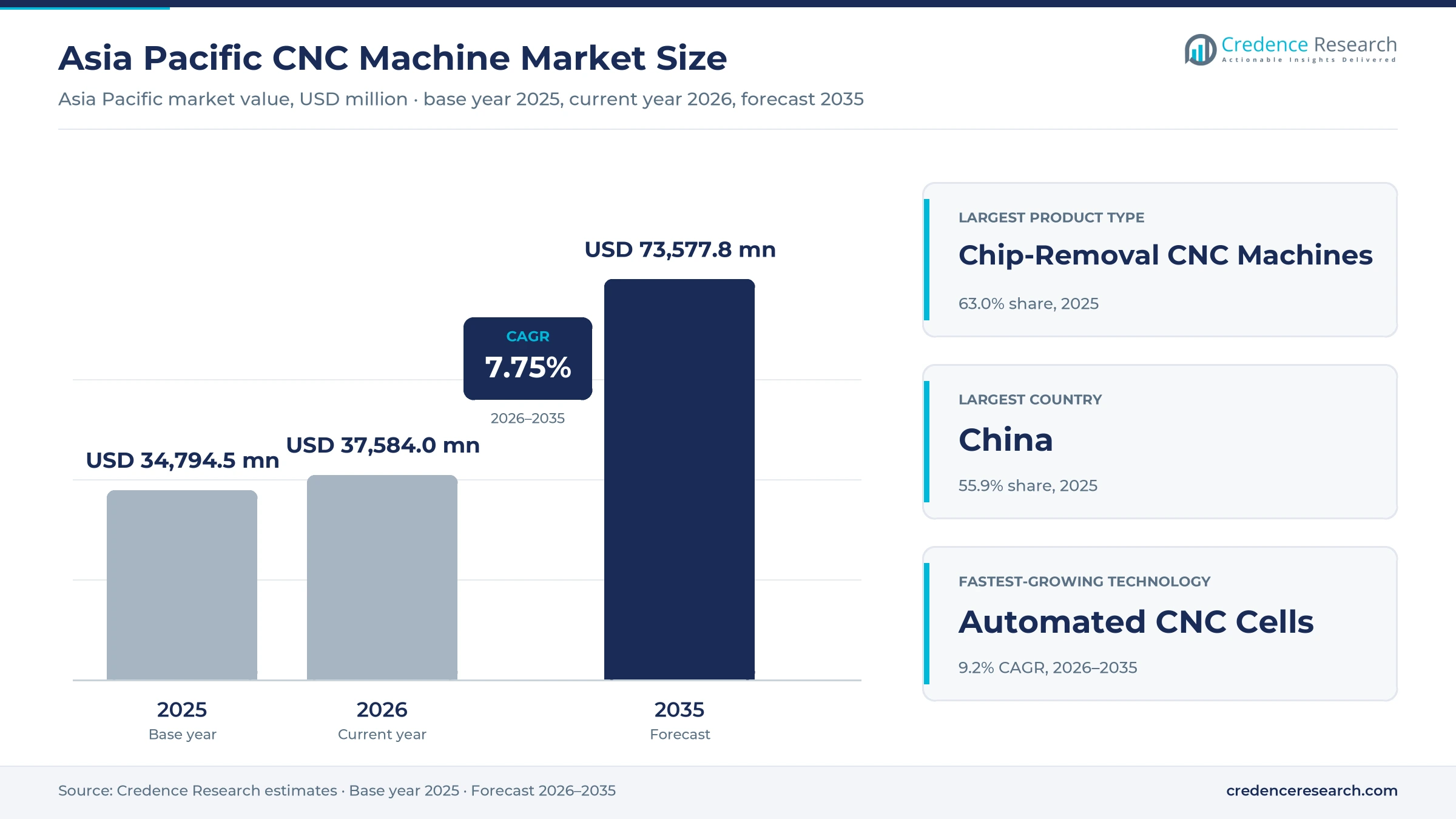
The Asia Pacific CNC machine market was valued at USD 34.79 billion in 2025 and is projected to increase from USD 37.58 billion in 2026 to USD 73.58 billion by 2035, registering a CAGR of 7.75% during 2026–2035. Demand comes from automotive component plants, electronics equipment makers, machinery shops and aerospace suppliers replacing older equipment with faster, more precise machines. China held the largest country share, 55.9% in 2025, because its factories buy about a third of the world's machine tools and its builders supply much of that volume at lower prices. India is the fastest-growing country market at 10.0% a year as vehicle, defense and electronics plants add capacity. Japanese builders booked about 72% of their 2025 orders abroad, which shows how far even the largest builders depend on export buyers.
Builders in five countries serve job shops and EV lines alike
The market counts the value of new computer numerically controlled machines sold to plants across the region, including turning and machining centers, grinders, electrical discharge and laser cutters, and CNC press brakes and punching machines. Buyers range from vehicle and electronics groups ordering dedicated lines through direct sales teams to small job shops buying one vertical machining center through a dealer.
The market excludes cutting tools, used machines, spare parts and service income. Supply runs from controller, servo and spindle makers, many of them Japanese, German or Taiwanese, through machine builders in China, Japan, South Korea, Taiwan and India to distributors, system integrators and end plants.
Asia Pacific CNC Machine Market Insights
- The Asia Pacific CNC machine market rises from USD 34.79 billion in 2025 to USD 73.58 billion by 2035, a 7.75% CAGR over 2026–2035, as vehicle, electronics and aerospace plants re-equip.
- China held 55.9% of 2025 value because it consumed about EUR 25.2 billion of machine tools in 2025, roughly 32% of world demand, according to VDW.
- Chip-Removal CNC Machines led with 63.0% of 2025 value, supported by Chinese output of about 870,000 metal-cutting machine tools in 2025.
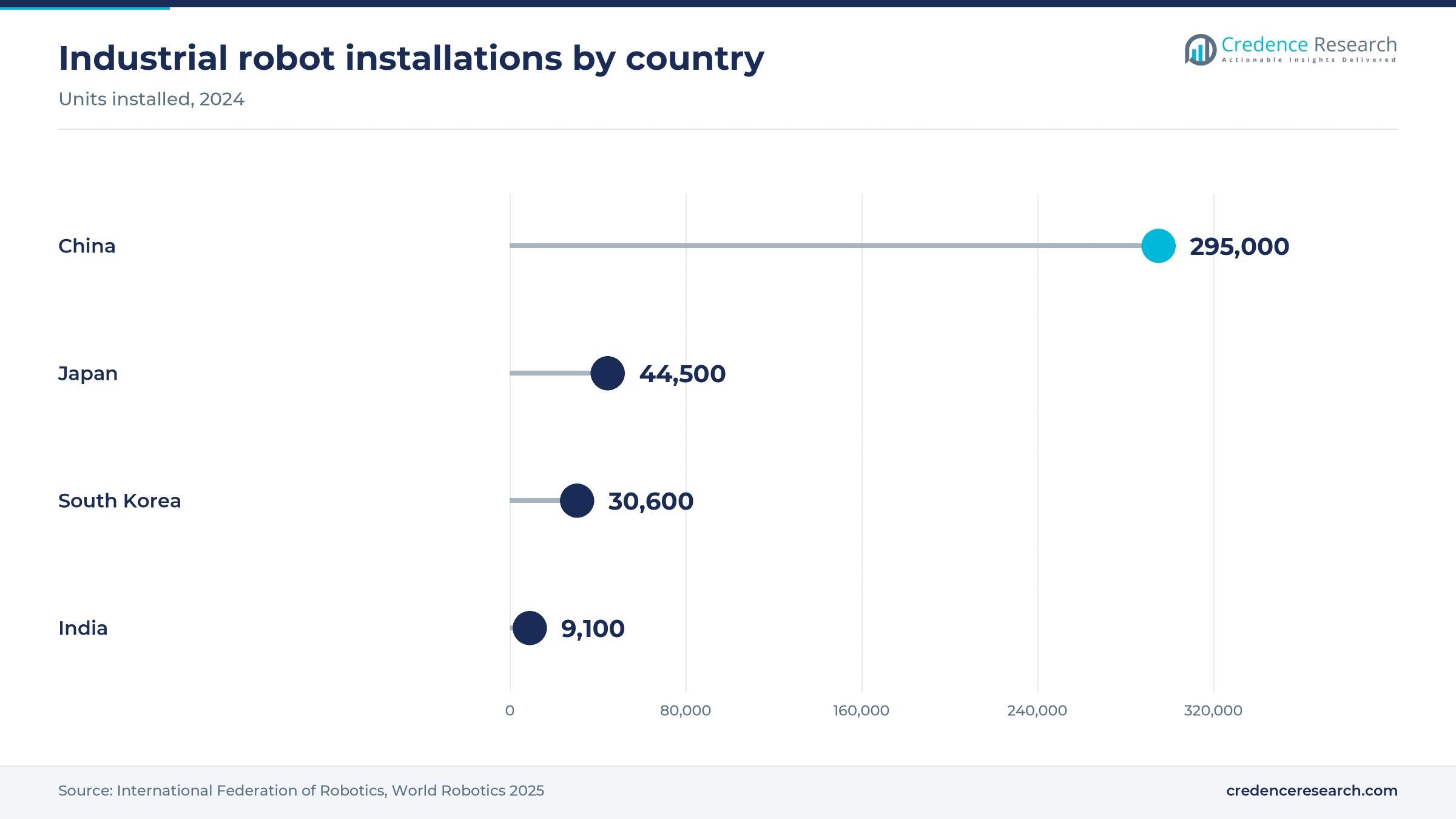
- Robot installations in China reached 295,000 units in 2024, so Automated CNC Cells grow fastest at 9.2% a year as plants link machines and robots.
- Indian capacity is rising quickly, with Bharat Fritz Werner, Tsugami and Jyoti CNC Automation adding plants since 2024, which makes India the fastest-growing country.
Chip-removal machines lead while laser cutters gain ground
Chip-removal machines lead as fiber laser cutting spreads
Based on product type, the market is categorized into chip-removal CNC machines, noncontact metal-cutting CNC machines and metal-forming CNC machines. Chip-Removal CNC Machines led with 63.0% of 2025 value because turning and machining centers make every shaft, housing and mold base, and China produced about 870,000 metal-cutting machine tools in 2025, according to the National Bureau of Statistics. Noncontact Metal-Cutting CNC Machines grow fastest at 8.9% a year as fiber laser cutting needs less capital to build, which TRUMPF China said in October 2025 had drawn many new entrants into the field.
Vehicle parts still lead while aerospace and medical work climbs
Based on end-use industry, the market is categorized into automotive component manufacturing, electronics and semiconductor equipment manufacturing, machinery and fabricated metal manufacturing, and aerospace, medical and precision equipment manufacturing. Automotive Component Manufacturing led with 34.0% of 2025 value because engine, transmission and EV lines buy machines in batches, and automotive and EV work made up about 60% of Makino India's order book in December 2025, according to Domain-b. Aerospace, Medical and Precision Equipment Manufacturing grows fastest at 9.1% a year as aerospace and defense formed 40% of Jyoti CNC Automation's order book on Sept. 30, 2025, according to Machinist.
Standalone machines hold the base while automated cells rise
Based on technology, the market is categorized into standalone CNC machines, automated CNC cells and connected CNC production systems. Standalone CNC Machines led with 68.0% of 2025 value because job shops buy single machines at low cost, and a Batala seller lists an Indian-built vertical machining center with an 800 by 500 mm table at Rs 19.75 lakh before tax on TradeIndia. Automated CNC Cells grow fastest at 9.2% a year as China's output of industrial robots rose 28% to 773,074 sets in 2025, according to the National Bureau of Statistics, giving plants cheaper loaders for unattended shifts.
| Segment Group | Leading Sub-segment | Share, 2025 | Fastest-growing Sub-segment | CAGR, 2026–2035 |
|---|---|---|---|---|
| By Product Type | Chip-Removal CNC Machines | 63.0% | Noncontact Metal-Cutting CNC Machines | 8.9% |
| By End-Use Industry | Automotive Component Manufacturing | 34.0% | Aerospace, Medical and Precision Equipment Manufacturing | 9.1% |
| By Technology | Standalone CNC Machines | 68.0% | Automated CNC Cells | 9.2% |
Origin and axis count set a wide spread in machine prices
CNC machines are sold per unit, and the price spread depends more on axis count, accuracy class and origin than on frame size. An Indian-built three-axis vertical machining center lists near USD 23,000 before tax, while Japanese five-axis and multitasking machines are quoted per order with controls, automation and service included. Builders also sell controllers, automation, probing and training as options, which widens the gap between a bare machine quote and a working cell. Exchange rates also move prices, as the yen's fall has made Japanese machines cheaper in dollar terms. For buyers, the cheapest machine is rarely the lowest cost per part, because uptime and service reach decide utilization.
| Machine class | Typical price or fee | Basis |
|---|---|---|
| Indian three-axis vertical machining center, 800 x 500 mm table | Rs 19.75 lakh before GST, about USD 23,000 | Sahil Alloys lists on TradeIndia, 2026 |
| Yen against U.S. dollar since 2021 | Down 52.2%, against 9.8% for the NT dollar, cutting dollar prices of Japanese machines | Taiwan Association of Machinery Industry via Taipei Times, Dec. 2025 |
| Taiwanese versus Japanese machining centers | Former 20% to 30% Taiwanese discount largely gone since 2021 | Taiwan Association of Machinery Industry via Taipei Times, Dec. 2025 |
Request a Free Sample
Fill in your details and we'll send you a free sample report.
- Sample data tables & charts
- Research methodology
EV lines, localization and automation lift orders
EV component retooling across vehicle supply chains
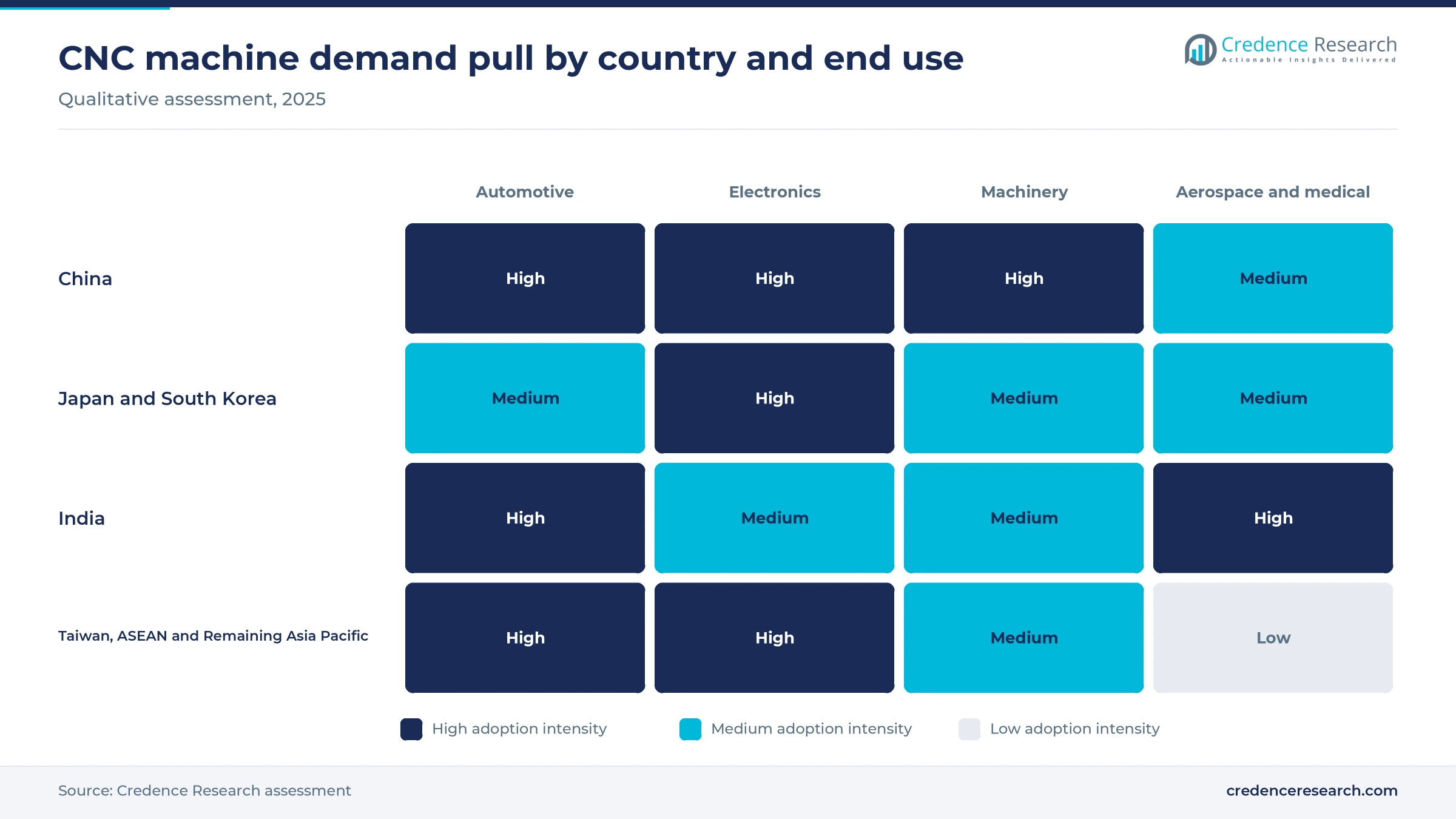
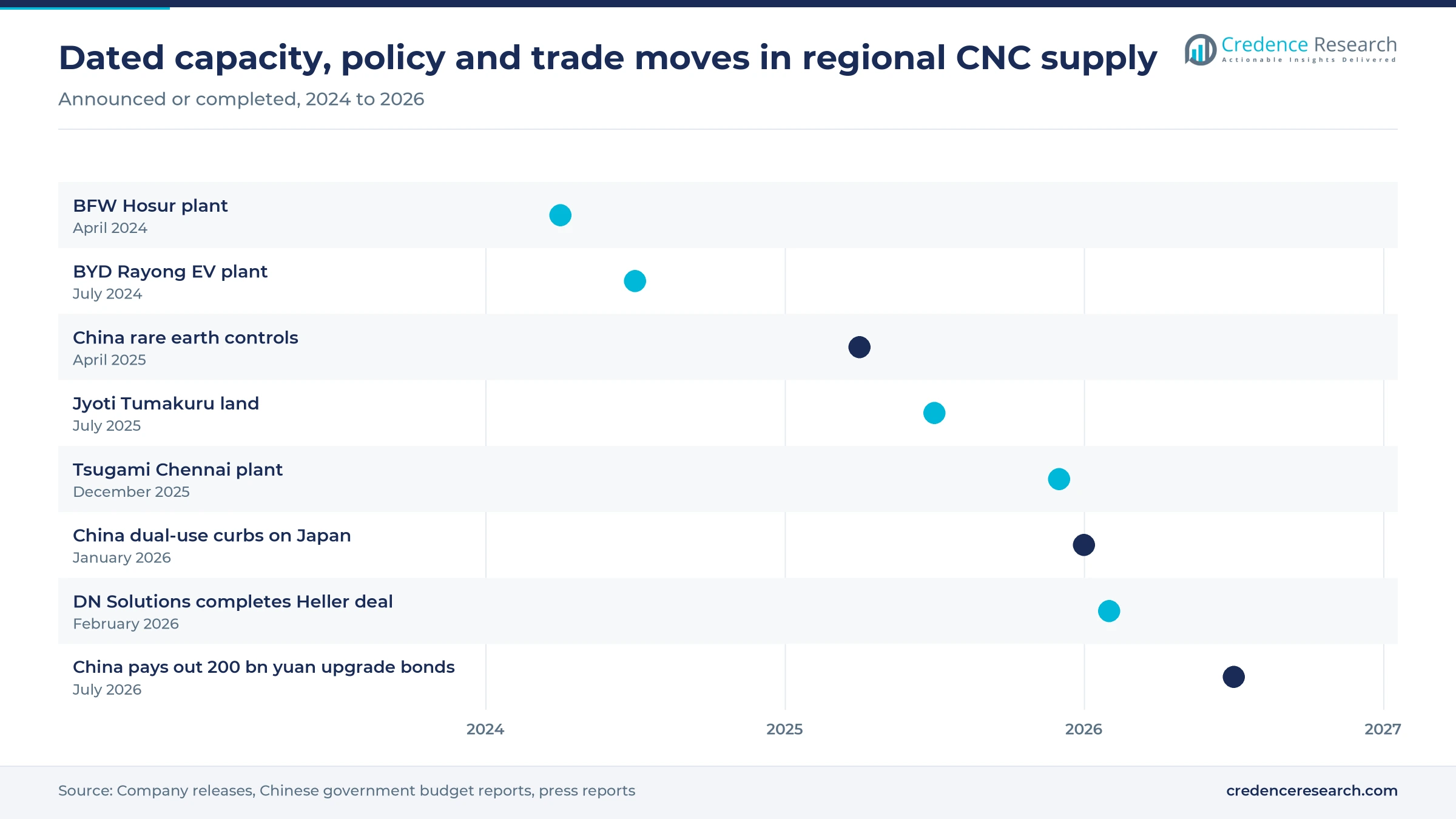
Electric vehicle programs force suppliers to replace engine and transmission machining with lines for motor housings, battery trays, reducers and e-axle shafts. China produced 16.52 million new energy vehicles in 2025, up 25.1%, according to the National Bureau of Statistics, and each new platform needs fresh fixtures, spindles and cycle-time tuning. The shift is spreading outside China, since BYD opened a Rayong, Thailand plant for 150,000 vehicles a year on July 4, 2024, as Thailand courts EV assembly with tax incentives. China's total motor vehicle output also rose 9.8% to 34.78 million units in 2025, according to the same statistics release, so EV retooling comes on top of rising overall volume. Suppliers that can quote complete EV machining lines therefore win the largest orders.
Manufacturing localization and domestic supplier development
Governments and buyers want machines built close to the plants that use them, which shortens delivery and cuts currency exposure. Bharat Fritz Werner inaugurated a plant at Hosur, Tamil Nadu on April 22, 2024, built for more than 10,000 CNC machines a year, according to The Print. Japan's Tsugami opened a 3,000-machine assembly plant and a foundry for 6,000 metric tons of castings at Oragadam near Chennai on Dec. 4, 2025, according to The Machine Maker. Jyoti CNC Automation is adding 10,000 machines a year of Rajkot capacity by September 2026, according to Machinist. Makino India has also raised domestic value addition from about 15% to nearly 50%, which narrows the price gap with Indian builders.
Machine-integrated automation and digital engineering
Labor costs and the need for night shifts push buyers from single machines toward cells with robots, pallet changers and monitoring software. China installed 295,000 industrial robots in 2024, about 54% of global deployments, and Asia took 74% of all new installations, according to the International Federation of Robotics. Domestic robot production keeps lowering cell costs, as noted in the technology segment above. Machine builders are adding engineering support to sell these systems, and Makino India runs labs for factory automation layouts and software-driven workflows at Whitefield and Coimbatore, according to Domain-b in December 2025. Builders that design the whole cell capture more value per order than suppliers of the machine alone.
Chinese equipment upgrade funding sustains replacement
Public funding keeps Chinese replacement orders flowing even when private investment is cautious. Metal-cutting machine tool production rose 9.7% in 2025, while high-technology manufacturing value added grew 9.4%, according to the National Bureau of Statistics. China then disbursed all 200 billion yuan of ultra-long special treasury bonds set aside for 2026 equipment upgrades by July 2026, supporting about 11,000 projects across 22 sectors, according to Xinhua. Investment in equipment and machinery purchases grew 9.3% in the first five months of 2026, the agency added, which shows the subsidy reaching factory budgets. Chinese builders are best placed to benefit, since they already supply most local volume.
Five-axis work and export orders reshape builder strategy
Shift toward five-axis machines that finish parts in one setup
Aerospace, energy and medical suppliers are shifting from three-axis machines toward five-axis and gantry machines that complete a part in one clamping. Haitian Precision launched a GFM650 gantry five-axis milling center for aviation and energy parts at the CMES Xi'an show in March 2026, according to its newsroom. Makino India, with about 8,000 machines installed, called five-axis and wire EDM systems central to its aerospace and semiconductor pivot in December 2025, Domain-b reported. European, Japanese and U.S. builders still hold about 70% of the global market for high-precision finishing, according to Jiemian in 2026, although a German supplier quoted there estimated that Chinese machines can already meet about 90% of demand. Chinese builders closing this gap can displace imports on price.
Rise of export orders as home markets plateau
Builders in Japan and China are relying more on overseas demand because domestic orders have flattened. Japanese foreign orders rose 11.5% to 1,163.46 billion yen in 2025, while orders from Asia rose 12.2% to 580.19 billion yen, according to the Japan Machine Tool Builders' Association. China became the largest machine tool exporter in 2025, shipping about EUR 8.6 billion, up 13%, according to VDW. Taiwan's trade body expects machine tool exports to the United States to rise by up to 8% in 2026, according to Focus Taiwan in January 2026. This export shift means regional buyers now face Chinese and Japanese builders competing harder on price and delivery.
Large precision machines for Indian defense and aerospace
The clearest opening lies in large, high-precision machines for Indian defense and aerospace plants, which still import much of this equipment. India's defense production reached a record Rs 1.78 lakh crore in fiscal 2025-26, according to the office of the defense minister, which lifts demand for large machines. Jyoti CNC Automation held an order book of INR 45.46 billion on Sept. 30, 2025, and received approval in July 2025 for about 20 acres at the Tumakuru Machine Tools Park to build large CNC machines for aerospace, defense and heavy engineering, according to Machinist. Builders that qualify such machines locally can replace imports and charge for application engineering.
Semiconductor and electronics equipment opens a precision niche
Chip and electronics equipment makers create a distinct opening because they need ultraclean, micron-level machining for chambers, frames and optical parts. China produced 484.3 billion integrated circuits in 2025, up 10.9%, according to the National Bureau of Statistics. Taiwan's machinery exports rose 8.5% to USD 28.87 billion in the first 11 months of 2025 on equipment tied to AI and cloud computing, according to the Taipei Times. Haitian Precision also introduced a VFM40 vertical five-axis center for medical, semiconductor and optical parts in March 2026. Builders with thermal stability and fine surface control can win these orders at higher margins than in vehicle work.
Price wars, a weak yen and export controls squeeze margins
Price wars in laser and entry machines erode margins
Low entry costs have turned parts of the market into a price war, and TRUMPF China said in October 2025 that homogeneous competition in fiber laser cutting systems was still continuing and squeezing profit. Smaller Chinese laser makers and dealers are most exposed, since they compete on price with few service revenues. Consolidation within two to three years is the outcome that executive expected, which would favor builders with automation, software and service income.
A weak yen erases Taiwanese price advantages
Currency moves have reshaped price competition, because the yen depreciation shown in the price table erased Taiwan's former 20% to 30% price edge over Japanese machines. Taiwan's machine tool exports fell 8.8% to USD 1.83 billion in the first 11 months of 2025, according to the Taipei Times. Taiwanese builders of lathes and machining centers are most exposed, and they now need automation packages or faster delivery to hold customers.
Korean manufacturers move capital spending offshore
Korean domestic demand weakened sharply, as machine tool orders fell 47.5% to 172.1 billion won between July and November 2025, according to the Korea Economic Daily in January 2026. The newspaper linked the fall to manufacturers investing in overseas production bases instead of home plants. Korean builders and dealers that depend on home demand are most exposed, while DN Solutions can offset part of the gap through overseas sales. The risk eases only if Korean capital spending returns to domestic sites.
Export controls and rare earth curbs threaten supply
Trade restrictions now reach the component chain, because China banned dual-use exports to Japanese military end users on Jan. 7, 2026, according to The Standard. Heavy rare earths used in motor magnets have also been under Chinese export controls since April 4, 2025. Japanese builders and servo suppliers are most exposed, since Japan relies almost entirely on China for dysprosium and terbium. Builders are responding with dual sourcing and stock building, which raises working capital.
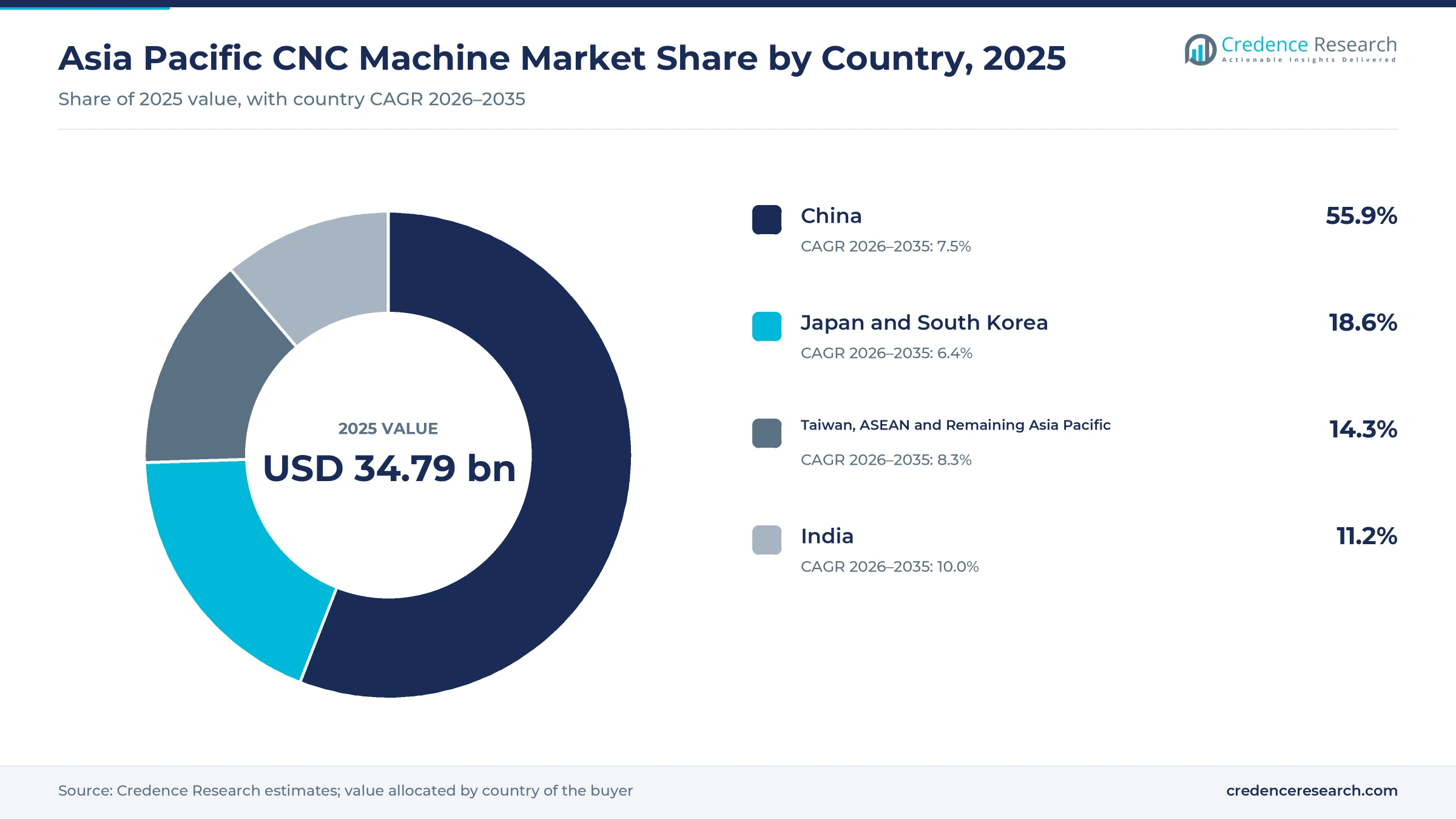
China anchors demand as India grows fastest
| Country | Value, 2025 (USD billion) | Share, 2025 | CAGR, 2026–2035 |
|---|---|---|---|
| China | 19.45 | 55.9% | 7.5% |
| Japan and South Korea | 6.47 | 18.6% | 6.4% |
| Taiwan, ASEAN and Remaining Asia Pacific | 4.98 | 14.3% | 8.3% |
| India | 3.90 | 11.2% | 10.0% |
China leads on scale, subsidies and domestic builders
China held 55.9% of 2025 value and grows at 7.5% a year, because it consumed about EUR 25.2 billion of machine tools in 2025, up 5% and roughly 32% of world demand, according to VDW. Chinese builders also produced about EUR 30 billion of machines, or 37% of global output, so most local demand can be met at lower prices. Growth slows slightly from here because entry segments are crowded and price competition limits value gains.
Japan and South Korea grow slowly from a mature base
Japan and South Korea held 18.6% of 2025 value and grow at 6.4% a year, the slowest pace among the four markets. Japanese domestic demand stalled, as orders slipped 0.2% to 440.86 billion yen in 2025, according to the Japan Machine Tool Builders' Association. Robot installations also fell 4% in Japan to 44,500 units and 3% in South Korea to 30,600 units in 2024, according to the International Federation of Robotics. Replacement and semiconductor work keep demand steady, but new plant spending is moving abroad.
India grows fastest as plants and builders scale up
India held 11.2% of 2025 value and grows at 10.0% a year, the fastest pace in the region. The country accounted for 5.4% of world machine tool demand in 2025, according to VDW. Robot installations also reached a record 9,100 units in 2024, up 7%, according to the International Federation of Robotics. Foreign builders are investing locally, as Mazak opened a Pune plant in July 2023, while HSG Laser, present since 2012, runs spare parts centers in Bengaluru and Chennai and announced a wider service expansion in July 2025.
Taiwan and ASEAN combine export builders with new vehicle hubs
Taiwan, ASEAN and Remaining Asia Pacific held 14.3% of 2025 value and grow at 8.3% a year. Taiwan is mainly a builder base, and its lathe exports fell 18.8% in the first 11 months of 2025, according to the Taiwan Association of Machinery Industry. Demand in Thailand, Vietnam and Malaysia comes from Japanese and Chinese vehicle and electronics plants, along with job shops offering sheet metal fabrication services. Thailand's goal of making 30% of its vehicle output electric by 2030 adds further demand for EV component machining.
Plants, acquisitions and five-axis launches since 2024
| Development | Status and market relevance |
|---|---|
| In April 2024, Bharat Fritz Werner inaugurated a 54-acre plant at Hosur, Tamil Nadu, built for more than 10,000 CNC machines a year. | Completed and operating; it triples the company's Indian output. |
| In July 2025, Jyoti CNC Automation received approval for about 20 acres at the Tumakuru Machine Tools Park for large high-precision machines. | Approval; it prepares capacity for aerospace and defense buyers. |
| In December 2025, Tsugami inaugurated a Rs 300 crore assembly plant and foundry at Oragadam near Chennai. | Operational launch; it adds 3,000 machines a year of Japanese-designed supply in India. |
| In February 2026, DN Solutions completed its acquisition of German machine tool maker Heller after approvals in Germany, the U.S. and the U.K. | Completed; it adds high-end horizontal machining know-how to the Korean builder. |
| In March 2026, Haitian Precision launched the GFM650 gantry and VFM40 vertical five-axis milling centers at the CMES Xi'an show. | Product launch; it extends a Chinese volume builder into five-axis work. |
Controls, cells and software decide the next buying round
- Five-axis machining completes complex aerospace, medical and mold parts in one setup, which cuts fixturing time and handling errors.
- Automated cells combine machines with robots, pallet changers and part stores so plants can run unattended night shifts on repeat parts.
- CNC controls and servo drives remain the largest technology gap for Chinese and Indian builders, who still rely heavily on Japanese and German suppliers.
- Connected monitoring collects spindle, alarm and utilization data so builders can offer remote diagnostics and plants can plan maintenance.
Need a Custom Version of This Report?
Tailor the scope, geography, or segments to your exact requirements.
- Custom geography or segment scope
- Direct access to our analyst team
Japanese precision meets Chinese and Indian scale
Competition splits between Japanese precision builders, Korean and Taiwanese mid-market suppliers, and Chinese and Indian volume builders. Yamazaki Mazak, DMG MORI, Okuma and Makino compete on multitasking, five-axis accuracy and application engineering, and they defend share through technology centers close to customers. DN Solutions competes on broad ranges and price, while Haas Automation sells standardized machines through Phillips Machine Tools Asia, its authorized distributor in the region. AMADA specializes in sheet metal lasers and press brakes across the region. In India, Jyoti CNC Automation and Bharat Fritz Werner are scaling capacity to win business that once went to imports. Ningbo Haitian Precision Machinery extends Chinese volume production into gantry and five-axis machines. Service reach, delivery time and automation packages now decide many orders as closely as list price does.
A few precision majors sit above many volume builders
Japanese groups such as Yamazaki Mazak, DMG MORI, Okuma and Makino lead five-axis, multitasking and grinding work, and DMG MORI announced in 2021 a Pinghu plant designed for more than 2,200 five-axis milling machines a year for Chinese buyers. Entry machines are fragmented among many Chinese, Taiwanese and Indian builders. DN Solutions completed its Heller acquisition in February 2026, giving the pair more than 13,400 machines a year. Entry barriers are highest in controls and reliability, since domestic Chinese high-end CNC systems run about 30,000 hours between failures against more than 50,000 for foreign systems, according to 36Kr. Margins sit with controls and service, as they do for press brake bending equipment.
Companies profiled and their roles in this market
| Company | Type | Role in the market |
|---|---|---|
| Yamazaki Mazak Corporation | Japanese full-line builder | Sells multitasking, turning and five-axis machines and opened a Pune plant in July 2023. |
| DMG MORI Co., Ltd. | Japanese full-line builder | Sells five-axis, turning and automation systems, with a five-axis milling plant at Pinghu, China. |
| Okuma Corporation | Japanese full-line builder | Makes lathes and machining centers with its own controls, including Genos models in Taiwan. |
| AMADA Co., Ltd. | Sheet metal specialist | Sells fiber laser cutters and press brakes, with an Indian technical center in Bengaluru. |
| Makino Milling Machine Co., Ltd. | Japanese precision builder | Sells five-axis and wire EDM machines, with about 8,000 installed in India. |
| DN Solutions | Korean full-line builder | Sells turning and machining centers and completed its Heller acquisition in February 2026. |
| Haas Automation, Inc. | U.S. volume builder | Sells standard vertical, five-axis and turning machines through Phillips Machine Tools Asia. |
| Jyoti CNC Automation Limited | Indian builder | Runs 6,000 machines of Rajkot capacity and is adding 10,000 by September 2026. |
| Bharat Fritz Werner Limited | Indian builder | Makes turning and machining centers at a Hosur plant built for over 10,000 a year. |
| Ningbo Haitian Precision Machinery Co., Ltd. | Chinese builder | Makes machining centers and launched gantry and vertical five-axis models in March 2026. |
Margin moves toward precision, automation and service
Credence Research's view is that value in the region is moving from the machine frame to precision, automation and service. Chinese and Indian capacity additions will keep entry machines cheap, so builders selling standard turning and machining centers face lower margins. Builders that sell complete cells, five-axis accuracy and fast service should hold price. Buyers benefit from lower entry prices but carry more risk on controls and spare parts as trade controls tighten. Suppliers of carbide inserts and cutting tools gain from every new spindle, whichever builder wins. The main downside risk is a deeper price war in China.
Modeled values checked against trade association data
The report uses 2025 as the base year and forecasts values to 2035 through the Credence Research market model. The regional total was checked against machine tool consumption data published by the German machine tool builders' association, order data of the Japan Machine Tool Builders' Association and Chinese official production statistics. Country and segment splits are Credence Research estimates informed by company announcements, plant data, robot installation figures and press reports. No interviews or surveys were conducted for this edition, so the splits should be read as modeled estimates.
Automation and Indian capacity set the pace to 2035
Through 2035, the Asia Pacific CNC machine market should reach USD 73.58 billion as vehicle, electronics, aerospace and machinery plants keep re-equipping. China will stay the largest buyer, but Indian capacity and Southeast Asian vehicle plants will add a growing part of new orders. The machine mix should shift toward five-axis machines, laser cutters and automated cells, which raises value per installation even where unit volumes flatten. Controls supply, trade restrictions and the depth of Chinese price competition remain the conditions to watch, and builders with local service networks should hold the best margins.
Chinese capital spending and Indian capacity set the range
The range of outcomes depends mainly on whether Chinese equipment upgrade funding keeps replacement orders steady and whether Indian plants fill the capacity now being built. A deeper price war in China or a wider trade dispute between China and Japan would lower growth, because both cut builder margins and delay buyer decisions. Faster adoption of automated cells and a strong semiconductor equipment cycle would lift it. Vehicle electrification affects the mix of machines more than total spending in every case.
| Scenario | CAGR, 2026–2035 | Value, 2035 | What has to hold |
|---|---|---|---|
| Downside | 6.2% | USD 64.31 billion | Chinese subsidies fade, price wars deepen and export controls disrupt servo and magnet supply |
| Base | 7.75% | USD 73.58 billion | Chinese replacement, Indian capacity and automation spending follow recent rates across the region |
| Upside | 8.9% | USD 81.29 billion | Automated cells spread to mid-size suppliers and semiconductor equipment demand stays strong |
Frequently Asked Questions
How big is the Asia Pacific CNC machine market?
Which country leads the regional market?
Which country grows fastest?
Which product type holds the largest share?
How do electric vehicles affect CNC machine demand?
Why are automated CNC cells growing quickly?
What are the main challenges for builders?
Who are the main companies in this market?
Table of Content
Chapter 1 Market Segmentation
- 1.1 Segmentation Framework
- 1.1.1 Product and Service Classification
- 1.1.2 Application and End-Use Classification
- 1.1.3 Technology and Solution Classification
- 1.1.4 Customer and Distribution Channel Classification
- 1.1.5 Geographic Segmentation
- 1.1.6 Market Segment Definitions and Boundaries
- 1.2 By Product Type
- 1.2.1 Chip-Removal CNC Machines
- 1.2.2 Noncontact Metal-Cutting CNC Machines
- 1.2.3 Metal-Forming CNC Machines
- 1.3 By End-Use Industry
- 1.3.1 Automotive Component Manufacturing
- 1.3.2 Electronics and Semiconductor Equipment Manufacturing
- 1.3.3 Machinery and Fabricated Metal Manufacturing
- 1.3.4 Aerospace, Medical and Precision Equipment Manufacturing
- 1.4 By Technology
- 1.4.1 Standalone CNC Machines
- 1.4.2 Automated CNC Cells
- 1.4.3 Connected CNC Production Systems
- 1.5 By Country
- 1.5.1 China
- 1.5.2 Japan and South Korea
- 1.5.3 India
- 1.5.4 Taiwan, ASEAN and Remaining Asia Pacific
Chapter 2 Introduction
- 2.1 Report Objectives and Scope
- 2.2 Product Definition and Industry Terminology
- 2.3 Market Inclusions and Exclusions
- 2.4 Research Process
- 2.4.1 Primary Research and Expert Interviews
- 2.4.2 Secondary Research and Source Review
- 2.4.3 Top-Down and Bottom-Up Estimation
- 2.4.4 Data Triangulation and Verification
- 2.5 Market Size Measurement Basis
- 2.5.1 2025: USD 34.79 billion → 2035: USD 73.58 billion
- 2.6 Historical and Forecast Reference Periods
- 2.6.1 Historical Period: 2018-2025
- 2.6.2 Base Year: 2025
- 2.6.3 Forecast Period: 2025-2035
- 2.7 Research Assumptions and Limitations
Chapter 3 Executive Summary
- 3.1 Market Snapshot and Key Findings
- 3.2 Base-Year Market Size, 2025
- 3.3 Forecast Market Size, 2035
- 3.4 Revenue and Volume Growth Outlook
- 3.5 Key Demand and Supply Indicators
- 3.6 Leading Market Segments
- 3.7 Fastest-Growing Market Opportunities
- 3.8 Regional Performance Highlights
- 3.9 Technology and Industry Transformation
- 3.10 Competitive Landscape Summary
- 3.11 Analyst View and Strategic Implications
Chapter 4 Asia Pacific CNC Machine Market Trends and Developments
- 4.1 Historical Industry Development, 2018-2025
- 4.2 Recent Market Trends and Developments
- 4.3 Demand and Customer Behavior Trends
- 4.4 Technology and Product Innovation
- 4.5 Artificial Intelligence, Automation and Digitalization
- 4.6 Local Manufacturing and Supply Chain Realignment
- 4.7 Industry Partnerships, Mergers and Acquisitions
- 4.8 Sustainability and Circular Economy Developments
- 4.9 Government and Private Sector Investment Trends
- 4.10 Emerging Business Models and Commercialization
- 4.11 Industry Developments and Announcements
Chapter 5 Asia Pacific CNC Machine Market Production, Supply and Demand Analysis
- 5.1 Demand Trend and Consumption Analysis, 2018-2025
- 5.2 Demand Forecast, 2025-2035
- 5.3 Production and Output Trend, 2018-2025
- 5.4 Production and Output Forecast, 2025-2035
- 5.5 Installed Capacity and Capacity Utilization
- 5.6 Company-Wise Production Plants and Statistics
- 5.6.1 Installed Production Capacity
- 5.6.2 Actual Production
- 5.6.3 Planned Capacity and Expansion Targets
- 5.7 Supply Chain Structure and Procurement Trends
- 5.8 Supply-Demand Gap and Bottlenecks
- 5.9 Import Dependence and Sourcing Structure
- 5.10 Contract Manufacturing and Outsourcing
- 5.11 Regional Supply and Demand Concentration
Chapter 6 Asia Pacific CNC Machine Market Pricing Analysis
- 6.1 Pricing Structure and Measurement
- 6.2 Historical Pricing Trends, 2018-2025
- 6.3 Pricing Outlook, 2025-2035
- 6.4 Average Selling Price and Unit Economics
- 6.5 Pricing by Product and Market Segment
- 6.6 Geographic Pricing Differences
- 6.7 Key Input, Energy, Labor and Logistics Costs
- 6.8 Contract Pricing and Purchasing Models
- 6.9 Pricing Sensitivity and Competitive Positioning
- 6.10 Price, Margin and Profitability Implications
Chapter 7 Asia Pacific CNC Machine Market Dynamics
- 7.1 Market Growth Drivers
- 7.1.1 Demand-Side Drivers
- 7.1.2 Technology and Innovation Drivers
- 7.1.3 Infrastructure and Investment Drivers
- 7.1.4 Regulatory and Policy Drivers
- 7.2 Market Restraints
- 7.2.1 Cost and Affordability Constraints
- 7.2.2 Technology and Adoption Barriers
- 7.2.3 Supply Chain and Operational Constraints
- 7.3 Market Challenges
- 7.3.1 Competitive Pressure and Margin Erosion
- 7.3.2 Skills, Infrastructure and Implementation Gaps
- 7.4 Emerging Market Opportunities
- 7.5 Market Dynamics Impact and Time-Horizon Assessment
Chapter 8 Asia Pacific CNC Machine Value Chain Analysis
- 8.1 Industry Value Chain Overview
- 8.2 Upstream Suppliers and Critical Inputs
- 8.3 Technology and Component Providers
- 8.4 Manufacturing or Service Delivery
- 8.5 Distribution, Channel Partners and Integrators
- 8.6 Downstream Applications and End Users
- 8.7 Value Addition and Profit Pools
- 8.8 Vertical Integration and Outsourcing
- 8.9 Supplier Concentration and Risk
- 8.10 Supply Chain Localization and Resilience
Chapter 9 Asia Pacific CNC Machine Market Regulations and Policies
- 9.1 Relevant Laws, Standards and Compliance Frameworks
- 9.2 Product, Service, Safety and Quality Requirements
- 9.3 Government Policies, Incentives and Subsidies
- 9.4 Imports, Exports and Trade Barriers
- 9.5 Public Procurement and Local Content Requirements
- 9.6 Environmental and Sustainability Compliance
- 9.7 Upcoming Policy Changes and Market Implications
Chapter 10 Asia Pacific CNC Machine Market Hotspots and Opportunities
- 10.1 Market Opportunity Mapping and Growth Hotspots
- 10.2 High-Growth Applications and Customer Groups
- 10.3 Underserved Markets and White-Space Opportunities
- 10.4 Emerging Technology and Product Opportunities
- 10.5 New Capacity and Investment Hotspots
- 10.6 Market Entry and Expansion Opportunities
- 10.7 Distribution and Partnership Opportunities
- 10.8 Near-Term and Long-Term Commercial Potential
- 10.9 Opportunity Attractiveness and Execution Risks
Chapter 11 Asia Pacific CNC Machine Market Outlook, 2025-2035
- 11.1 Market Size and Analysis
- 11.1.1 Revenue (Market Measurement: 2025: USD 34.79 billion → 2035: USD 73.58 billion)
- 11.1.2 Market Volume and Quantity Sold
- 11.1.3 Historical Market Size, 2018-2025
- 11.1.4 Base-Year Market Size, 2025
- 11.2 Market Forecast, 2025-2035
- 11.2.1 Revenue Forecast to 2035
- 11.2.2 Volume Forecast to 2035
- 11.2.3 CAGR and Year-on-Year Growth
- 11.2.4 Incremental Revenue Opportunity
- 11.3 Forecast Assumptions and Scenario Analysis
- 11.3.1 Base-Case Forecast
- 11.3.2 Optimistic and Conservative Scenarios
- 11.3.3 Technology, Pricing and Policy Sensitivities
- 11.4 Market Attractiveness and Growth Outlook
Chapter 12 Asia Pacific CNC Machine Market Segmentation and Outlook
- 12.1 Segmentation Summary and Market Shares, 2025
- 12.2 Largest and Fastest-Growing Segments
- 12.3 By Product Type - Market Size and Forecast, 2025-2035
- 12.3.1 Segment Definition and Scope
- 12.3.2 Historical Market Size, 2018-2025
- 12.3.3 Revenue Forecast, 2025-2035
- 12.3.4 Volume Forecast, 2025-2035
- 12.3.5 Base-Year Market Share, 2025
- 12.3.6 Segment CAGR and Growth Drivers
- 12.3.7 Subsegment Market Size and Forecast
- 12.3.7.1 Chip-Removal CNC Machines
- 12.3.7.2 Noncontact Metal-Cutting CNC Machines
- 12.3.7.3 Metal-Forming CNC Machines
- 12.3.8 Subsegment Pricing and Adoption Trends
- 12.3.9 Leading Suppliers and Competition
- 12.3.10 Regional Demand and Opportunities
- 12.4 By End-Use Industry - Market Size and Forecast, 2025-2035
- 12.4.1 Segment Definition and Scope
- 12.4.2 Historical Market Size, 2018-2025
- 12.4.3 Revenue Forecast, 2025-2035
- 12.4.4 Volume Forecast, 2025-2035
- 12.4.5 Base-Year Market Share, 2025
- 12.4.6 Segment CAGR and Growth Drivers
- 12.4.7 Subsegment Market Size and Forecast
- 12.4.7.1 Automotive Component Manufacturing
- 12.4.7.2 Electronics and Semiconductor Equipment Manufacturing
- 12.4.7.3 Machinery and Fabricated Metal Manufacturing
- 12.4.7.4 Aerospace, Medical and Precision Equipment Manufacturing
- 12.4.8 Subsegment Pricing and Adoption Trends
- 12.4.9 Leading Suppliers and Competition
- 12.4.10 Regional Demand and Opportunities
- 12.5 By Technology - Market Size and Forecast, 2025-2035
- 12.5.1 Segment Definition and Scope
- 12.5.2 Historical Market Size, 2018-2025
- 12.5.3 Revenue Forecast, 2025-2035
- 12.5.4 Volume Forecast, 2025-2035
- 12.5.5 Base-Year Market Share, 2025
- 12.5.6 Segment CAGR and Growth Drivers
- 12.5.7 Subsegment Market Size and Forecast
- 12.5.7.1 Standalone CNC Machines
- 12.5.7.2 Automated CNC Cells
- 12.5.7.3 Connected CNC Production Systems
- 12.5.8 Subsegment Pricing and Adoption Trends
- 12.5.9 Leading Suppliers and Competition
- 12.5.10 Regional Demand and Opportunities
- 12.6 By Country - Market Size and Forecast, 2025-2035
- 12.6.1 Segment Definition and Scope
- 12.6.2 Historical Market Size, 2018-2025
- 12.6.3 Revenue Forecast, 2025-2035
- 12.6.4 Volume Forecast, 2025-2035
- 12.6.5 Base-Year Market Share, 2025
- 12.6.6 Segment CAGR and Growth Drivers
- 12.6.7 Subsegment Market Size and Forecast
- 12.6.7.1 China
- 12.6.7.2 Japan and South Korea
- 12.6.7.3 India
- 12.6.7.4 Taiwan, ASEAN and Remaining Asia Pacific
- 12.6.8 Subsegment Pricing and Adoption Trends
- 12.6.9 Leading Suppliers and Competition
- 12.6.10 Regional Demand and Opportunities
- 12.7 Segment Growth Comparison
- 12.8 Segment Attractiveness and Priority Matrix
Chapter 13 Asia Pacific CNC Machine End-Use and Application Market Outlook
- 13.1 End-Use Industry and Customer Demand Structure
- 13.2 Leading Applications and Customer Groups
- 13.3 End-Use Market Size, Share and Forecast
- 13.4 Major End-Use Industry Deep Dives
- 13.4.1 Customer Requirements and Use Cases
- 13.4.2 Demand and Replacement Cycles
- 13.4.3 Technical and Regulatory Considerations
- 13.4.4 Purchasing and Procurement Models
- 13.4.5 Leading Vendors and Distribution Channels
- 13.4.6 Forecast and Commercial Opportunities
- 13.5 Emerging Applications and Cross-Segment Demand
- 13.6 End-Use Industry Investment Priorities
Chapter 14 Asia Pacific CNC Machine Geographic Market Outlook, 2025-2035
- 14.1 Regional Market Size and Country-Level Shares, 2025
- 14.2 Country Market Size Comparison, 2025
- 14.3 Country Market Forecasts, 2025-2035
- 14.4 Subregional Industrial and Demand Clusters
- 14.5 Intra-Regional Pricing and Cost Differences
- 14.6 Cross-Border Trade and Supply Networks
- 14.7 Regional Supply and Demand Balances
- 14.8 Country Opportunity Comparison and Prioritization
Note: Every listed country is covered on the structure shown under the first country.
Chapter 15 Asia Pacific CNC Machine Technology, Innovation and Sustainability Outlook
- 15.1 Technology Landscape and Maturity
- 15.2 Product, Process and Service Innovation
- 15.3 AI, Automation and Digital Tools in the Industry
- 15.4 Technology Adoption and Performance Benchmarking
- 15.5 Innovation Pipeline and R&D Investment
- 15.6 Patent and Intellectual Property Trends
- 15.7 Energy Efficiency and Resource Management
- 15.8 Sustainability, Recycling and Circularity
- 15.9 Technology Roadmap, 2025-2035
- 15.10 Risks of Obsolescence and Technology Substitution
Chapter 16 Asia Pacific CNC Machine Market Key Strategic Imperatives
- 16.1 Growth and Market Entry Priorities
- 16.2 High-Return Products and Segments
- 16.3 Pricing, Profitability and Cost Optimization
- 16.4 Technology Investment and Product Differentiation
- 16.5 Supply Chain Localization and Resilience
- 16.6 Distribution and Customer Acquisition
- 16.7 Partnership, Acquisition and Capacity Strategy
- 16.8 Regional Expansion Priorities
- 16.9 Short-, Medium- and Long-Term Actions
Chapter 17 Competition Outlook
- 17.1 Industry Competition Characteristics
- 17.2 Market Structure and Concentration
- 17.3 Market Share and Competitive Positioning, 2025
- 17.4 Company-Wise Revenue and Product Benchmarking
- 17.5 Production and Service Capacity Benchmarking
- 17.6 Technology, Pricing and Differentiation
- 17.7 Regional Footprint and Distribution Strength
- 17.8 Mergers, Acquisitions and Strategic Alliances
- 17.9 New Entrants and Competitive Threats
- 17.10 Porter's Five Forces and Industry Attractiveness
- 17.11 Competitive Outlook, 2025-2035
Chapter 18 Company Profiles
- 18.1 Company Coverage and Selection Criteria
- 18.2 Yamazaki Mazak Corporation
- 18.2.1 Business Description
- 18.2.2 Company Ownership and Geographic Presence
- 18.2.3 Product and Service Portfolio
- 18.2.4 Manufacturing and Operating Footprint
- 18.2.5 Production Capacity and Expansion Plans
- 18.2.6 Financial Performance and Investment
- 18.2.7 Market Share and Competitive Position
- 18.2.8 Technology and Innovation Capabilities
- 18.2.9 Strategic Alliances or Partnerships
- 18.2.10 Recent Developments
- 18.2.11 Growth Strategy and Outlook
- 18.3 DMG MORI Co., Ltd.
- 18.4 Okuma Corporation
- 18.5 AMADA Co., Ltd.
- 18.6 Makino Milling Machine Co., Ltd.
- 18.7 DN Solutions
- 18.8 Haas Automation, Inc.
- 18.9 Jyoti CNC Automation Limited
- 18.10 Bharat Fritz Werner Limited
- 18.11 Ningbo Haitian Precision Machinery Co., Ltd.
- 18.12 Other Relevant Market Participants
Note: Every listed company is profiled on the structure shown under the first company. The company list is preliminary and may change based on research findings, market developments, data availability and client requirements.
Chapter 19 Disclaimer
- 19.1 Research and Forecast Disclaimer
- 19.2 Data Source and Estimation Limitations
Note: The depth of individual sections depends on data availability for this market. Volume, capacity, trade and other unit-based metrics are included where applicable.

