Storage mandates and audited armories reshape demand
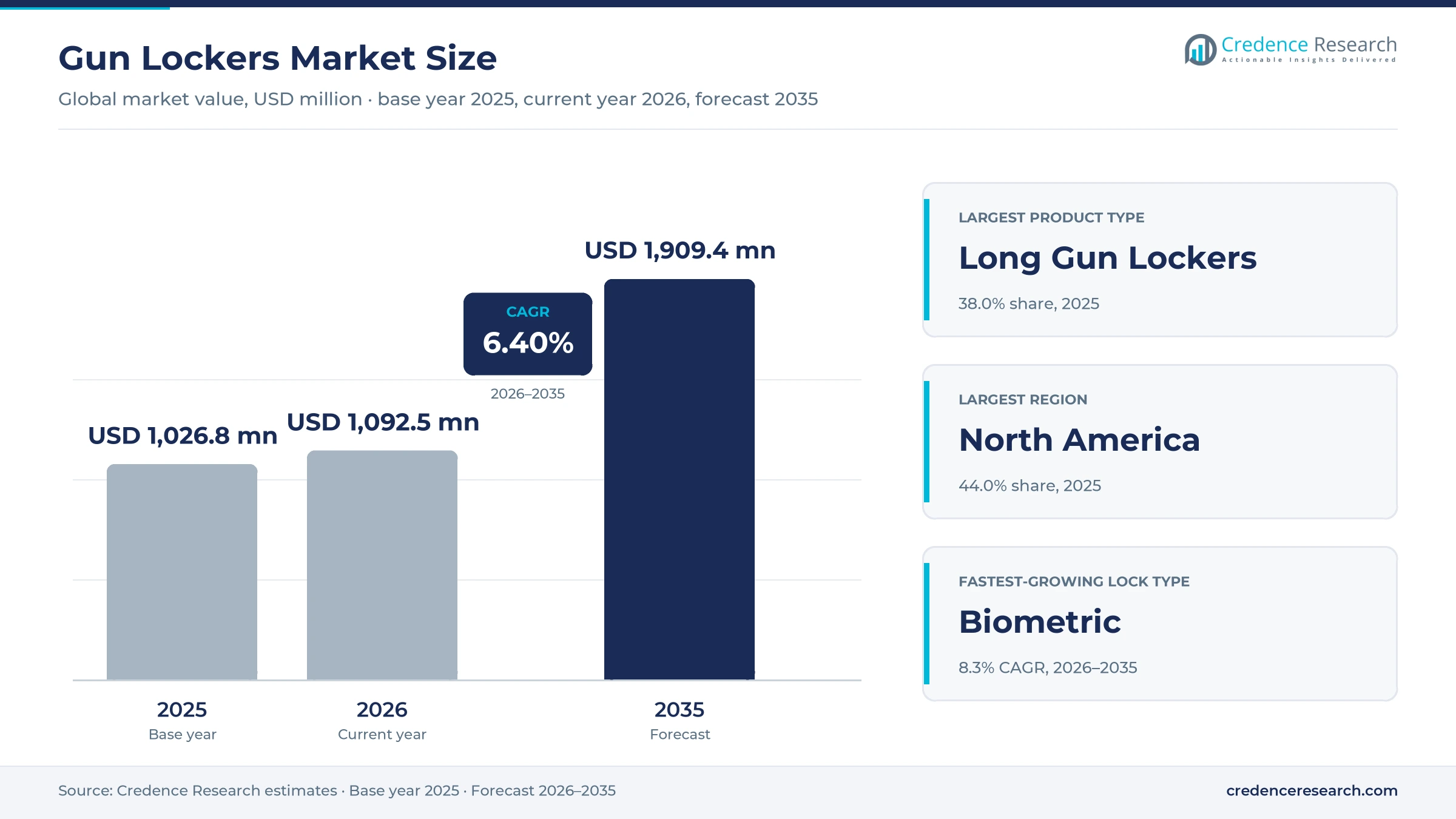
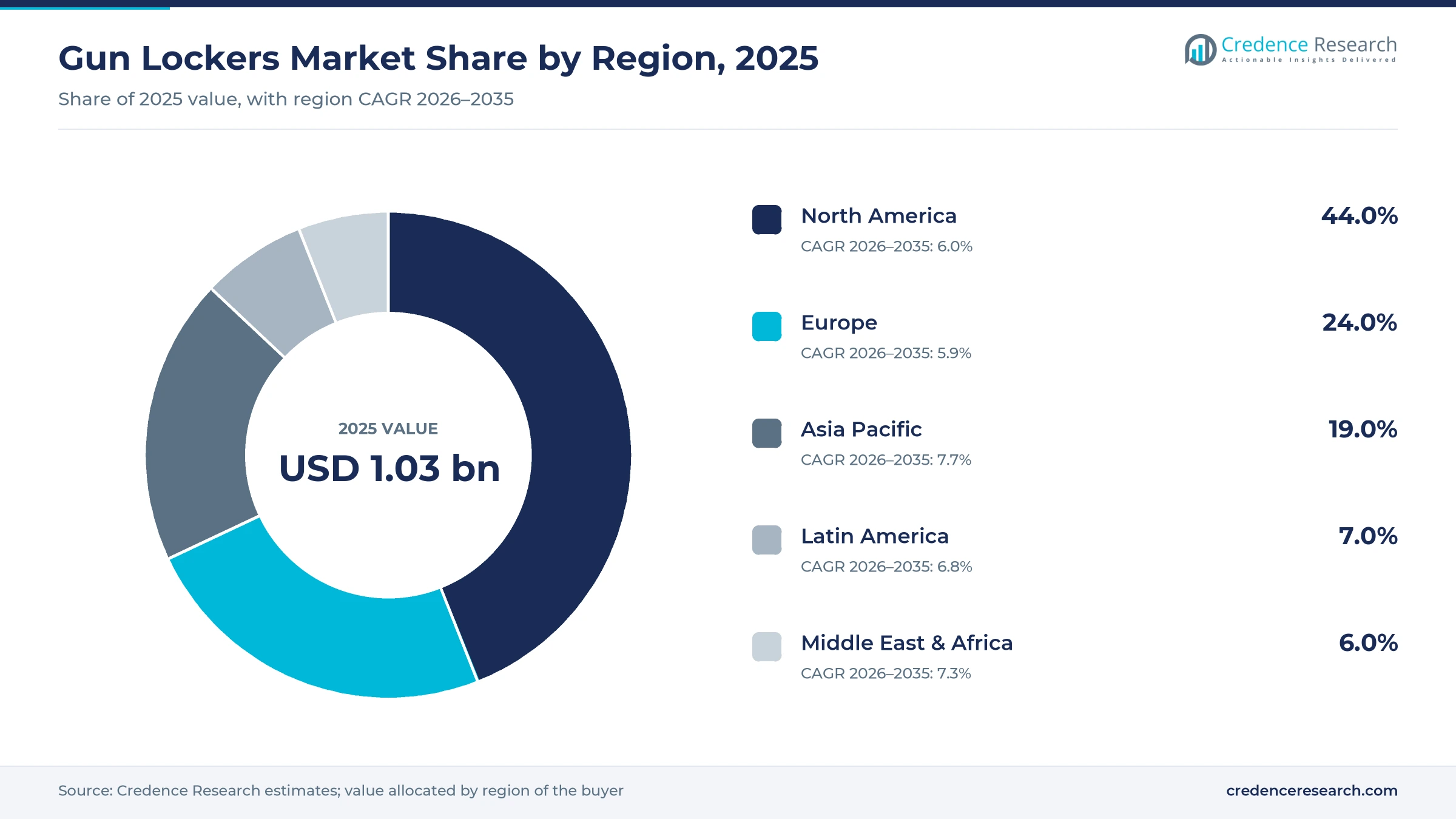
The global gun lockers market was valued at USD 1.03 billion in 2025 and is projected to increase from USD 1.09 billion in 2026 to USD 1.91 billion by 2035, registering a CAGR of 6.40% during 2026–2035. Demand comes from households that must meet secure storage laws, police departments that need an auditable record of every weapon issue, and military units that buy containers to federal specifications. North America held the largest regional share, 44.0% in 2025, because the United States pairs the largest civilian buyer base with a growing list of state storage mandates. Asia Pacific is the fastest-growing region at 7.7% a year, supported mainly by police and defense armory procurement, even as Australia's buyback reduces its civilian firearm stock. The most important commercial change is the move from key-locked steel cabinets toward electronic and biometric access with activity logs, which raises the value of each unit even as retail firearm sales cool. Higher steel input costs remain the main restraint for value brands.
Lockers win on access control and price, not fire rating
The market counts steel, wood and composite lockers, cabinets and wall racks built to hold long guns or handguns behind a mechanical, electronic or biometric lock, together with entry and mid-range gun safes marketed for firearm storage. Households buy them through sporting goods chains, farm stores and online marketplaces, while agencies buy configured armory systems through integrators and government supply contracts. Retail units sell at listed shelf prices, whereas police and military installations are quoted project by project.
Walk-in vault rooms, vault doors, general home safes without firearm fittings and stand-alone cable locks fall outside the count. The value chain runs from coil steel and lock modules through fabrication and assembly to retail delivery or integrator installation, and smart lockers add access-control software that agencies use for audit reports.
Gun Lockers Market Insights
- The gun lockers market reaches USD 1.91 billion by 2035 from USD 1.03 billion in 2025, growing at a 6.40% CAGR as storage mandates and audited police armories lift value per unit.
- North America held 44.0% of 2025 value, supported by U.S. state secure storage laws and Canada's 2.46 million licensed possession and acquisition holders.
- Long Gun Lockers led product types with 38.0% in 2025, while Biometric locks grow fastest at 8.3% a year to 2035.
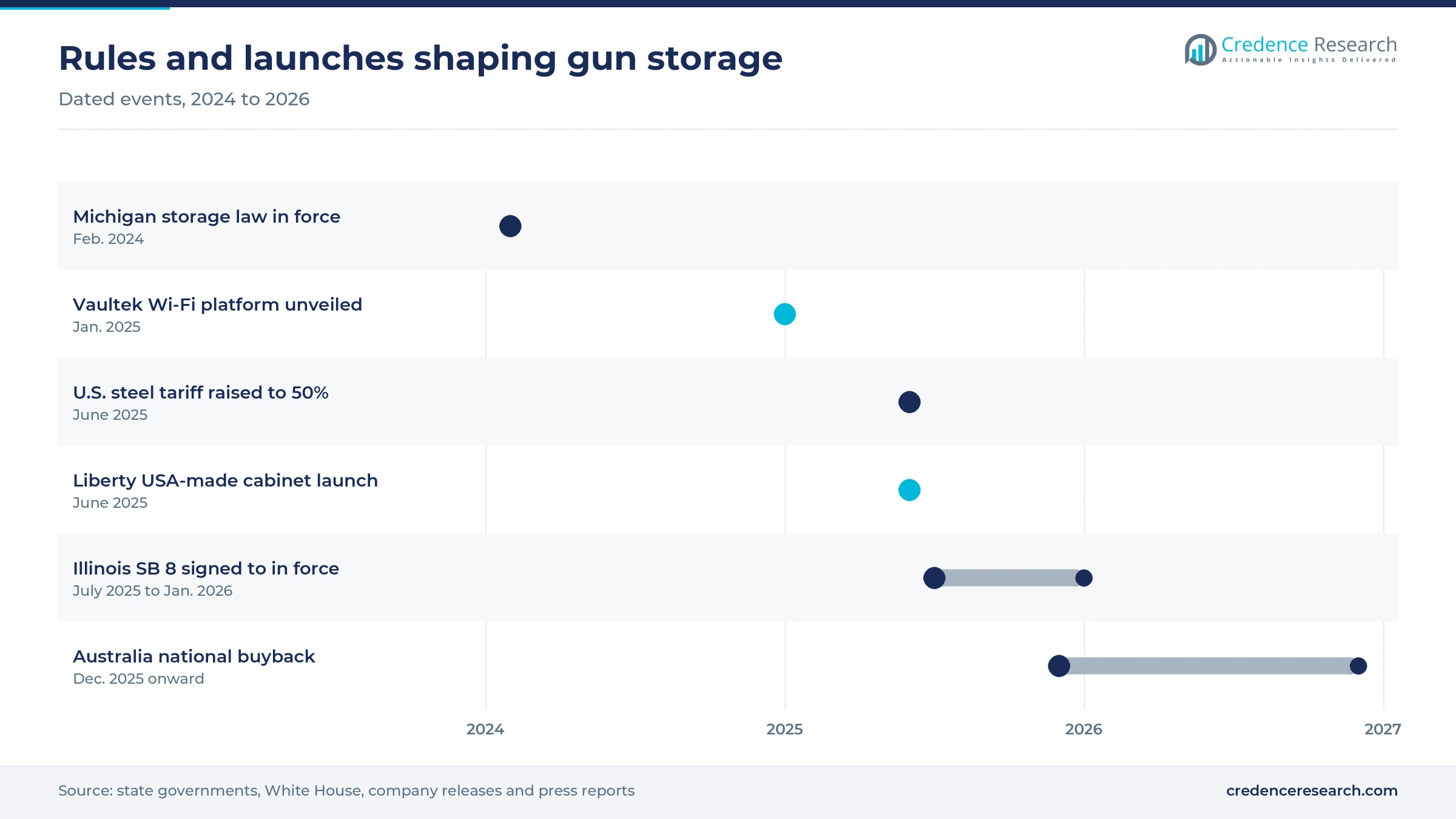
- Illinois began requiring locked storage where a minor may gain access on Jan. 1, 2026, extending compliance-driven buying to another large state.
- The 50% U.S. steel tariff in force since June 4, 2025, favors domestic fabricators such as Liberty Safe over importers of low-cost cabinets.
Long gun units lead while biometric and police lockers grow
Long gun units hold volume as handgun lockers gain share
Based on product type, the market is categorized into long gun lockers, handgun lockers, firearm cabinets, gun wall racks and others. Long Gun Lockers led with 38.0% of 2025 value because rifles and shotguns make up most hunting and sport shooting inventories, and England and Wales alone had 1,300,223 shotguns on certificate at March 31, 2026, according to the Home Office. Handgun Lockers grow fastest at 7.5% a year as compact quick-access units follow handgun ownership, and pistols made up 4,025,829 of the 9,474,540 firearms made in the United States in 2024, according to the ATF. Wall racks remain an armory product sold mainly with configured police and military systems.
Mechanical locks lead on cost while biometrics grow fastest
Based on lock type, the market is categorized into mechanical, electronic, biometric and others. Mechanical locks led with 46.0% of 2025 value because entry cabinets compete on price, and Liberty Safe fitted a simple key lock to the USA-made 14-gun and 18-gun cabinets it launched in June 2025. Biometric locks grow fastest at 8.3% a year as quick-access buyers pay for fingerprint entry, and Vaultek lists an RS slider safe whose scanner stores up to 80 fingerprints and logs every opening through Wi-Fi. Electronic keypads sit between the two on cost and convenience.
Households dominate value as police lockers grow fastest
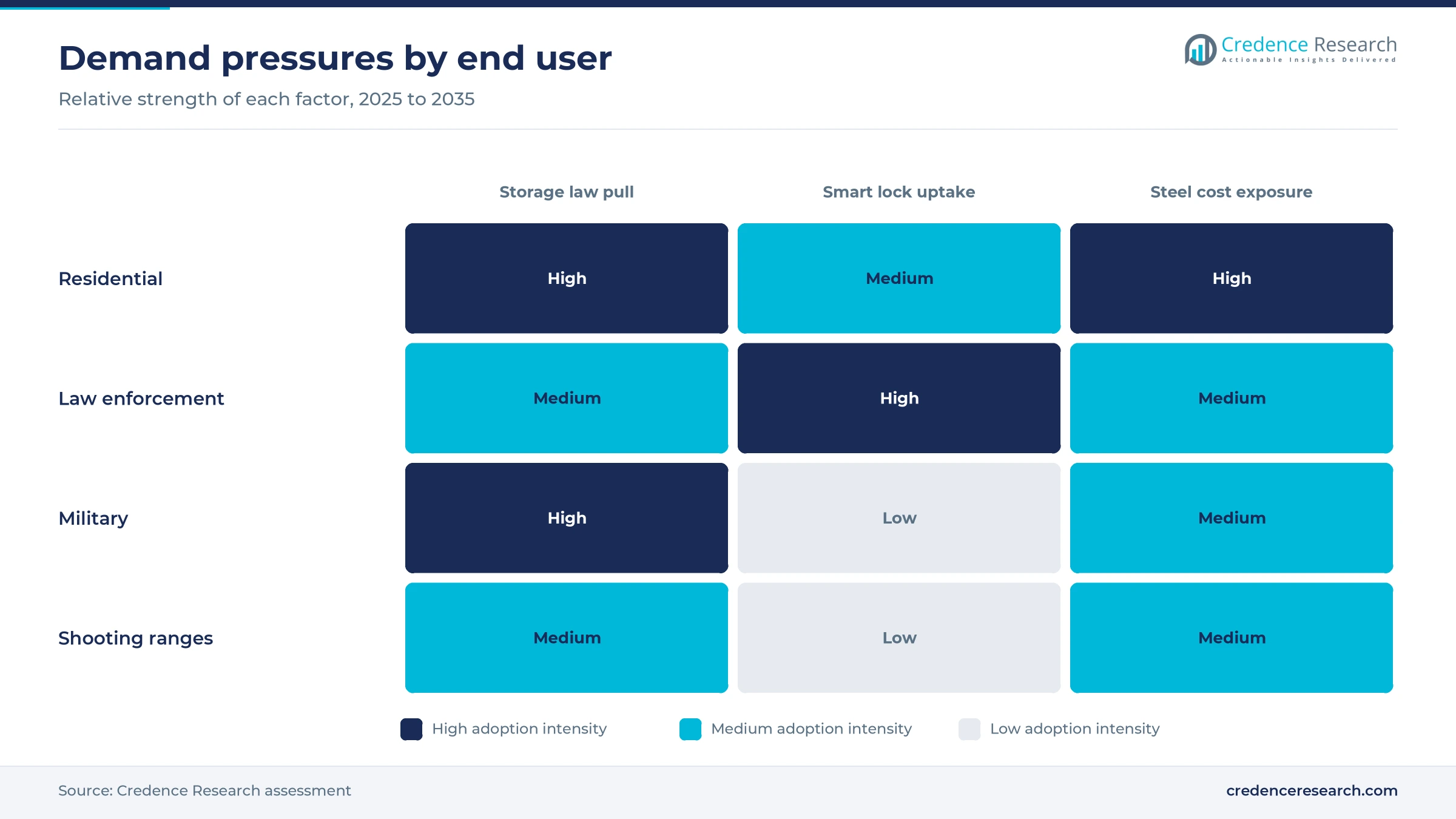
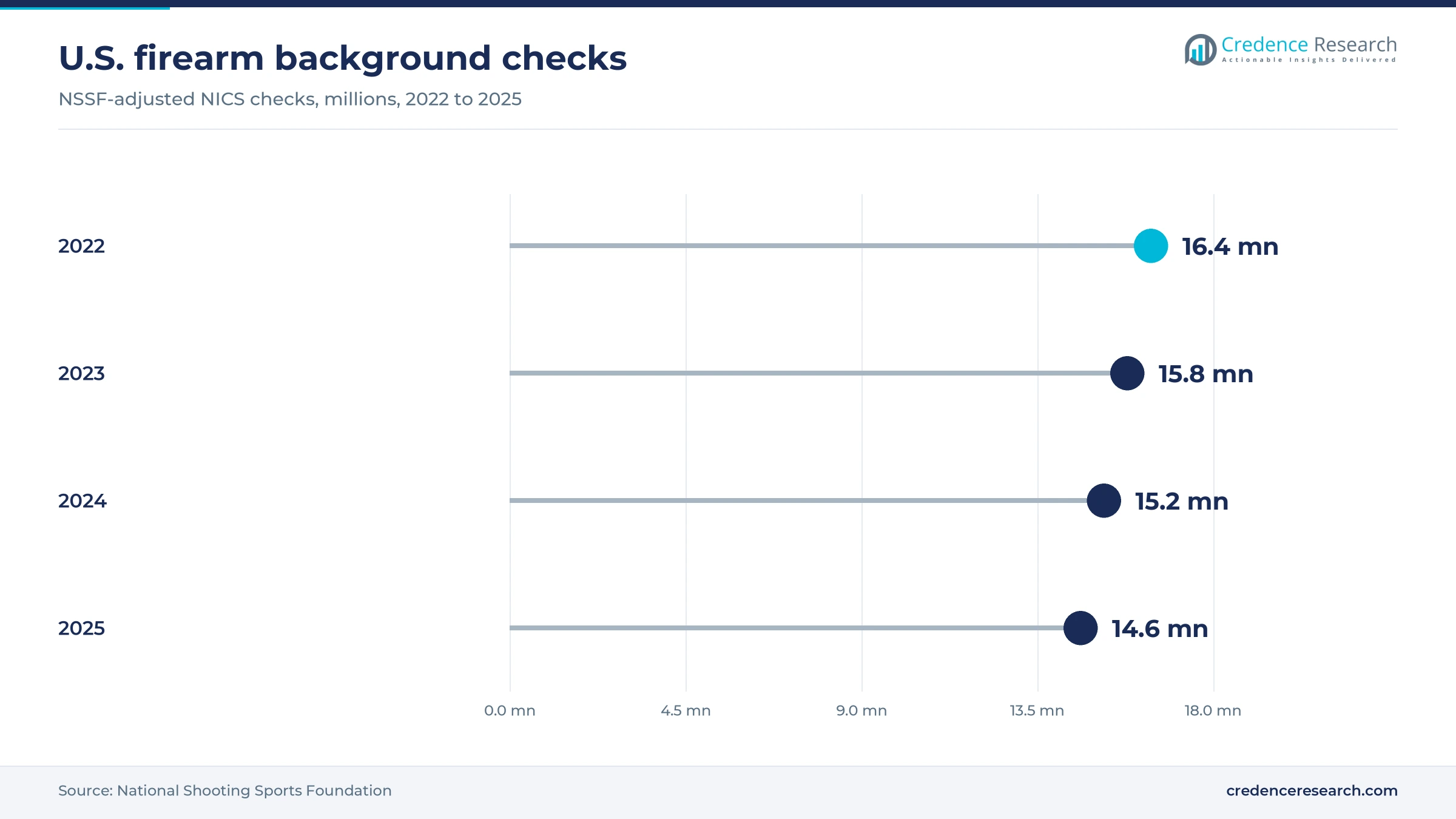
Based on end user, the market is categorized into residential, law enforcement, military, shooting ranges and others. Residential buyers led with 52.0% of 2025 value because household purchases track retail gun sales, and NSSF-adjusted background checks still totaled 14,612,314 in 2025 despite a 4.1% decline. Law Enforcement grows fastest at 7.1% a year as departments replace staffed armory windows with audited lockers, and Traka showed lockers with automated tracking, curfew alerts and fault logging at SHOT Show in January 2025. Shooting ranges buy rental and member storage in smaller lots for club use.
Dealer and store networks still move most heavy units
Based on distribution channel, the market is categorized into offline and online. Offline sales led with 71.0% of 2025 value because heavy steel units need freight handling, and Tractor Supply states that it delivers gun safes only to a ground-level spot outside the home. Liberty Safe added 25 dealer locations in 2025 after more than 40 in 2024, which keeps showroom selling central. Online sales grow fastest at 7.4% a year as ready-to-assemble cabinets and compact biometric safes ship by parcel through brand stores and retailer websites.
| Segment Group | Leading Sub-segment | Share, 2025 | Fastest-growing Sub-segment | CAGR, 2026–2035 |
|---|---|---|---|---|
| By Product Type | Long Gun Lockers | 38.0% | Handgun Lockers | 7.5% |
| By Lock Type | Mechanical | 46.0% | Biometric | 8.3% |
| By End User | Residential | 52.0% | Law Enforcement | 7.1% |
| By Distribution Channel | Offline | 71.0% | Online | 7.4% |
Shelf prices run from under USD 100 to over USD 1,000
Retail pricing steps up with steel gauge, capacity and lock technology rather than with brand alone. A thin-gauge eight-gun cabinet sells below USD 100 on promotion, a domestic 14-gauge cabinet costs about four times as much, and a fire-rated electronic safe or a connected biometric unit crosses USD 800. Steel tariffs and freight push the entry tier up first because those units carry the thinnest margins. Agency armory systems are quoted per project, with software and installation included, so integrators earn more per compartment than retail brands earn per cabinet.
| Offer or segment | Typical price or fee | Basis |
|---|---|---|
| Stack-On 8-gun steel security cabinet | USD 89.97 sale, USD 119.99 regular | Academy Sports + Outdoors listing, Nov. 2026 |
| Liberty Safe USA-made cabinet, 14-gun and 18-gun | USD 359 and USD 399 | Liberty Safe launch, June 2025 |
| Cannon 42 long gun electronic safe, 60-minute fire rating | USD 799.99 | Tractor Supply listing, Nov. 2026 |
| Vaultek RS slider biometric Wi-Fi safe | USD 1,199.99 | Sig Sauer online store listing, Nov. 2026 |
Request a Free Sample
Fill in your details and we'll send you a free sample report.
- Sample data tables & charts
- Research methodology
Storage laws, licensing rules and armory audits lift demand
State storage mandates turn lockers into compliance purchases
Secure storage laws convert a discretionary purchase into a legal duty, which pulls first-time owners and families with children toward locked cabinets rather than closets or loose cable locks. Everytown's January 2026 ranking counts 26 states with secure storage or child access prevention laws, and the list keeps lengthening. Michigan's law took effect on Feb. 13, 2024, according to the Michigan Department of Health and Human Services, and New Mexico Gov. Michelle Lujan Grisham signed the Bennie Hargrove Gun Safety Act requiring safe storage on March 14, 2023. Illinois Senate Bill 8, signed in July 2025, has required a locked container where a minor may gain access since Jan. 1, 2026. Each statute widens the pool of compliance buyers, which favors makers of low-cost cabinets listed as approved safety devices.
Police agencies move armories to firearm management lockers
Law enforcement demand is moving from plain steel racks to audited firearm management lockers as agencies fund police modernization programs, because a missing duty firearm creates liability that a paper sign-out sheet cannot defend. A June 2025 ASIS Security Management article describes lockers that tie each compartment to badge, PIN or biometric credentials and log RFID-tagged weapons automatically, which frees the officer who previously staffed the armory window. Traka showed tracked lockers with curfew alerts and fault logging to agency buyers at SHOT Show in January 2025, and Precision Locker Company lists a new 8-door pistol locker for issue weapons. Law enforcement demand grows at 7.1% a year, the fastest end-user pace. Spending therefore shifts toward integrators with software and service contracts, and makers of commodity steel lockers must add electronic access or partner with them.
Licensing rules abroad attach storage duties to every holder
Outside the United States, a firearm license usually comes with storage conditions, so the licensed population sets a floor for locker demand. Article 7 of EU Directive 2021/555 requires member states to set rules for proper storage in a secure manner and to keep firearms and ammunition from being readily accessible together. Canada had 2,458,677 valid possession and acquisition licenses at Dec. 31, 2025, according to the RCMP, and South Africa's Firearms Control Regulations point owners to safes meeting SABS 953-1 or 953-2. Because a new license or a police inspection often triggers a certified storage purchase, stable license counts sustain replacement and upgrade demand. Makers holding national test approvals in each country gain the most from this regulated, repeat-purchase base.
Military armories buy to fixed federal container specifications
Defense buyers procure weapons storage against federal specifications, which creates steady, specification-locked demand that commercial cabinets cannot address. The Navy's DoD Lock Program states that GSA Class 5 weapons containers are built to Federal Specification AA-C-2859 and can hold up to 360 weapons in drawer layouts. The same program requires GSA-approved security containers to be bought through GSA Global Supply, which concentrates orders among qualified suppliers. Spacesaver Corporation developed a TriCon-based weapons shipping container with the U.S. Navy for storing and moving small arms and gear. Qualification costs keep new entrants out, so listed suppliers sell on compliance rather than on price, and defense budgets set the pace of this demand.
Connected safes, domestic steel and armory retrofits
Connected safes shift home storage toward app-based monitoring
Residential suppliers are shifting toward Wi-Fi safes that send alerts and keep activity histories, to address owners who want proof that a stored handgun stayed locked while they were away. Vaultek introduced its Vaultek Intelligent Safe Network, an all-new Wi-Fi platform, at SHOT Show in January 2025 and said its RS Slider Series would launch in spring 2025. The RS slider scanner stores up to 80 fingerprints and logs each opening, which suits shared households. Hornady lists VEXIS vein-scanning safes beside its RFID-based RAPiD line, which widens the choice of biometric access. This shift creates openings for smart lock module and app suppliers across quick-access handgun storage, although battery dependence and data privacy remain buyer concerns that brands must answer with mechanical overrides.
Domestic fabrication becomes a selling point after steel tariffs
U.S. brands are shifting toward American-made claims to address both tariff costs and buyer preference among hunters and sport shooters. The Section 232 tariff on steel imports rose from 25% to 50% on June 4, 2025, raising the landed cost of imported cabinets and steel coil. Liberty Safe said the cabinets it launched in June 2025 are engineered and manufactured entirely in the United States at its Payson, Utah, plant. SecureIt Gun Storage and Cannon both list products as California-approved firearm safety devices, which adds certification to origin as a shelf claim. Domestic fabricators gain pricing room from this shift, while importers of thin-gauge cabinets must either absorb costs or reprice entry models.
Police interview rooms and booking areas need short-term lockers
A clear opening sits in temporary handgun storage at points where officers must disarm, such as interview rooms, booking areas and courthouses. Spacesaver Corporation markets configurable wall-mounted handgun lockers for interview rooms and common areas, and Precision Locker Company offers its 8-door pistol locker for surface or recessed mounting at such points. Handgun Lockers grow fastest at 7.5% a year among product types, because each facility needs several small units. A June 2025 ASIS Security Management article adds that distributed long gun lockers can speed weapon access during a campus shooter response. Suppliers that pair small multi-door units with access logs can sell into every facility a department runs, giving buyers a measurable cut in unsecured weapons and ammunition at transfer points.
Lock replacement rules open a retrofit market in armories
Military and federal armories present a retrofit opportunity because existing containers must move to newer lock standards when old locks fail. The Navy's DoD Lock Program states that new GSA-approved weapons containers must use FF-L-2937 mechanical locks, while existing containers may keep UL 768 Group 1 locks only until they fail or need replacement. The program also lists Class 5-W drawer containers made to Federal Specification AA-F-358K for weapons storage. Suppliers and locksmith contractors qualified on these specifications can win steady replacement orders across installations, and defense buyers gain lower risk of an armory failing inspection over a worn lock.
Steel tariffs, softer gun sales and cheap locks weigh
Steel tariffs squeeze value cabinet makers
Steel is the largest material input in most lockers, so the 50% U.S. tariff in force since June 4, 2025, raises costs quickly for brands that import finished cabinets or coil. Value models such as the Stack-On 8-gun cabinet, listed at USD 89.97, leave little margin to absorb that increase. Importers and big-box private labels are most exposed, while domestic plants may also see local steel prices rise behind the tariff. Suppliers mitigate by thinning gauge, raising entry prices or shifting mix toward electronic models.
Cooling gun sales thin the first-purchase pool
Locker demand from new owners follows firearm sales, and NSSF-adjusted background checks fell 4.1% to 14,612,314 in 2025 from 15,239,011 in 2024. Fewer first-time buyers mean fewer entry cabinet sales at sporting chains and farm stores, where volume is highest. Retailers holding heavy inventory are most exposed, because steel units are costly to store and ship. Brands with upgrade paths, such as larger capacity or biometric models for existing owners, are better placed to hold revenue.
Australia's buyback will shrink the civilian stock
Australia announced a national gun buyback on Dec. 19, 2025, after the Bondi Beach attack, and Prime Minister Anthony Albanese said he expects hundreds of thousands of firearms to be collected from a stock of more than four million, according to Al Jazeera. A smaller civilian stock reduces replacement demand for home cabinets in a major Asia Pacific market. Local retailers and importers selling to hunters and farmers are most exposed. Tighter rules could partly offset the loss if storage enforcement rises.
Free cable locks substitute at the bottom of the market
Free and low-cost cable locks satisfy basic storage rules for many owners, which limits trading up to cabinets. Project ChildSafe says it has distributed more than 41 million safety kits with cable-style gun locks through over 15,000 law enforcement agencies, and Michigan reminded families about free gun locks in February 2025. Entry cabinet makers are most exposed where a cable lock meets the law. Brands respond by stressing theft resistance and quick access that a cable lock cannot provide.
North America leads while Asia Pacific grows fastest
| Region | Value, 2025 (USD billion) | Share, 2025 | CAGR, 2026–2035 |
|---|---|---|---|
| North America | 0.45 | 44.0% | 6.0% |
| Europe | 0.25 | 24.0% | 5.8% |
| Asia Pacific | 0.20 | 19.0% | 7.7% |
| Latin America | 0.07 | 7.0% | 6.8% |
| Middle East & Africa | 0.06 | 6.0% | 7.2% |
North America leads on civilian volume and state mandates
North America held 44.0% of 2025 value and grows at 6.0% a year, the largest base because U.S. household firearm ownership remains broad, with 42% of Americans telling Gallup in October 2025 that a gun is kept in their home, down from 48% in 2024. Canada adds a regulated market, where 1,253,010 restricted or prohibited firearms were registered at the end of 2025, according to the RCMP. Domestic fabrication, dense dealer networks and state storage laws keep the region ahead, although softer gun sales slow unit growth.
Europe grows on licensing rules despite fewer certificates
Europe held 24.0% of 2025 value and grows at 5.8% a year, the slowest pace because license numbers are stable or falling. England and Wales had 140,257 firearm certificates and 457,340 shotgun certificates on issue at March 31, 2026, down 3% and 5% in a year, according to the Home Office. The EU storage duty noted above keeps certified cabinets mandatory for remaining holders, and BURG-WÄCHTER sells gun cabinets alongside its safe range. Replacement and upgrade purchases by existing holders, not new owners, carry demand.
Asia Pacific grows fastest on agency procurement
Asia Pacific held 19.0% of 2025 value and grows fastest at 7.7% a year, as police and defense armory spending rather than civilian ownership drives most purchases. India's Modernisation of Police Forces umbrella scheme carries a central outlay of Rs 26,275 crore for 2021-22 to 2025-26, according to the Press Information Bureau in February 2022, although the release does not say how much of it buys weapons storage. Australia's buyback announced in December 2025 will shrink a civilian stock of more than four million firearms. Because armory shares of police budgets are not disclosed, this growth rate rests on Credence Research procurement assumptions.
Latin America builds on Brazil's registered firearm base
Latin America held 7.0% of 2025 value and grows at 6.8% a year. Brazil's Federal Police Sinarm system holds registrations for about three million weapons, according to Correio Braziliense in December 2024, and new hunter, sport shooter and collector authorizations resumed in January 2024 after a suspension. Registered owners keep firearms at declared addresses, which supports cabinet sales through gun shops. Import duties and currency swings keep imported branded lockers expensive, which favors local metal fabricators.
Middle East & Africa rely on certified safes and defense buyers
Middle East & Africa held 6.0% of 2025 value and grows at 7.2% a year. South Africa's Firearms Control Regulations, noted above, specify safes meeting SABS 953-1 or 953-2, which channels civilian demand to certified products and local safe makers. Gulf defense and police forces buy armory systems through tenders that are rarely published, so the regional estimate leans on Credence Research assumptions. Higher growth reflects small base effects and security force expansion rather than civilian ownership.
Launches, dealer growth and new storage rules, 2025 to 2026
| Development | Status and market relevance |
|---|---|
| In January 2025, Vaultek introduced its Vaultek Intelligent Safe Network Wi-Fi platform at SHOT Show and said its RS Slider Series would launch in spring 2025. | Product announcement followed by a commercial launch; the RS slider now sells through Vaultek and Sig Sauer. |
| In June 2025, Liberty Safe launched USA-made 14-gun and 18-gun cabinets priced at USD 359 and USD 399, built at its Payson, Utah, plant. | Operational launch; gives Liberty a tariff-insulated entry product against imported cabinets. |
| In July 2025, Illinois enacted Senate Bill 8, which requires firearms to be kept in a locked container where a minor may gain access, effective Jan. 1, 2026. | Law signed and now in force; adds a large state to the compliance-driven buyer base. |
| In December 2025, Australia announced a national gun buyback after the Bondi Beach attack, with states and territories to collect and pay for surrendered firearms. | Government plan announced; collection runs through 2026 and reduces the civilian stock. |
| In December 2025, Liberty Safe said it had added 25 new dealer locations during 2025, following more than 40 additions in 2024. | Completed expansion; strengthens showroom coverage for heavy, freight-delivered units. |
Access control, not steel thickness, now separates products
- Biometric readers store fingerprint or vein templates so an authorized owner can open a handgun locker in seconds without a code.
- RFID tags and readers identify both the user and the tagged weapon, letting agency lockers log each removal and return automatically.
- Wi-Fi connectivity sends opening alerts and activity histories to a phone or a central console, which agencies use for audits.
- Steel gauge and bolt design still set pry and drill resistance, with 14-gauge bodies and multi-point bolts marking the step above entry cabinets.
Need a Custom Version of This Report?
Tailor the scope, geography, or segments to your exact requirements.
- Custom geography or segment scope
- Direct access to our analyst team
Retail brands and armory integrators compete apart
Competition splits along buyer lines, with retail brands and agency suppliers rarely meeting in the same tender. In retail, Liberty Safe and Cannon Security Products, which groups Cannon Safe, Stack-On and GunVault, compete on capacity, steel gauge and dealer reach, while Vaultek, Hornady Security and SentrySafe compete on quick-access biometric and RFID entry for handguns. Rhino Metals, Gardall Safe Corporation, Homak Manufacturing and SecureIt Gun Storage hold positions in heavier safes, cabinets and modular storage. In agency markets, Spacesaver Corporation, Traka and Precision Locker Company sell configured armory and pistol lockers, where specification approval and audit software matter more than shelf price. BURG-WÄCHTER represents the certified gun cabinet segment for European license holders. Domestic fabrication has become a competitive lever since the 2025 steel tariff increase, and access-control software is the main route to higher margins for agency suppliers.
Two supply chains serve households and agencies
The supply side splits into two groups that rarely compete head to head. Retail brands such as Liberty Safe, Cannon Security Products, Vaultek and Hornady sell standardized units through dealers, farm stores and online shops, where shelf space, freight cost and brand trust decide share. Agency suppliers such as Spacesaver, Traka and Precision Locker sell configured systems through integrators, where specification approval, software and service contracts create barriers. Retail margins sit with brands that own fabrication, while agency margins sit in software, installation and multi-year support rather than in the steel itself.
Companies profiled and their roles in this market
| Company | Type | Role in the market |
|---|---|---|
| Liberty Safe | Full-line safe maker | U.S.-built gun safes and cabinets sold through a national dealer network |
| Cannon Security Products (Cannon Safe, Stack-On, GunVault) | Multi-brand supplier | Gun safes, steel cabinets and handgun vaults across retail price tiers |
| Vaultek | Smart safe specialist | Biometric and Wi-Fi handgun safes with app-based activity logs |
| Hornady Security | Quick-access specialist | RFID RAPiD safes and VEXIS vein-scanning safes for handgun storage |
| Spacesaver Corporation | Armory systems maker | Weapons racks, wall-mounted handgun lockers and armory storage for military and police |
| Traka (ASSA ABLOY) | Intelligent locker supplier | Tracked weapons lockers with credential access and audit reporting for agencies |
| SentrySafe (Master Lock, Fortune Brands Innovations) | Safe maker | Gun safes and quick-access handgun safes sold through mass retail |
| Precision Locker Company | Law enforcement specialist | Pistol lockers, including multi-door units, for police facilities |
| SecureIt Gun Storage | Modular storage maker | Modular gun cabinets listed as California-approved firearm safety devices |
| Rhino Metals, Inc. | Safe manufacturer | Heavy-gauge gun safes for residential buyers |
| Gardall Safe Corporation | Safe manufacturer | Gun safes and security cabinets for homes and businesses |
| Homak Manufacturing | Cabinet manufacturer | Steel gun cabinets and security storage sold through retail channels |
| BURG-WÄCHTER | European safe maker | Gun cabinets and certified safes for European buyers |
Value per unit rises faster than the number of buyers
Credence Research's view is that value per unit will rise faster than the number of buyers through 2035. Retail firearm sales are cooling and some markets, such as Australia, will hold fewer civilian guns, yet storage laws, inspections and agency audits are pushing each purchase toward stronger, tracked and biometric units. Suppliers that own domestic fabrication or access-control software are best placed, because tariffs and liability concerns reward both. Value brands that depend on imported thin-gauge cabinets face the hardest decade, caught between cable locks below and certified cabinets above.
Estimates rest on the 2025 base and public storage data
The report uses 2025 as the base year, with 2026 as the first forecast year and 2035 as the last. The 2025 value starts from the earlier Credence Research estimate brought forward with its own growth rate and is checked against household ownership, retail price points and agency procurement data. Sources used are government statistics and regulations, licensing reports, industry association sales data, company product releases and retailer price listings. Regional, segment and scenario splits are Credence Research estimates, and no interviews or surveys were conducted.
Smart lockers and compliance buyers carry growth to 2035
The market is expected to grow from USD 1.09 billion in 2026 to USD 1.91 billion in 2035, with growth weighted toward biometric handgun lockers, online sales and agency systems rather than basic long gun cabinets. North America will remain the largest region, supported by state mandates and domestic fabrication, while Asia Pacific grows fastest on agency purchases. The forecast assumes no federal U.S. storage mandate, and a national rule would move demand toward the upside case. Steel prices and retail firearm sales are the two variables most likely to pull results below the base case.
Storage enforcement decides the range of 2035 outcomes
The outcome range depends mostly on how far storage rules spread and how quickly agencies replace manual armories. A weak case combines a further slide in retail firearm sales with steel costs that force price increases on entry units. The base case assumes steady state mandates and gradual smart locker adoption. A strong case needs more U.S. states and European regulators to tie storage to inspection, together with larger police and defense budgets for audited lockers.
| Scenario | CAGR, 2026–2035 | Value, 2035 | What has to hold |
|---|---|---|---|
| Downside | 4.9% | USD 1.68 billion | Retail gun sales keep falling and tariffs push entry cabinet prices beyond buyers |
| Base | 6.40% | USD 1.91 billion | State mandates hold steady and agencies adopt smart lockers gradually through 2035 |
| Upside | 7.6% | USD 2.11 billion | More storage laws with inspections and faster police armory upgrades across regions |
Frequently Asked Questions
How big is the gun lockers market?
What are firearm management lockers and who buys them?
Which region leads the gun lockers market?
Which lock type grows fastest?
How do storage laws affect demand?
How did steel tariffs change the market?
What do gun lockers cost?
Who are the main companies in the market?
Table of Content
Chapter 1 Market Segmentation
- 1.1 Segmentation Framework
- 1.1.1 Product and Service Classification
- 1.1.2 Application and End-Use Classification
- 1.1.3 Technology and Solution Classification
- 1.1.4 Customer and Distribution Channel Classification
- 1.1.5 Geographic Segmentation
- 1.1.6 Market Segment Definitions and Boundaries
- 1.2 By Product Type
- 1.2.1 Long Gun Lockers
- 1.2.2 Handgun Lockers
- 1.2.3 Firearm Cabinets
- 1.2.4 Gun Wall Racks
- 1.2.5 Others
- 1.3 By Lock Type
- 1.3.1 Mechanical
- 1.3.2 Electronic
- 1.3.3 Biometric
- 1.3.4 Others
- 1.4 By End User
- 1.4.1 Residential
- 1.4.2 Law Enforcement
- 1.4.3 Military
- 1.4.4 Shooting Ranges
- 1.4.5 Others
Chapter 2 Introduction
- 2.1 Report Objectives and Scope
- 2.2 Product Definition and Industry Terminology
- 2.3 Market Inclusions and Exclusions
- 2.4 Research Process
- 2.4.1 Primary Research and Expert Interviews
- 2.4.2 Secondary Research and Source Review
- 2.4.3 Top-Down and Bottom-Up Estimation
- 2.4.4 Data Triangulation and Verification
- 2.5 Market Size Measurement Basis
- 2.5.1 2025: USD 1.03 billion → 2035: USD 1.91 billion
- 2.6 Historical and Forecast Reference Periods
- 2.6.1 Historical Period: 2018-2025
- 2.6.2 Base Year: 2025
- 2.6.3 Forecast Period: 2025-2035
- 2.7 Research Assumptions and Limitations
Chapter 3 Executive Summary
- 3.1 Market Snapshot and Key Findings
- 3.2 Base-Year Market Size, 2025
- 3.3 Forecast Market Size, 2035
- 3.4 Revenue and Volume Growth Outlook
- 3.5 Key Demand and Supply Indicators
- 3.6 Leading Market Segments
- 3.7 Fastest-Growing Market Opportunities
- 3.8 Regional Performance Highlights
- 3.9 Technology and Industry Transformation
- 3.10 Competitive Landscape Summary
- 3.11 Analyst View and Strategic Implications
Chapter 4 Global Gun Lockers Market Trends and Developments
- 4.1 Historical Industry Development, 2018-2025
- 4.2 Recent Market Trends and Developments
- 4.3 Demand and Customer Behavior Trends
- 4.4 Technology and Product Innovation
- 4.5 Artificial Intelligence, Automation and Digitalization
- 4.6 Local Manufacturing and Supply Chain Realignment
- 4.7 Industry Partnerships, Mergers and Acquisitions
- 4.8 Sustainability and Circular Economy Developments
- 4.9 Government and Private Sector Investment Trends
- 4.10 Emerging Business Models and Commercialization
- 4.11 Industry Developments and Announcements
Chapter 5 Global Gun Lockers Market Production, Supply and Demand Analysis
- 5.1 Demand Trend and Consumption Analysis, 2018-2025
- 5.2 Demand Forecast, 2025-2035
- 5.3 Production and Output Trend, 2018-2025
- 5.4 Production and Output Forecast, 2025-2035
- 5.5 Installed Capacity and Capacity Utilization
- 5.6 Company-Wise Production Plants and Statistics
- 5.6.1 Installed Production Capacity
- 5.6.2 Actual Production
- 5.6.3 Planned Capacity and Expansion Targets
- 5.7 Supply Chain Structure and Procurement Trends
- 5.8 Supply-Demand Gap and Bottlenecks
- 5.9 Import Dependence and Sourcing Structure
- 5.10 Contract Manufacturing and Outsourcing
- 5.11 Regional Supply and Demand Concentration
Chapter 6 Global Gun Lockers Market Pricing Analysis
- 6.1 Pricing Structure and Measurement
- 6.2 Historical Pricing Trends, 2018-2025
- 6.3 Pricing Outlook, 2025-2035
- 6.4 Average Selling Price and Unit Economics
- 6.5 Pricing by Product and Market Segment
- 6.6 Geographic Pricing Differences
- 6.7 Key Input, Energy, Labor and Logistics Costs
- 6.8 Contract Pricing and Purchasing Models
- 6.9 Pricing Sensitivity and Competitive Positioning
- 6.10 Price, Margin and Profitability Implications
Chapter 7 Global Gun Lockers Market Dynamics
- 7.1 Market Growth Drivers
- 7.1.1 Demand-Side Drivers
- 7.1.2 Technology and Innovation Drivers
- 7.1.3 Infrastructure and Investment Drivers
- 7.1.4 Regulatory and Policy Drivers
- 7.2 Market Restraints
- 7.2.1 Cost and Affordability Constraints
- 7.2.2 Technology and Adoption Barriers
- 7.2.3 Supply Chain and Operational Constraints
- 7.3 Market Challenges
- 7.3.1 Competitive Pressure and Margin Erosion
- 7.3.2 Skills, Infrastructure and Implementation Gaps
- 7.4 Emerging Market Opportunities
- 7.5 Market Dynamics Impact and Time-Horizon Assessment
Chapter 8 Global Gun Lockers Value Chain Analysis
- 8.1 Industry Value Chain Overview
- 8.2 Upstream Suppliers and Critical Inputs
- 8.3 Technology and Component Providers
- 8.4 Manufacturing or Service Delivery
- 8.5 Distribution, Channel Partners and Integrators
- 8.6 Downstream Applications and End Users
- 8.7 Value Addition and Profit Pools
- 8.8 Vertical Integration and Outsourcing
- 8.9 Supplier Concentration and Risk
- 8.10 Supply Chain Localization and Resilience
Chapter 9 Global Gun Lockers Market Regulations and Policies
- 9.1 Relevant Laws, Standards and Compliance Frameworks
- 9.2 Product, Service, Safety and Quality Requirements
- 9.3 Government Policies, Incentives and Subsidies
- 9.4 Imports, Exports and Trade Barriers
- 9.5 Public Procurement and Local Content Requirements
- 9.6 Environmental and Sustainability Compliance
- 9.7 Upcoming Policy Changes and Market Implications
Chapter 10 Global Gun Lockers Market Hotspots and Opportunities
- 10.1 Market Opportunity Mapping and Growth Hotspots
- 10.2 High-Growth Applications and Customer Groups
- 10.3 Underserved Markets and White-Space Opportunities
- 10.4 Emerging Technology and Product Opportunities
- 10.5 New Capacity and Investment Hotspots
- 10.6 Market Entry and Expansion Opportunities
- 10.7 Distribution and Partnership Opportunities
- 10.8 Near-Term and Long-Term Commercial Potential
- 10.9 Opportunity Attractiveness and Execution Risks
Chapter 11 Global Gun Lockers Market Outlook, 2025-2035
- 11.1 Market Size and Analysis
- 11.1.1 Revenue (Market Measurement: 2025: USD 1.03 billion → 2035: USD 1.91 billion)
- 11.1.2 Market Volume and Quantity Sold
- 11.1.3 Historical Market Size, 2018-2025
- 11.1.4 Base-Year Market Size, 2025
- 11.2 Market Forecast, 2025-2035
- 11.2.1 Revenue Forecast to 2035
- 11.2.2 Volume Forecast to 2035
- 11.2.3 CAGR and Year-on-Year Growth
- 11.2.4 Incremental Revenue Opportunity
- 11.3 Forecast Assumptions and Scenario Analysis
- 11.3.1 Base-Case Forecast
- 11.3.2 Optimistic and Conservative Scenarios
- 11.3.3 Technology, Pricing and Policy Sensitivities
- 11.4 Market Attractiveness and Growth Outlook
Chapter 12 Global Gun Lockers Market Segmentation and Outlook
- 12.1 Segmentation Summary and Market Shares, 2025
- 12.2 Largest and Fastest-Growing Segments
- 12.3 By Product Type - Market Size and Forecast, 2025-2035
- 12.3.1 Segment Definition and Scope
- 12.3.2 Historical Market Size, 2018-2025
- 12.3.3 Revenue Forecast, 2025-2035
- 12.3.4 Volume Forecast, 2025-2035
- 12.3.5 Base-Year Market Share, 2025
- 12.3.6 Segment CAGR and Growth Drivers
- 12.3.7 Subsegment Market Size and Forecast
- 12.3.7.1 Long Gun Lockers
- 12.3.7.2 Handgun Lockers
- 12.3.7.3 Firearm Cabinets
- 12.3.7.4 Gun Wall Racks
- 12.3.7.5 Others
- 12.3.8 Subsegment Pricing and Adoption Trends
- 12.3.9 Leading Suppliers and Competition
- 12.3.10 Regional Demand and Opportunities
- 12.4 By Lock Type - Market Size and Forecast, 2025-2035
- 12.4.1 Segment Definition and Scope
- 12.4.2 Historical Market Size, 2018-2025
- 12.4.3 Revenue Forecast, 2025-2035
- 12.4.4 Volume Forecast, 2025-2035
- 12.4.5 Base-Year Market Share, 2025
- 12.4.6 Segment CAGR and Growth Drivers
- 12.4.7 Subsegment Market Size and Forecast
- 12.4.7.1 Mechanical
- 12.4.7.2 Electronic
- 12.4.7.3 Biometric
- 12.4.7.4 Others
- 12.4.8 Subsegment Pricing and Adoption Trends
- 12.4.9 Leading Suppliers and Competition
- 12.4.10 Regional Demand and Opportunities
- 12.5 By End User - Market Size and Forecast, 2025-2035
- 12.5.1 Segment Definition and Scope
- 12.5.2 Historical Market Size, 2018-2025
- 12.5.3 Revenue Forecast, 2025-2035
- 12.5.4 Volume Forecast, 2025-2035
- 12.5.5 Base-Year Market Share, 2025
- 12.5.6 Segment CAGR and Growth Drivers
- 12.5.7 Subsegment Market Size and Forecast
- 12.5.7.1 Residential
- 12.5.7.2 Law Enforcement
- 12.5.7.3 Military
- 12.5.7.4 Shooting Ranges
- 12.5.7.5 Others
- 12.5.8 Subsegment Pricing and Adoption Trends
- 12.5.9 Leading Suppliers and Competition
- 12.5.10 Regional Demand and Opportunities
- 12.6 Segment Growth Comparison
- 12.7 Segment Attractiveness and Priority Matrix
Chapter 13 Global Gun Lockers End-Use and Application Market Outlook
- 13.1 End-Use Industry and Customer Demand Structure
- 13.2 Leading Applications and Customer Groups
- 13.3 End-Use Market Size, Share and Forecast
- 13.4 Major End-Use Industry Deep Dives
- 13.4.1 Customer Requirements and Use Cases
- 13.4.2 Demand and Replacement Cycles
- 13.4.3 Technical and Regulatory Considerations
- 13.4.4 Purchasing and Procurement Models
- 13.4.5 Leading Vendors and Distribution Channels
- 13.4.6 Forecast and Commercial Opportunities
- 13.5 Emerging Applications and Cross-Segment Demand
- 13.6 End-Use Industry Investment Priorities
Chapter 14 Global Gun Lockers Geographic Market Outlook, 2025-2035
- 14.1 Regional Market Size and Share, 2025
- 14.2 Regional Market Forecast, 2025-2035
- 14.3 Regional Pricing, Production and Demand Differences
- 14.4 North America
- 14.4.1 United States
- 14.4.2 Canada
- 14.4.3 Mexico
- 14.5 Europe
- 14.5.1 Germany
- 14.5.2 France
- 14.5.3 Italy
- 14.5.4 United Kingdom
- 14.5.5 Spain
- 14.5.6 Poland
- 14.5.7 Russia
- 14.5.8 Netherlands
- 14.5.9 Belgium
- 14.5.10 Sweden
- 14.5.11 Denmark
- 14.5.12 Norway
- 14.5.13 Rest of Europe
- 14.6 Asia Pacific
- 14.6.1 China
- 14.6.2 India
- 14.6.3 Japan
- 14.6.4 South Korea
- 14.6.5 Thailand
- 14.6.6 Indonesia
- 14.6.7 Vietnam
- 14.6.8 Malaysia
- 14.6.9 Australia
- 14.6.10 Rest of Asia Pacific
- 14.7 Latin America
- 14.7.1 Brazil
- 14.7.2 Argentina
- 14.7.3 Colombia
- 14.7.4 Chile
- 14.7.5 Rest of Latin America
- 14.8 Middle East
- 14.8.1 Saudi Arabia
- 14.8.2 United Arab Emirates
- 14.8.3 Turkey
- 14.8.4 Israel
- 14.8.5 Iran
- 14.8.6 Rest of the Middle East
- 14.9 Africa
- 14.9.1 South Africa
- 14.9.2 Egypt
- 14.9.3 Nigeria
- 14.9.4 Morocco
- 14.9.5 Rest of Africa
- 14.10 Regional Investment, Policy and Supply Chain Differences
- 14.11 Regional Competitive Landscape
- 14.12 Geographic Growth Hotspots
Chapter 15 Global Gun Lockers Technology, Innovation and Sustainability Outlook
- 15.1 Technology Landscape and Maturity
- 15.2 Product, Process and Service Innovation
- 15.3 AI, Automation and Digital Tools in the Industry
- 15.4 Technology Adoption and Performance Benchmarking
- 15.5 Innovation Pipeline and R&D Investment
- 15.6 Patent and Intellectual Property Trends
- 15.7 Energy Efficiency and Resource Management
- 15.8 Sustainability, Recycling and Circularity
- 15.9 Technology Roadmap, 2025-2035
- 15.10 Risks of Obsolescence and Technology Substitution
Chapter 16 Global Gun Lockers Market Key Strategic Imperatives
- 16.1 Growth and Market Entry Priorities
- 16.2 High-Return Products and Segments
- 16.3 Pricing, Profitability and Cost Optimization
- 16.4 Technology Investment and Product Differentiation
- 16.5 Supply Chain Localization and Resilience
- 16.6 Distribution and Customer Acquisition
- 16.7 Partnership, Acquisition and Capacity Strategy
- 16.8 Regional Expansion Priorities
- 16.9 Short-, Medium- and Long-Term Actions
Chapter 17 Competition Outlook
- 17.1 Industry Competition Characteristics
- 17.2 Market Structure and Concentration
- 17.3 Market Share and Competitive Positioning, 2025
- 17.4 Company-Wise Revenue and Product Benchmarking
- 17.5 Production and Service Capacity Benchmarking
- 17.6 Technology, Pricing and Differentiation
- 17.7 Regional Footprint and Distribution Strength
- 17.8 Mergers, Acquisitions and Strategic Alliances
- 17.9 New Entrants and Competitive Threats
- 17.10 Porter's Five Forces and Industry Attractiveness
- 17.11 Competitive Outlook, 2025-2035
Chapter 18 Company Profiles
- 18.1 Company Coverage and Selection Criteria
- 18.2 Liberty Safe
- 18.2.1 Business Description
- 18.2.2 Company Ownership and Geographic Presence
- 18.2.3 Product and Service Portfolio
- 18.2.4 Manufacturing and Operating Footprint
- 18.2.5 Production Capacity and Expansion Plans
- 18.2.6 Financial Performance and Investment
- 18.2.7 Market Share and Competitive Position
- 18.2.8 Technology and Innovation Capabilities
- 18.2.9 Strategic Alliances or Partnerships
- 18.2.10 Recent Developments
- 18.2.11 Growth Strategy and Outlook
- 18.3 Cannon Security Products (Cannon Safe, Stack-On, GunVault)
- 18.4 Vaultek
- 18.5 Hornady Security
- 18.6 Spacesaver Corporation
- 18.7 Traka (ASSA ABLOY)
- 18.8 SentrySafe (Master Lock, Fortune Brands Innovations)
- 18.9 Precision Locker Company
- 18.10 SecureIt Gun Storage
- 18.11 Rhino Metals, Inc.
- 18.12 Gardall Safe Corporation
- 18.13 Homak Manufacturing
- 18.14 BURG-WÄCHTER
- 18.15 Other Relevant Market Participants
Note: Every listed company is profiled on the structure shown under the first company. The company list is preliminary and may change based on research findings, market developments, data availability and client requirements.
Chapter 19 Disclaimer
- 19.1 Research and Forecast Disclaimer
- 19.2 Data Source and Estimation Limitations
Note: The depth of individual sections depends on data availability for this market. Volume, capacity, trade and other unit-based metrics are included where applicable.