
Quick answer
Propane is not manufactured from scratch. It is recovered from natural gas or refinery streams, so a new propane plant is usually an LPG recovery and fractionation unit. One processing 40 MMSCFD of rich gas makes about 40,000 tonnes of propane a year plus butane and condensate. Fixed CapEx runs about USD 35–50 million in Asia, gross margin about 22–40% depending on the gas cost, and central-case payback about 5–8 years.
Viable where a rich gas stream, especially flared associated gas, can be secured on a long contract near LPG demand; weak where the plant must pay full market value for the gas it strips.
Propane plant: key highlights
| Parameter | Indicative value | Note |
|---|---|---|
| Plant capacity | 40,000 TPA propane | From 40 MMSCFD of rich gas over 330 days, with about 13,500 tonnes of butane and 320 barrels a day of condensate |
| Total CapEx | USD 35–50 million | Asian site; assumed USD 60–85 million at a U.S. or EU site; excludes working capital |
| Raw material share of operating cost | 72–76% | Value of the heat content stripped from the feed gas, paid back to the gas owner |
| Gross margin | 22–40% | Assumed propane at USD 500–650 per tonne and feed gas valued at USD 5.5–7.5 per MMBtu |
| Payback period | 5–8 years | Central case at 85% utilization, on CapEx plus working capital; a price squeeze can push it past 10 years |
| IRR | Available in report | Post-tax, 10-year model |
| Break-even | Available in report | Capacity utilization basis |
Ranges assume a greenfield 40 MMSCFD LPG recovery and fractionation plant making about 40,000 TPA of propane on 5 hectares at an Asian site, rich gas with about 6% propane, 85% utilization, 2026 prices, assumed propane at USD 500–650 per tonne and feed gas heat value at USD 5.5–7.5 per MMBtu. U.S. and EU costs are assumed multiples. The full report is customizable to any country.
What is propane?
Propane is a three-carbon hydrocarbon gas that turns liquid under modest pressure, which lets it be stored in steel tanks and shipped by truck, rail and pressurized or refrigerated ships. It is sold alone or blended with butane as liquefied petroleum gas, or LPG. Nobody synthesizes fuel propane from basic chemicals. It is separated from raw natural gas and crude oil, so a propane plant is really a recovery and fractionation unit.
Most supply comes from gas processing plants that chill rich gas to condense propane and heavier liquids, and the rest from refinery units such as crude distillation and fluid catalytic crackers. A small but growing share is renewable propane, made as a co-product when vegetable oils, used cooking oil and animal fats are hydrotreated into renewable diesel and jet fuel.
Commercial grades include HD-5, the U.S. specification for engine fuel with at least 90% propane, commercial propane for heating, autogas blends meeting EN 589 in Europe, and high-purity propane for petrochemicals and refrigerants. Liquefied propane falls under HS code 271112, while butanes sit under 271113. Buyers include households and restaurants, crop dryers, forklift and vehicle fleets, and propane dehydrogenation plants that turn it into propylene.
Propane market overview and global demand
Credence Research does not publish a standalone propane market size, but its liquefied petroleum gas market study covers the wider fuel, and physical data show the scale. World LPG supply rose by 11 million tonnes to more than 370 million tonnes in 2024, according to World Liquid Gas Association statistics. U.S. output alone rose to 111 million tonnes, and the U.S. supplied 43% of all LPG exports. Renewable LPG capacity reached about 480,000 tonnes, still a fraction of 1% of supply.
U.S. propane exports averaged 2 million barrels a day in the first half of 2026, up 11% from a year earlier, and hit a record 2.1 million barrels a day in April 2026, the U.S. Energy Information Administration reported. India and South Asia drove much of the gain as importers replaced disrupted Middle East cargoes, while tariffs cut U.S. shipments to China by 19% in the first half. The rise in seaborne volume also supports demand for LPG tanker capacity.
Residential cooking and heating remain the largest use, and India passed China in 2024 as the largest residential market at 27.8 million tonnes, a pattern that sustains the LPG cylinder business. Petrochemicals add most of the growth, since China lifted propane dehydrogenation capacity to 18 million tonnes a year in 2024 from 5.2 million in 2019. Mature markets in Europe, Japan and North America are flat or slipping as homes electrify, so new recovery plants make most sense in Africa, South and Southeast Asia, the Middle East and Latin America, where gas is still flared and LPG is imported.
Propane manufacturing process
The modeled plant is a straddle or field LPG recovery unit. It takes rich gas from a pipeline or oil field, strips out propane and heavier liquids, and returns lean gas to the pipeline or a power or fertilizer customer. The design uses mechanical refrigeration with a turboexpander, the route chosen for mid-sized plants where very deep ethane recovery is not needed.
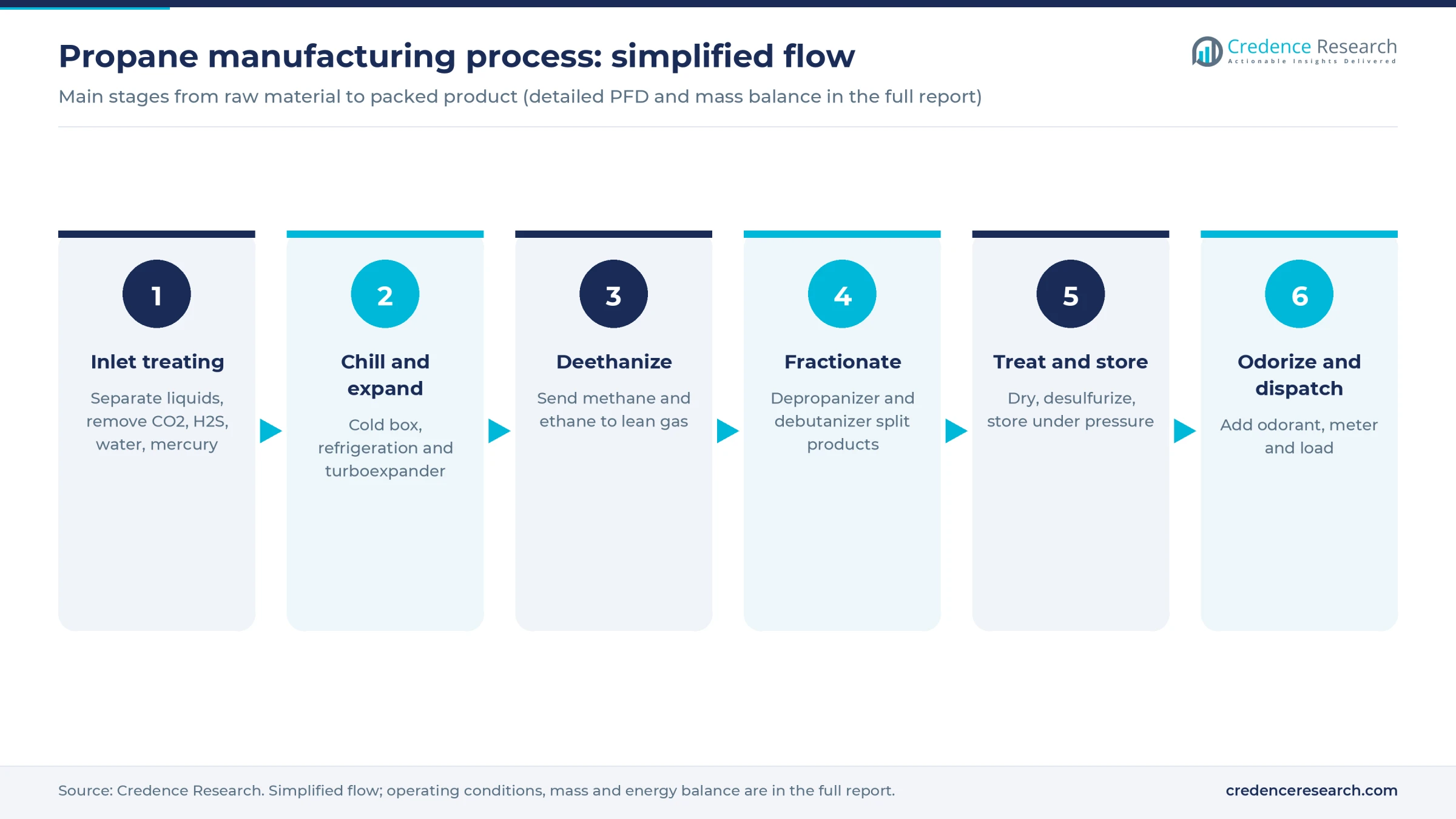
- Inlet separation and treating. A slug catcher and separators remove free liquids, then an amine unit takes out carbon dioxide and hydrogen sulfide where the gas is sour. Molecular sieve dryers cut water to parts per million, because any moisture would freeze in the cold section, and a guard bed removes mercury that attacks aluminum exchangers.
- Chilling and expansion. Dry gas is cooled in a brazed aluminum cold box against outgoing lean gas and a propane refrigeration loop. A turboexpander then drops the pressure and temperature further, condensing most of the propane and heavier hydrocarbons.
- Deethanizing. The cold liquids feed a deethanizer, which boils off methane and ethane to the lean gas stream and leaves a propane-plus mix at the bottom.
- Fractionation. A depropanizer takes propane overhead to specification, and a debutanizer splits butane from natural gasoline or condensate.
- Treating and storage. Propane passes through a final dryer and sulfur treater, then goes to pressurized bullets or spheres.
- Odorizing and dispatch. Ethyl mercaptan is added to fuel grades so leaks can be smelled, and product leaves by metered truck loading, rail or pipeline.
The lean gas is recompressed by the expander's own compressor and an electric or gas-driven booster before it leaves the plant. Propane recovery of about 90–99% is achievable, and each percentage point matters, since the product is worth far more as a liquid than as gas.
Propane plant setup cost
The indicative plant processes 40 MMSCFD of rich gas holding about 6% propane and recovers about 120 tonnes of propane a day, or roughly 40,000 tonnes a year over 330 operating days. It also yields about 13,500 tonnes of butane and 320 barrels a day of condensate on about 5 hectares. Fixed CapEx comes to about USD 35–50 million at an Asian site and an assumed USD 60–85 million at a U.S. or EU site. Working capital of about USD 2–3 million is excluded, and the full report can be recast for any country.
A recent plant anchors the Asian range. The Cilamaya LPG plant in West Java, Indonesia, built for 40 MMSCFD and about 160 tonnes a day of LPG, cost USD 36.93 million and was inaugurated in October 2026. For the higher-cost range, Brazos Midstream budgeted USD 185 million for a 300 MMcf/d cryogenic plant in Texas. Scaled down to 40 MMcf/d with the six-tenths rule, that implies about USD 55 million before propane splitting, storage and loading, which add an assumed USD 10–20 million.
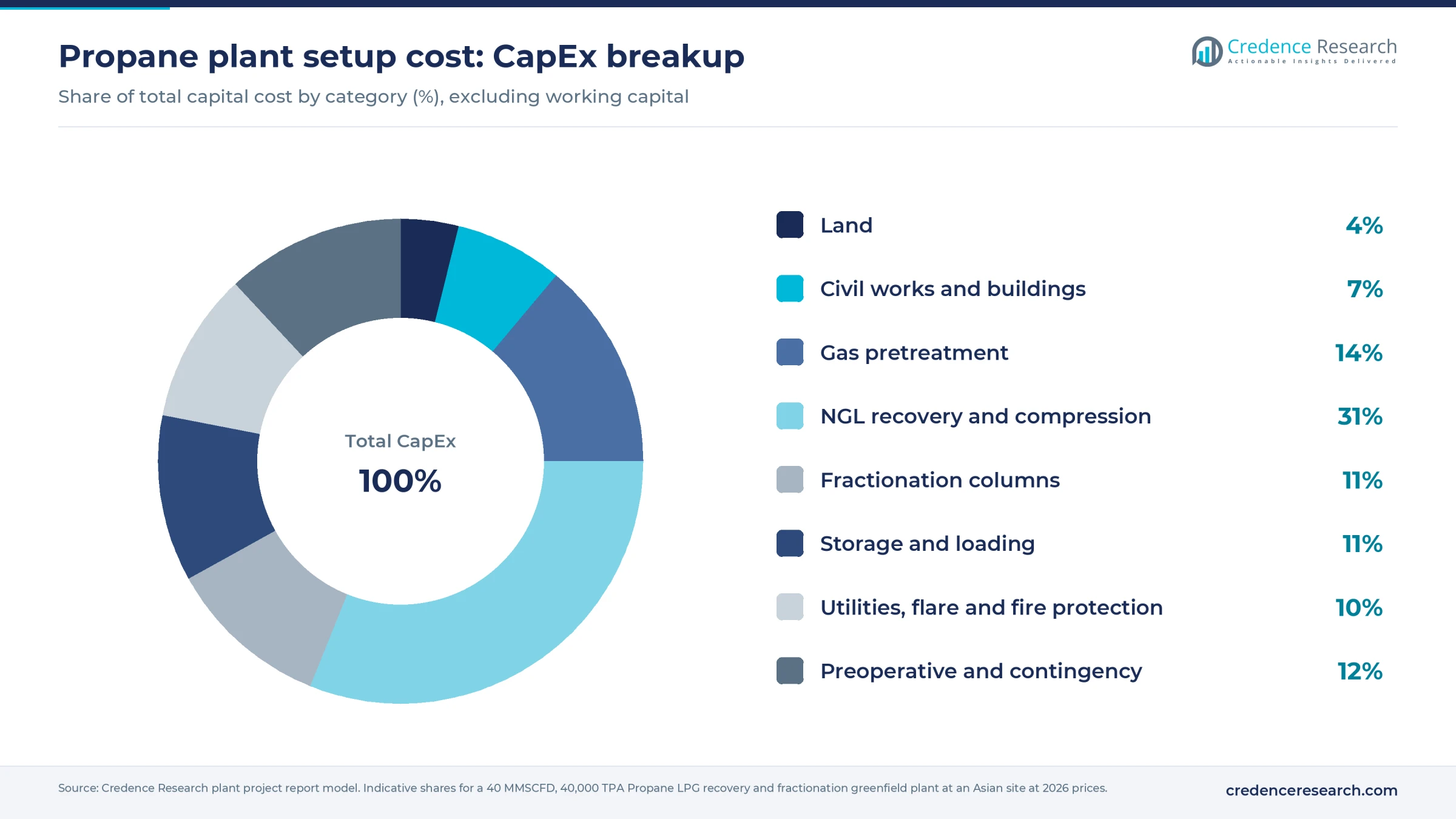
Land shows how each row was built. At an assumed USD 30–45 per square meter, a 50,000 square meter plot costs about USD 1.5–2.25 million, or about 4% of CapEx at the midpoint. The plot is large because safety codes require wide spacing between pressurized storage, process units and the boundary.
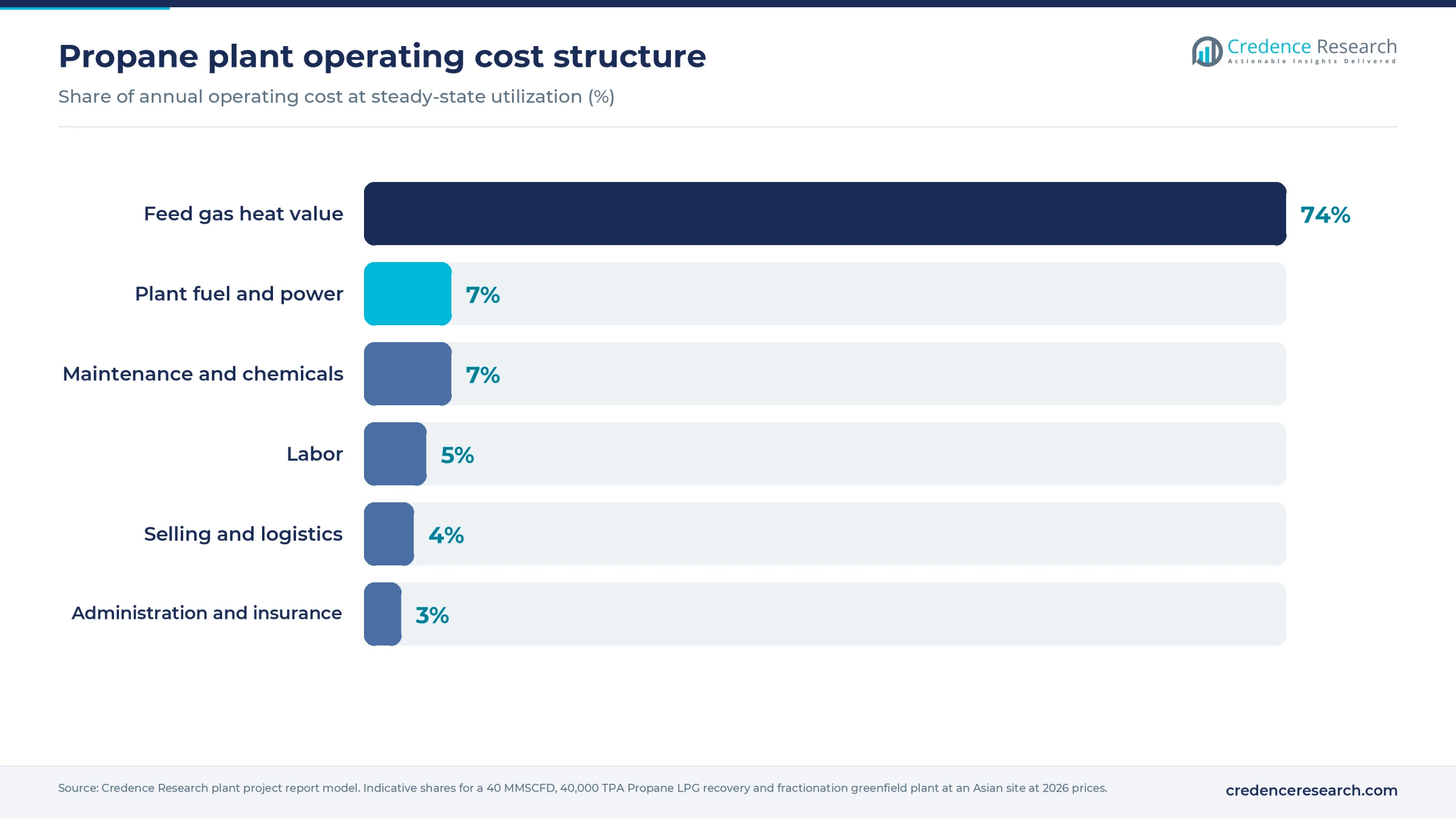
The value of the heat removed from the feed gas takes about 72–76% of cash operating cost, since the plant must compensate the gas owner for every British thermal unit it turns into liquid. Plant fuel, maintenance and labor follow. Each USD 1 per MMBtu change in that gas value moves gross margin by about 9 points.
Machinery and raw materials for a propane plant
The core equipment is an inlet slug catcher and separators, an amine contactor and regenerator for sour gas, twin or triple molecular sieve dehydration beds with regeneration heaters, and a mercury guard bed. The cold section needs a brazed aluminum cold box, a propane refrigeration package with screw or centrifugal compressors, and a turboexpander with a direct-coupled recompressor. Fractionation needs deethanizer, depropanizer and debutanizer columns with reboilers, air-cooled condensers and reflux pumps. Offsites include LPG bullets or spheres, an odorant injection skid, metered truck loading arms, a flare system, fire water pumps and deluge, gas engine generators, and a distributed control and safety instrumented system. A lab gas chromatograph and vapor pressure tester confirm grade before every dispatch.
The only real raw material is rich gas, and its propane content decides the plant's economics. The richest sources are associated gas from oil fields in the Middle East, the U.S. Permian Basin, West Africa, Russia and the Caspian, and Latin America, along with gas condensate fields in Southeast Asia and Australia. Associated gas that is now flared is the most attractive feed, since its owner may accept a low price to avoid flaring penalties. Consumables are small: amine, molecular sieve, glycol or methanol, and ethyl mercaptan odorant. A separate route recovers renewable propane alongside renewable diesel production, but output depends on the host unit.
Propane business profit margin and ROI
A recovery plant earns the frac spread, the gap between what propane, butane and condensate sell for and the value of the gas they would have been worth if left in the pipeline. Saudi Aramco's propane contract price, the main Asian benchmark, moved from USD 525 per tonne in January 2026 to USD 750 in April and USD 680 for October 2026, so the model uses an assumed realized price of USD 500–650 per tonne. Feed gas heat value is assumed at USD 5.5–7.5 per MMBtu.
At 85% utilization, gross margin runs about 22–40%, with about 32% in the central case. The top of the range assumes cheap gas, as with flare capture, and the bottom assumes the plant pays full pipeline value. Margin is much more sensitive to gas cost than to propane price: a USD 50 per tonne change in propane moves margin by about 3.5 points.
The central-case plant generates about USD 6–8 million in yearly post-tax cash profit after selling, logistics and overhead. On CapEx plus working capital, payback takes about 5–8 years. A squeeze in which propane falls to USD 500 while gas stays at USD 7.5 per MMBtu stretches payback past 10 years, which is why long, oil-linked or fixed-price gas contracts matter.
| Financial metric | Status |
|---|---|
| IRR | Available in report |
| NPV | Available in report |
| ROI | Available in report |
| DSCR | Available in report |
How to start a propane business, licenses and approvals
Propane is a flammable gas stored in large quantities under pressure, so process safety approvals dominate. A plant needs business and tax registration, zoning and building permits, and an environmental permit or impact assessment covering flaring, venting, leaks and effluent. It also needs pressure vessel and storage licenses, a process safety and major accident prevention program, fire service approval, and a gas supply agreement with the field operator or pipeline owner. Product must be tested against the buyer's grade specification, and fuel sales usually require a marketing or distribution license. Trucks and rail cars carry dangerous goods permits.
| Market | Key approvals for a propane recovery plant |
|---|---|
| United States | State air permit plus EPA New Source Performance Standards for onshore gas processing plants; EPA Risk Management Program under 40 CFR Part 68 and OSHA Process Safety Management under 29 CFR 1910.119 above 10,000 pounds of propane; NFPA 58 storage code; HD-5 grade testing to ASTM D1835 |
| European Union | National environmental permit; Seveso III Directive 2012/18/EU, with LPG at lower tier from 50 tonnes and upper tier from 200 tonnes; Pressure Equipment Directive 2014/68/EU and ATEX rules; CLP classification and labeling, with LPG exempt from REACH registration under Annex V; EN 589 for autogas |
| India | Environmental clearance under the EIA Notification, 2006, where the category applies, and state pollution control board consent to establish and operate; PESO license under the Static and Mobile Pressure Vessels (Unfired) Rules, 2016; Oil Industry Safety Directorate standards; IS 4576 grade; marketing authorization under the LPG Control Order, 2000 |
Key propane manufacturers and recent developments
The largest propane producers are national oil and gas companies and U.S. midstream firms. Saudi Aramco, ADNOC, QatarEnergy and Sonatrach dominate Middle East and North African exports, while Enterprise Products, Targa Resources, Energy Transfer and ONEOK process and fractionate most U.S. supply around Mont Belvieu, Texas. ExxonMobil, Chevron, Sinopec, PetroChina and Reliance add refinery propane. Renewable propane comes mainly from Neste and other renewable diesel producers. Recent moves show capacity still growing.
- August 2026. Compañía Mega, owned by YPF, Petrobras and Dow, won Argentine incentive-regime approval for a plan of about USD 360 million to lift Vaca Muerta NGL output by about 500,000 tonnes a year, mostly propane, butane and natural gasoline for export, by the end of 2028.
- October 2026. The Cilamaya LPG plant in West Java was inaugurated, recovering about 160 tonnes a day of LPG from 37 MMSCFD of contracted gas.
- November 2026. Targa Resources reported that its 150,000 barrel-a-day Train 12 fractionator at Mont Belvieu started up in the fourth quarter and took a final investment decision on Train 14, due in early 2029.
What's inside the Propane project report PDF
The report runs to 21 chapters. Open a chapter to see its sections.
1. Preface
2. Scope and Methodology
- 2.1 Objectives of the Study
- 2.2 Stakeholders
- 2.3 Research Methodology
- 2.4 Data Sources and Key Assumptions
3. Executive Summary
- 3.1 Market Snapshot
- 3.2 Project at a Glance (Capacity, CapEx, OpEx)
- 3.3 Key Financial Indicators (IRR, NPV, Payback, Break-even)
- 3.4 Feasibility Verdict
4. Product Overview
- 4.1 Propane Definition and Properties
- 4.2 Grades and Specifications (BIS / ISO / ASTM)
- 4.3 HS Code and Classification
- 4.4 Key Applications
- 4.5 Substitutes
5. Global Propane Market
- 5.1 Market Overview
- 5.2 Historical and Current Market Performance (Volume and Value)
- 5.3 Market Breakup by Grade / Type
- 5.4 Market Breakup by End-Use Industry
- 5.5 Market Breakup by Region
- 5.6 Market Drivers, Restraints and Trends
- 5.7 Value Chain Analysis
- 5.8 Market Forecast
6. Target Country Propane Market Analysis
- 6.1 Demand and Supply Analysis
- 6.2 Installed Capacity vs Demand Gap
- 6.3 Import Dependence
- 6.4 Demand Forecast by End-Use
7. Trade Analysis
- 7.1 Imports by Volume, Value and Country
- 7.2 Exports by Volume, Value and Country
- 7.3 Trade Balance and Opportunities
8. Price Analysis
- 8.1 Historical Propane Price Trends by Region
- 8.2 Raw Material / Feedstock Price Trends and Linkage
- 8.3 Price Forecast
- 8.4 Margins Across the Value Chain
9. Competitive Landscape
- 9.1 Market Structure
- 9.2 Key Players and Installed Capacities
- 9.3 Profiles of Key Players
- 9.4 Recent Developments (Expansions, M&A, New Plants)
10. Manufacturing Process and Technology
- 10.1 Comparison of Technology Routes
- 10.2 Selected Route and Process Flow Diagram
- 10.3 Unit Operations Involved
- 10.4 Chemical Reactions Involved
- 10.5 Mass Balance and Raw Material Requirements
- 10.6 Energy Balance
- 10.7 Quality Assurance Criteria and Technical Tests
- 10.8 By-products and Waste Handling
- 10.9 Technology Licensors / Providers
11. Project Details, Requirements and Costs
- 11.1 Land, Location and Site Development
- 11.1.1 Site Selection Criteria
- 11.1.2 Location Analysis
- 11.1.3 Land Requirement and Costs
- 11.1.4 Site Development Costs
- 11.2 Plant Layout
- 11.2.1 Layout Principles
- 11.2.2 Proposed Layout
- 11.2.3 Factors Influencing Layout
- 11.3 Civil Works and Buildings
- 11.4 Plant Machinery
- 11.4.1 Machinery Requirements and Specifications
- 11.4.2 Machinery Costs
- 11.4.3 Machinery Suppliers
- 11.5 Raw Materials
- 11.5.1 Requirements per Tonne of Output
- 11.5.2 Procurement and Sourcing
- 11.5.3 Costs
- 11.5.4 Suppliers
- 11.6 Packaging
- 11.6.1 Packaging Requirements
- 11.6.2 Packaging Costs
- 11.6.3 Packaging Suppliers
- 11.7 Storage and Material Handling
- 11.8 Transportation Requirements and Costs
- 11.9 Utilities
- 11.9.1 Power Requirements and Costs
- 11.9.2 Water Requirements and Costs
- 11.9.3 Steam, Fuel and Other Utilities
- 11.10 Manpower Requirements and Wages
12. Environment, Health, Safety and Sustainability
- 12.1 Effluent and Emissions Management
- 12.2 Hazard Classification and Safety Measures
- 12.3 Carbon Footprint
- 12.4 Green / Low-Carbon Process Options
13. Regulatory Procedures, Approvals and Certifications
- 13.1 Licences and Registrations
- 13.2 Environmental Clearances
- 13.3 Product Certifications (BIS, REACH, etc.)
- 13.4 Approval Timeline
14. Project Implementation Schedule
15. Project Economics
- 15.1 Capital Cost of the Project
- 15.2 Techno-Economic Parameters
- 15.3 Capacity Utilization and Ramp-up
- 15.4 Product Pricing and Margins
- 15.5 Income Projections
- 15.6 Expenditure Projections
- 15.7 Working Capital Requirement
- 15.8 Taxation
- 15.9 Depreciation
16. Financial Analysis
- 16.1 Projected Profit and Loss Account
- 16.2 Projected Cash Flow Statement
- 16.3 Projected Balance Sheet
- 16.4 Liquidity Analysis
- 16.5 Profitability Analysis (Payback, NPV, IRR, ROI)
- 16.6 Break-even Analysis
- 16.7 Debt Service Coverage Ratio (DSCR)
- 16.8 Sensitivity Analysis
- 16.9 Scenario and Uncertainty Analysis
17. Funding and Incentives
- 17.1 Means of Finance and Debt-Equity Structure
- 17.2 Loans and Financial Assistance
- 17.3 Government Schemes and Subsidies (PLI, State Policies)
18. Risk Assessment
- 18.1 Key Success Factors
- 18.2 Key Risk Factors
- 18.3 Risk Mitigation
19. Strategic Recommendations
20. Case Study of a Successful Venture
21. Appendix
- 21.1 Detailed Assumptions
- 21.2 Abbreviations
- 21.3 List of Tables and Figures
- 21.4 Sources
This page vs. the full report
| Data point | On this page (free) | In the full report |
|---|---|---|
| Total CapEx | One rounded range at one capacity | Exact figure at three capacities with a line-item breakup |
| CapEx breakup | Category shares (%) only | Cost, quantity and supplier for every machine |
| Operating cost | Share of raw materials, utilities and labor | Per-unit cost sheet with each input price and consumption |
| Profitability | Gross margin range and payback band | Exact IRR, NPV, ROI, break-even and DSCR |
| Financial statements | List of what is included | 10-year P&L, cash flow, balance sheet and Excel model |
| Sensitivity | One directional line | Full sensitivity and scenario tables |
| Process | Simplified flow diagram | Detailed process flow, mass and energy balance, operating conditions |
| Machinery | Names of the main machines | Specifications, capacity, cost and supplier list |
| Market | Headline size, growth and global demand | Segment, region, trade and price forecast tables |
| Suppliers and buyers | Supplier types and sourcing hubs | Named suppliers and buyers |
Propane project report: FAQs
How much does it cost to set up a propane plant?
Can propane be manufactured in a small plant?
What is the profit margin in propane recovery?
How long does a propane plant take to pay back?
Where does the feed gas for a propane plant come from?
What licenses does a propane plant need?
Which HS code covers propane?

About the analyst
Ganesh Chandwade, Senior Industry Consultant
Ganesh is a senior industry consultant specializing in heavy industries and advanced materials.
Related market research
- Liquefied Petroleum Gas Market Industry Size & Forecast 2032
- LPG Tanker Market Size, Share, Trends and Forecast 2032
- LPG Gas Cylinder Market Size, Growth, Share and Forecast 2032
- Renewable Diesel Market Size, Trends, Share and Forecast 2032
- CNG and LPG Vehicles Market Size, Growth and Forecast 2032
- LPG Forklift Market Size, Share, Growth and Forecast 2032
More plant project reports
- Tyre Oil Manufacturing Plant Project Report (DPR) 2026
- Furnace Oil Manufacturing Plant Project Report (DPR) 2026
- Glass Bottle Manufacturing Plant Project Report (DPR) 2026
- Gypsum Board Manufacturing Plant Project Report (DPR) 2026
- Ethanol Manufacturing Plant Project Report (DPR) 2026
- Automatic Plant Watering System Manufacturing Plant Project Report (DPR) 2026