
Quick answer
A small furnace oil plant is usually a used oil reprocessing unit, not a refinery. It dewaters, filters and distills collected lubricating oil into industrial burner fuel. A plant taking 20,000 tonnes of used oil a year needs fixed CapEx of about USD 4.5–7.5 million at an Asian industrial park and an assumed USD 12–25 million at a U.S. or EU site. Gross margin runs about 18–30%, and central-case payback takes about 4–7 years.
Viable for operators who control used oil collection and hold hazardous waste permits; weak for a stand-alone buyer of feedstock competing with re-refiners for the same oil.
Furnace Oil plant: key highlights
| Parameter | Indicative value | Note |
|---|---|---|
| Plant capacity | 20,000 TPA used oil feed | About 67 tonnes a day over 300 days, yielding roughly 16,000 tonnes of furnace oil-grade fuel at full load |
| Total CapEx | USD 4.5–7.5 million | Asian industrial park; assumed USD 12–25 million at a U.S. or EU site; excludes working capital |
| Raw material share of operating cost | 64–71% | Delivered used oil, including collection, as a share of total cash cost |
| Gross margin | 18–30% | Assumed fuel oil price of USD 450–650 per tonne and assumed delivered used oil of USD 220–320 per tonne |
| Payback period | 4–7 years | Central case at 80% utilization, on CapEx plus working capital; extreme pairings about 3–12 years |
| IRR | Available in report | Post-tax, 10-year model |
| Break-even | Available in report | Capacity utilization basis |
Ranges assume a 20,000 TPA greenfield used oil reprocessing plant making industrial furnace oil, not marine fuel or a refinery, on 3 acres at an Asian industrial park, 2026 prices, 80% utilization, 80% fuel yield, assumed delivered used oil of USD 220–320 per tonne and assumed fuel oil prices of USD 450–650 per tonne. U.S. and EU costs are assumed multiples. The full report is customizable to any country.
What is furnace oil?
Furnace oil is a heavy, dark liquid fuel burned in industrial boilers, furnaces, kilns and thermic fluid heaters. Refineries make most of it by blending vacuum or cracked residue with lighter cutter stock to reach a target viscosity. A second route, the one this report models, recovers it from collected used lubricating oil. The plant removes water, sediment and light ends, then flashes or distills the oil into a burner fuel often sold as reprocessed or recycled fuel oil.
Buyers specify viscosity, flash point, sulfur, water and sediment, and ash or metal content, and burner owners care most about consistent viscosity and low water. Marine bunkers are a separate product under ISO 8217, which flags fuel containing used lubricant through calcium, zinc and phosphorus limits. IMO 2020 also caps sulfur in ship fuel at 0.50% outside emission control areas unless a scrubber is fitted, so a small reprocessor usually sells to land-based industry rather than ships.
Refinery and reprocessed furnace oil both fall under HS code 271019, the 6-digit subheading for other petroleum oils, including fuel oils. The used oil feed is classed as waste oil under HS 271099, or 271091 if it contains PCBs. Main buyers include ceramics, glass, textile processing, asphalt mixing, steel rerolling, lime kilns and food plants with steam boilers.
Furnace oil market overview and global demand
Credence Research does not publish a standalone furnace oil market size, so adjacent live benchmarks frame the sector. The very low sulfur fuel oil market study implies about USD 92.4 billion in 2025, based on Credence Research's USD 87.55 billion for 2024 and 5.55% CAGR. On the feedstock side, the used oil management services analysis implies about USD 15.2 billion in 2025, based on USD 14.43 billion for 2024 and 5.52% CAGR. Neither figure measures industrial furnace oil sales directly.
Physical indicators show the scale of heavy fuel use. The IEA estimated world residual fuel oil demand at about 6.4 million barrels a day in 2025, spread across shipping, power and industry. Singapore, the largest bunkering hub, sold a record 56.77 million tonnes of marine fuel in 2025, and its high-sulfur fuel oil sales rose 7.8% to 21.73 million tonnes, a fifth straight annual gain. Prices also swing sharply, and Singapore high-sulfur fuel oil reached USD 902 per tonne on Oct. 30, 2026, up from USD 799 on Oct. 8, a 13% move in three weeks.
Used oil supply sets the ceiling for reprocessors. A 2025 European Commission Joint Research Centre assessment found that of 4.3 million tonnes of lubricants sold in the EU28 in 2017, about 1.6 million tonnes of waste oil was collected, with 61% regenerated and 39% sent to energy recovery, including conversion to fuel. Industrial furnace oil demand is shrinking where gas pipelines reach factories, but holds up in South Asia, Africa, the Middle East and Latin America, where heavy oil remains a common fuel for the industrial boiler fleet.
Furnace oil manufacturing process
A reprocessing plant cleans and fractionates used oil rather than cracking it, so most of the value comes from removing water, solids and contaminants without losing fuel. The modeled route uses heated settling, dehydration and vacuum flash distillation. Older acid and clay treatment is avoided because it leaves acid sludge that regulators in most markets now restrict.
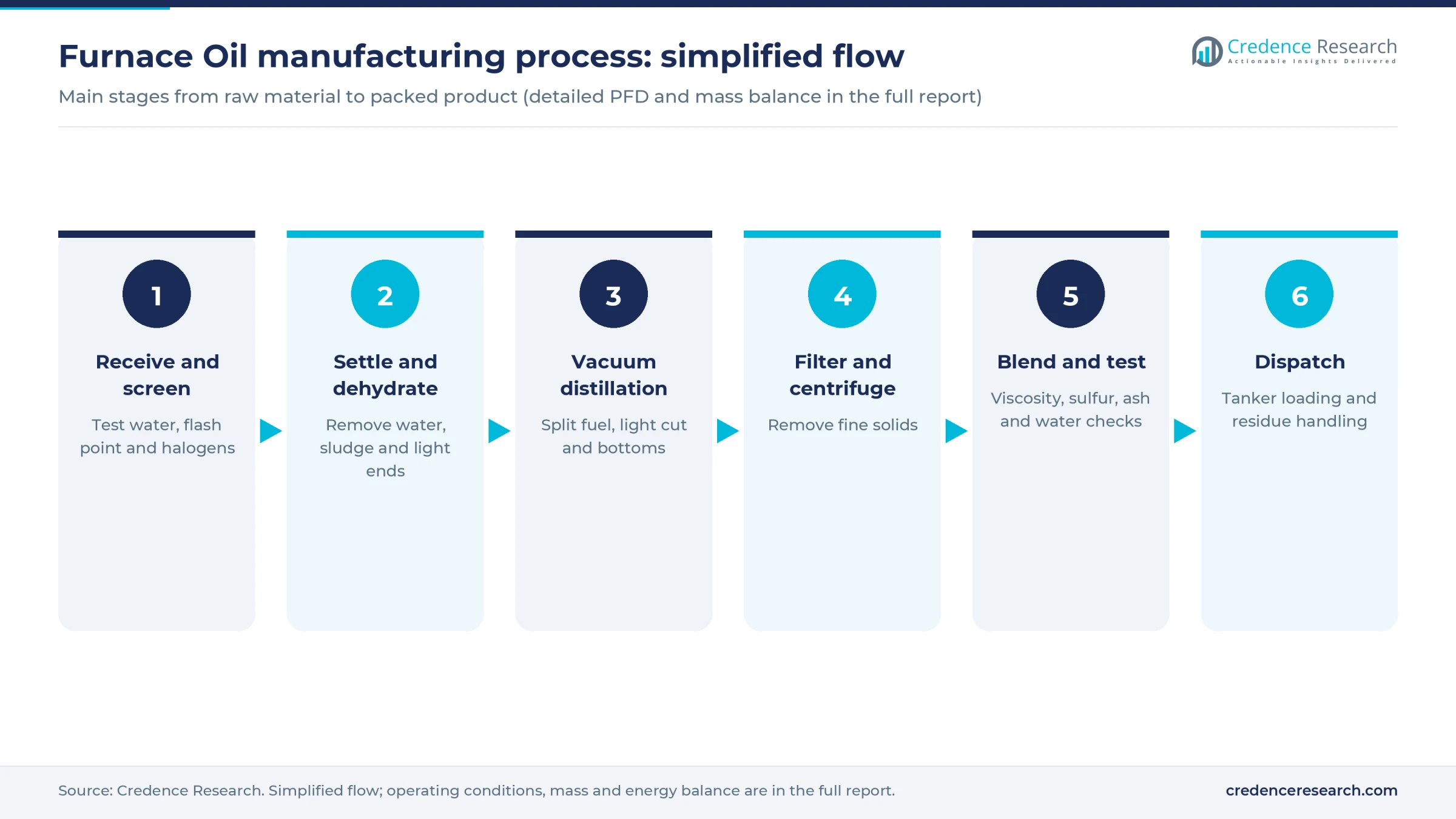
- Receiving and screening. Tankers unload through strainers after the lab checks water, flash point and total halogens. Loads that test high for chlorine are rejected or quarantined, because chlorinated solvents and PCB-contaminated transformer oil can turn a whole tank into hazardous waste with far higher disposal costs.
- Settling and dehydration. Oil is heated in settling tanks so free water and sludge drop out, then passes through a dehydration column at roughly 120–150 degrees Celsius to drive off emulsified water and the lightest hydrocarbons.
- Vacuum flash distillation. A thermal oil heater brings the dry oil to distillation temperature under vacuum. A light distillate cut, close to diesel range, is condensed and sold separately, while the main fuel fraction is drawn off for blending. Additive metals, ash and carbon stay in a heavy bottoms stream.
- Filtration and centrifuging. A decanter centrifuge and bag or cartridge filters remove fine solids that would clog burner nozzles.
- Blending and testing. The fuel is blended to a viscosity grade and tested for viscosity, flash point, sulfur, water, sediment and ash before release.
- Dispatch and residue handling. Product leaves by road tanker, while recovered water goes to oily water treatment and bottoms go to bitumen blending, cement kiln co-processing or licensed disposal.
Non-condensable gases from the vacuum system are burned in a thermal oxidizer or the plant heater. Odor and vapor control often decide whether a site keeps its permit.
Furnace oil plant setup cost
The indicative build takes 20,000 tonnes of used oil a year, about 67 tonnes a day over 300 days, on about 3 acres of serviced land. Fixed CapEx comes to about USD 4.5–7.5 million at an Asian industrial park and an assumed USD 12–25 million at a U.S. or EU site, where vapor control, tankage, labor and permitting cost more. Working capital of about USD 0.6–1 million is excluded, and the full report can be recast for any country.
Two public reference points bracket that range. Chinese suppliers list batch used oil distillation kettles of 3–10 tonnes a day at USD 30,000–40,000 and a 30-tonne-a-day continuous unit at about USD 77,000, but those prices cover bare equipment without tank farms, emission control, effluent treatment or installation. At the top end, Enerpure closed CAD 48 million, about USD 35 million, in August 2026 to fund engineering, construction and working capital for a 32.6 million liter a year plant in Alberta that will turn used motor oil into marine fuel. Scaled to 20,000 tonnes with the six-tenths rule, that implies about USD 28 million for a North American plant built to marine standards, so the U.S. and EU range stays below it for a simpler industrial fuel.
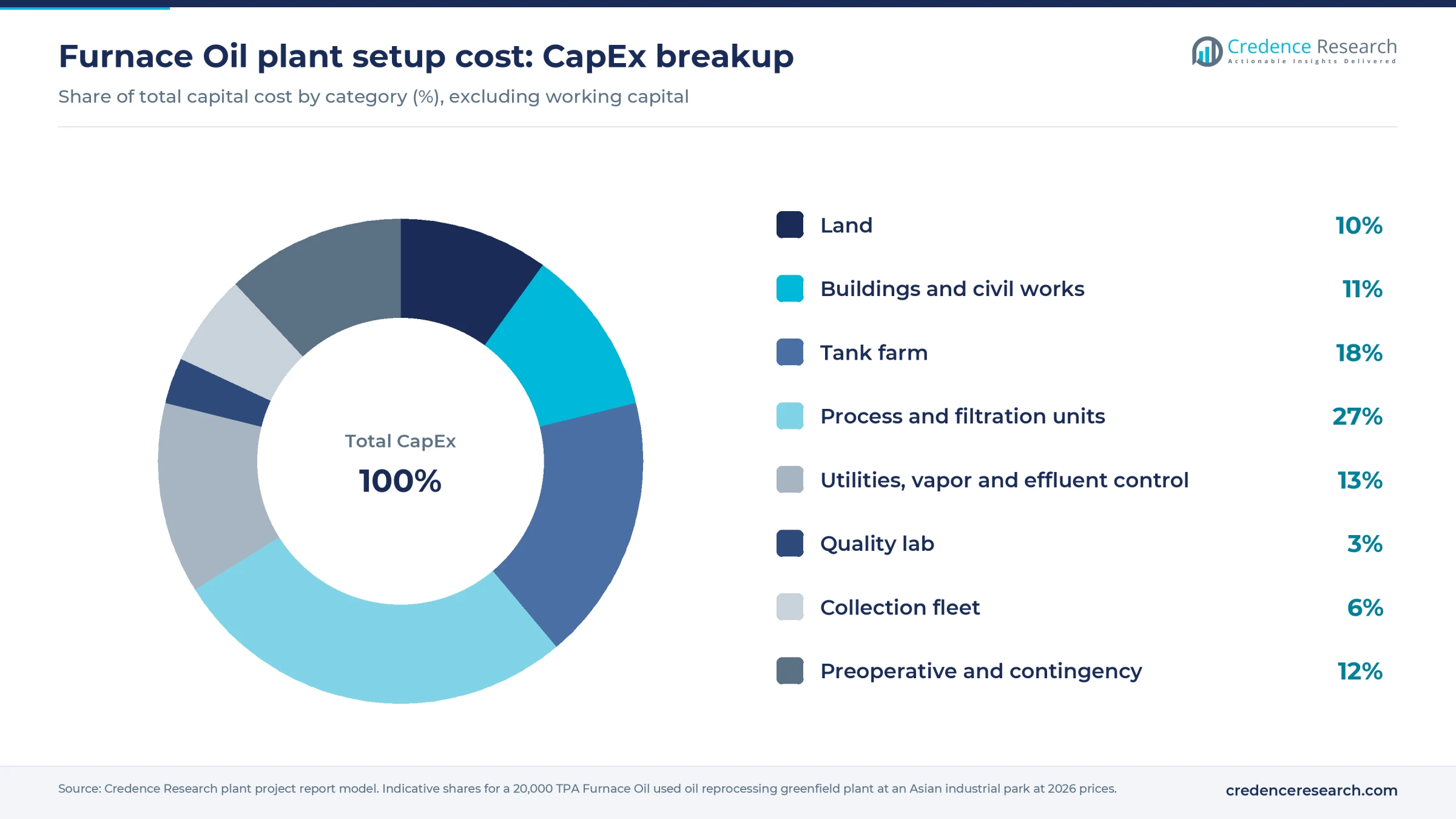
Land shows how each row was built. At an assumed USD 40–55 per square meter, a 12,000 square meter plot costs about USD 480,000–660,000, or about 10% of CapEx at the midpoint. Rural U.S. sites can cost less, while EU chemical parks often cost more.
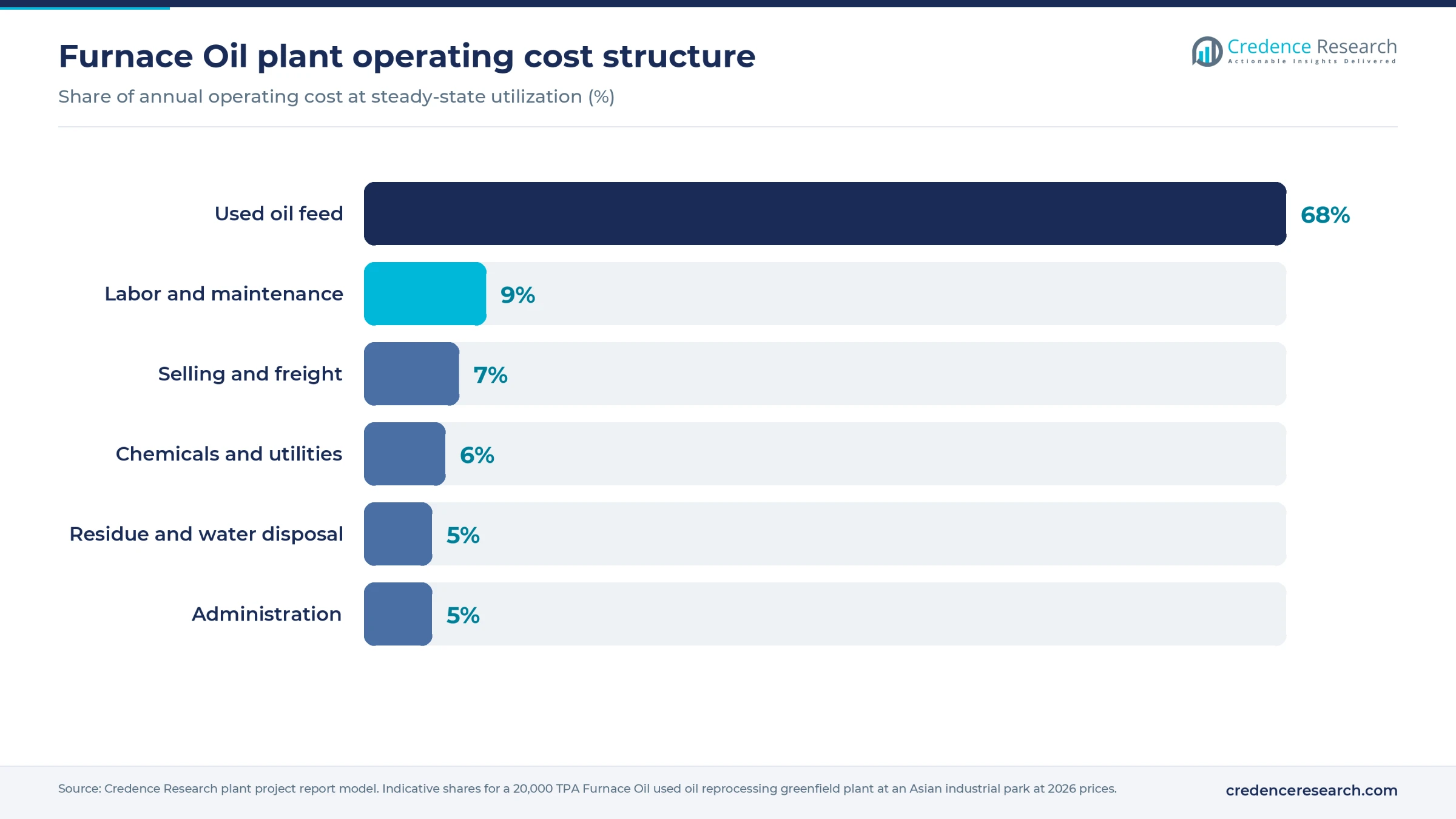
Delivered used oil, including collection, takes about 64–71% of total cash cost. Labor, maintenance and residue disposal follow. With feed cost unchanged, each USD 50 per tonne change in the fuel oil price moves gross margin by about 5 points.
Machinery and raw materials for a furnace oil plant
The plant needs a tanker unloading bay with strainers and pumps, feed, intermediate and product storage tanks, heated settling tanks and a dehydration column. The distillation section needs a thermal oil heater, a vacuum flash or wiped-film evaporator, condensers, vacuum pumps and a light distillate receiver. Cleanup equipment includes a decanter centrifuge, bag filters, blending tanks with agitators, a thermal oxidizer for vent gases, an oily water treatment unit with dissolved air flotation, fire protection and a bunded tank farm. A quality lab with a closed-cup flash point tester, viscometer, sulfur analyzer, water titrator and chlorine screening kits protects both product quality and the permit. Many operators also run their own collection tankers.
Used lubricating oil is the main raw material, and it is generated wherever vehicles and machinery run. The largest pools are in North America, Europe, China, India, Southeast Asia, the Middle East and Brazil. Workshops, fleets, mines, factories and ports supply engine, hydraulic and gear oils. Collection, not volume, is the bottleneck: oil is scattered across thousands of small generators, and informal burning or dumping still captures part of it in many emerging markets.
Feed competition is rising, since re-refiners pay more for clean oil to make base stock. Some reprocessors widen supply with tire or plastic pyrolysis oil, a segment tracked in the waste-derived pyrolysis oil market, though it needs separate permits and testing.
Furnace oil business profit margin and ROI
Profit depends on the spread between what the plant pays for used oil and what burner customers pay for the fuel. The model uses assumed fuel oil prices of USD 450–650 per tonne, a discount to Singapore high-sulfur fuel oil quotes of USD 799–902 per tonne in October 2026. That discount reflects reprocessed fuel's higher ash and the risk that 2026 prices ease. Delivered used oil is assumed at USD 220–320 per tonne, including collection.
At an 80% fuel yield plus a light distillate cut, gross margin runs about 18–30%. The top of the range assumes used oil prices follow fuel oil prices, while the bottom reflects a squeeze in which feed costs stay high as fuel prices fall. Re-refiners bidding for clean oil can create that squeeze.
At 80% utilization, the central-case plant generates about USD 1.0–1.6 million in yearly post-tax cash profit after selling, freight and overhead. On CapEx plus working capital, payback takes about 4–7 years. Extreme pairings stretch that to about 3–12 years. Gate fees for difficult wastes and sale of the light distillate can improve returns.
| Financial metric | Status |
|---|---|
| IRR | Available in report |
| NPV | Available in report |
| ROI | Available in report |
| DSCR | Available in report |
How to start a furnace oil business, licenses and approvals
Because the feed is regulated waste, permitting weighs more here than in most fuel businesses. A plant needs business and tax registration, zoning and building permits, and a waste treatment permit or authorization covering receipt, storage and processing of used oil. It also needs an air permit for the heater and vent gases, a wastewater discharge consent, fire and petroleum storage approval, and spill prevention plans. Product claims require testing against the buyer's fuel specification and local sulfur limits, and selling to ships adds MARPOL Annex VI and ISO 8217 compliance. Waste transport licenses apply to the collection fleet.
| Market | Key approvals for furnace oil from used oil |
|---|---|
| United States | EPA notification and ID number as a used oil processor under 40 CFR Part 279, Subpart F, with an analysis plan and tracking records; used oil fuel specification in 40 CFR 279.11; spill prevention plan under 40 CFR Part 112; state air and waste permits |
| European Union | Permit under the Industrial Emissions Directive, since Annex I item 5.1(j) covers reuse of oil from hazardous waste above 10 tonnes a day; waste oil rules and end-of-waste status under Directive 2008/98/EC; heavy fuel oil sulfur limits under Directive (EU) 2016/802 |
| India | State pollution control board authorization under the Hazardous and Other Wastes Rules, 2016, plus consent to establish and operate; recycler registration with the Central Pollution Control Board under the used oil extended producer responsibility rules in force since April 2024; storage license from the Petroleum and Explosives Safety Organisation |
Key furnace oil manufacturers and recent developments
Most furnace oil still comes from refiners such as Saudi Aramco, Sinopec, ExxonMobil, Shell, Rosneft and Indian Oil, which sell it into industry and bunkering. The reprocessing segment is far more fragmented, with collectors and processors ranging from Clean Harbors' Safety-Kleen and Heritage-Crystal Clean in North America to Veolia and Tradebe in Europe and many regional firms in Asia and the Middle East. Feed competition from re-refiners is the main trend to watch, as recent deals show.
- January 2026. Hindustan Petroleum and Castrol India signed a memorandum of understanding to study collecting and re-refining used lubricating oil into base oil.
- March 2026. Re Sustainability and Indian Oil signed a memorandum of understanding to set up a special purpose vehicle targeting 100,000 tonnes a year of used oil collection and a 50,000–100,000 tonne re-refinery within three years.
- August 2026. Enerpure closed CAD 48 million in financing for its Alberta plant to convert used motor oil into lower-carbon marine fuel, with commissioning targeted for the first half of 2028.
What's inside the Furnace Oil project report PDF
The report runs to 21 chapters. Open a chapter to see its sections.
1. Preface
2. Scope and Methodology
- 2.1 Objectives of the Study
- 2.2 Stakeholders
- 2.3 Research Methodology
- 2.4 Data Sources and Key Assumptions
3. Executive Summary
- 3.1 Market Snapshot
- 3.2 Project at a Glance (Capacity, CapEx, OpEx)
- 3.3 Key Financial Indicators (IRR, NPV, Payback, Break-even)
- 3.4 Feasibility Verdict
4. Product Overview
- 4.1 Furnace Oil Definition and Properties
- 4.2 Grades and Specifications (BIS / ISO / ASTM)
- 4.3 HS Code and Classification
- 4.4 Key Applications
- 4.5 Substitutes
5. Global Furnace Oil Market
- 5.1 Market Overview
- 5.2 Historical and Current Market Performance (Volume and Value)
- 5.3 Market Breakup by Grade / Type
- 5.4 Market Breakup by End-Use Industry
- 5.5 Market Breakup by Region
- 5.6 Market Drivers, Restraints and Trends
- 5.7 Value Chain Analysis
- 5.8 Market Forecast
6. Target Country Furnace Oil Market Analysis
- 6.1 Demand and Supply Analysis
- 6.2 Installed Capacity vs Demand Gap
- 6.3 Import Dependence
- 6.4 Demand Forecast by End-Use
7. Trade Analysis
- 7.1 Imports by Volume, Value and Country
- 7.2 Exports by Volume, Value and Country
- 7.3 Trade Balance and Opportunities
8. Price Analysis
- 8.1 Historical Furnace Oil Price Trends by Region
- 8.2 Raw Material / Feedstock Price Trends and Linkage
- 8.3 Price Forecast
- 8.4 Margins Across the Value Chain
9. Competitive Landscape
- 9.1 Market Structure
- 9.2 Key Players and Installed Capacities
- 9.3 Profiles of Key Players
- 9.4 Recent Developments (Expansions, M&A, New Plants)
10. Manufacturing Process and Technology
- 10.1 Comparison of Technology Routes
- 10.2 Selected Route and Process Flow Diagram
- 10.3 Unit Operations Involved
- 10.4 Chemical Reactions Involved
- 10.5 Mass Balance and Raw Material Requirements
- 10.6 Energy Balance
- 10.7 Quality Assurance Criteria and Technical Tests
- 10.8 By-products and Waste Handling
- 10.9 Technology Licensors / Providers
11. Project Details, Requirements and Costs
- 11.1 Land, Location and Site Development
- 11.1.1 Site Selection Criteria
- 11.1.2 Location Analysis
- 11.1.3 Land Requirement and Costs
- 11.1.4 Site Development Costs
- 11.2 Plant Layout
- 11.2.1 Layout Principles
- 11.2.2 Proposed Layout
- 11.2.3 Factors Influencing Layout
- 11.3 Civil Works and Buildings
- 11.4 Plant Machinery
- 11.4.1 Machinery Requirements and Specifications
- 11.4.2 Machinery Costs
- 11.4.3 Machinery Suppliers
- 11.5 Raw Materials
- 11.5.1 Requirements per Tonne of Output
- 11.5.2 Procurement and Sourcing
- 11.5.3 Costs
- 11.5.4 Suppliers
- 11.6 Packaging
- 11.6.1 Packaging Requirements
- 11.6.2 Packaging Costs
- 11.6.3 Packaging Suppliers
- 11.7 Storage and Material Handling
- 11.8 Transportation Requirements and Costs
- 11.9 Utilities
- 11.9.1 Power Requirements and Costs
- 11.9.2 Water Requirements and Costs
- 11.9.3 Steam, Fuel and Other Utilities
- 11.10 Manpower Requirements and Wages
12. Environment, Health, Safety and Sustainability
- 12.1 Effluent and Emissions Management
- 12.2 Hazard Classification and Safety Measures
- 12.3 Carbon Footprint
- 12.4 Green / Low-Carbon Process Options
13. Regulatory Procedures, Approvals and Certifications
- 13.1 Licences and Registrations
- 13.2 Environmental Clearances
- 13.3 Product Certifications (BIS, REACH, etc.)
- 13.4 Approval Timeline
14. Project Implementation Schedule
15. Project Economics
- 15.1 Capital Cost of the Project
- 15.2 Techno-Economic Parameters
- 15.3 Capacity Utilization and Ramp-up
- 15.4 Product Pricing and Margins
- 15.5 Income Projections
- 15.6 Expenditure Projections
- 15.7 Working Capital Requirement
- 15.8 Taxation
- 15.9 Depreciation
16. Financial Analysis
- 16.1 Projected Profit and Loss Account
- 16.2 Projected Cash Flow Statement
- 16.3 Projected Balance Sheet
- 16.4 Liquidity Analysis
- 16.5 Profitability Analysis (Payback, NPV, IRR, ROI)
- 16.6 Break-even Analysis
- 16.7 Debt Service Coverage Ratio (DSCR)
- 16.8 Sensitivity Analysis
- 16.9 Scenario and Uncertainty Analysis
17. Funding and Incentives
- 17.1 Means of Finance and Debt-Equity Structure
- 17.2 Loans and Financial Assistance
- 17.3 Government Schemes and Subsidies (PLI, State Policies)
18. Risk Assessment
- 18.1 Key Success Factors
- 18.2 Key Risk Factors
- 18.3 Risk Mitigation
19. Strategic Recommendations
20. Case Study of a Successful Venture
21. Appendix
- 21.1 Detailed Assumptions
- 21.2 Abbreviations
- 21.3 List of Tables and Figures
- 21.4 Sources
This page vs. the full report
| Data point | On this page (free) | In the full report |
|---|---|---|
| Total CapEx | One rounded range at one capacity | Exact figure at three capacities with a line-item breakup |
| CapEx breakup | Category shares (%) only | Cost, quantity and supplier for every machine |
| Operating cost | Share of raw materials, utilities and labor | Per-unit cost sheet with each input price and consumption |
| Profitability | Gross margin range and payback band | Exact IRR, NPV, ROI, break-even and DSCR |
| Financial statements | List of what is included | 10-year P&L, cash flow, balance sheet and Excel model |
| Sensitivity | One directional line | Full sensitivity and scenario tables |
| Process | Simplified flow diagram | Detailed process flow, mass and energy balance, operating conditions |
| Machinery | Names of the main machines | Specifications, capacity, cost and supplier list |
| Market | Headline size, growth and global demand | Segment, region, trade and price forecast tables |
| Suppliers and buyers | Supplier types and sourcing hubs | Named suppliers and buyers |
Furnace Oil project report: FAQs
How much does it cost to set up a furnace oil plant?
Is a furnace oil plant the same as a refinery?
What is the profit margin in furnace oil from used oil?
How long does a furnace oil plant take to pay back?
Can reprocessed furnace oil be sold as marine fuel?
What licenses does a furnace oil plant need?
Which HS code covers furnace oil?

About the analyst
Ganesh Chandwade, Senior Industry Consultant
Ganesh is a senior industry consultant specializing in heavy industries and advanced materials.
Related market research
- Very Low Sulphur Fuel Oil Market Size, Growth and Forecast 2032
- Used Oil Management Service Market Size, Growth and Forecast 2032
- Industrial Boiler Market Size, Share, Growth and Forecast 2032
- Waste Derived Pyrolysis Oil Market Size, Growth and Forecast
- Bunker Fuel Market Size, Growth, Analysis & Forecast 2032
- Bunkering Services Market Size, Share, Growth & Forecast 2032
More plant project reports
- Vinyl Chloride Manufacturing Plant Project Report (DPR) 2026
- Rice Bran Oil Processing Plant Project Report (DPR) 2026
- Neopentyl Glycol Manufacturing Plant Project Report (DPR) 2026
- Generic Injectables Manufacturing Plant Project Report (DPR) 2026
- Citric Acid Manufacturing Plant Project Report (DPR) 2026
- Castor Oil Processing Plant Project Report (DPR) 2026