
| REPORT ATTRIBUTE | DETAILS |
|---|---|
| Historical Period | 2020-2023 |
| Base Year | 2024 |
| Forecast Period | 2025-2032 |
| LPG Forklift Market Size 2024 | USD 5,594.50 Million |
| LPG Forklift Market, CAGR | 6.73% |
| LPG Forklift Market Size 2032 | USD 9,420.05 Million |
Market Overview
The global LPG Forklift Market is projected to grow from USD 5,594.50 million in 2024 to an estimated USD 9,420.05 million by 2032, with a compound annual growth rate (CAGR) of 6.73% from 2025 to 2032. This growth is driven by the increasing adoption of LPG-powered forklifts due to their environmental benefits and cost-effectiveness.
Key drivers of this market include the rising demand for material handling equipment across various industries and the growing emphasis on reducing carbon emissions. Trends such as the development of advanced LPG forklift models with improved fuel efficiency and performance are also contributing to market growth. Manufacturers are focusing on innovation to meet stringent environmental regulations and enhance user experience.
Geographically, the Asia Pacific region holds a significant share of the LPG forklift market, attributed to rapid industrialization and the expansion of manufacturing sectors in countries like China and India. Major players in the market include Toyota Industries Corporation, KION Group AG, and Jungheinrich AG, which are leading the development of LPG forklift technologies and expanding their global presence.
Market Insights
- The global LPG forklift market is projected to grow from USD 5,594.50 million in 2024 to USD 9,420.05 million by 2032, with a CAGR of 6.73% from 2025 to 2032.
- LPG forklifts are favored for their lower emissions compared to diesel models, aligning with global sustainability and carbon reduction goals.
- Their lower operational and maintenance costs, combined with faster refueling times, make LPG forklifts an attractive option for businesses aiming to reduce expenses.
- Stricter environmental regulations are encouraging industries to adopt cleaner material handling equipment, boosting demand for LPG forklifts.
- High initial investment and the need for LPG refueling infrastructure in certain regions may pose challenges to adoption.
- The Asia Pacific region holds the largest share of the market, driven by rapid industrialization in countries like China and India.
- Manufacturers are focusing on advanced LPG forklift models with improved fuel efficiency and performance to meet evolving market needs and regulatory standards.
Market Drivers
Increasing Demand for Material Handling Equipment
The rise in demand for material handling equipment across industries like manufacturing, warehousing, retail, and logistics has directly influenced the growth of the LPG forklift market. The growing need for efficient transportation and storage systems in warehouses, distribution centers, and factories has propelled the adoption of forklifts, including those powered by LPG.The logistics and e-commerce sectors are expanding rapidly, driven by the growth of online shopping and global supply chains. As these industries scale up, there is an increased demand for forklifts that can handle large volumes of materials in warehouses and distribution hubs. LPG forklifts are ideal for these applications due to their ability to operate indoors without the harmful exhaust emissions that diesel-powered forklifts produce. As businesses seek ways to streamline their operations and increase throughput, the demand for material handling equipment, including LPG-powered forklifts, is expected to continue growing. Moreover, industries focused on optimizing warehouse operations and reducing turnaround times are turning to LPG forklifts for their balance of performance, reliability, and low maintenance needs.
Technological Advancements and Product Innovations
Technological advancements in LPG forklift design are significantly boosting the market. Forklift manufacturers are focusing on improving fuel efficiency, reducing emissions, and enhancing the overall performance of LPG-powered forklifts. Innovations such as improved engine technologies, better fuel management systems, and lightweight materials have made LPG forklifts more efficient and environmentally friendly.In addition to fuel efficiency improvements, manufacturers are integrating advanced features like enhanced ergonomics, automated systems, and telematics into LPG forklifts. These innovations not only help reduce operational costs but also improve the overall user experience. For instance, telematics enable fleet managers to monitor forklift performance remotely, track fuel usage, and predict maintenance needs, further improving fleet efficiency. The continuous advancements in LPG forklift technology are meeting the evolving needs of industries and attracting more companies to switch to LPG-powered forklifts, driving market growth.
Environmental Regulations and Sustainability Goals
One of the primary drivers of the global LPG forklift market is the increasing pressure from governments worldwide to reduce greenhouse gas emissions. For instance, surveys by government authorities highlight the importance of adopting sustainable practices to comply with stringent environmental regulations. LPG-powered forklifts are considered a more environmentally friendly alternative compared to traditional diesel-powered models. They emit fewer pollutants, such as nitrogen oxides and particulate matter, making them a suitable choice for companies striving to meet emissions reduction targets. Additionally, LPG fuel produces lower carbon emissions than gasoline and diesel, which aligns with global sustainability goals, contributing to the market’s growth. Many countries have set ambitious goals to reduce their carbon footprint and are encouraging businesses to adopt cleaner technologies.
Cost-Effectiveness and Operational Efficiency
The economic advantages of LPG forklifts over other types of material handling equipment are a significant factor in driving the market. For instance, company surveys indicate that LPG forklifts generally have lower operational costs compared to electric and diesel-powered counterparts. The cost of LPG as a fuel is relatively lower than gasoline and diesel, making it more affordable for long-term use. Additionally, LPG forklifts tend to have a longer operational life and fewer maintenance requirements compared to diesel-powered forklifts. They offer a faster refueling time compared to electric forklifts, which need to be recharged after a set period of use. For industries with high operational hours, LPG-powered forklifts are more efficient and can work continuously without the downtime associated with battery charging. These advantages make LPG forklifts an appealing option for businesses that need to maximize productivity while minimizing operational disruptions. Furthermore, LPG fuel is widely available in most regions, contributing to the low cost of operation and enhanced fleet management.
Market Trends
Integration of Advanced Telematics and Fleet Management Systems
The integration of telematics and advanced fleet management systems is one of the key trends shaping the future of the LPG forklift market. These technologies enable businesses to track the performance of their forklifts in real-time, providing valuable insights into fuel consumption, maintenance schedules, operational efficiency, and even operator behavior. This growing trend is particularly relevant in large warehouses, logistics operations, and distribution centers, where managing multiple forklifts efficiently can have a significant impact on overall productivity and cost savings.Telematics systems offer fleet managers the ability to monitor forklift usage, detect potential mechanical issues before they become critical, and optimize maintenance schedules. By utilizing real-time data, businesses can reduce downtime, extend the lifespan of their equipment, and minimize repair costs. Furthermore, some systems now include predictive analytics, helping companies forecast when specific components or parts might fail, allowing for proactive maintenance and reducing the likelihood of unplanned breakdowns.Additionally, advanced fleet management systems are improving safety standards by providing insights into operator behavior. They can track parameters such as speed, lifting capacity, and even identify unsafe driving habits, allowing businesses to implement targeted training programs. The integration of telematics and fleet management systems not only boosts operational efficiency but also plays a crucial role in enhancing safety and productivity.
Increased Adoption in Indoor and Restricted Environments
The increasing demand for material handling equipment in indoor and confined spaces is another notable trend in the global LPG forklift market. Unlike diesel-powered forklifts, which are not ideal for indoor use due to their harmful emissions, LPG-powered forklifts offer a more suitable solution for operations in warehouses, factories, and distribution centers. LPG forklifts produce significantly fewer emissions and operate with a clean-burning fuel, making them an ideal choice for environments where air quality is a concern and ventilation may be limited.In addition to the benefit of reduced emissions, LPG forklifts also have the advantage of offering long-lasting operational capabilities in environments with limited space. Their compact size and maneuverability make them ideal for navigating tight aisles and confined workspaces, which is common in warehouses and retail operations. As more businesses focus on enhancing their supply chain and warehouse operations, the demand for LPG forklifts in indoor environments continues to rise.Moreover, indoor environments in sectors like food and beverage, pharmaceuticals, and chemicals require forklifts that not only reduce emissions but are also less likely to cause contamination. LPG forklifts, which are less likely to spill fuel or produce hazardous exhaust fumes, are often preferred in such industries. This trend is contributing to the continued growth of the LPG forklift market in sectors where safety, cleanliness, and efficiency are of paramount importance.
Shift Toward Electrification and Hybrid Technologies
While LPG forklifts continue to dominate the market due to their cost-effectiveness and environmental benefits, there is an increasing shift towards hybrid technologies and electric alternatives. For instance, companies like Linde have demonstrated significant fuel efficiency improvements in their forklifts, which can influence the adoption of hybrid models. Many businesses are exploring ways to reduce their overall carbon footprint and improve energy efficiency, leading to a growing interest in hybrid forklift models that combine LPG power with electric capabilities. These hybrid forklifts offer the best of both worlds-lower emissions and operational flexibility. They are designed to operate in environments that require extended duty cycles, offering businesses the ability to run their forklifts continuously without the need for lengthy downtime typically associated with battery-powered electric models.Moreover, the trend of electrification is being driven by regulatory pressures, as governments across the world continue to impose stricter emissions standards. For instance, California's proposed Zero-Emission Forklift Regulation aims to phase out spark-ignited forklifts, promoting the adoption of cleaner technologies. This shift is particularly noticeable in urban areas and regions with stringent environmental regulations, where companies are looking to modernize their forklift fleets to meet the increasing demands for cleaner and more sustainable equipment. However, despite this trend, LPG forklifts continue to be favored in many industrial environments due to their superior fueling speed, range, and cost-effectiveness, especially in regions where infrastructure for electric charging is still developing.
Focus on Enhanced Fuel Efficiency and Reduced Emissions
One of the most prominent trends in the global LPG forklift market is the continuous focus on improving fuel efficiency and reducing emissions. Manufacturers are increasingly incorporating advanced engine technologies, such as electronic fuel injection (EFI) systems and turbocharging, which help optimize fuel consumption and reduce harmful emissions. For instance, propane forklifts have been shown to reduce certain emissions significantly compared to other fuel types, making them a cleaner alternative. This focus aligns with the global push towards cleaner technologies and the growing demand from companies looking to enhance their environmental credentials.Many companies in the LPG forklift market are investing heavily in research and development (R&D) to create engines that meet the stricter emissions standards while still offering the power and performance needed in industrial environments. This trend has led to the development of LPG forklift models that produce fewer harmful emissions compared to older models. Additionally, some manufacturers are integrating advanced fuel management systems that help monitor and optimize LPG consumption, reducing both fuel costs and environmental impact. The heightened emphasis on fuel efficiency is being driven by rising fuel prices and the growing importance of operational cost savings for businesses. By reducing the amount of fuel consumed and minimizing emissions, companies can meet sustainability goals while maintaining productivity levels. These technological advancements ensure that LPG forklifts remain a competitive choice in an increasingly eco-conscious marketplace.
Market Challenges
Infrastructure and Fuel Availability Concerns
Another significant challenge facing the LPG forklift market is the availability and accessibility of LPG refueling infrastructure. While LPG is widely available in many regions, businesses operating in areas where refueling stations are limited or non-existent may face difficulties maintaining a consistent and cost-effective fuel supply. Companies operating in remote areas or locations with underdeveloped infrastructure may struggle to secure a reliable source of LPG fuel, which can lead to operational disruptions and increased costs for logistics and transportation of fuel.Furthermore, the infrastructure required to store and handle LPG safely can be expensive for businesses to establish. Companies must comply with safety regulations for the storage and handling of LPG cylinders, which adds complexity and cost to their operations. As a result, businesses without the necessary infrastructure may be reluctant to invest in LPG forklifts, especially when alternative fuel options, such as electric forklifts, provide a simpler solution without the need for specialized refueling systems. This issue may limit the adoption of LPG forklifts in certain markets, impeding broader growth across regions with limited fuel access.
High Initial Investment and Maintenance Costs
One of the key challenges faced by the global LPG forklift market is the relatively high initial investment required for LPG-powered forklifts compared to their electric and manual counterparts. For instance, surveys from major forklift manufacturers like Toyota Industries Corporation and KION Group highlight that the cost of purchasing LPG forklifts, along with the need for refueling infrastructure, such as LPG cylinders and refueling stations, can deter companies from adopting this technology, particularly in price-sensitive markets. This is evident in feedback from small and medium-sized enterprises (SMEs), which often find the upfront costs prohibitive despite the operational benefits of LPG forklifts. Additionally, although LPG forklifts generally require less maintenance than diesel models, they still incur ongoing costs for regular maintenance, including engine tuning and replacing fuel systems or components that may be subject to wear and tear. For instance, reports from companies like Linde Material Handling GmbH and Jungheinrich AG indicate that maintenance of LPG forklifts, while typically lower than diesel forklifts, can still be more costly than electric models, which have fewer mechanical components that require regular attention. This challenge may hinder market growth, especially for industries that prioritize low-cost solutions or are looking for long-term financial savings.
Market Opportunities
Expansion in Emerging Markets
One of the significant opportunities for growth in the global LPG forklift market lies in the expansion into emerging markets, particularly in regions such as Asia Pacific, Latin America, and the Middle East. Rapid industrialization, urbanization, and the expansion of the logistics and e-commerce sectors in these regions are driving the demand for material handling equipment, including LPG-powered forklifts. Emerging markets are seeing a significant rise in manufacturing activities, particularly in industries like automotive, retail, and construction, which require efficient and cost-effective material handling solutions. LPG forklifts, with their relatively lower operational costs and faster refueling times compared to electric alternatives, offer an attractive solution for businesses in these regions. As industries continue to grow and adopt modern equipment, the LPG forklift market has the potential to capture substantial market share by catering to the specific needs of these fast-developing economies. Companies can leverage this opportunity by offering tailored solutions, such as LPG forklifts designed for specific regional requirements and providing affordable financing options to make these products more accessible to businesses in emerging markets.
Technological Advancements and Product Innovation
Another significant opportunity for the global LPG forklift market lies in the ongoing technological advancements and product innovations. Manufacturers are increasingly focusing on developing LPG forklifts with improved fuel efficiency, reduced emissions, and advanced safety features, making them more appealing to businesses that prioritize sustainability and operational efficiency. Innovations such as smart fleet management systems, telematics, and automation are enhancing the operational efficiency and performance of LPG forklifts, providing significant value to companies. By investing in R&D to create more eco-friendly and technologically advanced LPG forklifts, manufacturers can cater to the evolving needs of industries aiming to improve productivity while adhering to stringent environmental regulations. As businesses increasingly look to enhance operational capabilities, the market has a significant opportunity to introduce innovative, high-performance LPG forklift models that meet the demand for greater efficiency, safety, and sustainability.
Market Segmentation Analysis
By Product
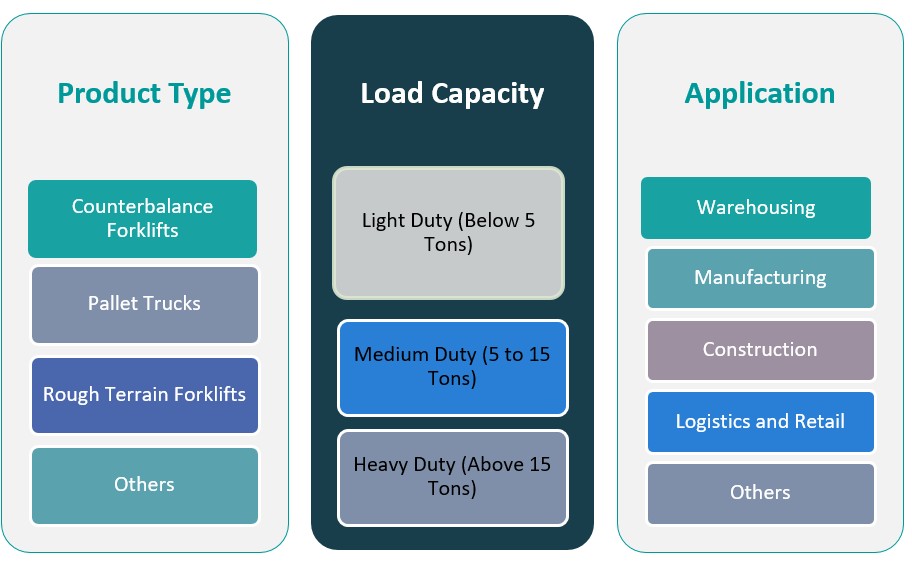
Counterbalance Forklifts dominate the market due to their versatility and ability to handle heavy loads with ease. These forklifts are widely used across various industries for their stability and maneuverability in tight spaces, making them ideal for warehousing and manufacturing applications. Pallet Trucks are growing in popularity, especially in warehouses and retail sectors, due to their simplicity and cost-effectiveness. They are primarily used for light-duty tasks, including material transport over short distances. Rough Terrain Forklifts are expected to see increasing demand, particularly in construction and outdoor environments, as they are designed to operate on uneven surfaces. This product type is gaining traction in regions with extensive construction activities. Others, including specialized forklifts for unique applications, represent a smaller but growing segment. These forklifts are tailored for niche markets, such as food and beverage handling or environments with specific safety requirements.
By Application
The market is segmented by application into Warehousing, Manufacturing, Construction, Logistics and Retail, and Others. Warehousing holds the largest share, driven by the rise in e-commerce and the need for efficient material handling systems in distribution centers and storage facilities. LPG forklifts in warehouses offer the advantage of quick refueling and longer operational hours compared to electric models. Manufacturing is another significant application area, particularly in industries such as automotive, where heavy-duty material handling equipment is required. LPG forklifts are well-suited for manufacturing environments due to their durability and ability to operate in confined spaces. Construction applications are expected to grow, especially in regions with active infrastructure development. Rough terrain LPG forklifts are commonly used in construction sites for lifting and transporting materials over rugged surfaces. Logistics and Retail also represent key sectors for LPG forklifts. With the increasing need for efficient supply chains and retail operations, LPG forklifts are utilized to transport goods in large retail stores, supermarkets, and logistics hubs. The Others category encompasses niche markets, such as specialized operations in cold storage or chemical handling, where specific types of forklifts are required.
Segments
Based on Product
- Counterbalance Forklifts
- Pallet Trucks
- Rough Terrain Forklifts
- Others
Based on Application
- Warehousing
- Manufacturing
- Construction
- Logistics and Retail
- Others
Based on Load Capacity
- Light Duty (Below 5 Tons)
- Medium Duty (5 to 15 Tons)
- Heavy Duty (Above 15 Tons)
Based on Region
- North America
- U.S.
- Canada
- Mexico
- Europe
- Germany
- France
- U.K.
- Italy
- Spain
- Rest of Europe
- Asia Pacific
- China
- Japan
- India
- South Korea
- South-east Asia
- Rest of Asia Pacific
- Latin America
- Brazil
- Argentina
- Rest of Latin America
- Middle East & Africa
- GCC Countries
- South Africa
- Rest of the Middle East and Africa
Regional Analysis
North America (25%)
North America holds a significant share of the global LPG forklift market, accounting for approximately 25%. The United States and Canada are key contributors to the market's growth in this region, with the logistics, manufacturing, and warehousing sectors driving the demand for LPG forklifts. The region is also influenced by stringent environmental regulations that encourage the adoption of more fuel-efficient and low-emission equipment, including LPG-powered forklifts. The trend towards automating material handling processes, along with a focus on sustainability, has further bolstered the demand for LPG forklifts in North America.
Europe (20%)
Europe represents around 20% of the global LPG forklift market. The region is known for its focus on sustainability and environmental regulations, which encourage the use of LPG forklifts as a more eco-friendly alternative to diesel-powered models. Countries like Germany, the UK, and France are major contributors to market growth, particularly in industries such as automotive, warehousing, and retail. The European Union’s stringent emission standards and policies aimed at reducing carbon footprints further promote the adoption of LPG forklifts, creating favorable conditions for market expansion.
Key players
- Toyota Industries Corporation
- Mitsubishi Forklift Trucks
- Hyster-Yale Materials Handling
- Nissan Forklift
- Linde Material Handling
Competitive Analysis
The global LPG forklift market is highly competitive, with key players continually innovating to maintain their market positions. Toyota Industries Corporation leads the market, known for its extensive product portfolio, including high-performance LPG forklifts, and its strong global presence. The company’s focus on reliability and sustainability gives it a significant edge. Mitsubishi Forklift Trucks also holds a strong market position, benefiting from its reputation for durability and cost-effectiveness. It emphasizes technological advancements and customization, meeting specific industry needs. Hyster-Yale Materials Handling is another formidable competitor, recognized for its robust industrial solutions and commitment to innovation, offering LPG forklifts with advanced features. Nissan Forklift differentiates itself with fuel-efficient models and a reputation for offering user-friendly forklifts, appealing to businesses focused on operational efficiency. Linde Material Handling is known for its premium offerings, combining advanced technology and safety features, which make its LPG forklifts popular in high-demand environments. These key players continue to drive competition through continuous product enhancements and strategic market expansion.
Recent Developments
- On January 29, 2024, Toyota Industries Corporation (TICO) extended its suspension of forklift shipments to include models equipped with 3.5-ton to 5.0-ton gasoline engines. This decision followed the earlier suspension of 1.5-ton to 8.0-ton diesel and 1.0-ton to 3.5-ton gasoline engine forklifts due to emissions certification irregularities.
- In February 2023, Mitsubishi Forklift Trucks enhanced its EDiA electric counterbalance range by introducing AutoBoost technology. This feature automatically adjusts power on inclines and under heavy loads, aiming to encourage customers to switch from LPG and diesel to electric forklifts.
Market Concentration and Characteristics
The global LPG forklift market is moderately concentrated, with a few major players holding significant market shares while numerous smaller players and regional manufacturers cater to specific niches. Key players such as Toyota Industries Corporation, Mitsubishi Forklift Trucks, Hyster-Yale Materials Handling, Nissan Forklift, and Linde Material Handling dominate the market, driving innovation and setting trends in fuel efficiency, emissions reduction, and advanced features like telematics and automation. The market is characterized by intense competition, as these companies focus on continuous product development, cost-effectiveness, and meeting strict environmental regulations. Additionally, the growing demand for sustainable and efficient material handling solutions is encouraging both established players and new entrants to innovate. However, the market also features a diverse range of offerings from smaller manufacturers who provide cost-effective, region-specific models tailored to different industrial applications, contributing to the market's fragmentation.
Report Coverage
The research report offers an in-depth analysis based on Product, Application, Load Capacity and Region. It details leading market players, providing an overview of their business, product offerings, investments, revenue streams, and key applications. Additionally, the report includes insights into the competitive environment, SWOT analysis, current market trends, as well as the primary drivers and constraints. Furthermore, it discusses various factors that have driven market expansion in recent years. The report also explores market dynamics, regulatory scenarios, and technological advancements that are shaping the industry. It assesses the impact of external factors and global economic changes on market growth. Lastly, it provides strategic recommendations for new entrants and established companies to navigate the complexities of the market.
Future Outlook
- As environmental regulations become stricter, the demand for low-emission forklifts, including LPG-powered models, will continue to rise. Manufacturers will innovate to meet sustainability goals while maintaining operational efficiency.
- Technological innovations, such as telematics and smart fleet management systems, will enhance the performance and efficiency of LPG forklifts. This will further drive adoption in industries focused on operational optimization.
- The adoption of hybrid forklifts combining LPG with electric power is expected to grow, offering businesses flexibility in operations and helping meet both environmental and operational demands.
- Emerging markets in Asia Pacific, Latin America, and the Middle East will drive substantial growth, with industries like manufacturing and logistics in these regions increasingly relying on LPG forklifts for cost-effective material handling solutions.
- The growth of e-commerce and logistics industries, especially in developing economies, will increase demand for LPG forklifts in warehouses and distribution centers, where efficiency and speed are critical.
- Stricter environmental policies in regions like Europe and North America will encourage businesses to shift towards LPG forklifts to comply with emissions standards and reduce operational costs.
- The demand for cost-effective material handling solutions will continue to drive LPG forklift adoption, particularly in industries looking to reduce operational expenses without sacrificing productivity.
- Future trends will see more customized LPG forklift solutions tailored to specific industries, such as food and beverage, chemicals, and pharmaceuticals, where operational requirements differ.
- Indoor environments, particularly in industries with limited space, will see increased use of LPG forklifts due to their ability to operate efficiently with reduced emissions, making them ideal for urban settings.
- The market will become increasingly competitive, with manufacturers focusing on innovation, fuel efficiency, and sustainability to capture market share. Strategic partnerships and acquisitions will further shape the competitive environment.

Request a Free Sample
Fill in your details and we'll send you a free sample report.
- Sample data tables & charts
- Research methodology
Market Dynamics
Adoption Driven by Environmental Regulations
Stricter global and regional emissions standards are pushing industries to adopt LPG forklifts, which emit fewer pollutants than diesel models and help companies meet sustainability targets.
Cost-Effectiveness and Operational Efficiency
LPG forklifts offer lower operational and maintenance costs, as well as faster refueling compared to electric alternatives, making them attractive for businesses seeking to maximize uptime and reduce expenses.
Technological Advancements in LPG Forklifts
Manufacturers are introducing advanced LPG forklift models with improved fuel efficiency, telematics, and automation features, enhancing performance and appealing to industries focused on productivity and fleet management.
Growth of Warehousing, Logistics, and E-commerce
The rapid expansion of warehousing and logistics, especially due to e-commerce growth, is increasing the need for efficient, clean-operating forklifts that can handle high throughput in indoor environments.
Expansion in Emerging Markets
Industrialization and infrastructure development in Asia Pacific, Latin America, and the Middle East are driving demand for LPG forklifts as these regions seek cost-effective and reliable material handling solutions.
Need a Custom Version of This Report?
Tailor the scope, geography, or segments to your exact requirements.
- Custom geography or segment scope
- Direct access to our analyst team
Frequently Asked Questions
What is the projected market size of the LPG forklift market in 2024 and 2032?
What are the main drivers of the global LPG forklift market?
Which regions are leading in the LPG forklift market?
What are the advantages of LPG forklifts over other types of forklifts?
Who are the major players in the LPG forklift market?
Table of Content
Chapter 1 Market Segmentation
- 1.1 Segmentation Framework
- 1.1.1 Product and Service Classification
- 1.1.2 Application and End-Use Classification
- 1.1.3 Technology and Solution Classification
- 1.1.4 Customer and Distribution Channel Classification
- 1.1.5 Geographic Segmentation
- 1.1.6 Market Segment Definitions and Boundaries
- 1.2 By Product
- 1.2.1 Counterbalance Forklifts
- 1.2.2 Pallet Trucks
- 1.2.3 Rough Terrain Forklifts
- 1.2.4 Others
- 1.3 By Application
- 1.3.1 Warehousing
- 1.3.2 Manufacturing
- 1.3.3 Construction
- 1.3.4 Logistics and Retail
- 1.3.5 Others
- 1.4 By Load Capacity
- 1.4.1 Light Duty (Below 5 Tons)
- 1.4.2 Medium Duty (5 to 15 Tons)
- 1.4.3 Heavy Duty (Above 15 Tons)
Chapter 2 Introduction
- 2.1 Report Objectives and Scope
- 2.2 Product Definition and Industry Terminology
- 2.3 Market Inclusions and Exclusions
- 2.4 Research Process
- 2.4.1 Primary Research and Expert Interviews
- 2.4.2 Secondary Research and Source Review
- 2.4.3 Top-Down and Bottom-Up Estimation
- 2.4.4 Data Triangulation and Verification
- 2.5 Market Size Measurement Basis
- 2.5.1 2024: USD 5,594.50 million → 2032: USD 9,420.05 million
- 2.6 Historical and Forecast Reference Periods
- 2.6.1 Base Year: 2024
- 2.6.2 Forecast Period: 2024-2032
- 2.7 Research Assumptions and Limitations
Chapter 3 Executive Summary
- 3.1 Market Snapshot and Key Findings
- 3.2 Base-Year Market Size, 2024
- 3.3 Forecast Market Size, 2032
- 3.4 Revenue and Volume Growth Outlook
- 3.5 Key Demand and Supply Indicators
- 3.6 Leading Market Segments
- 3.7 Fastest-Growing Market Opportunities
- 3.8 Regional Performance Highlights
- 3.9 Technology and Industry Transformation
- 3.10 Competitive Landscape Summary
- 3.11 Analyst View and Strategic Implications
Chapter 4 Global LPG Forklift Market Trends and Developments
- 4.1 Historical Industry Development
- 4.2 Recent Market Trends and Developments
- 4.3 Demand and Customer Behavior Trends
- 4.4 Technology and Product Innovation
- 4.5 Artificial Intelligence, Automation and Digitalization
- 4.6 Local Manufacturing and Supply Chain Realignment
- 4.7 Industry Partnerships, Mergers and Acquisitions
- 4.8 Sustainability and Circular Economy Developments
- 4.9 Government and Private Sector Investment Trends
- 4.10 Emerging Business Models and Commercialization
- 4.11 Industry Developments and Announcements
Chapter 5 Global LPG Forklift Market Production, Supply and Demand Analysis
- 5.1 Demand Trend and Consumption Analysis
- 5.2 Demand Forecast, 2024-2032
- 5.3 Production and Output Trend
- 5.4 Production and Output Forecast, 2024-2032
- 5.5 Installed Capacity and Capacity Utilization
- 5.6 Company-Wise Production Plants and Statistics
- 5.6.1 Installed Production Capacity
- 5.6.2 Actual Production
- 5.6.3 Planned Capacity and Expansion Targets
- 5.7 Supply Chain Structure and Procurement Trends
- 5.8 Supply-Demand Gap and Bottlenecks
- 5.9 Import Dependence and Sourcing Structure
- 5.10 Contract Manufacturing and Outsourcing
- 5.11 Regional Supply and Demand Concentration
Chapter 6 Global LPG Forklift Market Pricing Analysis
- 6.1 Pricing Structure and Measurement
- 6.2 Historical Pricing Trends
- 6.3 Pricing Outlook, 2024-2032
- 6.4 Average Selling Price and Unit Economics
- 6.5 Pricing by Product and Market Segment
- 6.6 Geographic Pricing Differences
- 6.7 Key Input, Energy, Labor and Logistics Costs
- 6.8 Contract Pricing and Purchasing Models
- 6.9 Pricing Sensitivity and Competitive Positioning
- 6.10 Price, Margin and Profitability Implications
Chapter 7 Global LPG Forklift Market Dynamics
- 7.1 Market Growth Drivers
- 7.1.1 Demand-Side Drivers
- 7.1.2 Technology and Innovation Drivers
- 7.1.3 Infrastructure and Investment Drivers
- 7.1.4 Regulatory and Policy Drivers
- 7.2 Market Restraints
- 7.2.1 Cost and Affordability Constraints
- 7.2.2 Technology and Adoption Barriers
- 7.2.3 Supply Chain and Operational Constraints
- 7.3 Market Challenges
- 7.3.1 Competitive Pressure and Margin Erosion
- 7.3.2 Skills, Infrastructure and Implementation Gaps
- 7.4 Emerging Market Opportunities
- 7.5 Market Dynamics Impact and Time-Horizon Assessment
Chapter 8 Global LPG Forklift Value Chain Analysis
- 8.1 Industry Value Chain Overview
- 8.2 Upstream Suppliers and Critical Inputs
- 8.3 Technology and Component Providers
- 8.4 Manufacturing or Service Delivery
- 8.5 Distribution, Channel Partners and Integrators
- 8.6 Downstream Applications and End Users
- 8.7 Value Addition and Profit Pools
- 8.8 Vertical Integration and Outsourcing
- 8.9 Supplier Concentration and Risk
- 8.10 Supply Chain Localization and Resilience
Chapter 9 Global LPG Forklift Market Regulations and Policies
- 9.1 Relevant Laws, Standards and Compliance Frameworks
- 9.2 Product, Service, Safety and Quality Requirements
- 9.3 Government Policies, Incentives and Subsidies
- 9.4 Imports, Exports and Trade Barriers
- 9.5 Public Procurement and Local Content Requirements
- 9.6 Environmental and Sustainability Compliance
- 9.7 Upcoming Policy Changes and Market Implications
Chapter 10 Global LPG Forklift Market Hotspots and Opportunities
- 10.1 Market Opportunity Mapping and Growth Hotspots
- 10.2 High-Growth Applications and Customer Groups
- 10.3 Underserved Markets and White-Space Opportunities
- 10.4 Emerging Technology and Product Opportunities
- 10.5 New Capacity and Investment Hotspots
- 10.6 Market Entry and Expansion Opportunities
- 10.7 Distribution and Partnership Opportunities
- 10.8 Near-Term and Long-Term Commercial Potential
- 10.9 Opportunity Attractiveness and Execution Risks
Chapter 11 Global LPG Forklift Market Outlook, 2024-2032
- 11.1 Market Size and Analysis
- 11.1.1 Revenue (Market Measurement: 2024: USD 5,594.50 million → 2032: USD 9,420.05 million)
- 11.1.2 Market Volume and Quantity Sold
- 11.1.3 Historical Market Size
- 11.1.4 Base-Year Market Size, 2024
- 11.2 Market Forecast, 2024-2032
- 11.2.1 Revenue Forecast to 2032
- 11.2.2 Volume Forecast to 2032
- 11.2.3 CAGR and Year-on-Year Growth
- 11.2.4 Incremental Revenue Opportunity
- 11.3 Forecast Assumptions and Scenario Analysis
- 11.3.1 Base-Case Forecast
- 11.3.2 Optimistic and Conservative Scenarios
- 11.3.3 Technology, Pricing and Policy Sensitivities
- 11.4 Market Attractiveness and Growth Outlook
Chapter 12 Global LPG Forklift Market Segmentation and Outlook
- 12.1 Segmentation Summary and Market Shares, 2024
- 12.2 Largest and Fastest-Growing Segments
- 12.3 By Product - Market Size and Forecast, 2024-2032
- 12.3.1 Segment Definition and Scope
- 12.3.2 Historical Market Size
- 12.3.3 Revenue Forecast, 2024-2032
- 12.3.4 Volume Forecast, 2024-2032
- 12.3.5 Base-Year Market Share, 2024
- 12.3.6 Segment CAGR and Growth Drivers
- 12.3.7 Subsegment Market Size and Forecast
- 12.3.7.1 Counterbalance Forklifts
- 12.3.7.2 Pallet Trucks
- 12.3.7.3 Rough Terrain Forklifts
- 12.3.7.4 Others
- 12.3.8 Subsegment Pricing and Adoption Trends
- 12.3.9 Leading Suppliers and Competition
- 12.3.10 Regional Demand and Opportunities
- 12.4 By Application - Market Size and Forecast, 2024-2032
- 12.4.1 Segment Definition and Scope
- 12.4.2 Historical Market Size
- 12.4.3 Revenue Forecast, 2024-2032
- 12.4.4 Volume Forecast, 2024-2032
- 12.4.5 Base-Year Market Share, 2024
- 12.4.6 Segment CAGR and Growth Drivers
- 12.4.7 Subsegment Market Size and Forecast
- 12.4.7.1 Warehousing
- 12.4.7.2 Manufacturing
- 12.4.7.3 Construction
- 12.4.7.4 Logistics and Retail
- 12.4.7.5 Others
- 12.4.8 Subsegment Pricing and Adoption Trends
- 12.4.9 Leading Suppliers and Competition
- 12.4.10 Regional Demand and Opportunities
- 12.5 By Load Capacity - Market Size and Forecast, 2024-2032
- 12.5.1 Segment Definition and Scope
- 12.5.2 Historical Market Size
- 12.5.3 Revenue Forecast, 2024-2032
- 12.5.4 Volume Forecast, 2024-2032
- 12.5.5 Base-Year Market Share, 2024
- 12.5.6 Segment CAGR and Growth Drivers
- 12.5.7 Subsegment Market Size and Forecast
- 12.5.7.1 Light Duty (Below 5 Tons)
- 12.5.7.2 Medium Duty (5 to 15 Tons)
- 12.5.7.3 Heavy Duty (Above 15 Tons)
- 12.5.8 Subsegment Pricing and Adoption Trends
- 12.5.9 Leading Suppliers and Competition
- 12.5.10 Regional Demand and Opportunities
- 12.6 Segment Growth Comparison
- 12.7 Segment Attractiveness and Priority Matrix
Chapter 13 Global LPG Forklift End-Use and Application Market Outlook
- 13.1 End-Use Industry and Customer Demand Structure
- 13.2 Leading Applications and Customer Groups
- 13.3 End-Use Market Size, Share and Forecast
- 13.4 Major End-Use Industry Deep Dives
- 13.4.1 Customer Requirements and Use Cases
- 13.4.2 Demand and Replacement Cycles
- 13.4.3 Technical and Regulatory Considerations
- 13.4.4 Purchasing and Procurement Models
- 13.4.5 Leading Vendors and Distribution Channels
- 13.4.6 Forecast and Commercial Opportunities
- 13.5 Emerging Applications and Cross-Segment Demand
- 13.6 End-Use Industry Investment Priorities
Chapter 14 Global LPG Forklift Geographic Market Outlook, 2024-2032
- 14.1 Regional Market Size and Share, 2024
- 14.2 Regional Market Forecast, 2024-2032
- 14.3 Regional Pricing, Production and Demand Differences
- 14.4 North America
- 14.4.1 United States
- 14.4.2 Canada
- 14.4.3 Mexico
- 14.5 Europe
- 14.5.1 Germany
- 14.5.2 France
- 14.5.3 Italy
- 14.5.4 United Kingdom
- 14.5.5 Spain
- 14.5.6 Poland
- 14.5.7 Russia
- 14.5.8 Netherlands
- 14.5.9 Belgium
- 14.5.10 Sweden
- 14.5.11 Denmark
- 14.5.12 Norway
- 14.5.13 Rest of Europe
- 14.6 Asia Pacific
- 14.6.1 China
- 14.6.2 India
- 14.6.3 Japan
- 14.6.4 South Korea
- 14.6.5 Thailand
- 14.6.6 Indonesia
- 14.6.7 Vietnam
- 14.6.8 Malaysia
- 14.6.9 Australia
- 14.6.10 Rest of Asia Pacific
- 14.7 Latin America
- 14.7.1 Brazil
- 14.7.2 Argentina
- 14.7.3 Colombia
- 14.7.4 Chile
- 14.7.5 Rest of Latin America
- 14.8 Middle East
- 14.8.1 Saudi Arabia
- 14.8.2 United Arab Emirates
- 14.8.3 Turkey
- 14.8.4 Israel
- 14.8.5 Iran
- 14.8.6 Rest of the Middle East
- 14.9 Africa
- 14.9.1 South Africa
- 14.9.2 Egypt
- 14.9.3 Nigeria
- 14.9.4 Morocco
- 14.9.5 Rest of Africa
- 14.10 Regional Investment, Policy and Supply Chain Differences
- 14.11 Regional Competitive Landscape
- 14.12 Geographic Growth Hotspots
Chapter 15 Global LPG Forklift Technology, Innovation and Sustainability Outlook
- 15.1 Technology Landscape and Maturity
- 15.2 Product, Process and Service Innovation
- 15.3 AI, Automation and Digital Tools in the Industry
- 15.4 Technology Adoption and Performance Benchmarking
- 15.5 Innovation Pipeline and R&D Investment
- 15.6 Patent and Intellectual Property Trends
- 15.7 Energy Efficiency and Resource Management
- 15.8 Sustainability, Recycling and Circularity
- 15.9 Technology Roadmap, 2024-2032
- 15.10 Risks of Obsolescence and Technology Substitution
Chapter 16 Global LPG Forklift Market Key Strategic Imperatives
- 16.1 Growth and Market Entry Priorities
- 16.2 High-Return Products and Segments
- 16.3 Pricing, Profitability and Cost Optimization
- 16.4 Technology Investment and Product Differentiation
- 16.5 Supply Chain Localization and Resilience
- 16.6 Distribution and Customer Acquisition
- 16.7 Partnership, Acquisition and Capacity Strategy
- 16.8 Regional Expansion Priorities
- 16.9 Short-, Medium- and Long-Term Actions
Chapter 17 Competition Outlook
- 17.1 Industry Competition Characteristics
- 17.2 Market Structure and Concentration
- 17.3 Market Share and Competitive Positioning, 2024
- 17.4 Company-Wise Revenue and Product Benchmarking
- 17.5 Production and Service Capacity Benchmarking
- 17.6 Technology, Pricing and Differentiation
- 17.7 Regional Footprint and Distribution Strength
- 17.8 Mergers, Acquisitions and Strategic Alliances
- 17.9 New Entrants and Competitive Threats
- 17.10 Porter's Five Forces and Industry Attractiveness
- 17.11 Competitive Outlook, 2024-2032
Chapter 18 Company Profiles
- 18.1 Company Coverage and Selection Criteria
- 18.2 Toyota Industries Corporation
- 18.2.1 Business Description
- 18.2.2 Company Ownership and Geographic Presence
- 18.2.3 Product and Service Portfolio
- 18.2.4 Manufacturing and Operating Footprint
- 18.2.5 Production Capacity and Expansion Plans
- 18.2.6 Financial Performance and Investment
- 18.2.7 Market Share and Competitive Position
- 18.2.8 Technology and Innovation Capabilities
- 18.2.9 Strategic Alliances or Partnerships
- 18.2.10 Recent Developments
- 18.2.11 Growth Strategy and Outlook
- 18.3 Mitsubishi Forklift Trucks
- 18.4 Hyster-Yale Materials Handling
- 18.5 Nissan Forklift
- 18.6 Linde Material Handling
- 18.7 KION Group AG
- 18.8 Jungheinrich AG
- 18.9 Crown Equipment Corporation
- 18.10 Komatsu Ltd.
- 18.11 Doosan Industrial Vehicle
- 18.12 Other Relevant Market Participants
Note: Every listed company is profiled on the structure shown under the first company. The company list is preliminary and may change based on research findings, market developments, data availability and client requirements.
Chapter 19 Disclaimer
- 19.1 Research and Forecast Disclaimer
- 19.2 Data Source and Estimation Limitations
Note: The depth of individual sections depends on data availability for this market. Volume, capacity, trade and other unit-based metrics are included where applicable.

