
Quick answer
An automatic plant watering system plant that molds drippers and fittings, extrudes micro-tubing and assembles timers makes about 400,000 kits and controllers a year and needs total CapEx of roughly USD 1.6–2.7 million in an Asian industrial park, including land, molds and working capital margin. Gross margin typically runs 24–32% of ex-factory price, higher on app-connected controllers, and payback falls in a 4–6 year band at 65–75% utilization.
Feasible for entrants with a retail or private-label offtake plan and in-house mold capability; plain drip kits alone face heavy price competition from Chinese volume.
Automatic Plant Watering System plant: key highlights
| Parameter | Indicative value | Note |
|---|---|---|
| Plant capacity | 400,000 units per year | About 250,000 drip kits and 150,000 timers and controllers, two shifts, 300 days |
| Total CapEx | USD 1.6–2.7 million | Asian industrial park; land, shed, molding, extrusion, assembly, test, working capital margin |
| Raw material share of operating cost | 58–66% | Resin, circuit boards, solenoids, brass inlets, packaging |
| Gross margin | 24–32% | On ex-factory price after materials, direct labor and power |
| Payback period | 4–6 years | Central case at 65–75% utilization from year two |
| IRR | Available in report | Post-tax, 10-year model |
| Break-even | Available in report | Capacity utilization basis |
Ranges assume a 400,000 units a year plant (250,000 drip kits, 150,000 timers) on one acre in an Asian industrial park with a 2,500 sq m shed, 2026 prices, machinery listings converted at INR 88 per USD, bought-in circuit boards, in-house molding, tubing extrusion and assembly, assumed ex-factory prices of USD 8–14 per kit and USD 10–16 per timer, and 65–75% utilization. U.S. or EU sites cost more. The full report can be customized to any country.
What is an automatic plant watering system?
An automatic plant watering system delivers measured amounts of water to pots, beds, lawns or greenhouse benches without anyone opening a tap. A typical consumer set combines a battery or 24 VAC controller, a solenoid or motorized valve, a filter and pressure regulator, 4 mm or 16 mm polyethylene tubing, and drippers, micro-sprayers or soaker line. Higher-end units add Wi-Fi or Bluetooth control, rain delay, soil moisture sensing and weather-based scheduling through an app.
Product grades run from simple hose-end timers and indoor pot-watering kits to multi-zone home controllers and small greenhouse drip sets. For customs, drip and micro-sprinkler equipment for gardens and farms falls under HS subheading 8424.82, agricultural or horticultural appliances for projecting or dispersing liquids, the code U.S. Customs applied to Netafim on-line drippers in ruling N284425 of April 2017. Stand-alone timers are treated differently: in ruling N334563 of September 2023, CBP classified battery water timers as valves under 8481.80, so a plant shipping timers separately from kits should plan for both codes. Buyers include households, garden centers, DIY chains, online sellers, landscapers and small greenhouse growers.
Automatic plant watering system market overview and global demand
Credence Research values the global garden watering systems market at USD 4,599.6 million in 2024, growing at a 6.29% CAGR to about USD 7.4 billion by 2032. Carried forward one year, that implies roughly USD 4.9 billion in 2025, a figure derived from the 2024 value and the forecast CAGR. The connected segment grows faster: Credence Research puts the smart irrigation market at USD 2,025.2 million in 2024 with a 12.58% CAGR, as app-controlled timers and weather-aware controllers replace mechanical dials.
Water use explains the pull, and the U.S. Environmental Protection Agency's WaterSense program says outdoor use averages more than 30% of household water and can reach 60% in arid regions, that up to 50% of outdoor water is lost to wind, evaporation and runoff, and that a WaterSense labeled controller can cut an average home's irrigation use by up to 30%, about 15,000 gallons a year. Utility rebates and watering restrictions in the western United States, Australia, southern Europe and the Middle East turn those savings into purchase triggers.
A large share of low-cost timers, drip kits and fittings sold through global retail and online channels is made in China, while brand owners in the United States, Germany, Italy, Israel and the United Kingdom design and assemble premium lines. Europe is a big seasonal market: Husqvarna Group reported in April 2026 that Gardena's irrigation products grew in the first quarter, led by Europe, even as division sales fell 7% in Swedish kronor terms. Hot, dry summers lift sell-through, while wet seasons leave retailers holding stock, so orders swing from year to year. Balcony gardening, urban food growing and hobby greenhouses widen the buyer base beyond lawn owners.
Automatic plant watering system manufacturing process
A mid-size plant molds its own plastic parts, extrudes tubing and assembles controllers from bought-in circuit boards. In-house molding protects margin because fittings, drippers and valve bodies are high-volume parts, while surface-mount electronics are usually left to contract assemblers with full reflow lines.
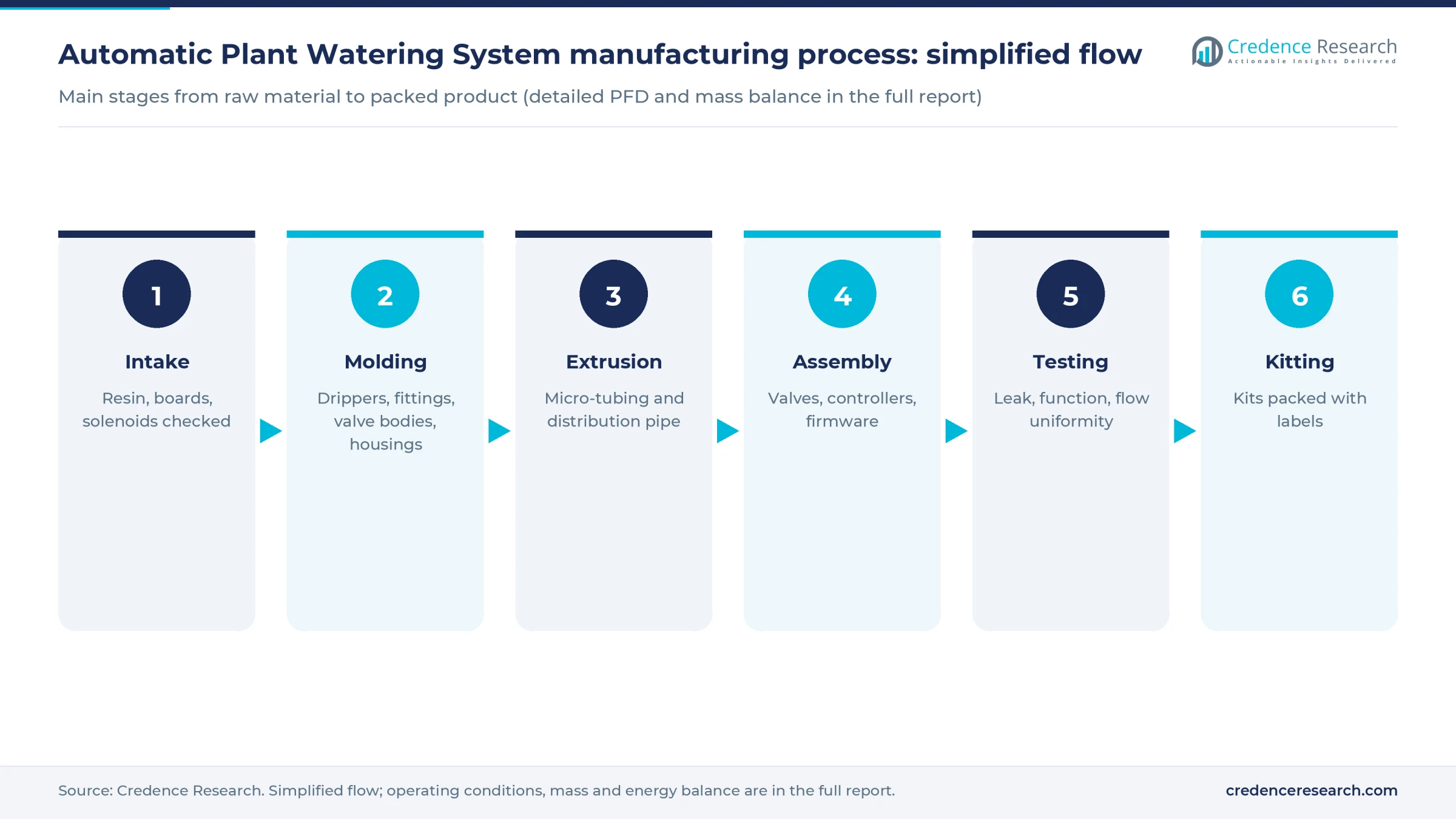
- Resin and component intake. Polypropylene, polyacetal (POM), ABS and linear low-density polyethylene granules are checked for melt flow and UV stabilizer content, and circuit board assemblies, solenoid coils, brass inlets, O-rings and diaphragms are sampled against drawings.
- Injection molding. Multi-cavity molds produce drippers, adjustable emitters, barbed connectors, end caps, stakes, valve bodies and controller housings. Pressure-compensating drippers need tight tolerances on the labyrinth and membrane seat, because a few hundredths of a millimeter shift the flow rate.
- Tubing extrusion. A small extrusion line makes 4 mm micro-tubing and 13–16 mm distribution pipe with carbon black or UV additives, cooled in a vacuum tank and wound into retail coils.
- Valve and controller assembly. Diaphragms, springs and solenoids go into valve bodies, and boards, displays, keypads and battery contacts go into housings sealed by ultrasonic welding or gaskets to an ingress rating suited to outdoor use. Firmware is flashed and radio modules paired on Wi-Fi or Bluetooth models.
- Testing. Every valve gets a leak and opening-pressure test and every controller a functional and current-draw test, while drippers are sampled for flow uniformity against the coefficient of variation buyers specify. Housing batches go through UV exposure, temperature cycling and drop tests.
- Kitting and packing. Tubing coils, emitters, connectors, a filter or pressure regulator and the timer are counted into boxed kits or blister packs with instructions and market-specific compliance labels.
Scrap comes mainly from short shots and flash on small parts, warped housings and leaking welds. Regrind can return to stakes and caps but not to precision drippers, so mold maintenance sets yield.
Automatic plant watering system plant setup cost
For a plant rated at 400,000 units a year, about 250,000 drip and micro-irrigation kits and 150,000 electronic timers and controllers on two shifts over 300 days, total project cost comes to roughly USD 1.6–2.7 million in an Asian industrial park, the cost region used for this range. The spread depends mainly on how many molds the promoter commissions, whether tubing is extruded or bought, and the size of the pre-season stock buffer. The full report can be customized to any country.
Land shows how the build works. A plant of this size needs about one acre, roughly 4,000 sq m, for a 2,500 sq m shed, a resin store, a finished goods warehouse sized for spring stocking and truck access. At USD 30–70 per sq m for an industrial estate plot (assumed), land costs about USD 120,000–280,000. A pre-engineered building with a clean assembly room, office and utilities at USD 180–250 per sq m (assumed) adds USD 450,000–625,000. U.S. or EU sites can raise total CapEx by 1.5–2.5 times (assumed), mostly through buildings and wages.
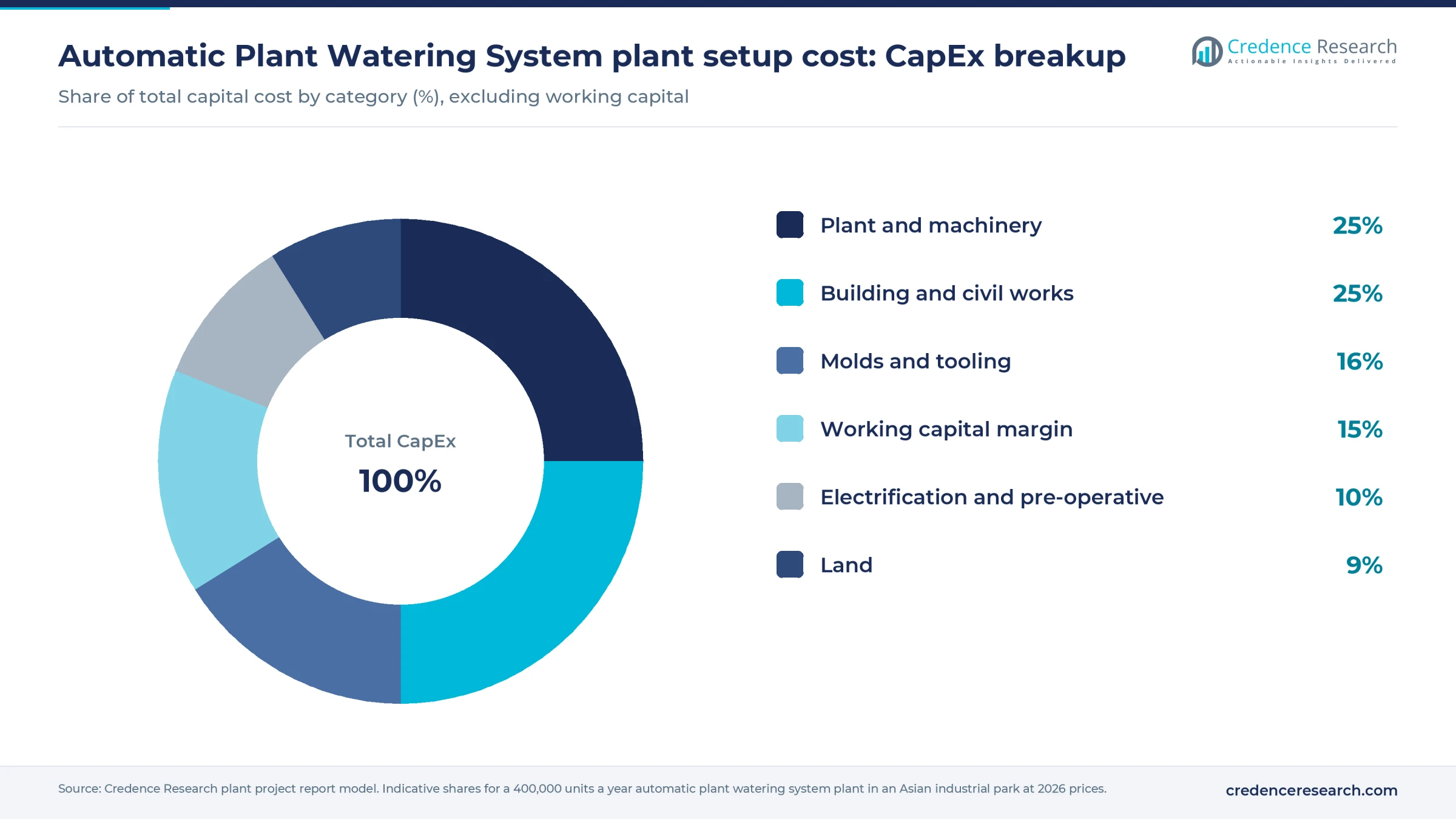
Plant and machinery, including eight injection molding machines, one or two small extrusion lines, ultrasonic welders, assembly and test stations and utilities, comes to roughly USD 420,000–680,000, benchmarked on supplier listings of about USD 25,000 for a 150-ton molding machine. Molds and tooling for 25–35 parts add USD 250,000–450,000, based on multi-cavity dripper mold listings of about USD 6,000–34,000 each. Electrification, pre-operative costs and contingency take USD 150,000–250,000, and the working capital margin is USD 250,000–400,000 because retailers order months ahead of spring and pay on long terms.
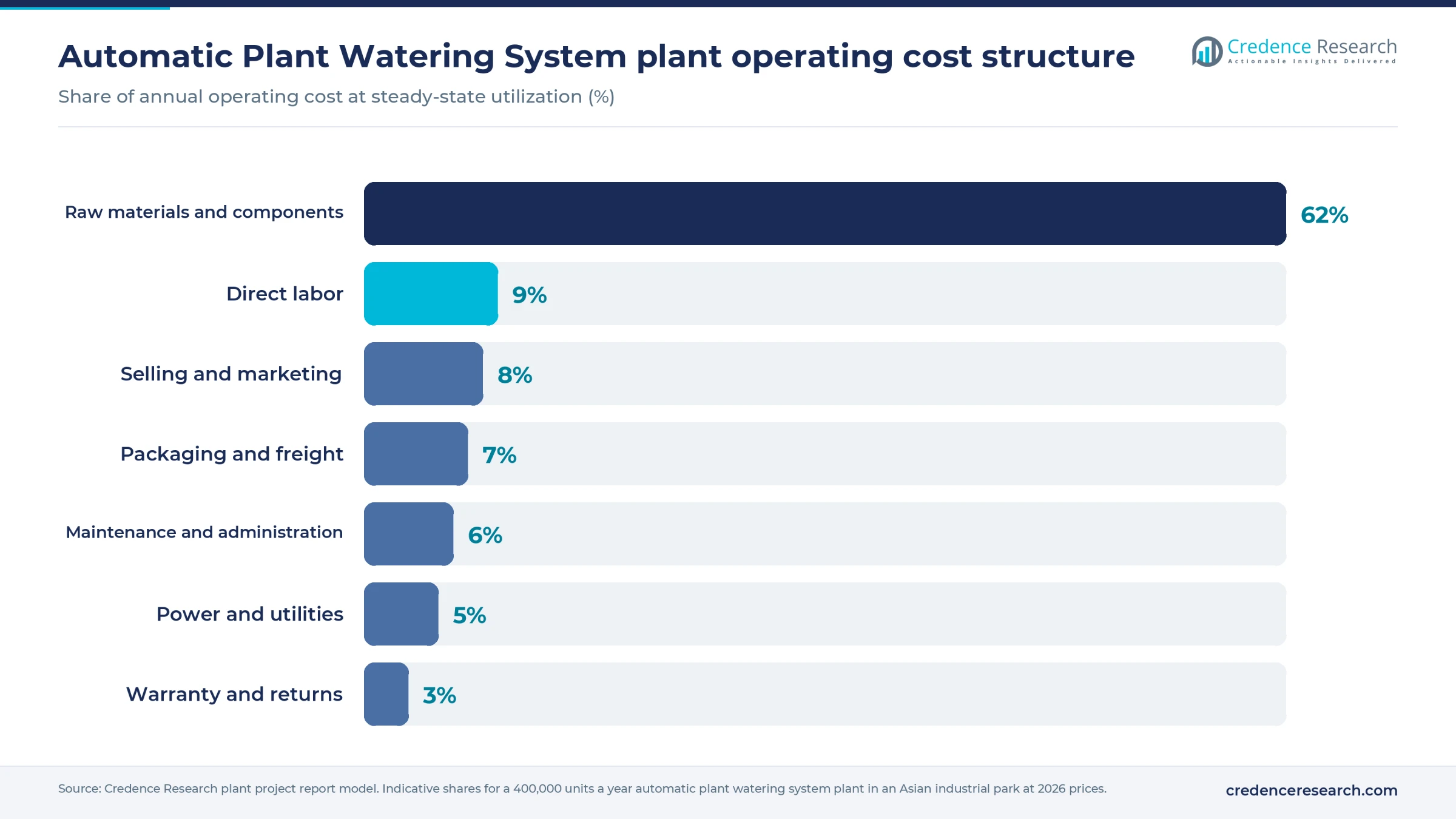
Operating cost is led by bought electronics and resin. Circuit boards, solenoids and displays can make up half of a controller's bill of materials, so component prices matter as much as polymer prices.
Machinery and raw materials for an automatic plant watering system plant
The machinery list covers servo-driven injection molding machines in the 80–250 ton range with hot-runner multi-cavity molds, granule dryers, mold temperature controllers and a chiller, a micro-tubing extrusion line with vacuum sizing and coiler, ultrasonic welding presses, coil winding machines if solenoids are made in-house, pneumatic assembly fixtures, firmware programming jigs, valve leak and flow benches, a dripper flow-uniformity rig, a UV and climate chamber, an air compressor and a backup generator.
Raw materials are polypropylene, POM and ABS for fittings, emitters and housings, LLDPE and LDPE for tubing, silicone or EPDM for diaphragms and dripper membranes, brass for hose inlets, copper wire and steel plungers for solenoids, plus bought-in circuit board assemblies, LCD displays, radio modules and printed cartons. Polyolefins come from producers in the Middle East, China, the United States, South Korea and Singapore, while POM is made mainly in China, Japan, Germany, South Korea and the United States. Electronic assemblies come largely from China, Vietnam, Taiwan and Malaysia. Weather-aware products tie the plant to the non-agriculture smart irrigation controllers market, where firmware and app quality decide brand loyalty, and larger drip sets serve buyers in the greenhouse irrigation systems market.
Automatic plant watering system business profit margin and ROI
Margins depend on product mix, channel and brand. Unbranded drip kits sold to importers and online resellers compete on price against large Chinese volumes, while timers and app-connected controllers carry more value per unit and repeat accessory sales. At assumed ex-factory prices of USD 8–14 per kit and USD 10–16 per timer, bought materials and components take 58–66% of sales and direct labor and power another 8–10%, leaving a gross margin of about 24–32%.
At 65–75% utilization, the plant sells about 260,000–300,000 units and earns roughly USD 2.3–3.9 million a year. After selling, warranty, freight and administrative costs, cash profit of about USD 0.35–0.55 million in a central case supports a payback of 4–6 years on the mid-point investment. The main risks are a wet or cool season that leaves retail stock unsold, returns from leaking valves or failed boards, and retailer pressure on private-label pricing.
| Metric | Value |
|---|---|
| Gross margin | 24–32% |
| Payback period | 4–6 years |
| IRR (post-tax) | Available in report |
| NPV | Available in report |
| ROI | Available in report |
| DSCR | Available in report |
Sensitivity is strongest to realization: a 10% cut in ex-factory price without a matching cost cut trims gross margin by about 7–9 percentage points.
How to start an automatic plant watering business, licenses and approvals
A new plant needs business and tax registration, land use and building permits, an environmental permit or consent for plastics processing, which most authorities treat as low to moderate impact, fire and occupational safety approvals, and importer-exporter registration for resin and electronic components. Product approvals depend on what each kit contains: electronic controllers need electromagnetic and radio compliance, plug-in adapters need electrical safety approval, and drip components may need a national standard mark where public subsidies apply.
| Market | Main approvals for this product |
|---|---|
| United States | FCC Part 15 authorization for digital controllers, with an FCC ID for Wi-Fi or Bluetooth models; NRTL listing of any plug-in Class 2 power supply; optional EPA WaterSense label for weather-based or soil moisture-based controllers; California Proposition 65 warnings where brass or PVC parts trigger them |
| European Union | CE marking under the Radio Equipment Directive 2014/53/EU for wireless controllers, including its cybersecurity requirements applied from August 2025, or the EMC Directive for wired units, with the Low Voltage Directive for mains adapters; RoHS, WEEE, the Batteries Regulation and REACH; the General Product Safety Regulation for non-electrical kit parts |
| India | BIS certification to IS 13487 for emitters, IS 12786 for laterals and IS 13488 for emitting pipes, which Per Drop More Crop subsidy guidelines require from registered suppliers; WPC Equipment Type Approval for Wi-Fi or Bluetooth controllers |
Consumer garden kits mostly sell outside subsidy channels, but BIS-marked drippers open the much larger farm segment.
Key automatic plant watering system makers and recent developments
Leading makers of automatic watering products include Rain Bird and Hunter Industries in the United States, Husqvarna Group through its Gardena and Orbit B-hyve brands, Claber in Italy and Hozelock in the United Kingdom, with Netafim, part of Orbia, Rivulis and Jain Irrigation Systems strong in drip components. Rain Bird has owned Rachio, a maker of Wi-Fi controllers, since October 2025. Many Chinese factories supply private-label timers and kits to retailers and online brands.
- March 2026. Rain Bird launched electronic hose-end timers in one- and two-station versions with a low-draw solenoid, rain delay of up to 96 hours and run times from one minute to three hours.
- March 2026. Irrigreen introduced a Smart Drip System co-developed with Netafim, using a smart valve that monitors pressure and flow to flag leaks and clogs in garden-bed drip lines.
- June 2026. Orbia Netafim opened a 323,000 sq ft drip irrigation plant in Hermosillo, Mexico, its 21st production site worldwide, expected to create 200 jobs.
For a new entrant, these moves show brands pushing sensing and app features into entry-level products, which raises the bar for unbranded timers.
What's inside the Automatic Plant Watering System project report PDF
The report runs to 21 chapters. Open a chapter to see its sections.
1. Preface
2. Scope and Methodology
- 2.1 Objectives of the Study
- 2.2 Stakeholders
- 2.3 Research Methodology
- 2.4 Data Sources and Key Assumptions
3. Executive Summary
- 3.1 Market Snapshot
- 3.2 Project at a Glance (Capacity, CapEx, OpEx)
- 3.3 Key Financial Indicators (IRR, NPV, Payback, Break-even)
- 3.4 Feasibility Verdict
4. Product Overview
- 4.1 Automatic Plant Watering System Definition and Properties
- 4.2 Grades and Specifications (BIS / ISO / ASTM)
- 4.3 HS Code and Classification
- 4.4 Key Applications
- 4.5 Substitutes
5. Global Automatic Plant Watering System Market
- 5.1 Market Overview
- 5.2 Historical and Current Market Performance (Volume and Value)
- 5.3 Market Breakup by Grade / Type
- 5.4 Market Breakup by End-Use Industry
- 5.5 Market Breakup by Region
- 5.6 Market Drivers, Restraints and Trends
- 5.7 Value Chain Analysis
- 5.8 Market Forecast
6. Target Country Automatic Plant Watering System Market Analysis
- 6.1 Demand and Supply Analysis
- 6.2 Installed Capacity vs Demand Gap
- 6.3 Import Dependence
- 6.4 Demand Forecast by End-Use
7. Trade Analysis
- 7.1 Imports by Volume, Value and Country
- 7.2 Exports by Volume, Value and Country
- 7.3 Trade Balance and Opportunities
8. Price Analysis
- 8.1 Historical Automatic Plant Watering System Price Trends by Region
- 8.2 Raw Material / Feedstock Price Trends and Linkage
- 8.3 Price Forecast
- 8.4 Margins Across the Value Chain
9. Competitive Landscape
- 9.1 Market Structure
- 9.2 Key Players and Installed Capacities
- 9.3 Profiles of Key Players
- 9.4 Recent Developments (Expansions, M&A, New Plants)
10. Manufacturing Process and Technology
- 10.1 Comparison of Technology Routes
- 10.2 Selected Route and Process Flow Diagram
- 10.3 Unit Operations Involved
- 10.4 Chemical Reactions Involved
- 10.5 Mass Balance and Raw Material Requirements
- 10.6 Energy Balance
- 10.7 Quality Assurance Criteria and Technical Tests
- 10.8 By-products and Waste Handling
- 10.9 Technology Licensors / Providers
11. Project Details, Requirements and Costs
- 11.1 Land, Location and Site Development
- 11.1.1 Site Selection Criteria
- 11.1.2 Location Analysis
- 11.1.3 Land Requirement and Costs
- 11.1.4 Site Development Costs
- 11.2 Plant Layout
- 11.2.1 Layout Principles
- 11.2.2 Proposed Layout
- 11.2.3 Factors Influencing Layout
- 11.3 Civil Works and Buildings
- 11.4 Plant Machinery
- 11.4.1 Machinery Requirements and Specifications
- 11.4.2 Machinery Costs
- 11.4.3 Machinery Suppliers
- 11.5 Raw Materials
- 11.5.1 Requirements per Tonne of Output
- 11.5.2 Procurement and Sourcing
- 11.5.3 Costs
- 11.5.4 Suppliers
- 11.6 Packaging
- 11.6.1 Packaging Requirements
- 11.6.2 Packaging Costs
- 11.6.3 Packaging Suppliers
- 11.7 Storage and Material Handling
- 11.8 Transportation Requirements and Costs
- 11.9 Utilities
- 11.9.1 Power Requirements and Costs
- 11.9.2 Water Requirements and Costs
- 11.9.3 Steam, Fuel and Other Utilities
- 11.10 Manpower Requirements and Wages
12. Environment, Health, Safety and Sustainability
- 12.1 Effluent and Emissions Management
- 12.2 Hazard Classification and Safety Measures
- 12.3 Carbon Footprint
- 12.4 Green / Low-Carbon Process Options
13. Regulatory Procedures, Approvals and Certifications
- 13.1 Licences and Registrations
- 13.2 Environmental Clearances
- 13.3 Product Certifications (BIS, REACH, etc.)
- 13.4 Approval Timeline
14. Project Implementation Schedule
15. Project Economics
- 15.1 Capital Cost of the Project
- 15.2 Techno-Economic Parameters
- 15.3 Capacity Utilization and Ramp-up
- 15.4 Product Pricing and Margins
- 15.5 Income Projections
- 15.6 Expenditure Projections
- 15.7 Working Capital Requirement
- 15.8 Taxation
- 15.9 Depreciation
16. Financial Analysis
- 16.1 Projected Profit and Loss Account
- 16.2 Projected Cash Flow Statement
- 16.3 Projected Balance Sheet
- 16.4 Liquidity Analysis
- 16.5 Profitability Analysis (Payback, NPV, IRR, ROI)
- 16.6 Break-even Analysis
- 16.7 Debt Service Coverage Ratio (DSCR)
- 16.8 Sensitivity Analysis
- 16.9 Scenario and Uncertainty Analysis
17. Funding and Incentives
- 17.1 Means of Finance and Debt-Equity Structure
- 17.2 Loans and Financial Assistance
- 17.3 Government Schemes and Subsidies (PLI, State Policies)
18. Risk Assessment
- 18.1 Key Success Factors
- 18.2 Key Risk Factors
- 18.3 Risk Mitigation
19. Strategic Recommendations
20. Case Study of a Successful Venture
21. Appendix
- 21.1 Detailed Assumptions
- 21.2 Abbreviations
- 21.3 List of Tables and Figures
- 21.4 Sources
This page vs. the full report
| Data point | On this page (free) | In the full report |
|---|---|---|
| Total CapEx | One rounded range at one capacity | Exact figure at three capacities with a line-item breakup |
| CapEx breakup | Category shares (%) only | Cost, quantity and supplier for every machine |
| Operating cost | Share of raw materials, utilities and labor | Per-unit cost sheet with each input price and consumption |
| Profitability | Gross margin range and payback band | Exact IRR, NPV, ROI, break-even and DSCR |
| Financial statements | List of what is included | 10-year P&L, cash flow, balance sheet and Excel model |
| Sensitivity | One directional line | Full sensitivity and scenario tables |
| Process | Simplified flow diagram | Detailed process flow, mass and energy balance, operating conditions |
| Machinery | Names of the main machines | Specifications, capacity, cost and supplier list |
| Market | Headline size, growth and global demand | Segment, region, trade and price forecast tables |
| Suppliers and buyers | Supplier types and sourcing hubs | Named suppliers and buyers |
Automatic Plant Watering System project report: FAQs
How much does it cost to set up an automatic plant watering system plant?
What HS code applies to automatic plant watering systems?
What certifications does an automatic watering controller need?
Should a new plant make circuit boards in-house?
What is the profit margin in automatic plant watering system manufacturing?
What is the payback period for an automatic plant watering system plant?
Why is demand for automatic watering systems seasonal?

About the analyst
Nisha Gupta, Senior Research Analyst
Nisha Gupta is a Senior Research Analyst at Credence Research Inc. who works across industry domains, including packaging, automotive parts and machinery. Her focus is the modelling engine behind each study: she builds quantitative market databases and econometric forecasting frameworks, and developed automated Excel-based market modelling templates that cut client turnaround time by 30%.
Related market research
- Garden Watering Systems Market Size, Growth and Forecast 2032
- Smart Irrigation Market Size, Share, Growth and Forecast 2032
- Non-Agriculture Smart Irrigation Controllers Market Size and Forecast 2032
- Greenhouse Irrigation System Market Size, Share and Forecast 2032
- Drip Irrigation Systems Market Size, Growth and Forecast 2032
- Micro Irrigation Systems Market Size, Trends, Share and Forecast 2032
More plant project reports
- Fish Feed Manufacturing Plant Project Report (DPR) 2026
- Biofertilizer Manufacturing Plant Project Report (DPR) 2026
- Avocado Processing Plant Project Report (DPR) 2026
- Glass Bottle Manufacturing Plant Project Report (DPR) 2026
- Gypsum Board Manufacturing Plant Project Report (DPR) 2026
- Propane Manufacturing Plant Project Report (DPR) 2026