
Quick answer
A tyre oil plant heats shredded end-of-life tyres without oxygen to recover pyrolysis oil, plus char, steel wire and a fuel gas burned on site. A continuous plant taking 15,000 tonnes of tyres a year needs fixed CapEx of about USD 3.5–5.7 million at an Asian industrial park and an assumed USD 30–60 million at a U.S. or EU site. Gross margin runs about 30–50%, and central-case payback takes about 5–8 years.
Viable for operators with steady tyre supply, a clean continuous reactor and a buyer for char; weak where oil is sold only as cheap burner fuel and feed must be bought in a crowded market.
Tyre Oil plant: key highlights
| Parameter | Indicative value | Note |
|---|---|---|
| Plant capacity | 15,000 TPA end-of-life tyres | About 50 tonnes a day over 300 days, giving roughly 4,800 tonnes of oil a year at 80% utilization |
| Total CapEx | USD 3.5–5.7 million | Asian industrial park; assumed USD 30–60 million at a U.S. or EU site; excludes working capital |
| Raw material share of operating cost | 30–37% | Delivered tyres as a share of total cash cost; feed is cheap, so conversion costs dominate |
| Gross margin | 30–50% | Assumed oil price of USD 420–560 per tonne and tyres at USD 55–75 per tonne, with char and steel sales |
| Payback period | 5–8 years | Central case at 80% utilization, on CapEx plus working capital; extreme pairings about 4–16 years |
| IRR | Available in report | Post-tax, 10-year model |
| Break-even | Available in report | Capacity utilization basis |
Ranges assume a 15,000 TPA greenfield continuous tyre pyrolysis plant on 3 acres at an Asian industrial park, 2026 prices, 80% utilization, yields of 40% oil, 33% char and 12% steel, assumed tyre feed of USD 55–75 per tonne, assumed oil prices of USD 420–560 per tonne and INR 88 per USD. U.S. and EU costs are assumed and checked against a European project. The full report is customizable to any country.
What is tyre oil?
Tyre oil, also called tyre pyrolysis oil or TPO, is a dark, runny liquid recovered by heating end-of-life tyres to about 400–550 degrees Celsius without oxygen. The heat breaks rubber polymer chains into vapors that condense into oil, while carbon black and fillers stay behind as solid char and the steel cord comes out as scrap. A tonne of mixed passenger and truck tyres typically yields roughly 35–45% oil, 30–35% char, 10–15% steel and 10–15% non-condensable gas that fuels the reactor.
The oil is a blend of aromatic, olefinic and paraffinic hydrocarbons with a heating value close to heavy fuel oil, but it carries about 0.8–1.5% sulfur, a sharp odor, some limonene and fine carbon. Grades run from crude oil sold to boilers, furnaces and cement kilns, through filtered or distilled cuts, to refinery feed that is hydrotreated into fuels and chemicals with recycled content.
An Indian customs advance ruling classified tyre pyrolysis oil under HS subheading 271019, the 6-digit code for other petroleum oils, and recovered carbon black under 280300. Waste tyre feed usually moves as 400400, rubber waste and scrap, or 401220, used pneumatic tyres. National schedules add digits and can differ.
Tyre oil market overview and global demand
Credence Research values the waste-derived pyrolysis oil market at about USD 342 million in 2025, based on its USD 327.3 million for 2024 and 4.6% CAGR to 2032, a segment that covers tyre and plastic feeds. The wider market for tire recycling downstream products, which also counts crumb rubber, steel and recovered carbon black, implies about USD 4.66 billion in 2025, based on USD 4,495.44 million for 2024 and 3.71% CAGR.
Feed supply is large and grows with the vehicle fleet. In the United States, 79% of end-of-life tires went to scrap tire end markets in 2023, with tire-derived fuel still a major outlet and about 48 million tires left in stockpiles. Italy's Ecopneus consortium collected 199,408 tonnes in 2025 and sent 49% to energy recovery. India has become the main destination for traded scrap tyres. A 2025 Centre for Science and Environment review put domestic generation at about 1.6 million tonnes in 2024, with imports up from about 0.3 million tonnes in 2021 to 1.4 million tonnes, nearly half from the UK. It also cites a pollution board review of 757 tyre pyrolysis oil units, 216 of them non-compliant.
Demand for the oil splits in two. Buyers in Asia, Africa and the Middle East burn crude TPO as a cheaper substitute for furnace oil, so its price tracks heavy fuel oil. In Europe, the higher-value outlet is refinery and cracker feed for chemicals with certified recycled content, which pushes producers toward cleaner oil and audited supply chains. England formalized that route in June 2026, when the Environment Agency set out when tyre pyrolysis oil sent to a permitted refinery stops being waste.
Tyre oil manufacturing process
Commercial plants have moved from simple batch kettles toward continuous or automated reactors, because batch units opened while hot leak smoke and oil vapor and cause most fires. India's 2024 Central Pollution Control Board procedure now allows only continuous or advanced automated batch plants. The modeled plant runs two continuous lines fed with shredded chips.
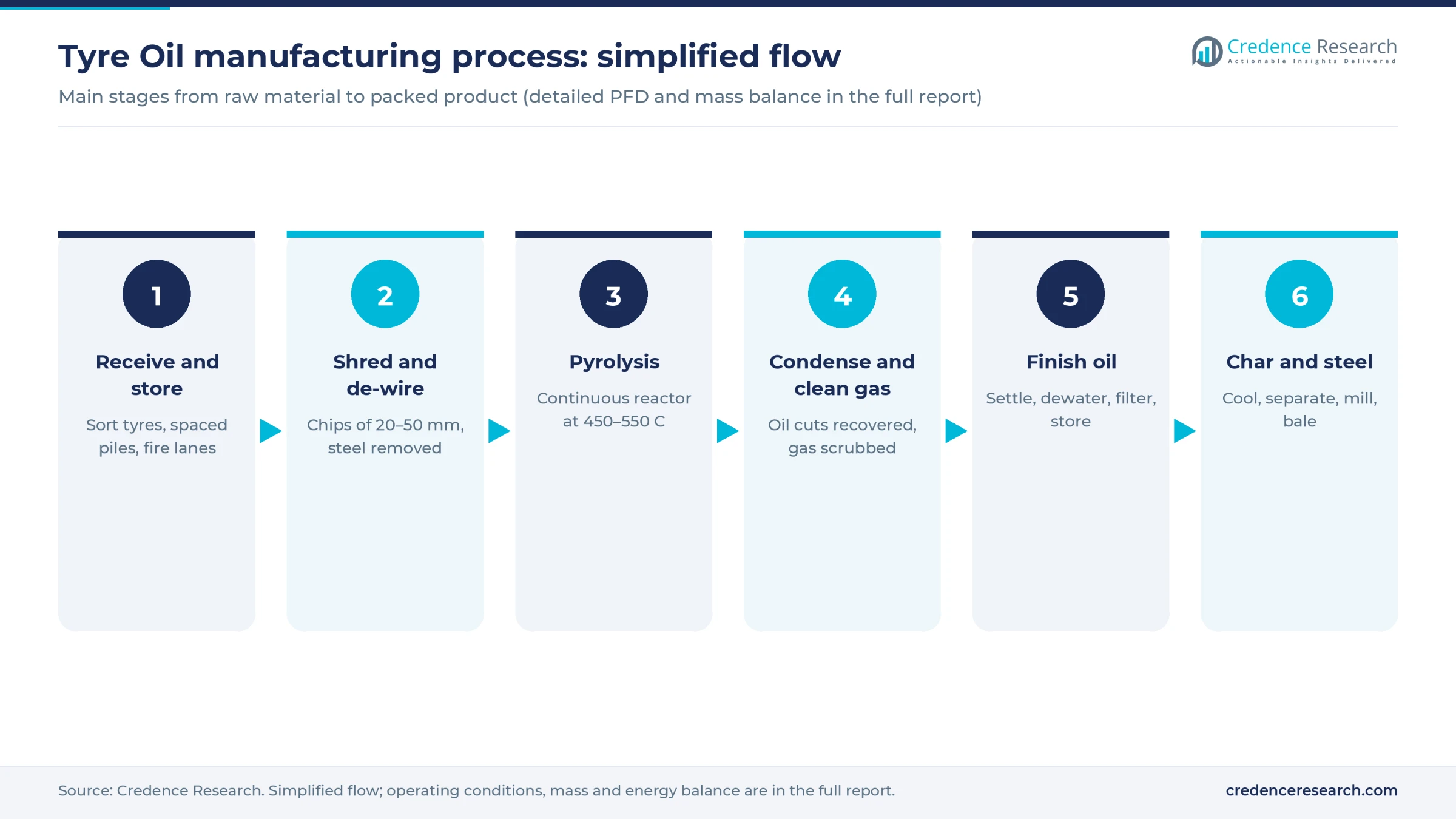
- Receiving and storage. Tyres are weighed, sorted by type and kept in limited, spaced piles with fire lanes and hydrants, since tyre fires can burn for weeks and release oily runoff.
- Shredding and steel removal. Debeaders pull the bead wire, then primary shredders and granulators cut tyres into chips of about 20–50 millimeters while magnets and wire separators remove loose steel.
- Pyrolysis. Chips enter through a gas-tight airlock into a rotary or screw reactor held at about 450–550 degrees Celsius in a low-oxygen atmosphere. Residence time and temperature set the split between oil, gas and char.
- Condensation and gas cleanup. Hot vapors pass through cyclones and staged condensers, where heavy and light oil fractions drop out. Non-condensable gas, rich in methane and hydrogen with some hydrogen sulfide, runs through a water seal and scrubber before it fires the reactor burners.
- Oil finishing. Oil is settled, dewatered and filtered to remove fine carbon, then held in bunded tanks. Some plants distill it into lighter and heavier cuts or cut sulfur to meet buyer specifications.
- Char and steel handling. Char leaves through a water-cooled screw, passes magnetic separation and is milled, and often pelletized, for sale as fuel, pigment or recovered carbon black. Clean wire is baled for steel mills.
Burner flue gas, dust from char milling and vapor from oil tanks are the main emission points. Continuous emission monitoring and a closed char path therefore matter as much to the permit as the reactor itself.
Tyre oil plant setup cost
The indicative plant takes 15,000 tonnes of end-of-life tyres a year, about 50 tonnes a day over 300 days, on about 3 acres. Fixed CapEx comes to about USD 3.5–5.7 million at an Asian industrial park and an assumed USD 30–60 million at a U.S. or EU site, where emission control, upgrading char to rubber-grade carbon black, labor and engineering cost far more. Working capital of about USD 250,000–400,000 is excluded, and the full report can be recast for any country.
The Asian figure starts from a public Indian estimate of about USD 680,000 for one continuous pyrolysis reactor, converted from rupees, with two lines plus shredding, tanks, char milling and pollution control added at assumed costs. The European end comes from a 45,000-tonne-a-year plant planned at Livanates in Greece, which carries a reported EUR 100 million budget, including EUR 29.4 million of European Investment Bank financing. Scaled to 15,000 tonnes with the six-tenths rule at an assumed USD 1.15 per euro, that implies about USD 60 million for a plant built to sell upgraded carbon black to tyre makers.
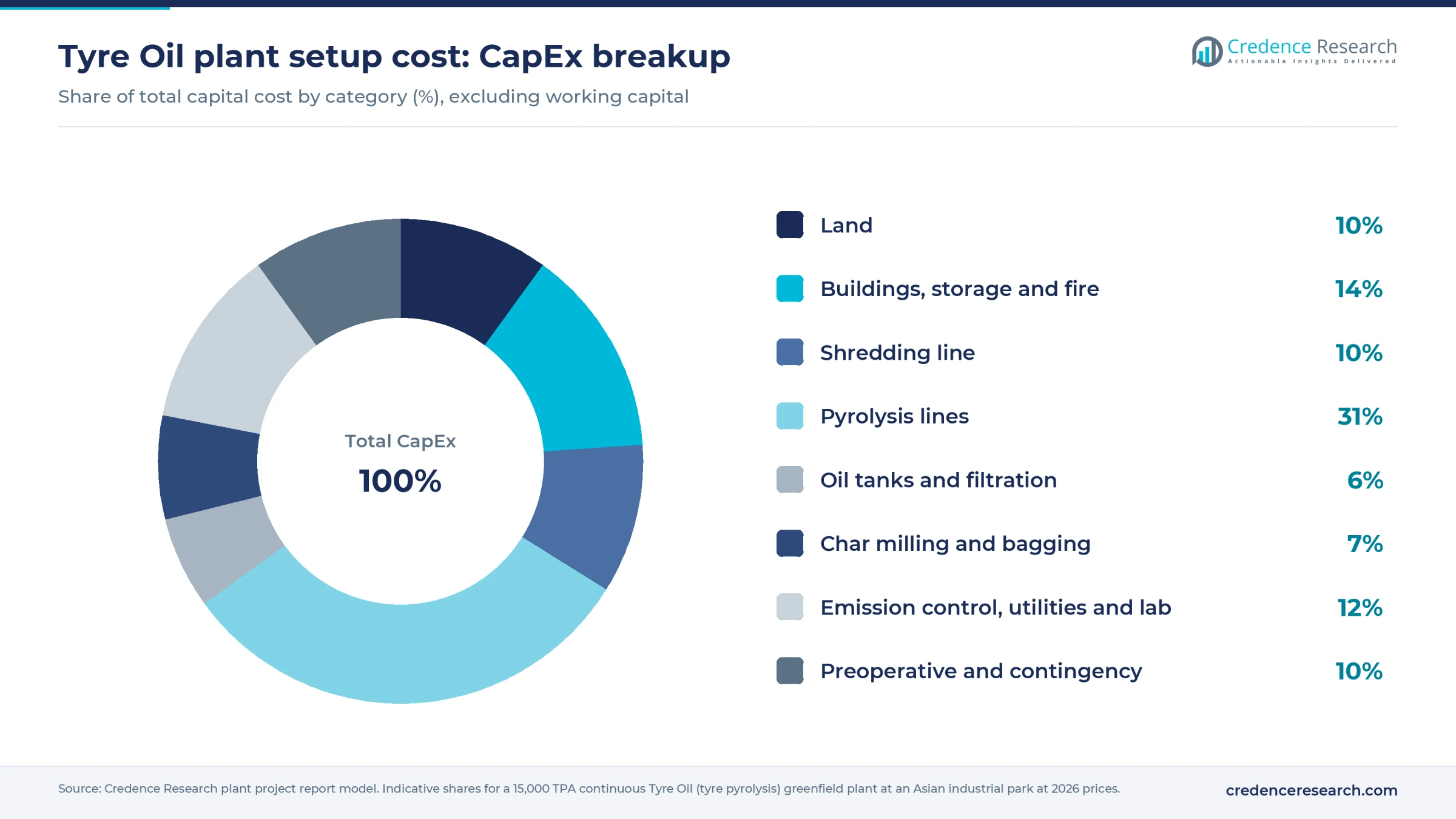
Land shows how each row was built. At an assumed USD 30–50 per square meter, a 12,000 square meter plot costs about USD 360,000–600,000, or about 10% of CapEx at the midpoint. Pyrolysis lines take the largest share at about 31%, followed by buildings, covered tyre storage and fire protection at 14%.
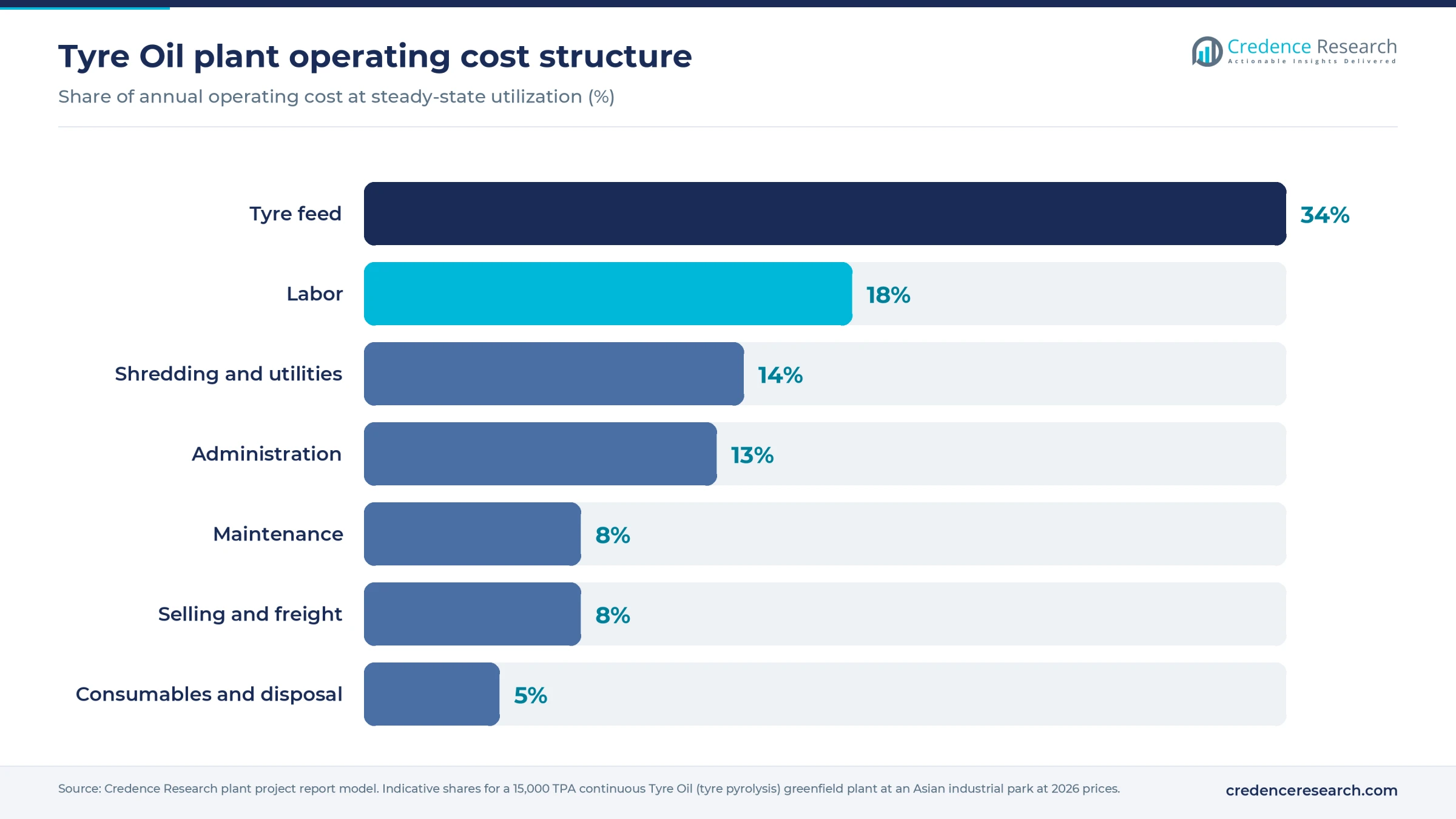
Delivered tyres take only about 30–37% of total cash cost, because feed is cheap and in some markets comes with a gate fee. With feed cost unchanged, each USD 50 per tonne change in the oil price moves gross margin by about 4 points and yearly cash earnings by about USD 240,000.
Machinery and raw materials for a tyre oil plant
Core equipment includes a weighbridge, tyre debeader, primary shredder, secondary granulator, magnetic and wire separators, conveyors and a feed hopper with a gas-tight airlock. Each pyrolysis line needs a rotary or screw reactor with burners, cyclones, shell-and-tube and spray condensers, heavy and light oil receivers, a water seal, a gas scrubber and an emergency flare. Finishing needs oil-water separators, filters or a centrifuge, a bunded tank farm, a char cooling screw, magnetic separation, a mill and a bagging or pelletizing unit. Utilities include cooling, nitrogen purge, flue gas treatment, fire suppression and a fuel lab.
The raw material is end-of-life tyres, which arise wherever vehicles run. The largest pools are in China, the United States, the European Union, India, Japan and Brazil. Truck tyres give more oil and natural rubber than passenger tyres, which carry more steel and filler. Producer responsibility schemes in Europe and North America often pay processors a gate fee to take tyres, while South Asian plants usually buy them. Trade flows shift quickly, since Australia restricted baled tyre exports from December 2021 and India's 2024 procedure bars imported tyres for pyrolysis.
Char is the second revenue stream, and its price depends on how close it comes to the specialty carbon black grades that rubber and plastics makers buy.
Tyre oil business profit margin and ROI
Revenue comes from oil, char and steel, and the model uses assumed tyre oil prices of USD 420–560 per tonne, inside the roughly USD 400–680 per tonne implied by Indian prices that recyclers reported in 2026 after a sharp rise. Char is assumed at USD 110 per tonne, steel wire at USD 240 per tonne and delivered tyres at USD 55–75 per tonne.
At a 40% oil yield, revenue is only about USD 230–290 per tonne of tyres processed. Gross margin, after feed, shredding, utilities, labor and maintenance, runs about 30–50%. The lower end pairs weak oil prices with costlier feed, the squeeze Indian recyclers described in 2026 as export demand for recycled products slowed.
At 80% utilization, the central-case plant generates about USD 730,000 a year in post-tax cash profit after selling, freight and overhead. Payback on CapEx plus working capital therefore takes about 5–8 years across the CapEx range, and extreme pairings stretch it to about 4–16 years. Gate fees, recycled-content premiums from chemical buyers and upgraded carbon black are the levers that shorten it.
| Financial metric | Status |
|---|---|
| IRR | Available in report |
| NPV | Available in report |
| ROI | Available in report |
| DSCR | Available in report |
How to start a tyre oil business, licenses and approvals
Tyre pyrolysis is regulated as waste treatment, not just fuel production, so the permit file is heavier than for an oil blending plant. A project needs business and tax registration, zoning and building approval in an industrial zone, and a waste treatment permit or registration covering tyre storage and processing. It also needs an air permit for reactor burners and char milling, wastewater and stormwater consent, fire safety approval for tyre piles and oil tanks, and a petroleum storage license where volumes require one. Oil sold as fuel must meet buyer specifications and local sulfur limits, and oil that leaves waste status as a product may need chemical registration.
| Market | Key approvals for a tyre pyrolysis oil plant |
|---|---|
| United States | State scrap tire facility registration or permit, such as Texas registration under 30 TAC Chapter 328, Subchapter F, or a CalRecycle waste tire facility permit in California; state air permit under Clean Air Act programs; spill prevention plan under 40 CFR Part 112 for oil storage |
| European Union | National environmental permit for treating end-of-life tyres, waste code 16 01 03, under the Waste Framework Directive 2008/98/EC; Industrial Emissions Directive rules where capacity thresholds apply or untreated pyrolysis gas is burned; REACH registration once the oil gains end-of-waste status |
| India | Continuous or advanced automated batch plant in an industrial area under the Central Pollution Control Board's 2024 procedure; state pollution control board consent to establish and operate; registration as a waste tyre recycler on the board's EPR portal under the Hazardous and Other Wastes Amendment Rules, 2022; PESO license for oil storage |
Key tyre oil manufacturers and recent developments
Tyre oil output is fragmented, as hundreds of small plants operate in India, China and Southeast Asia, while larger European and North American firms build plants around recovered carbon black, with oil as a co-product. Leading names include Pyrum Innovations in Germany, Scandinavian Enviro Systems and its Infiniteria joint venture with Michelin and Antin in Sweden, Contec in Poland, Black Bear Carbon in the Netherlands, Bolder Industries in the United States and Apchemi in India.
- March 2026. Pyrum reported progress on a 45,000-tonne-a-year Greek plant developed by Thermo Lysi with Pyrum technology and European Investment Bank funding, and on a 22,000-tonne Czech joint venture plant set for commissioning in 2027.
- May 2026. Bolder Industries won an extra EUR 1 million from the Flemish government, on top of a EUR 32.3 million EU Innovation Fund grant, for an Antwerp plant to process about 6 million tyres a year from 2027.
- July 2026. Scandinavian Enviro Systems said in its half-year report that the timeline for its 34,500-tonne Uddevalla plant would not be met and that it could not yet give a new schedule.
What's inside the Tyre Oil project report PDF
The report runs to 21 chapters. Open a chapter to see its sections.
1. Preface
2. Scope and Methodology
- 2.1 Objectives of the Study
- 2.2 Stakeholders
- 2.3 Research Methodology
- 2.4 Data Sources and Key Assumptions
3. Executive Summary
- 3.1 Market Snapshot
- 3.2 Project at a Glance (Capacity, CapEx, OpEx)
- 3.3 Key Financial Indicators (IRR, NPV, Payback, Break-even)
- 3.4 Feasibility Verdict
4. Product Overview
- 4.1 Tyre Oil Definition and Properties
- 4.2 Grades and Specifications (BIS / ISO / ASTM)
- 4.3 HS Code and Classification
- 4.4 Key Applications
- 4.5 Substitutes
5. Global Tyre Oil Market
- 5.1 Market Overview
- 5.2 Historical and Current Market Performance (Volume and Value)
- 5.3 Market Breakup by Grade / Type
- 5.4 Market Breakup by End-Use Industry
- 5.5 Market Breakup by Region
- 5.6 Market Drivers, Restraints and Trends
- 5.7 Value Chain Analysis
- 5.8 Market Forecast
6. Target Country Tyre Oil Market Analysis
- 6.1 Demand and Supply Analysis
- 6.2 Installed Capacity vs Demand Gap
- 6.3 Import Dependence
- 6.4 Demand Forecast by End-Use
7. Trade Analysis
- 7.1 Imports by Volume, Value and Country
- 7.2 Exports by Volume, Value and Country
- 7.3 Trade Balance and Opportunities
8. Price Analysis
- 8.1 Historical Tyre Oil Price Trends by Region
- 8.2 Raw Material / Feedstock Price Trends and Linkage
- 8.3 Price Forecast
- 8.4 Margins Across the Value Chain
9. Competitive Landscape
- 9.1 Market Structure
- 9.2 Key Players and Installed Capacities
- 9.3 Profiles of Key Players
- 9.4 Recent Developments (Expansions, M&A, New Plants)
10. Manufacturing Process and Technology
- 10.1 Comparison of Technology Routes
- 10.2 Selected Route and Process Flow Diagram
- 10.3 Unit Operations Involved
- 10.4 Chemical Reactions Involved
- 10.5 Mass Balance and Raw Material Requirements
- 10.6 Energy Balance
- 10.7 Quality Assurance Criteria and Technical Tests
- 10.8 By-products and Waste Handling
- 10.9 Technology Licensors / Providers
11. Project Details, Requirements and Costs
- 11.1 Land, Location and Site Development
- 11.1.1 Site Selection Criteria
- 11.1.2 Location Analysis
- 11.1.3 Land Requirement and Costs
- 11.1.4 Site Development Costs
- 11.2 Plant Layout
- 11.2.1 Layout Principles
- 11.2.2 Proposed Layout
- 11.2.3 Factors Influencing Layout
- 11.3 Civil Works and Buildings
- 11.4 Plant Machinery
- 11.4.1 Machinery Requirements and Specifications
- 11.4.2 Machinery Costs
- 11.4.3 Machinery Suppliers
- 11.5 Raw Materials
- 11.5.1 Requirements per Tonne of Output
- 11.5.2 Procurement and Sourcing
- 11.5.3 Costs
- 11.5.4 Suppliers
- 11.6 Packaging
- 11.6.1 Packaging Requirements
- 11.6.2 Packaging Costs
- 11.6.3 Packaging Suppliers
- 11.7 Storage and Material Handling
- 11.8 Transportation Requirements and Costs
- 11.9 Utilities
- 11.9.1 Power Requirements and Costs
- 11.9.2 Water Requirements and Costs
- 11.9.3 Steam, Fuel and Other Utilities
- 11.10 Manpower Requirements and Wages
12. Environment, Health, Safety and Sustainability
- 12.1 Effluent and Emissions Management
- 12.2 Hazard Classification and Safety Measures
- 12.3 Carbon Footprint
- 12.4 Green / Low-Carbon Process Options
13. Regulatory Procedures, Approvals and Certifications
- 13.1 Licences and Registrations
- 13.2 Environmental Clearances
- 13.3 Product Certifications (BIS, REACH, etc.)
- 13.4 Approval Timeline
14. Project Implementation Schedule
15. Project Economics
- 15.1 Capital Cost of the Project
- 15.2 Techno-Economic Parameters
- 15.3 Capacity Utilization and Ramp-up
- 15.4 Product Pricing and Margins
- 15.5 Income Projections
- 15.6 Expenditure Projections
- 15.7 Working Capital Requirement
- 15.8 Taxation
- 15.9 Depreciation
16. Financial Analysis
- 16.1 Projected Profit and Loss Account
- 16.2 Projected Cash Flow Statement
- 16.3 Projected Balance Sheet
- 16.4 Liquidity Analysis
- 16.5 Profitability Analysis (Payback, NPV, IRR, ROI)
- 16.6 Break-even Analysis
- 16.7 Debt Service Coverage Ratio (DSCR)
- 16.8 Sensitivity Analysis
- 16.9 Scenario and Uncertainty Analysis
17. Funding and Incentives
- 17.1 Means of Finance and Debt-Equity Structure
- 17.2 Loans and Financial Assistance
- 17.3 Government Schemes and Subsidies (PLI, State Policies)
18. Risk Assessment
- 18.1 Key Success Factors
- 18.2 Key Risk Factors
- 18.3 Risk Mitigation
19. Strategic Recommendations
20. Case Study of a Successful Venture
21. Appendix
- 21.1 Detailed Assumptions
- 21.2 Abbreviations
- 21.3 List of Tables and Figures
- 21.4 Sources
This page vs. the full report
| Data point | On this page (free) | In the full report |
|---|---|---|
| Total CapEx | One rounded range at one capacity | Exact figure at three capacities with a line-item breakup |
| CapEx breakup | Category shares (%) only | Cost, quantity and supplier for every machine |
| Operating cost | Share of raw materials, utilities and labor | Per-unit cost sheet with each input price and consumption |
| Profitability | Gross margin range and payback band | Exact IRR, NPV, ROI, break-even and DSCR |
| Financial statements | List of what is included | 10-year P&L, cash flow, balance sheet and Excel model |
| Sensitivity | One directional line | Full sensitivity and scenario tables |
| Process | Simplified flow diagram | Detailed process flow, mass and energy balance, operating conditions |
| Machinery | Names of the main machines | Specifications, capacity, cost and supplier list |
| Market | Headline size, growth and global demand | Segment, region, trade and price forecast tables |
| Suppliers and buyers | Supplier types and sourcing hubs | Named suppliers and buyers |
Tyre Oil project report: FAQs
How much does it cost to set up a tyre oil plant?
How much oil does one tonne of tyres produce?
What is the profit margin in a tyre oil business?
How long does a tyre pyrolysis plant take to pay back?
Is batch or continuous tyre pyrolysis better?
What licenses does a tyre oil plant need?
Which HS code covers tyre pyrolysis oil?
Who buys tyre pyrolysis oil?

About the analyst
Ganesh Chandwade, Senior Industry Consultant
Ganesh is a senior industry consultant specializing in heavy industries and advanced materials.
Related market research
- Waste Derived Pyrolysis Oil Market Size, Growth and Forecast
- Tire Recycling Downstream Product Market Size and Forecast 2032
- Specialty Carbon Black Market Size, Share and Forecast 2032
- Pyrolysis Oil Market Size, Share and Growth Report 2032
- Reclaimed Rubber Market Size, Growth, Trends and Forecast 2032
- Waste to Energy Market Size, Share, Growth and Forecast 2032
More plant project reports
- Propane Manufacturing Plant Project Report (DPR) 2026
- Furnace Oil Manufacturing Plant Project Report (DPR) 2026
- Glass Bottle Manufacturing Plant Project Report (DPR) 2026
- Gypsum Board Manufacturing Plant Project Report (DPR) 2026
- Ethanol Manufacturing Plant Project Report (DPR) 2026
- Automatic Plant Watering System Manufacturing Plant Project Report (DPR) 2026