
Acoustic Neuroma Market Overview:
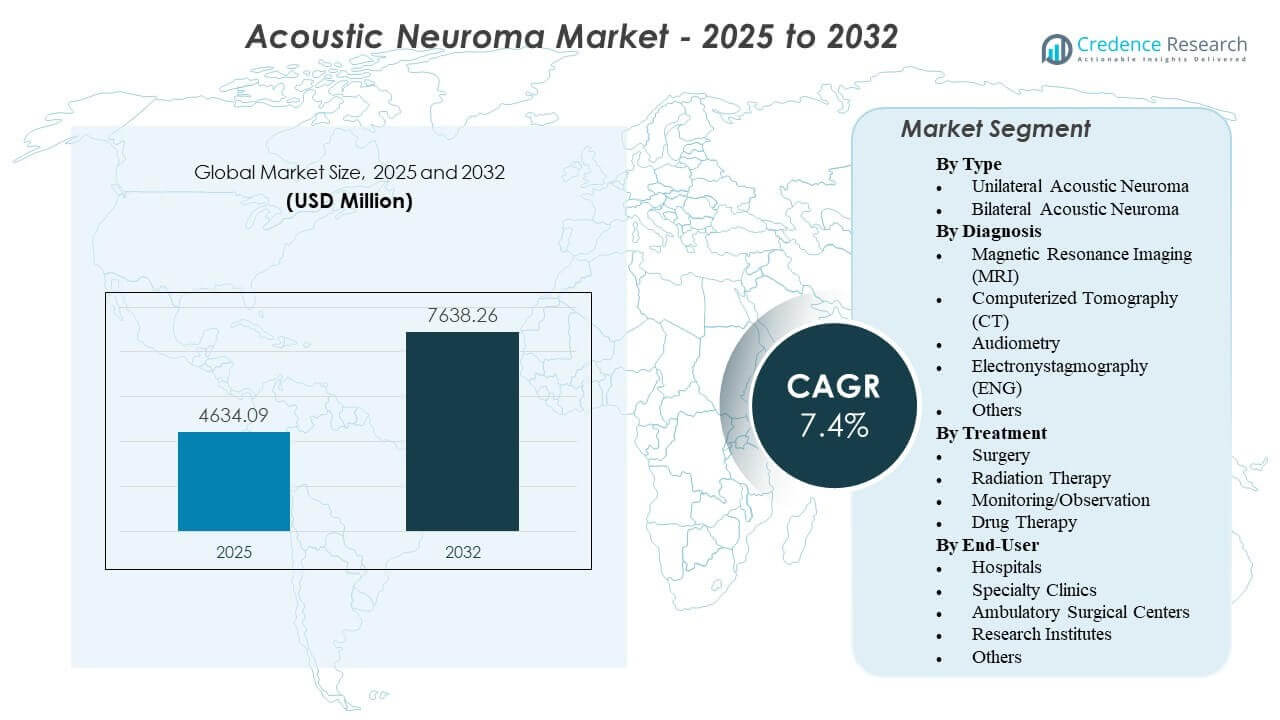
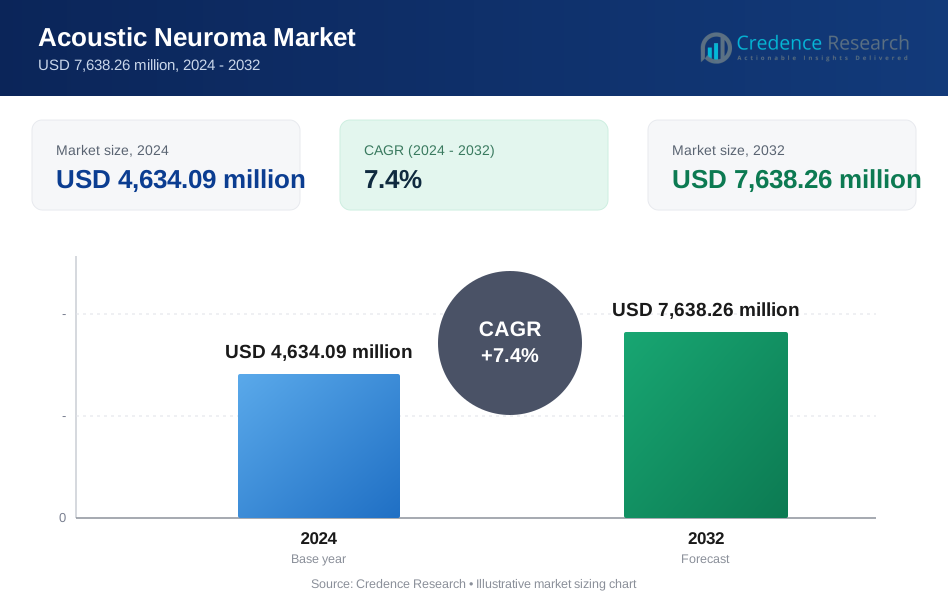
The Acoustic Neuroma Market is projected to grow from USD 4,634.09 million in 2025 to an estimated USD 7,638.26 million by 2032, with a compound annual growth rate (CAGR) of 7.4% from 2025 to 2032.
| RT ATTRIBUTE | DETAILS |
|---|---|
| Historical Period | 2020-2023 |
| Base Year | 2024 |
| Forecast Period | 2025-2032 |
| Acoustic Neuroma Market Size 2025 | USD 4,634.09 million |
| Acoustic Neuroma Market, CAGR | 7.4% |
| Acoustic Neuroma Market Size 2032 | USD 7,638.26 million |
Acoustic Neuroma Market Insights:
- Rising adoption of high-resolution MRI and stereotactic radiosurgery strengthens early detection and supports preference for minimally invasive tumor management approaches.
- High treatment costs, limited specialist availability in emerging regions, and risks of nerve-related complications restrict uniform market expansion across all healthcare systems.
- North America leads due to advanced neurosurgical infrastructure and strong reimbursement support, while Europe maintains steady demand through established neuro-oncology networks.
- Asia-Pacific emerges as a fast-growing region due to expanding tertiary hospitals and radiation therapy access, while Latin America and the Middle East improve gradually with private healthcare investments.
Acoustic Neuroma Market Drivers
Rising Detection Rates Through Advanced Imaging And Standardized Diagnostic Protocols Across Major Healthcare Systems
The Acoustic Neuroma Market expands due to improved detection supported by high-resolution MRI systems. Hospitals standardize imaging protocols for patients with unilateral hearing symptoms. Neurologists promote early referral for persistent tinnitus and balance disorders. Wider insurance coverage increases access to diagnostic evaluation. Clinical guidelines encourage structured tumor assessment. Academic centers publish outcome data that strengthens physician confidence. Early-stage identification expands eligibility for radiation and surgical options. Strong diagnostic capacity sustains steady procedural volumes.
- For instance, Siemens Healthineers’ MAGNETOM Free.Max 0.55T MRI system delivers up to 80% lower helium consumption and supports high-quality neuroimaging with advanced Deep Resolve reconstruction, enhancing small tumor visualization.
Expansion Of Specialized Skull Base Surgery Units And Precision Radiation Therapy Capabilities
Tertiary hospitals invest in dedicated neurosurgical units for complex cranial tumors. Surgeons use image-guided navigation to improve operative precision. Radiation oncology departments expand stereotactic radiosurgery platforms. Focus on facial nerve preservation improves patient outcomes. Multidisciplinary care teams coordinate treatment planning. Improved perioperative protocols enhance recovery and reduce complications. Training programs increase the number of skilled neurosurgeons. Infrastructure expansion supports long-term market stability.
- For instance, Elekta’s Leksell Gamma Knife Esprit features a 192 cobalt-60 source configuration and sub-millimeter accuracy of 0.15 mm, supporting highly precise acoustic neuroma radiosurgery.
Improved Access To Multidisciplinary Care And Structured Long-Term Monitoring Frameworks
Healthcare providers develop coordinated care models for vestibular schwannoma patients. Tumor boards guide treatment decisions with collective expertise. Structured follow-up protocols track tumor growth and nerve function. Digital record systems improve patient monitoring. Referral networks connect community clinics with tertiary centers. Private hospitals expand advanced treatment services in urban areas. Growing patient awareness increases consultation rates. These improvements strengthen sustained demand across treatment pathways.
Supportive Reimbursement Policies And Rising Investment In Advanced Neurosurgical Technologies
Public and private insurers expand coverage for radiation and surgical interventions. Governments invest in hospital modernization programs. Medical device companies introduce refined surgical instruments. Compact radiation systems increase accessibility in mid-sized centers. Continuous technology upgrades enhance procedural accuracy. Providers prioritize systems that integrate imaging and treatment planning. Capital investment in oncology infrastructure rises across developed regions. Strong financial support mechanisms reinforce long-term growth prospects.
Acoustic Neuroma Market Trends
Shift Toward Personalized Treatment Planning And Risk-Stratified Clinical Decision Frameworks
Clinicians assess tumor size, location, and growth rate before selecting therapy. Risk stratification tools guide individualized treatment pathways. Physicians balance intervention benefits against potential nerve complications. Patient preference influences final therapeutic choice. Observation strategies gain recognition for select cases. Outcome registries support evidence-based planning. The Acoustic Neuroma Market reflects this move toward personalized clinical management. It strengthens long-term patient satisfaction and care quality.
- For instance, Brainlab’s Elements Cranial SRS software enables automated segmentation and sub-millimeter contouring accuracy, supporting precise individualized radiosurgery planning.
Growing Adoption Of Minimally Invasive And Outpatient-Based Treatment Approaches
Radiation therapy gains preference for eligible patients seeking non-invasive care. Hospitals refine surgical techniques to reduce operative trauma. Shorter hospital stays improve patient experience. Ambulatory centers manage select cases with structured protocols. Enhanced anesthesia methods reduce recovery time. Surgeons emphasize precision to limit tissue disruption. Providers promote minimally invasive options during patient counseling. This approach reshapes treatment delivery models.
- For instance, Accuray’s CyberKnife system delivers frameless radiosurgery with real-time image guidance and sub-millimeter accuracy of 0.5 mm, enabling outpatient acoustic neuroma treatment.
Integration Of Digital Imaging Platforms And Artificial Intelligence For Tumor Assessment
High-resolution imaging integrates with digital planning software. Artificial intelligence assists in tumor measurement accuracy. Radiologists use advanced visualization to assess nerve proximity. Predictive analytics support complication risk estimation. Electronic platforms enable seamless data sharing among specialists. Remote consultation expands expert access beyond major cities. Technology vendors focus on workflow efficiency. Digital transformation enhances clinical confidence and coordination.
Expansion Of International Patient Mobility And Cross-Border Treatment Networks
Specialized centers attract patients from neighboring countries. Medical tourism increases demand for advanced radiosurgery systems. Private hospitals promote expertise in skull base surgery. Global referral networks improve case flow to leading institutions. Cross-border insurance agreements support treatment access. Academic collaborations foster skill exchange among surgeons. International conferences strengthen knowledge dissemination. Global connectivity shapes competitive dynamics across regions.
Acoustic Neuroma Market Challenges Analysis
High Treatment Costs And Limited Access To Specialized Neurosurgical Centers In Emerging Economies
The Acoustic Neuroma Market faces pressure from elevated treatment expenses. Advanced imaging systems require significant capital investment. Specialized neurosurgeons concentrate in urban tertiary hospitals. Rural patients struggle to access expert care. Insurance coverage gaps restrict advanced therapy adoption. Radiation platforms demand costly maintenance and skilled operators. Delayed diagnosis increases clinical complexity in underserved areas. Healthcare budgets in developing nations limit infrastructure upgrades. These constraints slow uniform market expansion across regions.
Risk Of Post-Treatment Complications And Complex Decision-Making In Small Tumor Cases
Facial nerve damage remains a key concern after surgery. Hearing preservation poses challenges in certain tumor locations. Physicians weigh risks between surgery and radiation carefully. Small tumors may follow a watch-and-wait strategy. Patient anxiety complicates treatment decisions. Long-term follow-up requires consistent monitoring. Variability in clinical outcomes influences patient confidence. Inconsistent referral practices delay specialist consultation. These factors create complexity in treatment planning and provider alignment.
Acoustic Neuroma Market Opportunities
Expansion Of Multidisciplinary Skull Base Centers And Specialized Treatment Networks Globally
Healthcare systems invest in dedicated skull base surgery units. Multidisciplinary teams improve coordinated patient care. Advanced centers attract complex cases from surrounding regions. International patient travel supports revenue growth in specialized hubs. Training programs develop skilled neurosurgeons and radiation experts. Partnerships between hospitals enhance referral efficiency. The Acoustic Neuroma Market can benefit from expanded specialist networks. Structured care models improve patient satisfaction and clinical outcomes.
Development Of Innovative Radiotherapy Platforms And Image-Guided Minimally Invasive Surgical Systems
Medical device companies focus on compact radiation systems. New navigation platforms enhance intraoperative precision. Robotics support steady instrument control in delicate procedures. Software upgrades improve tumor visualization during surgery. Research explores targeted drug therapies for tumor growth control. Clinical trials evaluate safer radiation dose protocols. Integration of data analytics enhances outcome measurement. These innovations create strong growth avenues across advanced healthcare markets.
Acoustic Neuroma Market Segmentation Analysis:
By Type
The Acoustic Neuroma Market segments tumors into unilateral and bilateral forms. Unilateral acoustic neuroma accounts for most diagnosed cases and drives the majority of treatment demand. It often presents with gradual hearing loss in one ear. Bilateral acoustic neuroma remains less common but shows steady clinical focus due to its link with genetic disorders such as neurofibromatosis type II. Bilateral cases require complex management and long-term monitoring. It supports demand for specialized care pathways and advanced imaging.
By Diagnosis
Magnetic Resonance Imaging (MRI) leads diagnostic practice due to high sensitivity in detecting small tumors. Computerized Tomography (CT) supports cases where MRI is not feasible. Audiometry helps assess hearing impairment severity. Electronystagmography (ENG) evaluates balance function and vestibular nerve response. Other tools support differential diagnosis. The Acoustic Neuroma Market relies on accurate imaging for early detection and treatment planning.
- For instance, Siemens Healthineers’ 3T MRI systems achieve spatial resolution below 1 mm in cranial neuroimaging, enabling detection of tumors smaller than 2 mm in diameter.
By Treatment
Surgery holds a major share due to definitive tumor removal in suitable candidates. Radiation therapy, including stereotactic radiosurgery, gains preference for small and medium tumors. Monitoring or observation suits slow-growing tumors in older patients. Drug therapy addresses symptom control rather than tumor cure. It focuses on preserving nerve function and patient quality of life.
By End-User
Hospitals dominate due to access to neurosurgical teams and advanced imaging systems. Specialty clinics expand rapidly with focused expertise in skull base disorders. Ambulatory surgical centers manage select minimally invasive procedures. Research institutes contribute through clinical trials and innovation. Other care settings support long-term monitoring and rehabilitation services.
- For instance, Mayo Clinic reports facial nerve preservation rates above 90% in small vestibular schwannoma surgeries, reflecting measurable outcome performance in high-volume hospital settings.
Segmentation:
By Type
- Unilateral Acoustic Neuroma
- Bilateral Acoustic Neuroma
By Diagnosis
- Magnetic Resonance Imaging (MRI)
- Computerized Tomography (CT)
- Audiometry
- Electronystagmography (ENG)
- Others
By Treatment
- Surgery
- Radiation Therapy
- Monitoring/Observation
- Drug Therapy
By End-User
- Hospitals
- Specialty Clinics
- Ambulatory Surgical Centers
- Research Institutes
- Others
By Region
- North America
- U.S.
- Canada
- Mexico
- Europe
- Germany
- France
- U.K.
- Italy
- Spain
- Rest of Europe
- Asia Pacific
- China
- Japan
- India
- South Korea
- South-east Asia
- Rest of Asia Pacific
- Latin America
- Brazil
- Argentina
- Rest of Latin America
- Middle East & Africa
- GCC Countries
- South Africa
- Rest of the Middle East and Africa
Regional Analysis:
North America holds the largest share of the Acoustic Neuroma Market, accounting for nearly 38% of global revenue. The United States drives regional dominance due to advanced neurosurgical infrastructure and high MRI penetration. Strong reimbursement coverage supports access to surgery and stereotactic radiosurgery. Canada contributes through structured referral systems and specialized skull base centers. Europe captures around 30% of the global market. Countries such as Germany, the U.K., and France maintain well-established neuro-oncology networks and radiation therapy facilities. Public healthcare funding ensures broad patient access to early diagnosis and intervention.
Asia-Pacific represents approximately 22% of the global share and shows strong expansion potential. China and Japan invest in advanced imaging and radiation platforms across tertiary hospitals. India improves access to neurosurgical care in urban centers. Growing awareness of hearing disorders supports early clinical evaluation. Latin America accounts for nearly 6% of global revenue. Brazil and Mexico lead regional demand through expanding private healthcare networks. The Middle East & Africa hold close to 4%, driven by infrastructure development in Gulf countries.
The Acoustic Neuroma Market shows varied maturity across regions based on healthcare access and specialist availability. Developed regions benefit from established referral pathways and high patient awareness. Emerging markets face constraints in specialist distribution and advanced imaging access. Urban centers in Asia and the Middle East expand treatment capacity through new hospital investments. Cross-border medical travel supports growth in select countries. Regional growth depends on improved diagnostic access and training of skilled neurosurgeons.
Key Player Analysis:
- Medtronic plc
- Stryker Corporation
- Elekta AB
- Varian Medical Systems
- Integra LifeSciences Holdings Corporation
- Brainlab AG
- Siemens Healthineers
- GE Healthcare
- Natus Medical Incorporated
- Cochlear Limited
- Cleveland Clinic
- Johns Hopkins Hospital
- Memorial Sloan Kettering Cancer Center
- MD Anderson Cancer Center
Competitive Analysis:
The Acoustic Neuroma Market features competition among medical device manufacturers, radiation therapy providers, and specialized surgical centers. Companies such as Medtronic, Elekta AB, Varian Medical Systems, and Accuray Inc. supply advanced radiosurgery and neurosurgical platforms. It reflects strong focus on precision, safety, and nerve preservation. Device manufacturers invest in compact radiation systems and image-guided navigation tools. Strategic partnerships between hospitals and technology firms strengthen treatment capability. Market participants emphasize clinical evidence to support product adoption. Competitive positioning depends on technological differentiation and service support. Vendors compete on treatment accuracy, system reliability, and workflow integration. Hospitals favor platforms that reduce procedural risk and improve patient outcomes. Continuous upgrades in imaging and radiation planning software enhance provider confidence. Companies expand geographic presence through distribution alliances and service networks. The market remains technology-driven with steady emphasis on innovation and clinical performance.
Recent Developments:
- In June 2024, Fortis Memorial Research Institute launched South Asia's first Gamma Knife Esprit. This groundbreaking version of the Leksell Gamma Knife offers non-surgical high-precision treatment, transforming non-invasive options for patients.
Report Coverage:
The research report offers an in-depth analysis based on Type, Diagnosis, Treatment, End-User, and Region. It details leading market players, providing an overview of their business, product offerings, investments, revenue streams, and key applications. Additionally, the report includes insights into the competitive environment, SWOT analysis, current market trends, as well as the primary drivers and constraints. Furthermore, it discusses various factors that have driven market expansion in recent years. The report also explores market dynamics, regulatory scenarios, and technological advancements that are shaping the industry. It assesses the impact of external factors and global economic changes on market growth. Lastly, it provides strategic recommendations for new entrants and established companies to navigate the complexities of the market.
Future Outlook:
- Growing adoption of early MRI screening will strengthen diagnosis rates across developed and emerging healthcare systems.
- Expanding use of stereotactic radiosurgery will support demand for non-invasive treatment options.
- Advancements in image-guided neurosurgery will improve precision and patient outcomes.
- Rising awareness of unilateral hearing loss symptoms will encourage earlier specialist referrals.
- Increasing investment in skull base surgery centers will expand treatment capacity.
- Integration of digital planning tools will enhance personalized intervention strategies.
- Strong reimbursement frameworks in developed regions will sustain procedural volumes.
- Expansion of advanced radiation platforms in Asia-Pacific will support regional growth.
- Collaborative research initiatives will accelerate innovation in tumor management techniques.
- Continuous improvement in post-operative monitoring systems will enhance long-term patient care within the Acoustic Neuroma Market.
Request a Free Sample
Fill in your details and we'll send you a free sample report.
- Sample data tables & charts
- Research methodology
Need a Custom Version of This Report?
Tailor the scope, geography, or segments to your exact requirements.
- Custom geography or segment scope
- Direct access to our analyst team
Frequently Asked Questions
What is the current market size for Acoustic Neuroma Market, and what is its projected size in 2032?
At what Compound Annual Growth Rate is the Acoustic Neuroma Market projected to grow between 2025 and 2032?
Which Acoustic Neuroma Market segment held the largest share in 2025?
What are the primary factors fueling the growth of the Acoustic Neuroma Market?
Who are the leading companies in the Acoustic Neuroma Market?
Which region commanded the largest share of the Acoustic Neuroma Market in 2025?
Table of Content
Chapter 1. Report Introduction
- 1.1 Report Description & Purpose
- 1.1.1 Report Title & Market Definition
- 1.1.2 Unique Selling Propositions (USP) & Key Differentiators
- 1.1.3 Value Proposition for Stakeholders
- 1.2 Research Objectives
- 1.2.1 Market Sizing Objectives (Volume & Revenue)
- 1.2.2 Segmentation Objectives
- 1.2.3 Competitive Intelligence Objectives
- 1.2.4 Forecast & Scenario Objectives
- 1.3 Report Scope
- 1.3.1 Acoustic Neuroma Scope – Types & Subtypes Covered
- 1.3.2 Geographic Scope – Regions & Countries Covered
- 1.3.3 Historical Period, Base Year & Forecast Period (2024; forecast to 2032)
- 1.3.4 Inclusions & Exclusions
- 1.4 HS Code & Classification Framework
- 1.5 Currency, Units & Pricing Basis
- 1.6 Target Stakeholders
- 1.7 Limitations & Assumptions
Chapter 2. Executive Summary
- 2.1 Global Acoustic Neuroma Market Snapshot
- 2.1.1 Market Size – Historical (2024) & Forecast (2024-2032) (2024: USD 4,634.09 million → 2032: USD 7,638.26 million)
- 2.1.2 Volume & Revenue – Global Totals
- 2.1.3 Key Market Highlights – Top Five Facts
- 2.2 Acoustic Neuroma Market Segmentation Snapshot
- 2.2.1 Market Split by Region – 2024 vs. 2032
- 2.3 Competitive Snapshot
- 2.3.1 Top 10 Players by Revenue Share – 2024
- 2.3.2 Top 10 Players by Volume Share – 2024
- 2.3.3 Recent Strategic Developments (18-Month Summary)
- 2.4 Key Investment Highlights & Strategic Conclusions
Chapter 3. Acoustic Neuroma Market Dynamics & Industry Analysis
- 3.1 Market Overview & Context
- 3.1.1 Acoustic Neuroma Market Position in the Broader Automotive Value Chain
- 3.1.2 OEM vs. Replacement Market Dynamics
- 3.1.3 Market Maturity & Development Stage by Region
- 3.2 Acoustic Neuroma Market Drivers
- 3.3 Acoustic Neuroma Market Restraints & Challenges
- 3.4 Acoustic Neuroma Market Opportunities
- 3.5 Porter's Five Forces Analysis
- 3.5.1 Threat of New Entrants
- 3.5.2 Bargaining Power of Suppliers
- 3.5.3 Bargaining Power of Buyers
- 3.5.4 Threat of Substitutes
- 3.5.5 Competitive Rivalry – Intensity Assessment
- 3.6 Acoustic Neuroma Value Chain Analysis
- 3.6.1 Upstream – Raw Material/Input Suppliers
- 3.6.1.1 Raw Material/Input 1
- 3.6.1.2 Raw Material/Input 2
- 3.6.1.3 Raw Material/Input 3
- 3.6.2 Midstream – Production/Manufacturing/Service Delivery
- 3.6.2.1 Production/Process Overview
- 3.6.2.2 Key Facility Locations & Capacity by Manufacturer
- 3.6.3 Downstream – Distribution & End Consumer
- 3.6.3.1 Primary Channel – B2B/OEM
- 3.6.3.2 Secondary Channels – Dealer, Retail, Online, Direct
- 3.6.4 Value Chain Profitability Analysis
- 3.6.1 Upstream – Raw Material/Input Suppliers
- 3.7 PESTEL Analysis
- 3.7.1 Political Factors
- 3.7.2 Economic Factors
- 3.7.3 Social Factors
- 3.7.4 Technological Factors
- 3.7.5 Environmental Factors
- 3.7.6 Legal Factors
- 3.8 Acoustic Neuroma Supply Chain Analysis
- 3.8.1 Raw Material/Input Supply Risk Assessment
- 3.8.2 Manufacturing Concentration Risk (Geographic Exposure)
- 3.8.3 Trade Disruption Impact Analysis
- 3.9 Regulatory & Policy Landscape
Note: The regulatory and policy landscape section covers regulations based on their applicability to the market, Acoustic Neuroma category, geography, and scope of the study. Only regulatory frameworks with a material impact on operations, compliance, trade, sustainability, or market access are analyzed in detail.
Chapter 4. Key Investment Pockets & Opportunity Analysis
- 4.1 Acoustic Neuroma Market Attractiveness Analysis
- 4.1.1 By Region – Investment Attractiveness Matrix (Volume × CAGR)
- 4.2 Absolute Revenue Growth Opportunity
- 4.2.1 By Region – Absolute USD Growth Through 2032
- 4.3 Incremental Volume Opportunity
- 4.3.1 By Region – Incremental Volume Through 2032
- 4.3.2 Segment – Incremental Volume
- 4.4 Emerging Submarket Opportunity Deep Dive (Subject to Applicability)
- 4.5 Emerging Market Opportunity Scorecards
- 4.5.1 United States
- 4.5.2 Europe
- 4.5.3 Asia
- 4.5.4 Middle East & Africa
Note: Emerging Market Opportunity Scorecards will be included based on relevance and strategic importance. Regions listed are indicative and may vary depending on data availability and market dynamics.
Chapter 5. Acoustic Neuroma Import-Export Analysis & Trade Flows
- 5.1 Global Trade Overview
- 5.1.1 Global Export Value by Country (2024)
- 5.1.2 Global Export Volume by Country (2024)
- 5.1.3 Global Import Value by Country (2024)
- 5.1.4 Global Import Volume by Country (2024)
- 5.1.5 Net Trade Balance by Country (2024)
- 5.2 Export Analysis – Segment
- 5.2.1 Type 1 (HS Code)
- 5.2.2 Type 2 (HS Code)
- 5.2.3 Type 3 (HS Code)
- 5.2.4 Type 4 (HS Code)
- 5.2.5 Type 5 (HS Code)
- 5.3 Import Analysis – Segment
- 5.3.1 Type 1 (HS Code)
- 5.3.2 Type 2 (HS Code)
- 5.3.3 Type 3 (HS Code)
- 5.3.4 Type 4 (HS Code)
- 5.3.5 Type 5 (HS Code)
- 5.4 Average Unit Trade Prices
- 5.4.1 Average Export Price – Segment & Country
- 5.4.2 Average Import Price – Segment & Source Country
- 5.4.3 Price Trends (2024)
- 5.5 Key Trade Route Analysis
- 5.5.1 Trade Route 1
- 5.5.2 Trade Route 2
- 5.5.3 Trade Route 3
- 5.5.4 Trade Route 4
- 5.5.5 Trade Route 5
- 5.6 Trade Policy Impact Assessment
- 5.6.1 US Anti-Dumping & Section 301 Tariffs
- 5.6.2 EU Customs Union Impact
- 5.6.3 Major Free Trade Agreements
- 5.6.4 USMCA Rules of Origin
Note: Trade policy analysis will be included only where relevant to the Acoustic Neuroma market.
Chapter 6. Competitive Landscape & Company Benchmarking
- 6.1 Acoustic Neuroma Market Concentration & Structure
- 6.1.1 Herfindahl-Hirschman Index (HHI) – vs. 2024
- 6.1.2 Tier 1, Tier 2 & Tier 3 Market Structure
- 6.1.3 Global, Regional & Local Player Dynamics
- 6.2 Acoustic Neuroma Market Share Analysis – 2024
- 6.2.1 Global Revenue Share by Company
- 6.2.2 Global Volume Share by Company
- 6.2.3 Regional Revenue Share
- 6.2.4 Market Share Evolution ( vs. 2024)
- 6.2.5 OEM Segment Share by Company
- 6.2.6 Replacement Segment Share by Company
- 6.3 Production/Delivery Capacity & Facility Analysis
- 6.3.1 Global Installed Capacity
- 6.3.2 Capacity Utilization Rates
- 6.3.3 Production/Output Volume
- 6.3.4 Facility Locations & Capacity Map
- 6.3.5 Planned Capacity Additions
- 6.4 Acoustic Neuroma Competitive Benchmarking Matrix
- 6.4.1 Revenue, Volume, CAGR & Profitability Comparison
- 6.4.2 Channel Revenue Mix
- 6.4.3 Geographic Revenue Exposure
- 6.4.4 R&D Intensity
- 6.4.5 Sustainability Maturity
- 6.5 Strategic Developments in Acoustic Neuroma (Last 24 Months)
- 6.5.1 Mergers, Acquisitions & Divestments
- 6.5.2 New Acoustic Neuroma Launches
- 6.5.3 Facility Expansions
- 6.5.4 Strategic Alliances, Joint Ventures & Partnerships
- 6.5.5 Distribution Expansion & Market Entry
- 6.5.6 Sustainability & ESG Initiatives
- 6.6 Competitive Strategy Mapping
- 6.6.1 Leader, Challenger, Follower & Niche Classification
- 6.6.2 Pricing Strategy Comparison
- 6.6.3 Channel Strategy Matrix
Note: Strategic developments are included based on their materiality and the availability of reliable information.
Chapter 7. Global Acoustic Neuroma Market – By Distribution Channel
- 7.1 Segment Overview
- 7.1.1 Volume & Revenue Split by Channel (2024 & 2032)
- 7.1.2 Channel Mix Evolution (2024-2032)
Chapter 8. Regional Market Analysis – Global Overview
- 8.1 Global Regional Overview
- 8.1.1 Regional Volume Share
- 8.1.2 Regional Revenue Share
- 8.1.3 Regional Volume by Region
- 8.1.4 Regional Revenue by Region
- 8.1.5 Regional Forecast Through 2032
- 8.2 Cross-Regional Segment Analysis
- 8.2.1 By Distribution Channel
- 8.2.2 By Brand/Price Tier
Chapter 9. North America Acoustic Neuroma Market
- 9.1 United States
- 9.2 Canada
- 9.3 Mexico
Chapter 10. Europe Acoustic Neuroma Market
- 10.1 Germany
- 10.2 France
- 10.3 Italy
- 10.4 United Kingdom
- 10.5 Spain
- 10.6 Poland
- 10.7 Russia
- 10.8 Netherlands
- 10.9 Belgium
- 10.10 Sweden
- 10.11 Denmark
- 10.12 Norway
- 10.13 Rest of Europe
Chapter 11. Asia Pacific Acoustic Neuroma Market
- 11.1 China
- 11.2 India
- 11.3 Japan
- 11.4 South Korea
- 11.5 Thailand
- 11.6 Indonesia
- 11.7 Vietnam
- 11.8 Malaysia
- 11.9 Australia
- 11.10 Rest of Asia Pacific
Chapter 12. Latin America Acoustic Neuroma Market
- 12.1 Brazil
- 12.2 Argentina
- 12.3 Colombia
- 12.4 Chile
- 12.5 Rest of Latin America
Chapter 13. Middle East Acoustic Neuroma Market
- 13.1 Saudi Arabia
- 13.2 United Arab Emirates
- 13.3 Turkey
- 13.4 Israel
- 13.5 Iran
- 13.6 Rest of the Middle East
Chapter 14. Africa Acoustic Neuroma Market
- 14.1 South Africa
- 14.2 Egypt
- 14.3 Nigeria
- 14.4 Morocco
- 14.5 Rest of Africa
Chapter 15. Acoustic Neuroma Company Profiles
- 15.1 [Company 01]
- 15.1.1 Company Overview
- 15.1.2 Key Management Personnel
- 15.1.3 Products & Services Portfolio
- 15.1.4 Financial Performance
- 15.1.5 Key Market Focus & Geographic Presence
- 15.1.6 Recent Developments & Strategic Initiatives
Note: The company profile list is preliminary and may change based on research findings, market developments, data availability, and client requirements.
Chapter 16. Appendices
- Appendix A – List of Abbreviations & Acronyms
- Appendix B – Industry Classification Code Reference – Full Series
- Appendix C – Production & Capacity Data Tables
- Appendix D – End-Use & Demand Base Tables
- Appendix E – Consumption & Replacement Rate Assumptions
- Appendix F – ASP Reference Tables
- Appendix G – Manufacturing & Facility Database
- Appendix H – Import-Export Data Tables
- Appendix I – Regulatory Summary Tables
- Appendix J – Primary Research Participant List (Anonymized)
- Appendix K – Primary Research Questionnaire Framework
- Appendix L – Data Sources & Bibliography
- Appendix M – Market Size Divergence & Source Comparison
Chapter 17. Research Methodology
- 17.1 Research Framework & Philosophy
- 17.2 Secondary Research – Sources, Hierarchy & Data Extraction
- 17.3 Data Modeling – Bottom-Up & Top-Down Market Sizing
- 17.4 Primary Research – Stakeholder Framework, LOI & Sample Sizes
- 17.5 Forecast Methodology – Regression, Scenario & Sensitivity Analysis
- 17.6 Quality Control – Four-Layer Validation Framework
- 17.7 Limitations & Standard Assumptions
- 17.8 Disclaimer
