
Key Highlights of the Report
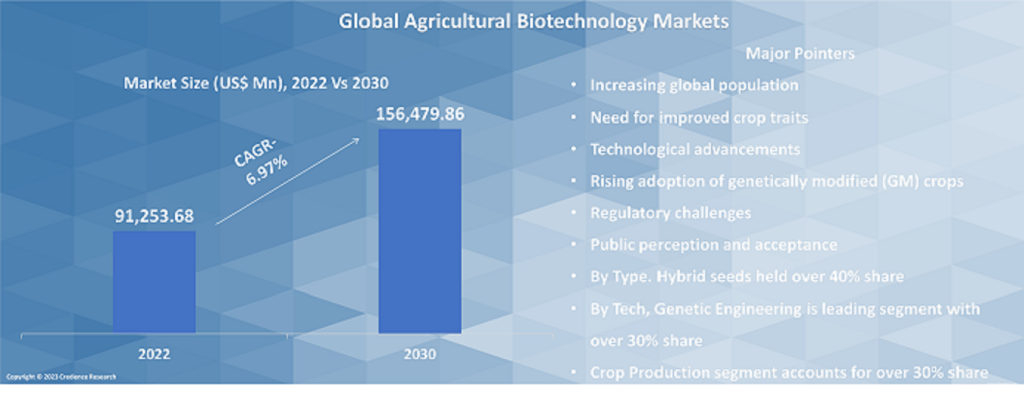
- The agricultural biotechnology marketplace is projected to attain sales of USD 156,479.86 million by 2030, displaying a CAGR of 6.97% all through the period from 2023 to 2030.
- Hybrid seeds dominate the market with over 40% percentage, driven by their capability to combine proper tendencies from unique discern plants.
- Genetic engineering emerges because the leading technology phase, accounting for over 30% percentage, attributable to its capability to beautify crop trends and boom productiveness.
- The crop production section holds a good sized proportion of over 30%, highlighting the importance of biotechnology in enhancing agricultural yields.
- North America is the dominant vicinity, shooting over 25% of the market percentage, pushed by means of the adoption of superior farming practices and strong research and improvement activities.
Executive Summary
The agricultural biotechnology market has witnessed massive growth during the last decade, pushed by using the need to feed an increasing international populace and the call for improved crop traits. Technological improvements, mainly in genetic engineering, have played an essential position in enhancing agricultural productivity and sustainability.
The marketplace has confronted challenges in phrases of regulatory hurdles and public belief; however, possibilities lie inside the improvement of biotech tendencies for emerging markets and the adoption of sustainable agriculture practices.
This report provides a complete analysis of the rural biotechnology marketplace, which include market insights, drivers, restraints, possibilities, competitive landscape, key findings, and future outlook.
Market Insights
The agricultural biotechnology marketplace has skilled a constant increase, on the whole, due to the increasing worldwide population and the want to produce more meals sustainably. Biotechnology offers modern answers to deal with these challenges by improving crop tendencies consisting of yield, pest resistance, and tolerance to environmental stressors.
Genetic engineering, which entails the manipulation of an organism's genes, has been a key generation riding the marketplace. It enables the advent of desirable trends in plants, leading to more suitable productivity and decreased dependence on chemical inputs.
Current Market Trends
Growing Demand for GM Crops
Genetically modified (GM) crops hold to dominate the agricultural biotechnology marketplace. These plants are engineered to own proper tendencies, together with expanded yield, herbicide tolerance, and pest resistance.
GM vegetation has gained extensive adoption, particularly in the most important agricultural economies just like the United States, Brazil, Argentina, and India. The growing worldwide populace and the want for greater food manufacturing are driving the demand for GM plants.
Rise of Gene Editing Technologies
Gene modifying technology, together with CRISPR-Cas9, TALENs, and ZFNs, have revolutionized agricultural biotechnology. These tools allow unique amendment of plant genomes, bearing in mind centred gene insertion, deletion, or change.
Gene enhancing offers a quicker and more precise alternative to standard breeding strategies, bearing in mind the development of plants with progressed trends and reduced regulatory hurdles.
Focus on Sustainable Agriculture
There is a developing emphasis on sustainable agricultural practices, promoting environmentally pleasant answers that limit the use of chemical inputs and decrease the ecological impact. Agricultural biotechnology plays an essential function in this shift toward sustainability.
Biopesticides derived from clearly going on microorganisms, as an example, provide a green opportunity for synthetic insecticides. Additionally, biotechnology-based totally answers for nitrogen fixation, stronger nutrient uptake, and water-use performance are gaining traction.
Integration of Big Data and Analytics
The integration of large statistics and analytics in agriculture is remodeling the arena. Farmers and agricultural groups are leveraging information-driven insights to optimize crop production, enhance resource control, and mitigate risks.
Agricultural biotechnology groups are growing advanced analytics structures that integrate genetic and environmental information to provide personalized crop management guidelines, improving efficiency and productivity.
Key Players in the Agricultural Biotechnology Market
1. Bayer AG
Bayer AG, a multinational pharmaceutical and life sciences organization, is a key participant in the agricultural biotechnology marketplace. Through its subsidiary, Monsanto, Bayer is involved in improving and commercializing genetically modified vegetation, including insect-resistant corn and herbicide-tolerant soybeans.
2. Syngenta AG
Syngenta AG is a main agricultural company that specializes in crop protection, seeds, and traits. The company offers genetically modified seeds, developments, and included pest management solutions. Syngenta has a sturdy global presence and collaborates with studies institutions to broaden progressive agricultural biotechnology merchandise.
3. DowDuPont Inc.
DowDuPont Inc., shaped via the merger of Dow Chemical Company and DuPont, is an outstanding player in the agricultural biotechnology market. The business enterprise provides a huge range of genetically changed seeds, crop protection products, and agricultural technology. DowDuPont has made tremendous investments in studies and improvement to enhance crop productivity and sustainability.
4. BASF SE
BASF SE, an international chemical agency, has a devoted agricultural answers division that gives genetically modified seeds, crop safety products, and revolutionary biotechnology solutions. The enterprise focuses on sustainable agriculture, growing products that enhance crop yields while minimizing environmental impact.
Market Overview
The market is segmented primarily based on type, technology, and application. Hybrid seeds dominate the marketplace, accounting for over forty% proportion. These seeds integrate the acceptable traits of different discern plants, ensuing in advanced crop performance.
Genetic engineering is the leading era phase, with over 30% marketplace proportion, owing to its capability to adjust crop traits at the genetic stage. In phrases of software, crop production holds a large proportion of over 30%, as agricultural biotechnology focuses on enhancing crop yields and quality.
Market Drivers
Increasing Global Population
The international populace is expected to attain nine billion by 2030, necessitating an enormous increase in food production. Agricultural biotechnology offers a promising answer by enhancing crop yields and decreasing put up-harvest losses.
Need for Improved Crop Traits
The demand for vegetation with improved traits, consisting of accelerated yield, resistance to diseases and pests, and tolerance to environmental pressure, is growing. Biotechnology enables the development of such trends thru genetic modification, contributing to advanced agricultural productiveness.
Technological Advancements
Continuous advancements in biotechnology, which include gene modifying strategies like CRISPR-Cas9, have revolutionized crop improvement. These technologies offer particular and efficient techniques for enhancing plant genomes, accelerating the improvement of new and advanced crop types.
Rising Adoption of Genetically Modified (GM) Crops
GM crops have won vast recognition in several countries because of their capacity blessings, which include improved yields, reduced pesticide use, and superior nutritional content material. The growing adoption of GM plants drives the call for agricultural biotechnology products and services.
Market Restraints
Regulatory Challenges
The regulatory panorama for agricultural biotechnology varies throughout countries, posing demanding situations to marketplace players. Stringent regulations and lengthy approval strategies restrict the commercialization of genetically modified plants and biotech trends, limiting marketplace boom.
Public Perception and Acceptance
Biotechnology in agriculture is frequently met with scepticism and concerns regarding safety and environmental effects. Public belief and attractiveness play an important position in shaping regulatory rules and influencing consumer options, posing a venture to market growth.
Market Opportunities
Development of Biotech Traits for Emerging Markets
Emerging markets characterized by developing populations and growing urbanization, present good sized opportunities for agricultural biotechnology. Developing biotech tendencies tailored to the specific needs of those markets can help cope with food protection demanding situations and pressure market boom.
Sustainable Agriculture Practices
The adoption of sustainable agriculture practices, together with precision farming, integrated pest control, and conservation agriculture, is at the upward push. Agricultural biotechnology can complement these practices via presenting gear and answers for useful resource-green and environmentally pleasant farming techniques.
Competitive Landscape
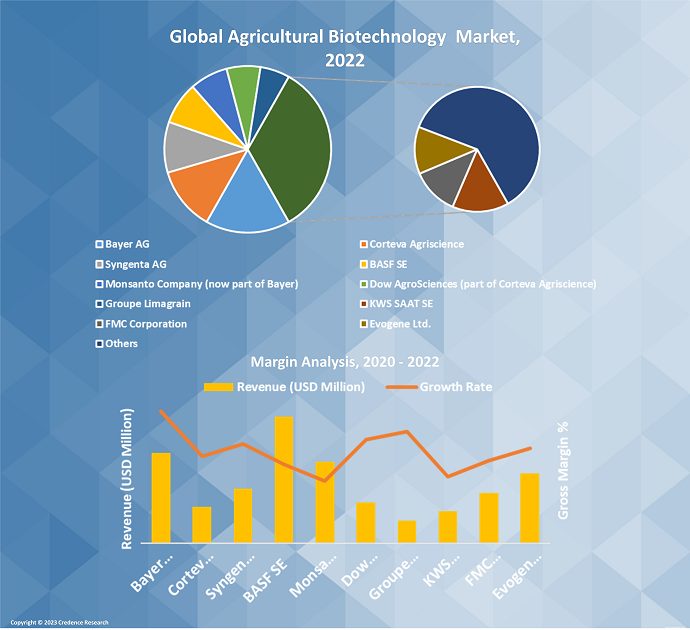
The agricultural biotechnology market is exceedingly aggressive, with numerous key gamers actively concerned in studies, development, and commercialization activities. Major groups in the market consist of Monsanto Company, Syngenta AG, DowDuPont Inc., Bayer AG, and BASF SE.
These companies focus on strategic collaborations, mergers and acquisitions, and product improvements to advantage a competitive part. Additionally, numerous smaller gamers and startups contribute to the marketplace's dynamism and innovation.
Summary of Key Findings
- The agricultural biotechnology market is projected to attain USD 156,479.86 million by 2030, growing at a CAGR of 6.97% during the length from 2023 to 2030.
- Hybrid seeds preserve the largest market proportion, observed via genetic engineering because the dominant technology segment.
- Crop production bills for a vast proportion of the market, reflecting the point of interest on improving agricultural yields.
- North America is the leading place in phrases of marketplace percentage, driven by using advanced farming practices and robust research and improvement activities.
Future Outlook
The agricultural biotechnology market is poised for continued growth in the coming years. Technological improvements, along with gene enhancing and artificial biology, will similarly boost up the development of novel biotech trends. Regulatory frameworks are predicted to conform, facilitating the commercialization of genetically modified crops and biotech merchandise.
Public belief and reputation are probable to improve because the advantages and safety of agricultural biotechnology become extra obvious. The marketplace will witness multiplied investments in research and development, collaborations, and partnerships, as stakeholders strive to fulfil the demanding situations of feeding a growing international population and ensuring sustainable agriculture practices.
Why Buy This Report
This comprehensive report on the agricultural biotechnology market presents treasured insights and analysis for enterprise stakeholders, buyers, researchers, and policymakers. Here are the important thing motives for buying this record:
- Gives an in depth evaluation of the agricultural biotechnology market, such as market size, increase price, traits, and destiny projections.
- Identifies and examines the key drivers and restraints influencing the agricultural biotechnology marketplace.
- Offers the modern-day trends within the agricultural biotechnology marketplace to provide insights into rising opportunities and capacity areas of increase.
- Profiles key players inside the agricultural biotechnology market, such as Bayer AG, Syngenta AG, DowDuPont Inc., and BASF SE.
- Offers a future outlook for the agricultural biotechnology market.
- Segments the market primarily based on era, utility, and product, providing a comprehensive expertise of each section's marketplace size, increased fee, and ability.
- The report is primarily based on extensive studies and analysis conducted by enterprise professionals.
Request a Free Sample
Fill in your details and we'll send you a free sample report.
- Sample data tables & charts
- Research methodology
Need a Custom Version of This Report?
Tailor the scope, geography, or segments to your exact requirements.
- Custom geography or segment scope
- Direct access to our analyst team
Frequently Asked Questions
What is agricultural biotechnology?
What are the benefits of agricultural biotechnology?
What forms of genetically changed organisms (GMOs) are generally used in agricultural biotechnology?
Are genetically changed crops safe for consumption?
How is agricultural biotechnology regulated?
What is the present-day market size of the rural biotechnology enterprise?
What are the major programs of agricultural biotechnology?
What are a few key demanding situations and ethical issues related to agricultural biotechnology?
How does agricultural biotechnology make a contribution to sustainable agriculture?
What is the destiny outlook for the rural biotechnology marketplace?
Table of Content
Chapter 1. Report Introduction
- 1.1 Report Description & Purpose
- 1.1.1 Report Title & Market Definition
- 1.1.2 Unique Selling Propositions (USP) & Key Differentiators
- 1.1.3 Value Proposition for Stakeholders
- 1.2 Research Objectives
- 1.2.1 Market Sizing Objectives (Volume & Revenue) (Volume Where Applicable)
- 1.2.2 Segmentation Objectives
- 1.2.3 Competitive Intelligence Objectives
- 1.2.4 Forecast & Scenario Objectives
- 1.3 Report Scope
- 1.3.1 Agriculture Biotechnology Scope – Segments & Subsegments Covered
- 1.3.2 Geographic Scope – Regions & Countries Covered
- 1.3.3 Historical Period, Base Year & Forecast Period (the historical period; forecast to the forecast period)
- 1.3.4 Inclusions & Exclusions
- 1.4 Industry Classification & Applicable Codes
- 1.5 Currency, Measurement Units & Valuation Basis
- 1.6 Target Stakeholders
- 1.7 Limitations & Assumptions
Chapter 2. Executive Summary
- 2.1 Global Agriculture Biotechnology Market Snapshot
- 2.1.1 Market Size – Historical (the historical period) & Forecast (the forecast period) (base year: USD 156,479.86 million → forecast year: NULL)
- 2.1.2 Volume & Revenue – Global Totals (Volume Where Applicable)
- 2.1.3 Key Market Highlights – Top Five Facts
- 2.2 Agriculture Biotechnology Market Segmentation Snapshot
- 2.2.1 Market Split by Region – vs.
- 2.3 Competitive Snapshot
- 2.3.1 Top 10 Players by Revenue Share –
- 2.3.2 Top 10 Players by Volume Share – (Volume Where Applicable)
- 2.3.3 Recent Strategic Developments (18-Month Summary)
- 2.4 Key Investment Highlights & Strategic Conclusions
Chapter 3. Agriculture Biotechnology Market Dynamics & Industry Analysis
- 3.1 Market Overview & Context
- 3.1.1 Agriculture Biotechnology Market Position in the Broader Industry Value Chain
- 3.1.2 Demand Structure & Purchasing Dynamics
- 3.1.3 Market Maturity & Development Stage by Region
- 3.2 Agriculture Biotechnology Market Drivers
- 3.3 Agriculture Biotechnology Market Restraints & Challenges
- 3.4 Agriculture Biotechnology Market Opportunities
- 3.5 Porter's Five Forces Analysis
- 3.5.1 Threat of New Entrants
- 3.5.2 Bargaining Power of Suppliers
- 3.5.3 Bargaining Power of Buyers
- 3.5.4 Threat of Substitutes
- 3.5.5 Competitive Rivalry – Intensity Assessment
- 3.6 Agriculture Biotechnology Value Chain Analysis
- 3.6.1 Upstream – Key Inputs, Resources & Suppliers
- 3.6.1.1 Key Input/Resource 1
- 3.6.1.2 Key Input/Resource 2
- 3.6.1.3 Key Input/Resource 3
- 3.6.2 Midstream – Core Operations & Value Creation
- 3.6.2.1 Operating Model & Process Overview
- 3.6.2.2 Key Operating Locations & Capabilities by Company
- 3.6.3 Downstream – Market Channels & End Users
- 3.6.3.1 Direct Sales & Customer Engagement Channels
- 3.6.3.2 Indirect Sales, Intermediaries & Partner Channels
- 3.6.4 Value Chain Profitability Analysis
- 3.6.1 Upstream – Key Inputs, Resources & Suppliers
- 3.7 PESTEL Analysis
- 3.7.1 Political Factors
- 3.7.2 Economic Factors
- 3.7.3 Social Factors
- 3.7.4 Technological Factors
- 3.7.5 Environmental Factors
- 3.7.6 Legal Factors
- 3.8 Agriculture Biotechnology Supply Chain Analysis
- 3.8.1 Critical Input & Resource Availability Risk Assessment
- 3.8.2 Supplier & Operational Concentration Risk (Geographic Exposure)
- 3.8.3 Supply & Service Disruption Impact Analysis
- 3.9 Regulatory & Policy Landscape
Note: The regulatory and policy landscape section covers regulations based on their applicability to the market, Agriculture Biotechnology category, geography, and scope of the study. Only regulatory frameworks with a material impact on operations, compliance, trade, sustainability, or market access are analyzed in detail.
Chapter 4. Key Investment Pockets & Opportunity Analysis
- 4.1 Agriculture Biotechnology Market Attractiveness Analysis
- 4.1.1 By Region – Investment Attractiveness Matrix (Market Size × CAGR)
- 4.2 Absolute Revenue Growth Opportunity
- 4.2.1 By Region – Absolute Revenue Growth Through the forecast period
- 4.3 Incremental Demand Opportunity
- 4.3.1 By Region – Incremental Demand Through the forecast period
- 4.3.2 Segment – Incremental Demand
- 4.4 Emerging Submarket Opportunity Deep Dive (Subject to Applicability)
- 4.5 Priority Market Opportunity Scorecards
- 4.5.1 United States
- 4.5.2 Europe
- 4.5.3 Asia
- 4.5.4 Middle East & Africa
Note: Priority market opportunity scorecards reflect the geographic scope and strategic relevance of the study. Listed markets are indicative and may be adapted to the industry.
Chapter 5. Agriculture Biotechnology Cross-Border Trade & Market Access Analysis
- 5.1 International Trade & Cross-Border Activity Overview
- 5.1.1 Global Export Value by Country (the historical period)
- 5.1.2 Global Export Volume by Country (the historical period) (Volume Where Applicable)
- 5.1.3 Global Import Value by Country (the historical period)
- 5.1.4 Global Import Volume by Country (the historical period) (Volume Where Applicable)
- 5.1.5 Net Trade Balance by Country (the historical period)
- 5.2 Export Analysis – Segment
- 5.2.1 Category 1 (Applicable Classification Code)
- 5.2.2 Category 2 (Applicable Classification Code)
- 5.2.3 Category 3 (Applicable Classification Code)
- 5.2.4 Category 4 (Applicable Classification Code)
- 5.2.5 Category 5 (Applicable Classification Code)
- 5.3 Import Analysis – Segment
- 5.3.1 Category 1 (Applicable Classification Code)
- 5.3.2 Category 2 (Applicable Classification Code)
- 5.3.3 Category 3 (Applicable Classification Code)
- 5.3.4 Category 4 (Applicable Classification Code)
- 5.3.5 Category 5 (Applicable Classification Code)
- 5.4 Cross-Border Pricing & Transaction Benchmarks
- 5.4.1 Export Pricing – Segment & Country
- 5.4.2 Import Pricing – Segment & Source Country
- 5.4.3 Price Trends (the historical period)
- 5.5 Key Cross-Border Trade & Delivery Routes
- 5.5.1 Cross-Border Trade/Delivery Route 1
- 5.5.2 Cross-Border Trade/Delivery Route 2
- 5.5.3 Cross-Border Trade/Delivery Route 3
- 5.5.4 Cross-Border Trade/Delivery Route 4
- 5.5.5 Cross-Border Trade/Delivery Route 5
- 5.6 Trade Policy & Market Access Impact Assessment
- 5.6.1 Tariff & Non-Tariff Barriers
- 5.6.2 Regional Trade & Economic Integration Frameworks
- 5.6.3 Bilateral & Multilateral Trade Agreements
- 5.6.4 Cross-Border Operating, Licensing & Localization Requirements
Note: This chapter applies where cross-border trade or delivery is relevant to Agriculture Biotechnology. Goods, services, and digital offerings are assessed using applicable classifications and transaction measures. Import-export volumes, trade balances, and route analyses are included only where meaningful to the market.
Chapter 6. Competitive Landscape & Company Benchmarking
- 6.1 Agriculture Biotechnology Market Concentration & Structure
- 6.1.1 Herfindahl-Hirschman Index (HHI) – vs.
- 6.1.2 Leading, Mid-Sized & Emerging Player Structure
- 6.1.3 Global, Regional & Local Player Dynamics
- 6.2 Agriculture Biotechnology Market Share Analysis –
- 6.2.1 Global Revenue Share by Company
- 6.2.2 Global Volume Share by Company (Volume Where Applicable)
- 6.2.3 Regional Revenue Share
- 6.2.4 Market Share Evolution ( vs. )
- 6.2.5 Company Market Share by Key Segment
- 6.2.6 Company Market Share by Customer Group
- 6.3 Operating Scale, Capacity & Infrastructure Analysis
- 6.3.1 Global Operating Scale & Supply Capacity
- 6.3.2 Resource Utilization & Operating Efficiency
- 6.3.3 Output, Service Delivery & Activity Metrics
- 6.3.4 Operating Footprint & Infrastructure Map
- 6.3.5 Planned Operational & Capacity Expansion
- 6.4 Agriculture Biotechnology Competitive Benchmarking Matrix
- 6.4.1 Revenue, Growth, Profitability & Operating Metric Comparison
- 6.4.2 Channel Revenue Mix
- 6.4.3 Geographic Revenue Exposure
- 6.4.4 R&D Intensity
- 6.4.5 Sustainability Maturity
- 6.5 Strategic Developments in Agriculture Biotechnology (Last 24 Months)
- 6.5.1 Mergers, Acquisitions & Divestments
- 6.5.2 New Products, Services & Solutions in Agriculture Biotechnology
- 6.5.3 Operational & Infrastructure Expansions
- 6.5.4 Strategic Alliances, Joint Ventures & Partnerships
- 6.5.5 Distribution Expansion & Market Entry
- 6.5.6 Sustainability & ESG Initiatives
- 6.6 Competitive Strategy Mapping
- 6.6.1 Leader, Challenger, Follower & Niche Classification
- 6.6.2 Pricing Strategy Comparison
- 6.6.3 Channel Strategy Matrix
Note: Strategic developments are included based on their materiality and the availability of reliable information.
Chapter 7. Global Agriculture Biotechnology Market – By Sales & Delivery Channel
- 7.1 Segment Overview
- 7.1.1 Volume & Revenue Split by Channel ( & ) (Volume Where Applicable)
- 7.1.2 Channel Mix Evolution (the forecast period)
Chapter 8. Regional Market Analysis – Global Overview
- 8.1 Global Regional Overview
- 8.1.1 Regional Volume Share (Volume Where Applicable)
- 8.1.2 Regional Revenue Share
- 8.1.3 Regional Volume by Region (Volume Where Applicable)
- 8.1.4 Regional Revenue by Region
- 8.1.5 Regional Forecast Through the forecast period
- 8.2 Cross-Regional Segment Analysis
- 8.2.1 By Sales & Delivery Channel
- 8.2.2 By Competitive Positioning & Price Tier
Chapter 9. North America Agriculture Biotechnology Market
- 9.1 United States
- 9.2 Canada
- 9.3 Mexico
Chapter 10. Europe Agriculture Biotechnology Market
- 10.1 Germany
- 10.2 France
- 10.3 Italy
- 10.4 United Kingdom
- 10.5 Spain
- 10.6 Poland
- 10.7 Russia
- 10.8 Netherlands
- 10.9 Belgium
- 10.10 Sweden
- 10.11 Denmark
- 10.12 Norway
- 10.13 Rest of Europe
Chapter 11. Asia Pacific Agriculture Biotechnology Market
- 11.1 China
- 11.2 India
- 11.3 Japan
- 11.4 South Korea
- 11.5 Thailand
- 11.6 Indonesia
- 11.7 Vietnam
- 11.8 Malaysia
- 11.9 Australia
- 11.10 Rest of Asia Pacific
Chapter 12. Latin America Agriculture Biotechnology Market
- 12.1 Brazil
- 12.2 Argentina
- 12.3 Colombia
- 12.4 Chile
- 12.5 Rest of Latin America
Chapter 13. Middle East Agriculture Biotechnology Market
- 13.1 Saudi Arabia
- 13.2 United Arab Emirates
- 13.3 Turkey
- 13.4 Israel
- 13.5 Iran
- 13.6 Rest of the Middle East
Chapter 14. Africa Agriculture Biotechnology Market
- 14.1 South Africa
- 14.2 Egypt
- 14.3 Nigeria
- 14.4 Morocco
- 14.5 Rest of Africa
Chapter 15. Agriculture Biotechnology Company Profiles
- 15.1 [Company 01]
- 15.1.1 Company Overview
- 15.1.2 Key Management Personnel
- 15.1.3 Products & Services Portfolio
- 15.1.4 Financial Performance
- 15.1.5 Key Market Focus & Geographic Presence
- 15.1.6 Recent Developments & Strategic Initiatives
Note: The company profile list is preliminary and may change based on research findings, market developments, data availability, and client requirements.
Chapter 16. Appendices
- Appendix A – List of Abbreviations & Acronyms
- Appendix B – Industry Classification Code Reference – Full Series
- Appendix C – Supply, Output & Operating Capacity Data Tables
- Appendix D – End-Use & Demand Base Tables
- Appendix E – Demand, Adoption & Usage Assumptions
- Appendix F – Pricing & Revenue Metric Reference Tables
- Appendix G – Company Operations & Infrastructure Database
- Appendix H – Cross-Border Trade & Activity Data Tables (Where Applicable)
- Appendix I – Regulatory Summary Tables
- Appendix J – Primary Research Participant List (Anonymized)
- Appendix K – Primary Research Questionnaire Framework
- Appendix L – Data Sources & Bibliography
- Appendix M – Market Size Divergence & Source Comparison
Chapter 17. Research Methodology
- 17.1 Research Framework & Philosophy
- 17.2 Secondary Research – Sources, Hierarchy & Data Extraction
- 17.3 Data Modeling – Bottom-Up & Top-Down Market Sizing
- 17.4 Primary Research – Stakeholder Framework, LOI & Sample Sizes
- 17.5 Forecast Methodology – Regression, Scenario & Sensitivity Analysis
- 17.6 Quality Control – Four-Layer Validation Framework
- 17.7 Limitations & Standard Assumptions
- 17.8 Disclaimer
