Insect cell platforms move from benchtop to GMP supply
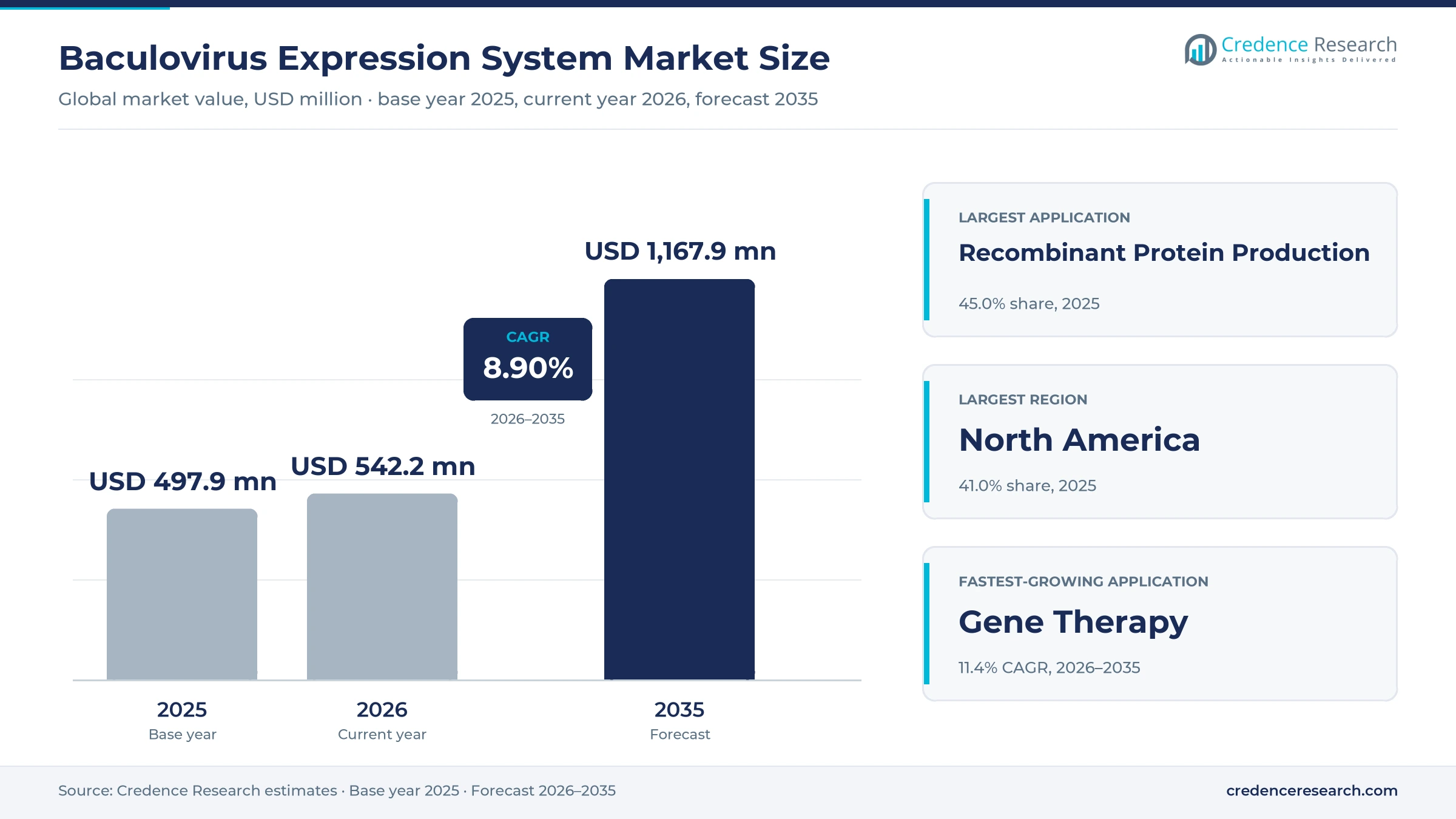
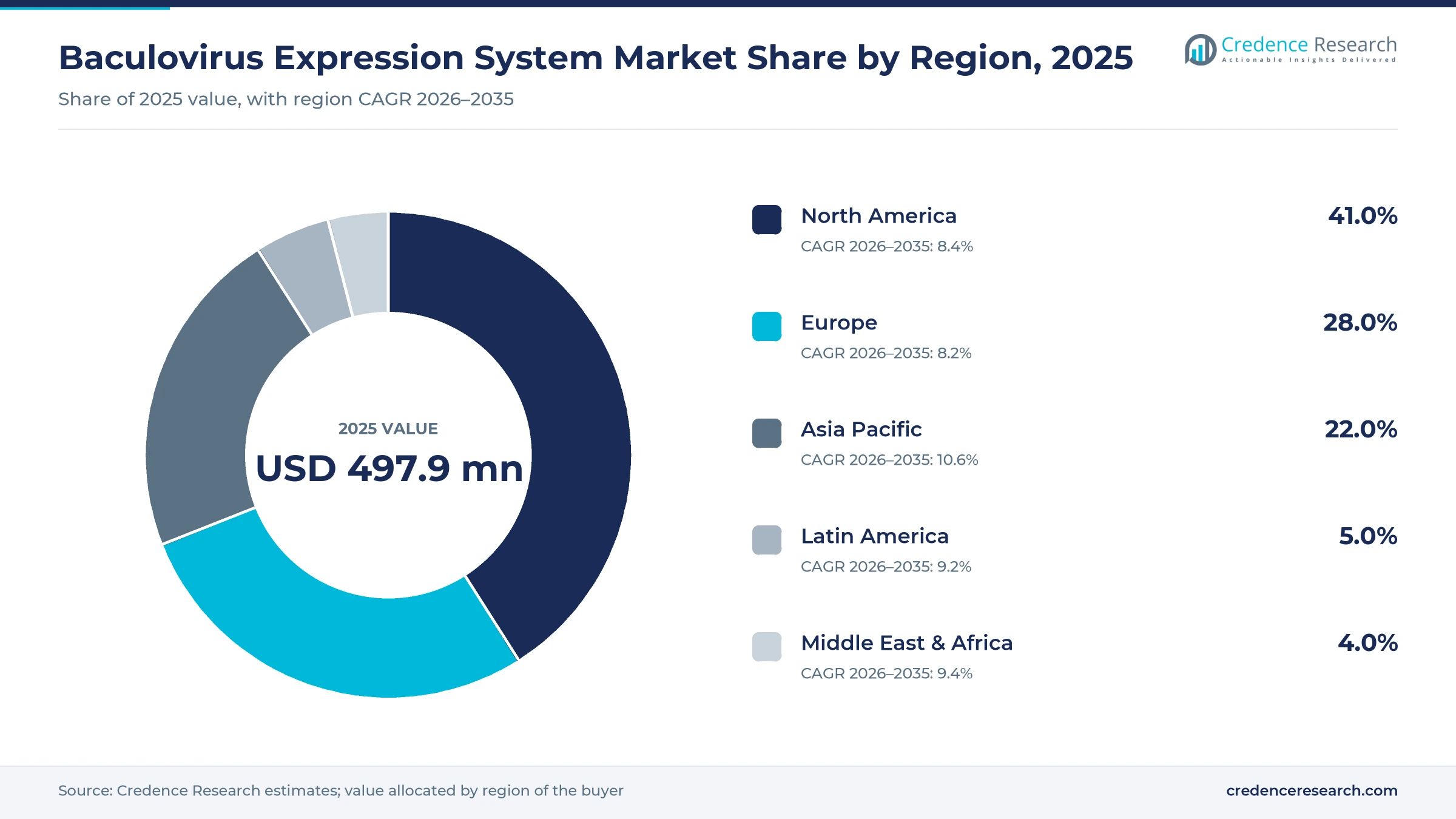
The global baculovirus expression system market was valued at USD 497.9 million in 2025 and is projected to increase from USD 542.2 million in 2026 to USD 1.17 billion by 2035, registering a CAGR of 8.90% during 2026–2035. Demand comes from structural biology and antibody discovery groups that need folded eukaryotic proteins, vaccine developers producing recombinant antigens and virus-like particles, and gene therapy programs that make recombinant adeno-associated virus in insect cells rather than in mammalian lines. North America held the largest regional share, 41.0% in 2025, because most clinical-stage gene therapy sponsors and the largest protein core facilities sit there. Asia Pacific is the fastest-growing region at 10.6% a year, as Chinese and Japanese vaccine and contract manufacturers build insect cell capacity. Regulatory acceptance is the structural change behind demand, since authorized products now state that their active substance is produced in insect cells by recombinant DNA technology.
Which products and services does the estimate count?
The estimate counts supplier sales of baculovirus DNA and transfer vectors, bacmid and transfection kits, insect host cells such as Sf9, Sf21 and High Five lines, insect cell media and feeds sold for this work, and contract expression services that deliver protein, virus-like particles or viral vectors on the platform. Buyers range from single academic laboratories ordering one vial to commercial sponsors placing multi-year supply contracts under good manufacturing practice.
Revenue from the finished biologics themselves sits outside the estimate, as do mammalian transfection platforms, microbial fermentation and general laboratory consumables. The value chain runs from vector and cell line licensors through media and reagent makers to contract development and manufacturing organizations, with the service layer capturing most of the spending once a program reaches toxicology work and clinical supply.
Baculovirus Expression System Market Insights
- The market is valued at USD 497.9 million in 2025 and is projected to reach USD 1.17 billion by 2035, growing at an 8.90% CAGR as insect cell vector production scales up.
- North America led with 41.0% of 2025 value, because clinical gene therapy sponsors and large protein production core facilities concentrate there.
- Recombinant Protein Production held 45.0% of 2025 value, while gene therapy use grows fastest at 11.4% a year.
- The FDA approved the Biologics License Application for Novavax's recombinant protein nanoparticle COVID-19 vaccine on May 19, 2025, triggering a USD 175 million milestone from Sanofi.
- BioMarin said on Feb. 23, 2026 that it would voluntarily remove its hemophilia A gene therapy from the market after failing to find a buyer.
Protein work leads while gene therapy use grows fastest
Why does protein work lead while gene therapy grows faster?
Based on application, the market is categorized into recombinant protein production, vaccine development, gene therapy and enzyme production. Recombinant Protein Production led with 45.0% of 2025 value because insect cells fold large multi-domain targets that bacteria cannot, and the Journal of Biological Engineering review of Oct. 6, 2025 described a run that delivered 100 milligrams of purified protein from a 5-liter suspension culture in 34 days. Gene therapy is the fastest application at 11.4% a year, as the same review traced insect cell use in recombinant AAV production from about 5.6% before 2007 to above a fifth of reported processes by 2022. Microbial hosts remain far cheaper for bulk enzymes, so enzyme work stays small.
What keeps Sf9 cells ahead of other insect lines?
Based on expression host, the market is categorized into Sf9 cells, Sf21 cells and other insect cell lines, mainly High Five and S2 lines. Sf9 Cells led with 52.0% of 2025 value because regulators have already reviewed products made in it, and ATCC lists it at USD 577 a vial with Autographa californica nuclear polyhedrosis virus as a susceptible virus. Other insect cell lines grow fastest at 9.6% a year, as secreted, glycosylated targets favor High Five cells, where the same 2025 review reported a 1.8-fold yield gain at bioreactor scale. Sf21 remains in use where established laboratory protocols specify it, so its share grows more slowly than lines chosen for new secreted-protein work.
Why are contract organizations the fastest-growing buyers?
Based on end user, the market is categorized into biopharmaceutical companies, academic and research institutions and contract research organizations. Biopharmaceutical Companies led with 54.0% of 2025 value because clinical and commercial supply contracts dwarf single-laboratory orders, and Novavax closed the sale of its Czech biologics campus to Novo Nordisk on Dec. 30, 2024, moving that capacity to a larger pharmaceutical owner. Contract research organizations grow fastest at 10.1% a year, as sponsors outsource insect cell work rather than build it, which uniQure did when it sold its Lexington plant in 2024. Academic demand grows most slowly, because single-laboratory orders scale with the number of grant-funded projects rather than with clinical dose volumes.
| Segment Group | Leading Sub-segment | Share, 2025 | Fastest-growing Sub-segment | CAGR, 2026–2035 |
|---|---|---|---|---|
| By Application | Recombinant Protein Production | 45.0% | Gene Therapy | 11.4% |
| By Expression Host | Sf9 Cells | 52.0% | Other Insect Cell Lines | 9.6% |
| By End User | Biopharmaceutical Companies | 54.0% | Contract Research Organizations | 10.1% |
Kits are cheap while GMP runs carry the real cost
Pricing in this platform separates sharply by the stage at which it is used. Discovery groups buy catalog items once, so a vector kit, a cell vial and a liter of medium decide their spending, and those list prices are published. Programs heading toward the clinic pay for process work instead, where a single bioreactor run, virus stock generation and titration are each billed separately and academic core facilities charge external users roughly 60% more than internal ones. Service quotes under good manufacturing practice are negotiated and rarely disclosed, which is the main reason published estimates of this market differ so widely. Suppliers selling only catalog reagents face flat pricing, while service providers keep margin as customers scale up.
| Offer or reference | Typical price or fee | Basis |
|---|---|---|
| Bac-to-Bac baculovirus expression system kit | USD 1,950 list | Fisher Scientific listing, November 2026 |
| flashBAC ULTRA baculovirus DNA | From GBP 331 | Oxford Expression Technologies, November 2026 |
| Sf9 host cell line vial, ATCC CRL-1711 | USD 577 | ATCC catalog, November 2026 |
| Bacmid transfection, core facility | USD 211 internal, USD 276 external academic | Baylor College of Medicine core fee schedule, November 2026 |
| 500 ml viral stock production, core facility | USD 592 internal, USD 947 external academic | Baylor College of Medicine core fee schedule, November 2026 |
| 5-liter bioreactor protein production run | USD 1,210 internal, USD 1,936 external academic | Baylor College of Medicine core fee schedule, November 2026 |
Request a Free Sample
Fill in your details and we'll send you a free sample report.
- Sample data tables & charts
- Research methodology
Approved products, vector scale-up and clean cell lines
Authorized products anchor the platform in regulated supply
Regulatory acceptance of insect cell manufacturing is what moved this platform from research tool to qualified supply route, because sponsors can point to approved precedents instead of defending the host from first principles. The European product information for the hemophilia B gene therapy etranacogene dezaparvovec states that the active substance is produced in insect cells by recombinant DNA technology, with first authorization on Feb. 20, 2023. The FDA approved the Biologics License Application for Novavax's recombinant protein nanoparticle COVID-19 vaccine on May 19, 2025, and the European product information for that vaccine states it is made using a baculovirus expression system in an Sf9 insect cell line. Each precedent lowers review risk for the next sponsor, which favors suppliers that can document cell line history and viral clearance.
Insect cell routes scale gene therapy vector supply
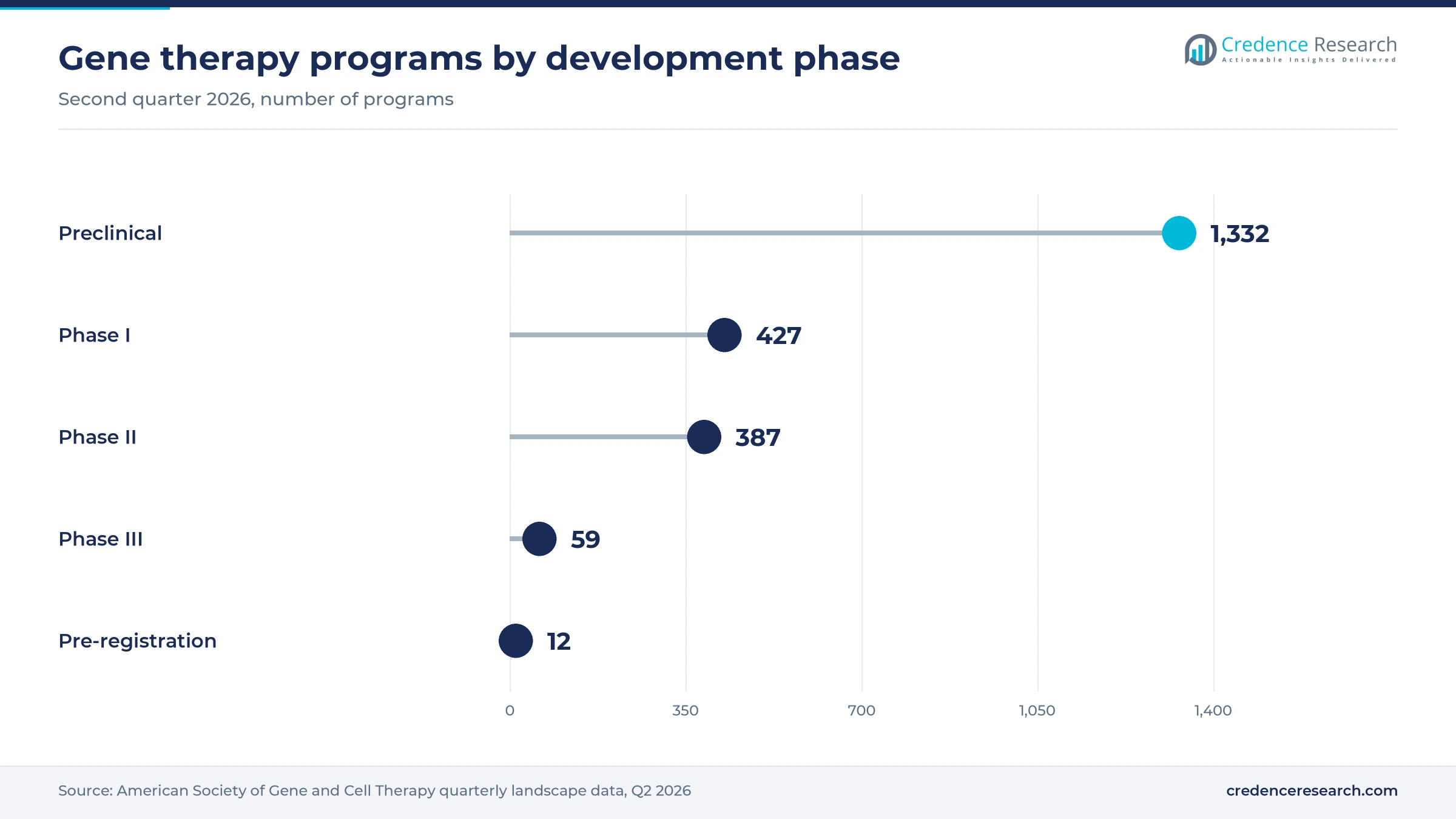
Sponsors choose the insect cell route when a program needs kilogram-scale vector without the transfection reagent cost of mammalian production, which is why vector demand now pulls the platform forward. GeneVoyager opened a 68,000-square-foot contract facility built on an insect baculovirus platform in December 2023, quoting yields of 1E+15 to 5E+15 viral genomes per liter at 500 to 2,000 liter scale. The American Society of Gene and Cell Therapy counted 59 gene therapy programs in Phase III in the second quarter of 2026, against 45 a year earlier, and 387 in Phase II. Suppliers holding qualified insect cell capacity for viral vector and plasmid DNA manufacturing gain pricing power as those programs file.
Clean host lines remove a documented review obstacle
Removing adventitious viruses from the host line answers a question regulators ask of every insect cell filing, so clean lines convert directly into orders. Merck describes Sf-rhabdovirus as a common and persistent contaminant of Sf9 lines and sells the rhabdovirus-negative Sf-RVN line, first described in 2016, with a chemically defined medium that it says reached 6 million to 8 million cells per milliliter by day four. GeneVoyager built its contract facility on the One-Bac 4.0 system paired with the Sf-RVF line, choosing a cleaned host rather than a standard Sf9 bank. Documented clearance strengthens suppliers that own validated lines and matched media, and it disadvantages laboratories still passaging legacy banks of unknown provenance.
Outsourcing shifts spending toward contract capacity
Sponsors are selling plants instead of building them, which concentrates insect cell spending in contract organizations that can fill several programs at once. uniQure announced on July 1, 2024 that it would sell its Lexington commercial manufacturing facility to Genezen for USD 25 million in stock and a convertible note, with Genezen taking over global commercial supply for its partner. Novavax closed the USD 200 million sale of its Czech biologics campus to Novo Nordisk on Dec. 30, 2024, after an agreement signed on Dec. 3, 2024. Both transfers moved trained production staff across to the buyer rather than only equipment. Contract organizations therefore gain the capability that is hardest to rebuild, which is why Contract Research Organizations are the fastest-growing buyer group at 10.1% a year.
Clean host lines, defined media and outsourced capacity
Chemically defined media replace hydrolysate formulations
Media buyers are shifting from hydrolysate-based formulations to chemically defined feeds to address lot variability and regulatory documentation. Lonza introduced a chemically defined, non-animal origin gene therapy cell culture media product for AAV production in Sf9 cells in March 2020, supported by a drug master file. Merck reports that its chemically defined insect medium raised reporter protein production by 36% and 45% against a competing medium in its own testing. ANGUS Chemical acquired Expression Systems, the Davis, California maker of ESF 921 insect cell medium, on Nov. 9, 2022, bringing a specialist formulator into a chemical group. Buyers gain reproducibility, while media houses gain recurring consumable revenue that one-off reagent kits never provide.
Vectors arrive with viral genes already deleted
Vector design is moving toward pre-deleted baculovirus backbones, so laboratories no longer screen plaques to find a clean recombinant. Oxford Expression Technologies supplies flashBAC ULTRA with five viral genes removed, among them chiA and v-cath to limit degradation of secreted protein, and p74 to restrict passage through the insect gut wall. The insect cell review of Oct. 6, 2025 reported that an improved transfection method lifted efficiency from a range of 2% to 20% up to 45% to 57%, and that a lef5-deficient vector improved secretion 1.8-fold. Deleted-gene backbones shorten timelines for secreted targets, which favors specialist vector licensors over general cloning suppliers whose catalogs do not carry these products.
Asian vaccine programs open a second demand center
Insect cell antigen production is becoming a regional capability rather than a Western one, which creates an opening for suppliers willing to localize media and cell line support. China granted emergency use authorization in June 2023 for the WestVac Biopharma trivalent protein vaccine named for its Sf9 cell substrate, developed with West China Medical Center and Sichuan University, after an earlier authorization for a first Sf9 cell vaccine in December 2022. Takara Bio expanded its Center for Gene and Cell Processing in Shiga, Japan with 2,000-liter fermenters from February 2022. Demand for insect cell culture inputs in the region is therefore growing from a manufacturing base, so reagent suppliers with local stock and documentation win the orders.
Service providers absorb work sponsors will not build
Contract expression is the clearest commercial opening, because sponsors need insect cell material long before they can justify a facility of their own. GenScript offers baculovirus expression with virus generation in two to three weeks and a one-liter expression and purification run in a further two to three weeks, citing yields above two milligrams per liter for a claudin target and 10 milligrams per liter for a 100-kilodalton protein. The American Society of Gene and Cell Therapy counted 427 gene therapy programs in Phase I in the second quarter of 2026, each a potential service buyer. Curia Global listed baculovirus expression vector system work in 2026 alongside particle screening, and VectorBuilder sells insect protein expression as a catalog service. Providers that carry a protein from vector design to a qualified run capture the largest share of program spending.
Glycosylation gaps and vector withdrawals expose suppliers
Insect glycans still limit therapeutic protein use
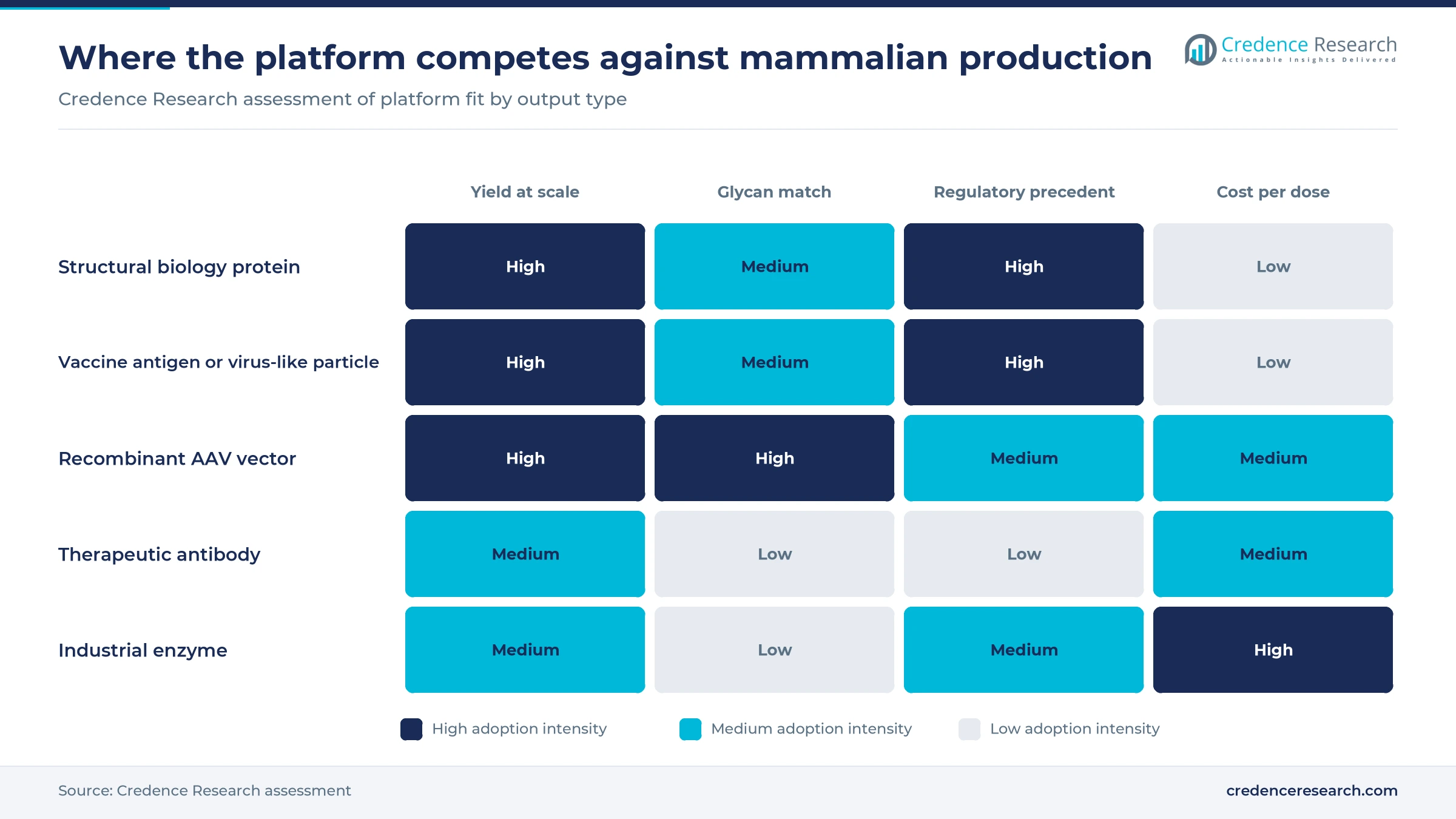
Insect cells add simpler glycans than mammalian cells, so some therapeutic proteins cannot use the platform at all. The Journal of Biological Engineering review of Oct. 6, 2025 named incomplete and non-humanized glycosylation as a key bottleneck and flagged difficult removal of residual baculovirus and host cell impurities. Developers of glycosylated antibodies and replacement enzymes are the most exposed, because a glycan mismatch can change clearance and potency. Glyco-engineered insect cell lines address part of the gap, but each new line restarts the characterization work from the beginning.
Gene therapy withdrawals cut service order books
Platform demand depends on a small number of commercial vector programs, so a single withdrawal removes years of service volume. BioMarin said on Feb. 23, 2026 that it would voluntarily remove its hemophilia A gene therapy from the market after it was unable to identify a qualified buyer, and stated that the decision was not related to the product's efficacy or safety. Contract organizations that reserved suites for one program carry the loss, since insect cell capacity cannot be repurposed quickly. Providers with several clinical clients absorb such cancellations far more easily.
Residual DNA limits raise purification costs
Clearing residual host cell and baculovirus DNA to published benchmarks adds purification steps that smaller suppliers struggle to fund. A Cell and Gene Therapy Insights review of Oct. 15, 2025 recorded a World Health Organization benchmark of 10 nanograms per dose and FDA advice from 2010 that median fragment size stay below 200 base pairs. Developers of high-dose systemic vectors face the hardest arithmetic, because a larger dose carries proportionally more host cell DNA. Analytical method development and validated assays are the main cost, not the chromatography itself.
Published estimates of this platform disagree widely
Buyers planning capacity face a genuine evidence gap, because the platform is sold as kits, media and services that no public statistic separates. Catalog prices are published, with a system kit at USD 1,950 and an Sf9 vial at USD 577, while service contracts under good manufacturing practice stay confidential. The estimate here therefore rests on list prices, core facility fee schedules and disclosed pipeline counts rather than on reported platform revenue. Readers comparing published figures should check scope first, since service inclusion changes the total materially.
North America leads as Asia Pacific grows fastest
Regional demand tracks where clinical gene therapy sponsors sit, where vaccine antigens are produced and where contract capacity has been built, so the regions differ in both level and growth. The three leading regions together accounted for 91.0% of 2025 demand, leaving a small balance to Latin America and the Middle East & Africa.
| Region | Value, 2025 (USD million) | Share, 2025 | CAGR, 2026–2035 |
|---|---|---|---|
| North America | 204.1 | 41.0% | 8.4% |
| Europe | 139.4 | 28.0% | 8.2% |
| Asia Pacific | 109.5 | 22.0% | 10.6% |
| Latin America | 24.9 | 5.0% | 9.2% |
| Middle East & Africa | 19.9 | 4.0% | 9.4% |
North America leads on clinical vector programs
North America held 41.0% of 2025 value and grows at 8.4% a year, because most clinical-stage gene therapy sponsors, the largest protein production core facilities and the main reagent suppliers are based there. The region also carries the clearest pricing evidence, since academic cores publish fee schedules such as the USD 1,936 external charge for a 5-liter bioreactor run. Capacity has changed hands rather than closed, as the Lexington plant sale noted above shows. Cancellation of a single commercial program remains the main regional risk to service revenue.
Asia Pacific grows fastest on vaccine and contract capacity
Asia Pacific held 22.0% of 2025 value and grows fastest at 10.6% a year, because China and Japan have built insect cell capability for vaccines and contract work. China authorized Sf9 cell protein vaccines from WestVac Biopharma in December 2022 and June 2023, which created a domestic market for media and cell lines. Takara Bio runs gene and cell therapy manufacturing from Shiga with 2,000-liter fermenters. Import documentation and local cell bank requirements still slow foreign reagent suppliers entering these markets.
Europe holds a regulated manufacturing base
Europe held 28.0% of 2025 value and grows at 8.2% a year, supported by authorized insect cell products and by specialist vector and media suppliers. The European product information for the hemophilia B gene therapy states insect cell manufacture, which gives sponsors a documented precedent for their own filings. Oxford Expression Technologies in the United Kingdom and Lonza in Switzerland supply vectors and media into this base, while the Czech campus sold in December 2024 moved to a large pharmaceutical owner. Slower growth reflects mature academic demand and tight hospital budgets across the region.
Latin America depends on imported reagents
Latin America held 5.0% of 2025 value and grows at 9.2% a year, as university and public health laboratories in Brazil and Mexico run protein and antigen work on imported kits and cells. Almost all vectors, host lines and defined media arrive through distributors, so landed cost and cold chain reliability decide purchase timing. No commercial insect cell capacity under good manufacturing practice in the region has been publicly reported, which is an acknowledged gap in the evidence behind this regional estimate. Growth follows research funding rather than commercial vector programs, and this regional estimate rests largely on university purchasing patterns.
Middle East & Africa builds from a small research base
Middle East & Africa held 4.0% of 2025 value and grows at 9.4% a year, from a base of university laboratories and new biotechnology institutes in the Gulf states and South Africa. Purchases are mostly single kits and cell vials at catalog prices, so order values stay small against the other regions. Public information on insect cell platform use in these markets is thin, so this estimate carries the widest error range in the report. Donor-funded vaccine research is the most likely source of larger orders in the next few years.
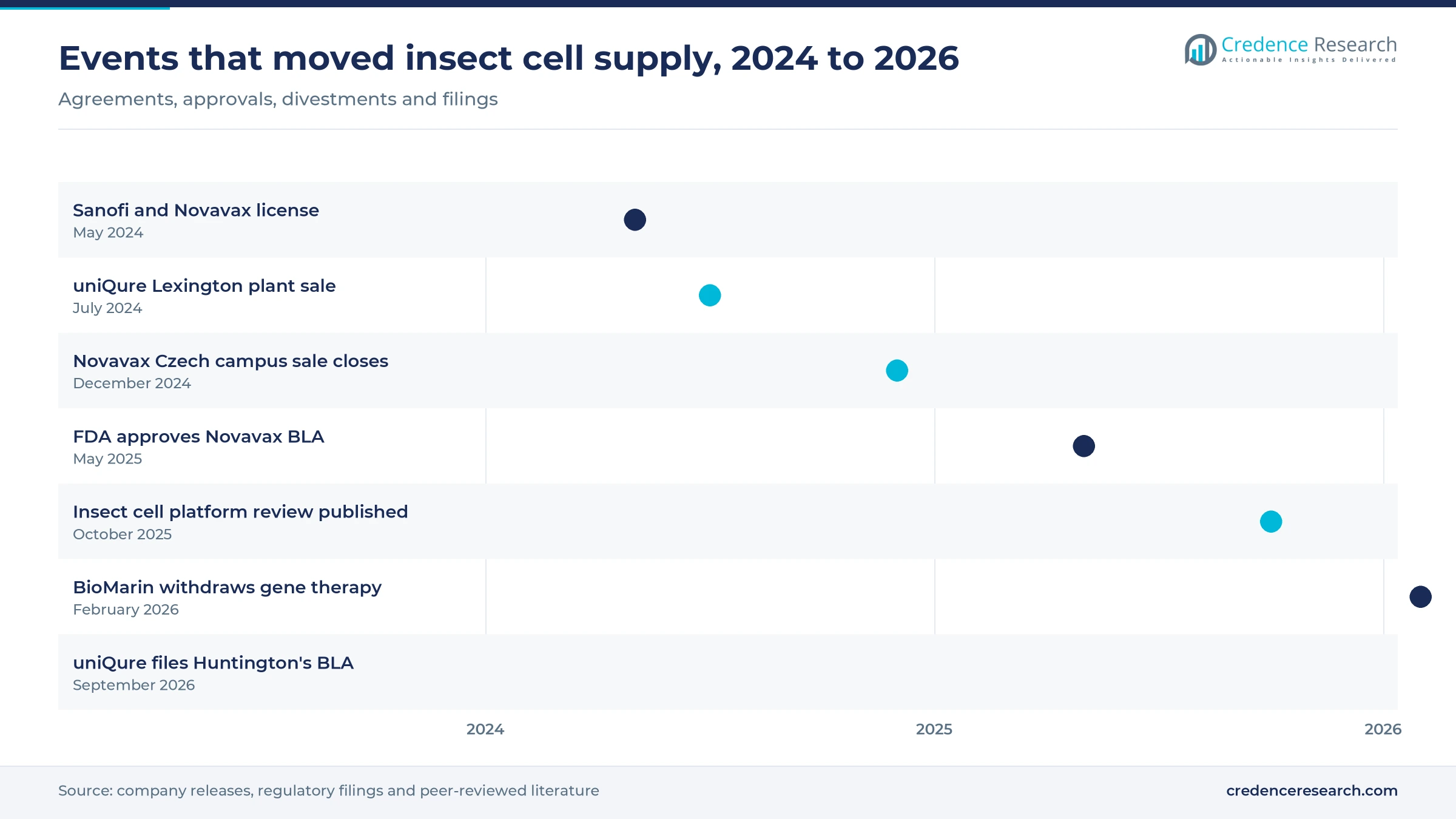
Approvals, plant sales and filings reshape demand, 2024-2026
| Development | Status and market relevance |
|---|---|
| In May 2024, Sanofi and Novavax signed a co-exclusive license to co-commercialize an adjuvanted COVID-19 vaccine made by recombinant protein technology. | Completed agreement with USD 500 million paid upfront and up to USD 700 million in milestones; it moved commercial responsibility to a larger partner from 2025. |
| In December 2024, Novavax closed the sale of its Czech biologics manufacturing campus to Novo Nordisk for USD 200 million. | Completed divestment on Dec. 30, 2024, with USD 180 million paid in cash at closing; it removed owned antigen capacity and shifted the company toward partnered supply. |
| In May 2025, the FDA approved the Biologics License Application for Novavax's recombinant protein nanoparticle COVID-19 vaccine. | Regulatory approval completed on May 19, 2025 for adults 65 and older and high-risk people 12 to 64; it triggered a USD 175 million milestone and a requested Phase 4 trial. |
| In February 2026, BioMarin said it would voluntarily remove its hemophilia A gene therapy from the market. | Withdrawal decision announced Feb. 23, 2026 after no qualified buyer was found; it removes a commercial insect cell vector program from service order books. |
| In September 2026, uniQure submitted a Biologics License Application for its Huntington's disease gene therapy and sought priority review. | Regulatory submission announced Sept. 2, 2026 under the accelerated approval pathway; approval would add a commercial vector program to insect cell supply chains. |
Gene-deleted vectors, bacmids and single-virus designs
The International Committee on Taxonomy of Viruses records baculovirus nucleocapsids at 250 to 300 nanometers in length and 30 to 60 nanometers in diameter, carrying a circular double-stranded DNA genome of 80 to 180 kilobase pairs, which is what allows large inserts. Platform performance now depends less on the host cell than on vector engineering and process control.
- Gene-deleted baculovirus backbones remove chiA, v-cath and other viral genes so secreted proteins survive the late phase of infection intact.
- Bacmid cloning in bacteria lets laboratories build a recombinant virus without plaque purification, which removes weeks from vector generation.
- Rhabdovirus-negative host lines answer the adventitious virus question in filings and remove a documented obstacle to regulated manufacturing.
- Single-baculovirus vector designs carry all elements for recombinant AAV in one virus, which simplifies infection control at large scale.
- Chemically defined feeds eliminate animal origin hydrolysates and reduce lot-to-lot variability across long production campaigns.
Need a Custom Version of This Report?
Tailor the scope, geography, or segments to your exact requirements.
- Custom geography or segment scope
- Direct access to our analyst team
Kit makers, media houses and service providers compete
Competition runs on different terms at each layer of the platform. Thermo Fisher Scientific and Merck KGaA compete as full-line suppliers, pairing vectors and kits with host cells and media so a customer can buy one documented workflow, and Merck differentiates on its rhabdovirus-negative Sf9 line. Oxford Expression Technologies competes on vector engineering alone, licensing gene-deleted backbones that specialist users adopt for difficult secreted targets, and reaches buyers through distribution partners. Takara Bio sells both research reagents and gene and cell therapy manufacturing from its Japanese site, which few competitors match. Lonza and Expression Systems compete on media performance and documentation rather than on vectors. GenScript Biotech, Curia Global and VectorBuilder compete for outsourced expression work on turnaround time, published yields and the ability to carry a project toward regulated supply.
How is the supply side of this platform organized?
Three distinct groups share the value chain of this platform between them. A handful of large life science suppliers sell vectors, host cells and media as catalog products, specialist licensors such as Oxford Expression Technologies hold the engineered baculovirus backbones and reach customers partly through distributors including Mirus Bio, and contract organizations sell the process work. Entry is cheap at the reagent end and expensive at the regulated end, where a validated insect cell bank, viral clearance data and regulatory history take years to assemble. Margins sit with media formulators, who hold recurring consumable revenue, and with service providers running qualified suites. Biopharmaceutical companies hold 54.0% of 2025 demand, so suppliers compete hardest for a small number of sponsor accounts.
Companies profiled and their roles in this market
| Company | Type | Role in the market |
|---|---|---|
| Thermo Fisher Scientific Inc. | Full-line supplier | Sells baculovirus expression kits, insect host cells and insect cell media |
| Merck KGaA (MilliporeSigma) | Full-line supplier | Supplies the rhabdovirus-negative Sf9 line and chemically defined insect media |
| Takara Bio Inc. | Specialist and service provider | Sells baculovirus vectors and runs gene and cell therapy manufacturing in Japan |
| Oxford Expression Technologies Ltd. | Vector specialist | Licenses gene-deleted flashBAC baculovirus DNA for difficult secreted proteins |
| GenScript Biotech Corporation | Expression service provider | Runs virus generation and liter-scale insect cell expression and purification |
| Lonza Group AG | Media and manufacturing supplier | Supplies chemically defined insect cell medium for viral vector production |
| Expression Systems LLC (ANGUS Chemical Company) | Media specialist | Formulates ESF 921 and related insect cell culture media and reagents |
| Mirus Bio LLC | Distributor and reagent supplier | Distributes flashBAC vector systems and supplies transfection reagents |
| Curia Global, Inc. | Contract development organization | Provides baculovirus vector system expression and particle screening services |
| VectorBuilder Inc. | Service provider | Offers catalog insect cell protein expression from vector design to purification |
Value migrates from kits toward GMP services and media
Credence Research's view is that the growth in this platform is not coming from laboratory reagents, whose list prices have been stable for years. Growth is coming from the services and media that sit under clinical vector programs, which is why the estimate runs ahead of the catalog layer. The main risk is concentration, because a few commercial programs drive service demand and one withdrawal can empty a provider's order book. The Phase III count noted above is the number worth watching, because each filing converts into years of qualified supply work. Suppliers holding validated cell banks and clearance data are better placed than those competing on kit price.
Earlier estimate rolled forward and tested on list prices
The report uses 2025 as the base year and forecasts to 2035. The earlier published estimate for this platform was rolled forward at its own growth rate and then tested against published list prices, academic core facility fee schedules and disclosed clinical pipeline counts, with the three supply layers of reagents, media and services sized separately. The resulting 2025 value of USD 497.9 million reflects reagent, media and service demand together rather than any single source. Regional and segment shares are Credence Research estimates built from where clinical sponsors, vaccine producers and contract capacity are located, and they are stated as estimates because no official statistic separates this platform. Sources used are regulator product information, company releases and filings, peer-reviewed literature, trade association pipeline data and supplier catalogs. No interviews or surveys were conducted for this edition of the report.
Gene therapy filings decide the pace through 2035
Through 2035 the direction of this market depends on how many insect cell vector programs reach the market, not on laboratory demand. Filings now in review, including the Huntington's disease application submitted in September 2026, would each add multi-year supply contracts if they are approved. Media and service revenue should keep rising faster than kit sales, because process steps scale with dose while catalog purchases do not. Glycosylation limits will keep most therapeutic antibody work in mammalian cells, so the platform grows within protein research, vaccine antigens and viral vectors rather than across all biologics. Suppliers that document viral clearance and residual DNA control will hold the strongest commercial positions.
What decides the range of outcomes to 2035?
The spread depends almost entirely on how many programs convert in the clinic. If several insect cell vector programs win approval and hold their launches, service contracts carry the market above the base case. If approvals slip or further products are withdrawn, as happened in February 2026, growth falls back toward the reagent and media layers, which grow with research budgets rather than with doses. Media standardization and clean host lines support the base case in every scenario, since they are bought at all stages of development.
| Scenario | CAGR, 2026–2035 | Value, 2035 | What has to hold |
|---|---|---|---|
| Downside | 6.9% | USD 988.4 million | More vector programs are withdrawn and service suites stay underused |
| Base | 8.90% | USD 1.17 billion | Approved products hold and pipeline programs file on current timelines |
| Upside | 10.7% | USD 1.35 billion | Several insect cell vector approvals convert into multi-year supply contracts |
Frequently Asked Questions
How big is the baculovirus expression system market?
What is counted in this market estimate?
Which application accounts for the largest share?
Which application is growing fastest?
Which region leads the market?
Are any approved medicines made in insect cells?
What limits wider therapeutic use of the platform?
What does insect cell expression work cost?
Table of Content
Chapter 1 Market Segmentation
- 1.1 Segmentation Framework
- 1.1.1 Product and Service Classification
- 1.1.2 Application and End-Use Classification
- 1.1.3 Technology and Solution Classification
- 1.1.4 Customer and Distribution Channel Classification
- 1.1.5 Geographic Segmentation
- 1.1.6 Market Segment Definitions and Boundaries
- 1.2 By Application
- 1.2.1 Recombinant Protein Production
- 1.2.2 Vaccine Development
- 1.2.3 Gene Therapy
- 1.2.4 Enzyme Production
- 1.3 By Expression Host
- 1.3.1 Sf9 Cells
- 1.3.2 Sf21 Cells
- 1.3.3 Other Insect Cell Lines
- 1.4 By End User
- 1.4.1 Biopharmaceutical Companies
- 1.4.2 Academic and Research Institutions
- 1.4.3 Contract Research Organizations
Chapter 2 Introduction
- 2.1 Report Objectives and Scope
- 2.2 Product Definition and Industry Terminology
- 2.3 Market Inclusions and Exclusions
- 2.4 Research Process
- 2.4.1 Primary Research and Expert Interviews
- 2.4.2 Secondary Research and Source Review
- 2.4.3 Top-Down and Bottom-Up Estimation
- 2.4.4 Data Triangulation and Verification
- 2.5 Market Size Measurement Basis
- 2.5.1 2025: USD 497.9 million → 2035: USD 1.17 billion
- 2.6 Historical and Forecast Reference Periods
- 2.6.1 Historical Period: 2018-2025
- 2.6.2 Base Year: 2025
- 2.6.3 Forecast Period: 2025-2035
- 2.7 Research Assumptions and Limitations
Chapter 3 Executive Summary
- 3.1 Market Snapshot and Key Findings
- 3.2 Base-Year Market Size, 2025
- 3.3 Forecast Market Size, 2035
- 3.4 Revenue and Volume Growth Outlook
- 3.5 Key Demand and Supply Indicators
- 3.6 Leading Market Segments
- 3.7 Fastest-Growing Market Opportunities
- 3.8 Regional Performance Highlights
- 3.9 Technology and Industry Transformation
- 3.10 Competitive Landscape Summary
- 3.11 Analyst View and Strategic Implications
Chapter 4 Global Baculovirus Expression System Market Trends and Developments
- 4.1 Historical Industry Development, 2018-2025
- 4.2 Recent Market Trends and Developments
- 4.3 Demand and Customer Behavior Trends
- 4.4 Technology and Product Innovation
- 4.5 Artificial Intelligence, Automation and Digitalization
- 4.6 Local Manufacturing and Supply Chain Realignment
- 4.7 Industry Partnerships, Mergers and Acquisitions
- 4.8 Sustainability and Circular Economy Developments
- 4.9 Government and Private Sector Investment Trends
- 4.10 Emerging Business Models and Commercialization
- 4.11 Industry Developments and Announcements
Chapter 5 Global Baculovirus Expression System Market Production, Supply and Demand Analysis
- 5.1 Demand Trend and Consumption Analysis, 2018-2025
- 5.2 Demand Forecast, 2025-2035
- 5.3 Production and Output Trend, 2018-2025
- 5.4 Production and Output Forecast, 2025-2035
- 5.5 Installed Capacity and Capacity Utilization
- 5.6 Company-Wise Production Plants and Statistics
- 5.6.1 Installed Production Capacity
- 5.6.2 Actual Production
- 5.6.3 Planned Capacity and Expansion Targets
- 5.7 Supply Chain Structure and Procurement Trends
- 5.8 Supply-Demand Gap and Bottlenecks
- 5.9 Import Dependence and Sourcing Structure
- 5.10 Contract Manufacturing and Outsourcing
- 5.11 Regional Supply and Demand Concentration
Chapter 6 Global Baculovirus Expression System Market Pricing Analysis
- 6.1 Pricing Structure and Measurement
- 6.2 Historical Pricing Trends, 2018-2025
- 6.3 Pricing Outlook, 2025-2035
- 6.4 Average Selling Price and Unit Economics
- 6.5 Pricing by Product and Market Segment
- 6.6 Geographic Pricing Differences
- 6.7 Key Input, Energy, Labor and Logistics Costs
- 6.8 Contract Pricing and Purchasing Models
- 6.9 Pricing Sensitivity and Competitive Positioning
- 6.10 Price, Margin and Profitability Implications
Chapter 7 Global Baculovirus Expression System Market Dynamics
- 7.1 Market Growth Drivers
- 7.1.1 Demand-Side Drivers
- 7.1.2 Technology and Innovation Drivers
- 7.1.3 Infrastructure and Investment Drivers
- 7.1.4 Regulatory and Policy Drivers
- 7.2 Market Restraints
- 7.2.1 Cost and Affordability Constraints
- 7.2.2 Technology and Adoption Barriers
- 7.2.3 Supply Chain and Operational Constraints
- 7.3 Market Challenges
- 7.3.1 Competitive Pressure and Margin Erosion
- 7.3.2 Skills, Infrastructure and Implementation Gaps
- 7.4 Emerging Market Opportunities
- 7.5 Market Dynamics Impact and Time-Horizon Assessment
Chapter 8 Global Baculovirus Expression System Value Chain Analysis
- 8.1 Industry Value Chain Overview
- 8.2 Upstream Suppliers and Critical Inputs
- 8.3 Technology and Component Providers
- 8.4 Manufacturing or Service Delivery
- 8.5 Distribution, Channel Partners and Integrators
- 8.6 Downstream Applications and End Users
- 8.7 Value Addition and Profit Pools
- 8.8 Vertical Integration and Outsourcing
- 8.9 Supplier Concentration and Risk
- 8.10 Supply Chain Localization and Resilience
Chapter 9 Global Baculovirus Expression System Market Regulations and Policies
- 9.1 Relevant Laws, Standards and Compliance Frameworks
- 9.2 Product, Service, Safety and Quality Requirements
- 9.3 Government Policies, Incentives and Subsidies
- 9.4 Imports, Exports and Trade Barriers
- 9.5 Public Procurement and Local Content Requirements
- 9.6 Environmental and Sustainability Compliance
- 9.7 Upcoming Policy Changes and Market Implications
Chapter 10 Global Baculovirus Expression System Market Hotspots and Opportunities
- 10.1 Market Opportunity Mapping and Growth Hotspots
- 10.2 High-Growth Applications and Customer Groups
- 10.3 Underserved Markets and White-Space Opportunities
- 10.4 Emerging Technology and Product Opportunities
- 10.5 New Capacity and Investment Hotspots
- 10.6 Market Entry and Expansion Opportunities
- 10.7 Distribution and Partnership Opportunities
- 10.8 Near-Term and Long-Term Commercial Potential
- 10.9 Opportunity Attractiveness and Execution Risks
Chapter 11 Global Baculovirus Expression System Market Outlook, 2025-2035
- 11.1 Market Size and Analysis
- 11.1.1 Revenue (Market Measurement: 2025: USD 497.9 million → 2035: USD 1.17 billion)
- 11.1.2 Market Volume and Quantity Sold
- 11.1.3 Historical Market Size, 2018-2025
- 11.1.4 Base-Year Market Size, 2025
- 11.2 Market Forecast, 2025-2035
- 11.2.1 Revenue Forecast to 2035
- 11.2.2 Volume Forecast to 2035
- 11.2.3 CAGR and Year-on-Year Growth
- 11.2.4 Incremental Revenue Opportunity
- 11.3 Forecast Assumptions and Scenario Analysis
- 11.3.1 Base-Case Forecast
- 11.3.2 Optimistic and Conservative Scenarios
- 11.3.3 Technology, Pricing and Policy Sensitivities
- 11.4 Market Attractiveness and Growth Outlook
Chapter 12 Global Baculovirus Expression System Market Segmentation and Outlook
- 12.1 Segmentation Summary and Market Shares, 2025
- 12.2 Largest and Fastest-Growing Segments
- 12.3 By Application - Market Size and Forecast, 2025-2035
- 12.3.1 Segment Definition and Scope
- 12.3.2 Historical Market Size, 2018-2025
- 12.3.3 Revenue Forecast, 2025-2035
- 12.3.4 Volume Forecast, 2025-2035
- 12.3.5 Base-Year Market Share, 2025
- 12.3.6 Segment CAGR and Growth Drivers
- 12.3.7 Subsegment Market Size and Forecast
- 12.3.7.1 Recombinant Protein Production
- 12.3.7.2 Vaccine Development
- 12.3.7.3 Gene Therapy
- 12.3.7.4 Enzyme Production
- 12.3.8 Subsegment Pricing and Adoption Trends
- 12.3.9 Leading Suppliers and Competition
- 12.3.10 Regional Demand and Opportunities
- 12.4 By Expression Host - Market Size and Forecast, 2025-2035
- 12.4.1 Segment Definition and Scope
- 12.4.2 Historical Market Size, 2018-2025
- 12.4.3 Revenue Forecast, 2025-2035
- 12.4.4 Volume Forecast, 2025-2035
- 12.4.5 Base-Year Market Share, 2025
- 12.4.6 Segment CAGR and Growth Drivers
- 12.4.7 Subsegment Market Size and Forecast
- 12.4.7.1 Sf9 Cells
- 12.4.7.2 Sf21 Cells
- 12.4.7.3 Other Insect Cell Lines
- 12.4.8 Subsegment Pricing and Adoption Trends
- 12.4.9 Leading Suppliers and Competition
- 12.4.10 Regional Demand and Opportunities
- 12.5 By End User - Market Size and Forecast, 2025-2035
- 12.5.1 Segment Definition and Scope
- 12.5.2 Historical Market Size, 2018-2025
- 12.5.3 Revenue Forecast, 2025-2035
- 12.5.4 Volume Forecast, 2025-2035
- 12.5.5 Base-Year Market Share, 2025
- 12.5.6 Segment CAGR and Growth Drivers
- 12.5.7 Subsegment Market Size and Forecast
- 12.5.7.1 Biopharmaceutical Companies
- 12.5.7.2 Academic and Research Institutions
- 12.5.7.3 Contract Research Organizations
- 12.5.8 Subsegment Pricing and Adoption Trends
- 12.5.9 Leading Suppliers and Competition
- 12.5.10 Regional Demand and Opportunities
- 12.6 Segment Growth Comparison
- 12.7 Segment Attractiveness and Priority Matrix
Chapter 13 Global Baculovirus Expression System End-Use and Application Market Outlook
- 13.1 End-Use Industry and Customer Demand Structure
- 13.2 Leading Applications and Customer Groups
- 13.3 End-Use Market Size, Share and Forecast
- 13.4 Major End-Use Industry Deep Dives
- 13.4.1 Customer Requirements and Use Cases
- 13.4.2 Demand and Replacement Cycles
- 13.4.3 Technical and Regulatory Considerations
- 13.4.4 Purchasing and Procurement Models
- 13.4.5 Leading Vendors and Distribution Channels
- 13.4.6 Forecast and Commercial Opportunities
- 13.5 Emerging Applications and Cross-Segment Demand
- 13.6 End-Use Industry Investment Priorities
Chapter 14 Global Baculovirus Expression System Geographic Market Outlook, 2025-2035
- 14.1 Regional Market Size and Share, 2025
- 14.2 Regional Market Forecast, 2025-2035
- 14.3 Regional Pricing, Production and Demand Differences
- 14.4 North America
- 14.4.1 United States
- 14.4.2 Canada
- 14.4.3 Mexico
- 14.5 Europe
- 14.5.1 Germany
- 14.5.2 France
- 14.5.3 Italy
- 14.5.4 United Kingdom
- 14.5.5 Spain
- 14.5.6 Poland
- 14.5.7 Russia
- 14.5.8 Netherlands
- 14.5.9 Belgium
- 14.5.10 Sweden
- 14.5.11 Denmark
- 14.5.12 Norway
- 14.5.13 Rest of Europe
- 14.6 Asia Pacific
- 14.6.1 China
- 14.6.2 India
- 14.6.3 Japan
- 14.6.4 South Korea
- 14.6.5 Thailand
- 14.6.6 Indonesia
- 14.6.7 Vietnam
- 14.6.8 Malaysia
- 14.6.9 Australia
- 14.6.10 Rest of Asia Pacific
- 14.7 Latin America
- 14.7.1 Brazil
- 14.7.2 Argentina
- 14.7.3 Colombia
- 14.7.4 Chile
- 14.7.5 Rest of Latin America
- 14.8 Middle East
- 14.8.1 Saudi Arabia
- 14.8.2 United Arab Emirates
- 14.8.3 Turkey
- 14.8.4 Israel
- 14.8.5 Iran
- 14.8.6 Rest of the Middle East
- 14.9 Africa
- 14.9.1 South Africa
- 14.9.2 Egypt
- 14.9.3 Nigeria
- 14.9.4 Morocco
- 14.9.5 Rest of Africa
- 14.10 Regional Investment, Policy and Supply Chain Differences
- 14.11 Regional Competitive Landscape
- 14.12 Geographic Growth Hotspots
Chapter 15 Global Baculovirus Expression System Technology, Innovation and Sustainability Outlook
- 15.1 Technology Landscape and Maturity
- 15.2 Product, Process and Service Innovation
- 15.3 AI, Automation and Digital Tools in the Industry
- 15.4 Technology Adoption and Performance Benchmarking
- 15.5 Innovation Pipeline and R&D Investment
- 15.6 Patent and Intellectual Property Trends
- 15.7 Energy Efficiency and Resource Management
- 15.8 Sustainability, Recycling and Circularity
- 15.9 Technology Roadmap, 2025-2035
- 15.10 Risks of Obsolescence and Technology Substitution
Chapter 16 Global Baculovirus Expression System Market Key Strategic Imperatives
- 16.1 Growth and Market Entry Priorities
- 16.2 High-Return Products and Segments
- 16.3 Pricing, Profitability and Cost Optimization
- 16.4 Technology Investment and Product Differentiation
- 16.5 Supply Chain Localization and Resilience
- 16.6 Distribution and Customer Acquisition
- 16.7 Partnership, Acquisition and Capacity Strategy
- 16.8 Regional Expansion Priorities
- 16.9 Short-, Medium- and Long-Term Actions
Chapter 17 Competition Outlook
- 17.1 Industry Competition Characteristics
- 17.2 Market Structure and Concentration
- 17.3 Market Share and Competitive Positioning, 2025
- 17.4 Company-Wise Revenue and Product Benchmarking
- 17.5 Production and Service Capacity Benchmarking
- 17.6 Technology, Pricing and Differentiation
- 17.7 Regional Footprint and Distribution Strength
- 17.8 Mergers, Acquisitions and Strategic Alliances
- 17.9 New Entrants and Competitive Threats
- 17.10 Porter's Five Forces and Industry Attractiveness
- 17.11 Competitive Outlook, 2025-2035
Chapter 18 Company Profiles
- 18.1 Company Coverage and Selection Criteria
- 18.2 Thermo Fisher Scientific Inc.
- 18.2.1 Business Description
- 18.2.2 Company Ownership and Geographic Presence
- 18.2.3 Product and Service Portfolio
- 18.2.4 Manufacturing and Operating Footprint
- 18.2.5 Production Capacity and Expansion Plans
- 18.2.6 Financial Performance and Investment
- 18.2.7 Market Share and Competitive Position
- 18.2.8 Technology and Innovation Capabilities
- 18.2.9 Strategic Alliances or Partnerships
- 18.2.10 Recent Developments
- 18.2.11 Growth Strategy and Outlook
- 18.3 Merck KGaA (MilliporeSigma)
- 18.4 Takara Bio Inc.
- 18.5 Oxford Expression Technologies Ltd.
- 18.6 GenScript Biotech Corporation
- 18.7 Lonza Group AG
- 18.8 Expression Systems LLC (ANGUS Chemical Company)
- 18.9 Mirus Bio LLC
- 18.10 Curia Global, Inc.
- 18.11 VectorBuilder Inc.
- 18.12 Other Relevant Market Participants
Note: Every listed company is profiled on the structure shown under the first company. The company list is preliminary and may change based on research findings, market developments, data availability and client requirements.
Chapter 19 Disclaimer
- 19.1 Research and Forecast Disclaimer
- 19.2 Data Source and Estimation Limitations
Note: The depth of individual sections depends on data availability for this market. Volume, capacity, trade and other unit-based metrics are included where applicable.