| REPORT ATTRIBUTE | DETAILS |
|---|---|
| Historical Period | 2019-2022 |
| Base Year | 2023 |
| Forecast Period | 2024-2032 |
| Anorectal Manometry Systems Market Size 2024 | USD 77.8 million |
| Anorectal Manometry Systems Market, CAGR | 7.53% |
| Anorectal Manometry Systems Market Size 2032 | USD 139.06 million |
Market Overview
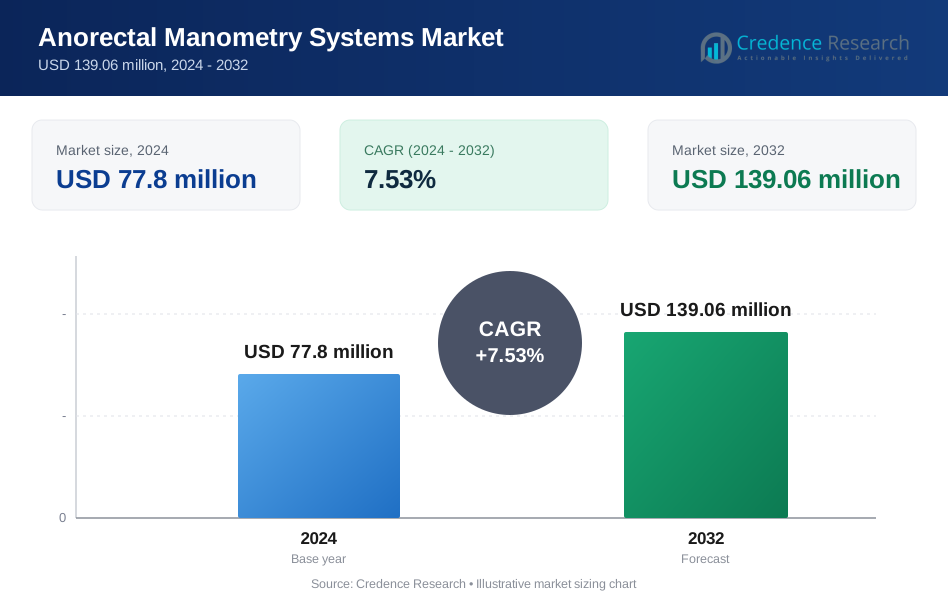
The anorectal manometry systems Market is projected to grow from USD 77.8 million in 2024 to USD 139.06 million by 2032, reflecting a compound annual growth rate (CAGR) of 7.53%.
The anorectal manometry systems market is driven by the rising prevalence of gastrointestinal disorders, such as constipation, fecal incontinence, and irritable bowel syndrome, which are increasingly diagnosed through manometry procedures. Advancements in technology, including the development of non-invasive, more accurate, and user-friendly devices, are also propelling market growth. The growing awareness and demand for early and precise diagnosis of anorectal dysfunctions, coupled with increasing healthcare investments, are further fueling market expansion. Moreover, the growing aging population, which is more susceptible to anorectal conditions, and the rising adoption of these systems in hospitals and diagnostic centers are significant trends contributing to market growth. Additionally, the shift towards outpatient care and minimally invasive treatments is encouraging the use of anorectal manometry systems for efficient, patient-centered care. These factors collectively contribute to the market's robust growth and innovation in device design and functionality.
The anorectal manometry systems market is geographically segmented into regions such as North America, Europe, Asia-Pacific, and the rest of the world. North America holds the largest market share due to the advanced healthcare infrastructure, high prevalence of gastrointestinal disorders, and significant investments in medical technology. Europe follows closely with a strong presence of established healthcare systems and increasing demand for accurate diagnostic tools. The Asia-Pacific region is rapidly growing, driven by rising healthcare access, aging populations, and increasing awareness of anorectal conditions. Key players in the market include Medtronic plc, Laborie, Dentsleeve, Sierra Scientific, Sandhill Scientific, and Synectics Medical Limited. These companies lead the market through innovation, strategic partnerships, and expanding their product portfolios to cater to the growing demand for anorectal manometry systems globally.
Market Drivers
Rising Prevalence of Gastrointestinal Disorders:
The growing prevalence of gastrointestinal disorders, such as constipation, fecal incontinence, and irritable bowel syndrome (IBS), is a major driver of the anorectal manometry systems market. These conditions often require diagnostic tests to assess the functionality of the anal sphincter and rectal muscles, which are best evaluated through anorectal manometry. For instance, Medtronic offers advanced anorectal manometry systems that help diagnose these conditions effectively. As more patients seek medical attention for these conditions, the demand for accurate and reliable diagnostic tools increases, boosting the adoption of manometry systems.
Technological Advancements and Innovation:
Advancements in technology have significantly enhanced the capabilities and accuracy of anorectal manometry systems, further driving market growth. For instance, Diversatek Healthcare has developed portable, easy-to-use manometry systems that can be used in outpatient settings, increasing the appeal of these diagnostic tools, enabling quicker diagnosis, and improving patient outcomes. Innovations such as improved sensors, more precise pressure measurement techniques, and non-invasive alternatives have made these devices more effective and user-friendly.
Aging Population:
The aging population is another key driver of the anorectal manometry systems market. Older adults are more prone to gastrointestinal issues, including constipation, incontinence, and pelvic floor dysfunction, all of which are commonly assessed using anorectal manometry. For instance, Laborie Medical Technologies offers manometry systems specifically designed to cater to the needs of the aging population, supporting market growth by addressing this key demographic. As the global population ages, there is a higher demand for diagnostic tools and treatments tailored to this demographic.
Growing Awareness and Demand for Early Diagnosis:
Increasing awareness among both healthcare professionals and patients about the importance of early and accurate diagnosis of anorectal conditions is contributing to the market's growth. Early detection and intervention can significantly improve treatment outcomes, driving the demand for anorectal manometry systems in both primary care and specialized healthcare settings. For instance, TechnoMed provides advanced diagnostic tools that help healthcare providers prioritize early detection and patient-centric care. Furthermore, as more healthcare institutions prioritize patient-centric care, the demand for advanced diagnostic tools, such as anorectal manometry systems, continues to increase.
Market Trends:
Increased Adoption of Outpatient Care:
A significant trend in the anorectal manometry systems market is the increasing adoption of outpatient care and ambulatory diagnostics. For instance, Sandhill Scientific offers minimally invasive diagnostic procedures that have made anorectal manometry systems more accessible to patients, with easier setup and faster recovery times compared to traditional in-hospital procedures. Hospitals and clinics are increasingly offering these diagnostic services on an outpatient basis, driven by the growing demand for convenience and reduced healthcare costs. This trend is pushing the expansion of manometry system applications in outpatient clinics and private practices.
Technological Advancements in Device Design:
Technological innovation continues to shape the anorectal manometry systems market. For instance, Medspira has integrated advanced sensors, real-time data analytics, and intuitive user interfaces into their devices, allowing healthcare providers to conduct tests with greater precision and efficiency. Many new systems are also becoming more portable, making them suitable for use in a variety of settings, from hospitals to smaller diagnostic centers. Additionally, non-invasive manometry systems are gaining traction, offering less discomfort for patients while maintaining high diagnostic accuracy.
Increasing Demand for Early Detection:
Another notable trend is the growing emphasis on early detection and diagnosis of anorectal dysfunctions. For instance, Alacer Biomédica offers systems that support the early diagnosis of conditions like constipation, incontinence, and pelvic floor dysfunction. As healthcare professionals increasingly recognize the importance of diagnosing these conditions early, the demand for anorectal manometry systems has surged. Early diagnosis not only improves patient outcomes but also supports preventive healthcare practices, further fueling the adoption of these systems.
Focus on Improved Patient Experience:
Healthcare providers are placing a greater emphasis on enhancing patient experience during diagnostic procedures. For instance, Neomedic International has developed user-friendly systems and educational initiatives for patients to help alleviate anxiety and increase the acceptance of anorectal manometry tests. This trend has led to innovations aimed at reducing discomfort and improving the overall experience with anorectal manometry tests. As a result, the demand for more patient-centric devices is expected to continue growing.
Market Challenges Analysis:
High Costs of Advanced Systems:
One of the primary challenges facing the anorectal manometry systems market is the high cost associated with advanced diagnostic devices. The development and production of high-precision manometry systems, which incorporate advanced sensors, real-time data analytics, and non-invasive technologies, require substantial investment in research, design, and manufacturing. These high costs can make it difficult for smaller healthcare facilities, especially those in developing regions, to adopt these systems. As a result, there is a disparity in access to these diagnostic tools between larger hospitals and smaller clinics or outpatient centers. Additionally, the significant upfront investment required for purchasing these systems may deter healthcare providers from integrating them into their practices, thereby limiting market growth in some areas. Moreover, the ongoing maintenance and calibration of these advanced systems can further exacerbate the financial burden on healthcare providers, restricting their adoption, especially in cost-sensitive markets.
Limited Awareness and Training among Healthcare Providers:
Another challenge for the anorectal manometry systems market is the limited awareness and lack of adequate training among healthcare providers, particularly in emerging markets. While the importance of anorectal manometry in diagnosing gastrointestinal and anorectal disorders is well-established, many healthcare professionals may not be sufficiently trained in the use of these systems or may not fully understand their capabilities. This lack of awareness can result in underutilization of these diagnostic tools, especially in regions where anorectal dysfunctions are prevalent but not widely diagnosed. Furthermore, proper training is essential to ensure that these systems are used correctly, as improper use can lead to inaccurate results or misdiagnoses, affecting patient care. The lack of standardized guidelines for the use of anorectal manometry in clinical practice also contributes to inconsistencies in diagnosis and treatment, hindering the widespread adoption of these systems. Addressing this challenge through targeted education and training initiatives, as well as raising awareness about the benefits of accurate anorectal diagnostics, is essential to ensure the optimal utilization of anorectal manometry systems and drive market growth.
Market Segmentation Analysis:
By Product Type
The anorectal manometry systems market can be segmented based on product type into catheter-based systems and water-perfused systems. Catheter-based systems dominate the market due to their accuracy, ease of use, and cost-effectiveness. These systems use a pressure-sensing catheter to assess the function of the anal sphincter and rectum, making them a preferred choice for many healthcare providers. On the other hand, water-perfused systems, which utilize a water-filled catheter to measure pressure changes in the rectum, are gaining traction due to their ability to provide more precise readings, especially for complex anorectal conditions. Although water-perfused systems are typically more expensive and require specialized equipment, their accuracy and versatility make them increasingly popular in specialized healthcare settings, contributing to market diversification.
By Modality Type
In terms of modality, the anorectal manometry systems market is categorized into stationary and portable systems. Stationary systems continue to hold the largest share of the market, primarily due to their comprehensive features and high precision, which are ideal for hospital settings and specialized diagnostic centers. These systems provide detailed and accurate assessments of anorectal function, making them the go-to choose for large healthcare facilities. However, the demand for portable systems is rapidly increasing, driven by the growing preference for outpatient care, home care settings, and smaller clinics. Portable systems offer flexibility, reduced setup time, and easier use, allowing healthcare providers to offer diagnostic services in a variety of environments. As a result, portable anorectal manometry systems are expected to see a significant rise in adoption, particularly in regions where access to specialized healthcare services is limited.
Segments:
Based on Product Type:
- Anorectal Manometry Systems
- Anorectal Manometry Systems Software
- System Sheath & Catheters
Based on Modality Type:
- Stand-Alone Systems
- Portable Systems
Based on End-user:
- Hospitals
- Diagnostic Centres
- Specialty Clinics
Based on the Geography:
- North America
- U.S.
- Canada
- Mexico
- Europe
- Germany
- France
- U.K.
- Italy
- Spain
- Rest of Europe
- Asia Pacific
- China
- Japan
- India
- South Korea
- South-east Asia
- Rest of Asia Pacific
- Latin America
- Brazil
- Argentina
- Rest of Latin America
- Middle East & Africa
- GCC Countries
- South Africa
- Rest of the Middle East and Africa
Regional Analysis:
North America
North America holds a dominant position in the anorectal manometry systems market, accounting for over 40% of the global market share in 2024. The region’s leadership in this market is driven by the high prevalence of gastrointestinal disorders, such as chronic constipation, fecal incontinence, and irritable bowel syndrome (IBS), conditions that require advanced diagnostic procedures like anorectal manometry. The well-established healthcare infrastructure in countries like the United States and Canada, along with significant investments in medical technology, has fostered an environment where cutting-edge diagnostic tools are widely accessible. Moreover, healthcare professionals in North America are increasingly recognizing the importance of early diagnosis and intervention, which further supports the demand for anorectal manometry systems. Hospitals and diagnostic centers in this region are continually adopting state-of-the-art equipment to enhance patient outcomes, which has contributed to the high market share. The region's focus on preventative healthcare and a strong regulatory environment that supports innovation in medical devices ensures the continued growth of the anorectal manometry systems market. Additionally, North America's aging population, who are more susceptible to anorectal dysfunctions, is contributing to the growing demand for these diagnostic systems. The market in North America is expected to maintain its significant share due to these combined factors, with a steady increase in both the adoption of these systems and the development of new, advanced devices.
Asia-Pacific
The Asia-Pacific region is rapidly emerging as a key player in the anorectal manometry systems market, with an estimated market share of 25% in 2024. This growth is largely driven by the rising prevalence of gastrointestinal disorders in the region, particularly in countries like China and India, where lifestyle changes, dietary patterns, and an aging population are contributing to an increase in such conditions. As healthcare standards continue to improve and healthcare spending rises in emerging markets, the demand for accurate diagnostic tools, including anorectal manometry systems, has surged. Furthermore, the region is experiencing rapid advancements in medical technologies, enabling more widespread adoption of these systems in hospitals, clinics, and diagnostic centers. In countries with less developed healthcare infrastructure, there is a growing shift toward outpatient and home-care solutions, driving the need for portable and cost-effective anorectal manometry devices. The increase in healthcare access, particularly in rural and remote areas, is making diagnostic services more accessible to the general population, thus supporting the expansion of this market. With continued urbanization, economic development, and improved healthcare access, Asia-Pacific’s market share is expected to increase substantially over the coming years, positioning the region as a significant growth driver for the anorectal manometry systems market.
Key Player Analysis
- Dentsleeve
- Given Imaging Ltd.
- MEDSPIRA
- Latitude
- Arndorfer Medical Specialties
- Sierra Scientific
- Synectics Medical Limited
- Albyn Medical Ltd.
- Sandhill Scientific
- Medtronic plc
Competitive Analysis
The anorectal manometry systems market is highly competitive, with several leading players vying for market share through product innovation, strategic partnerships, and regional expansions. Companies such as Medtronic plc, Laborie, Dentsleeve, Sierra Scientific, Sandhill Scientific, and Synectics Medical Limited have established strong footholds by offering advanced, user-friendly manometry systems equipped with cutting-edge technologies. For instance, Laborie differentiates itself by integrating enhanced features like real-time data analytics, portability, and non-invasive methods to improve patient outcomes and diagnostic accuracy. These players differentiate themselves by integrating enhanced features like real-time data analytics, portability, and non-invasive methods to improve patient outcomes and diagnostic accuracy. They also focus on expanding their global reach, particularly in emerging markets like Asia-Pacific, where rising healthcare investments are fueling the demand for anorectal diagnostics. Furthermore, with the growing trend toward outpatient care and minimally invasive procedures, these companies are continuously innovating to offer cost-effective solutions, thereby maintaining their competitive edge in an increasingly crowded market.
Recent Developments
- In May 2024, Laborie Medical Technologies introduced the Solar Anorectal Manometry Catheter, a 10-channel, air-charged, high-resolution catheter designed for disposable use, aimed at enhancing gastrointestinal diagnostics.
- In 2024, Medtronic provides the ManoScan™ High Resolution Anorectal Manometry System, which employs advanced sensing technology to assess and quantify the function of the anal sphincter and rectum, aiding in the diagnosis of motility disorders.
- In 2024, Dentsleeve develops cutting-edge devices for gastrointestinal manometry, including water-perfused catheters for clinical and research use, with a focus on improving patient comfort, safety, and measurement accuracy.
- In 2024, Medspira highlights the significance of training healthcare professionals in anorectal manometry, offering resources and guidance to support the effective adoption of this procedure for better diagnosis and management of motility disorders.
Market Concentration & Characteristics:
The anorectal manometry systems market exhibits moderate concentration, with a few leading companies dominating the landscape, while several smaller players contribute to the market's diversity. The market is characterized by a high level of technological innovation, with major players focusing on enhancing the precision, portability, and ease of use of their diagnostic systems. Companies are increasingly investing in research and development to improve the functionality of their products, offering features such as non-invasive diagnostics and real-time data analysis to cater to a growing demand for accurate and efficient tools. Furthermore, the market is witnessing strategic partnerships, acquisitions, and collaborations to expand product portfolios and regional presence. As healthcare systems worldwide place greater emphasis on early and accurate diagnosis, the market continues to evolve, driven by the need for cost-effective, patient-friendly solutions. Overall, the market is competitive yet steadily growing as new entrants bring forward unique technological advancements.
Report Coverage:
The research report offers an in-depth analysis based on Product Type, Modality Type, End-User and Geography. It details leading market players, providing an overview of their business, product offerings, investments, revenue streams, and key applications. Additionally, the report includes insights into the competitive environment, SWOT analysis, current market trends, as well as the primary drivers and constraints. Furthermore, it discusses various factors that have driven market expansion in recent years. The report also explores market dynamics, regulatory scenarios, and technological advancements that are shaping the industry. It assesses the impact of external factors and global economic changes on market growth. Lastly, it provides strategic recommendations for new entrants and established companies to navigate the complexities of the market.
Future Outlook:
- The anorectal manometry systems market is expected to continue growing due to rising demand for accurate diagnostics of gastrointestinal disorders.
- Technological advancements, such as non-invasive and portable systems, will drive greater adoption across healthcare settings.
- Increasing healthcare investments, particularly in emerging markets, will contribute to market expansion.
- The aging global population will lead to a higher prevalence of anorectal conditions, further boosting demand.
- The shift toward outpatient care and home-based diagnostics will accelerate the adoption of portable anorectal manometry systems.
- Increased awareness about gastrointestinal health and early detection will drive market penetration.
- The integration of artificial intelligence and real-time data analytics in anorectal manometry systems will enhance diagnostic accuracy.
- Growing partnerships and collaborations among key players will lead to innovations in product offerings and regional reach.
- Regulatory support and healthcare reforms will facilitate the development and approval of advanced diagnostic tools.
- Cost-effective solutions will become more prevalent as manufacturers aim to meet the demand from cost-conscious healthcare providers.
Request a Free Sample
Fill in your details and we'll send you a free sample report.
- Sample data tables & charts
- Research methodology
Market Dynamics
Rising Prevalence of Gastrointestinal Disorders
The increasing incidence of conditions such as constipation, fecal incontinence, and irritable bowel syndrome is driving demand for anorectal manometry systems, as these disorders require precise diagnostic evaluation of anorectal function.
Technological Advancements and Innovation
Continuous improvements in device accuracy, portability, and user-friendliness, including the development of non-invasive and high-resolution systems, are making anorectal manometry more accessible and effective, thus expanding its adoption.
Aging Population
As the global population ages, the prevalence of anorectal dysfunctions rises, leading to greater demand for diagnostic tools like manometry systems that are essential for assessing and managing these conditions in older adults.
Shift Toward Outpatient and Minimally Invasive Care
Healthcare systems are increasingly favoring outpatient and minimally invasive diagnostic procedures, boosting the adoption of portable and easy-to-use anorectal manometry systems in ambulatory and home-care settings.
Growing Awareness and Early Diagnosis Initiatives
Increased education among healthcare professionals and patients about the benefits of early and accurate diagnosis of anorectal disorders is fueling market growth, as early intervention improves outcomes and drives demand for advanced diagnostic systems.
Need a Custom Version of This Report?
Tailor the scope, geography, or segments to your exact requirements.
- Custom geography or segment scope
- Direct access to our analyst team
Frequently Asked Questions
What is the current size of the Anorectal Manometry Systems Market?
What factors are driving the growth of the Anorectal Manometry Systems Market?
What are the key segments within the Anorectal Manometry Systems Market?
What are some challenges faced by the Anorectal Manometry Systems Market?
Who are the major players in the Anorectal Manometry Systems Market?
Table of Content
Chapter 1 Market Segmentation
- 1.1 Segmentation Framework
- 1.1.1 Product and Service Classification
- 1.1.2 Application and End-Use Classification
- 1.1.3 Technology and Solution Classification
- 1.1.4 Customer and Distribution Channel Classification
- 1.1.5 Geographic Segmentation
- 1.1.6 Market Segment Definitions and Boundaries
- 1.2 By End-user
- 1.2.1 Hospitals
- 1.2.2 Diagnostic Centres
- 1.2.3 Specialty Clinics
- 1.3 By Product Type
- 1.3.1 Anorectal Manometry Systems
- 1.3.2 Anorectal Manometry Systems Software
- 1.3.3 System Sheath & Catheters
- 1.4 By Modality Type
- 1.4.1 Stand-Alone Systems
- 1.4.2 Portable Systems
Chapter 2 Introduction
- 2.1 Report Objectives and Scope
- 2.2 Product Definition and Industry Terminology
- 2.3 Market Inclusions and Exclusions
- 2.4 Research Process
- 2.4.1 Primary Research and Expert Interviews
- 2.4.2 Secondary Research and Source Review
- 2.4.3 Top-Down and Bottom-Up Estimation
- 2.4.4 Data Triangulation and Verification
- 2.5 Market Size Measurement Basis
- 2.5.1 2024: USD 77.8 million → 2032: USD 139.06 million
- 2.6 Historical and Forecast Reference Periods
- 2.6.1 Base Year: 2024
- 2.6.2 Forecast Period: 2024-2032
- 2.7 Research Assumptions and Limitations
Chapter 3 Executive Summary
- 3.1 Market Snapshot and Key Findings
- 3.2 Base-Year Market Size, 2024
- 3.3 Forecast Market Size, 2032
- 3.4 Revenue and Volume Growth Outlook
- 3.5 Key Demand and Supply Indicators
- 3.6 Leading Market Segments
- 3.7 Fastest-Growing Market Opportunities
- 3.8 Regional Performance Highlights
- 3.9 Technology and Industry Transformation
- 3.10 Competitive Landscape Summary
- 3.11 Analyst View and Strategic Implications
Chapter 4 Global Anorectal Manometry Systems Market Trends and Developments
- 4.1 Historical Industry Development
- 4.2 Recent Market Trends and Developments
- 4.3 Demand and Customer Behavior Trends
- 4.4 Technology and Product Innovation
- 4.5 Artificial Intelligence, Automation and Digitalization
- 4.6 Local Manufacturing and Supply Chain Realignment
- 4.7 Industry Partnerships, Mergers and Acquisitions
- 4.8 Sustainability and Circular Economy Developments
- 4.9 Government and Private Sector Investment Trends
- 4.10 Emerging Business Models and Commercialization
- 4.11 Industry Developments and Announcements
Chapter 5 Global Anorectal Manometry Systems Market Production, Supply and Demand Analysis
- 5.1 Demand Trend and Consumption Analysis
- 5.2 Demand Forecast, 2024-2032
- 5.3 Production and Output Trend
- 5.4 Production and Output Forecast, 2024-2032
- 5.5 Installed Capacity and Capacity Utilization
- 5.6 Company-Wise Production Plants and Statistics
- 5.6.1 Installed Production Capacity
- 5.6.2 Actual Production
- 5.6.3 Planned Capacity and Expansion Targets
- 5.7 Supply Chain Structure and Procurement Trends
- 5.8 Supply-Demand Gap and Bottlenecks
- 5.9 Import Dependence and Sourcing Structure
- 5.10 Contract Manufacturing and Outsourcing
- 5.11 Regional Supply and Demand Concentration
Chapter 6 Global Anorectal Manometry Systems Market Pricing Analysis
- 6.1 Pricing Structure and Measurement
- 6.2 Historical Pricing Trends
- 6.3 Pricing Outlook, 2024-2032
- 6.4 Average Selling Price and Unit Economics
- 6.5 Pricing by Product and Market Segment
- 6.6 Geographic Pricing Differences
- 6.7 Key Input, Energy, Labor and Logistics Costs
- 6.8 Contract Pricing and Purchasing Models
- 6.9 Pricing Sensitivity and Competitive Positioning
- 6.10 Price, Margin and Profitability Implications
Chapter 7 Global Anorectal Manometry Systems Market Dynamics
- 7.1 Market Growth Drivers
- 7.1.1 Demand-Side Drivers
- 7.1.2 Technology and Innovation Drivers
- 7.1.3 Infrastructure and Investment Drivers
- 7.1.4 Regulatory and Policy Drivers
- 7.2 Market Restraints
- 7.2.1 Cost and Affordability Constraints
- 7.2.2 Technology and Adoption Barriers
- 7.2.3 Supply Chain and Operational Constraints
- 7.3 Market Challenges
- 7.3.1 Competitive Pressure and Margin Erosion
- 7.3.2 Skills, Infrastructure and Implementation Gaps
- 7.4 Emerging Market Opportunities
- 7.5 Market Dynamics Impact and Time-Horizon Assessment
Chapter 8 Global Anorectal Manometry Systems Value Chain Analysis
- 8.1 Industry Value Chain Overview
- 8.2 Upstream Suppliers and Critical Inputs
- 8.3 Technology and Component Providers
- 8.4 Manufacturing or Service Delivery
- 8.5 Distribution, Channel Partners and Integrators
- 8.6 Downstream Applications and End Users
- 8.7 Value Addition and Profit Pools
- 8.8 Vertical Integration and Outsourcing
- 8.9 Supplier Concentration and Risk
- 8.10 Supply Chain Localization and Resilience
Chapter 9 Global Anorectal Manometry Systems Market Regulations and Policies
- 9.1 Relevant Laws, Standards and Compliance Frameworks
- 9.2 Product, Service, Safety and Quality Requirements
- 9.3 Government Policies, Incentives and Subsidies
- 9.4 Imports, Exports and Trade Barriers
- 9.5 Public Procurement and Local Content Requirements
- 9.6 Environmental and Sustainability Compliance
- 9.7 Upcoming Policy Changes and Market Implications
Chapter 10 Global Anorectal Manometry Systems Market Hotspots and Opportunities
- 10.1 Market Opportunity Mapping and Growth Hotspots
- 10.2 High-Growth Applications and Customer Groups
- 10.3 Underserved Markets and White-Space Opportunities
- 10.4 Emerging Technology and Product Opportunities
- 10.5 New Capacity and Investment Hotspots
- 10.6 Market Entry and Expansion Opportunities
- 10.7 Distribution and Partnership Opportunities
- 10.8 Near-Term and Long-Term Commercial Potential
- 10.9 Opportunity Attractiveness and Execution Risks
Chapter 11 Global Anorectal Manometry Systems Market Outlook, 2024-2032
- 11.1 Market Size and Analysis
- 11.1.1 Revenue (Market Measurement: 2024: USD 77.8 million → 2032: USD 139.06 million)
- 11.1.2 Market Volume and Quantity Sold
- 11.1.3 Historical Market Size
- 11.1.4 Base-Year Market Size, 2024
- 11.2 Market Forecast, 2024-2032
- 11.2.1 Revenue Forecast to 2032
- 11.2.2 Volume Forecast to 2032
- 11.2.3 CAGR and Year-on-Year Growth
- 11.2.4 Incremental Revenue Opportunity
- 11.3 Forecast Assumptions and Scenario Analysis
- 11.3.1 Base-Case Forecast
- 11.3.2 Optimistic and Conservative Scenarios
- 11.3.3 Technology, Pricing and Policy Sensitivities
- 11.4 Market Attractiveness and Growth Outlook
Chapter 12 Global Anorectal Manometry Systems Market Segmentation and Outlook
- 12.1 Segmentation Summary and Market Shares, 2024
- 12.2 Largest and Fastest-Growing Segments
- 12.3 By End-user - Market Size and Forecast, 2024-2032
- 12.3.1 Segment Definition and Scope
- 12.3.2 Historical Market Size
- 12.3.3 Revenue Forecast, 2024-2032
- 12.3.4 Volume Forecast, 2024-2032
- 12.3.5 Base-Year Market Share, 2024
- 12.3.6 Segment CAGR and Growth Drivers
- 12.3.7 Subsegment Market Size and Forecast
- 12.3.7.1 Hospitals
- 12.3.7.2 Diagnostic Centres
- 12.3.7.3 Specialty Clinics
- 12.3.8 Subsegment Pricing and Adoption Trends
- 12.3.9 Leading Suppliers and Competition
- 12.3.10 Regional Demand and Opportunities
- 12.4 By Product Type - Market Size and Forecast, 2024-2032
- 12.4.1 Segment Definition and Scope
- 12.4.2 Historical Market Size
- 12.4.3 Revenue Forecast, 2024-2032
- 12.4.4 Volume Forecast, 2024-2032
- 12.4.5 Base-Year Market Share, 2024
- 12.4.6 Segment CAGR and Growth Drivers
- 12.4.7 Subsegment Market Size and Forecast
- 12.4.7.1 Anorectal Manometry Systems
- 12.4.7.2 Anorectal Manometry Systems Software
- 12.4.7.3 System Sheath & Catheters
- 12.4.8 Subsegment Pricing and Adoption Trends
- 12.4.9 Leading Suppliers and Competition
- 12.4.10 Regional Demand and Opportunities
- 12.5 By Modality Type - Market Size and Forecast, 2024-2032
- 12.5.1 Segment Definition and Scope
- 12.5.2 Historical Market Size
- 12.5.3 Revenue Forecast, 2024-2032
- 12.5.4 Volume Forecast, 2024-2032
- 12.5.5 Base-Year Market Share, 2024
- 12.5.6 Segment CAGR and Growth Drivers
- 12.5.7 Subsegment Market Size and Forecast
- 12.5.7.1 Stand-Alone Systems
- 12.5.7.2 Portable Systems
- 12.5.8 Subsegment Pricing and Adoption Trends
- 12.5.9 Leading Suppliers and Competition
- 12.5.10 Regional Demand and Opportunities
- 12.6 Segment Growth Comparison
- 12.7 Segment Attractiveness and Priority Matrix
Chapter 13 Global Anorectal Manometry Systems End-Use and Application Market Outlook
- 13.1 End-Use Industry and Customer Demand Structure
- 13.2 Leading Applications and Customer Groups
- 13.3 End-Use Market Size, Share and Forecast
- 13.4 Major End-Use Industry Deep Dives
- 13.4.1 Customer Requirements and Use Cases
- 13.4.2 Demand and Replacement Cycles
- 13.4.3 Technical and Regulatory Considerations
- 13.4.4 Purchasing and Procurement Models
- 13.4.5 Leading Vendors and Distribution Channels
- 13.4.6 Forecast and Commercial Opportunities
- 13.5 Emerging Applications and Cross-Segment Demand
- 13.6 End-Use Industry Investment Priorities
Chapter 14 Global Anorectal Manometry Systems Geographic Market Outlook, 2024-2032
- 14.1 Regional Market Size and Share, 2024
- 14.2 Regional Market Forecast, 2024-2032
- 14.3 Regional Pricing, Production and Demand Differences
- 14.4 North America
- 14.4.1 United States
- 14.4.2 Canada
- 14.4.3 Mexico
- 14.5 Europe
- 14.5.1 Germany
- 14.5.2 France
- 14.5.3 Italy
- 14.5.4 United Kingdom
- 14.5.5 Spain
- 14.5.6 Poland
- 14.5.7 Russia
- 14.5.8 Netherlands
- 14.5.9 Belgium
- 14.5.10 Sweden
- 14.5.11 Denmark
- 14.5.12 Norway
- 14.5.13 Rest of Europe
- 14.6 Asia Pacific
- 14.6.1 China
- 14.6.2 India
- 14.6.3 Japan
- 14.6.4 South Korea
- 14.6.5 Thailand
- 14.6.6 Indonesia
- 14.6.7 Vietnam
- 14.6.8 Malaysia
- 14.6.9 Australia
- 14.6.10 Rest of Asia Pacific
- 14.7 Latin America
- 14.7.1 Brazil
- 14.7.2 Argentina
- 14.7.3 Colombia
- 14.7.4 Chile
- 14.7.5 Rest of Latin America
- 14.8 Middle East
- 14.8.1 Saudi Arabia
- 14.8.2 United Arab Emirates
- 14.8.3 Turkey
- 14.8.4 Israel
- 14.8.5 Iran
- 14.8.6 Rest of the Middle East
- 14.9 Africa
- 14.9.1 South Africa
- 14.9.2 Egypt
- 14.9.3 Nigeria
- 14.9.4 Morocco
- 14.9.5 Rest of Africa
- 14.10 Regional Investment, Policy and Supply Chain Differences
- 14.11 Regional Competitive Landscape
- 14.12 Geographic Growth Hotspots
Chapter 15 Global Anorectal Manometry Systems Technology, Innovation and Sustainability Outlook
- 15.1 Technology Landscape and Maturity
- 15.2 Product, Process and Service Innovation
- 15.3 AI, Automation and Digital Tools in the Industry
- 15.4 Technology Adoption and Performance Benchmarking
- 15.5 Innovation Pipeline and R&D Investment
- 15.6 Patent and Intellectual Property Trends
- 15.7 Energy Efficiency and Resource Management
- 15.8 Sustainability, Recycling and Circularity
- 15.9 Technology Roadmap, 2024-2032
- 15.10 Risks of Obsolescence and Technology Substitution
Chapter 16 Global Anorectal Manometry Systems Market Key Strategic Imperatives
- 16.1 Growth and Market Entry Priorities
- 16.2 High-Return Products and Segments
- 16.3 Pricing, Profitability and Cost Optimization
- 16.4 Technology Investment and Product Differentiation
- 16.5 Supply Chain Localization and Resilience
- 16.6 Distribution and Customer Acquisition
- 16.7 Partnership, Acquisition and Capacity Strategy
- 16.8 Regional Expansion Priorities
- 16.9 Short-, Medium- and Long-Term Actions
Chapter 17 Competition Outlook
- 17.1 Industry Competition Characteristics
- 17.2 Market Structure and Concentration
- 17.3 Market Share and Competitive Positioning, 2024
- 17.4 Company-Wise Revenue and Product Benchmarking
- 17.5 Production and Service Capacity Benchmarking
- 17.6 Technology, Pricing and Differentiation
- 17.7 Regional Footprint and Distribution Strength
- 17.8 Mergers, Acquisitions and Strategic Alliances
- 17.9 New Entrants and Competitive Threats
- 17.10 Porter's Five Forces and Industry Attractiveness
- 17.11 Competitive Outlook, 2024-2032
Chapter 18 Company Profiles
- 18.1 Company Coverage and Selection Criteria
- 18.2 Medtronic plc
- 18.2.1 Business Description
- 18.2.2 Company Ownership and Geographic Presence
- 18.2.3 Product and Service Portfolio
- 18.2.4 Manufacturing and Operating Footprint
- 18.2.5 Production Capacity and Expansion Plans
- 18.2.6 Financial Performance and Investment
- 18.2.7 Market Share and Competitive Position
- 18.2.8 Technology and Innovation Capabilities
- 18.2.9 Strategic Alliances or Partnerships
- 18.2.10 Recent Developments
- 18.2.11 Growth Strategy and Outlook
- 18.3 Laborie
- 18.4 Dentsleeve
- 18.5 Sierra Scientific
- 18.6 Sandhill Scientific
- 18.7 Synectics Medical Limited
- 18.8 MEDSPIRA
- 18.9 Albyn Medical Ltd.
- 18.10 Given Imaging Ltd.
- 18.11 Arndorfer Medical Specialties
- 18.12 Other Relevant Market Participants
Note: Every listed company is profiled on the structure shown under the first company. The company list is preliminary and may change based on research findings, market developments, data availability and client requirements.
Chapter 19 Disclaimer
- 19.1 Research and Forecast Disclaimer
- 19.2 Data Source and Estimation Limitations
Note: The depth of individual sections depends on data availability for this market. Volume, capacity, trade and other unit-based metrics are included where applicable.