
| REPORT ATTRIBUTE | DETAILS |
|---|---|
| Historical Period | 2020-2023 |
| Base Year | 2024 |
| Forecast Period | 2025-2032 |
| Artificial Intelligence (AI) in Military Market Size 2024 | USD 9,645.00 Million |
| Artificial Intelligence (AI) in Military Market, CAGR | 20% |
| Artificial Intelligence (AI) in Military Market Size 2032 | USD 41471.7 Million |
Market Overview:
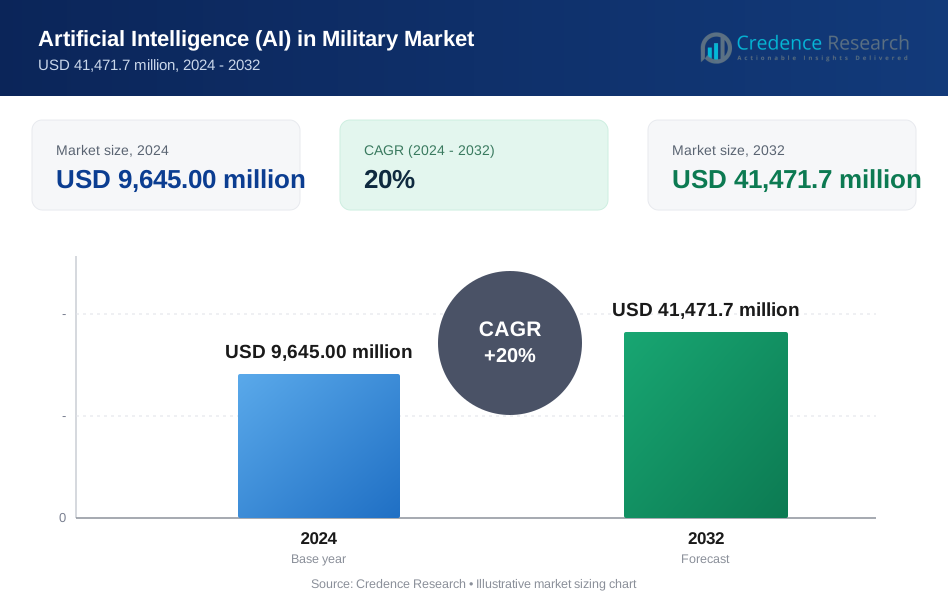
The Artificial Intelligence (AI) in Military Market is projected to grow from USD 9,645.00 million in 2024 to an estimated USD 41471.7 million by 2032, with a compound annual growth rate (CAGR) of 20% from 2024 to 2032.
The market is primarily driven by a confluence of factors that include rising global defense budgets, operational efficiency imperatives, and technological advancements. Many governments are prioritizing AI as part of their strategic military roadmaps. In the United States, defense spending on AI and continues to grow under initiatives from the Department of Défense’s Joint Artificial Intelligence Center (JAIC). AI technologies are being rapidly adopted to enhance autonomous threat detection, improve decision-making capabilities, and reduce human risk on the battlefield. The operational deployment of AI-enabled drones in Ukraine has demonstrated how autonomous systems can enhance precision and resilience in modern combat. In addition, the race for strategic dominance among nations such as China, the U.S., Russia, and India is accelerating AI research and deployment. China's military modernization, which includes swarming drones and AI-powered surveillance, further illustrates the urgency in leveraging AI to gain battlefield superiority. At the same time, growing concerns around cybersecurity, information warfare, and autonomous weapons have spurred regulatory attention and ethical debates, pushing industry and government stakeholders to balance innovation with accountability.
Regionally, North America holds the dominant share of the global market, led by extensive U.S. investments in AI-enabled military systems, cybersecurity frameworks, and next-gen autonomous weapons. The region benefits from the presence of key defense contractors, government initiatives, and a robust tech ecosystem. Meanwhile, Asia-Pacific is the fastest-growing region, with countries such as China, India, Japan, and South Korea making substantial strides in AI military capabilities. India, for instance, has launched over 75 defense AI projects and allocated significant funding to support indigenous innovation. China's continued investment in AI for command automation and unmanned warfare is reshaping the competitive landscape. Europe also plays a crucial role, with nations like France, Germany, and the UK investing in collaborative AI R&D programs and ethical military AI frameworks. Emerging markets in the Middle East, Latin America, and Africa are beginning to adopt AI in defense, driven by increasing threats and modernization goals, although infrastructure and regulatory readiness remain challenges. Overall, the global AI in military market is on a transformative trajectory, shaped by technology adoption, geopolitical urgency, and the evolving dynamics of modern warfare.
Market Insights:
- The market is projected to grow from USD 9,645.00 million in 2024 to USD 41,471.7 million by 2032, reflecting a strong CAGR of 20% driven by rising defense digitization and AI adoption in strategic operations.
- Governments are allocating targeted funding for AI-based modernization, with the U.S. Department of Defense alone investing over USD 2 billion in 2024 for battlefield autonomy, data analytics, and unmanned systems.
- Military forces are using AI to improve operational efficiency through enhanced command decision-making, autonomous combat platforms, predictive maintenance, and supply chain optimization.
- Escalating geopolitical tensions and competitive defense strategies among the U.S., China, Russia, and India are accelerating rapid prototyping and deployment of AI-driven surveillance and combat systems.
- AI is playing a central role in cyber defense, threat monitoring, and real-time intelligence processing, supporting strategic planning and faster responses to emerging threats.
- The market faces challenges from fragmented global regulations, ethical concerns around autonomous weapons, and limited consensus on AI use in lethal operations, which can delay deployment.
- North America holds the largest market share due to high defense investments and a robust AI ecosystem, while Asia-Pacific is the fastest-growing region led by China and India’s aggressive military AI development.
Market Drivers:
Escalating Global Defense Expenditures and Focused AI Investments in Military Modernization:
Governments are prioritizing the integration of AI into defense capabilities by increasing military budgets and allocating specific funds toward advanced technologies. The United States, China, Russia, and India are aggressively expanding AI programs to support national security objectives. In 2024, the U.S. Department of Defense allocated over USD 2 billion toward AI research, emphasizing battlefield autonomy, data analytics, and unmanned systems. The Artificial Intelligence (AI) in Military Market benefits directly from these targeted investments. Countries view AI as a force multiplier that enhances surveillance, precision, and overall mission effectiveness. Defense contractors and public-sector R&D agencies are jointly accelerating projects in AI-supported combat platforms and decision systems.
- For instance, the global defense budget exceeded $2.2 trillion in 2024, with the United States alone allocating over $850 billion annually and specifically requesting $1.8 billion for AI programs in fiscal year 2025.
Operational Efficiency Goals Across Command, Surveillance, and Autonomous Combat Functions:
AI technologies streamline complex military operations by reducing human workload, improving response time, and increasing decision accuracy. Command centers use real-time data analysis powered by AI to interpret vast amounts of battlefield intelligence with speed and precision. In combat zones, AI enables autonomous drones and robotic systems to engage targets with minimal human intervention. The market gains traction due to defense forces seeking to reduce risk to personnel and improve logistics and supply chain resilience. AI-based maintenance prediction tools help ensure readiness of mission-critical equipment. It supports a shift toward agile, data-driven warfare where technology enables superior control over evolving tactical scenarios.
- For instance, U.S. Special Operations Forces are using AI to reduce cognitive load on operators, enabling them to focus on critical decisions rather than data management.
Intensifying Geopolitical Tensions and Strategic Technological Rivalries Between Nations:
Heightened global instability has made technological superiority a critical defense priority. Nations are pursuing AI deployment not only for competitive advantage but also to deter adversaries. The Artificial Intelligence (AI) in Military Market expands as rivalries between major powers drive rapid prototyping and deployment of AI-enabled systems. China’s military uses AI to manage unmanned aerial vehicles, monitor borders, and enhance electronic warfare. Western alliances, including NATO, are responding by investing in interoperable AI frameworks and shared defense AI assets. Strategic competition ensures a continuous pipeline of innovation and funding across both offensive and defensive AI capabilities.
AI’s Role in Cybersecurity, Threat Detection, and Intelligence-Based Decision Making:
Cyber warfare has become a dominant threat, requiring advanced AI tools to detect intrusions, track anomalies, and protect military networks. Armed forces apply AI to support threat classification, predictive threat modeling, and anomaly detection within critical infrastructure. It plays a key role in building cyber resilience and informing command decisions based on live intelligence inputs. The market grows as defense agencies prioritize the need for secure, autonomous surveillance and real-time situational awareness. Intelligence operations increasingly rely on AI to analyze satellite imagery, intercept communications, and monitor hostile activities. It enables faster and more accurate threat responses across all levels of defense planning.
Market Trends:
Rising Deployment of Autonomous Combat and Surveillance Systems Across Military Platforms:
Defense forces are accelerating the adoption of autonomous vehicles and surveillance systems powered by AI. These systems improve mission flexibility, reduce dependence on human operators, and enhance real-time response in high-risk environments. AI enables unmanned aerial vehicles (UAVs), ground combat units, and maritime systems to operate with minimal guidance. The Artificial Intelligence (AI) in Military Market is witnessing increased demand for swarming drones, robotic sentries, and AI-guided missile systems. These solutions enhance situational awareness and allow for dynamic decision-making in fluid combat zones. It is transforming the structure of conventional warfare by reducing exposure and improving operational precision.
- For example, the U.S. Army utilizes PackBots and Talons for hazardous missions like bomb disposal, and India’s AI-based surveillance systems enhance border security by automating target detection and anomaly recognition.
Increased Emphasis on Edge Computing and Real-Time Decision Capabilities in Battlefield Scenarios:
Military organizations are prioritizing AI systems that can function independently of centralized data centers. Edge computing allows for on-site data processing, which is critical in environments where network access is limited or latency must be minimized. AI models deployed at the edge enable faster threat recognition and tactical decisions without delays. The Artificial Intelligence (AI) in Military Market is adapting to this need by focusing on robust, mobile computing systems built for frontline deployment. It ensures that AI functions remain active and responsive even during electronic warfare or communication blackouts. This trend supports the push for decentralized command structures and rapid field-level autonomy.
- For instance, edge AI enables drones and ground vehicles to process surveillance data onsite, providing immediate feedback and reducing latency, which is critical in environments with limited network access or during electronic warfare.
Integration of AI With Defense Simulation, Wargaming, and Mission Training Programs:
AI-driven simulation tools are becoming integral to military training and strategic planning. These tools generate realistic combat scenarios that help soldiers and commanders test readiness and refine tactics. It supports adaptive learning environments where training evolves based on individual and unit performance data. The Artificial Intelligence (AI) in Military Market reflects this shift through increased investment in virtual training environments and predictive modeling. Defense forces use AI to simulate enemy behavior, analyze terrain, and assess decision outcomes across various battlefield conditions. This trend enhances mission preparedness and reduces the cost of live training exercises.
Focus on Ethical AI, Governance Protocols, and Interoperability Standards in Defense Use Cases:
With the expansion of AI capabilities, defense agencies are establishing frameworks to govern responsible use. Concerns around autonomous weapons, data privacy, and unintended engagements have prompted stricter oversight. It has led to the development of ethical protocols and international guidelines for military AI. The Artificial Intelligence (AI) in Military Market is responding through partnerships that include regulatory compliance, human-in-the-loop safeguards, and AI auditing tools. Defense alliances are also working to ensure interoperability of AI systems across joint missions. This trend reflects a broader effort to align technological advancement with accountability and shared operational values.
Market Challenges Analysis:
Complex Regulatory Frameworks and Ethical Concerns Surrounding Autonomous Military Systems:
The integration of AI into military operations raises significant ethical, legal, and regulatory challenges. Governments and international bodies are debating the acceptable boundaries of autonomous weapon use, especially in lethal decision-making. The Artificial Intelligence (AI) in Military Market faces pressure to ensure human oversight in critical applications to prevent unintended engagements. Many countries lack unified standards or enforcement mechanisms for AI deployment in defense, which creates inconsistencies across regions and alliances. Ethical concerns over accountability and transparency also hinder public and political support for fully autonomous systems. It must align innovation with responsible use, which can delay deployment timelines and limit system capabilities in certain jurisdictions.
Data Security Risks, Technical Limitations, and Talent Gaps in Defense AI Implementation:
The effective use of AI in defense requires large volumes of high-quality, classified data, which presents serious cybersecurity risks. Military networks remain high-value targets for adversaries attempting to disrupt or manipulate AI systems. The Artificial Intelligence (AI) in Military Market also contends with technical challenges, such as limited explainability of AI decisions and vulnerability to adversarial attacks. Complex battlefield environments introduce unpredictability that many AI models are not yet able to handle reliably. Talent shortages in AI engineering, especially for defense-specific applications, further constrain adoption. It requires specialized skills in algorithm development, system integration, and secure deployment—areas where the defense sector competes with the private tech industry.
Market Opportunities:
Expansion of AI-Driven ISR Systems and Unmanned Combat Platforms Across Emerging Defense Forces:
Emerging economies are increasing their defense modernization budgets and actively exploring AI-based intelligence, surveillance, and reconnaissance (ISR) solutions. Nations in Asia-Pacific, the Middle East, and Latin America view autonomous drones, AI-supported border monitoring, and battlefield analytics as cost-effective force multipliers. The Artificial Intelligence (AI) in Military Market has an opportunity to expand by delivering modular, scalable platforms tailored to regional defense needs. It can support governments aiming to enhance national security without relying solely on conventional force structures. Demand for unmanned ground vehicles, robotic combat systems, and AI-integrated satellites is also growing in these regions. Companies that offer adaptable and interoperable AI systems can capitalize on this shift.
Adoption of AI in Cyber Warfare, Decision Support, and Predictive Defense Planning:
Defense organizations are recognizing the strategic value of AI in cyber operations and predictive threat modeling. AI tools that enhance command decision-making and detect cyber intrusions offer strong growth prospects. The Artificial Intelligence (AI) in Military Market can expand by developing intelligent systems that secure networks, manage data flow, and anticipate adversarial actions. It supports mission planning with simulation tools and AI-based scenario analysis. Governments and contractors are also investing in AI to strengthen hybrid warfare capabilities and real-time strategic forecasting. This creates long-term opportunities for firms with specialized expertise in defense-grade AI solutions.
Market Segmentation Analysis:
By Offering
Software leads the Artificial Intelligence (AI) in Military Market due to its central role in enabling AI functionalities like machine learning, natural language processing, and computer vision. Hardware follows with demand for specialized processors and memory units capable of handling high-intensity military workloads. Services are gaining traction as defense organizations require integration, maintenance, and operational support for complex AI systems.
- For instance, Hardware follows, driven by demand for specialized processors and memory units capable of handling high-intensity military workloads, such as GPUs for real-time data processing and integration into defense platforms.
By Technology
Machine learning holds the largest share due to its critical use in predictive modeling and autonomous decision-making. Natural language processing supports command-level operations and intelligence analysis. Computer vision remains essential for surveillance, object recognition, and target tracking. Context-aware computing and other adaptive technologies enable AI systems to operate effectively in dynamic battlefield conditions.
- For instance, Natural language processing supports command-level operations and intelligence analysis, while computer vision remains essential for surveillance, object recognition, and target tracking.
By Application
Warfare platforms dominate due to growing adoption of AI in autonomous weapons, combat vehicles, and unmanned systems. Cybersecurity applications are expanding rapidly to counter evolving digital threats. Logistics and transportation benefit from AI’s ability to optimize mission readiness. AI supports surveillance, situational awareness, and command decisions through real-time data analysis. Other emerging applications include battlefield healthcare, simulation and training, target tracking, and large-scale information processing.
By Platform
The land segment leads the market with widespread use in ground robotics and armored systems. Airborne and naval platforms are integrating AI for reconnaissance and combat support. The space segment is growing steadily as nations enhance satellite-based intelligence and communication.
By Installation Type
New installations contribute the highest share, reflecting rising deployment of advanced AI systems. Upgradation of legacy platforms is increasing, driven by cost-efficiency and modernization goals.
Segmentation:
By Offering (Component):
- Software
- Hardware
- Services
By Technology:
- Machine Learning
- Natural Language Processing (NLP)
- Computer Vision
- Context-Aware Computing and Others
By Application:
- Warfare Platforms
- Cybersecurity
- Logistics & Transportation
- Surveillance & Situational Awareness
- Command & Control
- Battlefield Healthcare
- Simulation & Training
- Threat Detection/Target Monitoring & Tracking
- Information Processing
By Platform:
- Land
- Naval
- Airborne
- Space
By Installation Type:
- New Installation
- Upgradation
By Region:
- North America
- U.S.
- Canada
- Mexico
- Europe
- Germany
- France
- U.K.
- Italy
- Spain
- Rest of Europe
- Asia Pacific
- China
- Japan
- India
- South Korea
- South-east Asia
- Rest of Asia Pacific
- Latin America
- Brazil
- Argentina
- Rest of Latin America
- Middle East & Africa
- GCC Countries
- South Africa
- Rest of the Middle East and Africa
Regional Analysis:
North America
North America dominates the Artificial Intelligence (AI) in Military Market with a market share of approximately 35%. The United States leads the region due to high defense spending, strong technological infrastructure, and active government initiatives focused on AI integration. Programs under the U.S. Department of Defense, such as the Joint Artificial Intelligence Center (JAIC), continue to support the deployment of AI in surveillance, autonomous systems, cybersecurity, and logistics. Canada contributes through collaborative research and niche AI applications in defense. The presence of major defense contractors and AI firms supports rapid development and deployment. It remains a highly mature market where adoption levels outpace most global counterparts.
Asia-Pacific
Asia-Pacific holds around 28% of the market and is the fastest-growing region, supported by expanding military budgets and strategic focus on defense innovation. China and India lead the regional growth, driven by large-scale modernization programs and indigenous AI development. China invests heavily in AI for surveillance, drone swarms, and autonomous decision-making systems. India has launched numerous defense AI initiatives with support from public-private partnerships and defense research organizations. Japan and South Korea are also advancing their AI capabilities in naval systems, aerospace, and cybersecurity. The region’s growth is fueled by rising geopolitical tensions and the strategic need to enhance operational readiness.
Europe, Middle East & Africa, and Latin America
Europe accounts for nearly 22% of the global market, with countries like the UK, Germany, and France investing in joint AI defense programs and ethical AI frameworks. European defense agencies are focusing on interoperability, cyber resilience, and automated command systems. The Middle East & Africa region holds a 10% share, led by nations such as Israel, the UAE, and Saudi Arabia investing in AI-powered defense infrastructure and unmanned systems. Latin America captures about 5% of the market, with Brazil and Colombia deploying AI selectively for surveillance and border security. The Artificial Intelligence (AI) in Military Market continues to expand across these regions, although infrastructure limitations and policy challenges may impact the pace of adoption.
Key Player Analysis:
- Lockheed Martin Corporation
- Northrop Grumman Corporation
- Raytheon Technologies Corporation
- BAE Systems plc
- General Dynamics Corporation
- Thales Group
- IBM
- L3Harris Technologies
- Palantir Technologies
- Anduril Industries
- Rafael Advanced Defense Systems
- QinetiQ
- Elbit Systems
- Leonardo S.p.A.
- ai
Competitive Analysis:
The Artificial Intelligence (AI) in Military Market features a concentrated landscape dominated by major defense contractors and specialized AI firms. Companies such as Lockheed Martin, Northrop Grumman, Raytheon Technologies, and BAE Systems are leading integrators of AI across defense platforms. Palantir Technologies, IBM, and C3.ai provide advanced data analytics, battlefield intelligence, and AI software solutions. Emerging players like Anduril Industries are gaining traction with autonomous systems and real-time threat detection capabilities. It remains highly competitive, with firms investing in R&D, strategic alliances, and government partnerships to secure long-term defense contracts. Companies differentiate through platform versatility, AI model accuracy, and cybersecurity integration. Regional players such as Elbit Systems, Rafael, and QinetiQ are strengthening market presence with tailored AI applications for specific military use cases. The market continues to evolve, driven by technological advancement, procurement cycles, and shifting defense priorities.
Recent Developments:
- In March 2025, Lockheed Martin announced a collaboration with Google Cloud to integrate generative AI into its AI Factory ecosystem, aiming to enhance decision-making and innovation across national security and aerospace applications
- . In March 2025, Northrop Grumman and Raytheon Technologies were both selected by Lockheed Martin to provide mission payloads for the next-generation missile warning satellite system, supporting advanced AI-driven space defense capabilities.
- In December 2024, Raytheon secured a $191.1 million contract from the Missile Defense Agency to provide modeling and simulation services for U.S. Army and Navy missile defense systems, leveraging AI to enhance operational preparedness.
- In February 2025, BAE Systems received a $251 million contract to support the U.S. Navy's AEGIS Combat System, focusing on AI-enhanced systems engineering and cybersecurity.
Market Concentration & Characteristics:
The Artificial Intelligence (AI) in Military Market exhibits moderate to high market concentration, with a core group of global defense giants and specialized AI firms dominating procurement and development. It is characterized by high entry barriers, long government approval cycles, and the need for proven integration capabilities within secure defense environments. The market favors companies with strong defense portfolios, advanced AI expertise, and established relationships with national defense agencies. It remains technology-intensive and R&D-driven, where continuous innovation in machine learning, autonomy, and data analytics defines competitiveness. Firms operate under strict regulatory oversight and cybersecurity protocols, which influence deployment speed and system design. The market shows a growing shift toward dual-use technologies and modular platforms, reflecting the evolving nature of modern warfare.
Report Coverage:
The research report offers an in-depth analysis based on By Offering, By Technology, By Application, By Platform and By Installation Type. It details leading market players, providing an overview of their business, product offerings, investments, revenue streams, and key applications. Additionally, the report includes insights into the competitive environment, SWOT analysis, current market trends, as well as the primary drivers and constraints. Furthermore, it discusses various factors that have driven market expansion in recent years. The report also explores market dynamics, regulatory scenarios, and technological advancements that are shaping the industry. It assesses the impact of external factors and global economic changes on market growth. Lastly, it provides strategic recommendations for new entrants and established companies to navigate the complexities of the market.
Future Outlook:
- AI will become a core enabler of autonomous decision-making in multi-domain military operations.
- Demand for AI-powered surveillance and reconnaissance systems will increase across land, air, naval, and space platforms.
- Governments will intensify funding for AI research focused on tactical edge computing and real-time threat detection.
- Ethical and regulatory frameworks will evolve to govern the deployment of autonomous weapons and command systems.
- AI integration in cybersecurity defense architectures will expand to counter advanced digital warfare threats.
- The use of AI in predictive maintenance and logistics optimization will enhance force readiness and cost efficiency.
- Simulation and training applications using AI will gain traction to improve combat preparedness and personnel performance.
- Emerging economies will accelerate AI adoption through defense modernization programs and local partnerships.
- Private defense tech startups will gain market share through disruptive innovations and rapid prototyping.
- Strategic collaborations between governments, defense contractors, and AI firms will shape future capability development.
Request a Free Sample
Fill in your details and we'll send you a free sample report.
- Sample data tables & charts
- Research methodology
Need a Custom Version of This Report?
Tailor the scope, geography, or segments to your exact requirements.
- Custom geography or segment scope
- Direct access to our analyst team
Frequently Asked Questions
What is the current size of the Artificial Intelligence (AI) in Military Market?
What factors are driving the growth of the Artificial Intelligence (AI) in Military Market?
What are the key segments within the Artificial Intelligence (AI) in Military Market?
What are some challenges faced by the Artificial Intelligence (AI) in Military Market?
Who are the major players in the Top Artificial Intelligence in Military market?
Which segment is leading the market share?
Table of Content
Chapter 1. Report Introduction
- 1.1 Report Description & Purpose
- 1.1.1 Report Title & Market Definition
- 1.1.2 Unique Selling Propositions (USP) & Key Differentiators
- 1.1.3 Value Proposition for Stakeholders
- 1.2 Research Objectives
- 1.2.1 Market Sizing Objectives (Volume & Revenue)
- 1.2.2 Segmentation Objectives
- 1.2.3 Competitive Intelligence Objectives
- 1.2.4 Forecast & Scenario Objectives
- 1.3 Report Scope
- 1.3.1 Artificial Intelligence (AI) in Military Scope – Types & Subtypes Covered
- 1.3.2 Geographic Scope – Regions & Countries Covered
- 1.3.3 Historical Period, Base Year & Forecast Period (2024; forecast to 2032)
- 1.3.4 Inclusions & Exclusions
- 1.4 HS Code & Classification Framework
- 1.5 Currency, Units & Pricing Basis
- 1.6 Target Stakeholders
- 1.7 Limitations & Assumptions
Chapter 2. Executive Summary
- 2.1 Global Artificial Intelligence (AI) in Military Market Snapshot
- 2.1.1 Market Size – Historical (2024) & Forecast (2024-2032) (2024: USD 9,645.00 million → 2032: USD 41,471.7 million)
- 2.1.2 Volume & Revenue – Global Totals
- 2.1.3 Key Market Highlights – Top Five Facts
- 2.2 Artificial Intelligence (AI) in Military Market Segmentation Snapshot
- 2.2.1 Market Split by Region – 2024 vs. 2032
- 2.3 Competitive Snapshot
- 2.3.1 Top 10 Players by Revenue Share – 2024
- 2.3.2 Top 10 Players by Volume Share – 2024
- 2.3.3 Recent Strategic Developments (18-Month Summary)
- 2.4 Key Investment Highlights & Strategic Conclusions
Chapter 3. Artificial Intelligence (AI) in Military Market Dynamics & Industry Analysis
- 3.1 Market Overview & Context
- 3.1.1 Artificial Intelligence (AI) in Military Market Position in the Broader Automotive Value Chain
- 3.1.2 OEM vs. Replacement Market Dynamics
- 3.1.3 Market Maturity & Development Stage by Region
- 3.2 Artificial Intelligence (AI) in Military Market Drivers
- 3.3 Artificial Intelligence (AI) in Military Market Restraints & Challenges
- 3.4 Artificial Intelligence (AI) in Military Market Opportunities
- 3.5 Porter's Five Forces Analysis
- 3.5.1 Threat of New Entrants
- 3.5.2 Bargaining Power of Suppliers
- 3.5.3 Bargaining Power of Buyers
- 3.5.4 Threat of Substitutes
- 3.5.5 Competitive Rivalry – Intensity Assessment
- 3.6 Artificial Intelligence (AI) in Military Value Chain Analysis
- 3.6.1 Upstream – Raw Material/Input Suppliers
- 3.6.1.1 Raw Material/Input 1
- 3.6.1.2 Raw Material/Input 2
- 3.6.1.3 Raw Material/Input 3
- 3.6.2 Midstream – Production/Manufacturing/Service Delivery
- 3.6.2.1 Production/Process Overview
- 3.6.2.2 Key Facility Locations & Capacity by Manufacturer
- 3.6.3 Downstream – Distribution & End Consumer
- 3.6.3.1 Primary Channel – B2B/OEM
- 3.6.3.2 Secondary Channels – Dealer, Retail, Online, Direct
- 3.6.4 Value Chain Profitability Analysis
- 3.6.1 Upstream – Raw Material/Input Suppliers
- 3.7 PESTEL Analysis
- 3.7.1 Political Factors
- 3.7.2 Economic Factors
- 3.7.3 Social Factors
- 3.7.4 Technological Factors
- 3.7.5 Environmental Factors
- 3.7.6 Legal Factors
- 3.8 Artificial Intelligence (AI) in Military Supply Chain Analysis
- 3.8.1 Raw Material/Input Supply Risk Assessment
- 3.8.2 Manufacturing Concentration Risk (Geographic Exposure)
- 3.8.3 Trade Disruption Impact Analysis
- 3.9 Regulatory & Policy Landscape
Note: The regulatory and policy landscape section covers regulations based on their applicability to the market, Artificial Intelligence (AI) in Military category, geography, and scope of the study. Only regulatory frameworks with a material impact on operations, compliance, trade, sustainability, or market access are analyzed in detail.
Chapter 4. Key Investment Pockets & Opportunity Analysis
- 4.1 Artificial Intelligence (AI) in Military Market Attractiveness Analysis
- 4.1.1 By Region – Investment Attractiveness Matrix (Volume × CAGR)
- 4.2 Absolute Revenue Growth Opportunity
- 4.2.1 By Region – Absolute USD Growth Through 2032
- 4.3 Incremental Volume Opportunity
- 4.3.1 By Region – Incremental Volume Through 2032
- 4.3.2 Segment – Incremental Volume
- 4.4 Emerging Submarket Opportunity Deep Dive (Subject to Applicability)
- 4.5 Emerging Market Opportunity Scorecards
- 4.5.1 United States
- 4.5.2 Europe
- 4.5.3 Asia
- 4.5.4 Middle East & Africa
Note: Emerging Market Opportunity Scorecards will be included based on relevance and strategic importance. Regions listed are indicative and may vary depending on data availability and market dynamics.
Chapter 5. Artificial Intelligence (AI) in Military Import-Export Analysis & Trade Flows
- 5.1 Global Trade Overview
- 5.1.1 Global Export Value by Country (2024)
- 5.1.2 Global Export Volume by Country (2024)
- 5.1.3 Global Import Value by Country (2024)
- 5.1.4 Global Import Volume by Country (2024)
- 5.1.5 Net Trade Balance by Country (2024)
- 5.2 Export Analysis – Segment
- 5.2.1 Type 1 (HS Code)
- 5.2.2 Type 2 (HS Code)
- 5.2.3 Type 3 (HS Code)
- 5.2.4 Type 4 (HS Code)
- 5.2.5 Type 5 (HS Code)
- 5.3 Import Analysis – Segment
- 5.3.1 Type 1 (HS Code)
- 5.3.2 Type 2 (HS Code)
- 5.3.3 Type 3 (HS Code)
- 5.3.4 Type 4 (HS Code)
- 5.3.5 Type 5 (HS Code)
- 5.4 Average Unit Trade Prices
- 5.4.1 Average Export Price – Segment & Country
- 5.4.2 Average Import Price – Segment & Source Country
- 5.4.3 Price Trends (2024)
- 5.5 Key Trade Route Analysis
- 5.5.1 Trade Route 1
- 5.5.2 Trade Route 2
- 5.5.3 Trade Route 3
- 5.5.4 Trade Route 4
- 5.5.5 Trade Route 5
- 5.6 Trade Policy Impact Assessment
- 5.6.1 US Anti-Dumping & Section 301 Tariffs
- 5.6.2 EU Customs Union Impact
- 5.6.3 Major Free Trade Agreements
- 5.6.4 USMCA Rules of Origin
Note: Trade policy analysis will be included only where relevant to the Artificial Intelligence (AI) in Military market.
Chapter 6. Competitive Landscape & Company Benchmarking
- 6.1 Artificial Intelligence (AI) in Military Market Concentration & Structure
- 6.1.1 Herfindahl-Hirschman Index (HHI) – vs. 2024
- 6.1.2 Tier 1, Tier 2 & Tier 3 Market Structure
- 6.1.3 Global, Regional & Local Player Dynamics
- 6.2 Artificial Intelligence (AI) in Military Market Share Analysis – 2024
- 6.2.1 Global Revenue Share by Company
- 6.2.2 Global Volume Share by Company
- 6.2.3 Regional Revenue Share
- 6.2.4 Market Share Evolution ( vs. 2024)
- 6.2.5 OEM Segment Share by Company
- 6.2.6 Replacement Segment Share by Company
- 6.3 Production/Delivery Capacity & Facility Analysis
- 6.3.1 Global Installed Capacity
- 6.3.2 Capacity Utilization Rates
- 6.3.3 Production/Output Volume
- 6.3.4 Facility Locations & Capacity Map
- 6.3.5 Planned Capacity Additions
- 6.4 Artificial Intelligence (AI) in Military Competitive Benchmarking Matrix
- 6.4.1 Revenue, Volume, CAGR & Profitability Comparison
- 6.4.2 Channel Revenue Mix
- 6.4.3 Geographic Revenue Exposure
- 6.4.4 R&D Intensity
- 6.4.5 Sustainability Maturity
- 6.5 Strategic Developments in Artificial Intelligence (AI) in Military (Last 24 Months)
- 6.5.1 Mergers, Acquisitions & Divestments
- 6.5.2 New Artificial Intelligence (AI) in Military Launches
- 6.5.3 Facility Expansions
- 6.5.4 Strategic Alliances, Joint Ventures & Partnerships
- 6.5.5 Distribution Expansion & Market Entry
- 6.5.6 Sustainability & ESG Initiatives
- 6.6 Competitive Strategy Mapping
- 6.6.1 Leader, Challenger, Follower & Niche Classification
- 6.6.2 Pricing Strategy Comparison
- 6.6.3 Channel Strategy Matrix
Note: Strategic developments are included based on their materiality and the availability of reliable information.
Chapter 7. Global Artificial Intelligence (AI) in Military Market – By Distribution Channel
- 7.1 Segment Overview
- 7.1.1 Volume & Revenue Split by Channel (2024 & 2032)
- 7.1.2 Channel Mix Evolution (2024-2032)
Chapter 8. Regional Market Analysis – Global Overview
- 8.1 Global Regional Overview
- 8.1.1 Regional Volume Share
- 8.1.2 Regional Revenue Share
- 8.1.3 Regional Volume by Region
- 8.1.4 Regional Revenue by Region
- 8.1.5 Regional Forecast Through 2032
- 8.2 Cross-Regional Segment Analysis
- 8.2.1 By Distribution Channel
- 8.2.2 By Brand/Price Tier
Chapter 9. North America Artificial Intelligence (AI) in Military Market
- 9.1 United States
- 9.2 Canada
- 9.3 Mexico
Chapter 10. Europe Artificial Intelligence (AI) in Military Market
- 10.1 Germany
- 10.2 France
- 10.3 Italy
- 10.4 United Kingdom
- 10.5 Spain
- 10.6 Poland
- 10.7 Russia
- 10.8 Netherlands
- 10.9 Belgium
- 10.10 Sweden
- 10.11 Denmark
- 10.12 Norway
- 10.13 Rest of Europe
Chapter 11. Asia Pacific Artificial Intelligence (AI) in Military Market
- 11.1 China
- 11.2 India
- 11.3 Japan
- 11.4 South Korea
- 11.5 Thailand
- 11.6 Indonesia
- 11.7 Vietnam
- 11.8 Malaysia
- 11.9 Australia
- 11.10 Rest of Asia Pacific
Chapter 12. Latin America Artificial Intelligence (AI) in Military Market
- 12.1 Brazil
- 12.2 Argentina
- 12.3 Colombia
- 12.4 Chile
- 12.5 Rest of Latin America
Chapter 13. Middle East Artificial Intelligence (AI) in Military Market
- 13.1 Saudi Arabia
- 13.2 United Arab Emirates
- 13.3 Turkey
- 13.4 Israel
- 13.5 Iran
- 13.6 Rest of the Middle East
Chapter 14. Africa Artificial Intelligence (AI) in Military Market
- 14.1 South Africa
- 14.2 Egypt
- 14.3 Nigeria
- 14.4 Morocco
- 14.5 Rest of Africa
Chapter 15. Artificial Intelligence (AI) in Military Company Profiles
- 15.1 [Company 01]
- 15.1.1 Company Overview
- 15.1.2 Key Management Personnel
- 15.1.3 Products & Services Portfolio
- 15.1.4 Financial Performance
- 15.1.5 Key Market Focus & Geographic Presence
- 15.1.6 Recent Developments & Strategic Initiatives
Note: The company profile list is preliminary and may change based on research findings, market developments, data availability, and client requirements.
Chapter 16. Appendices
- Appendix A – List of Abbreviations & Acronyms
- Appendix B – Industry Classification Code Reference – Full Series
- Appendix C – Production & Capacity Data Tables
- Appendix D – End-Use & Demand Base Tables
- Appendix E – Consumption & Replacement Rate Assumptions
- Appendix F – ASP Reference Tables
- Appendix G – Manufacturing & Facility Database
- Appendix H – Import-Export Data Tables
- Appendix I – Regulatory Summary Tables
- Appendix J – Primary Research Participant List (Anonymized)
- Appendix K – Primary Research Questionnaire Framework
- Appendix L – Data Sources & Bibliography
- Appendix M – Market Size Divergence & Source Comparison
Chapter 17. Research Methodology
- 17.1 Research Framework & Philosophy
- 17.2 Secondary Research – Sources, Hierarchy & Data Extraction
- 17.3 Data Modeling – Bottom-Up & Top-Down Market Sizing
- 17.4 Primary Research – Stakeholder Framework, LOI & Sample Sizes
- 17.5 Forecast Methodology – Regression, Scenario & Sensitivity Analysis
- 17.6 Quality Control – Four-Layer Validation Framework
- 17.7 Limitations & Standard Assumptions
- 17.8 Disclaimer
