
Automotive body mounts gain content as trucks grow heavier
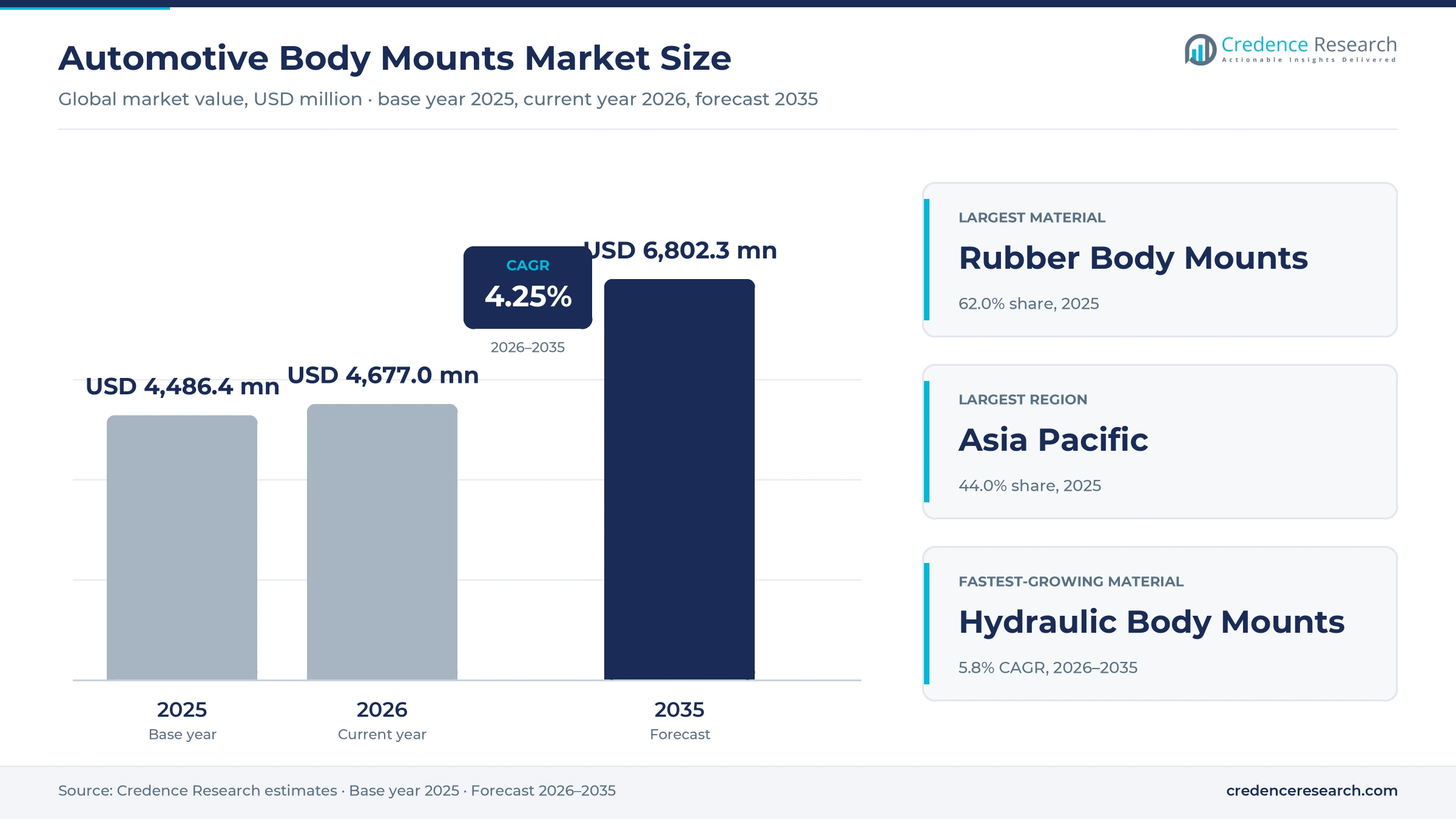
The global automotive body mounts market was valued at USD 4.49 billion in 2025 and is projected to increase from USD 4.68 billion in 2026 to USD 6.80 billion by 2035, registering a CAGR of 4.25% during 2026–2035. Demand comes from automakers and truck builders that fit elastomer isolators between the body and the frame, between unibody shells and their subframes, and between truck cabs and chassis, plus owners who replace worn mounts. Asia Pacific held the largest regional share, 44.0% in 2025, because China, Japan, India and Thailand build more than half of the world's vehicles and ladder-frame pickups. Asia Pacific is also the fastest-growing region at 4.8% a year, as Chinese pickup exports and new-energy output expand. The main technical change is the shift to hydraulic and tuned mounts on heavier battery and hybrid platforms, while tariffs on imported parts and rubber costs restrain supplier margins.
Which isolators between body, frame and cab are counted here?
The market counts the value of elastomeric mounts that locate and isolate a vehicle body from its frame, a unibody shell from its front and rear subframes, and a truck cab from its chassis. Rubber-metal, hydraulically damped, polyurethane and microcellular polyurethane designs are included, sold to automakers at supply prices and to replacement buyers at distributor prices.
Engine, transmission and motor mounts, suspension and control-arm bushings, strut top mounts, air-sprung cab suspensions and frame rails are excluded. Value flows from compounders and elastomer specialists to automakers and truck builders, and then to parts distributors and repair shops that serve the installed fleet.
Automotive Body Mounts Market Insights
- The global automotive body mounts market rises from USD 4.49 billion in 2025 to USD 6.80 billion by 2035, a 4.25% CAGR during 2026–2035, as heavier platforms raise mount content per vehicle.
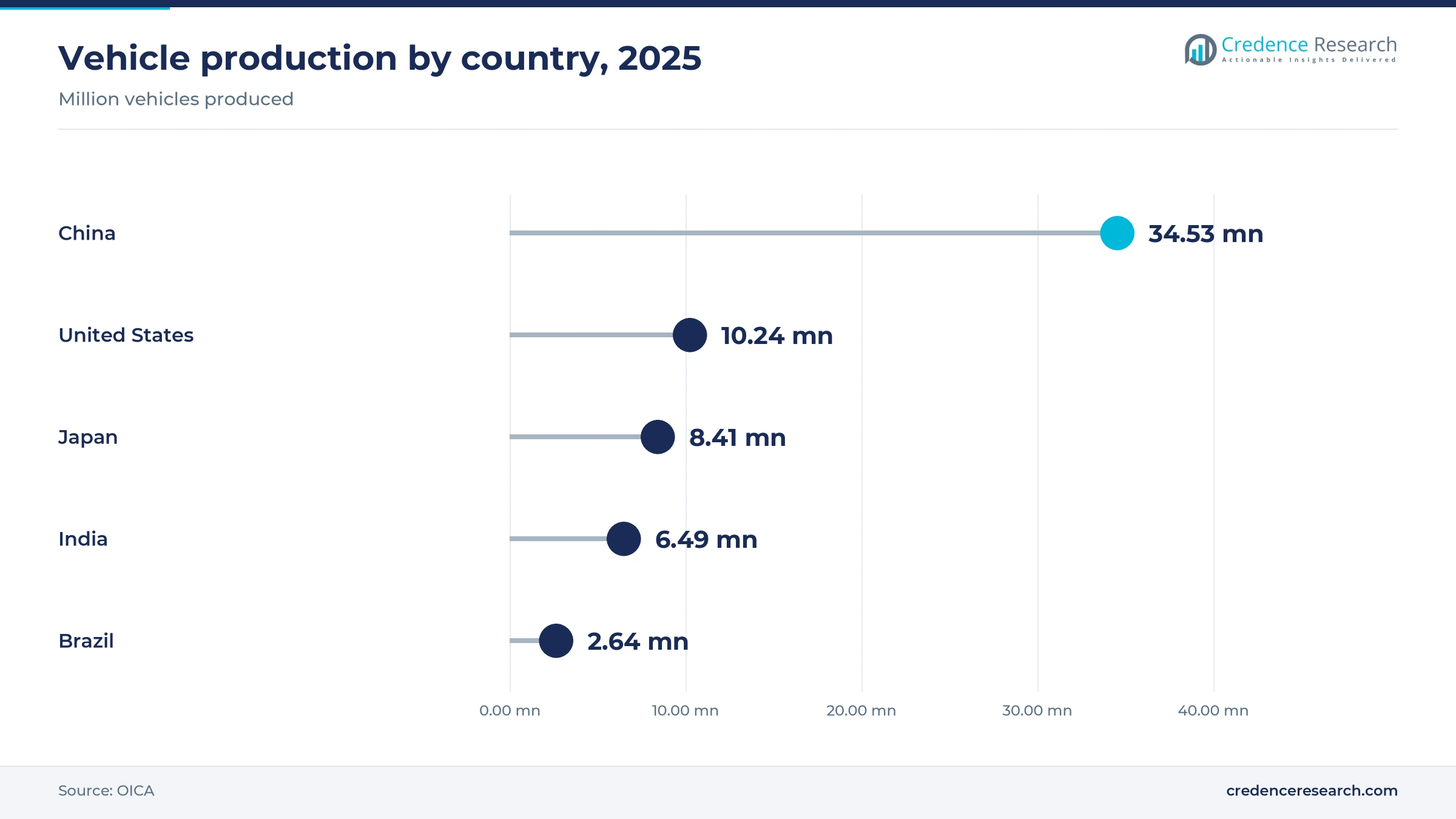
- Asia Pacific held 44.0% of 2025 value, because China alone produced 34.53 million vehicles in 2025, according to OICA.
- Rubber Body Mounts led material types with 62.0% of 2025 value, as rubber-metal mounts remain the lowest-cost way to isolate bodies from frames.
- Toyota revealed a battery-electric Hilux on Nov. 10, 2025, which brings electrified ladder-frame pickups and their heavier mount loads into Asian volume production.
- Sumitomo Electric moved to take full ownership of Sumitomo Riko in October 2025, and the Tokyo exchange set its delisting for Jan. 29, 2026.
Rubber leads while hydraulic mounts gain the fastest
Rubber mounts lead while hydraulic designs gain fastest
Based on material type, the market is categorized into rubber body mounts, hydraulic body mounts and polyurethane and MCU body mounts. Rubber Body Mounts led with 62.0% of 2025 value because rubber-metal isolators are cheap to mold and tune, and Continental lists flange elements and conical rubber-metal mounts as its standard cab mount designs. Hydraulic Body Mounts grow fastest at 5.8% a year, as fluid damping controls low-frequency shake on long, heavy frames and S&B Filters, which sells a USD 499 replacement set, notes that GM full-size trucks of the 2006 to 2014 model years left the factory with hydraulic rear-row body mounts.
Subframe isolators lead while ladder-frame mounts gain
Based on mount position, the market is categorized into subframe isolators, body-on-frame mounts and cab mounts. Subframe Isolators led with 46.0% of 2025 value because nearly every unibody car and crossover bolts front and rear subframes to its shell, and Boge Rubber & Plastics sells hydraulic subframe mounts for passenger cars. Body-on-Frame Mounts grow fastest at 4.7% a year, as heavy-duty pickup trucks and ladder-frame SUVs gain volume, with GWM selling 232,713 Tank SUVs and 181,660 Poer pickups in 2025, Paul Tan reported.
Combustion vehicles lead as battery models add load
Based on propulsion, the market is categorized into internal combustion engine vehicles, hybrid vehicles and battery electric vehicles. Internal Combustion Engine Vehicles led with 66.0% of 2025 value because most pickups, ladder-frame SUVs and trucks still run on fuel engines, and Ford said 2025 marked the 49th straight year that its F-Series was the best-selling U.S. truck. Battery Electric Vehicles grow fastest at 7.2% a year, as battery packs add mass and remove engine noise that once masked road inputs, and China produced 16.626 million new-energy vehicles in 2025, up 29%, according to OICA.
OEM supply leads while replacement demand gains
Based on sales channel, the market is categorized into OEM and aftermarket. OEM led with 85.0% of 2025 value because mounts are fitted to every new vehicle and are rarely replaced before the body or frame shows wear. The Aftermarket grows fastest at 5.3% a year, as aging trucks and SUVs need new mounts after rust or rubber cracking, and upgrade kits in polyurethane elastomers sell for USD 126.20 to USD 149.29 for a Toyota Tacoma set, Quadratec lists.
| Segment Group | Leading Sub-segment | Share, 2025 | Fastest-growing Sub-segment | CAGR, 2026–2035 |
|---|---|---|---|---|
| By Material Type | Rubber Body Mounts | 62.0% | Hydraulic Body Mounts | 5.8% |
| By Mount Position | Subframe Isolators | 46.0% | Body-on-Frame Mounts | 4.7% |
| By Propulsion | Internal Combustion Engine Vehicles | 66.0% | Battery Electric Vehicles | 7.2% |
| By Sales Channel | OEM | 85.0% | Aftermarket | 5.3% |
Replacement kits sell at USD 75 to USD 500 a truck
Automakers buy body mounts on multi-year platform contracts at a few dollars to a few tens of dollars per mount, priced on compound, metal content and damping type. Hydraulic mounts cost several times more than rubber-metal parts, so a shift in mix moves value faster than unit volume. Replacement prices sit far above OEM supply prices, because distributors carry fitment-specific stock for older vehicles. Rubber costs pass through with a lag, which squeezes molders when compound prices rise mid-contract.
| Product or offer | Typical price or fee | Basis |
|---|---|---|
| OEM rubber subframe isolator, unibody car | USD 4–9 per mount | Credence Research estimate from isolator counts and kit prices |
| OEM ladder-frame body mount, pickup or SUV | USD 10–20 per mount | Credence Research estimate from mount count and kit prices |
| GM genuine body mount cushion, Tahoe and Suburban | USD 150.85 MSRP each | GM parts site, November 2026 |
| Energy Suspension polyurethane set, Toyota Tacoma | USD 126.20–149.29 per set | Quadratec listing, November 2026 |
| Store-brand rubber kit, Silverado 1500 2007–2013 | USD 74.99 per kit | AmericanTrucks listing, November 2026 |
| S&B silicone body mount kit, GM 2006–2014 trucks | USD 499 per kit | S&B Filters listing, November 2026 |
Request a Free Sample
Fill in your details and we'll send you a free sample report.
- Sample data tables & charts
- Research methodology
Truck output and heavier platforms lift mount demand
Rising world vehicle output widens the mount base
Every vehicle built needs a set of body, subframe or cab isolators, so production volume sets the floor for demand. OICA reported that world vehicle production rose 3.9% to 96.4 million in 2025 from the prior year, and most of the gain came from Asian plants. The same data showed output falling in both the Americas and Europe, which shifts mount volume toward Chinese, Indian and Southeast Asian molding sites. Ladder-frame SUVs in India and pickups in Thailand add vehicles that carry more mounts than a compact car. Suppliers with molding plants close to these assembly lines capture most of the added volume, while European plants face flat call-offs and pressure to cut fixed costs.
Pickup and ladder-frame SUV demand lifts mounts per vehicle
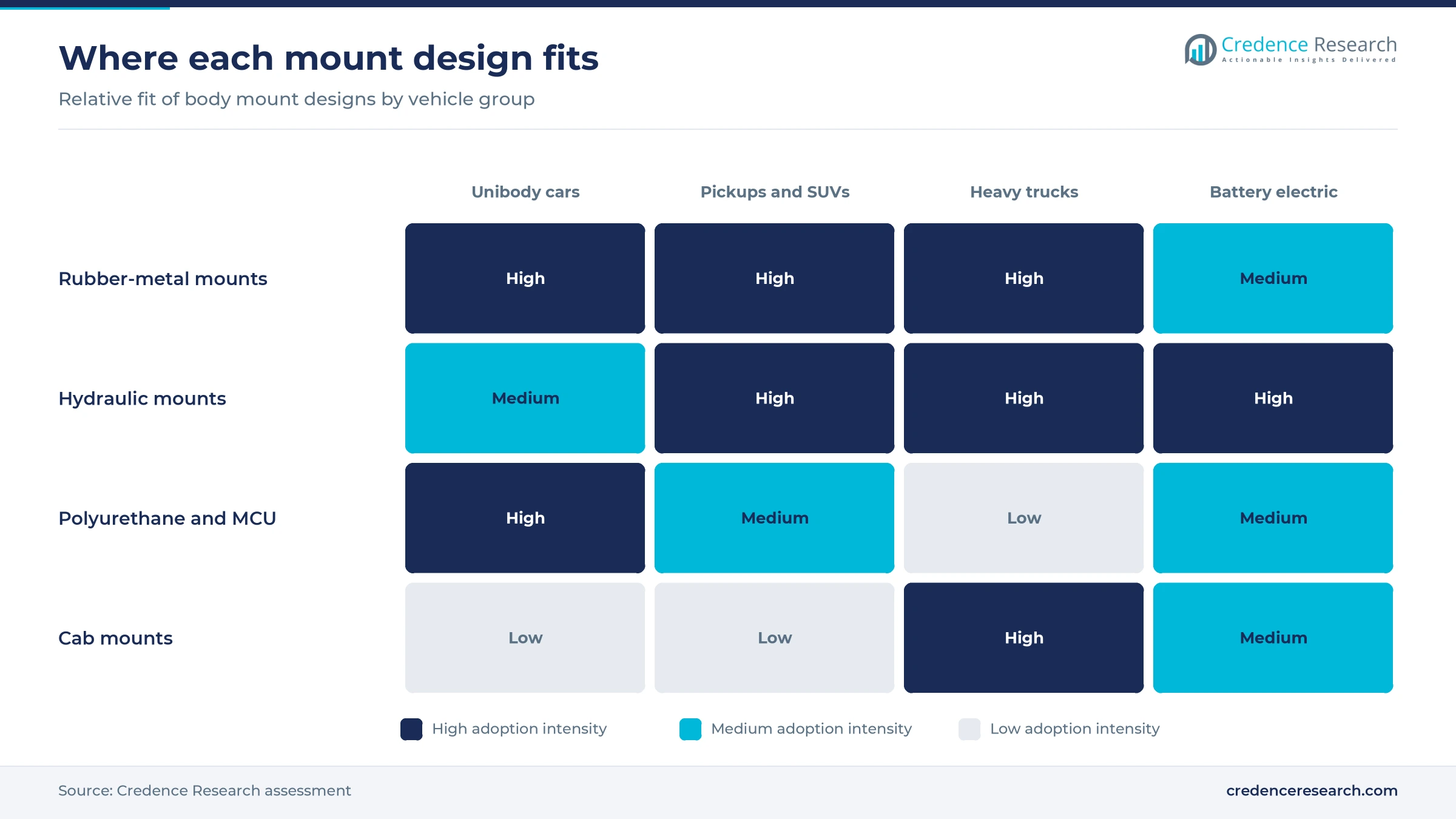
Ladder-frame pickups and SUVs carry eight to ten body mounts each, several times the isolator count of a typical unibody car, so their sales mix lifts value per vehicle. Ford reported 828,832 F-Series sales in the United States in 2025, and its ladder-frame Bronco set an annual record. Toyota said Tacoma, Sequoia and the Lexus GX had their best U.S. sales years in 2025. China sold 307,000 pickups in the first half of 2025, up 16.4%, according to the China Passenger Car Association, with about half shipped abroad. Suppliers qualified on these platforms gain multi-year volume from a single award, because frames stay in production for many years.
Heavier electrified platforms need stiffer, tuned isolation
Battery packs add hundreds of kilograms and remove the engine noise that once masked road and frame inputs, which pushes automakers toward stiffer and better-damped mounts. Vibracoustic designed its battery isolation mounts for ladder-frame vehicles to carry peak loads of 50 to 60 kN and packs of about 500 to 800 kilograms. Boge Rubber & Plastics develops subframe mounts with axial damping for the high axle loads of battery-electric and plug-in hybrid vehicles. China alone produced 16.626 million new-energy vehicles in 2025, so most of this re-engineering work now happens on Chinese platforms. These programs reward suppliers with simulation and hydraulic tuning skills, because each new platform needs its own stiffness map and its own durability validation.
Comfort targets in work trucks raise damping content
Truck buyers now expect car-like ride quality, so builders add hydraulically damped cab and body mounts to cut shake and cabin noise. Continental says hydraulically damped cab mounts improve driver comfort beyond rubber-metal designs by adding damping to the forces acting on the cab. Fluid-filled mounts on long pickup frames serve the same purpose, as noted in the segment analysis. Off-road trims such as Raptor, Tremor and Timberline made up 20.6% of Ford's U.S. mix in 2025, up 2.0 points, the company said. Ford also put its share of U.S. Class 1 to seven trucks and vans at 42.9% in 2025. These trims and premium cabs raise mount value, which favors suppliers that can build fluid-filled designs at scale.
Electrified frames and tuned damping reshape designs
Ladder-frame pickups are shifting toward electrified drives
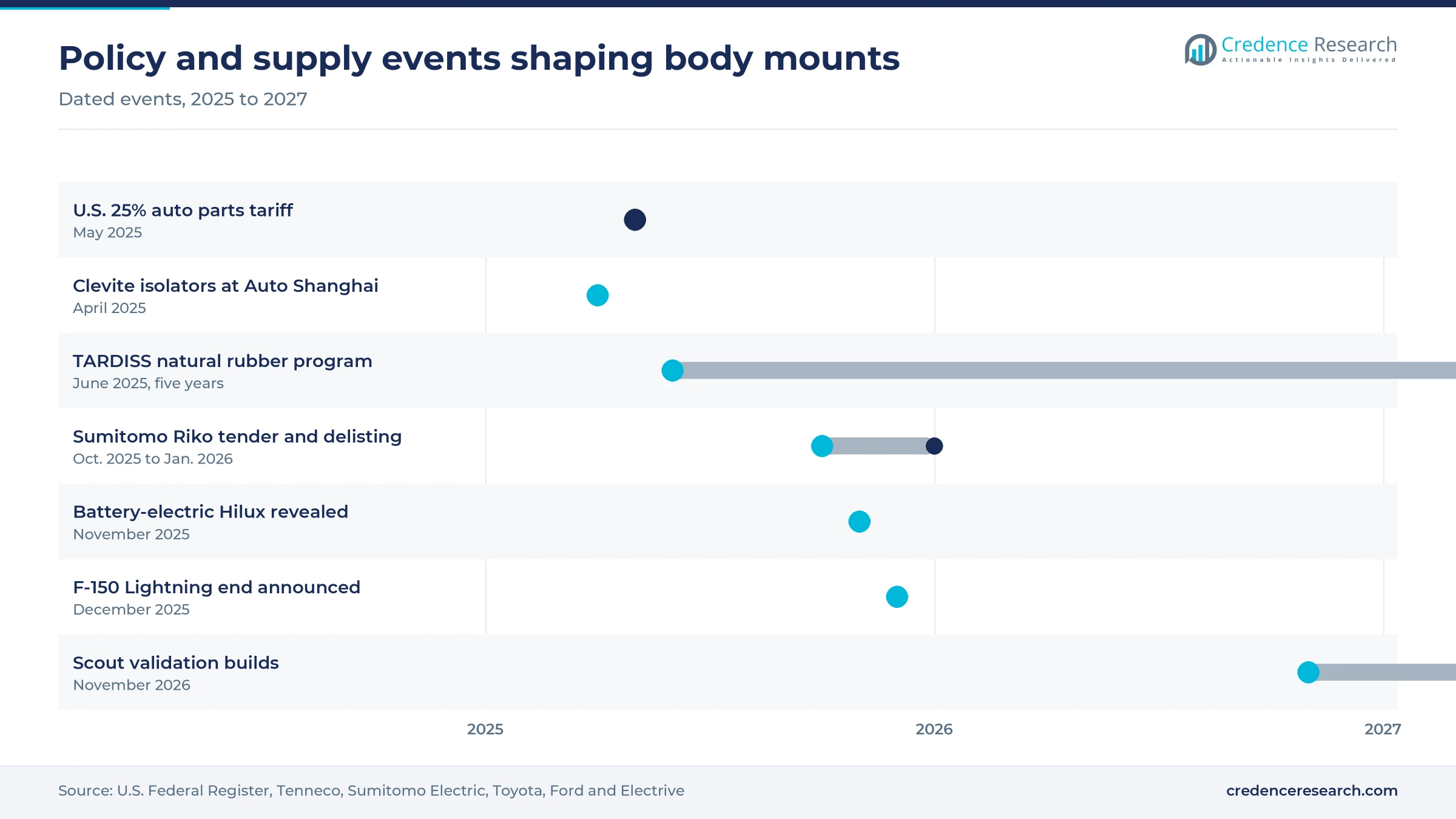
Pickup makers are shifting toward battery, hybrid and range-extended drives on ladder frames, to address emissions rules and fleet buyers, creating openings for re-tuned body mounts across midsize and full-size trucks. Toyota revealed a ninth-generation Hilux with a 59.2 kWh battery option in Bangkok on Nov. 10, 2025, with Asian launches from 2026. Ford said on Dec. 15, 2025, that it would end production of the battery-electric F-150 Lightning and replace it with an extended-range version, NPR reported. Scout Motors said 87% of its reservations were for range-extender versions, Electrive reported in November 2026. Mount suppliers must qualify designs for both heavier battery and mixed-drive variants of each frame.
Tunable foam and hydroelastic isolators are emerging
Automakers are shifting toward microcellular polyurethane and hydroelastic isolators in light vehicles, to address weight and tuning time, creating openings for designs beyond plain rubber. Vibracoustic says its MCU body mounts can be tuned by changing material density without changing chemistry or part geometry. Tenneco showed Clevite hydroelastic mounts and EV thermal isolators at Auto Shanghai, which ran from April 23 to May 2, 2025. Suppliers of NVH materials are moving toward the same tunable foams and hybrid parts. Polyurethane therefore gains mainly in light vehicles, while rubber-metal cab mounts remain the norm in heavy trucks, where load capacity and cost matter more than weight.
Aging truck and SUV fleets open replacement demand
Worn and rusted body mounts on aging pickups and SUVs are an underserved repair category, because many owners only replace them when doors misalign or the cab clunks. GM lists a single genuine body mount cushion for Tahoe and Suburban models at an MSRP of USD 150.85. AmericanTrucks lists a rubber and stainless-steel kit for 2007 to 2013 Silverado 1500 trucks at USD 74.99, while silicone and polyurethane sets sell for several times that. Owners in road-salt states see corrosion first, because steel mount cups rust where they meet the frame. Distributors and repair chains with complete fitment coverage for older trucks gain the most from this repair demand, since a full set is often sold as one job.
Domestic rubber and local sourcing offer a supply opening
Suppliers that secure domestic rubber and local molding can win share from importers as buyers seek tariff-proof parts. Tenneco said on June 16, 2025, that its Clevite Elastomers business joined the TARDISS consortium, led by Ohio State University with six other universities, to test natural rubber from U.S. crops in finished products. The National Science Foundation funds the work with a USD 26 million, five-year grant covering guayule, Russian dandelion and mountain gum. USMCA-compliant parts stayed free of the 25% U.S. parts tariff in force since May 2025, pending a content process, as noted under challenges. North American plants with local compounds gain a cost edge over Asian imports.
Tariffs, rubber costs and weak truck cycles squeeze margins
U.S. import tariffs raise costs for parts shippers
Tariffs on imported auto parts raise landed costs for mount makers that ship into U.S. assembly plants. The proclamation of March 26, 2025, imposed a 25% duty on covered automobile parts from no later than May 3, 2025, while USMCA-compliant parts stayed tariff-free pending a content process. Asian and European suppliers without North American molding are most exposed, and automakers may resource contracts to plants in Mexico or the United States.
Rubber and compound costs squeeze molders
Natural and synthetic rubber make up a large part of mount cost, so price moves pass quickly into supplier margins. The World Bank expects natural rubber prices to rise 2% in 2026 and 3% in 2027, after a 2% gain in the third quarter of 2025 on trade and weather worries. Tire production uses nearly two-thirds of natural rubber, so mount molders buy at the margin. Smaller molders without index-linked contracts face the most margin pressure.
Weak truck cycles cut cab mount volumes
Cab mount demand follows truck builds, and 2025 brought a soft cycle in the two largest Western truck markets. ACEA reported that EU truck registrations fell 6.2% to 307,460 units in 2025, a constraint on cab mount builds. Heavy trucks, which carry the most valuable cab mounts, fell 5.4% and medium trucks 9.9% in the same data. Cab mount specialists such as Trelleborg and Hutchinson are most exposed until truck orders recover.
Platform-specific tuning lengthens development cycles
Each body, frame and battery layout needs its own stiffness and damping map, which raises engineering cost per program and limits how fast suppliers can reuse designs. The heavier battery platforms described under drivers force new validation work for each axle load, and range-extended pickups noted under trends add a second drive type to tune on each frame. Powertrain resets such as Ford's Lightning decision of Dec. 15, 2025, can strand tuning work that suppliers completed for a single drive type, and smaller molders are least able to absorb that cost.
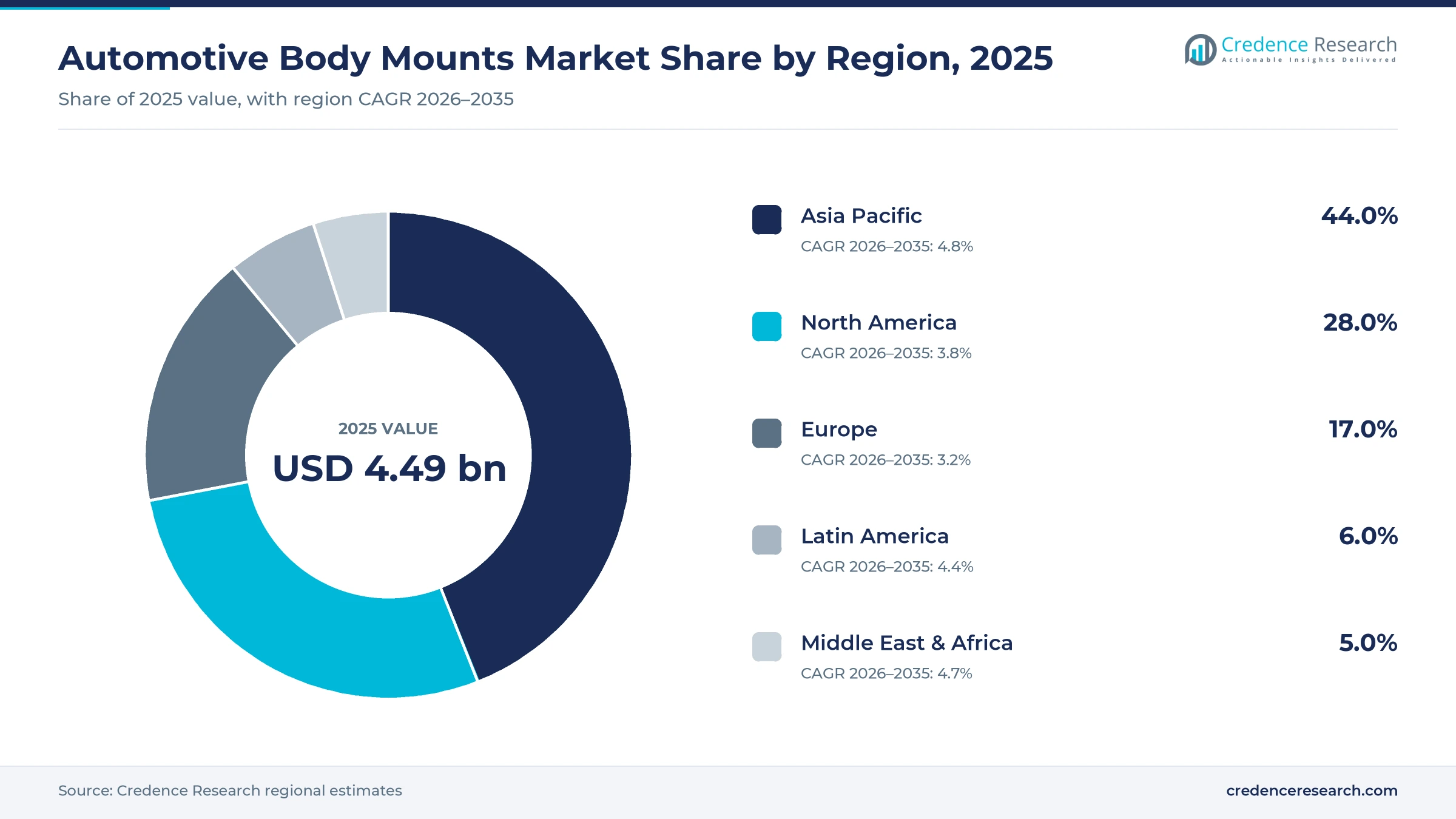
Asia Pacific leads on output, North America on content
| Region | Value, 2025 (USD billion) | Share, 2025 | CAGR, 2026–2035 |
|---|---|---|---|
| Asia Pacific | 1.97 | 44.0% | 4.8% |
| North America | 1.26 | 28.0% | 3.8% |
| Europe | 0.76 | 17.0% | 3.2% |
| Latin America | 0.27 | 6.0% | 4.4% |
| Middle East & Africa | 0.22 | 5.0% | 4.7% |
Asian vehicle output and pickup exports anchor Asia Pacific
Asia Pacific held a 44.0% share of 2025 value and grows at 4.8% a year. China produced 34.53 million vehicles in 2025, Japan 8.41 million and India 6.49 million, according to OICA, which puts most subframe isolator volume in the region. Thai ladder-frame plants and the Chinese pickup exports noted above add body-on-frame volume. Sumitomo Riko, Prospira and Chinese molders supply the region from local plants, which keeps prices below those of North America.
Full-size pickups and SUVs raise North American content
North America held a 28.0% share of 2025 value and grows at 3.8% a year. The region builds the world's largest full-size pickups and ladder-frame SUVs, so Credence Research estimates that its mount value per vehicle is the highest of any region, because a ladder-frame pickup carries eight to ten body mounts against four to eight isolators on a unibody car. OICA put 2025 output in the United States at 10.24 million vehicles. Slower growth follows because Americas output fell in 2025 and tariffs on imported parts, noted under challenges, raise costs for suppliers without plants in Mexico or the United States.
Unibody cars and premium trucks shape Europe
Europe held a 17.0% share of 2025 value and grows at 3.2% a year. Most European vehicles are unibody cars and crossovers, so subframe isolators dominate demand, while ladder-frame volume is small. Vibracoustic, Continental and Boge Rubber & Plastics design mounts in Germany for European and global platforms. ACEA reported that electrically chargeable trucks above 3.5 metric tons reached 4.2% of EU registrations in 2025, which adds new cab mount programs even as total truck registrations fell.
Brazilian assembly and pickups drive Latin America
Latin America held a 6.0% share of 2025 value and grows at 4.4% a year. Brazil produced 2.64 million vehicles in 2025, OICA reported, which gives local molders a base of subframe and body mount volume. Mount demand there leans toward rubber designs priced for local buyers and for older fleets. Country-level replacement spending is an evidence gap, so this share carries a wider range than the larger regions.
Imported pickups and SUVs set demand in Middle East & Africa
Middle East & Africa held a 5.0% share of 2025 value and grows at 4.7% a year. Gulf buyers favor ladder-frame SUVs and pickups, most of them imported from Asian plants, so mount demand here leans toward replacement on rough and hot roads. Chinese pickup and Tank SUV exports, noted above, add to the fleet that will need new mounts. Credence Research estimates that the aftermarket share is higher here than in any other region, although no supplier reports regional sales, which is an evidence gap.
Ownership moves and powertrain resets reshape suppliers
| Development | Status and market relevance |
|---|---|
| In April 2025, Tenneco showed Clevite Elastomers hydroelastic mounts and EV isolators at Auto Shanghai. | Product exhibition; hydroelastic mounts, e-compressor and thermal isolators shown to Chinese automakers |
| In June 2025, Tenneco said its Clevite Elastomers business joined the TARDISS natural rubber consortium. | Research program under way; USD 26 million, five-year National Science Foundation grant |
| In October 2025, Sumitomo Electric announced a tender offer to make Sumitomo Riko a wholly owned subsidiary. | Tender offer announced; Tokyo Stock Exchange set the delisting date for Jan. 29, 2026 |
| In November 2025, Toyota revealed the ninth-generation Hilux with a battery-electric version in Bangkok. | World premiere completed; sequential Asian launches planned from 2026 |
| In December 2025, Ford announced the end of production of the battery-electric F-150 Lightning pickup. | End of production announced; an extended-range Lightning is planned to replace it |
Four design choices set isolation and cost
- Rubber-metal bonding joins natural or synthetic rubber to steel or aluminum sleeves, giving the lowest-cost mount for most frames.
- Hydraulic damping pushes fluid through an inertia track inside the mount to damp low-frequency shake on long frames and heavy cabs.
- Microcellular polyurethane uses foam density to set stiffness, which shortens tuning time and cuts part weight against rubber designs.
- Durability simulation models fatigue and stiffness before tooling, which lets suppliers tune a new platform without many prototype rounds.
Need a Custom Version of This Report?
Tailor the scope, geography, or segments to your exact requirements.
- Custom geography or segment scope
- Direct access to our analyst team
Elastomer specialists compete on tuning and plant reach
Competition in the automotive body mounts market turns on compound know-how, tuning skill, plant location and price. Vibracoustic, part of the Freudenberg Group, supplies rubber, hydraulic and microcellular polyurethane body mounts to global automakers. Sumitomo Riko, which Sumitomo Electric calls a leader in anti-vibration rubber, serves Japanese and global platforms, and Sumitomo Electric announced in October 2025 a tender offer to take full ownership of it. Anhui Zhongding agreed in December 2021 to buy Bridgestone's anti-vibration rubber business, which Bridgestone moved into Prospira in September 2022 ahead of the share sale. Boge Rubber & Plastics and Tenneco's Clevite Elastomers compete in subframe and hydroelastic parts for passenger cars. Continental, Trelleborg and Hutchinson hold strong positions in truck cab mounts. Dorman and Energy Suspension sell replacement and upgrade kits through parts retailers. Qualification on new electrified frames now decides share more than catalog breadth.
A few elastomer groups supply most OEM mount programs
Supply is concentrated in a small group of elastomer specialists that mold body, subframe and cab mounts alongside engine mounts and bushings. Vibracoustic, Sumitomo Riko, Prospira, Boge Rubber & Plastics and Tenneco's Clevite Elastomers win most light-vehicle programs, while Continental, Trelleborg and Hutchinson lead in truck cab mounts. Entry barriers sit in compound know-how, tuning simulation, durability testing and plants near assembly lines. Margins are highest on hydraulic designs and on branded replacement kits sold by Dorman and Energy Suspension.
Elastomer specialists, truck suppliers and replacement brands
| Company | Type | Role in the market |
|---|---|---|
| Vibracoustic SE (Freudenberg Group) | Full-line supplier | Supplies rubber, hydraulic and MCU body mounts to global automakers |
| Sumitomo Riko Co., Ltd. (Sumitomo Electric) | Full-line supplier | Molds anti-vibration rubber mounts for Japanese and global vehicle platforms |
| Prospira Corporation (Anhui Zhongding) | Full-line supplier | Supplies anti-vibration rubber mounts from the former Bridgestone business |
| Tenneco Inc. (Clevite Elastomers) | Specialist | Supplies elastomer and hydroelastic mounts and isolators to automakers |
| Continental AG (ContiTech) | Specialist | Supplies rubber-metal and hydraulic cab mounts for commercial vehicles |
| Boge Rubber & Plastics (Zhuzhou Times New Material) | Specialist | Supplies hydraulic and damped subframe mounts for passenger cars |
| Hutchinson (TotalEnergies) | Specialist | Supplies Paulstra anti-vibration and cab mounts for trucks and machines |
| Trelleborg AB | Specialist | Supplies rubber cab mounts for commercial vehicles and tractors |
| Dorman Products, Inc. | Replacement brand | Sells body mount and cab mount kits to repair shops |
| Energy Suspension | Replacement brand | Sells polyurethane body mount sets for trucks and SUVs |
Content per vehicle, not unit growth, sets the value
Credence Research's view is that content per vehicle, not unit growth, will decide where value sits in the automotive body mounts market. World vehicle output should grow slowly, but heavier battery and range-extended ladder-frame pickups need stiffer, damped mounts that cost more than rubber-metal parts. Hydraulic designs should remain the fastest-growing material type as truck buyers demand car-like ride. The main strategic risk is tariff and powertrain uncertainty in North America, so suppliers should keep molding close to assembly plants and design mounts that fit more than one drive type.
Vehicle output and mount content anchor the estimate
The report uses 2025 as the base year and 2026 to 2035 as the forecast period. Market values come from the Credence Research model, built from vehicle production by type, mounts per vehicle and supply prices, plus a replacement share checked against retail kit prices. The previous edition's value was replaced because this build did not support it. Regional, material, position, propulsion and channel splits are Credence Research estimates informed by public data, and regional splits carry the widest ranges. Sources include OICA, ACEA, the World Bank, the U.S. Federal Register, company releases and published price lists, and no interviews or surveys were used.
Electrified frames and replacement demand shape 2035
Growth to 2035 rests on rising mount content in heavier pickups, ladder-frame SUVs and electrified platforms rather than on fast vehicle output growth. Asia Pacific should keep the fastest regional pace as Chinese and Indian plants add volume, while North America remains the region with the highest value per vehicle. Tariffs, rubber costs and weak truck cycles remain the main restraints, while replacement demand from aging fleets is the main upside. Suppliers that combine hydraulic tuning, local plants and fitment coverage for older trucks are best placed through the forecast period.
Truck cycles and electrified frames set the range of outcomes
The outcome to 2035 depends on how quickly ladder-frame vehicles electrify and how fast truck builds recover. The base case assumes modest growth in vehicle output with steady gains in hydraulic and tuned mounts. A downside follows if tariffs and weak freight demand hold truck builds down and automakers delay heavier electrified pickups. An upside follows if battery and range-extended pickups scale quickly and raise mount value per vehicle.
| Scenario | CAGR, 2026–2035 | Value, 2035 | What has to hold |
|---|---|---|---|
| Downside | 2.8% | USD 5.97 billion | Tariffs and weak freight demand hold truck builds down and delay electrified pickups |
| Base | 4.25% | USD 6.80 billion | Modest growth in vehicle output with steady gains in hydraulic and tuned mounts |
| Upside | 5.2% | USD 7.41 billion | Battery and range-extended pickups scale quickly and raise mount value per vehicle |
Frequently Asked Questions
How big is the automotive body mounts market?
What does an automotive body mount do?
Which material type leads the market?
Which region holds the largest share?
How do electric vehicles change body mount demand?
How much do replacement body mount kits cost?
How do U.S. tariffs affect body mount suppliers?
Who are the leading body mount suppliers?
Table of Content
Chapter 1 Market Segmentation
- 1.1 Segmentation Framework
- 1.1.1 Product and Service Classification
- 1.1.2 Application and End-Use Classification
- 1.1.3 Technology and Solution Classification
- 1.1.4 Customer and Distribution Channel Classification
- 1.1.5 Geographic Segmentation
- 1.1.6 Market Segment Definitions and Boundaries
- 1.2 By Material Type
- 1.2.1 Rubber Body Mounts
- 1.2.2 Hydraulic Body Mounts
- 1.2.3 Polyurethane and MCU Body Mounts
- 1.3 By Mount Position
- 1.3.1 Subframe Isolators
- 1.3.2 Body-on-Frame Mounts
- 1.3.3 Cab Mounts
- 1.4 By Propulsion
- 1.4.1 Internal Combustion Engine Vehicles
- 1.4.2 Hybrid Vehicles
- 1.4.3 Battery Electric Vehicles
- 1.5 By Sales Channel
- 1.5.1 OEM
- 1.5.2 Aftermarket
Chapter 2 Introduction
- 2.1 Report Objectives and Scope
- 2.2 Product Definition and Industry Terminology
- 2.3 Market Inclusions and Exclusions
- 2.4 Research Process
- 2.4.1 Primary Research and Expert Interviews
- 2.4.2 Secondary Research and Source Review
- 2.4.3 Top-Down and Bottom-Up Estimation
- 2.4.4 Data Triangulation and Verification
- 2.5 Market Size Measurement Basis
- 2.5.1 2025: USD 4.49 billion → 2035: USD 6.80 billion
- 2.6 Historical and Forecast Reference Periods
- 2.6.1 Historical Period: 2018-2025
- 2.6.2 Base Year: 2025
- 2.6.3 Forecast Period: 2025-2035
- 2.7 Research Assumptions and Limitations
Chapter 3 Executive Summary
- 3.1 Market Snapshot and Key Findings
- 3.2 Base-Year Market Size, 2025
- 3.3 Forecast Market Size, 2035
- 3.4 Revenue and Volume Growth Outlook
- 3.5 Key Demand and Supply Indicators
- 3.6 Leading Market Segments
- 3.7 Fastest-Growing Market Opportunities
- 3.8 Regional Performance Highlights
- 3.9 Technology and Industry Transformation
- 3.10 Competitive Landscape Summary
- 3.11 Analyst View and Strategic Implications
Chapter 4 Global Automotive Body Mounts Market Trends and Developments
- 4.1 Historical Industry Development, 2018-2025
- 4.2 Recent Market Trends and Developments
- 4.3 Demand and Customer Behavior Trends
- 4.4 Technology and Product Innovation
- 4.5 Artificial Intelligence, Automation and Digitalization
- 4.6 Local Manufacturing and Supply Chain Realignment
- 4.7 Industry Partnerships, Mergers and Acquisitions
- 4.8 Sustainability and Circular Economy Developments
- 4.9 Government and Private Sector Investment Trends
- 4.10 Emerging Business Models and Commercialization
- 4.11 Industry Developments and Announcements
Chapter 5 Global Automotive Body Mounts Market Production, Supply and Demand Analysis
- 5.1 Demand Trend and Consumption Analysis, 2018-2025
- 5.2 Demand Forecast, 2025-2035
- 5.3 Production and Output Trend, 2018-2025
- 5.4 Production and Output Forecast, 2025-2035
- 5.5 Installed Capacity and Capacity Utilization
- 5.6 Company-Wise Production Plants and Statistics
- 5.6.1 Installed Production Capacity
- 5.6.2 Actual Production
- 5.6.3 Planned Capacity and Expansion Targets
- 5.7 Supply Chain Structure and Procurement Trends
- 5.8 Supply-Demand Gap and Bottlenecks
- 5.9 Import Dependence and Sourcing Structure
- 5.10 Contract Manufacturing and Outsourcing
- 5.11 Regional Supply and Demand Concentration
Chapter 6 Global Automotive Body Mounts Market Pricing Analysis
- 6.1 Pricing Structure and Measurement
- 6.2 Historical Pricing Trends, 2018-2025
- 6.3 Pricing Outlook, 2025-2035
- 6.4 Average Selling Price and Unit Economics
- 6.5 Pricing by Product and Market Segment
- 6.6 Geographic Pricing Differences
- 6.7 Key Input, Energy, Labor and Logistics Costs
- 6.8 Contract Pricing and Purchasing Models
- 6.9 Pricing Sensitivity and Competitive Positioning
- 6.10 Price, Margin and Profitability Implications
Chapter 7 Global Automotive Body Mounts Market Dynamics
- 7.1 Market Growth Drivers
- 7.1.1 Demand-Side Drivers
- 7.1.2 Technology and Innovation Drivers
- 7.1.3 Infrastructure and Investment Drivers
- 7.1.4 Regulatory and Policy Drivers
- 7.2 Market Restraints
- 7.2.1 Cost and Affordability Constraints
- 7.2.2 Technology and Adoption Barriers
- 7.2.3 Supply Chain and Operational Constraints
- 7.3 Market Challenges
- 7.3.1 Competitive Pressure and Margin Erosion
- 7.3.2 Skills, Infrastructure and Implementation Gaps
- 7.4 Emerging Market Opportunities
- 7.5 Market Dynamics Impact and Time-Horizon Assessment
Chapter 8 Global Automotive Body Mounts Value Chain Analysis
- 8.1 Industry Value Chain Overview
- 8.2 Upstream Suppliers and Critical Inputs
- 8.3 Technology and Component Providers
- 8.4 Manufacturing or Service Delivery
- 8.5 Distribution, Channel Partners and Integrators
- 8.6 Downstream Applications and End Users
- 8.7 Value Addition and Profit Pools
- 8.8 Vertical Integration and Outsourcing
- 8.9 Supplier Concentration and Risk
- 8.10 Supply Chain Localization and Resilience
Chapter 9 Global Automotive Body Mounts Market Regulations and Policies
- 9.1 Relevant Laws, Standards and Compliance Frameworks
- 9.2 Product, Service, Safety and Quality Requirements
- 9.3 Government Policies, Incentives and Subsidies
- 9.4 Imports, Exports and Trade Barriers
- 9.5 Public Procurement and Local Content Requirements
- 9.6 Environmental and Sustainability Compliance
- 9.7 Upcoming Policy Changes and Market Implications
Chapter 10 Global Automotive Body Mounts Market Hotspots and Opportunities
- 10.1 Market Opportunity Mapping and Growth Hotspots
- 10.2 High-Growth Applications and Customer Groups
- 10.3 Underserved Markets and White-Space Opportunities
- 10.4 Emerging Technology and Product Opportunities
- 10.5 New Capacity and Investment Hotspots
- 10.6 Market Entry and Expansion Opportunities
- 10.7 Distribution and Partnership Opportunities
- 10.8 Near-Term and Long-Term Commercial Potential
- 10.9 Opportunity Attractiveness and Execution Risks
Chapter 11 Global Automotive Body Mounts Market Outlook, 2025-2035
- 11.1 Market Size and Analysis
- 11.1.1 Revenue (Market Measurement: 2025: USD 4.49 billion → 2035: USD 6.80 billion)
- 11.1.2 Market Volume and Quantity Sold
- 11.1.3 Historical Market Size, 2018-2025
- 11.1.4 Base-Year Market Size, 2025
- 11.2 Market Forecast, 2025-2035
- 11.2.1 Revenue Forecast to 2035
- 11.2.2 Volume Forecast to 2035
- 11.2.3 CAGR and Year-on-Year Growth
- 11.2.4 Incremental Revenue Opportunity
- 11.3 Forecast Assumptions and Scenario Analysis
- 11.3.1 Base-Case Forecast
- 11.3.2 Optimistic and Conservative Scenarios
- 11.3.3 Technology, Pricing and Policy Sensitivities
- 11.4 Market Attractiveness and Growth Outlook
Chapter 12 Global Automotive Body Mounts Market Segmentation and Outlook
- 12.1 Segmentation Summary and Market Shares, 2025
- 12.2 Largest and Fastest-Growing Segments
- 12.3 By Material Type - Market Size and Forecast, 2025-2035
- 12.3.1 Segment Definition and Scope
- 12.3.2 Historical Market Size, 2018-2025
- 12.3.3 Revenue Forecast, 2025-2035
- 12.3.4 Volume Forecast, 2025-2035
- 12.3.5 Base-Year Market Share, 2025
- 12.3.6 Segment CAGR and Growth Drivers
- 12.3.7 Subsegment Market Size and Forecast
- 12.3.7.1 Rubber Body Mounts
- 12.3.7.2 Hydraulic Body Mounts
- 12.3.7.3 Polyurethane and MCU Body Mounts
- 12.3.8 Subsegment Pricing and Adoption Trends
- 12.3.9 Leading Suppliers and Competition
- 12.3.10 Regional Demand and Opportunities
- 12.4 By Mount Position - Market Size and Forecast, 2025-2035
- 12.4.1 Segment Definition and Scope
- 12.4.2 Historical Market Size, 2018-2025
- 12.4.3 Revenue Forecast, 2025-2035
- 12.4.4 Volume Forecast, 2025-2035
- 12.4.5 Base-Year Market Share, 2025
- 12.4.6 Segment CAGR and Growth Drivers
- 12.4.7 Subsegment Market Size and Forecast
- 12.4.7.1 Subframe Isolators
- 12.4.7.2 Body-on-Frame Mounts
- 12.4.7.3 Cab Mounts
- 12.4.8 Subsegment Pricing and Adoption Trends
- 12.4.9 Leading Suppliers and Competition
- 12.4.10 Regional Demand and Opportunities
- 12.5 By Propulsion - Market Size and Forecast, 2025-2035
- 12.5.1 Segment Definition and Scope
- 12.5.2 Historical Market Size, 2018-2025
- 12.5.3 Revenue Forecast, 2025-2035
- 12.5.4 Volume Forecast, 2025-2035
- 12.5.5 Base-Year Market Share, 2025
- 12.5.6 Segment CAGR and Growth Drivers
- 12.5.7 Subsegment Market Size and Forecast
- 12.5.7.1 Internal Combustion Engine Vehicles
- 12.5.7.2 Hybrid Vehicles
- 12.5.7.3 Battery Electric Vehicles
- 12.5.8 Subsegment Pricing and Adoption Trends
- 12.5.9 Leading Suppliers and Competition
- 12.5.10 Regional Demand and Opportunities
- 12.6 By Sales Channel - Market Size and Forecast, 2025-2035
- 12.6.1 Segment Definition and Scope
- 12.6.2 Historical Market Size, 2018-2025
- 12.6.3 Revenue Forecast, 2025-2035
- 12.6.4 Volume Forecast, 2025-2035
- 12.6.5 Base-Year Market Share, 2025
- 12.6.6 Segment CAGR and Growth Drivers
- 12.6.7 Subsegment Market Size and Forecast
- 12.6.7.1 OEM
- 12.6.7.2 Aftermarket
- 12.6.8 Subsegment Pricing and Adoption Trends
- 12.6.9 Leading Suppliers and Competition
- 12.6.10 Regional Demand and Opportunities
- 12.7 Segment Growth Comparison
- 12.8 Segment Attractiveness and Priority Matrix
Chapter 13 Global Automotive Body Mounts Geographic Market Outlook, 2025-2035
- 13.1 Regional Market Size and Share, 2025
- 13.2 Regional Market Forecast, 2025-2035
- 13.3 Regional Pricing, Production and Demand Differences
- 13.4 North America
- 13.4.1 United States
- 13.4.2 Canada
- 13.4.3 Mexico
- 13.5 Europe
- 13.5.1 Germany
- 13.5.2 France
- 13.5.3 Italy
- 13.5.4 United Kingdom
- 13.5.5 Spain
- 13.5.6 Poland
- 13.5.7 Russia
- 13.5.8 Netherlands
- 13.5.9 Belgium
- 13.5.10 Sweden
- 13.5.11 Denmark
- 13.5.12 Norway
- 13.5.13 Rest of Europe
- 13.6 Asia Pacific
- 13.6.1 China
- 13.6.2 India
- 13.6.3 Japan
- 13.6.4 South Korea
- 13.6.5 Thailand
- 13.6.6 Indonesia
- 13.6.7 Vietnam
- 13.6.8 Malaysia
- 13.6.9 Australia
- 13.6.10 Rest of Asia Pacific
- 13.7 Latin America
- 13.7.1 Brazil
- 13.7.2 Argentina
- 13.7.3 Colombia
- 13.7.4 Chile
- 13.7.5 Rest of Latin America
- 13.8 Middle East
- 13.8.1 Saudi Arabia
- 13.8.2 United Arab Emirates
- 13.8.3 Turkey
- 13.8.4 Israel
- 13.8.5 Iran
- 13.8.6 Rest of the Middle East
- 13.9 Africa
- 13.9.1 South Africa
- 13.9.2 Egypt
- 13.9.3 Nigeria
- 13.9.4 Morocco
- 13.9.5 Rest of Africa
- 13.10 Regional Investment, Policy and Supply Chain Differences
- 13.11 Regional Competitive Landscape
- 13.12 Geographic Growth Hotspots
Chapter 14 Global Automotive Body Mounts Technology, Innovation and Sustainability Outlook
- 14.1 Technology Landscape and Maturity
- 14.2 Product, Process and Service Innovation
- 14.3 AI, Automation and Digital Tools in the Industry
- 14.4 Technology Adoption and Performance Benchmarking
- 14.5 Innovation Pipeline and R&D Investment
- 14.6 Patent and Intellectual Property Trends
- 14.7 Energy Efficiency and Resource Management
- 14.8 Sustainability, Recycling and Circularity
- 14.9 Technology Roadmap, 2025-2035
- 14.10 Risks of Obsolescence and Technology Substitution
Chapter 15 Global Automotive Body Mounts Market Key Strategic Imperatives
- 15.1 Growth and Market Entry Priorities
- 15.2 High-Return Products and Segments
- 15.3 Pricing, Profitability and Cost Optimization
- 15.4 Technology Investment and Product Differentiation
- 15.5 Supply Chain Localization and Resilience
- 15.6 Distribution and Customer Acquisition
- 15.7 Partnership, Acquisition and Capacity Strategy
- 15.8 Regional Expansion Priorities
- 15.9 Short-, Medium- and Long-Term Actions
Chapter 16 Competition Outlook
- 16.1 Industry Competition Characteristics
- 16.2 Market Structure and Concentration
- 16.3 Market Share and Competitive Positioning, 2025
- 16.4 Company-Wise Revenue and Product Benchmarking
- 16.5 Production and Service Capacity Benchmarking
- 16.6 Technology, Pricing and Differentiation
- 16.7 Regional Footprint and Distribution Strength
- 16.8 Mergers, Acquisitions and Strategic Alliances
- 16.9 New Entrants and Competitive Threats
- 16.10 Porter's Five Forces and Industry Attractiveness
- 16.11 Competitive Outlook, 2025-2035
Chapter 17 Company Profiles
- 17.1 Company Coverage and Selection Criteria
- 17.2 Vibracoustic SE (Freudenberg Group)
- 17.2.1 Business Description
- 17.2.2 Company Ownership and Geographic Presence
- 17.2.3 Product and Service Portfolio
- 17.2.4 Manufacturing and Operating Footprint
- 17.2.5 Production Capacity and Expansion Plans
- 17.2.6 Financial Performance and Investment
- 17.2.7 Market Share and Competitive Position
- 17.2.8 Technology and Innovation Capabilities
- 17.2.9 Strategic Alliances or Partnerships
- 17.2.10 Recent Developments
- 17.2.11 Growth Strategy and Outlook
- 17.3 Sumitomo Riko Co., Ltd. (Sumitomo Electric)
- 17.4 Prospira Corporation (Anhui Zhongding)
- 17.5 Tenneco Inc. (Clevite Elastomers)
- 17.6 Continental AG (ContiTech)
- 17.7 Boge Rubber & Plastics (Zhuzhou Times New Material)
- 17.8 Hutchinson (TotalEnergies)
- 17.9 Trelleborg AB
- 17.10 Dorman Products, Inc.
- 17.11 Energy Suspension
- 17.12 Other Relevant Market Participants
Note: Every listed company is profiled on the structure shown under the first company. The company list is preliminary and may change based on research findings, market developments, data availability and client requirements.
Chapter 18 Disclaimer
- 18.1 Research and Forecast Disclaimer
- 18.2 Data Source and Estimation Limitations
Note: The depth of individual sections depends on data availability for this market. Volume, capacity, trade and other unit-based metrics are included where applicable.

