
Vehicle plants, chip fabs and process lines set demand
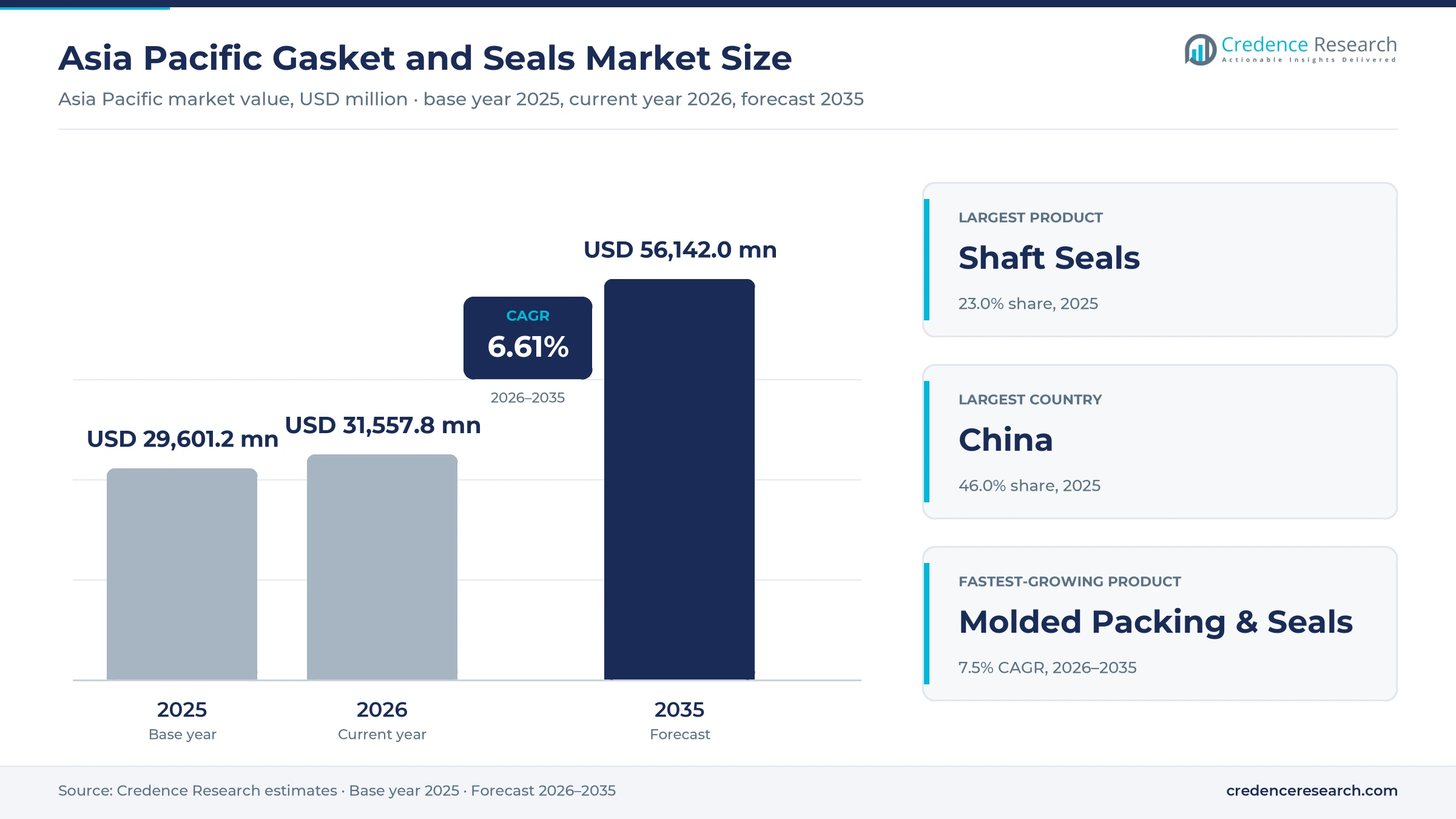
The Asia Pacific gasket and seals market was valued at USD 29.60 billion in 2025 and is projected to increase from USD 31.56 billion in 2026 to USD 56.14 billion by 2035, registering a CAGR of 6.61% during 2026–2035. Demand comes from carmakers and their tier suppliers, which fit shaft seals, body seals and gaskets on every engine, e-axle and battery pack, and from process plants, shipyards, machinery builders and chip equipment makers that seal flanges, pumps and vacuum chambers. China held the largest country share, 46.0% in 2025, because it builds the most vehicles, excavators and ships in the region, while India is the fastest-growing country at 8.7% a year as vehicle output and refining capacity expand. The most important commercial change is the shift of sealing value from combustion engine gaskets toward battery, e-axle and semiconductor tool seals. Lower car output in Japan and pressure on fluoropolymer materials are the main restraints.
Seals and gaskets bought in the region count, not exports
The market counts what buyers in Asia Pacific spend on metallic, semi-metallic and non-metallic gaskets, rotary shaft seals, molded O-rings and packing, and vehicle body seals. Carmakers and engine builders buy under multi-year platform awards, process plants buy flange gaskets and packing through framework contracts and distributors, and chip equipment makers qualify elastomer seals part by part for each chamber design.
Raw elastomers, fluoropolymer resins and sealants sold without a formed part are excluded, as are seals that regional plants ship to buyers in other regions. The value chain runs from polymer and steel suppliers through molders and gasket converters to tier suppliers and distributors, and margins are widest where a supplier controls the compound recipe, the tooling and the customer qualification.
Asia Pacific Gasket and Seals Market Insights
- The Asia Pacific gasket and seals market was valued at USD 29.60 billion in 2025 and is projected to reach USD 56.14 billion by 2035, growing at a 6.61% CAGR during 2026–2035.
- China held 46.0% of 2025 value, because it built 34.53 million vehicles, sold 235,257 excavators and completed 53.69 million deadweight tons of ships in 2025.
- Shaft seals held 23.0% of 2025 value, because every engine, transmission, e-axle reducer and pump needs a rotary seal at each turning shaft.
- Daikin plans to supply perfluoroelastomer from a new Kashima plant from 2027, with capacity more than three times its older site, to serve chip tool seal makers.
- Trelleborg completed its purchase of Singapore energy sealing specialist Masterseals on Sept. 1, 2025, adding local machining and aftermarket service in Southeast Asia.
Shaft seals and automotive lead, chip tool seals gain
Shaft seals lead while molded seals grow fastest
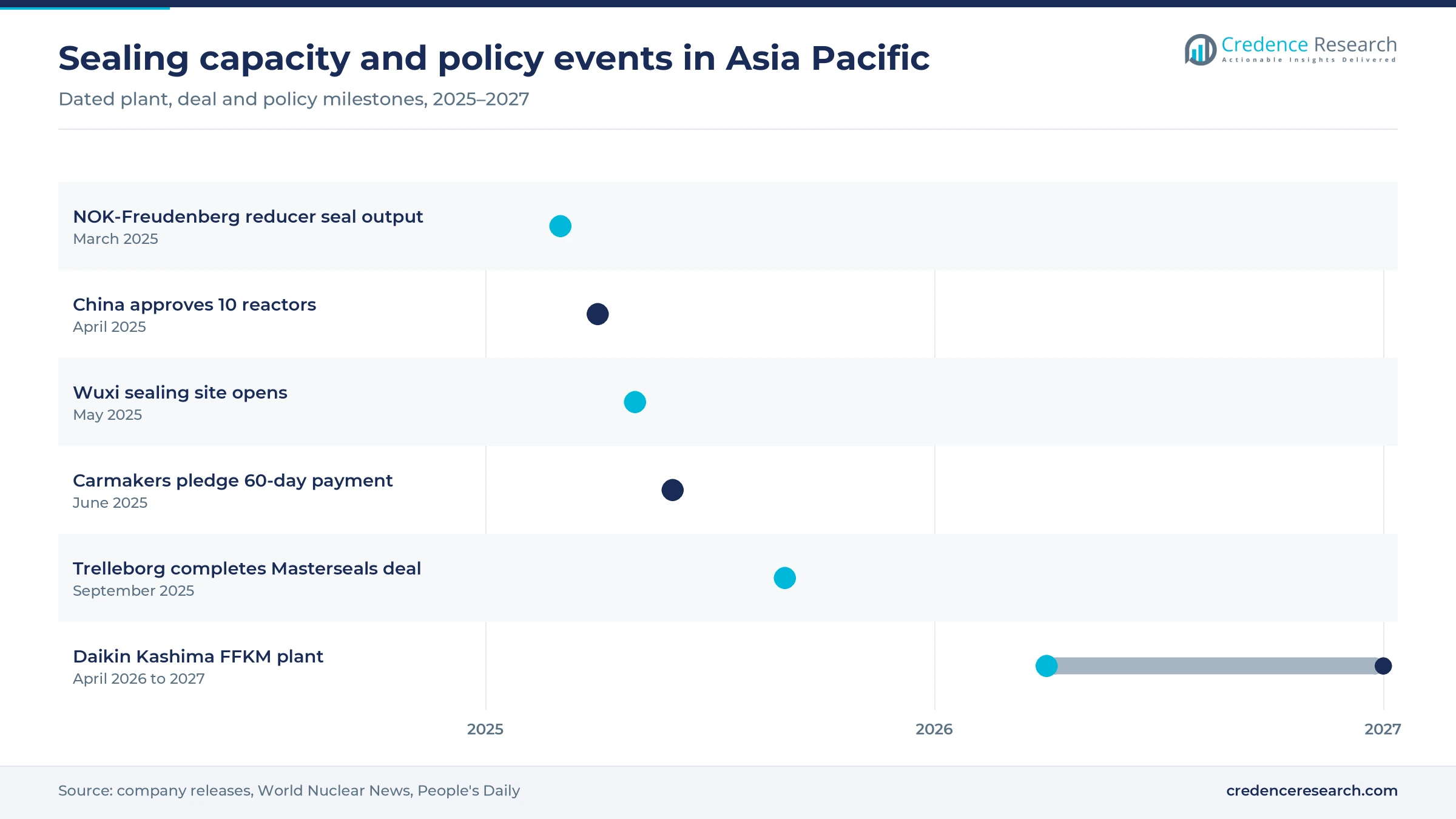
Based on product, the market is categorized into metallic gaskets, semi-metallic gaskets, non-metallic gaskets, shaft seals, molded packing and seals, and motor vehicle body seals. Shaft Seals led with 23.0% of 2025 value because every rotating shaft needs one, including those in electric drives. NOK-Freudenberg Group China began mass production of a Simmerring reducer oil seal for drive units at its Changchun plant in March 2025, according to MarkLines. Molded Packing & Seals grow fastest at 7.5% as chip tool makers need ultra-clean elastomer O-rings, and Daikin is building a perfluoroelastomer plant at Kashima to supply such seals from 2027.
Automotive leads while electronics grows fastest
Based on application, the market is categorized into automotive, electrical and electronics, marine and rail, industrial and manufacturing, aerospace, oil and gas, chemicals and petrochemicals, and others. Automotive led with 41.5% of 2025 value because seal and gasket content is fixed into vehicle platforms for years, and Freudenberg-NOK India supplies seals and gaskets to Maruti Suzuki, Toyota Kirloskar and Hyundai India from Morinda, according to Autocar Professional. Electrical & Electronics grows fastest at 8.1% as Taiwanese chip equipment billings rose 90% in 2025, according to SEMI, and every etch or deposition chamber relies on vacuum seals that wear in service.
OEM supply leads while the aftermarket gains
Based on end user, the market is categorized into original equipment manufacturers and the aftermarket. Original Equipment Manufacturer (OEM) led with 66.0% of 2025 value because gaskets and seals are designed into engines, gearboxes and machines at launch, and ElringKlinger supplies cylinder head and specialty gaskets to carmakers from four Chinese plants, according to the company. Aftermarket grows fastest at 7.2% as plant operators buy quick replacement parts, and Masterseals in Singapore, consolidated by Trelleborg from Sept. 1, 2025, runs a technical service center built around aftermarket support and short delivery times, according to Trelleborg.
| Segment Group | Leading Sub-segment | Share, 2025 | Fastest-growing Sub-segment | CAGR, 2026–2035 |
|---|---|---|---|---|
| By Product | Shaft Seals | 23.0% | Molded Packing & Seals | 7.5% |
| By Application | Automotive | 41.5% | Electrical & Electronics | 8.1% |
| By End User | Original Equipment Manufacturer (OEM) | 66.0% | Aftermarket | 7.2% |
Shaft seals cost a few dollars, flange gaskets far more
Sealing parts are priced per piece, but the price ladder is steep, from molded nitrile shaft seals sold in bags of five to stainless spiral wound gaskets sold in packs of ten for pressure-rated flanges. Size, pressure class, material and certification move price more than the brand, and a larger spiral wound ring costs about 17 times a small one in the same Singapore catalog. Distributor list prices overstate what carmakers pay under platform contracts, and those contract prices are an evidence gap. Suppliers keep margin through compound recipes, fast delivery and approvals for refinery, chemical and chip tool duty.
| Product | Typical price or fee | Basis |
|---|---|---|
| Nitrile rotary shaft seal, 50 x 70 x 10 mm | SGD 3.07 each in a bag of 5, before GST | RS Singapore list, November 2026 |
| Compressed fiber full face gasket, 115 mm bore | SGD 9.99 each in a bag of 5, before GST | RS Singapore list, November 2026 |
| Klinger spiral wound gasket, 2-inch Class 150 | SGD 80.18 per pack of 10, before GST | RS Singapore list, November 2026 |
| Klinger spiral wound gasket, 213 mm bore | SGD 267.44 per pack of 10, before GST | RS Singapore list, November 2026 |
Request a Free Sample
Fill in your details and we'll send you a free sample report.
- Sample data tables & charts
- Research methodology
Car output, fab tools, machinery and energy lift volumes
Record vehicle output carries seal and gasket volumes
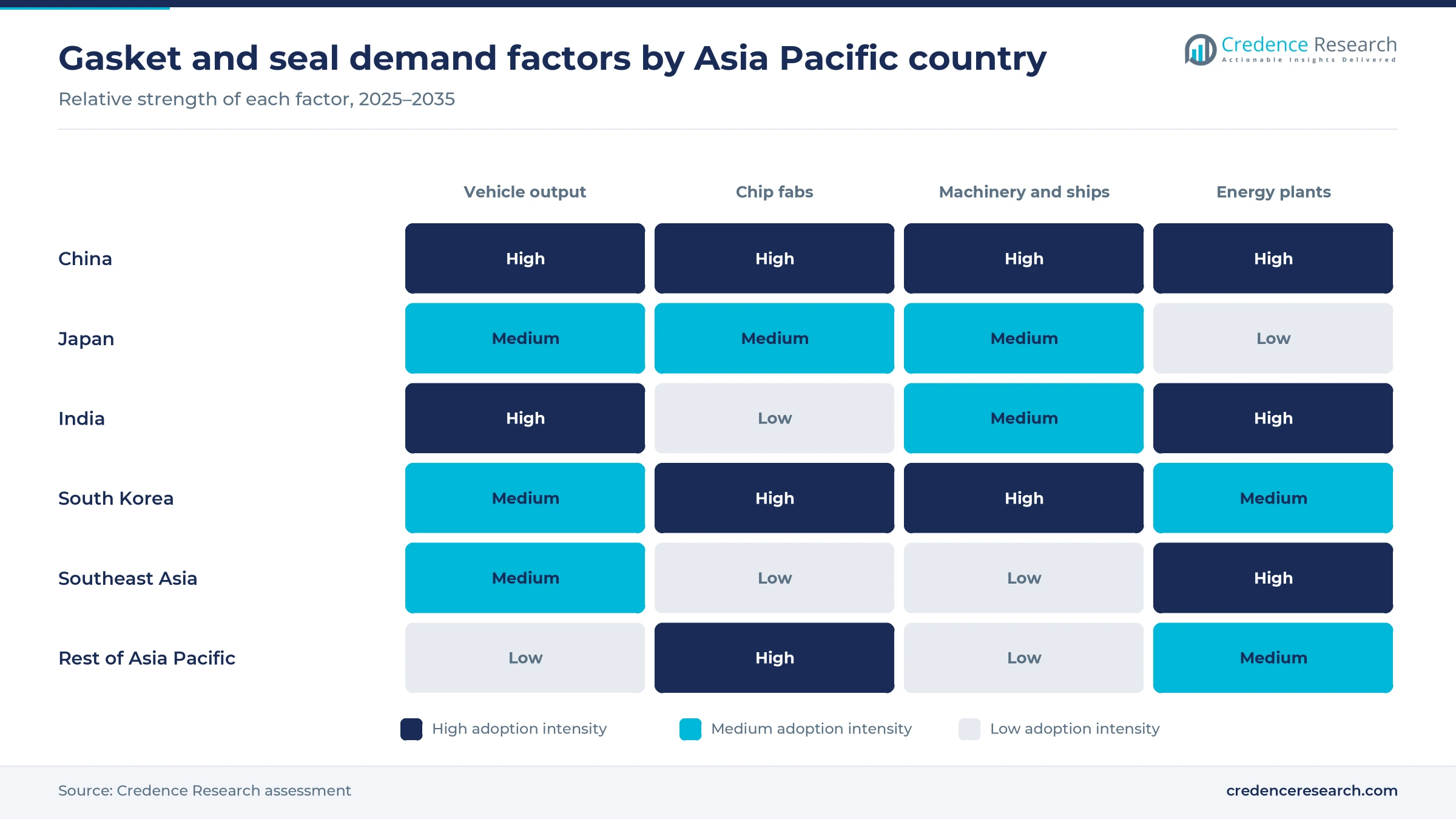
Vehicle output is the largest single source of seal and gasket volume in the region, because each car carries shaft seals, body seals and gaskets whether it burns fuel or runs on a battery. Asia Pacific produced about 59.2 million vehicles in 2025, up 7.6% and more than 61% of world output, according to OICA. China alone built 34.53 million vehicles, including 16.626 million new energy vehicles. India sold a record 4.643 million passenger vehicles in fiscal 2025-26, according to SIAM. Electric platforms remove head and exhaust gaskets but add sealing for battery packs, coolant plates and e-axles, which favors suppliers with qualified elastomer and plastic sealing parts for those systems.
Chip equipment spending lifts high-purity seal demand
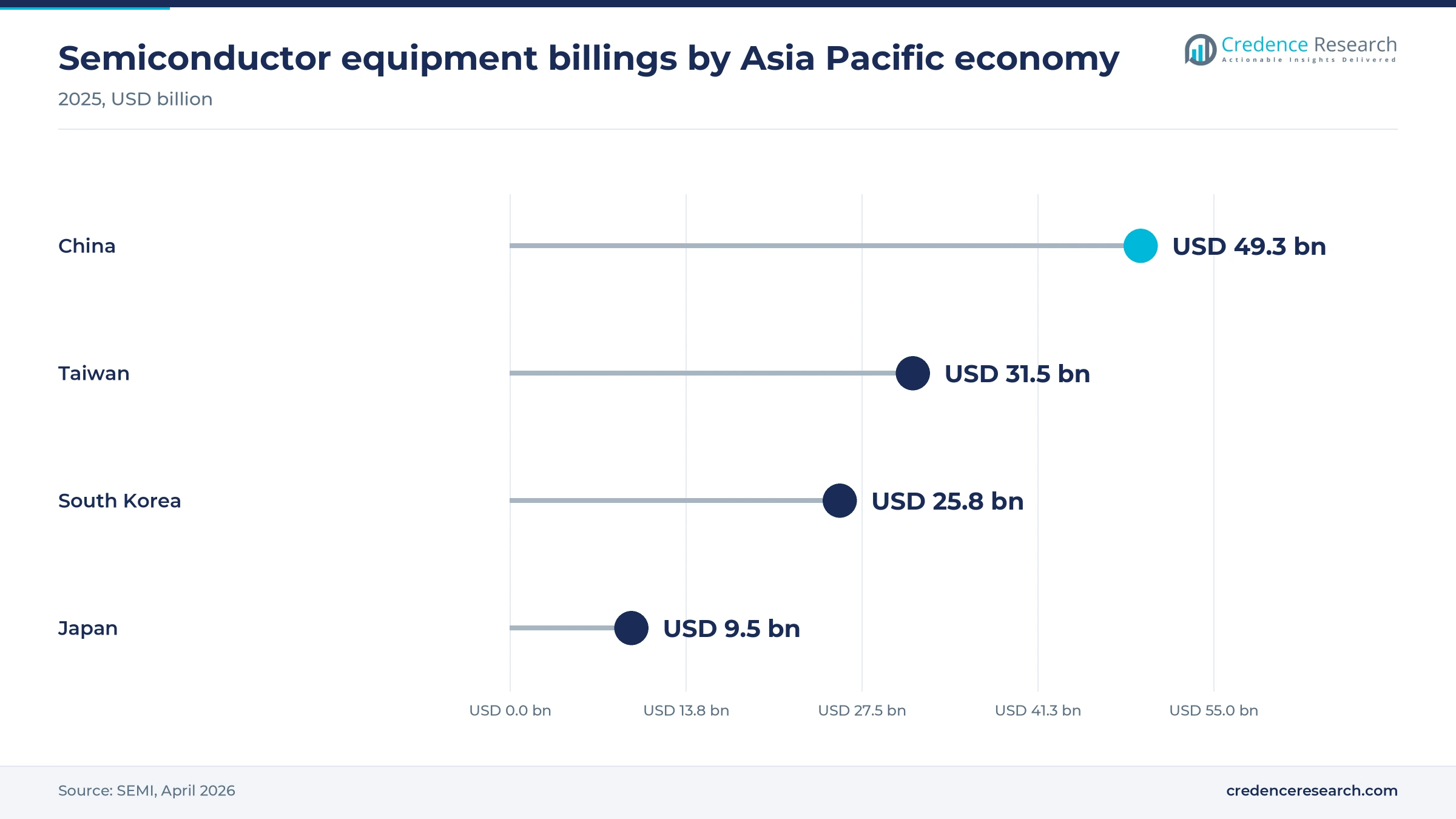
Chip equipment spending lifts demand for high-purity O-rings and gaskets, because etch, deposition and wafer cleaning tools wear out elastomer seals in plasma and corrosive gases and need frequent replacement. Regional billings reached USD 49.3 billion in China, USD 31.5 billion in Taiwan, USD 25.8 billion in South Korea and USD 9.5 billion in Japan in 2025, according to SEMI. Taiwan rose 90% and Korea 26%, while China was flat. The Daikin perfluoroelastomer expansion described in the segment analysis shows material makers preparing for this demand. Seal makers that can qualify parts for semiconductor manufacturing equipment gain the highest unit prices, while general rubber molders cannot enter without cleanroom lines.
Construction machinery and industry need hydraulic seals
Construction machinery and industrial equipment create steady demand for hydraulic seals, packing and gaskets, because cylinders, pumps and gearboxes run under high pressure and contamination. China sold 235,257 excavators in 2025, up 17%, with 116,739 exported, according to the China Construction Machinery Association as reported by Mysteel. NOK said in June 2026 that its seal sales grew with construction machinery in China and with sales to non-Japanese customers there, according to the European Rubber Journal. Industrial and manufacturing buyers hold the second-largest application share in Credence Research estimates. Hydraulic seal makers with Chinese plants gain most, because machine builders expect local tooling and short lead times.
Refinery and nuclear builds need certified gaskets
New refinery and nuclear capacity needs certified flange gaskets, valve packing and pump seals, which are among the highest-value sealing parts per unit. China's State Council approved 10 new reactors across five projects on April 27, 2025, with investment above CNY 200 billion, according to World Nuclear News. India's refining capacity stood at 258.1 million metric tons a year and is set to reach 309.5 million by 2030, the petroleum ministry told the Rajya Sabha in December 2025. Each new reactor and refinery unit adds thousands of flanged joints. Suppliers with nuclear and API approvals gain, while uncertified makers stay in maintenance supply for older plants.
PFAS rules and local plants reshape the supply side
Seal makers are shifting away from fluorinated materials
Seal makers are shifting toward compounds that use less fluorinated material, because European rules on PFAS reach parts that Asian plants make for export and global platforms. The European Sealing Association said in August 2025 that the updated restriction proposal puts sealing applications officially in focus and may allow continued use where risks can be managed, according to the European Rubber Journal. Freudenberg presented a battery cell sealing material in April 2025 that can replace fluorocarbon rubber and thermoplastic seals containing PFAS, according to SMM. Daikin's new Kashima line, due to supply from 2027, also adds processes that avoid fluorinated surfactants. Asian molders that export to European carmakers face the most redesign work, while PFAS-free compound suppliers gain.
Global sealers are moving production into China and India
Global sealing groups are shifting production into China and India to win local carmaker platforms on cost and delivery. The NOK-Freudenberg joint venture opened a CNY 200 million research and production site in Wuxi in May 2025 for new energy vehicles, hydrogen, robotics and wind power, according to Jiemian. Freudenberg Group commissioned two plants covering more than 40,000 square meters in Morinda, Punjab, for about Rs 385 crore in October 2024, including the Freudenberg-NOK seal and gasket plant. ElringKlinger inaugurated a further plant in China in April 2026, according to Gasgoo. Local tooling narrows the price gap with Chinese makers such as Zhongding, while importers without plants lose platform bids.
Shipyard order books are an opening for marine seals
Record shipyard order books are an opening for marine seal and gasket suppliers, because every new hull needs stern tube seals, engine gaskets and pump and valve seals. Chinese yards completed 53.69 million deadweight tons in 2025, 56.1% of the world total, and won 107.82 million deadweight tons of new orders, 69% of the world total, according to the Ministry of Industry and Information Technology. Their order book reached 274.42 million deadweight tons, up 31.5%, which gives seal makers delivery visibility for several years. Suppliers with class society approvals and service near Chinese shipbuilding clusters gain the most from this backlog.
India's two-wheeler fleet is an aftermarket opening
India's growing two-wheeler and commercial vehicle fleet is an opening for replacement gaskets and seals sold through parts distributors. Two-wheeler sales reached 21.7 million units in fiscal 2025-26, up 10.7%, with record exports of 5.18 million, while commercial vehicle sales reached a record 1.08 million, according to SIAM as reported by Autocar Professional. SKF India named a head of seals for India and Southeast Asia in October 2026 to develop distribution channels and key accounts, according to The Machine Maker. Each engine overhaul replaces head and cover gaskets and oil seals, so brands with wide retail networks gain more than suppliers that sell only to vehicle plants.
Japanese output, engine-free cars and payment terms bite
Lower car output in Japan squeezes domestic sealers
Lower vehicle output in Japan reduces volume for Japanese seal makers whose plants were sized for domestic carmakers. NOK said in June 2026 that production of Japanese cars in Japan declined in its fiscal year, offset only by Chinese and Thai demand, according to the European Rubber Journal. Japan still built 8.41 million vehicles in 2025, according to OICA. Japanese molders without export customers are most exposed, while groups with Chinese and Thai plants spread the risk.
Electric cars remove engine gasket content
Battery electric cars remove cylinder head, exhaust manifold and turbocharger gaskets, which are core lines for engine gasket specialists. Nippon Gasket, part of Taiho Kogyo, lists cylinder head, exhaust manifold and turbocharger gaskets as its main products, according to MarkLines, so almost its whole core range depends on combustion engines. China built 16.626 million new energy vehicles in 2025, according to OICA, which shows how fast that base can shrink. Engine gasket makers without battery or e-axle sealing parts face the largest loss.
Long payment terms strain Chinese seal suppliers
Long payment terms from Chinese carmakers strain small seal and gasket suppliers, which fund tooling and raw materials up front. Seventeen major Chinese carmakers committed in June 2025 to pay suppliers within 60 days, and the Ministry of Industry and Information Technology backed the pledge, according to People's Daily. The pledge followed complaints of delays during the price war. Small molders with one carmaker customer are most exposed, while larger groups spread receivables across machinery and export buyers.
High-purity qualification raises the cost of entry
Chip tool and nuclear seals require long qualification, which keeps most regional rubber molders out of the highest-value segments. Perfluoroelastomer supply itself is tight, as Daikin said capacity limits at its Yodogawa plant made the Kashima expansion necessary, with supply only from 2027, according to its April 2026 statement. Seal makers must also pass chamber tests for each tool design. New entrants without cleanroom molding and material contracts face years of trials before they can win repeat orders.
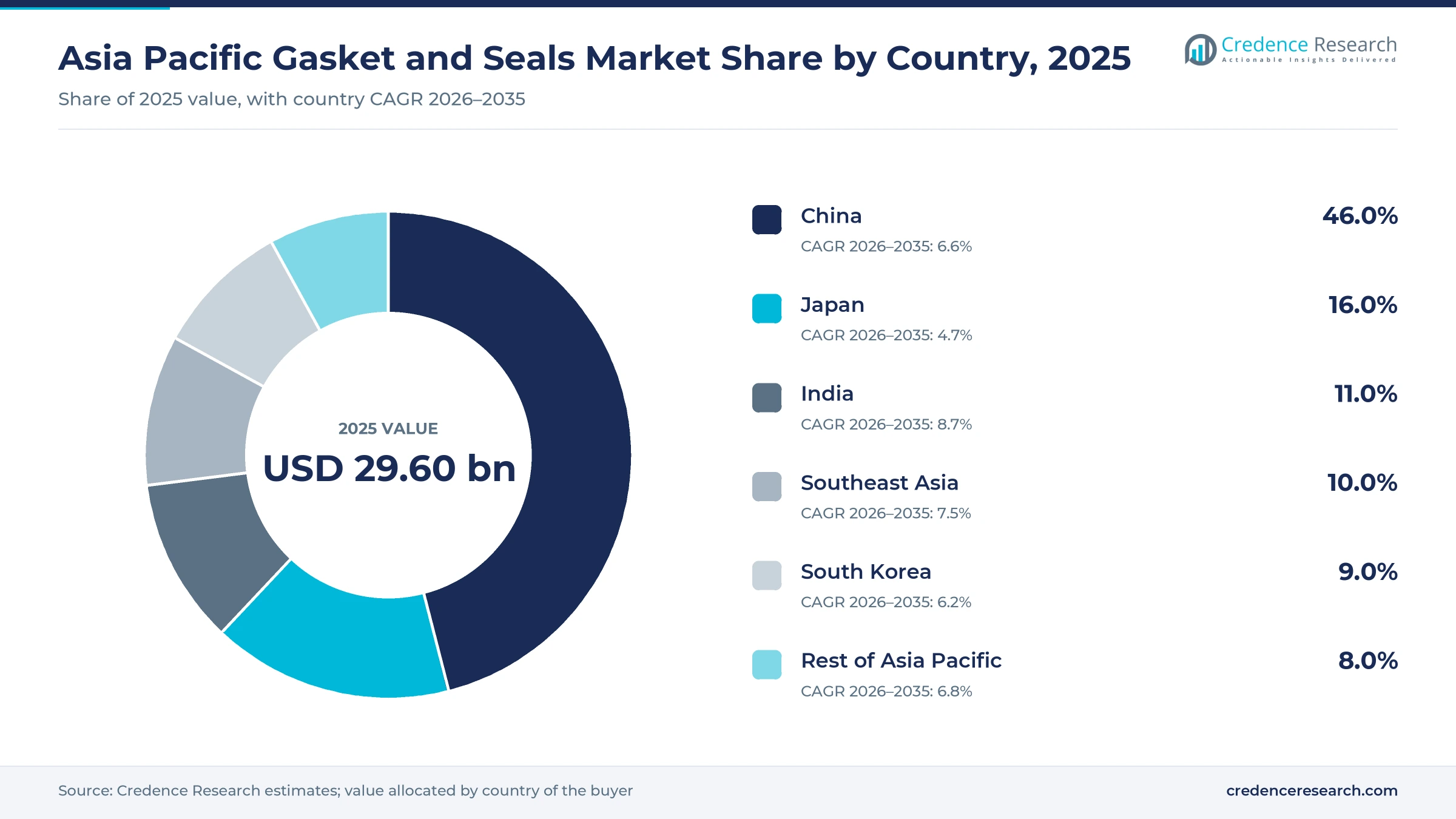
China leads on volume while India grows fastest
| Country | Value, 2025 (USD billion) | Share, 2025 | CAGR, 2026–2035 |
|---|---|---|---|
| China | 13.62 | 46.0% | 6.6% |
| Japan | 4.74 | 16.0% | 4.7% |
| India | 3.26 | 11.0% | 8.7% |
| Southeast Asia | 2.96 | 10.0% | 7.5% |
| South Korea | 2.66 | 9.0% | 6.2% |
| Rest of Asia Pacific | 2.37 | 8.0% | 6.8% |
China leads on vehicles, machinery and ships
China's vehicle, machinery and shipbuilding volumes give it 46.0% of 2025 value and growth of 6.6% a year. It builds more vehicles, excavators and ships than any other country in the region, as the driver and trend analysis shows, and its nuclear power program adds certified sealing demand. Garlock has made spiral wound and kammprofile gaskets and oil seals in China since 2008, according to the company, and Zhongding competes through its KACO (China) dynamic seal unit. Flat chip equipment spending and price pressure from carmakers keep growth near the regional pace.
Japan rests on chip tools as car output slips
Slipping car output keeps Japan below the regional pace at 4.7% a year, although it still holds 16.0% of 2025 value as home to NOK, Nichias and Nippon Gasket. Japanese chip equipment billings rose 22% to USD 9.5 billion in 2025, according to SEMI, which supports demand for high-purity seals. The Daikin Kashima plant gives local seal makers a domestic perfluoroelastomer source from 2027. Japanese suppliers increasingly earn their growth from customers in China and Thailand rather than from domestic carmakers.
India grows fastest on vehicles and refineries
Record vehicle sales and refinery expansion make India the fastest-growing country at 8.7% a year, from 11.0% of 2025 value. India built 6.49 million vehicles in 2025, according to OICA, a large base of OEM demand for shaft seals and gaskets. Its refining capacity is set to rise by about 51 million tons a year by 2030. Freudenberg-NOK's Morinda plant and SKF's new seals leadership for the region show suppliers building local capacity and channels. Growth depends on how fast local carmakers add electric platforms with new sealing content.
South Korea builds on chip fabs and carmakers
Chip fabs and carmakers give South Korea 9.0% of 2025 value and growth of 6.2% a year. Korean chip equipment billings rose 26% to USD 25.8 billion in 2025, according to SEMI, which lifts demand for vacuum and plasma seals in memory fabs. Korean carmakers and shipyards add steady OEM demand for shaft seals, gaskets and body seals. Published counts of seal content per Korean vehicle or hull are an evidence gap, so the country estimate rests on output and equipment data.
Southeast Asia adds car plants and energy service
Thai car plants and energy service hubs give Southeast Asia 10.0% of 2025 value and growth of 7.5% a year. NOK cited the recovery of the Thai car market as a source of seal sales growth in its latest fiscal year, and Nippon Gasket runs joint ventures in Thailand and Indonesia. Trelleborg's Masterseals unit in Singapore serves oilfield and energy buyers across the subregion. Country splits within Southeast Asia are Credence Research estimates from public output data.
Taiwan and Australia anchor the rest of the region
Chip fabs in Taiwan and mining and LNG plants in Australia give the rest of Asia Pacific 8.0% of 2025 value and growth of 6.8% a year. Taiwan's record chip equipment billings, noted in the segment analysis, make it the largest single buyer of high-purity seals outside China. Australia buys flange gaskets and packing for mining, LNG and water utilities. Published sealing demand counts for these markets are an evidence gap, so this estimate rests on industry output weights.
Plants, deals and capacity moves, 2025–2026
| Development | Status and market relevance |
|---|---|
| In March 2025, NOK-Freudenberg Group China began mass production of a Simmerring reducer oil seal at its Changchun plant. | Operational launch; the seal serves drive unit reducers, and the customer was not named. |
| In May 2025, the NOK-Freudenberg joint venture opened a CNY 200 million research and production site in Wuxi, China. | Completed investment; the site targets new energy vehicles, hydrogen, robotics and wind power. |
| In September 2025, Trelleborg completed its acquisition of Singapore sealing specialist Masterseals. | Completed acquisition; consolidated from Sept. 1, 2025, adding oilfield and energy seals and aftermarket service. |
| In April 2026, Daikin announced a new perfluoroelastomer plant at Kashima, Japan, for semiconductor equipment seals. | Under construction as of April 2026, with completion scheduled for August 2026 and commercial supply from 2027; completion was not confirmed in the sources reviewed. |
| In April 2026, ElringKlinger inaugurated a new plant in China during Auto China 2026. | Operational opening; the location, products and capacity were not disclosed. |
Material choice decides heat, chemical and purity limits
- Nitrile and other general elastomers cover most shaft seals, O-rings and body seals, because they resist oil and cost little to mold in high volume for vehicles and machines.
- Fluoroelastomers and perfluoroelastomers resist heat, plasma and aggressive chemicals, which makes them the standard for chip tools and chemical plants, although PFAS rules now press their use.
- Spiral wound and kammprofile gaskets combine metal with graphite or PTFE fillers, which lets them hold pressure and heat cycles on refinery, power and petrochemical flanges.
- Molded plastic and elastomer battery seals seal cell housings, coolant plates and pack covers, which gives electric vehicles the protection from water and gas that engines once got from gaskets.
Need a Custom Version of This Report?
Tailor the scope, geography, or segments to your exact requirements.
- Custom geography or segment scope
- Direct access to our analyst team
Global sealers, Japanese groups and Chinese makers compete
Competition splits between global sealing groups, Japanese specialists and Chinese makers. Freudenberg and NOK supply oil seals, gaskets and O-rings through joint plants in China and India, and Trelleborg added energy seals and aftermarket service in Singapore through the Masterseals deal. SKF and Parker sell shaft seals, O-rings and hydraulic seals to machine builders and distributors. ElringKlinger and Dana compete in engine, transmission and battery gaskets for carmakers. Nichias and Enpro's Garlock unit supply industrial flange gaskets and packing to refineries and chemical plants. Nippon Gasket serves Japanese carmakers in cylinder head and exhaust gaskets. Zhongding, through its KACO unit, competes in China on price and local engineering. Qualified compounds, local tooling, approvals and delivery speed decide most contracts.
A few global groups face many local molders
Supply of seals and gaskets in the region is organized in three tiers. Global groups such as Freudenberg, NOK, Trelleborg, SKF and Parker control compound recipes, tooling and qualified platform positions with carmakers and machine builders, and often work through joint ventures such as NOK-Freudenberg in China and India. Japanese specialists such as Nichias and Nippon Gasket hold strong positions in industrial gaskets and engine gaskets. Hundreds of local rubber molders and gasket cutters compete on price for aftermarket and standard parts. Entry is hardest in chip tool, nuclear and battery seals, where qualification takes years, and margins are highest there.
Sealing suppliers active in Asia Pacific
| Company | Type | Role in the market |
|---|---|---|
| Freudenberg Sealing Technologies | Full-line supplier | Simmerring shaft seals, O-rings and battery seals through NOK-Freudenberg plants in China and India |
| NOK Corporation | Full-line supplier | Oil seals, O-rings and packings for vehicles and construction machinery across Asia |
| Trelleborg Sealing Solutions | Full-line supplier | Engineered seals for vehicles, chip tools and energy, including Masterseals in Singapore |
| SKF | Bearing and seal maker | Rotary shaft seals and industrial seals sold through distributors and key accounts |
| Parker Hannifin Corporation | Full-line supplier | O-rings, hydraulic seals and gaskets for machinery, aerospace and process equipment |
| ElringKlinger AG | Automotive supplier | Cylinder head and specialty gaskets and battery components from four Chinese plants |
| Enpro Inc. (Garlock) | Industrial gasket maker | Spiral wound and kammprofile gaskets, packings and Klozure oil seals made in China |
| Dana Incorporated | Automotive supplier | Victor Reinz engine and transmission gaskets for vehicle makers |
| Nichias Corporation | Industrial gasket maker | Sheet, spiral wound and PTFE gaskets and gland packing for process plants |
| Taiho Kogyo Co., Ltd. (Nippon Gasket) | Engine gasket specialist | Cylinder head, exhaust and turbocharger gaskets with plants in Japan, Thailand and Indonesia |
| Anhui Zhongding Sealing Parts Co., Ltd. | Local manufacturer | Rubber seals and KACO radial and axial dynamic seals for Chinese vehicle makers |
Value moves from engine gaskets to fab and battery seals
Credence Research's view is that value in this market will move from engine gaskets toward chip tool, battery and energy seals through 2035. Cylinder head and exhaust gaskets lose volume as electric output rises, while battery packs, e-axles and coolant loops add new sealing parts with tighter tolerances. Chip fabs in Taiwan and Korea and reactor and refinery builds in China and India pay the highest prices per part, because each seal needs qualification. The suppliers best placed are those with PFAS-free compounds, local tooling in China and India, and approvals for cleanroom and nuclear duty.
Old estimate carried to 2025 and checked by end use
The report uses 2025 as the base year and forecasts to 2035. Market values in this report come from the Credence Research model. This edition of the Asia Pacific gasket and seals report replaces the previous 2024 estimate with a 2025 value carried forward at the earlier growth rate and checked against vehicle output, machinery sales, chip equipment billings, distributor list prices and company announcements. Segment and country shares are Credence Research estimates based on government statistics, industry association data and company releases. No interviews or surveys were carried out for this edition.
Fabs, EV platforms and energy plants set the pace to 2035
In the base case the Asia Pacific gasket and seals market grows at 6.61% a year through 2035, as battery, e-axle, chip tool and energy seals add value faster than engine gaskets lose it. Shaft seals keep the largest product share, from 23.0% in 2025, while molded packing and seals grow fastest as chip tool and battery demand rises across the region. Automotive remains the largest application, while electronics gains share as fabs in Taiwan and Korea expand. China keeps the largest country share, and India gains on vehicles and refining. Lower Japanese car output and PFAS rules are the main risks to that path.
Vehicle mix, fab spending and energy builds decide the range
The outcome depends on how fast electric platforms replace engines, whether chip equipment spending in Taiwan and Korea holds after the 2025 surge, and how quickly reactor and refinery projects reach construction. A sharp fall in fab spending and faster loss of engine gaskets would hold growth near the downside case. Wider battery and e-axle sealing content and on-time energy projects would push the market toward the upside case.
| Scenario | CAGR, 2026–2035 | Value, 2035 | What has to hold |
|---|---|---|---|
| Downside | 5.0% | USD 49.00 billion | Fab spending falls back and engine gasket demand shrinks faster than EV sealing grows |
| Base | 6.61% | USD 56.14 billion | Vehicle, machinery, fab and energy programs continue at the pace seen in 2025 and 2026 |
| Upside | 7.9% | USD 62.61 billion | Battery and e-axle sealing content rises and reactor and refinery builds stay on schedule |
Frequently Asked Questions
How big is the Asia Pacific gasket and seals market?
Which country leads the market?
Which product type holds the largest share?
How do electric vehicles change gasket and seal demand?
How much do gaskets and seals cost in the region?
Why do semiconductor fabs matter for seal makers?
What are the main challenges for suppliers in the region?
Which companies lead the market?
Table of Content
Chapter 1 Market Segmentation
- 1.1 Segmentation Framework
- 1.1.1 Product and Service Classification
- 1.1.2 Application and End-Use Classification
- 1.1.3 Technology and Solution Classification
- 1.1.4 Customer and Distribution Channel Classification
- 1.1.5 Geographic Segmentation
- 1.1.6 Market Segment Definitions and Boundaries
- 1.2 By Product
- 1.2.1 Metallic Gaskets
- 1.2.2 Semi-metallic Gaskets
- 1.2.3 Non-metallic Gaskets
- 1.2.4 Shaft Seals
- 1.2.5 Molded Packing & Seals
- 1.2.6 Motor Vehicle Body Seals
- 1.3 By Application
- 1.3.1 Automotive
- 1.3.2 Electrical & Electronics
- 1.3.3 Marine & Rail
- 1.3.4 Industrial & Manufacturing
- 1.3.5 Aerospace
- 1.3.6 Oil & Gas
- 1.3.7 Chemicals & Petrochemicals
- 1.3.8 Others
- 1.4 By End User
- 1.4.1 Original Equipment Manufacturer (OEM)
- 1.4.2 Aftermarket
- 1.5 By Country
- 1.5.1 China
- 1.5.2 Japan
- 1.5.3 India
- 1.5.4 South Korea
- 1.5.5 Southeast Asia
- 1.5.6 Rest of Asia Pacific
Chapter 2 Introduction
- 2.1 Report Objectives and Scope
- 2.2 Product Definition and Industry Terminology
- 2.3 Market Inclusions and Exclusions
- 2.4 Research Process
- 2.4.1 Primary Research and Expert Interviews
- 2.4.2 Secondary Research and Source Review
- 2.4.3 Top-Down and Bottom-Up Estimation
- 2.4.4 Data Triangulation and Verification
- 2.5 Market Size Measurement Basis
- 2.5.1 2025: USD 29.60 billion → 2035: USD 56.14 billion
- 2.6 Historical and Forecast Reference Periods
- 2.6.1 Historical Period: 2018-2025
- 2.6.2 Base Year: 2025
- 2.6.3 Forecast Period: 2025-2035
- 2.7 Research Assumptions and Limitations
Chapter 3 Executive Summary
- 3.1 Market Snapshot and Key Findings
- 3.2 Base-Year Market Size, 2025
- 3.3 Forecast Market Size, 2035
- 3.4 Revenue and Volume Growth Outlook
- 3.5 Key Demand and Supply Indicators
- 3.6 Leading Market Segments
- 3.7 Fastest-Growing Market Opportunities
- 3.8 Regional Performance Highlights
- 3.9 Technology and Industry Transformation
- 3.10 Competitive Landscape Summary
- 3.11 Analyst View and Strategic Implications
Chapter 4 Asia Pacific Gasket and Seals Market Trends and Developments
- 4.1 Historical Industry Development, 2018-2025
- 4.2 Recent Market Trends and Developments
- 4.3 Demand and Customer Behavior Trends
- 4.4 Technology and Product Innovation
- 4.5 Artificial Intelligence, Automation and Digitalization
- 4.6 Local Manufacturing and Supply Chain Realignment
- 4.7 Industry Partnerships, Mergers and Acquisitions
- 4.8 Sustainability and Circular Economy Developments
- 4.9 Government and Private Sector Investment Trends
- 4.10 Emerging Business Models and Commercialization
- 4.11 Industry Developments and Announcements
Chapter 5 Asia Pacific Gasket and Seals Market Production, Supply and Demand Analysis
- 5.1 Demand Trend and Consumption Analysis, 2018-2025
- 5.2 Demand Forecast, 2025-2035
- 5.3 Production and Output Trend, 2018-2025
- 5.4 Production and Output Forecast, 2025-2035
- 5.5 Installed Capacity and Capacity Utilization
- 5.6 Company-Wise Production Plants and Statistics
- 5.6.1 Installed Production Capacity
- 5.6.2 Actual Production
- 5.6.3 Planned Capacity and Expansion Targets
- 5.7 Supply Chain Structure and Procurement Trends
- 5.8 Supply-Demand Gap and Bottlenecks
- 5.9 Import Dependence and Sourcing Structure
- 5.10 Contract Manufacturing and Outsourcing
- 5.11 Regional Supply and Demand Concentration
Chapter 6 Asia Pacific Gasket and Seals Market Pricing Analysis
- 6.1 Pricing Structure and Measurement
- 6.2 Historical Pricing Trends, 2018-2025
- 6.3 Pricing Outlook, 2025-2035
- 6.4 Average Selling Price and Unit Economics
- 6.5 Pricing by Product and Market Segment
- 6.6 Geographic Pricing Differences
- 6.7 Key Input, Energy, Labor and Logistics Costs
- 6.8 Contract Pricing and Purchasing Models
- 6.9 Pricing Sensitivity and Competitive Positioning
- 6.10 Price, Margin and Profitability Implications
Chapter 7 Asia Pacific Gasket and Seals Market Dynamics
- 7.1 Market Growth Drivers
- 7.1.1 Demand-Side Drivers
- 7.1.2 Technology and Innovation Drivers
- 7.1.3 Infrastructure and Investment Drivers
- 7.1.4 Regulatory and Policy Drivers
- 7.2 Market Restraints
- 7.2.1 Cost and Affordability Constraints
- 7.2.2 Technology and Adoption Barriers
- 7.2.3 Supply Chain and Operational Constraints
- 7.3 Market Challenges
- 7.3.1 Competitive Pressure and Margin Erosion
- 7.3.2 Skills, Infrastructure and Implementation Gaps
- 7.4 Emerging Market Opportunities
- 7.5 Market Dynamics Impact and Time-Horizon Assessment
Chapter 8 Asia Pacific Gasket and Seals Value Chain Analysis
- 8.1 Industry Value Chain Overview
- 8.2 Upstream Suppliers and Critical Inputs
- 8.3 Technology and Component Providers
- 8.4 Manufacturing or Service Delivery
- 8.5 Distribution, Channel Partners and Integrators
- 8.6 Downstream Applications and End Users
- 8.7 Value Addition and Profit Pools
- 8.8 Vertical Integration and Outsourcing
- 8.9 Supplier Concentration and Risk
- 8.10 Supply Chain Localization and Resilience
Chapter 9 Asia Pacific Gasket and Seals Market Regulations and Policies
- 9.1 Relevant Laws, Standards and Compliance Frameworks
- 9.2 Product, Service, Safety and Quality Requirements
- 9.3 Government Policies, Incentives and Subsidies
- 9.4 Imports, Exports and Trade Barriers
- 9.5 Public Procurement and Local Content Requirements
- 9.6 Environmental and Sustainability Compliance
- 9.7 Upcoming Policy Changes and Market Implications
Chapter 10 Asia Pacific Gasket and Seals Market Hotspots and Opportunities
- 10.1 Market Opportunity Mapping and Growth Hotspots
- 10.2 High-Growth Applications and Customer Groups
- 10.3 Underserved Markets and White-Space Opportunities
- 10.4 Emerging Technology and Product Opportunities
- 10.5 New Capacity and Investment Hotspots
- 10.6 Market Entry and Expansion Opportunities
- 10.7 Distribution and Partnership Opportunities
- 10.8 Near-Term and Long-Term Commercial Potential
- 10.9 Opportunity Attractiveness and Execution Risks
Chapter 11 Asia Pacific Gasket and Seals Market Outlook, 2025-2035
- 11.1 Market Size and Analysis
- 11.1.1 Revenue (Market Measurement: 2025: USD 29.60 billion → 2035: USD 56.14 billion)
- 11.1.2 Market Volume and Quantity Sold
- 11.1.3 Historical Market Size, 2018-2025
- 11.1.4 Base-Year Market Size, 2025
- 11.2 Market Forecast, 2025-2035
- 11.2.1 Revenue Forecast to 2035
- 11.2.2 Volume Forecast to 2035
- 11.2.3 CAGR and Year-on-Year Growth
- 11.2.4 Incremental Revenue Opportunity
- 11.3 Forecast Assumptions and Scenario Analysis
- 11.3.1 Base-Case Forecast
- 11.3.2 Optimistic and Conservative Scenarios
- 11.3.3 Technology, Pricing and Policy Sensitivities
- 11.4 Market Attractiveness and Growth Outlook
Chapter 12 Asia Pacific Gasket and Seals Market Segmentation and Outlook
- 12.1 Segmentation Summary and Market Shares, 2025
- 12.2 Largest and Fastest-Growing Segments
- 12.3 By Product - Market Size and Forecast, 2025-2035
- 12.3.1 Segment Definition and Scope
- 12.3.2 Historical Market Size, 2018-2025
- 12.3.3 Revenue Forecast, 2025-2035
- 12.3.4 Volume Forecast, 2025-2035
- 12.3.5 Base-Year Market Share, 2025
- 12.3.6 Segment CAGR and Growth Drivers
- 12.3.7 Subsegment Market Size and Forecast
- 12.3.7.1 Metallic Gaskets
- 12.3.7.2 Semi-metallic Gaskets
- 12.3.7.3 Non-metallic Gaskets
- 12.3.7.4 Shaft Seals
- 12.3.7.5 Molded Packing & Seals
- 12.3.7.6 Motor Vehicle Body Seals
- 12.3.8 Subsegment Pricing and Adoption Trends
- 12.3.9 Leading Suppliers and Competition
- 12.3.10 Regional Demand and Opportunities
- 12.4 By Application - Market Size and Forecast, 2025-2035
- 12.4.1 Segment Definition and Scope
- 12.4.2 Historical Market Size, 2018-2025
- 12.4.3 Revenue Forecast, 2025-2035
- 12.4.4 Volume Forecast, 2025-2035
- 12.4.5 Base-Year Market Share, 2025
- 12.4.6 Segment CAGR and Growth Drivers
- 12.4.7 Subsegment Market Size and Forecast
- 12.4.7.1 Automotive
- 12.4.7.2 Electrical & Electronics
- 12.4.7.3 Marine & Rail
- 12.4.7.4 Industrial & Manufacturing
- 12.4.7.5 Aerospace
- 12.4.7.6 Oil & Gas
- 12.4.7.7 Chemicals & Petrochemicals
- 12.4.7.8 Others
- 12.4.8 Subsegment Pricing and Adoption Trends
- 12.4.9 Leading Suppliers and Competition
- 12.4.10 Regional Demand and Opportunities
- 12.5 By End User - Market Size and Forecast, 2025-2035
- 12.5.1 Segment Definition and Scope
- 12.5.2 Historical Market Size, 2018-2025
- 12.5.3 Revenue Forecast, 2025-2035
- 12.5.4 Volume Forecast, 2025-2035
- 12.5.5 Base-Year Market Share, 2025
- 12.5.6 Segment CAGR and Growth Drivers
- 12.5.7 Subsegment Market Size and Forecast
- 12.5.7.1 Original Equipment Manufacturer (OEM)
- 12.5.7.2 Aftermarket
- 12.5.8 Subsegment Pricing and Adoption Trends
- 12.5.9 Leading Suppliers and Competition
- 12.5.10 Regional Demand and Opportunities
- 12.6 By Country - Market Size and Forecast, 2025-2035
- 12.6.1 Segment Definition and Scope
- 12.6.2 Historical Market Size, 2018-2025
- 12.6.3 Revenue Forecast, 2025-2035
- 12.6.4 Volume Forecast, 2025-2035
- 12.6.5 Base-Year Market Share, 2025
- 12.6.6 Segment CAGR and Growth Drivers
- 12.6.7 Subsegment Market Size and Forecast
- 12.6.7.1 China
- 12.6.7.2 Japan
- 12.6.7.3 India
- 12.6.7.4 South Korea
- 12.6.7.5 Southeast Asia
- 12.6.7.6 Rest of Asia Pacific
- 12.6.8 Subsegment Pricing and Adoption Trends
- 12.6.9 Leading Suppliers and Competition
- 12.6.10 Regional Demand and Opportunities
- 12.7 Segment Growth Comparison
- 12.8 Segment Attractiveness and Priority Matrix
Chapter 13 Asia Pacific Gasket and Seals End-Use and Application Market Outlook
- 13.1 End-Use Industry and Customer Demand Structure
- 13.2 Leading Applications and Customer Groups
- 13.3 End-Use Market Size, Share and Forecast
- 13.4 Major End-Use Industry Deep Dives
- 13.4.1 Customer Requirements and Use Cases
- 13.4.2 Demand and Replacement Cycles
- 13.4.3 Technical and Regulatory Considerations
- 13.4.4 Purchasing and Procurement Models
- 13.4.5 Leading Vendors and Distribution Channels
- 13.4.6 Forecast and Commercial Opportunities
- 13.5 Emerging Applications and Cross-Segment Demand
- 13.6 End-Use Industry Investment Priorities
Chapter 14 Asia Pacific Gasket and Seals Geographic Market Outlook, 2025-2035
- 14.1 Regional Market Size and Country-Level Shares, 2025
- 14.2 Country Market Size Comparison, 2025
- 14.3 Country Market Forecasts, 2025-2035
- 14.4 Subregional Industrial and Demand Clusters
- 14.5 Intra-Regional Pricing and Cost Differences
- 14.6 Cross-Border Trade and Supply Networks
- 14.7 Regional Supply and Demand Balances
- 14.8 Country Opportunity Comparison and Prioritization
Note: Every listed country is covered on the structure shown under the first country.
Chapter 15 Asia Pacific Gasket and Seals Technology, Innovation and Sustainability Outlook
- 15.1 Technology Landscape and Maturity
- 15.2 Product, Process and Service Innovation
- 15.3 AI, Automation and Digital Tools in the Industry
- 15.4 Technology Adoption and Performance Benchmarking
- 15.5 Innovation Pipeline and R&D Investment
- 15.6 Patent and Intellectual Property Trends
- 15.7 Energy Efficiency and Resource Management
- 15.8 Sustainability, Recycling and Circularity
- 15.9 Technology Roadmap, 2025-2035
- 15.10 Risks of Obsolescence and Technology Substitution
Chapter 16 Asia Pacific Gasket and Seals Market Key Strategic Imperatives
- 16.1 Growth and Market Entry Priorities
- 16.2 High-Return Products and Segments
- 16.3 Pricing, Profitability and Cost Optimization
- 16.4 Technology Investment and Product Differentiation
- 16.5 Supply Chain Localization and Resilience
- 16.6 Distribution and Customer Acquisition
- 16.7 Partnership, Acquisition and Capacity Strategy
- 16.8 Regional Expansion Priorities
- 16.9 Short-, Medium- and Long-Term Actions
Chapter 17 Competition Outlook
- 17.1 Industry Competition Characteristics
- 17.2 Market Structure and Concentration
- 17.3 Market Share and Competitive Positioning, 2025
- 17.4 Company-Wise Revenue and Product Benchmarking
- 17.5 Production and Service Capacity Benchmarking
- 17.6 Technology, Pricing and Differentiation
- 17.7 Regional Footprint and Distribution Strength
- 17.8 Mergers, Acquisitions and Strategic Alliances
- 17.9 New Entrants and Competitive Threats
- 17.10 Porter's Five Forces and Industry Attractiveness
- 17.11 Competitive Outlook, 2025-2035
Chapter 18 Company Profiles
- 18.1 Company Coverage and Selection Criteria
- 18.2 Freudenberg Sealing Technologies
- 18.2.1 Business Description
- 18.2.2 Company Ownership and Geographic Presence
- 18.2.3 Product and Service Portfolio
- 18.2.4 Manufacturing and Operating Footprint
- 18.2.5 Production Capacity and Expansion Plans
- 18.2.6 Financial Performance and Investment
- 18.2.7 Market Share and Competitive Position
- 18.2.8 Technology and Innovation Capabilities
- 18.2.9 Strategic Alliances or Partnerships
- 18.2.10 Recent Developments
- 18.2.11 Growth Strategy and Outlook
- 18.3 NOK Corporation
- 18.4 Trelleborg Sealing Solutions
- 18.5 SKF
- 18.6 Parker Hannifin Corporation
- 18.7 ElringKlinger AG
- 18.8 Enpro Inc. (Garlock)
- 18.9 Dana Incorporated
- 18.10 Nichias Corporation
- 18.11 Taiho Kogyo Co., Ltd. (Nippon Gasket)
- 18.12 Anhui Zhongding Sealing Parts Co., Ltd.
- 18.13 Other Relevant Market Participants
Note: Every listed company is profiled on the structure shown under the first company. The company list is preliminary and may change based on research findings, market developments, data availability and client requirements.
Chapter 19 Disclaimer
- 19.1 Research and Forecast Disclaimer
- 19.2 Data Source and Estimation Limitations
Note: The depth of individual sections depends on data availability for this market. Volume, capacity, trade and other unit-based metrics are included where applicable.

