| REPORT ATTRIBUTE | DETAILS |
|---|---|
| Historical Period | 2020-2023 |
| Base Year | 2024 |
| Forecast Period | 2025-2032 |
| Air Filtration Market Size 2024 | USD 17,480.01 million |
| Air Filtration Market, CAGR | 7.15% |
| Air Filtration Market Size 2032 | USD 31,598.42 million |
Market Overview:
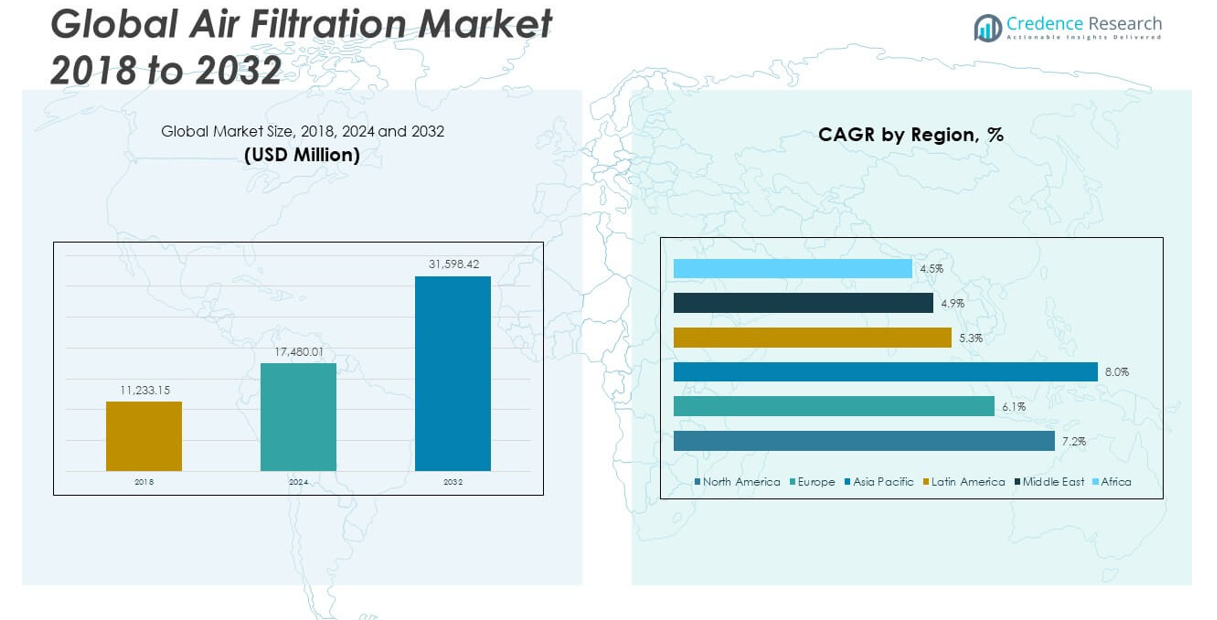
The Global Air Filtration Market size was valued at USD 11,233.15 million in 2018 to USD 17,480.01 million in 2024 and is anticipated to reach USD 31,598.42 million by 2032, at a CAGR of 7.15% during the forecast period.
The global air filtration market is primarily driven by several key factors, including rising concerns over air pollution, the growing incidence of respiratory diseases, and the need for compliance with stringent environmental regulations. As air quality continues to deteriorate, both indoor and outdoor air filtration systems have become essential to mitigate health risks. Industrialization and urbanization are also contributing to higher pollution levels, further increasing the demand for effective air filtration solutions. Technological advancements, such as the development of high-efficiency particulate air (HEPA) filters and electrostatic precipitators, are making filtration systems more effective and energy-efficient, fostering market growth. Moreover, government regulations across the globe are becoming increasingly strict, pushing industries to invest in air filtration solutions to meet air quality standards and ensure the safety of workers and residents alike.
Regionally, North America, Asia Pacific, and Europe are leading the market, each with its unique drivers and growth trends. North America, particularly the United States, dominates the market due to rigorous environmental policies and a high awareness of air quality issues, prompting significant investments in filtration technologies across various industries. Asia Pacific, on the other hand, is projected to experience the highest growth rate, driven by rapid industrialization and urbanization in countries like China, India, and Japan. These nations are facing severe air pollution challenges, prompting greater adoption of air filtration solutions in residential, commercial, and industrial sectors. Europe’s air filtration market is supported by stringent environmental regulations and a strong focus on sustainability, with countries like Germany and the United Kingdom leading in the adoption of advanced filtration systems across industries such as automotive and pharmaceuticals. While Latin America and the Middle East & Africa currently represent smaller market shares, these regions are witnessing gradual growth as urbanization and industrialization increase, alongside heightened awareness of the importance of air quality.
Market Insights:
- The Global Air Filtration Market is expected to grow significantly, reaching USD 31,598.42 million by 2032, driven by rising concerns over air pollution and health risks from poor air quality.
- Strict environmental regulations worldwide are compelling industries to adopt air filtration systems to meet compliance standards, boosting market demand in manufacturing, pharmaceuticals, and food processing sectors.
- Technological advancements, particularly in HEPA filters and electrostatic precipitators, have enhanced the efficiency and energy effectiveness of air filtration systems, further driving market growth.
- Rapid industrialization and urbanization, especially in Asia Pacific, are increasing airborne pollutants, necessitating advanced air filtration systems for residential, commercial, and industrial sectors.
- The residential sector is seeing increasing demand for air purifiers due to health concerns and a growing awareness of air quality's impact on well-being.
- The high initial costs and ongoing maintenance expenses of advanced air filtration systems remain a significant challenge, especially for small businesses and consumers in developing regions.
- Competition from alternative air purification solutions, such as UV light purifiers and ionizers, challenges traditional air filtration systems, driving innovation for more cost-effective and efficient filtration solutions.
Market Drivers:
Increasing Air Pollution and Health Concerns
The rise in global air pollution is one of the primary drivers of the Global Air Filtration Market. With urbanization and industrial activities contributing to the deterioration of air quality, the demand for efficient air filtration systems has surged. Cities around the world are grappling with the adverse effects of smog, particulate matter, and other pollutants that pose significant health risks, including respiratory diseases and cardiovascular issues. In this context, air filtration systems are crucial in mitigating the effects of harmful particles and ensuring healthier living and working environments. Public awareness regarding the health impact of poor air quality is increasing, which further fuels the demand for air filtration solutions in both residential and commercial spaces.
- For example, in aerospace, Donaldson’s Air Purification System (APS™) for the Airbus A320 and Boeing 787 utilizes a dual-stage process combining gas phase adsorption for chemical pollutants and particulate filtration for dust, bacteria, and viruses ensuring cabin air meets the strictest safety and comfort standards for passengers and crew.
Stringent Government Regulations and Environmental Standards
Governments globally are implementing increasingly stringent regulations to combat air pollution and protect public health, which is positively influencing the growth of the Global Air Filtration Market. Environmental agencies are enforcing tighter standards for air quality, requiring industries to adopt air filtration systems to meet compliance requirements. Industries such as manufacturing, pharmaceuticals, and food processing are particularly affected by these regulations, as they are major sources of air pollution. Filtration technologies are being integrated into industrial processes to maintain air quality levels, reduce emissions, and comply with evolving regulatory frameworks. This growing regulatory pressure is expected to drive continued investment in advanced filtration systems.
Technological Advancements in Filtration Systems
Technological advancements in air filtration systems are transforming the Global Air Filtration Market. The development of high-efficiency particulate air (HEPA) filters, activated carbon filters, and electrostatic precipitators is enabling air filtration systems to become more efficient, compact, and energy-efficient. These innovations allow for better filtration of smaller particles, including viruses and bacteria, which is crucial for sectors such as healthcare, where air purity is vital. The increasing integration of smart technologies, such as sensors and IoT devices, into filtration systems allows for real-time monitoring and optimization of air quality. Such technological progress not only enhances the effectiveness of filtration systems but also improves their adaptability to various environments and applications.
- For example, Nanofiber filters represent a major breakthrough, offering filtration precision down to 0.1 microns with air permeability exceeding 85% and service life extended by 180% compared to conventional media.
Expanding Industrialization and Urbanization
Global industrialization and urbanization are key factors contributing to the growing demand for air filtration systems. As cities expand and industrial activities increase, the levels of airborne pollutants also rise, necessitating effective filtration solutions to maintain air quality. The expanding commercial and residential construction in emerging economies like India, China, and Brazil further intensifies the need for air filtration in new buildings, especially in urban areas. Air filtration systems are becoming integral components of new infrastructure projects, whether in residential buildings, commercial spaces, or industrial facilities. This growing demand across multiple sectors is driving the Global Air Filtration Market's growth, as industries seek reliable solutions to improve air quality in response to environmental challenges.
Market Trends:
Rising Demand for Smart Air Filtration Systems
The demand for smart air filtration systems is increasingly shaping the Global Air Filtration Market. These advanced systems integrate sensors, IoT connectivity, and automated controls to monitor air quality and adjust filtration processes in real-time. Consumers and businesses alike are becoming more inclined toward smart solutions that provide enhanced efficiency and convenience. These systems enable users to track and manage air quality from mobile apps or centralized platforms, offering real-time data and analytics on pollutants. The growing trend toward home automation and connected devices is further driving the adoption of these intelligent air filtration solutions across residential and commercial sectors.
- For example, R-Zero’s smart filtration platform, awarded “Most Disruptive Technology” at Data Center World 2025, delivers up to 0.5–0.75% total energy savings at scale-translating to hundreds of millions in potential cost reductions for large facilities.
Growing Focus on Sustainability and Eco-Friendly Products
Sustainability is becoming a key trend within the Global Air Filtration Market, as consumers and businesses prioritize environmentally friendly products. This includes the increasing preference for air filtration systems that use eco-friendly materials, such as biodegradable filters or components made from recyclable materials. Manufacturers are responding by designing filters that consume less energy and have a reduced environmental footprint. Furthermore, the growing awareness of environmental issues and the push for greener solutions are encouraging companies to adopt air filtration systems that align with sustainability goals. This trend is particularly prominent in industries like hospitality and commercial buildings, where sustainability initiatives are increasingly a priority.
Integration of Air Purification Systems in HVAC Units
The integration of air filtration systems into heating, ventilation, and air conditioning (HVAC) units is becoming more common in the Global Air Filtration Market. HVAC systems in both residential and commercial settings are being equipped with advanced filtration technologies to improve indoor air quality. These integrated systems offer a more comprehensive solution by ensuring constant filtration of air as it circulates throughout buildings. The trend is gaining traction due to the increasing awareness of the importance of maintaining a healthy indoor environment, especially in spaces with high foot traffic, such as offices, hospitals, and schools. This integration also helps reduce the cost and maintenance associated with separate filtration systems.
Advancements in Nanotechnology for Air Filtration
Nanotechnology is emerging as a significant trend in the Global Air Filtration Market, offering promising advancements in filtration efficiency. Filters incorporating nanomaterials, such as carbon nanotubes and nanofibers, are providing higher levels of particle capture, including ultrafine particles that traditional filters struggle to remove. These next-generation filtration systems are more compact and offer longer lifespans compared to conventional air filters. The application of nanotechnology is particularly valuable in sectors like healthcare and aerospace, where air quality is critical for safety and performance. As research in nanotechnology continues, it is expected that these innovations will significantly enhance the effectiveness of air filtration systems across various industries.
- For example, Carbon nanotube (CNT) composite filters, as developed by multiple research teams and commercialized in pilot projects, have demonstrated over 90% filtration efficiency for particles as small as 0.3 μm with pressure drops of ~290 Pa. These CNT filters are lightweight, flexible, and highly hydrophobic, making them suitable for both room and wearable filtration applications.
Market Challenges Analysis:
High Initial Costs and Maintenance Expenses
One of the significant challenges in the Global Air Filtration Market is the high initial costs associated with advanced filtration systems. Many of the most effective solutions, such as HEPA filters and smart air purifiers, come with a premium price tag, which can be a barrier for both residential and small-business consumers. While these systems provide long-term benefits in terms of air quality, their upfront costs can deter potential buyers, particularly in developing markets. Furthermore, the maintenance of these systems adds to the overall cost, as filters need regular replacement and the systems require periodic servicing to maintain efficiency. This creates a financial burden for businesses, especially small enterprises, limiting the widespread adoption of advanced filtration technologies.
Competing with Alternative Air Purification Solutions
The Global Air Filtration Market faces competition from alternative air purification technologies, which pose a challenge to traditional filtration systems. Solutions such as ultraviolet (UV) light purifiers, ionizers, and ozone generators are gaining popularity due to their ability to eliminate harmful bacteria and viruses. These technologies often have lower initial costs and less maintenance compared to traditional air filtration systems. While they offer unique benefits, their effectiveness in removing particulate matter is still debated, leaving a gap in customer confidence. As more consumers seek cost-effective alternatives, air filtration companies need to demonstrate the superior efficiency and long-term benefits of their products to stay competitive in a crowded marketplace.
Market Opportunities:
Growth in Emerging Economies
The Global Air Filtration Market has significant growth opportunities in emerging economies, where urbanization and industrialization are rapidly increasing. As these regions develop, air pollution levels are rising, creating a strong demand for air filtration systems. Countries such as India, China, and Brazil are experiencing growth in both residential and commercial infrastructure, providing an avenue for air filtration manufacturers to expand their presence. Government initiatives aimed at improving air quality and regulating pollution standards also present opportunities for market penetration. As awareness of air quality improves, these regions are likely to become key growth areas for air filtration solutions.
Rising Demand for Air Purification in Healthcare and Commercial Sectors
The growing focus on air quality within the healthcare and commercial sectors presents substantial opportunities for the Global Air Filtration Market. Hospitals, pharmaceutical facilities, and laboratories require high-efficiency air filtration systems to maintain sterile environments and ensure the safety of patients and employees. Similarly, businesses are increasingly investing in air filtration to create healthier workplaces for their employees. This shift towards prioritizing health and safety within both sectors is opening new opportunities for advanced filtration solutions. Companies that provide innovative, energy-efficient, and easy-to-maintain systems stand to benefit from this growing demand.
Market Segmentation Analysis:
The Global Air Filtration Market is segmented into product types, applications, and end users, each reflecting distinct growth drivers and opportunities.
By Product Type, the market is dominated by HEPA filters, known for their efficiency in removing fine particles, including dust, allergens, and bacteria. Particulate air filtration media also holds a significant share, with applications across residential, commercial, and industrial sectors. Cartridge filters, baghouse filters, and dust collectors are key segments in industrial environments, where the need for large-scale filtration systems is essential. Other products, including electrostatic precipitators and UV purifiers, are gaining popularity due to their versatility in different air filtration applications.
- For example, 3M Filtrete HEPA Air Filters are widely used in residential HVAC systems, while Donaldson Ultra-Web HEPA filters serve industrial and healthcare applications.
By Application, home HVAC systems and stand-alone purifiers are leading, driven by growing consumer awareness of indoor air quality. Vehicles and cabin air filters are also significant, as automotive air quality becomes a critical concern. Offices, hotels, and restaurants require efficient air filtration to maintain air quality in high-traffic areas. Dust collection systems continue to thrive in industrial settings, where the control of airborne particles is vital for both health and compliance.
- For example, Camfil City M Air Purifier and IQAir HealthPro Plus are used in commercial spaces to maintain high air quality, with adoption rising due to post-pandemic concerns and regulatory demands.
By End User, residential, commercial, and industrial sectors each contribute to market growth. Residential users are increasingly investing in air purifiers for healthier living environments. The commercial segment sees strong demand from offices, healthcare, and hospitality industries, while the industrial sector remains a major driver, particularly in manufacturing, automotive, and pharmaceuticals.
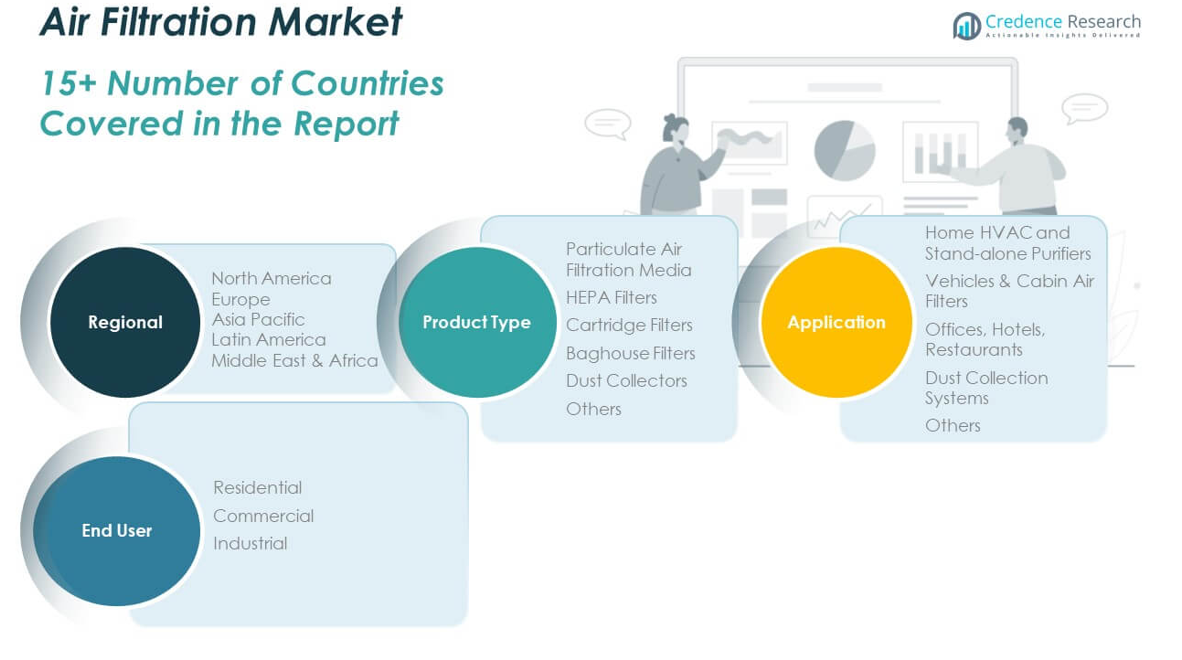
Segmentation:
By Product Type:
- Particulate Air Filtration Media
- HEPA Filters
- Cartridge Filters
- Baghouse Filters
- Dust Collectors
- Others
By Application:
- Home HVAC and Stand-alone Purifiers
- Vehicles & Cabin Air Filters
- Offices, Hotels, Restaurants
- Dust Collection Systems
- Others
By End User:
- Residential
- Commercial
- Industrial
By Region:
- North America
- U.S.
- Canada
- Mexico
- Europe
- Germany
- France
- U.K.
- Italy
- Spain
- Rest of Europe
- Asia Pacific
- China
- Japan
- India
- South Korea
- South-east Asia
- Rest of Asia Pacific
- Latin America
- Brazil
- Argentina
- Rest of Latin America
- Middle East & Africa
- GCC Countries
- South Africa
- Rest of the Middle East and Africa
Regional Analysis:
North America Air Filtration Market
The North America Air Filtration Market size was valued at USD 3,352.53 million in 2018, increasing to USD 5,137.64 million in 2024. It is anticipated to reach USD 9,325.17 million by 2032, at a CAGR of 7.2% during the forecast period. North America holds a significant share of the Global Air Filtration Market, primarily driven by strict environmental regulations and rising concerns over air quality. The United States is a major contributor, with the adoption of air filtration solutions expanding across residential, commercial, and industrial sectors. Growing awareness of health risks associated with poor air quality, along with the increasing integration of advanced technologies such as smart filtration systems, further boosts market demand. This region is expected to maintain its dominance due to continuous regulatory efforts and investment in air quality improvement technologies.
Europe Air Filtration Market
The Europe Air Filtration Market size was valued at USD 2,431.42 million in 2018, increasing to USD 3,604.77 million in 2024. It is projected to reach USD 6,010.73 million by 2032, with a CAGR of 6.1%. Europe accounts for a significant share of the Global Air Filtration Market, bolstered by stringent environmental regulations and a focus on sustainability. Countries such as Germany, the United Kingdom, and France are leading the market with high adoption rates of advanced filtration solutions across industries like automotive, pharmaceuticals, and food processing. The increasing emphasis on health, air quality, and reducing carbon emissions strengthens demand across both commercial and residential sectors. As Europe continues to prioritize green technologies, air filtration solutions are becoming a central aspect of industrial processes and urban infrastructure.
Asia Pacific Air Filtration Market
The Asia Pacific Air Filtration Market size was valued at USD 4,464.62 million in 2018, rising to USD 7,229.47 million in 2024. It is anticipated to reach USD 13,942.01 million by 2032, growing at a CAGR of 8.0%. Asia Pacific holds the largest share in the Global Air Filtration Market, driven by rapid industrialization and urbanization. Countries such as China, India, and Japan are facing significant air pollution challenges, leading to increasing demand for air filtration systems. Government initiatives and policies aimed at improving air quality and reducing emissions further support the market’s growth. The region’s large manufacturing base and rising consumer awareness about the health risks of poor air quality are also contributing to the growing adoption of air filtration technologies.
Latin America Air Filtration Market
The Latin America Air Filtration Market size was valued at USD 464.38 million in 2018, rising to USD 712.36 million in 2024. It is projected to reach USD 1,118.36 million by 2032, at a CAGR of 5.3%. Latin America is witnessing gradual growth in the Global Air Filtration Market, driven by urbanization and increasing industrial activity. Air pollution in major cities, such as São Paulo and Mexico City, is pushing the demand for filtration solutions in both residential and commercial buildings. The region’s growing industrial base and stricter regulations on air quality are further boosting market growth. While still a smaller market compared to other regions, Latin America’s focus on improving environmental conditions is expected to continue driving demand for air filtration technologies.
Middle East Air Filtration Market
The Middle East Air Filtration Market size was valued at USD 319.65 million in 2018, increasing to USD 455.35 million in 2024. It is anticipated to reach USD 696.73 million by 2032, growing at a CAGR of 4.9%. The Middle East's Air Filtration Market is expanding due to increasing industrialization and urbanization, particularly in countries such as the UAE, Saudi Arabia, and Qatar. The region faces unique challenges, including dust storms and pollution, which create a high demand for effective air filtration systems. Commercial and residential sectors are increasingly investing in air filtration solutions to combat air quality issues and improve living and working conditions. As infrastructure projects continue to develop and environmental concerns rise, demand for filtration technologies will likely grow in the coming years.
Africa Air Filtration Market
The Africa Air Filtration Market size was valued at USD 200.56 million in 2018, rising to USD 340.42 million in 2024. It is projected to reach USD 505.42 million by 2032, at a CAGR of 4.5%. Africa's Air Filtration Market is still in its early stages but is showing steady growth, driven by urbanization and industrial expansion. Major cities such as Cairo, Lagos, and Johannesburg are experiencing rising pollution levels, pushing the need for filtration solutions in both residential and industrial settings. While the market share remains small compared to other regions, the increasing awareness of air pollution’s health impacts and the growing number of urban centers with high pollution levels will drive the demand for air filtration systems. The market is expected to expand gradually as government policies and awareness around environmental health improve.
Key Player Analysis:
- 3M Company
- Honeywell International Inc.
- Camfil AB
- Donaldson Company, Inc.
- Pall Corporation
- Mann+Hummel
- Sogefi Group
- Ahlstrom-Munksjö
- Freudenberg Filtration Technologies
- Clarcor
Competitive Analysis:
The Global Air Filtration Market is highly competitive, with leading players focusing on innovation, product differentiation, and global expansion to maintain their market positions. Key players such as Honeywell International Inc., 3M, and Camfil AB dominate the market through their broad product portfolios, technological advancements, and strong distribution networks. These companies emphasize the development of advanced air filtration technologies, such as smart air purifiers and high-efficiency particulate air (HEPA) filters, to cater to diverse applications across industries like healthcare, automotive, and residential. Regional players also contribute to market growth, especially in emerging economies where urbanization and industrialization are rising. The competition is intensifying as new entrants focus on niche markets and offer cost-effective solutions. Companies with strong research and development capabilities and the ability to adapt to shifting regulatory requirements hold a competitive edge in the evolving market landscape.
Recent Developments:
- In April 2025, 3M’s Filtrete™ brand introduced a Refillable Air Filter Kitdesigned to deliver cleaner air while reducing waste and storage needs. The kit features a reusable frame with a lifespan of up to 20 years and a collapsible filter that lasts up to 12 months, helping consumers reduce disposable waste by 20% and storage space by 75%. The filters are certified Asthma & Allergy Friendly® and are compatible with the Filtrete Smart App for maintenance reminders.
- In February 2025, Thermo Fisher Scientific announced the acquisition of Solventum’s purification and filtration business(a 3M healthcare spinoff) for $4.1 billion. This deal is expected to close by the end of 2025 and will integrate Solventum’s advanced filters and membranes into Thermo Fisher’s bioproduction business, enhancing capabilities in biopharmaceutical manufacturing and other sectors.
- In October 2024, Honeywell completed the acquisition of Air Products’ liquefied natural gas (LNG) process technology and equipment businessfor $1.81 billion. This acquisition expands Honeywell’s portfolio in energy transition solutions, including advanced filtration for natural gas pre-treatment and liquefaction.
Market Concentration & Characteristics:
The Global Air Filtration Market is moderately concentrated, with a few key players holding a significant market share. Major companies dominate the market, offering a wide range of air filtration solutions across various industries, including residential, commercial, and industrial sectors. These companies invest heavily in research and development to introduce innovative, energy-efficient products that meet stringent environmental standards. The market is characterized by strong competition among established players, along with the emergence of regional and smaller players seeking to capitalize on niche segments. Technological advancements, such as smart filtration systems and eco-friendly solutions, play a key role in market dynamics, as companies aim to differentiate their offerings. Despite the dominance of a few large players, the growing demand for air quality solutions provides opportunities for new entrants to gain traction in the expanding market.
Report Coverage:
The research report offers an in-depth analysis based on Product Type, Application and End User, It details leading market players, providing an overview of their business, product offerings, investments, revenue streams, and key applications. Additionally, the report includes insights into the competitive environment, SWOT analysis, current market trends, as well as the primary drivers and constraints. Furthermore, it discusses various factors that have driven market expansion in recent years. The report also explores market dynamics, regulatory scenarios, and technological advancements that are shaping the industry. It assesses the impact of external factors and global economic changes on market growth. Lastly, it provides strategic recommendations for new entrants and established companies to navigate the complexities of the market.
Future Outlook:
- The Global Air Filtration Market is expected to grow at a steady pace, driven by increasing demand for air quality solutions across residential, commercial, and industrial sectors.
- Technological innovations such as smart air filters and IoT integration will continue to shape the market, offering enhanced performance and real-time monitoring.
- Growing awareness of the health impacts of poor air quality will increase the adoption of air filtration systems, particularly in urban areas with high pollution levels.
- Stricter environmental regulations will push industries to implement advanced filtration solutions to comply with air quality standards.
- The rise of green building initiatives and sustainable infrastructure projects will create significant demand for energy-efficient filtration systems.
- Emerging markets in Asia Pacific and Latin America will drive growth, fueled by urbanization and increasing industrial activity.
- The healthcare industry will remain a major driver, with air filtration systems being integral to maintaining sterile environments in hospitals and clinics.
- The development of eco-friendly filtration materials and recyclable filters will meet the growing demand for sustainable products.
- Governments will continue to introduce policies and incentives promoting the use of air filtration technologies, especially in regions with high pollution.
- The market will see increased consolidation, with larger players acquiring smaller companies to expand their product portfolios and geographical reach.

Request a Free Sample
Fill in your details and we'll send you a free sample report.
- Sample data tables & charts
- Research methodology
Market Dynamics
Increasing Air Pollution and Health Concerns
Rising levels of air pollution due to urbanization and industrialization are driving demand for air filtration systems to mitigate health risks such as respiratory diseases and cardiovascular issues. Growing public awareness of the health impacts of poor air quality is accelerating adoption in both residential and commercial spaces.
Stringent Government Regulations and Environmental Standards
Governments worldwide are enforcing stricter air quality regulations, compelling industries to invest in advanced air filtration systems to comply with emission standards. This regulatory pressure is particularly strong in manufacturing, pharmaceuticals, and food processing sectors, boosting market growth.
Technological Advancements in Filtration Systems
Innovations such as HEPA filters, electrostatic precipitators, and nanofiber technologies are making air filtration systems more efficient, compact, and energy-saving. The integration of smart sensors and IoT capabilities enables real-time monitoring and optimization, increasing the appeal and effectiveness of modern filtration solutions.
Expanding Industrialization and Urbanization
Rapid industrial growth and urban expansion, especially in emerging economies like China and India, are increasing airborne pollutants and necessitating the installation of air filtration systems in new residential, commercial, and industrial infrastructure.
Rising Demand in Healthcare and Commercial Sectors
Hospitals, laboratories, and commercial buildings are prioritizing air quality to ensure safety and compliance, leading to increased investment in high-efficiency air filtration systems. The post-pandemic focus on indoor air quality further accelerates this trend across healthcare and high-traffic commercial environments.
Need a Custom Version of This Report?
Tailor the scope, geography, or segments to your exact requirements.
- Custom geography or segment scope
- Direct access to our analyst team
Frequently Asked Questions
What is the current size of the Global Air Filtration Market?
What factors are driving the growth of the Global Air Filtration Market?
What are some challenges faced by the Global Air Filtration Market?
Who are the major players in the Global Air Filtration Market?
Table of Content
Chapter 1 Market Segmentation
- 1.1 Segmentation Framework
- 1.1.1 Product and Service Classification
- 1.1.2 Application and End-Use Classification
- 1.1.3 Technology and Solution Classification
- 1.1.4 Customer and Distribution Channel Classification
- 1.1.5 Geographic Segmentation
- 1.1.6 Market Segment Definitions and Boundaries
- 1.2 By End User
- 1.2.1 Residential
- 1.2.2 Commercial
- 1.2.3 Industrial
- 1.3 By Application
- 1.3.1 Home HVAC and Stand-alone Purifiers
- 1.3.2 Vehicles & Cabin Air Filters
- 1.3.3 Offices, Hotels, Restaurants
- 1.3.4 Dust Collection Systems
- 1.3.5 Others
- 1.4 By Product Type
- 1.4.1 Particulate Air Filtration Media
- 1.4.2 HEPA Filters
- 1.4.3 Cartridge Filters
- 1.4.4 Baghouse Filters
- 1.4.5 Dust Collectors
- 1.4.6 Others
Chapter 2 Introduction
- 2.1 Report Objectives and Scope
- 2.2 Product Definition and Industry Terminology
- 2.3 Market Inclusions and Exclusions
- 2.4 Research Process
- 2.4.1 Primary Research and Expert Interviews
- 2.4.2 Secondary Research and Source Review
- 2.4.3 Top-Down and Bottom-Up Estimation
- 2.4.4 Data Triangulation and Verification
- 2.5 Market Size Measurement Basis
- 2.5.1 2018: USD 11,233.15 million → 2024: USD 17,480.01 million
- 2.6 Historical and Forecast Reference Periods
- 2.6.1 Base Year: 2018
- 2.6.2 Forecast Period: 2018-2024
- 2.7 Research Assumptions and Limitations
Chapter 3 Executive Summary
- 3.1 Market Snapshot and Key Findings
- 3.2 Base-Year Market Size, 2018
- 3.3 Forecast Market Size, 2024
- 3.4 Revenue and Volume Growth Outlook
- 3.5 Key Demand and Supply Indicators
- 3.6 Leading Market Segments
- 3.7 Fastest-Growing Market Opportunities
- 3.8 Regional Performance Highlights
- 3.9 Technology and Industry Transformation
- 3.10 Competitive Landscape Summary
- 3.11 Analyst View and Strategic Implications
Chapter 4 Global Air Filtration Market Trends and Developments
- 4.1 Historical Industry Development
- 4.2 Recent Market Trends and Developments
- 4.3 Demand and Customer Behavior Trends
- 4.4 Technology and Product Innovation
- 4.5 Artificial Intelligence, Automation and Digitalization
- 4.6 Local Manufacturing and Supply Chain Realignment
- 4.7 Industry Partnerships, Mergers and Acquisitions
- 4.8 Sustainability and Circular Economy Developments
- 4.9 Government and Private Sector Investment Trends
- 4.10 Emerging Business Models and Commercialization
- 4.11 Industry Developments and Announcements
Chapter 5 Global Air Filtration Market Production, Supply and Demand Analysis
- 5.1 Demand Trend and Consumption Analysis
- 5.2 Demand Forecast, 2018-2024
- 5.3 Production and Output Trend
- 5.4 Production and Output Forecast, 2018-2024
- 5.5 Installed Capacity and Capacity Utilization
- 5.6 Company-Wise Production Plants and Statistics
- 5.6.1 Installed Production Capacity
- 5.6.2 Actual Production
- 5.6.3 Planned Capacity and Expansion Targets
- 5.7 Supply Chain Structure and Procurement Trends
- 5.8 Supply-Demand Gap and Bottlenecks
- 5.9 Import Dependence and Sourcing Structure
- 5.10 Contract Manufacturing and Outsourcing
- 5.11 Regional Supply and Demand Concentration
Chapter 6 Global Air Filtration Market Pricing Analysis
- 6.1 Pricing Structure and Measurement
- 6.2 Historical Pricing Trends
- 6.3 Pricing Outlook, 2018-2024
- 6.4 Average Selling Price and Unit Economics
- 6.5 Pricing by Product and Market Segment
- 6.6 Geographic Pricing Differences
- 6.7 Key Input, Energy, Labor and Logistics Costs
- 6.8 Contract Pricing and Purchasing Models
- 6.9 Pricing Sensitivity and Competitive Positioning
- 6.10 Price, Margin and Profitability Implications
Chapter 7 Global Air Filtration Market Dynamics
- 7.1 Market Growth Drivers
- 7.1.1 Demand-Side Drivers
- 7.1.2 Technology and Innovation Drivers
- 7.1.3 Infrastructure and Investment Drivers
- 7.1.4 Regulatory and Policy Drivers
- 7.2 Market Restraints
- 7.2.1 Cost and Affordability Constraints
- 7.2.2 Technology and Adoption Barriers
- 7.2.3 Supply Chain and Operational Constraints
- 7.3 Market Challenges
- 7.3.1 Competitive Pressure and Margin Erosion
- 7.3.2 Skills, Infrastructure and Implementation Gaps
- 7.4 Emerging Market Opportunities
- 7.5 Market Dynamics Impact and Time-Horizon Assessment
Chapter 8 Global Air Filtration Value Chain Analysis
- 8.1 Industry Value Chain Overview
- 8.2 Upstream Suppliers and Critical Inputs
- 8.3 Technology and Component Providers
- 8.4 Manufacturing or Service Delivery
- 8.5 Distribution, Channel Partners and Integrators
- 8.6 Downstream Applications and End Users
- 8.7 Value Addition and Profit Pools
- 8.8 Vertical Integration and Outsourcing
- 8.9 Supplier Concentration and Risk
- 8.10 Supply Chain Localization and Resilience
Chapter 9 Global Air Filtration Market Regulations and Policies
- 9.1 Relevant Laws, Standards and Compliance Frameworks
- 9.2 Product, Service, Safety and Quality Requirements
- 9.3 Government Policies, Incentives and Subsidies
- 9.4 Imports, Exports and Trade Barriers
- 9.5 Public Procurement and Local Content Requirements
- 9.6 Environmental and Sustainability Compliance
- 9.7 Upcoming Policy Changes and Market Implications
Chapter 10 Global Air Filtration Market Hotspots and Opportunities
- 10.1 Market Opportunity Mapping and Growth Hotspots
- 10.2 High-Growth Applications and Customer Groups
- 10.3 Underserved Markets and White-Space Opportunities
- 10.4 Emerging Technology and Product Opportunities
- 10.5 New Capacity and Investment Hotspots
- 10.6 Market Entry and Expansion Opportunities
- 10.7 Distribution and Partnership Opportunities
- 10.8 Near-Term and Long-Term Commercial Potential
- 10.9 Opportunity Attractiveness and Execution Risks
Chapter 11 Global Air Filtration Market Outlook, 2018-2024
- 11.1 Market Size and Analysis
- 11.1.1 Revenue (Market Measurement: 2018: USD 11,233.15 million → 2024: USD 17,480.01 million)
- 11.1.2 Market Volume and Quantity Sold
- 11.1.3 Historical Market Size
- 11.1.4 Base-Year Market Size, 2018
- 11.2 Market Forecast, 2018-2024
- 11.2.1 Revenue Forecast to 2024
- 11.2.2 Volume Forecast to 2024
- 11.2.3 CAGR and Year-on-Year Growth
- 11.2.4 Incremental Revenue Opportunity
- 11.3 Forecast Assumptions and Scenario Analysis
- 11.3.1 Base-Case Forecast
- 11.3.2 Optimistic and Conservative Scenarios
- 11.3.3 Technology, Pricing and Policy Sensitivities
- 11.4 Market Attractiveness and Growth Outlook
Chapter 12 Global Air Filtration Market Segmentation and Outlook
- 12.1 Segmentation Summary and Market Shares, 2018
- 12.2 Largest and Fastest-Growing Segments
- 12.3 By End User - Market Size and Forecast, 2018-2024
- 12.3.1 Segment Definition and Scope
- 12.3.2 Historical Market Size
- 12.3.3 Revenue Forecast, 2018-2024
- 12.3.4 Volume Forecast, 2018-2024
- 12.3.5 Base-Year Market Share, 2018
- 12.3.6 Segment CAGR and Growth Drivers
- 12.3.7 Subsegment Market Size and Forecast
- 12.3.7.1 Residential
- 12.3.7.2 Commercial
- 12.3.7.3 Industrial
- 12.3.8 Subsegment Pricing and Adoption Trends
- 12.3.9 Leading Suppliers and Competition
- 12.3.10 Regional Demand and Opportunities
- 12.4 By Application - Market Size and Forecast, 2018-2024
- 12.4.1 Segment Definition and Scope
- 12.4.2 Historical Market Size
- 12.4.3 Revenue Forecast, 2018-2024
- 12.4.4 Volume Forecast, 2018-2024
- 12.4.5 Base-Year Market Share, 2018
- 12.4.6 Segment CAGR and Growth Drivers
- 12.4.7 Subsegment Market Size and Forecast
- 12.4.7.1 Home HVAC and Stand-alone Purifiers
- 12.4.7.2 Vehicles & Cabin Air Filters
- 12.4.7.3 Offices, Hotels, Restaurants
- 12.4.7.4 Dust Collection Systems
- 12.4.7.5 Others
- 12.4.8 Subsegment Pricing and Adoption Trends
- 12.4.9 Leading Suppliers and Competition
- 12.4.10 Regional Demand and Opportunities
- 12.5 By Product Type - Market Size and Forecast, 2018-2024
- 12.5.1 Segment Definition and Scope
- 12.5.2 Historical Market Size
- 12.5.3 Revenue Forecast, 2018-2024
- 12.5.4 Volume Forecast, 2018-2024
- 12.5.5 Base-Year Market Share, 2018
- 12.5.6 Segment CAGR and Growth Drivers
- 12.5.7 Subsegment Market Size and Forecast
- 12.5.7.1 Particulate Air Filtration Media
- 12.5.7.2 HEPA Filters
- 12.5.7.3 Cartridge Filters
- 12.5.7.4 Baghouse Filters
- 12.5.7.5 Dust Collectors
- 12.5.7.6 Others
- 12.5.8 Subsegment Pricing and Adoption Trends
- 12.5.9 Leading Suppliers and Competition
- 12.5.10 Regional Demand and Opportunities
- 12.6 Segment Growth Comparison
- 12.7 Segment Attractiveness and Priority Matrix
Chapter 13 Global Air Filtration End-Use and Application Market Outlook
- 13.1 End-Use Industry and Customer Demand Structure
- 13.2 Leading Applications and Customer Groups
- 13.3 End-Use Market Size, Share and Forecast
- 13.4 Major End-Use Industry Deep Dives
- 13.4.1 Customer Requirements and Use Cases
- 13.4.2 Demand and Replacement Cycles
- 13.4.3 Technical and Regulatory Considerations
- 13.4.4 Purchasing and Procurement Models
- 13.4.5 Leading Vendors and Distribution Channels
- 13.4.6 Forecast and Commercial Opportunities
- 13.5 Emerging Applications and Cross-Segment Demand
- 13.6 End-Use Industry Investment Priorities
Chapter 14 Global Air Filtration Geographic Market Outlook, 2018-2024
- 14.1 Regional Market Size and Share, 2018
- 14.2 Regional Market Forecast, 2018-2024
- 14.3 Regional Pricing, Production and Demand Differences
- 14.4 North America
- 14.4.1 United States
- 14.4.2 Canada
- 14.4.3 Mexico
- 14.5 Europe
- 14.5.1 Germany
- 14.5.2 France
- 14.5.3 Italy
- 14.5.4 United Kingdom
- 14.5.5 Spain
- 14.5.6 Poland
- 14.5.7 Russia
- 14.5.8 Netherlands
- 14.5.9 Belgium
- 14.5.10 Sweden
- 14.5.11 Denmark
- 14.5.12 Norway
- 14.5.13 Rest of Europe
- 14.6 Asia Pacific
- 14.6.1 China
- 14.6.2 India
- 14.6.3 Japan
- 14.6.4 South Korea
- 14.6.5 Thailand
- 14.6.6 Indonesia
- 14.6.7 Vietnam
- 14.6.8 Malaysia
- 14.6.9 Australia
- 14.6.10 Rest of Asia Pacific
- 14.7 Latin America
- 14.7.1 Brazil
- 14.7.2 Argentina
- 14.7.3 Colombia
- 14.7.4 Chile
- 14.7.5 Rest of Latin America
- 14.8 Middle East
- 14.8.1 Saudi Arabia
- 14.8.2 United Arab Emirates
- 14.8.3 Turkey
- 14.8.4 Israel
- 14.8.5 Iran
- 14.8.6 Rest of the Middle East
- 14.9 Africa
- 14.9.1 South Africa
- 14.9.2 Egypt
- 14.9.3 Nigeria
- 14.9.4 Morocco
- 14.9.5 Rest of Africa
- 14.10 Regional Investment, Policy and Supply Chain Differences
- 14.11 Regional Competitive Landscape
- 14.12 Geographic Growth Hotspots
Chapter 15 Global Air Filtration Technology, Innovation and Sustainability Outlook
- 15.1 Technology Landscape and Maturity
- 15.2 Product, Process and Service Innovation
- 15.3 AI, Automation and Digital Tools in the Industry
- 15.4 Technology Adoption and Performance Benchmarking
- 15.5 Innovation Pipeline and R&D Investment
- 15.6 Patent and Intellectual Property Trends
- 15.7 Energy Efficiency and Resource Management
- 15.8 Sustainability, Recycling and Circularity
- 15.9 Technology Roadmap, 2018-2024
- 15.10 Risks of Obsolescence and Technology Substitution
Chapter 16 Global Air Filtration Market Key Strategic Imperatives
- 16.1 Growth and Market Entry Priorities
- 16.2 High-Return Products and Segments
- 16.3 Pricing, Profitability and Cost Optimization
- 16.4 Technology Investment and Product Differentiation
- 16.5 Supply Chain Localization and Resilience
- 16.6 Distribution and Customer Acquisition
- 16.7 Partnership, Acquisition and Capacity Strategy
- 16.8 Regional Expansion Priorities
- 16.9 Short-, Medium- and Long-Term Actions
Chapter 17 Competition Outlook
- 17.1 Industry Competition Characteristics
- 17.2 Market Structure and Concentration
- 17.3 Market Share and Competitive Positioning, 2018
- 17.4 Company-Wise Revenue and Product Benchmarking
- 17.5 Production and Service Capacity Benchmarking
- 17.6 Technology, Pricing and Differentiation
- 17.7 Regional Footprint and Distribution Strength
- 17.8 Mergers, Acquisitions and Strategic Alliances
- 17.9 New Entrants and Competitive Threats
- 17.10 Porter's Five Forces and Industry Attractiveness
- 17.11 Competitive Outlook, 2018-2024
Chapter 18 Company Profiles
- 18.1 Company Coverage and Selection Criteria
- 18.2 3M Company
- 18.2.1 Business Description
- 18.2.2 Company Ownership and Geographic Presence
- 18.2.3 Product and Service Portfolio
- 18.2.4 Manufacturing and Operating Footprint
- 18.2.5 Production Capacity and Expansion Plans
- 18.2.6 Financial Performance and Investment
- 18.2.7 Market Share and Competitive Position
- 18.2.8 Technology and Innovation Capabilities
- 18.2.9 Strategic Alliances or Partnerships
- 18.2.10 Recent Developments
- 18.2.11 Growth Strategy and Outlook
- 18.3 Honeywell International Inc.
- 18.4 Camfil AB
- 18.5 Donaldson Company, Inc.
- 18.6 Pall Corporation
- 18.7 Mann+Hummel
- 18.8 Sogefi Group
- 18.9 Ahlstrom-Munksjö
- 18.10 Freudenberg Filtration Technologies
- 18.11 Clarcor
- 18.12 Other Relevant Market Participants
Note: Every listed company is profiled on the structure shown under the first company. The company list is preliminary and may change based on research findings, market developments, data availability and client requirements.
Chapter 19 Disclaimer
- 19.1 Research and Forecast Disclaimer
- 19.2 Data Source and Estimation Limitations
Note: The depth of individual sections depends on data availability for this market. Volume, capacity, trade and other unit-based metrics are included where applicable.