| REPORT ATTRIBUTE | DETAILS |
|---|---|
| Historical Period | 2020-2023 |
| Base Year | 2024 |
| Forecast Period | 2025-2032 |
| Automotive Spacer Ring Market Size 2024 | USD 1,751.39 million |
| Automotive Spacer Ring Market, CAGR | 7.45% |
| Automotive Spacer Ring Market Size 2032 | USD 3,240.75 million |
Market Overview:
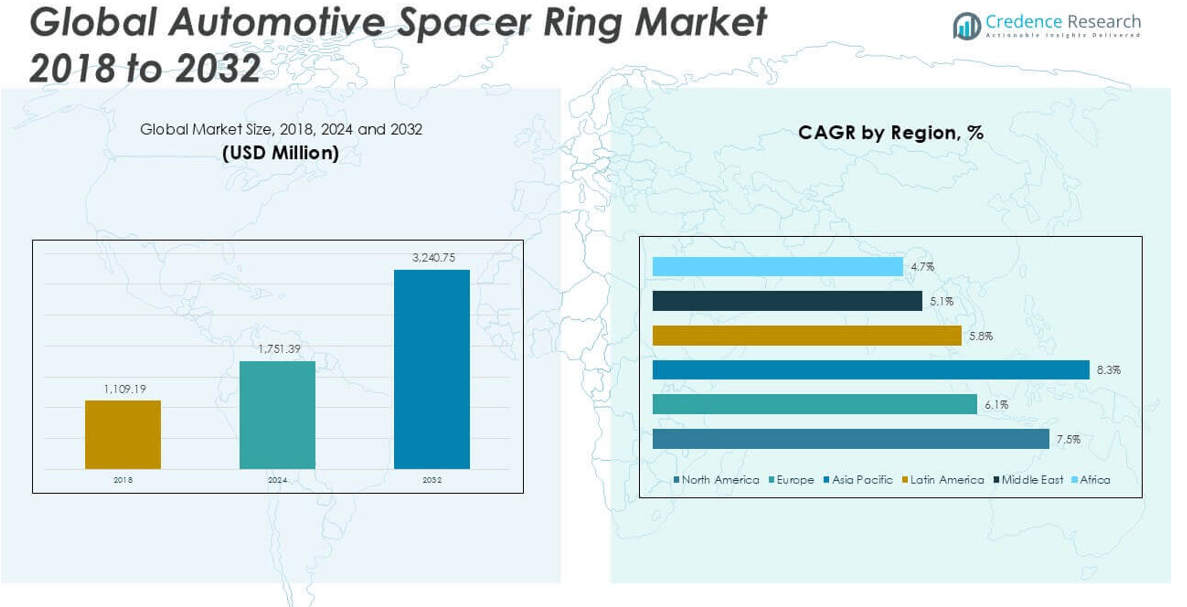
The Automotive Spacer Ring market size was valued at USD 1,109.19 million in 2018, increased to USD 1,751.39 million in 2024, and is anticipated to reach USD 3,240.75 million by 2032, at a CAGR of 7.45% during the forecast period.
The Automotive Spacer Ring market is driven by prominent players such as Schaeffler AG, SKF Group, NTN Corporation, Timken Company, and NSK Ltd., all of which maintain strong global presence through extensive OEM partnerships and advanced component innovations. These companies focus on material efficiency, precision engineering, and expansion into high-growth regions. Emerging players like SPIROL, KnitMesh Technologies, and WADE Drains are also contributing to market competitiveness through niche applications and regional supply networks. Asia Pacific leads the global market, commanding a 43.7% share in 2024, fueled by large-scale automotive production in China, India, and Japan. North America and Europe follow, benefiting from strong aftermarket demand and technological advancements in automotive manufacturing.
Market Insights
- The Automotive Spacer Ring market was valued at USD 1,751.39 million in 2024 and is projected to reach USD 3,240.75 million by 2032, growing at a CAGR of 7.45% during the forecast period.
- Market growth is driven by rising global automotive production, increasing demand for performance-enhancing components, and the shift toward lightweight and fuel-efficient vehicles.
- Stainless steel held the largest share by material type in 2024 due to its superior durability and corrosion resistance, while the passenger car segment led by vehicle type with over 45% share.
- The market is moderately competitive with key players like Schaeffler AG, SKF Group, NTN Corporation, and Timken Company investing in R&D and OEM partnerships; emerging firms are gaining traction through customized and regional solutions.
- Asia Pacific dominated with 43.7% of the market share in 2024, followed by North America at 29.9% and Europe at 17.2%, while Africa and the Middle East showed slower but steady growth.
Market Segmentation Analysis:
By Vehicle Type:
The passenger cars segment held the largest share in the Automotive Spacer Ring market in 2024, accounting for over 45% of the global revenue. This dominance is attributed to the high production volume of passenger vehicles and the increasing demand for comfort, safety, and performance enhancements in modern vehicles. Rapid urbanization, rising disposable incomes, and strong demand in emerging economies have also contributed to the segment’s growth. Light commercial vehicles are also gaining traction, supported by expanding e-commerce and logistics sectors that require efficient and durable automotive components like spacer rings.
- For instance, Toyota produced over 10.48 million vehicles globally in 2023, the majority of which were passenger cars, reinforcing the high-volume demand for durable internal components like spacer rings across its vehicle platforms.
By Material Type:
Stainless steel emerged as the leading material segment, capturing around 38% of the Automotive Spacer Ring market share in 2024. Its widespread use is driven by its excellent corrosion resistance, durability, and thermal stability critical for withstanding harsh operating conditions in automotive systems. While carbon steel and aluminum follow closely due to their lightweight and cost-effective properties, the use of nickel bronze and brass & copper remains limited to specialized applications. The growing preference for long-lasting materials in high-performance and premium vehicles supports the continued dominance of stainless steel in this segment.
- For instance, Schaeffler’s LuK division manufactures high-strength stainless steel transmission components, including precision-engineered rings and spacers used in double clutch systems, contributing to over 5 million dual-clutch units delivered annually.
By Sales Channel:
The original equipment manufacturer (OEM) segment led the Automotive Spacer Ring market in 2024, contributing more than 60% to total market revenue. This leadership is due to strong partnerships between spacer ring manufacturers and automotive OEMs, which prioritize high-quality and custom-engineered components. OEMs also benefit from consistent quality control and integrated supply chains. On the other hand, the aftermarket segment is expanding steadily, propelled by increasing vehicle maintenance activities and the growing average age of vehicles, particularly in North America and Europe, which boost the demand for replacement parts.
Market Overview
Expanding Automotive Production and Sales
The continuous growth in global automotive production, particularly in emerging economies, remains a primary driver for the Automotive Spacer Ring market. Rising demand for passenger vehicles, coupled with increasing disposable income and improving road infrastructure, is accelerating vehicle sales. This expansion necessitates a proportional rise in automotive component manufacturing, including spacer rings, which are critical for enhancing performance, durability, and safety. Automotive OEMs are investing in mass production of vehicles with advanced systems, which in turn is stimulating demand for reliable spacer rings across various vehicle types.
- For instance, Hyundai Motor Group manufactured more than 7.3 million vehicles in 2023, with factories in India and China contributing significantly to production volumes that rely heavily on high-precision components like spacer rings for drivetrain and axle assemblies.
Rising Emphasis on Vehicle Efficiency and Performance
Automotive manufacturers are increasingly integrating advanced mechanical components that contribute to fuel efficiency and smoother vehicle operation. Spacer rings play a pivotal role in reducing vibration, managing spacing tolerance, and enhancing system alignment. With stricter fuel efficiency and emission regulations globally, automakers are focusing on lightweight and high-performance components to optimize vehicle dynamics. This demand has encouraged the development of high-quality spacer rings using materials such as stainless steel and aluminum, driving sustained market growth through innovation and performance-oriented design.
- For instance, Dana Incorporated integrated over 500,000 lightweight precision components, including spacer rings, into global vehicle platforms in 2023, as reported in their official product and innovation report.
Growth of the Aftermarket Segment
The aftermarket sector has experienced strong growth, driven by the rising average vehicle age and increasing demand for vehicle maintenance and component replacement. Spacer rings, being subject to wear and tear, require periodic replacement to maintain vehicle performance. With more consumers opting to retain their vehicles for longer periods, the demand for reliable and affordable aftermarket components has surged. Additionally, the expansion of e-commerce platforms has made it easier for customers and service centers to access a variety of spacer rings, boosting sales through the aftermarket channel.
Key Trends & Opportunities
Shift Toward Lightweight Materials
There is a growing trend toward the use of lightweight materials such as aluminum and composite alloys in the manufacturing of spacer rings. This shift aligns with industry efforts to reduce vehicle weight and improve fuel efficiency. As environmental regulations tighten, automotive manufacturers are opting for materials that contribute to lower emissions without compromising performance. This trend presents opportunities for material innovation and the development of next-generation spacer rings designed for electric and hybrid vehicles, where weight optimization is even more critical for range and efficiency.
- For instance, Norsk Hydro ASA supplied over 170,000 metric tons of extruded aluminum solutions to the automotive industry in 2023, including precision components like spacer rings, to support the shift toward lighter vehicle structures, according to its official annual sustainability report.
Integration with Electric and Hybrid Vehicles
The rise in electric and hybrid vehicle adoption offers significant growth opportunities for the Automotive Spacer Ring market. These vehicles require precision-engineered components to ensure optimal performance of electric drivetrains and battery systems. Spacer rings play a crucial role in maintaining the structural integrity and alignment of rotating components in electric powertrains. As EV manufacturers seek durable, heat-resistant, and compact solutions, spacer ring suppliers that innovate and customize for these needs are well-positioned to capture new revenue streams in this fast-evolving automotive landscape.
- For instance, NSK Ltd. supplies spacer rings and high-precision bearings used in Tesla’s Model 3 motor assemblies, designed to support high-speed rotation exceeding 18,000 rpm in compact drive systems.
Key Challenges
Volatility in Raw Material Prices
Fluctuations in the prices of key raw materials such as stainless steel, aluminum, and copper pose a major challenge for manufacturers in the spacer ring market. These materials significantly influence production costs, and sudden spikes can compress profit margins or lead to higher product prices. Smaller players in particular face difficulties absorbing these costs or passing them on to customers. Long-term supply contracts and efficient procurement strategies are essential for manufacturers to remain competitive amidst such volatility in the global metal markets.
Intense Competition and Price Pressure
The Automotive Spacer Ring market is highly fragmented, with numerous regional and international players vying for market share. This competitive landscape leads to aggressive pricing strategies, often pressuring manufacturers to reduce costs while maintaining quality. OEMs frequently demand price concessions and just-in-time delivery, making it difficult for smaller suppliers to sustain profitability. To stand out, companies must focus on product differentiation, quality assurance, and technological innovation, though this often requires substantial investment in R&D and manufacturing capabilities.
Technological Shifts in Automotive Design
The rapid evolution of automotive design, particularly the shift toward electrification and integrated systems, poses a technological challenge for spacer ring manufacturers. Traditional spacer ring designs may not meet the demands of modern drivetrains, electric motors, or compact architectures. This requires ongoing product innovation and reengineering to keep pace with OEM requirements. Companies that fail to adapt quickly may lose relevance in the market, while those that invest in design compatibility and advanced materials stand to gain a competitive edge.
Regional Analysis
North America:
North America held a significant share of the global Automotive Spacer Ring market in 2024, accounting for approximately 29.9% of total revenue, with a market size of USD 523.13 million. The market grew from USD 336.34 million in 2018 and is projected to reach USD 971.88 million by 2032, registering a CAGR of 7.5%. The region benefits from a mature automotive industry, strong presence of leading OEMs, and high vehicle ownership rates. Advancements in automotive component technology and growing emphasis on vehicle performance and reliability continue to support the demand for high-quality spacer rings across the United States and Canada.
Europe:
Europe accounted for about 17.2% of the Automotive Spacer Ring market in 2024, with a value of USD 301.44 million, up from USD 202.25 million in 2018. It is anticipated to reach USD 505.92 million by 2032 at a CAGR of 6.1%. The regional growth is driven by stringent emission regulations, rising adoption of lightweight materials, and a robust automotive supply chain across Germany, France, and Italy. Europe’s strong focus on electric vehicles and innovation in driveline components further supports demand. The aftermarket segment is also witnessing steady growth due to an aging vehicle fleet and rising maintenance needs.
Asia Pacific:
Asia Pacific dominated the Automotive Spacer Ring market in 2024, commanding a 43.7% market share with revenue reaching USD 766.00 million. The region grew significantly from USD 467.22 million in 2018 and is forecasted to hit USD 1,506.96 million by 2032, registering the highest CAGR of 8.3%. This growth is fueled by massive automotive production hubs in China, India, and Japan, coupled with increasing vehicle ownership. The region benefits from cost-effective manufacturing, rising disposable incomes, and expanding aftermarket services. OEMs are actively investing in advanced automotive components to meet growing demand for fuel-efficient and high-performance vehicles.
Latin America:
Latin America contributed 4.8% to the global Automotive Spacer Ring market in 2024, with a market size of USD 83.63 million, up from USD 53.62 million in 2018. It is projected to reach USD 137.38 million by 2032, growing at a CAGR of 5.8%. Brazil and Mexico serve as regional automotive hubs, supported by local vehicle manufacturing and expanding aftermarket services. The region’s growth is influenced by rising demand for commercial and light vehicles and gradual economic recovery. However, limited industrial infrastructure and price sensitivity pose challenges for rapid expansion in the adoption of advanced spacer ring materials.
Middle East:
The Middle East represented approximately 2.5% of the Automotive Spacer Ring market in 2024, valued at USD 43.86 million, compared to USD 30.45 million in 2018. The market is expected to reach USD 68.20 million by 2032, growing at a CAGR of 5.1%. Demand is supported by growing investments in infrastructure, urbanization, and commercial vehicle fleets, especially in the Gulf Cooperation Council (GCC) countries. Automotive imports and aftermarket services continue to drive spacer ring consumption. However, regional instability and reliance on imported automotive components remain key constraints limiting faster market development.
Africa:
Africa accounted for 1.9% of the global Automotive Spacer Ring market in 2024, with a market size of USD 33.33 million, up from USD 19.31 million in 2018. The market is projected to grow to USD 50.40 million by 2032 at a CAGR of 4.7%. The region is in the early stages of automotive industry development, with South Africa leading in vehicle manufacturing and component demand. The market is driven by growing urban mobility needs and the expansion of used vehicle imports. However, limited production infrastructure, affordability challenges, and supply chain gaps restrict broader adoption of advanced automotive components like spacer rings.
Market Segmentations:
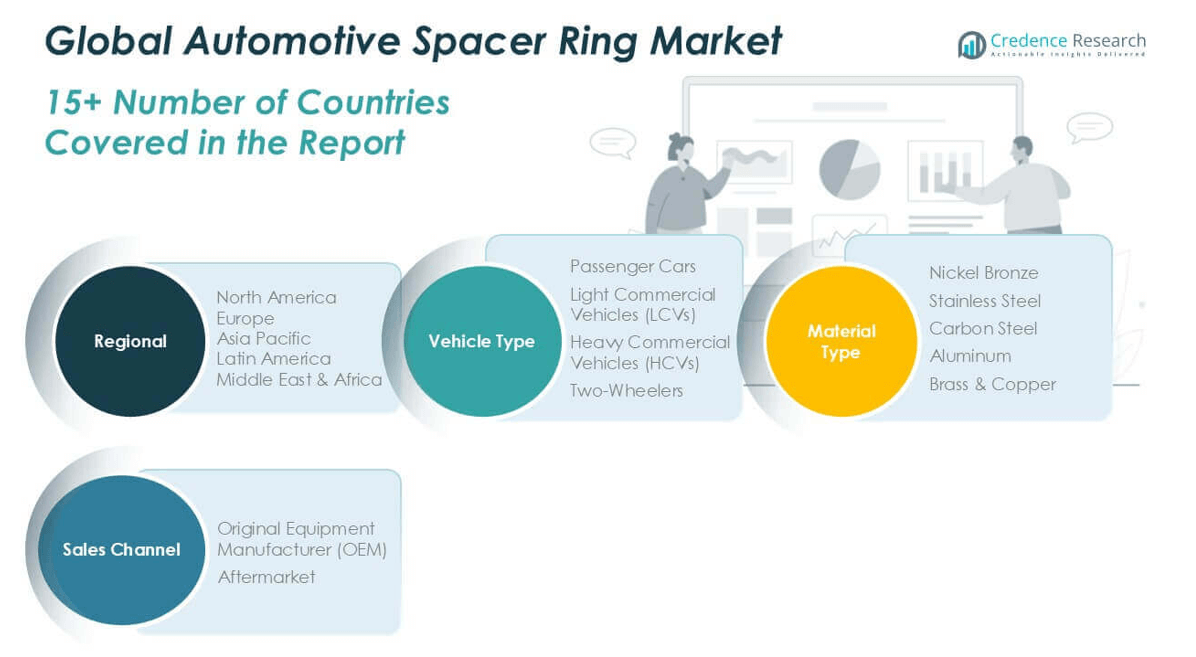
By Vehicle Type:
- Passenger Cars
- Light Commercial Vehicles (LCVs)
- Heavy Commercial Vehicles (HCVs)
- Two-Wheelers
By Material Type:
- Nickel Bronze
- Stainless Steel
- Carbon Steel
- Aluminum
- Brass & Copper
By Sales Channel:
- Original Equipment Manufacturer (OEM)
- Aftermarket
By Geography:
- North America
- U.S.
- Canada
- Mexico
- Europe
- Germany
- France
- U.K.
- Italy
- Spain
- Rest of Europe
- Asia Pacific
- China
- Japan
- India
- South Korea
- South-east Asia
- Rest of Asia Pacific
- Latin America
- Brazil
- Argentina
- Rest of Latin America
- Middle East & Africa
- GCC Countries
- South Africa
- Rest of the Middle East and Africa
Competitive Landscape
The competitive landscape of the Automotive Spacer Ring market is characterized by the presence of several global and regional players striving to enhance their market position through strategic collaborations, technological innovation, and capacity expansions. Key players such as Schaeffler AG, SKF Group, NTN Corporation, Timken Company, and NSK Ltd. lead the market with a strong focus on product reliability, advanced materials, and integration with OEMs. These companies leverage their extensive R&D capabilities to develop high-performance spacer rings that meet evolving automotive demands, particularly in electric and hybrid vehicles. Emerging players like SPIROL, KnitMesh Technologies, and WADE Drains are gaining traction through customized solutions and targeted regional expansion. The market also witnesses strategic mergers and acquisitions aimed at broadening product portfolios and strengthening global supply chains. As sustainability and lightweighting gain priority in the automotive sector, companies are increasingly investing in advanced manufacturing techniques and materials, further intensifying competition and driving innovation across the value chain.
Key Player Analysis
- Schaeffler AG
- SKF Group
- NTN Corporation
- Timken Company
- NSK Ltd.
- Sick AG
- SPIROL
- KnitMesh Technologies
- WADE Drains
- Eaton
Recent Developments
- In April 2025, At Auto Shanghai 2025, Schaeffler showcased an expanded product portfolio including solutions for electrification and intelligent chassis, emphasizing high-precision components that support new automotive architectures-spacer rings are integral to such systems.
- In January 2025, Schaeffler introduced optimized current-insulated bearings (J20G series) featuring advanced coatings for enhanced electrical protection, targeting sectors like rail and automation but applicable to automotive electrification as well.
- In November 2024, SKF introduced Infinium bearings, a new series designed for circular use, leveraging advanced Laser Metal Deposition (LMD) technology. This allows for repeated remanufacturing, extending the lifespan and promoting sustainability in automotive applications. While not specifically for spacer rings, this innovation demonstrates SKF's commitment to sustainable and advanced components.
- In September 2024, NSK introduced a new low-friction hub unit bearing that significantly reduces friction (by 40%) and enhances the driving range of electric vehicles (EVs). This innovation is closely linked to spacer ring applications due to the shared requirement of high precision and low friction for optimal performance in vehicles.
- In May 2024, NTN developed a large-diameter deep groove ball bearing for EV e-Axles, emphasizing high-speed rotation and low torque. While the announcement focuses on the bearing itself, these advancements in bearing technology indirectly influence the design and specifications of spacer rings used in EV powertrains.
Market Concentration & Characteristics
The Automotive Spacer Ring market exhibits a moderately consolidated structure with a mix of global leaders and regional players competing on technology, pricing, and customization. It is characterized by strong OEM collaborations, material innovation, and a growing emphasis on lightweight components. Leading companies such as Schaeffler AG, SKF Group, NTN Corporation, and Timken Company dominate through their established global supply chains, proprietary technologies, and strong brand reputation. The market relies heavily on precision manufacturing and consistent quality standards, especially in segments like passenger vehicles and commercial transport. Barriers to entry remain moderate due to the capital-intensive nature of production and stringent quality certifications required by OEMs. Demand patterns align closely with automotive production cycles and regional industrial development. It responds dynamically to shifts in vehicle design, emission norms, and drivetrain technologies. Emerging players target niche applications and aftermarket segments where product differentiation and cost competitiveness can offer market entry opportunities.
Report Coverage
The research report offers an in-depth analysis based on Vehicle Type, Material Type, Sales Channel and Geography. It details leading market players, providing an overview of their business, product offerings, investments, revenue streams, and key applications. Additionally, the report includes insights into the competitive environment, SWOT analysis, current market trends, as well as the primary drivers and constraints. Furthermore, it discusses various factors that have driven market expansion in recent years. The report also explores market dynamics, regulatory scenarios, and technological advancements that are shaping the industry. It assesses the impact of external factors and global economic changes on market growth. Lastly, it provides strategic recommendations for new entrants and established companies to navigate the complexities of the market.
Future Outlook
- The automotive spacer ring market will witness steady growth driven by increasing global vehicle production.
- Rising demand for fuel-efficient and lightweight vehicles will boost the use of advanced spacer ring materials.
- OEM partnerships will continue to shape the competitive landscape and influence product development.
- Technological advancements in electric and hybrid vehicles will create new opportunities for spacer ring applications.
- Asia Pacific will remain the dominant regional market due to strong manufacturing and expanding automotive sales.
- Aftermarket demand will grow as vehicle lifespan increases and maintenance needs rise.
- Manufacturers will invest more in stainless steel and aluminum spacer rings for durability and weight reduction.
- Regulatory standards for emissions and efficiency will push automakers to adopt high-performance components.
- Digitalization in manufacturing processes will improve spacer ring precision and reduce production costs.
- Strategic mergers and regional expansions will strengthen market positioning and global reach.

Request a Free Sample
Fill in your details and we'll send you a free sample report.
- Sample data tables & charts
- Research methodology
Market Dynamics
Expanding Global Automotive Production
The continuous increase in vehicle manufacturing, especially in emerging economies, directly raises the demand for spacer rings as essential components in drivetrains, axles, and transmissions, supporting both OEM and aftermarket growth.
Shift Toward Lightweight and Fuel-Efficient Vehicles
Automakers are prioritizing lightweight materials and precision components like spacer rings to meet stricter emission standards and improve fuel efficiency, driving innovation and higher adoption of advanced spacer ring materials such as stainless steel and aluminum.
Growth in Aftermarket and Vehicle Lifespan
As the average age of vehicles rises and consumers retain cars longer, the need for replacement spacer rings increases, boosting aftermarket sales and supporting market expansion in regions with mature vehicle fleets.
Technological Advancements in Electric and Hybrid Vehicles
The rise of electric and hybrid vehicles requires high-precision, durable spacer rings for electric drivetrains and battery systems, creating new opportunities for manufacturers to supply specialized components tailored to evolving automotive architectures.
OEM Partnerships and Customization
Strong collaborations between spacer ring manufacturers and automotive OEMs foster the development of custom-engineered, high-quality components, ensuring consistent demand and driving market growth through integrated supply chains and product innovation.
Need a Custom Version of This Report?
Tailor the scope, geography, or segments to your exact requirements.
- Custom geography or segment scope
- Direct access to our analyst team
Frequently Asked Questions
What is the current size of the Automotive Spacer Ring Market?
What are the key segments within the Automotive Spacer Ring Market?
What are some challenges faced by the Automotive Spacer Ring Market?
Who are the major players in the Automotive Spacer Ring Market?
Table of Content
Chapter 1 Market Segmentation
- 1.1 Segmentation Framework
- 1.1.1 Product and Service Classification
- 1.1.2 Application and End-Use Classification
- 1.1.3 Technology and Solution Classification
- 1.1.4 Customer and Distribution Channel Classification
- 1.1.5 Geographic Segmentation
- 1.1.6 Market Segment Definitions and Boundaries
- 1.2 By Vehicle Type
- 1.2.1 Passenger Cars
- 1.2.2 Light Commercial Vehicles (LCVs)
- 1.2.3 Heavy Commercial Vehicles (HCVs)
- 1.2.4 Two-Wheelers
- 1.3 By Material Type
- 1.3.1 Stainless Steel
- 1.3.2 Carbon Steel
- 1.3.3 Aluminum
- 1.3.4 Nickel Bronze
- 1.3.5 Brass & Copper
- 1.4 By Sales Channel
- 1.4.1 Original Equipment Manufacturer (OEM)
- 1.4.2 Aftermarket
Chapter 2 Introduction
- 2.1 Report Objectives and Scope
- 2.2 Product Definition and Industry Terminology
- 2.3 Market Inclusions and Exclusions
- 2.4 Research Process
- 2.4.1 Primary Research and Expert Interviews
- 2.4.2 Secondary Research and Source Review
- 2.4.3 Top-Down and Bottom-Up Estimation
- 2.4.4 Data Triangulation and Verification
- 2.5 Market Size Measurement Basis
- 2.5.1 2024: USD 1,751.39 million → 2032: USD 3,240.75 million
- 2.6 Historical and Forecast Reference Periods
- 2.6.1 Base Year: 2024
- 2.6.2 Forecast Period: 2024-2032
- 2.7 Research Assumptions and Limitations
Chapter 3 Executive Summary
- 3.1 Market Snapshot and Key Findings
- 3.2 Base-Year Market Size, 2024
- 3.3 Forecast Market Size, 2032
- 3.4 Revenue and Volume Growth Outlook
- 3.5 Key Demand and Supply Indicators
- 3.6 Leading Market Segments
- 3.7 Fastest-Growing Market Opportunities
- 3.8 Regional Performance Highlights
- 3.9 Technology and Industry Transformation
- 3.10 Competitive Landscape Summary
- 3.11 Analyst View and Strategic Implications
Chapter 4 Global Automotive Spacer Ring Market Trends and Developments
- 4.1 Historical Industry Development
- 4.2 Recent Market Trends and Developments
- 4.3 Demand and Customer Behavior Trends
- 4.4 Technology and Product Innovation
- 4.5 Artificial Intelligence, Automation and Digitalization
- 4.6 Local Manufacturing and Supply Chain Realignment
- 4.7 Industry Partnerships, Mergers and Acquisitions
- 4.8 Sustainability and Circular Economy Developments
- 4.9 Government and Private Sector Investment Trends
- 4.10 Emerging Business Models and Commercialization
- 4.11 Industry Developments and Announcements
Chapter 5 Global Automotive Spacer Ring Market Production, Supply and Demand Analysis
- 5.1 Demand Trend and Consumption Analysis
- 5.2 Demand Forecast, 2024-2032
- 5.3 Production and Output Trend
- 5.4 Production and Output Forecast, 2024-2032
- 5.5 Installed Capacity and Capacity Utilization
- 5.6 Company-Wise Production Plants and Statistics
- 5.6.1 Installed Production Capacity
- 5.6.2 Actual Production
- 5.6.3 Planned Capacity and Expansion Targets
- 5.7 Supply Chain Structure and Procurement Trends
- 5.8 Supply-Demand Gap and Bottlenecks
- 5.9 Import Dependence and Sourcing Structure
- 5.10 Contract Manufacturing and Outsourcing
- 5.11 Regional Supply and Demand Concentration
Chapter 6 Global Automotive Spacer Ring Market Pricing Analysis
- 6.1 Pricing Structure and Measurement
- 6.2 Historical Pricing Trends
- 6.3 Pricing Outlook, 2024-2032
- 6.4 Average Selling Price and Unit Economics
- 6.5 Pricing by Product and Market Segment
- 6.6 Geographic Pricing Differences
- 6.7 Key Input, Energy, Labor and Logistics Costs
- 6.8 Contract Pricing and Purchasing Models
- 6.9 Pricing Sensitivity and Competitive Positioning
- 6.10 Price, Margin and Profitability Implications
Chapter 7 Global Automotive Spacer Ring Market Dynamics
- 7.1 Market Growth Drivers
- 7.1.1 Demand-Side Drivers
- 7.1.2 Technology and Innovation Drivers
- 7.1.3 Infrastructure and Investment Drivers
- 7.1.4 Regulatory and Policy Drivers
- 7.2 Market Restraints
- 7.2.1 Cost and Affordability Constraints
- 7.2.2 Technology and Adoption Barriers
- 7.2.3 Supply Chain and Operational Constraints
- 7.3 Market Challenges
- 7.3.1 Competitive Pressure and Margin Erosion
- 7.3.2 Skills, Infrastructure and Implementation Gaps
- 7.4 Emerging Market Opportunities
- 7.5 Market Dynamics Impact and Time-Horizon Assessment
Chapter 8 Global Automotive Spacer Ring Value Chain Analysis
- 8.1 Industry Value Chain Overview
- 8.2 Upstream Suppliers and Critical Inputs
- 8.3 Technology and Component Providers
- 8.4 Manufacturing or Service Delivery
- 8.5 Distribution, Channel Partners and Integrators
- 8.6 Downstream Applications and End Users
- 8.7 Value Addition and Profit Pools
- 8.8 Vertical Integration and Outsourcing
- 8.9 Supplier Concentration and Risk
- 8.10 Supply Chain Localization and Resilience
Chapter 9 Global Automotive Spacer Ring Market Regulations and Policies
- 9.1 Relevant Laws, Standards and Compliance Frameworks
- 9.2 Product, Service, Safety and Quality Requirements
- 9.3 Government Policies, Incentives and Subsidies
- 9.4 Imports, Exports and Trade Barriers
- 9.5 Public Procurement and Local Content Requirements
- 9.6 Environmental and Sustainability Compliance
- 9.7 Upcoming Policy Changes and Market Implications
Chapter 10 Global Automotive Spacer Ring Market Hotspots and Opportunities
- 10.1 Market Opportunity Mapping and Growth Hotspots
- 10.2 High-Growth Applications and Customer Groups
- 10.3 Underserved Markets and White-Space Opportunities
- 10.4 Emerging Technology and Product Opportunities
- 10.5 New Capacity and Investment Hotspots
- 10.6 Market Entry and Expansion Opportunities
- 10.7 Distribution and Partnership Opportunities
- 10.8 Near-Term and Long-Term Commercial Potential
- 10.9 Opportunity Attractiveness and Execution Risks
Chapter 11 Global Automotive Spacer Ring Market Outlook, 2024-2032
- 11.1 Market Size and Analysis
- 11.1.1 Revenue (Market Measurement: 2024: USD 1,751.39 million → 2032: USD 3,240.75 million)
- 11.1.2 Market Volume and Quantity Sold
- 11.1.3 Historical Market Size
- 11.1.4 Base-Year Market Size, 2024
- 11.2 Market Forecast, 2024-2032
- 11.2.1 Revenue Forecast to 2032
- 11.2.2 Volume Forecast to 2032
- 11.2.3 CAGR and Year-on-Year Growth
- 11.2.4 Incremental Revenue Opportunity
- 11.3 Forecast Assumptions and Scenario Analysis
- 11.3.1 Base-Case Forecast
- 11.3.2 Optimistic and Conservative Scenarios
- 11.3.3 Technology, Pricing and Policy Sensitivities
- 11.4 Market Attractiveness and Growth Outlook
Chapter 12 Global Automotive Spacer Ring Market Segmentation and Outlook
- 12.1 Segmentation Summary and Market Shares, 2024
- 12.2 Largest and Fastest-Growing Segments
- 12.3 By Vehicle Type - Market Size and Forecast, 2024-2032
- 12.3.1 Segment Definition and Scope
- 12.3.2 Historical Market Size
- 12.3.3 Revenue Forecast, 2024-2032
- 12.3.4 Volume Forecast, 2024-2032
- 12.3.5 Base-Year Market Share, 2024
- 12.3.6 Segment CAGR and Growth Drivers
- 12.3.7 Subsegment Market Size and Forecast
- 12.3.7.1 Passenger Cars
- 12.3.7.2 Light Commercial Vehicles (LCVs)
- 12.3.7.3 Heavy Commercial Vehicles (HCVs)
- 12.3.7.4 Two-Wheelers
- 12.3.8 Subsegment Pricing and Adoption Trends
- 12.3.9 Leading Suppliers and Competition
- 12.3.10 Regional Demand and Opportunities
- 12.4 By Material Type - Market Size and Forecast, 2024-2032
- 12.4.1 Segment Definition and Scope
- 12.4.2 Historical Market Size
- 12.4.3 Revenue Forecast, 2024-2032
- 12.4.4 Volume Forecast, 2024-2032
- 12.4.5 Base-Year Market Share, 2024
- 12.4.6 Segment CAGR and Growth Drivers
- 12.4.7 Subsegment Market Size and Forecast
- 12.4.7.1 Stainless Steel
- 12.4.7.2 Carbon Steel
- 12.4.7.3 Aluminum
- 12.4.7.4 Nickel Bronze
- 12.4.7.5 Brass & Copper
- 12.4.8 Subsegment Pricing and Adoption Trends
- 12.4.9 Leading Suppliers and Competition
- 12.4.10 Regional Demand and Opportunities
- 12.5 By Sales Channel - Market Size and Forecast, 2024-2032
- 12.5.1 Segment Definition and Scope
- 12.5.2 Historical Market Size
- 12.5.3 Revenue Forecast, 2024-2032
- 12.5.4 Volume Forecast, 2024-2032
- 12.5.5 Base-Year Market Share, 2024
- 12.5.6 Segment CAGR and Growth Drivers
- 12.5.7 Subsegment Market Size and Forecast
- 12.5.7.1 Original Equipment Manufacturer (OEM)
- 12.5.7.2 Aftermarket
- 12.5.8 Subsegment Pricing and Adoption Trends
- 12.5.9 Leading Suppliers and Competition
- 12.5.10 Regional Demand and Opportunities
- 12.6 Segment Growth Comparison
- 12.7 Segment Attractiveness and Priority Matrix
Chapter 13 Global Automotive Spacer Ring Geographic Market Outlook, 2024-2032
- 13.1 Regional Market Size and Share, 2024
- 13.2 Regional Market Forecast, 2024-2032
- 13.3 Regional Pricing, Production and Demand Differences
- 13.4 North America
- 13.4.1 United States
- 13.4.2 Canada
- 13.4.3 Mexico
- 13.5 Europe
- 13.5.1 Germany
- 13.5.2 France
- 13.5.3 Italy
- 13.5.4 United Kingdom
- 13.5.5 Spain
- 13.5.6 Poland
- 13.5.7 Russia
- 13.5.8 Netherlands
- 13.5.9 Belgium
- 13.5.10 Sweden
- 13.5.11 Denmark
- 13.5.12 Norway
- 13.5.13 Rest of Europe
- 13.6 Asia Pacific
- 13.6.1 China
- 13.6.2 India
- 13.6.3 Japan
- 13.6.4 South Korea
- 13.6.5 Thailand
- 13.6.6 Indonesia
- 13.6.7 Vietnam
- 13.6.8 Malaysia
- 13.6.9 Australia
- 13.6.10 Rest of Asia Pacific
- 13.7 Latin America
- 13.7.1 Brazil
- 13.7.2 Argentina
- 13.7.3 Colombia
- 13.7.4 Chile
- 13.7.5 Rest of Latin America
- 13.8 Middle East
- 13.8.1 Saudi Arabia
- 13.8.2 United Arab Emirates
- 13.8.3 Turkey
- 13.8.4 Israel
- 13.8.5 Iran
- 13.8.6 Rest of the Middle East
- 13.9 Africa
- 13.9.1 South Africa
- 13.9.2 Egypt
- 13.9.3 Nigeria
- 13.9.4 Morocco
- 13.9.5 Rest of Africa
- 13.10 Regional Investment, Policy and Supply Chain Differences
- 13.11 Regional Competitive Landscape
- 13.12 Geographic Growth Hotspots
Chapter 14 Global Automotive Spacer Ring Technology, Innovation and Sustainability Outlook
- 14.1 Technology Landscape and Maturity
- 14.2 Product, Process and Service Innovation
- 14.3 AI, Automation and Digital Tools in the Industry
- 14.4 Technology Adoption and Performance Benchmarking
- 14.5 Innovation Pipeline and R&D Investment
- 14.6 Patent and Intellectual Property Trends
- 14.7 Energy Efficiency and Resource Management
- 14.8 Sustainability, Recycling and Circularity
- 14.9 Technology Roadmap, 2024-2032
- 14.10 Risks of Obsolescence and Technology Substitution
Chapter 15 Global Automotive Spacer Ring Market Key Strategic Imperatives
- 15.1 Growth and Market Entry Priorities
- 15.2 High-Return Products and Segments
- 15.3 Pricing, Profitability and Cost Optimization
- 15.4 Technology Investment and Product Differentiation
- 15.5 Supply Chain Localization and Resilience
- 15.6 Distribution and Customer Acquisition
- 15.7 Partnership, Acquisition and Capacity Strategy
- 15.8 Regional Expansion Priorities
- 15.9 Short-, Medium- and Long-Term Actions
Chapter 16 Competition Outlook
- 16.1 Industry Competition Characteristics
- 16.2 Market Structure and Concentration
- 16.3 Market Share and Competitive Positioning, 2024
- 16.4 Company-Wise Revenue and Product Benchmarking
- 16.5 Production and Service Capacity Benchmarking
- 16.6 Technology, Pricing and Differentiation
- 16.7 Regional Footprint and Distribution Strength
- 16.8 Mergers, Acquisitions and Strategic Alliances
- 16.9 New Entrants and Competitive Threats
- 16.10 Porter's Five Forces and Industry Attractiveness
- 16.11 Competitive Outlook, 2024-2032
Chapter 17 Company Profiles
- 17.1 Company Coverage and Selection Criteria
- 17.2 Schaeffler AG
- 17.2.1 Business Description
- 17.2.2 Company Ownership and Geographic Presence
- 17.2.3 Product and Service Portfolio
- 17.2.4 Manufacturing and Operating Footprint
- 17.2.5 Production Capacity and Expansion Plans
- 17.2.6 Financial Performance and Investment
- 17.2.7 Market Share and Competitive Position
- 17.2.8 Technology and Innovation Capabilities
- 17.2.9 Strategic Alliances or Partnerships
- 17.2.10 Recent Developments
- 17.2.11 Growth Strategy and Outlook
- 17.3 SKF Group
- 17.4 NTN Corporation
- 17.5 Timken Company
- 17.6 NSK Ltd.
- 17.7 SPIROL
- 17.8 KnitMesh Technologies
- 17.9 WADE Drains
- 17.10 Eaton
- 17.11 Sick AG
- 17.12 Other Relevant Market Participants
Note: Every listed company is profiled on the structure shown under the first company. The company list is preliminary and may change based on research findings, market developments, data availability and client requirements.
Chapter 18 Disclaimer
- 18.1 Research and Forecast Disclaimer
- 18.2 Data Source and Estimation Limitations
Note: The depth of individual sections depends on data availability for this market. Volume, capacity, trade and other unit-based metrics are included where applicable.