| REPORT ATTRIBUTE | DETAILS |
|---|---|
| Historical Period | 2020-2023 |
| Base Year | 2024 |
| Forecast Period | 2025-2032 |
| Baking Molds and Trays Market Size 2024 | USD 972.13 million |
| Baking Molds and Trays Market, CAGR | 7.23% |
| Baking Molds and Trays Market Size 2032 | USD 1,767.46 million |
Market Overview:
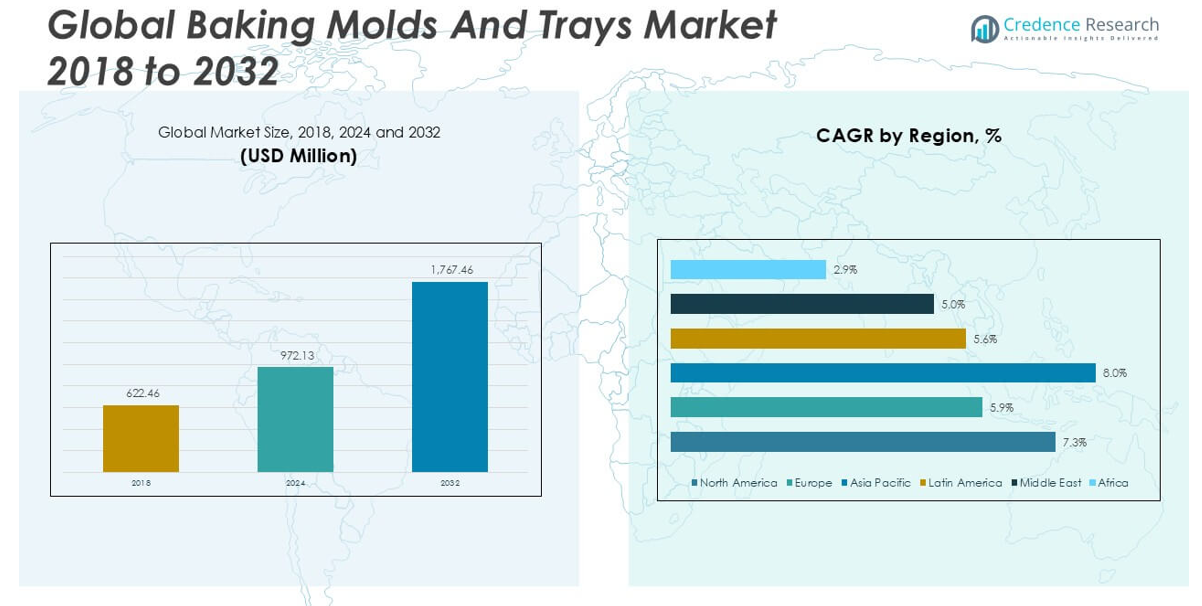
The Baking Molds and Trays market size was valued at USD 622.46 million in 2018, increased to USD 972.13 million in 2024, and is anticipated to reach USD 1,767.46 million by 2032, at a CAGR of 7.23% during the forecast period.
The Baking Molds and Trays market is driven by key players such as Northland Aluminum Products Inc., Genpak LLC, Huhtamaki BCP Ltd., iVEX Protective Packaging Inc., and Menasha Corporation. These companies focus on product innovation, sustainable materials, and ergonomic design to meet the evolving needs of both commercial and household consumers. Among regions, Asia Pacific leads the global market, accounting for 44.2% of the total market share in 2024, supported by rising demand for bakery products, increasing urbanization, and strong growth in commercial baking facilities across China, India, and Southeast Asia. North America follows as a prominent contributor, backed by an established foodservice sector and early adoption of non-stick and heat-resistant baking tools.
Market Insights
- The Baking Molds and Trays market was valued at USD 972.13 million in 2024 and is projected to reach USD 1,767.46 million by 2032, growing at a CAGR of 7.23% during the forecast period.
- Demand is primarily driven by the rising popularity of baked goods, expansion of commercial bakeries, and growing home baking trends worldwide.
- Silicone-based molds held the largest material segment share in 2024 due to their flexibility, non-stick properties, and reusability; multi-cavity trays dominated the cavity type segment owing to their efficiency in large-scale production.
- Asia Pacific led the market with a 44.2% share in 2024, followed by North America at 30.3%, driven by high bakery consumption and modern foodservice infrastructure.
- Price sensitivity, especially in emerging markets, and strict food safety regulations on materials used in baking equipment pose key restraints to new entrants and product expansion.
Market Segmentation Analysis:
By Cavity Type:
In the Baking Molds and Trays market, the multiple cavity segment dominated the category, accounting for the highest market share in 2024. This dominance is primarily driven by its efficiency in mass production and time-saving benefits in both commercial and industrial baking environments. Multiple cavity molds allow simultaneous preparation of numerous baked goods, making them ideal for large-scale operations such as commercial bakeries and food processing units. The growing preference for productivity-enhancing tools in the baking industry continues to boost the adoption of multi-cavity molds globally.
- For instance, Northland Aluminum Products Inc. reported a 38% increase in commercial orders for its 12-cavity bundt trays in 2023, driven by automation compatibility and enhanced thermal dispersion coatings used by industrial clients.
By Material
Among materials, the silicone segment held the largest market share in 2024, owing to its non-stick properties, flexibility, durability, and temperature resistance. Silicone baking molds have gained significant traction across household and commercial users due to ease of cleaning and suitability for both baking and freezing applications. Additionally, increased consumer preference for non-toxic, reusable, and eco-friendly kitchen products supports the rise in silicone usage. While metal and plastic molds still retain relevance, the expanding popularity of modern silicone variants continues to drive material innovation in the market.
- For instance, Huhtamaki BCP Ltd. developed a food-grade platinum silicone mold line in 2022 with heat tolerance up to 260°C and lifespan tested for over 1,000 baking cycles, which resulted in a 24% rise in commercial foodservice sales across Europe.
By End Use
The commercial segment emerged as the dominant end-use category, capturing the highest market share in 2024, supported by the rapid expansion of bakeries, cafes, and food chains globally. These establishments require durable, high-capacity molds and trays to meet growing consumer demand and maintain production consistency. Moreover, the increasing demand for customized and artisanal bakery products has compelled commercial users to invest in varied mold designs. Though household usage remains significant, especially with the rise in home baking trends, it is the commercial segment that drives bulk purchases and revenue growth.
Market Overview
Rising Demand for Baked Goods Worldwide
The global surge in demand for bakery products such as bread, cakes, cookies, and pastries has significantly fueled the need for baking molds and trays. Changing dietary habits, increasing urbanization, and the growth of the foodservice industry have expanded the bakery sector, particularly in developing markets. Moreover, the rising popularity of artisanal and specialty baked items has prompted commercial bakers to invest in innovative and high-capacity baking equipment. As a result, demand for both single-use and reusable molds and trays continues to grow steadily across industrial, commercial, and household settings.
- For instance, Genpak LLC expanded its baking solutions division in 2023 by integrating thermoformed tray systems for high-speed ovens, achieving distribution in 9,800 commercial bakeries across North America.
Expansion of Commercial Bakeries and QSRs
The proliferation of commercial bakeries, quick-service restaurants (QSRs), and in-store bakery outlets has emerged as a major growth driver. These establishments rely on efficient, durable, and heat-resistant baking molds and trays to maintain high-volume production and ensure product consistency. With rising investments in modern baking infrastructure and automation, commercial users are increasingly shifting toward multi-cavity, non-stick, and customizable trays. Additionally, expanding franchise models and bakery cafés in urban regions further drive bulk procurement of specialized molds tailored to standardized menus and rapid throughput.
- For instance, Menasha Corporation partnered with a major QSR chain in 2023 to supply over 650,000 custom-molded baking trays annually, designed for conveyor-belt baking systems with 99.2% shape retention after 500 cycles.
Innovation in Material Technology and Product Design
Advancements in material science have led to the development of more durable, non-toxic, and high-performance baking molds, particularly in silicone and hybrid composites. These innovations offer benefits such as enhanced thermal resistance, flexibility, and reusability, making them highly preferred over traditional materials. Manufacturers are also introducing modular designs, stackable trays, and ergonomic molds to cater to diverse baking needs. This continuous product evolution not only enhances user convenience but also encourages repeat purchases among commercial and domestic bakers aiming for quality and aesthetic appeal in baked products.
Key Trends & Opportunities
Growth in Home Baking Culture and DIY Kits
The rise in home baking, spurred by social media trends, cooking shows, and increased interest in do-it-yourself (DIY) activities, has created a substantial market opportunity. Consumers are investing in aesthetically appealing and user-friendly baking molds and trays to replicate professional-quality products at home. This trend accelerated during the COVID-19 lockdowns and continues with increasing interest in healthy, homemade bakery items. Retailers and online platforms have responded by expanding offerings of beginner-friendly molds, seasonal designs, and baking kits, presenting growth prospects for brands focused on home use segments.
- For instance, Tielman Sweden AB launched a consumer-grade line of patterned silicone cupcake molds in 2023 and sold over 2.3 million units across e-commerce platforms in the EU within nine months of launch.
Sustainability and Eco-Friendly Product Demand
Sustainability is becoming a central focus in consumer purchasing decisions. The baking molds and trays market is witnessing a shift toward reusable, recyclable, and biodegradable materials. Silicone, metal, and wood-based trays are gaining popularity as alternatives to single-use plastic molds. Brands that incorporate sustainable production practices and eco-conscious packaging are experiencing a competitive advantage. This trend not only aligns with evolving consumer values but also supports regulatory pushes toward reducing plastic waste, creating opportunities for green product innovation and market differentiation.
- For instance, iVEX Protective Packaging Inc. introduced a compostable wood-fiber-based tray series in 2023, which led to the elimination of over 420 metric tons of plastic waste annually in its partnered bakery supply chain.
Digital Commerce and D2C Expansion
The rise of e-commerce and direct-to-consumer (D2C) brands is reshaping the distribution landscape for baking molds and trays. Manufacturers are capitalizing on online channels to reach a broader customer base, particularly DIY bakers and small-scale commercial kitchens. Enhanced product visibility through social media marketing, influencer collaborations, and video tutorials is accelerating product adoption. In addition, the growing penetration of online grocery and kitchenware platforms in emerging economies creates a fertile ground for market expansion through personalized offers, reviews, and bundling strategies.
Key Challenges
Price Sensitivity Among End Users
One of the key challenges in the baking molds and trays market is the high price sensitivity of both domestic and commercial end users. While innovative and high-quality products offer superior performance, many consumers in emerging markets remain driven by cost over value. This price-conscious behavior limits the adoption of premium materials such as silicone or advanced metal composites. Manufacturers must therefore balance between cost-efficiency and product durability while maintaining profitability, often leading to trade-offs in innovation or quality.
Regulatory Compliance and Safety Standards
Compliance with stringent food safety and material certification standards poses a significant barrier, particularly for new market entrants. Baking molds and trays must adhere to safety guidelines for food contact materials, especially regarding heat resistance, chemical leaching, and toxicity. Regulatory differences across regions such as the EU, US, and Asia further complicate global product rollout. Non-compliance may result in recalls, brand reputation damage, and legal action, deterring small and mid-sized players from entering international markets or innovating at scale.
Fragmentation and Low Brand Loyalty
The market is highly fragmented with the presence of numerous small and regional manufacturers offering similar products at competitive prices. This saturation leads to minimal brand differentiation and low customer loyalty, particularly in the household segment. Consumers often make one-time purchases based on price or aesthetics rather than brand trust. As a result, leading companies face challenges in retaining customers and must continuously invest in marketing, product innovation, and customer engagement to sustain long-term growth and market share.
Regional Analysis
North America
In 2024, North America accounted for approximately 30.3% of the global Baking Molds and Trays market, with a market size of USD 294.47 million, up from USD 191.38 million in 2018. The market is projected to reach USD 537.51 million by 2032, growing at a CAGR of 7.3%. This growth is primarily driven by the strong presence of commercial bakeries, rising consumer demand for baked goods, and early adoption of innovative baking materials like silicone and non-stick metal molds. Additionally, the U.S. dominates regional revenue due to its highly developed foodservice industry and strong retail baking culture.
Europe
Europe represented around 17.0% of the global market in 2024, reaching USD 164.51 million, an increase from USD 111.70 million in 2018. It is projected to grow at a CAGR of 5.9%, reaching USD 270.81 million by 2032. The region’s market expansion is supported by a well-established bakery industry, growing emphasis on artisanal and organic baked products, and a surge in home baking trends. Germany, France, and the UK remain major contributors due to their cultural inclination toward bakery consumption and increasing consumer preference for sustainable, reusable molds in both commercial and household settings.
Asia Pacific
Asia Pacific held the largest market share of 44.2% in 2024, with a valuation of USD 430.14 million, up from USD 265.38 million in 2018. The market is forecasted to reach USD 830.91 million by 2032, at a leading CAGR of 8.0%. Rapid urbanization, growing disposable incomes, and increasing demand for convenience and packaged bakery goods are key growth drivers. Countries like China, India, and Japan are witnessing rising investment in commercial bakeries and food processing sectors. Additionally, expanding e-commerce and increasing DIY baking culture are encouraging higher consumption of baking molds and trays across the region.
Latin America
Latin America contributed around 4.7% to the global Baking Molds and Trays market in 2024, reaching USD 45.45 million, compared to USD 29.47 million in 2018. It is expected to reach USD 73.16 million by 2032, growing at a CAGR of 5.6%. The market is witnessing moderate growth due to expanding bakery chains and rising urban population. Brazil and Mexico lead the regional demand, supported by increasing consumer interest in Western-style baked products and growth in small-scale commercial baking ventures. However, economic constraints and price sensitivity continue to influence product choices, favoring cost-effective and reusable materials.
Middle East
In 2024, the Middle East accounted for approximately 3.1% of the global market, with a size of USD 25.21 million, increasing from USD 17.64 million in 2018. The market is expected to grow at a CAGR of 5.0%, reaching USD 38.77 million by 2032. The region benefits from a growing hospitality industry, particularly in the UAE and Saudi Arabia, where hotel chains and bakeries are expanding rapidly. Rising disposable income and a shift toward global food trends have increased the demand for quality baking accessories. However, limited local manufacturing results in heavy dependence on imports, affecting cost margins.
Africa
Africa represented the smallest share of the global market in 2024, holding approximately 1.3%, with a valuation of USD 12.35 million, up from USD 6.90 million in 2018. The market is anticipated to reach USD 16.30 million by 2032, growing at a CAGR of 2.9%. Growth is constrained by limited infrastructure, lower disposable income, and underdeveloped retail and foodservice sectors. Nonetheless, urban centers such as Nigeria, Kenya, and South Africa are seeing gradual uptake of baking equipment, driven by small bakeries and food entrepreneurs. Future growth will depend on economic reforms, urban expansion, and increasing awareness of modern baking solutions.
Market Segmentations:
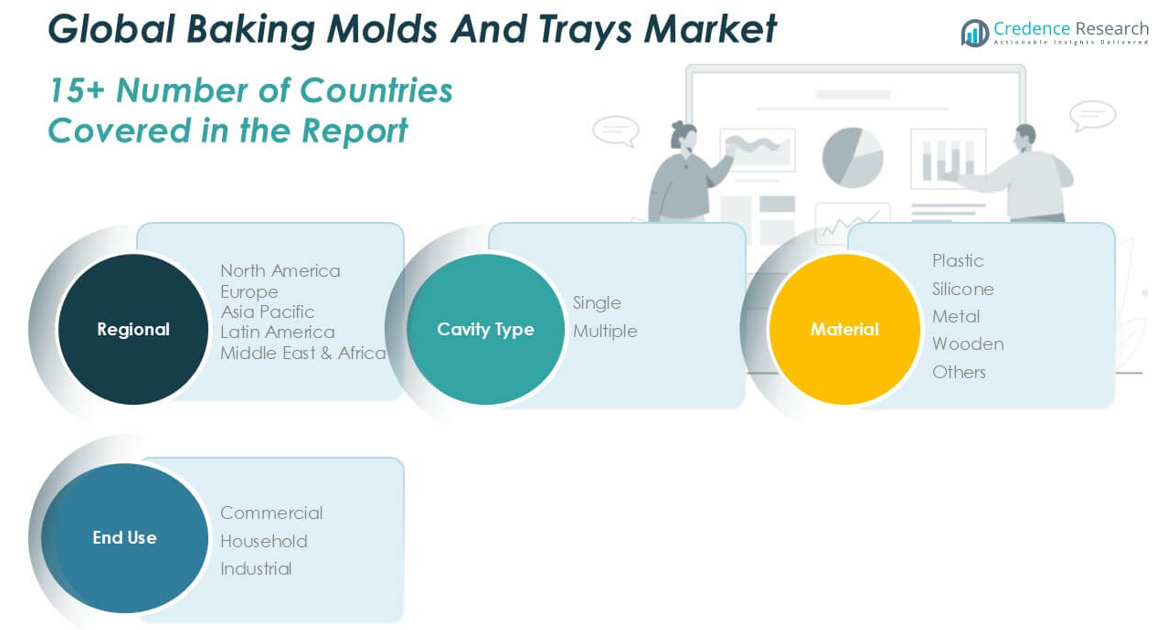
By Cavity Type
- Single
- Multiple
By Material
- Plastic
- Silicone
- Metal
- Wooden
- Others
By End Use
- Commercial
- Household
- Industrial
By Geography:
- North America
- U.S.
- Canada
- Mexico
- Europe
- Germany
- France
- U.K.
- Italy
- Spain
- Rest of Europe
- Asia Pacific
- China
- Japan
- India
- South Korea
- South-east Asia
- Rest of Asia Pacific
- Latin America
- Brazil
- Argentina
- Rest of Latin America
- Middle East & Africa
- GCC Countries
- South Africa
- Rest of the Middle East and Africa
Competitive Landscape
The Baking Molds and Trays market is moderately fragmented, with several global and regional players competing on product quality, innovation, material diversity, and pricing. Leading companies such as Northland Aluminum Products Inc., Genpak LLC, and Huhtamaki BCP Ltd. focus on expanding their product portfolios by introducing durable, heat-resistant, and food-safe materials like silicone and coated metals. Strategic collaborations with bakery chains, continuous investments in R&D, and growing emphasis on sustainability are key factors shaping competition. Regional manufacturers also play a significant role by offering cost-effective, customized solutions, especially in emerging markets. E-commerce growth has intensified market visibility and competition, enabling smaller brands to gain traction through direct-to-consumer models. To maintain a competitive edge, companies are focusing on ergonomic designs, stackability, and reusable features, addressing both commercial and household demands. As consumer preferences shift toward eco-friendly and high-performance baking tools, innovation and brand differentiation remain critical to long-term market positioning.
Key Player Analysis
- iVEX Protective Packaging Inc.
- DuraCorp LLC
- Huhtamaki BCP Ltd.
- Packaging Sales & Service Inc.
- Menasha Corporation
- Tielman Sweden AB
- Genpak LLC
- Northland Aluminum Products Inc.
- Laminating Technologies Industries LL
Recent Developments
- In June 2025, Tielman Sweden AB reaffirmed its commitment to sustainable, bakeable paper solutions for industrial bakers. This includes a range of products like baking cups, muffin wraps, tulip cups, and loaf cases, all designed with environmental responsibility in mind.
- In 2025, Laminating Technologies Industries LLC is part of a trend in the packaging industry to minimize waste and reduce costs by offering versatile trays that can be used for both baking and storage. This approach aligns with the broader movement towards sustainable packaging solutions and circular economy principles, where products are designed for reuse and minimal environmental impact.
Market Concentration & Characteristics
The Baking Molds and Trays Market exhibits moderate market concentration with a mix of global and regional manufacturers competing across material types and end-use segments. It features a diverse range of products catering to commercial, household, and industrial users, with silicone, metal, and plastic dominating the material landscape. Leading players focus on product innovation, sustainable designs, and performance enhancements to meet evolving consumer preferences. Regional manufacturers hold strong positions in price-sensitive markets, offering cost-effective solutions with limited customization. The market reflects steady demand from expanding commercial bakeries and rising interest in home baking, particularly in Asia Pacific and North America. Product differentiation is driven by durability, ease of use, heat resistance, and compatibility with modern baking equipment. Manufacturers engage in direct-to-consumer strategies, especially through e-commerce platforms, to improve accessibility and brand visibility. Regulatory compliance around food safety and material standards creates a competitive barrier, especially for new entrants. Despite fragmented competition, leading brands maintain their share through consistent quality, distribution strength, and long-term relationships with foodservice clients.
Report Coverage
The research report offers an in-depth analysis based on Cavity Type, Application, End-User and Geography. It details leading market players, providing an overview of their business, product offerings, investments, revenue streams, and key applications. Additionally, the report includes insights into the competitive environment, SWOT analysis, current market trends, as well as the primary drivers and constraints. Furthermore, it discusses various factors that have driven market expansion in recent years. The report also explores market dynamics, regulatory scenarios, and technological advancements that are shaping the industry. It assesses the impact of external factors and global economic changes on market growth. Lastly, it provides strategic recommendations for new entrants and established companies to navigate the complexities of the market.
Future Outlook
- The market is expected to witness sustained growth due to rising global consumption of bakery products across all demographics.
- Increasing preference for silicone and eco-friendly materials will drive innovation in mold and tray design.
- The home baking trend is likely to remain strong, encouraging demand for user-friendly and aesthetic baking tools.
- Commercial bakeries will continue investing in high-capacity, durable molds to enhance productivity and consistency.
- Manufacturers are expected to focus more on modular, stackable, and multi-functional designs for space-saving and efficiency.
- E-commerce and direct-to-consumer sales channels will play a crucial role in expanding market reach and consumer access.
- Sustainability concerns will push producers to reduce plastic usage and adopt recyclable or biodegradable alternatives.
- Regional players will likely increase their presence by offering cost-effective and customized solutions for local markets.
- Automation and smart baking solutions may influence future product development in industrial and commercial settings.
- Regulatory compliance and food safety standards will remain critical for market entry and long-term competitiveness.

Request a Free Sample
Fill in your details and we'll send you a free sample report.
- Sample data tables & charts
- Research methodology
Market Dynamics
Expansion of Commercial Bakeries and QSRs
The rapid growth of commercial bakeries, quick-service restaurants, and in-store bakery outlets is fueling demand for high-capacity, durable baking molds and trays, as these establishments require efficient tools to maintain production consistency and meet rising consumer demand.
Innovation in Material Technology
Advancements in materials such as silicone and hybrid composites have led to the development of more durable, non-stick, and reusable baking molds and trays, which are increasingly preferred by both commercial and household users for their performance and safety.
Growth in Home Baking Culture
The surge in home baking, driven by social media trends and increased interest in DIY activities, has boosted demand for user-friendly, aesthetically appealing baking molds and trays, especially among consumers seeking to replicate professional-quality baked goods at home.
Sustainability and Eco-Friendly Product Demand
Rising consumer awareness and regulatory pressure are driving the shift toward reusable, recyclable, and biodegradable baking molds and trays, encouraging manufacturers to innovate with sustainable materials and packaging to gain a competitive edge.
E-commerce and Direct-to-Consumer Expansion
The proliferation of online sales channels and direct-to-consumer brands has made baking molds and trays more accessible to a wider audience, accelerating market growth through enhanced product visibility, personalized offers, and convenience.
Need a Custom Version of This Report?
Tailor the scope, geography, or segments to your exact requirements.
- Custom geography or segment scope
- Direct access to our analyst team
Frequently Asked Questions
What is the current size of the Baking Molds and Trays Market?
What are the key segments within the Baking Molds and Trays Market?
What are some challenges faced by the Baking Molds and Trays Market?
Who are the major players in the Baking Molds and Trays Market?
Table of Content
Chapter 1 Market Segmentation
- 1.1 Segmentation Framework
- 1.1.1 Product and Service Classification
- 1.1.2 Application and End-Use Classification
- 1.1.3 Technology and Solution Classification
- 1.1.4 Customer and Distribution Channel Classification
- 1.1.5 Geographic Segmentation
- 1.1.6 Market Segment Definitions and Boundaries
- 1.2 By End Use
- 1.2.1 Commercial
- 1.2.2 Household
- 1.2.3 Industrial
- 1.3 By Material
- 1.3.1 Plastic
- 1.3.2 Silicone
- 1.3.3 Metal
- 1.3.4 Wooden
- 1.3.5 Others
- 1.4 By Cavity Type
- 1.4.1 Single
- 1.4.2 Multiple
Chapter 2 Introduction
- 2.1 Report Objectives and Scope
- 2.2 Product Definition and Industry Terminology
- 2.3 Market Inclusions and Exclusions
- 2.4 Research Process
- 2.4.1 Primary Research and Expert Interviews
- 2.4.2 Secondary Research and Source Review
- 2.4.3 Top-Down and Bottom-Up Estimation
- 2.4.4 Data Triangulation and Verification
- 2.5 Market Size Measurement Basis
- 2.5.1 2024: USD 972.13 million → 2032: USD 1,767.46 million
- 2.6 Historical and Forecast Reference Periods
- 2.6.1 Base Year: 2024
- 2.6.2 Forecast Period: 2024-2032
- 2.7 Research Assumptions and Limitations
Chapter 3 Executive Summary
- 3.1 Market Snapshot and Key Findings
- 3.2 Base-Year Market Size, 2024
- 3.3 Forecast Market Size, 2032
- 3.4 Revenue and Volume Growth Outlook
- 3.5 Key Demand and Supply Indicators
- 3.6 Leading Market Segments
- 3.7 Fastest-Growing Market Opportunities
- 3.8 Regional Performance Highlights
- 3.9 Technology and Industry Transformation
- 3.10 Competitive Landscape Summary
- 3.11 Analyst View and Strategic Implications
Chapter 4 Global Baking Molds and Trays Market Trends and Developments
- 4.1 Historical Industry Development
- 4.2 Recent Market Trends and Developments
- 4.3 Demand and Customer Behavior Trends
- 4.4 Technology and Product Innovation
- 4.5 Artificial Intelligence, Automation and Digitalization
- 4.6 Local Manufacturing and Supply Chain Realignment
- 4.7 Industry Partnerships, Mergers and Acquisitions
- 4.8 Sustainability and Circular Economy Developments
- 4.9 Government and Private Sector Investment Trends
- 4.10 Emerging Business Models and Commercialization
- 4.11 Industry Developments and Announcements
Chapter 5 Global Baking Molds and Trays Market Production, Supply and Demand Analysis
- 5.1 Demand Trend and Consumption Analysis
- 5.2 Demand Forecast, 2024-2032
- 5.3 Production and Output Trend
- 5.4 Production and Output Forecast, 2024-2032
- 5.5 Installed Capacity and Capacity Utilization
- 5.6 Company-Wise Production Plants and Statistics
- 5.6.1 Installed Production Capacity
- 5.6.2 Actual Production
- 5.6.3 Planned Capacity and Expansion Targets
- 5.7 Supply Chain Structure and Procurement Trends
- 5.8 Supply-Demand Gap and Bottlenecks
- 5.9 Import Dependence and Sourcing Structure
- 5.10 Contract Manufacturing and Outsourcing
- 5.11 Regional Supply and Demand Concentration
Chapter 6 Global Baking Molds and Trays Market Pricing Analysis
- 6.1 Pricing Structure and Measurement
- 6.2 Historical Pricing Trends
- 6.3 Pricing Outlook, 2024-2032
- 6.4 Average Selling Price and Unit Economics
- 6.5 Pricing by Product and Market Segment
- 6.6 Geographic Pricing Differences
- 6.7 Key Input, Energy, Labor and Logistics Costs
- 6.8 Contract Pricing and Purchasing Models
- 6.9 Pricing Sensitivity and Competitive Positioning
- 6.10 Price, Margin and Profitability Implications
Chapter 7 Global Baking Molds and Trays Market Dynamics
- 7.1 Market Growth Drivers
- 7.1.1 Demand-Side Drivers
- 7.1.2 Technology and Innovation Drivers
- 7.1.3 Infrastructure and Investment Drivers
- 7.1.4 Regulatory and Policy Drivers
- 7.2 Market Restraints
- 7.2.1 Cost and Affordability Constraints
- 7.2.2 Technology and Adoption Barriers
- 7.2.3 Supply Chain and Operational Constraints
- 7.3 Market Challenges
- 7.3.1 Competitive Pressure and Margin Erosion
- 7.3.2 Skills, Infrastructure and Implementation Gaps
- 7.4 Emerging Market Opportunities
- 7.5 Market Dynamics Impact and Time-Horizon Assessment
Chapter 8 Global Baking Molds and Trays Value Chain Analysis
- 8.1 Industry Value Chain Overview
- 8.2 Upstream Suppliers and Critical Inputs
- 8.3 Technology and Component Providers
- 8.4 Manufacturing or Service Delivery
- 8.5 Distribution, Channel Partners and Integrators
- 8.6 Downstream Applications and End Users
- 8.7 Value Addition and Profit Pools
- 8.8 Vertical Integration and Outsourcing
- 8.9 Supplier Concentration and Risk
- 8.10 Supply Chain Localization and Resilience
Chapter 9 Global Baking Molds and Trays Market Regulations and Policies
- 9.1 Relevant Laws, Standards and Compliance Frameworks
- 9.2 Product, Service, Safety and Quality Requirements
- 9.3 Government Policies, Incentives and Subsidies
- 9.4 Imports, Exports and Trade Barriers
- 9.5 Public Procurement and Local Content Requirements
- 9.6 Environmental and Sustainability Compliance
- 9.7 Upcoming Policy Changes and Market Implications
Chapter 10 Global Baking Molds and Trays Market Hotspots and Opportunities
- 10.1 Market Opportunity Mapping and Growth Hotspots
- 10.2 High-Growth Applications and Customer Groups
- 10.3 Underserved Markets and White-Space Opportunities
- 10.4 Emerging Technology and Product Opportunities
- 10.5 New Capacity and Investment Hotspots
- 10.6 Market Entry and Expansion Opportunities
- 10.7 Distribution and Partnership Opportunities
- 10.8 Near-Term and Long-Term Commercial Potential
- 10.9 Opportunity Attractiveness and Execution Risks
Chapter 11 Global Baking Molds and Trays Market Outlook, 2024-2032
- 11.1 Market Size and Analysis
- 11.1.1 Revenue (Market Measurement: 2024: USD 972.13 million → 2032: USD 1,767.46 million)
- 11.1.2 Market Volume and Quantity Sold
- 11.1.3 Historical Market Size
- 11.1.4 Base-Year Market Size, 2024
- 11.2 Market Forecast, 2024-2032
- 11.2.1 Revenue Forecast to 2032
- 11.2.2 Volume Forecast to 2032
- 11.2.3 CAGR and Year-on-Year Growth
- 11.2.4 Incremental Revenue Opportunity
- 11.3 Forecast Assumptions and Scenario Analysis
- 11.3.1 Base-Case Forecast
- 11.3.2 Optimistic and Conservative Scenarios
- 11.3.3 Technology, Pricing and Policy Sensitivities
- 11.4 Market Attractiveness and Growth Outlook
Chapter 12 Global Baking Molds and Trays Market Segmentation and Outlook
- 12.1 Segmentation Summary and Market Shares, 2024
- 12.2 Largest and Fastest-Growing Segments
- 12.3 By End Use - Market Size and Forecast, 2024-2032
- 12.3.1 Segment Definition and Scope
- 12.3.2 Historical Market Size
- 12.3.3 Revenue Forecast, 2024-2032
- 12.3.4 Volume Forecast, 2024-2032
- 12.3.5 Base-Year Market Share, 2024
- 12.3.6 Segment CAGR and Growth Drivers
- 12.3.7 Subsegment Market Size and Forecast
- 12.3.7.1 Commercial
- 12.3.7.2 Household
- 12.3.7.3 Industrial
- 12.3.8 Subsegment Pricing and Adoption Trends
- 12.3.9 Leading Suppliers and Competition
- 12.3.10 Regional Demand and Opportunities
- 12.4 By Material - Market Size and Forecast, 2024-2032
- 12.4.1 Segment Definition and Scope
- 12.4.2 Historical Market Size
- 12.4.3 Revenue Forecast, 2024-2032
- 12.4.4 Volume Forecast, 2024-2032
- 12.4.5 Base-Year Market Share, 2024
- 12.4.6 Segment CAGR and Growth Drivers
- 12.4.7 Subsegment Market Size and Forecast
- 12.4.7.1 Plastic
- 12.4.7.2 Silicone
- 12.4.7.3 Metal
- 12.4.7.4 Wooden
- 12.4.7.5 Others
- 12.4.8 Subsegment Pricing and Adoption Trends
- 12.4.9 Leading Suppliers and Competition
- 12.4.10 Regional Demand and Opportunities
- 12.5 By Cavity Type - Market Size and Forecast, 2024-2032
- 12.5.1 Segment Definition and Scope
- 12.5.2 Historical Market Size
- 12.5.3 Revenue Forecast, 2024-2032
- 12.5.4 Volume Forecast, 2024-2032
- 12.5.5 Base-Year Market Share, 2024
- 12.5.6 Segment CAGR and Growth Drivers
- 12.5.7 Subsegment Market Size and Forecast
- 12.5.7.1 Single
- 12.5.7.2 Multiple
- 12.5.8 Subsegment Pricing and Adoption Trends
- 12.5.9 Leading Suppliers and Competition
- 12.5.10 Regional Demand and Opportunities
- 12.6 Segment Growth Comparison
- 12.7 Segment Attractiveness and Priority Matrix
Chapter 13 Global Baking Molds and Trays End-Use and Application Market Outlook
- 13.1 End-Use Industry and Customer Demand Structure
- 13.2 Leading Applications and Customer Groups
- 13.3 End-Use Market Size, Share and Forecast
- 13.4 Major End-Use Industry Deep Dives
- 13.4.1 Customer Requirements and Use Cases
- 13.4.2 Demand and Replacement Cycles
- 13.4.3 Technical and Regulatory Considerations
- 13.4.4 Purchasing and Procurement Models
- 13.4.5 Leading Vendors and Distribution Channels
- 13.4.6 Forecast and Commercial Opportunities
- 13.5 Emerging Applications and Cross-Segment Demand
- 13.6 End-Use Industry Investment Priorities
Chapter 14 Global Baking Molds and Trays Geographic Market Outlook, 2024-2032
- 14.1 Regional Market Size and Share, 2024
- 14.2 Regional Market Forecast, 2024-2032
- 14.3 Regional Pricing, Production and Demand Differences
- 14.4 North America
- 14.4.1 United States
- 14.4.2 Canada
- 14.4.3 Mexico
- 14.5 Europe
- 14.5.1 Germany
- 14.5.2 France
- 14.5.3 Italy
- 14.5.4 United Kingdom
- 14.5.5 Spain
- 14.5.6 Poland
- 14.5.7 Russia
- 14.5.8 Netherlands
- 14.5.9 Belgium
- 14.5.10 Sweden
- 14.5.11 Denmark
- 14.5.12 Norway
- 14.5.13 Rest of Europe
- 14.6 Asia Pacific
- 14.6.1 China
- 14.6.2 India
- 14.6.3 Japan
- 14.6.4 South Korea
- 14.6.5 Thailand
- 14.6.6 Indonesia
- 14.6.7 Vietnam
- 14.6.8 Malaysia
- 14.6.9 Australia
- 14.6.10 Rest of Asia Pacific
- 14.7 Latin America
- 14.7.1 Brazil
- 14.7.2 Argentina
- 14.7.3 Colombia
- 14.7.4 Chile
- 14.7.5 Rest of Latin America
- 14.8 Middle East
- 14.8.1 Saudi Arabia
- 14.8.2 United Arab Emirates
- 14.8.3 Turkey
- 14.8.4 Israel
- 14.8.5 Iran
- 14.8.6 Rest of the Middle East
- 14.9 Africa
- 14.9.1 South Africa
- 14.9.2 Egypt
- 14.9.3 Nigeria
- 14.9.4 Morocco
- 14.9.5 Rest of Africa
- 14.10 Regional Investment, Policy and Supply Chain Differences
- 14.11 Regional Competitive Landscape
- 14.12 Geographic Growth Hotspots
Chapter 15 Global Baking Molds and Trays Technology, Innovation and Sustainability Outlook
- 15.1 Technology Landscape and Maturity
- 15.2 Product, Process and Service Innovation
- 15.3 AI, Automation and Digital Tools in the Industry
- 15.4 Technology Adoption and Performance Benchmarking
- 15.5 Innovation Pipeline and R&D Investment
- 15.6 Patent and Intellectual Property Trends
- 15.7 Energy Efficiency and Resource Management
- 15.8 Sustainability, Recycling and Circularity
- 15.9 Technology Roadmap, 2024-2032
- 15.10 Risks of Obsolescence and Technology Substitution
Chapter 16 Global Baking Molds and Trays Market Key Strategic Imperatives
- 16.1 Growth and Market Entry Priorities
- 16.2 High-Return Products and Segments
- 16.3 Pricing, Profitability and Cost Optimization
- 16.4 Technology Investment and Product Differentiation
- 16.5 Supply Chain Localization and Resilience
- 16.6 Distribution and Customer Acquisition
- 16.7 Partnership, Acquisition and Capacity Strategy
- 16.8 Regional Expansion Priorities
- 16.9 Short-, Medium- and Long-Term Actions
Chapter 17 Competition Outlook
- 17.1 Industry Competition Characteristics
- 17.2 Market Structure and Concentration
- 17.3 Market Share and Competitive Positioning, 2024
- 17.4 Company-Wise Revenue and Product Benchmarking
- 17.5 Production and Service Capacity Benchmarking
- 17.6 Technology, Pricing and Differentiation
- 17.7 Regional Footprint and Distribution Strength
- 17.8 Mergers, Acquisitions and Strategic Alliances
- 17.9 New Entrants and Competitive Threats
- 17.10 Porter's Five Forces and Industry Attractiveness
- 17.11 Competitive Outlook, 2024-2032
Chapter 18 Company Profiles
- 18.1 Company Coverage and Selection Criteria
- 18.2 Northland Aluminum Products Inc.
- 18.2.1 Business Description
- 18.2.2 Company Ownership and Geographic Presence
- 18.2.3 Product and Service Portfolio
- 18.2.4 Manufacturing and Operating Footprint
- 18.2.5 Production Capacity and Expansion Plans
- 18.2.6 Financial Performance and Investment
- 18.2.7 Market Share and Competitive Position
- 18.2.8 Technology and Innovation Capabilities
- 18.2.9 Strategic Alliances or Partnerships
- 18.2.10 Recent Developments
- 18.2.11 Growth Strategy and Outlook
- 18.3 Genpak LLC
- 18.4 Huhtamaki BCP Ltd.
- 18.5 iVEX Protective Packaging Inc.
- 18.6 Menasha Corporation
- 18.7 Tielman Sweden AB
- 18.8 DuraCorp LLC
- 18.9 Packaging Sales & Service Inc.
- 18.10 Laminating Technologies Industries LLC
- 18.11 Other Relevant Market Participants
Note: Every listed company is profiled on the structure shown under the first company. The company list is preliminary and may change based on research findings, market developments, data availability and client requirements.
Chapter 19 Disclaimer
- 19.1 Research and Forecast Disclaimer
- 19.2 Data Source and Estimation Limitations
Note: The depth of individual sections depends on data availability for this market. Volume, capacity, trade and other unit-based metrics are included where applicable.