
Imported fabric and export orders shape mill demand
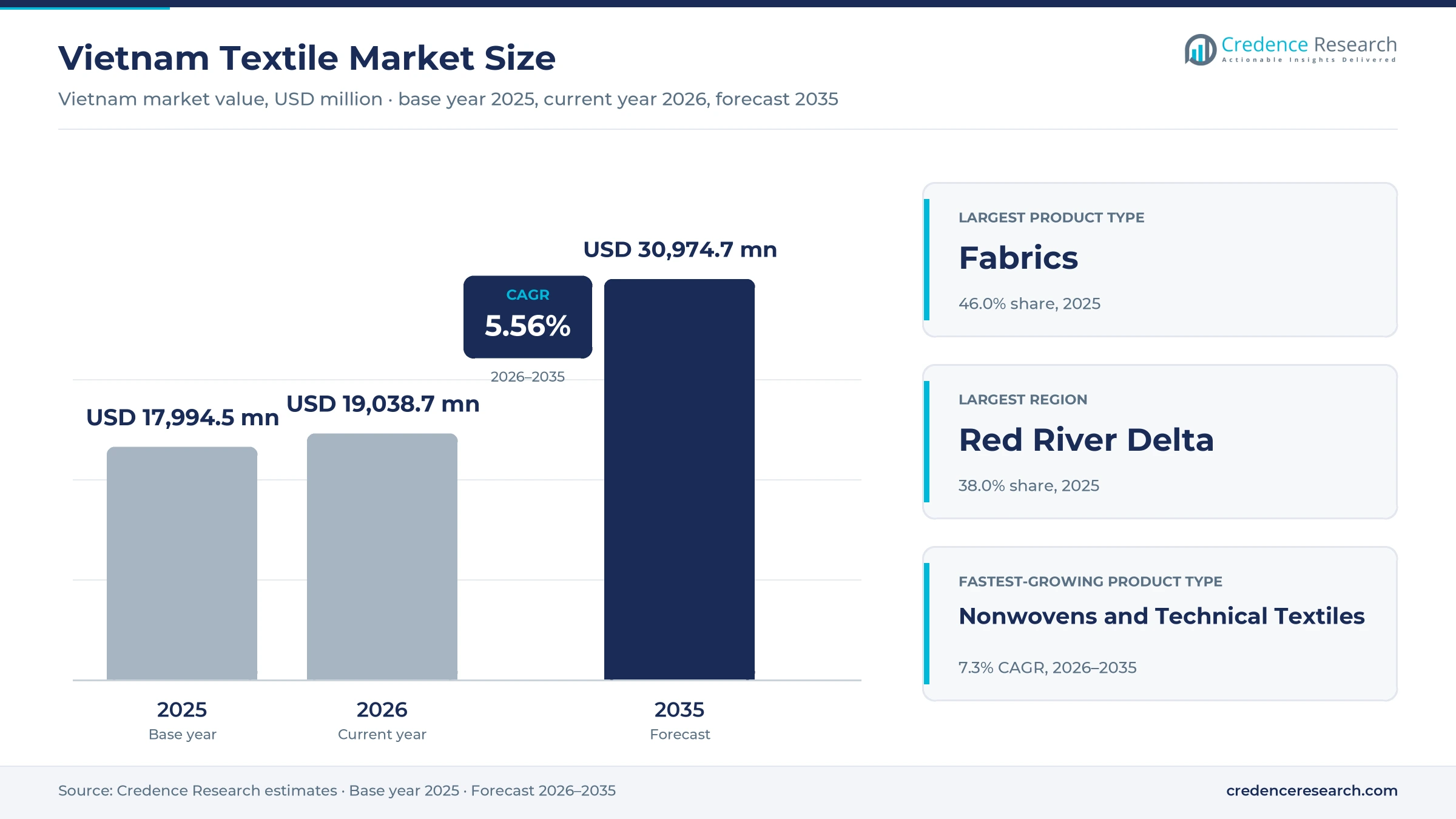
The Vietnam textile market was valued at USD 17.99 billion in 2025 and is projected to increase from USD 19.04 billion in 2026 to USD 30.97 billion by 2035, registering a CAGR of 5.56% during 2026–2035. Demand comes from export garment factories that cut and sew for U.S., European and Asian brands, from home textile and industrial users, and from a fast-growing nonwoven segment for hygiene and medical products. The Red River Delta held 38.0% of 2025 value, the largest regional share, because large spinning parks in Quang Ninh, Ninh Binh (formerly Nam Dinh) and Hung Yen sit close to Hai Phong port and the Chinese border. The North Central and Central Coast is the fastest-growing region at 6.4% a year, as new fabric and recycling projects move into Thanh Hoa, Nghe An and Gia Lai, which absorbed Binh Dinh in July 2025. On the trade side, a U.S. reciprocal tariff and a separate penalty on transshipped goods have raised the value of locally made yarn and fabric that can prove origin.
Fiber, yarn, fabric and nonwoven sales form one estimate
The estimate measures the value of fibers, yarns, woven and knitted fabrics, nonwovens and technical textiles sold by mills, traders and importers to users in Vietnam, plus the yarn and fabric that Vietnamese mills ship abroad. Most buyers are garment factories that order fabric by the meter and yarn by the ton, while home textile, industrial and hygiene producers buy rolls and specialty grades.
The estimate excludes finished garments, footwear, retail carpets and textile machinery. Yarn consumed inside an integrated mill is counted only within the fabric it becomes, so no input is counted twice. The value chain runs from imported cotton and polyester chips through spinning, weaving or knitting and dyeing to the cut-and-sew factories that make the final garments.
Vietnam Textile Market Insights
- The Vietnam textile market was valued at USD 17.99 billion in 2025 and is projected to reach USD 30.97 billion by 2035, registering a CAGR of 5.56% during 2026–2035.
- The Red River Delta held 38.0% of 2025 value, because Texhong, which produces about 25% of national yarn output, runs its main park in Quang Ninh.
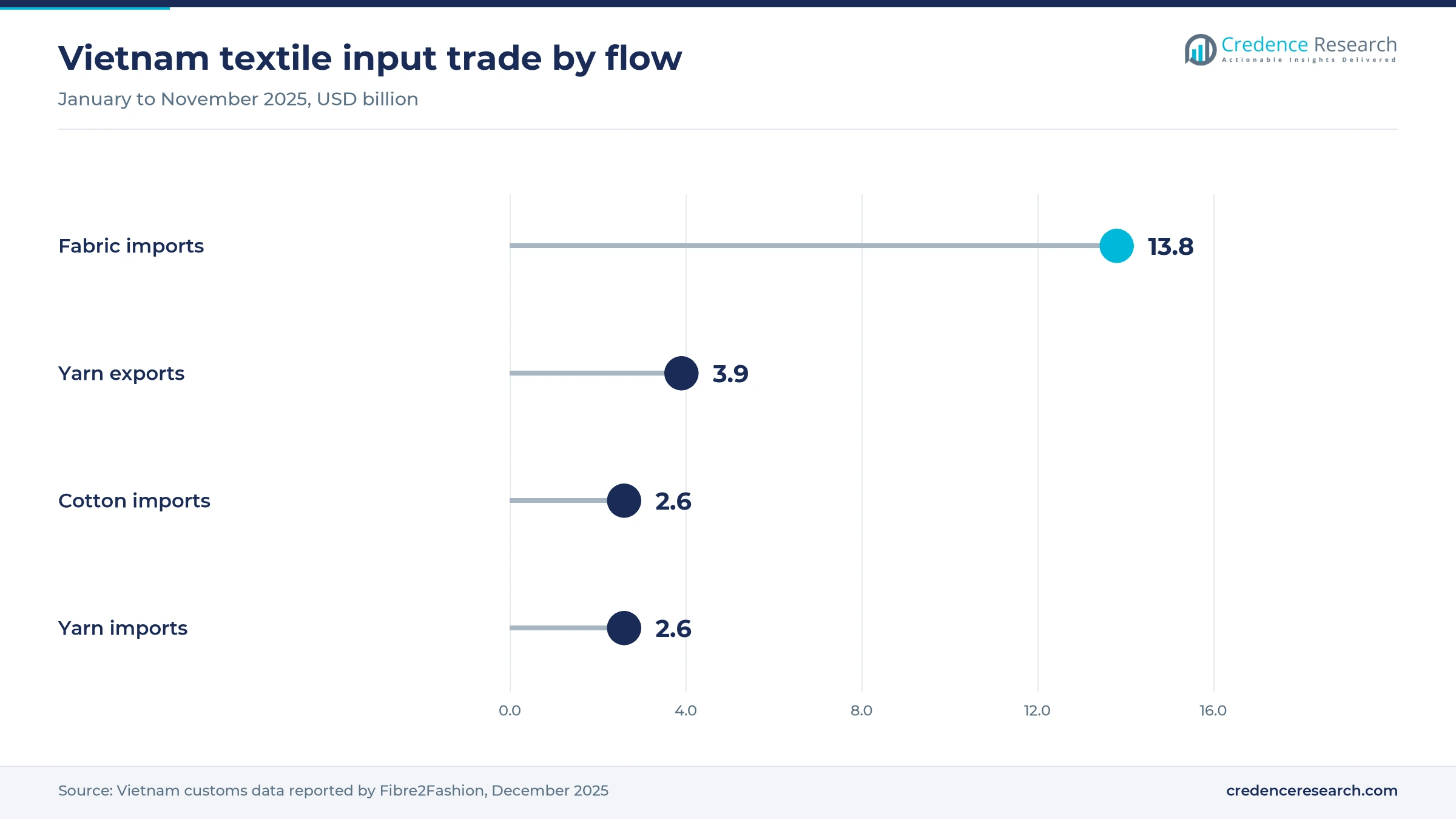
- Fabrics led product types with 46.0% of 2025 value, because Vietnam imported USD 15.2 billion of fabric in 2025 while local mills met only 36% of fabric demand.
- Century Synthetic Fiber opened its Unitex plant in Tay Ninh on Jan. 23, 2026, with design capacity of 60,000 tons of fiber and 15,000 tons of fabric a year.
- A 20% U.S. tariff on Vietnamese goods took effect on Aug. 7, 2025, with an extra 40% on transshipped goods, which rewards mills that document local yarn and fabric.
Fabrics lead while nonwovens and recycling grow fastest
Why do fabrics take the largest share of mill sales?
Based on product type, the market is categorized into fibers, yarns, fabrics and nonwovens and technical textiles. Fabrics led with 46.0% of 2025 value, because garment factories bought about USD 15.2 billion of imported fabric in 2025 and domestic mills covered only 36% of fabric demand, according to VietnamPlus. Nonwovens and Technical Textiles grow fastest at 7.3% a year, as exports of fibers, fabrics, accessories and nonwovens rose between 5.6% and 10.6% in the first half of 2026 while garment exports fell 0.4%, according to Viet Nam News. Mills that add nonwoven lines sell into a segment that is less tied to apparel orders.
How much of textile demand depends on apparel factories?
Based on end-use industry, the market is categorized into apparel manufacturing, home textiles, industrial manufacturing and medical and hygiene. Apparel Manufacturing led with 72.0% of 2025 value, because apparel made up about 80% of textile and garment export revenue, around USD 36.6 billion in 2025, according to Vietnam Economic News. Medical and Hygiene grows fastest at 7.1% a year, as Winner Medical received an investment certificate on Jan. 7, 2026, for a USD 60.5 million plant in Quang Ninh making bandages, wound care and surgical supplies. Local demand for medical-grade fabric and nonwovens rises as such plants ramp up.
Which customers buy most of the yarn and fabric?
Based on customer type, the market is categorized into export-oriented garment manufacturers, domestic apparel brands, home textile producers and technical textile converters. Export-Oriented Garment Manufacturers led with 64.0% of 2025 value, because domestic consumption of textiles and garments is only about USD 5 billion to 5.5 billion a year, far below exports, according to the Vietnam Chamber of Commerce and Industry. Technical Textile Converters grow fastest at 6.5% a year, as Far Eastern Polytex raised its investment in Ho Chi Minh City's former Binh Duong area to USD 1.54 billion, including super fiber for seat belts, tires and airbags, according to The Investor. Such converters pay more per ton than apparel mills do.
Which processing stage adds the most value?
Based on technology, the market is categorized into spinning, weaving and knitting, dyeing and finishing, and recycling and functional finishing. Weaving and Knitting led with 34.0% of 2025 value, because fabric formation adds more value per ton than spinning, and new plants are large, such as Toray's Top Textiles mill in Ninh Binh province, formerly Nam Dinh, which opened in July 2024 with 60 million meters of fabric a year. Recycling and Functional Finishing grows fastest at 7.9% a year, as Century Synthetic Fiber expects recycled fiber to make up about 68% of its 2026 sales across three plants, according to The Investor. Brand recycled-content targets from export customers keep this demand rising each year.
| Segment Group | Leading Sub-segment | Share, 2025 | Fastest-growing Sub-segment | CAGR, 2026–2035 |
|---|---|---|---|---|
| By Product Type | Fabrics | 46.0% | Nonwovens and Technical Textiles | 7.3% |
| By End-Use Industry | Apparel Manufacturing | 72.0% | Medical and Hygiene | 7.1% |
| By Customer Type | Export-Oriented Garment Manufacturers | 64.0% | Technical Textile Converters | 6.5% |
| By Technology | Weaving and Knitting | 34.0% | Recycling and Functional Finishing | 7.9% |
Cotton, polyester and power costs set mill prices
Yarn is priced per ton or per kilogram off the cotton or polyester feedstock cost plus a conversion spread for power, labor and depreciation, while fabric is quoted per meter or per kilogram for each construction and finish. Feedstock moves most of the price, so mills reprice quickly when cotton futures or oil-linked PET fiber shift. Export yarn averaged only about USD 520 a ton above imported cotton in the first 11 months of 2025, which leaves spinners exposed when Chinese buyers push prices down. Dyed fabric, technical grades and certified recycled yarn carry wider spreads, so margins sit with mills that move beyond commodity yarn.
| Product or cost item | Typical price or fee | Basis |
|---|---|---|
| Yarn exports, average unit value | About USD 2,214 a ton | Credence Research calculation from customs data for January to November 2025 reported by Fibre2Fashion |
| Cotton imports, average unit value | About USD 1,690 a ton | Credence Research calculation from customs data for January to November 2025 reported by Fibre2Fashion |
| Yarn imports, average unit value | About USD 2,177 a ton | Credence Research calculation from customs data for January to November 2025 reported by Fibre2Fashion |
| Average retail electricity price | VND 2,204.07 per kWh from May 10, 2025 | Vietnam Electricity, May 2025 |
| Ocean freight, 40-foot container | USD 4,500 to 5,200, up nearly 30% | Vinatex market seminar, April 2026 |
Request a Free Sample
Fill in your details and we'll send you a free sample report.
- Sample data tables & charts
- Research methodology
Export scale, origin rules and localization lift demand
How does export scale anchor demand for yarn and fabric?
The garment export base is the main buyer of yarn, fabric and trims, so its size sets the floor for textile demand in Vietnam. Textile and garment exports reached about USD 46 billion in 2025, with a trade surplus near USD 21 billion, as reported by Viet Nam News. Fiber and yarn made up 9.4% of that export revenue and fabric about 6%, according to Vietnam Economic News, so local mills also sell abroad rather than only to local cutters. Export-oriented garment manufacturers hold 64.0% of 2025 value, and each additional order pulls more fabric through local warehouses and dye houses.
Trade agreement access rewards mills that prove origin
Free trade agreements pay off only when yarn and fabric come from approved origins, which pushes garment makers toward local or partner-country textiles. Under the CPTPP yarn-forward rule, yarn and fabric must be made inside member countries, with a short supply list of 187 tariff lines as the main exception, according to Vietnam Economic News. Exports to CPTPP markets rose from USD 6.27 billion in 2018 to USD 8.3 billion in 2025, yet fewer than 10% of shipments used preferential certificates, according to VietnamPlus. In the United States, a 20% tariff took effect on Aug. 7, 2025, with an extra 40% on transshipped goods, as summarized by the Vietnam Chamber of Commerce and Industry. Each rule raises the premium on documented Vietnamese yarn and fabric.
Can localization policy pull spinning and dyeing investment?
Government and industry targets aim to replace imported fabric with local supply, which channels new capital into spinning, weaving and dyeing. The Vietnam Textile and Apparel Association reports a localization rate of about 52% and targets more than 60% by 2030, alongside exports of USD 64.5 billion. Texhong, which produces about 25% of national yarn output, has invested more than USD 1.8 billion in 16 projects, according to Viet Nam News in August 2026. Its Hai Ha park in Quang Ninh covers 660 hectares and hosts 27 investments with USD 3 billion of registered capital, according to The Investor. Such clusters let fabric and dyeing tenants share wastewater plants and utilities that single mills could not fund alone.
Cotton imports feed a spinning base that keeps expanding
Cotton spinners depend almost entirely on imported raw cotton, so cotton import volumes give a direct read of yarn demand. The U.S. Department of Agriculture forecast Vietnam's cotton imports to rise 6% to 7.6 million bales in the 2025/26 marketing year, with Brazil now the largest supplier. Customs data show cotton imports of 1,550,666 tons in the first 11 months of 2025, up 13.1% in volume, as reported by Fibre2Fashion. Vietnam also became the largest buyer of U.S. cotton in 2025, with purchases of about USD 1.3 billion, according to Tuoi Tre. Rising fiber intake supports yarn output for both local weavers and export buyers in China.
Recycled fiber and integrated dyeing reshape supply
Shift to recycled polyester and cotton fiber
Recycled fiber is moving from pilot lines to commercial plants, because brands want recycled content and traceable inputs from their Asian suppliers. Swedish company Syre signed a memorandum with Binh Dinh province in 2025 for a USD 1 billion plant with 250,000 tons of annual capacity, expected to run by the end of 2028, according to Fibre2Fashion. Recover planned to start a recycled cotton fiber plant in Dong Nai in early 2025 with two lines and 10,000 tons a year, Just Style reported. Phong Phu, a Vinatex member company, already sells open-end recycled yarn alongside linen-blend and slub yarns. Recycled polyester filament yarn and cotton grades let mills charge above virgin commodity prices.
Rise of integrated weaving, dyeing and finishing mills
Fabric investment is shifting toward plants that weave or knit, dye and finish under one roof, which cuts lead times and helps garment makers meet origin rules. Thai Tuan Group opened a USD 172 million fabric factory in Long An, now part of Tay Ninh, in February 2025, designed for 60 million meters a year, according to Vietstock. Nghe An approved a USD 590 million project by Mega Textile, a Best Pacific unit, in November 2024, for 67,200 tons of fabric and 7,200 tons of colored yarn a year. Phong Phu plans an integrated weaving, dyeing and finishing line in 2026, according to Vinatex. Integrated mills can bid for full-package orders that cut-make-trim factories cannot serve.
Can hygiene and medical nonwovens become a new outlet?
Hygiene and medical products give mills a buyer base that depends less on fashion cycles, which makes nonwovens an opening for new capacity. Winner Medical plans 5.6 million medical bandages and 6.49 million surgical supply units a year at its Quang Ninh plant, which is due to be fully operational by December 2027, according to The Investor. The second GENTEXH exhibition in Ho Chi Minh City in March 2026 drew more than 120 companies from 10 countries and territories, according to Viet Nam News. Medical and hygiene uses grow fastest by end use at 7.1% a year. Suppliers of nonwoven materials can sign long-term contracts with these converters.
Domestic brands open a second market for local fabric
The home market is small compared with exports, but it is the one channel where Vietnamese mills face no origin tests or foreign tariffs. The Vietnam Chamber of Commerce and Industry notes that the population now exceeds 100 million and that domestic products have not yet secured a firm foothold against international brands. The industry targets domestic revenue of USD 8 billion to USD 9 billion by 2030, well above current consumption. Local brands that make ready-made garments in short runs need fabric delivered in days rather than the weeks imported rolls take. Mills with small-lot dyeing and stock fabric programs can win these accounts.
Thin yarn margins and rising power costs squeeze mills
Why are yarn margins thin despite rising volumes?
Yarn mills are selling more tons for less money, which squeezes margins at the stage where Vietnam is most self-sufficient. Yarn exports rose 2.9% in volume to 1,760,126 tons in the first 11 months of 2025 but fell 3.1% in value, according to customs data reported by Fibre2Fashion. China took 49.47% of shipments, so Chinese demand largely sets the price. Vinatex said its yarn units produced about 130,000 tons in 2025, below realizable capacity. Mills respond by shifting output toward specialty counts and recycled blends.
Power and wage increases lift conversion costs
Spinning, weaving and dyeing are energy-intensive and labor-intensive, so utility and wage decisions move unit costs quickly. Vietnam Electricity raised the average retail power price by 4.8% to VND 2,204.07 per kWh from May 10, 2025. The regional minimum wage then rose an average 7.2% from Jan. 1, 2026, according to Fibre2Fashion. Mills with rooftop solar, automated spinning frames and higher output per worker absorb these increases better than older lines.
Heavy reliance on Chinese fabric limits value capture
Imported inputs still dominate the fabric stage, which caps local value added and exposes garment makers to origin audits. Imported raw materials make up 60% to 70% of total inputs, according to Viet Nam News in July 2026. China supplied about 68.4% of the USD 11.23 billion of fabric imported in the first nine months of 2025, according to customs data compiled by The Shiv. Scarce dyeing permits slow substitution, so new mills cluster in parks with central wastewater treatment.
Feedstock and freight swings unsettle 2026 pricing
Oil-linked fiber prices and freight costs became volatile again in 2026, which makes forward pricing of yarn and fabric harder. PET resin and PET fiber prices rose more than 20% from early March 2026, according to The Investor's report on Century Synthetic Fiber. Vinatex reported cotton above 70 cents per pound from late March and 40-foot container rates of USD 4,500 to USD 5,200, up nearly 30%. Mills hedge by buying fiber cautiously and shortening price validity.
Red River Delta leads as central provinces grow fastest
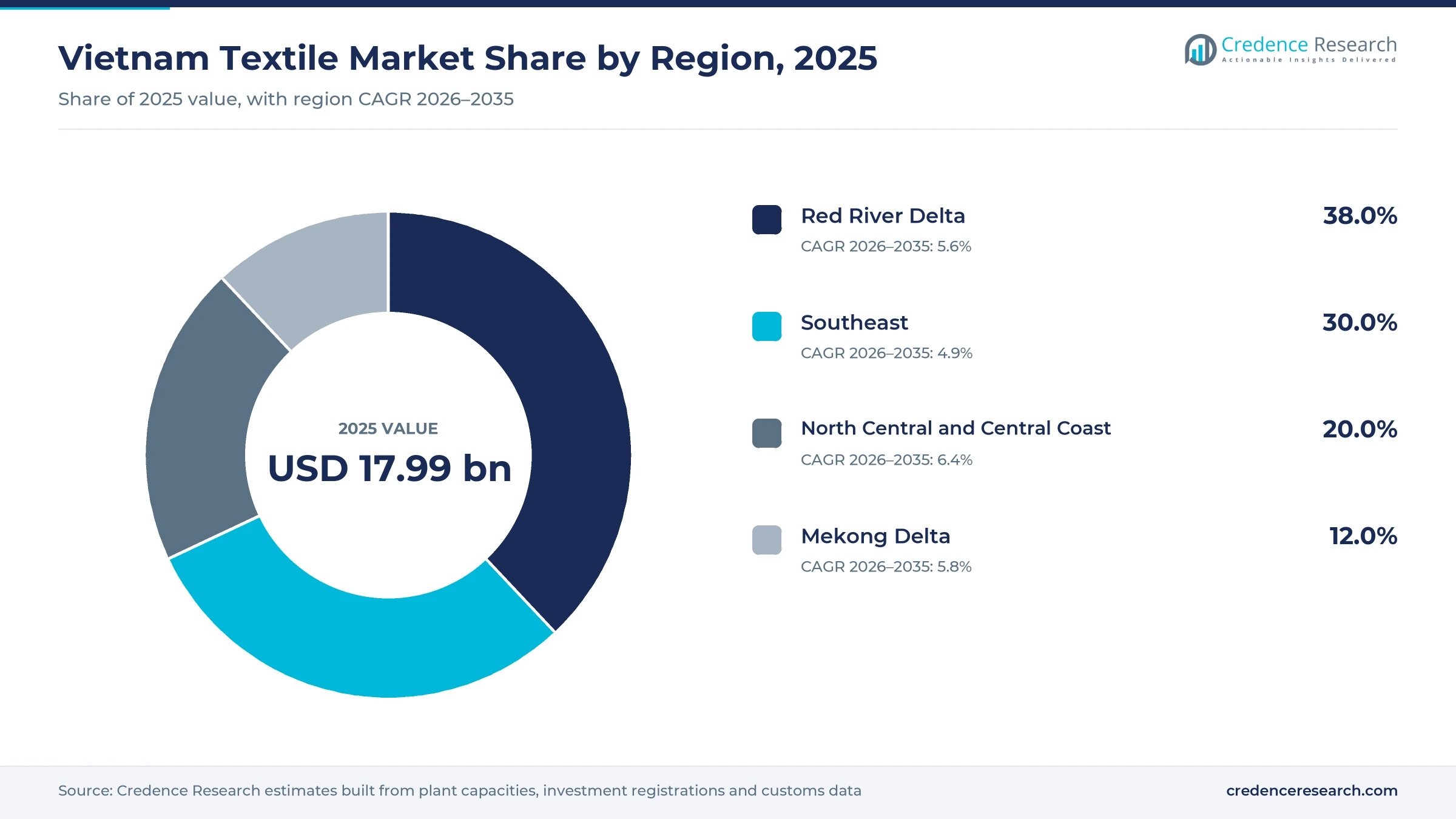
The Vietnam textile market is split into four economic regions that follow where spinning parks, dyeing clusters and garment factories sit. Regions follow the provincial map in use before the July 2025 mergers. Regional shares and growth rates are Credence Research estimates built from investment registrations, plant capacities and trade data.
| Region | Value, 2025 (USD billion) | Share, 2025 | CAGR, 2026–2035 |
|---|---|---|---|
| Red River Delta | 6.84 | 38.0% | 5.6% |
| Southeast | 5.40 | 30.0% | 4.9% |
| North Central and Central Coast | 3.60 | 20.0% | 6.4% |
| Mekong Delta | 2.16 | 12.0% | 5.8% |
Why does the Red River Delta lead mill demand?
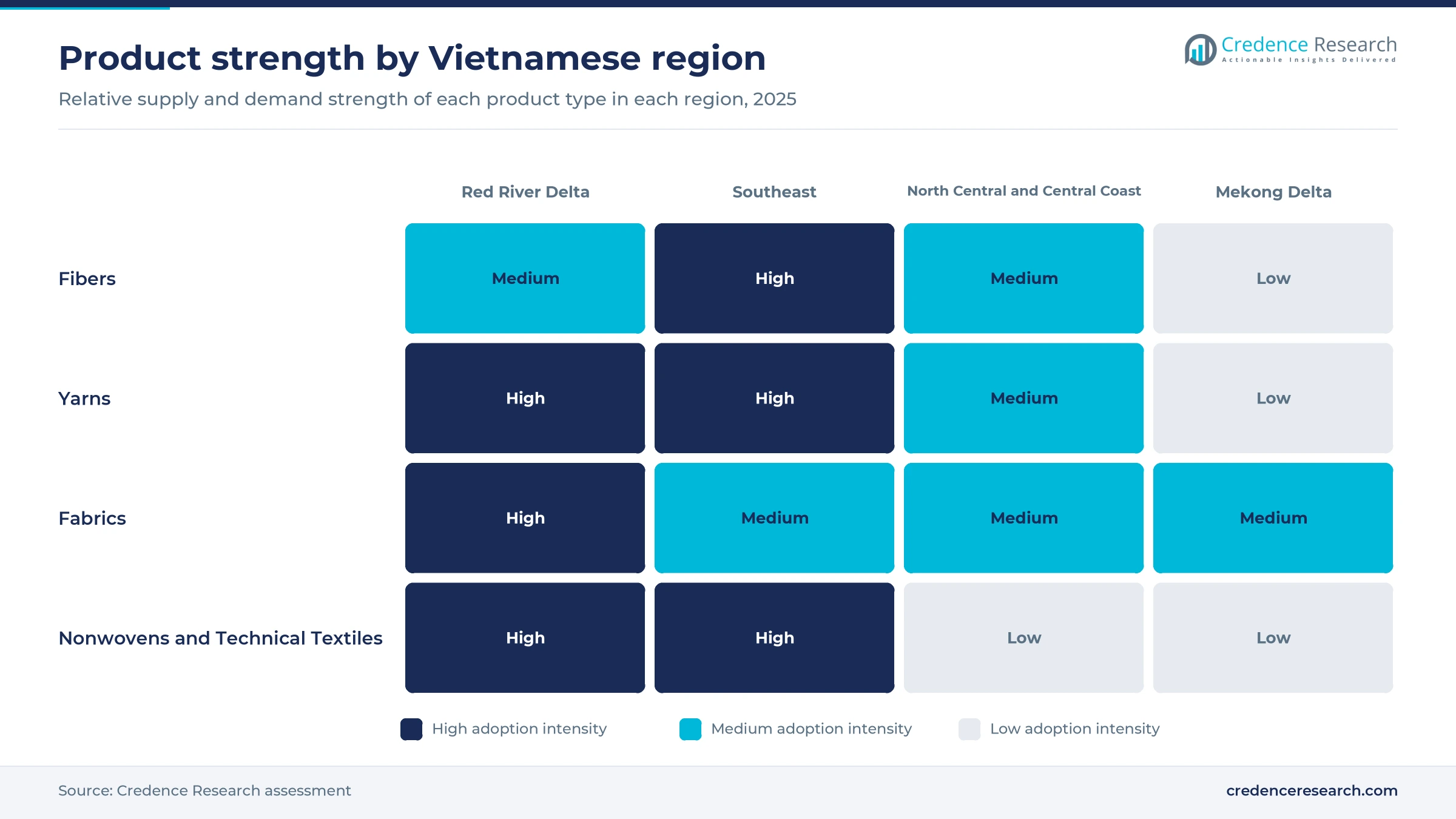
The Red River Delta held 38.0% of 2025 value and grows at 5.6% a year, because it combines large spinning parks with dense garment clusters near Hai Phong port and the Chinese border. Tenants of the Texhong Hai Ha park in Quang Ninh employ about 14,000 workers, according to The Investor. Toray's Top Textiles plant at the Rang Dong park in Ninh Binh province, formerly Nam Dinh, plans to double fabric output to 120 million meters a year in its second phase. Damsan in Hung Yen and Hanosimex in Hanoi add cotton and blended yarn capacity.
Southeast mills lead in synthetic and recycled fiber
The Southeast held 30.0% of 2025 value and grows at 4.9% a year, slower than the national pace as new spinning and fabric projects increasingly go north and to the central coast. Its strength is synthetic fiber and finishing, led by Far Eastern Polytex in Ho Chi Minh City's former Binh Duong area and Century Synthetic Fiber's plants in Cu Chi and Tay Ninh. Thanh Cong lists capacity of 31.5 million meters of dyed fabric and 8,000 tons of knitted fabric a year after buying a Dong Nai factory, according to Enterprise Forum.
New fabric projects lift the central provinces
The North Central and Central Coast held 20.0% of 2025 value and grows fastest at 6.4% a year, because the newest large fabric and fiber projects are being placed in its economic zones. Singapore's Billion Union broke ground on a USD 70 million plant in the Nghi Son Economic Zone of Thanh Hoa on Feb. 17, 2025, for 18,000 tons of fabric a year, according to The Investor. The Mega Textile project in Nghe An and the Syre recycling plan in Gia Lai, formerly Binh Dinh, both noted above, add capacity later in the decade.
Mekong Delta mills supply fabric to southern garment makers
The Mekong Delta held 12.0% of 2025 value and grows at 5.8% a year, from the smallest base among the four regions. Its largest recent addition is the Thai Tuan fabric factory noted above, in Duc Hoa in the former Long An province, which merged into Tay Ninh on July 1, 2025. Mills here sell mainly woven fabric to garment factories in the southern provinces, so their growth follows southern export orders.
Fabric, recycling and tariff milestones, 2024–2026
| Development | Status and market relevance |
|---|---|
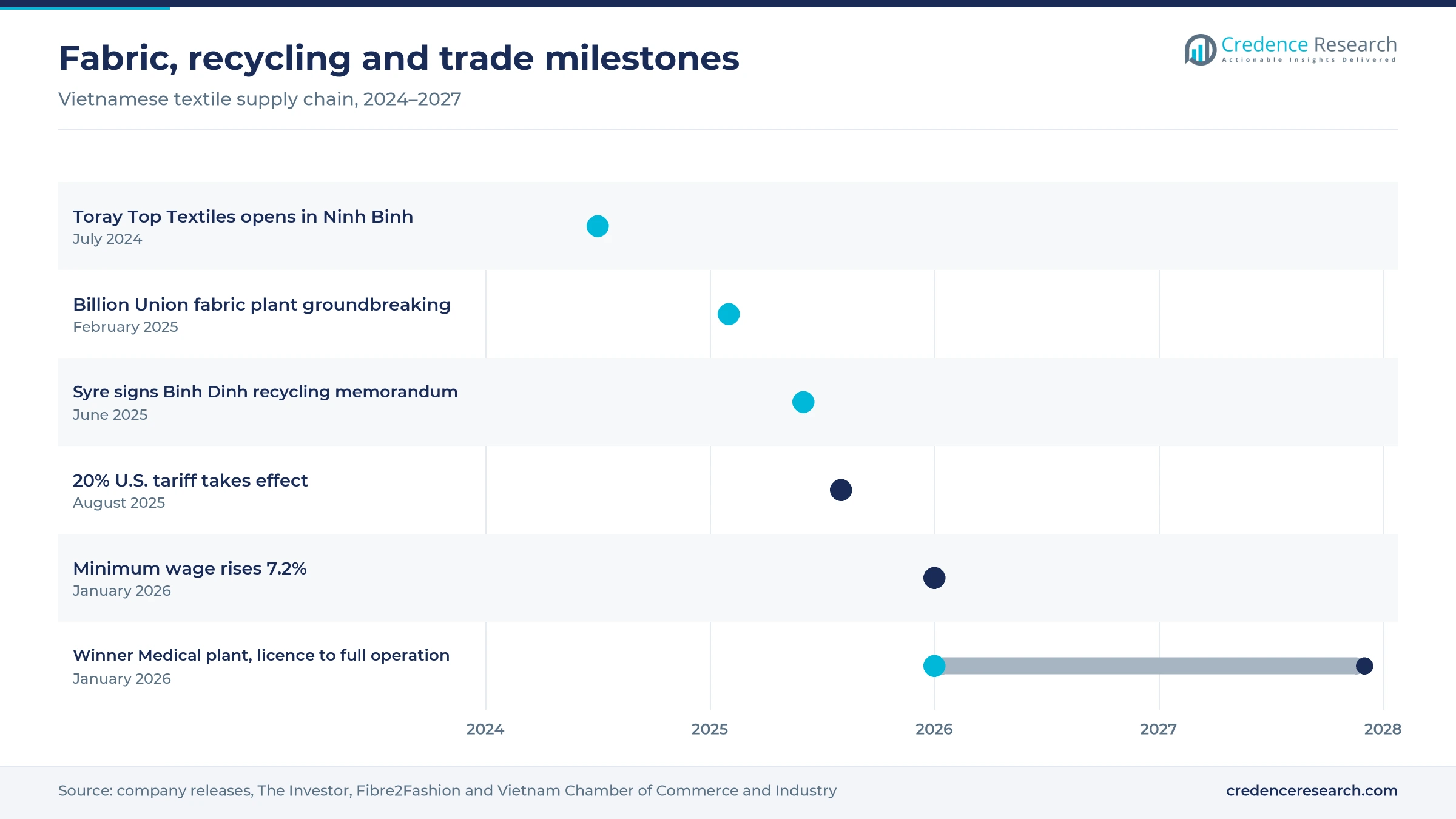
| In February 2025, Billion Union broke ground on a USD 70 million fabric plant in Thanh Hoa with 18,000 tons of annual capacity. | Central coast fabric capacity under construction |
| In March 2025, Texhong scaled back the planned expansion of its Hai Ha industrial park in Quang Ninh after land-use changes were rejected. | Existing park keeps operating |
| In June 2025, Syre signed a memorandum with Binh Dinh province for a USD 1 billion textile recycling plant. | Planned to operate by the end of 2028 |
| In August 2025, the United States applied a 20% tariff to Vietnamese goods, with an extra 40% on transshipped goods. | Raises the value of documented local origin |
| In January 2026, Century Synthetic Fiber inaugurated its Unitex fiber and fabric plant in Tay Ninh, with a first phase of 36,000 tons. | Phase one operating, phase two pending |
Spinning, dyeing and tracking technologies set costs
- Compact and open-end spinning lets mills switch between fine combed cotton counts and recycled open-end yarns on the same site, which protects utilization when one grade weakens.
- Air-jet weaving and circular knitting set fabric output per worker, which matters more each year as minimum wages rise.
- Low-liquor dyeing and central wastewater treatment cut water and chemical use per kilogram, and they decide which parks can host new dyeing capacity and finishing chemicals suppliers.
- Polyester recycling and spin-dyeing turn bottle flake and fabric waste into fiber and colored yarn, which brands count toward recycled-content goals.
- Origin tracking systems record yarn and fabric lots through QR and ERP codes, as garment maker TNG now does, so exporters can prove CPTPP and U.S. origin.
Need a Custom Version of This Report?
Tailor the scope, geography, or segments to your exact requirements.
- Custom geography or segment scope
- Direct access to our analyst team
State-linked mills and Asian investors compete for orders
Competition in the Vietnam textile market runs on three fronts, namely cost per ton in commodity yarn, lead time and origin documentation in fabric, and certification in recycled and technical grades. Vinatex, through member mills such as Phong Phu, Viet Thang, Hanosimex and Nam Dinh Textile Garment, is the largest domestic group, while Texhong leads foreign-invested spinning. Far Eastern Polytex and Century Synthetic Fiber compete in polyester fiber and filament yarn. Hyosung TNC supplies spandex and its PTMG raw material from Dong Nai and began commercial output at a 50,000-ton bio-BDO plant in Ho Chi Minh City in August 2026, according to Vietstock. Toray's Top Textiles and Thai Tuan add large woven fabric capacity in the north and south. Thanh Cong sells woven, dyed and knitted fabric mainly to Korean and Japanese buyers, and Damsan competes in cotton yarn. Buyers shortlist mills with stable quality, compliance audits and fast sampling.
State-linked groups and Asian investors split supply
Supply is split between the Vinatex system of state-linked mills and foreign-invested spinners and fiber makers from China, Taiwan, Japan and Singapore. Vinatex runs 22 yarn factories across three regions through 12 member units, while Texhong alone produces about a quarter of national yarn. Spinning is concentrated and capital-heavy, but weaving, knitting and dyeing remain fragmented and short of capacity, which is why local fabric covers only about a third of demand. Entry barriers are wastewater permits, power supply and buyer audits, and margins sit with integrated mills that dye and finish.
Companies profiled and their roles in this market
| Company | Type | Role in the market |
|---|---|---|
| Vietnam National Textile and Garment Group (Vinatex) | State-linked integrated group | Yarn, fabric and home textiles through members such as Phong Phu, Viet Thang and Hanosimex |
| Texhong Textile Group Limited | Foreign-invested spinner | Cotton and blended yarn, about a quarter of national yarn output |
| Far Eastern Polytex (Vietnam) Limited | Integrated polyester producer | Polyester fiber, dyed products and super fiber in Ho Chi Minh City (former Binh Duong) |
| Century Synthetic Fiber Corporation | Synthetic filament yarn maker | Virgin and recycled POY, DTY and FDY yarn, plus finished fabric at Unitex |
| Toray Industries (Top Textiles) | Foreign-invested fabric mill | Woven fabric weaving and dyeing at the Rang Dong park in Ninh Binh |
| Thanh Cong Textile Garment Investment Trading JSC | Integrated fabric and garment maker | Woven, dyed and knitted fabric, mainly for Korean and Japanese buyers |
| Thai Tuan Group | Domestic fabric mill | Woven fabric from its Duc Hoa factory for apparel buyers |
| Hyosung TNC (Hyosung Group) | Foreign-invested fiber maker | Spandex and PTMG from Dong Nai plants, plus bio-BDO in Ho Chi Minh City |
| Damsan JSC | Domestic spinner | Cotton and textile yarns and woven fabric from Hung Yen |
Local fabric will outgrow garment exports
Credence Research's view is that the Vietnam textile market will grow faster than garment exports, because origin rules and the U.S. transshipment penalty reward every ton of fabric made locally. Spinning is already close to self-sufficient, so the gain will come from weaving, knitting, dyeing and recycled fiber, where most new projects are being built. Fabrics keep the largest share at 46.0% of 2025 value, while nonwovens and technical textiles grow fastest at 7.3% a year. The central provinces gain share as their new fabric and fiber plants open. Winners will be integrated mills with dyeing permits, traceable inputs and access to reliable, affordable power.
Customs, cotton and plant data anchor the estimate
The report uses 2025 as the base year on a calendar basis, and market values come from the Credence Research model. That model combines Vietnam customs trade data for fiber, yarn and fabric, U.S. Department of Agriculture cotton estimates, textile association and Ministry of Industry and Trade statements, Vietnam Electricity tariffs and company plant announcements. Segment splits, regional shares and regional growth rates are Credence Research estimates built from plant capacities, investment registrations and trade flows. Sources used are government statistics, international agencies, industry associations, trade press and company releases, and no interviews or surveys were used.
Fabric localization and recycling carry growth to 2035
Textile sales in Vietnam are expected to reach USD 30.97 billion by 2035, a 5.56% CAGR during 2026–2035, as export garment makers buy more local fabric to meet origin rules and new mills replace part of the imported fabric bill noted above. Fabrics remain the largest product type, while nonwovens, technical grades and recycled fiber gain share. The Red River Delta keeps its lead in spinning and fabric, and the central provinces grow fastest as projects open in Thanh Hoa, Nghe An and Gia Lai. Weaker U.S. demand would pull growth toward the downside case.
U.S. tariffs and origin audits set the range of outcomes
In the base case, mill sales grow from the 2026 value along the central forecast as export orders hold and fabric localization edges up. The downside case assumes weaker U.S. and European demand, tougher transshipment enforcement and further price pressure from Chinese yarn buyers. The upside case adds faster commissioning of integrated fabric, dyeing and recycling plants, which would replace imported fabric and lift value added per garment.
| Scenario | CAGR, 2026–2035 | Value, 2035 | What has to hold |
|---|---|---|---|
| Downside | 4.2% | USD 27.48 billion | U.S. and EU orders weaken and transshipment audits slow garment exports |
| Base | 5.56% | USD 30.97 billion | Export orders hold and fabric localization rises gradually toward 2030 targets |
| Upside | 6.8% | USD 34.30 billion | Integrated fabric, dyeing and recycling plants start on time and replace imported fabric |
Frequently Asked Questions
How big is the Vietnam textile market?
Which product type leads the market?
Which region holds the largest share?
How do U.S. tariffs affect Vietnamese mills?
Why does Vietnam still import so much fabric?
Is recycled fiber a growing part of supply?
Who are the main companies in this market?
What are the main challenges for Vietnamese mills?
Table of Content
Chapter 1 Market Segmentation
- 1.1 Segmentation Framework
- 1.1.1 Product and Service Classification
- 1.1.2 Application and End-Use Classification
- 1.1.3 Technology and Solution Classification
- 1.1.4 Customer and Distribution Channel Classification
- 1.1.5 Geographic Segmentation
- 1.1.6 Market Segment Definitions and Boundaries
- 1.2 By Product Type
- 1.2.1 Fabrics
- 1.2.2 Yarns
- 1.2.3 Fibers
- 1.2.4 Nonwovens and Technical Textiles
- 1.3 By End-Use Industry
- 1.3.1 Apparel Manufacturing
- 1.3.2 Home Textiles
- 1.3.3 Industrial Manufacturing
- 1.3.4 Medical and Hygiene
- 1.4 By Customer Type
- 1.4.1 Export-Oriented Garment Manufacturers
- 1.4.2 Domestic Apparel Brands
- 1.4.3 Home Textile Producers
- 1.4.4 Technical Textile Converters
- 1.5 By Technology
- 1.5.1 Weaving and Knitting
- 1.5.2 Spinning
- 1.5.3 Dyeing and Finishing
- 1.5.4 Recycling and Functional Finishing
Chapter 2 Introduction
- 2.1 Report Objectives and Scope
- 2.2 Product Definition and Industry Terminology
- 2.3 Market Inclusions and Exclusions
- 2.4 Research Process
- 2.4.1 Primary Research and Expert Interviews
- 2.4.2 Secondary Research and Source Review
- 2.4.3 Top-Down and Bottom-Up Estimation
- 2.4.4 Data Triangulation and Verification
- 2.5 Market Size Measurement Basis
- 2.5.1 2025: USD 17.99 billion → 2035: USD 30.97 billion
- 2.6 Historical and Forecast Reference Periods
- 2.6.1 Historical Period: 2018-2025
- 2.6.2 Base Year: 2025
- 2.6.3 Forecast Period: 2025-2035
- 2.7 Research Assumptions and Limitations
Chapter 3 Executive Summary
- 3.1 Market Snapshot and Key Findings
- 3.2 Base-Year Market Size, 2025
- 3.3 Forecast Market Size, 2035
- 3.4 Revenue and Volume Growth Outlook
- 3.5 Key Demand and Supply Indicators
- 3.6 Leading Market Segments
- 3.7 Fastest-Growing Market Opportunities
- 3.8 Regional Performance Highlights
- 3.9 Technology and Industry Transformation
- 3.10 Competitive Landscape Summary
- 3.11 Analyst View and Strategic Implications
Chapter 4 Vietnam Textile Market Trends and Developments
- 4.1 Historical Industry Development, 2018-2025
- 4.2 Recent Market Trends and Developments
- 4.3 Demand and Customer Behavior Trends
- 4.4 Technology and Product Innovation
- 4.5 Artificial Intelligence, Automation and Digitalization
- 4.6 Local Manufacturing and Supply Chain Realignment
- 4.7 Industry Partnerships, Mergers and Acquisitions
- 4.8 Sustainability and Circular Economy Developments
- 4.9 Government and Private Sector Investment Trends
- 4.10 Emerging Business Models and Commercialization
- 4.11 Industry Developments and Announcements
Chapter 5 Vietnam Textile Market Production, Supply and Demand Analysis
- 5.1 Demand Trend and Consumption Analysis, 2018-2025
- 5.2 Demand Forecast, 2025-2035
- 5.3 Production and Output Trend, 2018-2025
- 5.4 Production and Output Forecast, 2025-2035
- 5.5 Installed Capacity and Capacity Utilization
- 5.6 Company-Wise Production Plants and Statistics
- 5.6.1 Installed Production Capacity
- 5.6.2 Actual Production
- 5.6.3 Planned Capacity and Expansion Targets
- 5.7 Supply Chain Structure and Procurement Trends
- 5.8 Supply-Demand Gap and Bottlenecks
- 5.9 Import Dependence and Sourcing Structure
- 5.10 Contract Manufacturing and Outsourcing
- 5.11 Regional Supply and Demand Concentration
Chapter 6 Vietnam Textile Market Pricing Analysis
- 6.1 Pricing Structure and Measurement
- 6.2 Historical Pricing Trends, 2018-2025
- 6.3 Pricing Outlook, 2025-2035
- 6.4 Average Selling Price and Unit Economics
- 6.5 Pricing by Product and Market Segment
- 6.6 Geographic Pricing Differences
- 6.7 Key Input, Energy, Labor and Logistics Costs
- 6.8 Contract Pricing and Purchasing Models
- 6.9 Pricing Sensitivity and Competitive Positioning
- 6.10 Price, Margin and Profitability Implications
Chapter 7 Vietnam Textile Market Dynamics
- 7.1 Market Growth Drivers
- 7.1.1 Demand-Side Drivers
- 7.1.2 Technology and Innovation Drivers
- 7.1.3 Infrastructure and Investment Drivers
- 7.1.4 Regulatory and Policy Drivers
- 7.2 Market Restraints
- 7.2.1 Cost and Affordability Constraints
- 7.2.2 Technology and Adoption Barriers
- 7.2.3 Supply Chain and Operational Constraints
- 7.3 Market Challenges
- 7.3.1 Competitive Pressure and Margin Erosion
- 7.3.2 Skills, Infrastructure and Implementation Gaps
- 7.4 Emerging Market Opportunities
- 7.5 Market Dynamics Impact and Time-Horizon Assessment
Chapter 8 Vietnam Textile Value Chain Analysis
- 8.1 Industry Value Chain Overview
- 8.2 Upstream Suppliers and Critical Inputs
- 8.3 Technology and Component Providers
- 8.4 Manufacturing or Service Delivery
- 8.5 Distribution, Channel Partners and Integrators
- 8.6 Downstream Applications and End Users
- 8.7 Value Addition and Profit Pools
- 8.8 Vertical Integration and Outsourcing
- 8.9 Supplier Concentration and Risk
- 8.10 Supply Chain Localization and Resilience
Chapter 9 Vietnam Textile Market Regulations and Policies
- 9.1 Relevant Laws, Standards and Compliance Frameworks
- 9.2 Product, Service, Safety and Quality Requirements
- 9.3 Government Policies, Incentives and Subsidies
- 9.4 Imports, Exports and Trade Barriers
- 9.5 Public Procurement and Local Content Requirements
- 9.6 Environmental and Sustainability Compliance
- 9.7 Upcoming Policy Changes and Market Implications
Chapter 10 Vietnam Textile Market Hotspots and Opportunities
- 10.1 Market Opportunity Mapping and Growth Hotspots
- 10.2 High-Growth Applications and Customer Groups
- 10.3 Underserved Markets and White-Space Opportunities
- 10.4 Emerging Technology and Product Opportunities
- 10.5 New Capacity and Investment Hotspots
- 10.6 Market Entry and Expansion Opportunities
- 10.7 Distribution and Partnership Opportunities
- 10.8 Near-Term and Long-Term Commercial Potential
- 10.9 Opportunity Attractiveness and Execution Risks
Chapter 11 Vietnam Textile Market Outlook, 2025-2035
- 11.1 Market Size and Analysis
- 11.1.1 Revenue (Market Measurement: 2025: USD 17.99 billion → 2035: USD 30.97 billion)
- 11.1.2 Market Volume and Quantity Sold
- 11.1.3 Historical Market Size, 2018-2025
- 11.1.4 Base-Year Market Size, 2025
- 11.2 Market Forecast, 2025-2035
- 11.2.1 Revenue Forecast to 2035
- 11.2.2 Volume Forecast to 2035
- 11.2.3 CAGR and Year-on-Year Growth
- 11.2.4 Incremental Revenue Opportunity
- 11.3 Forecast Assumptions and Scenario Analysis
- 11.3.1 Base-Case Forecast
- 11.3.2 Optimistic and Conservative Scenarios
- 11.3.3 Technology, Pricing and Policy Sensitivities
- 11.4 Market Attractiveness and Growth Outlook
Chapter 12 Vietnam Textile Market Segmentation and Outlook
- 12.1 Segmentation Summary and Market Shares, 2025
- 12.2 Largest and Fastest-Growing Segments
- 12.3 By Product Type - Market Size and Forecast, 2025-2035
- 12.3.1 Segment Definition and Scope
- 12.3.2 Historical Market Size, 2018-2025
- 12.3.3 Revenue Forecast, 2025-2035
- 12.3.4 Volume Forecast, 2025-2035
- 12.3.5 Base-Year Market Share, 2025
- 12.3.6 Segment CAGR and Growth Drivers
- 12.3.7 Subsegment Market Size and Forecast
- 12.3.7.1 Fabrics
- 12.3.7.2 Yarns
- 12.3.7.3 Fibers
- 12.3.7.4 Nonwovens and Technical Textiles
- 12.3.8 Subsegment Pricing and Adoption Trends
- 12.3.9 Leading Suppliers and Competition
- 12.3.10 Regional Demand and Opportunities
- 12.4 By End-Use Industry - Market Size and Forecast, 2025-2035
- 12.4.1 Segment Definition and Scope
- 12.4.2 Historical Market Size, 2018-2025
- 12.4.3 Revenue Forecast, 2025-2035
- 12.4.4 Volume Forecast, 2025-2035
- 12.4.5 Base-Year Market Share, 2025
- 12.4.6 Segment CAGR and Growth Drivers
- 12.4.7 Subsegment Market Size and Forecast
- 12.4.7.1 Apparel Manufacturing
- 12.4.7.2 Home Textiles
- 12.4.7.3 Industrial Manufacturing
- 12.4.7.4 Medical and Hygiene
- 12.4.8 Subsegment Pricing and Adoption Trends
- 12.4.9 Leading Suppliers and Competition
- 12.4.10 Regional Demand and Opportunities
- 12.5 By Customer Type - Market Size and Forecast, 2025-2035
- 12.5.1 Segment Definition and Scope
- 12.5.2 Historical Market Size, 2018-2025
- 12.5.3 Revenue Forecast, 2025-2035
- 12.5.4 Volume Forecast, 2025-2035
- 12.5.5 Base-Year Market Share, 2025
- 12.5.6 Segment CAGR and Growth Drivers
- 12.5.7 Subsegment Market Size and Forecast
- 12.5.7.1 Export-Oriented Garment Manufacturers
- 12.5.7.2 Domestic Apparel Brands
- 12.5.7.3 Home Textile Producers
- 12.5.7.4 Technical Textile Converters
- 12.5.8 Subsegment Pricing and Adoption Trends
- 12.5.9 Leading Suppliers and Competition
- 12.5.10 Regional Demand and Opportunities
- 12.6 By Technology - Market Size and Forecast, 2025-2035
- 12.6.1 Segment Definition and Scope
- 12.6.2 Historical Market Size, 2018-2025
- 12.6.3 Revenue Forecast, 2025-2035
- 12.6.4 Volume Forecast, 2025-2035
- 12.6.5 Base-Year Market Share, 2025
- 12.6.6 Segment CAGR and Growth Drivers
- 12.6.7 Subsegment Market Size and Forecast
- 12.6.7.1 Weaving and Knitting
- 12.6.7.2 Spinning
- 12.6.7.3 Dyeing and Finishing
- 12.6.7.4 Recycling and Functional Finishing
- 12.6.8 Subsegment Pricing and Adoption Trends
- 12.6.9 Leading Suppliers and Competition
- 12.6.10 Regional Demand and Opportunities
- 12.7 Segment Growth Comparison
- 12.8 Segment Attractiveness and Priority Matrix
Chapter 13 Vietnam Textile End-Use and Application Market Outlook
- 13.1 End-Use Industry and Customer Demand Structure
- 13.2 Leading Applications and Customer Groups
- 13.3 End-Use Market Size, Share and Forecast
- 13.4 Major End-Use Industry Deep Dives
- 13.4.1 Customer Requirements and Use Cases
- 13.4.2 Demand and Replacement Cycles
- 13.4.3 Technical and Regulatory Considerations
- 13.4.4 Purchasing and Procurement Models
- 13.4.5 Leading Vendors and Distribution Channels
- 13.4.6 Forecast and Commercial Opportunities
- 13.5 Emerging Applications and Cross-Segment Demand
- 13.6 End-Use Industry Investment Priorities
Chapter 14 Vietnam Textile Geographic Market Outlook, 2025-2035
- 14.1 Domestic Market Distribution and Demand Clusters
- 14.2 State- or Province-Wise Market Size and Forecast, 2025-2035
- 14.3 City and Metropolitan Market Outlook
- 14.4 Industrial, Manufacturing and Commercial Clusters
- 14.5 Geographic Concentration of Key End Users
- 14.6 Local Pricing and Purchasing Differences
- 14.7 Domestic Production Facilities and Capacity Map
- 14.8 Local Infrastructure and Project Pipeline
- 14.9 State-Level Policy and Incentive Differences
- 14.10 Subnational Investment Hotspots and Opportunities
- 14.11 Distribution and Logistics Networks
- 14.12 Domestic Competitive Footprint
Chapter 15 Vietnam Textile Technology, Innovation and Sustainability Outlook
- 15.1 Technology Landscape and Maturity
- 15.2 Product, Process and Service Innovation
- 15.3 AI, Automation and Digital Tools in the Industry
- 15.4 Technology Adoption and Performance Benchmarking
- 15.5 Innovation Pipeline and R&D Investment
- 15.6 Patent and Intellectual Property Trends
- 15.7 Energy Efficiency and Resource Management
- 15.8 Sustainability, Recycling and Circularity
- 15.9 Technology Roadmap, 2025-2035
- 15.10 Risks of Obsolescence and Technology Substitution
Chapter 16 Vietnam Textile Market Key Strategic Imperatives
- 16.1 Growth and Market Entry Priorities
- 16.2 High-Return Products and Segments
- 16.3 Pricing, Profitability and Cost Optimization
- 16.4 Technology Investment and Product Differentiation
- 16.5 Supply Chain Localization and Resilience
- 16.6 Distribution and Customer Acquisition
- 16.7 Partnership, Acquisition and Capacity Strategy
- 16.8 Regional Expansion Priorities
- 16.9 Short-, Medium- and Long-Term Actions
Chapter 17 Competition Outlook
- 17.1 Industry Competition Characteristics
- 17.2 Market Structure and Concentration
- 17.3 Market Share and Competitive Positioning, 2025
- 17.4 Company-Wise Revenue and Product Benchmarking
- 17.5 Production and Service Capacity Benchmarking
- 17.6 Technology, Pricing and Differentiation
- 17.7 Regional Footprint and Distribution Strength
- 17.8 Mergers, Acquisitions and Strategic Alliances
- 17.9 New Entrants and Competitive Threats
- 17.10 Porter's Five Forces and Industry Attractiveness
- 17.11 Competitive Outlook, 2025-2035
Chapter 18 Company Profiles
- 18.1 Company Coverage and Selection Criteria
- 18.2 Vietnam National Textile and Garment Group (Vinatex)
- 18.2.1 Business Description
- 18.2.2 Company Ownership and Geographic Presence
- 18.2.3 Product and Service Portfolio
- 18.2.4 Manufacturing and Operating Footprint
- 18.2.5 Production Capacity and Expansion Plans
- 18.2.6 Financial Performance and Investment
- 18.2.7 Market Share and Competitive Position
- 18.2.8 Technology and Innovation Capabilities
- 18.2.9 Strategic Alliances or Partnerships
- 18.2.10 Recent Developments
- 18.2.11 Growth Strategy and Outlook
- 18.3 Texhong Textile Group Limited
- 18.4 Far Eastern Polytex (Vietnam) Limited
- 18.5 Century Synthetic Fiber Corporation
- 18.6 Toray Industries (Top Textiles)
- 18.7 Thanh Cong Textile Garment Investment Trading JSC
- 18.8 Thai Tuan Group
- 18.9 Hyosung TNC (Hyosung Group)
- 18.10 Damsan JSC
- 18.11 Other Relevant Market Participants
Note: Every listed company is profiled on the structure shown under the first company. The company list is preliminary and may change based on research findings, market developments, data availability and client requirements.
Chapter 19 Disclaimer
- 19.1 Research and Forecast Disclaimer
- 19.2 Data Source and Estimation Limitations
Note: The depth of individual sections depends on data availability for this market. Volume, capacity, trade and other unit-based metrics are included where applicable.

