| REPORT ATTRIBUTE | DETAILS |
|---|---|
| Historical Period | 2020-2023 |
| Base Year | 2024 |
| Forecast Period | 2025-2032 |
| Beverage Cups Market Size 2024 | USD 6,891.31 million |
| Beverage Cups Market, CAGR | 6.21% |
| Beverage Cups Market Size 2032 | USD 11,555.18 million |
Market Overview
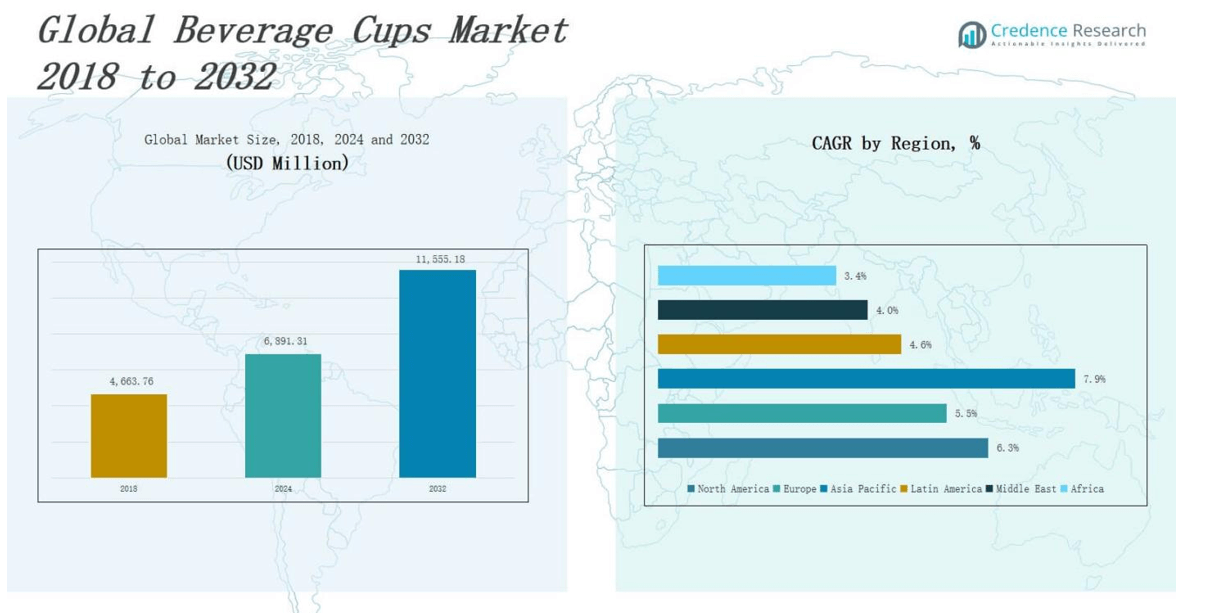
The Beverage Cups Market size was valued at USD 4,663.76 million in 2018 to USD 6,891.31 million in 2024 and is anticipated to reach USD 11,555.18 million by 2032, at a CAGR of 6.21 % during the forecast period.
The Beverage Cups Market is witnessing steady growth driven by rising global consumption of hot and cold beverages across commercial and household settings. The expanding café culture, rapid urbanization, and increasing preference for on-the-go drinks are significantly boosting demand for both disposable and reusable beverage cups. Foodservice outlets, fast-food chains, and coffee shops continue to be primary drivers, supported by growing takeout and delivery trends. Sustainability has emerged as a major market influence, pushing manufacturers to adopt biodegradable, compostable, and recyclable materials in response to environmental regulations and shifting consumer preferences. Paper, bamboo, and PLA-based alternatives are gaining traction as replacements for plastic. Custom-printed and branded cups are also in demand for marketing and aesthetic appeal. The market benefits from advancements in cup insulation technology and lid compatibility, improving user experience. Rising health awareness and hygiene standards are encouraging single-use product adoption in many regions, further supporting the market’s upward trajectory.
The Beverage Cups Market shows strong global distribution, with North America holding the largest share due to high takeaway beverage consumption and a well-established foodservice sector. Europe follows, driven by sustainability regulations and strong demand for eco-friendly cups. Asia Pacific is the fastest-growing region, led by China, India, and Japan, where rising urbanization and café culture are expanding market reach. Latin America, including Brazil and Mexico, is witnessing steady growth supported by developing foodservice infrastructure. The Middle East, led by the UAE and Saudi Arabia, sees demand from hospitality and event sectors. Africa, though the smallest market, is gradually expanding with growth in South Africa and Egypt. Key players operating across these regions include Dart Container, Huhtamaki, Georgia-Pacific, Berry Global, Pactiv Evergreen, Genpak, Solo Cup Company, Eco-Products, WinCup, and Karat, all competing through innovation, sustainability, and strategic partnerships to strengthen their market presence.
Market Insights
- The Beverage Cups Market was valued at USD 6,891.31 million in 2024 and is projected to reach USD 11,555.18 million by 2032, driven by steady global demand.
- Rising consumption of hot and cold beverages in both household and commercial settings is boosting demand for disposable and reusable beverage cups.
- Sustainability trends are reshaping the market, with increasing use of biodegradable, recyclable, and compostable materials like paper, PLA, and bamboo.
- North America leads the global market, while Asia Pacific shows the fastest growth due to urbanization, café expansion, and rising disposable incomes.
- Regulatory pressures and environmental mandates are pushing manufacturers toward compliant, eco-conscious materials and packaging alternatives.
- Events, outdoor catering, and travel applications continue to expand the use of beverage cups due to convenience, hygiene, and portability needs.
- Major players including Dart Container, Huhtamaki, Georgia-Pacific, and Berry Global compete through innovation, sustainability, and strategic partnerships across all regions.
Market Drivers
Growing Demand from Foodservice and On-the-Go Consumption
The Beverage Cups Market is driven by increasing demand from quick-service restaurants, cafés, and food trucks. Urban lifestyles and time constraints are encouraging consumers to opt for takeaway beverages, boosting cup consumption. It meets the daily needs of coffee chains and convenience stores serving hot and cold drinks. Single-use cups are vital to maintaining hygiene and efficiency. Rising disposable incomes support frequent beverage purchases. Beverage cups remain a staple in daily consumer routines.
- For instance, Starbucks reported that over 60% of its beverage sales in the U.S. in 2023 were made through drive-thru or mobile orders, reflecting a strong consumer preference for takeaway drinks and the necessity for single-use cups to maintain hygiene and operational efficiency.
Expansion of Specialty Coffee and Tea Culture
The Beverage Cups Market benefits from the global expansion of specialty coffee and tea chains. Consumers are embracing premium beverages, creating demand for high-quality, insulated, and custom-printed cups. It enables cafes to enhance brand visibility through packaging. Specialty shops rely on cups that preserve drink temperature and quality. Consumer expectations are evolving alongside product presentation. This cultural shift influences the need for differentiated and functional beverage cup solutions.
Sustainability Regulations and Eco-Friendly Materials
Government mandates and public concern over plastic waste are pushing the Beverage Cups Market toward sustainable materials. Brands are adopting biodegradable, compostable, and recyclable cups to meet environmental standards. It is prompting innovation in paper-based and PLA-coated alternatives. Manufacturers are rethinking production processes to lower environmental impact. Businesses also gain consumer trust by aligning with sustainability goals. Market momentum now depends on balancing functionality with environmental responsibility.
Growth in Events, Travel, and Outdoor Activities
The Beverage Cups Market sees growing usage across entertainment, sports, and travel sectors. Demand spikes during festivals, exhibitions, and corporate events where disposable cups provide convenience and sanitation. It supports beverage distribution in high-traffic venues and mobile settings. Tourism growth boosts consumption in airports, stations, and hotels. Outdoor functions rely on sturdy, easy-to-carry cup formats. These applications contribute to the overall volume and frequency of use.
- For instance, in August 2024, more than 30 eateries and coffee shops in Petaluma, California-including Starbucks, Taco Bell, and Dunkin' Donuts-participated in the first citywide reusable cup program in the US, offering multi-use beverage cups to reduce landfill waste.
Market Trends
Rise of Sustainable and Compostable Materials
The Beverage Cups Market shows a clear shift toward sustainable and compostable materials, with businesses prioritizing paper, PLA, bamboo, and bagasse over plastic. It drives innovation in material sourcing and manufacturing techniques to meet eco-friendly demands. Brands support transparency by providing recyclable or biodegradable labeling. Consumers demand waste reduction and eco-conscious packaging design. Municipal regulations promote bans on single-use plastics. These measures reshape the supply chain and product development for cups.
- For instance, Starbucks launched a pilot program in cities like Seattle and London using paper cups lined with bioPBS, a bio-based plastic that is both recyclable and home compostable, aiming to reduce the environmental impact of single-use cups.
Customization and Brand Differentiation
Customization continues to define the Beverage Cups Market, with companies offering bespoke printing, color schemes, and designs to enhance brand awareness. It gives coffee shops and restaurants unique packaging that reflects their identity and marketing messages. Print technologies allow full-color branding and variable graphics. Brands leverage limited-edition designs to engage local events and seasonal trends. This artistic direction enhances consumer experience and loyalty. Producers respond with flexible manufacturing platforms for variable runs.
- For instance, Costa Coffee consistently uses high-quality custom cup designs that prominently display its logo and brand colors, reinforcing visual identity and ensuring instant recognition among consumers.
Insulation and Functional Enhancement
Functionality upgrades drive the Beverage Cups Market, with innovators focusing on insulation, grip, and lid compatibility. It elevates user comfort for both hot and cold beverages. Double-wall construction, sleeve integration, and heat-resistant coatings help maintain temperature and reduce burns. Lids now include sip-through designs and spill resistance. R&D efforts prioritize ergonomics and convenience features. These enhancements cater to premium beverage segments, improving user satisfaction and market appeal.
Expansion of Reusable Cup Initiatives
The Beverage Cups Market increasingly promotes reusable cup initiatives within retail chains, workplace programs, and public venues. It encourages consumers to reduce waste by bringing their own cups or utilizing reusable cup-sharing systems. Incentive schemes, such as discounts and loyalty points, encourage behavior change. Refill stations support hygiene and cleanliness standards. Brands develop durable, dishwasher-safe cups from materials like stainless steel and silicone. This trend aligns with shifting consumer preferences and corporate sustainability commitments.
Market Challenges Analysis
Regulatory Pressures and Material Compliance Issues
The Beverage Cups Market faces increasing regulatory scrutiny over single-use plastics and non-recyclable materials. Governments are implementing bans and restrictions that challenge traditional production models. It forces manufacturers to rapidly shift toward sustainable alternatives, which often come with higher costs and limited availability. Compliance with region-specific environmental standards can delay product rollouts and disrupt supply chains. Small and medium enterprises struggle to adapt due to limited resources. These pressures slow market flexibility and increase production complexity.
Cost Constraints and Supply Chain Disruptions
The Beverage Cups Market experiences challenges from fluctuating raw material prices and supply chain instability. Rising costs of paper, bioplastics, and coatings impact profit margins across manufacturers and distributors. It affects pricing strategies, especially for budget-sensitive segments. Transport delays and material shortages hinder consistent delivery schedules. Market players must manage logistics while maintaining product quality and safety standards. These factors create operational hurdles, especially in regions with underdeveloped infrastructure or import dependencies.
Market Opportunities
Expansion into Emerging Economies and Untapped Sectors
The Beverage Cups Market has strong growth potential in emerging economies where foodservice sectors are rapidly expanding. Rising urban populations, changing consumption habits, and growing café culture drive higher demand for disposable and reusable cups. It benefits from the increasing presence of international coffee chains and quick-service restaurants. Market penetration remains low in rural and semi-urban areas, offering room for regional brands to scale. Localized production and tailored distribution strategies enhance reach. Government support for small food businesses further strengthens this opportunity.
Innovation in Smart and Sustainable Packaging Solutions
Product innovation creates new avenues for the Beverage Cups Market by meeting environmental standards and consumer expectations. Brands are investing in compostable linings, plant-based coatings, and smart cups with temperature indicators. It improves both functional performance and consumer appeal. Customization technologies also allow limited-edition and event-specific packaging, opening up marketing value. Digital printing and modular production support short runs with minimal waste. These innovations align with evolving regulatory trends and eco-conscious consumer behavior.
Market Segmentation Analysis:
By Material
The Beverage Cups Market includes key material segments such as paper, plastic, and foam. Paper cups are gaining preference due to their eco-friendly profile and compliance with sustainability regulations. Plastic cups remain widely used for cold beverages, especially in fast food and outdoor settings, due to their durability and cost-efficiency. Foam cups, though effective in insulation, face regulatory pressure over recyclability concerns. It continues to evolve toward materials that balance function, cost, and environmental responsibility.
- For instance, Starbucks replaced its traditional plastic straws with paper alternatives in 2018 and has expanded the use of paper cups made from responsibly sourced fiber, aiming to reduce plastic waste and comply with global sustainability regulations.
By Product Type
The Beverage Cups Market is segmented into disposable cups, reusable cups, and cups with lids. Disposable cups dominate in volume due to high usage in takeaway and food delivery services. Reusable cups are gaining traction with environmentally conscious consumers and corporate sustainability programs. Cups with lids are essential for on-the-go convenience and spill prevention. It supports demand in urban and mobile consumer environments. Product type choice often reflects both functional and branding needs.
By Application
The Beverage Cups Market serves multiple applications including food and beverage, food services, retail, and events and catering. The food and beverage sector leads usage, driven by cafes, tea shops, and juice bars. Food services rely on high-volume cup supply for daily operations. Retail outlets use cups for self-service beverages. Events and catering companies prefer disposable formats for hygiene and convenience. It addresses diverse consumption scenarios with tailored solutions across segments.
- For instance, Coca-Cola Canada announced the launch of 100% recycled plastic bottles and refillable cups for fountain dispensers, manufactured at their local facilities, as part of their shift toward sustainable beverage packaging in retail and food service outlets.
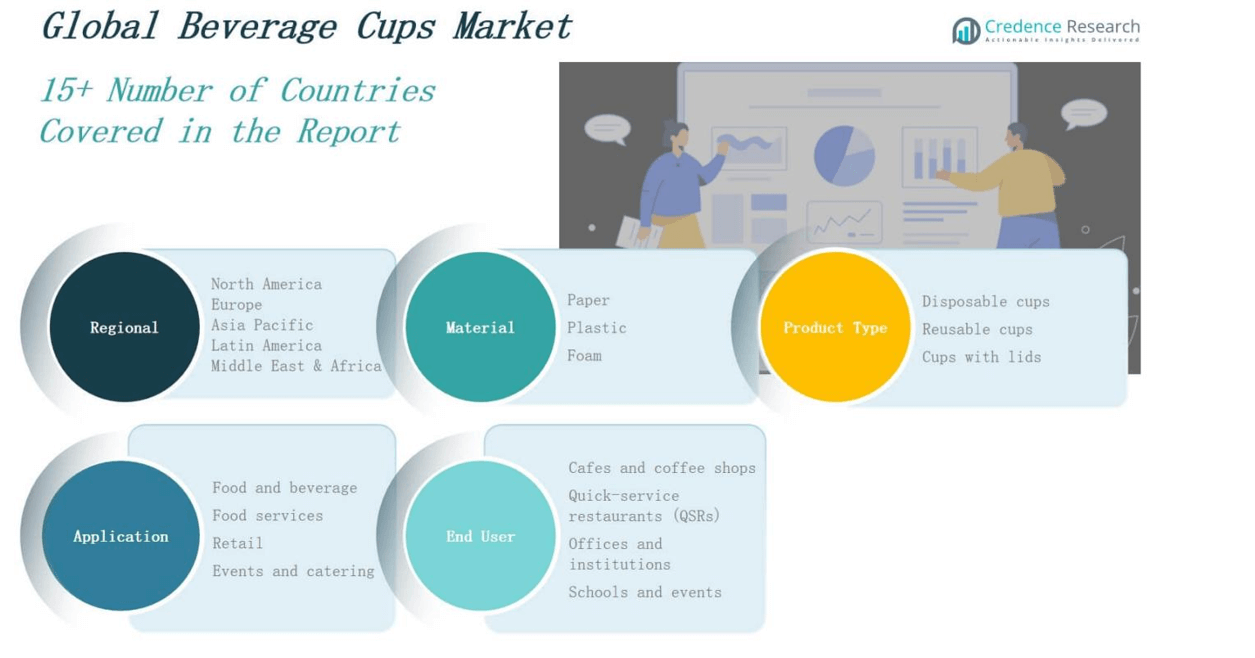
Segments:
Based on Material:
- Paper
- Plastic
- Foam
Based on Product Type:
- Disposable Cups
- Reusable Cups
- Cups with Lids
Based on Application:
- Food and Beverage
- Food Services
- Retail
- Events and Catering
Based on End User:
- Cafes and Coffee Shops
- Quick-Service Restaurants (QSRs)
- Offices and Institutions
- Schools and Events
Based on Region:
- North America
- U.S.
- Canada
- Mexico
- Europe
- Germany
- France
- U.K.
- Italy
- Spain
- Rest of Europe
- Asia Pacific
- China
- Japan
- India
- South Korea
- South-east Asia
- Rest of Asia Pacific
- Latin America
- Brazil
- Argentina
- Rest of Latin America
- Middle East & Africa
- GCC Countries
- South Africa
- Rest of the Middle East and Africa
Regional Analysis
North America
The North America Beverage Cups Market size was valued at USD 1,951.06 million in 2018, reached USD 2,851.69 million in 2024, and is anticipated to hit USD 4,795.52 million by 2032, at a CAGR of 6.3% during the forecast period. North America holds the largest market share globally, driven by high consumption of coffee and takeaway beverages. The region benefits from a mature foodservice industry and strong presence of leading QSR chains. It sees increasing consumer preference for sustainable and customized cup solutions. The United States contributes the most revenue, followed by Canada and Mexico. Regulatory support for eco-friendly materials is shaping product innovation and supplier strategies.
Europe
The Europe Beverage Cups Market size was valued at USD 1,404.88 million in 2018, increased to USD 2,005.42 million in 2024, and is projected to reach USD 3,177.75 million by 2032, at a CAGR of 5.5%. Europe commands a significant share of the global market, led by demand in the UK, Germany, France, and Italy. Stringent regulations on single-use plastics are encouraging the adoption of paper and compostable cups. It thrives on a strong café culture and growing interest in eco-conscious packaging. The market favors branded and premium cup formats in both retail and commercial channels. Manufacturers are investing in circular economy models to comply with EU sustainability targets.
Asia Pacific
The Asia Pacific Beverage Cups Market size was valued at USD 878.89 million in 2018, grew to USD 1,409.86 million in 2024, and is expected to reach USD 2,683.40 million by 2032, at a CAGR of 7.9%. Asia Pacific is the fastest-growing region in the Beverage Cups Market, driven by urbanization, expanding café chains, and rising disposable incomes. China, India, and Japan lead regional growth, supported by rapid expansion of food delivery platforms. It sees growing interest in reusable and affordable cup solutions. Domestic manufacturers are scaling production to meet rising volume demands. Innovation in material usage is also increasing due to environmental policy shifts.
Latin America
The Latin America Beverage Cups Market size was valued at USD 221.30 million in 2018, reached USD 322.95 million in 2024, and is forecasted to grow to USD 479.57 million by 2032, at a CAGR of 4.6%. Latin America holds a smaller but expanding share of the Beverage Cups Market, led by Brazil, Mexico, and Argentina. Growth is supported by rising urban foodservice demand and adoption of takeaway models. It faces infrastructure gaps that challenge distribution in rural areas. Market players are focusing on low-cost and recyclable materials. Governments are beginning to introduce basic packaging waste regulations, influencing product development.
Middle East
The Middle East Beverage Cups Market size was valued at USD 131.16 million in 2018, grew to USD 177.22 million in 2024, and is projected to reach USD 250.94 million by 2032, at a CAGR of 4.0%. The Middle East market shows steady growth, driven by tourism, hospitality expansion, and premium beverage consumption. UAE and Saudi Arabia lead in consumption due to rapid retail development. It benefits from large-scale catering demand during festivals and events. Disposable cups dominate the market due to hygiene preferences. Import reliance and regulatory delays remain moderate challenges for regional manufacturers.
Africa
The Africa Beverage Cups Market size was valued at USD 76.48 million in 2018, increased to USD 124.17 million in 2024, and is expected to reach USD 168.00 million by 2032, at a CAGR of 3.4%. Africa holds the smallest share but presents untapped potential in the Beverage Cups Market. Growth is emerging in South Africa, Egypt, and Nigeria, where urbanization is reshaping food and drink consumption. It sees gradual uptake in takeaway models and mobile cafés. Local production is limited, leading to reliance on imports for quality products. Affordability and waste management infrastructure remain key barriers to scale.
Key Player Analysis
- Dart Container
- Huhtamaki
- Georgia-Pacific
- Berry Global
- Pactiv Evergreen
- Genpak
- Solo Cup Company
- Eco-Products
- WinCup
- Karat
Competitive Analysis
The Beverage Cups Market is moderately fragmented, with a mix of global leaders and regional suppliers competing across material, design, and sustainability. Key players such as Dart Container, Huhtamaki, Georgia-Pacific, and Berry Global hold strong market positions through wide product portfolios and established distribution networks. It sees constant innovation in cup materials, insulation, and branding to meet evolving customer demands. Companies are investing in compostable solutions and custom printing to enhance differentiation. Emerging players focus on local manufacturing and cost competitiveness, especially in price-sensitive markets. Strategic collaborations with foodservice chains and retailers help expand reach and brand visibility. Competitive pressure is rising with growing demand for eco-friendly and multifunctional cup formats. Players must align product development with global sustainability regulations and maintain high-volume capabilities to meet contract requirements. The Beverage Cups Market continues to evolve through a balance of innovation, cost control, and operational efficiency across key regions.
Recent Developments
- On May 6, 2025, Starbucks EMEA partnered with Transcend Packaging, Qwarzo®, and Metsä Board to introduce a new home-compostable hot cup and lid across ten European markets. These cups use mineral-based coatings, aiming for wide recyclability across the region.
- In November 18, 2024, Berry Global launched the first domestically produced, fully recyclable polypropylene (PP) drink cups designed specifically for private-label party cups, enabling retailers to offer eco-friendly alternatives in mainstream supply chains.
- In April 18, 2024, Starbucks introduced a redesigned cold beverage cup using 20% less plastic, featuring raised tactile dots for easy size identification by baristas and a standardized lid system-helping remove over 13.5 million pounds of plastic annually.
- In May 2025, Borealis supplied high-performance chemically recycled polypropylene reusable cups for Messe Düsseldorf’s K Fair 2025, supporting a trial reusable cup system throughout the event, including on-site collection and washing.
Market Concentration & Characteristics
The Beverage Cups Market is moderately fragmented, with a mix of global corporations and regional manufacturers competing across materials, formats, and sustainability. It features a strong presence of large players like Dart Container, Huhtamaki, Georgia-Pacific, and Berry Global, which dominate through extensive distribution networks, product diversity, and supply contracts with major foodservice chains. Smaller players operate in niche segments, offering eco-friendly or region-specific solutions. The market is characterized by high volume turnover, driven by the foodservice sector and rapid consumption cycles. It shows growing emphasis on sustainability, customization, and regulatory compliance. Manufacturers focus on product innovation, such as insulated designs and biodegradable materials, to meet evolving consumer and government expectations. Price sensitivity and functionality remain key factors in buyer decisions. The Beverage Cups Market responds quickly to consumer trends and regional policy shifts, maintaining competitive intensity across developed and emerging regions through technology, logistics, and partnerships.
Report Coverage
The research report offers an in-depth analysis based on Material, Product Type, Application, End-User and Region. It details leading market players, providing an overview of their business, product offerings, investments, revenue streams, and key applications. Additionally, the report includes insights into the competitive environment, SWOT analysis, current market trends, as well as the primary drivers and constraints. Furthermore, it discusses various factors that have driven market expansion in recent years. The report also explores market dynamics, regulatory scenarios, and technological advancements that are shaping the industry. It assesses the impact of external factors and global economic changes on market growth. Lastly, it provides strategic recommendations for new entrants and established companies to navigate the complexities of the market.
Future Outlook
- Demand for beverage cups will rise with increasing urbanization and expanding on-the-go consumption habits.
- Sustainable materials like paper, bamboo, and PLA will gain preference over traditional plastic.
- Foodservice and quick-service restaurant chains will continue to drive bulk purchases of disposable cups.
- Manufacturers will invest more in recyclable and compostable product innovations to meet regulatory expectations.
- Custom printing and branding on cups will become a strategic marketing tool for cafes and retailers.
- Asia Pacific will see the fastest market expansion due to rising disposable incomes and café culture.
- Reusable cup programs will grow in offices, institutions, and public venues to reduce waste.
- E-commerce and online food delivery platforms will boost demand for insulated and spill-proof cup designs.
- Regional players will scale production to reduce import reliance and improve affordability.
- Technological advancements in lid compatibility and heat retention will improve consumer experience.

Request a Free Sample
Fill in your details and we'll send you a free sample report.
- Sample data tables & charts
- Research methodology
Market Dynamics
Growing Foodservice and On-the-Go Consumption
The proliferation of quick-service restaurants, cafés, and food trucks, combined with urban lifestyles and time constraints, is driving increased demand for takeaway beverages and thus beverage cups. Single-use cups are essential for maintaining hygiene and operational efficiency in these high-volume environments.
Expansion of Specialty Coffee and Tea Culture
The global rise of specialty coffee and tea chains is fueling demand for high-quality, insulated, and custom-printed cups that enhance brand visibility and preserve beverage quality. This trend is particularly strong in urban centers and among younger consumers seeking premium experiences.
Sustainability Regulations and Eco-Friendly Materials
Government mandates and consumer concern over plastic waste are pushing manufacturers to adopt biodegradable, compostable, and recyclable materials such as paper, PLA, and bamboo. Compliance with environmental standards is driving innovation and reshaping product offerings.
Growth in Events, Travel, and Outdoor Activities
Increased frequency of festivals, sports events, and travel is boosting the use of beverage cups for convenience and sanitation. Disposable and portable cup formats are in high demand for large gatherings and mobile consumption scenarios.
Customization and Brand Differentiation
Businesses are leveraging custom-printed and branded cups as marketing tools to enhance customer experience and brand recognition. Advances in printing technology allow for unique designs and limited-edition runs, supporting promotional strategies and consumer engagement.
Need a Custom Version of This Report?
Tailor the scope, geography, or segments to your exact requirements.
- Custom geography or segment scope
- Direct access to our analyst team
Frequently Asked Questions
What is the current size of the Beverage Cups Market?
What are the key segments within the Beverage Cups Market?
What are some challenges faced by the Beverage Cups Market?
Who are the major players in the Beverage Cups Market?
Table of Content
Chapter 1 Market Segmentation
- 1.1 Segmentation Framework
- 1.1.1 Product and Service Classification
- 1.1.2 Application and End-Use Classification
- 1.1.3 Technology and Solution Classification
- 1.1.4 Customer and Distribution Channel Classification
- 1.1.5 Geographic Segmentation
- 1.1.6 Market Segment Definitions and Boundaries
- 1.2 By End User
- 1.2.1 Cafes and Coffee Shops
- 1.2.2 Quick-Service Restaurants (QSRs)
- 1.2.3 Offices and Institutions
- 1.2.4 Schools and Events
- 1.3 By Material
- 1.3.1 Paper
- 1.3.2 Plastic
- 1.3.3 Foam
- 1.4 By Application
- 1.4.1 Food and Beverage
- 1.4.2 Food Services
- 1.4.3 Retail
- 1.4.4 Events and Catering
- 1.5 By Product Type
- 1.5.1 Disposable Cups
- 1.5.2 Reusable Cups
- 1.5.3 Cups with Lids
Chapter 2 Introduction
- 2.1 Report Objectives and Scope
- 2.2 Product Definition and Industry Terminology
- 2.3 Market Inclusions and Exclusions
- 2.4 Research Process
- 2.4.1 Primary Research and Expert Interviews
- 2.4.2 Secondary Research and Source Review
- 2.4.3 Top-Down and Bottom-Up Estimation
- 2.4.4 Data Triangulation and Verification
- 2.5 Market Size Measurement Basis
- 2.5.1 2024: USD 6,891.31 million → 2032: USD 11,555.18 million
- 2.6 Historical and Forecast Reference Periods
- 2.6.1 Base Year: 2024
- 2.6.2 Forecast Period: 2024-2032
- 2.7 Research Assumptions and Limitations
Chapter 3 Executive Summary
- 3.1 Market Snapshot and Key Findings
- 3.2 Base-Year Market Size, 2024
- 3.3 Forecast Market Size, 2032
- 3.4 Revenue and Volume Growth Outlook
- 3.5 Key Demand and Supply Indicators
- 3.6 Leading Market Segments
- 3.7 Fastest-Growing Market Opportunities
- 3.8 Regional Performance Highlights
- 3.9 Technology and Industry Transformation
- 3.10 Competitive Landscape Summary
- 3.11 Analyst View and Strategic Implications
Chapter 4 Global Beverage Cups Market Trends and Developments
- 4.1 Historical Industry Development
- 4.2 Recent Market Trends and Developments
- 4.3 Demand and Customer Behavior Trends
- 4.4 Technology and Product Innovation
- 4.5 Artificial Intelligence, Automation and Digitalization
- 4.6 Local Manufacturing and Supply Chain Realignment
- 4.7 Industry Partnerships, Mergers and Acquisitions
- 4.8 Sustainability and Circular Economy Developments
- 4.9 Government and Private Sector Investment Trends
- 4.10 Emerging Business Models and Commercialization
- 4.11 Industry Developments and Announcements
Chapter 5 Global Beverage Cups Market Production, Supply and Demand Analysis
- 5.1 Demand Trend and Consumption Analysis
- 5.2 Demand Forecast, 2024-2032
- 5.3 Production and Output Trend
- 5.4 Production and Output Forecast, 2024-2032
- 5.5 Installed Capacity and Capacity Utilization
- 5.6 Company-Wise Production Plants and Statistics
- 5.6.1 Installed Production Capacity
- 5.6.2 Actual Production
- 5.6.3 Planned Capacity and Expansion Targets
- 5.7 Supply Chain Structure and Procurement Trends
- 5.8 Supply-Demand Gap and Bottlenecks
- 5.9 Import Dependence and Sourcing Structure
- 5.10 Contract Manufacturing and Outsourcing
- 5.11 Regional Supply and Demand Concentration
Chapter 6 Global Beverage Cups Market Pricing Analysis
- 6.1 Pricing Structure and Measurement
- 6.2 Historical Pricing Trends
- 6.3 Pricing Outlook, 2024-2032
- 6.4 Average Selling Price and Unit Economics
- 6.5 Pricing by Product and Market Segment
- 6.6 Geographic Pricing Differences
- 6.7 Key Input, Energy, Labor and Logistics Costs
- 6.8 Contract Pricing and Purchasing Models
- 6.9 Pricing Sensitivity and Competitive Positioning
- 6.10 Price, Margin and Profitability Implications
Chapter 7 Global Beverage Cups Market Dynamics
- 7.1 Market Growth Drivers
- 7.1.1 Demand-Side Drivers
- 7.1.2 Technology and Innovation Drivers
- 7.1.3 Infrastructure and Investment Drivers
- 7.1.4 Regulatory and Policy Drivers
- 7.2 Market Restraints
- 7.2.1 Cost and Affordability Constraints
- 7.2.2 Technology and Adoption Barriers
- 7.2.3 Supply Chain and Operational Constraints
- 7.3 Market Challenges
- 7.3.1 Competitive Pressure and Margin Erosion
- 7.3.2 Skills, Infrastructure and Implementation Gaps
- 7.4 Emerging Market Opportunities
- 7.5 Market Dynamics Impact and Time-Horizon Assessment
Chapter 8 Global Beverage Cups Value Chain Analysis
- 8.1 Industry Value Chain Overview
- 8.2 Upstream Suppliers and Critical Inputs
- 8.3 Technology and Component Providers
- 8.4 Manufacturing or Service Delivery
- 8.5 Distribution, Channel Partners and Integrators
- 8.6 Downstream Applications and End Users
- 8.7 Value Addition and Profit Pools
- 8.8 Vertical Integration and Outsourcing
- 8.9 Supplier Concentration and Risk
- 8.10 Supply Chain Localization and Resilience
Chapter 9 Global Beverage Cups Market Regulations and Policies
- 9.1 Relevant Laws, Standards and Compliance Frameworks
- 9.2 Product, Service, Safety and Quality Requirements
- 9.3 Government Policies, Incentives and Subsidies
- 9.4 Imports, Exports and Trade Barriers
- 9.5 Public Procurement and Local Content Requirements
- 9.6 Environmental and Sustainability Compliance
- 9.7 Upcoming Policy Changes and Market Implications
Chapter 10 Global Beverage Cups Market Hotspots and Opportunities
- 10.1 Market Opportunity Mapping and Growth Hotspots
- 10.2 High-Growth Applications and Customer Groups
- 10.3 Underserved Markets and White-Space Opportunities
- 10.4 Emerging Technology and Product Opportunities
- 10.5 New Capacity and Investment Hotspots
- 10.6 Market Entry and Expansion Opportunities
- 10.7 Distribution and Partnership Opportunities
- 10.8 Near-Term and Long-Term Commercial Potential
- 10.9 Opportunity Attractiveness and Execution Risks
Chapter 11 Global Beverage Cups Market Outlook, 2024-2032
- 11.1 Market Size and Analysis
- 11.1.1 Revenue (Market Measurement: 2024: USD 6,891.31 million → 2032: USD 11,555.18 million)
- 11.1.2 Market Volume and Quantity Sold
- 11.1.3 Historical Market Size
- 11.1.4 Base-Year Market Size, 2024
- 11.2 Market Forecast, 2024-2032
- 11.2.1 Revenue Forecast to 2032
- 11.2.2 Volume Forecast to 2032
- 11.2.3 CAGR and Year-on-Year Growth
- 11.2.4 Incremental Revenue Opportunity
- 11.3 Forecast Assumptions and Scenario Analysis
- 11.3.1 Base-Case Forecast
- 11.3.2 Optimistic and Conservative Scenarios
- 11.3.3 Technology, Pricing and Policy Sensitivities
- 11.4 Market Attractiveness and Growth Outlook
Chapter 12 Global Beverage Cups Market Segmentation and Outlook
- 12.1 Segmentation Summary and Market Shares, 2024
- 12.2 Largest and Fastest-Growing Segments
- 12.3 By End User - Market Size and Forecast, 2024-2032
- 12.3.1 Segment Definition and Scope
- 12.3.2 Historical Market Size
- 12.3.3 Revenue Forecast, 2024-2032
- 12.3.4 Volume Forecast, 2024-2032
- 12.3.5 Base-Year Market Share, 2024
- 12.3.6 Segment CAGR and Growth Drivers
- 12.3.7 Subsegment Market Size and Forecast
- 12.3.7.1 Cafes and Coffee Shops
- 12.3.7.2 Quick-Service Restaurants (QSRs)
- 12.3.7.3 Offices and Institutions
- 12.3.7.4 Schools and Events
- 12.3.8 Subsegment Pricing and Adoption Trends
- 12.3.9 Leading Suppliers and Competition
- 12.3.10 Regional Demand and Opportunities
- 12.4 By Material - Market Size and Forecast, 2024-2032
- 12.4.1 Segment Definition and Scope
- 12.4.2 Historical Market Size
- 12.4.3 Revenue Forecast, 2024-2032
- 12.4.4 Volume Forecast, 2024-2032
- 12.4.5 Base-Year Market Share, 2024
- 12.4.6 Segment CAGR and Growth Drivers
- 12.4.7 Subsegment Market Size and Forecast
- 12.4.7.1 Paper
- 12.4.7.2 Plastic
- 12.4.7.3 Foam
- 12.4.8 Subsegment Pricing and Adoption Trends
- 12.4.9 Leading Suppliers and Competition
- 12.4.10 Regional Demand and Opportunities
- 12.5 By Application - Market Size and Forecast, 2024-2032
- 12.5.1 Segment Definition and Scope
- 12.5.2 Historical Market Size
- 12.5.3 Revenue Forecast, 2024-2032
- 12.5.4 Volume Forecast, 2024-2032
- 12.5.5 Base-Year Market Share, 2024
- 12.5.6 Segment CAGR and Growth Drivers
- 12.5.7 Subsegment Market Size and Forecast
- 12.5.7.1 Food and Beverage
- 12.5.7.2 Food Services
- 12.5.7.3 Retail
- 12.5.7.4 Events and Catering
- 12.5.8 Subsegment Pricing and Adoption Trends
- 12.5.9 Leading Suppliers and Competition
- 12.5.10 Regional Demand and Opportunities
- 12.6 By Product Type - Market Size and Forecast, 2024-2032
- 12.6.1 Segment Definition and Scope
- 12.6.2 Historical Market Size
- 12.6.3 Revenue Forecast, 2024-2032
- 12.6.4 Volume Forecast, 2024-2032
- 12.6.5 Base-Year Market Share, 2024
- 12.6.6 Segment CAGR and Growth Drivers
- 12.6.7 Subsegment Market Size and Forecast
- 12.6.7.1 Disposable Cups
- 12.6.7.2 Reusable Cups
- 12.6.7.3 Cups with Lids
- 12.6.8 Subsegment Pricing and Adoption Trends
- 12.6.9 Leading Suppliers and Competition
- 12.6.10 Regional Demand and Opportunities
- 12.7 Segment Growth Comparison
- 12.8 Segment Attractiveness and Priority Matrix
Chapter 13 Global Beverage Cups End-Use and Application Market Outlook
- 13.1 End-Use Industry and Customer Demand Structure
- 13.2 Leading Applications and Customer Groups
- 13.3 End-Use Market Size, Share and Forecast
- 13.4 Major End-Use Industry Deep Dives
- 13.4.1 Customer Requirements and Use Cases
- 13.4.2 Demand and Replacement Cycles
- 13.4.3 Technical and Regulatory Considerations
- 13.4.4 Purchasing and Procurement Models
- 13.4.5 Leading Vendors and Distribution Channels
- 13.4.6 Forecast and Commercial Opportunities
- 13.5 Emerging Applications and Cross-Segment Demand
- 13.6 End-Use Industry Investment Priorities
Chapter 14 Global Beverage Cups Geographic Market Outlook, 2024-2032
- 14.1 Regional Market Size and Share, 2024
- 14.2 Regional Market Forecast, 2024-2032
- 14.3 Regional Pricing, Production and Demand Differences
- 14.4 North America
- 14.4.1 United States
- 14.4.2 Canada
- 14.4.3 Mexico
- 14.5 Europe
- 14.5.1 Germany
- 14.5.2 France
- 14.5.3 Italy
- 14.5.4 United Kingdom
- 14.5.5 Spain
- 14.5.6 Poland
- 14.5.7 Russia
- 14.5.8 Netherlands
- 14.5.9 Belgium
- 14.5.10 Sweden
- 14.5.11 Denmark
- 14.5.12 Norway
- 14.5.13 Rest of Europe
- 14.6 Asia Pacific
- 14.6.1 China
- 14.6.2 India
- 14.6.3 Japan
- 14.6.4 South Korea
- 14.6.5 Thailand
- 14.6.6 Indonesia
- 14.6.7 Vietnam
- 14.6.8 Malaysia
- 14.6.9 Australia
- 14.6.10 Rest of Asia Pacific
- 14.7 Latin America
- 14.7.1 Brazil
- 14.7.2 Argentina
- 14.7.3 Colombia
- 14.7.4 Chile
- 14.7.5 Rest of Latin America
- 14.8 Middle East
- 14.8.1 Saudi Arabia
- 14.8.2 United Arab Emirates
- 14.8.3 Turkey
- 14.8.4 Israel
- 14.8.5 Iran
- 14.8.6 Rest of the Middle East
- 14.9 Africa
- 14.9.1 South Africa
- 14.9.2 Egypt
- 14.9.3 Nigeria
- 14.9.4 Morocco
- 14.9.5 Rest of Africa
- 14.10 Regional Investment, Policy and Supply Chain Differences
- 14.11 Regional Competitive Landscape
- 14.12 Geographic Growth Hotspots
Chapter 15 Global Beverage Cups Technology, Innovation and Sustainability Outlook
- 15.1 Technology Landscape and Maturity
- 15.2 Product, Process and Service Innovation
- 15.3 AI, Automation and Digital Tools in the Industry
- 15.4 Technology Adoption and Performance Benchmarking
- 15.5 Innovation Pipeline and R&D Investment
- 15.6 Patent and Intellectual Property Trends
- 15.7 Energy Efficiency and Resource Management
- 15.8 Sustainability, Recycling and Circularity
- 15.9 Technology Roadmap, 2024-2032
- 15.10 Risks of Obsolescence and Technology Substitution
Chapter 16 Global Beverage Cups Market Key Strategic Imperatives
- 16.1 Growth and Market Entry Priorities
- 16.2 High-Return Products and Segments
- 16.3 Pricing, Profitability and Cost Optimization
- 16.4 Technology Investment and Product Differentiation
- 16.5 Supply Chain Localization and Resilience
- 16.6 Distribution and Customer Acquisition
- 16.7 Partnership, Acquisition and Capacity Strategy
- 16.8 Regional Expansion Priorities
- 16.9 Short-, Medium- and Long-Term Actions
Chapter 17 Competition Outlook
- 17.1 Industry Competition Characteristics
- 17.2 Market Structure and Concentration
- 17.3 Market Share and Competitive Positioning, 2024
- 17.4 Company-Wise Revenue and Product Benchmarking
- 17.5 Production and Service Capacity Benchmarking
- 17.6 Technology, Pricing and Differentiation
- 17.7 Regional Footprint and Distribution Strength
- 17.8 Mergers, Acquisitions and Strategic Alliances
- 17.9 New Entrants and Competitive Threats
- 17.10 Porter's Five Forces and Industry Attractiveness
- 17.11 Competitive Outlook, 2024-2032
Chapter 18 Company Profiles
- 18.1 Company Coverage and Selection Criteria
- 18.2 Dart Container
- 18.2.1 Business Description
- 18.2.2 Company Ownership and Geographic Presence
- 18.2.3 Product and Service Portfolio
- 18.2.4 Manufacturing and Operating Footprint
- 18.2.5 Production Capacity and Expansion Plans
- 18.2.6 Financial Performance and Investment
- 18.2.7 Market Share and Competitive Position
- 18.2.8 Technology and Innovation Capabilities
- 18.2.9 Strategic Alliances or Partnerships
- 18.2.10 Recent Developments
- 18.2.11 Growth Strategy and Outlook
- 18.3 Huhtamaki
- 18.4 Georgia-Pacific
- 18.5 Berry Global
- 18.6 Pactiv Evergreen
- 18.7 Genpak
- 18.8 Solo Cup Company
- 18.9 Eco-Products
- 18.10 WinCup
- 18.11 Karat
- 18.12 Other Relevant Market Participants
Note: Every listed company is profiled on the structure shown under the first company. The company list is preliminary and may change based on research findings, market developments, data availability and client requirements.
Chapter 19 Disclaimer
- 19.1 Research and Forecast Disclaimer
- 19.2 Data Source and Estimation Limitations
Note: The depth of individual sections depends on data availability for this market. Volume, capacity, trade and other unit-based metrics are included where applicable.