Key Highlights of the report
How are the major segments performing in the Canned Coffee market?
- In 2022, the regular segment accounted for the largest share of the market as it is high in demand among consumers.
- In 2022, the supermarkets/ hypermarkets segment was anticipated to hold a prominent share in the global canned coffee market as the number of supermarkets and hypermarkets has grown in the past few years.
What is the Market Size of Canned Coffee regarding value?
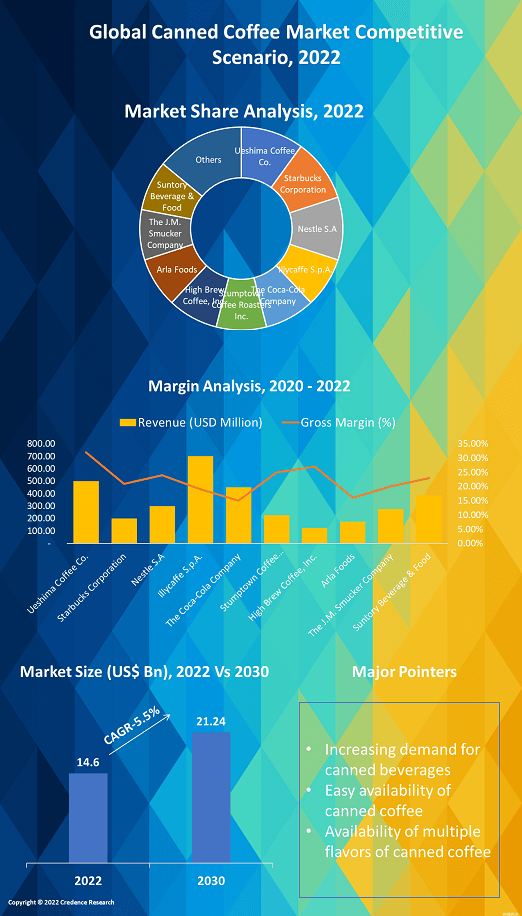
The global canned coffee market is anticipated to grow at a substantial CAGR of 5.50% in the upcoming years. The global canned coffee industry was estimated to be worth USD 14.6 billion in 2022 and was expected to be worth USD 21.24 billion by 2028.
Which region dominated the canned coffee market?
In 2022, the North American region was anticipated to hold a prominent share of the global canned coffee market. The preference among consumers is high for canned coffee as most of the population in this region is working. Moreover, increasing awareness regarding the health benefits of coffee and growing disposable income are also among the major factors driving the canned coffee market in the North American region.
How US Market is performing in the canned coffee market?
In 2022, the U.S. held the majority share in the North American region and was anticipated to hold a prominent share during the forecast period. In the U.S., the population is growing health-conscious are savouring drinks that have health benefits, such as coffee. A growing number of supermarkets and convenience stores that sell canned coffee, demanding work schedules, and increasing demand for health-friendly products are some of the key factors fuelling the canned coffee market in this region.
How is the economy impacting the global canned coffee growth?
Major factors affecting the canned coffee market include COVID-19, Russia Ukraine war, and the upcoming recession. It has been estimated by the World Bank that in 2023 there will be a recession owing to the inflated interest rate by the Central government. Also, the fluctuating prices of various products and raw materials are due to the Russia-Ukraine war and the shortage of various materials. Moreover, ongoing COVID-19 in China has also led to a shortage of materials such as aluminium and steel, which is also affecting the canned coffee market.
What is the competitive environment of the canned coffee market?
The canned coffee industry is very competitive and has many small players in the market. The market is moderately fragmented, and players are taking initiatives to adopt various strategies such as signing agreements, partnerships, and collaborations. With these strategies, the prominent players in the market are strengthening their market position. For instance, in Feb 2020, STōK Cold Brew launched three flavors of STōK fueled creamers and ready-to-drink coffee for their customers. Moreover, in April 2022, illycaffè launched cold brew cappuccino & latte macchiato cans and cold brew blade tap system, especially for summers. This coffee is among the most commonly chosen among consumers.
Executive Summary
What are the key trends in the Canned Coffee market?
- The increasing availability of coffee in convenience stores and supermarkets has made coffee the preferred choice among consumers.
- Availability of coffee in various flavors also allows customers to savor a new taste every now and then and hence has a higher demand than other beverages.
How are Technological Advancements Supporting the Growth of the Canned Coffee Market?
Manufacturers in the canned coffee market need help to maintain the quality and shelf life of the product. To overcome this majorly faced issue, companies in the market are constantly investing in incorporating systems and technologies. Companies such as BKON, a beverage technology company, have patented Reverse Atmospheric Infusion (RAIN) technology that helps packaged drinks remain fresh for four months, thereby improving the shelf life. They state that the technology was initially tested on canned cold beverages but can also be used across a wide spectrum. Manufacturers of canned coffee are also focused on installing advanced machines and equipment that help in large-scale and faster manufacturing and packaging of the product. Thus, adopting such technologies is anticipated to aid the market during the forecast period.
Which are the key investments by the Canned Coffee market players?
Leading players operating in the canned coffee market are focusing on expansion in production capacities, concentrating on acquisitions, collaborations, and creating awareness regarding the health benefits of coffee to promote demand in the market to gain a competitive edge. Several start-up companies are entering the market by raising funds to promote and expand their product distribution. For instance, in June 2022, Atomo, a start-up company, raised USD 40 million from three agtech investment firms for manufacturing their beanless "reverse-engineered" coffee In large quantities in the market. The company states that its product is more sustainable and tastes better than traditional coffee. Similarly, in July 2022, Danish multinational dairy cooperative Arla Foods invested USD 43.34 million in its dairy to meet the increased global demand for on-the-go chilled coffee drinks. The company manufactures milk-based coffee products from 100% Arabica coffee from the Starbucks Coffee Company and naturally sourced milk from farmers in Esbjerg, Denmark.
Some major players in the canned coffee market are Ueshima Coffee Co., Starbucks Corporation, Nestle S.A, Illycaffe S.p.A., The Coca-Cola Company, Stumptown Coffee Roasters Inc., High Brew Coffee, Inc., Arla Foods, The J.M. Smucker Company, Suntory Beverage & Food, Lotte Chilsung Beverage Co Ltd., Tres Coracoes Alimentos S.A., Dr. Pepper Snapple Group, Dunkin' Brands, and WhiteWave Foods.
What are the Major Driving Factors for the Canned Coffee Market?
The growing urbanization, rising working population, and rising disposable income are among the key factors driving the canned coffee market. Moreover, the growing popularity of a healthy lifestyle, growing trends of functional drinks, and the rising demand for ready-to-use products are among the major factors impacting the market growth. Companies in the market are launching products with various flavors and better tasting than traditional coffee to stay in the competition and provide consumers with options for canned coffee. They are also adopting various technologies that help improve the product's shelf life. Companies are also constantly raising funds for the development, promotion, and distribution of their brand of canned coffee in the market.
What are the Major Risks for the Canned Coffee Market?
One of the major challenges faced by the manufacturers in the canned coffee market includes the freshness and shortage of the shelf life of this ready-to-go coffee. However, to overcome this challenge, companies in the market are adopting technologies that help maintain a longer shelf life while maintaining the quality of the canned coffee. Consumption of caffeine can cause constipation, dehydration, gastritis, and acidity, among others. Thus, consumer preference for healthy drinks such as juices and other hot beverages is also hampering the market growth to a certain extent.
Which is the key application in the Canned Coffee market?
The regular canned coffee segment will hold a prominent share of the global canned coffee market in 2022. Coffee is among the majorly consumed beverage in various countries. According to various research studies, it has been estimated that the sales of specialty coffee, such as canned coffee, are increasing faster. Studies have also shown that coffee drinkers consume at least 3 cups of coffee per day in the United States. Increasing preference among consumers for regular coffee is higher compared to flavors is one of the major factors driving the growth of canned coffee. Manufacturers in the market are also manufacturing regular canned coffee in bulk as the demand is high in the market to meet growing demand.
How is the Canned Coffee market performing in regions?
Asia Pacific market is anticipated to witness the fastest growth in the global canned coffee market during the forecast period. Large-scale cultivation of coffee in this region, such as in Japan, India, China, Indonesia, and Vietnam, is providing manufacturers an advantage in procuring the raw material at a lower cost. Moreover, the growing consumption of coffee among the working population and rising disposable income are also among the major factors aiding the growth of canned coffee. As the demand for coffee is rising in this region, several start-up companies are also entering the market by investing in developing and promoting this product. For instance, in November 2021, Sleepy Owl Coffee, an Indian coffee start-up, raised USD 6.5 million in series A funds to expand its distribution network and market its product in India.
What is the regulatory landscape for the Canned Coffee market?
Food & beverage products must meet several regulations before being distributed in the market. Regulatory bodies such as the Food Safety and Standards Authority of India (FSSAI) drafted Food Products Standards and Food Additives Amendment Regulations in 2018 to monitor decaffeinated coffee quality. Companies in the United States must meet FDA compliances. Such regulations for the product are hindering the market growth to a certain extent.
What are the major players planning for the future of the Canned Coffee market?
Growing regional existence and taking initiatives for developing new and improved flavor of coffee that helps refresh the consumers are among the major strategies anticipated to be seen in the market in the coming years. As new players enter the market, the prominent players are taking initiatives to maintain their market position by introducing new and improved products. Players are also investing in developing new products; thus, such factors are anticipated to aid the market growth during the forecast period.
| REPORT ATTRIBUTE | DETAILS |
|---|---|
| Canned Coffee Market by Volume | Yes |
| Canned Coffee Market by Value | Yes |
| Canned Coffee Market, Tornado Analysis | Yes |
| Canned Coffee Market, STAR Analysis | Yes |
| Canned Coffee Market, SRC Analysis | Yes |
| Canned Coffee Market Pricing Analysis | Yes (On Demand) |
| Canned Coffee Market Segment Analysis | By Product (Regular, Mocha, Cappuccino, Latte, Black coffee, Expresso, and Others) By Distribution Channel (Super Markets/ Hypermarkets, Convenience Stores, Food Service Centres, and Others) |
| Canned Coffee Market, Regional Analysis | North America (US and Canada) Europe (Germany, UK, France, Italy, Spain, and Rest of Europe) Asia Pacific (China, India, Japan, South Korea, South East Asia, and Rest of Asia Pacific) Latin America (Brazil, Mexico, and Rest of Latin America) Middle East and Africa (GCC Countries, South Africa, and Rest of Middle East and Africa) |
| Canned Coffee Market Key Companies | Ueshima Coffee Co., Starbucks Corporation, Nestle S.A, Illycaffe S.p.A., The Coca-Cola Company, Stumptown Coffee Roasters Inc., High Brew Coffee, Inc., Arla Foods, The J.M. Smucker Company, Suntory Beverage & Food, Lotte Chilsung Beverage Co Ltd., Tres Coracoes Alimentos S.A., Dr. Pepper Snapple Group, Dunkin' Brands, and WhiteWave Foods |
| Canned Coffee Market Competitive Landscape | Market Share Analysis Competitive Benchmarking Key Players Market Positioning Geographical Presence Analysis Major Strategies Adopted |
Segmentation of Global Canned Coffee Market-
Global Canned Coffee Market – By Product
- Regular
- Mocha
- Cappuccino
- Latte
- Black coffee
- Expresso
- Others
Global Canned Coffee Market – By Distribution Channel
- Super Markets/ Hypermarkets
- Convenience Stores
- Food Service Centres
- Others
Global Canned Coffee Market – By Region
- North America
- US.
- Canada
- Europe
- Germany
- France
- U.K.
- Italy
- Spain
- Rest of Europe
- Asia Pacific
- China
- Japan
- India
- South Korea
- South-east Asia
- Rest of Asia Pacific
- Latin America
- Brazil
- Mexico
- Rest of Latin America
- Middle East & Africa
- GCC Countries
- South Africa
- Rest of Middle East and Africa

Request a Free Sample
Fill in your details and we'll send you a free sample report.
- Sample data tables & charts
- Research methodology
Market Dynamics
Urbanization and Growing Working Population
Increasing urbanization and a rising number of working professionals are driving demand for convenient, ready-to-drink beverages like canned coffee, as consumers seek quick energy boosts during busy schedules.
Expansion of Modern Retail Channels
The proliferation of supermarkets, hypermarkets, and convenience stores has made canned coffee more accessible to consumers, supporting higher sales volumes and market penetration globally.
Product Innovation and Flavor Variety
Manufacturers are introducing a wide range of flavors and specialty variants, catering to evolving consumer tastes and preferences, which stimulates repeat purchases and attracts new customer segments.
Health and Wellness Trends
Rising consumer awareness of the health benefits associated with coffee, such as antioxidants and functional ingredients, is boosting demand for canned coffee as a perceived healthier alternative to sugary soft drinks.
Technological Advancements in Packaging
Innovations in packaging technology, such as improved shelf life and preservation of freshness, are enabling manufacturers to deliver higher-quality products and expand distribution, especially in regions with challenging logistics.
Need a Custom Version of This Report?
Tailor the scope, geography, or segments to your exact requirements.
- Custom geography or segment scope
- Direct access to our analyst team
Frequently Asked Questions
How does COVID-19 Impact the global canned coffee market?
Which is the leading region of the market for canned coffee?
What are the key drivers for the growth of the canned coffee market?
Which is the major segment in the canned coffee market by product?
Which is the major segment in the canned coffee market by distribution channel?
Table of Content
Chapter 1 Market Segmentation
- 1.1 Segmentation Framework
- 1.1.1 Product and Service Classification
- 1.1.2 Application and End-Use Classification
- 1.1.3 Technology and Solution Classification
- 1.1.4 Customer and Distribution Channel Classification
- 1.1.5 Geographic Segmentation
- 1.1.6 Market Segment Definitions and Boundaries
- 1.2 By Product
- 1.2.1 Regular
- 1.2.2 Mocha
- 1.2.3 Cappuccino
- 1.2.4 Latte
- 1.2.5 Black coffee
- 1.2.6 Expresso
- 1.2.7 Others
Chapter 2 Introduction
- 2.1 Report Objectives and Scope
- 2.2 Product Definition and Industry Terminology
- 2.3 Market Inclusions and Exclusions
- 2.4 Research Process
- 2.4.1 Primary Research and Expert Interviews
- 2.4.2 Secondary Research and Source Review
- 2.4.3 Top-Down and Bottom-Up Estimation
- 2.4.4 Data Triangulation and Verification
- 2.5 Market Size Measurement Basis
- 2.5.1 2022: USD 17,840.62 million → 2028: USD 32,557.80 million
- 2.6 Historical and Forecast Reference Periods
- 2.6.1 Base Year: 2022
- 2.6.2 Forecast Period: 2022-2028
- 2.7 Research Assumptions and Limitations
Chapter 3 Executive Summary
- 3.1 Market Snapshot and Key Findings
- 3.2 Base-Year Market Size, 2022
- 3.3 Forecast Market Size, 2028
- 3.4 Revenue and Volume Growth Outlook
- 3.5 Key Demand and Supply Indicators
- 3.6 Leading Market Segments
- 3.7 Fastest-Growing Market Opportunities
- 3.8 Regional Performance Highlights
- 3.9 Technology and Industry Transformation
- 3.10 Competitive Landscape Summary
- 3.11 Analyst View and Strategic Implications
Chapter 4 Global Canned Coffee Market Trends and Developments
- 4.1 Historical Industry Development
- 4.2 Recent Market Trends and Developments
- 4.3 Demand and Customer Behavior Trends
- 4.4 Technology and Product Innovation
- 4.5 Artificial Intelligence, Automation and Digitalization
- 4.6 Local Manufacturing and Supply Chain Realignment
- 4.7 Industry Partnerships, Mergers and Acquisitions
- 4.8 Sustainability and Circular Economy Developments
- 4.9 Government and Private Sector Investment Trends
- 4.10 Emerging Business Models and Commercialization
- 4.11 Industry Developments and Announcements
Chapter 5 Global Canned Coffee Market Production, Supply and Demand Analysis
- 5.1 Demand Trend and Consumption Analysis
- 5.2 Demand Forecast, 2022-2028
- 5.3 Production and Output Trend
- 5.4 Production and Output Forecast, 2022-2028
- 5.5 Installed Capacity and Capacity Utilization
- 5.6 Company-Wise Production Plants and Statistics
- 5.6.1 Installed Production Capacity
- 5.6.2 Actual Production
- 5.6.3 Planned Capacity and Expansion Targets
- 5.7 Supply Chain Structure and Procurement Trends
- 5.8 Supply-Demand Gap and Bottlenecks
- 5.9 Import Dependence and Sourcing Structure
- 5.10 Contract Manufacturing and Outsourcing
- 5.11 Regional Supply and Demand Concentration
Chapter 6 Global Canned Coffee Market Pricing Analysis
- 6.1 Pricing Structure and Measurement
- 6.2 Historical Pricing Trends
- 6.3 Pricing Outlook, 2022-2028
- 6.4 Average Selling Price and Unit Economics
- 6.5 Pricing by Product and Market Segment
- 6.6 Geographic Pricing Differences
- 6.7 Key Input, Energy, Labor and Logistics Costs
- 6.8 Contract Pricing and Purchasing Models
- 6.9 Pricing Sensitivity and Competitive Positioning
- 6.10 Price, Margin and Profitability Implications
Chapter 7 Global Canned Coffee Market Dynamics
- 7.1 Market Growth Drivers
- 7.1.1 Demand-Side Drivers
- 7.1.2 Technology and Innovation Drivers
- 7.1.3 Infrastructure and Investment Drivers
- 7.1.4 Regulatory and Policy Drivers
- 7.2 Market Restraints
- 7.2.1 Cost and Affordability Constraints
- 7.2.2 Technology and Adoption Barriers
- 7.2.3 Supply Chain and Operational Constraints
- 7.3 Market Challenges
- 7.3.1 Competitive Pressure and Margin Erosion
- 7.3.2 Skills, Infrastructure and Implementation Gaps
- 7.4 Emerging Market Opportunities
- 7.5 Market Dynamics Impact and Time-Horizon Assessment
Chapter 8 Global Canned Coffee Value Chain Analysis
- 8.1 Industry Value Chain Overview
- 8.2 Upstream Suppliers and Critical Inputs
- 8.3 Technology and Component Providers
- 8.4 Manufacturing or Service Delivery
- 8.5 Distribution, Channel Partners and Integrators
- 8.6 Downstream Applications and End Users
- 8.7 Value Addition and Profit Pools
- 8.8 Vertical Integration and Outsourcing
- 8.9 Supplier Concentration and Risk
- 8.10 Supply Chain Localization and Resilience
Chapter 9 Global Canned Coffee Market Regulations and Policies
- 9.1 Relevant Laws, Standards and Compliance Frameworks
- 9.2 Product, Service, Safety and Quality Requirements
- 9.3 Government Policies, Incentives and Subsidies
- 9.4 Imports, Exports and Trade Barriers
- 9.5 Public Procurement and Local Content Requirements
- 9.6 Environmental and Sustainability Compliance
- 9.7 Upcoming Policy Changes and Market Implications
Chapter 10 Global Canned Coffee Market Hotspots and Opportunities
- 10.1 Market Opportunity Mapping and Growth Hotspots
- 10.2 High-Growth Applications and Customer Groups
- 10.3 Underserved Markets and White-Space Opportunities
- 10.4 Emerging Technology and Product Opportunities
- 10.5 New Capacity and Investment Hotspots
- 10.6 Market Entry and Expansion Opportunities
- 10.7 Distribution and Partnership Opportunities
- 10.8 Near-Term and Long-Term Commercial Potential
- 10.9 Opportunity Attractiveness and Execution Risks
Chapter 11 Global Canned Coffee Market Outlook, 2022-2028
- 11.1 Market Size and Analysis
- 11.1.1 Revenue (Market Measurement: 2022: USD 17,840.62 million → 2028: USD 32,557.80 million)
- 11.1.2 Market Volume and Quantity Sold
- 11.1.3 Historical Market Size
- 11.1.4 Base-Year Market Size, 2022
- 11.2 Market Forecast, 2022-2028
- 11.2.1 Revenue Forecast to 2028
- 11.2.2 Volume Forecast to 2028
- 11.2.3 CAGR and Year-on-Year Growth
- 11.2.4 Incremental Revenue Opportunity
- 11.3 Forecast Assumptions and Scenario Analysis
- 11.3.1 Base-Case Forecast
- 11.3.2 Optimistic and Conservative Scenarios
- 11.3.3 Technology, Pricing and Policy Sensitivities
- 11.4 Market Attractiveness and Growth Outlook
Chapter 12 Global Canned Coffee Market Segmentation and Outlook
- 12.1 Segmentation Summary and Market Shares, 2022
- 12.2 Largest and Fastest-Growing Segments
- 12.3 By Product - Market Size and Forecast, 2022-2028
- 12.3.1 Segment Definition and Scope
- 12.3.2 Historical Market Size
- 12.3.3 Revenue Forecast, 2022-2028
- 12.3.4 Volume Forecast, 2022-2028
- 12.3.5 Base-Year Market Share, 2022
- 12.3.6 Segment CAGR and Growth Drivers
- 12.3.7 Subsegment Market Size and Forecast
- 12.3.7.1 Regular
- 12.3.7.2 Mocha
- 12.3.7.3 Cappuccino
- 12.3.7.4 Latte
- 12.3.7.5 Black coffee
- 12.3.7.6 Expresso
- 12.3.7.7 Others
- 12.3.8 Subsegment Pricing and Adoption Trends
- 12.3.9 Leading Suppliers and Competition
- 12.3.10 Regional Demand and Opportunities
- 12.4 Segment Growth Comparison
- 12.5 Segment Attractiveness and Priority Matrix
Chapter 13 Global Canned Coffee Geographic Market Outlook, 2022-2028
- 13.1 Regional Market Size and Share, 2022
- 13.2 Regional Market Forecast, 2022-2028
- 13.3 Regional Pricing, Production and Demand Differences
- 13.4 North America
- 13.4.1 United States
- 13.4.2 Canada
- 13.4.3 Mexico
- 13.5 Europe
- 13.5.1 Germany
- 13.5.2 France
- 13.5.3 Italy
- 13.5.4 United Kingdom
- 13.5.5 Spain
- 13.5.6 Poland
- 13.5.7 Russia
- 13.5.8 Netherlands
- 13.5.9 Belgium
- 13.5.10 Sweden
- 13.5.11 Denmark
- 13.5.12 Norway
- 13.5.13 Rest of Europe
- 13.6 Asia Pacific
- 13.6.1 China
- 13.6.2 India
- 13.6.3 Japan
- 13.6.4 South Korea
- 13.6.5 Thailand
- 13.6.6 Indonesia
- 13.6.7 Vietnam
- 13.6.8 Malaysia
- 13.6.9 Australia
- 13.6.10 Rest of Asia Pacific
- 13.7 Latin America
- 13.7.1 Brazil
- 13.7.2 Argentina
- 13.7.3 Colombia
- 13.7.4 Chile
- 13.7.5 Rest of Latin America
- 13.8 Middle East
- 13.8.1 Saudi Arabia
- 13.8.2 United Arab Emirates
- 13.8.3 Turkey
- 13.8.4 Israel
- 13.8.5 Iran
- 13.8.6 Rest of the Middle East
- 13.9 Africa
- 13.9.1 South Africa
- 13.9.2 Egypt
- 13.9.3 Nigeria
- 13.9.4 Morocco
- 13.9.5 Rest of Africa
- 13.10 Regional Investment, Policy and Supply Chain Differences
- 13.11 Regional Competitive Landscape
- 13.12 Geographic Growth Hotspots
Chapter 14 Global Canned Coffee Technology, Innovation and Sustainability Outlook
- 14.1 Technology Landscape and Maturity
- 14.2 Product, Process and Service Innovation
- 14.3 AI, Automation and Digital Tools in the Industry
- 14.4 Technology Adoption and Performance Benchmarking
- 14.5 Innovation Pipeline and R&D Investment
- 14.6 Patent and Intellectual Property Trends
- 14.7 Energy Efficiency and Resource Management
- 14.8 Sustainability, Recycling and Circularity
- 14.9 Technology Roadmap, 2022-2028
- 14.10 Risks of Obsolescence and Technology Substitution
Chapter 15 Global Canned Coffee Market Key Strategic Imperatives
- 15.1 Growth and Market Entry Priorities
- 15.2 High-Return Products and Segments
- 15.3 Pricing, Profitability and Cost Optimization
- 15.4 Technology Investment and Product Differentiation
- 15.5 Supply Chain Localization and Resilience
- 15.6 Distribution and Customer Acquisition
- 15.7 Partnership, Acquisition and Capacity Strategy
- 15.8 Regional Expansion Priorities
- 15.9 Short-, Medium- and Long-Term Actions
Chapter 16 Competition Outlook
- 16.1 Industry Competition Characteristics
- 16.2 Market Structure and Concentration
- 16.3 Market Share and Competitive Positioning, 2022
- 16.4 Company-Wise Revenue and Product Benchmarking
- 16.5 Production and Service Capacity Benchmarking
- 16.6 Technology, Pricing and Differentiation
- 16.7 Regional Footprint and Distribution Strength
- 16.8 Mergers, Acquisitions and Strategic Alliances
- 16.9 New Entrants and Competitive Threats
- 16.10 Porter's Five Forces and Industry Attractiveness
- 16.11 Competitive Outlook, 2022-2028
Chapter 17 Company Profiles
- 17.1 Company Coverage and Selection Criteria
- 17.2 Starbucks Corporation
- 17.2.1 Business Description
- 17.2.2 Company Ownership and Geographic Presence
- 17.2.3 Product and Service Portfolio
- 17.2.4 Manufacturing and Operating Footprint
- 17.2.5 Production Capacity and Expansion Plans
- 17.2.6 Financial Performance and Investment
- 17.2.7 Market Share and Competitive Position
- 17.2.8 Technology and Innovation Capabilities
- 17.2.9 Strategic Alliances or Partnerships
- 17.2.10 Recent Developments
- 17.2.11 Growth Strategy and Outlook
- 17.3 Nestle S.A.
- 17.4 Illycaffè S.p.A.
- 17.5 The Coca-Cola Company
- 17.6 Ueshima Coffee Co.
- 17.7 Suntory Beverage & Food
- 17.8 Arla Foods
- 17.9 High Brew Coffee, Inc.
- 17.10 Lotte Chilsung Beverage Co Ltd.
- 17.11 The J.M. Smucker Company
- 17.12 Other Relevant Market Participants
Note: Every listed company is profiled on the structure shown under the first company. The company list is preliminary and may change based on research findings, market developments, data availability and client requirements.
Chapter 18 Disclaimer
- 18.1 Research and Forecast Disclaimer
- 18.2 Data Source and Estimation Limitations
Note: The depth of individual sections depends on data availability for this market. Volume, capacity, trade and other unit-based metrics are included where applicable.