
| REPORT ATTRIBUTE | DETAILS |
|---|---|
| Historical Period | 2020-2023 |
| Base Year | 2024 |
| Forecast Period | 2025-2032 |
| Canada Digital Signature Market Size 2024 | USD 887.69 million |
| Canada Digital Signature Market, CAGR | 32.42% |
| Canada Digital Signature Market Size 2032 | USD 8,390.97 million |
Market Overview:
The Canada Digital Signature Market is projected to grow from USD 887.69 million in 2024 to an estimated USD 8,390.97 million by 2032, with a compound annual growth rate (CAGR) of 32.42% from 2024 to 2032.
Several factors are propelling the growth of the digital signature market in Canada. Foremost among these is the increasing emphasis on data security and the need to prevent digital fraud, which has led organizations to seek more secure methods of authentication and document verification. The widespread shift towards remote work and digital workflows has further accelerated the demand for digital signatures, enabling efficient and secure document handling without the need for physical presence. Additionally, stringent regulatory standards and data privacy compliances, such as the Personal Information Protection and Electronic Documents Act (PIPEDA), have mandated the adoption of secure digital solutions, thereby fostering market growth. The integration of advanced technologies like blockchain and artificial intelligence into digital signature solutions is also enhancing their appeal by offering improved security features and streamlined user experiences.
Within North America, Canada stands out as a rapidly growing market for digital signatures, trailing only the United States in terms of market size. The country's strong legal framework supporting electronic transactions, coupled with high internet penetration and a tech-savvy population, creates a conducive environment for the adoption of digital signature solutions. Major urban centers such as Toronto, Vancouver, and Montreal are leading the charge, with significant uptake observed in sectors like banking, healthcare, government, and legal services. The Canadian government's initiatives to promote digital transformation across public services further bolster the market, ensuring that digital signatures become an integral part of the nation's digital infrastructure.
Market Insights:
- The Canada Digital Signature market is projected to grow from USD 887.69 million in 2024 to USD 8,390.97 million by 2032, registering a CAGR of 32.42%, driven by digital transformation across sectors.
- The Global Digital Signature Market is projected to grow significantly, from USD 7,885.08 million in 2024 to USD 76,046.14 million by 2032, reflecting a strong CAGR of 32.75% during the forecast period.
- Adoption is accelerating due to increased concerns over data security and the need for tamper-proof authentication in sensitive sectors like BFSI, healthcare, and government.
- Strong legal backing through PIPEDA and the Uniform Electronic Commerce Act (UECA) is providing regulatory clarity and encouraging electronic signature adoption.
- Remote work trends have boosted demand for cloud-based digital signature platforms that support seamless, location-independent workflows.
- Technological integration of blockchain and AI is enhancing identity verification, fraud detection, and end-to-end document traceability.
- Key challenges include high upfront implementation costs, inconsistent provincial regulations, cybersecurity concerns, and a digital literacy gap in certain segments.
- Ontario leads regional adoption with 38% market share, followed by Quebec (25%) and British Columbia (18%), while urban centers like Toronto and Vancouver drive enterprise-level uptake.
Report Scope
This report segments the Canada Digital Signature Market as follow
[caption id="" align="aligncenter" width="758"]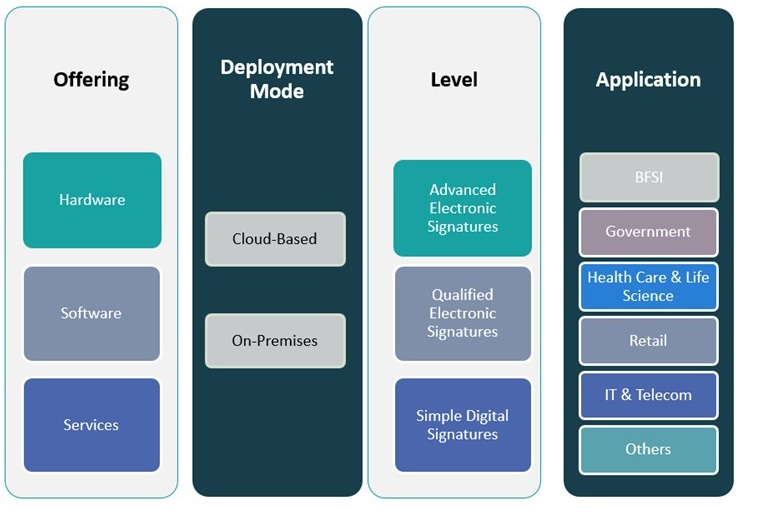 Canada Digital Signature Market[/caption]
Market Drivers:
Rising Regulatory Compliance and Legal Validity
The expansion of the Canada digital signature market is strongly supported by a robust legal and regulatory framework. The Personal Information Protection and Electronic Documents Act (PIPEDA) grants legal recognition to electronic signatures, enabling their use in a wide range of commercial and government transactions. This regulatory clarity has eliminated uncertainties around enforceability, driving increased adoption among enterprises. In addition, the Uniform Electronic Commerce Act (UECA) adopted by several provinces standardizes electronic signature usage, ensuring consistency across jurisdictions. These legal advancements have provided organizations with the confidence to transition from traditional paper-based systems to secure digital workflows.
Growing Demand for Secure and Efficient Digital Transactions
As digital transformation accelerates across industries, Canadian businesses increasingly require secure and efficient tools for document verification and authentication. Digital signatures offer a tamper-evident mechanism that ensures the integrity of signed documents, reducing the risks associated with data breaches, fraud, and unauthorized alterations. This is particularly vital for sectors handling sensitive data, such as finance, healthcare, legal, and government. For instance, companies like DocuSign have responded to heightened security needs by enhancing fraud detection and authentication features, especially after a surge in phishing attacks targeting digital signature platforms. The need for enhanced security protocols has surged in the wake of rising cyber threats, compelling organizations to invest in digital signature solutions that align with modern security standards while enabling faster turnaround times for transactions.
Remote Work and Digital Workflow Integration
The widespread adoption of remote work has significantly reshaped corporate operations in Canada. Businesses are now prioritizing tools that support decentralized collaboration and seamless workflow integration. Digital signature platforms enable users to sign, send, and manage documents from any location, facilitating continuous business operations without physical dependencies. This flexibility has proven crucial for maintaining productivity and operational efficiency, especially in legal processes, client onboarding, and HR documentation. Cloud-based digital signature solutions have further enhanced accessibility and reduced infrastructure costs, making them attractive to both large enterprises and small businesses.
Technology Advancements and Enterprise Digitalization
Advancements in technology continue to be a key driver of digital signature adoption in Canada. The integration of blockchain technology has enhanced the traceability and security of signed documents, while artificial intelligence is improving identity verification and fraud detection processes. For example, OneSpan Sign’s collaboration with Smart Communications in February 2022 aimed to streamline digital agreement processes, improving customer experience across digital channels like email, SMS, and in-app messages. Moreover, digital signature solutions are now being embedded into broader enterprise platforms such as CRM systems, HR management tools, and cloud storage services. These integrations allow organizations to digitize entire document workflows, improve user experience, and accelerate compliance processes. As Canadian enterprises continue to embrace digital-first strategies, the role of digital signatures in enabling secure, streamlined operations will become increasingly critical.
Market Trends:
Accelerated Growth in Cloud-Based Solutions
The Canadian digital signature market is witnessing a significant shift towards cloud-based solutions, driven by the need for scalable, secure, and accessible platforms. Cloud deployments offer organizations the flexibility to manage digital transactions remotely, a feature that has become increasingly vital in the post-pandemic era. This trend is further bolstered by the integration of digital signature functionalities into existing cloud services, enhancing operational efficiency and reducing the reliance on physical documentation. As businesses continue to prioritize digital transformation, the demand for cloud-based digital signature solutions is expected to rise, reflecting a broader global movement towards cloud computing.
Integration with Advanced Technologies
The incorporation of advanced technologies such as blockchain and artificial intelligence (AI) is reshaping the digital signature landscape in Canada. Blockchain technology enhances the security and immutability of digital signatures, providing a tamper-proof record of transactions. Meanwhile, AI facilitates intelligent document processing and verification, streamlining workflows and reducing the potential for human error. For instance, Klippa leverages AI and biometrics for automated identity verification, reducing onboarding times and preventing fraud in compliance with KYC and AML regulations. These technological advancements not only improve the reliability of digital signatures but also open new avenues for their application across various sectors, including finance, healthcare, and legal services.
Rising Adoption in Healthcare and Government Sectors
There is a growing trend of digital signature adoption within Canada's healthcare and government sectors. In healthcare, digital signatures are being utilized to expedite patient onboarding, consent forms, and the management of electronic health records, thereby enhancing patient care and administrative efficiency. Government agencies are increasingly implementing digital signatures to facilitate secure and efficient public services, such as electronic voting, tax filings, and identity verification processes. For instance, in government, provinces such as Alberta and British Columbia have launched digital IDs and electronic document initiatives, including mobile cards and video verification, to support secure public services and digital identity verification. This adoption is driven by the need for secure, efficient, and legally compliant digital transaction methods that can meet the demands of modern governance and healthcare delivery.
Demographic Shifts Influencing User Preferences
Demographic changes are influencing the adoption patterns of digital signatures in Canada. Younger generations, who are more technologically adept, show a preference for mobile-friendly and user-centric digital signature solutions. This shift is prompting providers to develop more intuitive interfaces and mobile applications that cater to the expectations of a digitally native user base. As these demographics become more prominent in the workforce and consumer markets, their preferences are expected to drive the evolution of digital signature technologies towards more accessible and user-friendly platforms.
Market Challenges Analysis:
High Initial Implementation Costs
One of the significant restraints in the Canada digital signature market is the high initial investment required for deployment. For instance, Notarius charges a one-time sign-up fee of $109 and an annual subscription of $215 for its digital signature service, with additional signatures for other provinces costing $99 each per year. While cloud-based solutions have made adoption more accessible for small and medium-sized enterprises, the upfront costs for enterprise-level integration including hardware upgrades, cybersecurity frameworks, and software licensing remain substantial. Many organizations hesitate to adopt digital signature platforms due to budget constraints or uncertainty around the return on investment. This cost barrier can slow the market penetration rate, particularly among businesses with limited technological infrastructure.
Lack of Uniform Standards Across Provinces
Despite federal legislation like the Personal Information Protection and Electronic Documents Act (PIPEDA), the absence of uniform electronic signature standards across Canadian provinces presents a regulatory challenge. Provinces may have differing interpretations or supplementary regulations regarding the use of digital signatures, particularly in sectors like real estate or legal documentation. This lack of standardization complicates cross-border and inter-provincial transactions, limiting the seamless integration of digital signature solutions nationwide. Businesses operating in multiple jurisdictions often face additional legal and compliance costs as a result.
Cybersecurity Concerns and Trust Issues
Although digital signatures enhance security, they are not immune to cybersecurity threats. Concerns regarding data breaches, phishing attacks, and unauthorized access continue to challenge user confidence. Public skepticism about the authenticity and legal standing of digital signatures, especially in high-value transactions, can deter wider adoption. Additionally, evolving cyber threats demand constant updates and audits of digital signature systems, increasing operational complexity for solution providers and end-users alike.
Limited Digital Literacy in Certain Segments
Digital literacy levels vary significantly across industries and demographic groups in Canada. Older professionals, small business owners in rural areas, or sectors traditionally reliant on paper-based workflows may lack the skills or motivation to adopt digital signature technology. This digital divide restricts adoption and presents a challenge for vendors seeking broad market coverage.
Market Opportunities:
The Canada digital signature market presents a robust opportunity for growth, driven by the nation’s accelerating digital transformation initiatives across both public and private sectors. As businesses increasingly shift toward paperless operations and decentralized work environments, digital signature solutions stand to become a critical component of enterprise infrastructure. The integration of digital signatures into cloud platforms, customer relationship management (CRM) systems, and enterprise resource planning (ERP) tools is creating new avenues for solution providers to expand their offerings. Additionally, sectors such as banking, legal services, education, and insurance are actively modernizing workflows, thus generating strong demand for secure, scalable, and compliant digital signing platforms.
Moreover, Canada’s strategic focus on enhancing digital governance, particularly in healthcare and e-government services, further amplifies the market potential. The increasing emphasis on remote service delivery and secure identity verification opens significant opportunities for vendors to collaborate with government agencies and public service providers. As regulatory bodies continue to refine frameworks supporting electronic transactions, solution providers that offer compliance-ready, user-centric products will be well-positioned to capitalize on emerging demand. Furthermore, the growing popularity of blockchain-based and AI-enhanced digital signature platforms signals potential for innovation-driven growth, enabling Canadian enterprises to adopt next-generation security and automation capabilities. With a digitally literate consumer base and strong legal backing, Canada offers a fertile environment for market expansion and technological leadership in the global digital signature space.
Market Segmentation Analysis:
The Canada digital signature market is segmented based on offering, deployment mode, signature level, and application.
By offering, the software segment holds the largest market share due to the rising adoption of cloud-based and AI-integrated platforms that streamline document management and authentication processes. However, the services segment is expected to witness the fastest growth, driven by increasing demand for managed and consulting services to support secure integration and compliance. Hardware-based solutions, though comparatively smaller in share, remain relevant in sectors requiring dedicated signing devices or secure tokens.
By deployment mode, cloud-based solutions dominate the Canadian market owing to their scalability, lower infrastructure costs, and compatibility with remote work environments. Cloud deployment is particularly attractive for small and medium-sized enterprises that seek flexible and cost-efficient options. On-premises deployment, while declining in share, continues to serve organizations with strict data sovereignty and internal security policies.
By level, advanced electronic signatures lead the market due to their optimal balance between security, usability, and legal compliance. Qualified electronic signatures are gaining traction, especially in highly regulated industries such as banking and government. Simple digital signatures remain in use for low-risk, internal documentation.
By Application-wise, the BFSI sector holds the dominant position due to the increasing need for secure and legally binding transactions. Government and healthcare sectors are also key contributors, fueled by digitalization in public service and health record management. Additionally, IT & telecom and retail sectors are increasingly integrating digital signatures to optimize customer experience and internal operations.
Segmentation:
By Offering Segment:
- Hardware
- Software
- Services
By Deployment Mode Segment:
- Cloud-Based
- On-Premises
By Level Segment:
- Advanced Electronic Signatures
- Qualified Electronic Signatures
- Simple Digital Signatures
By Application Segment:
- BFSI (Banking, Financial Services, and Insurance)
- Government
- Healthcare & Life Sciences
- Retail
- IT & Telecom
- Others
Regional Analysis:
Ontario leads the market, accounting for approximately 38% of the national digital signature revenue. The province's dominance is attributed to its status as Canada's financial and technological hub, with Toronto housing numerous financial institutions and tech companies that have rapidly adopted digital signature solutions.
Quebec follows, contributing around 25% to the market share. The province's strong emphasis on digital governance and the presence of key industries such as aerospace and healthcare drive the adoption of secure digital transaction methods.
British Columbia holds a significant share of about 18%, propelled by its thriving tech sector and progressive policies supporting digital transformation. Vancouver, in particular, has seen increased adoption of digital signatures in real estate and legal services.
Alberta contributes approximately 12% to the market, with growth driven by the energy sector's need for secure and efficient document management systems. The province's investment in digital infrastructure also supports this upward trend.
The remaining provinces and territories collectively account for the remaining 7% of the market. While their individual shares are smaller, initiatives to enhance digital literacy and infrastructure are expected to foster growth in these regions.
Key Player Analysis:
- OneSpan
- Syngrafii
- Notarius
- Certicom
- Signority
Competitive Analysis:
The Canada digital signature market features a competitive landscape dominated by both global and regional players striving to enhance their market presence through innovation and strategic partnerships. Leading global companies such as DocuSign Inc., Adobe Inc., and OneSpan Inc. hold a significant share due to their comprehensive digital signature suites, regulatory compliance capabilities, and established brand recognition. These players continuously invest in product enhancements and integrations with enterprise platforms like Microsoft 365 and Salesforce to expand their Canadian footprint. Meanwhile, regional firms and emerging vendors are leveraging localized support, data residency solutions, and sector-specific offerings to gain a competitive edge. As cybersecurity concerns intensify and digital adoption accelerates across industries, competition is expected to heighten, with firms focusing on secure authentication features, AI-driven automation, and compliance with Canadian privacy laws such as PIPEDA. The market remains dynamic, with ample opportunities for innovation and strategic collaboration.
Recent Developments:
- In August 2024, Syngrafii announced a strategic partnership with MetaDolce Technologies to expand the reach of its iinked Sign™ e-signature platform. This partnership will integrate Syngrafii’s advanced e-signature solutions with MetaDolce’s biometric and mobile data capture technologies, targeting commercial, enterprise, and government clients globally, including in Canada. Earlier.
- In May 2024, FileCloud, a global leader in content governance, acquired Signority, a Canadian e-signature and document workflow platform. This acquisition is set to enhance FileCloud’s offerings in secure digital signature solutions, particularly benefiting regulated industries in Canada. The integration is expected to drive growth, increase efficiency, and support compliance requirements for sensitive content processing, further establishing a strong Canadian presence for both companies.
- In June 2024, OneSpan launched the OneSpan Integration Platform, a modern solution enabling organizations to seamlessly integrate eSignatures into popular business applications like Microsoft Apps, Google Workspace, Salesforce, and Workday. This low-code/no-code platform aims to simplify digital agreement workflows, boost productivity, and enhance security for organizations in Canada and beyond.
Market Concentration & Characteristics:
The Canada digital signature market demonstrates a moderately concentrated structure, with a few dominant players accounting for a substantial share of the overall market. Companies such as DocuSign Inc., Adobe Inc., and OneSpan Inc. lead the space through extensive service portfolios, robust security protocols, and compliance with Canadian regulatory frameworks. However, the market also accommodates a growing number of regional vendors and niche solution providers that target specific industries or offer tailored services. The market is characterized by rapid technological evolution, cloud-native deployments, and increasing integration with identity verification systems and document management platforms. Demand is driven by sectors such as BFSI, government, and healthcare, which require highly secure and legally compliant transaction systems. Additionally, the market benefits from a strong legal foundation, high digital literacy, and widespread internet access across Canada, fostering continued growth and innovation. This evolving landscape offers opportunities for differentiation through innovation and customer-centric features.
Report Coverage:
The research report offers an in-depth analysis based on Offering, Deployment Mode, Level and Application. It details leading market players, providing an overview of their business, product offerings, investments, revenue streams, and key applications. Additionally, the report includes insights into the competitive environment, SWOT analysis, current market trends, as well as the primary drivers and constraints. Furthermore, it discusses various factors that have driven market expansion in recent years. The report also explores market dynamics, regulatory scenarios, and technological advancements that are shaping the industry. It assesses the impact of external factors and global economic changes on market growth. Lastly, it provides strategic recommendations for new entrants and established companies to navigate the complexities of the market.
Future Outlook:
- Canada’s digital signature market is projected to maintain strong double-digit growth through 2032, driven by enterprise digitization.
- Government initiatives promoting paperless workflows will further accelerate public sector adoption.
- Enhanced AI and blockchain integration will improve authentication and fraud prevention capabilities.
- Cloud-based solutions will continue to dominate due to their scalability and cost-effectiveness.
- Small and medium-sized enterprises are expected to increase adoption as platforms become more affordable and accessible.
- Sector-specific solutions for healthcare, legal, and finance will see higher demand.
- Data residency requirements will drive interest in locally hosted and compliant digital signature services.
- Increased remote work and hybrid business models will sustain demand for secure digital workflows.
- Competition will intensify, pushing vendors to innovate in UX, automation, and integration capabilities.
- Education and awareness initiatives will help overcome digital literacy barriers in underpenetrated regions.

Request a Free Sample
Fill in your details and we'll send you a free sample report.
- Sample data tables & charts
- Research methodology
Market Dynamics
Rising Regulatory Compliance and Legal Validity
Canada's robust legal framework, including PIPEDA and the Uniform Electronic Commerce Act, provides clear legal recognition for digital signatures, encouraging adoption across commercial and government sectors by eliminating uncertainties around enforceability.
Growing Demand for Secure and Efficient Digital Transactions
The need to prevent digital fraud and ensure data integrity is driving organizations in sensitive sectors like BFSI, healthcare, and government to adopt digital signatures for tamper-proof authentication and document verification.
Remote Work and Digital Workflow Integration
The shift to remote and hybrid work models has accelerated the need for cloud-based digital signature solutions, enabling secure, location-independent document management and supporting business continuity.
Technology Advancements and Enterprise Digitalization
Integration of blockchain and AI technologies is enhancing the security, traceability, and automation of digital signature solutions, making them more attractive for enterprises seeking to digitize workflows and improve compliance.
Government Digital Transformation Initiatives
Canadian government programs promoting paperless workflows and digital public services are driving adoption of digital signatures in the public sector, further legitimizing and expanding the market.
Need a Custom Version of This Report?
Tailor the scope, geography, or segments to your exact requirements.
- Custom geography or segment scope
- Direct access to our analyst team
Frequently Asked Questions
What is the current size of the Canada Digital Signature Market?
What factors are driving the growth of the Canada Digital Signature Market?
What are the key segments within the Canada Digital Signature Market?
Who are the major players in the Canada Digital Signature Market?
Table of Content
Chapter 1 Market Segmentation
- 1.1 Segmentation Framework
- 1.1.1 Product and Service Classification
- 1.1.2 Application and End-Use Classification
- 1.1.3 Technology and Solution Classification
- 1.1.4 Customer and Distribution Channel Classification
- 1.1.5 Geographic Segmentation
- 1.1.6 Market Segment Definitions and Boundaries
- 1.2 By Level
- 1.2.1 Advanced Electronic Signatures
- 1.2.2 Qualified Electronic Signatures
- 1.2.3 Simple Digital Signatures
- 1.3 By Offering
- 1.3.1 Hardware
- 1.3.2 Software
- 1.3.3 Services
- 1.4 By Application
- 1.4.1 BFSI (Banking, Financial Services, and Insurance)
- 1.4.2 Government
- 1.4.3 Healthcare & Life Sciences
- 1.4.4 Retail
- 1.4.5 IT & Telecom
- 1.4.6 Others
- 1.5 By Deployment Mode
- 1.5.1 Cloud-Based
- 1.5.2 On-Premises
Chapter 2 Introduction
- 2.1 Report Objectives and Scope
- 2.2 Product Definition and Industry Terminology
- 2.3 Market Inclusions and Exclusions
- 2.4 Research Process
- 2.4.1 Primary Research and Expert Interviews
- 2.4.2 Secondary Research and Source Review
- 2.4.3 Top-Down and Bottom-Up Estimation
- 2.4.4 Data Triangulation and Verification
- 2.5 Market Size Measurement Basis
- 2.5.1 2024: USD 887.69 million → 2032: USD 8,390.97 million
- 2.6 Historical and Forecast Reference Periods
- 2.6.1 Base Year: 2024
- 2.6.2 Forecast Period: 2024-2032
- 2.7 Research Assumptions and Limitations
Chapter 3 Executive Summary
- 3.1 Market Snapshot and Key Findings
- 3.2 Base-Year Market Size, 2024
- 3.3 Forecast Market Size, 2032
- 3.4 Revenue and Volume Growth Outlook
- 3.5 Key Demand and Supply Indicators
- 3.6 Leading Market Segments
- 3.7 Fastest-Growing Market Opportunities
- 3.8 Regional Performance Highlights
- 3.9 Technology and Industry Transformation
- 3.10 Competitive Landscape Summary
- 3.11 Analyst View and Strategic Implications
Chapter 4 Canada Digital Signature Market Trends and Developments
- 4.1 Historical Industry Development
- 4.2 Recent Market Trends and Developments
- 4.3 Demand and Customer Behavior Trends
- 4.4 Technology and Product Innovation
- 4.5 Artificial Intelligence, Automation and Digitalization
- 4.6 Local Manufacturing and Supply Chain Realignment
- 4.7 Industry Partnerships, Mergers and Acquisitions
- 4.8 Sustainability and Circular Economy Developments
- 4.9 Government and Private Sector Investment Trends
- 4.10 Emerging Business Models and Commercialization
- 4.11 Industry Developments and Announcements
Chapter 5 Canada Digital Signature Market Production, Supply and Demand Analysis
- 5.1 Demand Trend and Consumption Analysis
- 5.2 Demand Forecast, 2024-2032
- 5.3 Production and Output Trend
- 5.4 Production and Output Forecast, 2024-2032
- 5.5 Installed Capacity and Capacity Utilization
- 5.6 Company-Wise Production Plants and Statistics
- 5.6.1 Installed Production Capacity
- 5.6.2 Actual Production
- 5.6.3 Planned Capacity and Expansion Targets
- 5.7 Supply Chain Structure and Procurement Trends
- 5.8 Supply-Demand Gap and Bottlenecks
- 5.9 Import Dependence and Sourcing Structure
- 5.10 Contract Manufacturing and Outsourcing
- 5.11 Regional Supply and Demand Concentration
Chapter 6 Canada Digital Signature Market Pricing Analysis
- 6.1 Pricing Structure and Measurement
- 6.2 Historical Pricing Trends
- 6.3 Pricing Outlook, 2024-2032
- 6.4 Average Selling Price and Unit Economics
- 6.5 Pricing by Product and Market Segment
- 6.6 Geographic Pricing Differences
- 6.7 Key Input, Energy, Labor and Logistics Costs
- 6.8 Contract Pricing and Purchasing Models
- 6.9 Pricing Sensitivity and Competitive Positioning
- 6.10 Price, Margin and Profitability Implications
Chapter 7 Canada Digital Signature Market Dynamics
- 7.1 Market Growth Drivers
- 7.1.1 Demand-Side Drivers
- 7.1.2 Technology and Innovation Drivers
- 7.1.3 Infrastructure and Investment Drivers
- 7.1.4 Regulatory and Policy Drivers
- 7.2 Market Restraints
- 7.2.1 Cost and Affordability Constraints
- 7.2.2 Technology and Adoption Barriers
- 7.2.3 Supply Chain and Operational Constraints
- 7.3 Market Challenges
- 7.3.1 Competitive Pressure and Margin Erosion
- 7.3.2 Skills, Infrastructure and Implementation Gaps
- 7.4 Emerging Market Opportunities
- 7.5 Market Dynamics Impact and Time-Horizon Assessment
Chapter 8 Canada Digital Signature Value Chain Analysis
- 8.1 Industry Value Chain Overview
- 8.2 Upstream Suppliers and Critical Inputs
- 8.3 Technology and Component Providers
- 8.4 Manufacturing or Service Delivery
- 8.5 Distribution, Channel Partners and Integrators
- 8.6 Downstream Applications and End Users
- 8.7 Value Addition and Profit Pools
- 8.8 Vertical Integration and Outsourcing
- 8.9 Supplier Concentration and Risk
- 8.10 Supply Chain Localization and Resilience
Chapter 9 Canada Digital Signature Market Regulations and Policies
- 9.1 Relevant Laws, Standards and Compliance Frameworks
- 9.2 Product, Service, Safety and Quality Requirements
- 9.3 Government Policies, Incentives and Subsidies
- 9.4 Imports, Exports and Trade Barriers
- 9.5 Public Procurement and Local Content Requirements
- 9.6 Environmental and Sustainability Compliance
- 9.7 Data Protection, AI and Cybersecurity Compliance
- 9.8 Upcoming Policy Changes and Market Implications
Chapter 10 Canada Digital Signature Market Hotspots and Opportunities
- 10.1 Market Opportunity Mapping and Growth Hotspots
- 10.2 High-Growth Applications and Customer Groups
- 10.3 Underserved Markets and White-Space Opportunities
- 10.4 Emerging Technology and Product Opportunities
- 10.5 New Capacity and Investment Hotspots
- 10.6 Market Entry and Expansion Opportunities
- 10.7 Distribution and Partnership Opportunities
- 10.8 Near-Term and Long-Term Commercial Potential
- 10.9 Opportunity Attractiveness and Execution Risks
Chapter 11 Canada Digital Signature Market Outlook, 2024-2032
- 11.1 Market Size and Analysis
- 11.1.1 Revenue (Market Measurement: 2024: USD 887.69 million → 2032: USD 8,390.97 million)
- 11.1.2 Market Volume and Quantity Sold
- 11.1.3 Historical Market Size
- 11.1.4 Base-Year Market Size, 2024
- 11.2 Market Forecast, 2024-2032
- 11.2.1 Revenue Forecast to 2032
- 11.2.2 Volume Forecast to 2032
- 11.2.3 CAGR and Year-on-Year Growth
- 11.2.4 Incremental Revenue Opportunity
- 11.3 Forecast Assumptions and Scenario Analysis
- 11.3.1 Base-Case Forecast
- 11.3.2 Optimistic and Conservative Scenarios
- 11.3.3 Technology, Pricing and Policy Sensitivities
- 11.4 Market Attractiveness and Growth Outlook
Chapter 12 Canada Digital Signature Market Segmentation and Outlook
- 12.1 Segmentation Summary and Market Shares, 2024
- 12.2 Largest and Fastest-Growing Segments
- 12.3 By Level - Market Size and Forecast, 2024-2032
- 12.3.1 Segment Definition and Scope
- 12.3.2 Historical Market Size
- 12.3.3 Revenue Forecast, 2024-2032
- 12.3.4 Volume Forecast, 2024-2032
- 12.3.5 Base-Year Market Share, 2024
- 12.3.6 Segment CAGR and Growth Drivers
- 12.3.7 Subsegment Market Size and Forecast
- 12.3.7.1 Advanced Electronic Signatures
- 12.3.7.2 Qualified Electronic Signatures
- 12.3.7.3 Simple Digital Signatures
- 12.3.8 Subsegment Pricing and Adoption Trends
- 12.3.9 Leading Suppliers and Competition
- 12.3.10 Regional Demand and Opportunities
- 12.4 By Offering - Market Size and Forecast, 2024-2032
- 12.4.1 Segment Definition and Scope
- 12.4.2 Historical Market Size
- 12.4.3 Revenue Forecast, 2024-2032
- 12.4.4 Volume Forecast, 2024-2032
- 12.4.5 Base-Year Market Share, 2024
- 12.4.6 Segment CAGR and Growth Drivers
- 12.4.7 Subsegment Market Size and Forecast
- 12.4.7.1 Hardware
- 12.4.7.2 Software
- 12.4.7.3 Services
- 12.4.8 Subsegment Pricing and Adoption Trends
- 12.4.9 Leading Suppliers and Competition
- 12.4.10 Regional Demand and Opportunities
- 12.5 By Application - Market Size and Forecast, 2024-2032
- 12.5.1 Segment Definition and Scope
- 12.5.2 Historical Market Size
- 12.5.3 Revenue Forecast, 2024-2032
- 12.5.4 Volume Forecast, 2024-2032
- 12.5.5 Base-Year Market Share, 2024
- 12.5.6 Segment CAGR and Growth Drivers
- 12.5.7 Subsegment Market Size and Forecast
- 12.5.7.1 BFSI (Banking, Financial Services, and Insurance)
- 12.5.7.2 Government
- 12.5.7.3 Healthcare & Life Sciences
- 12.5.7.4 Retail
- 12.5.7.5 IT & Telecom
- 12.5.7.6 Others
- 12.5.8 Subsegment Pricing and Adoption Trends
- 12.5.9 Leading Suppliers and Competition
- 12.5.10 Regional Demand and Opportunities
- 12.6 By Deployment Mode - Market Size and Forecast, 2024-2032
- 12.6.1 Segment Definition and Scope
- 12.6.2 Historical Market Size
- 12.6.3 Revenue Forecast, 2024-2032
- 12.6.4 Volume Forecast, 2024-2032
- 12.6.5 Base-Year Market Share, 2024
- 12.6.6 Segment CAGR and Growth Drivers
- 12.6.7 Subsegment Market Size and Forecast
- 12.6.7.1 Cloud-Based
- 12.6.7.2 On-Premises
- 12.6.8 Subsegment Pricing and Adoption Trends
- 12.6.9 Leading Suppliers and Competition
- 12.6.10 Regional Demand and Opportunities
- 12.7 Segment Growth Comparison
- 12.8 Segment Attractiveness and Priority Matrix
Chapter 13 Canada Digital Signature End-Use and Application Market Outlook
- 13.1 End-Use Industry and Customer Demand Structure
- 13.2 Leading Applications and Customer Groups
- 13.3 End-Use Market Size, Share and Forecast
- 13.4 Major End-Use Industry Deep Dives
- 13.4.1 Customer Requirements and Use Cases
- 13.4.2 Demand and Replacement Cycles
- 13.4.3 Technical and Regulatory Considerations
- 13.4.4 Purchasing and Procurement Models
- 13.4.5 Leading Vendors and Distribution Channels
- 13.4.6 Forecast and Commercial Opportunities
- 13.5 Emerging Applications and Cross-Segment Demand
- 13.6 End-Use Industry Investment Priorities
Chapter 14 Canada Digital Signature Geographic Market Outlook, 2024-2032
- 14.1 Domestic Market Distribution and Demand Clusters
- 14.2 State- or Province-Wise Market Size and Forecast, 2024-2032
- 14.3 City and Metropolitan Market Outlook
- 14.4 Industrial, Manufacturing and Commercial Clusters
- 14.5 Geographic Concentration of Key End Users
- 14.6 Local Pricing and Purchasing Differences
- 14.7 Domestic Production Facilities and Capacity Map
- 14.8 Local Infrastructure and Project Pipeline
- 14.9 State-Level Policy and Incentive Differences
- 14.10 Subnational Investment Hotspots and Opportunities
- 14.11 Distribution and Logistics Networks
- 14.12 Domestic Competitive Footprint
Chapter 15 Canada Digital Signature Technology, Innovation and Sustainability Outlook
- 15.1 Technology Landscape and Maturity
- 15.2 Product, Process and Service Innovation
- 15.3 AI, Automation and Digital Tools in the Industry
- 15.4 Technology Adoption and Performance Benchmarking
- 15.5 Innovation Pipeline and R&D Investment
- 15.6 Patent and Intellectual Property Trends
- 15.7 Energy Efficiency and Resource Management
- 15.8 Sustainability, Recycling and Circularity
- 15.9 Technology Roadmap, 2024-2032
- 15.10 Risks of Obsolescence and Technology Substitution
Chapter 16 Canada Digital Signature Market Key Strategic Imperatives
- 16.1 Growth and Market Entry Priorities
- 16.2 High-Return Products and Segments
- 16.3 Pricing, Profitability and Cost Optimization
- 16.4 Technology Investment and Product Differentiation
- 16.5 Supply Chain Localization and Resilience
- 16.6 Distribution and Customer Acquisition
- 16.7 Partnership, Acquisition and Capacity Strategy
- 16.8 Regional Expansion Priorities
- 16.9 Short-, Medium- and Long-Term Actions
Chapter 17 Competition Outlook
- 17.1 Industry Competition Characteristics
- 17.2 Market Structure and Concentration
- 17.3 Market Share and Competitive Positioning, 2024
- 17.4 Company-Wise Revenue and Product Benchmarking
- 17.5 Production and Service Capacity Benchmarking
- 17.6 Technology, Pricing and Differentiation
- 17.7 Regional Footprint and Distribution Strength
- 17.8 Mergers, Acquisitions and Strategic Alliances
- 17.9 New Entrants and Competitive Threats
- 17.10 Porter's Five Forces and Industry Attractiveness
- 17.11 Competitive Outlook, 2024-2032
Chapter 18 Company Profiles
- 18.1 Company Coverage and Selection Criteria
- 18.2 DocuSign Inc.
- 18.2.1 Business Description
- 18.2.2 Company Ownership and Geographic Presence
- 18.2.3 Product and Service Portfolio
- 18.2.4 Manufacturing and Operating Footprint
- 18.2.5 Production Capacity and Expansion Plans
- 18.2.6 Financial Performance and Investment
- 18.2.7 Market Share and Competitive Position
- 18.2.8 Technology and Innovation Capabilities
- 18.2.9 Strategic Alliances or Partnerships
- 18.2.10 Recent Developments
- 18.2.11 Growth Strategy and Outlook
- 18.3 Adobe Inc.
- 18.4 OneSpan Inc.
- 18.5 Syngrafii
- 18.6 Notarius
- 18.7 Certicom
- 18.8 Signority
- 18.9 FileCloud
- 18.10 Entrust
- 18.11 Zoho Corporation
- 18.12 Other Relevant Market Participants
Note: Every listed company is profiled on the structure shown under the first company. The company list is preliminary and may change based on research findings, market developments, data availability and client requirements.
Chapter 19 Disclaimer
- 19.1 Research and Forecast Disclaimer
- 19.2 Data Source and Estimation Limitations
Note: The depth of individual sections depends on data availability for this market. Volume, capacity, trade and other unit-based metrics are included where applicable.

