
Market Overview:
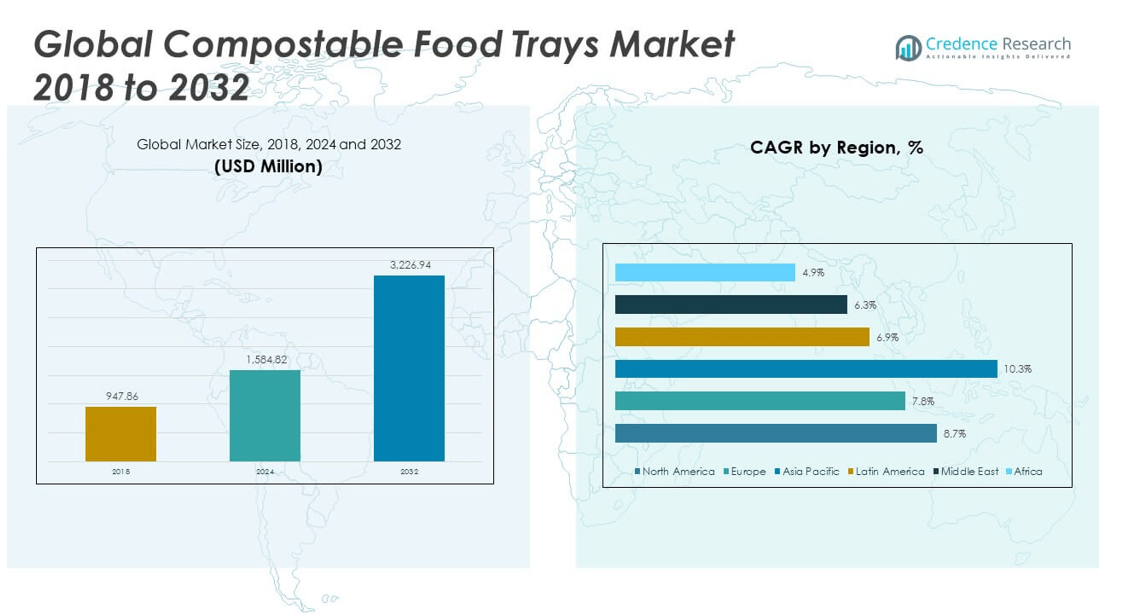
The Global Compostable Food Trays Market size was valued at USD 947.86 million in 2018 to USD 1,584.82 million in 2024 and is anticipated to reach USD 3,226.94 million by 2032, at a CAGR of 8.66% during the forecast period.
| REPORT ATTRIBUTE | DETAILS |
|---|---|
| Historical Period | 2020-2023 |
| Base Year | 2024 |
| Forecast Period | 2025-2032 |
| Compostable Food Trays Market Size 2024 | USD 1,584.82 million |
| Compostable Food Trays Market, CAGR | 8.66% |
| Compostable Food Trays Market Size 2032 | USD 3,226.94 million |
The market growth is driven by increasing consumer awareness regarding environmental sustainability and the harmful impacts of single-use plastics. Governments worldwide are enforcing stricter regulations and bans on non-biodegradable packaging, encouraging the adoption of compostable alternatives. Foodservice providers, retail chains, and e-commerce companies are actively transitioning to eco-friendly trays to meet sustainability goals and improve brand perception, while advancements in biodegradable material technology are further enhancing product durability and cost-efficiency.
Regionally, North America and Europe lead the market due to strong environmental regulations, high consumer demand for sustainable packaging, and established composting infrastructure. Countries such as the U.S., Germany, France, and the UK are at the forefront of adoption. Meanwhile, Asia Pacific is emerging as a high-growth region, driven by rapid urbanization, expanding foodservice industries, and government-led plastic reduction initiatives in countries like India, China, and Australia, creating new opportunities for manufacturers in the compostable food trays sector.
Market Insights:
- The Global Compostable Food Trays Market was valued at USD 1,584.82 million in 2024 and is anticipated to reach USD 3,226.94 million by 2032, growing at a CAGR of 8.66%.
- Rising environmental regulations and consumer preference for sustainable packaging are driving strong market adoption across multiple sectors.
- Bans on single-use plastics in several countries are pushing foodservice providers and retailers toward compostable alternatives.
- High production costs compared to conventional plastic trays remain a challenge for wider adoption in cost-sensitive markets.
- North America leads the market in 2024, supported by advanced composting infrastructure and strict regulatory frameworks.
- Asia Pacific shows the fastest growth rate due to rapid urbanization, government initiatives, and expanding food delivery services.
- Limited composting infrastructure in developing regions continues to restrict large-scale market penetration.
Market Drivers
Rising Global Awareness of Environmental Sustainability and Plastic Waste Reduction
Growing environmental consciousness is driving strong demand for eco-friendly packaging solutions. Governments and organizations are promoting the shift from single-use plastics to biodegradable alternatives through awareness campaigns and policy interventions. Consumers are increasingly favoring products that align with sustainability values, pushing retailers and foodservice providers to adopt greener options. The Global Compostable Food Trays Market benefits from this shift, with rising adoption across quick-service restaurants, catering services, and retail chains. Corporate sustainability targets are further encouraging the use of compostable trays as part of broader environmental strategies. Regulations banning or taxing plastic packaging in various countries are accelerating this transition. Companies are investing in product innovation to meet consumer expectations for durability, aesthetics, and performance. Industry players are positioning their offerings to meet both functional and environmental demands, strengthening market growth.
- For instance, Notpla a London-based startup has replaced over 21.5 million single-use plastic food containers with its seaweed-derived compostable packaging across Europe as of May 2025.
Strong Regulatory Frameworks and Government-Led Plastic Reduction Initiatives
Legislative action is playing a critical role in promoting biodegradable and compostable packaging solutions. Governments in developed and developing economies are implementing strict regulations against non-biodegradable materials. Mandatory waste segregation, composting infrastructure development, and subsidies for sustainable packaging production are fueling adoption. The Global Compostable Food Trays Market gains from these supportive policy measures, which create a favorable environment for manufacturers. Food safety standards and labeling requirements ensure compliance and consumer trust. Import restrictions on certain plastic materials encourage local production of compostable alternatives. Public institutions, including schools and hospitals, are mandated to use eco-friendly products in some regions. This alignment between policy and consumer preferences strengthens the market’s expansion potential.
- For example, California’s SB 54 mandates a 25% reduction in single-use plastic packaging by 2032 and requires all such packaging sold in the state to be recyclable or compostable, while establishing a $5 billion fund to support recycling infrastructure and plastic pollution mitigation.
Expansion of Foodservice and E-Commerce Sectors Increasing Product Demand
The rapid growth of the foodservice sector, driven by urbanization and lifestyle changes, is creating a significant need for sustainable packaging solutions. Quick-service restaurants, cloud kitchens, and catering companies are integrating compostable trays into their operations. E-commerce platforms offering ready-to-eat meals and fresh produce are adopting biodegradable trays to enhance sustainability credentials. The Global Compostable Food Trays Market benefits from this broadening application base across multiple distribution channels. Companies seek packaging that protects product quality while meeting eco-friendly commitments. The expansion of delivery services increases consumption of disposable packaging, boosting demand for compostable alternatives. Seasonal and event-driven food demand further contributes to higher sales volumes. This demand pattern supports consistent market growth.
Advancements in Compostable Material Technology Improving Product Performance
Technological innovations in biodegradable polymers and plant-based materials are enhancing the durability, heat resistance, and moisture barrier properties of compostable trays. Manufacturers are improving production processes to achieve better cost efficiency and scalability. The Global Compostable Food Trays Market is witnessing the introduction of trays that match or exceed the performance of plastic counterparts. These innovations address previous concerns about structural integrity and shelf life. Enhanced material properties expand the range of applications, including hot food service and frozen food storage. Investments in R&D are leading to new blends and coatings that maintain compostability while improving usability. Brand owners leverage these advancements to deliver products that meet both environmental and operational requirements. Continuous product improvement is helping overcome adoption barriers in competitive markets.
Market Trends
Growing Adoption of Circular Economy Principles in Packaging Strategies
Businesses are integrating circular economy practices to reduce environmental impact and optimize resource use. Companies design compostable trays with full end-of-life recovery in mind, ensuring they fit into composting systems. The Global Compostable Food Trays Market benefits from these principles, which promote closed-loop material cycles. Brands are using take-back programs and composting partnerships to manage post-consumer waste responsibly. Collaboration between packaging manufacturers and waste management providers is increasing. Public campaigns highlight the role of compostable products in reducing landfill dependency. Companies emphasize the traceability of raw materials to assure consumers of sustainability claims. This alignment with circular economy goals is becoming a competitive advantage for market participants.
- For instance, Vegware, a leading UK-based producer of compostable food packaging, collected over 76 tonnes (equivalent to 4.4 million units) of its used products for composting through its 'Close the Loop' program in Scotland in 2021.
Customization and Branding Innovations Driving Product Differentiation
Manufacturers are offering highly customizable compostable trays to meet the unique branding requirements of clients. Advanced printing techniques enable high-quality graphics and messaging on eco-friendly substrates. The Global Compostable Food Trays Market sees strong uptake from brands seeking distinctive packaging that also supports sustainability. Foodservice operators use customization to enhance brand recall and customer engagement. Seasonal designs and limited-edition packaging help businesses differentiate their offerings. The combination of aesthetics and environmental responsibility attracts environmentally conscious consumers. Improved printing inks and coatings ensure compostability remains intact. This trend drives higher value sales within the market.
Increasing Use of Local and Regionally Sourced Raw Materials
Sourcing raw materials locally is becoming a priority to reduce transportation costs and carbon emissions. The Global Compostable Food Trays Market benefits from this shift, as regional supply chains improve responsiveness and flexibility. Manufacturers form partnerships with local agricultural producers for plant-based feedstocks. This approach strengthens community economies and reduces environmental impact. Locally sourced inputs allow for better quality control and traceability. Regional material availability supports faster production cycles and supply chain resilience. Governments encourage this practice through incentives and procurement policies. The trend also aligns with growing consumer interest in supporting local industries.
Expansion of Industrial Composting Infrastructure Supporting Market Scalability
Infrastructure for industrial composting is expanding in response to rising organic waste volumes. Municipalities and private operators are investing in facilities capable of processing large quantities of compostable packaging. The Global Compostable Food Trays Market benefits as more regions develop the capacity to handle such waste streams. Infrastructure growth supports compliance with compostability certifications and standards. Greater processing availability reassures businesses that products will decompose effectively. Partnerships between composting facilities and packaging suppliers create integrated waste solutions. Public awareness campaigns encourage proper disposal practices to maximize composting efficiency. This expansion ensures compostable trays have a viable end-of-life pathway in multiple regions.
- For instance, the Composting Consortium a collaboration involving brands like PepsiCo, Kraft Heinz, and US Composting Council has awarded grants and launched multi-year infrastructure projects to increase food-contact compostable packaging recovery in the US.
Market Challenges Analysis
High Production Costs and Price Sensitivity Among End Users
Production costs for compostable trays remain higher than conventional plastic alternatives due to material sourcing and processing complexities. Limited economies of scale in some regions add to overall pricing pressure. The Global Compostable Food Trays Market faces challenges when competing for contracts in cost-sensitive segments such as street food vendors and small eateries. Businesses in price-competitive markets hesitate to adopt higher-cost solutions without strong regulatory mandates. Fluctuations in raw material supply impact pricing stability. Some manufacturers struggle to maintain profitability while offering competitive rates. This challenge requires continuous investment in manufacturing efficiency to lower production expenses. Cost remains a critical barrier to mass adoption in certain regions.
Limited Consumer Awareness and End-of-Life Processing Infrastructure
Many consumers remain unaware of the correct disposal methods for compostable trays, leading to contamination in waste streams. The Global Compostable Food Trays Market encounters difficulties in regions with insufficient industrial composting facilities. Without proper infrastructure, the environmental benefits of compostable products diminish. Waste management systems in developing economies often lack the capability to process such materials efficiently. Confusion between biodegradable and compostable packaging causes improper disposal. This gap in awareness reduces overall market impact. Manufacturers and policymakers must collaborate to improve education and infrastructure investment. Addressing these limitations is vital for long-term growth and consumer trust.
Market Opportunities
Expansion into Emerging Markets with Rising Foodservice Demand
Emerging economies present strong opportunities due to rapid urbanization and increasing disposable incomes. The Global Compostable Food Trays Market can expand into these regions by aligning with growing demand for sustainable food packaging. Rising middle-class populations seek convenience without compromising environmental values. Governments in these markets are beginning to adopt anti-plastic regulations. Food delivery services and quick-service restaurants offer a strong customer base for compostable solutions. Local production partnerships can improve cost efficiency and market penetration. Establishing brand presence early ensures long-term competitiveness.
Product Diversification and Integration with Smart Packaging Solutions
Innovation in product design offers opportunities to combine compostable trays with smart packaging features such as freshness indicators. The Global Compostable Food Trays Market can leverage these features to attract premium customers seeking functionality and sustainability. Integration of QR codes and traceability data enhances consumer engagement. Advanced coatings improve performance in varied temperature conditions. Diversification into multiple shapes and sizes supports broader application across food categories. Collaborations with technology providers can differentiate products in competitive markets. These advancements create value beyond basic sustainability, appealing to both businesses and consumers.
Market Segmentation Analysis:
The Global Compostable Food Trays Market is segmented by compartment, material, and end use, reflecting varied consumer preferences and operational requirements.
By compartment, single-compartment trays dominate due to their extensive use in quick-service restaurants and takeaway outlets. The 2 to 5 compartment segment serves portioned meals in institutional and catering applications, offering convenience and portion control. Trays with more than 5 compartments remain niche but are gaining attention in specialized catering services for elaborate meal presentations.
- For instance, single-compartment compostable trays made from sugarcane and bamboo fibers are offered by Oliver Packaging, and are certified to meet ASTM 6868 and 6400, as well as EN 13432 standards for compostability. These trays can withstand temperatures from -40° to 400°F, making them highly versatile for different food types and prep environments.
By material, bagasse leads due to its durability, heat resistance, and wide acceptance as an eco-friendly alternative to plastics. Kraft paper and paperboard follow, valued for their recyclability and printing flexibility, which supports branding initiatives. Bamboo is emerging as a premium segment, offering strength, biodegradability, and an upscale appearance suitable for high-end foodservice. The “others” category, including blends of plant fibers and bio-polymers, is expanding with advancements in material innovation that enhance performance while maintaining compostability.
By end use, restaurants, cafes, and eateries hold the largest share due to high daily consumption and the need for disposable, sustainable solutions. Catering services adopt compostable trays to meet event-specific sustainability demands, while groceries and fresh produce outlets use them for packaging ready-to-eat meals and fresh food. Institutional foodservice, including schools, hospitals, and corporate cafeterias, incorporates these trays to align with sustainability policies and regulatory requirements. The “others” segment covers niche applications, including airlines, railways, and specialty food vendors, where portability, safety, and eco-compliance are key purchasing factors.
- For instance, Huhtamaki’s SAVADAY® molded fiber trays are made from recycled and renewable materials, are fully compostable, and offer durability with oil-absorbing properties, making them suitable for a wide range of foodservice applications.
Segmentation:
By Compartment
- Single
- 2 to 5
- More than 5
By Material
- Bagasse
- Kraft Paper
- Paperboard
- Bamboo
- Others
By End Use
- Restaurants, cafes, eateries
- Catering services
- Groceries and fresh produce outlets
- Institutional foodservice
- Others
By Region
- North America
- U.S.
- Canada
- Mexico
- Europe
- UK
- France
- Germany
- Italy
- Spain
- Russia
- Belgium
- Netherlands
- Austria
- Sweden
- Poland
- Denmark
- Switzerland
- Rest of Europe
- Asia Pacific
- China
- Japan
- South Korea
- India
- Australia
- Thailand
- Indonesia
- Vietnam
- Malaysia
- Philippines
- Taiwan
- Rest of Asia Pacific
- Latin America
- Brazil
- Argentina
- Peru
- Chile
- Colombia
- Rest of Latin America
- Middle East
- UAE
- KSA
- Israel
- Turkey
- Iran
- Rest of Middle East
- Africa
- Egypt
- Nigeria
- Algeria
- Morocco
- Rest of Africa
Regional Analysis:
North America
The North America Global Compostable Food Trays Market size was valued at USD 415.49 million in 2018 to USD 687.51 million in 2024 and is anticipated to reach USD 1,403.75 million by 2032, at a CAGR of 8.7% during the forecast period. It accounts for 43.39% of the global share in 2024. Strong regulatory frameworks banning single-use plastics, coupled with consumer preference for eco-friendly packaging, drive market growth. Quick-service restaurants, retail chains, and institutional foodservice adopt compostable trays to meet sustainability commitments. The presence of advanced composting infrastructure supports proper end-of-life processing. E-commerce meal delivery services boost demand for durable and compostable packaging. Major players in the region invest in material innovation and local production capacity. Food safety compliance and high-quality standards reinforce adoption. Competitive activity focuses on brand differentiation through custom designs and certifications.
Europe
The Europe Global Compostable Food Trays Market size was valued at USD 267.72 million in 2018 to USD 431.42 million in 2024 and is anticipated to reach USD 826.81 million by 2032, at a CAGR of 7.8% during the forecast period. It holds 27.21% of the global share in 2024. Stringent EU packaging regulations and waste reduction directives fuel adoption across multiple sectors. Foodservice operators comply with extended producer responsibility schemes, encouraging the use of compostable trays. The region’s strong recycling and composting networks ensure efficient processing. Urban consumers increasingly prefer sustainable packaging in restaurants and supermarkets. Manufacturers leverage advanced printing and customization for branding. Government incentives support innovation in biodegradable materials. Industry collaborations with waste processors enhance value chain efficiency. Demand continues to rise from catering services and institutional buyers.
Asia Pacific
The Asia Pacific Global Compostable Food Trays Market size was valued at USD 185.05 million in 2018 to USD 334.98 million in 2024 and is anticipated to reach USD 771.25 million by 2032, at a CAGR of 10.3% during the forecast period. It represents 21.14% of the global share in 2024. Rapid urbanization and expansion of the foodservice sector drive substantial demand. Governments introduce bans on certain plastics and promote biodegradable alternatives. The growing middle class values convenience aligned with environmental responsibility. E-commerce meal deliveries and online grocery platforms accelerate adoption. Local manufacturing capacity is expanding to reduce costs. Rising environmental awareness supports market penetration in metropolitan areas. Investments in R&D focus on material strength and moisture resistance. Regional exporters supply cost-competitive products to other global markets.
Latin America
The Latin America Global Compostable Food Trays Market size was valued at USD 41.82 million in 2018 to USD 69.00 million in 2024 and is anticipated to reach USD 123.19 million by 2032, at a CAGR of 6.9% during the forecast period. It contributes 4.35% of the global share in 2024. Market growth is supported by increasing regulatory measures in key economies like Brazil and Argentina. The foodservice industry adopts compostable trays for environmental branding. Rising tourism boosts demand from hotels and catering providers. Retail adoption expands through fresh produce and takeaway packaging. Supply chain challenges exist due to limited local production. Import dependency drives product pricing. Environmental advocacy groups play a role in consumer education. Gradual infrastructure development improves composting capabilities.
Middle East
The Middle East Global Compostable Food Trays Market size was valued at USD 25.81 million in 2018 to USD 39.35 million in 2024 and is anticipated to reach USD 67.21 million by 2032, at a CAGR of 6.3% during the forecast period. It holds 2.48% of the global share in 2024. Government-led sustainability programs and national waste management strategies encourage adoption. High foodservice activity, particularly in hospitality and tourism, drives demand. Corporate sustainability initiatives influence procurement decisions. Importers supply premium compostable products to meet quality expectations. Limited composting infrastructure remains a challenge. Retail adoption grows in premium grocery and gourmet food segments. The catering sector for large events supports periodic demand spikes. Manufacturers explore partnerships to develop localized production capacity.
Africa
The Africa Global Compostable Food Trays Market size was valued at USD 11.96 million in 2018 to USD 22.57 million in 2024 and is anticipated to reach USD 34.72 million by 2032, at a CAGR of 4.9% during the forecast period. It accounts for 1.42% of the global share in 2024. Adoption is driven by increasing government restrictions on plastic packaging in select countries. Urban foodservice establishments adopt compostable trays to appeal to environmentally aware customers. The market is at an early stage, with low-cost alternatives still dominating. Limited composting infrastructure constrains full-scale adoption. International NGOs and sustainability projects introduce pilot programs for biodegradable packaging. Import dependency influences pricing and product availability. Gradual expansion of modern retail and quick-service restaurants creates new opportunities. Local manufacturing potential remains underdeveloped but offers long-term prospects.
Key Player Analysis:
- Green Paper Products
- Good Start Packaging
- World Centric
- Biopak
- Eco-Products
- Dart Container
- Vegware
- Genpak
- EarthPak
- Pactiv Evergreen
Competitive Analysis:
The Global Compostable Food Trays Market features a moderately fragmented landscape with the presence of global brands and regional manufacturers. Key players such as Green Paper Products, Good Start Packaging, World Centric, Biopak, Eco-Products, Dart Container, Vegware, Genpak, EarthPak, and Pactiv Evergreen compete through product innovation, material advancements, and sustainable manufacturing practices. It witnesses strategic mergers, acquisitions, and partnerships aimed at expanding geographic presence and enhancing product portfolios. Customization, durability, and compliance with compostability standards remain core competitive differentiators. Companies invest in branding and certifications to strengthen market credibility and win institutional contracts. Price competitiveness is balanced with premium positioning in high-value segments, supported by strong distribution networks and targeted marketing strategies.
Recent Developments:
- In May 2025, Eco-Products announced an official zero waste partnership with the San Francisco Giants. Through this partnership, Oracle Park will feature Eco-Products’ compostable foodservice packaging, supporting the stadium’s ongoing composting program and waste diversion objectives.
- In January 2025, Cirkla launched its Fiber MAP Trays, a significant innovation in food packaging. These trays leverage molded fiber technology to reduce plastic content and enhance recyclability, aligning with the sustainability goals set by many foodservice and retail operators worldwide.
- In September 2024, BioPak launched a new line of compostable Beer BioCups specifically tailored for outdoor events and stadiums. Crafted with FSC-certified paper and coated with plant-based bioplastic, these cups comply with single-use plastic bans and offer a sustainable alternative to conventional event drinkware.
Market Concentration & Characteristics:
The Global Compostable Food Trays Market demonstrates moderate concentration, with leading players holding significant shares in developed markets and smaller regional firms dominating emerging regions. It is characterized by continuous innovation in biodegradable materials, increasing emphasis on sustainable sourcing, and alignment with regulatory mandates. The market shows strong growth potential driven by environmental awareness and expanding foodservice applications. Competition centers on product performance, cost optimization, and eco-certifications. Distribution strategies focus on penetrating retail, foodservice, and institutional channels while maintaining flexibility to adapt to evolving consumer preferences and waste management infrastructure advancements.
Report Coverage:
The research report offers an in-depth analysis based on Compartment, Material and End Use. It details leading market players, providing an overview of their business, product offerings, investments, revenue streams, and key applications. Additionally, the report includes insights into the competitive environment, SWOT analysis, current market trends, as well as the primary drivers and constraints. Furthermore, it discusses various factors that have driven market expansion in recent years. The report also explores market dynamics, regulatory scenarios, and technological advancements that are shaping the industry. It assesses the impact of external factors and global economic changes on market growth. Lastly, it provides strategic recommendations for new entrants and established companies to navigate the complexities of the market.
Future Outlook:
- Expansion of sustainable packaging mandates will stimulate adoption across foodservice and retail sectors.
- Advancements in compostable material technology will improve durability and performance under varied conditions.
- Growth in e-commerce meal delivery services will increase demand for portable and eco-compliant packaging.
- Rising investment in industrial composting infrastructure will enhance end-of-life processing efficiency.
- Strategic partnerships between manufacturers and waste management companies will strengthen circular economy practices.
- Emerging markets will present high-growth potential through urbanization and regulatory shifts toward plastic alternatives.
- Product diversification into premium and customized designs will support brand differentiation.
- Localized production will reduce costs, improve supply chain resilience, and meet regional sustainability goals.
- Integration of smart packaging features will open new opportunities in premium foodservice applications.
- Continuous alignment with global sustainability certifications will reinforce market credibility and customer trust.

Request a Free Sample
Fill in your details and we'll send you a free sample report.
- Sample data tables & charts
- Research methodology
Market Dynamics
Rising Global Awareness of Environmental Sustainability and Plastic Waste Reduction
Increasing consumer and corporate focus on reducing plastic waste is driving demand for compostable food trays, as both individuals and organizations seek packaging solutions that align with sustainability values and regulatory requirements.
Strong Regulatory Frameworks and Government-Led Plastic Reduction Initiatives
Governments worldwide are implementing bans and restrictions on single-use plastics, mandating the use of compostable or recyclable packaging, which directly accelerates the adoption of compostable food trays across foodservice and retail sectors.
Expansion of Foodservice and E-Commerce Sectors
The rapid growth of quick-service restaurants, catering, and online meal delivery services is increasing the need for disposable, eco-friendly packaging, making compostable trays a preferred choice for businesses aiming to meet sustainability commitments and consumer expectations.
Advancements in Compostable Material Technology
Innovations in biodegradable polymers and plant-based materials are improving the durability, heat resistance, and cost-efficiency of compostable trays, making them more competitive with conventional plastics and expanding their range of applications.
Expansion of Industrial Composting Infrastructure
The development of municipal and private composting facilities is enhancing the end-of-life processing of compostable trays, reassuring businesses and consumers that these products will be properly decomposed and supporting broader market adoption.
Need a Custom Version of This Report?
Tailor the scope, geography, or segments to your exact requirements.
- Custom geography or segment scope
- Direct access to our analyst team
Frequently Asked Questions
What is the current market size for Global Compostable Food Trays Market, and what is its projected size in 2032?
At what Compound Annual Growth Rate is the Global Compostable Food Trays Market projected to grow between 2024 and 2032?
What are the primary factors fueling the growth of the Global Compostable Food Trays Market?
Who are the leading companies in the Global Compostable Food Trays Market?
Table of Content
Chapter 1 Market Segmentation
- 1.1 Segmentation Framework
- 1.1.1 Product and Service Classification
- 1.1.2 Application and End-Use Classification
- 1.1.3 Technology and Solution Classification
- 1.1.4 Customer and Distribution Channel Classification
- 1.1.5 Geographic Segmentation
- 1.1.6 Market Segment Definitions and Boundaries
- 1.2 By End Use
- 1.2.1 Restaurants, cafes, eateries
- 1.2.2 Catering services
- 1.2.3 Groceries and fresh produce outlets
- 1.2.4 Institutional foodservice
- 1.2.5 Others
- 1.3 By Material
- 1.3.1 Bagasse
- 1.3.2 Kraft Paper
- 1.3.3 Paperboard
- 1.3.4 Bamboo
- 1.3.5 Others
- 1.4 By Compartment
- 1.4.1 Single
- 1.4.2 2 to 5
- 1.4.3 More than 5
Chapter 2 Introduction
- 2.1 Report Objectives and Scope
- 2.2 Product Definition and Industry Terminology
- 2.3 Market Inclusions and Exclusions
- 2.4 Research Process
- 2.4.1 Primary Research and Expert Interviews
- 2.4.2 Secondary Research and Source Review
- 2.4.3 Top-Down and Bottom-Up Estimation
- 2.4.4 Data Triangulation and Verification
- 2.5 Market Size Measurement Basis
- 2.5.1 2024: USD 1,584.82 million → 2032: USD 3,226.94 million
- 2.6 Historical and Forecast Reference Periods
- 2.6.1 Base Year: 2024
- 2.6.2 Forecast Period: 2024-2032
- 2.7 Research Assumptions and Limitations
Chapter 3 Executive Summary
- 3.1 Market Snapshot and Key Findings
- 3.2 Base-Year Market Size, 2024
- 3.3 Forecast Market Size, 2032
- 3.4 Revenue and Volume Growth Outlook
- 3.5 Key Demand and Supply Indicators
- 3.6 Leading Market Segments
- 3.7 Fastest-Growing Market Opportunities
- 3.8 Regional Performance Highlights
- 3.9 Technology and Industry Transformation
- 3.10 Competitive Landscape Summary
- 3.11 Analyst View and Strategic Implications
Chapter 4 Global Compostable Food Trays Market Trends and Developments
- 4.1 Historical Industry Development
- 4.2 Recent Market Trends and Developments
- 4.3 Demand and Customer Behavior Trends
- 4.4 Technology and Product Innovation
- 4.5 Artificial Intelligence, Automation and Digitalization
- 4.6 Local Manufacturing and Supply Chain Realignment
- 4.7 Industry Partnerships, Mergers and Acquisitions
- 4.8 Sustainability and Circular Economy Developments
- 4.9 Government and Private Sector Investment Trends
- 4.10 Emerging Business Models and Commercialization
- 4.11 Industry Developments and Announcements
Chapter 5 Global Compostable Food Trays Market Production, Supply and Demand Analysis
- 5.1 Demand Trend and Consumption Analysis
- 5.2 Demand Forecast, 2024-2032
- 5.3 Production and Output Trend
- 5.4 Production and Output Forecast, 2024-2032
- 5.5 Installed Capacity and Capacity Utilization
- 5.6 Company-Wise Production Plants and Statistics
- 5.6.1 Installed Production Capacity
- 5.6.2 Actual Production
- 5.6.3 Planned Capacity and Expansion Targets
- 5.7 Supply Chain Structure and Procurement Trends
- 5.8 Supply-Demand Gap and Bottlenecks
- 5.9 Import Dependence and Sourcing Structure
- 5.10 Contract Manufacturing and Outsourcing
- 5.11 Regional Supply and Demand Concentration
Chapter 6 Global Compostable Food Trays Market Pricing Analysis
- 6.1 Pricing Structure and Measurement
- 6.2 Historical Pricing Trends
- 6.3 Pricing Outlook, 2024-2032
- 6.4 Average Selling Price and Unit Economics
- 6.5 Pricing by Product and Market Segment
- 6.6 Geographic Pricing Differences
- 6.7 Key Input, Energy, Labor and Logistics Costs
- 6.8 Contract Pricing and Purchasing Models
- 6.9 Pricing Sensitivity and Competitive Positioning
- 6.10 Price, Margin and Profitability Implications
Chapter 7 Global Compostable Food Trays Market Dynamics
- 7.1 Market Growth Drivers
- 7.1.1 Demand-Side Drivers
- 7.1.2 Technology and Innovation Drivers
- 7.1.3 Infrastructure and Investment Drivers
- 7.1.4 Regulatory and Policy Drivers
- 7.2 Market Restraints
- 7.2.1 Cost and Affordability Constraints
- 7.2.2 Technology and Adoption Barriers
- 7.2.3 Supply Chain and Operational Constraints
- 7.3 Market Challenges
- 7.3.1 Competitive Pressure and Margin Erosion
- 7.3.2 Skills, Infrastructure and Implementation Gaps
- 7.4 Emerging Market Opportunities
- 7.5 Market Dynamics Impact and Time-Horizon Assessment
Chapter 8 Global Compostable Food Trays Value Chain Analysis
- 8.1 Industry Value Chain Overview
- 8.2 Upstream Suppliers and Critical Inputs
- 8.3 Technology and Component Providers
- 8.4 Manufacturing or Service Delivery
- 8.5 Distribution, Channel Partners and Integrators
- 8.6 Downstream Applications and End Users
- 8.7 Value Addition and Profit Pools
- 8.8 Vertical Integration and Outsourcing
- 8.9 Supplier Concentration and Risk
- 8.10 Supply Chain Localization and Resilience
Chapter 9 Global Compostable Food Trays Market Regulations and Policies
- 9.1 Relevant Laws, Standards and Compliance Frameworks
- 9.2 Product, Service, Safety and Quality Requirements
- 9.3 Government Policies, Incentives and Subsidies
- 9.4 Imports, Exports and Trade Barriers
- 9.5 Public Procurement and Local Content Requirements
- 9.6 Environmental and Sustainability Compliance
- 9.7 Upcoming Policy Changes and Market Implications
Chapter 10 Global Compostable Food Trays Market Hotspots and Opportunities
- 10.1 Market Opportunity Mapping and Growth Hotspots
- 10.2 High-Growth Applications and Customer Groups
- 10.3 Underserved Markets and White-Space Opportunities
- 10.4 Emerging Technology and Product Opportunities
- 10.5 New Capacity and Investment Hotspots
- 10.6 Market Entry and Expansion Opportunities
- 10.7 Distribution and Partnership Opportunities
- 10.8 Near-Term and Long-Term Commercial Potential
- 10.9 Opportunity Attractiveness and Execution Risks
Chapter 11 Global Compostable Food Trays Market Outlook, 2024-2032
- 11.1 Market Size and Analysis
- 11.1.1 Revenue (Market Measurement: 2024: USD 1,584.82 million → 2032: USD 3,226.94 million)
- 11.1.2 Market Volume and Quantity Sold
- 11.1.3 Historical Market Size
- 11.1.4 Base-Year Market Size, 2024
- 11.2 Market Forecast, 2024-2032
- 11.2.1 Revenue Forecast to 2032
- 11.2.2 Volume Forecast to 2032
- 11.2.3 CAGR and Year-on-Year Growth
- 11.2.4 Incremental Revenue Opportunity
- 11.3 Forecast Assumptions and Scenario Analysis
- 11.3.1 Base-Case Forecast
- 11.3.2 Optimistic and Conservative Scenarios
- 11.3.3 Technology, Pricing and Policy Sensitivities
- 11.4 Market Attractiveness and Growth Outlook
Chapter 12 Global Compostable Food Trays Market Segmentation and Outlook
- 12.1 Segmentation Summary and Market Shares, 2024
- 12.2 Largest and Fastest-Growing Segments
- 12.3 By End Use - Market Size and Forecast, 2024-2032
- 12.3.1 Segment Definition and Scope
- 12.3.2 Historical Market Size
- 12.3.3 Revenue Forecast, 2024-2032
- 12.3.4 Volume Forecast, 2024-2032
- 12.3.5 Base-Year Market Share, 2024
- 12.3.6 Segment CAGR and Growth Drivers
- 12.3.7 Subsegment Market Size and Forecast
- 12.3.7.1 Restaurants, cafes, eateries
- 12.3.7.2 Catering services
- 12.3.7.3 Groceries and fresh produce outlets
- 12.3.7.4 Institutional foodservice
- 12.3.7.5 Others
- 12.3.8 Subsegment Pricing and Adoption Trends
- 12.3.9 Leading Suppliers and Competition
- 12.3.10 Regional Demand and Opportunities
- 12.4 By Material - Market Size and Forecast, 2024-2032
- 12.4.1 Segment Definition and Scope
- 12.4.2 Historical Market Size
- 12.4.3 Revenue Forecast, 2024-2032
- 12.4.4 Volume Forecast, 2024-2032
- 12.4.5 Base-Year Market Share, 2024
- 12.4.6 Segment CAGR and Growth Drivers
- 12.4.7 Subsegment Market Size and Forecast
- 12.4.7.1 Bagasse
- 12.4.7.2 Kraft Paper
- 12.4.7.3 Paperboard
- 12.4.7.4 Bamboo
- 12.4.7.5 Others
- 12.4.8 Subsegment Pricing and Adoption Trends
- 12.4.9 Leading Suppliers and Competition
- 12.4.10 Regional Demand and Opportunities
- 12.5 By Compartment - Market Size and Forecast, 2024-2032
- 12.5.1 Segment Definition and Scope
- 12.5.2 Historical Market Size
- 12.5.3 Revenue Forecast, 2024-2032
- 12.5.4 Volume Forecast, 2024-2032
- 12.5.5 Base-Year Market Share, 2024
- 12.5.6 Segment CAGR and Growth Drivers
- 12.5.7 Subsegment Market Size and Forecast
- 12.5.7.1 Single
- 12.5.7.2 2 to 5
- 12.5.7.3 More than 5
- 12.5.8 Subsegment Pricing and Adoption Trends
- 12.5.9 Leading Suppliers and Competition
- 12.5.10 Regional Demand and Opportunities
- 12.6 Segment Growth Comparison
- 12.7 Segment Attractiveness and Priority Matrix
Chapter 13 Global Compostable Food Trays End-Use and Application Market Outlook
- 13.1 End-Use Industry and Customer Demand Structure
- 13.2 Leading Applications and Customer Groups
- 13.3 End-Use Market Size, Share and Forecast
- 13.4 Major End-Use Industry Deep Dives
- 13.4.1 Customer Requirements and Use Cases
- 13.4.2 Demand and Replacement Cycles
- 13.4.3 Technical and Regulatory Considerations
- 13.4.4 Purchasing and Procurement Models
- 13.4.5 Leading Vendors and Distribution Channels
- 13.4.6 Forecast and Commercial Opportunities
- 13.5 Emerging Applications and Cross-Segment Demand
- 13.6 End-Use Industry Investment Priorities
Chapter 14 Global Compostable Food Trays Geographic Market Outlook, 2024-2032
- 14.1 Regional Market Size and Share, 2024
- 14.2 Regional Market Forecast, 2024-2032
- 14.3 Regional Pricing, Production and Demand Differences
- 14.4 North America
- 14.4.1 United States
- 14.4.2 Canada
- 14.4.3 Mexico
- 14.5 Europe
- 14.5.1 Germany
- 14.5.2 France
- 14.5.3 Italy
- 14.5.4 United Kingdom
- 14.5.5 Spain
- 14.5.6 Poland
- 14.5.7 Russia
- 14.5.8 Netherlands
- 14.5.9 Belgium
- 14.5.10 Sweden
- 14.5.11 Denmark
- 14.5.12 Norway
- 14.5.13 Rest of Europe
- 14.6 Asia Pacific
- 14.6.1 China
- 14.6.2 India
- 14.6.3 Japan
- 14.6.4 South Korea
- 14.6.5 Thailand
- 14.6.6 Indonesia
- 14.6.7 Vietnam
- 14.6.8 Malaysia
- 14.6.9 Australia
- 14.6.10 Rest of Asia Pacific
- 14.7 Latin America
- 14.7.1 Brazil
- 14.7.2 Argentina
- 14.7.3 Colombia
- 14.7.4 Chile
- 14.7.5 Rest of Latin America
- 14.8 Middle East
- 14.8.1 Saudi Arabia
- 14.8.2 United Arab Emirates
- 14.8.3 Turkey
- 14.8.4 Israel
- 14.8.5 Iran
- 14.8.6 Rest of the Middle East
- 14.9 Africa
- 14.9.1 South Africa
- 14.9.2 Egypt
- 14.9.3 Nigeria
- 14.9.4 Morocco
- 14.9.5 Rest of Africa
- 14.10 Regional Investment, Policy and Supply Chain Differences
- 14.11 Regional Competitive Landscape
- 14.12 Geographic Growth Hotspots
Chapter 15 Global Compostable Food Trays Technology, Innovation and Sustainability Outlook
- 15.1 Technology Landscape and Maturity
- 15.2 Product, Process and Service Innovation
- 15.3 AI, Automation and Digital Tools in the Industry
- 15.4 Technology Adoption and Performance Benchmarking
- 15.5 Innovation Pipeline and R&D Investment
- 15.6 Patent and Intellectual Property Trends
- 15.7 Energy Efficiency and Resource Management
- 15.8 Sustainability, Recycling and Circularity
- 15.9 Technology Roadmap, 2024-2032
- 15.10 Risks of Obsolescence and Technology Substitution
Chapter 16 Global Compostable Food Trays Market Key Strategic Imperatives
- 16.1 Growth and Market Entry Priorities
- 16.2 High-Return Products and Segments
- 16.3 Pricing, Profitability and Cost Optimization
- 16.4 Technology Investment and Product Differentiation
- 16.5 Supply Chain Localization and Resilience
- 16.6 Distribution and Customer Acquisition
- 16.7 Partnership, Acquisition and Capacity Strategy
- 16.8 Regional Expansion Priorities
- 16.9 Short-, Medium- and Long-Term Actions
Chapter 17 Competition Outlook
- 17.1 Industry Competition Characteristics
- 17.2 Market Structure and Concentration
- 17.3 Market Share and Competitive Positioning, 2024
- 17.4 Company-Wise Revenue and Product Benchmarking
- 17.5 Production and Service Capacity Benchmarking
- 17.6 Technology, Pricing and Differentiation
- 17.7 Regional Footprint and Distribution Strength
- 17.8 Mergers, Acquisitions and Strategic Alliances
- 17.9 New Entrants and Competitive Threats
- 17.10 Porter's Five Forces and Industry Attractiveness
- 17.11 Competitive Outlook, 2024-2032
Chapter 18 Company Profiles
- 18.1 Company Coverage and Selection Criteria
- 18.2 Green Paper Products
- 18.2.1 Business Description
- 18.2.2 Company Ownership and Geographic Presence
- 18.2.3 Product and Service Portfolio
- 18.2.4 Manufacturing and Operating Footprint
- 18.2.5 Production Capacity and Expansion Plans
- 18.2.6 Financial Performance and Investment
- 18.2.7 Market Share and Competitive Position
- 18.2.8 Technology and Innovation Capabilities
- 18.2.9 Strategic Alliances or Partnerships
- 18.2.10 Recent Developments
- 18.2.11 Growth Strategy and Outlook
- 18.3 Good Start Packaging
- 18.4 World Centric
- 18.5 Biopak
- 18.6 Eco-Products
- 18.7 Dart Container
- 18.8 Vegware
- 18.9 Genpak
- 18.10 EarthPak
- 18.11 Pactiv Evergreen
- 18.12 Other Relevant Market Participants
Note: Every listed company is profiled on the structure shown under the first company. The company list is preliminary and may change based on research findings, market developments, data availability and client requirements.
Chapter 19 Disclaimer
- 19.1 Research and Forecast Disclaimer
- 19.2 Data Source and Estimation Limitations
Note: The depth of individual sections depends on data availability for this market. Volume, capacity, trade and other unit-based metrics are included where applicable.

