
Charm collecting and gifting set the pace of U.S. demand
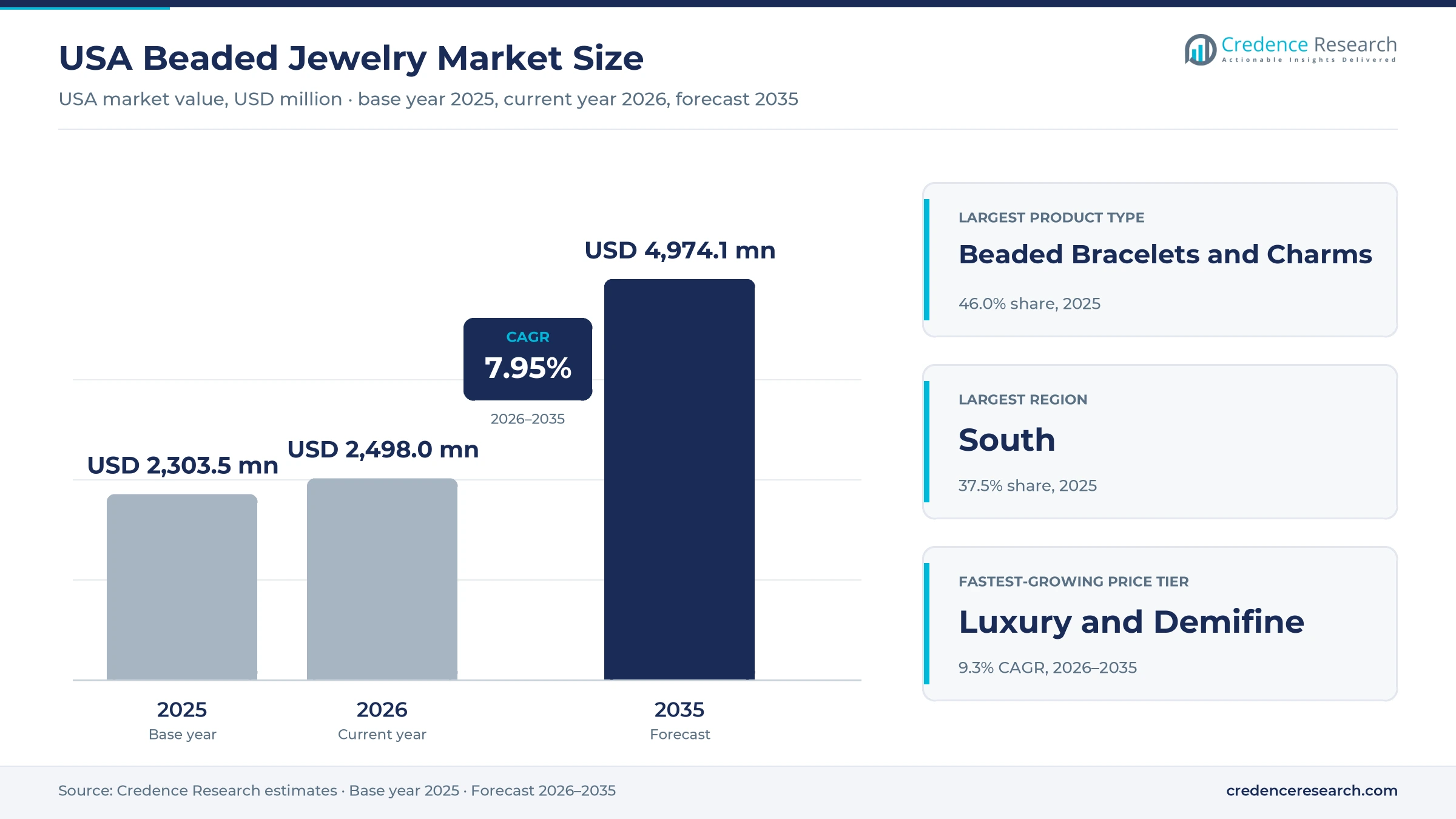
The USA beaded jewelry market was valued at USD 2.30 billion in 2025 and is projected to increase from USD 2.50 billion in 2026 to USD 4.97 billion by 2035, registering a CAGR of 7.95% during 2026–2035. Demand rests on collectors who add charms and beads to a bracelet over years, on holiday and milestone gifting, and on shoppers who now design pieces online or at in-store bars. The South held the largest regional share, 37.5% in 2025, and it is also the fastest-growing region at 8.2% a year, helped by Texas brands that are opening stores across neighboring states. Bracelets and charms make up the largest product group, while gemstone and lab-grown pieces in the demifine tier gain the most share. The end of duty-free treatment for low-value parcels in August 2025 raised landed costs for small importers and marketplace sellers, which favors brands with domestic distribution through 2035.
Bead-based adornment sold by brands, retailers and makers
The market counts retail spending by U.S. buyers on finished bracelets, charms, necklaces, earrings, rings and anklets built from beads of glass, crystal, gemstone, metal, pearl, wood or resin, together with kits for assembling wearable pieces. Shoppers buy through brand stores, department stores and specialty jewelers, brand websites and marketplaces where independent makers sell handmade work.
Loose beads and findings sold for general crafting, fine solitaire pieces without beadwork, and watches are outside the scope. The value chain runs from bead, crystal and metal suppliers and casting workshops in Thailand, India, China and Texas through brand owners and wholesalers to stores, websites and the buyer.
USA Beaded Jewelry Market Insights
- The USA beaded jewelry market grows from USD 2.30 billion in 2025 to USD 4.97 billion by 2035 at a 7.95% CAGR as charm collecting, gifting and gemstone pieces lift spending.
- The South held the largest regional share at 37.5% in 2025 and grows fastest at 8.2% a year as Texas-based brands open stores across the region.
- Beaded bracelets and charms led product types with 46.0% of 2025 value, while luxury and demifine pieces are the fastest-growing price tier at 9.3% a year.
- Duty-free entry for parcels of USD 800 or less ended on Aug. 29, 2025, so marketplace sellers that shipped single pieces from overseas now pay duty on each order.
- Spot silver reached USD 51.23 an ounce in October 2025, its highest level since 1980, which is pushing sterling-based charm brands toward price rises and new alloys.
Charm bracelets lead as demifine stones grow fastest
Charm bracelets lead while gemstone bead necklaces grow fastest
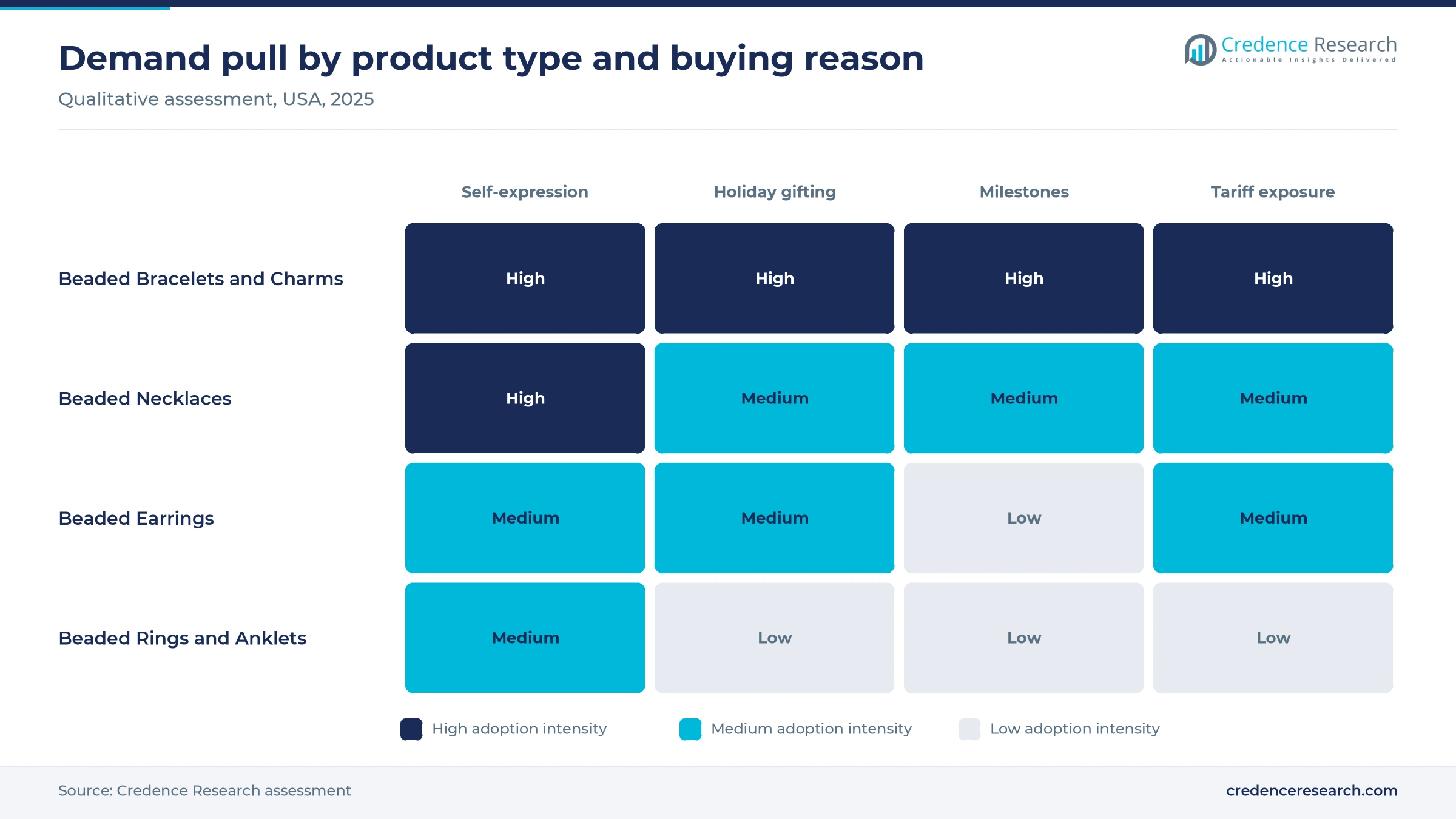
Based on product type, the market is categorized into beaded bracelets and charms, beaded necklaces, beaded earrings and beaded rings and anklets. Beaded bracelets and charms led with 46.0% of 2025 value because the format invites repeat buying, and James Avery alone offers more than 600 charm designs in sterling silver, gold and mixed metals. Beaded necklaces grow fastest at 8.7% a year as big, colorful gemstone strands were among the leading styles at the June 2026 Las Vegas shows, National Jeweler reported. Earrings, rings and anklets add lower-priced pieces that complete a stack.
Mid-market pieces lead while demifine stones grow fastest
Based on price tier, the market is categorized into mass market, mid-market, premium artisan and luxury and demifine. Mid-market pieces led with 38.0% of 2025 value because the main brands price for gift budgets, with Kendra Scott's range starting under USD 50, Fortune reported in March 2025. Luxury and demifine pieces grow fastest at 9.3% a year as lab-grown stones move into fashion lines, with Pandora reporting a 17% sales gain for its lab-grown diamond jewelry in the third quarter of 2025. Mass market pieces lose share to these upgrades over the forecast period.
Brand stores lead while brand websites grow fastest
Based on distribution channel, the market is categorized into brand-owned stores, multi-brand retailers, brand-owned websites and independent seller channels. Brand-owned stores led with 38.0% of 2025 value because charm brands sell through their own boutiques, and Kendra Scott planned 25 openings in 2025 on a base of about 150 stores. Brand-owned websites grow fastest at 9.2% a year as U.S. e-commerce sales rose 12.2% in the second quarter of 2026 to 17.1% of retail sales, according to the Census Bureau. Department stores stay important, with James Avery sold in 245 Dillard's and 38 Von Maur locations.
| Segment Group | Leading Sub-segment | Share, 2025 | Fastest-growing Sub-segment | CAGR, 2026–2035 |
|---|---|---|---|---|
| By Product Type | Beaded Bracelets and Charms | 46.0% | Beaded Necklaces | 8.7% |
| By Price Tier | Mid-Market | 38.0% | Luxury and Demifine | 9.3% |
| By Distribution Channel | Brand-Owned Stores | 38.0% | Brand-Owned Websites | 9.2% |
Sterling charms and gemstone strands set two price ladders
Pricing works per piece, but brands design the bracelet as a system so that a buyer pays for a base chain once and charms many times. That model protects margins because each added charm is small enough to buy on impulse or as a gift. Metal costs move the floor of the ladder, and Pandora raised prices 5% in October 2024, 4% in April 2025 and by a low single digit in August 2025, according to TheIndustry.fashion. Gemstone and gold strands sit on a separate ladder where the stone and the maker's name set the price, so buyers in that tier compare designers rather than brands of charm bracelet.
| Offer or tier | Typical price or fee | Basis |
|---|---|---|
| Children's jewelry sets sold on Amazon, three to 12 pieces | USD 8-21 per set | CPSC recall notice, January 2025 |
| James Avery sterling summer collection, entry price | From USD 46 per piece | JCK, July 2026 |
| Kendra Scott fashion line, full price range | Under USD 50 to nearly USD 10,000 | Fortune, March 2025 |
| Kendra Scott Lab Grown Collection, 19 styles | USD 500-2,950 per piece | National Jeweler, March 2024 |
| Designer gemstone bead necklaces at Las Vegas shows | USD 695-48,500 per piece | National Jeweler, June 2026 |
Request a Free Sample
Fill in your details and we'll send you a free sample report.
- Sample data tables & charts
- Research methodology
Charm systems, personal design and real stones lift spending
Collectible bead systems turn one sale into many
Charm and bead systems keep buyers coming back, because a bracelet bought once becomes a base for years of added pieces. The U.S. is Pandora's largest market, and in the third quarter of 2025 the brand launched Talisman medallion charms and smaller Minis charms to give existing bracelet owners new pieces to add. James Avery runs a summer charm event with a free charm holder worth up to USD 79 for buyers of two charms. Beaded bracelets and charms hold 46.0% of 2025 value, so brands that keep releasing charms protect the largest pool of repeat spending in the market.
Digital personalization widens artisan discovery
Online tools and marketplaces let buyers design a piece or find a maker, which widens demand beyond what store shelves can carry. Etsy had 86.5 million active buyers and 5.6 million active sellers at the end of 2025, with 74% of its gross sales from U.S. buyers and jewelry among its top six categories. Kendra Scott opened its first airport store at Austin-Bergstrom on Jan. 9, 2026, with its interactive Color Bar for custom pieces. James Avery's summer 2026 line was built for layering and charm collecting, JCK reported. Makers that photograph and describe work well can reach national buyers without a store.
Gemstone and material choices lift average prices
Buyers are paying more for real stones, lab-grown diamonds and gold accents, and that pushes up the average value of a beaded piece. Kendra Scott launched 19 lab-grown diamond styles in 14-karat gold at USD 500 to USD 2,950 in March 2024 and sold them in 50 stores. Pandora's lab-grown jewelry sales gain, noted above, shows the same shift at a larger brand. National Jeweler's June 2026 show report featured strands of jade, turquoise, lapis, tourmaline and opal with gold clasps. Luxury and demifine pieces grow fastest among price tiers at 9.3% a year, so suppliers of graded stones and colored gemstones gain from each upgrade.
Holiday and milestone gifting anchors peak demand
Gifting concentrates sales in a few weeks, and beaded pieces suit gift budgets because they come in many price steps. The National Retail Federation found that 18% of consumers planned to give jewelry for the 2025 holidays, and a record 202.9 million people shopped from Thanksgiving to Cyber Monday. About 14% of those shoppers bought jewelry over that weekend, according to the same survey. Brands that set charm launches and gift sets around these dates turn seasonal traffic into future collectors. Personal gift buyers also return for birthdays and graduations, which spreads demand across the year.
New metals, kits and Western styles reshape the assortment
Shift from sterling silver toward plated alloys
Higher silver prices are pushing charm brands to change the metal under their designs. Spot silver reached USD 51.23 an ounce on Oct. 9, 2025, its highest level since 1980, with a gain of nearly 70% that year to date, according to IPMI. Pandora said external cost headwinds reached 440 basis points in the fourth quarter of 2025. In response it is moving into platinum-plated jewelry on its own EVERSHINE alloy to reduce commodity exposure. Buyers may see more plated and mixed-metal charms at stable prices, while solid sterling pieces move up the ladder. Brands that switch early can keep entry charms near current price points and avoid losing gift buyers.
Rise of Western and regional style lines
Western styling has become a separate line for beaded brands, led by Texas companies. Yellow Rose by Kendra Scott, launched in 2023, opened its first store outside Texas in Nashville in March 2026, giving it four flagships with Austin, Dallas and Houston, FashionNetwork reported. National Jeweler listed Western flair and big beads among the leading styles at the June 2026 Las Vegas shows, where Anzie showed a turquoise necklace with gold-filled beads at USD 695 and Lionheart a tiger's eye bead chain at USD 1,950. Kendra Scott also told Fortune that its national brand awareness was only about 10%, which leaves room for a regional line to introduce the name in new states. Brands can use such lines to enter new markets without cutting prices on their core range.
Assembly kits gain buyers after craft store closures
Jewelry assembly kits are an opening for brands and toy makers, because the main craft chain left the market. Joann moved to close all of its roughly 800 stores in February 2025, cutting about 19,000 jobs, according to Axios. Michaels said in August 2023 that its jewelry category, including kits, rose more than 40% chainwide during the friendship bracelet trend. Kits sell as gifts and party activities, which ties them to the gifting calendar and to children's birthdays. Suppliers that pass safety testing and sell through mass retailers can win the shelf space Joann left behind, as interest in handicrafts stays high among families and schools.
Crystal and pearl capsules open celebrity-led launches
Crystal and charm brands are using short capsules to bring younger buyers into beaded and pearl designs. Swarovski's second Ariana Grande capsule, released on March 17, 2026, had 29 designs built on crystal, pearls and flower motifs, JCK reported. Pandora launched 12 Talisman medallions from USD 45 and 16 Minis charms from USD 35 on Aug. 28, 2025, and held launch events on both U.S. coasts with invited celebrities, National Jeweler reported. Entry prices this low turn a capsule into an easy gift within weeks of release, and brands that pair crystal with demi-fine metals can sell higher prices to the same fans. Short capsules also limit unsold stock, because each run is sized to a single season.
Tariffs, silver costs and safety rules squeeze margins
End of duty-free parcels raises costs for small sellers
Marketplace sellers that shipped single pieces from overseas lost their main cost advantage in 2025. Duty-free de minimis entry for goods of USD 800 or less ended for all countries on Aug. 29, 2025, and postal shipments could pay a flat duty of USD 80 to USD 200 per item for six months. Low-priced beaded pieces carry thin margins, so a flat duty can exceed the item price. Sellers respond by holding stock in U.S. warehouses and shipping domestically.
Tariffs on producing countries lift landed costs
Most branded beaded jewelry is made in Asia, so U.S. tariffs feed straight into shelf prices. National Jeweler reported in November 2025 that Pandora is mainly affected by a 19% U.S. tariff on Thailand, where most of its jewelry is made, while India faces 50%. The company expected a tariff cost of DKK 450 million in 2026, TheIndustry.fashion reported in August 2025. Brands mitigate by moving supply, but buyers still face higher prices.
Lead and cadmium rules expose low-cost imports
Children's beaded jewelry must meet federal limits on lead and cadmium, and cheap imports often fail them. The CPSC recalled about 6,900 Yaomiao children's jewelry sets sold only on Amazon on Jan. 2, 2025, citing lead above the federal content ban and cadmium. Recalls force refunds and destroy stock, and marketplaces delist sellers. Testing costs fall hardest on small kit and charm sellers.
Counterfeit artisan pieces erode buyer trust
Fake Native American and artisan pieces undercut makers who charge for genuine handwork. A New Mexico couple pleaded guilty in April 2026 to selling Vietnam-made jewelry as Navajo work and agreed to forfeit USD 341,967.98, the Indian Arts and Crafts Board reported. Each case makes buyers wary of artisan claims at shows and online. Makers that document origin and sign pieces can defend their prices.
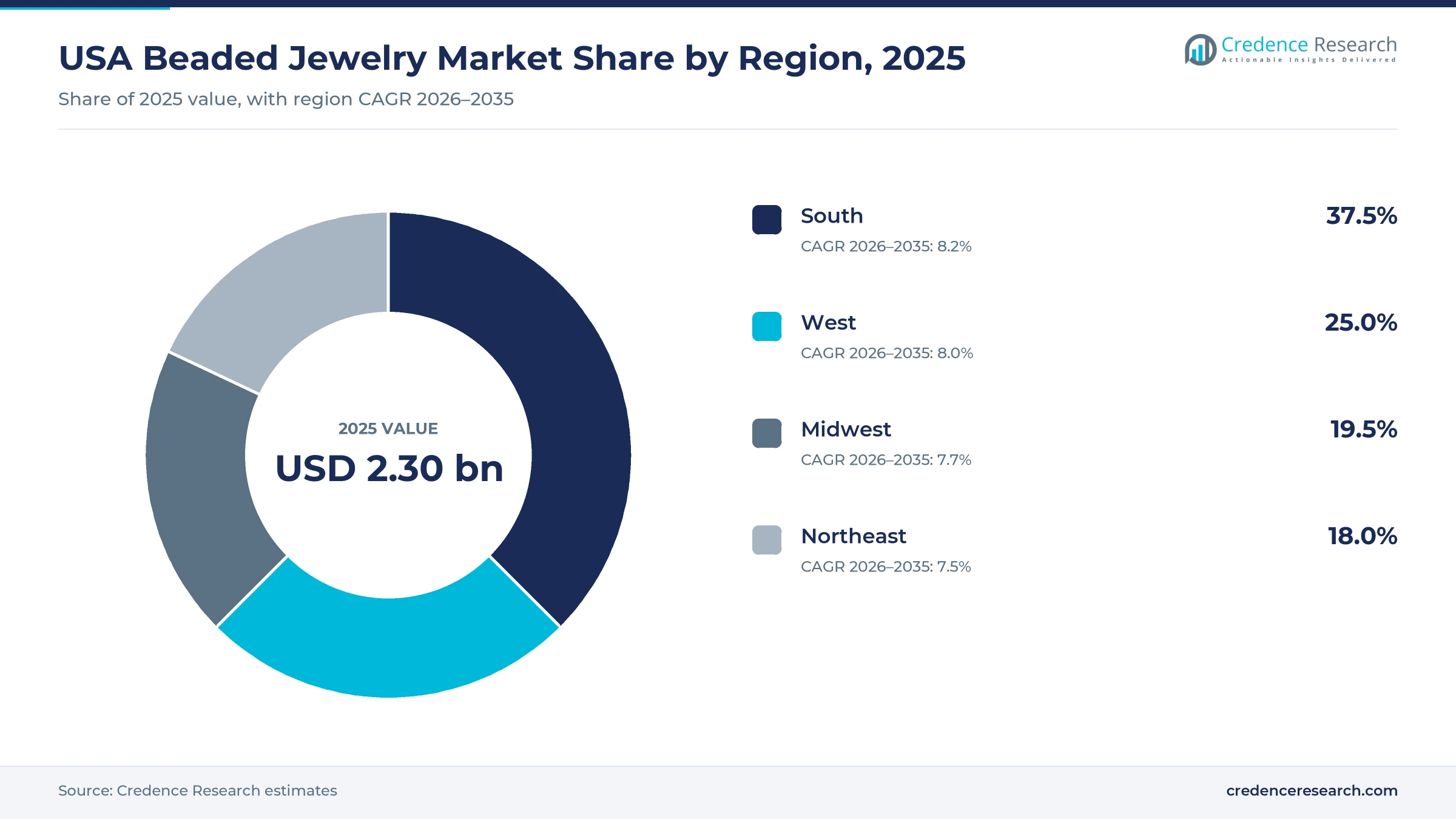
The South leads as Texas brands expand across the region
| Region | Value, 2025 (USD billion) | Share, 2025 | CAGR, 2026–2035 |
|---|---|---|---|
| South | 0.86 | 37.5% | 8.2% |
| West | 0.58 | 25.0% | 8.0% |
| Midwest | 0.45 | 19.5% | 7.7% |
| Northeast | 0.41 | 18.0% | 7.5% |
The South leads as Texas charm brands expand
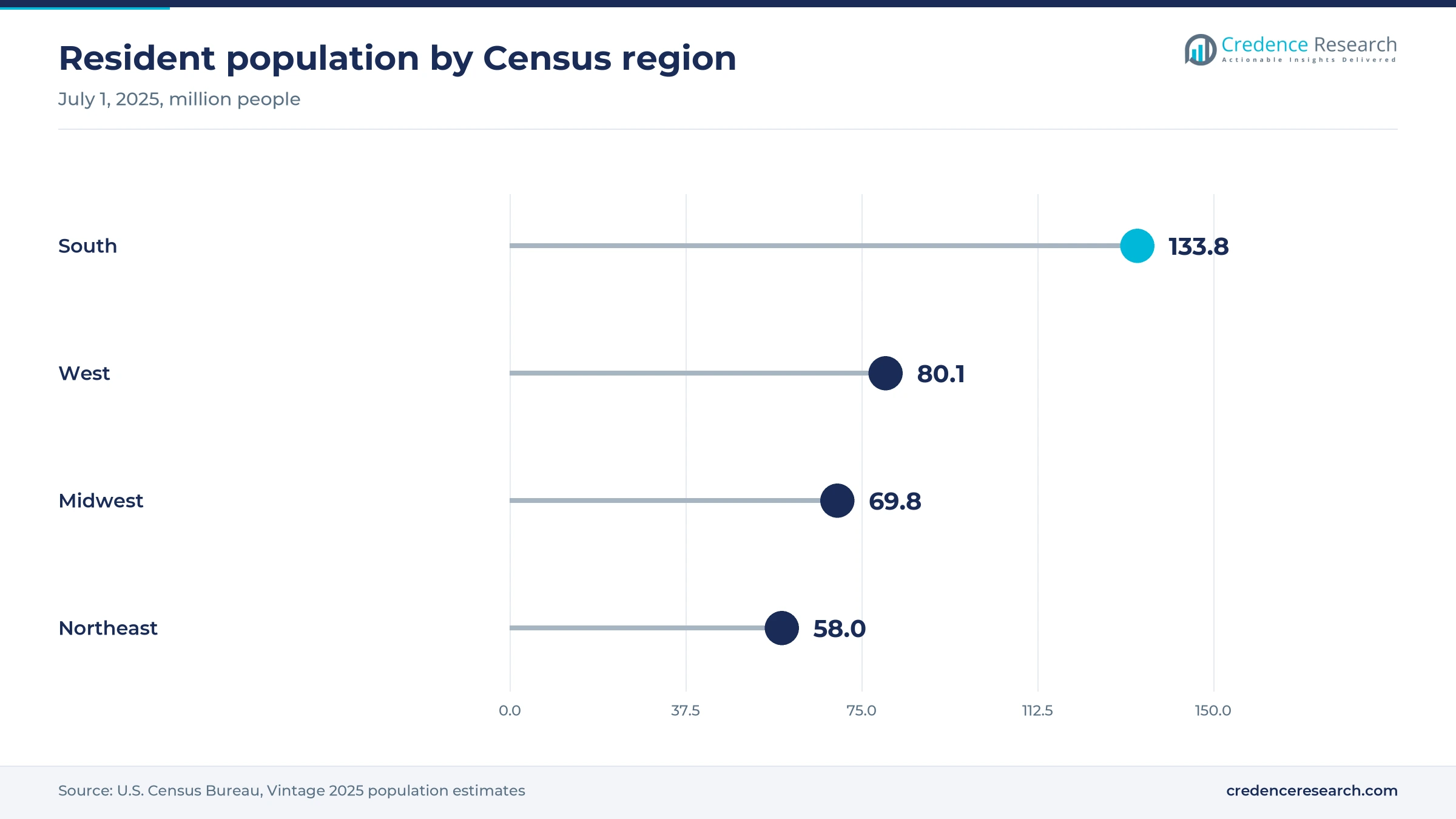
The South held 37.5% of 2025 value and grows at 8.2% a year, the fastest of the four regions. The Census Bureau counted 133.8 million residents in the South in July 2025, up 6.0% since 2020, the largest gain of any region. James Avery has 135 stores in six states and crafts more than 90% of its pieces in Texas, and Kendra Scott and Yellow Rose both started in Austin. Both brands are now opening in Tennessee, James Avery in Knoxville and Yellow Rose in Nashville, so the region stays ahead of the others through 2035.
The West grows on new stores and online makers
The West held 25.0% of 2025 value and grows at 8.0% a year. James Avery opened its first two Arizona stores in Glendale and Chandler in 2025, and Kendra Scott named West Coast locations among its expansion targets. The region has 80.1 million residents, the second-largest regional population, according to the Census Bureau. Growth stays close to the market rate because the region's population grew 1.9% from 2020 to 2025.
The Midwest relies on department stores and gifting
The Midwest held 19.5% of 2025 value and grows at 7.7% a year. Von Maur stocks James Avery in its stores, and Credence Research estimates that department stores carry a larger share of beaded sales here than in the South. Kendra Scott told Fortune it sees fast traffic growth in the Midwest and Northeast. Slow population growth of 1.1% since 2020 limits the number of new buyers, so growth depends on higher spending per gift.
The Northeast grows slowest as older chains shrink
The Northeast held 18.0% of 2025 value and grows at 7.5% a year, the slowest of the four regions. Alex and Ani, founded in Rhode Island, closed 20 stores and its headquarters in 2023 and kept seven stores, Retail TouchPoints reported. Population rose only 0.7% from 2020 to 2025, the lowest gain of any region. Buyers in the region's large metro areas still support demand for luxury fine pieces with gemstone beads.
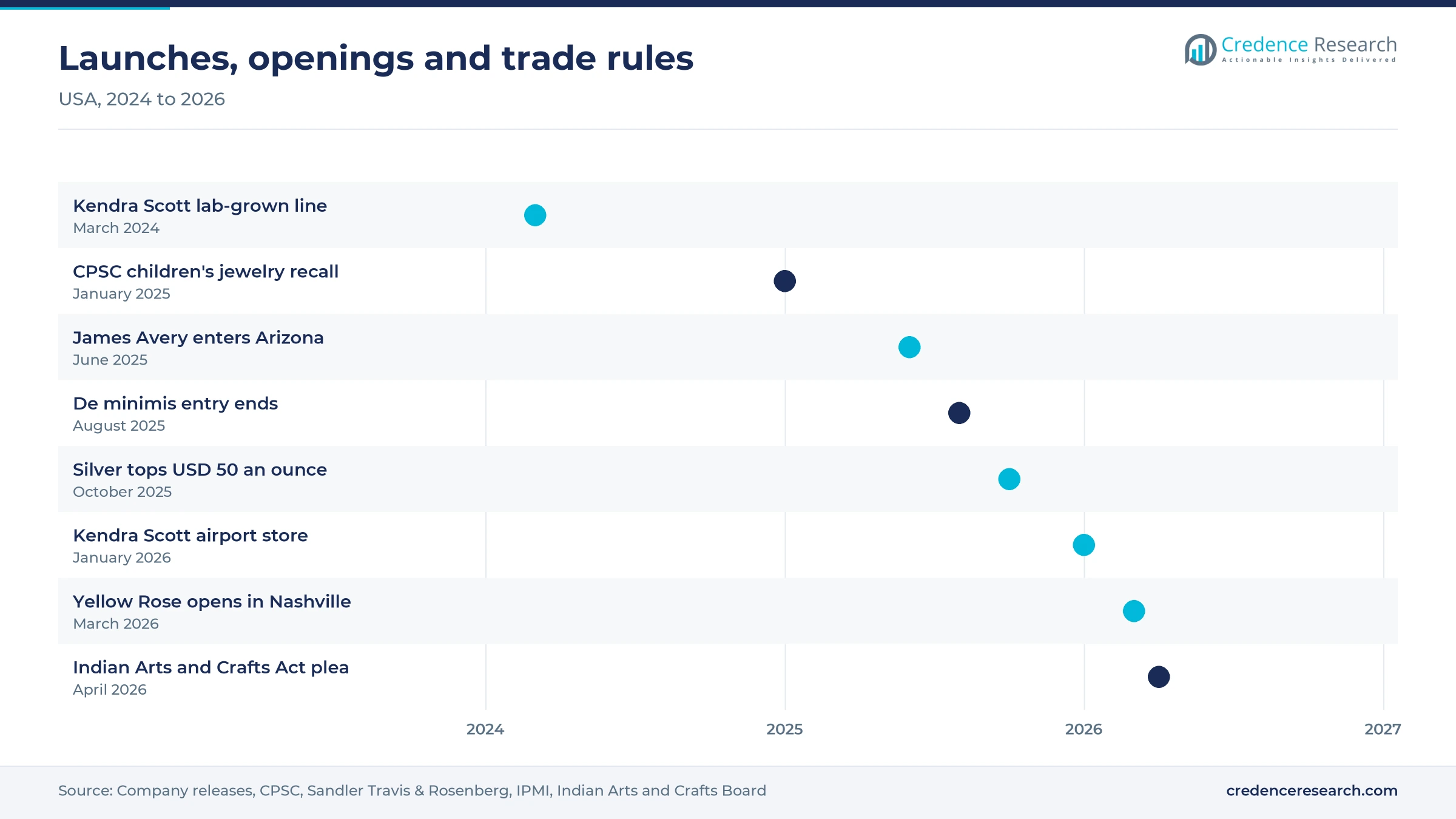
Launches, store openings and trade rules, 2024 to 2026
| Development | Status and market relevance |
|---|---|
| In March 2024, Kendra Scott launched a 19-style lab-grown diamond collection in 50 stores. | Launched; demifine upgrade |
| In February 2025, Joann moved to close all of its roughly 800 craft stores. | Completed; kit shelf space reopens |
| In June 2025, James Avery opened its first Arizona stores, reaching 135 stores in six states. | Opened; western expansion |
| In August 2025, U.S. duty-free de minimis entry ended for low-value parcels from all countries. | In force; higher landed costs |
| In January 2026, Kendra Scott opened its first airport store, with a Color Bar, in Austin. | Opened; new travel channel |
Personalization tools and new alloys change how pieces sell
- Online design tools let buyers choose beads, charms and metals before checkout, which raises order values on brand websites.
- In-store custom bars such as Kendra Scott's Color Bar assemble and finish pieces in minutes, which turns a store visit into a made-to-order sale.
- Lab-grown stones give demifine lines diamond sparkle at fashion prices, which lets beaded brands move buyers up the price ladder.
- Plated alloys such as Pandora EVERSHINE cut the silver content of each charm, which protects margins when metal prices jump.
Need a Custom Version of This Report?
Tailor the scope, geography, or segments to your exact requirements.
- Custom geography or segment scope
- Direct access to our analyst team
Brand chains with charm systems hold the strongest position
Competition centers on who owns the bracelet a buyer adds to. Pandora leads charm collecting with more than 2,700 concept stores worldwide and regular launches such as Talisman and Minis, and the U.S. is its largest market. Kendra Scott competes on color, lab-grown stones and its Color Bar, and it is opening stores while many jewelers shrink. James Avery holds a loyal base in Texas and nearby states with sterling and gold charms made in its own workshops, and it also sells through Dillard's and Von Maur. Swarovski brings crystal and pearl designs and celebrity capsules to mall stores and department stores. Alex and Ani, once the leading bangle brand, now runs a small store base and partner retail. Independent makers on Etsy and at shows compete on originality rather than price, while low-cost imports and costume accessories set the floor for mass pieces.
A few charm brands at the top and many makers below
The supply side of the market is organized in two distinct layers. At the top, a few vertically run brands such as Pandora, Kendra Scott and James Avery design, source and sell through their own stores, which keeps the highest margins with them. Below sits a long tail of independent makers selling on marketplaces and at shows, where entry is easy but prices are low. Entry barriers at the top are store networks, a charm library that buyers already collect, and supplier contracts in Thailand or Texas. Margins sit in charms and add-ons rather than in the base bracelet.
Companies profiled and their roles in this market
| Company | Type | Role in the market |
|---|---|---|
| Pandora A/S | Charm and bracelet brand | Largest U.S. charm system, Talisman and Minis launches, lab-grown lines |
| Kendra Scott | Fashion jewelry brand | Color Bar custom pieces, about 150 stores, Yellow Rose Western line |
| James Avery Artisan Jewelry | Artisan charm maker and retailer | 135 stores in six states, more than 600 charm designs |
| Swarovski | Crystal jewelry brand | Crystal and pearl designs and celebrity capsules such as its Ariana Grande lines |
| Alex and Ani | Bangle and charm brand | Seven stores after 2023 closures, partner retail and online sales |
Repeat charm buyers and fewer import shortcuts decide growth
Credence Research's view is that the market is driven less by new buyers than by how often existing collectors add to what they own. BEA data put 2025 U.S. spending on jewelry and watches at about USD 106.2 billion, so beaded pieces are a modest slice that grows by deepening wallets, not by finding a new category. The brands best placed are those that control a charm system, own their stores and can switch metals without breaking the look. Sellers that relied on duty-free parcels must rebuild their cost base, which tilts share toward domestic stock and brand websites.
BEA spending and brand disclosures anchor the estimate
The report uses 2025 as the base year and forecasts to 2035. Market values come from the Credence Research model, built from BEA consumer spending on jewelry and watches, brand disclosures on U.S. trading, store counts and price lists, and Census Bureau retail and population data. Segment and regional splits are Credence Research estimates built from these inputs. Sources include company filings and releases, the Census Bureau, the CPSC, the Indian Arts and Crafts Board, trade law notes and jewelry trade press. No interviews or surveys were conducted for this report or its estimates.
Value roughly doubles by 2035 as premium bead pieces gain
The USA beaded jewelry market is set to roughly double from USD 2.50 billion in 2026 to USD 4.97 billion by 2035 at a 7.95% CAGR. Growth will come mostly from higher values per piece as gemstone, gold-accent and lab-grown designs replace plain beads, and from charm collectors who keep adding to bracelets they already own. The South will gain share as Texas brands open stores in nearby states, and brand websites will take share from marketplaces now that low-value parcels pay duty. Metal costs and tariffs remain the main risk to volumes through 2035.
Charm demand and import costs set the range of outcomes
The outcome depends on whether collectors keep adding charms while prices rise. In the downside case, tariffs and high silver prices push average prices up faster than buyers accept, and holiday traffic stays weak. The base case assumes brands offset most metal costs with alloys and keep store openings on plan. In the upside case, lab-grown and gemstone pieces lift average values while charm launches bring back lapsed collectors.
| Scenario | CAGR, 2026–2035 | Value, 2035 | What has to hold |
|---|---|---|---|
| Downside | 6.5% | USD 4.38 billion | Tariffs and silver costs raise prices faster than buyers accept, and holiday traffic stays weak |
| Base | 7.95% | USD 4.97 billion | Brands offset metal costs with alloys, open stores on plan and keep charm launches regular |
| Upside | 9.2% | USD 5.49 billion | Gemstone and lab-grown upgrades lift average values and charm launches bring lapsed collectors back |
Frequently Asked Questions
How big is the USA beaded jewelry market?
Which product type leads U.S. beaded jewelry sales?
Which price tier grows fastest?
Which region leads the market?
How did the end of de minimis entry affect sellers?
Why do silver prices matter for beaded jewelry?
Which companies lead the USA beaded jewelry market?
Which channel grows fastest?
Table of Content
Chapter 1 Market Segmentation
- 1.1 Segmentation Framework
- 1.1.1 Product and Service Classification
- 1.1.2 Application and End-Use Classification
- 1.1.3 Technology and Solution Classification
- 1.1.4 Customer and Distribution Channel Classification
- 1.1.5 Geographic Segmentation
- 1.1.6 Market Segment Definitions and Boundaries
- 1.2 By Product Type
- 1.2.1 Beaded Bracelets and Charms
- 1.2.2 Beaded Necklaces
- 1.2.3 Beaded Earrings
- 1.2.4 Beaded Rings and Anklets
- 1.3 By Price Tier
- 1.3.1 Mass Market
- 1.3.2 Mid-Market
- 1.3.3 Premium Artisan
- 1.3.4 Luxury and Demifine
Chapter 2 Introduction
- 2.1 Report Objectives and Scope
- 2.2 Product Definition and Industry Terminology
- 2.3 Market Inclusions and Exclusions
- 2.4 Research Process
- 2.4.1 Primary Research and Expert Interviews
- 2.4.2 Secondary Research and Source Review
- 2.4.3 Top-Down and Bottom-Up Estimation
- 2.4.4 Data Triangulation and Verification
- 2.5 Market Size Measurement Basis
- 2.5.1 2025: USD 2.30 billion → 2035: USD 4.97 billion
- 2.6 Historical and Forecast Reference Periods
- 2.6.1 Historical Period: 2018-2025
- 2.6.2 Base Year: 2025
- 2.6.3 Forecast Period: 2025-2035
- 2.7 Research Assumptions and Limitations
Chapter 3 Executive Summary
- 3.1 Market Snapshot and Key Findings
- 3.2 Base-Year Market Size, 2025
- 3.3 Forecast Market Size, 2035
- 3.4 Revenue and Volume Growth Outlook
- 3.5 Key Demand and Supply Indicators
- 3.6 Leading Market Segments
- 3.7 Fastest-Growing Market Opportunities
- 3.8 Regional Performance Highlights
- 3.9 Technology and Industry Transformation
- 3.10 Competitive Landscape Summary
- 3.11 Analyst View and Strategic Implications
Chapter 4 USA Beaded Jewelry Market Trends and Developments
- 4.1 Historical Industry Development, 2018-2025
- 4.2 Recent Market Trends and Developments
- 4.3 Demand and Customer Behavior Trends
- 4.4 Technology and Product Innovation
- 4.5 Artificial Intelligence, Automation and Digitalization
- 4.6 Local Manufacturing and Supply Chain Realignment
- 4.7 Industry Partnerships, Mergers and Acquisitions
- 4.8 Sustainability and Circular Economy Developments
- 4.9 Government and Private Sector Investment Trends
- 4.10 Emerging Business Models and Commercialization
- 4.11 Industry Developments and Announcements
Chapter 5 USA Beaded Jewelry Market Production, Supply and Demand Analysis
- 5.1 Demand Trend and Consumption Analysis, 2018-2025
- 5.2 Demand Forecast, 2025-2035
- 5.3 Production and Output Trend, 2018-2025
- 5.4 Production and Output Forecast, 2025-2035
- 5.5 Installed Capacity and Capacity Utilization
- 5.6 Company-Wise Production Plants and Statistics
- 5.6.1 Installed Production Capacity
- 5.6.2 Actual Production
- 5.6.3 Planned Capacity and Expansion Targets
- 5.7 Supply Chain Structure and Procurement Trends
- 5.8 Supply-Demand Gap and Bottlenecks
- 5.9 Import Dependence and Sourcing Structure
- 5.10 Contract Manufacturing and Outsourcing
- 5.11 Regional Supply and Demand Concentration
Chapter 6 USA Beaded Jewelry Market Pricing Analysis
- 6.1 Pricing Structure and Measurement
- 6.2 Historical Pricing Trends, 2018-2025
- 6.3 Pricing Outlook, 2025-2035
- 6.4 Average Selling Price and Unit Economics
- 6.5 Pricing by Product and Market Segment
- 6.6 Geographic Pricing Differences
- 6.7 Key Input, Energy, Labor and Logistics Costs
- 6.8 Contract Pricing and Purchasing Models
- 6.9 Pricing Sensitivity and Competitive Positioning
- 6.10 Price, Margin and Profitability Implications
Chapter 7 USA Beaded Jewelry Market Dynamics
- 7.1 Market Growth Drivers
- 7.1.1 Demand-Side Drivers
- 7.1.2 Technology and Innovation Drivers
- 7.1.3 Infrastructure and Investment Drivers
- 7.1.4 Regulatory and Policy Drivers
- 7.2 Market Restraints
- 7.2.1 Cost and Affordability Constraints
- 7.2.2 Technology and Adoption Barriers
- 7.2.3 Supply Chain and Operational Constraints
- 7.3 Market Challenges
- 7.3.1 Competitive Pressure and Margin Erosion
- 7.3.2 Skills, Infrastructure and Implementation Gaps
- 7.4 Emerging Market Opportunities
- 7.5 Market Dynamics Impact and Time-Horizon Assessment
Chapter 8 USA Beaded Jewelry Value Chain Analysis
- 8.1 Industry Value Chain Overview
- 8.2 Upstream Suppliers and Critical Inputs
- 8.3 Technology and Component Providers
- 8.4 Manufacturing or Service Delivery
- 8.5 Distribution, Channel Partners and Integrators
- 8.6 Downstream Applications and End Users
- 8.7 Value Addition and Profit Pools
- 8.8 Vertical Integration and Outsourcing
- 8.9 Supplier Concentration and Risk
- 8.10 Supply Chain Localization and Resilience
Chapter 9 USA Beaded Jewelry Market Regulations and Policies
- 9.1 Relevant Laws, Standards and Compliance Frameworks
- 9.2 Product, Service, Safety and Quality Requirements
- 9.3 Government Policies, Incentives and Subsidies
- 9.4 Imports, Exports and Trade Barriers
- 9.5 Public Procurement and Local Content Requirements
- 9.6 Environmental and Sustainability Compliance
- 9.7 Upcoming Policy Changes and Market Implications
Chapter 10 USA Beaded Jewelry Market Hotspots and Opportunities
- 10.1 Market Opportunity Mapping and Growth Hotspots
- 10.2 High-Growth Applications and Customer Groups
- 10.3 Underserved Markets and White-Space Opportunities
- 10.4 Emerging Technology and Product Opportunities
- 10.5 New Capacity and Investment Hotspots
- 10.6 Market Entry and Expansion Opportunities
- 10.7 Distribution and Partnership Opportunities
- 10.8 Near-Term and Long-Term Commercial Potential
- 10.9 Opportunity Attractiveness and Execution Risks
Chapter 11 USA Beaded Jewelry Market Outlook, 2025-2035
- 11.1 Market Size and Analysis
- 11.1.1 Revenue (Market Measurement: 2025: USD 2.30 billion → 2035: USD 4.97 billion)
- 11.1.2 Market Volume and Quantity Sold
- 11.1.3 Historical Market Size, 2018-2025
- 11.1.4 Base-Year Market Size, 2025
- 11.2 Market Forecast, 2025-2035
- 11.2.1 Revenue Forecast to 2035
- 11.2.2 Volume Forecast to 2035
- 11.2.3 CAGR and Year-on-Year Growth
- 11.2.4 Incremental Revenue Opportunity
- 11.3 Forecast Assumptions and Scenario Analysis
- 11.3.1 Base-Case Forecast
- 11.3.2 Optimistic and Conservative Scenarios
- 11.3.3 Technology, Pricing and Policy Sensitivities
- 11.4 Market Attractiveness and Growth Outlook
Chapter 12 USA Beaded Jewelry Market Segmentation and Outlook
- 12.1 Segmentation Summary and Market Shares, 2025
- 12.2 Largest and Fastest-Growing Segments
- 12.3 By Product Type - Market Size and Forecast, 2025-2035
- 12.3.1 Segment Definition and Scope
- 12.3.2 Historical Market Size, 2018-2025
- 12.3.3 Revenue Forecast, 2025-2035
- 12.3.4 Volume Forecast, 2025-2035
- 12.3.5 Base-Year Market Share, 2025
- 12.3.6 Segment CAGR and Growth Drivers
- 12.3.7 Subsegment Market Size and Forecast
- 12.3.7.1 Beaded Bracelets and Charms
- 12.3.7.2 Beaded Necklaces
- 12.3.7.3 Beaded Earrings
- 12.3.7.4 Beaded Rings and Anklets
- 12.3.8 Subsegment Pricing and Adoption Trends
- 12.3.9 Leading Suppliers and Competition
- 12.3.10 Regional Demand and Opportunities
- 12.4 By Price Tier - Market Size and Forecast, 2025-2035
- 12.4.1 Segment Definition and Scope
- 12.4.2 Historical Market Size, 2018-2025
- 12.4.3 Revenue Forecast, 2025-2035
- 12.4.4 Volume Forecast, 2025-2035
- 12.4.5 Base-Year Market Share, 2025
- 12.4.6 Segment CAGR and Growth Drivers
- 12.4.7 Subsegment Market Size and Forecast
- 12.4.7.1 Mass Market
- 12.4.7.2 Mid-Market
- 12.4.7.3 Premium Artisan
- 12.4.7.4 Luxury and Demifine
- 12.4.8 Subsegment Pricing and Adoption Trends
- 12.4.9 Leading Suppliers and Competition
- 12.4.10 Regional Demand and Opportunities
- 12.5 Segment Growth Comparison
- 12.6 Segment Attractiveness and Priority Matrix
Chapter 13 USA Beaded Jewelry Geographic Market Outlook, 2025-2035
- 13.1 Domestic Market Distribution and Demand Clusters
- 13.2 State- or Province-Wise Market Size and Forecast, 2025-2035
- 13.3 City and Metropolitan Market Outlook
- 13.4 Industrial, Manufacturing and Commercial Clusters
- 13.5 Geographic Concentration of Key End Users
- 13.6 Local Pricing and Purchasing Differences
- 13.7 Domestic Production Facilities and Capacity Map
- 13.8 Local Infrastructure and Project Pipeline
- 13.9 State-Level Policy and Incentive Differences
- 13.10 Subnational Investment Hotspots and Opportunities
- 13.11 Distribution and Logistics Networks
- 13.12 Domestic Competitive Footprint
Chapter 14 USA Beaded Jewelry Technology, Innovation and Sustainability Outlook
- 14.1 Technology Landscape and Maturity
- 14.2 Product, Process and Service Innovation
- 14.3 AI, Automation and Digital Tools in the Industry
- 14.4 Technology Adoption and Performance Benchmarking
- 14.5 Innovation Pipeline and R&D Investment
- 14.6 Patent and Intellectual Property Trends
- 14.7 Energy Efficiency and Resource Management
- 14.8 Sustainability, Recycling and Circularity
- 14.9 Technology Roadmap, 2025-2035
- 14.10 Risks of Obsolescence and Technology Substitution
Chapter 15 USA Beaded Jewelry Market Key Strategic Imperatives
- 15.1 Growth and Market Entry Priorities
- 15.2 High-Return Products and Segments
- 15.3 Pricing, Profitability and Cost Optimization
- 15.4 Technology Investment and Product Differentiation
- 15.5 Supply Chain Localization and Resilience
- 15.6 Distribution and Customer Acquisition
- 15.7 Partnership, Acquisition and Capacity Strategy
- 15.8 Regional Expansion Priorities
- 15.9 Short-, Medium- and Long-Term Actions
Chapter 16 Competition Outlook
- 16.1 Industry Competition Characteristics
- 16.2 Market Structure and Concentration
- 16.3 Market Share and Competitive Positioning, 2025
- 16.4 Company-Wise Revenue and Product Benchmarking
- 16.5 Production and Service Capacity Benchmarking
- 16.6 Technology, Pricing and Differentiation
- 16.7 Regional Footprint and Distribution Strength
- 16.8 Mergers, Acquisitions and Strategic Alliances
- 16.9 New Entrants and Competitive Threats
- 16.10 Porter's Five Forces and Industry Attractiveness
- 16.11 Competitive Outlook, 2025-2035
Chapter 17 Company Profiles
- 17.1 Company Coverage and Selection Criteria
- 17.2 Pandora A/S
- 17.2.1 Business Description
- 17.2.2 Company Ownership and Geographic Presence
- 17.2.3 Product and Service Portfolio
- 17.2.4 Manufacturing and Operating Footprint
- 17.2.5 Production Capacity and Expansion Plans
- 17.2.6 Financial Performance and Investment
- 17.2.7 Market Share and Competitive Position
- 17.2.8 Technology and Innovation Capabilities
- 17.2.9 Strategic Alliances or Partnerships
- 17.2.10 Recent Developments
- 17.2.11 Growth Strategy and Outlook
- 17.3 Kendra Scott
- 17.4 Swarovski
- 17.5 James Avery Artisan Jewelry
- 17.6 Alex and Ani
- 17.7 Other Relevant Market Participants
Note: Every listed company is profiled on the structure shown under the first company. The company list is preliminary and may change based on research findings, market developments, data availability and client requirements.
Chapter 18 Disclaimer
- 18.1 Research and Forecast Disclaimer
- 18.2 Data Source and Estimation Limitations
Note: The depth of individual sections depends on data availability for this market. Volume, capacity, trade and other unit-based metrics are included where applicable.

