
Full-price Swiss supply keeps regional value growing
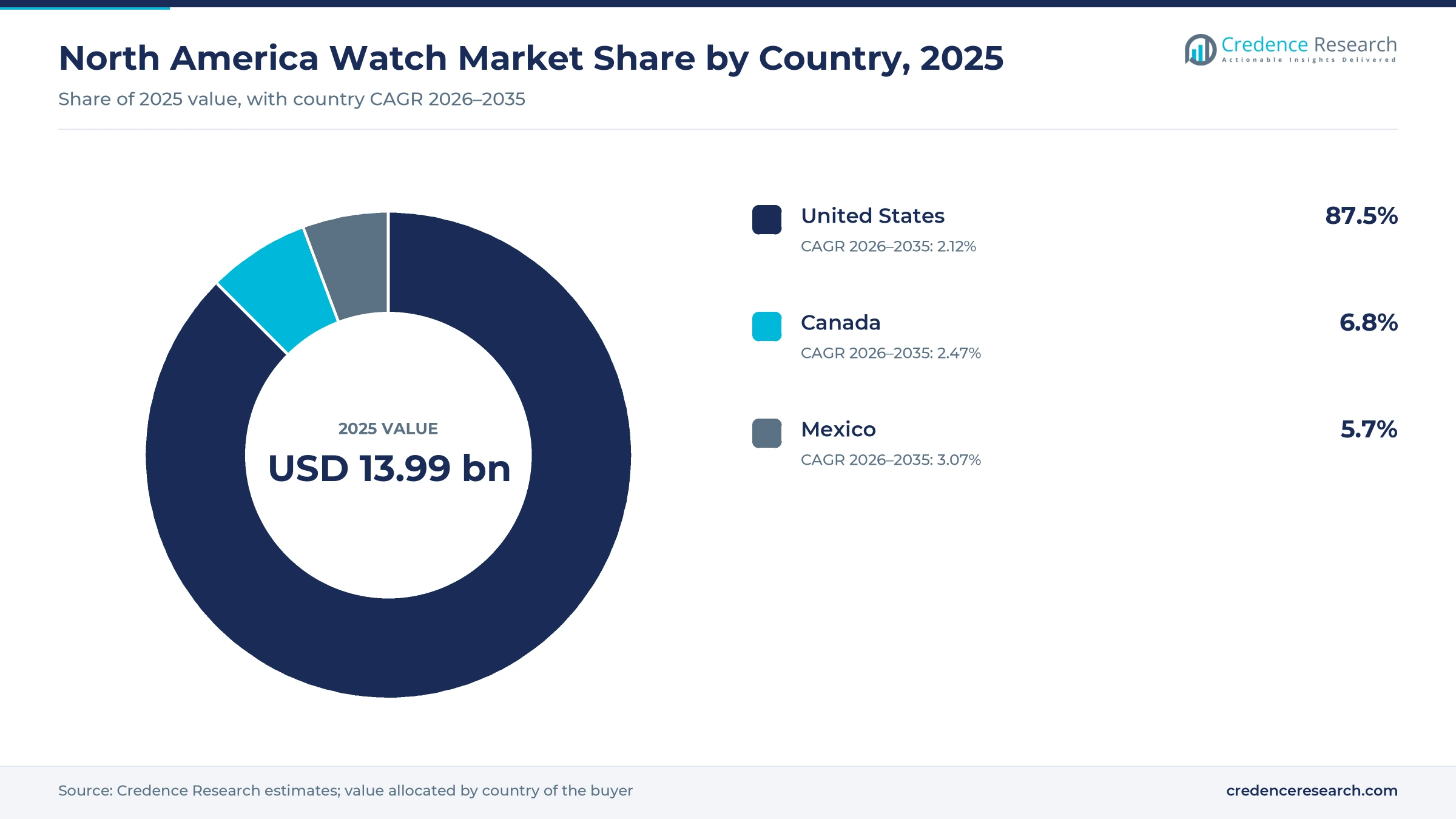
The North America watch market was valued at USD 13.99 billion in 2025 and is projected to increase from USD 14.34 billion in 2026 to USD 17.44 billion by 2035, registering a CAGR of 2.20% during 2026–2035. Demand comes from affluent households that buy Swiss mechanical pieces as long-term possessions, from gift buyers around Valentine's Day and the holidays, and from everyday wearers who still prefer an analog dial to a screen. United States held the largest regional share, 87.5% in 2025, because it has the densest network of brand boutiques and authorized retailers in the region. Mexico is the fastest-growing country at 3.07% a year, as online retail spreads and Swiss brands such as Rado open new boutiques there. On the commercial side, United States duties on Swiss watches moved from 39% in August 2025 to 15% in November 2025 and to 12.5% in July 2026, and each change forced brands to reprice their American catalogs.
What does the North America watch market include?
This report counts new wristwatches sold to consumers and companies in the United States, Canada and Mexico, including dress, sports, jewellery watches and field models with mechanical, quartz and hybrid movements. Sales are counted at retail selling prices across brand boutiques, independent authorized retailers, department stores and online stores, and they cover purchases for personal use, collections and gifts.
The scope excludes full smartwatches, fitness bands, secondhand pieces, parts and straps sold alone, and repair or servicing fees. The value chain runs from Swiss, Japanese and American brand owners through importers and regional distributors to boutiques, authorized dealers and online stores, which handle pricing, after-sales service and warranty claims.
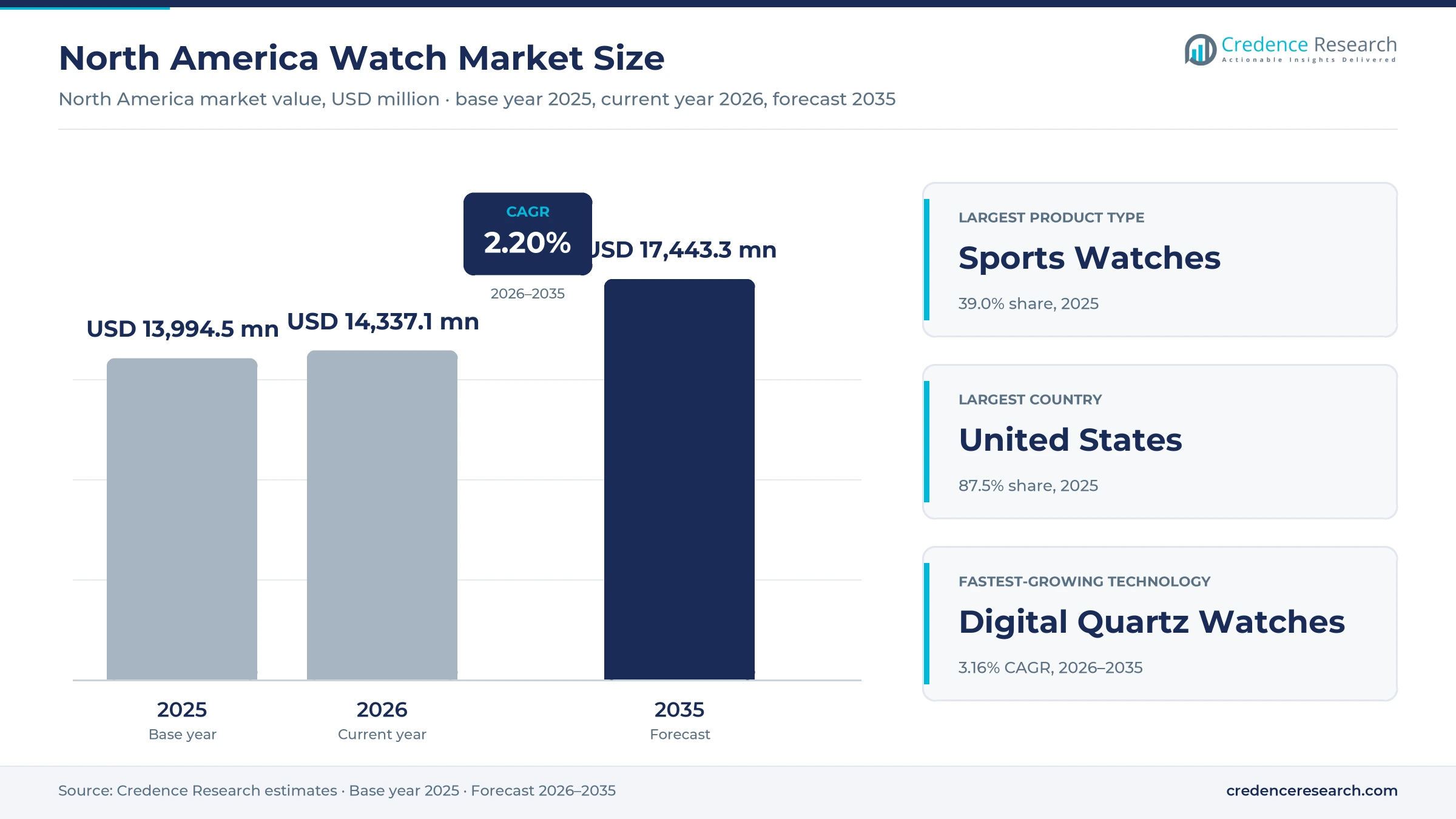
North America Watch Market Insights
- The market grows from USD 13.99 billion in 2025 to USD 17.44 billion by 2035, a 2.20% CAGR, as full-price Swiss supply and collector buying offset slower volume growth.
- United States led with 87.5% of 2025 value, while Mexico grows fastest at 3.07% a year as online buying and new brand stores spread there.
- Sports Watches held 39.0% of 2025 value because diving and racing chronographs carry the highest list prices in most Swiss catalogs.
- United States duties on Swiss watches moved from 39% in August 2025 to 15% in November 2025 and to 12.5% from July 24, 2026.
- Audemars Piguet opened its third United States AP House in Atlanta in January 2026, showing how Swiss brands invest in private client spaces.
Sports models and mechanical movements hold most value
Why do sports models carry the most value?
Based on product type, the market is categorized into dress watches, sports watches, jewellery watches and field watches. Sports Watches led with 39.0% of 2025 value because diving and racing chronographs carry the highest list prices in most Swiss catalogs, and Luxury Bazaar reported that Rolex priced the yellow gold Daytona at USD 42,700 from June 1, 2026. Field Watches grow fastest at 3.10% a year as heritage designs reach new buyers, with Hamilton releasing a Khaki Field Mechanical 250 limited to 1,776 pieces for the United States only in April 2026, according to Monochrome Watches. Dress pieces remain the steady second choice for office and formal wear.
Which movement types decide where the money goes?
Based on technology, the market is categorized into mechanical watches, analog quartz watches, digital quartz watches and hybrid watches. Mechanical Watches led with 63.0% of 2025 value because Swiss brands with self-winding movements set the highest prices, and Luxury Bazaar reported Rolex increases of 4% to 9% on most United States models from Jan. 1, 2026. Digital Quartz Watches grow fastest at 3.16% a year as digital models move upmarket, with Casio America placing its full-metal G-SHOCK GMWBZ5000 series with select jewelers at USD 660 to USD 720 in December 2025, according to G-Central. Analog quartz models stay the volume choice in department stores and fashion lines.
What purposes drive most purchases in the region?
Based on application, the market is categorized into everyday timekeeping, collection building, personal gifting and corporate gifting. Everyday Timekeeping led with 46.0% of 2025 value because most owners wear one main piece each day, and Fossil Group said in January 2024 that it would leave smartwatches to focus on traditional watches and accessories, according to iPhone in Canada. Collection Building grows fastest at 3.11% a year as brands court serious buyers, and Audemars Piguet opened a nearly 10,000-square-foot AP House in Atlanta on Jan. 28, 2026, its third such space in the country, according to National Jeweler. Gifting purchases follow the holiday calendar and employer award programs across the region.
Where do North American buyers complete purchases?
Based on distribution channel, the market is categorized into brand boutiques, independent retailers, department stores and online retail. Independent Retailers led with 38.0% of 2025 value because authorized dealers run most flagship Rolex spaces, including the 6,200-square-foot store that Gearys opened on Rodeo Drive in December 2024, according to National Jeweler. Online Retail grows fastest at 3.31% a year as e-commerce reached 17.1% of United States retail sales in the second quarter of 2026, according to Census Bureau data published by the St. Louis Fed. Department stores keep a role for quartz and fashion brands, although their store counts are shrinking.
| Segment Group | Leading Sub-segment | Share, 2025 | Fastest-growing Sub-segment | CAGR, 2026–2035 |
|---|---|---|---|---|
| By Product Type | Sports Watches | 39.0% | Field Watches | 3.10% |
| By Technology | Mechanical Watches | 63.0% | Digital Quartz Watches | 3.16% |
| By Application | Everyday Timekeeping | 46.0% | Collection Building | 3.11% |
| By Distribution Channel | Independent Retailers | 38.0% | Online Retail | 3.31% |
Request a Free Sample
Fill in your details and we'll send you a free sample report.
- Sample data tables & charts
- Research methodology
Wealth, full-price retail and new stores support demand
Wealth formation and collector demand at the top end
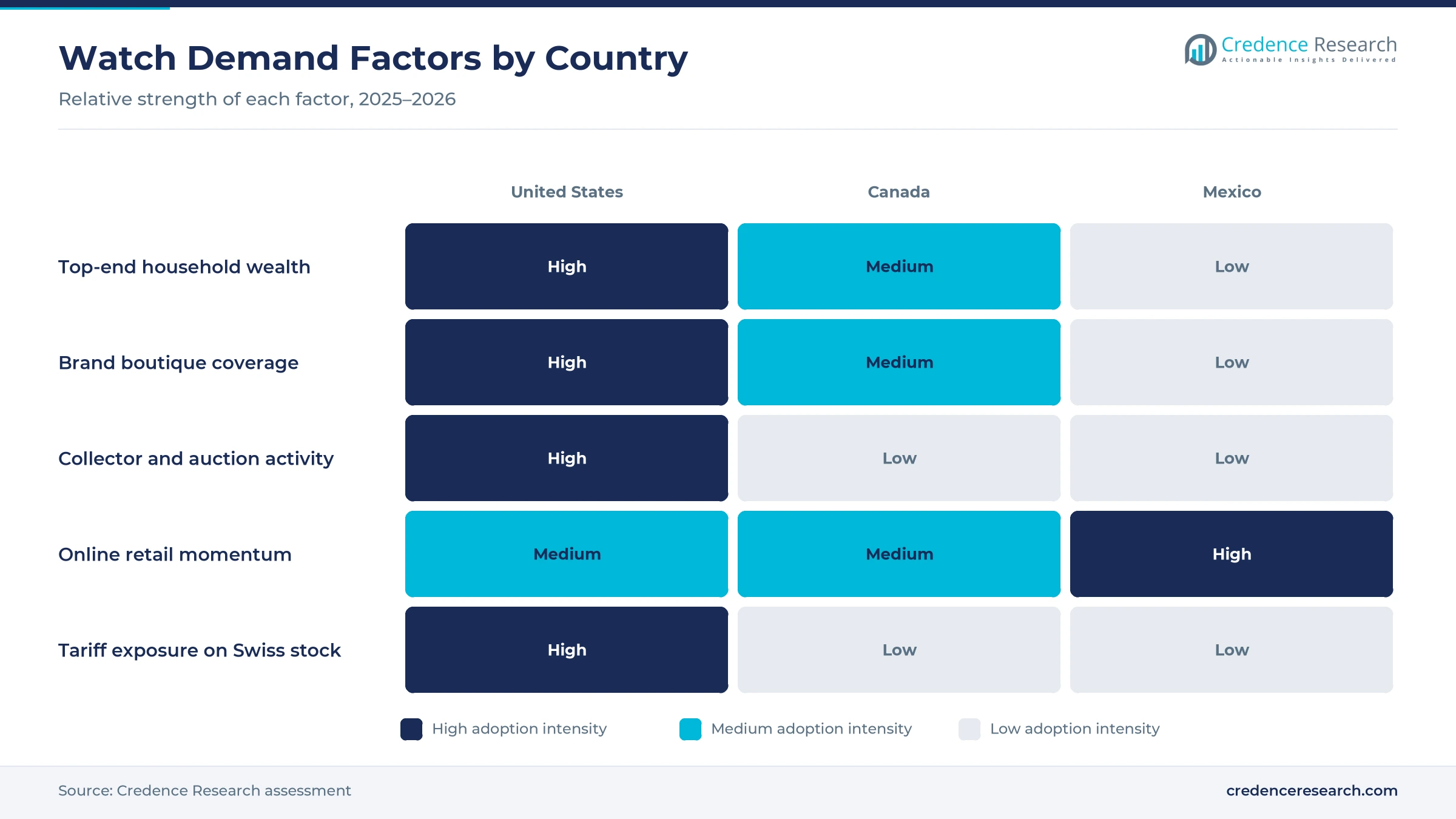
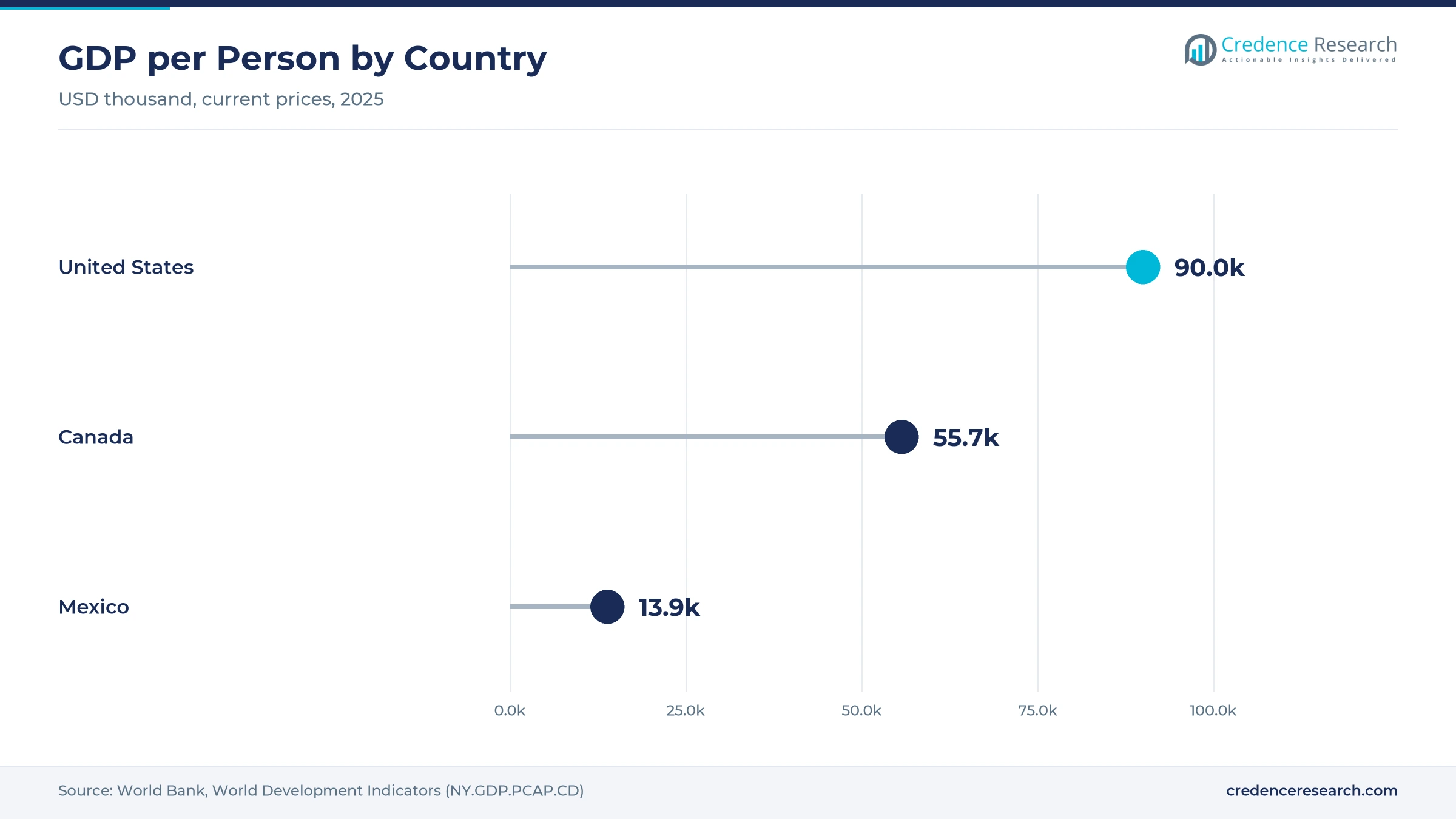
Household wealth at the top of the distribution sets the ceiling for spending on mechanical and gem-set pieces, and that ceiling kept rising into 2026. The top 1% of United States households held a record 32.5% of national net worth in the second quarter of 2026, according to Federal Reserve distributional accounts published by the St. Louis Fed. In Canada, Statistics Canada reported that the wealthiest 20% of households held 65.7% of national net worth at the end of 2025. World Bank data also put 2025 GDP per person at about USD 90,027 in the United States, the highest of the three countries. As a result, Collection Building grows at 3.11% a year, the fastest purpose of purchase in the North America watch market.
Full-price distribution and retail productivity
Brands that keep supply tight and sell at full price through fewer, larger stores raise the value of each sale, and that model held through the 2025 tariff swings. The Watches of Switzerland Group reported on Dec. 10, 2025, that Rolex, Omega and Patek Philippe had raised United States prices to offset higher import costs. Patek Philippe then cut United States prices by 8% from Feb. 1, 2026, after raising them by an average of 22% in 2025, according to Gear Patrol, so its list prices stayed well above their level at the end of 2024. Because authorized dealers control most of this full-price supply, Independent Retailers hold 38.0% of 2025 value in the region.
Canadian and Mexican customer development
Brand owners are building store networks in Canada and Mexico, where wealthy buyers once traveled to the United States for new releases. Raffi Jewellers opened a nearly 5,500-square-foot Rolex store at Royalmount in Montreal in December 2025, the largest Rolex store in Canada, according to Retail Insider. Maison Birks and TimeVallée had opened a 2,800-square-foot multi-brand store at the same center on Sept. 5, 2024, with seven maisons including Cartier and Jaeger-LeCoultre. In Mexico, El Palacio de Hierro opened the first Rado boutique in Latin America at Perisur late in 2024, according to its annual report. As a result, Mexico and Canada both grow faster than United States through 2035, from much smaller bases.
Gift calendars keep personal buying strong
Gift occasions bring in buyers who would not purchase a watch for themselves, and the American gift calendar stayed strong in 2026. The National Retail Federation forecast record Valentine's Day spending of USD 29.1 billion for 2026, above the USD 27.5 billion spent in 2025. Shoppers were expected to spend about USD 7 billion on jewelry, the largest gift category, and 25% of consumers planned to buy a jewelry gift. Retailers place watches beside fine jewelry for these occasions, and buyers of luxury jewelry often add a dress or jewellery watch to the same purchase. Consequently, personal gifting holds a steady share of regional value through the forecast period.
Independent makers and racing ties reshape buying
Rise of independent makers in North American salerooms
Independent makers now draw the strongest collector bids in the region, and that shift pulls attention toward small-series mechanical pieces. Phillips sold USD 43.5 million of watches at its New York Watch Auction XIII in December 2025, a record for a United States watch sale, with every lot sold, according to duPont Registry. Its top lot, the FFC prototype that François-Paul Journe made with Francis Ford Coppola, sold for USD 10,775,000 after more than eleven minutes of bidding. Journe and Philippe Dufour pieces also took nine of the top ten lots, a new pattern for New York sales. As a result, Mechanical Watches keep 63.0% of 2025 value, and buyers of new pieces study secondhand auction results before they order.
Shift toward motor racing ties in sports model marketing
Sports model marketing is shifting toward motor racing, which reaches younger buyers in all three countries. Formula 1 confirmed on Jan. 6, 2025, that TAG Heuer would return as its official timekeeper from the 2025 season, as part of a 10-year partnership with LVMH. The role places the TAG Heuer name on official race timing throughout each season, which keeps its racing chronographs in front of fans. In Mexico City, a TAG Heuer pop-up at El Palacio de Hierro Polanco during the 2024 Grand Prix drew more than 1,800 visitors in five days, according to the retailer's annual report. Consequently, Sports Watches hold 39.0% of 2025 value, the largest product type in the region.
Opening for online sales of entry and mid-range pieces
Online stores give quartz and entry mechanical brands a way to reach buyers far from boutiques, and that gap is a clear opening. Casio America said in December 2025 that its GMWBZ5000 series would reach gshock.com and select department stores from February 2026, after a jeweler-only launch, according to G-Central. In Mexico, online sales rose 19.2% in 2025 to MXN 941 billion, or 17.7% of retail, and 77.2 million people bought online, according to the AMVO study reported by Mobile Time. In the United States, e-commerce reached 17.1% of retail sales in the second quarter of 2026, according to Census Bureau data. As a result, Online Retail grows at 3.31% a year, the fastest channel in the region.
Employer award programs as a gifting opening
Employer recognition programs offer a steady opening for brands that sell mid-priced pieces, because tax rules set clear spending limits. A qualified plan award of up to USD 1,600 per employee a year can be excluded from income, against USD 400 for other awards, according to SHRM. That limit covers most quartz and many entry mechanical models, including the Casio pieces priced at USD 660 to USD 720. National anniversaries also create gift moments, as Hamilton timed its 1,776-piece United States edition to the 250th anniversary of independence in 2026. Most corporate gifting budgets sit in the United States, where engraved service awards keep this part of the North America watch market recurring.
Tariff swings and store closures weigh on sellers
Repeated tariff changes complicate pricing of Swiss stock
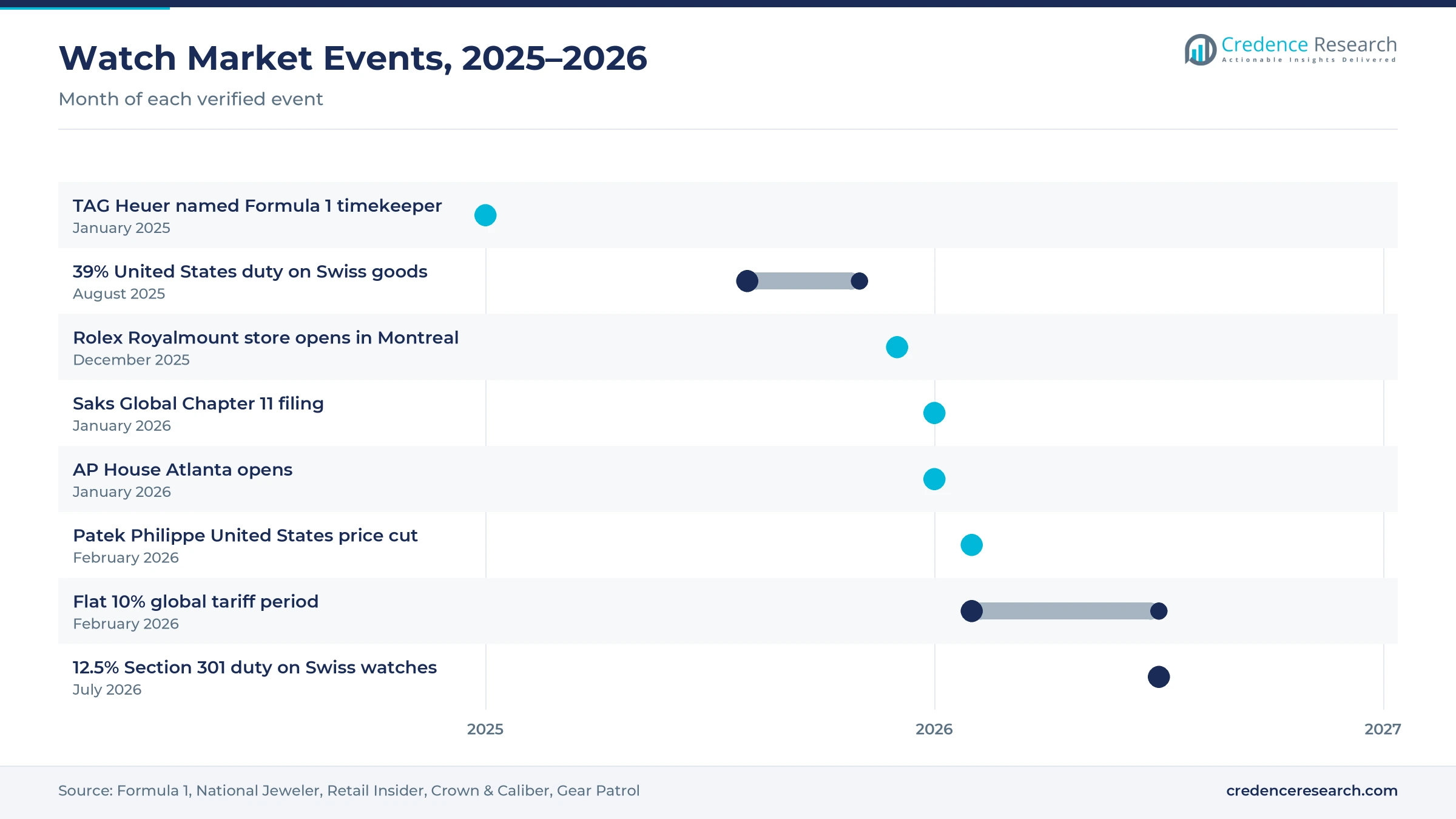
Repeated changes in United States duties make Swiss stock hard to price. Rates moved from 39% on Aug. 7, 2025, to 15% from Nov. 14, 2025, then to a flat 10% from Feb. 24, 2026, and to 12.5% from July 24, 2026, according to Crown & Caliber. The Supreme Court had struck down the earlier emergency tariffs on Feb. 20, 2026, and Al Jazeera reported that refunds could take years. Retailers that hold imported stock carry the most risk, so many now reprice more often.
Department store distress narrows wholesale outlets
Department store distress has narrowed a key outlet for quartz, fashion and entry Swiss brands. Saks Global filed for Chapter 11 protection in January 2026 and planned to cut Saks Fifth Avenue to 15 stores from about 33, National Jeweler reported in April 2026. Its failure to pay vendors damaged supplier ties, although more than 650 brands later resumed shipping. Watch suppliers that relied on these doors face lost space and payment risk, so many now shift stock toward independent retailers.
Counterfeit supply raises enforcement and trust costs
Counterfeit supply raises costs for brands and retailers and weakens buyer trust in online listings. CBP officers at Chicago O'Hare International Airport seized 200 fake Cartier watches on Sept. 18, 2026, worth about USD 28 million if genuine, according to Fox 32 Chicago. The shipment came from Hong Kong and was bound for California. Brands respond with serial checks, authorized dealer lists and digital warranty cards, but smaller online sellers still struggle to prove authenticity.
Uneven Swiss shipments disrupt retail stock planning
Uneven Swiss shipments make stock planning hard for retailers in the region. MR Magazine reported that Swiss watch exports to the United States fell 56% in September 2025 after the higher duty took hold. A year later, exports to the United States rose 86% in September 2026 on that weak base, according to Plattform J. Over the first half of 2026, shipments were 14.8% below the front-loaded first half of 2025, Watch Collecting Lifestyle reported. Retailers therefore face long waits for some references and excess stock of others.
United States leads while Mexico grows fastest
| Country | Value, 2025 (USD billion) | Share, 2025 | CAGR, 2026–2035 |
|---|---|---|---|
| United States | 12.25 | 87.5% | 2.12% |
| Canada | 0.95 | 6.8% | 2.47% |
| Mexico | 0.80 | 5.7% | 3.07% |
United States leads on wealth and store density
United States held 87.5% of 2025 value and grows at 2.12% a year. The country has the region's densest network of brand boutiques and authorized retailers, and Audemars Piguet now runs AP Houses in Los Angeles, New York and Atlanta. Swiss exports to the country reached CHF 349 million in June 2026, up 12.7% on a year earlier, according to Watch Collecting Lifestyle. Household wealth concentrated at the top supports mechanical and jewellery watches, while quartz brands rely on department stores and online sales.
Canada grows on concentrated household wealth
Canada held 6.8% of 2025 value and grows at 2.47% a year, slightly ahead of the United States pace. Montreal has become a key store cluster, because the Royalmount center now hosts both the largest Rolex store in Canada and a TimeVallée multi-brand store. Retail Insider reported that the Rolex store has nine distinct areas and planned a full after-sales workshop for spring 2026. Canadian buyers also shop in the United States, so cross-border duty rules and the exchange rate shape the pace of growth.
Mexico grows fastest from a narrow buyer base
Mexico held 5.7% of 2025 value and grows at 3.07% a year, the fastest pace in the region. Online retail reached 17.7% of total retail sales in 2025, according to the AMVO study, and that helps buyers outside Mexico City reach brand stores online. El Palacio de Hierro also reported that Cartier reopened its Guadalajara boutique in 2024. World Bank data put GDP per person at about USD 13,889 in 2025, and that keeps the buyer pool narrow, so demand centers on wealthy households in the largest cities.
Store openings and tariff rulings mark 2025 and 2026
| Development | Status and market relevance |
|---|---|
| In January 2025, Formula 1 confirmed TAG Heuer as its official timekeeper from the 2025 season under a 10-year partnership with LVMH. | Active; the partnership runs for 10 years. |
| In November 2025, the United States and Switzerland agreed to cut the duty on Swiss goods, including watches, from 39% to 15%. | Applied in December, retroactive to Nov. 14, 2025. |
| In December 2025, Raffi Jewellers opened a nearly 5,500-square-foot Rolex store at Royalmount in Montreal. | Open; the largest Rolex store in Canada. |
| In January 2026, Audemars Piguet opened a nearly 10,000-square-foot AP House in the Buckhead Village District of Atlanta. | Open; the brand's third AP House in the United States. |
| In July 2026, the United States set a 12.5% Section 301 duty on Swiss watches after the 10% global tariff expired. | In force from July 24, 2026. |
Movement choice decides price, upkeep and buyer type
- Self-winding mechanical calibers carry most of the value in Swiss catalogs and need servicing every few years, which ties owners to authorized service centers.
- Analog quartz movements keep prices low and accuracy high, so they dominate fashion, department store and corporate award lines.
- Digital quartz modules add timers, world time and alarms, and full-metal cases now move these models into jeweler showcases.
- Hybrid analog designs pair hands and a dial with basic step or notification functions, giving buyers a middle path between classic pieces and connected wrist wearables.
Need a Custom Version of This Report?
Tailor the scope, geography, or segments to your exact requirements.
- Custom geography or segment scope
- Direct access to our analyst team
Swiss groups compete on scarcity, stores and pricing
Competition turns on supply discipline, store quality and pricing power. Rolex sells through authorized retailers such as Gearys and Raffi Jewellers, and its larger flagship stores in Beverly Hills and Montreal show how it raises sales per door. Richemont maisons such as Cartier and Jaeger-LeCoultre reach Canadian buyers through the TimeVallée store in Montreal, while Cartier was also the brand copied in a 200-piece counterfeit seizure in Chicago in September 2026. The Swatch Group covers more price points, from Hamilton field models near USD 700 to Rado boutiques in Mexico City. Audemars Piguet and Patek Philippe compete on scarcity, with Audemars Piguet building private client houses and Patek Philippe adjusting United States prices after the tariff changes. Buyers comparing Swiss luxury timepieces across these groups weigh waiting lists, resale value and service access.
Companies profiled and their roles in this market
| Company | Type | Role in the market |
|---|---|---|
| Rolex SA | Brand owner | Raised most United States prices by 4% to 9% on Jan. 1, 2026; largest Canadian store opened at Royalmount in December 2025 |
| Compagnie Financière Richemont SA | Brand group | Cartier, Jaeger-LeCoultre, Panerai and Piaget sold at the TimeVallée Montreal store opened in September 2024 |
| The Swatch Group Ltd | Brand group | Hamilton released a 1,776-piece United States edition in April 2026; Rado opened its first Latin American boutique in Mexico City |
| Audemars Piguet | Brand owner | Opened its third United States AP House in Atlanta in January 2026 |
| Patek Philippe | Brand owner | Cut United States prices by 8% from Feb. 1, 2026, after tariff relief |
| LVMH (TAG Heuer) | Brand group | TAG Heuer became Formula 1 official timekeeper from the 2025 season |
| Casio America | Brand distributor | Launched the full-metal G-SHOCK GMWBZ5000 series through jewelers in December 2025 |
Full-price discipline will set the pace to 2035
Credence Research's view is that full-price discipline will set the pace of growth in the North America watch market through 2035. Swiss brands have shown that they can pass tariff costs to buyers, and collector spending in New York remains deep at the top. The weak points are the middle of the market and wholesale outlets, where department store closures and uneven shipments squeeze smaller retailers. Brands that combine controlled supply, larger flagship stores and online reach in Canada and Mexico should gain share, while quartz brands will depend more on online sales and employer award programs.
How Credence Research built this regional estimate
The report uses 2025 as the base year and forecasts to 2035. Market values come from the Credence Research model, and country and segment splits are Credence Research estimates shaped by household wealth, store presence, Swiss export data and retail channel data. Sources used include the Federal Reserve data published by the St. Louis Fed, Statistics Canada, the World Bank, the National Retail Federation, U.S. Customs and Border Protection announcements, company pages, retailer reports and trade press. No interviews or surveys were conducted for this edition, so prices reflect published information at the time of research.
Collectors and new stores shape growth to 2035
The market should reach USD 17.44 billion by 2035, and most of the added value will come from mechanical pieces sold through authorized dealers and brand boutiques. Collector buying should keep supporting high-priced sports and jewellery watches, while field and digital models widen the entry range. Canada and Mexico add smaller but faster streams of value as brands open stores in Montreal, Mexico City and Guadalajara. The main risks are further tariff changes, department store closures and counterfeit supply, any of which could slow retailer orders.
Frequently Asked Questions
How big is the North America watch market?
Which country leads the market?
Which country grows fastest?
Which product type is largest?
How have tariffs affected watch prices?
Which distribution channel grows fastest?
What are the main challenges for sellers?
Which companies operate in this market?
Table of Content
Chapter 1 Market Segmentation
- 1.1 Segmentation Framework
- 1.1.1 Product and Service Classification
- 1.1.2 Application and End-Use Classification
- 1.1.3 Technology and Solution Classification
- 1.1.4 Customer and Distribution Channel Classification
- 1.1.5 Geographic Segmentation
- 1.1.6 Market Segment Definitions and Boundaries
- 1.2 By Product Type
- 1.2.1 Sports Watches
- 1.2.2 Dress Watches
- 1.2.3 Jewellery Watches
- 1.2.4 Field Watches
- 1.3 By Technology
- 1.3.1 Mechanical Watches
- 1.3.2 Analog Quartz Watches
- 1.3.3 Digital Quartz Watches
- 1.3.4 Hybrid Watches
- 1.4 By Application
- 1.4.1 Everyday Timekeeping
- 1.4.2 Collection Building
- 1.4.3 Personal Gifting
- 1.4.4 Corporate Gifting
- 1.5 By Country
- 1.5.1 United States
- 1.5.2 Canada
- 1.5.3 Mexico
Chapter 2 Introduction
- 2.1 Report Objectives and Scope
- 2.2 Product Definition and Industry Terminology
- 2.3 Market Inclusions and Exclusions
- 2.4 Research Process
- 2.4.1 Primary Research and Expert Interviews
- 2.4.2 Secondary Research and Source Review
- 2.4.3 Top-Down and Bottom-Up Estimation
- 2.4.4 Data Triangulation and Verification
- 2.5 Market Size Measurement Basis
- 2.5.1 2025: USD 13.99 billion → 2035: USD 17.44 billion
- 2.6 Historical and Forecast Reference Periods
- 2.6.1 Historical Period: 2018-2025
- 2.6.2 Base Year: 2025
- 2.6.3 Forecast Period: 2025-2035
- 2.7 Research Assumptions and Limitations
Chapter 3 Executive Summary
- 3.1 Market Snapshot and Key Findings
- 3.2 Base-Year Market Size, 2025
- 3.3 Forecast Market Size, 2035
- 3.4 Revenue and Volume Growth Outlook
- 3.5 Key Demand and Supply Indicators
- 3.6 Leading Market Segments
- 3.7 Fastest-Growing Market Opportunities
- 3.8 Regional Performance Highlights
- 3.9 Technology and Industry Transformation
- 3.10 Competitive Landscape Summary
- 3.11 Analyst View and Strategic Implications
Chapter 4 North America Watch Market Trends and Developments
- 4.1 Historical Industry Development, 2018-2025
- 4.2 Recent Market Trends and Developments
- 4.3 Demand and Customer Behavior Trends
- 4.4 Technology and Product Innovation
- 4.5 Artificial Intelligence, Automation and Digitalization
- 4.6 Local Manufacturing and Supply Chain Realignment
- 4.7 Industry Partnerships, Mergers and Acquisitions
- 4.8 Sustainability and Circular Economy Developments
- 4.9 Government and Private Sector Investment Trends
- 4.10 Emerging Business Models and Commercialization
- 4.11 Industry Developments and Announcements
Chapter 5 North America Watch Market Production, Supply and Demand Analysis
- 5.1 Demand Trend and Consumption Analysis, 2018-2025
- 5.2 Demand Forecast, 2025-2035
- 5.3 Production and Output Trend, 2018-2025
- 5.4 Production and Output Forecast, 2025-2035
- 5.5 Installed Capacity and Capacity Utilization
- 5.6 Company-Wise Production Plants and Statistics
- 5.6.1 Installed Production Capacity
- 5.6.2 Actual Production
- 5.6.3 Planned Capacity and Expansion Targets
- 5.7 Supply Chain Structure and Procurement Trends
- 5.8 Supply-Demand Gap and Bottlenecks
- 5.9 Import Dependence and Sourcing Structure
- 5.10 Contract Manufacturing and Outsourcing
- 5.11 Regional Supply and Demand Concentration
Chapter 6 North America Watch Market Pricing Analysis
- 6.1 Pricing Structure and Measurement
- 6.2 Historical Pricing Trends, 2018-2025
- 6.3 Pricing Outlook, 2025-2035
- 6.4 Average Selling Price and Unit Economics
- 6.5 Pricing by Product and Market Segment
- 6.6 Geographic Pricing Differences
- 6.7 Key Input, Energy, Labor and Logistics Costs
- 6.8 Contract Pricing and Purchasing Models
- 6.9 Pricing Sensitivity and Competitive Positioning
- 6.10 Price, Margin and Profitability Implications
Chapter 7 North America Watch Market Dynamics
- 7.1 Market Growth Drivers
- 7.1.1 Demand-Side Drivers
- 7.1.2 Technology and Innovation Drivers
- 7.1.3 Infrastructure and Investment Drivers
- 7.1.4 Regulatory and Policy Drivers
- 7.2 Market Restraints
- 7.2.1 Cost and Affordability Constraints
- 7.2.2 Technology and Adoption Barriers
- 7.2.3 Supply Chain and Operational Constraints
- 7.3 Market Challenges
- 7.3.1 Competitive Pressure and Margin Erosion
- 7.3.2 Skills, Infrastructure and Implementation Gaps
- 7.4 Emerging Market Opportunities
- 7.5 Market Dynamics Impact and Time-Horizon Assessment
Chapter 8 North America Watch Value Chain Analysis
- 8.1 Industry Value Chain Overview
- 8.2 Upstream Suppliers and Critical Inputs
- 8.3 Technology and Component Providers
- 8.4 Manufacturing or Service Delivery
- 8.5 Distribution, Channel Partners and Integrators
- 8.6 Downstream Applications and End Users
- 8.7 Value Addition and Profit Pools
- 8.8 Vertical Integration and Outsourcing
- 8.9 Supplier Concentration and Risk
- 8.10 Supply Chain Localization and Resilience
Chapter 9 North America Watch Market Regulations and Policies
- 9.1 Relevant Laws, Standards and Compliance Frameworks
- 9.2 Product, Service, Safety and Quality Requirements
- 9.3 Government Policies, Incentives and Subsidies
- 9.4 Imports, Exports and Trade Barriers
- 9.5 Public Procurement and Local Content Requirements
- 9.6 Environmental and Sustainability Compliance
- 9.7 Upcoming Policy Changes and Market Implications
Chapter 10 North America Watch Market Hotspots and Opportunities
- 10.1 Market Opportunity Mapping and Growth Hotspots
- 10.2 High-Growth Applications and Customer Groups
- 10.3 Underserved Markets and White-Space Opportunities
- 10.4 Emerging Technology and Product Opportunities
- 10.5 New Capacity and Investment Hotspots
- 10.6 Market Entry and Expansion Opportunities
- 10.7 Distribution and Partnership Opportunities
- 10.8 Near-Term and Long-Term Commercial Potential
- 10.9 Opportunity Attractiveness and Execution Risks
Chapter 11 North America Watch Market Outlook, 2025-2035
- 11.1 Market Size and Analysis
- 11.1.1 Revenue (Market Measurement: 2025: USD 13.99 billion → 2035: USD 17.44 billion)
- 11.1.2 Market Volume and Quantity Sold
- 11.1.3 Historical Market Size, 2018-2025
- 11.1.4 Base-Year Market Size, 2025
- 11.2 Market Forecast, 2025-2035
- 11.2.1 Revenue Forecast to 2035
- 11.2.2 Volume Forecast to 2035
- 11.2.3 CAGR and Year-on-Year Growth
- 11.2.4 Incremental Revenue Opportunity
- 11.3 Forecast Assumptions and Scenario Analysis
- 11.3.1 Base-Case Forecast
- 11.3.2 Optimistic and Conservative Scenarios
- 11.3.3 Technology, Pricing and Policy Sensitivities
- 11.4 Market Attractiveness and Growth Outlook
Chapter 12 North America Watch Market Segmentation and Outlook
- 12.1 Segmentation Summary and Market Shares, 2025
- 12.2 Largest and Fastest-Growing Segments
- 12.3 By Product Type - Market Size and Forecast, 2025-2035
- 12.3.1 Segment Definition and Scope
- 12.3.2 Historical Market Size, 2018-2025
- 12.3.3 Revenue Forecast, 2025-2035
- 12.3.4 Volume Forecast, 2025-2035
- 12.3.5 Base-Year Market Share, 2025
- 12.3.6 Segment CAGR and Growth Drivers
- 12.3.7 Subsegment Market Size and Forecast
- 12.3.7.1 Sports Watches
- 12.3.7.2 Dress Watches
- 12.3.7.3 Jewellery Watches
- 12.3.7.4 Field Watches
- 12.3.8 Subsegment Pricing and Adoption Trends
- 12.3.9 Leading Suppliers and Competition
- 12.3.10 Regional Demand and Opportunities
- 12.4 By Technology - Market Size and Forecast, 2025-2035
- 12.4.1 Segment Definition and Scope
- 12.4.2 Historical Market Size, 2018-2025
- 12.4.3 Revenue Forecast, 2025-2035
- 12.4.4 Volume Forecast, 2025-2035
- 12.4.5 Base-Year Market Share, 2025
- 12.4.6 Segment CAGR and Growth Drivers
- 12.4.7 Subsegment Market Size and Forecast
- 12.4.7.1 Mechanical Watches
- 12.4.7.2 Analog Quartz Watches
- 12.4.7.3 Digital Quartz Watches
- 12.4.7.4 Hybrid Watches
- 12.4.8 Subsegment Pricing and Adoption Trends
- 12.4.9 Leading Suppliers and Competition
- 12.4.10 Regional Demand and Opportunities
- 12.5 By Application - Market Size and Forecast, 2025-2035
- 12.5.1 Segment Definition and Scope
- 12.5.2 Historical Market Size, 2018-2025
- 12.5.3 Revenue Forecast, 2025-2035
- 12.5.4 Volume Forecast, 2025-2035
- 12.5.5 Base-Year Market Share, 2025
- 12.5.6 Segment CAGR and Growth Drivers
- 12.5.7 Subsegment Market Size and Forecast
- 12.5.7.1 Everyday Timekeeping
- 12.5.7.2 Collection Building
- 12.5.7.3 Personal Gifting
- 12.5.7.4 Corporate Gifting
- 12.5.8 Subsegment Pricing and Adoption Trends
- 12.5.9 Leading Suppliers and Competition
- 12.5.10 Regional Demand and Opportunities
- 12.6 By Country - Market Size and Forecast, 2025-2035
- 12.6.1 Segment Definition and Scope
- 12.6.2 Historical Market Size, 2018-2025
- 12.6.3 Revenue Forecast, 2025-2035
- 12.6.4 Volume Forecast, 2025-2035
- 12.6.5 Base-Year Market Share, 2025
- 12.6.6 Segment CAGR and Growth Drivers
- 12.6.7 Subsegment Market Size and Forecast
- 12.6.7.1 United States
- 12.6.7.2 Canada
- 12.6.7.3 Mexico
- 12.6.8 Subsegment Pricing and Adoption Trends
- 12.6.9 Leading Suppliers and Competition
- 12.6.10 Regional Demand and Opportunities
- 12.7 Segment Growth Comparison
- 12.8 Segment Attractiveness and Priority Matrix
Chapter 13 North America Watch End-Use and Application Market Outlook
- 13.1 End-Use Industry and Customer Demand Structure
- 13.2 Leading Applications and Customer Groups
- 13.3 End-Use Market Size, Share and Forecast
- 13.4 Major End-Use Industry Deep Dives
- 13.4.1 Customer Requirements and Use Cases
- 13.4.2 Demand and Replacement Cycles
- 13.4.3 Technical and Regulatory Considerations
- 13.4.4 Purchasing and Procurement Models
- 13.4.5 Leading Vendors and Distribution Channels
- 13.4.6 Forecast and Commercial Opportunities
- 13.5 Emerging Applications and Cross-Segment Demand
- 13.6 End-Use Industry Investment Priorities
Chapter 14 North America Watch Geographic Market Outlook, 2025-2035
- 14.1 Regional Market Size and Country-Level Shares, 2025
- 14.2 Country Market Size Comparison, 2025
- 14.3 Country Market Forecasts, 2025-2035
- 14.4 Subregional Industrial and Demand Clusters
- 14.5 Intra-Regional Pricing and Cost Differences
- 14.6 Cross-Border Trade and Supply Networks
- 14.7 Regional Supply and Demand Balances
- 14.8 Country Opportunity Comparison and Prioritization
Note: Every listed country is covered on the structure shown under the first country.
Chapter 15 North America Watch Technology, Innovation and Sustainability Outlook
- 15.1 Technology Landscape and Maturity
- 15.2 Product, Process and Service Innovation
- 15.3 AI, Automation and Digital Tools in the Industry
- 15.4 Technology Adoption and Performance Benchmarking
- 15.5 Innovation Pipeline and R&D Investment
- 15.6 Patent and Intellectual Property Trends
- 15.7 Energy Efficiency and Resource Management
- 15.8 Sustainability, Recycling and Circularity
- 15.9 Technology Roadmap, 2025-2035
- 15.10 Risks of Obsolescence and Technology Substitution
Chapter 16 North America Watch Market Key Strategic Imperatives
- 16.1 Growth and Market Entry Priorities
- 16.2 High-Return Products and Segments
- 16.3 Pricing, Profitability and Cost Optimization
- 16.4 Technology Investment and Product Differentiation
- 16.5 Supply Chain Localization and Resilience
- 16.6 Distribution and Customer Acquisition
- 16.7 Partnership, Acquisition and Capacity Strategy
- 16.8 Regional Expansion Priorities
- 16.9 Short-, Medium- and Long-Term Actions
Chapter 17 Competition Outlook
- 17.1 Industry Competition Characteristics
- 17.2 Market Structure and Concentration
- 17.3 Market Share and Competitive Positioning, 2025
- 17.4 Company-Wise Revenue and Product Benchmarking
- 17.5 Production and Service Capacity Benchmarking
- 17.6 Technology, Pricing and Differentiation
- 17.7 Regional Footprint and Distribution Strength
- 17.8 Mergers, Acquisitions and Strategic Alliances
- 17.9 New Entrants and Competitive Threats
- 17.10 Porter's Five Forces and Industry Attractiveness
- 17.11 Competitive Outlook, 2025-2035
Chapter 18 Company Profiles
- 18.1 Company Coverage and Selection Criteria
- 18.2 Rolex SA
- 18.2.1 Business Description
- 18.2.2 Company Ownership and Geographic Presence
- 18.2.3 Product and Service Portfolio
- 18.2.4 Manufacturing and Operating Footprint
- 18.2.5 Production Capacity and Expansion Plans
- 18.2.6 Financial Performance and Investment
- 18.2.7 Market Share and Competitive Position
- 18.2.8 Technology and Innovation Capabilities
- 18.2.9 Strategic Alliances or Partnerships
- 18.2.10 Recent Developments
- 18.2.11 Growth Strategy and Outlook
- 18.3 Compagnie Financière Richemont SA
- 18.4 The Swatch Group Ltd
- 18.5 Audemars Piguet
- 18.6 Patek Philippe
- 18.7 Other Relevant Market Participants
Note: Every listed company is profiled on the structure shown under the first company. The company list is preliminary and may change based on research findings, market developments, data availability and client requirements.
Chapter 19 Disclaimer
- 19.1 Research and Forecast Disclaimer
- 19.2 Data Source and Estimation Limitations
Note: The depth of individual sections depends on data availability for this market. Volume, capacity, trade and other unit-based metrics are included where applicable.

