
Market Overview
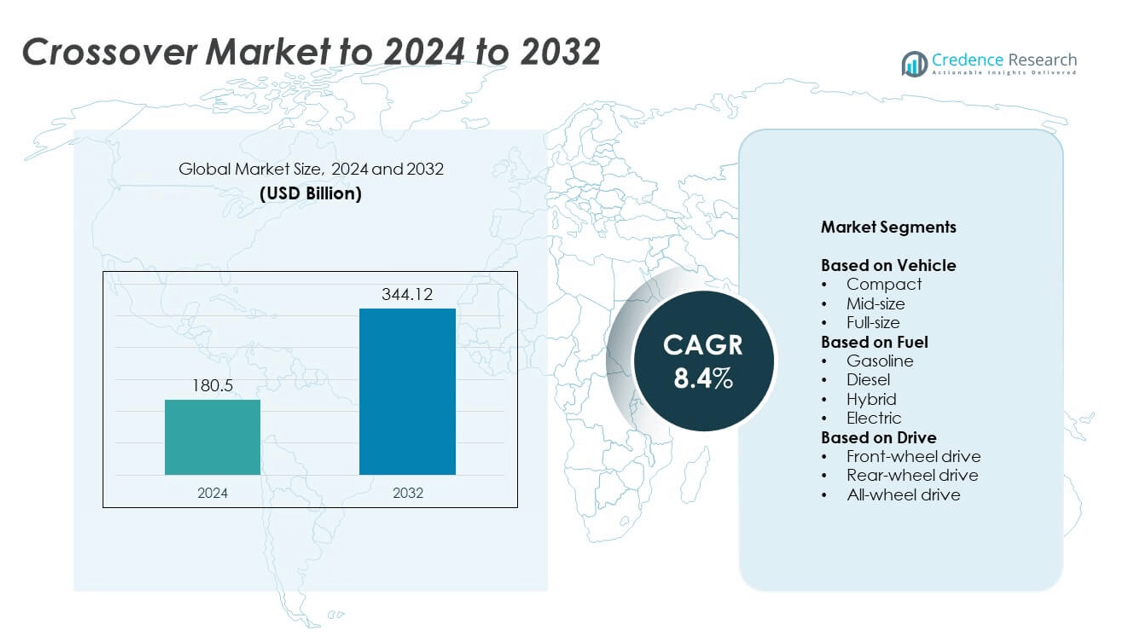
Crossover Market size was valued USD 180.5 billion in 2024 and is anticipated to reach USD 344.12 billion by 2032, at a CAGR of 8.4% during the forecast period.
| REPORT ATTRIBUTE | DETAILS |
|---|---|
| Historical Period | 2020-2023 |
| Base Year | 2024 |
| Forecast Period | 2025-2032 |
| Crossover Market Size 2024 | USD 180.5 billion |
| Crossover Market, CAGR | 8.4% |
| Crossover Market Size 2032 | USD 344.12 billion |
The crossover market is led by major players including Hyundai, BMW, Nissan, Tesla, Ford, Mitsubishi, Toyota, Volkswagen, Stellantis N.V., Honda, Mercedes-Benz, General Motors, and Mazda Motor Europe. These companies dominate through extensive product portfolios, innovation in hybrid and electric powertrains, and continuous upgrades in safety and connectivity features. Manufacturers are focusing on expanding production capacity and introducing region-specific models to meet varying consumer preferences. North America emerged as the leading region with a 37% market share in 2024, driven by high demand for mid-size and premium crossovers supported by strong purchasing power and advanced infrastructure.
Market Insights
- The crossover market was valued at USD 180.5 billion in 2024 and is projected to reach USD 344.12 billion by 2032, growing at a CAGR of 8.4%.
- Rising consumer preference for versatile, fuel-efficient vehicles is driving market growth, supported by strong demand for mid-size crossovers that held a 47% share in 2024.
- Electrification and hybrid integration are key trends, with automakers focusing on eco-friendly models and advanced driver-assistance technologies to enhance safety and efficiency.
- Competition remains high as global manufacturers invest in digital connectivity, AI-based diagnostics, and lightweight materials, while high production costs and supply chain challenges limit growth.
- North America led the global market with a 37% share in 2024, followed by Europe at 30% and Asia-Pacific at 26%, supported by growing urbanization, regional manufacturing expansion, and increasing adoption of hybrid and electric crossover models.
Market Segmentation Analysis:
By Vehicle
The mid-size segment dominated the crossover market in 2024 with a 47% share. These vehicles offer an ideal balance between interior space, performance, and fuel efficiency, making them popular among families and urban buyers. Automakers are focusing on advanced safety features, connected infotainment, and hybrid options to attract consumers. Growing demand for vehicles that combine SUV capability with sedan comfort continues to strengthen mid-size crossovers. Expanding model availability across price ranges and improved ride quality are further boosting this segment’s leadership in both developed and emerging markets.
- For instance, Toyota RAV4 deliveries in the U.S. reached 475,193 units in 2024, an increase of 9.3% compared to 2023. This sales volume made the RAV4 the best-selling SUV in the U.S. for the eighth consecutive year.
By Fuel
The gasoline segment held the largest share of 56% in 2024, driven by widespread fuel infrastructure and affordability. Gasoline crossovers remain preferred for their smooth performance, lower initial cost, and high availability across global markets. However, hybrid and electric segments are gaining traction due to emission regulations and sustainability goals. Automakers such as Toyota and Hyundai are introducing efficient hybrid crossover variants to attract eco-conscious buyers. Technological improvements in engine efficiency and lightweight materials are also extending the relevance of gasoline crossovers during the transition toward electrification.
- For instance, For its first full calendar year on the U.S. market, the Honda Prologue sold just over 33,000 units in 2024, with initial sales starting in March of that year.
By Drive
The all-wheel-drive (AWD) segment accounted for the leading 41% share in 2024, supported by strong demand in regions with diverse terrain and harsh climates. AWD crossovers offer improved traction, stability, and handling, making them suitable for both urban and off-road conditions. The segment benefits from rising consumer preference for adventure-ready vehicles with enhanced safety. Brands like Subaru and Mazda are emphasizing advanced torque control and intelligent drive systems to boost performance. The continued expansion of AWD options in compact and hybrid models is further solidifying this segment’s dominance globally.
Key Growth Drivers
Rising Consumer Demand for Versatile Mobility
The growing preference for vehicles that combine SUV capability with car-like comfort is a major driver of the crossover market. Consumers are increasingly choosing crossovers for their elevated seating, cargo space, and flexible performance across urban and rural roads. Automakers are expanding model portfolios to address this demand, offering compact, mid-size, and luxury options. The trend toward multi-purpose vehicles that suit both family and individual needs continues to propel global crossover sales.
- For instance, Chevrolet Equinox EV hit 8,500+ U.S. sales in July 2025, a non-Tesla monthly record.
Technological Integration and Safety Advancements
Advancements in driver-assistance technologies, infotainment systems, and connectivity features are fueling crossover adoption. Modern models now include adaptive cruise control, lane-keeping assist, and advanced braking systems as standard or optional features. These improvements enhance driver safety and user experience, making crossovers appealing across demographics. Automakers are also integrating AI-based diagnostics and over-the-air software updates to improve performance and convenience, strengthening customer trust and loyalty.
- For instance, General Motors says Super Cruise coverage is expanding toward ~750,000 miles of mapped roads by end-2025.
Shift Toward Electrification and Hybrid Powertrains
The rapid adoption of hybrid and electric crossover models is another strong growth driver. Governments worldwide are offering incentives and implementing emission targets that encourage low-emission vehicles. Manufacturers are responding by launching plug-in hybrid and fully electric crossovers with longer driving ranges and faster charging capabilities. This shift aligns with growing environmental awareness among consumers, accelerating the transition toward sustainable mobility in both developed and emerging markets.
Key Trends & Opportunities
Expansion of Compact and Affordable Models
Automakers are expanding their lineup of compact crossovers to target price-sensitive buyers and first-time car owners. The segment offers an attractive balance of fuel efficiency, practicality, and advanced features at a competitive price. Compact models are also becoming more popular in densely populated regions where space and parking are limited. Growing demand from emerging markets in Asia-Pacific and Latin America provides an opportunity for manufacturers to increase market penetration and brand presence.
- For instance, BYD’s Song family recorded 89,135 sales in September 2024 in China.
Integration of Connected and Autonomous Features
The integration of connectivity, smart navigation, and semi-autonomous driving systems is reshaping the crossover market. Features such as remote diagnostics, real-time traffic assistance, and vehicle-to-everything communication are improving safety and convenience. Automakers are leveraging data analytics and cloud-based technologies to deliver personalized experiences. This digital shift offers new revenue opportunities through software updates, subscription-based services, and mobility solutions tailored to urban drivers.
- For instance, Hyundai states infotainment OTA updates typically complete in ~10 minutes; map updates can take up to 100 minutes.
Key Challenges
High Manufacturing and Battery Costs
The rising cost of raw materials, advanced electronics, and electric drivetrains poses a significant challenge for manufacturers. Producing hybrid and electric crossovers requires costly components such as lithium-ion batteries and semiconductor chips. These expenses often increase vehicle prices, limiting affordability for middle-income consumers. The challenge is to balance cost reduction through scale and innovation while maintaining performance and safety standards in a competitive market.
Infrastructure and Supply Chain Constraints
Limited charging infrastructure and global supply chain disruptions continue to hinder market expansion. Delays in component availability, particularly semiconductors, have affected production timelines. In developing regions, inadequate charging networks slow the adoption of electric crossovers. Manufacturers are focusing on localizing production and building partnerships to stabilize supply chains. However, sustained investment in logistics and infrastructure remains essential for achieving long-term market growth.
Regional Analysis
North America
North America held the largest share of 37% in the global crossover market in 2024. Strong consumer preference for versatile, family-oriented vehicles and advanced features drives demand across the United States and Canada. The region’s well-established infrastructure and high disposable income support premium and mid-size crossover sales. Automakers such as Ford, General Motors, and Toyota continue expanding hybrid and electric variants to align with emission goals. Increasing interest in safety technologies and off-road capable designs further strengthens North America’s leadership position in the global crossover market.
Europe
Europe accounted for a 30% share in 2024, supported by stringent emission standards and rising adoption of electric crossovers. Countries such as Germany, France, and the United Kingdom are witnessing strong growth due to urban mobility initiatives and incentives for low-emission vehicles. European automakers like Volkswagen, BMW, and Volvo are leading with electrified crossover portfolios. Compact and mid-size models dominate urban demand, while plug-in hybrid options are expanding rapidly. Continuous innovation in lightweight design and autonomous technology enhances vehicle efficiency and strengthens the region’s competitive position.
Asia-Pacific
Asia-Pacific captured a 26% share of the global crossover market in 2024, driven by growing urbanization, rising incomes, and expanding automotive production. China, Japan, and South Korea are major contributors due to strong consumer demand and government support for hybrid and electric vehicles. Automakers such as Hyundai, Honda, and Toyota are launching region-specific crossovers with advanced infotainment and safety features. Compact and affordable models dominate sales in emerging markets like India and Southeast Asia. Increasing local manufacturing and technological innovation are expected to further boost regional growth.
Latin America
Latin America represented a 5% share in the global crossover market in 2024. Countries such as Brazil, Mexico, and Argentina are witnessing steady growth due to the rising popularity of compact and mid-size crossovers. Consumers are drawn to their higher ground clearance, comfort, and fuel efficiency compared to sedans. Manufacturers are expanding local assembly operations and introducing flexible financing options to enhance affordability. Economic recovery and infrastructure development are expected to support long-term market stability, while growing availability of hybrid models improves the region’s environmental outlook.
Middle East & Africa
The Middle East & Africa region held a 2% share in 2024, reflecting moderate but consistent growth. Rising demand for durable and versatile vehicles suitable for varied terrains is boosting crossover adoption, especially in the Gulf countries and South Africa. Expanding road networks, improving living standards, and growing awareness of vehicle safety contribute to regional growth. International brands are introducing models adapted for extreme weather conditions and rough roads. As economic diversification and urbanization progress, the region is expected to record steady expansion in the coming years.
Market Segmentations:
By Vehicle
- Compact
- Mid-size
- Full-size
By Fuel
- Gasoline
- Diesel
- Hybrid
- Electric
By Drive
- Front-wheel drive
- Rear-wheel drive
- All-wheel drive
By Geography
- North America
- U.S.
- Canada
- Europe
- Germany
- France
- U.K.
- Italy
- Spain
- Rest of Europe
- Asia Pacific
- China
- Japan
- India
- South Korea
- South-east Asia
- Rest of Asia Pacific
- Latin America
- Brazil
- Mexico
- Rest of Latin America
- Middle East & Africa
- GCC Countries
- South Africa
- Rest of Middle East and Africa
Competitive Landscape
The crossover market features strong competition among major automakers such as Hyundai, BMW, Nissan, Tesla, Ford, Mitsubishi, Toyota, Volkswagen, Stellantis N.V., Honda, Mercedes-Benz, General Motors, and Mazda Motor Europe. The market is characterized by continuous innovation in design, electrification, and advanced safety systems. Companies are focusing on hybrid and electric powertrain integration to align with global sustainability standards. Intense competition drives investments in digital connectivity, autonomous driving features, and lightweight architecture to improve efficiency. Strategic alliances and joint ventures are expanding global reach and supply chain resilience. Manufacturers are also strengthening aftersales networks and adopting flexible production models to address fluctuating demand. The increasing use of AI-driven analytics helps optimize production and customer engagement. Competitive intensity is expected to grow as brands introduce region-specific models with improved comfort, technology, and performance features to capture diverse consumer segments in emerging and developed markets alike.
Key Player Analysis
- Hyundai
- BMW
- Nissan
- Tesla
- Ford
- Mitsubishi
- Toyota
- Volkswagen
- Stellantis N.V.
- Honda
- Mercedes-Benz
- General Motors
- Mazda Motor Europe
Recent Developments
- In 2025, Honda confirmed plans to launch 13 new-generation hybrid models globally starting in 2027.
- In April 2024, Mazda Motor Europe unveiled the first-ever Mazda CX-80 Crossover in Europe.
- In 2024, Tesla announced its plans to introduce a crossover, an entry-level budget EV from 2025, which is likely to be designed for India.
Report Coverage
The research report offers an in-depth analysis based on Vehicle, Fuel, Drive and Geography. It details leading market players, providing an overview of their business, product offerings, investments, revenue streams, and key applications. Additionally, the report includes insights into the competitive environment, SWOT analysis, current market trends, as well as the primary drivers and constraints. Furthermore, it discusses various factors that have driven market expansion in recent years. The report also explores market dynamics, regulatory scenarios, and technological advancements that are shaping the industry. It assesses the impact of external factors and global economic changes on market growth. Lastly, it provides strategic recommendations for new entrants and established companies to navigate the complexities of the market.
Future Outlook
- Demand for compact and mid-size crossovers will continue to rise due to urban lifestyles.
- Automakers will expand electric and hybrid crossover portfolios to meet emission goals.
- Advanced driver-assistance systems will become standard across most new crossover models.
- Connected and AI-enabled infotainment systems will enhance the in-car experience.
- Lightweight materials and aerodynamic designs will improve vehicle efficiency and performance.
- Subscription-based ownership models will grow in popularity among younger consumers.
- Asia-Pacific will emerge as the fastest-growing regional market for crossovers.
- Manufacturers will focus on regional customization to meet diverse market preferences.
- Integration of autonomous driving technologies will redefine safety and convenience features.
- Partnerships between automakers and tech firms will accelerate innovation and smart mobility adoption.

Request a Free Sample
Fill in your details and we'll send you a free sample report.
- Sample data tables & charts
- Research methodology
Need a Custom Version of This Report?
Tailor the scope, geography, or segments to your exact requirements.
- Custom geography or segment scope
- Direct access to our analyst team
Frequently Asked Questions
What is the current market size for Crossover Market, and what is its projected size in 2032?
At what Compound Annual Growth Rate is the Crossover Market projected to grow between 2025 and 2032?
Which Crossover Market segment held the largest share in 2024?
What are the primary factors fueling the growth of the Crossover Market?
Who are the leading companies in the Crossover Market?
Table of Content
Chapter 1 Market Segmentation
- 1.1 Segmentation Framework
- 1.1.1 Product and Service Classification
- 1.1.2 Application and End-Use Classification
- 1.1.3 Technology and Solution Classification
- 1.1.4 Customer and Distribution Channel Classification
- 1.1.5 Geographic Segmentation
- 1.1.6 Market Segment Definitions and Boundaries
Chapter 2 Introduction
- 2.1 Report Objectives and Scope
- 2.2 Product Definition and Industry Terminology
- 2.3 Market Inclusions and Exclusions
- 2.4 Research Process
- 2.4.1 Primary Research and Expert Interviews
- 2.4.2 Secondary Research and Source Review
- 2.4.3 Top-Down and Bottom-Up Estimation
- 2.4.4 Data Triangulation and Verification
- 2.5 Market Size Measurement Basis
- 2.5.1 2024: USD 180.5 billion → 2032: USD 344.12 billion
- 2.6 Historical and Forecast Reference Periods
- 2.6.1 Base Year: 2024
- 2.6.2 Forecast Period: 2024-2032
- 2.7 Research Assumptions and Limitations
Chapter 3 Executive Summary
- 3.1 Market Snapshot and Key Findings
- 3.2 Base-Year Market Size, 2024
- 3.3 Forecast Market Size, 2032
- 3.4 Revenue and Volume Growth Outlook
- 3.5 Key Demand and Supply Indicators
- 3.6 Leading Market Segments
- 3.7 Fastest-Growing Market Opportunities
- 3.8 Regional Performance Highlights
- 3.9 Technology and Industry Transformation
- 3.10 Competitive Landscape Summary
- 3.11 Analyst View and Strategic Implications
Chapter 4 Global Crossover Market Trends and Developments
- 4.1 Historical Industry Development
- 4.2 Recent Market Trends and Developments
- 4.3 Demand and Customer Behavior Trends
- 4.4 Technology and Product Innovation
- 4.5 Artificial Intelligence, Automation and Digitalization
- 4.6 Local Manufacturing and Supply Chain Realignment
- 4.7 Industry Partnerships, Mergers and Acquisitions
- 4.8 Sustainability and Circular Economy Developments
- 4.9 Government and Private Sector Investment Trends
- 4.10 Emerging Business Models and Commercialization
- 4.11 Industry Developments and Announcements
Chapter 5 Global Crossover Market Production, Supply and Demand Analysis
- 5.1 Demand Trend and Consumption Analysis
- 5.2 Demand Forecast, 2024-2032
- 5.3 Production and Output Trend
- 5.4 Production and Output Forecast, 2024-2032
- 5.5 Installed Capacity and Capacity Utilization
- 5.6 Company-Wise Production Plants and Statistics
- 5.6.1 Installed Production Capacity
- 5.6.2 Actual Production
- 5.6.3 Planned Capacity and Expansion Targets
- 5.7 Supply Chain Structure and Procurement Trends
- 5.8 Supply-Demand Gap and Bottlenecks
- 5.9 Import Dependence and Sourcing Structure
- 5.10 Contract Manufacturing and Outsourcing
- 5.11 Regional Supply and Demand Concentration
Chapter 6 Global Crossover Market Pricing Analysis
- 6.1 Pricing Structure and Measurement
- 6.2 Historical Pricing Trends
- 6.3 Pricing Outlook, 2024-2032
- 6.4 Average Selling Price and Unit Economics
- 6.5 Pricing by Product and Market Segment
- 6.6 Geographic Pricing Differences
- 6.7 Key Input, Energy, Labor and Logistics Costs
- 6.8 Contract Pricing and Purchasing Models
- 6.9 Pricing Sensitivity and Competitive Positioning
- 6.10 Price, Margin and Profitability Implications
Chapter 7 Global Crossover Market Dynamics
- 7.1 Market Growth Drivers
- 7.1.1 Demand-Side Drivers
- 7.1.2 Technology and Innovation Drivers
- 7.1.3 Infrastructure and Investment Drivers
- 7.1.4 Regulatory and Policy Drivers
- 7.2 Market Restraints
- 7.2.1 Cost and Affordability Constraints
- 7.2.2 Technology and Adoption Barriers
- 7.2.3 Supply Chain and Operational Constraints
- 7.3 Market Challenges
- 7.3.1 Competitive Pressure and Margin Erosion
- 7.3.2 Skills, Infrastructure and Implementation Gaps
- 7.4 Emerging Market Opportunities
- 7.5 Market Dynamics Impact and Time-Horizon Assessment
Chapter 8 Global Crossover Value Chain Analysis
- 8.1 Industry Value Chain Overview
- 8.2 Upstream Suppliers and Critical Inputs
- 8.3 Technology and Component Providers
- 8.4 Manufacturing or Service Delivery
- 8.5 Distribution, Channel Partners and Integrators
- 8.6 Downstream Applications and End Users
- 8.7 Value Addition and Profit Pools
- 8.8 Vertical Integration and Outsourcing
- 8.9 Supplier Concentration and Risk
- 8.10 Supply Chain Localization and Resilience
Chapter 9 Global Crossover Market Regulations and Policies
- 9.1 Relevant Laws, Standards and Compliance Frameworks
- 9.2 Product, Service, Safety and Quality Requirements
- 9.3 Government Policies, Incentives and Subsidies
- 9.4 Imports, Exports and Trade Barriers
- 9.5 Public Procurement and Local Content Requirements
- 9.6 Environmental and Sustainability Compliance
- 9.7 Upcoming Policy Changes and Market Implications
Chapter 10 Global Crossover Market Hotspots and Opportunities
- 10.1 Market Opportunity Mapping and Growth Hotspots
- 10.2 High-Growth Applications and Customer Groups
- 10.3 Underserved Markets and White-Space Opportunities
- 10.4 Emerging Technology and Product Opportunities
- 10.5 New Capacity and Investment Hotspots
- 10.6 Market Entry and Expansion Opportunities
- 10.7 Distribution and Partnership Opportunities
- 10.8 Near-Term and Long-Term Commercial Potential
- 10.9 Opportunity Attractiveness and Execution Risks
Chapter 11 Global Crossover Market Outlook, 2024-2032
- 11.1 Market Size and Analysis
- 11.1.1 Revenue (Market Measurement: 2024: USD 180.5 billion → 2032: USD 344.12 billion)
- 11.1.2 Market Volume and Quantity Sold
- 11.1.3 Historical Market Size
- 11.1.4 Base-Year Market Size, 2024
- 11.2 Market Forecast, 2024-2032
- 11.2.1 Revenue Forecast to 2032
- 11.2.2 Volume Forecast to 2032
- 11.2.3 CAGR and Year-on-Year Growth
- 11.2.4 Incremental Revenue Opportunity
- 11.3 Forecast Assumptions and Scenario Analysis
- 11.3.1 Base-Case Forecast
- 11.3.2 Optimistic and Conservative Scenarios
- 11.3.3 Technology, Pricing and Policy Sensitivities
- 11.4 Market Attractiveness and Growth Outlook
Chapter 12 Global Crossover Market Segmentation and Outlook
- 12.1 Segmentation Summary and Market Shares, 2024
- 12.2 Largest and Fastest-Growing Segments
- 12.3 Segment Growth Comparison
- 12.4 Segment Attractiveness and Priority Matrix
Chapter 13 Global Crossover Geographic Market Outlook, 2024-2032
- 13.1 Regional Market Size and Share, 2024
- 13.2 Regional Market Forecast, 2024-2032
- 13.3 Regional Pricing, Production and Demand Differences
- 13.4 North America
- 13.4.1 United States
- 13.4.2 Canada
- 13.4.3 Mexico
- 13.5 Europe
- 13.5.1 Germany
- 13.5.2 France
- 13.5.3 Italy
- 13.5.4 United Kingdom
- 13.5.5 Spain
- 13.5.6 Poland
- 13.5.7 Russia
- 13.5.8 Netherlands
- 13.5.9 Belgium
- 13.5.10 Sweden
- 13.5.11 Denmark
- 13.5.12 Norway
- 13.5.13 Rest of Europe
- 13.6 Asia Pacific
- 13.6.1 China
- 13.6.2 India
- 13.6.3 Japan
- 13.6.4 South Korea
- 13.6.5 Thailand
- 13.6.6 Indonesia
- 13.6.7 Vietnam
- 13.6.8 Malaysia
- 13.6.9 Australia
- 13.6.10 Rest of Asia Pacific
- 13.7 Latin America
- 13.7.1 Brazil
- 13.7.2 Argentina
- 13.7.3 Colombia
- 13.7.4 Chile
- 13.7.5 Rest of Latin America
- 13.8 Middle East
- 13.8.1 Saudi Arabia
- 13.8.2 United Arab Emirates
- 13.8.3 Turkey
- 13.8.4 Israel
- 13.8.5 Iran
- 13.8.6 Rest of the Middle East
- 13.9 Africa
- 13.9.1 South Africa
- 13.9.2 Egypt
- 13.9.3 Nigeria
- 13.9.4 Morocco
- 13.9.5 Rest of Africa
- 13.10 Regional Investment, Policy and Supply Chain Differences
- 13.11 Regional Competitive Landscape
- 13.12 Geographic Growth Hotspots
Chapter 14 Global Crossover Technology, Innovation and Sustainability Outlook
- 14.1 Technology Landscape and Maturity
- 14.2 Product, Process and Service Innovation
- 14.3 AI, Automation and Digital Tools in the Industry
- 14.4 Technology Adoption and Performance Benchmarking
- 14.5 Innovation Pipeline and R&D Investment
- 14.6 Patent and Intellectual Property Trends
- 14.7 Energy Efficiency and Resource Management
- 14.8 Sustainability, Recycling and Circularity
- 14.9 Technology Roadmap, 2024-2032
- 14.10 Risks of Obsolescence and Technology Substitution
Chapter 15 Global Crossover Market Key Strategic Imperatives
- 15.1 Growth and Market Entry Priorities
- 15.2 High-Return Products and Segments
- 15.3 Pricing, Profitability and Cost Optimization
- 15.4 Technology Investment and Product Differentiation
- 15.5 Supply Chain Localization and Resilience
- 15.6 Distribution and Customer Acquisition
- 15.7 Partnership, Acquisition and Capacity Strategy
- 15.8 Regional Expansion Priorities
- 15.9 Short-, Medium- and Long-Term Actions
Chapter 16 Competition Outlook
- 16.1 Industry Competition Characteristics
- 16.2 Market Structure and Concentration
- 16.3 Market Share and Competitive Positioning, 2024
- 16.4 Company-Wise Revenue and Product Benchmarking
- 16.5 Production and Service Capacity Benchmarking
- 16.6 Technology, Pricing and Differentiation
- 16.7 Regional Footprint and Distribution Strength
- 16.8 Mergers, Acquisitions and Strategic Alliances
- 16.9 New Entrants and Competitive Threats
- 16.10 Porter's Five Forces and Industry Attractiveness
- 16.11 Competitive Outlook, 2024-2032
Chapter 17 Company Profiles
- 17.1 Company Coverage and Selection Criteria
- 17.2 Leading Market Participants – Standard Profile Structure
- 17.2.1 Business Description
- 17.2.2 Company Ownership and Geographic Presence
- 17.2.3 Product and Service Portfolio
- 17.2.4 Manufacturing and Operating Footprint
- 17.2.5 Production Capacity and Expansion Plans
- 17.2.6 Financial Performance and Investment
- 17.2.7 Market Share and Competitive Position
- 17.2.8 Technology and Innovation Capabilities
- 17.2.9 Strategic Alliances or Partnerships
- 17.2.10 Recent Developments
- 17.2.11 Growth Strategy and Outlook
- 17.3 Other Relevant Market Participants
Note: Every listed company is profiled on the structure shown under the first company. The company list is preliminary and may change based on research findings, market developments, data availability and client requirements.
Chapter 18 Disclaimer
- 18.1 Research and Forecast Disclaimer
- 18.2 Data Source and Estimation Limitations
Note: The depth of individual sections depends on data availability for this market. Volume, capacity, trade and other unit-based metrics are included where applicable.

