
Scooter volumes and pack sizes set the value of this market
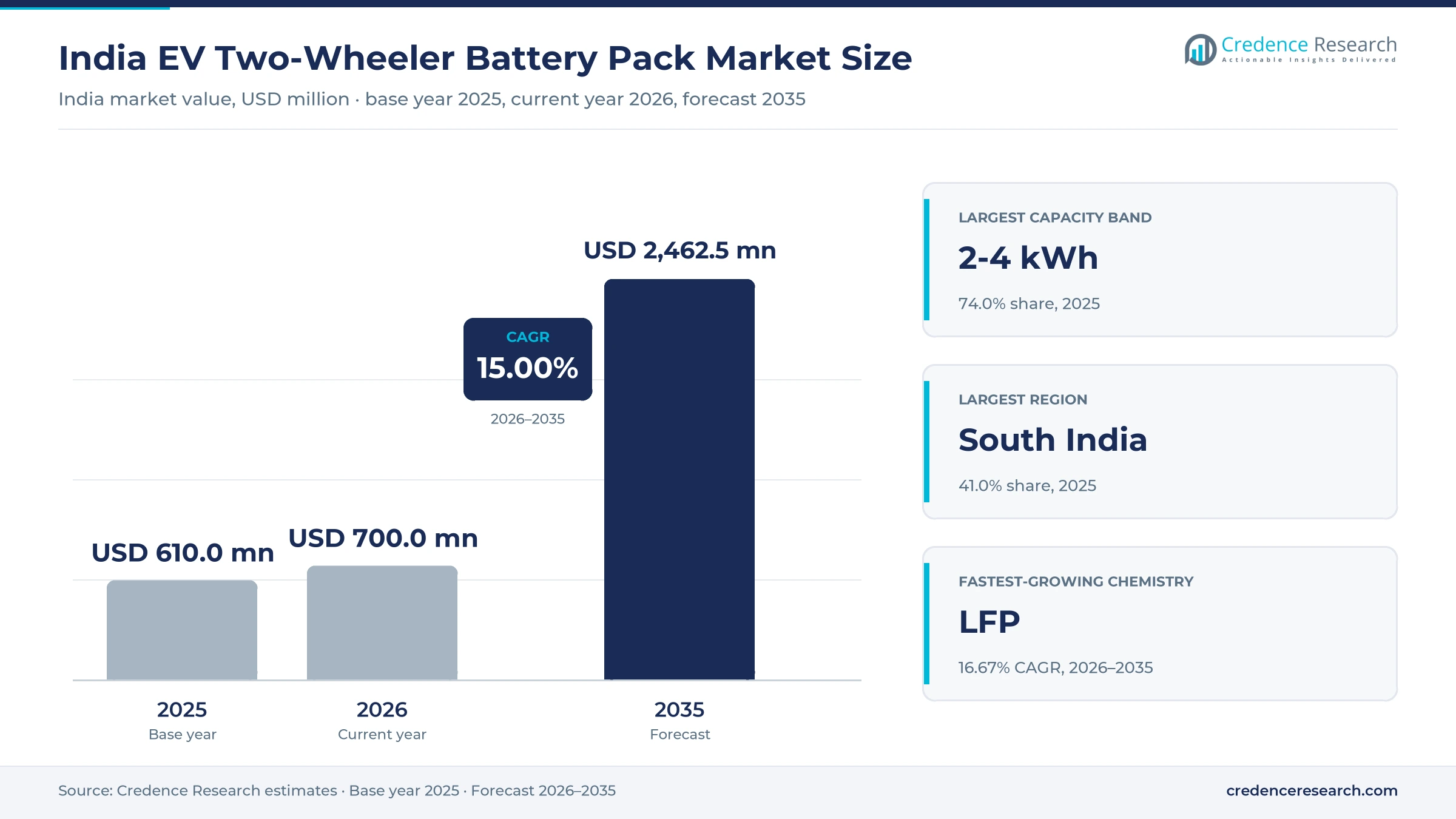
The India EV two-wheeler battery pack market was valued at USD 610.0 million in 2025 and is projected to increase from USD 700.0 million in 2026 to USD 2.46 billion by 2035, registering a CAGR of 15.00% during 2026–2035. Demand comes from electric scooter registrations, safer LFP chemistries and the first wave of out-of-warranty replacements, with TVS Motor, Bajaj Auto, Ather Energy and Hero MotoCorp now the largest buyers or builders of packs. South India held the largest regional share, 41.0% in 2025, because Karnataka and Kerala pair high penetration with nearby plants in Tamil Nadu. Northeast India is the fastest-growing region at 15.87% a year from a small base. The main commercial change is battery subscription, which removes pack cost from the sticker price and moves ownership of the asset to OEMs and their financiers.
What does the India EV two-wheeler battery pack market measure?
The market counts the value of assembled lithium-ion traction packs fitted to electric scooters, motorcycles and mopeds sold in India, plus replacement packs. Each pack includes cells, modules, the battery management system, thermal parts and the enclosure, whether an OEM assembles it or buys it from a supplier.
Lead-acid packs, low-speed models that need no registration, chargers and swapping station hardware sit outside the count. The value chain runs from imported cell materials through cell makers and pack assemblers to OEMs, service networks and recyclers.
India EV Two-Wheeler Battery Pack Market Insights
- The market rises from USD 610.0 million in 2025 to USD 2.46 billion by 2035 at a 15.00% CAGR, because scooter volume growth outweighs lower prices per kilowatt-hour.
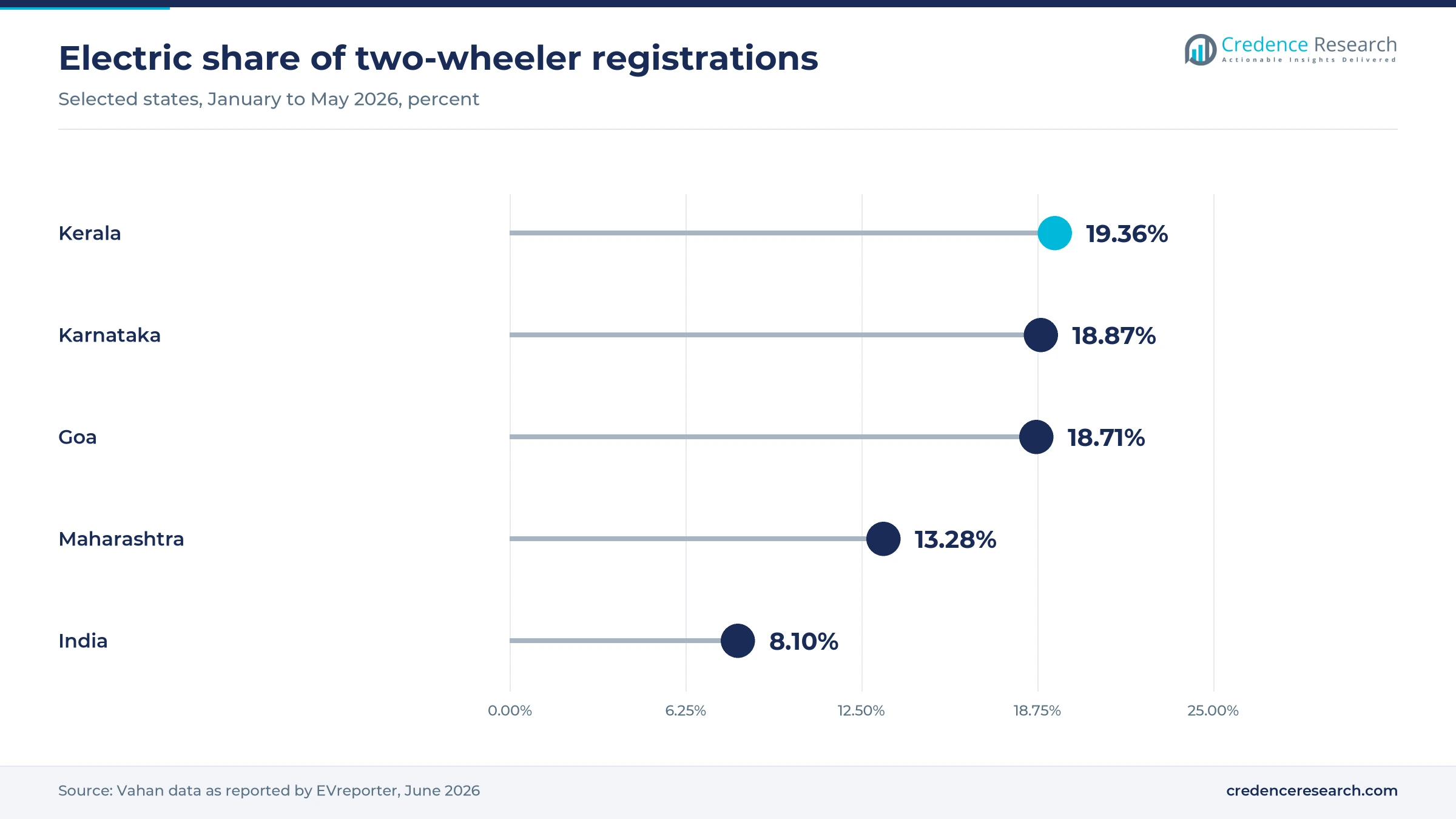
- South India held 41.0% of 2025 value, supported by Karnataka at 18.87% electric penetration and Kerala at 19.36% in Vahan data for early 2026.
- 2-4 kWh packs held 74.0% of 2025 value, the band that carries the volume TVS iQube, Bajaj Chetak, Ather Rizta and Hero Vida VX2 variants.
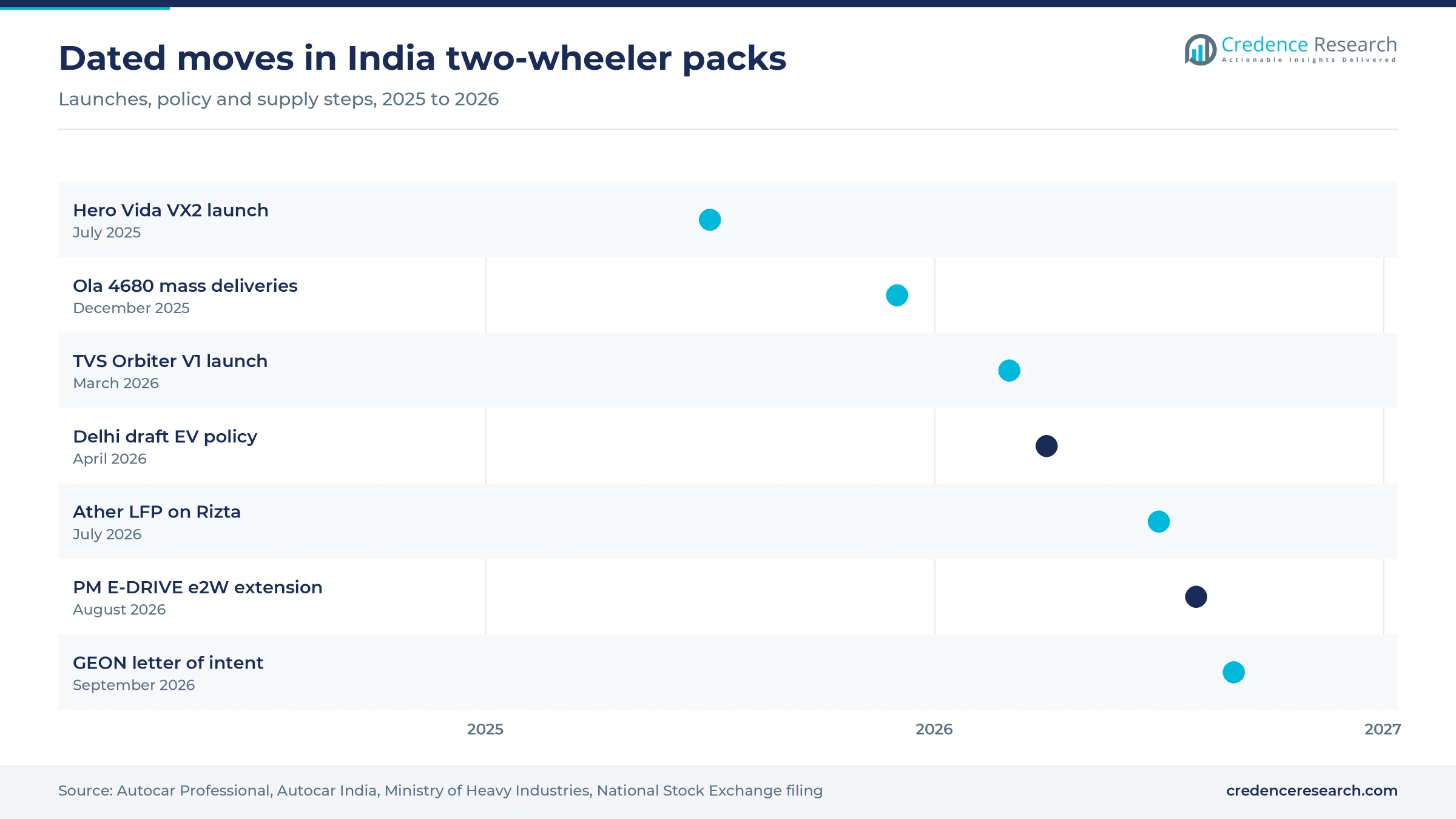
- Ather Energy added LFP cells to the Rizta on July 16, 2026, the clearest sign that mass-market scooters are moving away from NMC-only supply.
- Kabra Extrusiontechnik disclosed a letter of intent from a top-three two-wheeler maker on Sept. 2, 2026, showing that legacy OEMs still buy packs from outside suppliers.
NMC and mid-size packs anchor value as LFP gains share
Why NMC leads and LFP gains on mass-market scooters
Based on chemistry, the market is categorized into NMC and LFP. NMC led with 62.0% of 2025 value because its energy density suits higher-power scooters, and Ather Energy kept its 450 range on NMC in July 2026 for that reason, according to Autocar India. LFP grows fastest at 16.67% a year as the same update brought LFP cells to the family-oriented Rizta. Amara Raja management also expects LFP to reach about 75% to 80% of the market, according to Autocar Professional in May 2025, and it plans gigafactory capacity around that split.
Why mid-size packs carry the volume in Indian scooters
Based on capacity, the market is categorized into Under 2 kWh, 2-4 kWh and Above 4 kWh. The 2-4 kWh band led with 74.0% of 2025 value because volume models sit there, including the 3.0 kWh Bajaj Chetak 3001 launched in June 2025 and the 3.4 kWh Hero Vida VX2 Plus. Under 2 kWh grows fastest at 17.00% a year as TVS Motor launched the 1.8 kWh Orbiter V1 on March 12, 2026 at Rs 49,999 with battery subscription, according to Autocar Professional. At the top end, the TVS iQube ST carries 5.3 kWh and sold at Rs 172,000 in Bengaluru in May 2026.
Why OEM assembly leads while outside suppliers win new programs
Based on supply, the market is categorized into In-House OEM and Third-Party. In-House OEM led with 64.0% of 2025 value because large brands control assembly, as Ather Energy built its Hosur plant for 120,000 packs a year in 2021 and Ola Electric began mass deliveries of cells made in-house on Dec. 7, 2025, according to Autocar Professional. Third-Party grows fastest at 15.69% a year as the GEON brand of Kabra Extrusiontechnik received a letter of intent from a top-three two-wheeler maker on Sept. 2, 2026, according to its National Stock Exchange filing.
| Segment Group | Leading Sub-segment | Share, 2025 | Fastest-growing Sub-segment | CAGR, 2026–2035 |
|---|---|---|---|---|
| By Chemistry | NMC | 62.0% | LFP | 16.67% |
| By Capacity | 2-4 kWh | 74.0% | Under 2 kWh | 17.00% |
| By Supply | In-House OEM | 64.0% | Third-Party | 15.69% |
Request a Free Sample
Fill in your details and we'll send you a free sample report.
- Sample data tables & charts
- Research methodology
Registrations, LFP safety and aftersales lift pack demand
Electric two-wheeler sales expand assembled pack demand
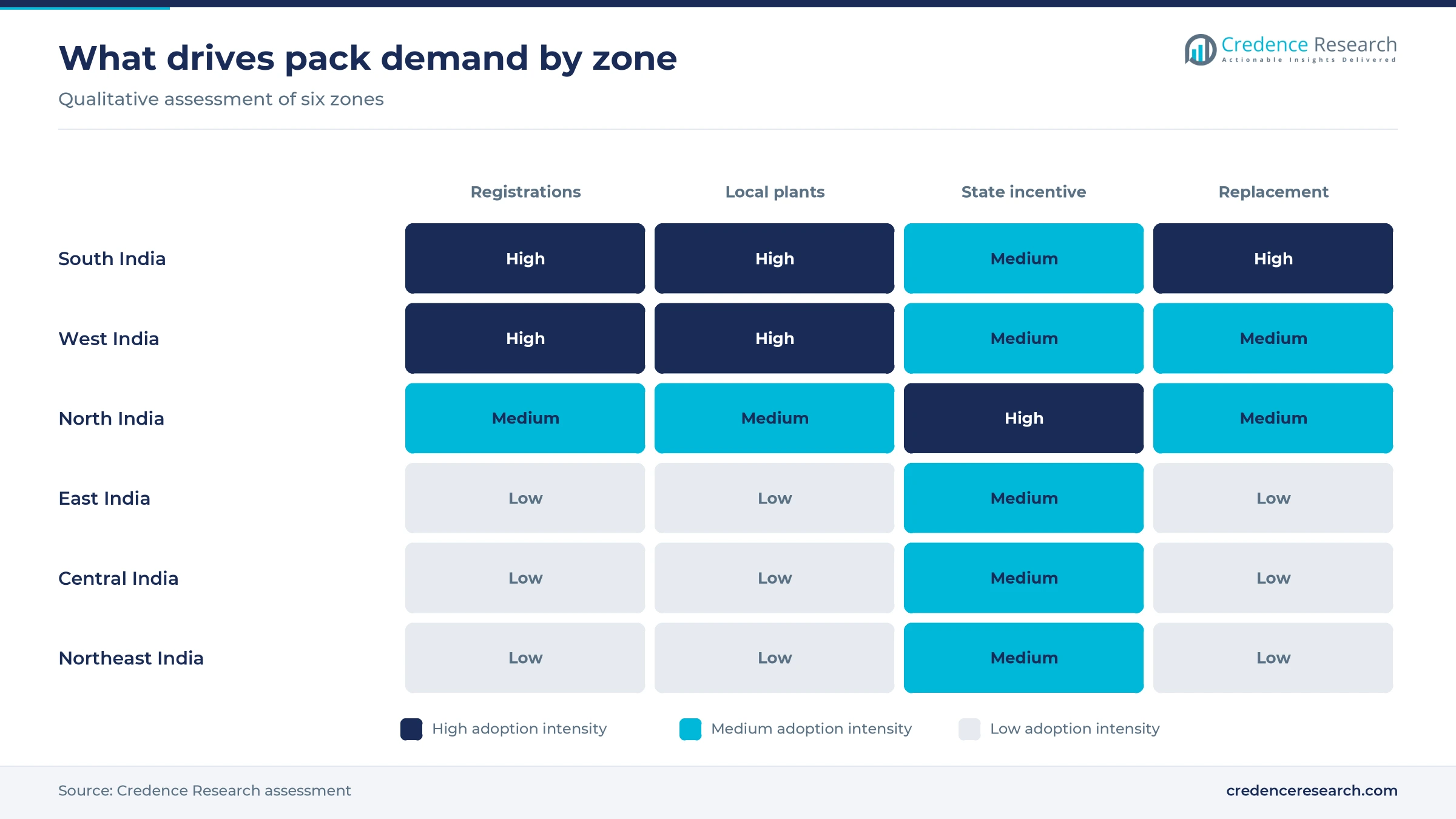
Every electric two-wheeler sold needs a traction pack, so registrations set the base of this market. Autocar Professional reported on April 1, 2026 that registrations rose 22% to 1.40 million units in fiscal 2026 and that penetration reached 6.5%, up from 5.8%. Momentum then strengthened, because January to August 2026 volume reached 1.36 million units, according to the same publisher, almost matching the whole previous fiscal year. EVFY reported 203,000 registrations in September 2026, up 85% from a year earlier. The International Energy Agency counted about 1.3 million electric two-wheelers in 2024 before this latest surge in registrations began. In the Credence Research model this adds about 6.30 percentage points to annual growth to 2035.
Safer LFP and better thermal design raise pack value
Safety rules and chemistry changes add content to each pack, which raises value even as cell prices move. The Ministry of Road Transport and Highways amended AIS-156 in two phases dated Dec. 1, 2022 and March 31, 2023, setting limits on pack design and thermal propagation, according to Mobility Outlook. Ather Energy then added a 2.7 kWh LFP pack on the Rizta on July 16, 2026. Trontek told Mobility Outlook in May 2023 that its sales mix had already swung from mostly NMC to about four-fifths LFP. Cell makers are planning for lithium iron phosphate too, since Amara Raja is allocating gigafactory capacity around its expected majority. In the Credence Research model this adds about 4.05 percentage points to annual growth to 2035.
Replacement and aftersales networks open second-cycle demand
The earliest high-speed scooters are aging out of their first warranties, so a replacement cycle for battery packs is starting. EVFY estimated in March 2026 that replacement packs cost Rs 45,000 to Rs 120,000, or roughly Rs 19,000 to Rs 25,000 per kWh across listed models. Ather Energy offers an eight-year or 80,000 km warranty that guarantees 70% battery health for Rs 4,999 extra, according to Autocar India in November 2024, and it planned 700 experience centers by the end of fiscal 2026. This replacement work adds a new high-value line to the wider automotive aftermarket over time. In the Credence Research model this adds about 2.55 percentage points to annual growth to 2035.
Central and state incentives still support pack demand
Central incentives are paid per kilowatt-hour, so national policy supports both volume and pack size. A Ministry of Heavy Industries notification extended PM E-DRIVE support for electric two-wheelers to March 31, 2028, at Rs 2,500 per kWh with a Rs 5,000 cap, according to Autocar Professional on Aug. 11, 2026. The same notification raised the two-wheeler allocation to Rs 2,767 crore and covers up to 4,579,120 vehicles. Delhi notified its EV Policy 2026 with effect from July 1, 2026, offering up to Rs 30,000 per electric two-wheeler in its first year and registering only electric two-wheelers from April 1, 2028, according to EV Infrastructure News. Odisha proposed Rs 5,000 per kWh in September 2025, capped at Rs 30,000, according to Angel One.
Subscriptions and smaller packs reshape pack economics
Shift to battery subscription moves pack ownership away from riders
Battery subscription separates pack cost from the scooter price, which changes who buys and finances the asset. Hero MotoCorp launched the Vida VX2 on July 1, 2025 at Rs 59,490 with a pay-per-kilometer plan starting at Rs 0.96, plus a free replacement if performance falls under the plan threshold, according to Autocar Professional. TVS Motor followed on March 12, 2026 with the Orbiter V1 at Rs 49,999, against Rs 84,500 without subscription, and monthly plans from Rs 862 across its electric range. As a result, the gap implies a pack value near Rs 34,500 on a 1.8 kWh model. OEMs that keep pack ownership therefore gain a stronger reason to manage health and second-life value themselves.
Rise of smaller packs with the same claimed range
Better cells let OEMs cut capacity without cutting claimed range, which lowers the kilowatt-hours sold per scooter. Ather Energy reduced its large pack from 3.7 kWh to 3.5 kWh in July 2026 while the 450 kept a claimed 161 km and the Rizta rose to 161 km from 159 km, according to Autocar India. The same update added a 900-watt portable charger that cut claimed charging time by more than an hour on large packs. TVS Motor now sells the iQube at 2.2 kWh, 3.1 kWh and 3.5 kWh, according to Autocar India in May 2026. This spread shows buyers paying for usable range rather than installed capacity, so pack makers compete on efficiency.
Opportunity for pack makers to pair with Indian cell plants
Domestic cell lines create an opening for pack makers that qualify local cells early, because imported cells carry price and licensing risk. Amara Raja plans 4 GWh of cylindrical cells initially and 16 GWh by the end of the decade in Telangana, with operations shifted to the second or third quarter of fiscal 2027, according to Autocar Professional. Exide Energy Solutions is building a 12 GWh plant in two 6 GWh phases and expected cylindrical samples by the first quarter of fiscal 2027, according to the same publisher in May 2026. Ather Energy has already partnered with Amara Raja on NMC and LFP cells, according to GreenTechLead in March 2026, while local cathode and anode materials remain the longer gap.
Opportunity in collection and recycling as producer targets begin
Producer responsibility targets turn end-of-life packs into a managed material stream, which opens a service line for pack makers and recyclers. Under the Battery Waste Management Rules, producers must collect 70% of the EV battery quantity placed on the market in fiscal 2023 during fiscal 2027, according to MeraEV in July 2026. Recyclers face a 90% material recovery target from fiscal 2027, and new batteries must contain at least 5% domestically recycled material from fiscal 2028, rising to 20% from fiscal 2031. The government also launched a Rs 1,500 crore recycling incentive on Oct. 2, 2025, according to the Ministry of Heavy Industries. Pack designs that ease disassembly therefore gain a commercial advantage.
Cell costs and import reliance squeeze pack makers
Cell inflation compresses pack and scooter margins
Rising cell prices hit pack makers directly, because cells form the largest share of pack cost. Angel One reported on May 13, 2026, citing the Economic Times, that lithium-ion cell costs had risen roughly 30% to 50% and lithium had moved from nearly USD 8 to about USD 24 per kg. Ather Energy had already taken blended price rises of nearly Rs 4,000 this year. Suppliers without pass-through clauses carry this risk first, so indexed contracts and LFP sourcing are the main defenses.
Full import reliance leaves the chain exposed to licensing
Lithium supply remains the weakest link, and pack makers cannot yet hedge it locally. The Ministry of Heavy Industries told the Lok Sabha on March 17, 2026 that the entire current demand is met through imports, which makes the sector sensitive to external shocks. It also said China plans licensing for cathode materials and artificial-graphite anodes, which could raise component prices in the near term. Smaller assemblers with thin inventories face the greatest risk, while the National Critical Mineral Mission approved on Jan. 29, 2025 offers relief only over time.
Safety failures carry recall and warranty costs
A single thermal failure can damage a brand and force costly checks across a whole batch of scooters. Ola Electric recalled 1,441 vehicles in April 2022 for battery, thermal and safety inspection after a fire in Pune on March 26, according to Outlook Business. Longer cover raises this exposure, because Ather Energy now offers eight years on the pack. Suppliers therefore carry more testing cost and warranty risk per unit, and stronger traceability and cell-level monitoring are the usual responses from pack makers.
Lower incentives and shifting OEM share unsettle suppliers
Support per vehicle has halved, and supplier volumes depend on a changing group of OEM customers. PM E-DRIVE fell from Rs 5,000 per kWh in fiscal 2025 to Rs 2,500 per kWh, and payouts stop if funds run out before March 31, 2028, according to Autocar Professional. Ola Electric also fell from a 29.2% share to 11.7% of registrations in fiscal 2026, while TVS Motor rose to 24.3%. A supplier tied to one OEM therefore carries high concentration risk, so diversified order books matter.
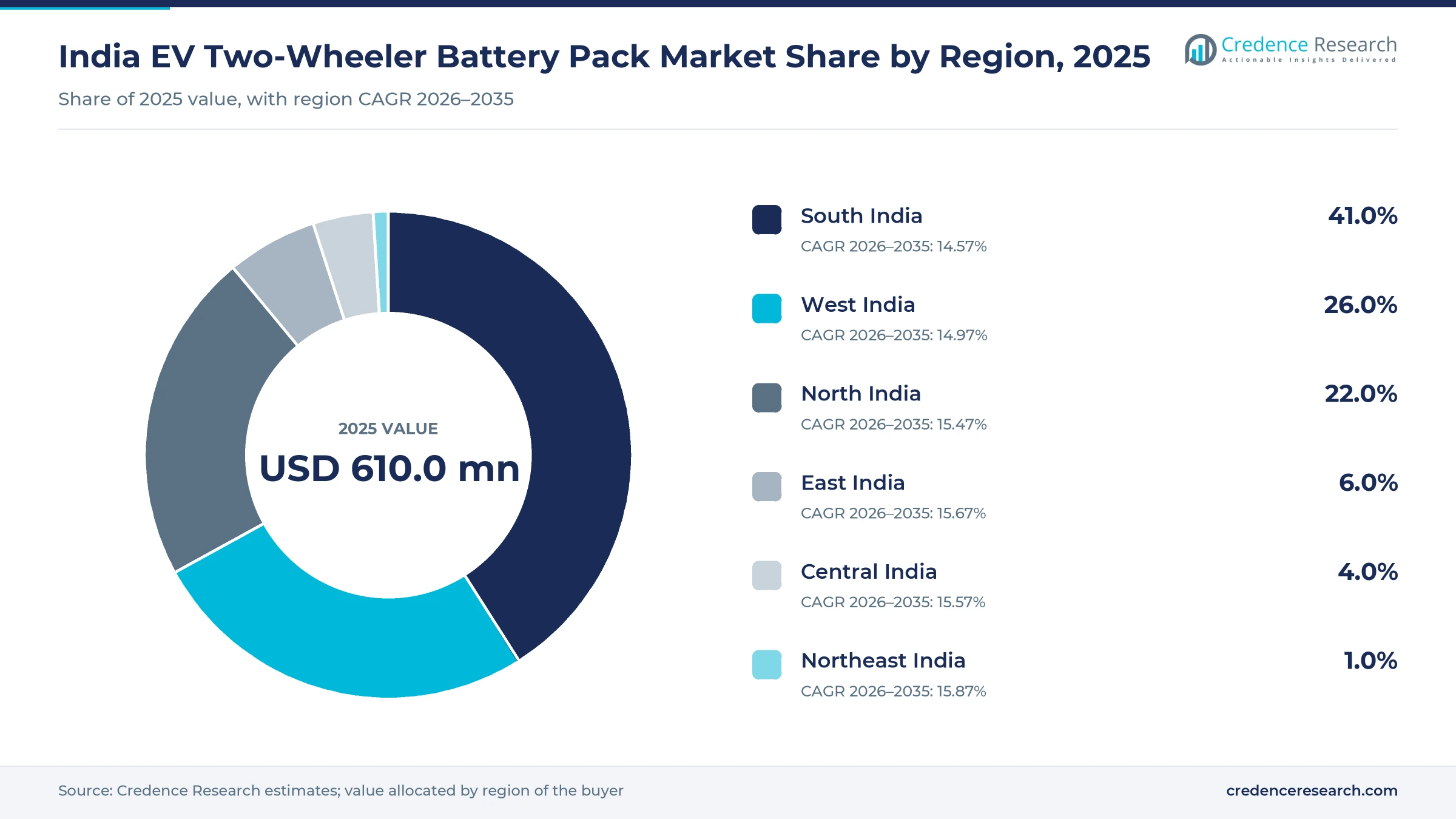
South India leads as western states add new capacity
| Region | Value, 2025 (USD million) | Share, 2025 | CAGR, 2026–2035 |
|---|---|---|---|
| South India | 250.1 | 41.0% | 14.57% |
| West India | 158.6 | 26.0% | 14.97% |
| North India | 134.2 | 22.0% | 15.47% |
| East India | 36.6 | 6.0% | 15.67% |
| Central India | 24.4 | 4.0% | 15.57% |
| Northeast India | 6.1 | 1.0% | 15.87% |
South India leads on penetration and plants
South India held 41.0% of 2025 value and grows at 14.57% a year, the slowest rate because its penetration is already high. Vahan data for January to May 2026 show southern states at 39.4% of electric two-wheeler sales, with Kerala at 19.36% and Karnataka at 18.87% penetration. Supply sits close to this demand, since Ather Energy assembles at Hosur and Ola Electric builds at its Tamil Nadu Futurefactory. Exicom also opened a Rs 216 crore Hyderabad plant on March 16, 2026 that includes lithium-ion battery systems.
West India rests on the largest state market and new capacity
West India held 26.0% of 2025 value and grows at 14.97% a year, supported by the largest state market. Maharashtra registered 177,736 electric two-wheelers from January to May 2026, the highest state demand in India, at 13.28% penetration, and Goa reached 18.71%, according to EVreporter. New capacity follows, because Ather Energy expected Factory 3.0 at Chhatrapati Sambhajinagar, designed for 1.42 million vehicles a year, to begin operations in October 2026, according to GreenTechLead. Kabra Extrusiontechnik, the parent of Battrixx, also runs two facilities in Daman on the western coast.
North India gains from Delhi policy and Haryana assemblers
North India held 22.0% of 2025 value and grows at 15.47% a year, because policy in the capital could lift volumes sharply. Delhi's EV Policy 2026, in force since July 1, 2026, registers only electric two-wheelers from April 1, 2028, and it pays up to Rs 30,000 on models priced below Rs 2.25 lakh in its first year, according to Outlook India. Local supply also exists in this zone, as Trontek operated two Kundli plants in Haryana with 0.6 GWh of capacity in May 2023, according to Mobility Outlook.
East India watches a richer state draft incentive
East India held 6.0% of 2025 value and grows at 15.67% a year, with state policy the main swing factor. Odisha is the clearest policy signal, because its draft Electric Vehicle Policy of September 2025 proposed Rs 5,000 per kWh, capped at Rs 30,000, against Rs 20,000 earlier, according to Angel One. This design pays more on larger packs, up to 6 kWh, which would favor models above 4 kWh if the draft is adopted. The policy remained a draft awaiting stakeholder feedback when Angel One reported it.
Central India builds from a subsidized fleet
Central India held 4.0% of 2025 value and grows at 15.57% a year as central support reaches the state fleet. Madhya Pradesh recorded 88,209 electric vehicles subsidized under PM E-DRIVE in fiscal 2026 and 94,277 deployed in total, according to ANI in August 2026, citing the Ministry of Heavy Industries. These totals cover all eligible vehicle types, and the report gave no separate two-wheeler count, so this zone rests more heavily on estimates than the larger zones do.
Northeast India grows fastest from a very small base
Northeast India held 1.0% of 2025 value and grows fastest at 15.87% a year, although charging limits still shape pack choice. Assam offers subsidies of up to Rs 20,000 for electric two-wheelers under its 2021 policy, and the region holds about 1% of national charging infrastructure, according to Down To Earth in July 2026. A Plus Charge runs only 63 to 64 stations across Assam, Meghalaya and Tripura, so pack sellers here work with a thin support network.
OEMs and suppliers moved on cells and chemistry in 2026
| Development | Status and market relevance |
|---|---|
| In March 2026, TVS Motor launched the Orbiter V1 with a 1.8 kWh battery and a subscription plan from Rs 862 a month. | On sale; opens the sub-2 kWh band |
| In July 2026, Ather Energy added a 2.7 kWh LFP pack to the Rizta and cut its large pack to 3.5 kWh. | In production; cell type depends on supply |
| In August 2026, the Ministry of Heavy Industries extended PM E-DRIVE electric two-wheeler incentives to March 31, 2028. | Notified; Rs 2,500 per kWh, capped at Rs 5,000 |
| In September 2026, Kabra Extrusiontechnik received a letter of intent for two types of two-wheeler battery programs under its GEON brand. | Development and supply stage; volume not disclosed |
| In October 2026, Trontek reported 3 GWh of active capacity and a target of 12 GWh by 2028. | Announced before The Battery Show India 2026 |
Chemistry, cell format and charging define pack design
- Cell chemistry splits by duty, as Ather Energy keeps NMC on the higher-power 450 range and uses LFP or NMC on the Rizta depending on cell supply.
- Cell format is moving toward larger cylindrical cells, with the Ola S1 Pro+ using 4680 cells in a 5.2 kWh pack and Ather Energy researching 4695 cells.
- Removable packs separate charging from parking, and both Hero Vida VX2 variants use them, with 33.2 liters of boot space on the VX2 Go once removed.
- Pack electronics are tightening under AIS-156, and management systems now monitor thermal events and support subscription plans through remote health data on models such as the Orbiter V1.
Need a Custom Version of This Report?
Tailor the scope, geography, or segments to your exact requirements.
- Custom geography or segment scope
- Direct access to our analyst team
Scooter OEMs hold assembly as suppliers court legacy brands
Competition centers on who controls the battery pack, and the answer differs by brand. Ola Electric has the most integrated position, since Autocar Professional describes it as the first Indian company to control both cell and pack manufacturing internally. Ather Energy assembles packs and sources local cells through Amara Raja, while TVS Motor offers the widest capacity range, from 1.8 kWh to 5.3 kWh. Suppliers such as Trontek and Battrixx compete for programs that OEMs do not build themselves, and they sell on delivery speed, certification and chemistry choice. Share shifted sharply in fiscal 2026, when TVS Motor reached 24.3% of registrations and Bajaj Auto 20.6%, while Ola Electric fell to 11.7%. Hero MotoCorp also almost tripled its fiscal 2026 volume to 144,099 units. Because the electric scooters sold by these brands now set pack specifications, suppliers depend on winning platform decisions early.
Companies profiled and their roles in this market
| Company | Type | Role in the market |
|---|---|---|
| Ola Electric | Integrated OEM | Began mass deliveries of 4680 cells in a 5.2 kWh S1 Pro+ pack in December 2025 |
| Ather Energy | OEM and pack assembler | Added LFP on the Rizta in July 2026; building Factory 3.0 in Maharashtra |
| TVS Motor | OEM | Sells iQube and Orbiter from 1.8 kWh to 5.3 kWh; led fiscal 2026 registrations |
| Bajaj Auto | OEM | Sold 288,866 electric two-wheelers in fiscal 2026; Chetak 3001 uses 3.0 kWh |
| Hero MotoCorp | OEM | Vida VX2 uses removable 2.2 kWh and 3.4 kWh packs with subscription |
| Trontek | Third-party pack maker | Sold 150,000 e2W batteries in fiscal 2023; reports 3 GWh of active capacity |
| Battrixx | Third-party pack maker | Unit of Kabra Extrusiontechnik; announced a 0.75 GWh North India plant in February 2023 |
| Amara Raja | Cell supplier | Partner to Ather Energy; 4 GWh initial cell capacity planned in Telangana |
Chemistry choice will decide who keeps pack margin
Credence Research's view is that the market's value depends less on unit growth than on who keeps margin as chemistry shifts. Registrations are already strong, with 1.36 million units in the first eight months of 2026. However, lower capacity per scooter and LFP pricing will pull value per pack down, so assemblers need service income, recycling compliance and local cell contracts to protect returns. Battery subscription is the variable to watch closely, because it moves replacement risk onto OEMs and financiers. Suppliers that can prove battery pack health data will hold the stronger position in those negotiations.
Model values with estimates built from public sources
The report uses 2025 as the base year and 2035 as the forecast year, with market values from the Credence Research model. Regional and segment splits are Credence Research estimates, informed by Vahan registrations, model capacities, company disclosures and government documents. Sources include the Ministry of Heavy Industries, the International Energy Agency, stock exchange filings and named trade publications. No interviews or surveys were conducted for this edition, and all dated facts come from pages opened during research.
LFP and local cells shape the pack market to 2035
The market is expected to reach USD 2.46 billion by 2035, growing at a 15.00% CAGR from USD 700.0 million in 2026. Volume should remain the main force, while lower prices per kilowatt-hour and smaller packs limit value growth. LFP should narrow the gap with NMC as Telangana and other domestic cell plants start, and replacement sales should grow as fiscal 2026 scooters age. Policy timing matters most in the early years, since PM E-DRIVE support ends on March 31, 2028, the same year Delhi's electric-only rule for new two-wheelers begins.
Frequently Asked Questions
How big is the India EV two-wheeler battery pack market?
Which chemistry leads the market?
Which capacity band is the largest?
Which region leads demand?
What is the main growth driver?
How does battery subscription affect pack demand?
What are the main risks for pack makers?
How much does a replacement pack cost in India?
Table of Content
Chapter 1 Market Segmentation
- 1.1 Segmentation Framework
- 1.1.1 Product and Service Classification
- 1.1.2 Application and End-Use Classification
- 1.1.3 Technology and Solution Classification
- 1.1.4 Customer and Distribution Channel Classification
- 1.1.5 Geographic Segmentation
- 1.1.6 Market Segment Definitions and Boundaries
- 1.2 By Chemistry
- 1.2.1 NMC
- 1.2.2 LFP
- 1.3 By Capacity
- 1.3.1 2-4 kWh
- 1.3.2 Above 4 kWh
- 1.3.3 Under 2 kWh
- 1.4 By Supply
- 1.4.1 In-House OEM
- 1.4.2 Third-Party
Chapter 2 Introduction
- 2.1 Report Objectives and Scope
- 2.2 Product Definition and Industry Terminology
- 2.3 Market Inclusions and Exclusions
- 2.4 Research Process
- 2.4.1 Primary Research and Expert Interviews
- 2.4.2 Secondary Research and Source Review
- 2.4.3 Top-Down and Bottom-Up Estimation
- 2.4.4 Data Triangulation and Verification
- 2.5 Market Size Measurement Basis
- 2.5.1 2025: USD 610.0 million → 2035: USD 2.46 billion
- 2.6 Historical and Forecast Reference Periods
- 2.6.1 Historical Period: 2018-2025
- 2.6.2 Base Year: 2025
- 2.6.3 Forecast Period: 2025-2035
- 2.7 Research Assumptions and Limitations
Chapter 3 Executive Summary
- 3.1 Market Snapshot and Key Findings
- 3.2 Base-Year Market Size, 2025
- 3.3 Forecast Market Size, 2035
- 3.4 Revenue and Volume Growth Outlook
- 3.5 Key Demand and Supply Indicators
- 3.6 Leading Market Segments
- 3.7 Fastest-Growing Market Opportunities
- 3.8 Regional Performance Highlights
- 3.9 Technology and Industry Transformation
- 3.10 Competitive Landscape Summary
- 3.11 Analyst View and Strategic Implications
Chapter 4 India EV Two-Wheeler Battery Pack Market Trends and Developments
- 4.1 Historical Industry Development, 2018-2025
- 4.2 Recent Market Trends and Developments
- 4.3 Demand and Customer Behavior Trends
- 4.4 Technology and Product Innovation
- 4.5 Artificial Intelligence, Automation and Digitalization
- 4.6 Local Manufacturing and Supply Chain Realignment
- 4.7 Industry Partnerships, Mergers and Acquisitions
- 4.8 Sustainability and Circular Economy Developments
- 4.9 Government and Private Sector Investment Trends
- 4.10 Emerging Business Models and Commercialization
- 4.11 Industry Developments and Announcements
Chapter 5 India EV Two-Wheeler Battery Pack Market Production, Supply and Demand Analysis
- 5.1 Demand Trend and Consumption Analysis, 2018-2025
- 5.2 Demand Forecast, 2025-2035
- 5.3 Production and Output Trend, 2018-2025
- 5.4 Production and Output Forecast, 2025-2035
- 5.5 Installed Capacity and Capacity Utilization
- 5.6 Company-Wise Production Plants and Statistics
- 5.6.1 Installed Production Capacity
- 5.6.2 Actual Production
- 5.6.3 Planned Capacity and Expansion Targets
- 5.7 Supply Chain Structure and Procurement Trends
- 5.8 Supply-Demand Gap and Bottlenecks
- 5.9 Import Dependence and Sourcing Structure
- 5.10 Contract Manufacturing and Outsourcing
- 5.11 Regional Supply and Demand Concentration
Chapter 6 India EV Two-Wheeler Battery Pack Market Pricing Analysis
- 6.1 Pricing Structure and Measurement
- 6.2 Historical Pricing Trends, 2018-2025
- 6.3 Pricing Outlook, 2025-2035
- 6.4 Average Selling Price and Unit Economics
- 6.5 Pricing by Product and Market Segment
- 6.6 Geographic Pricing Differences
- 6.7 Key Input, Energy, Labor and Logistics Costs
- 6.8 Contract Pricing and Purchasing Models
- 6.9 Pricing Sensitivity and Competitive Positioning
- 6.10 Price, Margin and Profitability Implications
Chapter 7 India EV Two-Wheeler Battery Pack Market Dynamics
- 7.1 Market Growth Drivers
- 7.1.1 Demand-Side Drivers
- 7.1.2 Technology and Innovation Drivers
- 7.1.3 Infrastructure and Investment Drivers
- 7.1.4 Regulatory and Policy Drivers
- 7.2 Market Restraints
- 7.2.1 Cost and Affordability Constraints
- 7.2.2 Technology and Adoption Barriers
- 7.2.3 Supply Chain and Operational Constraints
- 7.3 Market Challenges
- 7.3.1 Competitive Pressure and Margin Erosion
- 7.3.2 Skills, Infrastructure and Implementation Gaps
- 7.4 Emerging Market Opportunities
- 7.5 Market Dynamics Impact and Time-Horizon Assessment
Chapter 8 India EV Two-Wheeler Battery Pack Value Chain Analysis
- 8.1 Industry Value Chain Overview
- 8.2 Upstream Suppliers and Critical Inputs
- 8.3 Technology and Component Providers
- 8.4 Manufacturing or Service Delivery
- 8.5 Distribution, Channel Partners and Integrators
- 8.6 Downstream Applications and End Users
- 8.7 Value Addition and Profit Pools
- 8.8 Vertical Integration and Outsourcing
- 8.9 Supplier Concentration and Risk
- 8.10 Supply Chain Localization and Resilience
Chapter 9 India EV Two-Wheeler Battery Pack Market Regulations and Policies
- 9.1 Relevant Laws, Standards and Compliance Frameworks
- 9.2 Product, Service, Safety and Quality Requirements
- 9.3 Government Policies, Incentives and Subsidies
- 9.4 Imports, Exports and Trade Barriers
- 9.5 Public Procurement and Local Content Requirements
- 9.6 Environmental and Sustainability Compliance
- 9.7 Upcoming Policy Changes and Market Implications
Chapter 10 India EV Two-Wheeler Battery Pack Market Hotspots and Opportunities
- 10.1 Market Opportunity Mapping and Growth Hotspots
- 10.2 High-Growth Applications and Customer Groups
- 10.3 Underserved Markets and White-Space Opportunities
- 10.4 Emerging Technology and Product Opportunities
- 10.5 New Capacity and Investment Hotspots
- 10.6 Market Entry and Expansion Opportunities
- 10.7 Distribution and Partnership Opportunities
- 10.8 Near-Term and Long-Term Commercial Potential
- 10.9 Opportunity Attractiveness and Execution Risks
Chapter 11 India EV Two-Wheeler Battery Pack Market Outlook, 2025-2035
- 11.1 Market Size and Analysis
- 11.1.1 Revenue (Market Measurement: 2025: USD 610.0 million → 2035: USD 2.46 billion)
- 11.1.2 Market Volume and Quantity Sold
- 11.1.3 Historical Market Size, 2018-2025
- 11.1.4 Base-Year Market Size, 2025
- 11.2 Market Forecast, 2025-2035
- 11.2.1 Revenue Forecast to 2035
- 11.2.2 Volume Forecast to 2035
- 11.2.3 CAGR and Year-on-Year Growth
- 11.2.4 Incremental Revenue Opportunity
- 11.3 Forecast Assumptions and Scenario Analysis
- 11.3.1 Base-Case Forecast
- 11.3.2 Optimistic and Conservative Scenarios
- 11.3.3 Technology, Pricing and Policy Sensitivities
- 11.4 Market Attractiveness and Growth Outlook
Chapter 12 India EV Two-Wheeler Battery Pack Market Segmentation and Outlook
- 12.1 Segmentation Summary and Market Shares, 2025
- 12.2 Largest and Fastest-Growing Segments
- 12.3 By Chemistry - Market Size and Forecast, 2025-2035
- 12.3.1 Segment Definition and Scope
- 12.3.2 Historical Market Size, 2018-2025
- 12.3.3 Revenue Forecast, 2025-2035
- 12.3.4 Volume Forecast, 2025-2035
- 12.3.5 Base-Year Market Share, 2025
- 12.3.6 Segment CAGR and Growth Drivers
- 12.3.7 Subsegment Market Size and Forecast
- 12.3.7.1 NMC
- 12.3.7.2 LFP
- 12.3.8 Subsegment Pricing and Adoption Trends
- 12.3.9 Leading Suppliers and Competition
- 12.3.10 Regional Demand and Opportunities
- 12.4 By Capacity - Market Size and Forecast, 2025-2035
- 12.4.1 Segment Definition and Scope
- 12.4.2 Historical Market Size, 2018-2025
- 12.4.3 Revenue Forecast, 2025-2035
- 12.4.4 Volume Forecast, 2025-2035
- 12.4.5 Base-Year Market Share, 2025
- 12.4.6 Segment CAGR and Growth Drivers
- 12.4.7 Subsegment Market Size and Forecast
- 12.4.7.1 2-4 kWh
- 12.4.7.2 Above 4 kWh
- 12.4.7.3 Under 2 kWh
- 12.4.8 Subsegment Pricing and Adoption Trends
- 12.4.9 Leading Suppliers and Competition
- 12.4.10 Regional Demand and Opportunities
- 12.5 By Supply - Market Size and Forecast, 2025-2035
- 12.5.1 Segment Definition and Scope
- 12.5.2 Historical Market Size, 2018-2025
- 12.5.3 Revenue Forecast, 2025-2035
- 12.5.4 Volume Forecast, 2025-2035
- 12.5.5 Base-Year Market Share, 2025
- 12.5.6 Segment CAGR and Growth Drivers
- 12.5.7 Subsegment Market Size and Forecast
- 12.5.7.1 In-House OEM
- 12.5.7.2 Third-Party
- 12.5.8 Subsegment Pricing and Adoption Trends
- 12.5.9 Leading Suppliers and Competition
- 12.5.10 Regional Demand and Opportunities
- 12.6 Segment Growth Comparison
- 12.7 Segment Attractiveness and Priority Matrix
Chapter 13 India EV Two-Wheeler Battery Pack Geographic Market Outlook, 2025-2035
- 13.1 Domestic Market Distribution and Demand Clusters
- 13.2 State- or Province-Wise Market Size and Forecast, 2025-2035
- 13.3 City and Metropolitan Market Outlook
- 13.4 Industrial, Manufacturing and Commercial Clusters
- 13.5 Geographic Concentration of Key End Users
- 13.6 Local Pricing and Purchasing Differences
- 13.7 Domestic Production Facilities and Capacity Map
- 13.8 Local Infrastructure and Project Pipeline
- 13.9 State-Level Policy and Incentive Differences
- 13.10 Subnational Investment Hotspots and Opportunities
- 13.11 Distribution and Logistics Networks
- 13.12 Domestic Competitive Footprint
Chapter 14 India EV Two-Wheeler Battery Pack Technology, Innovation and Sustainability Outlook
- 14.1 Technology Landscape and Maturity
- 14.2 Product, Process and Service Innovation
- 14.3 AI, Automation and Digital Tools in the Industry
- 14.4 Technology Adoption and Performance Benchmarking
- 14.5 Innovation Pipeline and R&D Investment
- 14.6 Patent and Intellectual Property Trends
- 14.7 Energy Efficiency and Resource Management
- 14.8 Sustainability, Recycling and Circularity
- 14.9 Technology Roadmap, 2025-2035
- 14.10 Risks of Obsolescence and Technology Substitution
Chapter 15 India EV Two-Wheeler Battery Pack Market Key Strategic Imperatives
- 15.1 Growth and Market Entry Priorities
- 15.2 High-Return Products and Segments
- 15.3 Pricing, Profitability and Cost Optimization
- 15.4 Technology Investment and Product Differentiation
- 15.5 Supply Chain Localization and Resilience
- 15.6 Distribution and Customer Acquisition
- 15.7 Partnership, Acquisition and Capacity Strategy
- 15.8 Regional Expansion Priorities
- 15.9 Short-, Medium- and Long-Term Actions
Chapter 16 Competition Outlook
- 16.1 Industry Competition Characteristics
- 16.2 Market Structure and Concentration
- 16.3 Market Share and Competitive Positioning, 2025
- 16.4 Company-Wise Revenue and Product Benchmarking
- 16.5 Production and Service Capacity Benchmarking
- 16.6 Technology, Pricing and Differentiation
- 16.7 Regional Footprint and Distribution Strength
- 16.8 Mergers, Acquisitions and Strategic Alliances
- 16.9 New Entrants and Competitive Threats
- 16.10 Porter's Five Forces and Industry Attractiveness
- 16.11 Competitive Outlook, 2025-2035
Chapter 17 Company Profiles
- 17.1 Company Coverage and Selection Criteria
- 17.2 Ola Electric
- 17.2.1 Business Description
- 17.2.2 Company Ownership and Geographic Presence
- 17.2.3 Product and Service Portfolio
- 17.2.4 Manufacturing and Operating Footprint
- 17.2.5 Production Capacity and Expansion Plans
- 17.2.6 Financial Performance and Investment
- 17.2.7 Market Share and Competitive Position
- 17.2.8 Technology and Innovation Capabilities
- 17.2.9 Strategic Alliances or Partnerships
- 17.2.10 Recent Developments
- 17.2.11 Growth Strategy and Outlook
- 17.3 Ather Energy
- 17.4 TVS Motor
- 17.5 Trontek
- 17.6 Battrixx
- 17.7 Amara Raja
- 17.8 Bajaj Auto
- 17.9 Hero MotoCorp
- 17.10 Other Relevant Market Participants
Note: Every listed company is profiled on the structure shown under the first company. The company list is preliminary and may change based on research findings, market developments, data availability and client requirements.
Chapter 18 Disclaimer
- 18.1 Research and Forecast Disclaimer
- 18.2 Data Source and Estimation Limitations
Note: The depth of individual sections depends on data availability for this market. Volume, capacity, trade and other unit-based metrics are included where applicable.

