
Market Overview:
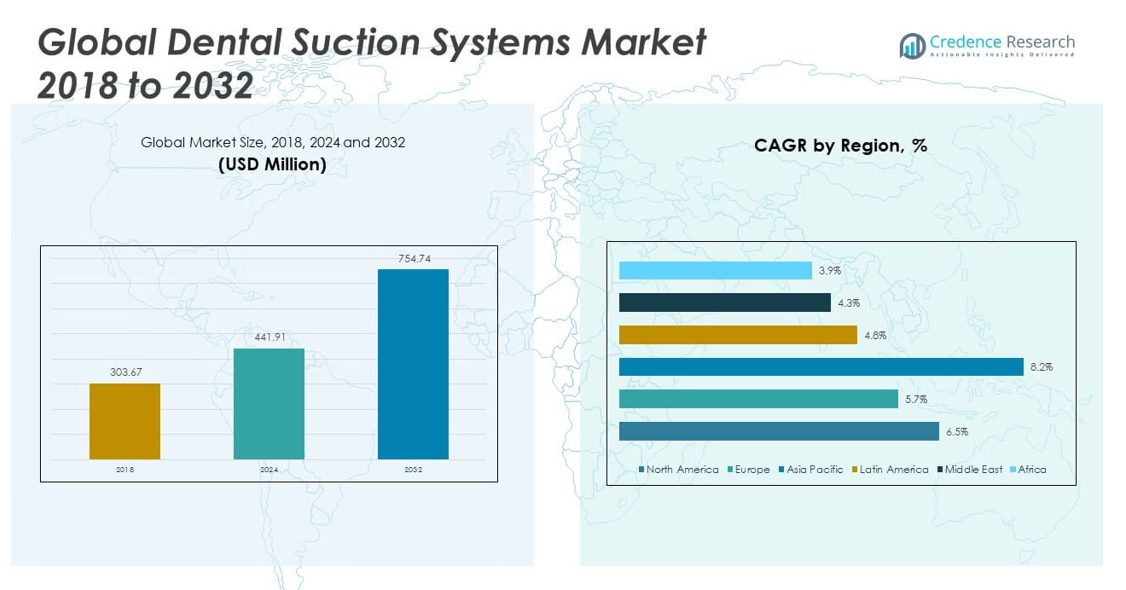
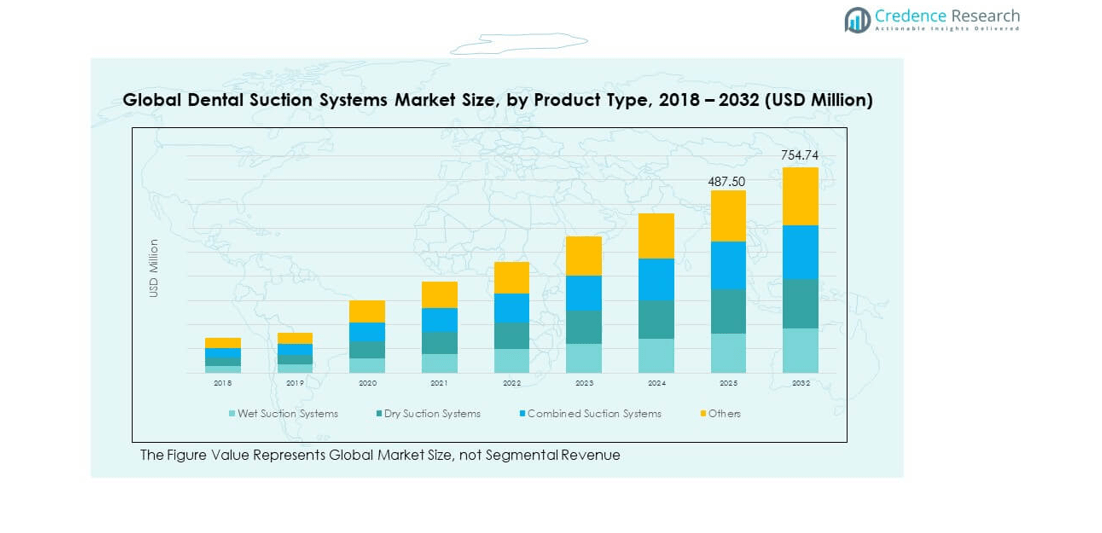
The Global Dental Suction Systems Market size was valued at USD 303.67 million in 2018 to USD 441.91 million in 2024 and is anticipated to reach USD 754.74 million by 2032, at a CAGR of 6.44% during the forecast period.
| REPORT ATTRIBUTE | DETAILS |
|---|---|
| Historical Period | 2020-2023 |
| Base Year | 2024 |
| Forecast Period | 2025-2032 |
| Dental Suction Systems Market Size 2024 | USD 441.91 million |
| Dental Suction Systems Market, CAGR | 6.44% |
| Dental Suction Systems Market Size 2032 | USD 754.74 million |
The market is driven by the rising demand for advanced dental care, increasing dental procedures, and growing awareness about oral hygiene. Adoption of suction systems in modern clinics is expanding as professionals focus on infection control and patient comfort. Continuous innovations in suction technology, coupled with supportive government healthcare initiatives, are fostering wider adoption globally.
Geographically, North America leads due to high dental expenditure, advanced clinical infrastructure, and strong adoption of digital solutions. Europe follows with its robust healthcare framework and strong patient awareness. Meanwhile, Asia-Pacific is emerging as the fastest-growing region, driven by rising disposable incomes, increasing access to dental care, and expanding private clinic networks in countries like China and India. Latin America and the Middle East are also seeing gradual adoption supported by healthcare modernization.
Market Insights:
- The Global Dental Suction Systems Market was valued at USD 303.67 million in 2018, reached USD 441.91 million in 2024, and is expected to reach USD 754.74 million by 2032, growing at a CAGR of 6.44%.
- North America held 37% share in 2024, driven by advanced infrastructure and high dental spending, followed by Europe at 28% with strong regulatory frameworks, and Asia Pacific at 20% supported by rising healthcare access.
- Asia Pacific is the fastest-growing region with 20% share in 2024, fueled by rising disposable incomes, expanding clinics, and strong dental tourism markets.
- Wet suction systems accounted for 42% share of the market in 2024, supported by efficiency in handling higher fluid volumes in large practices.
- Dry suction systems represented 33% share in 2024, gaining traction with energy-efficient designs and reduced maintenance needs.
Market Drivers
Rising demand for advanced dental care solutions across diverse clinical settings
The Global Dental Suction Systems Market benefits from a significant rise in dental treatments worldwide. Growing patient awareness of oral hygiene has led to more visits to dental clinics. Dentists increasingly rely on suction systems for cleaner and safer procedures. Infection control remains a critical factor, driving clinics to adopt efficient devices. Modern suction systems enhance patient comfort during long procedures. Government programs supporting preventive dental care also boost adoption rates. Hospitals and private practices expand their equipment base to meet increasing demand. This combination of factors continues to reinforce steady growth across developed and developing markets.
Growing emphasis on infection prevention and cross-contamination control
The Global Dental Suction Systems Market experiences strong growth from infection prevention needs. Clinics face stricter hygiene protocols to reduce cross-contamination risks. Dental suction systems serve as critical tools for maintaining a sterile environment. Practitioners seek systems with strong filtration and disposal capacity. Patient safety drives investments in improved evacuation systems. High-risk procedures highlight the importance of reliable suction equipment. Manufacturers respond with enhanced designs for hygiene management. It creates sustained demand for systems with superior safety and compliance features.
Increasing adoption of technological advancements in dental equipment
The Global Dental Suction Systems Market grows as practices integrate advanced dental technologies. Clinics demand suction systems that align with digital and automated treatment processes. Energy-efficient and noise-reduction designs enhance both operator and patient experience. Compact and mobile suction units support flexibility in dental offices. Hospitals invest in centralized systems for multi-chair operations. Manufacturers innovate to deliver systems with better power and efficiency. Integration of suction with ergonomic dental chairs improves workflow efficiency. Continuous upgrades fuel replacement demand alongside new installations in clinics.
- For instance, the A-dec 500 Pro delivery system launched in 2023 features full digital integration via the A-dec+ software platform. This upgradable system connects equipment operation and workflow data on a single dashboard, enabling clinics to optimize performance, support asset management, and streamline infection control processes through real-time remote monitoring.
Rising dental tourism and expanding private healthcare infrastructure
The Global Dental Suction Systems Market benefits from global growth in dental tourism. Countries in Asia and Latin America attract patients seeking affordable care. Clinics in these regions invest in modern suction systems to meet global standards. Expanding private healthcare networks amplify demand for advanced dental devices. Patients prefer clinics that guarantee comfort and hygiene with modern equipment. Suction systems help facilities build trust and attract international patients. Growth in disposable incomes further supports demand for premium services. It strengthens the role of suction systems as a central tool in advanced clinical environments.
- For instance, KaVo dental units are widely recognized for their configurable design and high quality. They are adopted globally in dental practices, supported by a strong reputation and high repurchase rates, particularly in established markets. The systems emphasize comfort, hygiene, and flexibility, enabling clinics to deliver premium patient care while meeting regulatory and clinical standards.
Market Trends
Integration of eco-friendly designs and sustainable suction technologies
The Global Dental Suction Systems Market shows a shift toward eco-friendly equipment. Manufacturers design suction systems with energy-saving motors and recyclable materials. Clinics demand devices that align with sustainability goals and regulatory expectations. Low water and power consumption features reduce operational costs. Product development focuses on minimizing environmental impact without reducing performance. Green dentistry concepts accelerate this adoption across many regions. Hospitals integrate sustainable devices as part of environmental certification initiatives. It encourages continuous innovation in eco-focused suction technologies.
- For instance, Dürr Dental’s Tyscor suction unitsachieve up to 75% lower energy consumption compared to conventional side channel blowers, as confirmed by the Fraunhofer Institute in 2024. Additionally, Dürr Dental’s Gechingen production site has been fully CO₂ neutral since 2023, using renewable energy, pellet heating, and photovoltaic systems to meet verified sustainability goals
Expanding use of portable and mobile suction units in modern practices
The Global Dental Suction Systems Market advances with demand for portable systems. Clinics use mobile devices for flexibility in multi-chair arrangements. Portable suction supports field dentistry and community outreach programs. Compact designs appeal to smaller private practices with limited space. Emergency and surgical setups also benefit from mobile suction solutions. Manufacturers target designs with high suction power in smaller units. Increasing patient load drives clinics to adopt additional portable systems. It widens product adoption beyond conventional large-scale installations.
- For instance, the Aseptico GO Ultra Portable Dental System (AEU-350S), launched in 2024, weighs just 34 lbs (15.5 kg)and offers restorative and hygiene functionality, including a built-in electric motor and LED fiber-optic lighting. The system is regulatory compliant and compact enough for global field dentistry, making it ideal for mobile and outreach applications
Growing integration of suction systems with digital monitoring platforms
The Global Dental Suction Systems Market adapts to the integration of digital solutions. Clinics adopt smart systems capable of monitoring suction flow in real time. Advanced platforms provide alerts for maintenance and hygiene checks. Digital integration improves efficiency across multi-chair dental clinics. Smart sensors reduce downtime by predicting equipment needs. Connectivity with electronic dental records enhances workflow. Hospitals adopt centralized systems with remote monitoring capabilities. It supports data-driven decisions for better patient outcomes and equipment management.
Rising focus on ergonomic and patient-centric product designs
The Global Dental Suction Systems Market emphasizes patient comfort and dentist convenience. Suction devices evolve with noise-reduction features and lightweight construction. Dentists prefer ergonomic equipment that reduces strain during long procedures. Patients benefit from quiet operation, enhancing overall treatment satisfaction. Design improvements improve accessibility in pediatric and geriatric dentistry. Manufacturers prioritize user-friendly controls for seamless operation. Clinics invest in equipment that enhances both safety and experience. It ensures a competitive edge for companies introducing ergonomic innovations.
Market Challenges Analysis
High cost of advanced suction systems and limited access in low-resource regions
The Global Dental Suction Systems Market faces barriers from high equipment costs. Advanced suction systems require significant investment by clinics and hospitals. Smaller practices often struggle with affordability, limiting adoption. High maintenance and replacement costs add financial burden for operators. Emerging economies face limited access to modern equipment due to budget constraints. Dental tourism destinations must invest heavily to match international standards. Public sector healthcare systems in many regions delay procurement. It creates a gap between advanced markets and underdeveloped areas.
Technical complexities, regulatory hurdles, and operational maintenance issues
The Global Dental Suction Systems Market encounters challenges linked to compliance and functionality. Strict regulations demand adherence to hygiene and safety standards. Clinics often find compliance costly and time-consuming. Suction systems require continuous maintenance to remain effective. Technical failures during procedures can create safety concerns. Training staff on new devices increases workload in busy clinics. Operators also face difficulties with waste disposal from suction units. It emphasizes the importance of consistent technical support and regulatory alignment.
Market Opportunities
Expanding demand for advanced dental equipment in emerging healthcare markets
The Global Dental Suction Systems Market holds strong opportunities in emerging regions. Rising disposable incomes support higher spending on oral care. Governments invest in modernizing healthcare systems to expand dental coverage. Private clinics expand across urban and semi-urban areas to meet demand. Increasing awareness of hygiene encourages adoption of modern devices. Dental tourism creates additional opportunities for clinics upgrading equipment. Manufacturers benefit by offering affordable yet advanced systems for these markets. It ensures significant potential for long-term growth in developing economies.
Innovation-driven product development and growth in specialized dental procedures
The Global Dental Suction Systems Market finds opportunities in specialized care. Growing demand for pediatric, orthodontic, and cosmetic dentistry creates need for advanced systems. Manufacturers innovate to design solutions tailored to these segments. Smart suction systems with integrated sensors attract attention in premium clinics. Compact and modular systems suit multi-chair facilities seeking flexibility. Innovations in noise control and ergonomic features enhance adoption. Global R&D investments support creation of new product lines. It establishes a wide field of opportunity for companies driving innovation.
Market Segmentation Analysis:
The Global Dental Suction Systems Market is segmented
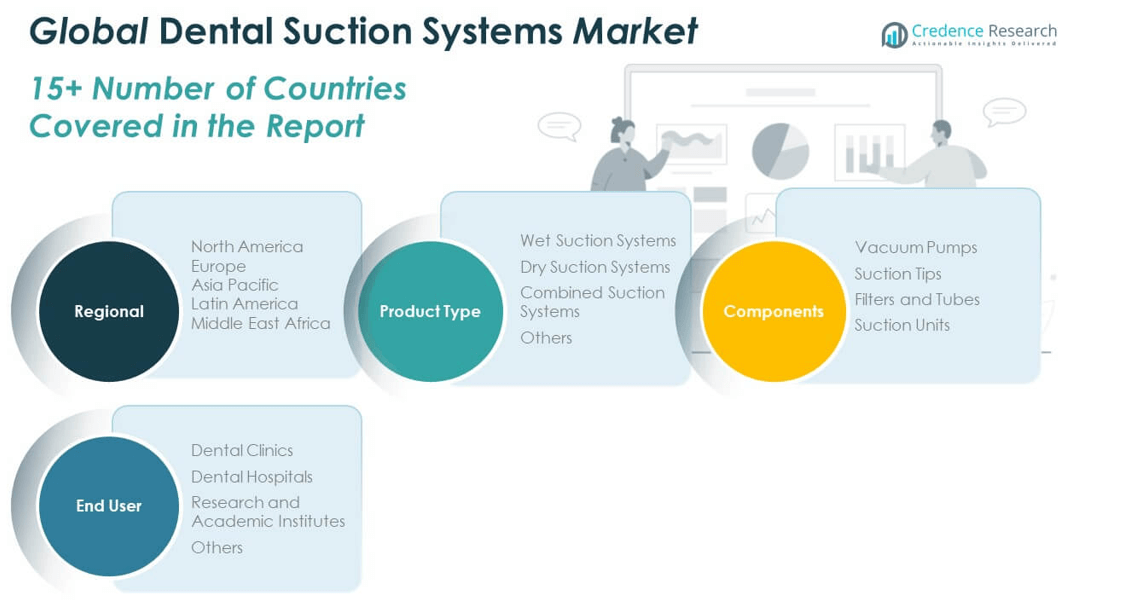
By product type into wet suction systems, dry suction systems, combined suction systems, and others. Wet suction systems hold a strong position due to their consistent efficiency in handling high fluid volumes, making them a preferred choice in large practices. Dry suction systems gain traction with their lower maintenance and energy-efficient features, appealing to clinics seeking cost control. Combined suction systems address diverse clinical needs by integrating benefits of both technologies. The “others” category includes specialized and portable units that serve niche demands and emergency setups.
- For instance, the Aseptico Express II Portable Dental System (ADU-17X)features a portable vacuum pump with HVE and saliva ejector hoses, designed for field clinics and emergency dental setups, enhancing accessibility for niche and mobile care
By components, the market includes vacuum pumps, suction tips, filters and tubes, and suction units. Vacuum pumps remain central to system performance, driving replacement demand across facilities. Suction tips account for significant recurring demand, supported by single-use adoption for infection control. Filters and tubes strengthen compliance with hygiene regulations, contributing to steady growth. Suction units expand with multi-chair installations in modern clinics and hospitals, highlighting the importance of durable equipment.
- For instance, Dentsply Sirona's Intego and Axano dental treatment centersuse fine-mesh water filters and sterile tubing to ensure bacterial counts remain below 500 CFU/mL, complying with EN 1717 and national hygiene regulations in clinics.
By end-user segmentation covers dental clinics, dental hospitals, research and academic institutes, and others. Clinics dominate due to higher procedure volumes and faster adoption of advanced systems. Dental hospitals strengthen adoption with centralized suction facilities catering to multiple departments. Research and academic institutes support demand by investing in systems for training and experimental use. The “others” segment includes mobile dental setups and public health facilities, reflecting growing accessibility in emerging regions. Together, these segments define the growth pathways of the market.
Segmentation:
By Product Type
- Wet Suction Systems
- Dry Suction Systems
- Combined Suction Systems
- Others
By Components
- Vacuum Pumps
- Suction Tips
- Filters and Tubes
- Suction Units
By End User
- Dental Clinics
- Dental Hospitals
- Research and Academic Institutes
- Others
By Region
- North America
- U.S.
- Canada
- Mexico
- Europe
- UK
- France
- Germany
- Italy
- Spain
- Russia
- Belgium
- Netherlands
- Austria
- Sweden
- Poland
- Denmark
- Switzerland
- Rest of Europe
- Asia Pacific
- China
- Japan
- South Korea
- India
- Australia
- Thailand
- Indonesia
- Vietnam
- Malaysia
- Philippines
- Taiwan
- Rest of Asia Pacific
- Latin America
- Brazil
- Argentina
- Peru
- Chile
- Colombia
- Rest of Latin America
- Middle East
- UAE
- KSA
- Israel
- Turkey
- Iran
- Rest of Middle East
- Africa
- Egypt
- Nigeria
- Algeria
- Morocco
- Rest of Africa
Regional Analysis:
North America
The North America Global Dental Suction Systems Market size was valued at USD 133.15 million in 2018 to USD 191.75 million in 2024 and is anticipated to reach USD 328.41 million by 2032, at a CAGR of 6.5% during the forecast period. North America holds a market share of 37% in 2024. Strong dental infrastructure and advanced clinical facilities drive adoption across the U.S. and Canada. High healthcare spending supports widespread use of modern suction technologies. It benefits from stringent infection control regulations that mandate reliable evacuation systems. Dental tourism in Mexico contributes to steady growth in regional adoption. The presence of leading manufacturers strengthens product availability. Clinics and hospitals invest in centralized suction units to enhance efficiency. The region continues to lead with high technology penetration and consistent replacement demand.
Europe
The Europe Global Dental Suction Systems Market size was valued at USD 87.26 million in 2018 to USD 122.46 million in 2024 and is anticipated to reach USD 197.08 million by 2032, at a CAGR of 5.7% during the forecast period. Europe accounts for a market share of 28% in 2024. Strong regulatory frameworks guide product adoption across Germany, France, and the UK. Patient awareness of oral health drives demand for high-performance suction units. Hospitals and clinics invest in environmentally friendly and energy-efficient devices. It benefits from strong research initiatives in dental technology across the region. Southern Europe witnesses rising adoption in Italy and Spain supported by expanding private clinics. Eastern Europe presents growth potential with healthcare modernization. The market in Europe remains stable with an emphasis on compliance and innovation.
Asia Pacific
The Asia Pacific Global Dental Suction Systems Market size was valued at USD 54.46 million in 2018 to USD 86.38 million in 2024 and is anticipated to reach USD 168.40 million by 2032, at a CAGR of 8.2% during the forecast period. Asia Pacific holds a market share of 20% in 2024. Rising disposable incomes and expanding dental care access drive regional demand. China and India lead growth with expanding urban clinic networks. Japan and South Korea contribute with adoption of advanced technologies in established practices. Dental tourism in Thailand and Malaysia supports regional investments in premium systems. It benefits from government-led initiatives to expand oral healthcare services. Manufacturers target cost-effective products to meet local demand. Asia Pacific remains the fastest-growing region due to economic development and patient awareness.
Latin America
The Latin America Global Dental Suction Systems Market size was valued at USD 14.38 million in 2018 to USD 20.66 million in 2024 and is anticipated to reach USD 31.24 million by 2032, at a CAGR of 4.8% during the forecast period. Latin America represents a market share of 4% in 2024. Brazil dominates with strong investments in dental clinics and training institutes. Mexico benefits from cross-border dental tourism and patient inflows. It faces challenges from uneven healthcare distribution across rural areas. Argentina contributes with moderate growth supported by private sector expansion. Public initiatives to improve oral health create opportunities for adoption. Mid-range and portable suction systems appeal to smaller clinics. Regional growth remains steady but limited by economic pressures.
Middle East
The Middle East Global Dental Suction Systems Market size was valued at USD 8.84 million in 2018 to USD 11.81 million in 2024 and is anticipated to reach USD 17.15 million by 2032, at a CAGR of 4.3% during the forecast period. The Middle East holds a 3% market share in 2024. GCC countries drive growth with high investments in premium dental care. Saudi Arabia and UAE lead in adoption due to advanced healthcare infrastructure. Israel contributes with strong technology-driven dental practices. Turkey expands its role as a hub for medical and dental tourism. It faces gaps in rural areas where adoption remains slow. Government initiatives support modernization in public dental facilities. The region reflects steady demand with emphasis on high-end systems.
Africa
The Africa Global Dental Suction Systems Market size was valued at USD 5.58 million in 2018 to USD 8.84 million in 2024 and is anticipated to reach USD 12.48 million by 2032, at a CAGR of 3.9% during the forecast period. Africa represents a 2% share of the global market in 2024. South Africa leads regional adoption with established urban clinics and training centers. Egypt shows promising growth with expanding healthcare initiatives. It faces major barriers from low affordability and limited access in rural regions. Dental care infrastructure remains underdeveloped in much of Sub-Saharan Africa. Manufacturers target basic and portable suction systems to meet local needs. International aid programs contribute to improving access in public clinics. Growth opportunities exist but remain constrained by economic and infrastructure challenges.
Key Player Analysis:
- Dentsply Sirona
- A-dec Inc.
- Cattani S.p.A.
- Midmark Corporation
- Planmeca Oy
- NSK Ltd.
- Ivoclar Vivadent AG
- Hu-Friedy Mfg. Co., LLC
- Sirona Dental Systems GmbH
- KaVo Kerr
- Bien-Air Dental SA
Competitive Analysis:
The Global Dental Suction Systems Market features strong competition with leading players focusing on innovation, product quality, and geographic expansion. Companies such as Dentsply Sirona, A-dec Inc., Cattani S.p.A., Midmark Corporation, and Planmeca Oy maintain significant presence through advanced product portfolios. It is shaped by frequent mergers, partnerships, and product launches aimed at strengthening market reach. Firms invest in energy-efficient and noise-reduction technologies to enhance product appeal. Regional players target cost-effective solutions to capture demand in emerging economies. Established companies emphasize compliance with international hygiene standards to secure trust among clinics and hospitals. The competitive environment also reflects a balance between large multinational corporations and specialized local manufacturers. It continues to evolve as manufacturers expand distribution networks and integrate smart technologies into suction systems, reinforcing their market positions.
Recent Developments:
- In March 2025, Planmeca launched new products across all major dental categories at IDS 2025, further expanding its integrated digital equipment lines, including advanced dental units and imaging solutions.
- In Feb 2025, Dürr Dental introduced new compressed air and suction solutions at IDS 2025 in Cologne, unveiling the Tyscor Tandem Flex, which sets new benchmarks for scalability and expansion in dental practices, and released central separation containers designed for larger practices, reinforcing its innovative legacy in dental suction technologies.
- In Feb 2025, Dentsply Sirona introduced the MIS LYNX, a premium, cost-effective all-in-one dental implant solution in the US market, reinforcing its innovation in comprehensive clinical solutions for dental professionals.
- In January 2025, A-dec announced an enhanced 10-year product warranty for its core equipment, including dental chairs and delivery systems. In September 2024, A-dec expanded intraoral scanning offerings with the wireless, cloud-native Primescan 2 device developed in collaboration with Dentsply Sirona.
Report Coverage:
The research report offers an in-depth analysis based on Product Type, Components and End User. It details leading market players, providing an overview of their business, product offerings, investments, revenue streams, and key applications. Additionally, the report includes insights into the competitive environment, SWOT analysis, current market trends, as well as the primary drivers and constraints. Furthermore, it discusses various factors that have driven market expansion in recent years. The report also explores market dynamics, regulatory scenarios, and technological advancements that are shaping the industry. It assesses the impact of external factors and global economic changes on market growth. Lastly, it provides strategic recommendations for new entrants and established companies to navigate the complexities of the market.
Future Outlook:
- The Global Dental Suction Systems Market will expand with rising adoption of infection control solutions in clinics.
- Technological advancements in noise reduction and energy efficiency will drive premium product demand.
- Portable and compact suction systems will gain popularity in smaller clinics and mobile setups.
- Integration of smart monitoring features will enhance system efficiency and maintenance reliability.
- Growing investments in dental tourism will strengthen demand for modern equipment in emerging economies.
- Eco-friendly and sustainable suction technologies will align with global green dentistry initiatives.
- Expansion of private healthcare networks will create strong opportunities in urban and semi-urban areas.
- Research and academic institutes will continue investing in systems for training and innovation.
- Regional manufacturers will target affordable product lines to capture cost-sensitive markets.
- Strategic partnerships, mergers, and product launches will define competitive positioning across regions.

Request a Free Sample
Fill in your details and we'll send you a free sample report.
- Sample data tables & charts
- Research methodology
Market Dynamics
Emphasis on Infection Prevention and Cross-Contamination Control
Dental clinics and hospitals are increasingly prioritizing infection control, leading to higher adoption of advanced suction systems that offer strong filtration and disposal capabilities. Regulatory requirements and patient safety concerns are driving investments in reliable evacuation equipment.
Technological Advancements and Integration with Digital Platforms
Continuous innovation in suction technology, such as energy-efficient motors, noise reduction, and integration with digital monitoring platforms, is making these systems more attractive to modern dental practices. Smart features improve workflow efficiency and maintenance, fueling replacement and upgrade demand.
Expansion of Dental Tourism and Private Healthcare Infrastructure
Growth in dental tourism, especially in Asia and Latin America, is prompting clinics to invest in modern suction systems to meet international standards and attract global patients. Expanding private clinic networks and rising disposable incomes further support market growth in emerging regions.
Eco-Friendly and Sustainable Product Development
Manufacturers are developing suction systems with lower energy and water consumption, recyclable materials, and environmentally friendly designs. This aligns with global green dentistry initiatives and helps clinics reduce operational costs while meeting regulatory expectations.
Rising Volume of Dental Procedures and Oral Hygiene Awareness
Increasing awareness of oral health and a growing number of dental procedures worldwide are boosting demand for efficient suction systems. Both public and private sector investments in dental care infrastructure are expanding the installed base of these systems.
Need a Custom Version of This Report?
Tailor the scope, geography, or segments to your exact requirements.
- Custom geography or segment scope
- Direct access to our analyst team
Frequently Asked Questions
What is the current market size for Global Dental Suction Systems Market, and what is its projected size in 2032?
Which Global Dental Suction Systems Market segment held the largest share in 2024?
What are the primary factors fueling the growth of the Global Dental Suction Systems Market?
Who are the leading companies in the Global Dental Suction Systems Market?
Table of Content
Chapter 1 Market Segmentation
- 1.1 Segmentation Framework
- 1.1.1 Product and Service Classification
- 1.1.2 Application and End-Use Classification
- 1.1.3 Technology and Solution Classification
- 1.1.4 Customer and Distribution Channel Classification
- 1.1.5 Geographic Segmentation
- 1.1.6 Market Segment Definitions and Boundaries
- 1.2 By End User
- 1.2.1 Dental Clinics
- 1.2.2 Dental Hospitals
- 1.2.3 Research and Academic Institutes
- 1.2.4 Others
- 1.3 By Components
- 1.3.1 Vacuum Pumps
- 1.3.2 Suction Tips
- 1.3.3 Filters and Tubes
- 1.3.4 Suction Units
- 1.4 By Product Type
- 1.4.1 Wet Suction Systems
- 1.4.2 Dry Suction Systems
- 1.4.3 Combined Suction Systems
- 1.4.4 Others
Chapter 2 Introduction
- 2.1 Report Objectives and Scope
- 2.2 Product Definition and Industry Terminology
- 2.3 Market Inclusions and Exclusions
- 2.4 Research Process
- 2.4.1 Primary Research and Expert Interviews
- 2.4.2 Secondary Research and Source Review
- 2.4.3 Top-Down and Bottom-Up Estimation
- 2.4.4 Data Triangulation and Verification
- 2.5 Market Size Measurement Basis
- 2.5.1 2024: USD 441.91 million → 2032: USD 754.74 million
- 2.6 Historical and Forecast Reference Periods
- 2.6.1 Base Year: 2024
- 2.6.2 Forecast Period: 2024-2032
- 2.7 Research Assumptions and Limitations
Chapter 3 Executive Summary
- 3.1 Market Snapshot and Key Findings
- 3.2 Base-Year Market Size, 2024
- 3.3 Forecast Market Size, 2032
- 3.4 Revenue and Volume Growth Outlook
- 3.5 Key Demand and Supply Indicators
- 3.6 Leading Market Segments
- 3.7 Fastest-Growing Market Opportunities
- 3.8 Regional Performance Highlights
- 3.9 Technology and Industry Transformation
- 3.10 Competitive Landscape Summary
- 3.11 Analyst View and Strategic Implications
Chapter 4 Global Dental Suction Systems Market Trends and Developments
- 4.1 Historical Industry Development
- 4.2 Recent Market Trends and Developments
- 4.3 Demand and Customer Behavior Trends
- 4.4 Technology and Product Innovation
- 4.5 Artificial Intelligence, Automation and Digitalization
- 4.6 Local Manufacturing and Supply Chain Realignment
- 4.7 Industry Partnerships, Mergers and Acquisitions
- 4.8 Sustainability and Circular Economy Developments
- 4.9 Government and Private Sector Investment Trends
- 4.10 Emerging Business Models and Commercialization
- 4.11 Industry Developments and Announcements
Chapter 5 Global Dental Suction Systems Market Production, Supply and Demand Analysis
- 5.1 Demand Trend and Consumption Analysis
- 5.2 Demand Forecast, 2024-2032
- 5.3 Production and Output Trend
- 5.4 Production and Output Forecast, 2024-2032
- 5.5 Installed Capacity and Capacity Utilization
- 5.6 Company-Wise Production Plants and Statistics
- 5.6.1 Installed Production Capacity
- 5.6.2 Actual Production
- 5.6.3 Planned Capacity and Expansion Targets
- 5.7 Supply Chain Structure and Procurement Trends
- 5.8 Supply-Demand Gap and Bottlenecks
- 5.9 Import Dependence and Sourcing Structure
- 5.10 Contract Manufacturing and Outsourcing
- 5.11 Regional Supply and Demand Concentration
Chapter 6 Global Dental Suction Systems Market Pricing Analysis
- 6.1 Pricing Structure and Measurement
- 6.2 Historical Pricing Trends
- 6.3 Pricing Outlook, 2024-2032
- 6.4 Average Selling Price and Unit Economics
- 6.5 Pricing by Product and Market Segment
- 6.6 Geographic Pricing Differences
- 6.7 Key Input, Energy, Labor and Logistics Costs
- 6.8 Contract Pricing and Purchasing Models
- 6.9 Pricing Sensitivity and Competitive Positioning
- 6.10 Price, Margin and Profitability Implications
Chapter 7 Global Dental Suction Systems Market Dynamics
- 7.1 Market Growth Drivers
- 7.1.1 Demand-Side Drivers
- 7.1.2 Technology and Innovation Drivers
- 7.1.3 Infrastructure and Investment Drivers
- 7.1.4 Regulatory and Policy Drivers
- 7.2 Market Restraints
- 7.2.1 Cost and Affordability Constraints
- 7.2.2 Technology and Adoption Barriers
- 7.2.3 Supply Chain and Operational Constraints
- 7.3 Market Challenges
- 7.3.1 Competitive Pressure and Margin Erosion
- 7.3.2 Skills, Infrastructure and Implementation Gaps
- 7.4 Emerging Market Opportunities
- 7.5 Market Dynamics Impact and Time-Horizon Assessment
Chapter 8 Global Dental Suction Systems Value Chain Analysis
- 8.1 Industry Value Chain Overview
- 8.2 Upstream Suppliers and Critical Inputs
- 8.3 Technology and Component Providers
- 8.4 Manufacturing or Service Delivery
- 8.5 Distribution, Channel Partners and Integrators
- 8.6 Downstream Applications and End Users
- 8.7 Value Addition and Profit Pools
- 8.8 Vertical Integration and Outsourcing
- 8.9 Supplier Concentration and Risk
- 8.10 Supply Chain Localization and Resilience
Chapter 9 Global Dental Suction Systems Market Regulations and Policies
- 9.1 Relevant Laws, Standards and Compliance Frameworks
- 9.2 Product, Service, Safety and Quality Requirements
- 9.3 Government Policies, Incentives and Subsidies
- 9.4 Imports, Exports and Trade Barriers
- 9.5 Public Procurement and Local Content Requirements
- 9.6 Environmental and Sustainability Compliance
- 9.7 Upcoming Policy Changes and Market Implications
Chapter 10 Global Dental Suction Systems Market Hotspots and Opportunities
- 10.1 Market Opportunity Mapping and Growth Hotspots
- 10.2 High-Growth Applications and Customer Groups
- 10.3 Underserved Markets and White-Space Opportunities
- 10.4 Emerging Technology and Product Opportunities
- 10.5 New Capacity and Investment Hotspots
- 10.6 Market Entry and Expansion Opportunities
- 10.7 Distribution and Partnership Opportunities
- 10.8 Near-Term and Long-Term Commercial Potential
- 10.9 Opportunity Attractiveness and Execution Risks
Chapter 11 Global Dental Suction Systems Market Outlook, 2024-2032
- 11.1 Market Size and Analysis
- 11.1.1 Revenue (Market Measurement: 2024: USD 441.91 million → 2032: USD 754.74 million)
- 11.1.2 Market Volume and Quantity Sold
- 11.1.3 Historical Market Size
- 11.1.4 Base-Year Market Size, 2024
- 11.2 Market Forecast, 2024-2032
- 11.2.1 Revenue Forecast to 2032
- 11.2.2 Volume Forecast to 2032
- 11.2.3 CAGR and Year-on-Year Growth
- 11.2.4 Incremental Revenue Opportunity
- 11.3 Forecast Assumptions and Scenario Analysis
- 11.3.1 Base-Case Forecast
- 11.3.2 Optimistic and Conservative Scenarios
- 11.3.3 Technology, Pricing and Policy Sensitivities
- 11.4 Market Attractiveness and Growth Outlook
Chapter 12 Global Dental Suction Systems Market Segmentation and Outlook
- 12.1 Segmentation Summary and Market Shares, 2024
- 12.2 Largest and Fastest-Growing Segments
- 12.3 By End User - Market Size and Forecast, 2024-2032
- 12.3.1 Segment Definition and Scope
- 12.3.2 Historical Market Size
- 12.3.3 Revenue Forecast, 2024-2032
- 12.3.4 Volume Forecast, 2024-2032
- 12.3.5 Base-Year Market Share, 2024
- 12.3.6 Segment CAGR and Growth Drivers
- 12.3.7 Subsegment Market Size and Forecast
- 12.3.7.1 Dental Clinics
- 12.3.7.2 Dental Hospitals
- 12.3.7.3 Research and Academic Institutes
- 12.3.7.4 Others
- 12.3.8 Subsegment Pricing and Adoption Trends
- 12.3.9 Leading Suppliers and Competition
- 12.3.10 Regional Demand and Opportunities
- 12.4 By Components - Market Size and Forecast, 2024-2032
- 12.4.1 Segment Definition and Scope
- 12.4.2 Historical Market Size
- 12.4.3 Revenue Forecast, 2024-2032
- 12.4.4 Volume Forecast, 2024-2032
- 12.4.5 Base-Year Market Share, 2024
- 12.4.6 Segment CAGR and Growth Drivers
- 12.4.7 Subsegment Market Size and Forecast
- 12.4.7.1 Vacuum Pumps
- 12.4.7.2 Suction Tips
- 12.4.7.3 Filters and Tubes
- 12.4.7.4 Suction Units
- 12.4.8 Subsegment Pricing and Adoption Trends
- 12.4.9 Leading Suppliers and Competition
- 12.4.10 Regional Demand and Opportunities
- 12.5 By Product Type - Market Size and Forecast, 2024-2032
- 12.5.1 Segment Definition and Scope
- 12.5.2 Historical Market Size
- 12.5.3 Revenue Forecast, 2024-2032
- 12.5.4 Volume Forecast, 2024-2032
- 12.5.5 Base-Year Market Share, 2024
- 12.5.6 Segment CAGR and Growth Drivers
- 12.5.7 Subsegment Market Size and Forecast
- 12.5.7.1 Wet Suction Systems
- 12.5.7.2 Dry Suction Systems
- 12.5.7.3 Combined Suction Systems
- 12.5.7.4 Others
- 12.5.8 Subsegment Pricing and Adoption Trends
- 12.5.9 Leading Suppliers and Competition
- 12.5.10 Regional Demand and Opportunities
- 12.6 Segment Growth Comparison
- 12.7 Segment Attractiveness and Priority Matrix
Chapter 13 Global Dental Suction Systems End-Use and Application Market Outlook
- 13.1 End-Use Industry and Customer Demand Structure
- 13.2 Leading Applications and Customer Groups
- 13.3 End-Use Market Size, Share and Forecast
- 13.4 Major End-Use Industry Deep Dives
- 13.4.1 Customer Requirements and Use Cases
- 13.4.2 Demand and Replacement Cycles
- 13.4.3 Technical and Regulatory Considerations
- 13.4.4 Purchasing and Procurement Models
- 13.4.5 Leading Vendors and Distribution Channels
- 13.4.6 Forecast and Commercial Opportunities
- 13.5 Emerging Applications and Cross-Segment Demand
- 13.6 End-Use Industry Investment Priorities
Chapter 14 Global Dental Suction Systems Geographic Market Outlook, 2024-2032
- 14.1 Regional Market Size and Share, 2024
- 14.2 Regional Market Forecast, 2024-2032
- 14.3 Regional Pricing, Production and Demand Differences
- 14.4 North America
- 14.4.1 United States
- 14.4.2 Canada
- 14.4.3 Mexico
- 14.5 Europe
- 14.5.1 Germany
- 14.5.2 France
- 14.5.3 Italy
- 14.5.4 United Kingdom
- 14.5.5 Spain
- 14.5.6 Poland
- 14.5.7 Russia
- 14.5.8 Netherlands
- 14.5.9 Belgium
- 14.5.10 Sweden
- 14.5.11 Denmark
- 14.5.12 Norway
- 14.5.13 Rest of Europe
- 14.6 Asia Pacific
- 14.6.1 China
- 14.6.2 India
- 14.6.3 Japan
- 14.6.4 South Korea
- 14.6.5 Thailand
- 14.6.6 Indonesia
- 14.6.7 Vietnam
- 14.6.8 Malaysia
- 14.6.9 Australia
- 14.6.10 Rest of Asia Pacific
- 14.7 Latin America
- 14.7.1 Brazil
- 14.7.2 Argentina
- 14.7.3 Colombia
- 14.7.4 Chile
- 14.7.5 Rest of Latin America
- 14.8 Middle East
- 14.8.1 Saudi Arabia
- 14.8.2 United Arab Emirates
- 14.8.3 Turkey
- 14.8.4 Israel
- 14.8.5 Iran
- 14.8.6 Rest of the Middle East
- 14.9 Africa
- 14.9.1 South Africa
- 14.9.2 Egypt
- 14.9.3 Nigeria
- 14.9.4 Morocco
- 14.9.5 Rest of Africa
- 14.10 Regional Investment, Policy and Supply Chain Differences
- 14.11 Regional Competitive Landscape
- 14.12 Geographic Growth Hotspots
Chapter 15 Global Dental Suction Systems Technology, Innovation and Sustainability Outlook
- 15.1 Technology Landscape and Maturity
- 15.2 Product, Process and Service Innovation
- 15.3 AI, Automation and Digital Tools in the Industry
- 15.4 Technology Adoption and Performance Benchmarking
- 15.5 Innovation Pipeline and R&D Investment
- 15.6 Patent and Intellectual Property Trends
- 15.7 Energy Efficiency and Resource Management
- 15.8 Sustainability, Recycling and Circularity
- 15.9 Technology Roadmap, 2024-2032
- 15.10 Risks of Obsolescence and Technology Substitution
Chapter 16 Global Dental Suction Systems Market Key Strategic Imperatives
- 16.1 Growth and Market Entry Priorities
- 16.2 High-Return Products and Segments
- 16.3 Pricing, Profitability and Cost Optimization
- 16.4 Technology Investment and Product Differentiation
- 16.5 Supply Chain Localization and Resilience
- 16.6 Distribution and Customer Acquisition
- 16.7 Partnership, Acquisition and Capacity Strategy
- 16.8 Regional Expansion Priorities
- 16.9 Short-, Medium- and Long-Term Actions
Chapter 17 Competition Outlook
- 17.1 Industry Competition Characteristics
- 17.2 Market Structure and Concentration
- 17.3 Market Share and Competitive Positioning, 2024
- 17.4 Company-Wise Revenue and Product Benchmarking
- 17.5 Production and Service Capacity Benchmarking
- 17.6 Technology, Pricing and Differentiation
- 17.7 Regional Footprint and Distribution Strength
- 17.8 Mergers, Acquisitions and Strategic Alliances
- 17.9 New Entrants and Competitive Threats
- 17.10 Porter's Five Forces and Industry Attractiveness
- 17.11 Competitive Outlook, 2024-2032
Chapter 18 Company Profiles
- 18.1 Company Coverage and Selection Criteria
- 18.2 Dentsply Sirona
- 18.2.1 Business Description
- 18.2.2 Company Ownership and Geographic Presence
- 18.2.3 Product and Service Portfolio
- 18.2.4 Manufacturing and Operating Footprint
- 18.2.5 Production Capacity and Expansion Plans
- 18.2.6 Financial Performance and Investment
- 18.2.7 Market Share and Competitive Position
- 18.2.8 Technology and Innovation Capabilities
- 18.2.9 Strategic Alliances or Partnerships
- 18.2.10 Recent Developments
- 18.2.11 Growth Strategy and Outlook
- 18.3 A-dec Inc.
- 18.4 Cattani S.p.A.
- 18.5 Midmark Corporation
- 18.6 Planmeca Oy
- 18.7 NSK Ltd.
- 18.8 Ivoclar Vivadent AG
- 18.9 Hu-Friedy Mfg. Co., LLC
- 18.10 KaVo Kerr
- 18.11 Bien-Air Dental SA
- 18.12 Other Relevant Market Participants
Note: Every listed company is profiled on the structure shown under the first company. The company list is preliminary and may change based on research findings, market developments, data availability and client requirements.
Chapter 19 Disclaimer
- 19.1 Research and Forecast Disclaimer
- 19.2 Data Source and Estimation Limitations
Note: The depth of individual sections depends on data availability for this market. Volume, capacity, trade and other unit-based metrics are included where applicable.

