| REPORT ATTRIBUTE | DETAILS |
|---|---|
| Historical Period | 2020-2023 |
| Base Year | 2024 |
| Forecast Period | 2025-2032 |
| Fixing Agent Market Size 2024 | USD 1490 million |
| Fixing Agent Market, CAGR | 6.3% |
| Fixing Agent Market Size 2032 | USD 2429 million |
Market Overview:
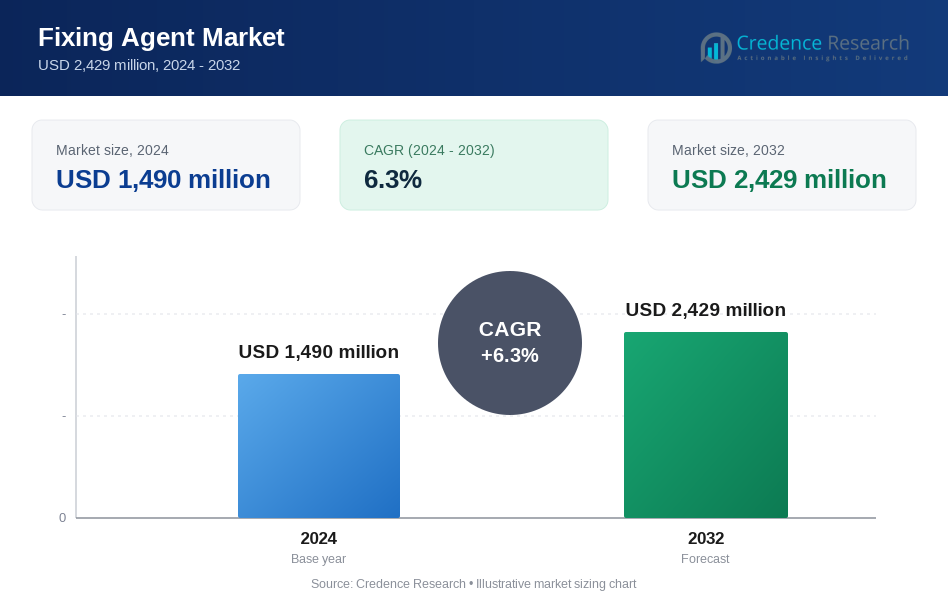
The Fixing agent market is projected to grow from USD 1490 million in 2024 to an estimated USD 2429 million by 2032, with a compound annual growth rate (CAGR) of 6.3% from 2024 to 2032.
The key drivers fueling the fixing agent market include the strong demand for color fastness and durability in textiles and leather products. As consumer preference shifts toward vibrant, long-lasting finishes, manufacturers are investing in efficient chemical solutions to meet quality benchmarks. The expansion of textile and apparel industries in developing countries has further increased the demand for fixing agents across production facilities. Additionally, rising environmental concerns and regulatory restrictions on harmful chemicals are compelling manufacturers to adopt sustainable, low-formaldehyde, or formaldehyde-free fixing agents. Technological innovations, such as the development of bio-based formulations and high-efficiency additives, are also enhancing product performance and widening their scope across diversified applications beyond traditional textile processing, including coatings, adhesives, and digital printing.
Regionally, the Asia-Pacific region leads the fixing agent market, holding over 35% of the global share. This dominance is attributed to the presence of large-scale textile and leather manufacturing hubs in countries like China, India, Bangladesh, and Vietnam. The region benefits from low production costs, skilled labor, and strong export capacity. North America and Europe are experiencing moderate yet steady growth, driven by a focus on sustainable manufacturing, strict regulatory frameworks, and the integration of eco-friendly chemicals in industrial processes. In contrast, Latin America, the Middle East & Africa are witnessing slower but promising development, supported by gradual industrialization, infrastructure development, and increasing investments in textile and packaging sectors. Emerging economies in Southeast Asia are also contributing to the global market by expanding domestic production capacities and adopting modern chemical processing technologies.
Market Insights:
- The Fixing Agent Market is expected to grow from USD 1,490 million in 2024 to USD 2,429 million by 2032, registering a CAGR of 6.3%.
- Demand is rising due to the need for high color fastness and durability in textiles and leather, particularly in emerging economies with growing apparel sectors.
- Sustainable, formaldehyde-free formulations are gaining traction as global regulations push manufacturers toward safer and eco-friendly alternatives.
- Technological advancements, including bio-based and high-efficiency additives, are enhancing product performance and broadening industrial applications.
- Asia-Pacific dominates with over 35% market share, driven by strong textile exports, skilled labor, and cost-effective production hubs in China, India, and Bangladesh.
- Challenges include strict environmental regulations and raw material price volatility, which strain smaller manufacturers and impact profit margins.
- New opportunities are emerging in digital textile printing, coatings, and packaging, where fixing agents improve color stability and processing efficiency.
Market Drivers:
Rising Demand from Textile and Leather Industries Fuels Growth
The fixing agent market is primarily driven by its widespread application in the textile and leather industries. Manufacturers seek agents that enhance color fastness, prevent fading, and improve fabric durability during washing or exposure to sunlight. The expanding global textile trade, especially in emerging economies, continues to push demand for reliable and efficient fixing agents. The rise in fast fashion and home textiles, coupled with increased export production from countries like India, Bangladesh, and Vietnam, creates a strong consumption base. It benefits from the volume-centric nature of textile production, where even minor improvements in dye-fixing performance translate to significant operational gains. The market also gains traction from the leather sector, where color retention and surface finish play a vital role in footwear, accessories, and automotive interiors.
- For instance, TFL’s Sellafix WW was developed specifically for wet-white leather fixation, creating additional binding sites for dyes and auxiliaries, significantly improving wet-fastness properties and reducing formaldehyde content in leather, which is especially important for high-performance leather goods.
Growing Preference for High-Performance and Durable Products
Consumers increasingly demand products that offer long-lasting performance, especially in garments, furnishings, and industrial fabrics. This shift has created a preference for high-performance fixing agents that maintain color vibrancy and structural integrity across multiple uses. Brands are focusing on quality and performance standards to differentiate themselves in a competitive marketplace. The fixing agent market supports these objectives by offering solutions that enhance product lifecycle and user satisfaction. It also aligns with customer expectations in premium textile segments where color consistency and fabric quality determine brand loyalty. Industries beyond fashion, including automotive and upholstery, are also contributing to the rising demand for fixing agents with high durability standards.
Regulatory Pressure Encourages Shift Toward Eco-Friendly Solutions
Stringent environmental regulations globally are prompting a shift toward low-toxicity, formaldehyde-free, and biodegradable fixing agents. Governments and regulatory bodies are enforcing stricter chemical use policies in textile processing to reduce ecological harm and ensure consumer safety. This pressure compels manufacturers to innovate and replace conventional formulations with sustainable alternatives. The fixing agent market is evolving to accommodate these shifts by offering new eco-labeled and compliant formulations. Brands looking to meet their sustainability goals are integrating such products into their supply chains, making environmental compliance a competitive advantage. Certification requirements like OEKO-TEX and REACH are further influencing procurement decisions within major manufacturing hubs.
- For instance, CSIR-CLRI’s chromium-melamine synthetic tanning agent replaces formaldehyde with an eco-benign material, resulting in tighter hides, fine grain effects, and environmentally safe leather that meets current regulations and is already in commercial production.
Technological Innovations Improve Efficiency and Expand Applications
Advancements in chemical engineering and textile processing are playing a crucial role in shaping product development. New-generation fixing agents offer better fabric compatibility, reduced residue, improved penetration, and compatibility with a wider range of dyes. These innovations improve production efficiency and reduce operational costs, appealing to high-volume textile manufacturers. The fixing agent market is also witnessing growth in digital textile printing, where agents help stabilize prints and prevent color bleeding. Its application is expanding into niche areas such as technical textiles, digital prints, paper coatings, and packaging. These developments indicate that innovation in formulation technology remains a critical driver for market competitiveness and expansion.
Market Trends:
Increasing Use of Cationic Fixing Agents for Enhanced Dye Affinity
A prominent trend in the fixing agent market is the growing preference for cationic fixing agents due to their superior performance in dye fixation. These agents possess positively charged functional groups that create strong ionic bonds with anionic dyes, significantly improving dye affinity and wash fastness. Manufacturers in the textile sector are adopting cationic formulations to address issues of poor dye uptake and color migration. This shift is particularly noticeable in the processing of reactive and direct dyes, where cationic agents ensure deeper shade development. The market is seeing increased R&D investment in optimizing cationic agent compositions to reduce fabric harshness while maintaining performance. It reflects the broader shift toward performance-based chemical treatment in dyeing processes.
- For instance, BLUELAKECHEM’s cationic agent Model 22107, designed for cotton and viscose, enables in-bath application at a dosage of 1.0–2.0% on weight of fabric (o.w.f.), reducing the number of wash cycles required and enhancing dye stability by inhibiting hydrolysis of reactive dyes.
Rising Adoption of Microencapsulation Technology in Textile Chemicals
Microencapsulation has emerged as a disruptive trend in the textile and chemical processing sectors. It enables the controlled release of active compounds within fixing agents, allowing for better penetration, stability, and long-lasting effects on treated fabrics. The fixing agent market is adopting microencapsulation technology to enhance product efficacy and reduce chemical wastage during application. This trend supports precision application, reduces re-dyeing rates, and improves cost efficiency in large-scale textile production. Companies are developing encapsulated variants that maintain fixing properties under diverse operational conditions such as high temperatures and rapid drying. It also enhances environmental compliance by limiting chemical runoff during washing and finishing.
- For instance, BASF SE and Encapsys LLC are leading the market, with BASF’s advanced encapsulation technologies supporting precise delivery of functional additives in textiles, resulting in enhanced wash durability and reduced chemical wastage
Growing Focus on Digital Printing Compatibility in Fixing Agent Development
The rapid adoption of digital printing technologies in textile manufacturing is reshaping chemical requirements across the value chain. Fixing agents must now adapt to the needs of high-resolution inkjet printing systems, which demand quick fixation and minimal bleeding. The fixing agent market is experiencing a surge in formulations tailored for pigment-based digital printing processes. These agents are designed to provide sharp print definition, fast drying, and compatibility with both synthetic and natural fibers. Manufacturers are developing hybrid agents that combine fixing and softening properties to cater to digital textile printers operating in fast-paced, low-inventory production environments. It positions the market for growth in textile segments that rely heavily on customization and short-run production.
Expansion of Fixing Agent Applications into Non-Textile Domains
Beyond its core use in textiles and leather, the fixing agent market is expanding into non-traditional sectors. Industries such as paper, packaging, construction materials, and even 3D printing now use fixing agents to enhance surface durability, pigment retention, and chemical resistance. It reflects a diversification trend where manufacturers leverage chemical fixation to improve product aesthetics and longevity in industrial coatings and composites. These agents are being tailored to suit diverse substrate requirements, from porous paper to smooth polymer surfaces. The market is seeing interest from construction sectors employing fixing agents in polymer-sand bonding and decorative laminates. This cross-industry applicability is widening the market scope and creating new revenue opportunities.
Market Challenges Analysis:
Compliance with Stringent Environmental Regulations Increases Production Burden
One of the major challenges in the fixing agent market lies in meeting stringent environmental and health safety regulations. Regulatory frameworks such as REACH in Europe and the Toxic Substances Control Act (TSCA) in the U.S. are restricting the use of certain chemical compounds, including formaldehyde-based agents. Manufacturers must reformulate their products to comply with these evolving standards, which increases R&D costs and delays product rollout. The shift to sustainable formulations often requires complex testing and certification, further elevating compliance-related expenses. Smaller players struggle to match the pace of regulatory adaptation, limiting their competitiveness. The fixing agent market faces increasing pressure to balance environmental responsibility with performance and affordability.
Volatility in Raw Material Prices Disrupts Production and Profit Margins
The fixing agent market is also challenged by fluctuations in raw material prices, which directly affect manufacturing stability and profit margins. Essential inputs such as amines, aldehydes, and specialty polymers are subject to global supply chain disruptions and price instability. These fluctuations reduce predictability in cost planning, especially for mid-sized and smaller chemical manufacturers. Procurement delays and inconsistent quality of raw materials further complicate production cycles. It creates a reliance on long-term supplier contracts and forward integration strategies, which not all companies can afford or manage efficiently. The market’s ability to maintain price competitiveness while ensuring consistent product quality remains a persistent operational hurdle.
Market Opportunities:
Expansion of Sustainable Product Lines Creates Competitive Differentiation
The growing demand for eco-friendly and non-toxic chemical solutions presents a strong opportunity for innovation in the fixing agent market. Brands are increasingly shifting toward sustainable sourcing and formaldehyde-free formulations to meet environmental standards and consumer expectations. Manufacturers that invest in green chemistry and biodegradable agents can tap into premium markets and secure long-term contracts with global textile and apparel brands. This transition also aligns with certifications such as OEKO-TEX and GOTS, enabling product positioning in environmentally certified supply chains. The market stands to benefit from early movers who lead in sustainable product development and build trust with environmentally conscious buyers. It positions sustainability not only as a compliance need but also as a strategic growth lever.
Growth of Technical Textiles and Digital Printing Expands Application Scope
The global rise of technical textiles and digital textile printing offers new application segments for fixing agents. These segments require advanced chemical formulations that provide excellent print fixation, color vibrancy, and substrate compatibility. The fixing agent market can capitalize on this trend by developing specialized solutions tailored to performance textiles, smart fabrics, and digitally printed garments. It enables expansion into automotive, medical, and sportswear sectors, where quality standards are high and product differentiation is critical. Customized agents for digital applications can also support shorter production runs and greater design flexibility, making them highly relevant for modern manufacturing environments.
Market Segmentation Analysis:
The fixing agent market exhibits diverse segmentation, reflecting its wide range of industrial applications and chemical properties.
By type, cationic fixing agents hold a significant share due to their strong affinity for anionic dyes, making them highly effective in textile and paper processing. Anionic and non-ionic agents are also gaining relevance, particularly in specialized formulations. Acid-based and alkaline-based agents cater to different pH environments, while exothermic and neutral pH agents serve applications requiring thermal stability or gentle chemical interaction.
By application, the textile industry remains the largest contributor to the fixing agent market, driven by global demand for durable, color-fast fabrics. The leather industry also plays a vital role, particularly in premium goods requiring enhanced dye fixation. Paper and printing industries use fixing agents to improve print quality and ink retention. Other sectors such as food and beverage, chemicals, and polymers utilize them for coating, adhesion, and process stability.
- For instance, Archroma’s Optifix® E‑50 Liquid, part of the DIRESUL® Auxiliaries line, is a bi-cationic fixing agent specifically formulated for sulfur dyeing. The company highlights it "improves color fixation and washfastness," reducing color discharge in wastewater-a key performance metric in textile dye processes.
By product form, liquid fixing agents dominate due to their ease of use and compatibility with automated systems, while solid agents offer advantages in storage and transport.
By formulation, single-component agents are popular for standard processes, whereas two- and multi-component systems are favored in complex or high-performance applications that require tailored chemical interactions.
- For instance, BASF’s Fixapret F‑ECO is a single-component finishing agent no catalyst or secondary agent required (though MgCl₂ may be added optionally). It ensures < 75 ppm free formaldehyde, meeting Oeko‑Tex® Standard 100 for formaldehyde levels.
Segmentation:
By Type
- Cationic Fixing Agents
- Anionic Fixing Agents
- Non-Ionic Fixing Agents
- Acid-Based Fixing Agents
- Alkaline-Based Fixing Agents
- Exothermic Fixing Agents
- Neutral pH Fixing Agents
By Application (End-Use Industry)
- Textile Industry (largest contributor)
- Leather Industry
- Paper Industry
- Printing Industry
- Others (includes food & beverage, chemicals, polymers)
By Product Form
- Solid Fixing Agents
- Liquid Fixing Agents
By Formulation
- Single-Component Fixing Agents
- Two-Component Fixing Agents
- Multi-Component Fixing Agents
By Region
- North America
- U.S.
- Canada
- Mexico
- Europe
- Germany
- France
- U.K.
- Italy
- Spain
- Rest of Europe
- Asia Pacific
- China
- Japan
- India
- South Korea
- South-east Asia
- Rest of Asia Pacific
- Latin America
- Brazil
- Argentina
- Rest of Latin America
- Middle East & Africa
- GCC Countries
- South Africa
- Rest of the Middle East and Africa
Regional Analysis:
Asia Pacific Maintains Market Leadership with Robust Manufacturing Base
Asia Pacific holds the largest share in the fixing agent market, accounting for nearly 38% of global revenue in 2024. The region benefits from a strong manufacturing ecosystem in countries such as China, India, Bangladesh, and Vietnam, which serve as global hubs for textile and leather production. Favorable labor costs, infrastructure investment, and government support for export-led industrialization continue to fuel demand for fixing agents. It also benefits from high domestic consumption of apparel, footwear, and home textiles, which drives consistent chemical usage in finishing processes. Rising environmental awareness is encouraging regional manufacturers to invest in cleaner formulations and production technologies. This evolving regulatory and industrial landscape positions Asia Pacific as both a volume and value-driven market.
Europe Focuses on Sustainability and High-Performance Applications
Europe represents around 27% of the global fixing agent market share, supported by its focus on sustainability and premium textile production. The region is home to strict chemical regulations under REACH, which has prompted widespread adoption of formaldehyde-free and biodegradable fixing agents. European textile producers prioritize high-performance, low-impact chemicals that meet environmental certifications such as OEKO-TEX and GOTS. It also sees strong demand from industries such as automotive interiors, technical textiles, and fashion apparel. Innovation in microencapsulation, hybrid formulations, and digital printing compatibility is actively shaping product development across Western and Central Europe. The market in this region is driven less by volume and more by specialization and value-added offerings.
North America Sees Steady Growth Through Innovation and Technical Textiles
North America holds a 19% share of the global fixing agent market, with growth anchored in technological innovation and demand from technical textiles. The region shows consistent uptake in industrial fabrics, sportswear, and healthcare textiles that require advanced dye fixation and durability. U.S.-based manufacturers invest in R&D to deliver high-efficiency, multi-functional fixing agents tailored for modern textile applications. The shift toward digital textile printing in North American garment and design sectors is also creating new demand for compatible chemical treatments. It benefits from stable industrial regulations and a growing emphasis on environmentally safe formulations. North America remains a strategic market for high-margin, application-specific products that demand technical precision.
Key Player Analysis:
- BASF SE
- Dow Chemical Company
- Clariant
- Solvay SA
- AkzoNobel N.V.
- Matex Bangladesh
- ASUTEX
- Piedmont Chemical Industries
- Achitex Minerva
- NICCA Chemical
- Avocet Dye & Chemical
- Fineotex Chemical Limited
- CHT Group
- Sarex
- Dymatic Chemicals
Competitive Analysis:
The fixing agent market features a competitive landscape shaped by innovation, regional specialization, and regulatory adaptability. Key players such as BASF SE, Huntsman Corporation, Archroma, DyStar Group, and Sarex Chemicals hold significant market positions through extensive product portfolios and global distribution networks. These companies invest heavily in research and development to introduce eco-friendly and high-performance formulations that comply with evolving environmental standards. Regional manufacturers in Asia Pacific focus on cost-effective solutions and volume production, catering to local textile and leather industries. Competition intensifies around customization, technical support, and application-specific formulations, especially in segments like digital textile printing and technical textiles. Strategic collaborations with textile mills and OEMs enhance brand presence and long-term customer retention. The fixing agent market continues to evolve through product innovation, sustainable practices, and expansion into emerging application areas, creating room for both established players and agile new entrants to strengthen their market footprint.
Recent Developments:
- In February 28, 2023, Archroma finalized its acquisition of Huntsman’s Textile Effects business. This move added approximately 2,300 employees, 10 production sites, and Huntsman’s established auxiliaries portfolio including fixing agent lines to Archroma’s capabilities. The integration strengthened Archroma's presence in dye fixation and finishing solutions across textiles and leather, enhancing its R&D and global production infrastructure.
Market Concentration & Characteristics:
The fixing agent market is moderately concentrated, with a mix of global chemical giants and regional specialty players competing across diverse application sectors. It features a fragmented supply landscape in Asia Pacific, where numerous mid-sized manufacturers serve the high-volume textile industry. In contrast, North America and Europe host companies that emphasize product innovation, regulatory compliance, and tailored chemical solutions. The market is characterized by high entry barriers due to strict environmental standards, complex formulation requirements, and the need for end-user validation. Product differentiation revolves around performance attributes such as color fastness, substrate compatibility, and environmental safety. Long-term partnerships with textile and leather manufacturers often determine supplier competitiveness, while innovation in bio-based formulations and digital printing compatibility continues to shape product portfolios. The fixing agent market shows dynamic characteristics influenced by end-user demand cycles, regional compliance frameworks, and ongoing technological evolution.
Report Coverage:
The research report offers an in-depth analysis based on Type, Application (End-Use Industry), Product Form and Formulation. It details leading market players, providing an overview of their business, product offerings, investments, revenue streams, and key applications. Additionally, the report includes insights into the competitive environment, SWOT analysis, current market trends, as well as the primary drivers and constraints. Furthermore, it discusses various factors that have driven market expansion in recent years. The report also explores market dynamics, regulatory scenarios, and technological advancements that are shaping the industry. It assesses the impact of external factors and global economic changes on market growth. Lastly, it provides strategic recommendations for new entrants and established companies to navigate the complexities of the market.
Future Outlook:
- Demand for eco-friendly and formaldehyde-free fixing agents will increase due to tightening global environmental regulations.
- Growth in digital textile printing will drive the need for advanced fixing solutions compatible with pigment-based inks.
- Rising production of technical textiles in sectors like automotive and healthcare will expand application opportunities.
- Asia Pacific will retain market leadership, supported by industrial growth and export-driven textile production.
- Manufacturers will invest in bio-based and biodegradable formulations to meet sustainability targets.
- Innovation in microencapsulation and hybrid chemical technologies will enhance product performance and efficiency.
- The shift toward localized supply chains may favor regional players offering tailored solutions.
- E-commerce growth will boost demand for performance textiles, indirectly increasing fixing agent consumption.
- Strategic mergers and partnerships will help leading companies strengthen their global distribution and R&D capabilities.
- Growing awareness of product certifications will influence procurement decisions across value chains.
Request a Free Sample
Fill in your details and we'll send you a free sample report.
- Sample data tables & charts
- Research methodology
Market Dynamics
Expansion of Textile and Leather Industries in Emerging Markets
Rapid industrialization and export-driven growth in countries like China, India, Bangladesh, and Vietnam are driving significant demand for fixing agents, as these regions ramp up textile and leather production to meet global and domestic needs.
Shift Toward Eco-Friendly and Formaldehyde-Free Formulations
Stricter environmental regulations and consumer demand for safer, sustainable products are compelling manufacturers to develop and adopt low-toxicity, biodegradable, and formaldehyde-free fixing agents, opening new market opportunities and driving innovation.
Technological Advancements in Chemical Formulations
Innovations such as bio-based agents, microencapsulation, and high-efficiency additives are enhancing the performance, durability, and application range of fixing agents, making them more attractive for both traditional and emerging uses like digital textile printing.
Rising Demand for High-Performance and Durable Products
Consumers and brands are increasingly seeking textiles and leather goods with superior color fastness and longevity, pushing manufacturers to invest in advanced fixing agents that ensure vibrant, long-lasting finishes and meet premium quality standards.
Growth in Digital Textile Printing and Technical Textiles
The proliferation of digital printing technologies and the expansion of technical textile applications in sectors like automotive, healthcare, and sportswear are creating new requirements for specialized fixing agents that deliver precise color fixation and compatibility with modern production processes.
Need a Custom Version of This Report?
Tailor the scope, geography, or segments to your exact requirements.
- Custom geography or segment scope
- Direct access to our analyst team
Frequently Asked Questions
What is the current size of the Fixing Agent Market?
What are the key segments within the Fixing Agent Market?
What are some challenges faced by the Fixing Agent Market?
Table of Content
Chapter 1 Market Segmentation
- 1.1 Segmentation Framework
- 1.1.1 Product and Service Classification
- 1.1.2 Application and End-Use Classification
- 1.1.3 Technology and Solution Classification
- 1.1.4 Customer and Distribution Channel Classification
- 1.1.5 Geographic Segmentation
- 1.1.6 Market Segment Definitions and Boundaries
- 1.2 By Type
- 1.2.1 Cationic Fixing Agents
- 1.2.2 Anionic Fixing Agents
- 1.2.3 Non-Ionic Fixing Agents
- 1.2.4 Acid-Based Fixing Agents
- 1.2.5 Alkaline-Based Fixing Agents
- 1.2.6 Exothermic Fixing Agents
- 1.2.7 Neutral pH Fixing Agents
- 1.3 By Formulation
- 1.3.1 Single-Component Fixing Agents
- 1.3.2 Two-Component Fixing Agents
- 1.3.3 Multi-Component Fixing Agents
- 1.4 By Product Form
- 1.4.1 Solid Fixing Agents
- 1.4.2 Liquid Fixing Agents
- 1.5 By Application (End-Use Industry)
- 1.5.1 Textile Industry
- 1.5.2 Leather Industry
- 1.5.3 Paper Industry
- 1.5.4 Printing Industry
- 1.5.5 Others (Food & Beverage, Chemicals, Polymers)
Chapter 2 Introduction
- 2.1 Report Objectives and Scope
- 2.2 Product Definition and Industry Terminology
- 2.3 Market Inclusions and Exclusions
- 2.4 Research Process
- 2.4.1 Primary Research and Expert Interviews
- 2.4.2 Secondary Research and Source Review
- 2.4.3 Top-Down and Bottom-Up Estimation
- 2.4.4 Data Triangulation and Verification
- 2.5 Market Size Measurement Basis
- 2.5.1 2024: USD 1,490 million → 2032: USD 2,429 million
- 2.6 Historical and Forecast Reference Periods
- 2.6.1 Base Year: 2024
- 2.6.2 Forecast Period: 2024-2032
- 2.7 Research Assumptions and Limitations
Chapter 3 Executive Summary
- 3.1 Market Snapshot and Key Findings
- 3.2 Base-Year Market Size, 2024
- 3.3 Forecast Market Size, 2032
- 3.4 Revenue and Volume Growth Outlook
- 3.5 Key Demand and Supply Indicators
- 3.6 Leading Market Segments
- 3.7 Fastest-Growing Market Opportunities
- 3.8 Regional Performance Highlights
- 3.9 Technology and Industry Transformation
- 3.10 Competitive Landscape Summary
- 3.11 Analyst View and Strategic Implications
Chapter 4 Global Fixing Agent Market Trends and Developments
- 4.1 Historical Industry Development
- 4.2 Recent Market Trends and Developments
- 4.3 Demand and Customer Behavior Trends
- 4.4 Technology and Product Innovation
- 4.5 Artificial Intelligence, Automation and Digitalization
- 4.6 Local Manufacturing and Supply Chain Realignment
- 4.7 Industry Partnerships, Mergers and Acquisitions
- 4.8 Sustainability and Circular Economy Developments
- 4.9 Government and Private Sector Investment Trends
- 4.10 Emerging Business Models and Commercialization
- 4.11 Industry Developments and Announcements
Chapter 5 Global Fixing Agent Market Production, Supply and Demand Analysis
- 5.1 Demand Trend and Consumption Analysis
- 5.2 Demand Forecast, 2024-2032
- 5.3 Production and Output Trend
- 5.4 Production and Output Forecast, 2024-2032
- 5.5 Installed Capacity and Capacity Utilization
- 5.6 Company-Wise Production Plants and Statistics
- 5.6.1 Installed Production Capacity
- 5.6.2 Actual Production
- 5.6.3 Planned Capacity and Expansion Targets
- 5.7 Supply Chain Structure and Procurement Trends
- 5.8 Supply-Demand Gap and Bottlenecks
- 5.9 Import Dependence and Sourcing Structure
- 5.10 Contract Manufacturing and Outsourcing
- 5.11 Regional Supply and Demand Concentration
Chapter 6 Global Fixing Agent Market Pricing Analysis
- 6.1 Pricing Structure and Measurement
- 6.2 Historical Pricing Trends
- 6.3 Pricing Outlook, 2024-2032
- 6.4 Average Selling Price and Unit Economics
- 6.5 Pricing by Product and Market Segment
- 6.6 Geographic Pricing Differences
- 6.7 Key Input, Energy, Labor and Logistics Costs
- 6.8 Contract Pricing and Purchasing Models
- 6.9 Pricing Sensitivity and Competitive Positioning
- 6.10 Price, Margin and Profitability Implications
Chapter 7 Global Fixing Agent Market Dynamics
- 7.1 Market Growth Drivers
- 7.1.1 Demand-Side Drivers
- 7.1.2 Technology and Innovation Drivers
- 7.1.3 Infrastructure and Investment Drivers
- 7.1.4 Regulatory and Policy Drivers
- 7.2 Market Restraints
- 7.2.1 Cost and Affordability Constraints
- 7.2.2 Technology and Adoption Barriers
- 7.2.3 Supply Chain and Operational Constraints
- 7.3 Market Challenges
- 7.3.1 Competitive Pressure and Margin Erosion
- 7.3.2 Skills, Infrastructure and Implementation Gaps
- 7.4 Emerging Market Opportunities
- 7.5 Market Dynamics Impact and Time-Horizon Assessment
Chapter 8 Global Fixing Agent Value Chain Analysis
- 8.1 Industry Value Chain Overview
- 8.2 Upstream Suppliers and Critical Inputs
- 8.3 Technology and Component Providers
- 8.4 Manufacturing or Service Delivery
- 8.5 Distribution, Channel Partners and Integrators
- 8.6 Downstream Applications and End Users
- 8.7 Value Addition and Profit Pools
- 8.8 Vertical Integration and Outsourcing
- 8.9 Supplier Concentration and Risk
- 8.10 Supply Chain Localization and Resilience
Chapter 9 Global Fixing Agent Market Regulations and Policies
- 9.1 Relevant Laws, Standards and Compliance Frameworks
- 9.2 Product, Service, Safety and Quality Requirements
- 9.3 Government Policies, Incentives and Subsidies
- 9.4 Imports, Exports and Trade Barriers
- 9.5 Public Procurement and Local Content Requirements
- 9.6 Environmental and Sustainability Compliance
- 9.7 Upcoming Policy Changes and Market Implications
Chapter 10 Global Fixing Agent Market Hotspots and Opportunities
- 10.1 Market Opportunity Mapping and Growth Hotspots
- 10.2 High-Growth Applications and Customer Groups
- 10.3 Underserved Markets and White-Space Opportunities
- 10.4 Emerging Technology and Product Opportunities
- 10.5 New Capacity and Investment Hotspots
- 10.6 Market Entry and Expansion Opportunities
- 10.7 Distribution and Partnership Opportunities
- 10.8 Near-Term and Long-Term Commercial Potential
- 10.9 Opportunity Attractiveness and Execution Risks
Chapter 11 Global Fixing Agent Market Outlook, 2024-2032
- 11.1 Market Size and Analysis
- 11.1.1 Revenue (Market Measurement: 2024: USD 1,490 million → 2032: USD 2,429 million)
- 11.1.2 Market Volume and Quantity Sold
- 11.1.3 Historical Market Size
- 11.1.4 Base-Year Market Size, 2024
- 11.2 Market Forecast, 2024-2032
- 11.2.1 Revenue Forecast to 2032
- 11.2.2 Volume Forecast to 2032
- 11.2.3 CAGR and Year-on-Year Growth
- 11.2.4 Incremental Revenue Opportunity
- 11.3 Forecast Assumptions and Scenario Analysis
- 11.3.1 Base-Case Forecast
- 11.3.2 Optimistic and Conservative Scenarios
- 11.3.3 Technology, Pricing and Policy Sensitivities
- 11.4 Market Attractiveness and Growth Outlook
Chapter 12 Global Fixing Agent Market Segmentation and Outlook
- 12.1 Segmentation Summary and Market Shares, 2024
- 12.2 Largest and Fastest-Growing Segments
- 12.3 By Type - Market Size and Forecast, 2024-2032
- 12.3.1 Segment Definition and Scope
- 12.3.2 Historical Market Size
- 12.3.3 Revenue Forecast, 2024-2032
- 12.3.4 Volume Forecast, 2024-2032
- 12.3.5 Base-Year Market Share, 2024
- 12.3.6 Segment CAGR and Growth Drivers
- 12.3.7 Subsegment Market Size and Forecast
- 12.3.7.1 Cationic Fixing Agents
- 12.3.7.2 Anionic Fixing Agents
- 12.3.7.3 Non-Ionic Fixing Agents
- 12.3.7.4 Acid-Based Fixing Agents
- 12.3.7.5 Alkaline-Based Fixing Agents
- 12.3.7.6 Exothermic Fixing Agents
- 12.3.7.7 Neutral pH Fixing Agents
- 12.3.8 Subsegment Pricing and Adoption Trends
- 12.3.9 Leading Suppliers and Competition
- 12.3.10 Regional Demand and Opportunities
- 12.4 By Formulation - Market Size and Forecast, 2024-2032
- 12.4.1 Segment Definition and Scope
- 12.4.2 Historical Market Size
- 12.4.3 Revenue Forecast, 2024-2032
- 12.4.4 Volume Forecast, 2024-2032
- 12.4.5 Base-Year Market Share, 2024
- 12.4.6 Segment CAGR and Growth Drivers
- 12.4.7 Subsegment Market Size and Forecast
- 12.4.7.1 Single-Component Fixing Agents
- 12.4.7.2 Two-Component Fixing Agents
- 12.4.7.3 Multi-Component Fixing Agents
- 12.4.8 Subsegment Pricing and Adoption Trends
- 12.4.9 Leading Suppliers and Competition
- 12.4.10 Regional Demand and Opportunities
- 12.5 By Product Form - Market Size and Forecast, 2024-2032
- 12.5.1 Segment Definition and Scope
- 12.5.2 Historical Market Size
- 12.5.3 Revenue Forecast, 2024-2032
- 12.5.4 Volume Forecast, 2024-2032
- 12.5.5 Base-Year Market Share, 2024
- 12.5.6 Segment CAGR and Growth Drivers
- 12.5.7 Subsegment Market Size and Forecast
- 12.5.7.1 Solid Fixing Agents
- 12.5.7.2 Liquid Fixing Agents
- 12.5.8 Subsegment Pricing and Adoption Trends
- 12.5.9 Leading Suppliers and Competition
- 12.5.10 Regional Demand and Opportunities
- 12.6 By Application (End-Use Industry) - Market Size and Forecast, 2024-2032
- 12.6.1 Segment Definition and Scope
- 12.6.2 Historical Market Size
- 12.6.3 Revenue Forecast, 2024-2032
- 12.6.4 Volume Forecast, 2024-2032
- 12.6.5 Base-Year Market Share, 2024
- 12.6.6 Segment CAGR and Growth Drivers
- 12.6.7 Subsegment Market Size and Forecast
- 12.6.7.1 Textile Industry
- 12.6.7.2 Leather Industry
- 12.6.7.3 Paper Industry
- 12.6.7.4 Printing Industry
- 12.6.7.5 Others (Food & Beverage, Chemicals, Polymers)
- 12.6.8 Subsegment Pricing and Adoption Trends
- 12.6.9 Leading Suppliers and Competition
- 12.6.10 Regional Demand and Opportunities
- 12.7 Segment Growth Comparison
- 12.8 Segment Attractiveness and Priority Matrix
Chapter 13 Global Fixing Agent End-Use and Application Market Outlook
- 13.1 End-Use Industry and Customer Demand Structure
- 13.2 Leading Applications and Customer Groups
- 13.3 End-Use Market Size, Share and Forecast
- 13.4 Major End-Use Industry Deep Dives
- 13.4.1 Customer Requirements and Use Cases
- 13.4.2 Demand and Replacement Cycles
- 13.4.3 Technical and Regulatory Considerations
- 13.4.4 Purchasing and Procurement Models
- 13.4.5 Leading Vendors and Distribution Channels
- 13.4.6 Forecast and Commercial Opportunities
- 13.5 Emerging Applications and Cross-Segment Demand
- 13.6 End-Use Industry Investment Priorities
Chapter 14 Global Fixing Agent Geographic Market Outlook, 2024-2032
- 14.1 Regional Market Size and Share, 2024
- 14.2 Regional Market Forecast, 2024-2032
- 14.3 Regional Pricing, Production and Demand Differences
- 14.4 North America
- 14.4.1 United States
- 14.4.2 Canada
- 14.4.3 Mexico
- 14.5 Europe
- 14.5.1 Germany
- 14.5.2 France
- 14.5.3 Italy
- 14.5.4 United Kingdom
- 14.5.5 Spain
- 14.5.6 Poland
- 14.5.7 Russia
- 14.5.8 Netherlands
- 14.5.9 Belgium
- 14.5.10 Sweden
- 14.5.11 Denmark
- 14.5.12 Norway
- 14.5.13 Rest of Europe
- 14.6 Asia Pacific
- 14.6.1 China
- 14.6.2 India
- 14.6.3 Japan
- 14.6.4 South Korea
- 14.6.5 Thailand
- 14.6.6 Indonesia
- 14.6.7 Vietnam
- 14.6.8 Malaysia
- 14.6.9 Australia
- 14.6.10 Rest of Asia Pacific
- 14.7 Latin America
- 14.7.1 Brazil
- 14.7.2 Argentina
- 14.7.3 Colombia
- 14.7.4 Chile
- 14.7.5 Rest of Latin America
- 14.8 Middle East
- 14.8.1 Saudi Arabia
- 14.8.2 United Arab Emirates
- 14.8.3 Turkey
- 14.8.4 Israel
- 14.8.5 Iran
- 14.8.6 Rest of the Middle East
- 14.9 Africa
- 14.9.1 South Africa
- 14.9.2 Egypt
- 14.9.3 Nigeria
- 14.9.4 Morocco
- 14.9.5 Rest of Africa
- 14.10 Regional Investment, Policy and Supply Chain Differences
- 14.11 Regional Competitive Landscape
- 14.12 Geographic Growth Hotspots
Chapter 15 Global Fixing Agent Technology, Innovation and Sustainability Outlook
- 15.1 Technology Landscape and Maturity
- 15.2 Product, Process and Service Innovation
- 15.3 AI, Automation and Digital Tools in the Industry
- 15.4 Technology Adoption and Performance Benchmarking
- 15.5 Innovation Pipeline and R&D Investment
- 15.6 Patent and Intellectual Property Trends
- 15.7 Energy Efficiency and Resource Management
- 15.8 Sustainability, Recycling and Circularity
- 15.9 Technology Roadmap, 2024-2032
- 15.10 Risks of Obsolescence and Technology Substitution
Chapter 16 Global Fixing Agent Market Key Strategic Imperatives
- 16.1 Growth and Market Entry Priorities
- 16.2 High-Return Products and Segments
- 16.3 Pricing, Profitability and Cost Optimization
- 16.4 Technology Investment and Product Differentiation
- 16.5 Supply Chain Localization and Resilience
- 16.6 Distribution and Customer Acquisition
- 16.7 Partnership, Acquisition and Capacity Strategy
- 16.8 Regional Expansion Priorities
- 16.9 Short-, Medium- and Long-Term Actions
Chapter 17 Competition Outlook
- 17.1 Industry Competition Characteristics
- 17.2 Market Structure and Concentration
- 17.3 Market Share and Competitive Positioning, 2024
- 17.4 Company-Wise Revenue and Product Benchmarking
- 17.5 Production and Service Capacity Benchmarking
- 17.6 Technology, Pricing and Differentiation
- 17.7 Regional Footprint and Distribution Strength
- 17.8 Mergers, Acquisitions and Strategic Alliances
- 17.9 New Entrants and Competitive Threats
- 17.10 Porter's Five Forces and Industry Attractiveness
- 17.11 Competitive Outlook, 2024-2032
Chapter 18 Company Profiles
- 18.1 Company Coverage and Selection Criteria
- 18.2 BASF SE
- 18.2.1 Business Description
- 18.2.2 Company Ownership and Geographic Presence
- 18.2.3 Product and Service Portfolio
- 18.2.4 Manufacturing and Operating Footprint
- 18.2.5 Production Capacity and Expansion Plans
- 18.2.6 Financial Performance and Investment
- 18.2.7 Market Share and Competitive Position
- 18.2.8 Technology and Innovation Capabilities
- 18.2.9 Strategic Alliances or Partnerships
- 18.2.10 Recent Developments
- 18.2.11 Growth Strategy and Outlook
- 18.3 Archroma
- 18.4 Huntsman Corporation
- 18.5 Clariant
- 18.6 DyStar Group
- 18.7 Sarex Chemicals
- 18.8 Solvay SA
- 18.9 AkzoNobel N.V.
- 18.10 NICCA Chemical
- 18.11 Fineotex Chemical Limited
- 18.12 Other Relevant Market Participants
Note: Every listed company is profiled on the structure shown under the first company. The company list is preliminary and may change based on research findings, market developments, data availability and client requirements.
Chapter 19 Disclaimer
- 19.1 Research and Forecast Disclaimer
- 19.2 Data Source and Estimation Limitations
Note: The depth of individual sections depends on data availability for this market. Volume, capacity, trade and other unit-based metrics are included where applicable.