Leather Goods Market Overview:
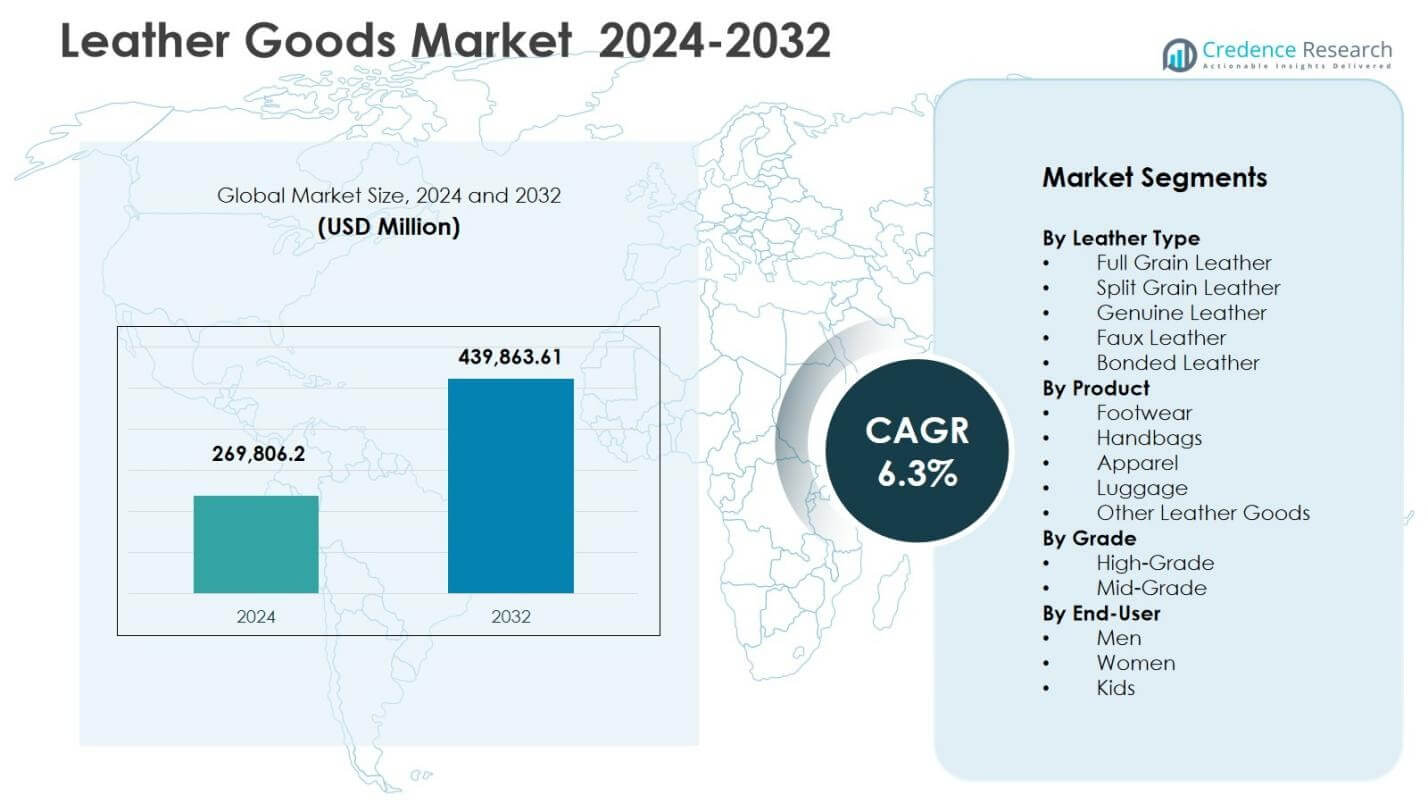
Leather Goods Market size was valued USD 269,806.2 Million in 2024 and is anticipated to reach USD 439,863.61 Million by 2032, at a CAGR of 6.3% during the forecast period.
| REPORT ATTRIBUTE | DETAILS |
|---|---|
| Historical Period | 2020-2023 |
| Base Year | 2024 |
| Forecast Period | 2025-2032 |
| Leather Goods Market Size 2024 | USD 269,806.2 million |
| Leather Goods Market, CAGR | 6.3% |
| Leather Goods Market Size 2032 | USD 439,863.61 million |
Leather Goods Market Insights
- Strong market growth is driven by rising demand for premium handbags, footwear, and lifestyle accessories, increasing luxury consumer spending, and expanding e-commerce and omnichannel retail participation across global fashion markets.
- Market trends emphasize sustainability adoption, eco-friendly tanning processes, personalized leather products, designer collaborations, and greater brand focus on premium craftsmanship, quality differentiation, and high-value leather categories across consumer segments.
- Leading players strengthen market presence through brand heritage, product innovation, luxury positioning, and retail expansion strategies, while emerging brands focus on affordability, mid-grade offerings, and wider distribution networks.
- Regional analysis shows Europe holding 32.1% share, Asia-Pacific at 28.6%, and North America at 27.4%, while by product, the Footwear segment leads with 41.2% share in 2024, supported by strong global consumer demand.
Leather Goods Market Segmentation Analysis:
By Leather Type
The Leather Goods Market by leather type is led by Full Grain Leather, which accounted for 34.6% share in 2024, driven by its durability, premium texture, and preference in luxury footwear, handbags, and premium accessories. Genuine Leather captured 28.4% share, supported by widespread use in mid-range consumer products, while Faux Leather held 22.1% share, benefiting from rising vegan fashion adoption and sustainability preferences. Split Grain Leather represented 9.3% share due to its cost-effective applications, and Bonded Leather accounted for 5.6% share, primarily driven by budget-segment upholstery and accessories.
- For instance, Nanushka's in-house OKOBOR™ alt-leather, made via a dry process using 56% recycled polyester and 44% polyurethane (80% less water than wet methods), outfits items like the Jen Drawstring bag for ethical vegan fashion.
By Product
By product, Footwear emerged as the dominant segment with 41.2% share in 2024, supported by strong demand for formal shoes, luxury sneakers, and leather boots across global fashion markets. Handbags accounted for 24.7% share, driven by premium branding, women’s fashion trends, and high retail margins. Apparel held 13.9% share due to rising demand for leather jackets and fashion garments, while Luggage contributed 11.6% share with growth in travel accessories. Other Leather Goods including belts, wallets, and small accessories represented 8.6% share, supported by expanding lifestyle and gifting categories.
- For instance, Tumi launched its “19 Degree” polycarbonate and leather-trimmed line catering to premium travelers, and Samsonite introduced hybrid cabin collections blending leather aesthetics with recycled materials.
By Grade
By grade, High-Grade Leather dominated the market with 52.8% share in 2024, driven by increasing demand for premium fashion accessories, luxury footwear, and branded handbags supported by strong consumer willingness to pay for craftsmanship and durability. Mid-Grade Leather accounted for 47.2% share, expanding steadily due to its balance of affordability and quality across mass-market bags, wallets, apparel, and footwear. Growth in the mid-grade category is also supported by rising urban consumption, private-label brands, and broader retail penetration in emerging economies.
Key Growth Drivers
Rising Demand for Premium and Luxury Fashion Accessories
The Leather Goods Market grows significantly due to increasing consumer preference for premium and luxury fashion accessories across handbags, footwear, and luggage categories. Higher disposable incomes, urban lifestyle expansion, and strong aspirational purchasing behavior drive demand for full-grain and high-grade leather products. Luxury brands leverage heritage craftsmanship, brand equity, and exclusivity positioning to strengthen consumer loyalty, particularly in Europe, North America, and fast-growing Asian markets. The rise of luxury retail networks, premium online platforms, and celebrity-influenced fashion culture further accelerates product adoption. This sustained shift toward high-value leather goods strengthens revenue growth and premium segment penetration across global markets.
- For instance, Louis Vuitton emphasizes premium monogram leather in recent collections, such as the VVN Collection using natural cowhide that develops a patina over time for longevity.
Expansion of E-Commerce and Omnichannel Retail Distribution
Rapid digitalization and the growth of e-commerce platforms significantly enhance market accessibility for leather goods manufacturers and brands. Online retail enables broader product visibility, personalized shopping experiences, and direct-to-consumer distribution models that improve margins and customer engagement. Omnichannel strategies including flagship stores, digital storefronts, and marketplace integrations support seamless purchasing journeys and deep brand interactions. The integration of virtual try-ons, AR-based product viewing, and AI-enabled recommendations strengthens conversion rates. Increasing cross-border e-commerce, flexible payment systems, and logistics advancements further expand market reach across emerging economies, supporting sustained sales growth across footwear, apparel, handbags, and lifestyle accessories.
- For instance, Alibaba’s AliExpress expanded its Cross-Border “Choice” logistics program to support delivery to over 200 countries with end-to-end tracking and consolidated shipping, enabling faster fulfillment and improved reliability for international fashion and accessories orders
Growth in Sustainable and Ethical Leather Sourcing Practices
The Leather Goods Market witnesses strong growth as manufacturers adopt sustainable sourcing, eco-friendly tanning technologies, and ethically produced leather materials to align with evolving consumer expectations. Brands increasingly invest in traceable supply chains, chrome-free tanning, water-efficient processing, and responsible livestock sourcing to reduce environmental impact. Growing acceptance of recycled leather, bio-based alternatives, and certified materials strengthens brand reputation among environmentally conscious consumers. Retailers emphasize transparency, sustainability labeling, and ESG-aligned manufacturing standards to comply with global regulations. These initiatives enhance brand credibility, attract premium consumers, and support long-term industry transformation toward responsible production practices.
Key Trends and Opportunities
Increasing Adoption of Designer Collaborations and Personalization
A major trend shaping the Leather Goods Market is the rising popularity of designer collaborations, limited-edition product lines, and personalized leather accessories that enhance brand differentiation and customer engagement. Luxury and premium brands partner with fashion designers, artists, and lifestyle influencers to launch signature collections that create exclusivity and high perceived value. At the same time, personalization features such as monogramming, custom stitching, and material customization strengthen emotional ownership and repeat purchases. The growth of digital configurators and made-to-order platforms enables tailored product design experiences, opening new revenue opportunities in high-margin lifestyle and luxury categories.
- For instance, Louis Vuitton collaborated with Pharrell Williams and Tyler, the Creator for the Spring 2024 Men's Capsule Collection, featuring leather goods like the Sac Golf bag with a hand-drawn Craggy Monogram motif in pastel shades and Airedale Terrier-patterned lining.
Strong Market Opportunity in Emerging Economies and Youth Fashion Segments
Rapid urbanization, rising middle-class purchasing power, and expanding fashion awareness across emerging markets create strong growth opportunities for leather goods manufacturers. Young consumer segments increasingly adopt premium footwear, handbags, and lifestyle accessories as status and lifestyle identifiers. International brands are expanding retail footprints in Asia-Pacific, Latin America, and the Middle East through franchise networks, online channels, and localized product strategies. Growth in organized retail, fashion e-commerce penetration, and exposure to global fashion trends further accelerates demand. These dynamics provide significant expansion potential across mid-grade and premium product segments with strong long-term consumption outlook.
- For instance, Zalora in Southeast Asia and Tata CLiQ Luxury in India have both broadened their premium accessory segments, providing brands with regional exposure to style-conscious consumers.
Key Challenges
Fluctuating Raw Material Prices and Supply Chain Vulnerabilities
The Leather Goods Market faces challenges arising from volatility in raw material costs, including hides, chemicals, and processing inputs, which directly impact manufacturing expenses and pricing stability. Supply chain disruptions related to livestock availability, transportation constraints, and geopolitical uncertainties further increase production risk for manufacturers. Small and mid-scale producers experience higher cost pressure due to limited procurement leverage and dependency on third-party suppliers. Additionally, currency fluctuations and regulatory changes across exporting regions affect profitability and inventory planning. These factors compel market participants to adopt strategic sourcing, cost-optimization initiatives, and resilient supply chain management frameworks.
Regulatory Compliance and Sustainability Pressure on Manufacturing Practices
Stringent environmental, labor, and material-compliance regulations present a major challenge for leather manufacturers, particularly in regions with evolving sustainability frameworks and ethical sourcing mandates. Requirements related to waste treatment, chemical usage, worker safety, and product traceability increase operational complexity and compliance costs. Brands must invest in technology upgrades, certified processes, and transparent reporting mechanisms to meet global ESG standards. Failure to comply may result in reputational risks, product restrictions, or market access limitations. At the same time, pressure to balance sustainability commitments with affordability and performance expectations creates operational and strategic challenges for industry participants.
Regional Analysis
North America
North America accounted for 27.4% share of the Leather Goods Market in 2024, driven by strong demand for premium handbags, footwear, and leather apparel across the United States and Canada. The market benefits from high consumer purchasing power, well-established luxury retail networks, and significant adoption of branded lifestyle accessories. Growth is further supported by the expansion of e-commerce channels, rising interest in designer and customized leather goods, and increasing uptake of sustainable and ethically sourced leather products. Leading brands strengthen market penetration through digital-first retail strategies, experiential stores, and premium product positioning across urban consumer segments.
Europe
Europe held 32.1% share of the Leather Goods Market in 2024, making it the leading regional market due to the dominance of luxury fashion houses, strong heritage manufacturing, and high export orientation across Italy, France, and the United Kingdom. The region benefits from strong consumer affinity toward handcrafted and high-grade leather accessories, supported by strong tourism-driven luxury purchases. Growth is reinforced by innovation in sustainable tanning processes, premium craftsmanship, and expanding designer collaborations. The presence of global luxury brands and well-developed retail infrastructure further strengthens Europe’s leadership position across handbags, footwear, luggage, and premium lifestyle accessories.
Asia-Pacific
Asia-Pacific captured 28.6% share of the Leather Goods Market in 2024, supported by rapid urbanization, rising middle-class consumption, and strong growth in fashion and lifestyle spending across China, India, Japan, and Southeast Asia. Expanding retail networks, increasing brand consciousness among youth consumers, and the rise of cross-border e-commerce significantly boost market adoption. Premium and luxury leather accessories gain traction as status and lifestyle symbols, while domestic manufacturers scale production for global brands. Growing investments in fashion manufacturing clusters and accelerating penetration of international brands position Asia-Pacific as the fastest-growing regional market over the forecast period.
Latin America
Latin America accounted for 6.9% share of the Leather Goods Market in 2024, supported by increasing fashion retail activity, growth in urban consumer spending, and rising adoption of leather footwear, handbags, and lifestyle accessories across Brazil, Mexico, and Argentina. The region benefits from strong domestic leather production capabilities and expanding participation of regional brands in mid-grade and premium product categories. Growth is further influenced by the expansion of online retail channels, increasing exposure to global fashion trends, and strengthening demand for durable and stylish leather goods among young urban consumers across major metropolitan markets.
Middle East and Africa
The Middle East and Africa region represented 5.0% share of the Leather Goods Market in 2024, driven by rising luxury consumption in Gulf countries, expanding tourism retail, and increasing demand for premium handbags, footwear, and luggage among high-income consumer groups. Growth is supported by the presence of international luxury boutiques, airport retail clusters, and luxury mall developments across the UAE and Saudi Arabia. In Africa, market expansion is influenced by gradual urban lifestyle adoption and the emergence of regional fashion brands. Increasing premium retail investments and expanding digital commerce platforms continue to enhance market penetration across key cities.
Leather Goods Market Segmentations:
By Leather Type
- Full Grain Leather
- Split Grain Leather
- Genuine Leather
- Faux Leather
- Bonded Leather
By Product
- Footwear
- Handbags
- Apparel
- Luggage
- Other Leather Goods
By Grade
- High-Grade
- Mid-Grade
By End-User
- Men
- Women
- Kids
By Geography
- North America
- U.S.
- Canada
- Mexico
- Europe
- Germany
- France
- U.K.
- Italy
- Spain
- Rest of Europe
- Asia Pacific
- China
- Japan
- India
- South Korea
- South-east Asia
- Rest of Asia Pacific
- Latin America
- Brazil
- Argentina
- Rest of Latin America
- Middle East & Africa
- GCC Countries
- South Africa
- Rest of the Middle East and Africa
Competitive Landscape
Competitive landscape analysis in the Leather Goods Market highlights leading players such as LVMH, Kering, Tapestry, Hermès, Burberry, Prada Group, Richemont Group, Hugo Boss, Capri Holdings, and Coach. These companies strengthen their positions through premium branding, craftsmanship excellence, diversified product portfolios, and strong retail networks across luxury handbags, footwear, apparel, and accessories. The market remains highly consolidated at the top tier, where global luxury houses leverage heritage value, celebrity endorsements, and exclusive product launches to sustain brand equity and pricing power. Mid-tier and emerging brands focus on affordability, design innovation, and expanding omnichannel distribution to capture mass-market consumers. Strategic initiatives including mergers, acquisitions, and designer collaborations support portfolio expansion and geographic penetration. Sustainability, ethical sourcing, and traceable leather production increasingly shape competitive differentiation, as brands invest in eco-friendly tanning, recycled materials, and transparency initiatives. Digital commerce, personalization features, and experiential retail formats further influence brand competitiveness and long-term market leadership.
Key Player Analysis
- Richemont Group
- Burberry
- Tapestry
- Hugo Boss
- Prada Group
- Natuzzi
- Hermès
- Belle
- LVMH
- Kering
Recent Developments
- In July 2025, British luxury leather goods maker Smythson of Bond Street was acquired by private equity firm Oakley Capital, aiming to accelerate the brand’s expansion in the U.S., Europe, and Japan markets.
- In July 2025, Tapestry Inc. expanded its partnership with Gen Phoenix by increasing its equity stake to 9.9% through a $15 million funding round and signing a three-year supply agreement for recycled leather materials used in Coach and Kate Spade products.
- In March 2025, handbag brand Miraggio expanded its product portfolio by launching a new Bag Charms Collection, tapping into growing demand for personalized and accessory-driven leather goods.
Report Coverage
The research report offers an in-depth analysis based on Leather Type, Product, Grade, End User and Geography. It details leading market players, providing an overview of their business, product offerings, investments, revenue streams, and key applications. Additionally, the report includes insights into the competitive environment, SWOT analysis, current market trends, as well as the primary drivers and constraints. Furthermore, it discusses various factors that have driven market expansion in recent years. The report also explores market dynamics, regulatory scenarios, and technological advancements that are shaping the industry. It assesses the impact of external factors and global economic changes on market growth. Lastly, it provides strategic recommendations for new entrants and established companies to navigate the complexities of the market.
Future Outlook
- The market will continue to grow as premium and luxury leather accessories gain stronger consumer adoption across global fashion markets.
- Brands will increasingly invest in sustainable leather sourcing, eco-friendly tanning processes, and greater supply-chain transparency.
- Digital commerce and omnichannel retail models will expand further, strengthening direct-to-consumer engagement and global market reach.
- Personalization, customization, and limited-edition product strategies will play a greater role in driving brand loyalty and repeat purchases.
- Demand from emerging economies will rise as urbanization, fashion awareness, and middle-class spending power increase.
- Technology integration in design, manufacturing, and inventory management will enhance production efficiency and product consistency.
- Premium footwear, handbags, and lifestyle accessories will remain core revenue-generating categories for leading brands.
- Collaborations between luxury brands, designers, and creative artists will create new differentiation and marketing opportunities.
- Sustainability certifications and ethical compliance standards will become critical to brand positioning and consumer trust.
- The competitive landscape will intensify as global luxury houses expand portfolios while regional players strengthen presence in mid-grade segments.

Request a Free Sample
Fill in your details and we'll send you a free sample report.
- Sample data tables & charts
- Research methodology
Need a Custom Version of This Report?
Tailor the scope, geography, or segments to your exact requirements.
- Custom geography or segment scope
- Direct access to our analyst team
Frequently Asked Questions
What is the current market size for the Leather Goods Market, and what is its projected size in 2032?
At what Compound Annual Growth Rate is the Leather Goods Market projected to grow between 2024 and 2032?
Which Leather Goods Market segment held the largest share in 2024?
What are the primary factors fueling the growth of the Leather Goods Market?
Who are the leading companies in the Leather Goods Market?
Which region commanded the largest share of the Leather Goods Market in 2024?
Table of Content
Chapter 1 Market Segmentation
- 1.1 Segmentation Framework
- 1.1.1 Product and Service Classification
- 1.1.2 Application and End-Use Classification
- 1.1.3 Technology and Solution Classification
- 1.1.4 Customer and Distribution Channel Classification
- 1.1.5 Geographic Segmentation
- 1.1.6 Market Segment Definitions and Boundaries
Chapter 2 Introduction
- 2.1 Report Objectives and Scope
- 2.2 Product Definition and Industry Terminology
- 2.3 Market Inclusions and Exclusions
- 2.4 Research Process
- 2.4.1 Primary Research and Expert Interviews
- 2.4.2 Secondary Research and Source Review
- 2.4.3 Top-Down and Bottom-Up Estimation
- 2.4.4 Data Triangulation and Verification
- 2.5 Market Size Measurement Basis
- 2.5.1 2024: USD 269,806.2 Million → 2032: USD 439,863.61 Million
- 2.6 Historical and Forecast Reference Periods
- 2.6.1 Base Year: 2024
- 2.6.2 Forecast Period: 2024-2032
- 2.7 Research Assumptions and Limitations
Chapter 3 Executive Summary
- 3.1 Market Snapshot and Key Findings
- 3.2 Base-Year Market Size, 2024
- 3.3 Forecast Market Size, 2032
- 3.4 Revenue and Volume Growth Outlook
- 3.5 Key Demand and Supply Indicators
- 3.6 Leading Market Segments
- 3.7 Fastest-Growing Market Opportunities
- 3.8 Regional Performance Highlights
- 3.9 Technology and Industry Transformation
- 3.10 Competitive Landscape Summary
- 3.11 Analyst View and Strategic Implications
Chapter 4 Global Leather Goods Market Trends and Developments
- 4.1 Historical Industry Development
- 4.2 Recent Market Trends and Developments
- 4.3 Demand and Customer Behavior Trends
- 4.4 Technology and Product Innovation
- 4.5 Artificial Intelligence, Automation and Digitalization
- 4.6 Local Manufacturing and Supply Chain Realignment
- 4.7 Industry Partnerships, Mergers and Acquisitions
- 4.8 Sustainability and Circular Economy Developments
- 4.9 Government and Private Sector Investment Trends
- 4.10 Emerging Business Models and Commercialization
- 4.11 Industry Developments and Announcements
Chapter 5 Global Leather Goods Market Production, Supply and Demand Analysis
- 5.1 Demand Trend and Consumption Analysis
- 5.2 Demand Forecast, 2024-2032
- 5.3 Production and Output Trend
- 5.4 Production and Output Forecast, 2024-2032
- 5.5 Installed Capacity and Capacity Utilization
- 5.6 Company-Wise Production Plants and Statistics
- 5.6.1 Installed Production Capacity
- 5.6.2 Actual Production
- 5.6.3 Planned Capacity and Expansion Targets
- 5.7 Supply Chain Structure and Procurement Trends
- 5.8 Supply-Demand Gap and Bottlenecks
- 5.9 Import Dependence and Sourcing Structure
- 5.10 Contract Manufacturing and Outsourcing
- 5.11 Regional Supply and Demand Concentration
Chapter 6 Global Leather Goods Market Pricing Analysis
- 6.1 Pricing Structure and Measurement
- 6.2 Historical Pricing Trends
- 6.3 Pricing Outlook, 2024-2032
- 6.4 Average Selling Price and Unit Economics
- 6.5 Pricing by Product and Market Segment
- 6.6 Geographic Pricing Differences
- 6.7 Key Input, Energy, Labor and Logistics Costs
- 6.8 Contract Pricing and Purchasing Models
- 6.9 Pricing Sensitivity and Competitive Positioning
- 6.10 Price, Margin and Profitability Implications
Chapter 7 Global Leather Goods Market Dynamics
- 7.1 Market Growth Drivers
- 7.1.1 Demand-Side Drivers
- 7.1.2 Technology and Innovation Drivers
- 7.1.3 Infrastructure and Investment Drivers
- 7.1.4 Regulatory and Policy Drivers
- 7.2 Market Restraints
- 7.2.1 Cost and Affordability Constraints
- 7.2.2 Technology and Adoption Barriers
- 7.2.3 Supply Chain and Operational Constraints
- 7.3 Market Challenges
- 7.3.1 Competitive Pressure and Margin Erosion
- 7.3.2 Skills, Infrastructure and Implementation Gaps
- 7.4 Emerging Market Opportunities
- 7.5 Market Dynamics Impact and Time-Horizon Assessment
Chapter 8 Global Leather Goods Value Chain Analysis
- 8.1 Industry Value Chain Overview
- 8.2 Upstream Suppliers and Critical Inputs
- 8.3 Technology and Component Providers
- 8.4 Manufacturing or Service Delivery
- 8.5 Distribution, Channel Partners and Integrators
- 8.6 Downstream Applications and End Users
- 8.7 Value Addition and Profit Pools
- 8.8 Vertical Integration and Outsourcing
- 8.9 Supplier Concentration and Risk
- 8.10 Supply Chain Localization and Resilience
Chapter 9 Global Leather Goods Market Regulations and Policies
- 9.1 Relevant Laws, Standards and Compliance Frameworks
- 9.2 Product, Service, Safety and Quality Requirements
- 9.3 Government Policies, Incentives and Subsidies
- 9.4 Imports, Exports and Trade Barriers
- 9.5 Public Procurement and Local Content Requirements
- 9.6 Environmental and Sustainability Compliance
- 9.7 Upcoming Policy Changes and Market Implications
Chapter 10 Global Leather Goods Market Hotspots and Opportunities
- 10.1 Market Opportunity Mapping and Growth Hotspots
- 10.2 High-Growth Applications and Customer Groups
- 10.3 Underserved Markets and White-Space Opportunities
- 10.4 Emerging Technology and Product Opportunities
- 10.5 New Capacity and Investment Hotspots
- 10.6 Market Entry and Expansion Opportunities
- 10.7 Distribution and Partnership Opportunities
- 10.8 Near-Term and Long-Term Commercial Potential
- 10.9 Opportunity Attractiveness and Execution Risks
Chapter 11 Global Leather Goods Market Outlook, 2024-2032
- 11.1 Market Size and Analysis
- 11.1.1 Revenue (Market Measurement: 2024: USD 269,806.2 Million → 2032: USD 439,863.61 Million)
- 11.1.2 Market Volume and Quantity Sold
- 11.1.3 Historical Market Size
- 11.1.4 Base-Year Market Size, 2024
- 11.2 Market Forecast, 2024-2032
- 11.2.1 Revenue Forecast to 2032
- 11.2.2 Volume Forecast to 2032
- 11.2.3 CAGR and Year-on-Year Growth
- 11.2.4 Incremental Revenue Opportunity
- 11.3 Forecast Assumptions and Scenario Analysis
- 11.3.1 Base-Case Forecast
- 11.3.2 Optimistic and Conservative Scenarios
- 11.3.3 Technology, Pricing and Policy Sensitivities
- 11.4 Market Attractiveness and Growth Outlook
Chapter 12 Global Leather Goods Market Segmentation and Outlook
- 12.1 Segmentation Summary and Market Shares, 2024
- 12.2 Largest and Fastest-Growing Segments
- 12.3 Segment Growth Comparison
- 12.4 Segment Attractiveness and Priority Matrix
Chapter 13 Global Leather Goods Geographic Market Outlook, 2024-2032
- 13.1 Regional Market Size and Share, 2024
- 13.2 Regional Market Forecast, 2024-2032
- 13.3 Regional Pricing, Production and Demand Differences
- 13.4 North America
- 13.4.1 United States
- 13.4.2 Canada
- 13.4.3 Mexico
- 13.5 Europe
- 13.5.1 Germany
- 13.5.2 France
- 13.5.3 Italy
- 13.5.4 United Kingdom
- 13.5.5 Spain
- 13.5.6 Poland
- 13.5.7 Russia
- 13.5.8 Netherlands
- 13.5.9 Belgium
- 13.5.10 Sweden
- 13.5.11 Denmark
- 13.5.12 Norway
- 13.5.13 Rest of Europe
- 13.6 Asia Pacific
- 13.6.1 China
- 13.6.2 India
- 13.6.3 Japan
- 13.6.4 South Korea
- 13.6.5 Thailand
- 13.6.6 Indonesia
- 13.6.7 Vietnam
- 13.6.8 Malaysia
- 13.6.9 Australia
- 13.6.10 Rest of Asia Pacific
- 13.7 Latin America
- 13.7.1 Brazil
- 13.7.2 Argentina
- 13.7.3 Colombia
- 13.7.4 Chile
- 13.7.5 Rest of Latin America
- 13.8 Middle East
- 13.8.1 Saudi Arabia
- 13.8.2 United Arab Emirates
- 13.8.3 Turkey
- 13.8.4 Israel
- 13.8.5 Iran
- 13.8.6 Rest of the Middle East
- 13.9 Africa
- 13.9.1 South Africa
- 13.9.2 Egypt
- 13.9.3 Nigeria
- 13.9.4 Morocco
- 13.9.5 Rest of Africa
- 13.10 Regional Investment, Policy and Supply Chain Differences
- 13.11 Regional Competitive Landscape
- 13.12 Geographic Growth Hotspots
Chapter 14 Global Leather Goods Technology, Innovation and Sustainability Outlook
- 14.1 Technology Landscape and Maturity
- 14.2 Product, Process and Service Innovation
- 14.3 AI, Automation and Digital Tools in the Industry
- 14.4 Technology Adoption and Performance Benchmarking
- 14.5 Innovation Pipeline and R&D Investment
- 14.6 Patent and Intellectual Property Trends
- 14.7 Energy Efficiency and Resource Management
- 14.8 Sustainability, Recycling and Circularity
- 14.9 Technology Roadmap, 2024-2032
- 14.10 Risks of Obsolescence and Technology Substitution
Chapter 15 Global Leather Goods Market Key Strategic Imperatives
- 15.1 Growth and Market Entry Priorities
- 15.2 High-Return Products and Segments
- 15.3 Pricing, Profitability and Cost Optimization
- 15.4 Technology Investment and Product Differentiation
- 15.5 Supply Chain Localization and Resilience
- 15.6 Distribution and Customer Acquisition
- 15.7 Partnership, Acquisition and Capacity Strategy
- 15.8 Regional Expansion Priorities
- 15.9 Short-, Medium- and Long-Term Actions
Chapter 16 Competition Outlook
- 16.1 Industry Competition Characteristics
- 16.2 Market Structure and Concentration
- 16.3 Market Share and Competitive Positioning, 2024
- 16.4 Company-Wise Revenue and Product Benchmarking
- 16.5 Production and Service Capacity Benchmarking
- 16.6 Technology, Pricing and Differentiation
- 16.7 Regional Footprint and Distribution Strength
- 16.8 Mergers, Acquisitions and Strategic Alliances
- 16.9 New Entrants and Competitive Threats
- 16.10 Porter's Five Forces and Industry Attractiveness
- 16.11 Competitive Outlook, 2024-2032
Chapter 17 Company Profiles
- 17.1 Company Coverage and Selection Criteria
- 17.2 Leading Market Participants – Standard Profile Structure
- 17.2.1 Business Description
- 17.2.2 Company Ownership and Geographic Presence
- 17.2.3 Product and Service Portfolio
- 17.2.4 Manufacturing and Operating Footprint
- 17.2.5 Production Capacity and Expansion Plans
- 17.2.6 Financial Performance and Investment
- 17.2.7 Market Share and Competitive Position
- 17.2.8 Technology and Innovation Capabilities
- 17.2.9 Strategic Alliances or Partnerships
- 17.2.10 Recent Developments
- 17.2.11 Growth Strategy and Outlook
- 17.3 Other Relevant Market Participants
Note: Every listed company is profiled on the structure shown under the first company. The company list is preliminary and may change based on research findings, market developments, data availability and client requirements.
Chapter 18 Disclaimer
- 18.1 Research and Forecast Disclaimer
- 18.2 Data Source and Estimation Limitations
Note: The depth of individual sections depends on data availability for this market. Volume, capacity, trade and other unit-based metrics are included where applicable.