
Market Overview:
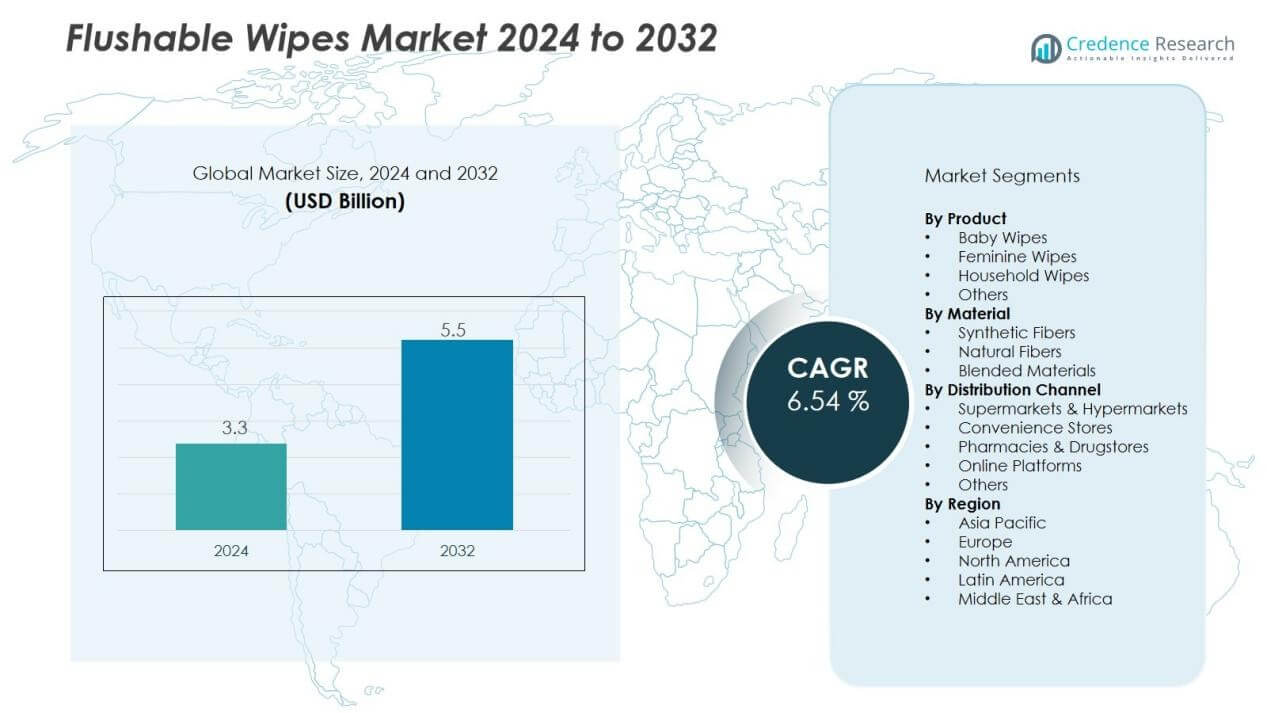
The flushable wipes market size was valued at USD 3.3 billion in 2024 and is anticipated to reach USD 5.5 billion by 2032, at a CAGR of 6.54% during the forecast period (2024-2032).
| REPORT ATTRIBUTE | DETAILS |
|---|---|
| Historical Period | 2020-2023 |
| Base Year | 2024 |
| Forecast Period | 2025-2032 |
| Flushable Wipes Market Size 2024 | USD 3.3 Billion |
| Flushable Wipes Market, CAGR | 6.54% |
| Flushable Wipes Market Size 2032 | USD 5.5 Billion |
Market growth is driven by several key factors. Increasing urbanization and busy lifestyles have heightened the demand for quick and hygienic cleaning products. Rising adoption of flushable wipes in baby care, feminine hygiene, and household cleaning contributes to market penetration. Sustainability concerns are pushing manufacturers to focus on eco-friendly, biodegradable wipes, which attract environmentally conscious consumers. Retailers and online platforms are also expanding product reach through diversified distribution networks.
Regionally, North America holds a leading share of the flushable wipes market, supported by high consumer awareness and strong retail infrastructure. Europe follows, driven by strict hygiene standards and a growing focus on sustainability. Asia-Pacific is expected to witness the fastest growth, fueled by rising disposable incomes, increasing urban populations, and growing demand for convenient hygiene products in countries such as China and India.
Market Insights:
- The flushable wipes market was valued at USD 3.3 billion in 2024 and is projected to reach USD 5.5 billion by 2032.
- Rising consumer demand for convenient hygiene products is a major driver of market growth.
- Expanding applications in baby care, feminine hygiene, and household cleaning continue to strengthen adoption.
- Sustainability trends are pushing manufacturers to invest in biodegradable and eco-friendly product innovations.
- Retail and e-commerce expansion ensures wider product availability and supports global consumer access.
- Challenges include environmental concerns, mislabeling issues, and stricter regulatory pressures across major markets.
- North America leads with over 35% market share, followed by Europe at nearly 30% and Asia-Pacific at 25%.
Market Drivers:
Rising Consumer Demand for Convenient Hygiene Products:
The flushable wipes market benefits from growing consumer preference for convenience in daily hygiene. Busy lifestyles and urbanization have increased reliance on disposable solutions that save time and effort. Consumers view flushable wipes as an effective alternative to traditional cleaning methods. It is gaining traction in both personal care and household applications due to ease of use.
Expanding Applications Across Baby Care, Feminine Care, and Household Cleaning:
Market growth is supported by diverse product use in baby care, feminine hygiene, and household cleaning. Parents prefer flushable wipes for their softness and convenience in baby care routines. Women use them for on-the-go hygiene, while households adopt them for quick cleaning. This versatility strengthens consumer loyalty and widens product adoption in the flushable wipes market.
- For instance, Cottonelle GentlePlus Flushable Wipes begin to disintegrate in just 17 seconds during the slosh-box test and fully break down after 30 minutes under ASTM-compliant conditions, ensuring safe plumbing compatibility.
Sustainability and Shift Toward Eco-Friendly, Biodegradable Materials:
Rising environmental awareness drives the need for biodegradable and eco-friendly wipes. Manufacturers are investing in plant-based fibers and water-dispersible materials that reduce sewer blockages. Consumers are increasingly selecting products labeled as safe for the environment. It encourages companies to innovate and align with regulatory expectations on sustainability.
- For Instances, In 2020, Kimberly-Clark introduced Huggies® Pure Biodegradable Baby Wipes in the UK, which are plastic-free and made with 100% naturally derived fibers and 99% water. Independent testing showed these wipes biodegraded in 15 days under specific, simulated laboratory conditions.
Expansion of Retail and Online Distribution Networks:
Strong growth in retail and e-commerce channels supports wider product availability. Supermarkets, pharmacies, and convenience stores ensure easy access to wipes across regions. Online platforms provide price comparison, product reviews, and subscription options, which boost sales. The flushable wipes market leverages this expanded reach to tap into both mature and emerging consumer segments.
Market Trends:
Growing Focus on Sustainability, Biodegradable Materials, and Product Innovation:
The flushable wipes market is witnessing strong momentum toward sustainable and biodegradable solutions. Consumers are increasingly conscious of environmental impact and prefer wipes that are safe for sewer systems. Manufacturers are investing in plant-based fibers, dispersible materials, and water-soluble binders to address concerns of blockages and pollution. Innovation in texture, moisture retention, and fragrance options is creating differentiation among brands. It is driving competition as companies balance performance with eco-friendly claims. Regulatory bodies in Europe and North America are also enforcing stricter labeling standards, which shape product development strategies.
- For instance, Kimberly-Clark’s Cottonelle FreshCare Flushable Wipes utilize 100% plant-based fibers and are engineered to break up completely within 30 minutes.
Expanding Adoption Across Demographics, E-Commerce Growth, and Premium Positioning:
The market is experiencing rising adoption across varied demographics, from parents and women to travelers and urban households. E-commerce platforms play a critical role by offering convenient access, subscription models, and personalized marketing. It is fueling strong online sales growth, especially in Asia-Pacific markets with high smartphone penetration. Premium positioning is also gaining ground, with brands offering dermatologically tested, fragrance-free, or specialty wipes targeting sensitive skin. Product bundling and private label expansion in retail are creating competitive dynamics. The flushable wipes market leverages these trends to increase consumer trust, diversify offerings, and capture long-term growth opportunities.
- For Instance, Unicharm's "Silcot" brand offers sterilizing wet wipes that, according to marketing materials on the company's Japanese website, have a 99.99% sanitizing effect against certain bacteria and maintain an antibacterial effect for up to 24 hours on wiped areas.
Market Challenges Analysis:
Environmental Concerns, Mislabeling Issues, and Regulatory Pressures:
The flushable wipes market faces challenges linked to environmental concerns and product mislabeling. Many products marketed as flushable fail to fully disintegrate, creating sewer blockages and damaging wastewater systems. It has drawn criticism from environmental groups and municipal authorities. Regulatory bodies in the U.S. and Europe are imposing stricter standards to ensure compliance with safety and sustainability claims. Manufacturers must invest in advanced materials and testing to validate product performance. Rising consumer skepticism about true flushability also affects brand trust and market adoption.
High Production Costs, Supply Chain Complexity, and Competitive Pressures:
Manufacturers encounter rising costs associated with sustainable raw materials and advanced technologies. Biodegradable fibers and water-dispersible binders raise production expenses, impacting profitability. It creates pricing pressure in a competitive landscape where private labels and low-cost alternatives expand rapidly. Supply chain disruptions, particularly in fiber and chemical sourcing, add to operational challenges. Companies also struggle to balance affordability with innovation to maintain consumer loyalty. The flushable wipes market requires strategic investment to overcome these constraints and secure long-term growth.
Market Opportunities:
Rising Demand for Eco-Friendly Products and Innovation in Biodegradable Solutions:
The flushable wipes market presents strong opportunities through the growing shift toward eco-friendly and biodegradable wipes. Consumers are willing to pay more for sustainable products that ensure safety for plumbing and the environment. It encourages manufacturers to invest in plant-based fibers, innovative dispersible technologies, and water-soluble binders. Brands that can combine performance with sustainability will gain a competitive advantage. Regulatory support for green products in Europe and North America further strengthens this opportunity. Emerging certifications and transparent labeling can also enhance consumer trust and expand adoption.
Expansion in Emerging Markets and Growth Through E-Commerce Channels:
High population growth and urbanization in Asia-Pacific, Latin America, and the Middle East create fresh demand for convenient hygiene solutions. Rising disposable incomes and awareness of personal hygiene make these regions attractive for global and local players. It opens opportunities for companies to introduce affordable, region-specific product ranges. E-commerce platforms enhance reach, enabling direct-to-consumer sales and subscription models that drive repeat purchases. Partnerships with supermarkets, pharmacies, and online retailers can accelerate distribution expansion. The flushable wipes market can capitalize on these opportunities to secure stronger global growth.
Market Segmentation Analysis:
By Product:
The flushable wipes market is segmented into baby wipes, feminine wipes, household wipes, and others. Baby wipes dominate due to high usage in infant care and parental preference for convenience. Feminine wipes are growing steadily with rising awareness of hygiene among women. Household wipes gain adoption for quick cleaning in kitchens, bathrooms, and on-the-go needs. It supports broader product diversification across consumer categories.
- For instance, Summer’s Eve introduced their Ultimate Odor Protection Daily Refreshing Wipes, formulated with a boric acid complex to support pH balance, in May 2024.
By Material:
The market is categorized by synthetic fibers, natural fibers, and blended materials. Synthetic fibers ensure durability and effective cleaning, but environmental concerns limit their growth. Natural fibers such as cotton and bamboo are gaining popularity for their biodegradability and eco-friendly appeal. Blended materials combine performance with dispersibility, appealing to consumers seeking balance between strength and sustainability. It drives innovation in product design and raw material sourcing.
- For instance, Lenzing AG’s TENCEL™ Modal fiber exhibits 11.0% moisture absorption-about 30% higher than standard viscose-while fully biodegrading in industrial composting within 45 days.
By Distribution Channel:
The flushable wipes market is distributed through supermarkets, convenience stores, pharmacies, and online platforms. Supermarkets hold a leading share due to widespread availability and bulk purchase options. Pharmacies build trust by offering certified products for sensitive skin and healthcare needs. Online platforms are witnessing rapid growth due to ease of access, subscription models, and attractive discounts. It enables companies to reach diverse consumers across both urban and rural areas.
Segmentations:
By Product:
- Baby Wipes
- Feminine Wipes
- Household Wipes
- Others
By Material:
- Synthetic Fibers
- Natural Fibers
- Blended Materials
By Distribution Channel:
- Supermarkets & Hypermarkets
- Convenience Stores
- Pharmacies & Drugstores
- Online Platforms
- Others
By Region:
- North America
- U.S.
- Canada
- Mexico
- Europe
- UK
- France
- Germany
- Italy
- Spain
- Russia
- Belgium
- Netherlands
- Austria
- Sweden
- Poland
- Denmark
- Switzerland
- Rest of Europe
- Asia Pacific
- China
- Japan
- South Korea
- India
- Australia
- Thailand
- Indonesia
- Vietnam
- Malaysia
- Philippines
- Taiwan
- Rest of Asia Pacific
- Latin America
- Brazil
- Argentina
- Peru
- Chile
- Colombia
- Rest of Latin America
- Middle East
- UAE
- KSA
- Israel
- Turkey
- Iran
- Rest of Middle East
- Africa
- Egypt
- Nigeria
- Algeria
- Morocco
- Rest of Africa
Regional Analysis:
North America:
North America holds a market share exceeding 35% in the flushable wipes market, driven by high consumer awareness and robust retail presence. The region benefits from well-established hygiene standards and strong penetration of premium products. It continues to gain traction through innovation in eco-friendly wipes and compliance with stringent regulatory guidelines. The U.S. drives demand through widespread adoption in baby care, feminine hygiene, and household cleaning. Canada contributes with rising consumer preference for sustainable solutions and advanced packaging formats. Strong e-commerce activity supports the distribution of both branded and private-label wipes. Manufacturers leverage this environment to expand premium offerings and strengthen brand loyalty.
Europe:
Europe accounts for nearly 30% market share in the flushable wipes market, supported by strict environmental regulations and consumer demand for biodegradable solutions. Governments enforce labeling standards that ensure product safety for wastewater systems. It creates opportunities for brands to differentiate with certifications and eco-friendly claims. The UK, Germany, and France lead adoption due to rising hygiene awareness and growing preference for sustainable products. Southern and Eastern Europe show rising demand as disposable incomes improve and retail networks expand. Innovation in plant-based fibers and sustainable packaging further strengthens regional product portfolios. Strong partnerships between manufacturers and retailers enhance accessibility across both urban and rural markets.
Asia-Pacific:
Asia-Pacific holds a market share of 25% in the flushable wipes market and demonstrates the fastest growth rate globally. Rising urbanization, expanding middle-class populations, and increasing disposable incomes drive strong demand for convenient hygiene products. It attracts global brands and local players to introduce affordable and accessible solutions. China, India, and Japan lead adoption, supported by high birth rates, growing awareness of personal hygiene, and rapid expansion of modern retail. Southeast Asian countries also present opportunities due to increasing smartphone penetration and rising e-commerce sales. Localized product development strategies, including cost-effective biodegradable wipes, help manufacturers capture emerging consumer segments. The region’s dynamic demand positions it as a critical growth engine for long-term market expansion.
Key Player Analysis:
- Ahlstrom
- Berry
- Albaad
- Codi Group
- John Dale
- Diamond Wipes
- Kelheim Fibres
- NEVA Global
- Kimberly-Clark
- Nice-Pak
- P&G
- Nölken Hygiene Products
Competitive Analysis:
The flushable wipes market is highly competitive, with global and regional players focusing on innovation and sustainability to strengthen their positions. Key companies include Ahlstrom, Berry, Albaad, Codi Group, John Dale, Diamond Wipes, Kelheim Fibres, NEVA Global, and Kimberly-Clark. It is characterized by continuous investment in biodegradable materials and dispersible fiber technologies to address environmental concerns and regulatory pressures. Leading players emphasize product diversification, targeting baby care, feminine hygiene, and household applications to expand consumer reach. Strategic partnerships with retailers and e-commerce platforms support broader distribution and brand visibility. Companies are also enhancing premium offerings, such as dermatologically tested and eco-certified wipes, to cater to rising consumer demand for safe and sustainable products. Competitive intensity remains high, with private-label expansion from retailers adding price pressure. The flushable wipes market continues to evolve through innovation, sustainability commitments, and aggressive competition across all major segments.
Recent Developments:
- In January 2025, Ahlstrom completed the acquisition of the Stevens Point operation in Wisconsin, USA, enhancing its manufacturing platform and capabilities in the food and consumer packaging segment.
- In September 2025, Ahlstrom presented new sustainable fiber-based specialty label materials at Labelexpo Europe 2025 in Barcelona, showcasing its proprietary Acti-V technology for pressure-sensitive adhesive labels.
Report Coverage:
The research report offers an in-depth analysis based on Product, Material, Distribution Channel and Region. It details leading Market players, providing an overview of their business, product offerings, investments, revenue streams, and key applications. Additionally, the report includes insights into the competitive environment, SWOT analysis, current Market trends, as well as the primary drivers and constraints. Furthermore, it discusses various factors that have driven Market expansion in recent years. The report also explores Market dynamics, regulatory scenarios, and technological advancements that are shaping the industry. It assesses the impact of external factors and global economic changes on Market growth. Lastly, it provides strategic recommendations for new entrants and established companies to navigate the complexities of the Market.
Future Outlook:
- Rising demand for biodegradable and eco-friendly wipes will drive innovation and product launches.
- Regulatory compliance on labeling and flushability standards will shape product development strategies.
- Consumer preference for sustainable solutions will strengthen the adoption of plant-based and dispersible fibers.
- Expansion of e-commerce platforms will enhance direct-to-consumer access and subscription-based sales.
- Private-label growth from retailers will intensify competition and pressure pricing strategies.
- Premiumization of wipes with dermatological testing and sensitive-skin formulations will gain market traction.
- Emerging economies in Asia-Pacific and Latin America will create new opportunities for global players.
- Partnerships between manufacturers and retailers will boost brand visibility and distribution reach.
- Advancements in packaging formats will improve convenience, sustainability, and consumer appeal.
- The flushable wipes market will continue evolving through innovation, regional expansion, and consumer-driven sustainability trends.

Request a Free Sample
Fill in your details and we'll send you a free sample report.
- Sample data tables & charts
- Research methodology
Market Dynamics
Convenience and Urban Lifestyles
Increasing urbanization and busy consumer lifestyles are driving demand for quick, easy-to-use hygiene solutions, making flushable wipes a preferred alternative to traditional cleaning methods in both personal and household care.
Expanding Applications in Baby, Feminine, and Household Care
The versatility of flushable wipes across baby care, feminine hygiene, and household cleaning is broadening their adoption, as consumers seek multi-purpose products that offer both effectiveness and ease of use.
Sustainability and Eco-Friendly Innovations
Growing environmental awareness and regulatory pressures are pushing manufacturers to develop biodegradable and plant-based flushable wipes, attracting eco-conscious consumers and helping brands differentiate in a competitive market.
Retail and E-Commerce Channel Expansion
The proliferation of supermarkets, pharmacies, and especially online platforms is increasing product accessibility, enabling brands to reach a wider audience and support repeat purchases through subscription models and direct-to-consumer sales.
Regulatory Compliance and Product Labeling
Stricter regulations around flushability standards and accurate labeling are encouraging innovation in product formulation and testing, ensuring consumer trust and reducing environmental impact, which in turn supports market growth.
Need a Custom Version of This Report?
Tailor the scope, geography, or segments to your exact requirements.
- Custom geography or segment scope
- Direct access to our analyst team
Frequently Asked Questions
What is the current market size for the flushable wipes market, and what is its projected size in 2032?
At what Compound Annual Growth Rate is the flushable wipes market projected to grow between 2024 and 2032?
Which flushable wipes market segment held the largest share in 2024?
What are the primary factors fueling the growth of the flushable wipes market?
Who are the leading companies in the flushable wipes market?
Which region commanded the largest share of the flushable wipes market in 2024?
Table of Content
Chapter 1 Market Segmentation
- 1.1 Segmentation Framework
- 1.1.1 Product and Service Classification
- 1.1.2 Application and End-Use Classification
- 1.1.3 Technology and Solution Classification
- 1.1.4 Customer and Distribution Channel Classification
- 1.1.5 Geographic Segmentation
- 1.1.6 Market Segment Definitions and Boundaries
- 1.2 By Product
- 1.2.1 Baby Wipes
- 1.2.2 Feminine Wipes
- 1.2.3 Household Wipes
- 1.2.4 Others
- 1.3 By Material
- 1.3.1 Synthetic Fibers
- 1.3.2 Natural Fibers
- 1.3.3 Blended Materials
Chapter 2 Introduction
- 2.1 Report Objectives and Scope
- 2.2 Product Definition and Industry Terminology
- 2.3 Market Inclusions and Exclusions
- 2.4 Research Process
- 2.4.1 Primary Research and Expert Interviews
- 2.4.2 Secondary Research and Source Review
- 2.4.3 Top-Down and Bottom-Up Estimation
- 2.4.4 Data Triangulation and Verification
- 2.5 Market Size Measurement Basis
- 2.5.1 2024: USD 3.3 billion → 2032: USD 5.5 billion
- 2.6 Historical and Forecast Reference Periods
- 2.6.1 Base Year: 2024
- 2.6.2 Forecast Period: 2024-2032
- 2.7 Research Assumptions and Limitations
Chapter 3 Executive Summary
- 3.1 Market Snapshot and Key Findings
- 3.2 Base-Year Market Size, 2024
- 3.3 Forecast Market Size, 2032
- 3.4 Revenue and Volume Growth Outlook
- 3.5 Key Demand and Supply Indicators
- 3.6 Leading Market Segments
- 3.7 Fastest-Growing Market Opportunities
- 3.8 Regional Performance Highlights
- 3.9 Technology and Industry Transformation
- 3.10 Competitive Landscape Summary
- 3.11 Analyst View and Strategic Implications
Chapter 4 Global Flushable Wipes Market Trends and Developments
- 4.1 Historical Industry Development
- 4.2 Recent Market Trends and Developments
- 4.3 Demand and Customer Behavior Trends
- 4.4 Technology and Product Innovation
- 4.5 Artificial Intelligence, Automation and Digitalization
- 4.6 Local Manufacturing and Supply Chain Realignment
- 4.7 Industry Partnerships, Mergers and Acquisitions
- 4.8 Sustainability and Circular Economy Developments
- 4.9 Government and Private Sector Investment Trends
- 4.10 Emerging Business Models and Commercialization
- 4.11 Industry Developments and Announcements
Chapter 5 Global Flushable Wipes Market Production, Supply and Demand Analysis
- 5.1 Demand Trend and Consumption Analysis
- 5.2 Demand Forecast, 2024-2032
- 5.3 Production and Output Trend
- 5.4 Production and Output Forecast, 2024-2032
- 5.5 Installed Capacity and Capacity Utilization
- 5.6 Company-Wise Production Plants and Statistics
- 5.6.1 Installed Production Capacity
- 5.6.2 Actual Production
- 5.6.3 Planned Capacity and Expansion Targets
- 5.7 Supply Chain Structure and Procurement Trends
- 5.8 Supply-Demand Gap and Bottlenecks
- 5.9 Import Dependence and Sourcing Structure
- 5.10 Contract Manufacturing and Outsourcing
- 5.11 Regional Supply and Demand Concentration
Chapter 6 Global Flushable Wipes Market Pricing Analysis
- 6.1 Pricing Structure and Measurement
- 6.2 Historical Pricing Trends
- 6.3 Pricing Outlook, 2024-2032
- 6.4 Average Selling Price and Unit Economics
- 6.5 Pricing by Product and Market Segment
- 6.6 Geographic Pricing Differences
- 6.7 Key Input, Energy, Labor and Logistics Costs
- 6.8 Contract Pricing and Purchasing Models
- 6.9 Pricing Sensitivity and Competitive Positioning
- 6.10 Price, Margin and Profitability Implications
Chapter 7 Global Flushable Wipes Market Dynamics
- 7.1 Market Growth Drivers
- 7.1.1 Demand-Side Drivers
- 7.1.2 Technology and Innovation Drivers
- 7.1.3 Infrastructure and Investment Drivers
- 7.1.4 Regulatory and Policy Drivers
- 7.2 Market Restraints
- 7.2.1 Cost and Affordability Constraints
- 7.2.2 Technology and Adoption Barriers
- 7.2.3 Supply Chain and Operational Constraints
- 7.3 Market Challenges
- 7.3.1 Competitive Pressure and Margin Erosion
- 7.3.2 Skills, Infrastructure and Implementation Gaps
- 7.4 Emerging Market Opportunities
- 7.5 Market Dynamics Impact and Time-Horizon Assessment
Chapter 8 Global Flushable Wipes Value Chain Analysis
- 8.1 Industry Value Chain Overview
- 8.2 Upstream Suppliers and Critical Inputs
- 8.3 Technology and Component Providers
- 8.4 Manufacturing or Service Delivery
- 8.5 Distribution, Channel Partners and Integrators
- 8.6 Downstream Applications and End Users
- 8.7 Value Addition and Profit Pools
- 8.8 Vertical Integration and Outsourcing
- 8.9 Supplier Concentration and Risk
- 8.10 Supply Chain Localization and Resilience
Chapter 9 Global Flushable Wipes Market Regulations and Policies
- 9.1 Relevant Laws, Standards and Compliance Frameworks
- 9.2 Product, Service, Safety and Quality Requirements
- 9.3 Government Policies, Incentives and Subsidies
- 9.4 Imports, Exports and Trade Barriers
- 9.5 Public Procurement and Local Content Requirements
- 9.6 Environmental and Sustainability Compliance
- 9.7 Upcoming Policy Changes and Market Implications
Chapter 10 Global Flushable Wipes Market Hotspots and Opportunities
- 10.1 Market Opportunity Mapping and Growth Hotspots
- 10.2 High-Growth Applications and Customer Groups
- 10.3 Underserved Markets and White-Space Opportunities
- 10.4 Emerging Technology and Product Opportunities
- 10.5 New Capacity and Investment Hotspots
- 10.6 Market Entry and Expansion Opportunities
- 10.7 Distribution and Partnership Opportunities
- 10.8 Near-Term and Long-Term Commercial Potential
- 10.9 Opportunity Attractiveness and Execution Risks
Chapter 11 Global Flushable Wipes Market Outlook, 2024-2032
- 11.1 Market Size and Analysis
- 11.1.1 Revenue (Market Measurement: 2024: USD 3.3 billion → 2032: USD 5.5 billion)
- 11.1.2 Market Volume and Quantity Sold
- 11.1.3 Historical Market Size
- 11.1.4 Base-Year Market Size, 2024
- 11.2 Market Forecast, 2024-2032
- 11.2.1 Revenue Forecast to 2032
- 11.2.2 Volume Forecast to 2032
- 11.2.3 CAGR and Year-on-Year Growth
- 11.2.4 Incremental Revenue Opportunity
- 11.3 Forecast Assumptions and Scenario Analysis
- 11.3.1 Base-Case Forecast
- 11.3.2 Optimistic and Conservative Scenarios
- 11.3.3 Technology, Pricing and Policy Sensitivities
- 11.4 Market Attractiveness and Growth Outlook
Chapter 12 Global Flushable Wipes Market Segmentation and Outlook
- 12.1 Segmentation Summary and Market Shares, 2024
- 12.2 Largest and Fastest-Growing Segments
- 12.3 By Product - Market Size and Forecast, 2024-2032
- 12.3.1 Segment Definition and Scope
- 12.3.2 Historical Market Size
- 12.3.3 Revenue Forecast, 2024-2032
- 12.3.4 Volume Forecast, 2024-2032
- 12.3.5 Base-Year Market Share, 2024
- 12.3.6 Segment CAGR and Growth Drivers
- 12.3.7 Subsegment Market Size and Forecast
- 12.3.7.1 Baby Wipes
- 12.3.7.2 Feminine Wipes
- 12.3.7.3 Household Wipes
- 12.3.7.4 Others
- 12.3.8 Subsegment Pricing and Adoption Trends
- 12.3.9 Leading Suppliers and Competition
- 12.3.10 Regional Demand and Opportunities
- 12.4 By Material - Market Size and Forecast, 2024-2032
- 12.4.1 Segment Definition and Scope
- 12.4.2 Historical Market Size
- 12.4.3 Revenue Forecast, 2024-2032
- 12.4.4 Volume Forecast, 2024-2032
- 12.4.5 Base-Year Market Share, 2024
- 12.4.6 Segment CAGR and Growth Drivers
- 12.4.7 Subsegment Market Size and Forecast
- 12.4.7.1 Synthetic Fibers
- 12.4.7.2 Natural Fibers
- 12.4.7.3 Blended Materials
- 12.4.8 Subsegment Pricing and Adoption Trends
- 12.4.9 Leading Suppliers and Competition
- 12.4.10 Regional Demand and Opportunities
- 12.5 Segment Growth Comparison
- 12.6 Segment Attractiveness and Priority Matrix
Chapter 13 Global Flushable Wipes Geographic Market Outlook, 2024-2032
- 13.1 Regional Market Size and Share, 2024
- 13.2 Regional Market Forecast, 2024-2032
- 13.3 Regional Pricing, Production and Demand Differences
- 13.4 North America
- 13.4.1 United States
- 13.4.2 Canada
- 13.4.3 Mexico
- 13.5 Europe
- 13.5.1 Germany
- 13.5.2 France
- 13.5.3 Italy
- 13.5.4 United Kingdom
- 13.5.5 Spain
- 13.5.6 Poland
- 13.5.7 Russia
- 13.5.8 Netherlands
- 13.5.9 Belgium
- 13.5.10 Sweden
- 13.5.11 Denmark
- 13.5.12 Norway
- 13.5.13 Rest of Europe
- 13.6 Asia Pacific
- 13.6.1 China
- 13.6.2 India
- 13.6.3 Japan
- 13.6.4 South Korea
- 13.6.5 Thailand
- 13.6.6 Indonesia
- 13.6.7 Vietnam
- 13.6.8 Malaysia
- 13.6.9 Australia
- 13.6.10 Rest of Asia Pacific
- 13.7 Latin America
- 13.7.1 Brazil
- 13.7.2 Argentina
- 13.7.3 Colombia
- 13.7.4 Chile
- 13.7.5 Rest of Latin America
- 13.8 Middle East
- 13.8.1 Saudi Arabia
- 13.8.2 United Arab Emirates
- 13.8.3 Turkey
- 13.8.4 Israel
- 13.8.5 Iran
- 13.8.6 Rest of the Middle East
- 13.9 Africa
- 13.9.1 South Africa
- 13.9.2 Egypt
- 13.9.3 Nigeria
- 13.9.4 Morocco
- 13.9.5 Rest of Africa
- 13.10 Regional Investment, Policy and Supply Chain Differences
- 13.11 Regional Competitive Landscape
- 13.12 Geographic Growth Hotspots
Chapter 14 Global Flushable Wipes Technology, Innovation and Sustainability Outlook
- 14.1 Technology Landscape and Maturity
- 14.2 Product, Process and Service Innovation
- 14.3 AI, Automation and Digital Tools in the Industry
- 14.4 Technology Adoption and Performance Benchmarking
- 14.5 Innovation Pipeline and R&D Investment
- 14.6 Patent and Intellectual Property Trends
- 14.7 Energy Efficiency and Resource Management
- 14.8 Sustainability, Recycling and Circularity
- 14.9 Technology Roadmap, 2024-2032
- 14.10 Risks of Obsolescence and Technology Substitution
Chapter 15 Global Flushable Wipes Market Key Strategic Imperatives
- 15.1 Growth and Market Entry Priorities
- 15.2 High-Return Products and Segments
- 15.3 Pricing, Profitability and Cost Optimization
- 15.4 Technology Investment and Product Differentiation
- 15.5 Supply Chain Localization and Resilience
- 15.6 Distribution and Customer Acquisition
- 15.7 Partnership, Acquisition and Capacity Strategy
- 15.8 Regional Expansion Priorities
- 15.9 Short-, Medium- and Long-Term Actions
Chapter 16 Competition Outlook
- 16.1 Industry Competition Characteristics
- 16.2 Market Structure and Concentration
- 16.3 Market Share and Competitive Positioning, 2024
- 16.4 Company-Wise Revenue and Product Benchmarking
- 16.5 Production and Service Capacity Benchmarking
- 16.6 Technology, Pricing and Differentiation
- 16.7 Regional Footprint and Distribution Strength
- 16.8 Mergers, Acquisitions and Strategic Alliances
- 16.9 New Entrants and Competitive Threats
- 16.10 Porter's Five Forces and Industry Attractiveness
- 16.11 Competitive Outlook, 2024-2032
Chapter 17 Company Profiles
- 17.1 Company Coverage and Selection Criteria
- 17.2 Kimberly-Clark
- 17.2.1 Business Description
- 17.2.2 Company Ownership and Geographic Presence
- 17.2.3 Product and Service Portfolio
- 17.2.4 Manufacturing and Operating Footprint
- 17.2.5 Production Capacity and Expansion Plans
- 17.2.6 Financial Performance and Investment
- 17.2.7 Market Share and Competitive Position
- 17.2.8 Technology and Innovation Capabilities
- 17.2.9 Strategic Alliances or Partnerships
- 17.2.10 Recent Developments
- 17.2.11 Growth Strategy and Outlook
- 17.3 P&G
- 17.4 Nice-Pak
- 17.5 Ahlstrom
- 17.6 Berry
- 17.7 Albaad
- 17.8 Codi Group
- 17.9 Diamond Wipes
- 17.10 Kelheim Fibres
- 17.11 Nölken Hygiene Products
- 17.12 Other Relevant Market Participants
Note: Every listed company is profiled on the structure shown under the first company. The company list is preliminary and may change based on research findings, market developments, data availability and client requirements.
Chapter 18 Disclaimer
- 18.1 Research and Forecast Disclaimer
- 18.2 Data Source and Estimation Limitations
Note: The depth of individual sections depends on data availability for this market. Volume, capacity, trade and other unit-based metrics are included where applicable.

