
High-Density Racks (>100 KW) Market Overview
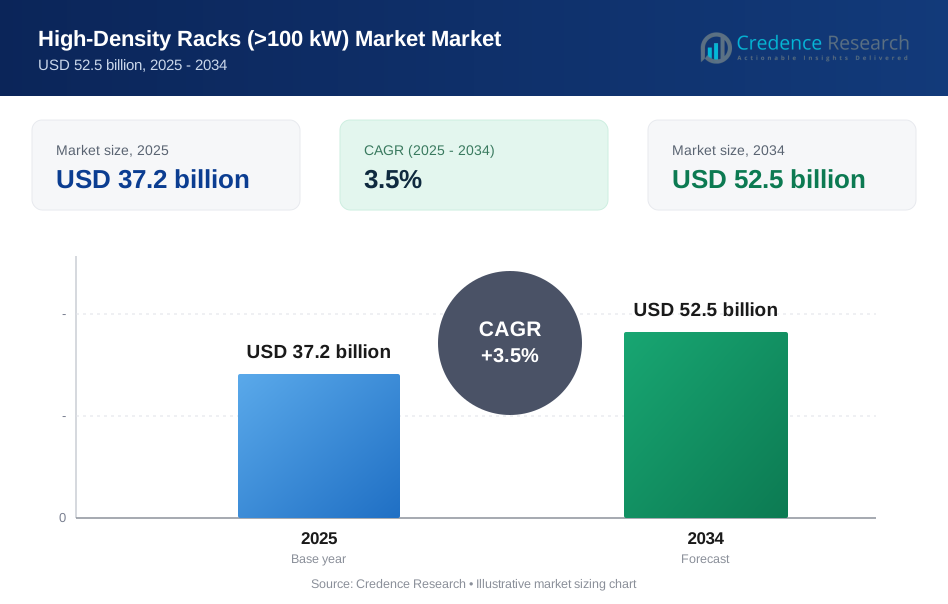
The High-Density Racks (>100 KW) market size was valued at USD 37.2 billion in 2025 and is anticipated to reach USD 52.5 billion by 2034, growing at a CAGR of 3.5% during the forecast period.
High-Density Racks (>100 KW) Market Segmentation
By Power Density
The High-Density Racks (>100 KW) market by power density is segmented into 100-200 kW per rack and more than 200 kW per rack. The 100-200 kW segment dominates due to its compatibility with most enterprise and hyperscale data center requirements, balancing performance and manageability. The more than 200 kW per rack segment is gaining traction as AI and HPC workloads demand higher compute density, pushing operators to adopt advanced cooling and power solutions. Growth in both segments is supported by the need for scalable, efficient infrastructure to handle rising data and compute intensity.
By Cooling Integration
Cooling integration is a critical differentiator in the High-Density Racks (>100 KW) market, with direct-to-chip liquid cooling manifold racks, rear-door heat exchanger racks, immersion-ready rack enclosures and enhanced-airflow/air-cooled racks as key segments. Direct-to-chip and immersion-ready solutions are seeing rapid adoption in AI and HPC environments, where thermal management is paramount. Rear-door heat exchangers and enhanced-airflow racks remain popular for incremental upgrades and retrofits, supporting a broad range of deployment scenarios. The segment’s growth is driven by the need to maximize rack density while maintaining operational reliability and energy efficiency.
By Rack Standard
The market is segmented by rack standard into OCP Open Rack v3, EIA-310 Standard 19-Inch and proprietary/custom form factors. OCP Open Rack v3 is gaining share among hyperscalers and cloud providers seeking open, scalable architectures. The EIA-310 Standard 19-Inch rack remains the industry mainstay, favored for its compatibility and widespread ecosystem support. Proprietary and custom form factors address specialized requirements in research, government and high-performance computing, enabling tailored solutions for unique workloads. The diversity of rack standards reflects the evolving needs of end users and the push for interoperability and flexibility.
By End User
End user segmentation includes hyperscalers & cloud providers, colocation operators, enterprises/on-premises AI & HPC and government, research & sovereign AI. Hyperscalers and cloud providers represent the largest share, driven by massive infrastructure investments and the need for scalable, high-density solutions. Colocation operators are rapidly upgrading to attract tenants with advanced compute needs, while enterprises and research institutions are deploying high-density racks to support AI, HPC and sovereign data initiatives. Each end user group is shaping demand for specific rack configurations, cooling technologies and integration services.
By Geography
Geographically, North America leads the High-Density Racks (>100 KW) market, followed by Asia Pacific and Europe. North America’s dominance is underpinned by strong hyperscale and cloud activity, while Asia Pacific’s rapid growth is fueled by digital transformation and data center expansion. Europe maintains a significant share due to regulatory support and enterprise adoption. Latin America, Middle East and Africa are emerging markets, with growth potential tied to infrastructure modernization and digital economy initiatives.
Request a Free Sample
Fill in your details and we'll send you a free sample report.
- Sample data tables & charts
- Research methodology
Market Dynamics
Target Audience
Benefits of the High-Density Racks (>100 KW) Market Report by Radial Insights
- Helps manufacturers and investors assess market size, share and growth rate for strategic planning.
- Identifies high-growth segments by power density, cooling integration and end user to guide product development.
- Supports distributors and service providers in evaluating regional expansion and distribution network opportunities.
- Provides competitive insights on leading companies, product portfolios and innovation strategies in High-Density Racks (>100 KW).
- Assesses pricing strategies, risk factors and customer demand trends for informed investment decisions.
- Enables retailers and channel partners to align offerings with evolving enterprise and hyperscale requirements.
- Guides end users in selecting optimal rack standards and cooling technologies for AI, HPC and cloud deployments.
| Category | Target Audience |
|---|---|
| Manufacturers | Product managers, business development, R&D teams |
| Distributors | Channel partners, logistics managers, regional distributors |
| Retailers | IT resellers, value-added retailers, e-commerce platforms |
| Investors | Private equity, venture capital, institutional investors |
| Service Providers | Data center operators, managed service providers, system integrators |
| End Users | Hyperscalers, cloud providers, enterprises, government agencies |
| Consultants | Market analysts, strategy consultants, technical advisors |
Key Market Opportunities and Challenges
Opportunities
Expanding AI and HPC workloads create new application opportunities for the High-Density Racks (>100 KW) market. It can support next-generation data center deployments by enabling higher compute density and advanced cooling integration, which are essential for AI, machine learning and scientific research. Regional expansion in Asia Pacific and Europe offers significant growth potential as digital transformation accelerates and governments invest in sovereign data infrastructure. Businesses can leverage these trends to enter new markets, diversify revenue streams and strengthen competitive positioning.
Technology adoption and product innovation present strategic opportunities for High-Density Racks (>100 KW) vendors. It can drive value creation by integrating direct-to-chip liquid cooling, modular rack designs and open standards to address evolving customer requirements. Investment in R&D and partnerships with hyperscalers, colocation operators and research institutions can accelerate product differentiation and market penetration. Companies that anticipate changing customer demand and regulatory requirements will be well positioned for long-term growth and profitability.
High capital costs and integration complexity limit adoption
High capital costs and integration complexity present significant barriers for the High-Density Racks (>100 KW) market. It requires substantial upfront investment in advanced cooling, power and monitoring systems, which can deter smaller operators and enterprises. Integration with legacy infrastructure and ensuring compatibility with diverse IT environments add to deployment challenges. These factors can slow market adoption, limit business expansion and impact return on investment for new entrants and established players.
Supply chain risks and regulatory hurdles affect market growth
Supply chain risks and regulatory hurdles are major challenges for the High-Density Racks (>100 KW) market. It faces potential disruptions from component shortages, logistics delays and geopolitical tensions, which can impact production timelines and cost structures. Regulatory requirements for data sovereignty, energy efficiency and safety standards vary across regions, increasing compliance complexity for manufacturers and service providers. These challenges can affect market growth, investment decisions and long-term profitability for industry participants.
Regional Analysis
North America leads with hyperscale and AI-driven demand
North America holds the leading position in the High-Density Racks (>100 KW) market with a 36% share, driven by strong hyperscale, cloud and AI infrastructure investments. The region benefits from advanced data center ecosystems, robust digital transformation and a concentration of leading technology companies. Regulatory support for energy efficiency and data security further strengthens market performance. High adoption of rack-scale computing and advanced cooling solutions supports continued growth and innovation.
Asia Pacific accelerates with digital transformation and data center expansion
Asia Pacific accounts for 30% of the High-Density Racks (>100 KW) market, reflecting rapid digital transformation, cloud adoption and large-scale data center construction. The region’s growth is supported by rising demand for AI, HPC and sovereign data infrastructure, particularly in China, Japan, South Korea and India. Government initiatives and private sector investments are fueling expansion, making Asia Pacific a key growth engine for the market.
Europe maintains strong enterprise and regulatory-driven growth
Europe holds a 22% share of the High-Density Racks (>100 KW) market, supported by enterprise adoption, regulatory mandates and investment in digital sovereignty. The region’s focus on energy efficiency, data protection and high-performance computing drives demand for advanced rack solutions. Collaboration between governments, research institutions and industry players supports innovation and market resilience.
Latin America emerges with infrastructure modernization
Latin America represents 6% of the High-Density Racks (>100 KW) market, with growth driven by infrastructure modernization and increased cloud adoption. The region is investing in new data centers and upgrading existing facilities to support digital economy initiatives. Demand is concentrated in Brazil, Mexico and Chile, where enterprises and service providers seek scalable, high-density solutions.
Middle East invests in digital infrastructure and sovereign data
The Middle East holds a 4% share of the High-Density Racks (>100 KW) market, supported by investments in digital infrastructure, smart city projects and sovereign data initiatives. Governments and enterprises are deploying high-density racks to enable advanced analytics, AI and secure data management. The region’s focus on technology-driven growth supports steady market expansion.
Africa shows early-stage adoption and long-term potential
Africa accounts for 2% of the High-Density Racks (>100 KW) market, reflecting early-stage adoption and emerging demand for digital infrastructure. Growth is supported by investments in data centers, cloud services and connectivity projects. The region’s long-term potential is tied to economic development, regulatory support and increasing enterprise IT adoption.
Recent developments
In November 2025, Rittal and the GSI Helmholtz Centre for Heavy Ion Research brought a new water-based direct liquid cooling system into productive use at the Green IT Cube in Darmstadt, while Rittal said AI and high-performance computing deployments would soon make rack power densities above 150 kW a standard requirement. Rittal also highlighted a compact rack-format cooling distribution unit with more than 1 MW of cooling output. This matters because it moves ultra-dense rack infrastructure from pilot-stage discussion into live operating environments and gives the market a practical model for installation, serviceability and heat-reuse at densities well above 100 kW.
In January 2026, Vertiv announced new configurations of its prefabricated MegaMod HDX platform for AI and HPC environments, with support for rack densities from 50 kW to more than 100 kW per rack and total power capacity up to 10 MW. The development is important because it reinforces demand for modular, factory-integrated rack ecosystems that combine direct-to-chip liquid cooling, air cooling, power distribution and monitoring in a faster-to-deploy format for high-density compute clusters.
In March 2026, Eaton unveiled the Beam Rubin DSX platform in collaboration with NVIDIA, positioning a modular grid-to-chip architecture as a standard implementation for Vera Rubin-based AI factories and indicating that new data center capacity can come online in months. This matters for the High-Density Racks (>100 KW) Market because procurement is shifting beyond cabinet hardware toward tightly co-designed power, cooling and digital-twin infrastructure that can scale from megawatts to hundreds of megawatts without slowing rack deployment.
In August 2026, Schneider Electric and AMD released the first Helios platform reference design, a validated blueprint for AI factory deployment that supports workloads up to 246 kW per rack and modular clusters up to 10.4 MW of IT load. This is a major market signal because it pushes the commercial design benchmark far beyond the 100 kW threshold and encourages operators, OEMs and colocation providers to plan around liquid-cooled, pre-validated rack-scale architectures rather than incremental air-cooled upgrades.
Need a Custom Version of This Report?
Tailor the scope, geography, or segments to your exact requirements.
- Custom geography or segment scope
- Direct access to our analyst team
Competitive Landscape
Competitive landscape shaped by innovation, expansion and differentiated market positioning
The High-Density Racks (>100 KW) market features a competitive landscape defined by innovation, geographic expansion and differentiated product offerings. Vertiv, Schneider Electric, Eaton, Rittal, Dell Technologies, Supermicro, HPE, NVIDIA, nVent and CoolIT Systems lead the market through advanced engineering, broad product portfolios and strong global distribution networks. These companies invest in R&D to deliver cutting-edge cooling integration, modular rack designs and open standards, addressing the evolving needs of hyperscalers, colocation operators and enterprises. Strategic partnerships, service delivery excellence and targeted regional expansion further strengthen their market positions. Competitive dynamics are shaped by the ability to deliver scalable, efficient and reliable solutions that support next-generation AI and HPC workloads.
| Company | Establishment/Founded Year | Headquarters | Market Share (%) | Revenue Growth Rate (%) | Volume of Tires Sold (Units) | Geographic Footprint (Number of Countries/Regions Served) | R&D Expenditure (% of Revenue) | Product Portfolio Breadth (Number of SKUs/Types) |
|---|---|---|---|---|---|---|---|---|
| Vertiv | 2016 | Columbus, Ohio, USA | 14 | 7.2 | NA | 130 | 4.5 | 120 |
| Schneider Electric | 1836 | Rueil-Malmaison, France | 13 | 6.8 | NA | 100 | 5.1 | 150 |
| Eaton | 1911 | Dublin, Ireland | 10 | 5.9 | NA | 85 | 3.8 | 90 |
| Rittal | 1961 | Herborn, Germany | 9 | 5.2 | NA | 70 | 4.2 | 80 |
| Dell Technologies | 1984 | Round Rock, Texas, USA | 8 | 6.1 | NA | 60 | 3.5 | 60 |
| Supermicro | 1993 | San Jose, California, USA | 7 | 8.3 | NA | 50 | 4.8 | 55 |
| HPE | 2015 | Houston, Texas, USA | 7 | 7.5 | NA | 65 | 4.0 | 70 |
| NVIDIA | 1993 | Santa Clara, California, USA | 6 | 12.4 | NA | 40 | 6.2 | 30 |
| nVent | 2018 | London, UK | 4 | 4.7 | NA | 35 | 3.1 | 25 |
| CoolIT Systems | 2001 | Calgary, Canada | 3 | 9.0 | NA | 25 | 5.5 | 20 |
Frequently Asked Questions
What is the projected market size for High-Density Racks (>100 KW) by 2034?
Which regions hold the largest market share in the High-Density Racks (>100 KW) market?
What are the key growth drivers for the High-Density Racks (>100 KW) market?
Which end users are driving demand for High-Density Racks (>100 KW)?
What cooling technologies are most important for High-Density Racks (>100 KW)?
Table of Content
Chapter 1. Report Introduction
- 1.1 Report Description & Purpose
- 1.1.1 Report Title & Market Definition
- 1.1.2 Unique Selling Propositions (USP) & Key Differentiators
- 1.1.3 Value Proposition for Stakeholders
- 1.2 Research Objectives
- 1.2.1 Market Sizing Objectives (Volume & Revenue)
- 1.2.2 Segmentation Objectives
- 1.2.3 Competitive Intelligence Objectives
- 1.2.4 Forecast & Scenario Objectives
- 1.3 Report Scope
- 1.3.1 High-Density Racks (>100 kW) Market Scope – Types & Subtypes Covered
- 1.3.2 Geographic Scope – Regions & Countries Covered
- 1.3.3 Historical Period, Base Year & Forecast Period (2018-2025; forecast to 2034)
- 1.3.4 Inclusions & Exclusions
- 1.4 HS Code & Classification Framework
- 1.5 Currency, Units & Pricing Basis
- 1.6 Target Stakeholders
- 1.7 Limitations & Assumptions
Chapter 2. Executive Summary
- 2.1 Global High-Density Racks (>100 kW) Market Market Snapshot
- 2.1.1 Market Size – Historical (2018-2025) & Forecast (2025-2034) (2025: USD 37.2 billion → 2034: USD 52.5 billion)
- 2.1.2 Volume & Revenue – Global Totals
- 2.1.3 Key Market Highlights – Top Five Facts
- 2.2 High-Density Racks (>100 kW) Market Market Segmentation Snapshot
- 2.2.1 Market Split – By Power Density – 2025 vs. 2034 (Volume & Revenue)
- 2.2.2 Market Split – By Cooling Integration – 2025 vs. 2034 (Volume & Revenue)
- 2.2.3 Market Split – By Rack Standard – 2025 vs. 2034 (Volume & Revenue)
- 2.2.4 Market Split – By End User – 2025 vs. 2034 (Volume & Revenue)
- 2.2.5 Market Split – By Geography – 2025 vs. 2034 (Volume & Revenue)
- 2.2.6 Market Split by Region – 2025 vs. 2034
- 2.3 Competitive Snapshot
- 2.3.1 Top 10 Players by Revenue Share – 2025
- 2.3.2 Top 10 Players by Volume Share – 2025
- 2.3.3 Recent Strategic Developments (18-Month Summary)
- 2.4 Key Investment Highlights & Strategic Conclusions
Chapter 3. High-Density Racks (>100 kW) Market Market Dynamics & Industry Analysis
- 3.1 Market Overview & Context
- 3.1.1 High-Density Racks (>100 kW) Market Market Position in the Broader Automotive Value Chain
- 3.1.2 OEM vs. Replacement Market Dynamics
- 3.1.3 Market Maturity & Development Stage by Region
- 3.2 High-Density Racks (>100 kW) Market Market Drivers
- 3.3 High-Density Racks (>100 kW) Market Market Restraints & Challenges
- 3.4 High-Density Racks (>100 kW) Market Market Opportunities
- 3.5 Porter's Five Forces Analysis
- 3.5.1 Threat of New Entrants
- 3.5.2 Bargaining Power of Suppliers
- 3.5.3 Bargaining Power of Buyers
- 3.5.4 Threat of Substitutes
- 3.5.5 Competitive Rivalry – Intensity Assessment
- 3.6 High-Density Racks (>100 kW) Market Value Chain Analysis
- 3.6.1 Upstream – Raw Material/Input Suppliers
- 3.6.1.1 Raw Material/Input 1
- 3.6.1.2 Raw Material/Input 2
- 3.6.1.3 Raw Material/Input 3
- 3.6.2 Midstream – Production/Manufacturing/Service Delivery
- 3.6.2.1 Production/Process Overview
- 3.6.2.2 Key Facility Locations & Capacity by Manufacturer
- 3.6.3 Downstream – Distribution & End Consumer
- 3.6.3.1 Primary Channel – B2B/OEM
- 3.6.3.2 Secondary Channels – Dealer, Retail, Online, Direct
- 3.6.4 Value Chain Profitability Analysis
- 3.6.1 Upstream – Raw Material/Input Suppliers
- 3.7 PESTEL Analysis
- 3.7.1 Political Factors
- 3.7.2 Economic Factors
- 3.7.3 Social Factors
- 3.7.4 Technological Factors
- 3.7.5 Environmental Factors
- 3.7.6 Legal Factors
- 3.8 High-Density Racks (>100 kW) Market Supply Chain Analysis
- 3.8.1 Raw Material/Input Supply Risk Assessment
- 3.8.2 Manufacturing Concentration Risk (Geographic Exposure)
- 3.8.3 Trade Disruption Impact Analysis
- 3.9 Regulatory & Policy Landscape
Note: The regulatory and policy landscape section covers regulations based on their applicability to the market, High-Density Racks (>100 kW) Market category, geography, and scope of the study. Only regulatory frameworks with a material impact on operations, compliance, trade, sustainability, or market access are analyzed in detail.
Chapter 4. Key Investment Pockets & Opportunity Analysis
- 4.1 High-Density Racks (>100 kW) Market Market Attractiveness Analysis
- 4.1.1 By Region – Investment Attractiveness Matrix (Volume × CAGR)
- 4.1.2 By Power Density – Investment Attractiveness Matrix
- 4.1.3 By Cooling Integration – Investment Attractiveness Matrix
- 4.1.4 By Rack Standard – Investment Attractiveness Matrix
- 4.1.5 By End User – Investment Attractiveness Matrix
- 4.1.6 By Geography – Investment Attractiveness Matrix
- 4.2 Absolute Revenue Growth Opportunity
- 4.2.1 By Region – Absolute USD Growth Through 2034
- 4.2.2 By Power Density – Absolute USD Growth
- 4.2.3 By Cooling Integration – Absolute USD Growth
- 4.2.4 By Rack Standard – Absolute USD Growth
- 4.2.5 By End User – Absolute USD Growth
- 4.2.6 By Geography – Absolute USD Growth
- 4.3 Incremental Volume Opportunity
- 4.3.1 By Region – Incremental Volume Through 2034
- 4.3.2 By Power Density – Incremental Volume
- 4.4 Emerging Submarket Opportunity Deep Dive (Subject to Applicability)
- 4.5 Emerging Market Opportunity Scorecards
- 4.5.1 United States
- 4.5.2 Europe
- 4.5.3 Asia
- 4.5.4 Middle East & Africa
Note: Emerging Market Opportunity Scorecards will be included based on relevance and strategic importance. Regions listed are indicative and may vary depending on data availability and market dynamics.
Chapter 5. High-Density Racks (>100 kW) Market Import-Export Analysis & Trade Flows
- 5.1 Global Trade Overview
- 5.1.1 Global Export Value by Country (2018-2025)
- 5.1.2 Global Export Volume by Country (2018-2025)
- 5.1.3 Global Import Value by Country (2018-2025)
- 5.1.4 Global Import Volume by Country (2018-2025)
- 5.1.5 Net Trade Balance by Country (2018-2025)
- 5.2 Export Analysis – By Power Density
- 5.2.1 Type 1 (HS Code)
- 5.2.2 Type 2 (HS Code)
- 5.2.3 Type 3 (HS Code)
- 5.2.4 Type 4 (HS Code)
- 5.2.5 Type 5 (HS Code)
- 5.3 Import Analysis – By Power Density
- 5.3.1 Type 1 (HS Code)
- 5.3.2 Type 2 (HS Code)
- 5.3.3 Type 3 (HS Code)
- 5.3.4 Type 4 (HS Code)
- 5.3.5 Type 5 (HS Code)
- 5.4 Average Unit Trade Prices
- 5.4.1 Average Export Price – By Power Density & Country
- 5.4.2 Average Import Price – By Power Density & Source Country
- 5.4.3 Price Trends (2018-2025)
- 5.5 Key Trade Route Analysis
- 5.5.1 Trade Route 1
- 5.5.2 Trade Route 2
- 5.5.3 Trade Route 3
- 5.5.4 Trade Route 4
- 5.5.5 Trade Route 5
- 5.6 Trade Policy Impact Assessment
- 5.6.1 US Anti-Dumping & Section 301 Tariffs
- 5.6.2 EU Customs Union Impact
- 5.6.3 Major Free Trade Agreements
- 5.6.4 USMCA Rules of Origin
Note: Trade policy analysis will be included only where relevant to the High-Density Racks (>100 kW) Market market.
Chapter 6. Competitive Landscape & Company Benchmarking
- 6.1 High-Density Racks (>100 kW) Market Market Concentration & Structure
- 6.1.1 Herfindahl-Hirschman Index (HHI) – 2018 vs. 2025
- 6.1.2 Tier 1, Tier 2 & Tier 3 Market Structure
- 6.1.3 Global, Regional & Local Player Dynamics
- 6.2 High-Density Racks (>100 kW) Market Market Share Analysis – 2025
- 6.2.1 Global Revenue Share by Company
- 6.2.2 Global Volume Share by Company
- 6.2.3 Regional Revenue Share
- 6.2.4 Market Share Evolution (2018 vs. 2025)
- 6.2.5 OEM Segment Share by Company
- 6.2.6 Replacement Segment Share by Company
- 6.3 Production/Delivery Capacity & Facility Analysis
- 6.3.1 Global Installed Capacity
- 6.3.2 Capacity Utilization Rates
- 6.3.3 Production/Output Volume
- 6.3.4 Facility Locations & Capacity Map
- 6.3.5 Planned Capacity Additions
- 6.4 High-Density Racks (>100 kW) Market Competitive Benchmarking Matrix
- 6.4.1 Revenue, Volume, CAGR & Profitability Comparison
- 6.4.2 Channel Revenue Mix
- 6.4.3 Geographic Revenue Exposure
- 6.4.4 R&D Intensity
- 6.4.5 Sustainability Maturity
- 6.5 Strategic Developments in High-Density Racks (>100 kW) Market (Last 24 Months)
- 6.5.1 Mergers, Acquisitions & Divestments
- 6.5.2 New High-Density Racks (>100 kW) Market Launches
- 6.5.3 Facility Expansions
- 6.5.4 Strategic Alliances, Joint Ventures & Partnerships
- 6.5.5 Distribution Expansion & Market Entry
- 6.5.6 Sustainability & ESG Initiatives
- 6.6 Competitive Strategy Mapping
- 6.6.1 Leader, Challenger, Follower & Niche Classification
- 6.6.2 Pricing Strategy Comparison
- 6.6.3 Channel Strategy Matrix
Note: Strategic developments are included based on their materiality and the availability of reliable information.
Chapter 7. Global High-Density Racks (>100 kW) Market Market – By Power Density
- 7.1 Segment Overview
- 7.1.1 Market Volume Share (2018, 2025 & 2026)
- 7.1.2 Market Revenue Share (2018, 2025 & 2026)
- 7.1.3 Market Forecast Through 2034
- 7.1.4 Key Growth Drivers & Restraints
- 7.1.5 Leading Brands
- 7.2 Types Covered – By Power Density
- 100-200 kW per Rack
- More Than 200 kW per Rack
Chapter 8. Global High-Density Racks (>100 kW) Market Market – By Cooling Integration
- 8.1 Segment Overview
- 8.1.1 Market Volume Share (2018, 2025 & 2026)
- 8.1.2 Market Revenue Share (2018, 2025 & 2026)
- 8.1.3 Market Forecast Through 2034
- 8.1.4 Key Growth Drivers & Restraints
- 8.1.5 Leading Brands
- 8.2 Types Covered – By Cooling Integration
- Direct-to-Chip Liquid Cooling Manifold Racks
- Rear-Door Heat Exchanger Racks
- Immersion-Ready Rack Enclosures
- Enhanced-Airflow/Air-Cooled Racks
Chapter 9. Global High-Density Racks (>100 kW) Market Market – By Rack Standard
- 9.1 Segment Overview
- 9.1.1 Market Volume Share (2018, 2025 & 2026)
- 9.1.2 Market Revenue Share (2018, 2025 & 2026)
- 9.1.3 Market Forecast Through 2034
- 9.1.4 Key Growth Drivers & Restraints
- 9.1.5 Leading Brands
- 9.2 Types Covered – By Rack Standard
- OCP Open Rack v3
- EIA-310 Standard 19-Inch
- Proprietary/Custom Form Factors
Chapter 10. Global High-Density Racks (>100 kW) Market Market – By End User
- 10.1 Segment Overview
- 10.1.1 Market Volume Share (2018, 2025 & 2026)
- 10.1.2 Market Revenue Share (2018, 2025 & 2026)
- 10.1.3 Market Forecast Through 2034
- 10.1.4 Key Growth Drivers & Restraints
- 10.1.5 Leading Brands
- 10.2 Types Covered – By End User
- Hyperscalers & Cloud Providers
- Colocation Operators
- Enterprises/On-Premises AI & HPC
- Government, Research & Sovereign AI
Chapter 11. Global High-Density Racks (>100 kW) Market Market – By Geography
- 11.1 Segment Overview
- 11.1.1 Market Volume Share (2018, 2025 & 2026)
- 11.1.2 Market Revenue Share (2018, 2025 & 2026)
- 11.1.3 Market Forecast Through 2034
- 11.1.4 Key Growth Drivers & Restraints
- 11.1.5 Leading Brands
- 11.2 Types Covered – By Geography
- North America
- Europe
- Asia Pacific
- Latin America
- Middle East & Africa
Chapter 12. Global High-Density Racks (>100 kW) Market Market – By Distribution Channel
- 12.1 Segment Overview
- 12.1.1 Volume & Revenue Split by Channel (2025 & 2034)
- 12.1.2 Channel Mix Evolution (2018-2034)
Chapter 13. Regional Market Analysis – Global Overview
- 13.1 Global Regional Overview
- 13.1.1 Regional Volume Share
- 13.1.2 Regional Revenue Share
- 13.1.3 Regional Volume by Region
- 13.1.4 Regional Revenue by Region
- 13.1.5 Regional Forecast Through 2034
- 13.2 Cross-Regional Segment Analysis
- 13.2.1 By Power Density
- 13.2.2 By Cooling Integration
- 13.2.3 By Rack Standard
- 13.2.4 By End User
- 13.2.5 By Geography
- 13.2.6 By Distribution Channel
- 13.2.7 By Brand/Price Tier
Chapter 14. North America High-Density Racks (>100 kW) Market Market
- 14.1 United States
- 14.2 Canada
- 14.3 Mexico
Chapter 15. Europe High-Density Racks (>100 kW) Market Market
- 15.1 Germany
- 15.2 France
- 15.3 Italy
- 15.4 United Kingdom
- 15.5 Spain
- 15.6 Poland
- 15.7 Russia
- 15.8 Netherlands
- 15.9 Belgium
- 15.10 Sweden
- 15.11 Denmark
- 15.12 Norway
- 15.13 Rest of Europe
Chapter 16. Asia Pacific High-Density Racks (>100 kW) Market Market
- 16.1 China
- 16.2 India
- 16.3 Japan
- 16.4 South Korea
- 16.5 Thailand
- 16.6 Indonesia
- 16.7 Vietnam
- 16.8 Malaysia
- 16.9 Australia
- 16.10 Rest of Asia Pacific
Chapter 17. Latin America High-Density Racks (>100 kW) Market Market
- 17.1 Brazil
- 17.2 Argentina
- 17.3 Colombia
- 17.4 Chile
- 17.5 Rest of Latin America
Chapter 18. Middle East High-Density Racks (>100 kW) Market Market
- 18.1 Saudi Arabia
- 18.2 United Arab Emirates
- 18.3 Turkey
- 18.4 Israel
- 18.5 Iran
- 18.6 Rest of the Middle East
Chapter 19. Africa High-Density Racks (>100 kW) Market Market
- 19.1 South Africa
- 19.2 Egypt
- 19.3 Nigeria
- 19.4 Morocco
- 19.5 Rest of Africa
Chapter 20. High-Density Racks (>100 kW) Market Company Profiles
- 20.1 "Vertiv
- 20.1.1 Company Overview
- 20.1.2 Key Management Personnel
- 20.1.3 Products & Services Portfolio
- 20.1.4 Financial Performance
- 20.1.5 Key Market Focus & Geographic Presence
- 20.1.6 Recent Developments & Strategic Initiatives
- 20.2 Schneider Electric
- 20.3 Eaton
- 20.4 Rittal
- 20.5 Dell Technologies
- 20.6 Supermicro
- 20.7 HPE
- 20.8 NVIDIA
- 20.9 nVent and CoolIT Systems"
Note: The company profile list is preliminary and may change based on research findings, market developments, data availability, and client requirements.
Chapter 21. Appendices
- Appendix A – List of Abbreviations & Acronyms
- Appendix B – Industry Classification Code Reference – Full Series
- Appendix C – Production & Capacity Data Tables
- Appendix D – End-Use & Demand Base Tables
- Appendix E – Consumption & Replacement Rate Assumptions
- Appendix F – ASP Reference Tables
- Appendix G – Manufacturing & Facility Database
- Appendix H – Import-Export Data Tables
- Appendix I – Regulatory Summary Tables
- Appendix J – Primary Research Participant List (Anonymized)
- Appendix K – Primary Research Questionnaire Framework
- Appendix L – Data Sources & Bibliography
- Appendix M – Market Size Divergence & Source Comparison
Chapter 22. Research Methodology
- 22.1 Research Framework & Philosophy
- 22.2 Secondary Research – Sources, Hierarchy & Data Extraction
- 22.3 Data Modeling – Bottom-Up & Top-Down Market Sizing
- 22.4 Primary Research – Stakeholder Framework, LOI & Sample Sizes
- 22.5 Forecast Methodology – Regression, Scenario & Sensitivity Analysis
- 22.6 Quality Control – Four-Layer Validation Framework
- 22.7 Limitations & Standard Assumptions
- 22.8 Disclaimer
