
| REPORT ATTRIBUTE | DETAILS |
|---|---|
| Historical Period | 2019-2022 |
| Base Year | 2023 |
| Forecast Period | 2024-2032 |
| North America Data Center Cooling Market Size 2023 | USD 4,519.49 million |
| North America Data Center Cooling Market, CAGR | 11.53% |
| North America Data Center Cooling Market Size 2032 | USD 13,897.92 million |
Market Overview
The North America Data Center Cooling market is projected to grow from USD 4,519.49 million in 2023 to an estimated USD 13,897.92 million by 2032, with a compound annual growth rate (CAGR) of 11.53% from 2024 to 2032. This significant growth is driven by the increasing demand for data centers due to the expansion of cloud computing, the rise of big data analytics, and the proliferation of IoT devices.
Market drivers include the growing emphasis on energy efficiency and the reduction of carbon footprints, which is leading to the adoption of advanced cooling technologies such as liquid cooling and evaporative cooling. Additionally, stringent government regulations regarding energy consumption in data centers are propelling the adoption of eco-friendly cooling systems. Trends such as the shift toward modular data centers and the integration of AI and machine learning for optimal cooling management are also influencing market growth.
Geographically, the United States dominates the North America Data Center Cooling market, accounting for the largest market share, followed by Canada. The presence of major data center operators and technology companies in the region, along with continuous investments in infrastructure development, are key factors driving this dominance. Key players in the market include Schneider Electric, Vertiv Co., Airedale International Air Conditioning Ltd., STULZ GmbH, and Rittal GmbH & Co. KG, who are actively innovating to meet the growing demands of the industry.
Market Drivers
Rising Demand for Data Centers and High-Density Computing:
The exponential growth in digitalization across various industries is driving unprecedented demand for data centers in North America. For instance, a recent survey found that enterprises are rapidly increasing their data center footprints to support cloud computing, big data analytics, and Internet of Things applications. This surge in data center construction and expansion is fueling the need for more sophisticated cooling solutions. As businesses migrate operations to cloud platforms, the density of computing equipment within data centers continues to rise, generating more heat that must be managed efficiently. A government study on data center energy use highlighted the critical role of cooling in maintaining optimal operating temperatures and preventing costly downtime. The adoption of artificial intelligence and machine learning is further amplifying cooling requirements. For instance, a survey of data center operators revealed that many are upgrading their cooling infrastructure to handle the increased heat loads from AI workloads. This trend is spurring innovation in cooling technologies, with many providers developing solutions specifically designed for high-density computing environments.
Emphasis on Energy Efficiency and Sustainability:
Energy efficiency and sustainability have become top priorities for data center operators in North America. A comprehensive industry report found that data centers are implementing various strategies to reduce power usage effectiveness and carbon emissions. For instance, many facilities are adopting liquid cooling solutions, which offer superior heat dissipation compared to traditional air cooling methods. A survey of data center managers indicated growing interest in evaporative cooling and free cooling techniques, especially in regions with favorable climates. Government agencies have conducted studies demonstrating the significant energy savings potential of these advanced cooling technologies. For example, implementing efficient cooling solutions could reduce a data center's overall energy consumption by a substantial amount. Additionally, a major industry association reported increasing adoption of sustainability metrics and goals among its members. This focus on energy efficiency is driving innovation in the cooling market, with manufacturers developing new products designed to minimize power consumption while maximizing cooling capacity.
Government Regulations and Industry Standards:
The North American data center industry is increasingly shaped by government regulations and industry standards aimed at promoting energy efficiency and sustainability. For instance, the U.S. Environmental Protection Agency has established guidelines for data center energy performance, incentivizing the adoption of advanced cooling technologies. A survey of data center operators revealed widespread efforts to comply with these regulations, with many citing cooling system upgrades as a key strategy. Industry standards, such as those set by the American Society of Heating, Refrigerating, and Air-Conditioning Engineers, also play a crucial role. A recent ASHRAE report outlined updated temperature and humidity recommendations for data centers, prompting many facilities to reassess their cooling infrastructure. Government agencies have conducted studies demonstrating the positive impact of these standards on energy consumption in data centers. For example, facilities adhering to the latest guidelines achieved significant improvements in cooling efficiency. The need to comply with evolving regulations and standards is driving investment in innovative cooling solutions across the North American market.
Technological Advancements and the Adoption of AI and Machine Learning:
The rapid pace of technological advancements in the data center industry is another key driver of the North America Data Center Cooling market. Innovations in cooling technology are being driven by the increasing complexity and demands of modern data centers. As data center environments become more intricate, with higher server densities and more powerful computing equipment, traditional cooling methods are often insufficient to maintain optimal operating conditions. In response, companies are investing in research and development to create more effective and efficient cooling solutions. One of the most significant advancements in data center cooling is the integration of AI and machine learning into cooling management systems. These technologies enable data centers to monitor and adjust cooling operations in real-time, optimizing energy usage and ensuring that cooling resources are allocated where they are needed most. For example, AI-driven systems can predict temperature fluctuations and adjust cooling output accordingly, reducing the risk of overheating and minimizing energy waste. Additionally, AI and machine learning can analyze vast amounts of data from sensors and other monitoring devices to identify inefficiencies and recommend improvements, further enhancing the performance of cooling systems. As the adoption of AI and machine learning continues to grow, data center operators are increasingly turning to these technologies to gain a competitive edge in terms of energy efficiency, operational reliability, and cost-effectiveness. This trend is expected to drive further growth in the North America Data Center Cooling market as companies seek to leverage the latest technological advancements to optimize their cooling strategies and meet the evolving demands of the industry.
Market Trends
Increasing Adoption of Liquid Cooling Technologies:
One of the most prominent trends in the North America Data Center Cooling market is the growing adoption of liquid cooling technologies. As data centers continue to evolve with higher server densities and more powerful computing equipment, traditional air-based cooling systems are increasingly being viewed as insufficient to meet the cooling demands of modern facilities. For instance, a recent survey by a leading industry association found that a significant portion of data center operators in North America are planning to implement liquid cooling solutions within the next few years. Government agencies have also reported an uptick in the use of liquid cooling technologies in federal data centers, citing improved energy efficiency and performance. This shift is particularly noticeable in high-performance computing environments, where the heat generated by densely packed servers and processors can be substantial. Major technology companies have reported substantial energy savings and increased computing capacity after transitioning to liquid cooling systems in their data centers. As the industry seeks more efficient ways to manage thermal challenges, the trend towards liquid cooling is expected to continue, with many experts predicting it will become the dominant cooling method in North American data centers in the coming decade.
Integration of AI and Machine Learning for Smart Cooling:
Another significant trend shaping the North America Data Center Cooling market is the integration of artificial intelligence (AI) and machine learning into cooling management systems. A recent industry report highlighted that a growing number of data center operators in North America are implementing AI-driven cooling solutions to optimize their operations. For instance, a survey conducted found that many large-scale data centers have already deployed AI-powered cooling systems, reporting improved energy efficiency and reduced operational costs. Government agencies have also begun piloting AI-based cooling management in their facilities, with early results showing promising outcomes in terms of energy savings and system reliability. These intelligent systems can predict temperature fluctuations, identify potential hotspots, and automatically adjust cooling resources to ensure efficient operation. Several leading data center cooling solution providers have reported increased demand for their AI-enabled products, with many customers citing the technology's ability to continuously learn and improve performance over time as a key selling point. As these technologies become more sophisticated and accessible, their integration into data center cooling strategies is expected to become increasingly widespread, driving further advancements in the market.
Market Restraints and Challenges
High Initial Costs and Complexity of Advanced Cooling Technologies:
One of the primary restraints in the North America Data Center Cooling market is the high initial costs associated with implementing advanced cooling technologies. Solutions like liquid cooling systems require significant capital investment for installation and integration into existing infrastructures. This includes specialized equipment, infrastructure modifications, and skilled personnel. For many small to medium-sized data centers, these costs can be prohibitive. The complexity of advanced cooling technologies also poses a challenge, often requiring specialized knowledge not readily available within organizations. This results in increased operational complexity and the need for additional training or external specialists. For instance, a survey by the Uptime Institute found that over 60% of data center operators cited cost as the main barrier to adopting liquid cooling technologies. Additionally, the U.S. Department of Energy reported that cooling costs can account for up to 40% of a data center's energy consumption, highlighting the financial impact of cooling solutions. These factors contribute to slower adoption of advanced cooling technologies, particularly among smaller data centers with limited budgets and resources.
Environmental and Regulatory Challenges:
Environmental concerns and regulatory challenges significantly restrain the growth of the North America Data Center Cooling market. While there's growing emphasis on sustainability, the environmental impact of cooling technologies using refrigerants with high global warming potential remains a critical issue. Regulatory bodies are imposing stricter guidelines on refrigerant use, pushing operators to transition to more environmentally friendly alternatives. This transition can be costly and complex, requiring significant changes to existing systems. For instance, the U.S. Environmental Protection Agency's Significant New Alternatives Policy (SNAP) program has banned certain hydrofluorocarbons commonly used in data center cooling systems, forcing operators to seek alternatives. Compliance with evolving regulations adds another layer of complexity, particularly challenging for smaller operators lacking resources to navigate these changes effectively. A report found that over 70% of data center operators consider regulatory compliance a major challenge in implementing new cooling technologies. These factors contribute to cautious adoption of new cooling technologies and highlight ongoing challenges in balancing performance, cost, and environmental responsibility.
Market Segmentation Analysis
By Component
The North America Data Center Cooling market is primarily segmented into solutions and services. The solutions segment dominates, featuring a variety of technologies designed to manage thermal loads, including air conditioners, precision air conditioners, chillers, and air handling units, all essential for maintaining optimal temperatures in high-density computing environments. For instance, a survey conducted by the Uptime Institute found that over 60% of data center operators consider cooling as their top priority for infrastructure improvements. Complementing this, the services segment encompasses installation and deployment, support and consulting, and maintenance services, which are critical for the efficient operation and management of cooling systems. The U.S. Department of Energy reports that data centers can reduce their cooling energy consumption by up to 40% through proper design and operation of cooling systems, highlighting the importance of comprehensive cooling services.
By Application
The North America Data Center Cooling market is significantly driven by various applications. The telecom and IT sectors represent a substantial portion of the market, fueled by the growing demand for data center services in light of rapid advancements in cloud computing and big data analytics, which necessitate efficient cooling systems. For instance, a study by the National Renewable Energy Laboratory (NREL) found that data centers in the U.S. consume about 2% of the country's total electricity, with cooling accounting for a significant portion of this consumption. Similarly, the retail and BFSI (Banking, Financial Services, and Insurance) industries increasingly rely on data centers for digital transactions and customer data management, highlighting the need for robust cooling solutions. In the healthcare sector, the expansion of electronic health records (EHR) and telemedicine requires secure and reliable data storage environments. The U.S. Department of Health and Human Services reports that over 95% of hospitals now use certified EHR technology, driving the demand for efficient data center cooling solutions in healthcare.
Segments
Based on Component
- Solution
- Services
Based on Application
- Telecom & IT
- Retail & BFSI
- Healthcare
- Energy
- Others
Based on Solution
- Air Conditioners
- Precision Air Conditioners
- Chillers
- Air Handling Units
- Others
Based on Containment
- Raised Floor with Containment
- Hot Aisle Containment (HAC)
- Cold Aisle Containment (CAC)
- Raised Floor without Containment
Based on Services
- Installation & Deployment
- Support & Consulting
- Maintenance Services
Based on Cooling Type
- Raised Floor
- Non-Raised Floors
Based on Structure
- Rack-based Cooling
- Row-based Cooling
- Room-based Cooling
Based on Region
- United States
- Canada
Regional Analysis
United States (85%):
The United States dominates the North America Data Center Cooling market, accounting for approximately 85% of the total market share. This significant dominance is driven by the country's status as a global hub for data centers, with numerous facilities supporting the operations of leading technology companies, cloud service providers, and enterprises across various sectors. For instance, according to the U.S. Department of Energy, data centers in the United States consumed about 2% of the country's total electricity use in 2022. The presence of major players in the data center industry contributes to the high demand for advanced cooling solutions. The U.S. market is characterized by a strong emphasis on energy efficiency and sustainability, driven by both regulatory pressures and corporate sustainability initiatives.
Canada (15%):
Canada holds the remaining 15% of the North America Data Center Cooling market. The country is experiencing robust growth in data center construction and expansion, fueled by several factors, including its cold climate, which naturally supports free cooling techniques. For instance, a report by the Canadian Data Centre Industry Association found that the country's data center market grew by 25% in 2023, with cooling solutions being a key area of investment. The Canadian government's favorable policies and incentives for green energy and sustainable infrastructure are also driving the adoption of energy-efficient cooling solutions. Additionally, the rising demand for cloud services, data storage, and disaster recovery solutions is contributing to the expansion of data center facilities in Canada, particularly in regions like Quebec, Ontario, and British Columbia.
Key players
- Vertiv Group Corp.
- Stulz GmbH
- Schneider Electric SE
- Rittal GmbH & Co. KG
- Asetek A/S
- Alfa Laval AB
- Iceotope Technologies Limited
- Green Revolution Cooling Inc.
- Chilldyne Inc.
- Airedale International Air Conditioning Ltd.
Competitive Analysis
The North America Data Center Cooling market is highly competitive, with key players such as Vertiv Group Corp., Schneider Electric SE, and Rittal GmbH & Co. KG leading the industry with their extensive product portfolios and advanced cooling solutions. These companies leverage their strong R&D capabilities to offer innovative and energy-efficient cooling technologies tailored to the needs of modern data centers. Stulz GmbH and Airedale International Air Conditioning Ltd. are also significant players, known for their precision air conditioning systems and global reach. Emerging companies like Iceotope Technologies Limited and Green Revolution Cooling Inc. are gaining traction with their cutting-edge liquid cooling technologies, which are increasingly being adopted for high-density computing environments. The market is characterized by continuous innovation, with companies focusing on sustainability and efficiency to maintain a competitive edge and meet the evolving demands of data center operators.
Recent Developments
- In March 2024, Vertiv announced it would showcase its latest liquid cooling innovations at Data Centre World 2024 in London. This includes the Vertiv Liebert XDU Coolant Distribution Units, designed for chip- and rear-door cooling applications, which came from Vertiv's acquisition of CoolTera in late 2023.
- In March 2024, Schneider Electric inaugurated a new cooling factory in Bengaluru, India, with an investment of approximately 10 million euros. While not in North America, this facility will manufacture cooling solutions for data centers, with 85% of the products intended for export, potentially impacting the North American market.
- In 2023, Asetek continued to promote its liquid cooling technology for data centers, highlighting that their solutions can reduce energy consumption for cooling by up to 50% by directly cooling processors instead of entire racks.
- In 2023, Iceotope partnered with Intel to leverage their latest processor technology in combination with Iceotope's Precision Liquid Cooling (PLC) solutions. This partnership aims to enhance cooling efficiency and reliability in data center operations.
Market Concentration and Characteristics
The North America Data Center Cooling market exhibits moderate to high concentration, characterized by the presence of several key players dominating the landscape, including Vertiv Group Corp., Schneider Electric SE, and Stulz GmbH. These companies account for a significant share of the market, leveraging their advanced technologies and extensive distribution networks to maintain a competitive edge. The market is also marked by rapid technological advancements, with a growing emphasis on energy efficiency and sustainability driving innovation in cooling solutions. Additionally, the increasing complexity of data center operations necessitates sophisticated cooling strategies, prompting established firms to invest heavily in research and development. Emerging players are entering the market, particularly those focusing on niche solutions like liquid cooling and AI-driven management systems, contributing to a dynamic and evolving competitive environment. Overall, the market is characterized by a blend of established leaders and innovative newcomers, all vying to meet the demands of a rapidly growing data center sector.
Report Coverage
The research report offers an in-depth analysis based on Component, Application, Solution, Containment, Services, Cooling Type, Structure and Region. It details leading market players, providing an overview of their business, product offerings, investments, revenue streams, and key applications. Additionally, the report includes insights into the competitive environment, SWOT analysis, current market trends, as well as the primary drivers and constraints. Furthermore, it discusses various factors that have driven market expansion in recent years. The report also explores market dynamics, regulatory scenarios, and technological advancements that are shaping the industry. It assesses the impact of external factors and global economic changes on market growth. Lastly, it provides strategic recommendations for new entrants and established companies to navigate the complexities of the market.
Future Outlook
- The North America Data Center Cooling market is expected to experience robust growth, driven by increasing data center constructions and expansions to support the rise of cloud services and big data analytics.
- There will be a significant shift towards advanced cooling technologies, such as liquid cooling and AI-driven management systems, as operators seek to optimize energy efficiency and performance.
- The market will increasingly prioritize sustainability, with data center operators adopting eco-friendly cooling solutions to reduce carbon footprints and comply with stricter regulations.
- As part of sustainability efforts, data centers will explore integrating renewable energy sources, such as solar and wind, to power cooling systems, enhancing overall energy efficiency.
- The trend towards modular data centers will continue, allowing operators to scale their cooling capabilities efficiently and cost-effectively in response to fluctuating demands.
- With the growth of edge computing, localized data centers will require tailored cooling solutions, promoting innovations that meet the unique challenges of these smaller facilities.
- Major players in the market will ramp up investments in research and development to create next-generation cooling technologies that can handle the increasing thermal loads of high-performance computing environments.
- As government regulations regarding energy consumption tighten, data center operators will need to invest in compliant cooling solutions, driving demand for innovative technologies that meet these standards.
- The adoption of advanced monitoring and management systems will become crucial for optimizing cooling operations, enabling real-time adjustments to maintain efficiency and reliability.
- The competitive landscape will evolve as new entrants focus on niche markets and innovative cooling solutions, prompting established players to enhance their offerings and strategic partnerships to retain market share.
Request a Free Sample
Fill in your details and we'll send you a free sample report.
- Sample data tables & charts
- Research methodology
Need a Custom Version of This Report?
Tailor the scope, geography, or segments to your exact requirements.
- Custom geography or segment scope
- Direct access to our analyst team
Frequently Asked Questions
What is the market size of the North America Data Center Cooling market in 2023 and2032?
What drives the growth of the Data Center Cooling market in North America?
Which industries are the largest consumers of data center cooling solutions?
How are government regulations impacting the Data Center Cooling market?
Table of Content
Chapter 1. Report Introduction
- 1.1 Report Description & Purpose
- 1.1.1 Report Title & Market Definition
- 1.1.2 Unique Selling Propositions (USP) & Key Differentiators
- 1.1.3 Value Proposition for Stakeholders
- 1.2 Research Objectives
- 1.2.1 Market Sizing Objectives (Volume & Revenue)
- 1.2.2 Segmentation Objectives
- 1.2.3 Competitive Intelligence Objectives
- 1.2.4 Forecast & Scenario Objectives
- 1.3 Report Scope
- 1.3.1 North America Data Center Cooling Scope – Types & Subtypes Covered
- 1.3.2 Geographic Scope – Regions & Countries Covered
- 1.3.3 Historical Period, Base Year & Forecast Period (the historical period; forecast to 2023)
- 1.3.4 Inclusions & Exclusions
- 1.4 HS Code & Classification Framework
- 1.5 Currency, Units & Pricing Basis
- 1.6 Target Stakeholders
- 1.7 Limitations & Assumptions
Chapter 2. Executive Summary
- 2.1 Global North America Data Center Cooling Market Snapshot
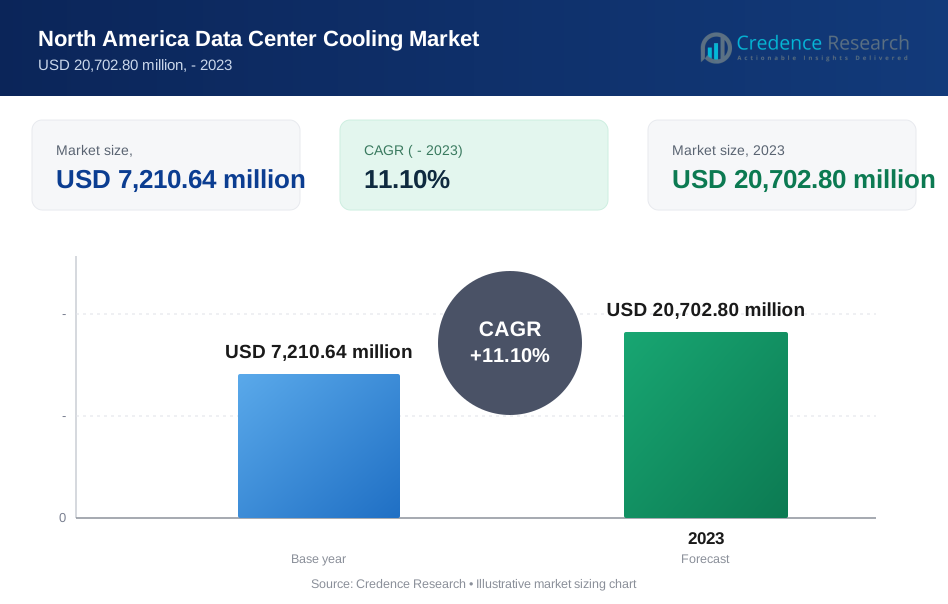
- 2.1.1 Market Size – Historical (the historical period) & Forecast (2023) (base year: USD 7,210.64 million → 2023: USD 20,702.80 million)
- 2.1.2 Volume & Revenue – Global Totals
- 2.1.3 Key Market Highlights – Top Five Facts
- 2.2 North America Data Center Cooling Market Segmentation Snapshot
- 2.2.1 Market Split by Region – vs. 2023
- 2.3 Competitive Snapshot
- 2.3.1 Top 10 Players by Revenue Share –
- 2.3.2 Top 10 Players by Volume Share –
- 2.3.3 Recent Strategic Developments (18-Month Summary)
- 2.4 Key Investment Highlights & Strategic Conclusions
Chapter 3. North America Data Center Cooling Market Dynamics & Industry Analysis
- 3.1 Market Overview & Context
- 3.1.1 North America Data Center Cooling Market Position in the Broader Automotive Value Chain
- 3.1.2 OEM vs. Replacement Market Dynamics
- 3.1.3 Market Maturity & Development Stage by Region
- 3.2 North America Data Center Cooling Market Drivers
- 3.3 North America Data Center Cooling Market Restraints & Challenges
- 3.4 North America Data Center Cooling Market Opportunities
- 3.5 Porter's Five Forces Analysis
- 3.5.1 Threat of New Entrants
- 3.5.2 Bargaining Power of Suppliers
- 3.5.3 Bargaining Power of Buyers
- 3.5.4 Threat of Substitutes
- 3.5.5 Competitive Rivalry – Intensity Assessment
- 3.6 North America Data Center Cooling Value Chain Analysis
- 3.6.1 Upstream – Raw Material/Input Suppliers
- 3.6.1.1 Raw Material/Input 1
- 3.6.1.2 Raw Material/Input 2
- 3.6.1.3 Raw Material/Input 3
- 3.6.2 Midstream – Production/Manufacturing/Service Delivery
- 3.6.2.1 Production/Process Overview
- 3.6.2.2 Key Facility Locations & Capacity by Manufacturer
- 3.6.3 Downstream – Distribution & End Consumer
- 3.6.3.1 Primary Channel – B2B/OEM
- 3.6.3.2 Secondary Channels – Dealer, Retail, Online, Direct
- 3.6.4 Value Chain Profitability Analysis
- 3.6.1 Upstream – Raw Material/Input Suppliers
- 3.7 PESTEL Analysis
- 3.7.1 Political Factors
- 3.7.2 Economic Factors
- 3.7.3 Social Factors
- 3.7.4 Technological Factors
- 3.7.5 Environmental Factors
- 3.7.6 Legal Factors
- 3.8 North America Data Center Cooling Supply Chain Analysis
- 3.8.1 Raw Material/Input Supply Risk Assessment
- 3.8.2 Manufacturing Concentration Risk (Geographic Exposure)
- 3.8.3 Trade Disruption Impact Analysis
- 3.9 Regulatory & Policy Landscape
Note: The regulatory and policy landscape section covers regulations based on their applicability to the market, North America Data Center Cooling category, geography, and scope of the study. Only regulatory frameworks with a material impact on operations, compliance, trade, sustainability, or market access are analyzed in detail.
Chapter 4. Key Investment Pockets & Opportunity Analysis
- 4.1 North America Data Center Cooling Market Attractiveness Analysis
- 4.1.1 By Region – Investment Attractiveness Matrix (Volume × CAGR)
- 4.2 Absolute Revenue Growth Opportunity
- 4.2.1 By Region – Absolute USD Growth Through 2023
- 4.3 Incremental Volume Opportunity
- 4.3.1 By Region – Incremental Volume Through 2023
- 4.3.2 Segment – Incremental Volume
- 4.4 Emerging Submarket Opportunity Deep Dive (Subject to Applicability)
- 4.5 Emerging Market Opportunity Scorecards
- 4.5.1 United States
- 4.5.2 Europe
- 4.5.3 Asia
- 4.5.4 Middle East & Africa
Note: Emerging Market Opportunity Scorecards will be included based on relevance and strategic importance. Regions listed are indicative and may vary depending on data availability and market dynamics.
Chapter 5. North America Data Center Cooling Import-Export Analysis & Trade Flows
- 5.1 Global Trade Overview
- 5.1.1 Global Export Value by Country (the historical period)
- 5.1.2 Global Export Volume by Country (the historical period)
- 5.1.3 Global Import Value by Country (the historical period)
- 5.1.4 Global Import Volume by Country (the historical period)
- 5.1.5 Net Trade Balance by Country (the historical period)
- 5.2 Export Analysis – Segment
- 5.2.1 Type 1 (HS Code)
- 5.2.2 Type 2 (HS Code)
- 5.2.3 Type 3 (HS Code)
- 5.2.4 Type 4 (HS Code)
- 5.2.5 Type 5 (HS Code)
- 5.3 Import Analysis – Segment
- 5.3.1 Type 1 (HS Code)
- 5.3.2 Type 2 (HS Code)
- 5.3.3 Type 3 (HS Code)
- 5.3.4 Type 4 (HS Code)
- 5.3.5 Type 5 (HS Code)
- 5.4 Average Unit Trade Prices
- 5.4.1 Average Export Price – Segment & Country
- 5.4.2 Average Import Price – Segment & Source Country
- 5.4.3 Price Trends (the historical period)
- 5.5 Key Trade Route Analysis
- 5.5.1 Trade Route 1
- 5.5.2 Trade Route 2
- 5.5.3 Trade Route 3
- 5.5.4 Trade Route 4
- 5.5.5 Trade Route 5
- 5.6 Trade Policy Impact Assessment
- 5.6.1 US Anti-Dumping & Section 301 Tariffs
- 5.6.2 EU Customs Union Impact
- 5.6.3 Major Free Trade Agreements
- 5.6.4 USMCA Rules of Origin
Note: Trade policy analysis will be included only where relevant to the North America Data Center Cooling market.
Chapter 6. Competitive Landscape & Company Benchmarking
- 6.1 North America Data Center Cooling Market Concentration & Structure
- 6.1.1 Herfindahl-Hirschman Index (HHI) – vs.
- 6.1.2 Tier 1, Tier 2 & Tier 3 Market Structure
- 6.1.3 Global, Regional & Local Player Dynamics
- 6.2 North America Data Center Cooling Market Share Analysis –
- 6.2.1 Global Revenue Share by Company
- 6.2.2 Global Volume Share by Company
- 6.2.3 Regional Revenue Share
- 6.2.4 Market Share Evolution ( vs. )
- 6.2.5 OEM Segment Share by Company
- 6.2.6 Replacement Segment Share by Company
- 6.3 Production/Delivery Capacity & Facility Analysis
- 6.3.1 Global Installed Capacity
- 6.3.2 Capacity Utilization Rates
- 6.3.3 Production/Output Volume
- 6.3.4 Facility Locations & Capacity Map
- 6.3.5 Planned Capacity Additions
- 6.4 North America Data Center Cooling Competitive Benchmarking Matrix
- 6.4.1 Revenue, Volume, CAGR & Profitability Comparison
- 6.4.2 Channel Revenue Mix
- 6.4.3 Geographic Revenue Exposure
- 6.4.4 R&D Intensity
- 6.4.5 Sustainability Maturity
- 6.5 Strategic Developments in North America Data Center Cooling (Last 24 Months)
- 6.5.1 Mergers, Acquisitions & Divestments
- 6.5.2 New North America Data Center Cooling Launches
- 6.5.3 Facility Expansions
- 6.5.4 Strategic Alliances, Joint Ventures & Partnerships
- 6.5.5 Distribution Expansion & Market Entry
- 6.5.6 Sustainability & ESG Initiatives
- 6.6 Competitive Strategy Mapping
- 6.6.1 Leader, Challenger, Follower & Niche Classification
- 6.6.2 Pricing Strategy Comparison
- 6.6.3 Channel Strategy Matrix
Note: Strategic developments are included based on their materiality and the availability of reliable information.
Chapter 7. Global North America Data Center Cooling Market – By Distribution Channel
- 7.1 Segment Overview
- 7.1.1 Volume & Revenue Split by Channel ( & 2023)
- 7.1.2 Channel Mix Evolution (2023)
Chapter 8. Regional Market Analysis – Global Overview
- 8.1 Global Regional Overview
- 8.1.1 Regional Volume Share
- 8.1.2 Regional Revenue Share
- 8.1.3 Regional Volume by Region
- 8.1.4 Regional Revenue by Region
- 8.1.5 Regional Forecast Through 2023
- 8.2 Cross-Regional Segment Analysis
- 8.2.1 By Distribution Channel
- 8.2.2 By Brand/Price Tier
Chapter 9. North America North America Data Center Cooling Market
- 9.1 United States
- 9.2 Canada
- 9.3 Mexico
Chapter 10. Europe North America Data Center Cooling Market
- 10.1 Germany
- 10.2 France
- 10.3 Italy
- 10.4 United Kingdom
- 10.5 Spain
- 10.6 Poland
- 10.7 Russia
- 10.8 Netherlands
- 10.9 Belgium
- 10.10 Sweden
- 10.11 Denmark
- 10.12 Norway
- 10.13 Rest of Europe
Chapter 11. Asia Pacific North America Data Center Cooling Market
- 11.1 China
- 11.2 India
- 11.3 Japan
- 11.4 South Korea
- 11.5 Thailand
- 11.6 Indonesia
- 11.7 Vietnam
- 11.8 Malaysia
- 11.9 Australia
- 11.10 Rest of Asia Pacific
Chapter 12. Latin America North America Data Center Cooling Market
- 12.1 Brazil
- 12.2 Argentina
- 12.3 Colombia
- 12.4 Chile
- 12.5 Rest of Latin America
Chapter 13. Middle East North America Data Center Cooling Market
- 13.1 Saudi Arabia
- 13.2 United Arab Emirates
- 13.3 Turkey
- 13.4 Israel
- 13.5 Iran
- 13.6 Rest of the Middle East
Chapter 14. Africa North America Data Center Cooling Market
- 14.1 South Africa
- 14.2 Egypt
- 14.3 Nigeria
- 14.4 Morocco
- 14.5 Rest of Africa
Chapter 15. North America Data Center Cooling Company Profiles
- 15.1 [Company 01]
- 15.1.1 Company Overview
- 15.1.2 Key Management Personnel
- 15.1.3 Products & Services Portfolio
- 15.1.4 Financial Performance
- 15.1.5 Key Market Focus & Geographic Presence
- 15.1.6 Recent Developments & Strategic Initiatives
Note: The company profile list is preliminary and may change based on research findings, market developments, data availability, and client requirements.
Chapter 16. Appendices
- Appendix A – List of Abbreviations & Acronyms
- Appendix B – Industry Classification Code Reference – Full Series
- Appendix C – Production & Capacity Data Tables
- Appendix D – End-Use & Demand Base Tables
- Appendix E – Consumption & Replacement Rate Assumptions
- Appendix F – ASP Reference Tables
- Appendix G – Manufacturing & Facility Database
- Appendix H – Import-Export Data Tables
- Appendix I – Regulatory Summary Tables
- Appendix J – Primary Research Participant List (Anonymized)
- Appendix K – Primary Research Questionnaire Framework
- Appendix L – Data Sources & Bibliography
- Appendix M – Market Size Divergence & Source Comparison
Chapter 17. Research Methodology
- 17.1 Research Framework & Philosophy
- 17.2 Secondary Research – Sources, Hierarchy & Data Extraction
- 17.3 Data Modeling – Bottom-Up & Top-Down Market Sizing
- 17.4 Primary Research – Stakeholder Framework, LOI & Sample Sizes
- 17.5 Forecast Methodology – Regression, Scenario & Sensitivity Analysis
- 17.6 Quality Control – Four-Layer Validation Framework
- 17.7 Limitations & Standard Assumptions
- 17.8 Disclaimer
