
Market Overview:
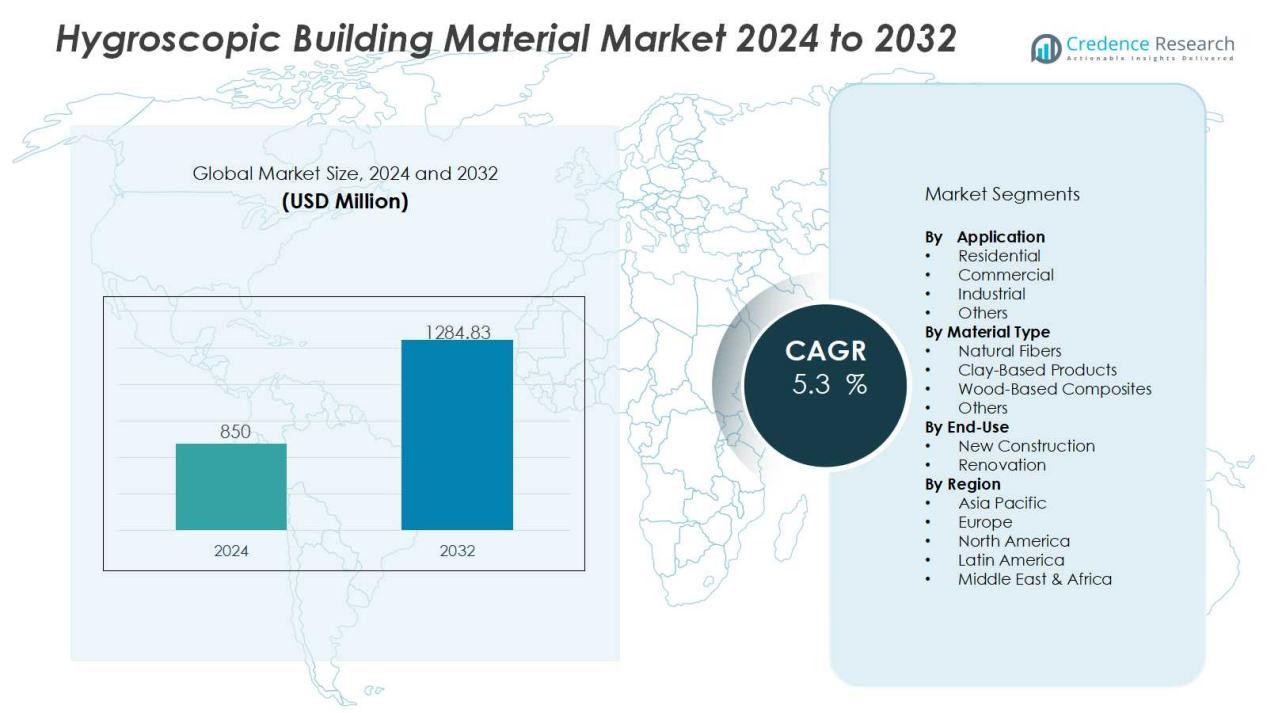
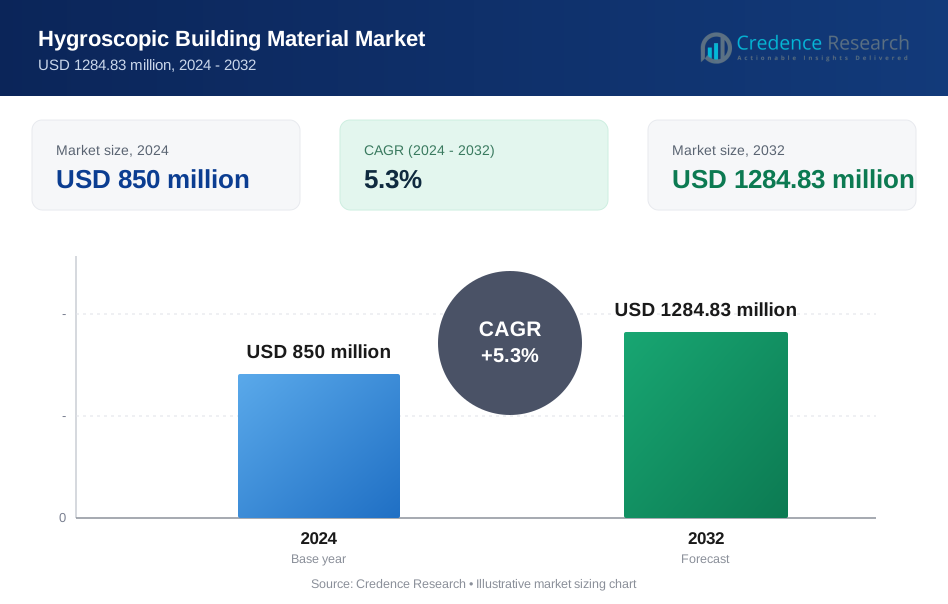
The hygroscopic building material market size was valued at USD 850 million in 2024 and is anticipated to reach USD 1284.83 million by 2032, at a CAGR of 5.3 % during the forecast period.
| REPORT ATTRIBUTE | DETAILS |
|---|---|
| Historical Period | 2020-2023 |
| Base Year | 2024 |
| Forecast Period | 2025-2032 |
| Hygroscopic Building Market Size 2024 | USD 850 Million |
| Hygroscopic Building Market, CAGR | 5.3 % |
| Hygroscopic Building Market Size 2032 | USD 1284.83 Million |
Growth is driven by rising urbanization, stricter environmental regulations, and the need for energy-efficient buildings. Hygroscopic materials help regulate humidity, improve air quality, and extend the life of structures. Governments and green certification bodies promote the use of eco-friendly materials, boosting their adoption. Additionally, rising construction activity in both developed and emerging economies creates a broader customer base for these products. Technological advances in material science also enhance performance, fueling greater acceptance.
Regionally, Europe leads the market due to strong sustainability policies and advanced construction practices. North America follows with high adoption in commercial and residential projects focused on energy efficiency. Asia-Pacific is the fastest-growing region, driven by rapid urbanization, infrastructure investment, and climate-conscious construction. Latin America and the Middle East are also emerging markets as awareness of sustainable building practices increases.
Market Insights:
- The hygroscopic building material market was valued at USD 850 million in 2024 and is expected to reach USD 1284.83 million by 2032, growing at a CAGR of 5.3%.
- Rising urbanization and stricter environmental regulations are driving demand for sustainable and energy-efficient construction solutions.
- Hygroscopic materials regulate indoor humidity, improve air quality, and extend the life of structures, making them highly attractive for modern projects.
- Government regulations and green building certifications strongly encourage adoption, positioning these materials as preferred eco-friendly solutions.
- High upfront costs and limited awareness among end-users remain major challenges, particularly in cost-sensitive regions.
- Europe held 38% market share in 2024, supported by strong sustainability policies, while North America accounted for 29% with high commercial and residential adoption.
- Asia-Pacific secured 24% market share in 2024 and is the fastest-growing region, driven by rapid urbanization, smart city projects, and climate-conscious construction.
Market Drivers:
Growing Demand for Energy-Efficient and Sustainable Construction:
The hygroscopic building material market is strongly driven by rising demand for energy-efficient construction. These materials regulate indoor humidity naturally, reducing reliance on artificial heating and cooling systems. Their adoption supports energy conservation, which aligns with global sustainability targets. Developers and homeowners are increasingly drawn to solutions that lower operational costs and improve energy ratings.
- For Instance, ROCKWOOL's Rockboard 40 stone wool insulation board is water-repellent and resistant to absorbing moisture, as demonstrated by its low moisture sorption of 0.03 wt% under ASTM C1104 testing.
Increasing Focus on Indoor Air Quality and Human Health:
Healthy living environments remain a top priority for modern construction projects. Hygroscopic materials help maintain stable humidity levels, which minimizes mold growth and reduces respiratory risks. Their ability to absorb and release moisture enhances overall indoor comfort. Growing awareness among end-users about health benefits continues to drive market adoption.
- For instance, CertainTeed’s MemBrain Smart Vapor Retarder achieves water vapor permeance above 10 perms under humid conditions.
Regulatory Push and Green Building Certifications:
Government regulations and international certifications play a significant role in market growth. Many countries promote sustainable construction standards that encourage the use of natural and eco-friendly materials. Green certifications often highlight the performance of hygroscopic materials, positioning them as a preferred choice for certified projects. This regulatory environment strengthens long-term demand.
Urbanization and Expanding Infrastructure Projects Worldwide:
Rapid urbanization creates consistent demand for durable and efficient construction materials. Infrastructure projects in emerging economies adopt hygroscopic solutions to balance cost-effectiveness with sustainability. The market benefits from large-scale residential, commercial, and industrial developments that require long-lasting building performance. It is further supported by rising investments in smart cities and climate-conscious infrastructure.
Market Trends:
Integration of Smart and Sustainable Construction Practices:
The hygroscopic building material market is experiencing a steady shift toward integration with smart and sustainable construction practices. Builders and developers are adopting these materials to meet energy codes and environmental goals. They help maintain balanced indoor humidity, which reduces the need for energy-intensive climate control. Digital monitoring systems are increasingly paired with hygroscopic solutions to optimize building performance. This integration enhances both energy efficiency and occupant comfort. The trend reflects rising demand for construction materials that support health, sustainability, and compliance with evolving regulations.
- For instance, Sensirion AG’s SHT35 sensors were integrated into Crodeon’s Reporter modules for concrete slab projects, delivering factory-calibrated humidity accuracy of ±1.5% RH in hourly in-situ measurements.
Rising Adoption Across Diverse Applications and Global Markets:
The market is witnessing broader adoption across residential, commercial, and industrial sectors. Architects and engineers use hygroscopic materials not only for energy savings but also for design flexibility. It is now being applied in heritage building restoration, smart homes, and eco-certified projects. Demand is especially strong in regions where climate control is expensive or energy policies are strict. Emerging economies are adopting these materials in new infrastructure projects, reflecting growing awareness of long-term sustainability benefits. This trend underlines the global transition toward resilient and climate-conscious construction.
- For Instance, Nature Communications details a 3D-printed geopolymer composite with a moisture buffering value exceeding 14 \(g\cdot m^{-2}\cdot \%RH^{-1}\) and shows the tiles improved indoor comfort by up to 85% in a public library study.
Market Challenges Analysis:
High Costs and Limited Awareness Among End-Users:
The hygroscopic building material market faces challenges from high upfront costs and limited consumer awareness. Many buyers prefer cheaper conventional materials, even if long-term benefits of hygroscopic solutions are clear. It requires significant investment in education and promotion to highlight advantages such as energy savings and improved health outcomes. Lack of familiarity among contractors and architects further slows adoption. Market penetration remains lower in cost-sensitive regions where budget constraints dominate decision-making. Overcoming this barrier depends on stronger outreach and clearer demonstrations of long-term value.
Technical Limitations and Inconsistent Performance Across Climates:
Performance variability across different environmental conditions presents another obstacle. Hygroscopic materials may not function optimally in regions with extreme humidity or highly fluctuating climates. Their effectiveness can also be reduced if installation standards are not properly maintained. The hygroscopic building material market is pressured to innovate and create adaptable solutions that perform consistently. It must address durability concerns, particularly in large-scale or industrial applications. Ensuring quality control and better technical training for builders remains essential to maintaining confidence and expanding use.
Market Opportunities:
Expansion Through Green Building Certifications and Sustainable Initiatives:
The hygroscopic building material market has strong opportunities through global green building certifications and sustainability initiatives. Developers and governments are setting stricter energy-efficiency targets, creating demand for materials that align with eco-friendly standards. Hygroscopic solutions are well-positioned to meet these requirements by supporting natural humidity control and reducing energy use. Rising consumer interest in healthier living spaces strengthens this shift. The trend also opens doors for collaborations with certification bodies to promote wider adoption. It provides manufacturers with a clear pathway to expand their market presence.
Adoption in Emerging Economies and Innovative Construction Projects:
Rapid growth in emerging economies offers a promising opportunity for future expansion. Large-scale infrastructure projects in Asia-Pacific, Latin America, and the Middle East present significant potential for hygroscopic materials. It can be applied in residential, commercial, and smart city projects where climate-conscious building practices are gaining traction. Advances in research and material technology allow producers to introduce cost-effective and high-performance variants. These innovations expand applications across diverse environments, including heritage restoration and industrial buildings. Rising global investment in sustainable construction ensures continuous growth opportunities for the market.
Market Segmentation Analysis:
By Material Type:
The hygroscopic building material market by material type is led by natural fibers, clay-based products, and wood-based composites. Natural fibers such as hemp and flax are gaining preference due to sustainability and moisture-regulating properties. Clay-based products remain popular for their durability and thermal balance in construction. Wood-based composites continue to expand due to design flexibility and availability. It benefits from growing demand for renewable and eco-friendly building solutions across regions.
- For Instance, Hempitecture established the first nonwoven U.S. hemp insulation manufacturing facility in Jerome, Idaho. The 33,000 sq ft facility produces high-performance, sustainable HempWool insulation products.
By Application:
Applications include residential, commercial, and industrial projects, with residential construction holding the leading share. Growing consumer awareness about indoor comfort and health drives strong adoption in homes. Commercial spaces such as offices, schools, and healthcare facilities use these materials to enhance air quality. Industrial projects adopt them for durability and climate control efficiency. It is further supported by the integration of these solutions into energy-efficient and smart building designs.
- For instance, Daikin launched its EWYE-CZ air-to-water inverter heat pump series in November 2024, delivering a coefficient of performance of 3.4 at 7 °C ambient temperature.
By End-Use:
End-use segments cover new construction and renovation activities, both contributing to steady growth. New construction projects in urban areas account for significant demand due to modern design standards. Renovation and heritage restoration projects use hygroscopic materials to preserve structure life and improve sustainability. Government-backed green building initiatives further encourage adoption in both categories. It continues to expand as global construction activities prioritize energy efficiency and healthier environments.
Segmentations:
By Material Type:
- Natural Fibers
- Clay-Based Products
- Wood-Based Composites
- Others
By Application:
- Residential
- Commercial
- Industrial
- Others
By End-Use:
- New Construction
- Renovation
By Region:
- North America
- U.S.
- Canada
- Mexico
- Europe
- Germany
- France
- U.K.
- Italy
- Spain
- Rest of Europe
- Asia Pacific
- China
- Japan
- India
- South Korea
- South-east Asia
- Rest of Asia Pacific
- Latin America
- Brazil
- Argentina
- Rest of Latin America
- Middle East & Africa
- GCC Countries
- South Africa
- Rest of the Middle East and Africa
Regional Analysis:
Europe:
Europe held 38% market share in the hygroscopic building material market in 2024, leading globally. Its dominance is supported by strict energy-efficiency laws and advanced construction practices. Countries such as Germany, France, and the Nordic region actively promote eco-friendly building solutions. Demand is further reinforced by the popularity of green certifications like BREEAM and LEED. Strong awareness among architects and contractors helps accelerate adoption across residential and commercial sectors. The region’s mature construction industry continues to support steady growth and innovation.
North America:
North America accounted for 29% market share in 2024, making it a significant contributor. The region benefits from rising awareness of indoor air quality and energy-saving materials. The U.S. and Canada lead adoption with supportive green building codes and sustainable housing programs. It is driven by consumer demand for healthier, durable, and cost-effective construction options. Commercial and institutional projects integrate hygroscopic solutions to reduce operational costs. Strong investments in research and development further enhance product performance in the region.
Asia-Pacific:
Asia-Pacific secured 24% market share in 2024, emerging as the fastest-growing regional market. Rapid urbanization and infrastructure expansion in China, India, and Southeast Asia fuel demand. It benefits from government initiatives promoting climate-conscious and energy-efficient construction. Growing construction of smart cities and residential projects strengthens the market position further. Rising consumer awareness about health and sustainability adds momentum to adoption. Continuous investments by global and regional manufacturers increase product accessibility in diverse applications.
Key Player Analysis:
- Vicat
- Knauf Insulation
- Owens Corning
- Holcim
- Italcementi
- HeidelbergCement
- Saint-Gobain
- Buzzi Unicem
- BASF
- CRH
- Cemex
- CertainTeed
- LafargeHolcim
- Johns Manville
Competitive Analysis:
The hygroscopic building material market is shaped by leading global construction material companies that focus on sustainable and energy-efficient solutions. Key players include Vicat, Owens Corning, Knauf Insulation, Holcim, Italcementi, and HeidelbergCement. These companies invest heavily in research to develop advanced materials that regulate indoor humidity and improve energy performance. It benefits from their strong distribution networks and established presence in major construction markets. Competitive strategies revolve around expanding product portfolios, forming partnerships, and integrating eco-friendly innovations into mainstream projects. Companies also target certifications and government-backed projects to strengthen their positions. Continuous innovation and regional expansion remain central to maintaining leadership in this competitive environment.
Recent Developments:
- In July, 2025, Vicat joined the New Energies Coalition to accelerate decarbonization efforts for transport and industry, in line with the group's commitment to carbon neutrality.
- In June 2025, Owens Corning partnered with Composite Recycling to develop sustainable composite waste recycling solutions and promote circular economy initiatives.
Report Coverage:
The research report offers an in-depth analysis based on Material Type, Application, End-Use and Region. It details leading Market players, providing an overview of their business, product offerings, investments, revenue streams, and key applications. Additionally, the report includes insights into the competitive environment, SWOT analysis, current Market trends, as well as the primary drivers and constraints. Furthermore, it discusses various factors that have driven Market expansion in recent years. The report also explores Market dynamics, regulatory scenarios, and technological advancements that are shaping the industry. It assesses the impact of external factors and global economic changes on Market growth. Lastly, it provides strategic recommendations for new entrants and established companies to navigate the complexities of the Market.
Future Outlook:
- The hygroscopic building material market will expand with rising demand for energy-efficient construction solutions.
- It will gain momentum from stricter global regulations on sustainable and eco-friendly building practices.
- Growing awareness of indoor air quality will drive adoption across residential and commercial projects.
- Technological advancements in material science will create products with improved durability and performance.
- Emerging economies will provide growth opportunities through large-scale urbanization and smart city projects.
- It will benefit from increasing integration with digital monitoring systems for climate control optimization.
- Green building certifications will play a key role in accelerating product acceptance worldwide.
- Collaborations between manufacturers and government bodies will strengthen long-term industry growth.
- Heritage restoration and adaptive reuse projects will expand demand for specialized hygroscopic materials.
- The market will see stronger competition as global and regional players invest in innovation.
Request a Free Sample
Fill in your details and we'll send you a free sample report.
- Sample data tables & charts
- Research methodology
Need a Custom Version of This Report?
Tailor the scope, geography, or segments to your exact requirements.
- Custom geography or segment scope
- Direct access to our analyst team
Frequently Asked Questions
What is the current market size for the hygroscopic building material market, and what is its projected size in 2032?
At what Compound Annual Growth Rate is the hygroscopic building material market projected to grow between 2024 and 2032?
Which hygroscopic building material market segment held the largest share in 2024?
What are the primary factors fueling the growth of the hygroscopic building material market?
Who are the leading companies in the hygroscopic building material market?
Which region commanded the largest share of the hygroscopic building material market in 2024?
Table of Content
Chapter 1. Report Introduction
- 1.1 Report Description & Purpose
- 1.1.1 Report Title & Market Definition
- 1.1.2 Unique Selling Propositions (USP) & Key Differentiators
- 1.1.3 Value Proposition for Stakeholders
- 1.2 Research Objectives
- 1.2.1 Market Sizing Objectives (Volume & Revenue) (Volume Where Applicable)
- 1.2.2 Segmentation Objectives
- 1.2.3 Competitive Intelligence Objectives
- 1.2.4 Forecast & Scenario Objectives
- 1.3 Report Scope
- 1.3.1 Hygroscopic Building Material Scope – Segments & Subsegments Covered
- 1.3.2 Geographic Scope – Regions & Countries Covered
- 1.3.3 Historical Period, Base Year & Forecast Period (2024; forecast to 2032)
- 1.3.4 Inclusions & Exclusions
- 1.4 Industry Classification & Applicable Codes
- 1.5 Currency, Measurement Units & Valuation Basis
- 1.6 Target Stakeholders
- 1.7 Limitations & Assumptions
Chapter 2. Executive Summary
- 2.1 Global Hygroscopic Building Material Market Snapshot
- 2.1.1 Market Size – Historical (2024) & Forecast (2024-2032) (2024: USD 850 million → 2032: USD 1284.83 million)
- 2.1.2 Volume & Revenue – Global Totals (Volume Where Applicable)
- 2.1.3 Key Market Highlights – Top Five Facts
- 2.2 Hygroscopic Building Material Market Segmentation Snapshot
- 2.2.1 Market Split by Region – 2024 vs. 2032
- 2.3 Competitive Snapshot
- 2.3.1 Top 10 Players by Revenue Share – 2024
- 2.3.2 Top 10 Players by Volume Share – 2024 (Volume Where Applicable)
- 2.3.3 Recent Strategic Developments (18-Month Summary)
- 2.4 Key Investment Highlights & Strategic Conclusions
Chapter 3. Hygroscopic Building Material Market Dynamics & Industry Analysis
- 3.1 Market Overview & Context
- 3.1.1 Hygroscopic Building Material Market Position in the Broader Industry Value Chain
- 3.1.2 Demand Structure & Purchasing Dynamics
- 3.1.3 Market Maturity & Development Stage by Region
- 3.2 Hygroscopic Building Material Market Drivers
- 3.3 Hygroscopic Building Material Market Restraints & Challenges
- 3.4 Hygroscopic Building Material Market Opportunities
- 3.5 Porter's Five Forces Analysis
- 3.5.1 Threat of New Entrants
- 3.5.2 Bargaining Power of Suppliers
- 3.5.3 Bargaining Power of Buyers
- 3.5.4 Threat of Substitutes
- 3.5.5 Competitive Rivalry – Intensity Assessment
- 3.6 Hygroscopic Building Material Value Chain Analysis
- 3.6.1 Upstream – Key Inputs, Resources & Suppliers
- 3.6.1.1 Key Input/Resource 1
- 3.6.1.2 Key Input/Resource 2
- 3.6.1.3 Key Input/Resource 3
- 3.6.2 Midstream – Core Operations & Value Creation
- 3.6.2.1 Operating Model & Process Overview
- 3.6.2.2 Key Operating Locations & Capabilities by Company
- 3.6.3 Downstream – Market Channels & End Users
- 3.6.3.1 Direct Sales & Customer Engagement Channels
- 3.6.3.2 Indirect Sales, Intermediaries & Partner Channels
- 3.6.4 Value Chain Profitability Analysis
- 3.6.1 Upstream – Key Inputs, Resources & Suppliers
- 3.7 PESTEL Analysis
- 3.7.1 Political Factors
- 3.7.2 Economic Factors
- 3.7.3 Social Factors
- 3.7.4 Technological Factors
- 3.7.5 Environmental Factors
- 3.7.6 Legal Factors
- 3.8 Hygroscopic Building Material Supply Chain Analysis
- 3.8.1 Critical Input & Resource Availability Risk Assessment
- 3.8.2 Supplier & Operational Concentration Risk (Geographic Exposure)
- 3.8.3 Supply & Service Disruption Impact Analysis
- 3.9 Regulatory & Policy Landscape
Note: The regulatory and policy landscape section covers regulations based on their applicability to the market, Hygroscopic Building Material category, geography, and scope of the study. Only regulatory frameworks with a material impact on operations, compliance, trade, sustainability, or market access are analyzed in detail.
Chapter 4. Key Investment Pockets & Opportunity Analysis
- 4.1 Hygroscopic Building Material Market Attractiveness Analysis
- 4.1.1 By Region – Investment Attractiveness Matrix (Market Size × CAGR)
- 4.2 Absolute Revenue Growth Opportunity
- 4.2.1 By Region – Absolute Revenue Growth Through 2032
- 4.3 Incremental Demand Opportunity
- 4.3.1 By Region – Incremental Demand Through 2032
- 4.3.2 Segment – Incremental Demand
- 4.4 Emerging Submarket Opportunity Deep Dive (Subject to Applicability)
- 4.5 Priority Market Opportunity Scorecards
- 4.5.1 United States
- 4.5.2 Europe
- 4.5.3 Asia
- 4.5.4 Middle East & Africa
Note: Priority market opportunity scorecards reflect the geographic scope and strategic relevance of the study. Listed markets are indicative and may be adapted to the industry.
Chapter 5. Hygroscopic Building Material Cross-Border Trade & Market Access Analysis
- 5.1 International Trade & Cross-Border Activity Overview
- 5.1.1 Global Export Value by Country (2024)
- 5.1.2 Global Export Volume by Country (2024) (Volume Where Applicable)
- 5.1.3 Global Import Value by Country (2024)
- 5.1.4 Global Import Volume by Country (2024) (Volume Where Applicable)
- 5.1.5 Net Trade Balance by Country (2024)
- 5.2 Export Analysis – Segment
- 5.2.1 Category 1 (Applicable Classification Code)
- 5.2.2 Category 2 (Applicable Classification Code)
- 5.2.3 Category 3 (Applicable Classification Code)
- 5.2.4 Category 4 (Applicable Classification Code)
- 5.2.5 Category 5 (Applicable Classification Code)
- 5.3 Import Analysis – Segment
- 5.3.1 Category 1 (Applicable Classification Code)
- 5.3.2 Category 2 (Applicable Classification Code)
- 5.3.3 Category 3 (Applicable Classification Code)
- 5.3.4 Category 4 (Applicable Classification Code)
- 5.3.5 Category 5 (Applicable Classification Code)
- 5.4 Cross-Border Pricing & Transaction Benchmarks
- 5.4.1 Export Pricing – Segment & Country
- 5.4.2 Import Pricing – Segment & Source Country
- 5.4.3 Price Trends (2024)
- 5.5 Key Cross-Border Trade & Delivery Routes
- 5.5.1 Cross-Border Trade/Delivery Route 1
- 5.5.2 Cross-Border Trade/Delivery Route 2
- 5.5.3 Cross-Border Trade/Delivery Route 3
- 5.5.4 Cross-Border Trade/Delivery Route 4
- 5.5.5 Cross-Border Trade/Delivery Route 5
- 5.6 Trade Policy & Market Access Impact Assessment
- 5.6.1 Tariff & Non-Tariff Barriers
- 5.6.2 Regional Trade & Economic Integration Frameworks
- 5.6.3 Bilateral & Multilateral Trade Agreements
- 5.6.4 Cross-Border Operating, Licensing & Localization Requirements
Note: This chapter applies where cross-border trade or delivery is relevant to Hygroscopic Building Material. Goods, services, and digital offerings are assessed using applicable classifications and transaction measures. Import-export volumes, trade balances, and route analyses are included only where meaningful to the market.
Chapter 6. Competitive Landscape & Company Benchmarking
- 6.1 Hygroscopic Building Material Market Concentration & Structure
- 6.1.1 Herfindahl-Hirschman Index (HHI) – vs. 2024
- 6.1.2 Leading, Mid-Sized & Emerging Player Structure
- 6.1.3 Global, Regional & Local Player Dynamics
- 6.2 Hygroscopic Building Material Market Share Analysis – 2024
- 6.2.1 Global Revenue Share by Company
- 6.2.2 Global Volume Share by Company (Volume Where Applicable)
- 6.2.3 Regional Revenue Share
- 6.2.4 Market Share Evolution ( vs. 2024)
- 6.2.5 Company Market Share by Key Segment
- 6.2.6 Company Market Share by Customer Group
- 6.3 Operating Scale, Capacity & Infrastructure Analysis
- 6.3.1 Global Operating Scale & Supply Capacity
- 6.3.2 Resource Utilization & Operating Efficiency
- 6.3.3 Output, Service Delivery & Activity Metrics
- 6.3.4 Operating Footprint & Infrastructure Map
- 6.3.5 Planned Operational & Capacity Expansion
- 6.4 Hygroscopic Building Material Competitive Benchmarking Matrix
- 6.4.1 Revenue, Growth, Profitability & Operating Metric Comparison
- 6.4.2 Channel Revenue Mix
- 6.4.3 Geographic Revenue Exposure
- 6.4.4 R&D Intensity
- 6.4.5 Sustainability Maturity
- 6.5 Strategic Developments in Hygroscopic Building Material (Last 24 Months)
- 6.5.1 Mergers, Acquisitions & Divestments
- 6.5.2 New Products, Services & Solutions in Hygroscopic Building Material
- 6.5.3 Operational & Infrastructure Expansions
- 6.5.4 Strategic Alliances, Joint Ventures & Partnerships
- 6.5.5 Distribution Expansion & Market Entry
- 6.5.6 Sustainability & ESG Initiatives
- 6.6 Competitive Strategy Mapping
- 6.6.1 Leader, Challenger, Follower & Niche Classification
- 6.6.2 Pricing Strategy Comparison
- 6.6.3 Channel Strategy Matrix
Note: Strategic developments are included based on their materiality and the availability of reliable information.
Chapter 7. Global Hygroscopic Building Material Market – By Sales & Delivery Channel
- 7.1 Segment Overview
- 7.1.1 Volume & Revenue Split by Channel (2024 & 2032) (Volume Where Applicable)
- 7.1.2 Channel Mix Evolution (2024-2032)
Chapter 8. Regional Market Analysis – Global Overview
- 8.1 Global Regional Overview
- 8.1.1 Regional Volume Share (Volume Where Applicable)
- 8.1.2 Regional Revenue Share
- 8.1.3 Regional Volume by Region (Volume Where Applicable)
- 8.1.4 Regional Revenue by Region
- 8.1.5 Regional Forecast Through 2032
- 8.2 Cross-Regional Segment Analysis
- 8.2.1 By Sales & Delivery Channel
- 8.2.2 By Competitive Positioning & Price Tier
Chapter 9. North America Hygroscopic Building Material Market
- 9.1 United States
- 9.2 Canada
- 9.3 Mexico
Chapter 10. Europe Hygroscopic Building Material Market
- 10.1 Germany
- 10.2 France
- 10.3 Italy
- 10.4 United Kingdom
- 10.5 Spain
- 10.6 Poland
- 10.7 Russia
- 10.8 Netherlands
- 10.9 Belgium
- 10.10 Sweden
- 10.11 Denmark
- 10.12 Norway
- 10.13 Rest of Europe
Chapter 11. Asia Pacific Hygroscopic Building Material Market
- 11.1 China
- 11.2 India
- 11.3 Japan
- 11.4 South Korea
- 11.5 Thailand
- 11.6 Indonesia
- 11.7 Vietnam
- 11.8 Malaysia
- 11.9 Australia
- 11.10 Rest of Asia Pacific
Chapter 12. Latin America Hygroscopic Building Material Market
- 12.1 Brazil
- 12.2 Argentina
- 12.3 Colombia
- 12.4 Chile
- 12.5 Rest of Latin America
Chapter 13. Middle East Hygroscopic Building Material Market
- 13.1 Saudi Arabia
- 13.2 United Arab Emirates
- 13.3 Turkey
- 13.4 Israel
- 13.5 Iran
- 13.6 Rest of the Middle East
Chapter 14. Africa Hygroscopic Building Material Market
- 14.1 South Africa
- 14.2 Egypt
- 14.3 Nigeria
- 14.4 Morocco
- 14.5 Rest of Africa
Chapter 15. Hygroscopic Building Material Company Profiles
- 15.1 [Company 01]
- 15.1.1 Company Overview
- 15.1.2 Key Management Personnel
- 15.1.3 Products & Services Portfolio
- 15.1.4 Financial Performance
- 15.1.5 Key Market Focus & Geographic Presence
- 15.1.6 Recent Developments & Strategic Initiatives
Note: The company profile list is preliminary and may change based on research findings, market developments, data availability, and client requirements.
Chapter 16. Appendices
- Appendix A – List of Abbreviations & Acronyms
- Appendix B – Industry Classification Code Reference – Full Series
- Appendix C – Supply, Output & Operating Capacity Data Tables
- Appendix D – End-Use & Demand Base Tables
- Appendix E – Demand, Adoption & Usage Assumptions
- Appendix F – Pricing & Revenue Metric Reference Tables
- Appendix G – Company Operations & Infrastructure Database
- Appendix H – Cross-Border Trade & Activity Data Tables (Where Applicable)
- Appendix I – Regulatory Summary Tables
- Appendix J – Primary Research Participant List (Anonymized)
- Appendix K – Primary Research Questionnaire Framework
- Appendix L – Data Sources & Bibliography
- Appendix M – Market Size Divergence & Source Comparison
Chapter 17. Research Methodology
- 17.1 Research Framework & Philosophy
- 17.2 Secondary Research – Sources, Hierarchy & Data Extraction
- 17.3 Data Modeling – Bottom-Up & Top-Down Market Sizing
- 17.4 Primary Research – Stakeholder Framework, LOI & Sample Sizes
- 17.5 Forecast Methodology – Regression, Scenario & Sensitivity Analysis
- 17.6 Quality Control – Four-Layer Validation Framework
- 17.7 Limitations & Standard Assumptions
- 17.8 Disclaimer
