
India building decoration follows office and transit work
The India building decoration market was valued at USD 1.45 billion in 2025 and is projected to increase from USD 1.58 billion in 2026 to USD 3.36 billion by 2035, registering a CAGR of 8.77% during 2026–2035. Demand comes from offices and retail complexes, railway stations and airport terminals, hotels, hospitals and government buildings, where owners pay for ceilings, wall and floor finishes, decorative facades, landscaping and lighting design. South India held the largest regional share, 33.0% in 2025, because Bengaluru, Hyderabad and Chennai take the largest share of national office leasing. East India is the fastest-growing zone at 9.3% a year, as station rebuilding and public building work reach a lower base. The September 2025 GST cut on marble, granite and cement lowered the tax on stone and plaster finishes, while site labor shortages and input cost swings remain the main restraint on contractor margins.
Which works and buyers make up decoration spending in India?
The market counts decorative finishing materials, systems and design-and-install work bought for non-residential buildings in India. It covers interior renovation such as false ceilings, wall finishes, decorative flooring and partitions, facade decoration such as cladding panels, louvers and screens, landscape and outdoor decoration, and decorative and architectural lighting design. Buyers include office occupiers, developers, hotel owners, railway and airport authorities, hospitals and government departments.
Residential homes, structural and civil work, mechanical, electrical and plumbing systems, air conditioning, loose furniture and engineered curtain walls are excluded. Routine repainting of existing non-residential buildings outside a fit-out or renovation contract is also excluded, so paint enters the estimate only as part of a decoration project. Value is measured at what building owners and occupiers pay, including materials, design fees and installation labor, so a single office fit-out contract can include several of the type segments below.

India Building Decoration Market Insights
- The India building decoration market was valued at USD 1.45 billion in 2025 and is projected to reach USD 3.36 billion by 2035, a rise driven by office fit-outs, station rebuilding and hotel openings.
- South India held 33.0% of 2025 value, because Bengaluru alone accounted for nearly three in every ten square feet of office space leased nationally in 2025.
- Interior Renovation led with 55.0% of 2025 value, as office and hotel owners refresh ceilings, walls and floors more often than facades.
- In December 2025, the railway minister told Parliament that 160 stations had been completed under the Amrit Bharat program of more than 1,300 stations.
- Material brands are adding local capacity, with Saint-Gobain commissioning a 5 million square meter ceiling tile plant in Visakhapatnam in 2026.
Interior work leads while lighting and stations gain
Interior renovation leads while lighting design grows fastest
Based on type, the market is categorized into interior renovation, facade decoration, landscape design and decoration, outdoor decoration and lighting design and decoration. Interior Renovation led with 55.0% of 2025 value because each new office lease triggers fresh interior work, and global capability centers took 37.7% of 2025 gross office leasing, according to JLL, a buyer group that refits ceilings and carpet tiles to its own workplace standard at every move. Lighting Design and Decoration grows fastest at 10.0% a year, as the 2024 Energy Conservation and Sustainable Building Code sets efficiency standards for new commercial and office buildings with high power demand, which pushes owners toward designed, controlled architectural lighting schemes.
Commercial complexes lead while transportation hubs grow fastest
Based on application, the market is categorized into commercial complexes, government agencies, public utilities, transportation hubs and hotels and guesthouses. Commercial Complex led with 50.0% of 2025 value because office occupiers leased a record 83.3 million sq ft in 2025, the largest single source of new fit-out work. Transportation Hub grows fastest at 9.9% a year, as 160 of the more than 1,300 Amrit Bharat stations were complete by December 2025, which leaves most finishing work still ahead.
| Segment Group | Leading Sub-segment | Share, 2025 | Fastest-growing Sub-segment | CAGR, 2026–2035 |
|---|---|---|---|---|
| By Type | Interior Renovation | 55.0% | Lighting Design and Decoration | 10.0% |
| By Application | Commercial Complex | 50.0% | Transportation Hub | 9.9% |
Per-square-foot rates and lump-sum tenders set prices
Decoration in India is priced per square foot for interiors, per square meter for facades and ceilings, and per key for hotels, with public jobs awarded as lump-sum tenders to the lowest compliant bidder. City labor rates and the choice between local and imported finishes create the widest gaps, so the same ceiling can cost several times more in one metro than another. Tax changes also move prices, since the GST Council cut the rate on marble and granite blocks to 5% from 12% and on cement to 18% from 28% in September 2025. Lower input taxes help stone and plaster work, while branded lighting and imported flooring hold their premiums.
| Offer or segment | Typical price or fee | Basis |
|---|---|---|
| Gypsum or plaster false ceiling, single level, installed | INR 50 to INR 350 per sq ft by city | Urban Company rate guide, rates as of Dec. 31, 2024 |
| Complete office fit-out in major cities, all trades | USD 65 to USD 73 per sq ft | Construction World, March 2026 |
| Office decorative finish package, ceilings, floors, walls and lighting | INR 1,000 to INR 1,300 per sq ft | Credence Research estimate from package scope |
| Hotel guest room decoration, midscale to upscale opening | INR 6 lakh to INR 10 lakh per key | Credence Research estimate from room fit-out scope |
| Decorative metal or composite facade cladding, installed | INR 300 to INR 500 per sq ft of facade | Credence Research estimate from panel and subframe costs |
Request a Free Sample
Fill in your details and we'll send you a free sample report.
- Sample data tables & charts
- Research methodology
Office leasing, station rebuilds and hotels lift spending
Record office leasing turns into fit-out orders
Office leasing is the largest single trigger for decorative work, because a new tenant rarely accepts the previous occupant's ceilings, flooring and wall finishes. Gross office leasing across the main cities reached a record 83.3 million sq ft in 2025, up 7.8% from 77.2 million sq ft in 2024, according to JLL. The capability-center tenants noted in the segment analysis took a large part of that space, and they usually specify branded finishes, acoustic ceilings and carpet tiles that match global workplace standards. Bengaluru, Hyderabad, Mumbai and Pune each posted their best year on record, which spreads office fit-out contracts beyond one metro. This keeps commercial complexes the anchor of demand through the forecast.
Station and airport rebuilding adds public decoration work
Public transport projects create large, repeat orders for ceilings, wall cladding, landscaped forecourts and feature lighting, because each rebuilt station or terminal is designed as a city landmark. The railway minister told the Lok Sabha in December 2025 that 160 stations had been completed under the Amrit Bharat Station Scheme, which covers more than 1,300 stations. The number of operational airports rose from 74 in 2014 to 160 by December 2025, the civil aviation minister said, and the Navi Mumbai airport, inaugurated on Oct. 8, 2025, began commercial flights on Dec. 25, 2025. These programs favor suppliers that can deliver metal ceilings and facade systems at scale, and they lift the transportation hub segment above the market rate.
Hotel openings and renovation cycles lift guest-room spending
Hotel owners spend on decoration twice, once at opening and again every seven to ten years when rooms, lobbies and restaurants are renovated to hold room rates. Indian Hotels Company signed a record 250 hotels and opened or onboarded more than 130 in fiscal 2025-26, the company reported, while investing over INR 1,000 crore in projects that included renovating the Taj Palace in New Delhi and the Taj Mahal Palace in Mumbai. A record signing year means a multiyear queue of openings, and openings in smaller cities widen demand for midscale finish packages, while flagship renovations keep premium stone, lighting and custom joinery in demand.
Energy codes and green ratings reshape lighting and finishes
Energy efficiency rules change what owners buy, because lighting density, daylight design and low-emission finishes now count toward code compliance and building ratings. The Energy Conservation and Sustainable Building Code sets efficiency and sustainability standards for new commercial and office buildings with high power demand, so lighting design and finishes now enter plan approval rather than taste alone. In July 2026, the Ministry of Power issued a draft rule requiring a rating such as BEE 3 Star or IGBC Gold for new buildings above 20,000 square meters, a proposal still open for comment. The Indian Green Building Council had registered 13.56 billion sq ft by April 2025, so certified buildings already form a large buyer group.
Fire-safe panels and local ceiling plants spread
Facade buyers shift toward fire-safe mineral-core panels
Facade specifiers are shifting from standard polyethylene-core cladding toward mineral-core and solid aluminum panels to address fire safety on taller commercial buildings. Viva launched what it called India's first in-house facility for A2-grade fire-retardant cores in June 2025, Construction World reported, with cores certified Class A2-s1 d0 under EN 13501-1. Euro Panel Products launched SolidAl, a non-combustible Class A1 facade panel, in October 2025, Construction World reported. For facade fabricators the practical effect is that fire test certificates become part of every bid, which favors panel makers with in-house testing and documented cores. This creates openings for Indian makers of aluminum composite panels that can certify cores, while importers of certified panels face closer local competition.
Ceiling and metal finish makers localize production
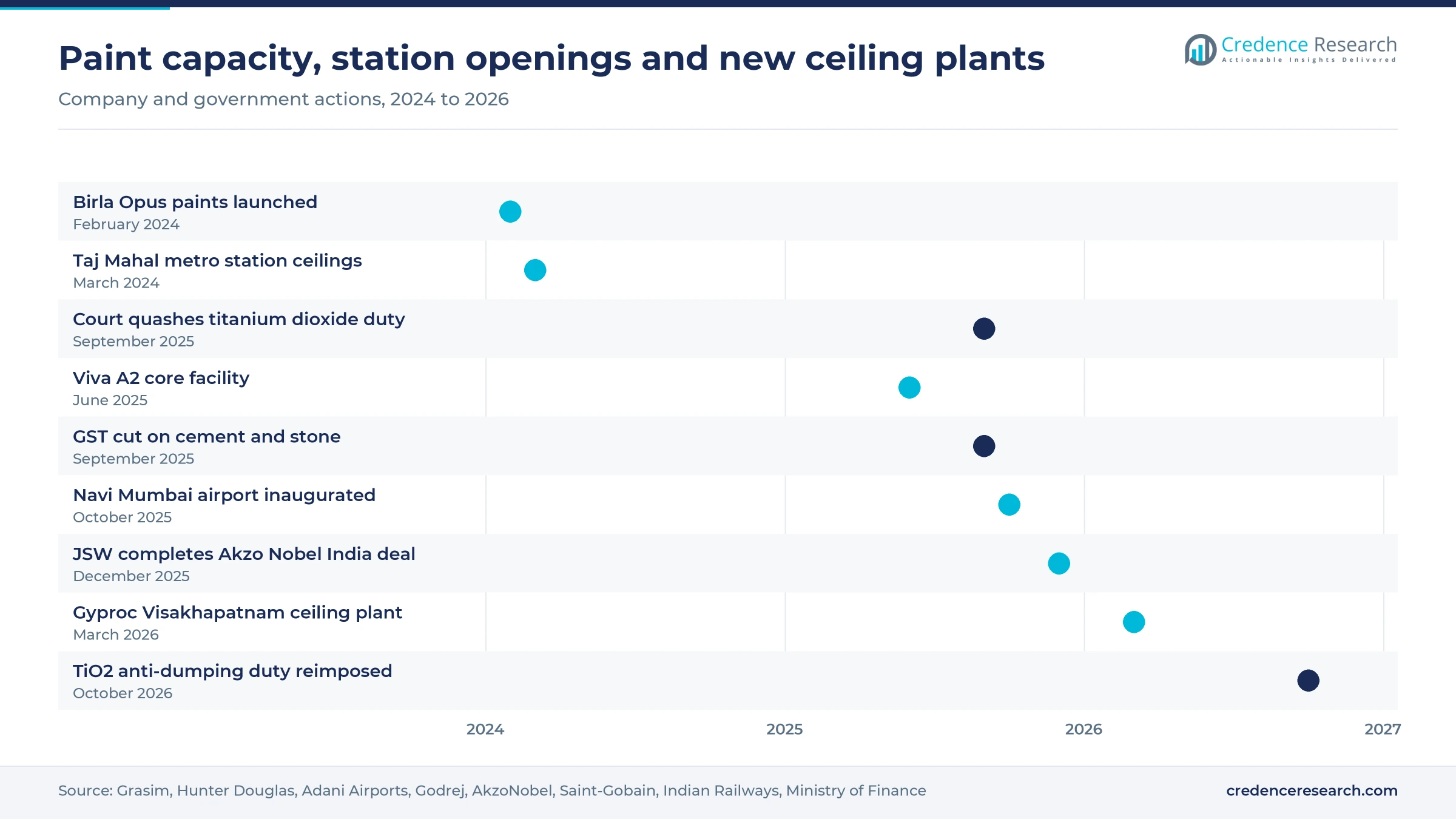
Ceiling and metal finish suppliers are moving production into India to shorten lead times and price in rupees for large public and office projects. Saint-Gobain India's Gyproc business commissioned a near-zero carbon plant in Visakhapatnam making 5 million square meters a year of PVC-laminated gypsum ceiling tiles, Global Gypsum reported in March 2026. Hunter Douglas India supplies its Luxalon metal ceilings from a plant in Sri City, and it fitted 10,000 square meters of wood-finish baffles and 3,500 square meters of linear ceiling at the Taj Mahal metro station in Agra in 2024, BizzBuzz reported. Local output makes false ceiling systems cheaper and quicker for transit and office buyers.
Opportunity in design-and-build packages for transit property
Metro corporations and state IT parks increasingly want one contractor for interiors, finishes and facades, which opens a market for design-and-build firms that can carry public tender risk. Interio by Godrej was declared lowest bidder for interior finishing at five elevated Kochi Metro Phase 2 stations in November 2025, the company said. It also completed an INR 24 crore design-and-build workspace for Kerala's state IT infrastructure company, with more than 50,000 sq ft of office interiors and 65,000 sq ft of facade work. Station-linked offices and retail give contractors a second order after the station shell, and buyers gain a single point of accountability.
Opportunity in festival, heritage and civic facade lighting
Cities and event authorities now treat facade and bridge lighting as permanent civic assets, which creates repeat work in controls, maintenance and content programming for lighting designers. Signify lit the Viman Mandapam and the Shastri Bridge for the Maha Kumbh in early 2025 with color-changing RGBW grazers on dynamic control, according to BIS Infotech. The housing and urban affairs ministry told the Lok Sabha in August 2025 that 7,636 of 8,063 sanctioned Smart Cities Mission projects, worth INR 1.53 lakh crore, were complete by July 31, 2025, and many include plazas, waterfronts and lit public spaces that now need upkeep. Lighting firms that sell multiyear service contracts to municipal bodies can lock in annuity revenue beyond one-off installation.
Pigment duties, wages and flex reuse squeeze margins
Titanium dioxide duties keep paint costs uncertain
Pigment costs swing with trade rulings, a cost risk for contractors that quote fixed prices on renovation contracts with large painted areas. The Calcutta High Court quashed India's earlier anti-dumping duty on Chinese titanium dioxide in September 2025, and the Finance Ministry reimposed duties of USD 460 to USD 681 per metric ton for five years through a notification dated Oct. 24, 2026, TaxGuru reported. Smaller paints and coatings brands without backward integration face the largest cost gap.
Rising wages for site labor squeeze lump-sum contracts
Decoration is labor-heavy work, so wage pressure reaches contractors faster than it reaches material suppliers. KEC International told analysts in November 2025 that it had 24,000 site workers against a need for 30,000, the Free Press Journal reported, and although KEC builds power and civil projects rather than interiors, it hires from the same pool of site labor. Fit-out contractors on lump-sum office jobs carry rising wages until the next tender, while skilled ceiling fixers, stone polishers and painters move between sites for better pay. Prefabricated panels and laminated tiles reduce that labor risk on large sites.
Flex operators reuse fit-outs and buy at scale
The growth of flexible workspace is a volume constraint, because it reduces the number of separate fit-out orders per square foot leased. Flex operators took 21.5% of 2025 office gross leasing and a record 26.6% share in the fourth quarter, JLL data show. These operators standardize finishes across centers, reuse layouts when members change, and negotiate national rate contracts with suppliers. Smaller decoration contractors that depend on one-off corporate tenants lose volume and pricing power as this share rises.
Public budgets arrive in uneven tranches
Public projects pay well but slowly, a cash-flow risk that arises because budgets are released by fiscal year and works are billed in stages. Indian Railways had spent INR 72.53 billion of its INR 121.18 billion station redevelopment allocation for fiscal 2025-26 by October 2025, Construction World reported. Contractors that finance finishing materials ahead of bills face working capital strain when releases slow, and smaller firms often cannot bid for the next tranche until earlier payments clear.
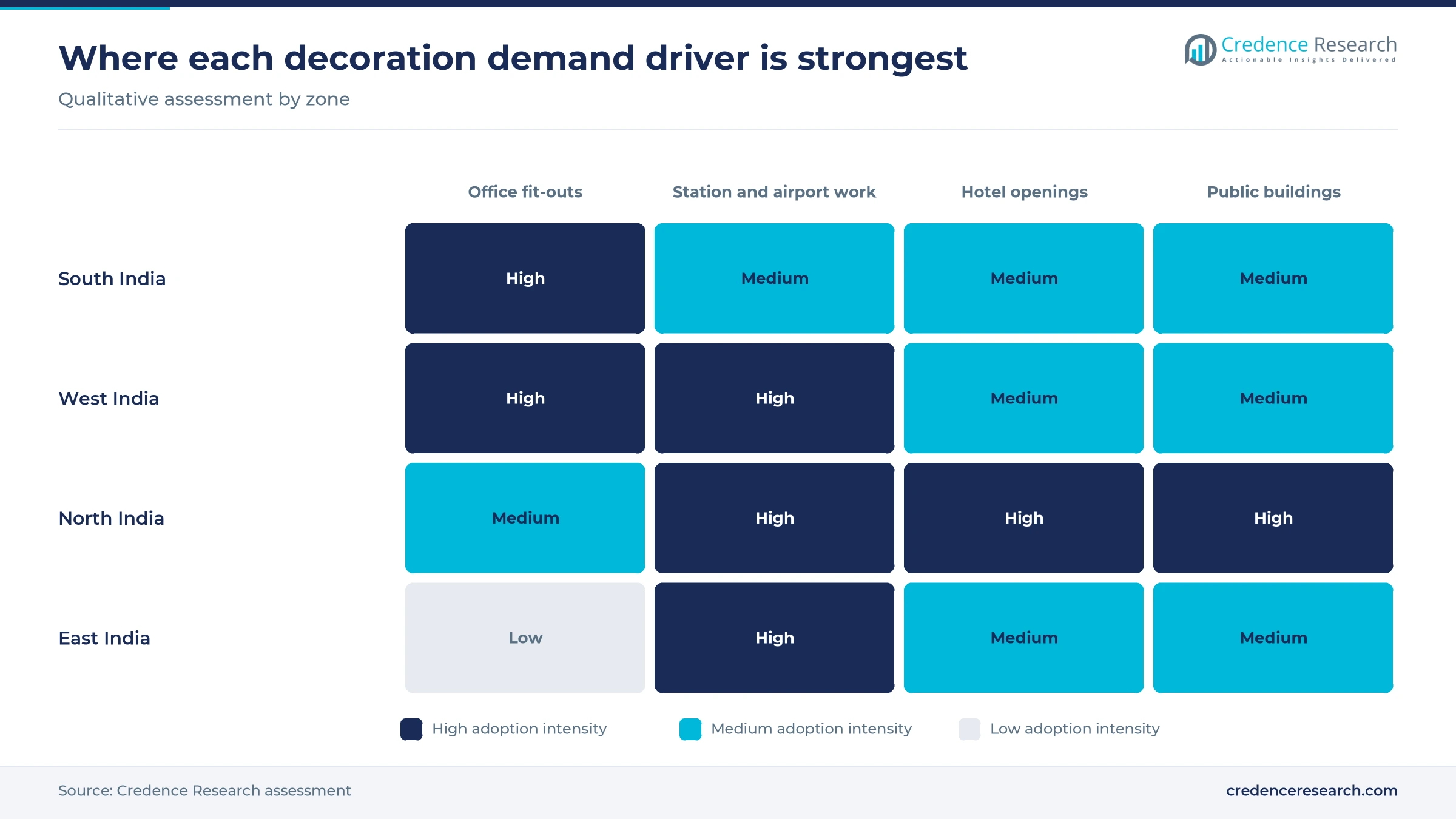
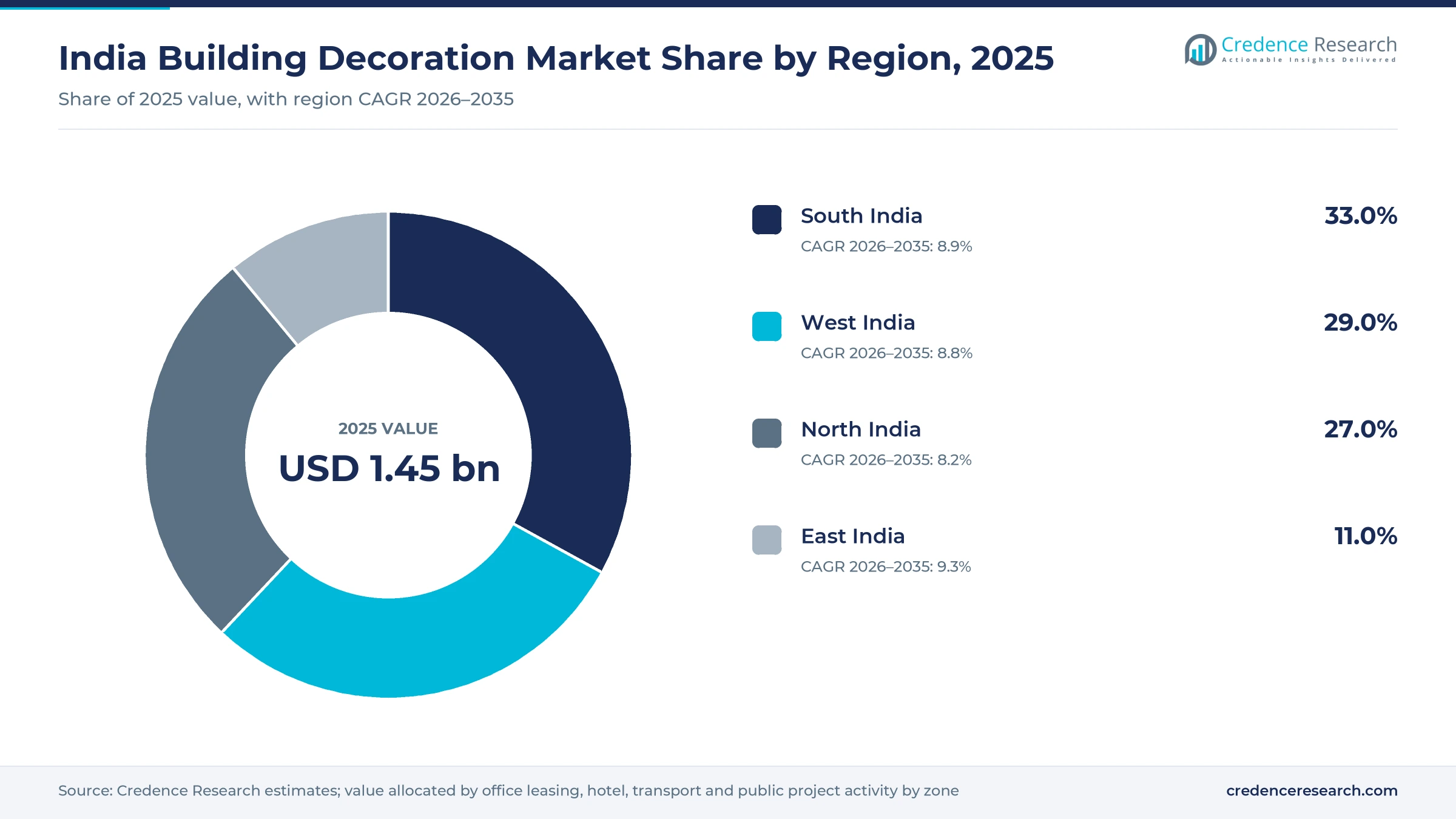
South India leads on office leasing while the East climbs
| Region | Value, 2025 (USD billion) | Share, 2025 | CAGR, 2026–2035 |
|---|---|---|---|
| South India | 0.48 | 33.0% | 8.9% |
| West India | 0.42 | 29.0% | 8.8% |
| North India | 0.39 | 27.0% | 8.2% |
| East India | 0.16 | 11.0% | 9.3% |
South India leads on technology office leasing
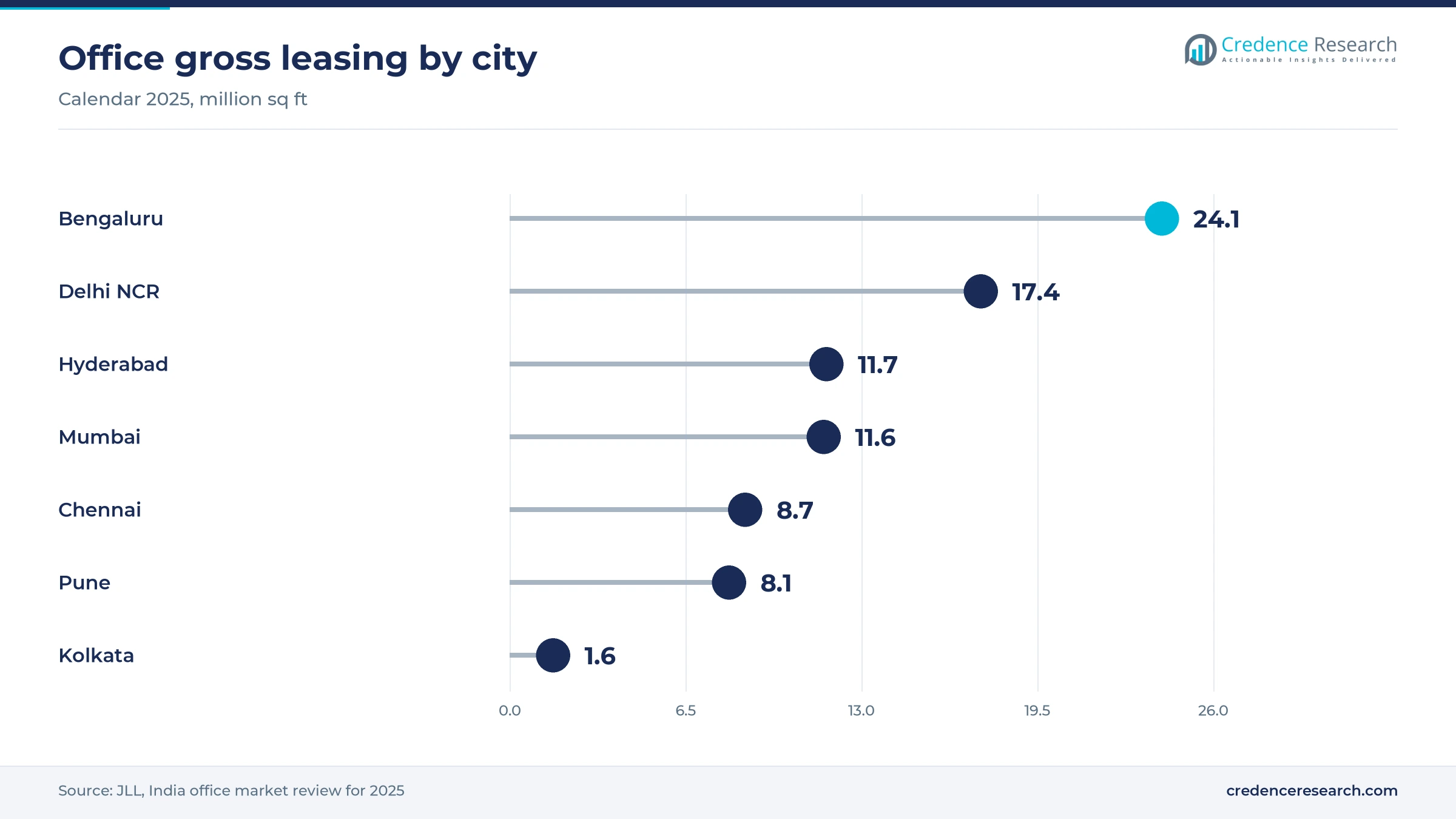
South India held a 33.0% share of 2025 value and grows at 8.9% a year through 2035. Demand is strongest here because Bengaluru, Hyderabad and Chennai together leased 44.5 million sq ft of office space in 2025, with Bengaluru alone at 24.1 million sq ft. Global capability centers cluster in these cities and specify premium ceilings, carpet tiles and lighting. Local supply is strong, since Hunter Douglas makes metal ceilings in Sri City and Saint-Gobain makes ceiling tiles in Visakhapatnam, which shortens delivery for southern projects.
West India gains from Mumbai, Pune and new terminals
West India held a 29.0% share of 2025 value and grows at 8.8% a year through 2035. Mumbai leasing rose 13.0% to 11.6 million sq ft in 2025 and Pune rose 18.2% to 8.1 million sq ft, both record years. The Navi Mumbai airport, which Adani says has first-phase capacity for 20 million passengers a year, adds a large new client for interior, landscape and lighting maintenance work across its terminal and forecourts.
North India relies on public projects and hotels
North India held a 27.0% share of 2025 value and grows at 8.2% a year through 2035. It is the slowest of the four zones because Delhi NCR office leasing slipped 1.6% to 17.4 million sq ft in 2025. Public and heritage work offsets part of that, from the Taj Mahal metro station in Agra to festival lighting in Prayagraj. Paint supply is close at hand, since Birla Opus opened plants in Panipat and Ludhiana in 2024.
East India climbs from a low office base
East India held an 11.0% share of 2025 value and grows fastest at 9.3% a year through 2035. Kolkata leased only 1.6 million sq ft of office space in 2025, down 9.2%, so offices matter less here than stations, hospitals and government buildings. New supply supports growth, since Birla Opus scheduled its Kharagpur paint plant for fiscal 2025, and Hunter Douglas has supplied ceilings for the Kolkata metro.
Paint capacity, station openings and new ceiling plants
| Development | Status and market relevance |
|---|---|
| In February 2024, Grasim launched Birla Opus paints with six plants and 1,332 million liters a year of capacity. | Commercial launch; three plants opened, three were scheduled for fiscal 2025. |
| In November 2025, Interio by Godrej was declared lowest bidder for interior finishing at five Kochi Metro stations. | Bid stage, award pending; it also completed an INR 24 crore workspace. |
| In December 2025, JSW Paints completed its purchase of Akzo Nobel India, owner of the Dulux paint business. | Completed acquisition; adds a second large group to decorative paints. |
| In March 2026, Saint-Gobain India commissioned a gypsum ceiling tile plant in Visakhapatnam. | Operational launch; 5 million square meters a year of capacity. |
Laminated gypsum, mineral-core panels and DMX lighting
- PVC-laminated gypsum ceiling tiles resist moisture and need no repainting, which suits hospitals, stations and offices that want washable ceilings, and local plants now supply them in rupees with shorter lead times for large public tenders.
- Mineral-core and solid aluminum facade panels reach A2 or A1 fire classes under EN 13501-1, so architects can keep a metal finish on taller commercial buildings while meeting stricter fire reviews by owners and insurers.
- DMX-controlled RGBW facade lighting lets cities and temple trusts change color scenes for festivals and events without new fixtures or extra wiring, which turns one installation into years of programming and service work.
- Roll-formed metal baffles and linear ceilings combine acoustic control with wood or metal finishes across large transit halls and atriums, and they install faster than plaster work on high ceilings.
Need a Custom Version of This Report?
Tailor the scope, geography, or segments to your exact requirements.
- Custom geography or segment scope
- Direct access to our analyst team
Material brands and design-build firms split the work
Competition splits between material brands that win specification and contractors that win the installation contract. Paint makers matter mainly through project sales teams that supply renovation contracts, and the entry of Birla Opus in 2024 and the JSW purchase of Akzo Nobel India in 2025 sharpened price competition with Asian Paints. Ceiling, flooring and facade brands such as Saint-Gobain, Hunter Douglas, Tarkett, Interface and Eurobond compete on architect approval, fire and acoustic test data, and local stock. Lighting firms such as Signify win on design capability and control systems for civic and heritage projects. Design-and-build firms such as Interio by Godrej compete on tender qualification and the ability to carry public payment cycles, while thousands of regional contractors compete on price for smaller offices and hotels.
How is the supply side organized?
The supply side runs in three tiers that rarely overlap. Material brands such as Asian Paints, JSW Paints, Saint-Gobain, Hunter Douglas, Tarkett and Interface sell finishes through dealers, applicators and project teams. Facade panel makers led by Eurobond and Aludecor sell to fabricators who install on site. Design-and-build firms such as Interio by Godrej, together with many regional fit-out contractors, assemble these products into turnkey packages. Entry barriers sit in brand approval by architects and public tender qualification, while margins sit with branded materials and specialist lighting design rather than site labor.
Finish, facade and lighting suppliers active in India
| Company | Type | Role in the market |
|---|---|---|
| Asian Paints | Paint manufacturer | Sells decorative interior and exterior paints through dealers and project sales teams |
| JSW Paints (Akzo Nobel India) | Paint manufacturer | Sells Dulux and JSW decorative paints through dealers and project teams since the December 2025 deal |
| Saint-Gobain India (Gyproc) | Ceiling and drywall maker | Makes gypsum boards and laminated ceiling tiles, including in Visakhapatnam |
| Hunter Douglas India | Ceiling and facade systems maker | Supplies Luxalon metal ceilings and facade products from Sri City |
| Signify Innovations India | Lighting company | Supplies architectural, facade and landmark lighting with control systems |
| Godrej Enterprises Group (Interio) | Design-and-build contractor | Delivers turnkey office, metro and institutional interiors and facades |
| Euro Panel Products (Eurobond) | Facade panel maker | Makes aluminum composite and solid aluminum facade panels in India |
| Aludecor Lamination | Facade panel maker | Makes aluminum composite panels for commercial facades and signage |
| Tarkett | Flooring maker | Sells vinyl and carpet flooring in India through distribution partners |
| Interface | Flooring maker | Sells modular carpet tiles and luxury vinyl tiles for offices |
Spending moves toward public hubs and code-led lighting
Credence Research's view is that decoration spending in India is moving from private office interiors toward a wider mix that includes stations, airports and hotels in smaller cities. Office leasing still sets the base, but public programs and energy rules decide where the faster growth sits, especially in lighting design and transit finishes. Suppliers that can certify fire and acoustic performance, stock locally and carry public payment cycles are best placed, while contractors tied to single corporate tenants face pressure from flex operators. Cost risk sits in site wages and imported inputs rather than demand.
Estimates rest on floor area, room keys and budgets
The report uses 2025 as the base year and 2026 to 2035 as the forecast period. Market value comes from the Credence Research model, which multiplies office floor area leased, hotel openings and renovations, and public station, airport and building budgets by estimated decorative spend per square foot, per key or per project. Type, application and regional splits are Credence Research estimates from public data. Sources used include government releases and parliamentary replies, company disclosures, energy code documents and published city leasing data; no interviews or surveys were conducted.
Office demand and public programs set the path to 2035
Through 2035, office leasing by global capability centers should keep commercial complexes the largest buyers, while station and airport programs make transportation hubs the fastest-growing application. Lighting design gains share as energy codes and possible mandatory ratings reach more large buildings. Hotel openings in smaller cities widen demand for midscale packages. Local ceiling, panel and paint capacity should hold material prices steady, but trade duties on inputs and site wages remain the main risks. The forecast assumes no prolonged slowdown in office hiring by global firms.
Office demand and public budgets set the range
The range to 2035 depends mainly on whether office leasing holds near current levels and whether station and airport programs keep their funding after the first wave of completions. Hotel openings support every case, because signed pipelines run several years ahead. A slowdown in global capability center hiring would cut fresh office fit-outs first, while faster public spending and stricter energy ratings would lift lighting and transit work.
| Scenario | CAGR, 2026–2035 | Value, 2035 | What has to hold |
|---|---|---|---|
| Downside | 7.2% | USD 2.94 billion | Office leasing falls back and station budgets slip after the first wave of completions |
| Base | 8.77% | USD 3.36 billion | Office leasing stays near 2025 levels and station and airport programs continue on schedule |
| Upside | 10.2% | USD 3.77 billion | Energy ratings become mandatory and public transit and hotel openings both accelerate |
Frequently Asked Questions
How big is the India building decoration market?
Which type of decoration work holds the largest share?
Which application grows fastest through 2035?
Which region leads decoration spending in India?
What recent news affects the building and decoration industry in India?
How do energy efficiency rules affect buildings in India?
Who are the key companies in this market?
How is decoration work priced in India?
Table of Content
Chapter 1 Market Segmentation
- 1.1 Segmentation Framework
- 1.1.1 Product and Service Classification
- 1.1.2 Application and End-Use Classification
- 1.1.3 Technology and Solution Classification
- 1.1.4 Customer and Distribution Channel Classification
- 1.1.5 Geographic Segmentation
- 1.1.6 Market Segment Definitions and Boundaries
- 1.2 By Type
- 1.2.1 Interior Renovation
- 1.2.2 Facade Decoration
- 1.2.3 Lighting Design and Decoration
- 1.2.4 Landscape Design and Decoration
- 1.2.5 Outdoor Decoration
- 1.3 By Application
- 1.3.1 Commercial Complex
- 1.3.2 Transportation Hub
- 1.3.3 Hotels and Guesthouses
- 1.3.4 Public Utilities
- 1.3.5 Government Agency
Chapter 2 Introduction
- 2.1 Report Objectives and Scope
- 2.2 Product Definition and Industry Terminology
- 2.3 Market Inclusions and Exclusions
- 2.4 Research Process
- 2.4.1 Primary Research and Expert Interviews
- 2.4.2 Secondary Research and Source Review
- 2.4.3 Top-Down and Bottom-Up Estimation
- 2.4.4 Data Triangulation and Verification
- 2.5 Market Size Measurement Basis
- 2.5.1 2025: USD 1.45 billion → 2035: USD 3.36 billion
- 2.6 Historical and Forecast Reference Periods
- 2.6.1 Historical Period: 2018-2025
- 2.6.2 Base Year: 2025
- 2.6.3 Forecast Period: 2025-2035
- 2.7 Research Assumptions and Limitations
Chapter 3 Executive Summary
- 3.1 Market Snapshot and Key Findings
- 3.2 Base-Year Market Size, 2025
- 3.3 Forecast Market Size, 2035
- 3.4 Revenue and Volume Growth Outlook
- 3.5 Key Demand and Supply Indicators
- 3.6 Leading Market Segments
- 3.7 Fastest-Growing Market Opportunities
- 3.8 Regional Performance Highlights
- 3.9 Technology and Industry Transformation
- 3.10 Competitive Landscape Summary
- 3.11 Analyst View and Strategic Implications
Chapter 4 India Building Decoration Market Trends and Developments
- 4.1 Historical Industry Development, 2018-2025
- 4.2 Recent Market Trends and Developments
- 4.3 Demand and Customer Behavior Trends
- 4.4 Technology and Product Innovation
- 4.5 Artificial Intelligence, Automation and Digitalization
- 4.6 Local Manufacturing and Supply Chain Realignment
- 4.7 Industry Partnerships, Mergers and Acquisitions
- 4.8 Sustainability and Circular Economy Developments
- 4.9 Government and Private Sector Investment Trends
- 4.10 Emerging Business Models and Commercialization
- 4.11 Industry Developments and Announcements
Chapter 5 India Building Decoration Market Production, Supply and Demand Analysis
- 5.1 Demand Trend and Consumption Analysis, 2018-2025
- 5.2 Demand Forecast, 2025-2035
- 5.3 Production and Output Trend, 2018-2025
- 5.4 Production and Output Forecast, 2025-2035
- 5.5 Installed Capacity and Capacity Utilization
- 5.6 Company-Wise Production Plants and Statistics
- 5.6.1 Installed Production Capacity
- 5.6.2 Actual Production
- 5.6.3 Planned Capacity and Expansion Targets
- 5.7 Supply Chain Structure and Procurement Trends
- 5.8 Supply-Demand Gap and Bottlenecks
- 5.9 Import Dependence and Sourcing Structure
- 5.10 Contract Manufacturing and Outsourcing
- 5.11 Regional Supply and Demand Concentration
Chapter 6 India Building Decoration Market Pricing Analysis
- 6.1 Pricing Structure and Measurement
- 6.2 Historical Pricing Trends, 2018-2025
- 6.3 Pricing Outlook, 2025-2035
- 6.4 Average Selling Price and Unit Economics
- 6.5 Pricing by Product and Market Segment
- 6.6 Geographic Pricing Differences
- 6.7 Key Input, Energy, Labor and Logistics Costs
- 6.8 Contract Pricing and Purchasing Models
- 6.9 Pricing Sensitivity and Competitive Positioning
- 6.10 Price, Margin and Profitability Implications
Chapter 7 India Building Decoration Market Dynamics
- 7.1 Market Growth Drivers
- 7.1.1 Demand-Side Drivers
- 7.1.2 Technology and Innovation Drivers
- 7.1.3 Infrastructure and Investment Drivers
- 7.1.4 Regulatory and Policy Drivers
- 7.2 Market Restraints
- 7.2.1 Cost and Affordability Constraints
- 7.2.2 Technology and Adoption Barriers
- 7.2.3 Supply Chain and Operational Constraints
- 7.3 Market Challenges
- 7.3.1 Competitive Pressure and Margin Erosion
- 7.3.2 Skills, Infrastructure and Implementation Gaps
- 7.4 Emerging Market Opportunities
- 7.5 Market Dynamics Impact and Time-Horizon Assessment
Chapter 8 India Building Decoration Value Chain Analysis
- 8.1 Industry Value Chain Overview
- 8.2 Upstream Suppliers and Critical Inputs
- 8.3 Technology and Component Providers
- 8.4 Manufacturing or Service Delivery
- 8.5 Distribution, Channel Partners and Integrators
- 8.6 Downstream Applications and End Users
- 8.7 Value Addition and Profit Pools
- 8.8 Vertical Integration and Outsourcing
- 8.9 Supplier Concentration and Risk
- 8.10 Supply Chain Localization and Resilience
Chapter 9 India Building Decoration Market Regulations and Policies
- 9.1 Relevant Laws, Standards and Compliance Frameworks
- 9.2 Product, Service, Safety and Quality Requirements
- 9.3 Government Policies, Incentives and Subsidies
- 9.4 Imports, Exports and Trade Barriers
- 9.5 Public Procurement and Local Content Requirements
- 9.6 Environmental and Sustainability Compliance
- 9.7 Upcoming Policy Changes and Market Implications
Chapter 10 India Building Decoration Market Hotspots and Opportunities
- 10.1 Market Opportunity Mapping and Growth Hotspots
- 10.2 High-Growth Applications and Customer Groups
- 10.3 Underserved Markets and White-Space Opportunities
- 10.4 Emerging Technology and Product Opportunities
- 10.5 New Capacity and Investment Hotspots
- 10.6 Market Entry and Expansion Opportunities
- 10.7 Distribution and Partnership Opportunities
- 10.8 Near-Term and Long-Term Commercial Potential
- 10.9 Opportunity Attractiveness and Execution Risks
Chapter 11 India Building Decoration Market Outlook, 2025-2035
- 11.1 Market Size and Analysis
- 11.1.1 Revenue (Market Measurement: 2025: USD 1.45 billion → 2035: USD 3.36 billion)
- 11.1.2 Market Volume and Quantity Sold
- 11.1.3 Historical Market Size, 2018-2025
- 11.1.4 Base-Year Market Size, 2025
- 11.2 Market Forecast, 2025-2035
- 11.2.1 Revenue Forecast to 2035
- 11.2.2 Volume Forecast to 2035
- 11.2.3 CAGR and Year-on-Year Growth
- 11.2.4 Incremental Revenue Opportunity
- 11.3 Forecast Assumptions and Scenario Analysis
- 11.3.1 Base-Case Forecast
- 11.3.2 Optimistic and Conservative Scenarios
- 11.3.3 Technology, Pricing and Policy Sensitivities
- 11.4 Market Attractiveness and Growth Outlook
Chapter 12 India Building Decoration Market Segmentation and Outlook
- 12.1 Segmentation Summary and Market Shares, 2025
- 12.2 Largest and Fastest-Growing Segments
- 12.3 By Type - Market Size and Forecast, 2025-2035
- 12.3.1 Segment Definition and Scope
- 12.3.2 Historical Market Size, 2018-2025
- 12.3.3 Revenue Forecast, 2025-2035
- 12.3.4 Volume Forecast, 2025-2035
- 12.3.5 Base-Year Market Share, 2025
- 12.3.6 Segment CAGR and Growth Drivers
- 12.3.7 Subsegment Market Size and Forecast
- 12.3.7.1 Interior Renovation
- 12.3.7.2 Facade Decoration
- 12.3.7.3 Lighting Design and Decoration
- 12.3.7.4 Landscape Design and Decoration
- 12.3.7.5 Outdoor Decoration
- 12.3.8 Subsegment Pricing and Adoption Trends
- 12.3.9 Leading Suppliers and Competition
- 12.3.10 Regional Demand and Opportunities
- 12.4 By Application - Market Size and Forecast, 2025-2035
- 12.4.1 Segment Definition and Scope
- 12.4.2 Historical Market Size, 2018-2025
- 12.4.3 Revenue Forecast, 2025-2035
- 12.4.4 Volume Forecast, 2025-2035
- 12.4.5 Base-Year Market Share, 2025
- 12.4.6 Segment CAGR and Growth Drivers
- 12.4.7 Subsegment Market Size and Forecast
- 12.4.7.1 Commercial Complex
- 12.4.7.2 Transportation Hub
- 12.4.7.3 Hotels and Guesthouses
- 12.4.7.4 Public Utilities
- 12.4.7.5 Government Agency
- 12.4.8 Subsegment Pricing and Adoption Trends
- 12.4.9 Leading Suppliers and Competition
- 12.4.10 Regional Demand and Opportunities
- 12.5 Segment Growth Comparison
- 12.6 Segment Attractiveness and Priority Matrix
Chapter 13 India Building Decoration End-Use and Application Market Outlook
- 13.1 End-Use Industry and Customer Demand Structure
- 13.2 Leading Applications and Customer Groups
- 13.3 End-Use Market Size, Share and Forecast
- 13.4 Major End-Use Industry Deep Dives
- 13.4.1 Customer Requirements and Use Cases
- 13.4.2 Demand and Replacement Cycles
- 13.4.3 Technical and Regulatory Considerations
- 13.4.4 Purchasing and Procurement Models
- 13.4.5 Leading Vendors and Distribution Channels
- 13.4.6 Forecast and Commercial Opportunities
- 13.5 Emerging Applications and Cross-Segment Demand
- 13.6 End-Use Industry Investment Priorities
Chapter 14 India Building Decoration Geographic Market Outlook, 2025-2035
- 14.1 Domestic Market Distribution and Demand Clusters
- 14.2 State- or Province-Wise Market Size and Forecast, 2025-2035
- 14.3 City and Metropolitan Market Outlook
- 14.4 Industrial, Manufacturing and Commercial Clusters
- 14.5 Geographic Concentration of Key End Users
- 14.6 Local Pricing and Purchasing Differences
- 14.7 Domestic Production Facilities and Capacity Map
- 14.8 Local Infrastructure and Project Pipeline
- 14.9 State-Level Policy and Incentive Differences
- 14.10 Subnational Investment Hotspots and Opportunities
- 14.11 Distribution and Logistics Networks
- 14.12 Domestic Competitive Footprint
Chapter 15 India Building Decoration Technology, Innovation and Sustainability Outlook
- 15.1 Technology Landscape and Maturity
- 15.2 Product, Process and Service Innovation
- 15.3 AI, Automation and Digital Tools in the Industry
- 15.4 Technology Adoption and Performance Benchmarking
- 15.5 Innovation Pipeline and R&D Investment
- 15.6 Patent and Intellectual Property Trends
- 15.7 Energy Efficiency and Resource Management
- 15.8 Sustainability, Recycling and Circularity
- 15.9 Technology Roadmap, 2025-2035
- 15.10 Risks of Obsolescence and Technology Substitution
Chapter 16 India Building Decoration Market Key Strategic Imperatives
- 16.1 Growth and Market Entry Priorities
- 16.2 High-Return Products and Segments
- 16.3 Pricing, Profitability and Cost Optimization
- 16.4 Technology Investment and Product Differentiation
- 16.5 Supply Chain Localization and Resilience
- 16.6 Distribution and Customer Acquisition
- 16.7 Partnership, Acquisition and Capacity Strategy
- 16.8 Regional Expansion Priorities
- 16.9 Short-, Medium- and Long-Term Actions
Chapter 17 Competition Outlook
- 17.1 Industry Competition Characteristics
- 17.2 Market Structure and Concentration
- 17.3 Market Share and Competitive Positioning, 2025
- 17.4 Company-Wise Revenue and Product Benchmarking
- 17.5 Production and Service Capacity Benchmarking
- 17.6 Technology, Pricing and Differentiation
- 17.7 Regional Footprint and Distribution Strength
- 17.8 Mergers, Acquisitions and Strategic Alliances
- 17.9 New Entrants and Competitive Threats
- 17.10 Porter's Five Forces and Industry Attractiveness
- 17.11 Competitive Outlook, 2025-2035
Chapter 18 Company Profiles
- 18.1 Company Coverage and Selection Criteria
- 18.2 Asian Paints
- 18.2.1 Business Description
- 18.2.2 Company Ownership and Geographic Presence
- 18.2.3 Product and Service Portfolio
- 18.2.4 Manufacturing and Operating Footprint
- 18.2.5 Production Capacity and Expansion Plans
- 18.2.6 Financial Performance and Investment
- 18.2.7 Market Share and Competitive Position
- 18.2.8 Technology and Innovation Capabilities
- 18.2.9 Strategic Alliances or Partnerships
- 18.2.10 Recent Developments
- 18.2.11 Growth Strategy and Outlook
- 18.3 JSW Paints (Akzo Nobel India)
- 18.4 Saint-Gobain India (Gyproc)
- 18.5 Hunter Douglas India
- 18.6 Signify Innovations India
- 18.7 Godrej Enterprises Group (Interio)
- 18.8 Euro Panel Products (Eurobond)
- 18.9 Aludecor Lamination
- 18.10 Tarkett
- 18.11 Interface
- 18.12 Other Relevant Market Participants
Note: Every listed company is profiled on the structure shown under the first company. The company list is preliminary and may change based on research findings, market developments, data availability and client requirements.
Chapter 19 Disclaimer
- 19.1 Research and Forecast Disclaimer
- 19.2 Data Source and Estimation Limitations
Note: The depth of individual sections depends on data availability for this market. Volume, capacity, trade and other unit-based metrics are included where applicable.

