
Vehicle programs and export plants set the design budget
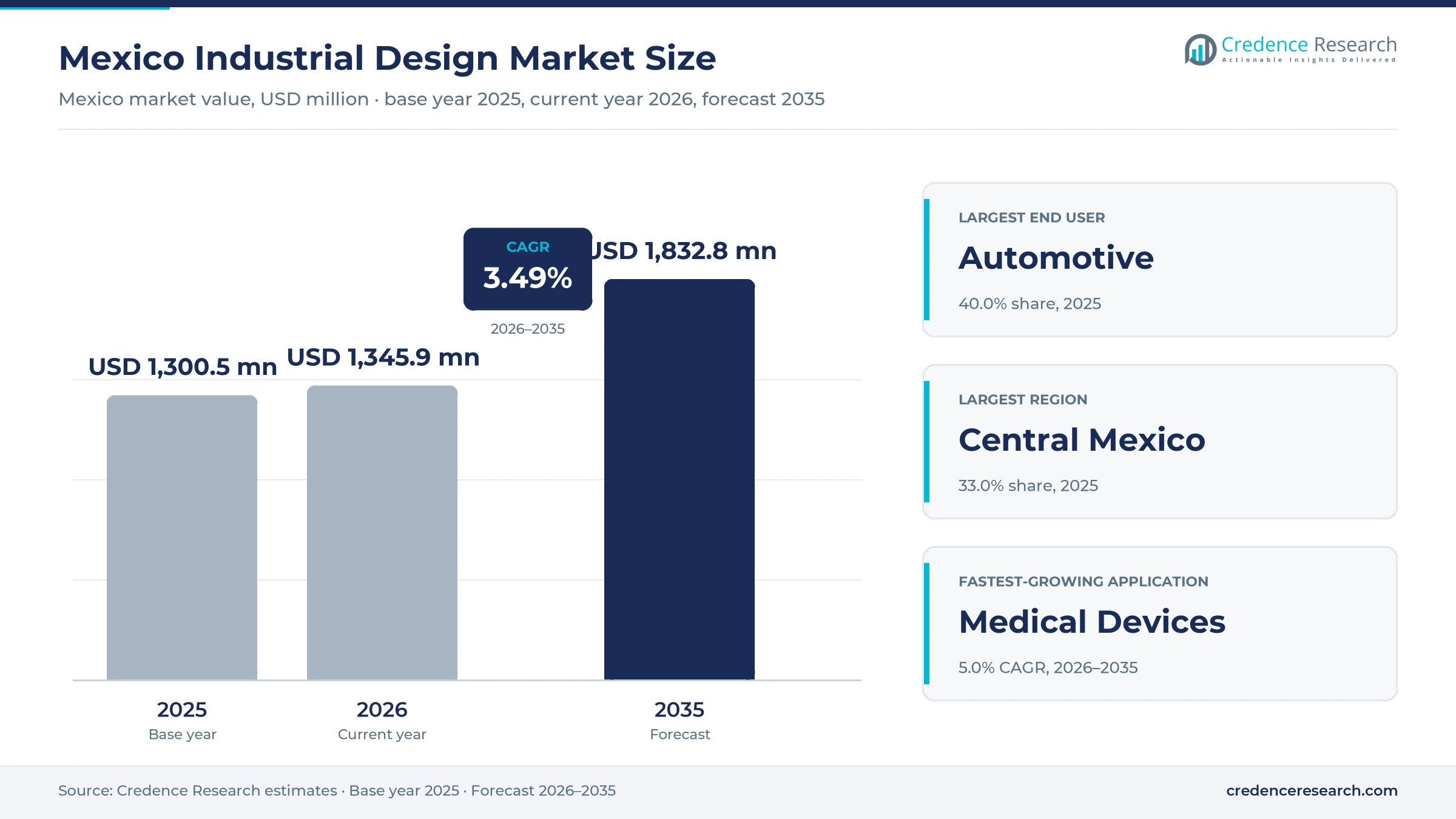
The Mexico industrial design market was valued at USD 1.30 billion in 2025 and is projected to increase from USD 1.35 billion in 2026 to USD 1.83 billion by 2035, registering a CAGR of 3.49% during 2026–2035. Spending comes from automakers and tier-one suppliers that style and engineer parts for North American programs, appliance, furniture and packaging makers that redesign products for local sourcing, and medical device and electronics exporters that move design work closer to their plants. Central Mexico held the largest regional share, 33.0% in 2025, because Mexico City concentrates design consultancies, brand owners and university programs, while the Bajío and Western Mexico region grows fastest at 4.0% a year on new engineering centers in Querétaro and Guadalajara. The most important policy change is Plan México, launched in January 2025, which sets higher national content targets for vehicles, consumer goods and aerospace exports. Low research spending still keeps many core design decisions at foreign headquarters.
Which design work is counted in Mexico?
The market counts what buyers in Mexico spend on industrial and product design work, from concept, styling and ergonomics to CAD modeling, prototyping and design-for-manufacturing, whether it is bought from consultancies, engineering-service firms and independent studios or carried out in captive design and technical centers of manufacturers. Automakers and suppliers buy most of it through program contracts, while furniture, appliance and packaging firms buy project by project.
Manufacturing itself, design software licences sold on their own, graphic branding and architectural or interior design work are excluded. The value chain runs from foreign headquarters that set product briefs through Mexican technical centers and engineering firms to local studios, and margins are widest where a firm owns the design and release responsibility rather than drawing work.
Mexico Industrial Design Market Insights
- The Mexico industrial design market was valued at USD 1.30 billion in 2025 and is projected to reach USD 1.83 billion by 2035, growing at a 3.49% CAGR during 2026–2035.
- Central Mexico held 33.0% of 2025 value, because Mexico City produced MXN 2.18 billion of the MXN 6.84 billion gross design services output in INEGI's 2019 census.
- Automotive work held 46.0% of 2025 value by product, because Mexico produced 3,953,494 light vehicles in 2025 and suppliers keep opening local design centers.
- Nexteer opened a USD 20 million technical center in Querétaro in October 2025 for design, validation and prototyping of advanced vehicle systems.
- The government-backed Olinia Uno city car was unveiled as a prototype in June 2026, with commercial production planned for 2027.
Vehicle work leads while device design grows fastest
Automotive design leads while furniture grows fastest
Based on product, the market is categorized into automotive, furniture, packaging and others. Automotive work led with 46.0% of 2025 value because suppliers now design and validate systems next to their Mexican plants, and Nexteer inaugurated a technical center in Querétaro in October 2025 after announcing a USD 20 million investment, with 400 specialized jobs, according to MexicoIndustry. Furniture grows fastest at 4.3% as North American buyers look beyond Asian suppliers, since China and Vietnam supplied 46% of world furniture exports in 2024, according to International Trade Centre data cited by MexicoIndustry in August 2025. Packaging work follows the consumer goods cycle and retail relaunches.
Transportation leads while device design grows fastest
Based on application, the market is categorized into transportation, consumer goods, medical devices and others. Transportation led with 48.0% of 2025 value because cars, trucks and aircraft parts carry the longest design and release programs, and nearly 400 aerospace companies now operate in 19 Mexican states, according to a MUNDI tally reported in July 2026. Medical Devices grow fastest at 5.0% as export volumes justify local engineering, and medical device exports reached about USD 20.55 billion in 2025 against USD 10.67 billion in 2020, according to Banco de México data reported by Expansión. Consumer goods sit second on appliance, furniture and housewares work.
Automakers lead while electronics firms grow fastest
Based on end user, the market is categorized into automotive, electronics, healthcare, aerospace and others. Automotive buyers led with 40.0% of 2025 value because vehicle output sets the volume of parts to design, and Mexico produced 3,953,494 light vehicles in 2025, according to the INEGI light vehicle bulletin of January 2026. Electronics buyers grow fastest at 4.4% as computer and communication equipment becomes the largest export line, and Jalisco's exports reached USD 52.58 billion in 2025, with computer and electronic equipment at 82.1% of fourth-quarter shipments, according to IIEG. Healthcare and aerospace buyers follow with smaller but steadier programs.
| Segment Group | Leading Sub-segment | Share, 2025 | Fastest-growing Sub-segment | CAGR, 2026–2035 |
|---|---|---|---|---|
| By Product | Automotive | 46.0% | Furniture | 4.3% |
| By Application | Transportation | 48.0% | Medical Devices | 5.0% |
| By End User | Automotive | 40.0% | Electronics | 4.4% |
Studio hourly rates span USD 25 to USD 149
Design work in Mexico is priced per hour for studio projects and per engineer month for program contracts, and both rest on local salaries that sit well below United States levels. Listed studio rates run from USD 25 to USD 149 an hour, with the top band including a Tijuana firm that also manufactures, while employed industrial designers earned an average of about MXN 11,000 a month in early 2026. Peso strength, the share of senior engineers and whether the supplier carries release responsibility move the price most. Buyers that bundle design with tooling or manufacturing pay more per hour but fewer hand-offs.
| Offer or input | Typical price or fee | Basis |
|---|---|---|
| Small studios in Mérida, Guadalajara and Mexico City | USD 25–49 per hour | Clutch agency listings, November 2026 |
| Mid-size studios in Monterrey and Mexico City | USD 50–99 per hour | Clutch agency listings, November 2026 |
| Top-tier firms in Tijuana, León and Mexico City | USD 100–149 per hour | Clutch agency listings, November 2026 |
| Minimum project for a design-and-manufacture firm | USD 250,000 and more | Clutch listing for SEACOMP, November 2026 |
| Employed industrial designer | About MXN 11,000 per month | INEGI ENOE via DataMexico, first quarter 2026 |
Request a Free Sample
Fill in your details and we'll send you a free sample report.
- Sample data tables & charts
- Research methodology
Capital, content rules and state programs lift design work
Record foreign capital funds new product programs
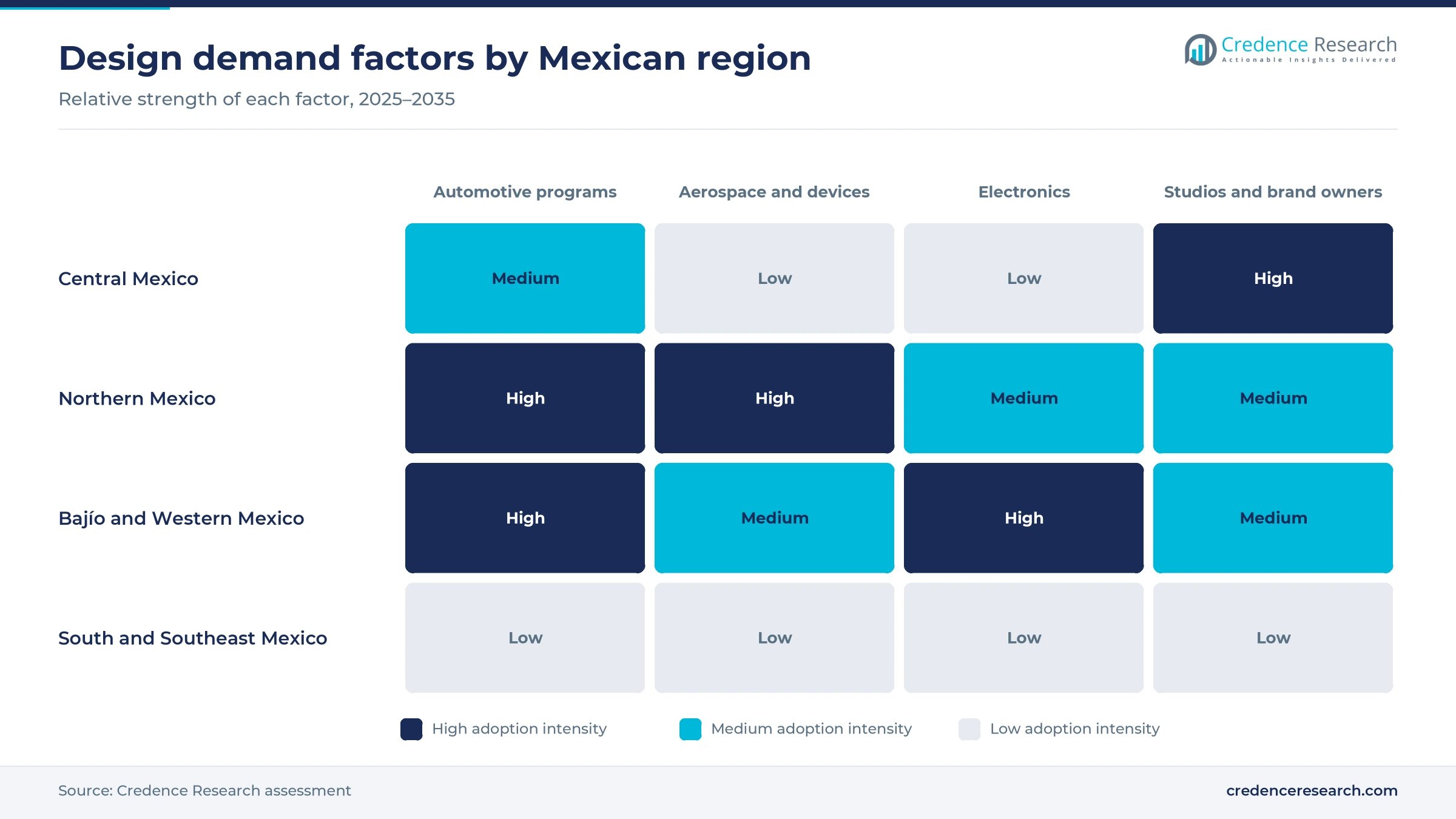
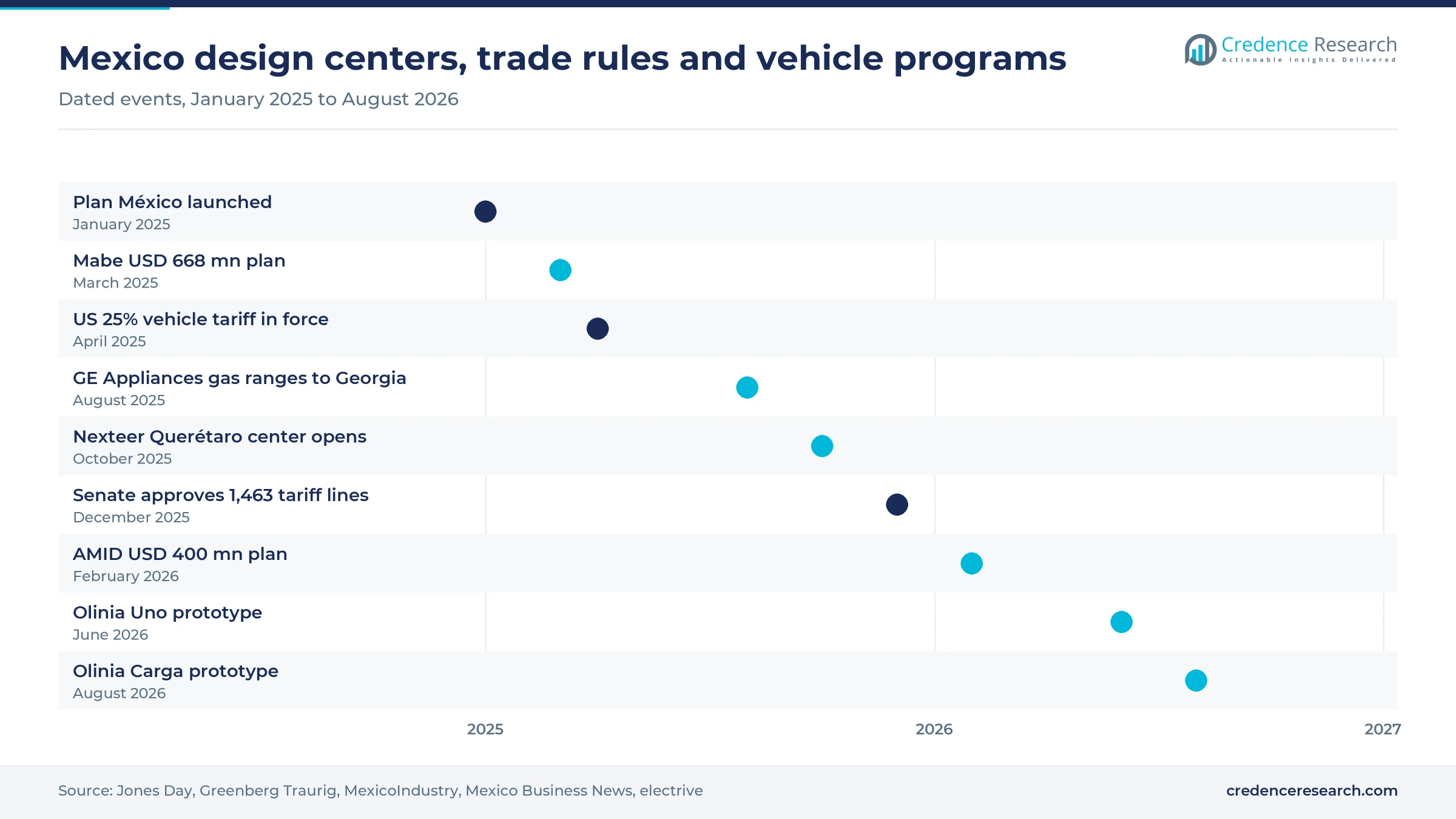
Each new production line or model needs parts, fixtures and packaging designed for local production, so investment inflows turn directly into design briefs. Mexico received almost USD 41 billion of foreign direct investment from January to September 2025, 15% more than a year earlier, according to figures presented by Economy Minister Marcelo Ebrard and reported by Cluster Industrial in November 2025. Only about USD 6.5 billion of that total was new investment, so most capital went to existing plants that refresh products rather than to greenfield sites. Mabe announced a USD 668 million plan for 2025 to 2027 in March 2025, naming the design and development of new products among its priorities. Studios and engineering firms that serve existing exporters gain most from this pattern.
National content targets push parts to be redesigned
A part made locally often needs new tooling, tolerances and materials, so content targets turn sourcing decisions into redesign work. Plan México, launched on Jan. 13, 2025, targets 15% more local content in vehicles, 20% more national content in consumer goods inputs and 10% more in aerospace exports, according to a Jones Day summary of the plan. It also offers immediate depreciation, with higher rates for research and development assets, and an extra 25% deduction on training. The Senate approved higher tariffs on 1,463 tariff lines from countries without trade agreements in December 2025, including 94 automotive and 81 plastics lines, according to N+. Design-for-manufacturing teams that can localize parts gain from both measures.
Captive engineering centers anchor design demand
A technical center next to the line turns a plant that builds to print into a site that owns part of the design. GE's engineering center in Querétaro employs about 1,500 engineers who design internal components for aerostructures and support aircraft engines, according to MexicoIndustry in June 2022. Employment of industrial designers rose to about 17,700 in the first quarter of 2026 from about 15,600 a quarter earlier, according to INEGI's employment survey, although quarterly readings are volatile. Visteon and Valeo also run Querétaro technical centers for cockpit electronics and lighting, but neither has published current staffing, which is an evidence gap. These centers buy CAD seats, prototypes and overflow engineering, which supports firms selling aerospace engineering outsourcing.
A state vehicle program creates a domestic design brief
Olinia gives Mexican designers a rare brief that starts at home rather than at a foreign headquarters. The science ministry SECIHTI coordinates Olinia, and more than 80 researchers from the IPN and TecNM work on it at an engineering center in Puebla, according to electrive in June 2026. The Olinia Uno prototype was shown in June 2026 with a target price of MXN 150,000, and commercial production is planned for 2027 with initial capacity of 20,000 units a year. An Olinia Carga light truck prototype followed on Aug. 25, 2026, with an industrial partner tender running to December. Local studios, prototype shops and suppliers of rapid prototyping materials gain a domestic reference customer.
Studios fold into consultancies as release work moves south
Independent studios are shifting into global consultancies
Global consultancies are shifting toward buying Mexican studios to address clients that want strategy, product and digital design from one supplier, creating openings for designers who join larger groups. Accenture agreed in August 2019 to acquire Insitum, a Mexico City design and innovation firm with more than 200 designers, strategists and researchers. frog opened a Mexico City studio on March 5, 2020, according to its press release, by hiring the team of local firm 23 Design, its first studio in Latin America. Buyers gain one contract for research, product and release work, while small studios face larger rivals that use the same local talent.
Design and release work is shifting into Mexico
Engineering-service firms are shifting design and release work into Mexico to address cost and time-zone needs of United States clients, creating openings for local powertrain, chassis and electrical engineers. Capgemini advertises design and release, CAD and CAE engineer roles in Guadalajara, Mexico City, Querétaro and Toluca on its careers site. ALTEN México posted a chassis design and release engineer role based in Querétaro on March 24, 2025. SEGULA Technologies has recruited automotive cooling system design and release engineers for Toluca and Saltillo on its SmartRecruiters careers page. Specialized design services as a whole employed about 117,000 workers in the third quarter of 2024, according to INEGI survey data published by DataMexico. Firms that sell automotive engineering services outsourcing capture most of this work.
Device exporters need design centers near their plants
Mexican device plants already build large volumes, yet most product definition still happens abroad, which leaves room for local design centers. The medical device association AMID plans up to USD 400 million of investment from 2026 to 2030 under Plan México, covering research, centers of excellence and training, according to Mexico Business News in February 2026. Device exports reached about USD 20.55 billion in 2025 and about 90% of output goes to the United States, according to Banco de México data reported by Expansión, so design changes follow United States regulatory files. SEACOMP lists electronic product design, design for manufacturing and new product introduction alongside its Mexico facility. Firms selling medical device engineering services near Tijuana and Guadalajara gain first.
Furniture buyers seek redesign partners outside Asia
United States furniture buyers need suppliers outside Asia that can adapt styles quickly, which gives Mexican studios a steady redesign brief. A United States furniture coalition estimates that tariffs of 10% to 20% would raise furniture prices by 6.4% to 9.5%, and says domestic producers cover only about one fifth of demand, according to MexicoIndustry in August 2025. The Jalisco furniture makers' association AFAMJAL is pushing deeper North American integration in response. The Plan México consumer goods content target noted above adds a second reason to redesign products around Mexican materials. Studios in Guadalajara and Mexico City that combine product and production design gain most.
Tariffs, thin research budgets and plant moves cap demand
United States auto tariffs delay new vehicle programs
Tariff uncertainty gives automakers reason to defer program awards, and each deferred program delays the parts design behind it. A 25% duty on imported vehicles took effect on April 3, 2025 under a United States presidential proclamation, applied only to the non-United States content of qualifying USMCA vehicles. Mexican light vehicle output fell 0.9% in 2025 and exports fell 2.7%, according to INEGI. Tier-one suppliers and engineering firms that depend on one automaker are most exposed while the USMCA review is pending.
Low research spending keeps design decisions abroad
Low research spending keeps core design decisions at foreign headquarters, which limits how much concept work reaches Mexico. Gross spending on research and development was 0.25% of GDP in 2024, according to the World Bank, down from 0.30% in 2018. Mexican technical centers therefore receive more adaptation and release work than original styling. Local studios that seek concept mandates are most exposed, unless state programs such as Olinia widen the domestic brief.
Production moves north can take design work with them
Product engineers tend to sit near the line that builds the product, so a plant relocated to the United States can take its design work with it. GE Appliances, owned by Haier, announced in August 2025 that it would move gas range production from Mexico to a plant in Georgia as part of a USD 3 billion United States expansion over five years, according to Mexico News Daily. Appliance design teams and suppliers in the north are most exposed if other brands follow.
A fragmented and informal studio base caps pricing
A fragmented and largely informal studio base caps pricing for formal design firms, because buyers can always find a cheaper freelancer for simple work. INEGI's 2019 Economic Census counted 4,862 specialized design units, and 78.1% of workers in design services were informal in the third quarter of 2024, according to DataMexico. Small formal studios without engineering or prototyping capacity are most exposed, while firms with release responsibility can charge more.
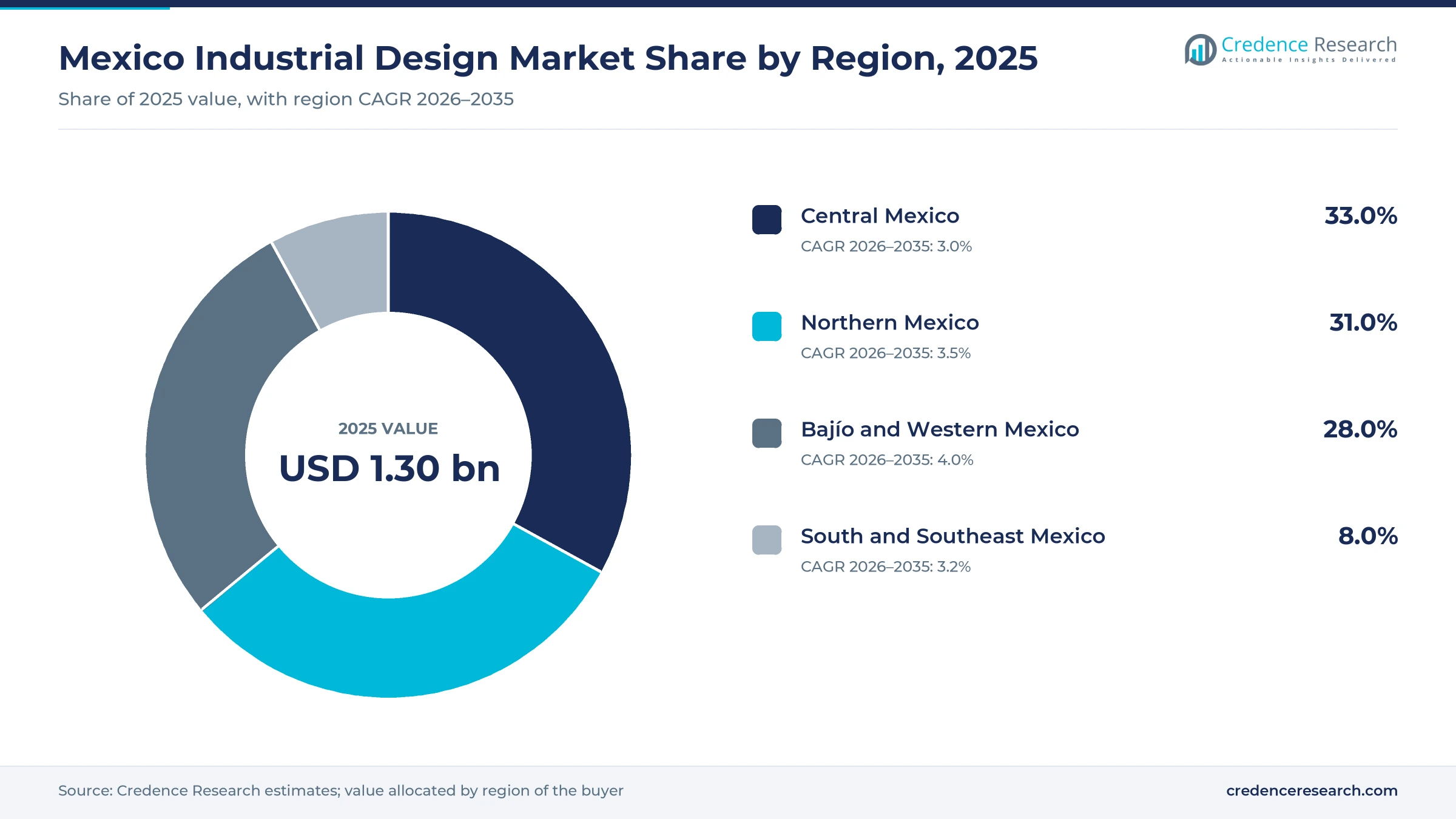
Central Mexico leads while the Bajío grows fastest
| Region | Value, 2025 (USD billion) | Share, 2025 | CAGR, 2026–2035 |
|---|---|---|---|
| Central Mexico | 0.43 | 33.0% | 3.0% |
| Northern Mexico | 0.40 | 31.0% | 3.5% |
| Bajío and Western Mexico | 0.36 | 28.0% | 4.0% |
| South and Southeast Mexico | 0.10 | 8.0% | 3.2% |
Central Mexico leads on consultancies and brand owners
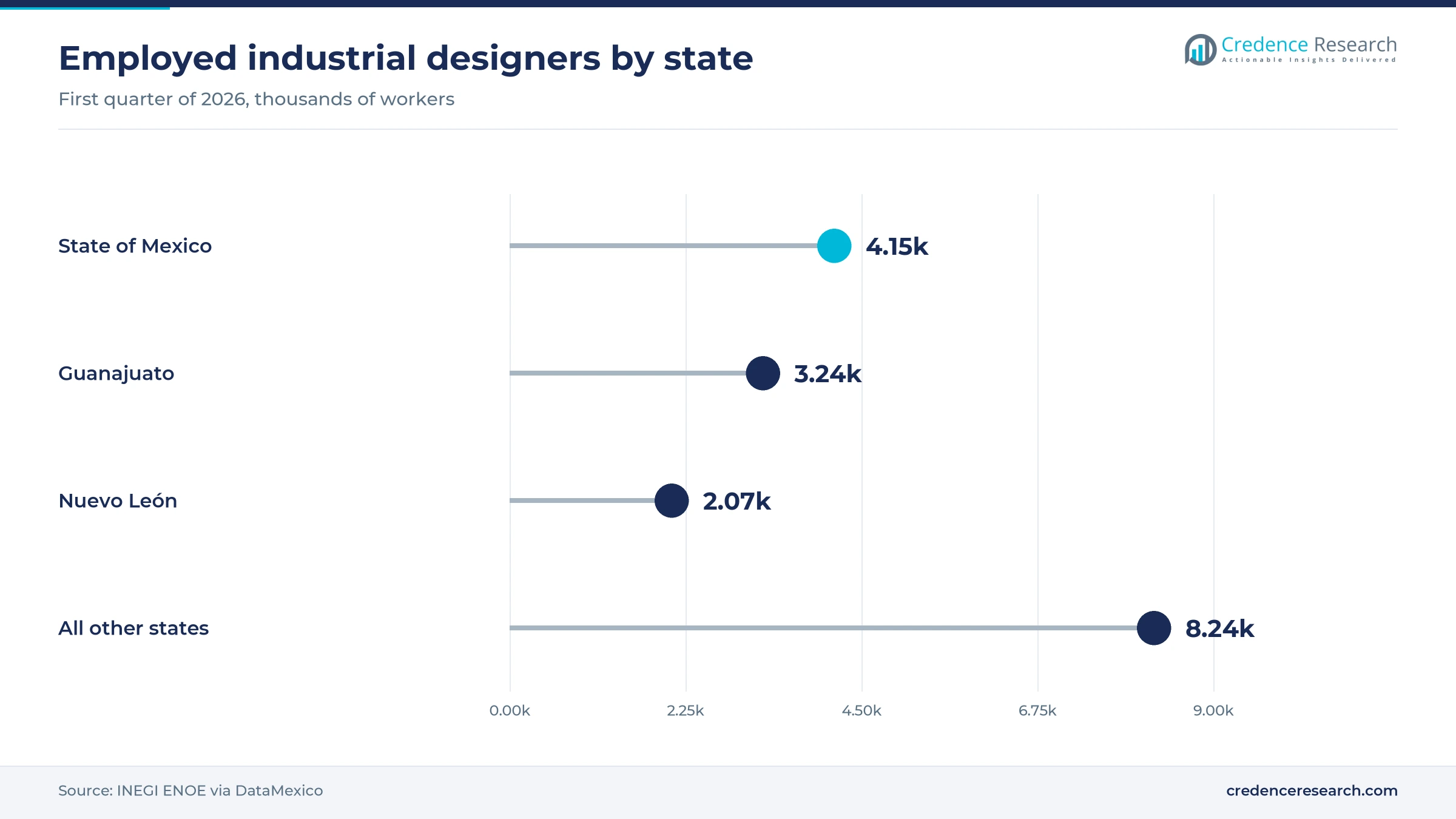
Central Mexico's market share was 33.0% in 2025, and the zone grows at 3.0% a year. Mexico City produced MXN 2.18 billion of the MXN 6.84 billion gross output of specialized design services in INEGI's 2019 census, and the State of Mexico employed about 4,150 industrial designers in early 2026, according to DataMexico. Consultancies such as frog and Accenture Song and studios such as Joel Escalona work from the capital, and Puebla hosts the Olinia engineering center. Slower growth reflects a mature client base of consultancies and brand owners.
Northern Mexico gains from export plants and clusters
Northern Mexico's market share was 31.0% in 2025, and the zone grows at 3.5% a year. Nuevo León produced MXN 675 million of specialized design output in the 2019 census, the second-largest state total, and employed about 2,070 industrial designers in early 2026. Aerospace clusters in Chihuahua, Baja California, Sonora and Nuevo León and medical device complexes in Baja California and Sonora add steady engineering demand. Appliance relocation to the United States is the main local risk.
The Bajío and the west grow fastest on technical centers
The market share of the Bajío and western Mexico was 28.0% in 2025, and the zone grows fastest at 4.0% a year. Querétaro hosts the GE, Nexteer, Valeo and Visteon centers described above, and Guanajuato employed about 3,240 industrial designers in early 2026, the second-largest state total. Jalisco adds electronics design demand after its exports rose 66.2% in 2025, according to the state statistics institute IIEG, and Capgemini and ALTEN recruit design and release engineers in Guadalajara and Querétaro.
The south and southeast rest on small studios
The market share of the south and southeast was 8.0% in 2025, and the zone grows at 3.2% a year. Studios in Mérida list hourly rates of USD 25 to USD 99 on Clutch, mainly for digital and small product projects, and the region has few captive engineering centers. Published counts of industrial design firms by southern state are an evidence gap, so this estimate rests on more assumptions than the other zones.
Design centers, vehicle prototypes and investment plans
| Development | Status and market relevance |
|---|---|
| In March 2025, Mabe announced a USD 668 million investment plan for 2025 to 2027 focused on innovation, design and new products. | Announced plan; progress on the design and development share has not been reported. |
| In October 2025, Nexteer inaugurated its Querétaro technical center for design, validation and prototyping of vehicle systems. | Operational launch of a USD 20 million investment announced in March 2024. |
| In February 2026, the medical device association AMID set out up to USD 400 million of investment for 2026 to 2030. | Industry plan under Plan México; centers of excellence remain a goal, not a completed project. |
| In June 2026, the government unveiled the Olinia Uno city car prototype developed by IPN and TecNM researchers. | Prototype shown; plant construction set to start in late 2026 and commercial production planned for 2027. |
| In August 2026, the Olinia Carga electric light truck prototype was presented with a tender for an industrial partner. | Prototype and tender stage; market launch planned for late 2027. |
Styling, CAD models, prototypes and validation set the cost
- Concept and styling set the look, ergonomics and user research of a product, and this stage still sits mostly at foreign headquarters.
- CAD and CAE modeling turn a concept into release-ready geometry and simulations, which is the work most often sent to Mexican engineers.
- Rapid prototyping produces printed or machined parts for fit and function tests, which lets local centers shorten validation loops.
- Design for manufacturing adapts parts to Mexican tooling, materials and suppliers, which national content targets make more valuable.
Need a Custom Version of This Report?
Tailor the scope, geography, or segments to your exact requirements.
- Custom geography or segment scope
- Direct access to our analyst team
Consultancies, engineering firms and studios compete
Competition splits between global consultancies, engineering-service firms and local studios, while captive centers of manufacturers set much of the demand. Capgemini competes through frog's Mexico City studio for research and product strategy and through Capgemini Engineering for design and release engineers. Accenture competes through Accenture Song, which absorbed the Mexico City firm Insitum. EDAG México and ALTEN México sell vehicle design and engineering services to automakers and suppliers, and SEGULA Technologies recruits design and release engineers for automotive cooling systems in Toluca and Saltillo. SEACOMP combines electronic product design with manufacturing in Mexico, and Joel Escalona Studio designs furniture and objects from Mexico City. Release responsibility, sector references, engineer availability and the ability to carry a design into tooling decide most contracts, and many buyers also use CAD software in house.
Captive centers, engineering firms and studios share work
Supply is organized in four layers, and concentration in each layer stays low. Captive technical centers of manufacturers such as GE, Nexteer and Visteon carry the largest design budgets but rarely sell to third parties. Engineering-service firms such as Capgemini Engineering, ALTEN and EDAG México supply design and release engineers under program contracts, and consultancies such as frog and Accenture Song sell research and product strategy. A long tail of studios shares about 17,700 employed industrial designers counted by INEGI in early 2026. Entry is easy for studios but hard for release work, where margins are highest.
Consultancies, engineering firms and studios in Mexico
| Company | Type | Role in the market |
|---|---|---|
| Capgemini (frog, Capgemini Engineering) | Consultancy and engineering firm | Product strategy from frog Mexico City and design and release engineering |
| Accenture (Accenture Song) | Design consultancy | Research, service and product design through the former Insitum team |
| EDAG Group (EDAG México) | Engineering-service firm | Vehicle and product design and engineering services from Mexican locations |
| ALTEN (ALTEN México) | Engineering-service firm | Chassis and systems design and release engineers for automotive clients |
| SEGULA Technologies (SEGULA México) | Engineering-service firm | Design and release engineers for automotive cooling systems in Toluca and Saltillo |
| SEACOMP | Design-and-manufacture firm | Electronic product design, design for manufacturing and production in Mexico |
| Joel Escalona Studio | Independent studio | Furniture, object and product design from its Mexico City studio |
Design and release contracts will carry the value
Credence Research's view is that value in this market will shift from drawing work toward design and release contracts through 2035. Mexico already hosts large captive engineering centers and a deep pool of CAD engineers, but low research spending keeps concept work abroad. National content targets, tariff changes and medical device growth reward firms that can localize parts, validate them and carry responsibility for the release. Studios that add prototyping and manufacturing links are best placed, while pure styling studios face price pressure from informal competitors.
Old estimate carried to 2025 and checked two ways
The report uses 2025 as the base year and forecasts to 2035. Market values in this report come from the Credence Research model. This edition replaces the previous 2023 estimate with a 2025 value carried forward at the earlier growth rate and checked against manufacturing value added, design services output from INEGI's economic census, employment of industrial designers, vehicle and export statistics, and company announcements. Segment and regional shares are Credence Research estimates based on government statistics, trade press and company releases. No interviews or surveys were carried out for this edition.
Device and electronics programs set the pace to 2035
In the base case the Mexico industrial design market grows at 3.49% a year through 2035, as medical device, electronics and localization work add value faster than mature vehicle programs. Automotive work keeps the largest share, but medical device design grows at 5.0% a year, the fastest rate of any application. Central Mexico keeps the largest regional share, and the Bajío gains on technical centers in Querétaro and Guadalajara. United States tariffs, low research spending and production moving north are the main risks to that path.
Tariffs, content rules and device programs decide the range
The outcome depends on how the 2026 USMCA review treats vehicles and parts, how fast Plan México content targets turn into redesigned parts, and whether medical device and electronics exporters move product definition to Mexico. Higher United States tariffs and more production moving north would hold growth near the downside case. A stable trade deal, Olinia reaching production and new device design centers would push the market toward the upside.
| Scenario | CAGR, 2026–2035 | Value, 2035 | What has to hold |
|---|---|---|---|
| Downside | 2.0% | USD 1.61 billion | Tariffs on vehicles rise after the USMCA review and more appliance lines move north |
| Base | 3.49% | USD 1.83 billion | Vehicle output stays near 2025 levels while device and electronics programs keep growing |
| Upside | 5.0% | USD 2.09 billion | Trade terms stabilize, Olinia enters production and device makers open design centers |
Frequently Asked Questions
How big is the Mexico industrial design market?
How many industrial designers work in Mexico?
What do design studios in Mexico charge?
Which region leads the market?
Which product segment leads the market?
How does Plan México affect design demand?
What are the main challenges for design firms in Mexico?
Which companies lead the market?
Table of Content
Chapter 1 Market Segmentation
- 1.1 Segmentation Framework
- 1.1.1 Product and Service Classification
- 1.1.2 Application and End-Use Classification
- 1.1.3 Technology and Solution Classification
- 1.1.4 Customer and Distribution Channel Classification
- 1.1.5 Geographic Segmentation
- 1.1.6 Market Segment Definitions and Boundaries
- 1.2 By Product
- 1.2.1 Automotive
- 1.2.2 Furniture
- 1.2.3 Packaging
- 1.2.4 Others
- 1.3 By Application
- 1.3.1 Transportation
- 1.3.2 Consumer Goods
- 1.3.3 Medical Devices
- 1.3.4 Others
- 1.4 By End User
- 1.4.1 Automotive
- 1.4.2 Electronics
- 1.4.3 Healthcare
- 1.4.4 Aerospace
- 1.4.5 Others
Chapter 2 Introduction
- 2.1 Report Objectives and Scope
- 2.2 Product Definition and Industry Terminology
- 2.3 Market Inclusions and Exclusions
- 2.4 Research Process
- 2.4.1 Primary Research and Expert Interviews
- 2.4.2 Secondary Research and Source Review
- 2.4.3 Top-Down and Bottom-Up Estimation
- 2.4.4 Data Triangulation and Verification
- 2.5 Market Size Measurement Basis
- 2.5.1 2025: USD 1.30 billion → 2035: USD 1.83 billion
- 2.6 Historical and Forecast Reference Periods
- 2.6.1 Historical Period: 2018-2025
- 2.6.2 Base Year: 2025
- 2.6.3 Forecast Period: 2025-2035
- 2.7 Research Assumptions and Limitations
Chapter 3 Executive Summary
- 3.1 Market Snapshot and Key Findings
- 3.2 Base-Year Market Size, 2025
- 3.3 Forecast Market Size, 2035
- 3.4 Revenue and Volume Growth Outlook
- 3.5 Key Demand and Supply Indicators
- 3.6 Leading Market Segments
- 3.7 Fastest-Growing Market Opportunities
- 3.8 Regional Performance Highlights
- 3.9 Technology and Industry Transformation
- 3.10 Competitive Landscape Summary
- 3.11 Analyst View and Strategic Implications
Chapter 4 Mexico Industrial Design Market Trends and Developments
- 4.1 Historical Industry Development, 2018-2025
- 4.2 Recent Market Trends and Developments
- 4.3 Demand and Customer Behavior Trends
- 4.4 Technology and Product Innovation
- 4.5 Artificial Intelligence, Automation and Digitalization
- 4.6 Local Manufacturing and Supply Chain Realignment
- 4.7 Industry Partnerships, Mergers and Acquisitions
- 4.8 Sustainability and Circular Economy Developments
- 4.9 Government and Private Sector Investment Trends
- 4.10 Emerging Business Models and Commercialization
- 4.11 Industry Developments and Announcements
Chapter 5 Mexico Industrial Design Market Production, Supply and Demand Analysis
- 5.1 Demand Trend and Consumption Analysis, 2018-2025
- 5.2 Demand Forecast, 2025-2035
- 5.3 Production and Output Trend, 2018-2025
- 5.4 Production and Output Forecast, 2025-2035
- 5.5 Installed Capacity and Capacity Utilization
- 5.6 Company-Wise Production Plants and Statistics
- 5.6.1 Installed Production Capacity
- 5.6.2 Actual Production
- 5.6.3 Planned Capacity and Expansion Targets
- 5.7 Supply Chain Structure and Procurement Trends
- 5.8 Supply-Demand Gap and Bottlenecks
- 5.9 Import Dependence and Sourcing Structure
- 5.10 Contract Manufacturing and Outsourcing
- 5.11 Regional Supply and Demand Concentration
Chapter 6 Mexico Industrial Design Market Pricing Analysis
- 6.1 Pricing Structure and Measurement
- 6.2 Historical Pricing Trends, 2018-2025
- 6.3 Pricing Outlook, 2025-2035
- 6.4 Average Selling Price and Unit Economics
- 6.5 Pricing by Product and Market Segment
- 6.6 Geographic Pricing Differences
- 6.7 Key Input, Energy, Labor and Logistics Costs
- 6.8 Contract Pricing and Purchasing Models
- 6.9 Pricing Sensitivity and Competitive Positioning
- 6.10 Price, Margin and Profitability Implications
Chapter 7 Mexico Industrial Design Market Dynamics
- 7.1 Market Growth Drivers
- 7.1.1 Demand-Side Drivers
- 7.1.2 Technology and Innovation Drivers
- 7.1.3 Infrastructure and Investment Drivers
- 7.1.4 Regulatory and Policy Drivers
- 7.2 Market Restraints
- 7.2.1 Cost and Affordability Constraints
- 7.2.2 Technology and Adoption Barriers
- 7.2.3 Supply Chain and Operational Constraints
- 7.3 Market Challenges
- 7.3.1 Competitive Pressure and Margin Erosion
- 7.3.2 Skills, Infrastructure and Implementation Gaps
- 7.4 Emerging Market Opportunities
- 7.5 Market Dynamics Impact and Time-Horizon Assessment
Chapter 8 Mexico Industrial Design Value Chain Analysis
- 8.1 Industry Value Chain Overview
- 8.2 Upstream Suppliers and Critical Inputs
- 8.3 Technology and Component Providers
- 8.4 Manufacturing or Service Delivery
- 8.5 Distribution, Channel Partners and Integrators
- 8.6 Downstream Applications and End Users
- 8.7 Value Addition and Profit Pools
- 8.8 Vertical Integration and Outsourcing
- 8.9 Supplier Concentration and Risk
- 8.10 Supply Chain Localization and Resilience
Chapter 9 Mexico Industrial Design Market Regulations and Policies
- 9.1 Relevant Laws, Standards and Compliance Frameworks
- 9.2 Product, Service, Safety and Quality Requirements
- 9.3 Government Policies, Incentives and Subsidies
- 9.4 Imports, Exports and Trade Barriers
- 9.5 Public Procurement and Local Content Requirements
- 9.6 Environmental and Sustainability Compliance
- 9.7 Upcoming Policy Changes and Market Implications
Chapter 10 Mexico Industrial Design Market Hotspots and Opportunities
- 10.1 Market Opportunity Mapping and Growth Hotspots
- 10.2 High-Growth Applications and Customer Groups
- 10.3 Underserved Markets and White-Space Opportunities
- 10.4 Emerging Technology and Product Opportunities
- 10.5 New Capacity and Investment Hotspots
- 10.6 Market Entry and Expansion Opportunities
- 10.7 Distribution and Partnership Opportunities
- 10.8 Near-Term and Long-Term Commercial Potential
- 10.9 Opportunity Attractiveness and Execution Risks
Chapter 11 Mexico Industrial Design Market Outlook, 2025-2035
- 11.1 Market Size and Analysis
- 11.1.1 Revenue (Market Measurement: 2025: USD 1.30 billion → 2035: USD 1.83 billion)
- 11.1.2 Market Volume and Quantity Sold
- 11.1.3 Historical Market Size, 2018-2025
- 11.1.4 Base-Year Market Size, 2025
- 11.2 Market Forecast, 2025-2035
- 11.2.1 Revenue Forecast to 2035
- 11.2.2 Volume Forecast to 2035
- 11.2.3 CAGR and Year-on-Year Growth
- 11.2.4 Incremental Revenue Opportunity
- 11.3 Forecast Assumptions and Scenario Analysis
- 11.3.1 Base-Case Forecast
- 11.3.2 Optimistic and Conservative Scenarios
- 11.3.3 Technology, Pricing and Policy Sensitivities
- 11.4 Market Attractiveness and Growth Outlook
Chapter 12 Mexico Industrial Design Market Segmentation and Outlook
- 12.1 Segmentation Summary and Market Shares, 2025
- 12.2 Largest and Fastest-Growing Segments
- 12.3 By Product - Market Size and Forecast, 2025-2035
- 12.3.1 Segment Definition and Scope
- 12.3.2 Historical Market Size, 2018-2025
- 12.3.3 Revenue Forecast, 2025-2035
- 12.3.4 Volume Forecast, 2025-2035
- 12.3.5 Base-Year Market Share, 2025
- 12.3.6 Segment CAGR and Growth Drivers
- 12.3.7 Subsegment Market Size and Forecast
- 12.3.7.1 Automotive
- 12.3.7.2 Furniture
- 12.3.7.3 Packaging
- 12.3.7.4 Others
- 12.3.8 Subsegment Pricing and Adoption Trends
- 12.3.9 Leading Suppliers and Competition
- 12.3.10 Regional Demand and Opportunities
- 12.4 By Application - Market Size and Forecast, 2025-2035
- 12.4.1 Segment Definition and Scope
- 12.4.2 Historical Market Size, 2018-2025
- 12.4.3 Revenue Forecast, 2025-2035
- 12.4.4 Volume Forecast, 2025-2035
- 12.4.5 Base-Year Market Share, 2025
- 12.4.6 Segment CAGR and Growth Drivers
- 12.4.7 Subsegment Market Size and Forecast
- 12.4.7.1 Transportation
- 12.4.7.2 Consumer Goods
- 12.4.7.3 Medical Devices
- 12.4.7.4 Others
- 12.4.8 Subsegment Pricing and Adoption Trends
- 12.4.9 Leading Suppliers and Competition
- 12.4.10 Regional Demand and Opportunities
- 12.5 By End User - Market Size and Forecast, 2025-2035
- 12.5.1 Segment Definition and Scope
- 12.5.2 Historical Market Size, 2018-2025
- 12.5.3 Revenue Forecast, 2025-2035
- 12.5.4 Volume Forecast, 2025-2035
- 12.5.5 Base-Year Market Share, 2025
- 12.5.6 Segment CAGR and Growth Drivers
- 12.5.7 Subsegment Market Size and Forecast
- 12.5.7.1 Automotive
- 12.5.7.2 Electronics
- 12.5.7.3 Healthcare
- 12.5.7.4 Aerospace
- 12.5.7.5 Others
- 12.5.8 Subsegment Pricing and Adoption Trends
- 12.5.9 Leading Suppliers and Competition
- 12.5.10 Regional Demand and Opportunities
- 12.6 Segment Growth Comparison
- 12.7 Segment Attractiveness and Priority Matrix
Chapter 13 Mexico Industrial Design End-Use and Application Market Outlook
- 13.1 End-Use Industry and Customer Demand Structure
- 13.2 Leading Applications and Customer Groups
- 13.3 End-Use Market Size, Share and Forecast
- 13.4 Major End-Use Industry Deep Dives
- 13.4.1 Customer Requirements and Use Cases
- 13.4.2 Demand and Replacement Cycles
- 13.4.3 Technical and Regulatory Considerations
- 13.4.4 Purchasing and Procurement Models
- 13.4.5 Leading Vendors and Distribution Channels
- 13.4.6 Forecast and Commercial Opportunities
- 13.5 Emerging Applications and Cross-Segment Demand
- 13.6 End-Use Industry Investment Priorities
Chapter 14 Mexico Industrial Design Geographic Market Outlook, 2025-2035
- 14.1 Domestic Market Distribution and Demand Clusters
- 14.2 State- or Province-Wise Market Size and Forecast, 2025-2035
- 14.3 City and Metropolitan Market Outlook
- 14.4 Industrial, Manufacturing and Commercial Clusters
- 14.5 Geographic Concentration of Key End Users
- 14.6 Local Pricing and Purchasing Differences
- 14.7 Domestic Production Facilities and Capacity Map
- 14.8 Local Infrastructure and Project Pipeline
- 14.9 State-Level Policy and Incentive Differences
- 14.10 Subnational Investment Hotspots and Opportunities
- 14.11 Distribution and Logistics Networks
- 14.12 Domestic Competitive Footprint
Chapter 15 Mexico Industrial Design Technology, Innovation and Sustainability Outlook
- 15.1 Technology Landscape and Maturity
- 15.2 Product, Process and Service Innovation
- 15.3 AI, Automation and Digital Tools in the Industry
- 15.4 Technology Adoption and Performance Benchmarking
- 15.5 Innovation Pipeline and R&D Investment
- 15.6 Patent and Intellectual Property Trends
- 15.7 Energy Efficiency and Resource Management
- 15.8 Sustainability, Recycling and Circularity
- 15.9 Technology Roadmap, 2025-2035
- 15.10 Risks of Obsolescence and Technology Substitution
Chapter 16 Mexico Industrial Design Market Key Strategic Imperatives
- 16.1 Growth and Market Entry Priorities
- 16.2 High-Return Products and Segments
- 16.3 Pricing, Profitability and Cost Optimization
- 16.4 Technology Investment and Product Differentiation
- 16.5 Supply Chain Localization and Resilience
- 16.6 Distribution and Customer Acquisition
- 16.7 Partnership, Acquisition and Capacity Strategy
- 16.8 Regional Expansion Priorities
- 16.9 Short-, Medium- and Long-Term Actions
Chapter 17 Competition Outlook
- 17.1 Industry Competition Characteristics
- 17.2 Market Structure and Concentration
- 17.3 Market Share and Competitive Positioning, 2025
- 17.4 Company-Wise Revenue and Product Benchmarking
- 17.5 Production and Service Capacity Benchmarking
- 17.6 Technology, Pricing and Differentiation
- 17.7 Regional Footprint and Distribution Strength
- 17.8 Mergers, Acquisitions and Strategic Alliances
- 17.9 New Entrants and Competitive Threats
- 17.10 Porter's Five Forces and Industry Attractiveness
- 17.11 Competitive Outlook, 2025-2035
Chapter 18 Company Profiles
- 18.1 Company Coverage and Selection Criteria
- 18.2 Capgemini (frog, Capgemini Engineering)
- 18.2.1 Business Description
- 18.2.2 Company Ownership and Geographic Presence
- 18.2.3 Product and Service Portfolio
- 18.2.4 Manufacturing and Operating Footprint
- 18.2.5 Production Capacity and Expansion Plans
- 18.2.6 Financial Performance and Investment
- 18.2.7 Market Share and Competitive Position
- 18.2.8 Technology and Innovation Capabilities
- 18.2.9 Strategic Alliances or Partnerships
- 18.2.10 Recent Developments
- 18.2.11 Growth Strategy and Outlook
- 18.3 Accenture (Accenture Song)
- 18.4 EDAG Group (EDAG México)
- 18.5 ALTEN (ALTEN México)
- 18.6 SEGULA Technologies (SEGULA México)
- 18.7 SEACOMP
- 18.8 Joel Escalona Studio
- 18.9 Other Relevant Market Participants
Note: Every listed company is profiled on the structure shown under the first company. The company list is preliminary and may change based on research findings, market developments, data availability and client requirements.
Chapter 19 Disclaimer
- 19.1 Research and Forecast Disclaimer
- 19.2 Data Source and Estimation Limitations
Note: The depth of individual sections depends on data availability for this market. Volume, capacity, trade and other unit-based metrics are included where applicable.

