
Renovation work is taking over from new-build fit-outs
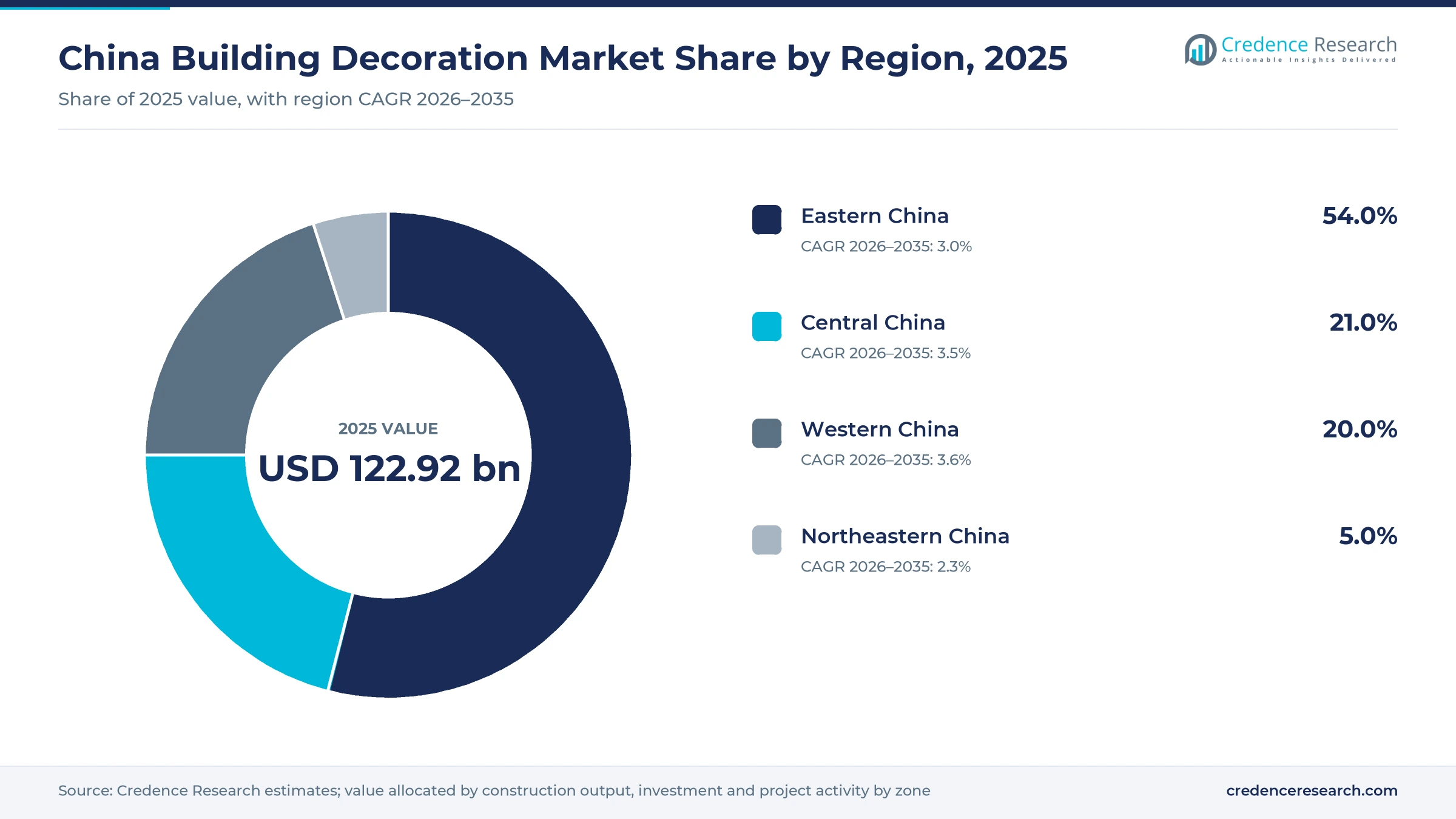
The China building decoration market was valued at USD 122.92 billion in 2025 and is projected to increase from USD 126.85 billion in 2026 to USD 168.43 billion by 2035, registering a CAGR of 3.20% during 2026–2035. Spending comes from office towers and shopping complexes, hospitals and schools, airport and rail terminals, hotels and government buildings, where owners buy interior fit-out, facade and curtain wall work, landscaping and lighting design. Eastern China held the largest regional share, 54.0% in 2025, because the coastal provinces hold the densest stock of offices, malls and hotels. Western China is the fastest-growing zone at 3.6% a year, as terminal and public building programs reach a smaller base. The May 2025 urban renewal guidelines move public money from new districts toward refitting existing buildings, while the property downturn and slow payment by developers remain the main restraint on contractor volumes and margins.
Non-residential fit-out, facades and lighting define the scope
The market counts decoration works bought for non-residential buildings in China, including interior fit-out and renovation such as ceilings, partitions, wall and floor finishes, facade decoration such as curtain walls and cladding, landscape and outdoor decoration, and decorative lighting design. Buyers include developers and landlords, hotel owners and franchisees, airport and railway operators, hospitals, universities and government departments, which usually tender the work to qualified decoration contractors as design-and-build or construction packages.
Household home improvement, structural work, mechanical and electrical services and loose furniture are excluded. Value is measured at contract prices and includes the decoration materials installed within each package, so the margin pool is shared between national contractors, specialist curtain wall firms and material producers. The non-residential share of decoration output is a Credence Research estimate, because official statistics do not publish that split.
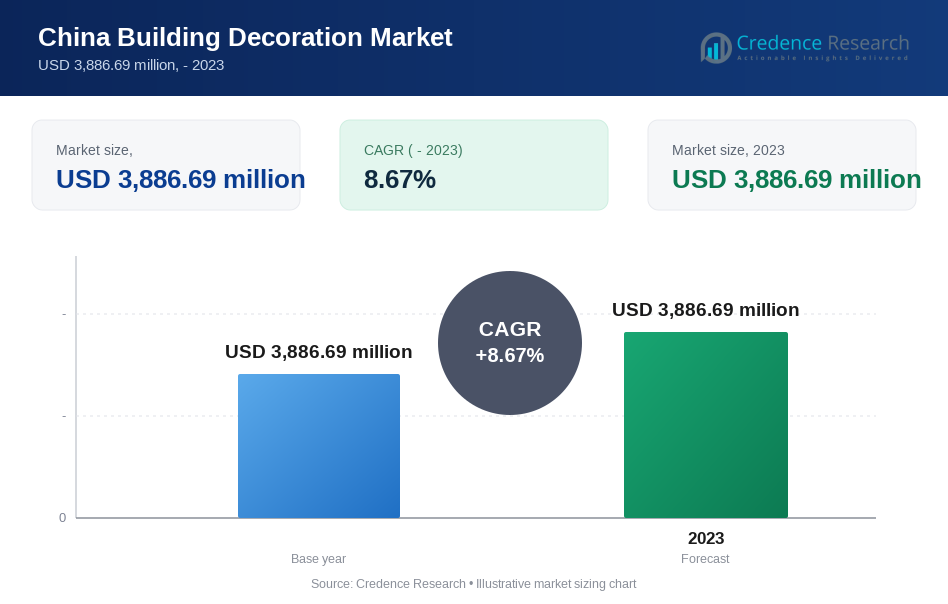
China Building Decoration Market Insights
- The China building decoration market is projected to rise from USD 122.92 billion in 2025 to USD 168.43 billion by 2035, a 3.20% CAGR held down by falling new-build completions.
- Eastern China held 54.0% of 2025 value, the largest zone, while Western China grows fastest at 3.6% a year.
- Interior renovation held 58.0% of 2025 value, because ceilings, partitions and finishes are replaced in nearly every office, hotel and hospital refit.
- Completed floor space fell 18.1% in 2025 according to the National Bureau of Statistics, shifting contractor work toward renovation of existing buildings.
- Leading contractors are taking backlog abroad, with Gold Mantis reporting a 41% rise in overseas contract output in the first half of 2026.
Interior work leads while terminals and facades grow fastest
Why interior renovation dominates decoration contracts
Based on type, the market is categorized into interior renovation, facade decoration, landscape design and decoration, outdoor decoration and lighting design and decoration. Interior Renovation led with 58.0% of 2025 value because every tenant change, hotel conversion and hospital upgrade replaces ceilings, partitions and finishes. Yasha alone reported 231 decoration projects in progress and 82 completed in 2025, excluding subsidiaries, in its annual report. Interior work therefore holds up even when new floor space shrinks. Facade Decoration grows fastest at 3.8% a year as owners retrofit aging envelopes, a field where Yasha Curtain Wall has ranked second among China's top 100 curtain wall firms for eight years.
Commercial complexes lead while terminals grow fastest
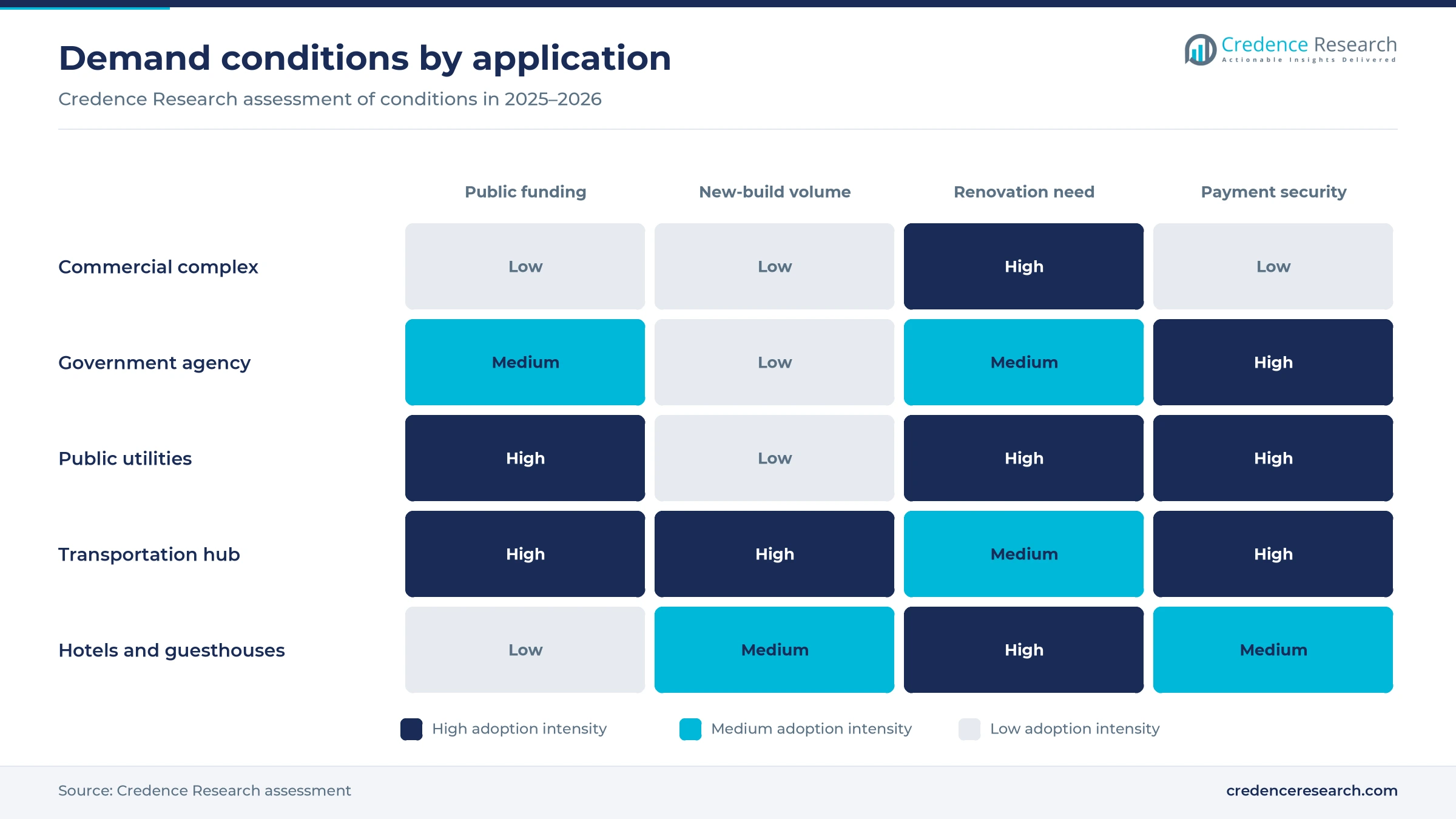
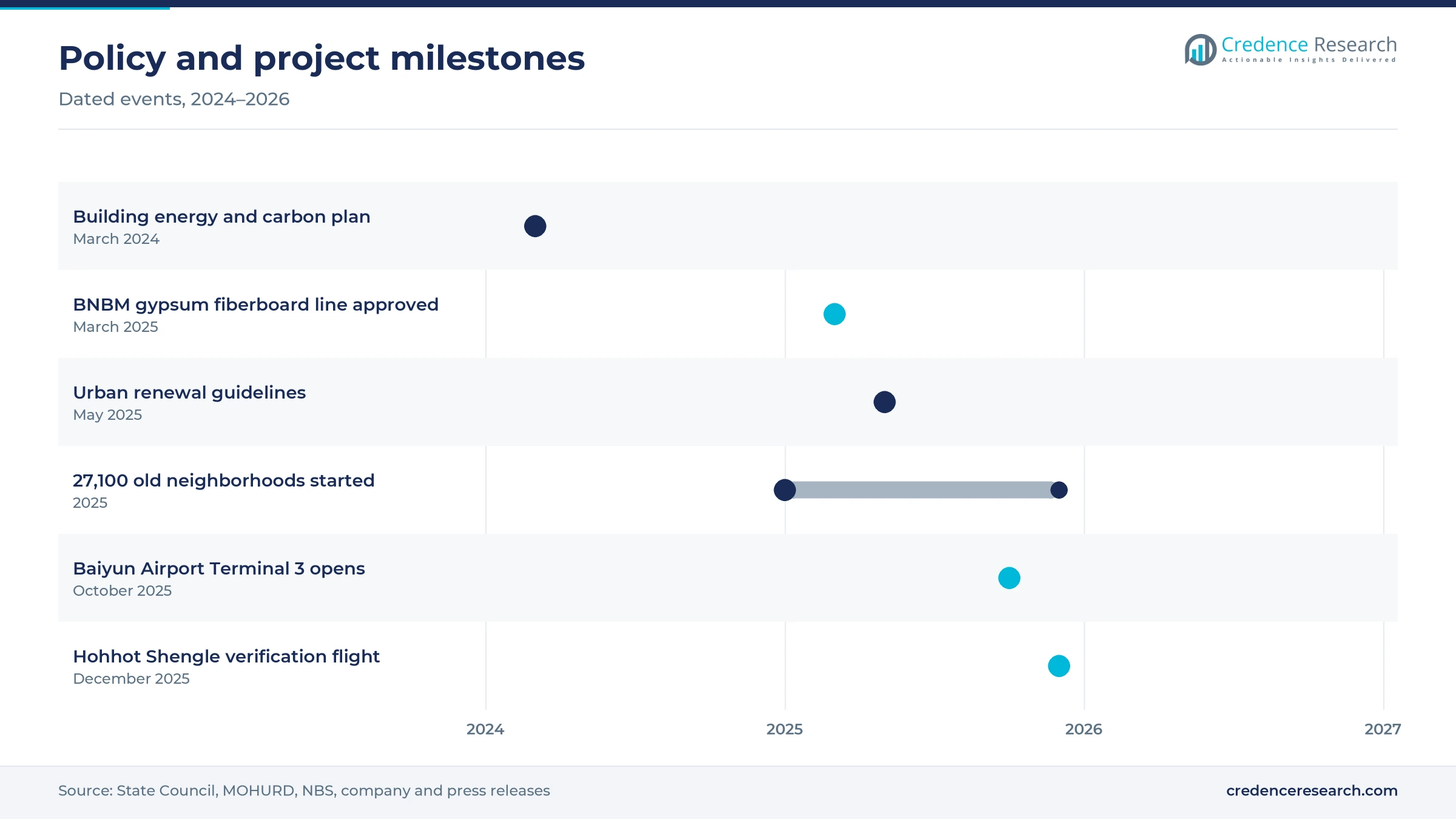
Based on application, the market is categorized into commercial complexes, government agencies, public utilities, transportation hubs and hotels and guesthouses. Commercial Complex led with 33.0% of 2025 value, because new towers and malls need full fit-outs and older ones must refit to keep tenants, and Shenzhen alone added about 712,000 square meters of Grade A office supply in 2025, up 154%, according to Caixin. Transportation Hub grows fastest at 4.1% a year as Guangzhou Baiyun opened Terminal 3 on Oct. 30, 2025 with a large public art system, gardens and flagship restrooms, a template for other hubs.
New-build fit-outs still lead as renovation closes the gap
Based on project type, the market is categorized into new-build fit-out and renovation and refurbishment. New-Build Fit-Out led with 51.0% of 2025 value, because the National Bureau of Statistics still counted 6.6 billion square meters of floor space under construction at the end of 2025, much of it awaiting finishing work. Renovation and Refurbishment grows fastest at 4.0% a year, as owners refit theaters, guesthouses and offices in occupied city centers, and Gold Mantis cites the Suzhou Kaiming theater and the Hangzhou Xixi state guesthouse among its urban renewal projects in its 2026 interim disclosure.
| Segment Group | Leading Sub-segment | Share, 2025 | Fastest-growing Sub-segment | CAGR, 2026–2035 |
|---|---|---|---|---|
| By Type | Interior Renovation | 58.0% | Facade Decoration | 3.8% |
| By Application | Commercial Complex | 33.0% | Transportation Hub | 4.1% |
| By Project Type | New-Build Fit-Out | 51.0% | Renovation and Refurbishment | 4.0% |
Unit rates are flat while margins come under pressure
Decoration is priced per square meter of finished area, with public buyers using competitive tenders and private owners negotiating design-and-build packages that bundle materials. Rates have stopped rising, because the construction material price index published by Arcadis stood at 94.8 in June 2026 against the same month a year earlier, a fall of about 5%, and Arcadis describes tender prices as broadly stable with growing pressure on gross margins. Lower material costs therefore pass to owners rather than contractors. Firms protect margins through design fees, prefabricated components and premium hotel or terminal work, where specifications are harder to substitute and bidder pools are smaller.
| Benchmark | Typical price or fee | Basis |
|---|---|---|
| Office fit-out, collaborative hybrid, Beijing | USD 100 per sq ft | Cushman & Wakefield fit-out cost guide, 2025 |
| Office fit-out, collaborative hybrid, Shanghai | USD 96 per sq ft | Cushman & Wakefield fit-out cost guide, 2025 |
| Prestige high-rise office, full building cost incl. curtain wall and public-area fit-out (upper bound), Shanghai | RMB 7,922–10,835 per sq m | Arcadis, Q2 2026 |
| Luxury five-star hotel, full building cost (upper bound), Shanghai | RMB 14,699–17,570 per sq m | Arcadis, Q2 2026 |
Request a Free Sample
Fill in your details and we'll send you a free sample report.
- Sample data tables & charts
- Research methodology
Urban renewal, terminals and hotel upgrades carry demand
Urban renewal policy moves spending to existing buildings
Urban renewal is the strongest support for decoration demand, because it directs public budgets toward refitting old blocks, factories and commercial streets instead of building new districts. Guidelines issued by the CPC Central Committee and State Council on May 15, 2025 call for reinforcing and renovating existing buildings and aim for key progress by 2030. The Ministry of Housing and Urban-Rural Development reported in January 2026 that work started on 27,100 old urban neighborhoods in 2025, above the 25,000 target, with RMB 133.2 billion invested. Renovation and refurbishment grows at 4.0% a year in the Credence Research estimates, so contractors with small-site logistics and occupied-building experience gain the most.
Airport and rail terminals add large public fit-out packages
Transport terminals supply some of the largest single decoration contracts, because terminal halls combine ceilings, stone floors, facades, public art and wayfinding lighting in one package. China added seven civil transport airports and 2,862 kilometers of high-speed rail in 2025, according to the National Bureau of Statistics. China Construction Shenzhen Decoration finished about 21,000 square meters of interior work at Hohhot Shengle International Airport before its December 2025 verification flight, according to a China Daily feature in December 2025. The contractor used BIM modeling and 3D laser scanning to fabricate a curved aluminum ceiling, the kind of capability that terminal tenders now require. Transportation hubs grow at 4.1% a year, which favors contractors with BIM capability and state-owned client relationships.
Hotel conversions keep interior crews busy
Hotel chains add rooms mainly by converting existing buildings, which shifts hospitality spending toward interior renovation rather than new construction. H World Group opened 2,444 hotels in 2025, and its 2026 guidance pairs about 2,200 to 2,300 openings with 600 to 700 closures, so much of the network is reflagged or refitted rather than newly built. Each conversion requires new lobbies, guest room finishes and lighting within weeks, because franchisees lose revenue while rooms are closed. Gold Mantis lists hotels among its core public building sectors and operates the HBA hotel design brand, which links design and fit-out for upscale owners. Hotels and guesthouses grow faster than the market overall, favoring fast-turnaround franchise fit-out specialists over general contractors.
Office vacancy forces landlords to pay for refits
High office vacancy supports refit spending, because landlords pay for fit-outs and amenities to compete for a shrinking tenant pool. Grade A vacancy reached 23.4% in Shanghai, 20.7% in Guangzhou and 29.4% in Shenzhen at the end of 2025, while four-city net absorption was 1.18 million square meters, about 65% below the 2021 peak, according to the same Caixin report. The 2025 office fit-out guide of Savills Projects notes that some Beijing landlords now offer design and construction as part of the lease, with costs folded into rent. Commercial complexes still held 33.0% of 2025 value, so landlord-funded refits keep this application at the center of contractor order books.
Prefab interiors and overseas bids reshape contracting
Prefabricated interior systems shift work into factories
Contractors are shifting toward prefabricated wall, ceiling and bathroom systems to cut site labor and speed handover, creating openings for factory-made panels across hotels, hospitals and offices. Yasha reported 16 industrialized prefabricated projects among its 2025 decoration projects and says the method cuts on-site installation steps by 70% and speeds construction by 50%. The company has also written standards such as T/CECS558-2018 for industrialized interior works. Wider prefabricated construction practice supports supply chains for panels and fixings. The shift favors contractors with their own factories and squeezes small crews that compete only on labor rates in hotels, hospitals and offices.
Leading contractors are taking backlog overseas
National contractors are shifting new capacity toward overseas projects to offset weaker home demand, which reduces bidding intensity on some domestic tenders. Gold Mantis said overseas contract output rose about 41% in the first half of 2026. Yuanda China reported about RMB 5.17 billion of new curtain wall projects in 2025, up about 55%, with growth led by Australia and the Middle East. China Construction Shenzhen Decoration signed a strategic partnership with Qatar's JTA International Investment Holding in May 2025. Domestic buyers gain negotiating room as the strongest firms ration capacity at home, while smaller rivals that cannot follow them abroad keep bidding harder for the remaining local tenders.
Facade retrofit and solar envelopes open a new contract type
Owners of aging towers are a clear opening for facade contractors, because energy rules and safety checks make old envelopes costly to keep. The State Council's building energy and carbon plan of March 15, 2024 calls for renovation and upgrading of existing urban buildings and large-scale ultra-low energy buildings by 2027. Jangho groups its curtain wall and photovoltaic building work in one business line, and China Construction Shenzhen Decoration enclosed a 62,000-square-meter curtain wall on Tianjin's Ping An Taida Financial Center in October 2025. Facade decoration grows at 3.8% a year, the fastest type, favoring firms that offer glass curtain walls with integrated solar panels.
Hospital and school upgrades are an underserved opening
Public health and education buildings are an opening for contractors able to deliver clean rooms, acoustic ceilings and hygienic finishes, because these specifications narrow the bidder pool. Fixed-asset investment in health and social work fell 12.3% in 2025 and education fell 8.3%, the National Bureau of Statistics reported, so new campuses are scarce while existing wards and classrooms still need upgrading. Gold Mantis cites the Mogan Mountain medical center as a clean-space project and named medical and elderly-care purification among its expansion sectors in December 2025. Standard GB 55016-2021, the general code for building environment, sets mandatory indoor environment requirements that hospital and school refits must meet at acceptance. Public utilities hold the second-largest application share, so specialist refits can gain margin where general contractors compete only on price.
Property slump, payment delays and price deflation bite
Shrinking completions remove new-build fit-out volume
Falling completions cut the main source of new fit-out contracts. Completed floor space fell 18.1% in 2025 and then 27.9% in January and February 2026, while real estate investment fell 17.2% in 2025, the National Bureau of Statistics reported. Contractors that relied on developer fine-fit-out and new malls face the steepest order decline. Diversifying into public renovation and terminals limits the damage, but it takes years to build the reference projects that public tenders demand.
Late payment by developers strains contractor cash
Slow payment is the most serious risk for decoration contractors, because they buy materials and pay crews long before final settlement. Private firms accounted for 87% of defaulted construction-sector bonds, Caixin reported in September 2024, which shows where payment stress concentrates. Private contractors with developer clients are most exposed, so many now require deposits, stage payments or guarantees and favor state-owned buyers even at lower margins, which slows growth in private commercial refits.
Deflation and bidding pressure compress margins
Price deflation squeezes margins because fixed-price tenders leave no room for cost recovery when volumes fall. Profits of qualified general and specialty contractors fell 14.1% in 2025 to RMB 635.5 billion, and new contracts signed by construction firms fell 5.51%, according to national statistics. Mid-sized regional contractors without design or factory capability are most exposed, because they cannot shift to higher-value work, so consolidation through exits and absorption by larger groups is likely.
Stricter fire and air quality codes raise compliance cost
Tighter technical codes raise the cost of finishing materials and acceptance testing. Standard GB 50325-2020 on indoor environmental pollution control, in force since Aug. 1, 2020, requires testing of formaldehyde and VOC emissions from decoration materials, and the 2025 office fit-out guide of Savills Projects notes that annual fire code changes make the fire systems of older buildings hard to align. Small contractors bear the testing cost most, while certified material brands such as major coatings and board producers gain specification share.
Eastern provinces lead while Western China gains share
| Region | Value, 2025 (USD billion) | Share, 2025 | CAGR, 2026–2035 |
|---|---|---|---|
| Eastern China | 66.38 | 54.0% | 3.0% |
| Central China | 25.81 | 21.0% | 3.5% |
| Western China | 24.58 | 20.0% | 3.6% |
| Northeastern China | 6.15 | 5.0% | 2.3% |
Eastern China leads on office, mall and hotel stock
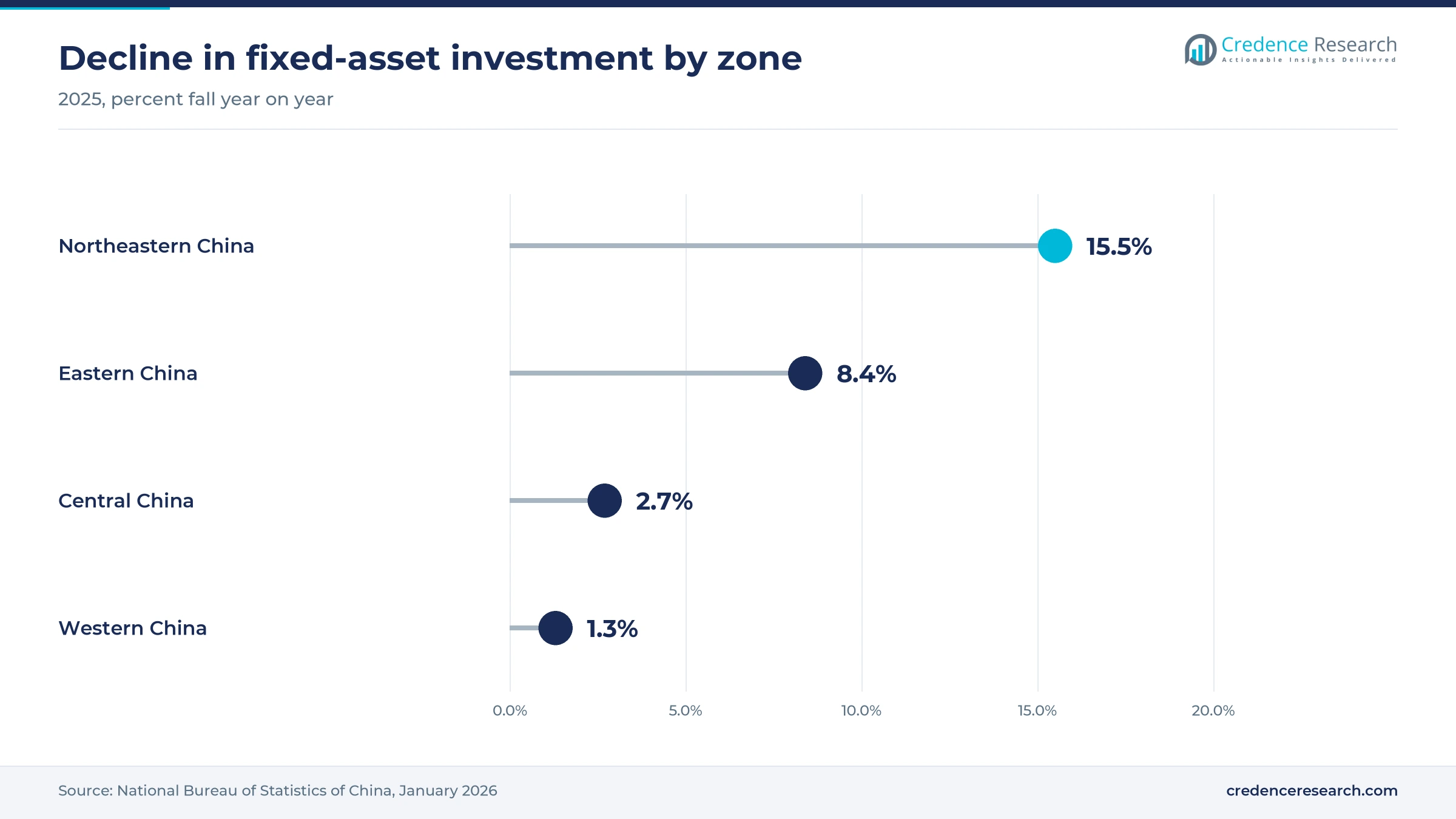
Eastern China held 54.0% of 2025 value and grows at 3.0% a year, because Shanghai, Jiangsu, Zhejiang, Guangdong and Beijing hold most of the country's Grade A offices, malls and branded hotels. Jiangsu leads the country in construction output, and the largest decoration contractors, including Gold Mantis in Suzhou and Yasha in Zhejiang, are based here. However, fixed-asset investment in the zone fell 8.4% in 2025, so growth now depends on refitting existing towers rather than new districts.
Central China gains from hub airports and provincial capitals
Central China held a 21.0% share of 2025 value and grows at 3.5% a year, supported by Wuhan, Zhengzhou and Changsha, where transport hubs and public buildings carry more of the work. Wuhan completed a third runway in 2025, and Hubei ranks first nationally in construction labor productivity. Fixed-asset investment in the zone fell only 2.7% in 2025, a smaller drop than in the east, which keeps public tender volumes steadier for contractors with provincial client relationships.
Western China grows fastest on terminals and public buildings
Western China held a 20.0% share of 2025 value and is the fastest-growing zone at 3.6% a year. Fixed-asset investment fell only 1.3% in 2025, the smallest regional decline, and Xi'an, Lanzhou and Urumqi all opened third runways that year, which brings terminal and airport hotel fit-out work. Xi'an Xianyang alone handled 47 million passenger trips by Dec. 19, 2025, above its total for the prior year, Yicai reported in December 2025. Contractors entering the zone must accept longer logistics and state-owned payment terms, so CSCEC units and provincial construction groups hold the advantage there.
Northeastern China contracts with the investment slump
Northeastern China held a 5.0% share of 2025 value and grows at 2.3% a year, the slowest pace among the zones. Fixed-asset investment in Liaoning, Jilin and Heilongjiang fell 15.5% in 2025, the steepest regional decline, and the population base is shrinking. Old neighborhood renovation and hospital upgrades provide most remaining work, so the zone suits local contractors with low overheads rather than national firms seeking large packages.
Order books, terminal fit-outs and new board capacity
| Development | Status and market relevance |
|---|---|
| In March 2025, Beijing New Building Materials approved a RMB 395 million investment in a gypsum fiberboard line at its Taishan Gypsum subsidiary in Tai'an, Shandong, adding 20 million square meters of annual capacity. | Approved investment; adds partition and ceiling board supply for east China fit-out work |
| In July 2025, Suzhou Gold Mantis Construction Decoration reported second-quarter new contract orders of RMB 6.25 billion and signed but uncompleted orders of RMB 21.02 billion. | Reported orders; even the largest contractor's backlog equals a small fraction of annual non-residential decoration output, which shows how fragmented the field is |
| In December 2025, Hohhot Shengle International Airport passed its verification flight after China Construction Shenzhen Decoration completed about 21,000 square meters of terminal interior work. | Testing milestone; terminal moves toward opening and shows CSCEC units winning western hub work |
| In March 2026, Yuanda China Holdings reported about RMB 5.17 billion of new curtain wall projects for 2025, up about 55%, and a backlog of about RMB 13.2 billion. | Reported orders; growth led by Australia and the Middle East rather than mainland China |
Prefab wall systems, BIM layout and low-emission finishes
- Prefabricated wall and ceiling systems move cutting and finishing into factories, which shortens site time in occupied hotels and hospitals and reduces dust, noise and rework during handover.
- BIM layout and 3D laser scanning let contractors model curved ceilings and check clashes before fabrication, as used on recent airport terminal work where errors are costly to fix on site.
- Low-emission finishes and coatings help projects pass formaldehyde and VOC acceptance tests under GB 50325-2020 without delays at handover, which matters most for hospitals and schools.
- Smart and architectural lighting controls let hotels and malls change scenes and cut energy use, which raises the value of lighting design packages.
Need a Custom Version of This Report?
Tailor the scope, geography, or segments to your exact requirements.
- Custom geography or segment scope
- Direct access to our analyst team
A few national contractors lead a fragmented field
Competition splits between national decoration contractors, specialist curtain wall firms and material producers that sell into decoration packages. Gold Mantis has ranked first among China's top 100 construction decoration enterprises for 23 consecutive years, based on industry statistics for 2024, and competes through design depth and hotel references. CSCEC decoration units win state-funded terminals and public buildings through group relationships with government clients. Yasha differentiates with prefabricated interior systems and its curtain wall arm, while Jangho and Yuanda compete on facade engineering and overseas references. Beijing New Building Materials and Nippon Paint China supply boards and architectural coatings that contractors specify for ceilings, partitions and walls. Price competition is fiercest in regional office tenders, where smaller firms bid with thin margins.
How concentrated is the contractor base?
The supply side is fragmented, with about 158,000 qualified construction enterprises at the end of 2023 according to the National Bureau of Statistics and thousands holding decoration or curtain wall qualifications. A small top tier of national firms, led by Gold Mantis, CSCEC decoration units and Yasha, wins most landmark hotel, terminal and headquarters packages because qualification grades, reference projects and balance sheets act as entry barriers. Below them, regional contractors compete on price for offices and public buildings. Margins sit with firms that own design studios or component factories, while pure installation crews earn the least.
Contractors and material makers active in China
| Company | Type | Role in the market |
|---|---|---|
| Suzhou Gold Mantis Construction Decoration | National contractor | Interior, curtain wall and landscape decoration for hotels, offices and hospitals |
| China State Construction Engineering (CSCEC decoration units) | State-owned contractor | Terminal, public building and curtain wall decoration through group decoration subsidiaries |
| Zhejiang Yasha Decoration | National contractor | Public building decoration, prefabricated interiors and curtain walls |
| Jangho Group | Facade specialist | Curtain wall, photovoltaic building envelopes and interior decoration |
| Yuanda China Holdings | Facade specialist | Curtain wall design and installation for towers in China and abroad |
| Shenzhen Ruihe Construction Decoration | Regional contractor | Public and hotel decoration design and construction in southern China |
| Beijing New Building Materials (CNBM) | Material producer | Gypsum boards and ceiling systems used in interior fit-out |
| Nippon Paint China (Nippon Paint Holdings) | Material producer | Architectural coatings and decorative wall and floor systems |
Value shifts to renovation and public infrastructure
Credence Research's view is that the China building decoration market has moved from a volume business tied to property completions to a renovation business tied to public budgets and landlord refits. That shift favors contractors with design studios, prefabricated components and state-owned client relationships, and it penalizes firms that depended on developer fine-fit-out. Renovation and refurbishment already held about half of 2025 demand, and its share keeps rising through 2035. Buyers should expect stable unit rates through 2027 and tougher payment terms from contractors. Investors should watch renovation funding and the pace at which leading firms move capacity overseas, because both decide domestic bidding intensity.
Estimates rest on official construction output data
The report uses 2025 as the base year and 2026 to 2035 as the forecast period. Market values come from the Credence Research model, which starts from National Bureau of Statistics data on decoration output of qualified contractors and removes residential work. Type, application, project and regional splits are Credence Research estimates based on official investment and property statistics, ministry releases, company filings and published cost data. No interviews or surveys were used to build these estimates.
A shallow trough, then renovation-led growth to 2035
Growth stays modest in 2026 and 2027 while new-build completions keep falling, then improves as renovation work and public terminal programs carry a larger share of the market. By 2035 the China building decoration market reaches USD 168.43 billion, with renovation and refurbishment close to overtaking new-build fit-out. Facade retrofit and transportation hubs remain the fastest-growing lines of work through the forecast period. The main uncertainty is local government finance, because public owners now fund a larger share of decoration packages than developers do.
Renovation funding decides how deep the trough runs
The outcome depends on whether renovation and public terminal budgets offset the fall in new-build completions. The base case assumes completions stabilize by 2027 and urban renewal funding keeps renovation growing. A downside follows if local government finances tighten and developer defaults spread to more contractors. An upside requires faster office and hotel refit cycles and a recovery in commercial property transactions.
| Scenario | CAGR, 2026–2035 | Value, 2035 | What has to hold |
|---|---|---|---|
| Downside | 1.4% | USD 143.76 billion | Completions keep falling past 2027 and local governments cut renovation budgets |
| Base | 3.20% | USD 168.43 billion | Completions stabilize by 2027 and urban renewal keeps renovation volumes rising |
| Upside | 4.6% | USD 190.15 billion | Office and hotel refits accelerate and commercial property transactions recover |
Frequently Asked Questions
How big is the China building decoration market?
Which type of decoration work holds the largest share?
Which application grows fastest?
Which region leads the market?
How does the property downturn affect decoration demand?
What role does urban renewal play?
Who are the leading companies?
What are the main risks for contractors?
Table of Content
Chapter 1 Market Segmentation
- 1.1 Segmentation Framework
- 1.1.1 Product and Service Classification
- 1.1.2 Application and End-Use Classification
- 1.1.3 Technology and Solution Classification
- 1.1.4 Customer and Distribution Channel Classification
- 1.1.5 Geographic Segmentation
- 1.1.6 Market Segment Definitions and Boundaries
- 1.2 By Type
- 1.2.1 Interior Renovation
- 1.2.2 Facade Decoration
- 1.2.3 Landscape Design and Decoration
- 1.2.4 Outdoor Decoration
- 1.2.5 Lighting Design and Decoration
- 1.3 By Application
- 1.3.1 Commercial Complex
- 1.3.2 Public Utilities
- 1.3.3 Hotels and Guesthouses
- 1.3.4 Transportation Hub
- 1.3.5 Government Agency
- 1.4 By Project Type
- 1.4.1 New-Build Fit-Out
- 1.4.2 Renovation and Refurbishment
Chapter 2 Introduction
- 2.1 Report Objectives and Scope
- 2.2 Product Definition and Industry Terminology
- 2.3 Market Inclusions and Exclusions
- 2.4 Research Process
- 2.4.1 Primary Research and Expert Interviews
- 2.4.2 Secondary Research and Source Review
- 2.4.3 Top-Down and Bottom-Up Estimation
- 2.4.4 Data Triangulation and Verification
- 2.5 Market Size Measurement Basis
- 2.5.1 2025: USD 122.92 billion → 2035: USD 168.43 billion
- 2.6 Historical and Forecast Reference Periods
- 2.6.1 Historical Period: 2018-2025
- 2.6.2 Base Year: 2025
- 2.6.3 Forecast Period: 2025-2035
- 2.7 Research Assumptions and Limitations
Chapter 3 Executive Summary
- 3.1 Market Snapshot and Key Findings
- 3.2 Base-Year Market Size, 2025
- 3.3 Forecast Market Size, 2035
- 3.4 Revenue and Volume Growth Outlook
- 3.5 Key Demand and Supply Indicators
- 3.6 Leading Market Segments
- 3.7 Fastest-Growing Market Opportunities
- 3.8 Regional Performance Highlights
- 3.9 Technology and Industry Transformation
- 3.10 Competitive Landscape Summary
- 3.11 Analyst View and Strategic Implications
Chapter 4 China Building Decoration Market Trends and Developments
- 4.1 Historical Industry Development, 2018-2025
- 4.2 Recent Market Trends and Developments
- 4.3 Demand and Customer Behavior Trends
- 4.4 Technology and Product Innovation
- 4.5 Artificial Intelligence, Automation and Digitalization
- 4.6 Local Manufacturing and Supply Chain Realignment
- 4.7 Industry Partnerships, Mergers and Acquisitions
- 4.8 Sustainability and Circular Economy Developments
- 4.9 Government and Private Sector Investment Trends
- 4.10 Emerging Business Models and Commercialization
- 4.11 Industry Developments and Announcements
Chapter 5 China Building Decoration Market Production, Supply and Demand Analysis
- 5.1 Demand Trend and Consumption Analysis, 2018-2025
- 5.2 Demand Forecast, 2025-2035
- 5.3 Production and Output Trend, 2018-2025
- 5.4 Production and Output Forecast, 2025-2035
- 5.5 Installed Capacity and Capacity Utilization
- 5.6 Company-Wise Production Plants and Statistics
- 5.6.1 Installed Production Capacity
- 5.6.2 Actual Production
- 5.6.3 Planned Capacity and Expansion Targets
- 5.7 Supply Chain Structure and Procurement Trends
- 5.8 Supply-Demand Gap and Bottlenecks
- 5.9 Import Dependence and Sourcing Structure
- 5.10 Contract Manufacturing and Outsourcing
- 5.11 Regional Supply and Demand Concentration
Chapter 6 China Building Decoration Market Pricing Analysis
- 6.1 Pricing Structure and Measurement
- 6.2 Historical Pricing Trends, 2018-2025
- 6.3 Pricing Outlook, 2025-2035
- 6.4 Average Selling Price and Unit Economics
- 6.5 Pricing by Product and Market Segment
- 6.6 Geographic Pricing Differences
- 6.7 Key Input, Energy, Labor and Logistics Costs
- 6.8 Contract Pricing and Purchasing Models
- 6.9 Pricing Sensitivity and Competitive Positioning
- 6.10 Price, Margin and Profitability Implications
Chapter 7 China Building Decoration Market Dynamics
- 7.1 Market Growth Drivers
- 7.1.1 Demand-Side Drivers
- 7.1.2 Technology and Innovation Drivers
- 7.1.3 Infrastructure and Investment Drivers
- 7.1.4 Regulatory and Policy Drivers
- 7.2 Market Restraints
- 7.2.1 Cost and Affordability Constraints
- 7.2.2 Technology and Adoption Barriers
- 7.2.3 Supply Chain and Operational Constraints
- 7.3 Market Challenges
- 7.3.1 Competitive Pressure and Margin Erosion
- 7.3.2 Skills, Infrastructure and Implementation Gaps
- 7.4 Emerging Market Opportunities
- 7.5 Market Dynamics Impact and Time-Horizon Assessment
Chapter 8 China Building Decoration Value Chain Analysis
- 8.1 Industry Value Chain Overview
- 8.2 Upstream Suppliers and Critical Inputs
- 8.3 Technology and Component Providers
- 8.4 Manufacturing or Service Delivery
- 8.5 Distribution, Channel Partners and Integrators
- 8.6 Downstream Applications and End Users
- 8.7 Value Addition and Profit Pools
- 8.8 Vertical Integration and Outsourcing
- 8.9 Supplier Concentration and Risk
- 8.10 Supply Chain Localization and Resilience
Chapter 9 China Building Decoration Market Regulations and Policies
- 9.1 Relevant Laws, Standards and Compliance Frameworks
- 9.2 Product, Service, Safety and Quality Requirements
- 9.3 Government Policies, Incentives and Subsidies
- 9.4 Imports, Exports and Trade Barriers
- 9.5 Public Procurement and Local Content Requirements
- 9.6 Environmental and Sustainability Compliance
- 9.7 Upcoming Policy Changes and Market Implications
Chapter 10 China Building Decoration Market Hotspots and Opportunities
- 10.1 Market Opportunity Mapping and Growth Hotspots
- 10.2 High-Growth Applications and Customer Groups
- 10.3 Underserved Markets and White-Space Opportunities
- 10.4 Emerging Technology and Product Opportunities
- 10.5 New Capacity and Investment Hotspots
- 10.6 Market Entry and Expansion Opportunities
- 10.7 Distribution and Partnership Opportunities
- 10.8 Near-Term and Long-Term Commercial Potential
- 10.9 Opportunity Attractiveness and Execution Risks
Chapter 11 China Building Decoration Market Outlook, 2025-2035
- 11.1 Market Size and Analysis
- 11.1.1 Revenue (Market Measurement: 2025: USD 122.92 billion → 2035: USD 168.43 billion)
- 11.1.2 Market Volume and Quantity Sold
- 11.1.3 Historical Market Size, 2018-2025
- 11.1.4 Base-Year Market Size, 2025
- 11.2 Market Forecast, 2025-2035
- 11.2.1 Revenue Forecast to 2035
- 11.2.2 Volume Forecast to 2035
- 11.2.3 CAGR and Year-on-Year Growth
- 11.2.4 Incremental Revenue Opportunity
- 11.3 Forecast Assumptions and Scenario Analysis
- 11.3.1 Base-Case Forecast
- 11.3.2 Optimistic and Conservative Scenarios
- 11.3.3 Technology, Pricing and Policy Sensitivities
- 11.4 Market Attractiveness and Growth Outlook
Chapter 12 China Building Decoration Market Segmentation and Outlook
- 12.1 Segmentation Summary and Market Shares, 2025
- 12.2 Largest and Fastest-Growing Segments
- 12.3 By Type - Market Size and Forecast, 2025-2035
- 12.3.1 Segment Definition and Scope
- 12.3.2 Historical Market Size, 2018-2025
- 12.3.3 Revenue Forecast, 2025-2035
- 12.3.4 Volume Forecast, 2025-2035
- 12.3.5 Base-Year Market Share, 2025
- 12.3.6 Segment CAGR and Growth Drivers
- 12.3.7 Subsegment Market Size and Forecast
- 12.3.7.1 Interior Renovation
- 12.3.7.2 Facade Decoration
- 12.3.7.3 Landscape Design and Decoration
- 12.3.7.4 Outdoor Decoration
- 12.3.7.5 Lighting Design and Decoration
- 12.3.8 Subsegment Pricing and Adoption Trends
- 12.3.9 Leading Suppliers and Competition
- 12.3.10 Regional Demand and Opportunities
- 12.4 By Application - Market Size and Forecast, 2025-2035
- 12.4.1 Segment Definition and Scope
- 12.4.2 Historical Market Size, 2018-2025
- 12.4.3 Revenue Forecast, 2025-2035
- 12.4.4 Volume Forecast, 2025-2035
- 12.4.5 Base-Year Market Share, 2025
- 12.4.6 Segment CAGR and Growth Drivers
- 12.4.7 Subsegment Market Size and Forecast
- 12.4.7.1 Commercial Complex
- 12.4.7.2 Public Utilities
- 12.4.7.3 Hotels and Guesthouses
- 12.4.7.4 Transportation Hub
- 12.4.7.5 Government Agency
- 12.4.8 Subsegment Pricing and Adoption Trends
- 12.4.9 Leading Suppliers and Competition
- 12.4.10 Regional Demand and Opportunities
- 12.5 By Project Type - Market Size and Forecast, 2025-2035
- 12.5.1 Segment Definition and Scope
- 12.5.2 Historical Market Size, 2018-2025
- 12.5.3 Revenue Forecast, 2025-2035
- 12.5.4 Volume Forecast, 2025-2035
- 12.5.5 Base-Year Market Share, 2025
- 12.5.6 Segment CAGR and Growth Drivers
- 12.5.7 Subsegment Market Size and Forecast
- 12.5.7.1 New-Build Fit-Out
- 12.5.7.2 Renovation and Refurbishment
- 12.5.8 Subsegment Pricing and Adoption Trends
- 12.5.9 Leading Suppliers and Competition
- 12.5.10 Regional Demand and Opportunities
- 12.6 Segment Growth Comparison
- 12.7 Segment Attractiveness and Priority Matrix
Chapter 13 China Building Decoration End-Use and Application Market Outlook
- 13.1 End-Use Industry and Customer Demand Structure
- 13.2 Leading Applications and Customer Groups
- 13.3 End-Use Market Size, Share and Forecast
- 13.4 Major End-Use Industry Deep Dives
- 13.4.1 Customer Requirements and Use Cases
- 13.4.2 Demand and Replacement Cycles
- 13.4.3 Technical and Regulatory Considerations
- 13.4.4 Purchasing and Procurement Models
- 13.4.5 Leading Vendors and Distribution Channels
- 13.4.6 Forecast and Commercial Opportunities
- 13.5 Emerging Applications and Cross-Segment Demand
- 13.6 End-Use Industry Investment Priorities
Chapter 14 China Building Decoration Geographic Market Outlook, 2025-2035
- 14.1 Domestic Market Distribution and Demand Clusters
- 14.2 State- or Province-Wise Market Size and Forecast, 2025-2035
- 14.3 City and Metropolitan Market Outlook
- 14.4 Industrial, Manufacturing and Commercial Clusters
- 14.5 Geographic Concentration of Key End Users
- 14.6 Local Pricing and Purchasing Differences
- 14.7 Domestic Production Facilities and Capacity Map
- 14.8 Local Infrastructure and Project Pipeline
- 14.9 State-Level Policy and Incentive Differences
- 14.10 Subnational Investment Hotspots and Opportunities
- 14.11 Distribution and Logistics Networks
- 14.12 Domestic Competitive Footprint
Chapter 15 China Building Decoration Technology, Innovation and Sustainability Outlook
- 15.1 Technology Landscape and Maturity
- 15.2 Product, Process and Service Innovation
- 15.3 AI, Automation and Digital Tools in the Industry
- 15.4 Technology Adoption and Performance Benchmarking
- 15.5 Innovation Pipeline and R&D Investment
- 15.6 Patent and Intellectual Property Trends
- 15.7 Energy Efficiency and Resource Management
- 15.8 Sustainability, Recycling and Circularity
- 15.9 Technology Roadmap, 2025-2035
- 15.10 Risks of Obsolescence and Technology Substitution
Chapter 16 China Building Decoration Market Key Strategic Imperatives
- 16.1 Growth and Market Entry Priorities
- 16.2 High-Return Products and Segments
- 16.3 Pricing, Profitability and Cost Optimization
- 16.4 Technology Investment and Product Differentiation
- 16.5 Supply Chain Localization and Resilience
- 16.6 Distribution and Customer Acquisition
- 16.7 Partnership, Acquisition and Capacity Strategy
- 16.8 Regional Expansion Priorities
- 16.9 Short-, Medium- and Long-Term Actions
Chapter 17 Competition Outlook
- 17.1 Industry Competition Characteristics
- 17.2 Market Structure and Concentration
- 17.3 Market Share and Competitive Positioning, 2025
- 17.4 Company-Wise Revenue and Product Benchmarking
- 17.5 Production and Service Capacity Benchmarking
- 17.6 Technology, Pricing and Differentiation
- 17.7 Regional Footprint and Distribution Strength
- 17.8 Mergers, Acquisitions and Strategic Alliances
- 17.9 New Entrants and Competitive Threats
- 17.10 Porter's Five Forces and Industry Attractiveness
- 17.11 Competitive Outlook, 2025-2035
Chapter 18 Company Profiles
- 18.1 Company Coverage and Selection Criteria
- 18.2 Suzhou Gold Mantis Construction Decoration
- 18.2.1 Business Description
- 18.2.2 Company Ownership and Geographic Presence
- 18.2.3 Product and Service Portfolio
- 18.2.4 Manufacturing and Operating Footprint
- 18.2.5 Production Capacity and Expansion Plans
- 18.2.6 Financial Performance and Investment
- 18.2.7 Market Share and Competitive Position
- 18.2.8 Technology and Innovation Capabilities
- 18.2.9 Strategic Alliances or Partnerships
- 18.2.10 Recent Developments
- 18.2.11 Growth Strategy and Outlook
- 18.3 China State Construction Engineering (CSCEC decoration units)
- 18.4 Zhejiang Yasha Decoration
- 18.5 Jangho Group
- 18.6 Yuanda China Holdings
- 18.7 Shenzhen Ruihe Construction Decoration
- 18.8 Beijing New Building Materials (CNBM)
- 18.9 Nippon Paint China (Nippon Paint Holdings)
- 18.10 Other Relevant Market Participants
Note: Every listed company is profiled on the structure shown under the first company. The company list is preliminary and may change based on research findings, market developments, data availability and client requirements.
Chapter 19 Disclaimer
- 19.1 Research and Forecast Disclaimer
- 19.2 Data Source and Estimation Limitations
Note: The depth of individual sections depends on data availability for this market. Volume, capacity, trade and other unit-based metrics are included where applicable.

