
Market Overview
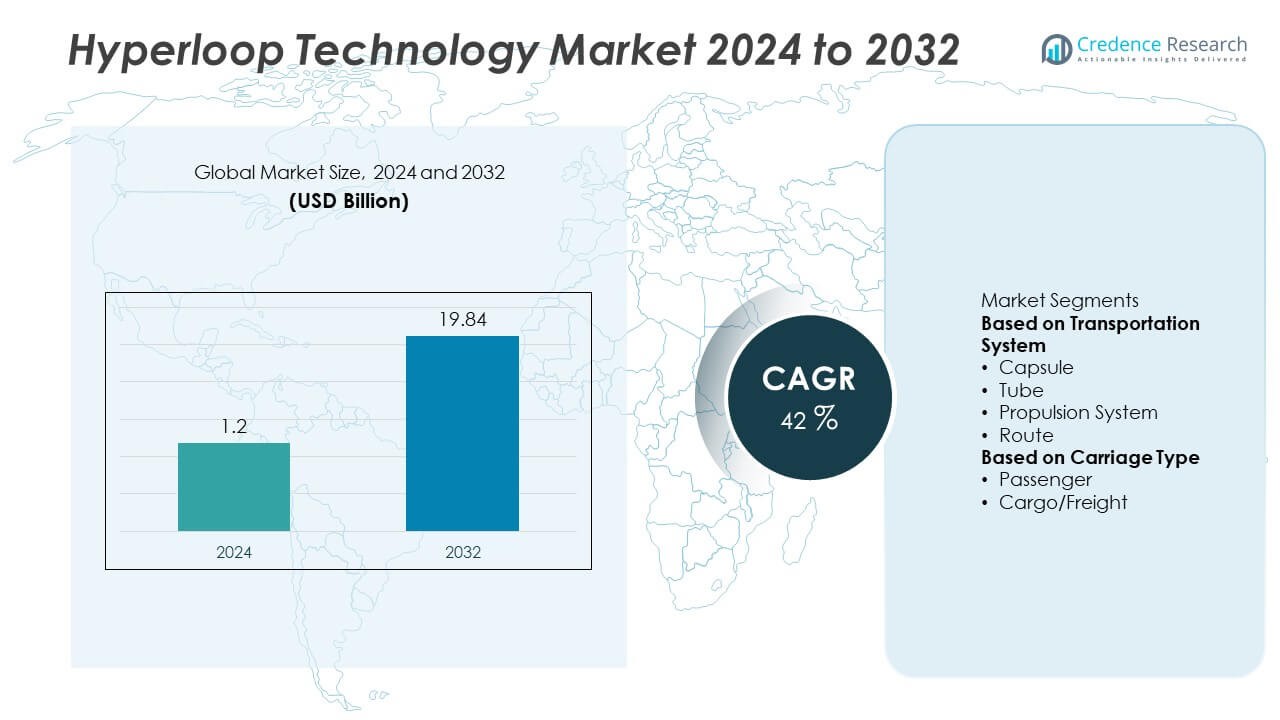
Hyperloop Technology market size was valued at USD 1.2 billion in 2024 and is anticipated to reach USD 19.84 billion by 2032, growing at a CAGR of 42% during the forecast period.
| REPORT ATTRIBUTE | DETAILS |
|---|---|
| Historical Period | 2020-2023 |
| Base Year | 2024 |
| Forecast Period | 2025-2032 |
| Hyperloop Technology Market Size 2024 | USD 1.2 Billion |
| Hyperloop Technology Market, CAGR | 42% |
| Hyperloop Technology Market Size 2032 | USD 19.84 Billion |
The Hyperloop Technology market is led by companies such as HyperloopTT, Space Exploration Technologies Corporation, Zeleros, Hardt B.V., TRANSPOD, Virgin Hyperloop, TUM Hyperloop, Hyper Chariot, Swisspod Technologies, and DGWHyperloop. These players are advancing capsule, propulsion, and tube systems to bring high-speed transportation closer to commercialization. In 2024, North America held the largest share at 36%, driven by strong investments in R&D and pilot testing projects led by U.S.-based firms. Europe followed with 33% share, supported by cross-border initiatives and EU-backed infrastructure development, while Asia-Pacific accounted for 25% share, boosted by government-backed urban mobility programs in China and India.
Market Insights
- The Hyperloop Technology market was valued at USD 1.2 billion in 2024 and is projected to reach USD 19.84 billion by 2032, growing at a CAGR of 42% during the forecast period.
- Rising demand for high-speed, sustainable, and efficient transportation systems drives growth, with passenger carriage leading at over 60% share due to urban mobility needs.
- A key trend is the integration of renewable energy and smart infrastructure, supporting eco-friendly hyperloop corridors across major economies.
- The market is competitive with players such as HyperloopTT, SpaceX, Zeleros, TRANSPOD, and Virgin Hyperloop focusing on partnerships, prototype testing, and large-scale pilot projects.
- Regionally, North America led with 36% share in 2024, followed by Europe at 33% and Asia-Pacific at 25%, while cargo/freight applications are gaining traction in Europe and Asia for logistics efficiency.
Market Segmentation Analysis:
By Transportation System
The capsule segment dominated the hyperloop technology market in 2024, accounting for over 40% share. Capsules are the core element of the system, designed to transport passengers and cargo at ultra-high speeds in low-pressure tubes. Their dominance is supported by ongoing R&D investments in aerodynamics, safety, and passenger comfort. Companies are focusing on lightweight materials and advanced engineering to enhance efficiency. While tubes, propulsion systems, and route infrastructure are critical components, capsules attract the highest share due to their direct role in operational functionality and their significance in pilot testing and demonstration projects.
- For instance, Swisspod Technologies achieved 40.7 km/h with a 1/12-scale capsule, covering 11.8 km under vacuum conditions on a 120m circular test track in Lausanne. This distance and speed were deemed equivalent to a full-scale journey of 141.6 km at 488.2 km/h.
By Carriage Type
Passenger carriage led the hyperloop technology market in 2024, capturing more than 55% share. Rising demand for high-speed, sustainable, and cost-efficient urban and intercity travel drives this segment’s dominance. Governments and private players are prioritizing passenger-focused systems to ease congestion and cut travel times, making this segment central to ongoing pilot projects worldwide. Cargo or freight carriage is also gaining momentum, supported by logistics companies exploring hyperloop for rapid goods transport. However, passenger services remain the focal point, as they offer broader economic and social benefits, strengthening their leadership in the global hyperloop ecosystem.
- For instance, Hardt Hyperloop set a European record with a passenger prototype reaching 85 km/h during trials at the Dutch European Hyperloop Center’s 420 m test track.
Key Growth Drivers
Rising Demand for High-Speed Transportation
The growing need for ultra-fast and efficient travel solutions is a primary driver of the hyperloop technology market. Unlike conventional rail or air transport, hyperloop systems promise speeds exceeding 1,000 km/h with lower energy consumption. Urbanization, expanding megacities, and increasing intercity travel demand make hyperloop attractive for reducing congestion and improving connectivity. Governments and private investors are exploring pilot projects to transform long-distance travel into shorter, more efficient journeys. This shift toward high-speed mobility strongly supports the adoption of hyperloop technology worldwide.
- For instance, Virgin Hyperloop’s full-scale test pod "XP-2" carried two passengers on a 500 m test track in Nevada during a trial run, where it reached a speed of 172 km/h (107 mph).
Focus on Sustainability and Carbon Reduction
Hyperloop technology aligns with global sustainability goals by offering an eco-friendly alternative to air and road travel. Powered primarily by renewable electricity, the system produces minimal emissions compared to conventional transport. With growing pressure to meet net-zero targets, countries are prioritizing green infrastructure investments. The ability of hyperloop to cut travel-related carbon footprints while providing mass transit solutions makes it highly relevant in today’s policy landscape. This sustainability focus continues to drive research funding and global interest in accelerating adoption.
- For instance, Zeleros developed a fully electric linear motor prototype, tested on a 100-meter track in Spain, that is designed for both container handling in port environments and as a stepping stone toward its hyperloop technology.
Growing Private and Public Investments
Rising financial support from governments, venture capital, and private enterprises is fueling hyperloop technology development. Pilot projects in the United States, Europe, and Asia are backed by significant R&D funding, enabling advancements in propulsion, safety, and materials. Public-private partnerships are accelerating feasibility studies and infrastructure planning, creating momentum for future deployments. Companies such as Virgin Hyperloop and Hyperloop Transportation Technologies are leading in innovation, attracting global attention. The inflow of investments ensures continuous technological progress, pushing hyperloop closer to commercialization within the forecast period.
Key Trends & Opportunities
Development of Passenger-Centric Systems
Passenger transport remains the central focus of hyperloop projects, with over half of initiatives targeting intercity travel. The opportunity lies in addressing increasing commuter demand while offering safer and faster alternatives to flights and high-speed rail. Integration with existing public transportation systems can further enhance accessibility. Pilot routes under development highlight the potential for passenger services to revolutionize daily travel and tourism. This trend provides companies with significant opportunities to attract investment, secure regulatory approvals, and demonstrate feasibility at a commercial scale.
- For instance, TUM Hyperloop achieved a speed of 482 km/h with its prototype pod at the 2019 SpaceX Hyperloop Pod Competition, setting a record for university-led hyperloop development. In July 2023, the team also performed Europe's first passenger run under vacuum conditions in a separate, full-scale passenger pod on its 24-meter test track in Munich.
Expanding Applications in Cargo and Freight
Cargo transport is emerging as a significant opportunity in the hyperloop market, with companies exploring its role in logistics and supply chains. Hyperloop can move goods faster and more efficiently than traditional trucking or rail networks, reducing delivery times for high-value and time-sensitive shipments. With global e-commerce and trade volumes rising, freight-focused systems offer new revenue streams. Logistics companies are increasingly interested in partnerships for pilot projects, highlighting the potential of hyperloop technology to reshape cargo distribution and last-mile connectivity.
- For instance, TransPod's "FluxJet"-designed for cargo and passengers-was demonstrated using a scaled-down prototype in Toronto, showcasing its potential for ultra-high-speed ground transportation that the company aims to operate at over 1,000 km/h in the future.
Key Challenges
High Infrastructure and Development Costs
One of the biggest challenges facing hyperloop adoption is the enormous cost of building routes, tubes, and propulsion systems. Land acquisition, construction, and technology integration require billions of dollars in investment, making it difficult for projects to scale. The long payback periods and uncertainty around return on investment discourage private investors in cost-sensitive regions. Without significant government funding and subsidies, the financial viability of large-scale hyperloop deployment remains uncertain, limiting its short-term adoption.
Regulatory and Safety Concerns
The lack of established regulatory frameworks for hyperloop technology is a critical barrier. Governments are still developing standards for safety, operations, and environmental impact. Questions regarding passenger safety at high speeds, emergency protocols, and long-term reliability delay approvals. Public acceptance also hinges on demonstrated safety through large-scale testing. Until international guidelines and certifications are established, the commercialization of hyperloop systems faces major hurdles, slowing down their widespread deployment despite technological advancements.
Regional Analysis
North America
North America accounted for over 35% share of the hyperloop technology market in 2024, making it the leading region. The United States leads adoption with major projects under development, supported by strong private investments and government-backed feasibility studies. Increasing urban congestion and demand for faster intercity travel boost adoption potential. Companies like Virgin Hyperloop are advancing test tracks and pilot routes, which strengthens the region’s leadership. Regulatory progress and strong R&D funding ensure that North America remains at the forefront of hyperloop development, with long-term opportunities in both passenger and freight transport.
Europe
Europe held more than 28% share of the hyperloop technology market in 2024, supported by sustainability initiatives and smart mobility programs. Countries such as Germany, France, and the Netherlands are leading pilot studies and R&D investments. The European Union’s carbon neutrality goals align with hyperloop’s low-emission profile, driving strong policy support. Infrastructure modernization and cross-border connectivity projects add momentum. Growing collaboration between technology developers and policymakers accelerates testing and certification efforts. With a focus on reducing aviation reliance, Europe positions hyperloop as a strategic solution for high-speed, eco-friendly regional transportation.
Asia-Pacific
Asia-Pacific captured over 30% share of the hyperloop technology market in 2024, ranking as a strong growth region. China, India, and Japan lead investments, supported by rapid urbanization and rising demand for efficient megacity-to-megacity transport. Government initiatives in infrastructure modernization and carbon reduction further support adoption. Pilot projects and feasibility studies highlight the potential for both passenger and freight applications. The region’s strong manufacturing base and expertise in large-scale infrastructure projects provide cost advantages. With ongoing partnerships between global technology providers and local governments, Asia-Pacific is expected to be a key driver of hyperloop commercialization.
Latin America
Latin America represented over 4% share of the hyperloop technology market in 2024, driven by growing urban populations and interest in innovative transport solutions. Brazil and Mexico are the primary markets, where feasibility studies are underway to evaluate long-distance passenger routes. Rising logistics demand also supports potential freight applications, though high development costs limit rapid adoption. Government support remains modest, but increasing collaboration with international hyperloop developers provides growth opportunities. As regional economies expand and infrastructure investment rises, Latin America is expected to show steady but gradual uptake of hyperloop technology.
Middle East & Africa
The Middle East & Africa accounted for nearly 3% share of the hyperloop technology market in 2024, with the Middle East driving most of the progress. The UAE and Saudi Arabia are spearheading large-scale projects, positioning hyperloop as part of long-term smart city and transport diversification plans. Investments in high-speed, sustainable infrastructure highlight the region’s ambition to lead in advanced mobility. In Africa, adoption remains limited but potential exists in urban hubs for cargo applications. Although constrained by high costs and regulatory gaps, the region’s strong infrastructure investments present long-term growth opportunities.
Market Segmentations:
By Transportation System
- Capsule
- Tube
- Propulsion System
- Route
By Carriage Type
- Passenger
- Cargo/Freight
By Geography
- North America
- U.S.
- Canada
- Mexico
- Europe
- Germany
- France
- U.K.
- Italy
- Spain
- Rest of Europe
- Asia Pacific
- China
- Japan
- India
- South Korea
- South-east Asia
- Rest of Asia Pacific
- Latin America
- Brazil
- Argentina
- Rest of Latin America
- Middle East & Africa
- GCC Countries
- South Africa
- Rest of the Middle East and Africa
Competitive Landscape
Competitive landscape of the Hyperloop Technology market features major players such as HyperloopTT, Space Exploration Technologies Corporation, Zeleros, TUM Hyperloop, Hardt B.V., TRANSPOD, Hyper Chariot, Virgin Hyperloop, DGWHyperloop, and Swisspod Technologies. These companies are driving innovation through advancements in capsule design, propulsion systems, and safety integration. HyperloopTT and Virgin Hyperloop are leading large-scale pilot projects, while SpaceX continues to support research and testing through its Hyperloop pod competitions. European firms like Zeleros, Hardt B.V., and TRANSPOD are focusing on scalable infrastructure and cross-border connectivity, aligning with EU transport goals. Start-ups including Swisspod Technologies and DGWHyperloop are contributing with modular systems and cost-efficient prototypes. The market is highly competitive, with firms emphasizing collaborations, government partnerships, and funding initiatives to accelerate commercial deployment. As global transport systems move toward high-speed, sustainable alternatives, competition among key players is expected to intensify, with strategic alliances and technology breakthroughs shaping the future of hyperloop adoption.
Key Player Analysis
- HyperloopTT
- Space Exploration Technologies Corporation
- Zeleros
- TUM Hyperloop
- Hardt B.V.
- TRANSPOD
- Hyper Chariot
- Virgin Hyperloop
- DGWHyperloop
- Swisspod Technologies
Recent Developments
- In March 2025, HyperloopTT completed the first “HyperPort” feasibility study in Brazil.
- In April 2024, Zeleros co-founded Battera, a JV focused on battery modules and packs for mobility and transport sectors.
- In December 2023, Virgin Hyperloop (formerly Hyperloop One) ceased operations, and its intellectual property was transferred to majority stakeholder DP World.
- In October 2023, Hardt formed a strategic alliance with Zeleros to accelerate hyperloop tech and commercialization.
Report Coverage
The research report offers an in-depth analysis based on Transportation System, Carriage Type and Geography. It details leading market players, providing an overview of their business, product offerings, investments, revenue streams, and key applications. Additionally, the report includes insights into the competitive environment, SWOT analysis, current market trends, as well as the primary drivers and constraints. Furthermore, it discusses various factors that have driven market expansion in recent years. The report also explores market dynamics, regulatory scenarios, and technological advancements that are shaping the industry. It assesses the impact of external factors and global economic changes on market growth. Lastly, it provides strategic recommendations for new entrants and established companies to navigate the complexities of the market.
Future Outlook
- The market will expand rapidly with increasing investments in next-generation transport systems.
- Passenger transport will remain the leading segment as demand for faster travel rises.
- Cargo and freight adoption will grow with emphasis on logistics efficiency and cost savings.
- North America will sustain leadership with government-backed pilot projects and private partnerships.
- Europe will strengthen growth through sustainability mandates and cross-border transport initiatives.
- Asia-Pacific will emerge as a high-growth region driven by urbanization and infrastructure upgrades.
- Renewable energy integration will enhance the sustainability of hyperloop networks.
- Partnerships between technology providers and governments will accelerate project implementation.
- High construction costs and regulatory barriers will remain key challenges for adoption.
- Ongoing R&D in propulsion and tube systems will improve performance and scalability.

Request a Free Sample
Fill in your details and we'll send you a free sample report.
- Sample data tables & charts
- Research methodology
Market Dynamics
Rising Demand for High-Speed Transportation
The need for ultra-fast, efficient travel solutions is propelling hyperloop technology, as it offers speeds exceeding 1,000 km/h and can significantly reduce travel times between cities, appealing to both governments and private investors seeking to alleviate congestion and improve connectivity.
Focus on Sustainability and Carbon Reduction
Hyperloop systems are primarily powered by renewable electricity and produce minimal emissions, aligning with global sustainability and net-zero targets, which is driving policy support and funding for eco-friendly transport alternatives.
Growing Private and Public Investments
Significant financial backing from governments, venture capital, and private enterprises is accelerating R&D, pilot projects, and infrastructure planning, ensuring continuous technological progress and moving hyperloop closer to commercialization.
Development of Passenger-Centric Systems
With over half of hyperloop initiatives targeting passenger transport, the market is driven by the need to provide safer, faster, and more sustainable alternatives to flights and high-speed rail, especially in urban and intercity corridors.
Expanding Applications in Cargo and Freight
The potential for hyperloop to revolutionize logistics by enabling rapid, efficient movement of goods is attracting interest from logistics companies and creating new revenue streams, particularly as global e-commerce and trade volumes rise.
Need a Custom Version of This Report?
Tailor the scope, geography, or segments to your exact requirements.
- Custom geography or segment scope
- Direct access to our analyst team
Frequently Asked Questions
What is the current market size for Hyperloop Technology market, and what is its projected size in 2032?
At what Compound Annual Growth Rate is the Hyperloop Technology market projected to grow between 2025 and 2032?
Which Hyperloop Technology market segment held the largest share in 2024?
What are the primary factors fueling the growth of the Hyperloop Technology market?
Who are the leading companies in the Hyperloop Technology market?
Which region commanded the largest share of the Hyperloop Technology market in 2024?
Table of Content
Chapter 1 Market Segmentation
- 1.1 Segmentation Framework
- 1.1.1 Product and Service Classification
- 1.1.2 Application and End-Use Classification
- 1.1.3 Technology and Solution Classification
- 1.1.4 Customer and Distribution Channel Classification
- 1.1.5 Geographic Segmentation
- 1.1.6 Market Segment Definitions and Boundaries
- 1.2 By Carriage Type
- 1.2.1 Passenger
- 1.2.2 Cargo/Freight
- 1.3 By Transportation System
- 1.3.1 Capsule
- 1.3.2 Tube
- 1.3.3 Propulsion System
- 1.3.4 Route
Chapter 2 Introduction
- 2.1 Report Objectives and Scope
- 2.2 Product Definition and Industry Terminology
- 2.3 Market Inclusions and Exclusions
- 2.4 Research Process
- 2.4.1 Primary Research and Expert Interviews
- 2.4.2 Secondary Research and Source Review
- 2.4.3 Top-Down and Bottom-Up Estimation
- 2.4.4 Data Triangulation and Verification
- 2.5 Market Size Measurement Basis
- 2.5.1 2024: USD 1.2 billion → 2032: USD 19.84 billion
- 2.6 Historical and Forecast Reference Periods
- 2.6.1 Base Year: 2024
- 2.6.2 Forecast Period: 2024-2032
- 2.7 Research Assumptions and Limitations
Chapter 3 Executive Summary
- 3.1 Market Snapshot and Key Findings
- 3.2 Base-Year Market Size, 2024
- 3.3 Forecast Market Size, 2032
- 3.4 Revenue and Volume Growth Outlook
- 3.5 Key Demand and Supply Indicators
- 3.6 Leading Market Segments
- 3.7 Fastest-Growing Market Opportunities
- 3.8 Regional Performance Highlights
- 3.9 Technology and Industry Transformation
- 3.10 Competitive Landscape Summary
- 3.11 Analyst View and Strategic Implications
Chapter 4 Global Hyperloop Technology Market Trends and Developments
- 4.1 Historical Industry Development
- 4.2 Recent Market Trends and Developments
- 4.3 Demand and Customer Behavior Trends
- 4.4 Technology and Product Innovation
- 4.5 Artificial Intelligence, Automation and Digitalization
- 4.6 Local Manufacturing and Supply Chain Realignment
- 4.7 Industry Partnerships, Mergers and Acquisitions
- 4.8 Sustainability and Circular Economy Developments
- 4.9 Government and Private Sector Investment Trends
- 4.10 Emerging Business Models and Commercialization
- 4.11 Industry Developments and Announcements
Chapter 5 Global Hyperloop Technology Market Production, Supply and Demand Analysis
- 5.1 Demand Trend and Consumption Analysis
- 5.2 Demand Forecast, 2024-2032
- 5.3 Production and Output Trend
- 5.4 Production and Output Forecast, 2024-2032
- 5.5 Installed Capacity and Capacity Utilization
- 5.6 Company-Wise Production Plants and Statistics
- 5.6.1 Installed Production Capacity
- 5.6.2 Actual Production
- 5.6.3 Planned Capacity and Expansion Targets
- 5.7 Supply Chain Structure and Procurement Trends
- 5.8 Supply-Demand Gap and Bottlenecks
- 5.9 Import Dependence and Sourcing Structure
- 5.10 Contract Manufacturing and Outsourcing
- 5.11 Regional Supply and Demand Concentration
Chapter 6 Global Hyperloop Technology Market Pricing Analysis
- 6.1 Pricing Structure and Measurement
- 6.2 Historical Pricing Trends
- 6.3 Pricing Outlook, 2024-2032
- 6.4 Average Selling Price and Unit Economics
- 6.5 Pricing by Product and Market Segment
- 6.6 Geographic Pricing Differences
- 6.7 Key Input, Energy, Labor and Logistics Costs
- 6.8 Contract Pricing and Purchasing Models
- 6.9 Pricing Sensitivity and Competitive Positioning
- 6.10 Price, Margin and Profitability Implications
Chapter 7 Global Hyperloop Technology Market Dynamics
- 7.1 Market Growth Drivers
- 7.1.1 Demand-Side Drivers
- 7.1.2 Technology and Innovation Drivers
- 7.1.3 Infrastructure and Investment Drivers
- 7.1.4 Regulatory and Policy Drivers
- 7.2 Market Restraints
- 7.2.1 Cost and Affordability Constraints
- 7.2.2 Technology and Adoption Barriers
- 7.2.3 Supply Chain and Operational Constraints
- 7.3 Market Challenges
- 7.3.1 Competitive Pressure and Margin Erosion
- 7.3.2 Skills, Infrastructure and Implementation Gaps
- 7.4 Emerging Market Opportunities
- 7.5 Market Dynamics Impact and Time-Horizon Assessment
Chapter 8 Global Hyperloop Technology Value Chain Analysis
- 8.1 Industry Value Chain Overview
- 8.2 Upstream Suppliers and Critical Inputs
- 8.3 Technology and Component Providers
- 8.4 Manufacturing or Service Delivery
- 8.5 Distribution, Channel Partners and Integrators
- 8.6 Downstream Applications and End Users
- 8.7 Value Addition and Profit Pools
- 8.8 Vertical Integration and Outsourcing
- 8.9 Supplier Concentration and Risk
- 8.10 Supply Chain Localization and Resilience
Chapter 9 Global Hyperloop Technology Market Regulations and Policies
- 9.1 Relevant Laws, Standards and Compliance Frameworks
- 9.2 Product, Service, Safety and Quality Requirements
- 9.3 Government Policies, Incentives and Subsidies
- 9.4 Imports, Exports and Trade Barriers
- 9.5 Public Procurement and Local Content Requirements
- 9.6 Environmental and Sustainability Compliance
- 9.7 Upcoming Policy Changes and Market Implications
Chapter 10 Global Hyperloop Technology Market Hotspots and Opportunities
- 10.1 Market Opportunity Mapping and Growth Hotspots
- 10.2 High-Growth Applications and Customer Groups
- 10.3 Underserved Markets and White-Space Opportunities
- 10.4 Emerging Technology and Product Opportunities
- 10.5 New Capacity and Investment Hotspots
- 10.6 Market Entry and Expansion Opportunities
- 10.7 Distribution and Partnership Opportunities
- 10.8 Near-Term and Long-Term Commercial Potential
- 10.9 Opportunity Attractiveness and Execution Risks
Chapter 11 Global Hyperloop Technology Market Outlook, 2024-2032
- 11.1 Market Size and Analysis
- 11.1.1 Revenue (Market Measurement: 2024: USD 1.2 billion → 2032: USD 19.84 billion)
- 11.1.2 Market Volume and Quantity Sold
- 11.1.3 Historical Market Size
- 11.1.4 Base-Year Market Size, 2024
- 11.2 Market Forecast, 2024-2032
- 11.2.1 Revenue Forecast to 2032
- 11.2.2 Volume Forecast to 2032
- 11.2.3 CAGR and Year-on-Year Growth
- 11.2.4 Incremental Revenue Opportunity
- 11.3 Forecast Assumptions and Scenario Analysis
- 11.3.1 Base-Case Forecast
- 11.3.2 Optimistic and Conservative Scenarios
- 11.3.3 Technology, Pricing and Policy Sensitivities
- 11.4 Market Attractiveness and Growth Outlook
Chapter 12 Global Hyperloop Technology Market Segmentation and Outlook
- 12.1 Segmentation Summary and Market Shares, 2024
- 12.2 Largest and Fastest-Growing Segments
- 12.3 By Carriage Type - Market Size and Forecast, 2024-2032
- 12.3.1 Segment Definition and Scope
- 12.3.2 Historical Market Size
- 12.3.3 Revenue Forecast, 2024-2032
- 12.3.4 Volume Forecast, 2024-2032
- 12.3.5 Base-Year Market Share, 2024
- 12.3.6 Segment CAGR and Growth Drivers
- 12.3.7 Subsegment Market Size and Forecast
- 12.3.7.1 Passenger
- 12.3.7.2 Cargo/Freight
- 12.3.8 Subsegment Pricing and Adoption Trends
- 12.3.9 Leading Suppliers and Competition
- 12.3.10 Regional Demand and Opportunities
- 12.4 By Transportation System - Market Size and Forecast, 2024-2032
- 12.4.1 Segment Definition and Scope
- 12.4.2 Historical Market Size
- 12.4.3 Revenue Forecast, 2024-2032
- 12.4.4 Volume Forecast, 2024-2032
- 12.4.5 Base-Year Market Share, 2024
- 12.4.6 Segment CAGR and Growth Drivers
- 12.4.7 Subsegment Market Size and Forecast
- 12.4.7.1 Capsule
- 12.4.7.2 Tube
- 12.4.7.3 Propulsion System
- 12.4.7.4 Route
- 12.4.8 Subsegment Pricing and Adoption Trends
- 12.4.9 Leading Suppliers and Competition
- 12.4.10 Regional Demand and Opportunities
- 12.5 Segment Growth Comparison
- 12.6 Segment Attractiveness and Priority Matrix
Chapter 13 Global Hyperloop Technology Geographic Market Outlook, 2024-2032
- 13.1 Regional Market Size and Share, 2024
- 13.2 Regional Market Forecast, 2024-2032
- 13.3 Regional Pricing, Production and Demand Differences
- 13.4 North America
- 13.4.1 United States
- 13.4.2 Canada
- 13.4.3 Mexico
- 13.5 Europe
- 13.5.1 Germany
- 13.5.2 France
- 13.5.3 Italy
- 13.5.4 United Kingdom
- 13.5.5 Spain
- 13.5.6 Poland
- 13.5.7 Russia
- 13.5.8 Netherlands
- 13.5.9 Belgium
- 13.5.10 Sweden
- 13.5.11 Denmark
- 13.5.12 Norway
- 13.5.13 Rest of Europe
- 13.6 Asia Pacific
- 13.6.1 China
- 13.6.2 India
- 13.6.3 Japan
- 13.6.4 South Korea
- 13.6.5 Thailand
- 13.6.6 Indonesia
- 13.6.7 Vietnam
- 13.6.8 Malaysia
- 13.6.9 Australia
- 13.6.10 Rest of Asia Pacific
- 13.7 Latin America
- 13.7.1 Brazil
- 13.7.2 Argentina
- 13.7.3 Colombia
- 13.7.4 Chile
- 13.7.5 Rest of Latin America
- 13.8 Middle East
- 13.8.1 Saudi Arabia
- 13.8.2 United Arab Emirates
- 13.8.3 Turkey
- 13.8.4 Israel
- 13.8.5 Iran
- 13.8.6 Rest of the Middle East
- 13.9 Africa
- 13.9.1 South Africa
- 13.9.2 Egypt
- 13.9.3 Nigeria
- 13.9.4 Morocco
- 13.9.5 Rest of Africa
- 13.10 Regional Investment, Policy and Supply Chain Differences
- 13.11 Regional Competitive Landscape
- 13.12 Geographic Growth Hotspots
Chapter 14 Global Hyperloop Technology Technology, Innovation and Sustainability Outlook
- 14.1 Technology Landscape and Maturity
- 14.2 Product, Process and Service Innovation
- 14.3 AI, Automation and Digital Tools in the Industry
- 14.4 Technology Adoption and Performance Benchmarking
- 14.5 Innovation Pipeline and R&D Investment
- 14.6 Patent and Intellectual Property Trends
- 14.7 Energy Efficiency and Resource Management
- 14.8 Sustainability, Recycling and Circularity
- 14.9 Technology Roadmap, 2024-2032
- 14.10 Risks of Obsolescence and Technology Substitution
Chapter 15 Global Hyperloop Technology Market Key Strategic Imperatives
- 15.1 Growth and Market Entry Priorities
- 15.2 High-Return Products and Segments
- 15.3 Pricing, Profitability and Cost Optimization
- 15.4 Technology Investment and Product Differentiation
- 15.5 Supply Chain Localization and Resilience
- 15.6 Distribution and Customer Acquisition
- 15.7 Partnership, Acquisition and Capacity Strategy
- 15.8 Regional Expansion Priorities
- 15.9 Short-, Medium- and Long-Term Actions
Chapter 16 Competition Outlook
- 16.1 Industry Competition Characteristics
- 16.2 Market Structure and Concentration
- 16.3 Market Share and Competitive Positioning, 2024
- 16.4 Company-Wise Revenue and Product Benchmarking
- 16.5 Production and Service Capacity Benchmarking
- 16.6 Technology, Pricing and Differentiation
- 16.7 Regional Footprint and Distribution Strength
- 16.8 Mergers, Acquisitions and Strategic Alliances
- 16.9 New Entrants and Competitive Threats
- 16.10 Porter's Five Forces and Industry Attractiveness
- 16.11 Competitive Outlook, 2024-2032
Chapter 17 Company Profiles
- 17.1 Company Coverage and Selection Criteria
- 17.2 HyperloopTT
- 17.2.1 Business Description
- 17.2.2 Company Ownership and Geographic Presence
- 17.2.3 Product and Service Portfolio
- 17.2.4 Manufacturing and Operating Footprint
- 17.2.5 Production Capacity and Expansion Plans
- 17.2.6 Financial Performance and Investment
- 17.2.7 Market Share and Competitive Position
- 17.2.8 Technology and Innovation Capabilities
- 17.2.9 Strategic Alliances or Partnerships
- 17.2.10 Recent Developments
- 17.2.11 Growth Strategy and Outlook
- 17.3 Space Exploration Technologies Corporation
- 17.4 Zeleros
- 17.5 TUM Hyperloop
- 17.6 Hardt B.V.
- 17.7 TRANSPOD
- 17.8 Hyper Chariot
- 17.9 Virgin Hyperloop
- 17.10 DGWHyperloop
- 17.11 Swisspod Technologies
- 17.12 Other Relevant Market Participants
Note: Every listed company is profiled on the structure shown under the first company. The company list is preliminary and may change based on research findings, market developments, data availability and client requirements.
Chapter 18 Disclaimer
- 18.1 Research and Forecast Disclaimer
- 18.2 Data Source and Estimation Limitations
Note: The depth of individual sections depends on data availability for this market. Volume, capacity, trade and other unit-based metrics are included where applicable.

