Spirits anchor demand as drinkers trade up to premium labels
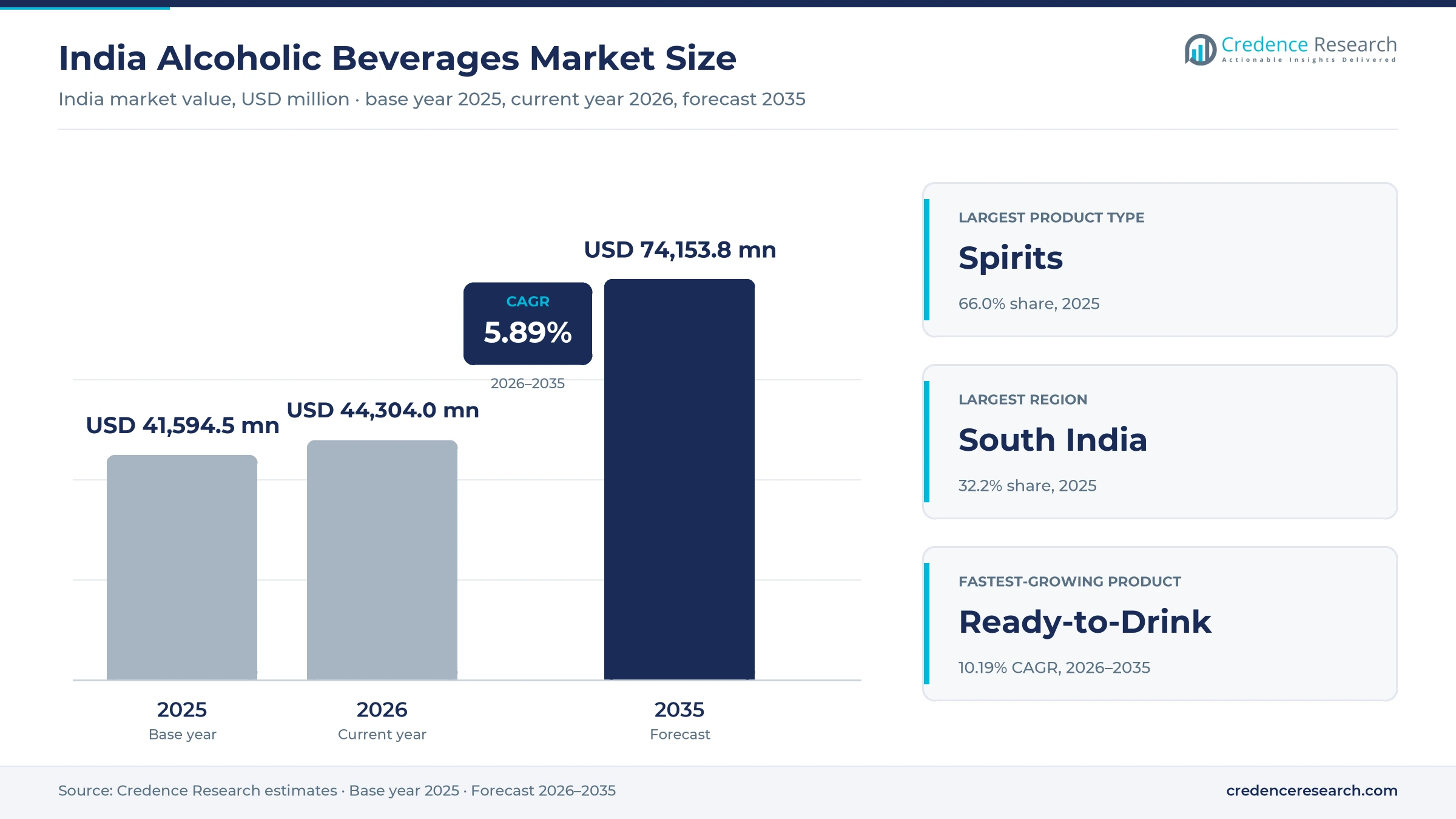
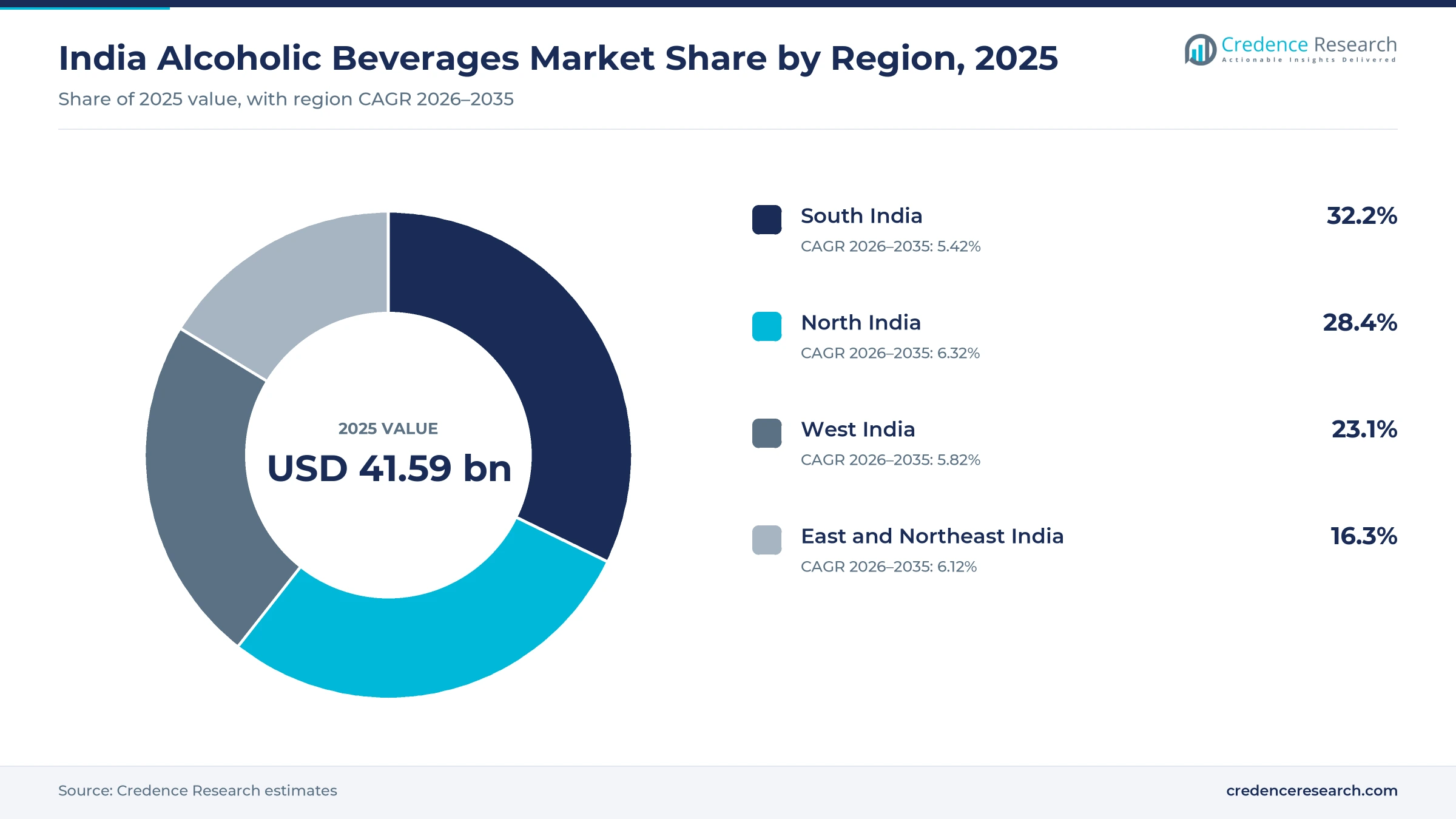
The India alcoholic beverages market was valued at USD 41.59 billion in 2025 and is projected to increase from USD 44.30 billion in 2026 to USD 74.15 billion by 2035, registering a CAGR of 5.89% during 2026–2035. Demand comes from legal-age drinkers in cities and towns who buy more branded whisky, beer and wine, and from hotels, bars and wedding hosts that serve larger volumes during festive seasons. South India held the largest regional share, 32.2% in 2025, because its southern states run large state-managed retail networks and have long-established whisky and brandy drinking habits. North India is the fastest-growing region at 6.32% a year, as Uttar Pradesh widens licensed retail and brewers add capacity closer to northern buyers. In turn, the India and United Kingdom trade agreement entered into force in July 2026 and halved the tariff on imported Scotch whisky, which widens the premium shelf for imported and blended labels.
Which drinks and sales routes does the estimate cover?
The estimate measures the retail value of spirits, beer, wine, ready-to-drink products and cider sold to legal-age consumers in India through licensed shops, bars, hotels, restaurants, defense and institutional canteens, travel retail and digital ordering where states permit it. It covers mass, premium, super-premium and luxury labels, whether they are made in India or imported in bulk or bottled form.
The estimate excludes illicit and unrecorded liquor, alcohol used for industrial or medical purposes and exports shipped out of the country. The value chain runs from grain, molasses and malt suppliers through distillers, brewers and wineries to state corporations, licensed distributors, retailers and hospitality outlets that serve drinkers.
India Alcoholic Beverages Market Insights
- The India alcoholic beverages market was valued at USD 41.59 billion in 2025 and is projected to reach USD 74.15 billion by 2035, registering a CAGR of 5.89% during 2026–2035.
- South India held a 32.2% share of 2025 value, because the southern states have large licensed retail networks and long-established whisky and brandy habits.
- Spirits led with a 66.0% share of 2025 value, because Indian-made whisky, rum, brandy and vodka dominate everyday and festive drinking occasions.
- The India and United Kingdom trade agreement entered into force on July 15, 2026, cutting the tariff on Scotch whisky and gin from 150% to 75%.
- Tilaknagar Industries completed the acquisition of the Imperial Blue whisky business from Pernod Ricard India in December 2025 for Rs 3,442 crore.
Spirits lead while ready-to-drink products grow fastest
Why do spirits hold most of the drinks value?
Based on product type, the market is categorized into spirits, beer, wine, ready-to-drink products and cider. Spirits led with a 66.0% share of 2025 value, because Indian-made whisky, rum, brandy and vodka carry higher prices per bottle than beer and dominate festive drinking. Ready-to-Drink products grow fastest at 10.19% a year, as younger urban drinkers try lighter canned cocktails and mixed drinks.
How fast are drinkers trading up across price tiers?
Based on price tier, the market is categorized into mass, premium, super-premium and luxury and prestige labels. Mass labels led with a 52.0% share of 2025 value, because most whisky and rum bought in small towns sells at entry prices. Luxury and Prestige labels grow fastest at 9.14% a year, as single malts, aged blends and imported Scotch win buyers who now spend more on gifting and celebrations.
Why do licensed shops dominate drinks sales?
Based on distribution channel, the market is categorized into licensed off-trade retail, on-trade, institutional channels and travel retail and permitted digital ordering. Licensed Off-Trade Retail led with a 74.0% share of 2025 value, because most states sell alcohol through licensed shops or state-run outlets. Travel Retail and Permitted Digital Ordering grows fastest at 8.40% a year, as airport stores sell limited editions and a few states allow home delivery.
How is packaging shifting from glass to cans?
Based on packaging format, the market is categorized into glass bottles, metal cans, PET and flexible packs, and kegs and bulk packs. Glass Bottles led with a 72.0% share of 2025 value, because spirits, wine and most beer still sell in glass. Metal Cans grow fastest at 8.03% a year, as brewers add canning lines and ready-to-drink brands favor lighter packs.
| Segment Group | Leading Sub-segment | Share, 2025 | Fastest-growing Sub-segment | CAGR, 2026–2035 |
|---|---|---|---|---|
| By Product Type | Spirits | 66.0% | Ready-to-Drink | 10.19% |
| By Price Tier | Mass | 52.0% | Luxury and Prestige | 9.14% |
| By Distribution Channel | Licensed Off-Trade Retail | 74.0% | Travel Retail and Permitted Digital Ordering | 8.40% |
| By Packaging Format | Glass Bottles | 72.0% | Metal Cans | 8.03% |
Request a Free Sample
Fill in your details and we'll send you a free sample report.
- Sample data tables & charts
- Research methodology
Trading up, city life and local distilling lift demand
How does premiumization raise spending per bottle?
Premiumization and portfolio trading-up raise spending per bottle, because drinkers who once bought entry whisky now pick aged blends and single malts for gifting and celebrations. Radico Khaitan introduced the TRIKAL Indian single malt on May 23, 2025, priced between INR 3,500 and INR 4,500 for Uttar Pradesh, Haryana and Maharashtra. Diageo India placed its Godawan 173 Collector's Edition single malt at Bangalore Duty Free in September 2025, priced at INR 500,000 for each of 173 bottles. Pernod Ricard said in December 2025 that India is its largest market by volume and its second-largest by value, and that it is focusing on higher price points. As a result, luxury and prestige labels grow at 9.14% a year during 2026–2035.
Why does urban growth widen formal drinking occasions?
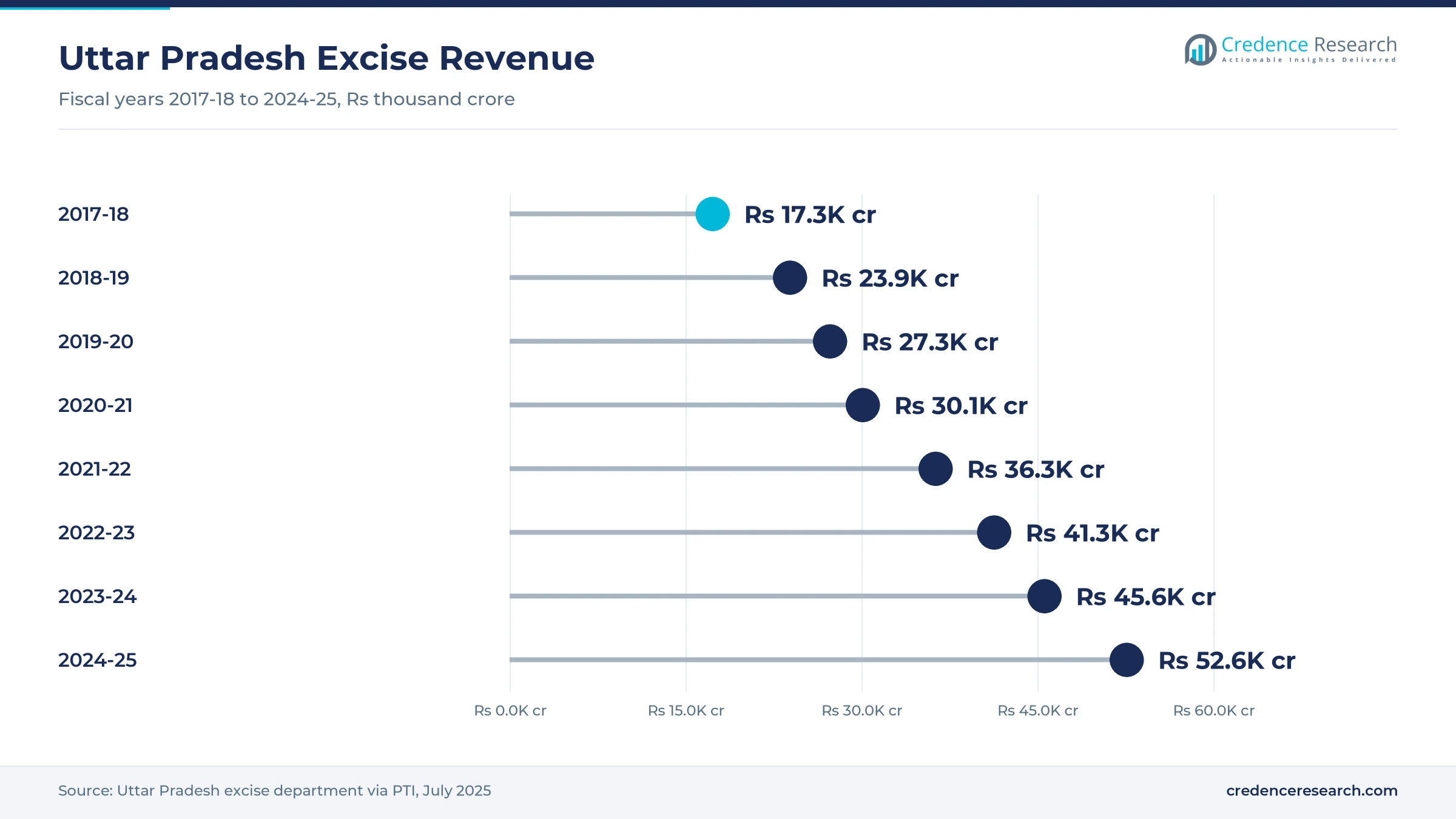
Urbanization and formal consumption occasions widen demand, because city households socialize in bars, restaurants and weddings where branded drinks replace unrecorded liquor. Urban residents made up 35.7% of India's population in 2025, up from 32.5% in 2015, according to the World Bank. The same source counts about 1.46 billion people in India in 2025, which adds millions of new legal-age adults each year. Uttar Pradesh excise revenue rose from Rs 17,320.10 crore in 2017-18 to Rs 52,573.07 crore in 2024-25, according to the state excise department, as more drinkers moved to licensed outlets. In turn, licensed off-trade retail holds 74.0% of 2025 value, while on-premise venues gain share in larger cities.
How do local distilling and exports build brand recognition?
Domestic manufacturing and export brand recognition support demand, because global groups now distill and bottle premium spirits inside India instead of shipping finished cases. Pernod Ricard began building a Rs 1,785 crore malt distillery in Nagpur in October 2024, with capacity for 60,000 liters of malt spirit a day, according to Rumporter. The company also said in December 2025 that about 97% of the volumes it sells in India are produced locally. India exported alcoholic drinks worth USD 389 million in 2023-24, and the commerce ministry targets USD 1 billion, according to Outlook Business. As a result, spirits hold 66.0% of 2025 value, as award-winning Indian whiskies gain shelf space at home.
Why do listed capital and brand deals fund expansion?
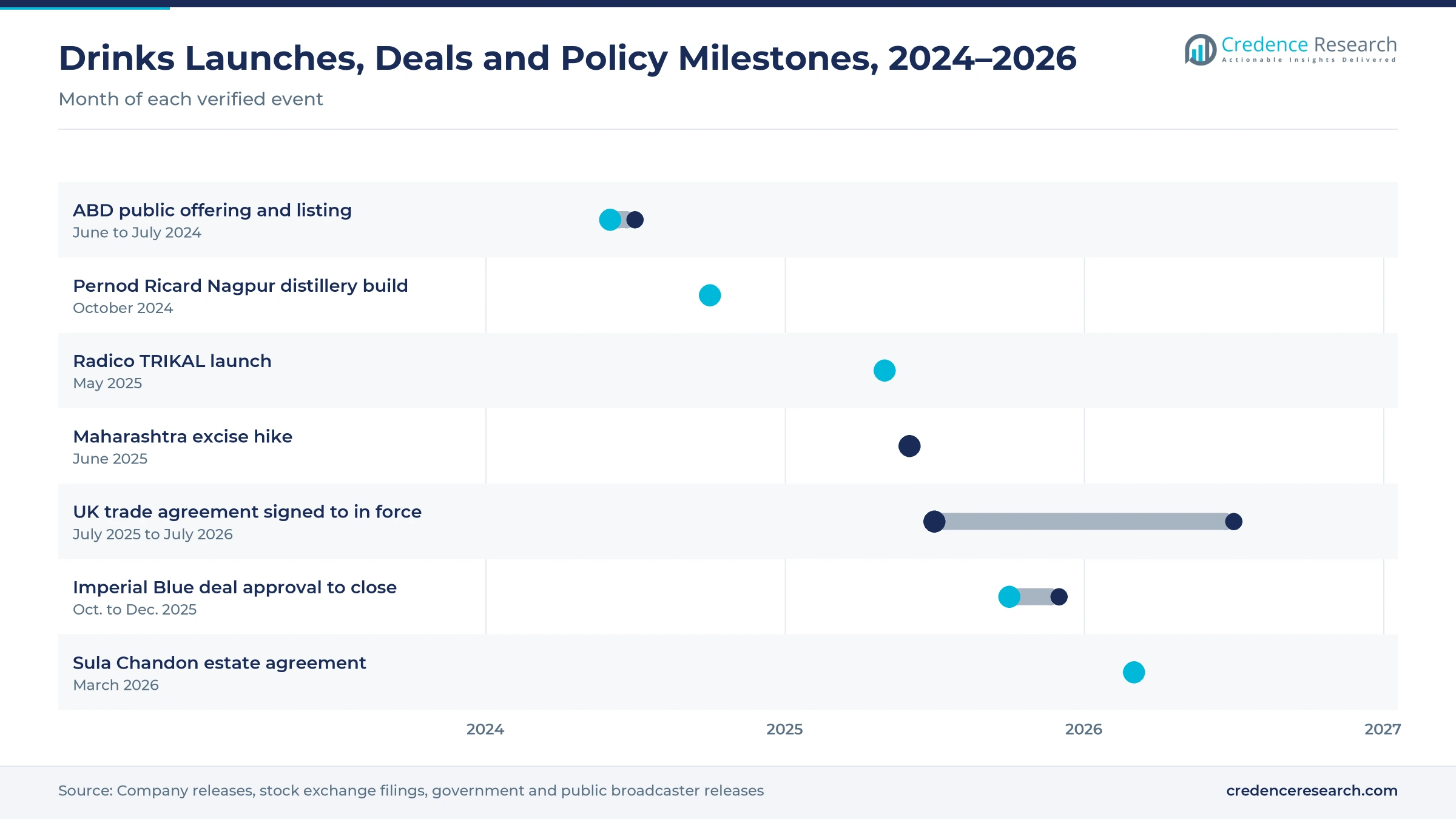
Listed capital and brand deals fund national expansion, because producers with stronger balance sheets can buy brands, add bottling units and reach more states. Allied Blenders and Distillers raised Rs 1,500 crore through an initial public offering that opened on June 25, 2024, and listed on the BSE and NSE in July 2024. Tilaknagar Industries completed the Rs 3,442 crore acquisition of the Imperial Blue business from Pernod Ricard India in December 2025, after competition approval on Oct. 7, 2025. Imperial Blue sold about 22.4 million nine-liter cases in the year to March 2025, which made it the third-largest whisky brand in India by volume. In turn, mass labels still hold 52.0% of 2025 value, as consolidated owners push them across new states.
Single malts, tariff cuts and new breweries reshape supply
How is the rise of Indian single malts changing shelves?
The rise of Indian single malts is changing premium shelves, because local distillers now age malt spirit in tropical climates and sell it against imported Scotch. Diageo India limited its Godawan 173 release to 173 bottles, one for each Great Indian Bustard still alive in India, which shows how scarcity now drives prestige pricing. Pernod Ricard's Nagpur project is described as the largest malt distillery in Asia, with about 13 million liters of pure alcohol a year once built. Radico Khaitan produces its TRIKAL single malt at the Rampur Distillery, which is more than 80 years old. As a result, malt whiskey gains space in premium bars and airport stores across India.
Why is the shift to lower Scotch tariffs significant?
The shift to lower Scotch tariffs is significant, because imported whisky and gin had carried one of the highest duties in the world before the United Kingdom agreement. India and the United Kingdom signed the trade agreement on July 24, 2025, and it entered into force on July 15, 2026, according to HLC. The agreement cut tariffs on Scotch whisky and gin from 150% to 75%, with a further fall to 40% after 10 years. India also reduced tariffs on 90% of tariff lines, covering 92% of goods exported by the United Kingdom. In turn, travel retail and permitted digital ordering grows at 8.40% a year, as duty-free liquor and imported labels reach more buyers.
Can new northern breweries open more beer and can sales?
New northern breweries can open more beer and can sales, because most large brewing capacity has long sat in the south and west. United Breweries, part of Heineken, registered land in Unnao, Uttar Pradesh, in November 2025 for a Rs 750 crore greenfield brewery with planned capacity of 1.0 million to 2.0 million hectoliters. The plant is due to start in the second quarter of fiscal 2027 and will run both canning and bottling lines. AB InBev India said in November 2022 that it held more than 65% of the premium beer segment, which was growing almost twice as fast as total beer. As a result, metal cans grow at 8.03% a year, and craft beer brands gain wider reach.
Is wine tourism an opening for estate wineries?
Wine tourism offers an opening for estate wineries, because visitors who taste wine at a vineyard often become regular buyers at home. Sula Vineyards signed a definitive agreement in March 2026 to acquire Chandon's 19-acre wine estate in Dindori, Nashik, including five acres of vineyards and a visitor center with tasting rooms. The estate has annual production capacity of 4.5 lakh liters, which can expand to 13 lakh liters. The deal is expected to close by the end of the first quarter of fiscal 2027 through a wholly owned subsidiary. In turn, wine, ready-to-drink and cider together grow faster than the market, with ready-to-drink products rising at 10.19% a year.
Excise hikes, state rules and ad limits pressure producers
How do state excise hikes raise shelf prices?
State excise hikes raise shelf prices, because each state sets its own duty and can change it with little notice. Maharashtra raised the excise duty on Indian-made foreign liquor from three times to 4.5 times the manufacturing cost in June 2025, according to All India Radio. As a result, prices of many labels were expected to rise by at least 50%. Producers respond with new price packs and smaller bottles that keep brands within reach of regular buyers.
Why do fragmented state rules slow national launches?
Fragmented state rules slow national launches, because every state runs its own label registration, pricing, route-to-market and license system. In turn, a brand that sells in one state may wait months before it reaches shelves in a neighboring state, which raises launch costs. Producers respond with phased state rollouts, local bottling partners and dedicated regulatory teams that track rule changes. As a result, larger groups with many bottling units launch faster than smaller distillers.
How do advertising limits restrict brand building?
Advertising limits restrict brand building, because direct alcohol advertising is not allowed on most Indian media. As a result, producers rely on surrogate brands, packaged water, music events and sponsorships to keep their names visible to adult drinkers. These routes cost more and reach fewer buyers than direct campaigns. Producers respond with in-store visibility, bar partnerships and limited editions that create word of mouth among legal-age consumers in large cities.
Why do grain and glass costs squeeze margins?
Grain, molasses and glass costs squeeze margins, because state governments often control retail prices and approve increases only once a year. In turn, producers absorb input cost spikes for months before they can pass them on, which hurts mass labels the most. Producers respond with long-term supply contracts, lighter bottles, returnable glass schemes and a richer premium mix that lifts value per case and protects profit across their portfolios.
South India leads while North India adds the fastest growth
| Region | Value, 2025 (USD billion) | Share, 2025 | CAGR, 2026–2035 |
|---|---|---|---|
| South India | 13.39 | 32.2% | 5.42% |
| North India | 11.81 | 28.4% | 6.32% |
| West India | 9.61 | 23.1% | 5.82% |
| East and Northeast India | 6.78 | 16.3% | 6.12% |
Why does South India hold the largest share?
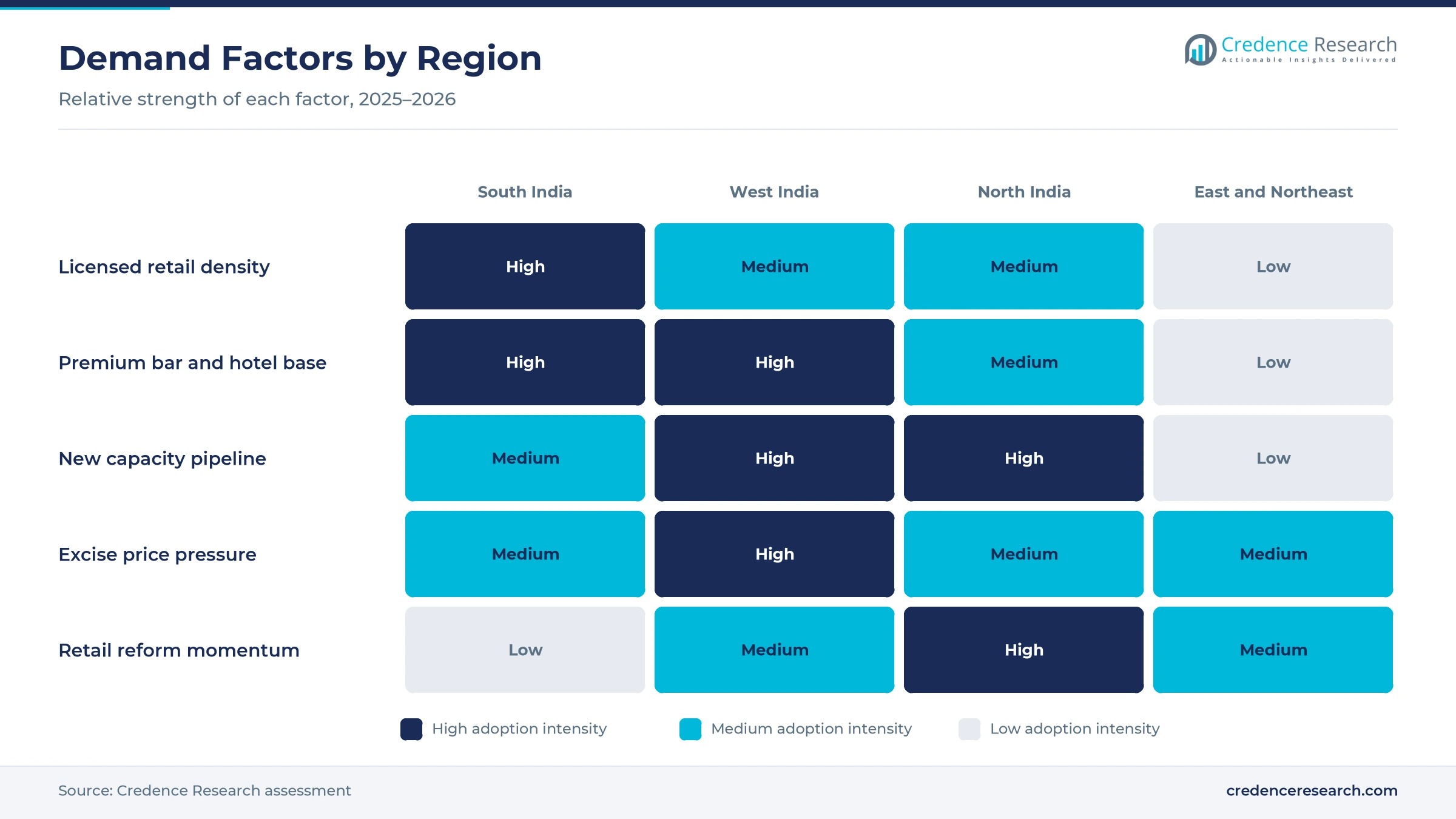
South India held a 32.2% share of 2025 value and grows at 5.42% a year, because its states run large state-managed retail networks and have strong whisky and brandy habits. Karnataka hosts the Bangalore Duty Free store where Diageo India released Godawan 173 in September 2025. The region also hosts major breweries and distilleries that serve the rest of the country. As a result, South India remains the largest regional market for spirits and beer across all price tiers.
How is North India adding the fastest growth?
North India held a 28.4% share of 2025 value and grows fastest at 6.32% a year, because Uttar Pradesh keeps widening licensed retail through composite shops. Uttar Pradesh set an excise revenue target of Rs 63,000 crore for fiscal 2025-26, and teams from six states visited to study its policy. United Breweries is also building a brewery in Unnao to serve northern buyers. In turn, North India gains volume from both beer and mass whisky as retail access improves.
Why does west India matter for premium labels?
West India held a 23.1% share of 2025 value and grows at 5.82% a year, because Mumbai, Pune and Goa host many premium bars, hotels and tourist venues. Maharashtra is home to the Pernod Ricard malt distillery project in Nagpur and the Nashik wine region where Sula Vineyards operates. However, the June 2025 excise hike in Maharashtra raised prices for many spirits. As a result, growth in the region leans on wine, beer and premium imported labels.
How fast is East and Northeast India growing?
East and Northeast India held a 16.3% share of 2025 value and grows at 6.12% a year, because rising incomes in West Bengal, Odisha and Assam lift branded spirits sales. Odisha sent a team to study the Uttar Pradesh excise model in 2025, which shows interest in wider licensed retail. However, lower urban density keeps on-premise sales smaller than in other regions. In turn, mass whisky and rum dominate most purchases across the region.
Launches, acquisitions and capacity moves since 2024
| Development | Status and market relevance |
|---|---|
| In May 2025, Radico Khaitan introduced the TRIKAL Indian single malt in Uttar Pradesh, Haryana and Maharashtra at INR 3,500 to INR 4,500. | Expands domestic single malt choice at premium prices |
| In November 2025, United Breweries registered land in Unnao, Uttar Pradesh, for a Rs 750 crore brewery planned at 1.0 million to 2.0 million hectoliters. | Adds northern beer and can capacity from fiscal 2027 |
| In December 2025, Tilaknagar Industries completed the acquisition of the Imperial Blue business from Pernod Ricard India for Rs 3,442 crore. | Consolidates a leading mass whisky brand |
| In March 2026, Sula Vineyards signed a definitive agreement to acquire the Chandon wine estate in Dindori, Nashik. | Lifts wine capacity and tourism reach |
| In July 2026, the India and United Kingdom trade agreement entered into force, cutting the Scotch whisky tariff from 150% to 75%. | Lowers costs for imported premium whisky |
Malt distilling, canning and tracking tools modernize supply
- Malt distilling and tropical aging lets distillers mature single malt faster in Indian heat, which supports premium labels at lower cost than long Scottish aging.
- High-speed canning lines fill beer and ready-to-drink products in lighter packs, which lowers freight costs and suits chilled retail and home use.
- Track and trace systems record each bottle from factory to shop, which helps states such as Uttar Pradesh curb duty evasion and counterfeit stock.
- Returnable glass handling cleans and inspects used bottles for refilling, which cuts packaging costs for beer and mass spirits brands.
Need a Custom Version of This Report?
Tailor the scope, geography, or segments to your exact requirements.
- Custom geography or segment scope
- Direct access to our analyst team
Spirits groups and brewers compete on brands and routes
Competition is led by large spirits groups with national bottling networks, alongside brewers, wine estates and listed Indian distillers. United Spirits, which trades as Diageo India, competes with Indian single malts such as Godawan and a broad whisky portfolio. Pernod Ricard India competes on premium whisky and is building a Rs 1,785 crore malt distillery in Nagpur. Radico Khaitan competes with premium launches such as TRIKAL, while Allied Blenders and Distillers and Tilaknagar Industries compete in mass and mass-premium whisky. United Breweries and AB InBev India lead beer, and Sula Vineyards leads domestic wine. Rivals compete on brand strength, state approvals, route-to-market reach, price packs and bar visibility. Because every state sets its own rules, groups with many bottling units and strong distributor ties usually win shelf space fastest.
Which producers shape Indian drinks shelves?
| Company | Type | Role in the market |
|---|---|---|
| United Spirits Limited | Spirits producer | Sells Godawan single malt and a wide whisky range as Diageo India |
| Pernod Ricard India Private Limited | Spirits producer | Builds a Rs 1,785 crore malt distillery in Nagpur |
| United Breweries Limited | Brewer | Plans a Rs 750 crore brewery in Unnao, Uttar Pradesh |
| AB InBev India | Brewer | Leads premium beer and launched Magnum Double Barrel whiskey in 2022 |
| Radico Khaitan Limited | Spirits producer | Introduced TRIKAL Indian single malt in May 2025 |
| Allied Blenders and Distillers Limited | Spirits producer | Raised Rs 1,500 crore through a 2024 public listing |
| Tilaknagar Industries Limited | Spirits producer | Acquired the Imperial Blue whisky business in December 2025 |
| Sula Vineyards Limited | Winery | Agreed to acquire the Chandon estate in Nashik in March 2026 |
Credence Research view on premium drinking in India
Credence Research's view is that the Indian drinks market will grow mainly through trading up rather than volume alone, because urban buyers keep moving from entry whisky to premium blends, single malts and imported labels. Spirits remain the largest value pool, while ready-to-drink products, metal cans and luxury labels add the fastest growth. The United Kingdom trade agreement, new malt distilling and northern brewing capacity will widen choice. Producers with strong state relationships, premium portfolios and local bottling should gain the most, while excise hikes and advertising limits keep pressure on brand building.
How the national drinks estimate was built
The report uses 2025 as the base year on a calendar basis, and market values come from the Credence Research model. That model combines state excise data, population and urbanization statistics, trade agreement terms, export data and company releases. Regional shares follow the client zone definitions, while segment splits and growth rates are Credence Research estimates. Sources used are official statistics, government and public broadcaster releases, stock exchange filings and company releases reported in trade media, and no interviews or surveys were used.
Premium labels and northern capacity carry growth to 2035
The India alcoholic beverages market is expected to reach USD 74.15 billion by 2035, a 5.89% CAGR during 2026–2035, as urban drinkers trade up and producers add capacity across more states. Growth should be strongest in ready-to-drink products, luxury labels, metal cans and North India, because these areas gain most from new breweries, single malts and wider licensed retail. Lower Scotch tariffs will widen premium choice, while state excise hikes, fragmented rules and advertising limits could slow some brands.
Frequently Asked Questions
How big is the India alcoholic beverages market?
Which product type leads Indian drinks value?
Which region leads the Indian market?
How did the United Kingdom trade agreement change whisky tariffs?
Which price tier is growing fastest?
What recent deals have changed the Indian market?
Who are the leading companies in the Indian market?
What are the main challenges for drinks producers in India?
Table of Content
Chapter 1 Market Segmentation
- 1.1 Segmentation Framework
- 1.1.1 Product and Service Classification
- 1.1.2 Application and End-Use Classification
- 1.1.3 Technology and Solution Classification
- 1.1.4 Customer and Distribution Channel Classification
- 1.1.5 Geographic Segmentation
- 1.1.6 Market Segment Definitions and Boundaries
- 1.2 By Product Type
- 1.2.1 Spirits
- 1.2.2 Beer
- 1.2.3 Wine
- 1.2.4 Ready-to-Drink
- 1.2.5 Cider
- 1.3 By Price Tier
- 1.3.1 Mass
- 1.3.2 Premium
- 1.3.3 Super-Premium
- 1.3.4 Luxury and Prestige
- 1.4 By Packaging Format
- 1.4.1 Glass Bottles
- 1.4.2 Metal Cans
- 1.4.3 PET and Flexible Packs
- 1.4.4 Kegs and Bulk Packs
Chapter 2 Introduction
- 2.1 Report Objectives and Scope
- 2.2 Product Definition and Industry Terminology
- 2.3 Market Inclusions and Exclusions
- 2.4 Research Process
- 2.4.1 Primary Research and Expert Interviews
- 2.4.2 Secondary Research and Source Review
- 2.4.3 Top-Down and Bottom-Up Estimation
- 2.4.4 Data Triangulation and Verification
- 2.5 Market Size Measurement Basis
- 2.5.1 2025: USD 41.59 billion → 2035: USD 74.15 billion
- 2.6 Historical and Forecast Reference Periods
- 2.6.1 Historical Period: 2018-2025
- 2.6.2 Base Year: 2025
- 2.6.3 Forecast Period: 2025-2035
- 2.7 Research Assumptions and Limitations
Chapter 3 Executive Summary
- 3.1 Market Snapshot and Key Findings
- 3.2 Base-Year Market Size, 2025
- 3.3 Forecast Market Size, 2035
- 3.4 Revenue and Volume Growth Outlook
- 3.5 Key Demand and Supply Indicators
- 3.6 Leading Market Segments
- 3.7 Fastest-Growing Market Opportunities
- 3.8 Regional Performance Highlights
- 3.9 Technology and Industry Transformation
- 3.10 Competitive Landscape Summary
- 3.11 Analyst View and Strategic Implications
Chapter 4 India Alcoholic Beverages Market Trends and Developments
- 4.1 Historical Industry Development, 2018-2025
- 4.2 Recent Market Trends and Developments
- 4.3 Demand and Customer Behavior Trends
- 4.4 Technology and Product Innovation
- 4.5 Artificial Intelligence, Automation and Digitalization
- 4.6 Local Manufacturing and Supply Chain Realignment
- 4.7 Industry Partnerships, Mergers and Acquisitions
- 4.8 Sustainability and Circular Economy Developments
- 4.9 Government and Private Sector Investment Trends
- 4.10 Emerging Business Models and Commercialization
- 4.11 Industry Developments and Announcements
Chapter 5 India Alcoholic Beverages Market Production, Supply and Demand Analysis
- 5.1 Demand Trend and Consumption Analysis, 2018-2025
- 5.2 Demand Forecast, 2025-2035
- 5.3 Production and Output Trend, 2018-2025
- 5.4 Production and Output Forecast, 2025-2035
- 5.5 Installed Capacity and Capacity Utilization
- 5.6 Company-Wise Production Plants and Statistics
- 5.6.1 Installed Production Capacity
- 5.6.2 Actual Production
- 5.6.3 Planned Capacity and Expansion Targets
- 5.7 Supply Chain Structure and Procurement Trends
- 5.8 Supply-Demand Gap and Bottlenecks
- 5.9 Import Dependence and Sourcing Structure
- 5.10 Contract Manufacturing and Outsourcing
- 5.11 Regional Supply and Demand Concentration
Chapter 6 India Alcoholic Beverages Market Pricing Analysis
- 6.1 Pricing Structure and Measurement
- 6.2 Historical Pricing Trends, 2018-2025
- 6.3 Pricing Outlook, 2025-2035
- 6.4 Average Selling Price and Unit Economics
- 6.5 Pricing by Product and Market Segment
- 6.6 Geographic Pricing Differences
- 6.7 Key Input, Energy, Labor and Logistics Costs
- 6.8 Contract Pricing and Purchasing Models
- 6.9 Pricing Sensitivity and Competitive Positioning
- 6.10 Price, Margin and Profitability Implications
Chapter 7 India Alcoholic Beverages Market Dynamics
- 7.1 Market Growth Drivers
- 7.1.1 Demand-Side Drivers
- 7.1.2 Technology and Innovation Drivers
- 7.1.3 Infrastructure and Investment Drivers
- 7.1.4 Regulatory and Policy Drivers
- 7.2 Market Restraints
- 7.2.1 Cost and Affordability Constraints
- 7.2.2 Technology and Adoption Barriers
- 7.2.3 Supply Chain and Operational Constraints
- 7.3 Market Challenges
- 7.3.1 Competitive Pressure and Margin Erosion
- 7.3.2 Skills, Infrastructure and Implementation Gaps
- 7.4 Emerging Market Opportunities
- 7.5 Market Dynamics Impact and Time-Horizon Assessment
Chapter 8 India Alcoholic Beverages Value Chain Analysis
- 8.1 Industry Value Chain Overview
- 8.2 Upstream Suppliers and Critical Inputs
- 8.3 Technology and Component Providers
- 8.4 Manufacturing or Service Delivery
- 8.5 Distribution, Channel Partners and Integrators
- 8.6 Downstream Applications and End Users
- 8.7 Value Addition and Profit Pools
- 8.8 Vertical Integration and Outsourcing
- 8.9 Supplier Concentration and Risk
- 8.10 Supply Chain Localization and Resilience
Chapter 9 India Alcoholic Beverages Market Regulations and Policies
- 9.1 Relevant Laws, Standards and Compliance Frameworks
- 9.2 Product, Service, Safety and Quality Requirements
- 9.3 Government Policies, Incentives and Subsidies
- 9.4 Imports, Exports and Trade Barriers
- 9.5 Public Procurement and Local Content Requirements
- 9.6 Environmental and Sustainability Compliance
- 9.7 Upcoming Policy Changes and Market Implications
Chapter 10 India Alcoholic Beverages Market Hotspots and Opportunities
- 10.1 Market Opportunity Mapping and Growth Hotspots
- 10.2 High-Growth Applications and Customer Groups
- 10.3 Underserved Markets and White-Space Opportunities
- 10.4 Emerging Technology and Product Opportunities
- 10.5 New Capacity and Investment Hotspots
- 10.6 Market Entry and Expansion Opportunities
- 10.7 Distribution and Partnership Opportunities
- 10.8 Near-Term and Long-Term Commercial Potential
- 10.9 Opportunity Attractiveness and Execution Risks
Chapter 11 India Alcoholic Beverages Market Outlook, 2025-2035
- 11.1 Market Size and Analysis
- 11.1.1 Revenue (Market Measurement: 2025: USD 41.59 billion → 2035: USD 74.15 billion)
- 11.1.2 Market Volume and Quantity Sold
- 11.1.3 Historical Market Size, 2018-2025
- 11.1.4 Base-Year Market Size, 2025
- 11.2 Market Forecast, 2025-2035
- 11.2.1 Revenue Forecast to 2035
- 11.2.2 Volume Forecast to 2035
- 11.2.3 CAGR and Year-on-Year Growth
- 11.2.4 Incremental Revenue Opportunity
- 11.3 Forecast Assumptions and Scenario Analysis
- 11.3.1 Base-Case Forecast
- 11.3.2 Optimistic and Conservative Scenarios
- 11.3.3 Technology, Pricing and Policy Sensitivities
- 11.4 Market Attractiveness and Growth Outlook
Chapter 12 India Alcoholic Beverages Market Segmentation and Outlook
- 12.1 Segmentation Summary and Market Shares, 2025
- 12.2 Largest and Fastest-Growing Segments
- 12.3 By Product Type - Market Size and Forecast, 2025-2035
- 12.3.1 Segment Definition and Scope
- 12.3.2 Historical Market Size, 2018-2025
- 12.3.3 Revenue Forecast, 2025-2035
- 12.3.4 Volume Forecast, 2025-2035
- 12.3.5 Base-Year Market Share, 2025
- 12.3.6 Segment CAGR and Growth Drivers
- 12.3.7 Subsegment Market Size and Forecast
- 12.3.7.1 Spirits
- 12.3.7.2 Beer
- 12.3.7.3 Wine
- 12.3.7.4 Ready-to-Drink
- 12.3.7.5 Cider
- 12.3.8 Subsegment Pricing and Adoption Trends
- 12.3.9 Leading Suppliers and Competition
- 12.3.10 Regional Demand and Opportunities
- 12.4 By Price Tier - Market Size and Forecast, 2025-2035
- 12.4.1 Segment Definition and Scope
- 12.4.2 Historical Market Size, 2018-2025
- 12.4.3 Revenue Forecast, 2025-2035
- 12.4.4 Volume Forecast, 2025-2035
- 12.4.5 Base-Year Market Share, 2025
- 12.4.6 Segment CAGR and Growth Drivers
- 12.4.7 Subsegment Market Size and Forecast
- 12.4.7.1 Mass
- 12.4.7.2 Premium
- 12.4.7.3 Super-Premium
- 12.4.7.4 Luxury and Prestige
- 12.4.8 Subsegment Pricing and Adoption Trends
- 12.4.9 Leading Suppliers and Competition
- 12.4.10 Regional Demand and Opportunities
- 12.5 By Packaging Format - Market Size and Forecast, 2025-2035
- 12.5.1 Segment Definition and Scope
- 12.5.2 Historical Market Size, 2018-2025
- 12.5.3 Revenue Forecast, 2025-2035
- 12.5.4 Volume Forecast, 2025-2035
- 12.5.5 Base-Year Market Share, 2025
- 12.5.6 Segment CAGR and Growth Drivers
- 12.5.7 Subsegment Market Size and Forecast
- 12.5.7.1 Glass Bottles
- 12.5.7.2 Metal Cans
- 12.5.7.3 PET and Flexible Packs
- 12.5.7.4 Kegs and Bulk Packs
- 12.5.8 Subsegment Pricing and Adoption Trends
- 12.5.9 Leading Suppliers and Competition
- 12.5.10 Regional Demand and Opportunities
- 12.6 Segment Growth Comparison
- 12.7 Segment Attractiveness and Priority Matrix
Chapter 13 India Alcoholic Beverages Geographic Market Outlook, 2025-2035
- 13.1 Domestic Market Distribution and Demand Clusters
- 13.2 State- or Province-Wise Market Size and Forecast, 2025-2035
- 13.3 City and Metropolitan Market Outlook
- 13.4 Industrial, Manufacturing and Commercial Clusters
- 13.5 Geographic Concentration of Key End Users
- 13.6 Local Pricing and Purchasing Differences
- 13.7 Domestic Production Facilities and Capacity Map
- 13.8 Local Infrastructure and Project Pipeline
- 13.9 State-Level Policy and Incentive Differences
- 13.10 Subnational Investment Hotspots and Opportunities
- 13.11 Distribution and Logistics Networks
- 13.12 Domestic Competitive Footprint
Chapter 14 India Alcoholic Beverages Technology, Innovation and Sustainability Outlook
- 14.1 Technology Landscape and Maturity
- 14.2 Product, Process and Service Innovation
- 14.3 AI, Automation and Digital Tools in the Industry
- 14.4 Technology Adoption and Performance Benchmarking
- 14.5 Innovation Pipeline and R&D Investment
- 14.6 Patent and Intellectual Property Trends
- 14.7 Energy Efficiency and Resource Management
- 14.8 Sustainability, Recycling and Circularity
- 14.9 Technology Roadmap, 2025-2035
- 14.10 Risks of Obsolescence and Technology Substitution
Chapter 15 India Alcoholic Beverages Market Key Strategic Imperatives
- 15.1 Growth and Market Entry Priorities
- 15.2 High-Return Products and Segments
- 15.3 Pricing, Profitability and Cost Optimization
- 15.4 Technology Investment and Product Differentiation
- 15.5 Supply Chain Localization and Resilience
- 15.6 Distribution and Customer Acquisition
- 15.7 Partnership, Acquisition and Capacity Strategy
- 15.8 Regional Expansion Priorities
- 15.9 Short-, Medium- and Long-Term Actions
Chapter 16 Competition Outlook
- 16.1 Industry Competition Characteristics
- 16.2 Market Structure and Concentration
- 16.3 Market Share and Competitive Positioning, 2025
- 16.4 Company-Wise Revenue and Product Benchmarking
- 16.5 Production and Service Capacity Benchmarking
- 16.6 Technology, Pricing and Differentiation
- 16.7 Regional Footprint and Distribution Strength
- 16.8 Mergers, Acquisitions and Strategic Alliances
- 16.9 New Entrants and Competitive Threats
- 16.10 Porter's Five Forces and Industry Attractiveness
- 16.11 Competitive Outlook, 2025-2035
Chapter 17 Company Profiles
- 17.1 Company Coverage and Selection Criteria
- 17.2 United Spirits Limited
- 17.2.1 Business Description
- 17.2.2 Company Ownership and Geographic Presence
- 17.2.3 Product and Service Portfolio
- 17.2.4 Manufacturing and Operating Footprint
- 17.2.5 Production Capacity and Expansion Plans
- 17.2.6 Financial Performance and Investment
- 17.2.7 Market Share and Competitive Position
- 17.2.8 Technology and Innovation Capabilities
- 17.2.9 Strategic Alliances or Partnerships
- 17.2.10 Recent Developments
- 17.2.11 Growth Strategy and Outlook
- 17.3 Pernod Ricard India Private Limited
- 17.4 United Breweries Limited
- 17.5 AB InBev India
- 17.6 Radico Khaitan Limited
- 17.7 Allied Blenders and Distillers Limited
- 17.8 Tilaknagar Industries Limited
- 17.9 Sula Vineyards Limited
- 17.10 Som Distilleries and Breweries Limited
- 17.11 Globus Spirits Limited
- 17.12 Other Relevant Market Participants
Note: Every listed company is profiled on the structure shown under the first company. The company list is preliminary and may change based on research findings, market developments, data availability and client requirements.
Chapter 18 Disclaimer
- 18.1 Research and Forecast Disclaimer
- 18.2 Data Source and Estimation Limitations
Note: The depth of individual sections depends on data availability for this market. Volume, capacity, trade and other unit-based metrics are included where applicable.