
Tourism and mindful drinking widen alcohol-free demand
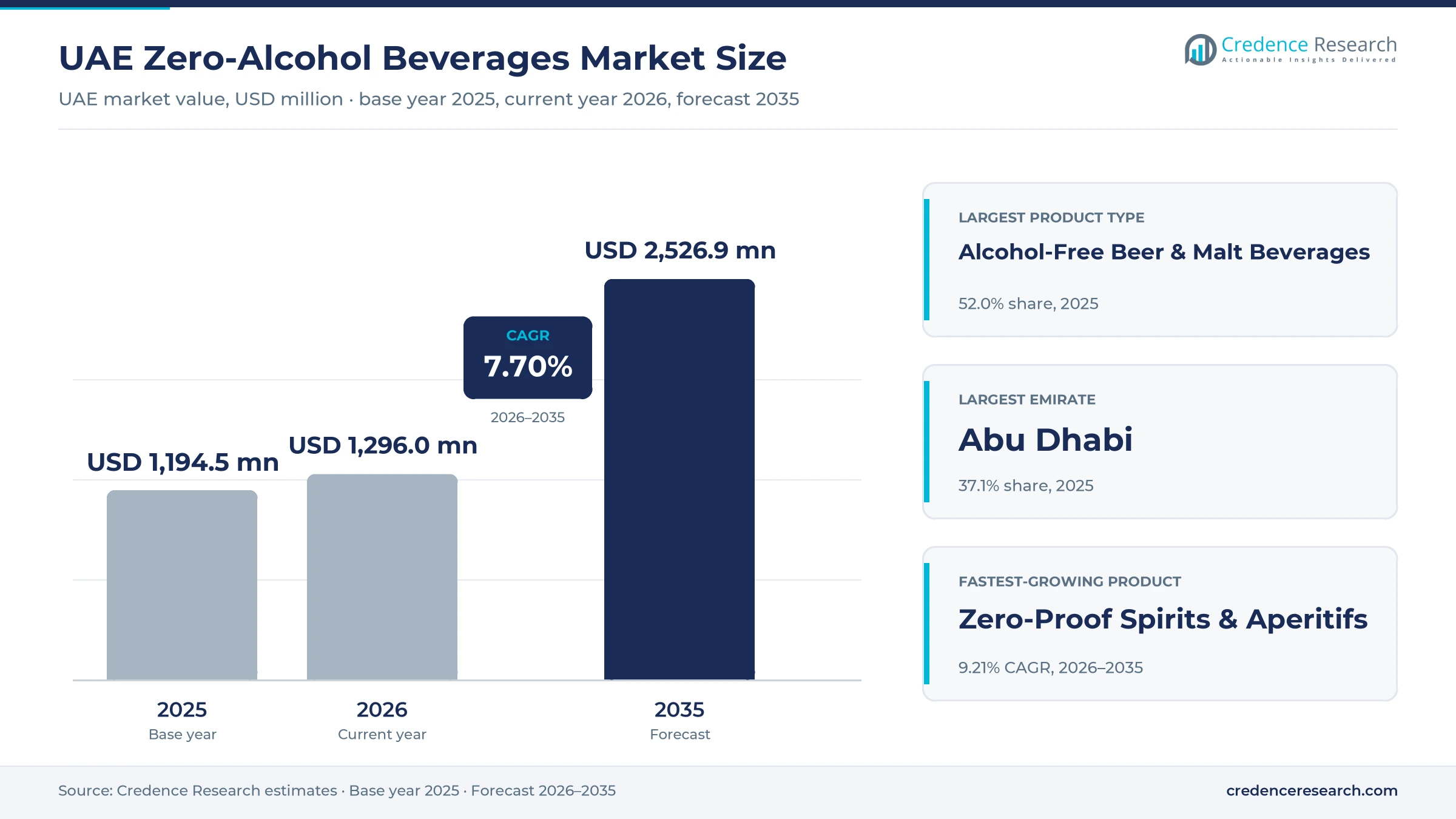
The UAE zero-alcohol beverages market was valued at USD 1.19 billion in 2025 and is projected to increase from USD 1.30 billion in 2026 to USD 2.53 billion by 2035, registering a CAGR of 7.70% during 2026–2035. Demand comes from a large resident expatriate population, millions of hotel guests and a growing habit of choosing adult drinks without alcohol at meals, events and family gatherings. Abu Dhabi held the largest share among the emirates, 37.1% in 2025, because its hotels, events and supermarkets serve both residents and record visitor numbers. Abu Dhabi also grows fastest at 7.94% a year, ahead of Dubai. The most important commercial change is the arrival of a wider range of alcohol-free spirits, wines and locally brewed halal ales, which gives restaurants and retailers more choices beyond traditional malt drinks.
Which drinks and sales channels does the estimate count?
The estimate measures sales value of alcohol-free beer and malt drinks, alcohol-free wine and sparkling drinks, zero-proof spirits and aperitifs, and alcohol-free ready-to-drink cocktails and adult soft drinks in the United Arab Emirates. It covers sales through supermarkets, hypermarkets, convenience and specialty stores, online stores, hotels, restaurants and caterers. Values are stated in USD million at current prices, converted from dirhams at the fixed rate.
The estimate excludes regular soft drinks, juices, energy drinks and bottled water that are not positioned as adult alternatives to alcohol. It also excludes low-alcohol drinks and products re-exported to other Gulf countries. The value chain runs from brewers, distillers and local producers through importers and distributors to retailers, hospitality venues and consumers.
UAE Zero-Alcohol Beverages Market Insights
- The UAE zero-alcohol beverages market was valued at USD 1.19 billion in 2025 and is projected to reach USD 2.53 billion by 2035, registering a CAGR of 7.70% during 2026–2035.
- Abu Dhabi held 37.1% of 2025 value, because its hotels, events and supermarkets serve residents and a record 26.6 million visitors in 2025.
- Alcohol-free beer and malt beverages led with 52.0% of 2025 value, as malt drinks are long-established in Gulf supermarkets and restaurants.
- Dubai welcomed 19.59 million international overnight visitors in 2025, up 5% from 2024, which widens hospitality demand for adult drinks without alcohol.
- Zero-proof spirits and aperitifs grow fastest by product at 9.21% a year during 2026–2035, as bars add alcohol-free cocktails to menus.
Malt drinks, supermarkets and expatriate buyers lead value
Why do alcohol-free beer and malt drinks lead sales?
Based on product type, the market is categorized into alcohol-free beer and malt beverages, alcohol-free wine and sparkling, zero-proof spirits and aperitifs, and alcohol-free RTD cocktails and adult soft drinks. Alcohol-Free Beer & Malt Beverages led with 52.0% of 2025 value, because malt drinks are sold widely in supermarkets. Zero-Proof Spirits & Aperitifs grow fastest at 9.21% a year, as bars and hotels build alcohol-free cocktail menus.
Which channels sell the most alcohol-free drinks?
Based on distribution channel, the market is categorized into supermarkets and hypermarkets, convenience and specialty retail, e-commerce and direct-to-consumer, and HoReCa and foodservice. Supermarkets & Hypermarkets led with 44.0% of 2025 value, because households buy malt drinks and sparkling alternatives with weekly groceries. E-Commerce & Direct-to-Consumer grows fastest at 9.14% a year, as online stores carry niche brands.
How do residents and visitors shape demand?
Based on customer type, the market is categorized into UAE nationals, resident expatriates, tourists and visitors, and corporate and institutional buyers. Resident Expatriates led with 54.0% of 2025 value, because they form most of the population and buy adult drinks for homes and social meals. Tourists & Visitors grow fastest at 8.26% a year, as hotels and restaurants serve record visitor numbers.
How do everyday and social occasions divide demand?
Based on purchase occasion, the market is categorized into everyday refreshment, social gatherings and dining, Ramadan and Eid hospitality, and events and corporate hospitality. Everyday Refreshment led with 45.0% of 2025 value, because many buyers choose malt and sparkling drinks with daily meals. Events & Corporate Hospitality grows fastest at 8.46% a year, as conferences and exhibitions add hosted dinners.
| Segment Group | Leading Sub-segment | Share, 2025 | Fastest-growing Sub-segment | CAGR, 2026–2035 |
|---|---|---|---|---|
| By Product Type | Alcohol-Free Beer & Malt Beverages | 52.0% | Zero-Proof Spirits & Aperitifs | 9.21% |
| By Distribution Channel | Supermarkets & Hypermarkets | 44.0% | E-Commerce & Direct-to-Consumer | 9.14% |
| By Customer Type | Resident Expatriates | 54.0% | Tourists & Visitors | 8.26% |
| By Purchase Occasion | Everyday Refreshment | 45.0% | Events & Corporate Hospitality | 8.46% |
Request a Free Sample
Fill in your details and we'll send you a free sample report.
- Sample data tables & charts
- Research methodology
Visitors, new products and online stores lift sales
How do tourism and hospitality expand alcohol-free occasions?
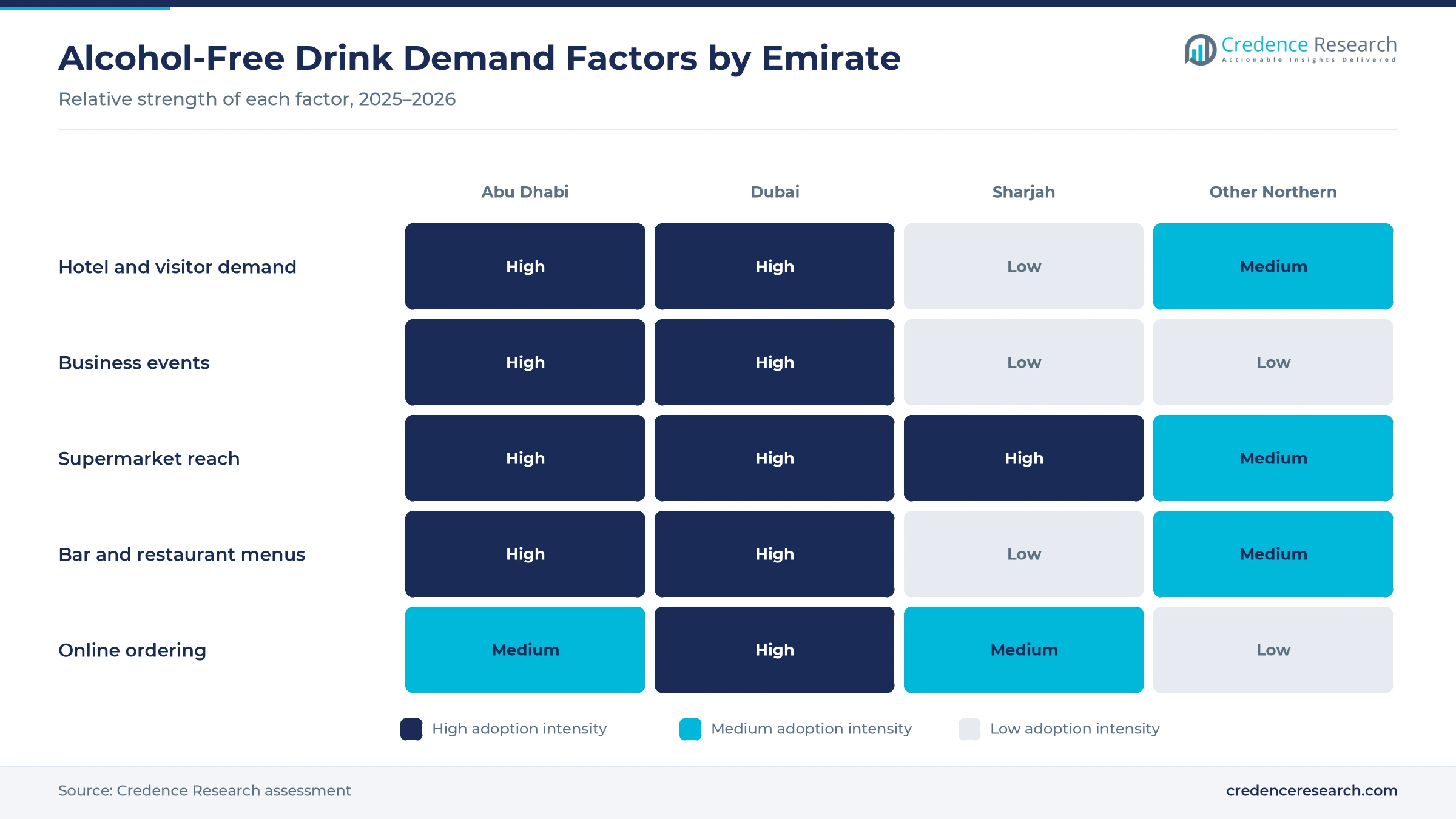
Tourism and hospitality expand alcohol-free occasions, because hotels, restaurants and event venues serve guests who want adult drinks without alcohol. Dubai welcomed 19.59 million international overnight visitors in 2025, up from 18.72 million in 2024, and its hotel occupancy reached 80.7%, according to the Dubai Media Office. Abu Dhabi recorded 26.6 million visitors and 5.9 million hotel guests in 2025, with occupancy at 81%, according to the Abu Dhabi Media Office. Its business events also drew 2.2 million delegates, up 40%. As a result, HoReCa and foodservice venues buy more alcohol-free cocktails and beers, and events and corporate hospitality grows fastest by occasion at 8.46% a year.
How is product innovation broadening the consumer base?
Product innovation is broadening the consumer base, because new alcohol-free spirits, wines and halal brews appeal to buyers who never drank alcohol as well as those cutting back. Midtown Factory launched Majlis Premium Arabian Ale in February 2025, brewed in Dubai Industrial City and certified halal by UAE authorities, according to Food Business MEA. Lyre's ran Dry January collaborations in 2026 with Buddha-Bar Dubai, St. Regis and SUSHISAMBA venues in Dubai and Abu Dhabi. Diageo also sells alcohol-free versions of Gordon's and Tanqueray in the region, with products at Waitrose and Spinneys supermarkets. Consequently, zero-proof spirits and aperitifs grow fastest by product at 9.21% a year, while hotel bars give the new labels more menu space.
How does e-commerce improve assortment and discovery?
E-commerce improves assortment economics and discovery, because online stores can stock niche brands that physical shelves cannot hold. Drink Dry, a Dubai-based importer and online retailer, works with about 700 distribution points across on-trade and off-trade channels, according to Vinetur. Its sales of alcohol-free spirits rose 242% over the past year, which shows how fast online and specialist buyers adopt new labels. More than one-third of UAE consumers shop by smartphone at least once a week, according to Dubai Chamber. Drink Dry also distributes to Bahrain, Kuwait, Oman, Qatar and Saudi Arabia from its UAE base. In turn, e-commerce and direct-to-consumer sales grow fastest among channels at 9.14% a year during 2026–2035.
Why does population growth widen the household buyer base?
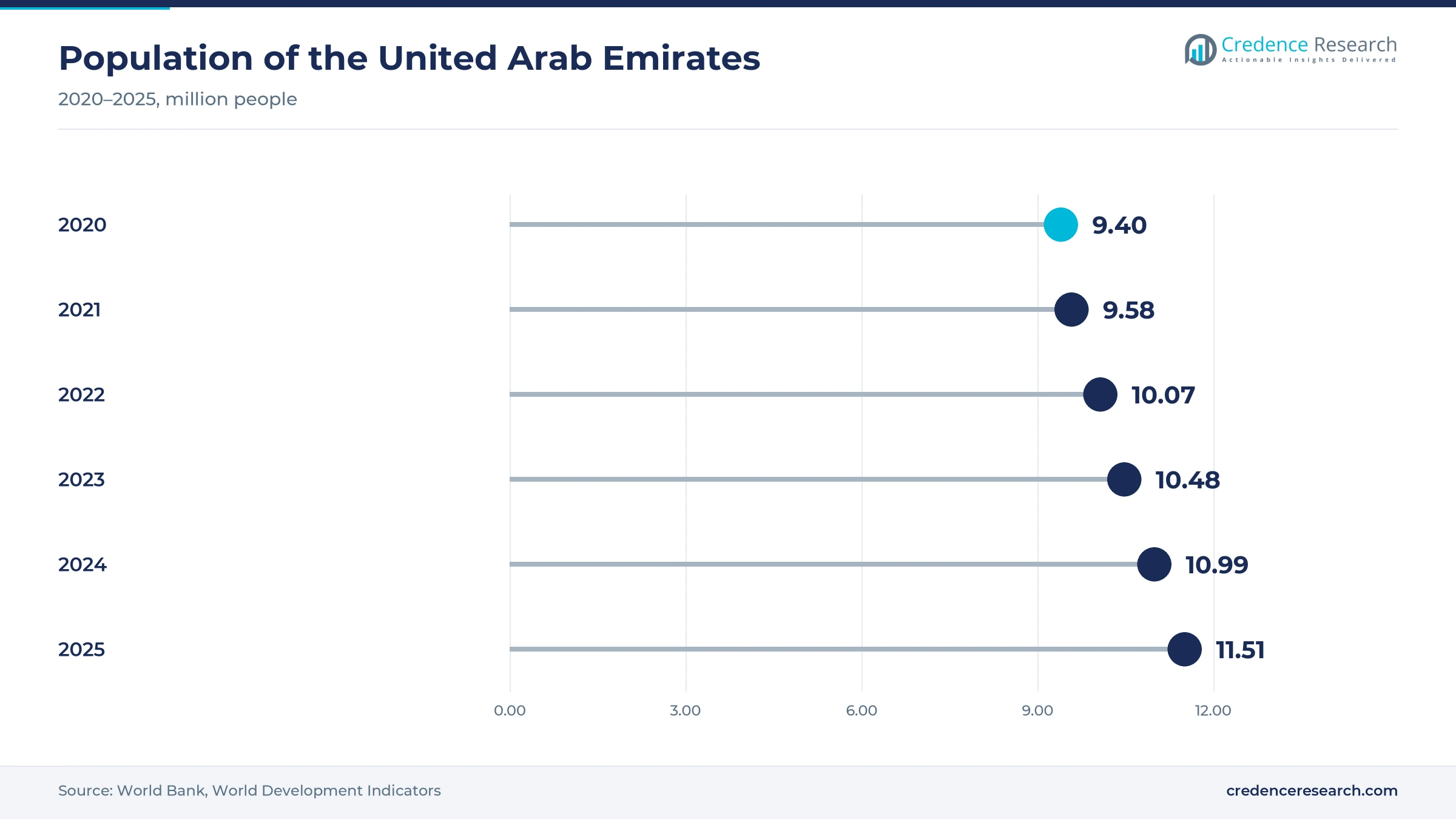
Population growth widens the household buyer base, because new residents bring drinking habits from many countries and buy adult drinks for homes and gatherings. The UAE population reached about 11.51 million in 2025, up from 10.99 million in 2024 and 9.40 million in 2020, according to World Bank data. About 85.96% of residents lived in urban areas in 2025, close to supermarkets, malls and delivery services. Aujan Coca-Cola Beverages Company also signed a deal in July 2026 for nationwide distribution of Barbican, Rani and Vimto. As a result, resident expatriates hold 54.0% of 2025 value, and malt drinks stay a weekly grocery item.
Zero-proof spirits and halal brews reshape the shelf
How is the shift toward zero-proof spirits playing out?
Venues are shifting toward zero-proof spirits and cocktails, because guests want the ritual of a crafted drink without alcohol. Lyre's launched in eight Middle East countries in April 2022 with seven alcohol-free spirits. In January 2026, the brand introduced Dry January menus with Buddha-Bar Dubai, St. Regis and SUSHISAMBA. Emirates also serves alcohol-free Tanqueray cocktails to business-class and first-class passengers on its U.K. routes. An alcohol-free Beefeater was also due in the Middle East in 2026, according to Drink Dry. Consequently, bars treat spirit alternatives as a full menu category, and social gatherings and dining remain a large occasion for premium bottles.
Why are halal-certified local brews rising?
Halal-certified local brews are rising, because some buyers want proof that a drink never contained alcohol at any stage. Majlis Premium Arabian Ale uses non-alcoholic yeast, so its process stays alcohol-free from start to finish. It launched in February 2025 in select retail stores, hotels and restaurants across Dubai, with plans for regional expansion. Beer alternatives still make up about 60% of sales at Drink Dry, a Dubai importer, which keeps beer-style drinks central to the category. Dubai also had 827 hotel establishments at the end of 2025 that can list local brews. In turn, UAE nationals and other observant buyers gain local options, and brewers that sell food services clients can add halal beers to menus.
Can Ramadan, Eid and corporate hosting open premium sales?
Ramadan, Eid and corporate hosting offer a clear opening, because hosts serve large groups and want festive drinks that suit every guest. Abu Dhabi hosted 6,600 business events in 2025, up 37%, and 252 culture and leisure events drew 4.2 million attendees. Dubai also had 154,264 hotel rooms across 827 establishments at the end of 2025. Hotel average daily rates in Dubai rose 8% to AED579 in 2025, which supports premium menus. As a result, sparkling alternatives and gift packs gain demand around holidays and conferences, while events and corporate hospitality grows faster than everyday buying across the largest emirates.
Is there room to grow through local brewing and wider distribution?
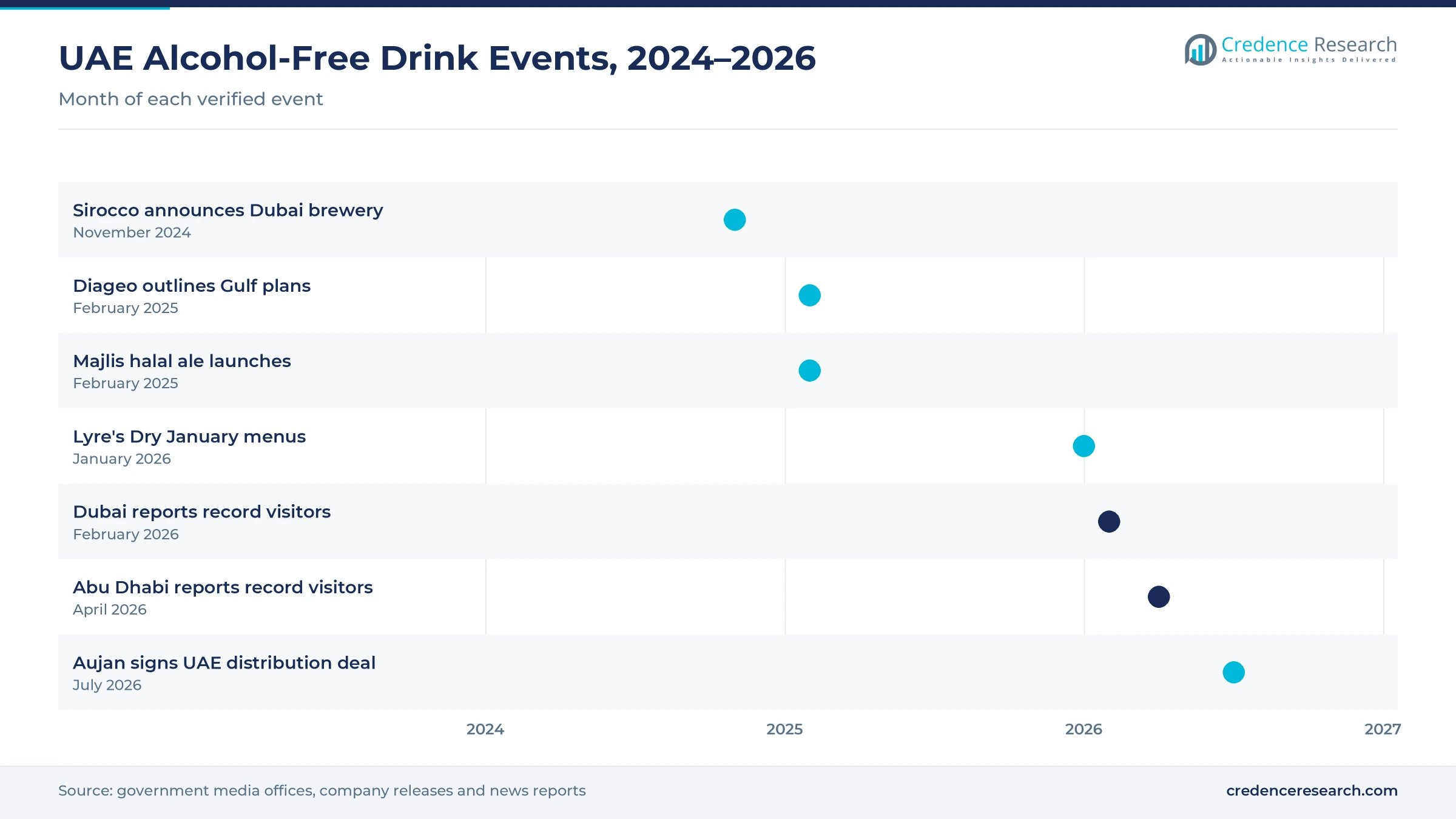
Local brewing and wider distribution open a second opportunity, because shorter supply chains can lower costs and keep shelves stocked. Heineken's joint venture Sirocco announced in November 2024 plans for a large brewery in Dubai, due by 2027. Diageo moved its regional head office to Dubai in late 2024 and said the Gulf is emerging as a major consumer of its non-alcoholic drinks. Aujan Coca-Cola also signed a distribution deal in July 2026 covering supermarkets, fuel stations, HoReCa and e-commerce. In turn, brands that pack drinks in aluminum cans and glass can reach more outlets across the seven emirates, from city hypermarkets to small fuel station shops.
Regional conflict, pricing and shelf clutter add pressure
How does regional conflict hurt hospitality demand?
Regional conflict hurts hospitality demand, because fewer visitors and cautious residents cut spending at hotels and fine dining venues. Drink Dry lost 40% of its sales at one stage during the conflict, with higher-end hospitality hit hardest. As a result, brands that rely on premium bars face uneven orders. Domestic spending by residents, retail channels and online sales help offset the drop until visitor numbers recover, and some suppliers cut marketing budgets to protect jobs.
Why do high prices limit trial?
High prices limit trial, because many imported alcohol-free spirits and wines cost close to regular premium drinks. Buyers who expect soft drink prices may hesitate to pay for a bottle they have not tasted. Consequently, sales stay concentrated in hotels and among higher-income residents. Smaller bottles, cans, tasting events and bundled online offers help lower the cost of trying new products, while supermarkets can place new labels beside familiar malt drinks.
How do crowded shelves confuse buyers?
Crowded shelves confuse buyers, because malt drinks, flavored sodas and alcohol-free beers often sit side by side with similar labels. Shoppers may not understand the difference between dealcoholized drinks and those brewed without alcohol. As a result, brands must spend more on labels, sampling and staff training in stores. Clear halal claims and simple category signs help buyers choose with confidence, and staff in hotels can explain how each drink is made.
Why do import rules and logistics add costs?
Import rules and logistics add costs, because most alcohol-free wines and spirits are made in Europe, Australia or the Americas. Each product needs labels, approvals and halal checks before sale, which delays launches. Consequently, small brands struggle to keep stock across all emirates. Local production, regional warehouses and partnerships with large distributors help reduce lead times and shipping costs for the category, especially for brands launching their first products in the country.
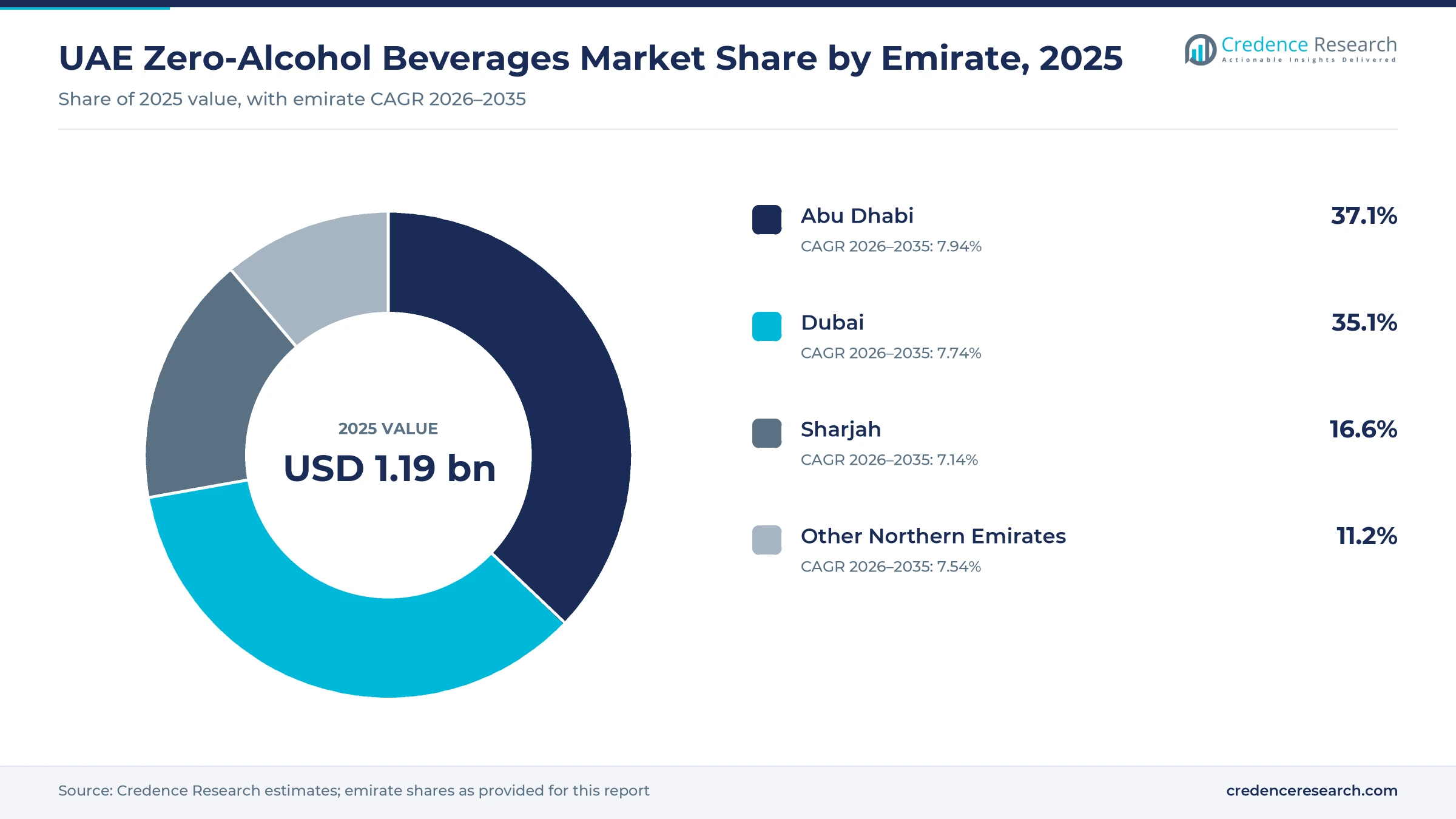
Abu Dhabi and Dubai lead the emirates in value
| Emirate | Value, 2025 (USD billion) | Share, 2025 | CAGR, 2026–2035 |
|---|---|---|---|
| Abu Dhabi | 0.44 | 37.1% | 7.94% |
| Dubai | 0.42 | 35.1% | 7.74% |
| Sharjah | 0.20 | 16.6% | 7.14% |
| Other Northern Emirates | 0.13 | 11.2% | 7.54% |
Why does Abu Dhabi lead and grow fastest?
Abu Dhabi held 37.1% of 2025 value and grows fastest at 7.94% a year in the UAE zero-alcohol beverages market, because its hotels, events and supermarkets serve residents and visitors. The emirate recorded 26.6 million visitors in 2025, and hotel occupancy reached 81%. Business events drew 2.2 million delegates, while St. Regis and SUSHISAMBA venues in the capital joined Lyre's Dry January menus. As a result, hosted dinners and hotel bars lift alcohol-free demand across the emirate.
How does Dubai sustain strong hospitality demand?
Dubai held 35.1% of 2025 value and grows at 7.74% a year, because the city has the densest mix of hotels, restaurants, bars and online retailers. The city welcomed 19.59 million international overnight visitors in 2025, a third record year. Local producers such as Midtown Factory brew Majlis in Dubai Industrial City, and Drink Dry runs its import business from the city. In turn, Dubai acts as the launch market for many new alcohol-free brands before they reach other emirates.
How does Sharjah add household demand?
Sharjah held 16.6% of 2025 value and grows at 7.14% a year, because many families live there and shop in large supermarkets and hypermarkets for weekly groceries. Malt drinks and sparkling alternatives sell well with family meals and during Ramadan gatherings. However, the emirate has fewer large hotels than Dubai or Abu Dhabi, so retail sales matter more than hospitality. Wider distribution deals help brands reach these stores and the families who shop there.
What drives demand in the other northern emirates?
The other northern emirates held 11.2% of 2025 value and grow at 7.54% a year, because resident households buy malt drinks and adult soft drinks with groceries. Resort hotels along the coast also add visitor demand for alcohol-free drinks. The Aujan Coca-Cola distribution deal of July 2026 also covers supermarkets and fuel stations nationwide, which helps reach smaller towns across the region.
Brewery plans, halal ale and new distribution deals
| Development | Status and market relevance |
|---|---|
| In November 2024, Heineken's joint venture Sirocco announced plans for a large brewery in Dubai, due by 2027. | Adds local beer production capacity |
| In February 2025, Midtown Factory launched Majlis Premium Arabian Ale, a halal-certified alcohol-free ale brewed in Dubai. | Gives buyers a local halal option |
| In January 2026, Lyre's ran Dry January menus with Buddha-Bar Dubai, St. Regis and SUSHISAMBA venues. | Shows hotel demand for zero-proof cocktails |
| In July 2026, Aujan Coca-Cola Beverages Company signed a UAE distribution deal for Barbican, Rani and Vimto. | Widens retail and HoReCa reach |
Halal brewing, dealcoholization and online retail
- Alcohol-free fermentation with non-alcoholic yeast, as used for Majlis, keeps the process free of alcohol from start to finish.
- Dealcoholization removes alcohol from beer, wine and spirits after production, which lets global brands offer familiar tastes without any alcohol.
- Online retail platforms such as Drink Dry let importers sell niche brands across the emirates without full supermarket listings.
- Cocktail recipe design helps bars and airlines serve drinks such as an alcohol-free Tanqueray Basil Smash with the same ritual as a classic cocktail.
Need a Custom Version of This Report?
Tailor the scope, geography, or segments to your exact requirements.
- Custom geography or segment scope
- Direct access to our analyst team
Global brewers, distillers and local brands compete
Competition in the UAE zero-alcohol beverages market is spread across global brewers, spirits groups and local producers. Heineken works in the market through its joint venture Sirocco and plans a large brewery in Dubai. Diageo moved its regional head office to Dubai and sells alcohol-free Gordon's and Tanqueray through partners. Lyre's builds demand through hotel and bar partnerships, while Midtown Factory sells its halal-certified Majlis ale in Dubai. Aujan Coca-Cola Beverages Company competes in malt drinks with Barbican and signed a new distribution deal in 2026. Companies compete on taste, halal trust, price per serve, pack format and reach in supermarkets, hotels and online stores. Importers such as Drink Dry also shape which smaller brands reach shelves.
Companies profiled and their roles in this market
| Company | Type | Role in the market |
|---|---|---|
| Heineken N.V. | Global brewer | Joint venture Sirocco plans a Dubai brewery by 2027 |
| Diageo plc | Global spirits group | Alcohol-free Gordon's and Tanqueray; regional head office in Dubai |
| Lyre's Non-Alcoholic Spirits | Zero-proof spirits brand | Dry January menus in Dubai and Abu Dhabi in 2026 |
| Majlis / Midtown Factory LLC | Local halal brewer | Majlis Premium Arabian Ale brewed in Dubai Industrial City |
| Aujan Coca-Cola Beverages Company | Regional beverage company | Barbican malt drinks; new UAE distribution deal in 2026 |
Credence Research view on steady adult soft drink demand
Credence Research's view is that the UAE zero-alcohol beverages market will grow steadily through 2035, because record visitor numbers, a growing resident population and new products support regular buying. Malt drinks already hold 52.0% of 2025 value, while zero-proof spirits and halal brews bring new buyers. Global brands benefit from scale, while local producers win on halal trust. However, regional conflict, high prices and shelf confusion could slow sales in some quarters. Abu Dhabi should keep growing faster than the other emirates.
How the alcohol-free drink estimate was built
The report uses 2025 as the base year, with values in USD million at current prices. Market values come from the Credence Research model, which combines population, visitor numbers, retail reach and average prices. Emirate shares are those set for this report, and segment splits by product type, channel, customer type and occasion are Credence Research estimates. Sources used are government media offices, World Bank data, company announcements and news reports, and no interviews or surveys were used.
Visitors and product range set the path to 2035
The UAE zero-alcohol beverages market is expected to reach USD 2.53 billion by 2035, a 7.70% CAGR during 2026–2035, as tourism, population growth and wider product ranges lift purchases. Growth should be strongest in zero-proof spirits, e-commerce and events, while Abu Dhabi keeps the largest share. Brands that combine halal trust, cocktail-ready products and broad distribution should win share. In contrast, a long fall in visitor numbers or sharp price rises for imported products would slow value growth for many suppliers.
Frequently Asked Questions
How big is the UAE zero-alcohol beverages market?
Which emirate leads sales?
Which emirate grows fastest?
Which product type holds the largest share?
Which product type grows fastest?
How does tourism affect the market?
Who are the leading companies?
What are the main risks to growth?
Table of Content
Chapter 1 Market Segmentation
- 1.1 Segmentation Framework
- 1.1.1 Product and Service Classification
- 1.1.2 Application and End-Use Classification
- 1.1.3 Technology and Solution Classification
- 1.1.4 Customer and Distribution Channel Classification
- 1.1.5 Geographic Segmentation
- 1.1.6 Market Segment Definitions and Boundaries
- 1.2 By Product Type
- 1.2.1 Alcohol-Free Beer & Malt Beverages
- 1.2.2 Alcohol-Free RTD Cocktails & Adult Soft Drinks
- 1.2.3 Alcohol-Free Wine & Sparkling
- 1.2.4 Zero-Proof Spirits & Aperitifs
- 1.3 By Customer Type
- 1.3.1 Resident Expatriates
- 1.3.2 Tourists & Visitors
- 1.3.3 UAE Nationals
- 1.3.4 Corporate & Institutional Buyers
- 1.4 By Purchase Occasion
- 1.4.1 Everyday Refreshment
- 1.4.2 Social Gatherings & Dining
- 1.4.3 Ramadan & Eid Hospitality
- 1.4.4 Events & Corporate Hospitality
- 1.5 By Emirate
- 1.5.1 Abu Dhabi
- 1.5.2 Dubai
- 1.5.3 Sharjah
- 1.5.4 Other Northern Emirates
Chapter 2 Introduction
- 2.1 Report Objectives and Scope
- 2.2 Product Definition and Industry Terminology
- 2.3 Market Inclusions and Exclusions
- 2.4 Research Process
- 2.4.1 Primary Research and Expert Interviews
- 2.4.2 Secondary Research and Source Review
- 2.4.3 Top-Down and Bottom-Up Estimation
- 2.4.4 Data Triangulation and Verification
- 2.5 Market Size Measurement Basis
- 2.5.1 2025: USD 1.19 billion → 2035: USD 2.53 billion
- 2.6 Historical and Forecast Reference Periods
- 2.6.1 Historical Period: 2018-2025
- 2.6.2 Base Year: 2025
- 2.6.3 Forecast Period: 2025-2035
- 2.7 Research Assumptions and Limitations
Chapter 3 Executive Summary
- 3.1 Market Snapshot and Key Findings
- 3.2 Base-Year Market Size, 2025
- 3.3 Forecast Market Size, 2035
- 3.4 Revenue and Volume Growth Outlook
- 3.5 Key Demand and Supply Indicators
- 3.6 Leading Market Segments
- 3.7 Fastest-Growing Market Opportunities
- 3.8 Regional Performance Highlights
- 3.9 Technology and Industry Transformation
- 3.10 Competitive Landscape Summary
- 3.11 Analyst View and Strategic Implications
Chapter 4 UAE Zero-Alcohol Beverages Market Trends and Developments
- 4.1 Historical Industry Development, 2018-2025
- 4.2 Recent Market Trends and Developments
- 4.3 Demand and Customer Behavior Trends
- 4.4 Technology and Product Innovation
- 4.5 Artificial Intelligence, Automation and Digitalization
- 4.6 Local Manufacturing and Supply Chain Realignment
- 4.7 Industry Partnerships, Mergers and Acquisitions
- 4.8 Sustainability and Circular Economy Developments
- 4.9 Government and Private Sector Investment Trends
- 4.10 Emerging Business Models and Commercialization
- 4.11 Industry Developments and Announcements
Chapter 5 UAE Zero-Alcohol Beverages Market Production, Supply and Demand Analysis
- 5.1 Demand Trend and Consumption Analysis, 2018-2025
- 5.2 Demand Forecast, 2025-2035
- 5.3 Production and Output Trend, 2018-2025
- 5.4 Production and Output Forecast, 2025-2035
- 5.5 Installed Capacity and Capacity Utilization
- 5.6 Company-Wise Production Plants and Statistics
- 5.6.1 Installed Production Capacity
- 5.6.2 Actual Production
- 5.6.3 Planned Capacity and Expansion Targets
- 5.7 Supply Chain Structure and Procurement Trends
- 5.8 Supply-Demand Gap and Bottlenecks
- 5.9 Import Dependence and Sourcing Structure
- 5.10 Contract Manufacturing and Outsourcing
- 5.11 Regional Supply and Demand Concentration
Chapter 6 UAE Zero-Alcohol Beverages Market Pricing Analysis
- 6.1 Pricing Structure and Measurement
- 6.2 Historical Pricing Trends, 2018-2025
- 6.3 Pricing Outlook, 2025-2035
- 6.4 Average Selling Price and Unit Economics
- 6.5 Pricing by Product and Market Segment
- 6.6 Geographic Pricing Differences
- 6.7 Key Input, Energy, Labor and Logistics Costs
- 6.8 Contract Pricing and Purchasing Models
- 6.9 Pricing Sensitivity and Competitive Positioning
- 6.10 Price, Margin and Profitability Implications
Chapter 7 UAE Zero-Alcohol Beverages Market Dynamics
- 7.1 Market Growth Drivers
- 7.1.1 Demand-Side Drivers
- 7.1.2 Technology and Innovation Drivers
- 7.1.3 Infrastructure and Investment Drivers
- 7.1.4 Regulatory and Policy Drivers
- 7.2 Market Restraints
- 7.2.1 Cost and Affordability Constraints
- 7.2.2 Technology and Adoption Barriers
- 7.2.3 Supply Chain and Operational Constraints
- 7.3 Market Challenges
- 7.3.1 Competitive Pressure and Margin Erosion
- 7.3.2 Skills, Infrastructure and Implementation Gaps
- 7.4 Emerging Market Opportunities
- 7.5 Market Dynamics Impact and Time-Horizon Assessment
Chapter 8 UAE Zero-Alcohol Beverages Value Chain Analysis
- 8.1 Industry Value Chain Overview
- 8.2 Upstream Suppliers and Critical Inputs
- 8.3 Technology and Component Providers
- 8.4 Manufacturing or Service Delivery
- 8.5 Distribution, Channel Partners and Integrators
- 8.6 Downstream Applications and End Users
- 8.7 Value Addition and Profit Pools
- 8.8 Vertical Integration and Outsourcing
- 8.9 Supplier Concentration and Risk
- 8.10 Supply Chain Localization and Resilience
Chapter 9 UAE Zero-Alcohol Beverages Market Regulations and Policies
- 9.1 Relevant Laws, Standards and Compliance Frameworks
- 9.2 Product, Service, Safety and Quality Requirements
- 9.3 Government Policies, Incentives and Subsidies
- 9.4 Imports, Exports and Trade Barriers
- 9.5 Public Procurement and Local Content Requirements
- 9.6 Environmental and Sustainability Compliance
- 9.7 Upcoming Policy Changes and Market Implications
Chapter 10 UAE Zero-Alcohol Beverages Market Hotspots and Opportunities
- 10.1 Market Opportunity Mapping and Growth Hotspots
- 10.2 High-Growth Applications and Customer Groups
- 10.3 Underserved Markets and White-Space Opportunities
- 10.4 Emerging Technology and Product Opportunities
- 10.5 New Capacity and Investment Hotspots
- 10.6 Market Entry and Expansion Opportunities
- 10.7 Distribution and Partnership Opportunities
- 10.8 Near-Term and Long-Term Commercial Potential
- 10.9 Opportunity Attractiveness and Execution Risks
Chapter 11 UAE Zero-Alcohol Beverages Market Outlook, 2025-2035
- 11.1 Market Size and Analysis
- 11.1.1 Revenue (Market Measurement: 2025: USD 1.19 billion → 2035: USD 2.53 billion)
- 11.1.2 Market Volume and Quantity Sold
- 11.1.3 Historical Market Size, 2018-2025
- 11.1.4 Base-Year Market Size, 2025
- 11.2 Market Forecast, 2025-2035
- 11.2.1 Revenue Forecast to 2035
- 11.2.2 Volume Forecast to 2035
- 11.2.3 CAGR and Year-on-Year Growth
- 11.2.4 Incremental Revenue Opportunity
- 11.3 Forecast Assumptions and Scenario Analysis
- 11.3.1 Base-Case Forecast
- 11.3.2 Optimistic and Conservative Scenarios
- 11.3.3 Technology, Pricing and Policy Sensitivities
- 11.4 Market Attractiveness and Growth Outlook
Chapter 12 UAE Zero-Alcohol Beverages Market Segmentation and Outlook
- 12.1 Segmentation Summary and Market Shares, 2025
- 12.2 Largest and Fastest-Growing Segments
- 12.3 By Product Type - Market Size and Forecast, 2025-2035
- 12.3.1 Segment Definition and Scope
- 12.3.2 Historical Market Size, 2018-2025
- 12.3.3 Revenue Forecast, 2025-2035
- 12.3.4 Volume Forecast, 2025-2035
- 12.3.5 Base-Year Market Share, 2025
- 12.3.6 Segment CAGR and Growth Drivers
- 12.3.7 Subsegment Market Size and Forecast
- 12.3.7.1 Alcohol-Free Beer & Malt Beverages
- 12.3.7.2 Alcohol-Free RTD Cocktails & Adult Soft Drinks
- 12.3.7.3 Alcohol-Free Wine & Sparkling
- 12.3.7.4 Zero-Proof Spirits & Aperitifs
- 12.3.8 Subsegment Pricing and Adoption Trends
- 12.3.9 Leading Suppliers and Competition
- 12.3.10 Regional Demand and Opportunities
- 12.4 By Customer Type - Market Size and Forecast, 2025-2035
- 12.4.1 Segment Definition and Scope
- 12.4.2 Historical Market Size, 2018-2025
- 12.4.3 Revenue Forecast, 2025-2035
- 12.4.4 Volume Forecast, 2025-2035
- 12.4.5 Base-Year Market Share, 2025
- 12.4.6 Segment CAGR and Growth Drivers
- 12.4.7 Subsegment Market Size and Forecast
- 12.4.7.1 Resident Expatriates
- 12.4.7.2 Tourists & Visitors
- 12.4.7.3 UAE Nationals
- 12.4.7.4 Corporate & Institutional Buyers
- 12.4.8 Subsegment Pricing and Adoption Trends
- 12.4.9 Leading Suppliers and Competition
- 12.4.10 Regional Demand and Opportunities
- 12.5 By Purchase Occasion - Market Size and Forecast, 2025-2035
- 12.5.1 Segment Definition and Scope
- 12.5.2 Historical Market Size, 2018-2025
- 12.5.3 Revenue Forecast, 2025-2035
- 12.5.4 Volume Forecast, 2025-2035
- 12.5.5 Base-Year Market Share, 2025
- 12.5.6 Segment CAGR and Growth Drivers
- 12.5.7 Subsegment Market Size and Forecast
- 12.5.7.1 Everyday Refreshment
- 12.5.7.2 Social Gatherings & Dining
- 12.5.7.3 Ramadan & Eid Hospitality
- 12.5.7.4 Events & Corporate Hospitality
- 12.5.8 Subsegment Pricing and Adoption Trends
- 12.5.9 Leading Suppliers and Competition
- 12.5.10 Regional Demand and Opportunities
- 12.6 By Emirate - Market Size and Forecast, 2025-2035
- 12.6.1 Segment Definition and Scope
- 12.6.2 Historical Market Size, 2018-2025
- 12.6.3 Revenue Forecast, 2025-2035
- 12.6.4 Volume Forecast, 2025-2035
- 12.6.5 Base-Year Market Share, 2025
- 12.6.6 Segment CAGR and Growth Drivers
- 12.6.7 Subsegment Market Size and Forecast
- 12.6.7.1 Abu Dhabi
- 12.6.7.2 Dubai
- 12.6.7.3 Sharjah
- 12.6.7.4 Other Northern Emirates
- 12.6.8 Subsegment Pricing and Adoption Trends
- 12.6.9 Leading Suppliers and Competition
- 12.6.10 Regional Demand and Opportunities
- 12.7 Segment Growth Comparison
- 12.8 Segment Attractiveness and Priority Matrix
Chapter 13 UAE Zero-Alcohol Beverages End-Use and Application Market Outlook
- 13.1 End-Use Industry and Customer Demand Structure
- 13.2 Leading Applications and Customer Groups
- 13.3 End-Use Market Size, Share and Forecast
- 13.4 Major End-Use Industry Deep Dives
- 13.4.1 Customer Requirements and Use Cases
- 13.4.2 Demand and Replacement Cycles
- 13.4.3 Technical and Regulatory Considerations
- 13.4.4 Purchasing and Procurement Models
- 13.4.5 Leading Vendors and Distribution Channels
- 13.4.6 Forecast and Commercial Opportunities
- 13.5 Emerging Applications and Cross-Segment Demand
- 13.6 End-Use Industry Investment Priorities
Chapter 14 UAE Zero-Alcohol Beverages Geographic Market Outlook, 2025-2035
- 14.1 Domestic Market Distribution and Demand Clusters
- 14.2 State- or Province-Wise Market Size and Forecast, 2025-2035
- 14.3 City and Metropolitan Market Outlook
- 14.4 Industrial, Manufacturing and Commercial Clusters
- 14.5 Geographic Concentration of Key End Users
- 14.6 Local Pricing and Purchasing Differences
- 14.7 Domestic Production Facilities and Capacity Map
- 14.8 Local Infrastructure and Project Pipeline
- 14.9 State-Level Policy and Incentive Differences
- 14.10 Subnational Investment Hotspots and Opportunities
- 14.11 Distribution and Logistics Networks
- 14.12 Domestic Competitive Footprint
Chapter 15 UAE Zero-Alcohol Beverages Technology, Innovation and Sustainability Outlook
- 15.1 Technology Landscape and Maturity
- 15.2 Product, Process and Service Innovation
- 15.3 AI, Automation and Digital Tools in the Industry
- 15.4 Technology Adoption and Performance Benchmarking
- 15.5 Innovation Pipeline and R&D Investment
- 15.6 Patent and Intellectual Property Trends
- 15.7 Energy Efficiency and Resource Management
- 15.8 Sustainability, Recycling and Circularity
- 15.9 Technology Roadmap, 2025-2035
- 15.10 Risks of Obsolescence and Technology Substitution
Chapter 16 UAE Zero-Alcohol Beverages Market Key Strategic Imperatives
- 16.1 Growth and Market Entry Priorities
- 16.2 High-Return Products and Segments
- 16.3 Pricing, Profitability and Cost Optimization
- 16.4 Technology Investment and Product Differentiation
- 16.5 Supply Chain Localization and Resilience
- 16.6 Distribution and Customer Acquisition
- 16.7 Partnership, Acquisition and Capacity Strategy
- 16.8 Regional Expansion Priorities
- 16.9 Short-, Medium- and Long-Term Actions
Chapter 17 Competition Outlook
- 17.1 Industry Competition Characteristics
- 17.2 Market Structure and Concentration
- 17.3 Market Share and Competitive Positioning, 2025
- 17.4 Company-Wise Revenue and Product Benchmarking
- 17.5 Production and Service Capacity Benchmarking
- 17.6 Technology, Pricing and Differentiation
- 17.7 Regional Footprint and Distribution Strength
- 17.8 Mergers, Acquisitions and Strategic Alliances
- 17.9 New Entrants and Competitive Threats
- 17.10 Porter's Five Forces and Industry Attractiveness
- 17.11 Competitive Outlook, 2025-2035
Chapter 18 Company Profiles
- 18.1 Company Coverage and Selection Criteria
- 18.2 Heineken N.V.
- 18.2.1 Business Description
- 18.2.2 Company Ownership and Geographic Presence
- 18.2.3 Product and Service Portfolio
- 18.2.4 Manufacturing and Operating Footprint
- 18.2.5 Production Capacity and Expansion Plans
- 18.2.6 Financial Performance and Investment
- 18.2.7 Market Share and Competitive Position
- 18.2.8 Technology and Innovation Capabilities
- 18.2.9 Strategic Alliances or Partnerships
- 18.2.10 Recent Developments
- 18.2.11 Growth Strategy and Outlook
- 18.3 Anheuser-Busch InBev SA/NV
- 18.4 Diageo plc
- 18.5 Asahi Group Holdings, Ltd.
- 18.6 Carlsberg A/S
- 18.7 Aujan Coca-Cola Beverages Company
- 18.8 Athletic Brewing Company
- 18.9 Lyre's Non-Alcoholic Spirits
- 18.10 Majlis / Midtown Factory LLC
- 18.11 United Dutch Breweries
- 18.12 Other Relevant Market Participants
Note: Every listed company is profiled on the structure shown under the first company. The company list is preliminary and may change based on research findings, market developments, data availability and client requirements.
Chapter 19 Disclaimer
- 19.1 Research and Forecast Disclaimer
- 19.2 Data Source and Estimation Limitations
Note: The depth of individual sections depends on data availability for this market. Volume, capacity, trade and other unit-based metrics are included where applicable.

