
Banh mi, cakes and packaged biscuits feed daily demand
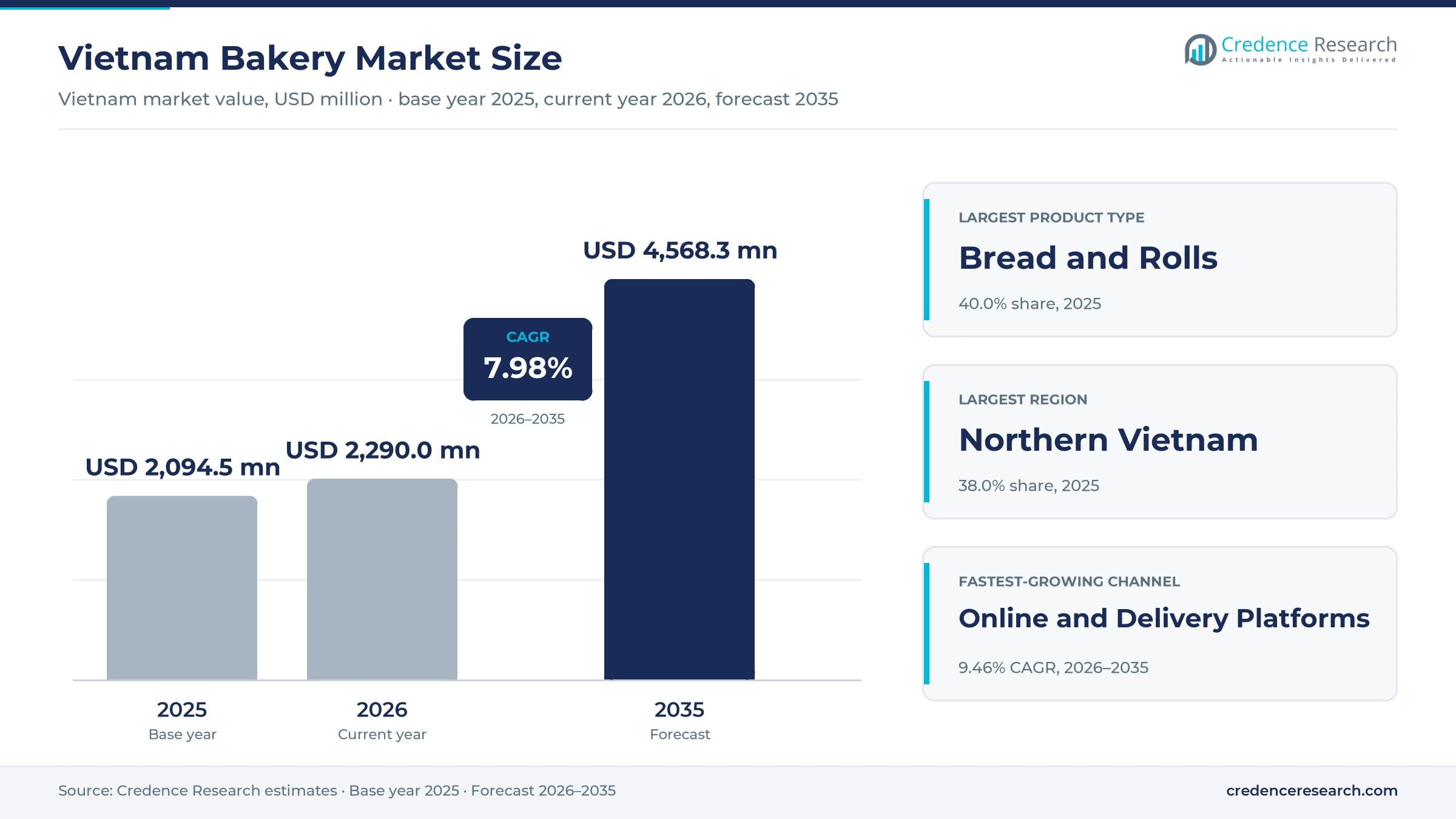
The Vietnam bakery market was valued at USD 2.09 billion in 2025 and is projected to increase from USD 2.29 billion in 2026 to USD 4.57 billion by 2035, registering a CAGR of 7.98% during 2026–2035. Demand comes from banh mi and bread eaten at breakfast, from cakes and biscuits bought for snacks and gifts, and from hotels and cafes that serve a fast-growing number of visitors. Northern Vietnam held the largest regional share, 38.0% in 2025, because Hanoi and the Red River Delta combine dense population with strong gifting demand at Tet and the Mid-Autumn Festival. Central Vietnam is the fastest-growing region at 8.44% a year, as tourism cities add hotels, cafes and catering contracts. Bread and rolls led the product mix in 2025, while cakes and pastries gain from bakery-cafe chains. Viet Thai International bought Paris Baguette's Vietnam business in September 2025, which shows investor interest in the bakery-cafe format.
Which baked goods and buyers does the estimate cover?
The estimate measures the retail and foodservice sales value of baked goods sold in Vietnam to households, cafes, hotels, caterers and companies. It covers bread and rolls, cakes and pastries, biscuits and cookies and savory and specialty items, whether sold fresh, single-serve packaged, in family packs or frozen and par-baked. Values are stated at current prices and include sales through bakeries, stores, delivery apps and foodservice contracts.
The estimate excludes flour, premixes and other ingredients sold to bakers, as well as baking equipment and exports. The value chain runs from imported wheat and local sugar, eggs and dairy through industrial plants, chain bakeries and street vendors to supermarkets, convenience stores, delivery apps and the cafes and hotels that serve the final buyer.
Vietnam Bakery Market Insights
- The Vietnam bakery market was valued at USD 2.09 billion in 2025 and is projected to reach USD 4.57 billion by 2035, registering a CAGR of 7.98% during 2026–2035.
- Northern Vietnam held 38.0% of 2025 sales, because Hanoi and the Red River Delta pair dense population with strong festival gifting.
- Bread and rolls led with 40.0% of 2025 value, because banh mi remains a daily breakfast and lunch staple across the country.
- Vietnam received nearly 21.2 million international visitors in 2025, up 20.4% from 2024, which lifts hotel, cafe and catering demand for baked goods.
- Orion broke ground on a 52,608-square-meter project in Bac Ninh in late 2025, adding confectionery lines in its second phase.
Bread leads while premium cakes and online sales rise
Why does banh mi keep bread and rolls on top?
Based on product type, the market is categorized into bread and rolls, cakes and pastries, biscuits and cookies and savory and specialty bakery. Bread and Rolls led with 40.0% of 2025 value, because banh mi is bought every day from street stalls, bakeries and stores. Savory and Specialty Bakery grows fastest at 8.76% a year, as cafes and premium chains add filled breads, croissants and local flavors.
Why are buyers paying more for handmade cakes?
Based on price tier, the market is categorized into value, mainstream, premium and artisanal and specialty. Mainstream led with 40.0% of 2025 value, because most households buy familiar branded loaves, cakes and biscuits at modest prices. Artisanal and Specialty grows fastest at 9.05% a year, as urban buyers pay more for handmade cakes, sourdough and limited editions sold online and in cafes.
Why does breakfast still drive most bakery spending?
Based on purchase occasion, the market is categorized into daily meals and breakfast, snacking and on-the-go, celebrations and gifting and hospitality and catering. Daily Meals and Breakfast led with 45.0% of 2025 value, because bread is part of breakfast and quick lunches nationwide. Hospitality and Catering grows fastest at 8.88% a year, as hotels, cafes and caterers serve more domestic and foreign visitors.
Why are delivery apps gaining on neighborhood bakers?
Based on distribution channel, the market is categorized into independent bakeries, supermarkets and hypermarkets, convenience stores and online and delivery platforms. Independent Bakeries led with 42.0% of 2025 value, because neighborhood bakers and banh mi stalls sell fresh bread daily. Online and Delivery Platforms grow fastest at 9.46% a year, as brands sell gift boxes and snacks through marketplaces and delivery apps.
| Segment Group | Leading Sub-segment | Share, 2025 | Fastest-growing Sub-segment | CAGR, 2026–2035 |
|---|---|---|---|---|
| By Product Type | Bread and Rolls | 40.0% | Savory and Specialty Bakery | 8.76% |
| By Price Tier | Mainstream | 40.0% | Artisanal and Specialty | 9.05% |
| By Purchase Occasion | Daily Meals and Breakfast | 45.0% | Hospitality and Catering | 8.88% |
| By Distribution Channel | Independent Bakeries | 42.0% | Online and Delivery Platforms | 9.46% |
Request a Free Sample
Fill in your details and we'll send you a free sample report.
- Sample data tables & charts
- Research methodology
City retail, tourism and online buying lift bakery sales
How do city consumers and modern retail lift demand?
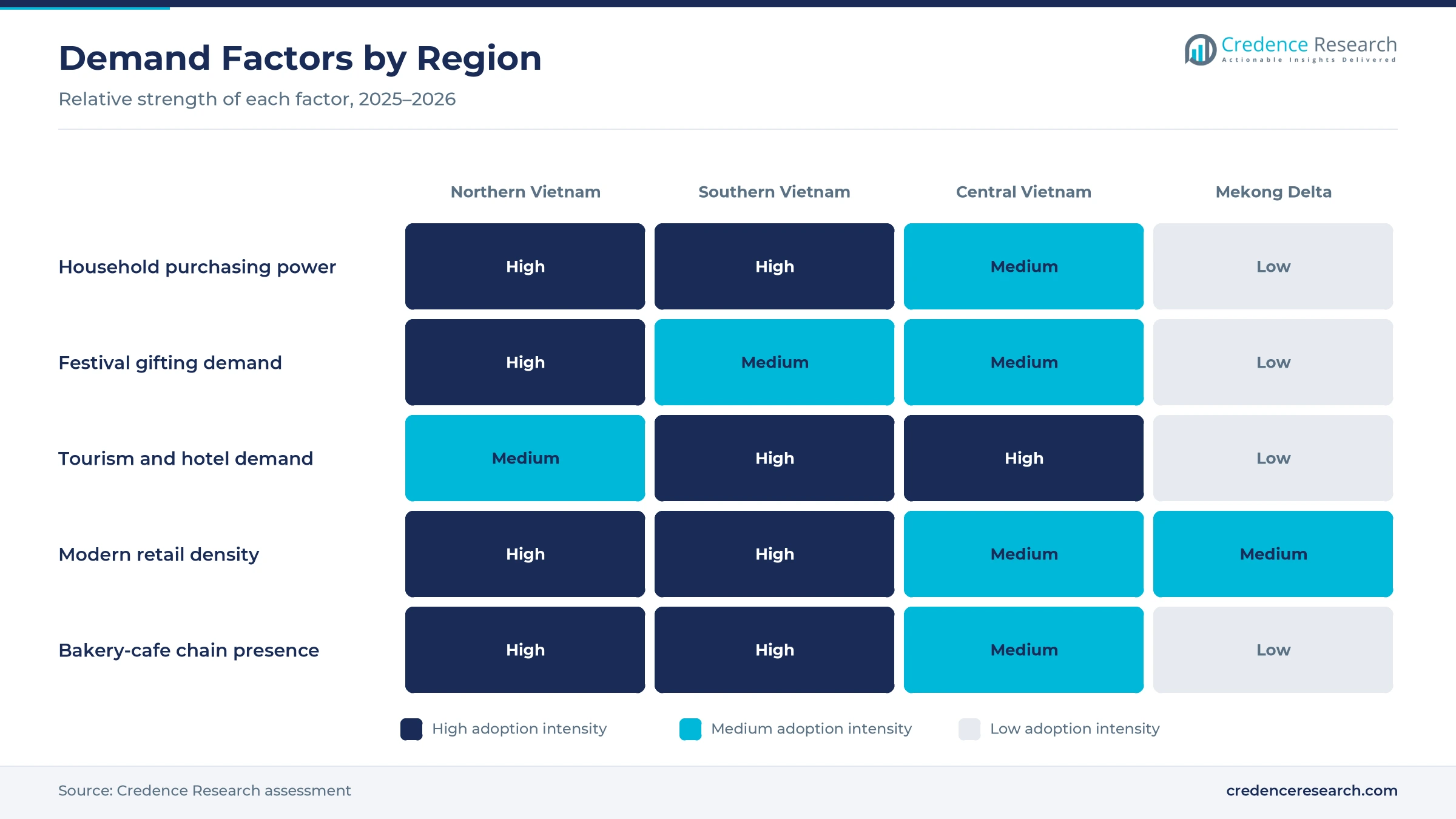
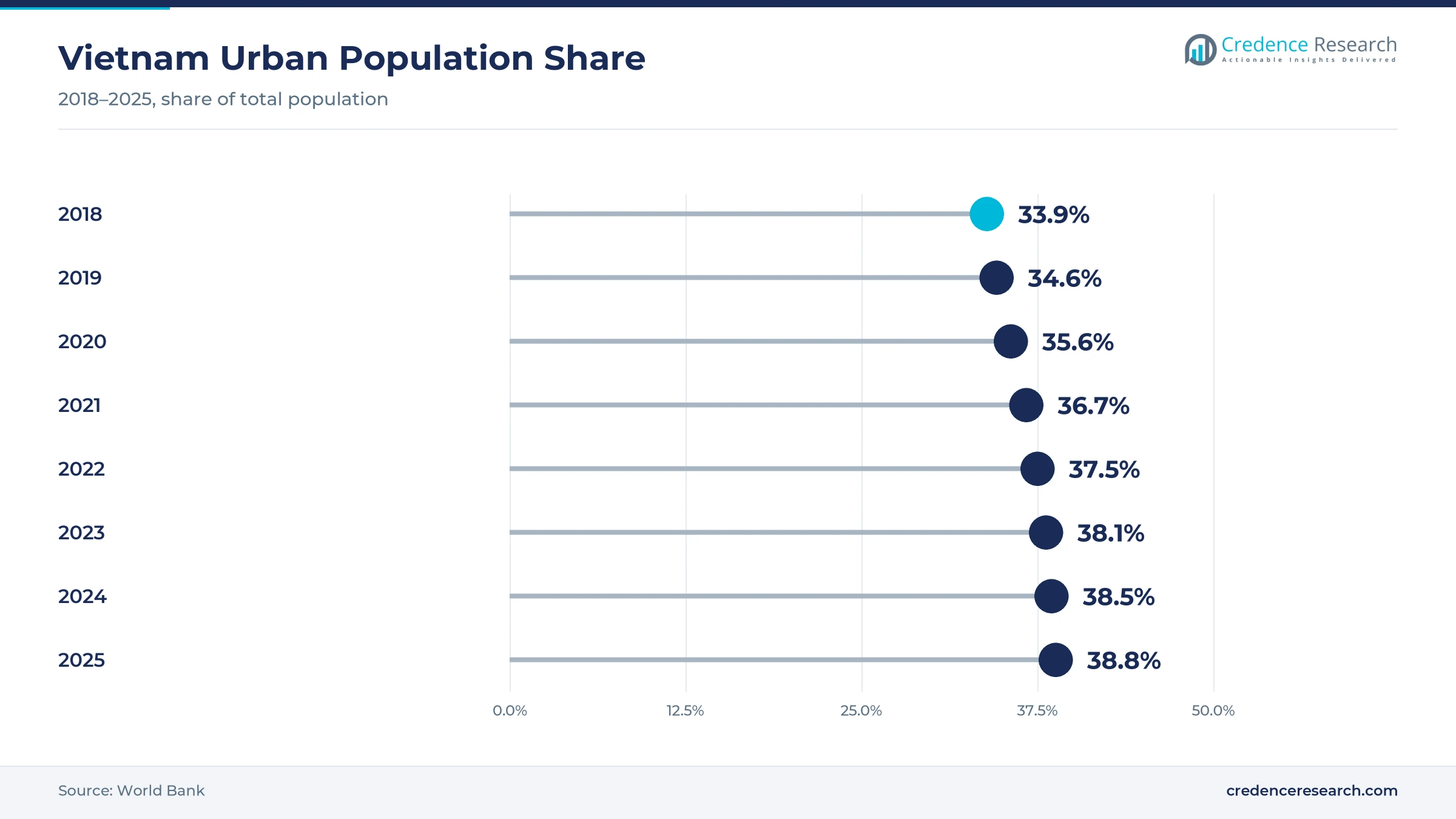
Urban consumption and retail modernization are the main source of demand, because city households buy more packaged bread, cakes and biscuits in modern stores. Total retail sales of goods and services topped VND7 quadrillion, about US$270 billion, in 2025, up 9.2% from 2024, based on National Statistics Office data. WinCommerce opened 764 new WinMart+ outlets in 2025 and reached 4,592 stores, while Bach Hoa Xanh opened 789 new stores. The urban share of the population also rose to 38.8% in 2025 from 33.9% in 2018, according to World Bank data. As a result, convenience stores grow faster than independent bakeries through 2035.
Why do tourism and bakery-cafes raise spending?
Tourism, hospitality and bakery-cafe demand raise spending, because hotels, cafes and visitors buy pastries, bread and cakes at higher prices. Vietnam received nearly 21.2 million international visitors in 2025, up 20.4% from 2024, as reported by the government news portal. South Korea sent about 4.3 million of those visitors, which supports Korean-style bakery-cafe chains. Viet Thai International acquired Paris Baguette Vietnam, which runs nine bakery-cafe stores mainly in Hanoi and Ho Chi Minh City, according to Inside Retail in September 2025. In turn, hospitality and catering grows at 8.88% a year, as visitors and catering services order more baked goods.
How do online channels and convenience buying widen reach?
Digital commerce and convenience purchasing widen reach, because shoppers now order snacks and gift boxes online and pick up bread at stores near home. The trade ministry raised its 2025 growth forecast for business-to-consumer e-commerce to 25.5% in September 2025. Kinh Do sold online limited-edition mooncake boxes only on Shopee, Lazada and TikTok Shop in 2025, as noted by Vietnam Investment Review. GS25 also ran more than 400 outlets in the South and opened its 50th Hanoi store in November 2025. As a result, online and delivery platforms grow at 9.46% a year, helped by online food delivery apps.
Why does plant investment support packaged supply?
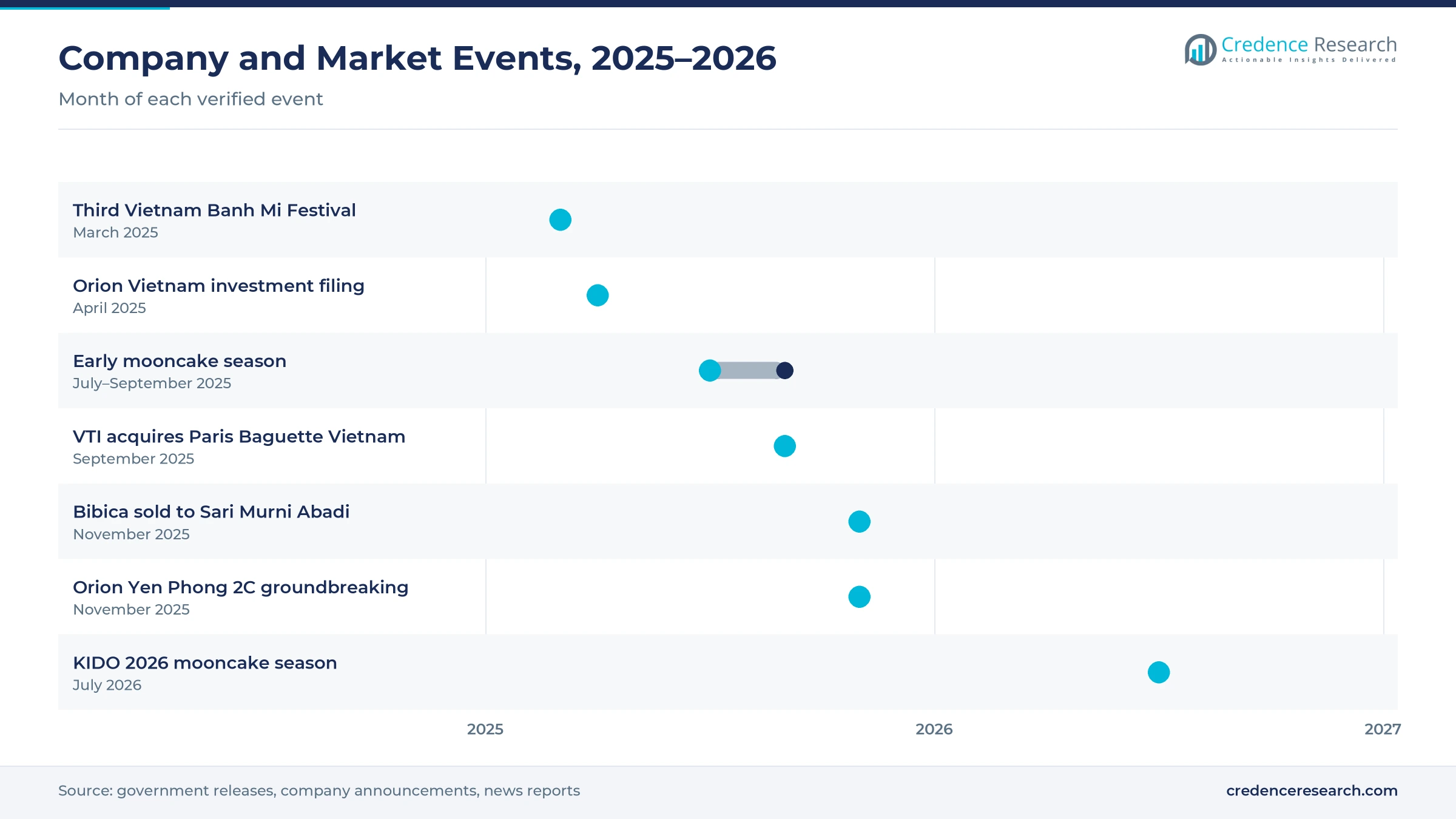
Plant investment supports packaged supply, because larger and newer lines raise output of biscuits, cakes and snacks for national distribution. Orion said in an April 15, 2025, filing that it would invest an additional 130 billion won in its Vietnam operations, which run plants in Hanoi and Ho Chi Minh City. The company then broke ground on its Yen Phong 2C project in Bac Ninh, which covers 52,608 square meters and adds eight confectionery lines in phase two. Bibica, which supplies more than 100,000 outlets, was sold to Indonesia's Sari Murni Abadi in November 2025. In turn, biscuits and cookies keep a large share of packaged sales across provinces.
Mooncake gifts, banh mi tourism and new stores shape demand
How is the rise of premium mooncake gifting changing the mix?
The rise of premium mooncake gifting is changing the mix, because buyers now start shopping earlier and pay more for designed boxes. The 2025 season began in mid-July, more than two months before the Mid-Autumn Festival, based on an Aug. 5, 2025, trade report. Premium gift boxes sold for VND250,000 to VND500,000, and some luxury boxes cost about VND2 million. Kinh Do launched over 70 varieties for 2025, including lava, matcha and yuzu flavors. KIDO said it would raise mooncake output for the 2026 season and sell through nearly 300 miniBAO stores. As a result, celebrations and gifting keep a steady share of value, while the premium tier grows at 9.05% a year.
Why is the shift of banh mi into tourism gaining pace?
The shift of banh mi into a tourism product is gaining pace, because festivals and food tours turn everyday bread into a national brand. The third Vietnam Banh Mi Festival ran from March 21 to March 24, 2025, in Ho Chi Minh City with 141 booths. Organizers projected more than 150,000 domestic and international visitors for the four-day event. Exhibitors included ABC Bakery and Asia Bakery, and the Vietnam Bakery Association agreed to help organize a banh mi festival in Sydney. In turn, bread and rolls keep the largest product share, while bakers add new fillings and colors, such as dragon fruit bread, to attract visitors.
Can rural convenience stores open a new growth channel?
Rural convenience stores offer a large opening, because modern retail still reaches only part of rural Vietnam. WinCommerce plans 1,000 new stores in 2026, including more than 300 in the first quarter, and its rural mini-mart revenue grew nearly 40% in 2025. Bach Hoa Xanh plans around 1,000 new stores in 2026, mainly in the North. About 61% of the population still lived outside cities in 2025, based on World Bank data. Together, the two chains plan about 2,000 new stores in 2026, which brings packaged bakery demand into many more districts. As a result, convenience stores grow at a faster pace than supermarkets, as packaged bread, cakes and biscuits reach small towns.
Is there room for new products from cheaper wheat supply?
Cheaper and more diverse wheat supply is an opening, because flour is the main cost in bread, cakes and biscuits. Vietnam imported more than 5.45 million tons of wheat in 2025, worth nearly US$1.46 billion, as reported by Nghe An Newspaper from customs data. Import value fell 7.8%, which eased input costs for millers and bakers. Australia supplied 25.4% of volume, while imports from the United States rose 96.5%. Brazil supplied 19.1% of 2025 volume, which gives millers a third major source to meet bakery demand. In turn, bakers can use bread improvers and new flours to launch whole-grain, soft and specialty breads at mainstream prices.
Food safety, flour costs and short shelf life test bakers
How do food safety risks hurt buyer trust?
Food safety is a key challenge, because homemade and unregistered cakes sold online can carry bacterial and labeling risks. Counterfeit mooncakes push buyers toward brands with clear origins, which squeezes small sellers. The Ho Chi Minh City Food Safety Management Board tightened inspections in 2025, and e-commerce platforms now check products more strictly. As a result, makers add ingredient disclosure, traceability and documentation to protect trust and keep their online listings.
Why do flour and ingredient costs pressure margins?
Flour, butter and sugar costs pressure margins, because Vietnam imports nearly all of its wheat and much of its dairy. Global grain prices and exchange rates can move input costs quickly, while buyers resist higher prices for daily bread. In turn, small bakeries have little room to absorb shocks. Bakers respond by buying from several origins, adjusting loaf sizes, using improvers and shifting the product mix toward higher-margin cakes and pastries.
How does short shelf life limit distribution?
Short shelf life limits distribution, because fresh bread and cream cakes spoil quickly in hot and humid weather. Retailers must order small batches and accept waste when sales slow. As a result, many fresh products stay within a short distance of the bakery. Producers respond with single-serve packaging, frozen and par-baked formats, chilled delivery and better preservation methods that extend shelf life without heavy additives.
Why does competition from rice-based meals restrain demand?
Competition from rice and noodle meals restrains demand, because pho, xoi and com tam remain strong breakfast and lunch choices in many provinces. Older buyers in rural areas often see bread as a snack rather than a meal. In turn, bakers must invest in new flavors, fillings and formats to win regular buyers. Brands respond with banh mi combos, local ingredients and value packs that fit everyday meal budgets.
The North leads while Central Vietnam grows fastest
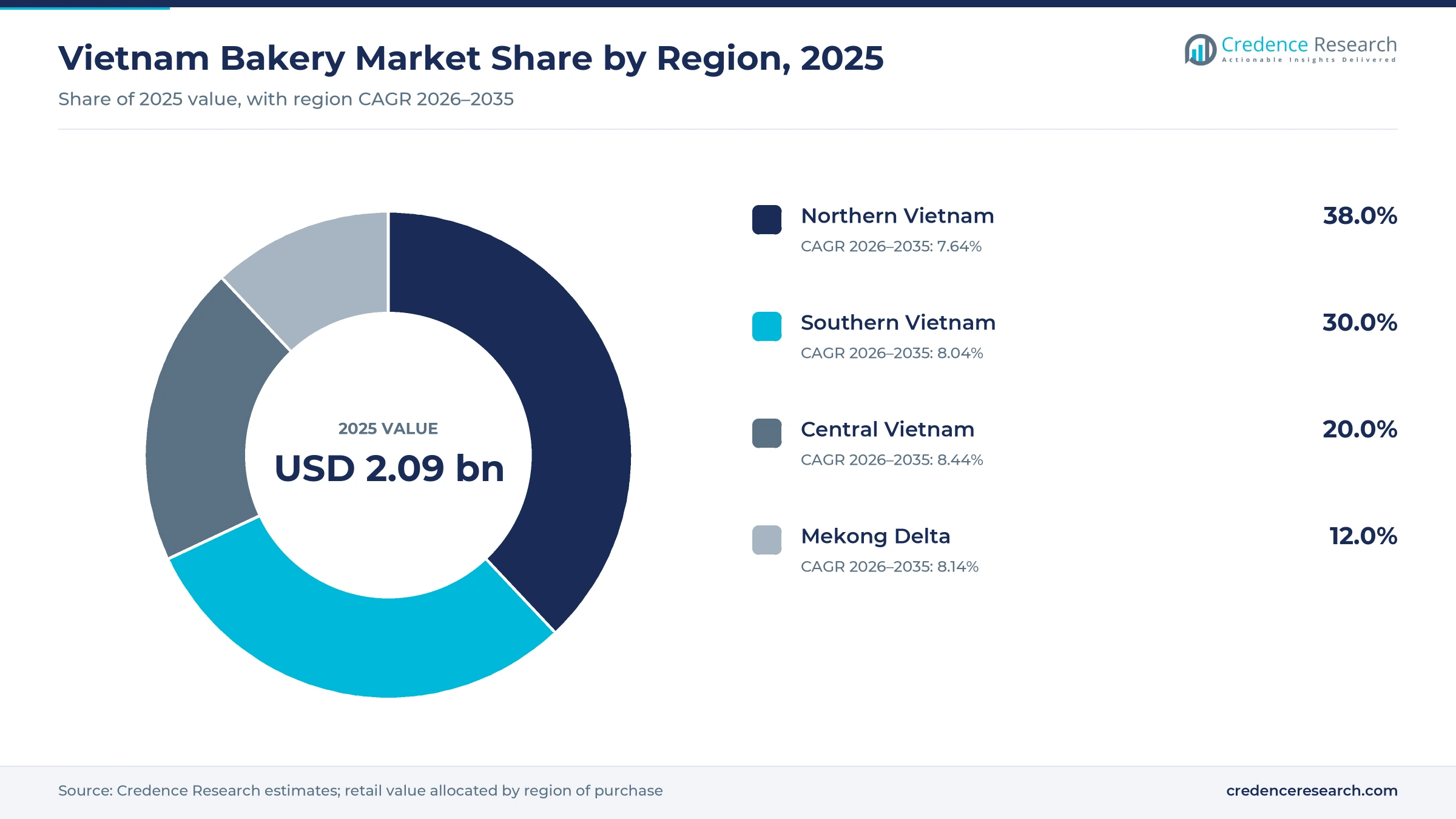
| Region | Value, 2025 (USD billion) | Share, 2025 | CAGR, 2026–2035 |
|---|---|---|---|
| Northern Vietnam | 0.80 | 38.0% | 7.64% |
| Southern Vietnam | 0.63 | 30.0% | 8.04% |
| Central Vietnam | 0.42 | 20.0% | 8.44% |
| Mekong Delta | 0.25 | 12.0% | 8.14% |
Why do Hanoi gifting seasons give the North its lead?
Northern Vietnam held 38.0% of 2025 value and grows at 7.64% a year, because Hanoi and the Red River Delta combine dense population with strong gifting at Tet and the Mid-Autumn Festival. Orion runs a plant in Hanoi and is building its Yen Phong 2C project in Bac Ninh, which strengthens local supply. Bach Hoa Xanh also plans most of its 2026 store openings in the North. However, growth is slower because many urban buyers already shop at modern stores.
How does banh mi culture keep southern Vietnam strong?
Southern Vietnam held 30.0% of 2025 value and grows at 8.04% a year, because Ho Chi Minh City is the center of banh mi culture, bakery-cafe chains and festival events. The 2025 Banh Mi Festival with 141 booths took place in the city. GS25 also runs more than 400 outlets in the South, which brings packaged bread and cakes closer to buyers. In turn, premium launches and online limited editions often start in the southern market.
Why do resort cities make Central Vietnam the fastest zone?
Central Vietnam held 20.0% of 2025 value and grows fastest at 8.44% a year, because tourism cities such as Da Nang, Hoi An and Nha Trang keep adding hotels, resorts and cafes. Hotels and caterers buy croissants, breads and cakes for breakfast buffets and events. As a result, bakery-cafe chains and suppliers of frozen and par-baked products see strong demand in the region.
Why do value loaves dominate Mekong Delta baskets?
The Mekong Delta held 12.0% of 2025 value and grows at 8.14% a year, because rural households buy mainly value bread, biscuits and cakes from local bakers and grocery stores. Bach Hoa Xanh began in the South, which gives the delta wide modern retail coverage. However, lower incomes keep most purchases in the value and mainstream tiers, and growth depends on packaged products reaching small towns.
Plant deals, chain sales and festivals shaped 2025–2026
| Development | Status and market relevance |
|---|---|
| In March 2025, the third Vietnam Banh Mi Festival opened in Ho Chi Minh City with 141 booths. | Promotes banh mi as a tourism and export product |
| In April 2025, Orion announced an additional 130 billion won investment in its Vietnam operations. | Expands packaged biscuit and cake supply |
| In August 2025, Kinh Do launched its 2025 mooncake collection with over 70 varieties and online-only editions. | Adds premium gifting and e-commerce sales |
| In September 2025, Viet Thai International acquired Paris Baguette Vietnam and its nine bakery-cafe stores. | Brings a local investor to the bakery-cafe format |
| In November 2025, PAN Group sold Bibica to Indonesia's Sari Murni Abadi. | Changes ownership of a major biscuit and cake maker |
Automated lines, frozen dough and apps change baking
- Automated production lines mix, bake and pack biscuits and cakes at scale, as planned in the eight confectionery lines of Orion's Yen Phong 2C project.
- Frozen and par-baked formats let cafes, hotels and convenience stores bake bread on site, which cuts waste and extends reach. Suppliers of frozen bread dough serve these outlets.
- Single-serve packaging keeps cakes and buns fresh for several days, which suits convenience stores and on-the-go buyers.
- Online ordering and livestream sales let brands sell gift boxes and limited editions through Shopee, Lazada and TikTok Shop, which widens reach beyond store networks.
Need a Custom Version of This Report?
Tailor the scope, geography, or segments to your exact requirements.
- Custom geography or segment scope
- Direct access to our analyst team
Local snack groups compete with Korean bakery-cafe chains
Competition combines large local snack groups, foreign-owned manufacturers, Korean bakery-cafe chains and thousands of independent bakers. Mondelez Kinh Do and KIDO compete hard in mooncakes and gift boxes, while Orion and Bibica lead packaged cakes and biscuits through wide store networks. Orion runs plants in Hanoi and Ho Chi Minh City and is adding capacity in Bac Ninh. Bibica supplies more than 100,000 outlets and changed owners in 2025. Paris Baguette, now owned by Viet Thai International, runs bakery-cafe stores in Hanoi and Ho Chi Minh City. ABC Bakery is a well-known local chain that joined the 2025 Banh Mi Festival. Rivals compete on taste, freshness, price, packaging design and online reach, while independent bakers dominate fresh bread.
Companies profiled and their roles in this market
| Company | Type | Role in the market |
|---|---|---|
| Mondelez Kinh Do Vietnam | Packaged snacks | Launched over 70 mooncake varieties in 2025 |
| KIDO Group | Packaged snacks | Raised mooncake output for 2026 through miniBAO stores |
| Orion Food Vina | Packaged snacks | Added Vietnam investment and Bac Ninh project in 2025 |
| Bibica Corporation | Packaged snacks | Supplies more than 100,000 outlets; sold to Sari Murni Abadi |
| Paris Baguette Vietnam | Bakery-cafe chain | Acquired by Viet Thai International in 2025 |
| ABC Bakery | Local bakery chain | Exhibited at the 2025 Vietnam Banh Mi Festival |
Credence Research view on premium and convenience growth
Credence Research's view is that Vietnamese bakery spending will grow faster than overall food sales because cafes, tourism and convenience stores keep adding new buying occasions. Daily banh mi remains the base of demand, while premium cakes, mooncake gifting and online editions raise average prices. However, food safety concerns, flour costs and short shelf life will keep pressure on small bakers. Brands that pair traceable products with frozen formats, convenience store reach and strong online sales should gain share fastest through 2035, especially in Central and Southern Vietnam.
Sizing bakery sales from retail, tourism and wheat data
The report uses 2025 as the base year on a calendar basis, and market values come from the Credence Research model. That model combines national retail sales, tourism and population statistics, World Bank data, wheat import data, company disclosures and typical retail prices by product type. Segment and regional splits are Credence Research estimates, with regional shares based on the client-defined split. Sources used are government releases, company announcements, news reports and statistical databases, and no interviews or surveys were used.
Cafe formats and convenience stores carry growth to 2035
Bakery sales are expected to reach USD 4.57 billion by 2035, a 7.98% CAGR during 2026–2035, as urban buyers, visitors and modern stores keep demand strong. Growth should be fastest in cakes, pastries and cafe formats while chain stores spread into provincial towns. After that, online sales, frozen products and premium gifting will add steady value as fresh bread demand matures. A sharp rise in wheat prices or a tourism slowdown would lower this outlook, while faster convenience store growth would raise it. Independent bakers will remain important for daily bread, even as packaged brands gain share.
Frequently Asked Questions
How big is the Vietnam bakery market?
Which product type leads bakery sales in Vietnam?
Which region leads the Vietnam bakery market?
How does tourism affect bakery demand?
Which sales channels grow fastest?
What drives premium bakery demand?
Who are the leading bakery companies in Vietnam?
What are the main challenges for bakers?
Table of Content
Chapter 1 Market Segmentation
- 1.1 Segmentation Framework
- 1.1.1 Product and Service Classification
- 1.1.2 Application and End-Use Classification
- 1.1.3 Technology and Solution Classification
- 1.1.4 Customer and Distribution Channel Classification
- 1.1.5 Geographic Segmentation
- 1.1.6 Market Segment Definitions and Boundaries
- 1.2 By Product Type
- 1.2.1 Bread and Rolls
- 1.2.2 Cakes and Pastries
- 1.2.3 Biscuits and Cookies
- 1.2.4 Savory and Specialty Bakery
- 1.3 By Price Tier
- 1.3.1 Value
- 1.3.2 Mainstream
- 1.3.3 Premium
- 1.3.4 Artisanal and Specialty
- 1.4 By Purchase Occasion
- 1.4.1 Daily Meals and Breakfast
- 1.4.2 Snacking and On-the-Go
- 1.4.3 Celebrations and Gifting
- 1.4.4 Hospitality and Catering
Chapter 2 Introduction
- 2.1 Report Objectives and Scope
- 2.2 Product Definition and Industry Terminology
- 2.3 Market Inclusions and Exclusions
- 2.4 Research Process
- 2.4.1 Primary Research and Expert Interviews
- 2.4.2 Secondary Research and Source Review
- 2.4.3 Top-Down and Bottom-Up Estimation
- 2.4.4 Data Triangulation and Verification
- 2.5 Market Size Measurement Basis
- 2.5.1 2025: USD 2.09 billion → 2035: USD 4.57 billion
- 2.6 Historical and Forecast Reference Periods
- 2.6.1 Historical Period: 2018-2025
- 2.6.2 Base Year: 2025
- 2.6.3 Forecast Period: 2025-2035
- 2.7 Research Assumptions and Limitations
Chapter 3 Executive Summary
- 3.1 Market Snapshot and Key Findings
- 3.2 Base-Year Market Size, 2025
- 3.3 Forecast Market Size, 2035
- 3.4 Revenue and Volume Growth Outlook
- 3.5 Key Demand and Supply Indicators
- 3.6 Leading Market Segments
- 3.7 Fastest-Growing Market Opportunities
- 3.8 Regional Performance Highlights
- 3.9 Technology and Industry Transformation
- 3.10 Competitive Landscape Summary
- 3.11 Analyst View and Strategic Implications
Chapter 4 Vietnam Bakery Market Trends and Developments
- 4.1 Historical Industry Development, 2018-2025
- 4.2 Recent Market Trends and Developments
- 4.3 Demand and Customer Behavior Trends
- 4.4 Technology and Product Innovation
- 4.5 Artificial Intelligence, Automation and Digitalization
- 4.6 Local Manufacturing and Supply Chain Realignment
- 4.7 Industry Partnerships, Mergers and Acquisitions
- 4.8 Sustainability and Circular Economy Developments
- 4.9 Government and Private Sector Investment Trends
- 4.10 Emerging Business Models and Commercialization
- 4.11 Industry Developments and Announcements
Chapter 5 Vietnam Bakery Market Production, Supply and Demand Analysis
- 5.1 Demand Trend and Consumption Analysis, 2018-2025
- 5.2 Demand Forecast, 2025-2035
- 5.3 Production and Output Trend, 2018-2025
- 5.4 Production and Output Forecast, 2025-2035
- 5.5 Installed Capacity and Capacity Utilization
- 5.6 Company-Wise Production Plants and Statistics
- 5.6.1 Installed Production Capacity
- 5.6.2 Actual Production
- 5.6.3 Planned Capacity and Expansion Targets
- 5.7 Supply Chain Structure and Procurement Trends
- 5.8 Supply-Demand Gap and Bottlenecks
- 5.9 Import Dependence and Sourcing Structure
- 5.10 Contract Manufacturing and Outsourcing
- 5.11 Regional Supply and Demand Concentration
Chapter 6 Vietnam Bakery Market Pricing Analysis
- 6.1 Pricing Structure and Measurement
- 6.2 Historical Pricing Trends, 2018-2025
- 6.3 Pricing Outlook, 2025-2035
- 6.4 Average Selling Price and Unit Economics
- 6.5 Pricing by Product and Market Segment
- 6.6 Geographic Pricing Differences
- 6.7 Key Input, Energy, Labor and Logistics Costs
- 6.8 Contract Pricing and Purchasing Models
- 6.9 Pricing Sensitivity and Competitive Positioning
- 6.10 Price, Margin and Profitability Implications
Chapter 7 Vietnam Bakery Market Dynamics
- 7.1 Market Growth Drivers
- 7.1.1 Demand-Side Drivers
- 7.1.2 Technology and Innovation Drivers
- 7.1.3 Infrastructure and Investment Drivers
- 7.1.4 Regulatory and Policy Drivers
- 7.2 Market Restraints
- 7.2.1 Cost and Affordability Constraints
- 7.2.2 Technology and Adoption Barriers
- 7.2.3 Supply Chain and Operational Constraints
- 7.3 Market Challenges
- 7.3.1 Competitive Pressure and Margin Erosion
- 7.3.2 Skills, Infrastructure and Implementation Gaps
- 7.4 Emerging Market Opportunities
- 7.5 Market Dynamics Impact and Time-Horizon Assessment
Chapter 8 Vietnam Bakery Value Chain Analysis
- 8.1 Industry Value Chain Overview
- 8.2 Upstream Suppliers and Critical Inputs
- 8.3 Technology and Component Providers
- 8.4 Manufacturing or Service Delivery
- 8.5 Distribution, Channel Partners and Integrators
- 8.6 Downstream Applications and End Users
- 8.7 Value Addition and Profit Pools
- 8.8 Vertical Integration and Outsourcing
- 8.9 Supplier Concentration and Risk
- 8.10 Supply Chain Localization and Resilience
Chapter 9 Vietnam Bakery Market Regulations and Policies
- 9.1 Relevant Laws, Standards and Compliance Frameworks
- 9.2 Product, Service, Safety and Quality Requirements
- 9.3 Government Policies, Incentives and Subsidies
- 9.4 Imports, Exports and Trade Barriers
- 9.5 Public Procurement and Local Content Requirements
- 9.6 Environmental and Sustainability Compliance
- 9.7 Upcoming Policy Changes and Market Implications
Chapter 10 Vietnam Bakery Market Hotspots and Opportunities
- 10.1 Market Opportunity Mapping and Growth Hotspots
- 10.2 High-Growth Applications and Customer Groups
- 10.3 Underserved Markets and White-Space Opportunities
- 10.4 Emerging Technology and Product Opportunities
- 10.5 New Capacity and Investment Hotspots
- 10.6 Market Entry and Expansion Opportunities
- 10.7 Distribution and Partnership Opportunities
- 10.8 Near-Term and Long-Term Commercial Potential
- 10.9 Opportunity Attractiveness and Execution Risks
Chapter 11 Vietnam Bakery Market Outlook, 2025-2035
- 11.1 Market Size and Analysis
- 11.1.1 Revenue (Market Measurement: 2025: USD 2.09 billion → 2035: USD 4.57 billion)
- 11.1.2 Market Volume and Quantity Sold
- 11.1.3 Historical Market Size, 2018-2025
- 11.1.4 Base-Year Market Size, 2025
- 11.2 Market Forecast, 2025-2035
- 11.2.1 Revenue Forecast to 2035
- 11.2.2 Volume Forecast to 2035
- 11.2.3 CAGR and Year-on-Year Growth
- 11.2.4 Incremental Revenue Opportunity
- 11.3 Forecast Assumptions and Scenario Analysis
- 11.3.1 Base-Case Forecast
- 11.3.2 Optimistic and Conservative Scenarios
- 11.3.3 Technology, Pricing and Policy Sensitivities
- 11.4 Market Attractiveness and Growth Outlook
Chapter 12 Vietnam Bakery Market Segmentation and Outlook
- 12.1 Segmentation Summary and Market Shares, 2025
- 12.2 Largest and Fastest-Growing Segments
- 12.3 By Product Type - Market Size and Forecast, 2025-2035
- 12.3.1 Segment Definition and Scope
- 12.3.2 Historical Market Size, 2018-2025
- 12.3.3 Revenue Forecast, 2025-2035
- 12.3.4 Volume Forecast, 2025-2035
- 12.3.5 Base-Year Market Share, 2025
- 12.3.6 Segment CAGR and Growth Drivers
- 12.3.7 Subsegment Market Size and Forecast
- 12.3.7.1 Bread and Rolls
- 12.3.7.2 Cakes and Pastries
- 12.3.7.3 Biscuits and Cookies
- 12.3.7.4 Savory and Specialty Bakery
- 12.3.8 Subsegment Pricing and Adoption Trends
- 12.3.9 Leading Suppliers and Competition
- 12.3.10 Regional Demand and Opportunities
- 12.4 By Price Tier - Market Size and Forecast, 2025-2035
- 12.4.1 Segment Definition and Scope
- 12.4.2 Historical Market Size, 2018-2025
- 12.4.3 Revenue Forecast, 2025-2035
- 12.4.4 Volume Forecast, 2025-2035
- 12.4.5 Base-Year Market Share, 2025
- 12.4.6 Segment CAGR and Growth Drivers
- 12.4.7 Subsegment Market Size and Forecast
- 12.4.7.1 Value
- 12.4.7.2 Mainstream
- 12.4.7.3 Premium
- 12.4.7.4 Artisanal and Specialty
- 12.4.8 Subsegment Pricing and Adoption Trends
- 12.4.9 Leading Suppliers and Competition
- 12.4.10 Regional Demand and Opportunities
- 12.5 By Purchase Occasion - Market Size and Forecast, 2025-2035
- 12.5.1 Segment Definition and Scope
- 12.5.2 Historical Market Size, 2018-2025
- 12.5.3 Revenue Forecast, 2025-2035
- 12.5.4 Volume Forecast, 2025-2035
- 12.5.5 Base-Year Market Share, 2025
- 12.5.6 Segment CAGR and Growth Drivers
- 12.5.7 Subsegment Market Size and Forecast
- 12.5.7.1 Daily Meals and Breakfast
- 12.5.7.2 Snacking and On-the-Go
- 12.5.7.3 Celebrations and Gifting
- 12.5.7.4 Hospitality and Catering
- 12.5.8 Subsegment Pricing and Adoption Trends
- 12.5.9 Leading Suppliers and Competition
- 12.5.10 Regional Demand and Opportunities
- 12.6 Segment Growth Comparison
- 12.7 Segment Attractiveness and Priority Matrix
Chapter 13 Vietnam Bakery Geographic Market Outlook, 2025-2035
- 13.1 Domestic Market Distribution and Demand Clusters
- 13.2 State- or Province-Wise Market Size and Forecast, 2025-2035
- 13.3 City and Metropolitan Market Outlook
- 13.4 Industrial, Manufacturing and Commercial Clusters
- 13.5 Geographic Concentration of Key End Users
- 13.6 Local Pricing and Purchasing Differences
- 13.7 Domestic Production Facilities and Capacity Map
- 13.8 Local Infrastructure and Project Pipeline
- 13.9 State-Level Policy and Incentive Differences
- 13.10 Subnational Investment Hotspots and Opportunities
- 13.11 Distribution and Logistics Networks
- 13.12 Domestic Competitive Footprint
Chapter 14 Vietnam Bakery Technology, Innovation and Sustainability Outlook
- 14.1 Technology Landscape and Maturity
- 14.2 Product, Process and Service Innovation
- 14.3 AI, Automation and Digital Tools in the Industry
- 14.4 Technology Adoption and Performance Benchmarking
- 14.5 Innovation Pipeline and R&D Investment
- 14.6 Patent and Intellectual Property Trends
- 14.7 Energy Efficiency and Resource Management
- 14.8 Sustainability, Recycling and Circularity
- 14.9 Technology Roadmap, 2025-2035
- 14.10 Risks of Obsolescence and Technology Substitution
Chapter 15 Vietnam Bakery Market Key Strategic Imperatives
- 15.1 Growth and Market Entry Priorities
- 15.2 High-Return Products and Segments
- 15.3 Pricing, Profitability and Cost Optimization
- 15.4 Technology Investment and Product Differentiation
- 15.5 Supply Chain Localization and Resilience
- 15.6 Distribution and Customer Acquisition
- 15.7 Partnership, Acquisition and Capacity Strategy
- 15.8 Regional Expansion Priorities
- 15.9 Short-, Medium- and Long-Term Actions
Chapter 16 Competition Outlook
- 16.1 Industry Competition Characteristics
- 16.2 Market Structure and Concentration
- 16.3 Market Share and Competitive Positioning, 2025
- 16.4 Company-Wise Revenue and Product Benchmarking
- 16.5 Production and Service Capacity Benchmarking
- 16.6 Technology, Pricing and Differentiation
- 16.7 Regional Footprint and Distribution Strength
- 16.8 Mergers, Acquisitions and Strategic Alliances
- 16.9 New Entrants and Competitive Threats
- 16.10 Porter's Five Forces and Industry Attractiveness
- 16.11 Competitive Outlook, 2025-2035
Chapter 17 Company Profiles
- 17.1 Company Coverage and Selection Criteria
- 17.2 Mondelez Kinh Do Vietnam
- 17.2.1 Business Description
- 17.2.2 Company Ownership and Geographic Presence
- 17.2.3 Product and Service Portfolio
- 17.2.4 Manufacturing and Operating Footprint
- 17.2.5 Production Capacity and Expansion Plans
- 17.2.6 Financial Performance and Investment
- 17.2.7 Market Share and Competitive Position
- 17.2.8 Technology and Innovation Capabilities
- 17.2.9 Strategic Alliances or Partnerships
- 17.2.10 Recent Developments
- 17.2.11 Growth Strategy and Outlook
- 17.3 KIDO Group
- 17.4 Orion Food Vina
- 17.5 Huu Nghi Food Joint Stock Company
- 17.6 Bibica Corporation
- 17.7 Hai Ha Confectionery Joint Stock Company
- 17.8 ABC Bakery
- 17.9 Givral Bakery
- 17.10 TOUS les JOURS Vietnam
- 17.11 Paris Baguette Vietnam
- 17.12 Other Relevant Market Participants
Note: Every listed company is profiled on the structure shown under the first company. The company list is preliminary and may change based on research findings, market developments, data availability and client requirements.
Chapter 18 Disclaimer
- 18.1 Research and Forecast Disclaimer
- 18.2 Data Source and Estimation Limitations
Note: The depth of individual sections depends on data availability for this market. Volume, capacity, trade and other unit-based metrics are included where applicable.

