
India railway station redevelopment moves from plan to site
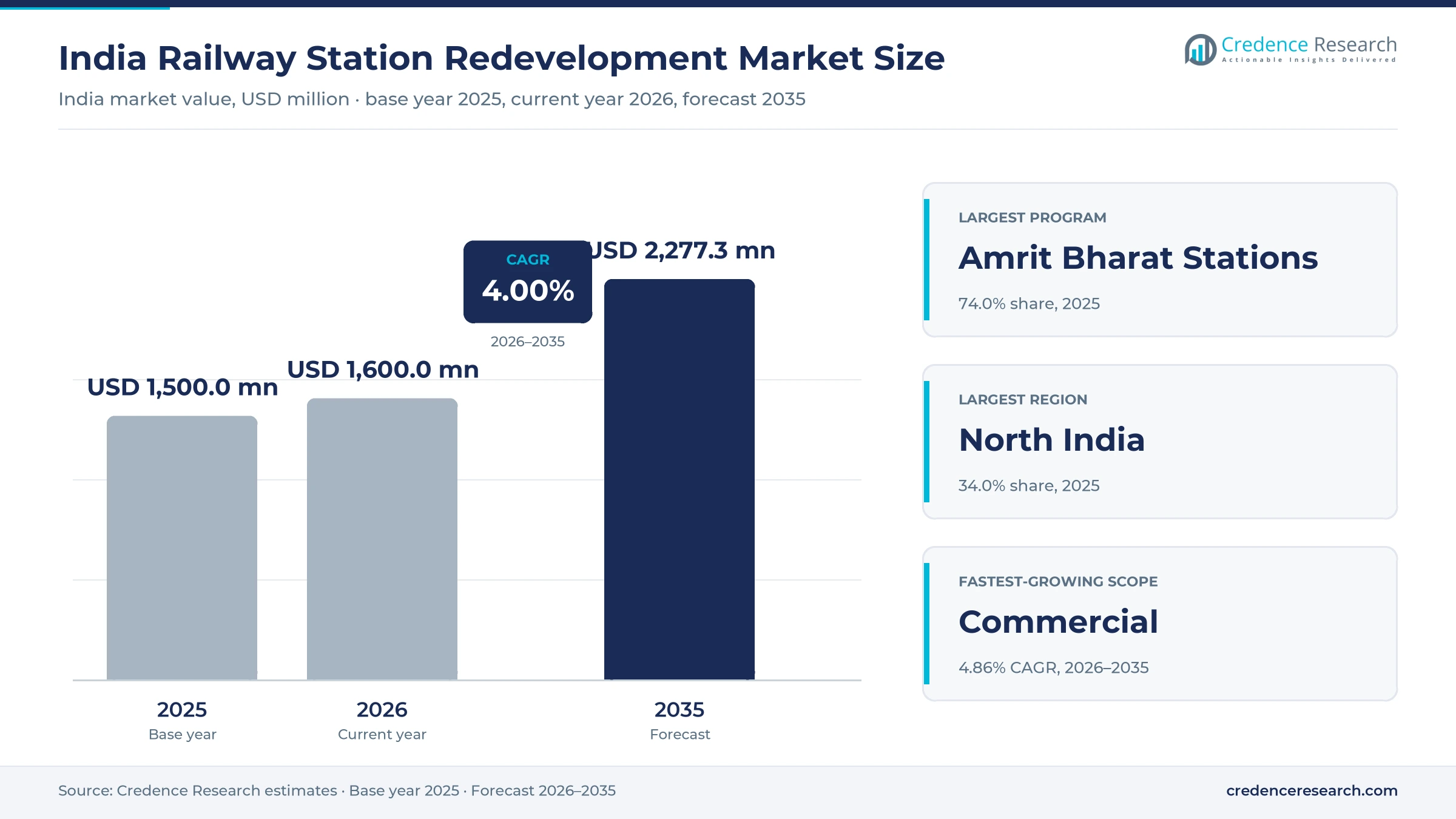
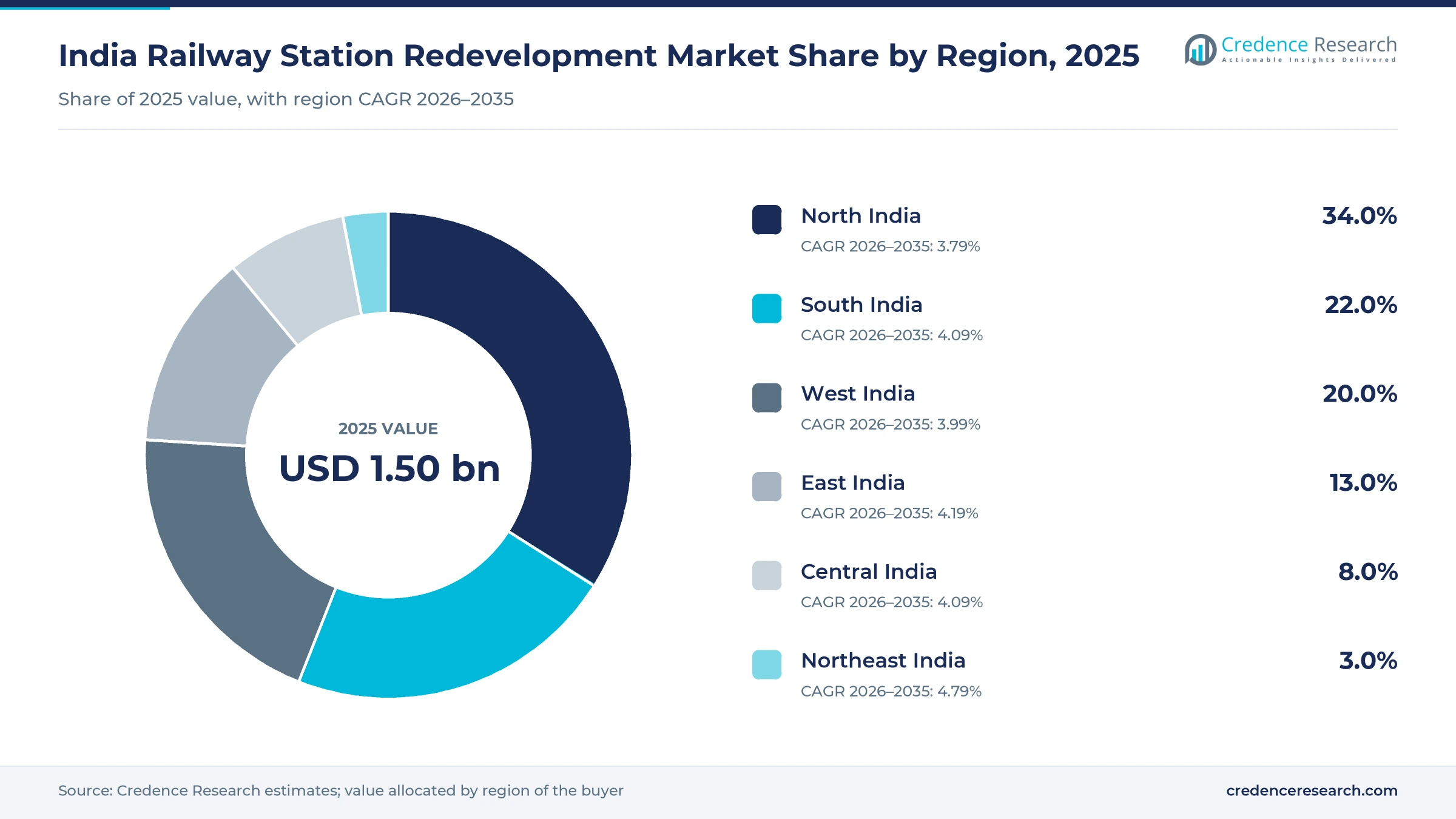
The India railway station redevelopment market was valued at USD 1.50 billion in 2025 and is projected to increase from USD 1.60 billion in 2026 to USD 2.28 billion by 2035, registering a CAGR of 4.00% during 2026–2035. Demand comes from the Amrit Bharat Station Scheme, which lists about 1,340 stations, and from large terminal rebuilds that the Rail Land Development Authority manages in New Delhi, Ahmedabad and Mumbai. North India held the largest regional share, 34.0% in 2025, because Uttar Pradesh alone has 157 listed stations and the capital hosts the biggest single rebuild. Northeast India is the fastest-growing region at 4.79% a year, as Assam moves from tender awards to site work on its 50 listed stations. The main commercial change is the rise of air space leasing, under which railway authorities now offer retail, office and hotel floors above rebuilt stations on leases of 45 to 60 years.
Which station works count toward this spending estimate?
The estimate counts engineering, procurement and construction value spent on existing passenger stations, including station buildings, air concourses and roof plazas, foot overbridges, platform shelters, mechanical and electrical systems, and commercial floors built with the station. Buyers are the zonal railways, which manage Plan Head-53 budgets, and the Rail Land Development Authority, which tenders the largest stations.
The estimate excludes new track, signaling, electrification, rolling stock and metro or suburban stations built by other authorities. Station cleaning, operations and retail sales after opening also fall outside the count. Land lease premiums paid by developers are excluded as well, although the construction value that those developers fund is included.
India Railway Station Redevelopment Market Insights
- Spending grows from USD 1.50 billion in 2025 to USD 2.28 billion by 2035, a 4.00% CAGR over 2026–2035, as finished small stations give way to larger terminal works.
- North India led with 34.0% of 2025 value, supported by 157 listed stations in Uttar Pradesh and the New Delhi terminal rebuild.
- Amrit Bharat Stations held 74.0% of 2025 value, because Plan Head-53 budgets of about Rs 12,000 crore a year fund the scheme across all zones.
- By July 2026, work was complete at 261 of 1,340 listed stations, so roughly four in five stations still have construction value ahead.
- Engineering, procurement and construction contracts formed 98% of awards as of March 2026, which leaves contractors such as Afcons, NCC and Larsen & Toubro competing on price and execution.
Amrit Bharat volume and building works hold the most value
Why does the Amrit Bharat line outweigh major station projects?
Based on program, the market is categorized into Amrit Bharat Stations and Major Station PPP. Amrit Bharat Stations led with 74.0% of 2025 value because the zonal railways spent Rs 11,892 crore of a Rs 12,120 crore Plan Head-53 allocation by February 2026, according to Construction World, across more than 1,300 sites. Major Station PPP grows fastest at 4.59% a year as the Rail Land Development Authority carries 104 stations and 15 sites are designated for private partnership, according to Indian Infrastructure magazine. New Delhi, an EPC job counted in this group, is estimated at Rs 2,917 crore, which shows how few sites can carry large value.
Which work packages hold the most contract value?
Based on scope, the market is categorized into Buildings, Roof Plazas, MEP and Commercial. Buildings led with 46.0% of 2025 value because most packages begin with new structures, such as the nine-story Civil Lines block in the Rs 960 crore Prayagraj project reported by PropNewsTime in March 2026. Commercial grows fastest at 4.86% a year as tenders now add leasable floors, including about 358,568 square feet at Lucknow, for which the authority issued its notice on Feb. 19, 2026, according to News Station. New Delhi plans 82 lifts and 52 escalators, which supports steady MEP value.
| Segment Group | Leading Sub-segment | Share, 2025 | Fastest-growing Sub-segment | CAGR, 2026–2035 |
|---|---|---|---|---|
| By Program | Amrit Bharat Stations | 74.0% | Major Station PPP | 4.59% |
| By Scope | Buildings | 46.0% | Commercial | 4.86% |
Request a Free Sample
Fill in your details and we'll send you a free sample report.
- Sample data tables & charts
- Research methodology
Budgets, bigger contracts and transit links drive awards
Station programs keep EPC and refurbishment awards flowing
Public budgets remain the core source of work, and they now run at a far higher level than before the scheme began. Allocations rose from Rs 2,159 crore in fiscal 2023 to Rs 15,511 crore in the fiscal 2025 budget estimate, according to Construction World. The fiscal 2027 allocation stands at Rs 11,972 crore, and Rs 4,633 crore was spent by June 2026, with 1,340 stations listed and 261 complete. That leaves 1,079 sites with work still in progress or pending. In the Credence Research model this adds about 1.68 percentage points to annual growth to 2035. As a result, contractors see a visible pipeline of Amrit Bharat packages in every railway zone.
Commercial amenities and access retrofits lift contract size
Station scope has grown beyond platforms and waiting halls, and that raises the value of each contract. Plans for Mumbai CSMT include 102 lifts, 78 escalators and nearly 60,000 square meters of parking, according to Indian Infrastructure magazine. Demand for lifts and escalators also reaches small sites, since Patrika reported in April 2026 that 11 Jodhpur division stations would receive 22 lifts for Rs 16.37 crore. Retail scope is spreading too, with about 2,326 One Station One Product outlets at more than 2,000 stations reported by IANS in March 2026. In the Credence Research model this adds about 1.04 percentage points to annual growth to 2035. In turn, the commercial share of each station package keeps widening over time.
Multimodal integration adds station upgrade requirements
Stations are being planned as city transit nodes, which adds road, parking and interchange work to the building contract. Urban residents formed 35.7% of the population in 2025, according to World Bank urban population data, so access capacity matters more each year. Ahmedabad links high-speed rail, metro and bus rapid transit, while the New Delhi hub on the Paharganj side stacks city buses, five parking floors and nine office floors, according to India Seatrade News in June 2024. Construction World reported in September 2026 that the Bodaki terminal plans 12 platforms and a 12.5-acre bus terminal. In the Credence Research model this adds about 0.68 percentage points to annual growth to 2035.
Crowd safety orders create a new class of holding area works
Safety policy now creates station work that did not exist in the original scheme budgets. After 18 passengers died in a crush at New Delhi on Feb. 15, 2025, the ministry ordered permanent holding areas at five stations and later said 55 more would follow, PTI reported in October 2026. The Udhna facility in Gujarat covers 10,100 square meters and includes 10 ticket counters, 55 cameras and 120 seats. Sites under construction include Ujjain, Bhopal, Nashik Road, Bandra Terminus and Sabarmati. The Standing Committee on Railways also said in March 2025 that redevelopment should focus on crowd management, according to ETV Bharat. Facilities at Anand Vihar, Ayodhya and Haridwar add further civil work in North India.
EPC delivery and air space leasing are redrawing the work
A shift from PPP to EPC delivery is reshaping who bids
Station work moved from private partnership to engineering, procurement and construction contracts in December 2022, according to Construction World, and that decision still shapes the bidder pool. Indian Infrastructure magazine reported in March 2026 that EPC accounts for 98% of awards, with only 15 stations designated for private partnership. The shift brought builders rather than concessionaires to the table, and the New Delhi package went to an HG Infra and DEC Infrastructure joint venture at Rs 2,195.68 crore against a Rs 2,469 crore estimate, according to Angel One in February 2025. However, the Standing Committee on Railways asked the ministry in March 2025 to assess the Rani Kamlapati partnership model for wider use.
Precast and phased building are rising at the busiest stations
Builders increasingly favor methods that keep trains running, because the largest stations cannot close during construction. Construction World reported in June 2026 that the minister's review of Borivali, Ambala Cantonment and Mangaluru Central discussed precast components to speed execution. Borivali handles about 365,000 passengers, 191 long-distance services and about 1,200 suburban services daily, so each possession window is short. Kandivali, about 2 kilometers away, is planned in parallel with multilevel parking. New Delhi has a 45-month contract period for the same reason, with Ranchi building its south and north sides in separate phases at Rs 447 crore. As a result, phasing now drives contract planning for the station building packages at these sites.
Air space leasing opens a new opportunity for developers
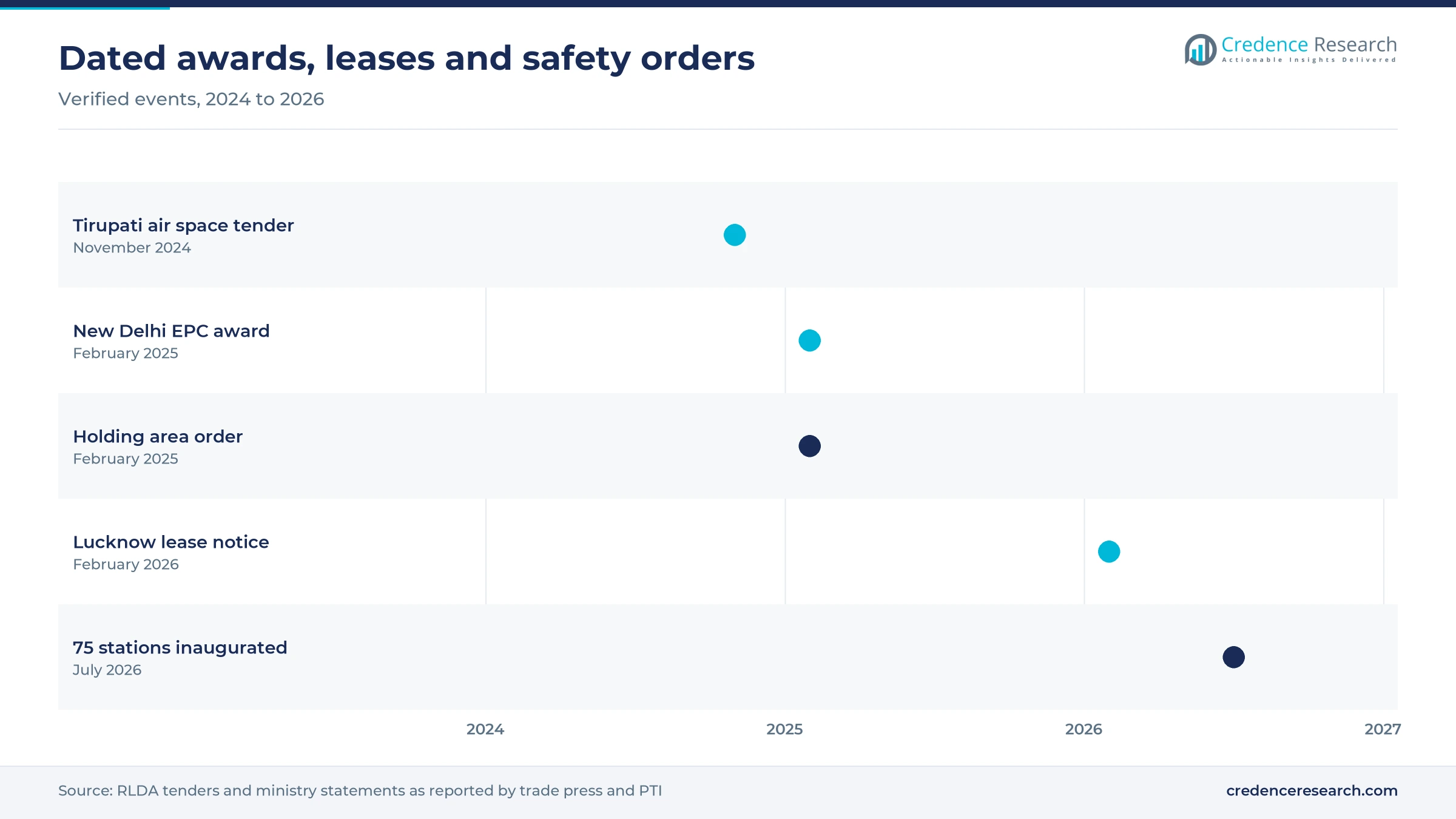
Developers have a growing opening above rebuilt stations, because authorities are now tendering floors rather than whole sites. NBM&CW reported in November 2024 that Tirupati offered 36,640 square meters on a 60-year lease, including 21,984 square meters for hotels and 10,992 square meters for retail. Prayagraj followed with about 203,000 square feet on a 45-year lease with a 25% minimum revenue share, according to PropNewsTime in March 2026. Lucknow then offered offices, hotels and retail space on similar terms. This links station work to the wider real estate cycle. Commercial grows at 4.86% a year on these tenders, which gives developers a lower-capital entry than a full station concession.
Small station packages offer an opening for midsize contractors
Regional contractors have a clear opening in the long tail of the scheme, where packages are small enough to win without large balance sheets. Narengi, Jagiroad and Chaparmukh in Assam are estimated at about Rs 31 crore each, according to ANI in March 2025, and Nellore at Rs 102 crore, according to Deccan Chronicle. Jaisalmer, completed in December 2025, cost an estimated Rs 140 crore. Construction World reported in April 2026 that 157 listed stations sit in Aspirational Districts, which spreads station redevelopment work into smaller local markets. Because such sites form most of the list, these packages add up to substantial volume. Standard designs and pooled procurement would improve margins for such firms.
Live traffic, bid prices and flat budgets slow delivery
Live traffic and utility shifting extend every schedule
Brownfield conditions remain the largest source of delay, since trains and passengers stay on site throughout construction. A Lok Sabha reply of Feb. 11, 2026 on Bengaluru area stations said no time frame can be indicated because of utility shifting, statutory clearances and train operations. Chandigarh, a Rs 436 crore project started on Jan. 11, 2023, faced fire, heritage, tree-felling and airport clearances, The Tribune reported in December 2024. Contractors carry extended overheads as a result, so owners increasingly need early utility surveys before award.
Bid prices far above estimates strain large tenders
Large terminal tenders have drawn prices well above official estimates, which forces owners to reconsider scope. At Ahmedabad in April 2023, Afcons bid Rs 5,355 crore, NCC Rs 5,694 crore and Larsen & Toubro Rs 5,770 crore against a Rs 3,000 crore estimate, according to Swarajya. The authority scrapped that tender, and a DRA Infracon and Delhi Metro Rail Corporation venture then emerged lowest at Rs 2,383.59 crore in November 2023, The Metro Rail Guy reported. Mumbai CSMT went to Ahluwalia Contracts at Rs 2,450 crore against nearly Rs 2,000 crore.
Contractor disputes stall midsize stations
Midsize stations are exposed to weak subcontracting chains, and a single dispute can idle a site for many months. Deccan Chronicle reported in March 2026 that Nellore, a Rs 102 crore project, stood at about 57% complete in October 2024 before work largely stalled around April 2025 over disputes between the main contractor and subcontractors. Passengers then endure unfinished facilities for longer, and zonal railways face slower budget use. Tighter payment monitoring and milestone reviews would reduce this risk for owners.
Flat budgets and slow completions limit the pace
Funding has stopped rising just as many sites reach their most expensive stages, which limits how quickly work can finish. The fiscal 2027 allocation of Rs 11,972 crore sits below the fiscal 2025 budget estimate. The Standing Committee on Railways noted in March 2025 that only one station was upgraded against a 2024-25 target of 453, according to ETV Bharat. Contractors with thin cash reserves are most affected, so wider private finance would help to ease the pressure.
North India holds the largest share of station works
| Region | Value, 2025 (USD billion) | Share, 2025 | CAGR, 2026–2035 |
|---|---|---|---|
| North India | 0.51 | 34.0% | 3.79% |
| South India | 0.33 | 22.0% | 4.09% |
| West India | 0.30 | 20.0% | 3.99% |
| East India | 0.20 | 13.0% | 4.19% |
| Central India | 0.12 | 8.0% | 4.09% |
| Northeast India | 0.04 | 3.0% | 4.79% |
North India leads on station count and the capital rebuild
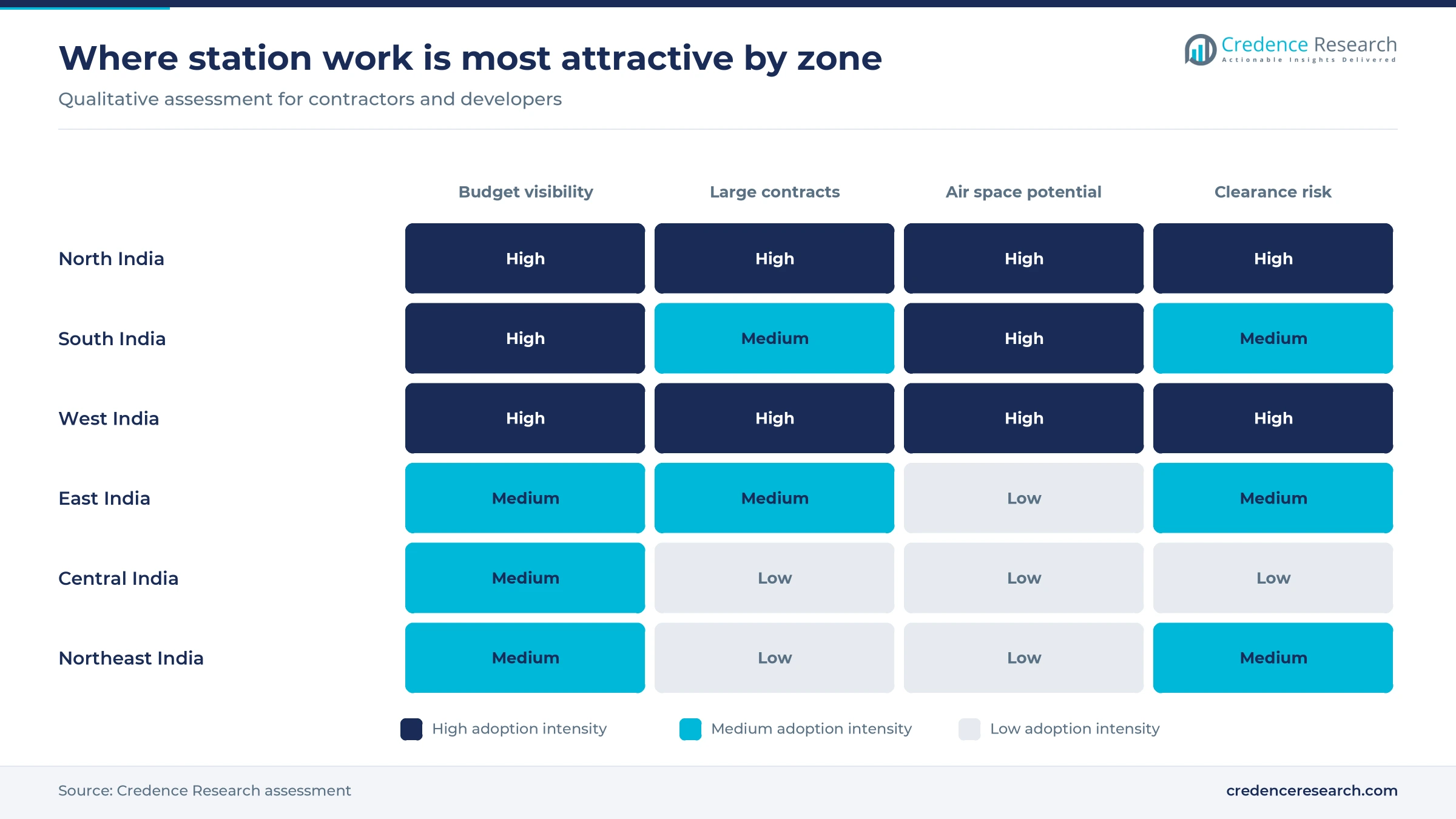
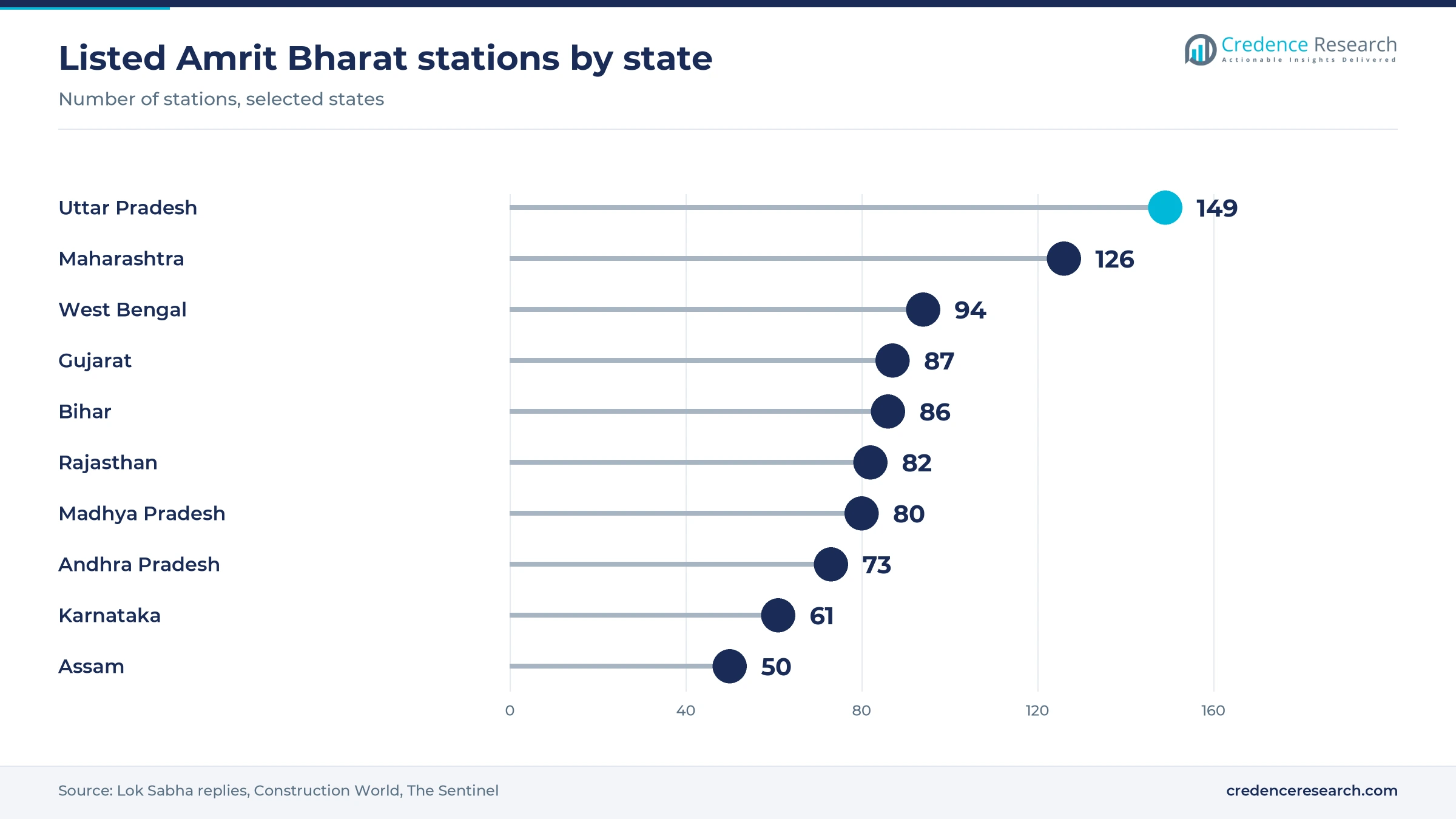
North India held 34.0% of 2025 value and grows at 3.79% a year. Uttar Pradesh leads the list with 157 stations, according to a Dec. 3, 2025, Lok Sabha reply, and it contributed seven of the 75 stations inaugurated on July 17, 2026, according to Indian Infrastructure magazine. New Delhi, projected to serve 700,000 passengers a day, is the largest single site. Slower growth reflects early completions, while the Bodaki terminal near Greater Noida and Ambala Cantonment extend the pipeline.
South India pairs steady zonal budgets with air space deals
South India held 22.0% of 2025 value and grows at 4.09% a year. Andhra Pradesh has 73 listed stations and Karnataka has 61, according to Lok Sabha replies. South Western Railway spent Rs 468 crore of its Rs 572 crore allocation by December 2025, which shows strong budget use. Tirupati adds commercial floors, while Kerala delivered six of the stations inaugurated in July 2026. Ernakulam and Chennai Egmore were reported at advanced stages early that year.
West India carries two of the biggest terminal contracts
West India held 20.0% of 2025 value and grows at 3.99% a year. Gujarat lists 87 stations, according to Construction World, but value concentrates in a few large rebuilds. Mumbai CSMT is projected to serve 1.5 million passengers a day, and Ahmedabad 310,000. Surat, estimated at Rs 1,475 crore in February 2023 with Gujarat government funding, targets a Platinum green rating and adds further high-value building work to the region.
East India grows on a broad base of small packages
East India held 13.0% of 2025 value and grows at 4.19% a year. Bihar lists 98 stations, according to a Dec. 4, 2024, Lok Sabha reply, which gives the region a broad base of smaller packages. Odisha accounted for seven of the stations inaugurated in July 2026, and Bhubaneswar and Gaya are named among key sites. Ranchi, a Rs 447 crore project, shows that the region also holds larger building contracts for national contractors.
Central India benefits from early commissioning and new sites
Central India held 8.0% of 2025 value and grows at 4.09% a year. Madhya Pradesh lists 80 stations and delivered 13 of the 75 stations inaugurated in July 2026, the highest count of any state. Rani Kamlapati in Bhopal was among the first stations commissioned under the Rail Land Development Authority. Gwalior and Nagpur were at advanced stages in early 2026, while holding areas at Ujjain, Sehore and Bhopal add new civil work.
Northeast India starts small but grows from a low base
Northeast India held 3.0% of 2025 value and grows at 4.79% a year, the fastest pace among the zones. ANI reported in March 2025 that 60 stations are being rebuilt in the region, with 50 in Assam. The Sentinel said tenders were awarded for 47 of those by April 2025. The Morung Express put Assam investment at Rs 2,101 crore in January 2026, and Haibargaon became the first completed Assam station in May 2025.
Awards, leases and inaugurations mark the last two years
| Development | Status and market relevance |
|---|---|
| In November 2024, the Rail Land Development Authority invited bids for 36,640 square meters of air space above the Tirupati south side building on a 60-year lease. | Reported by NBM&CW; shows the commercial model for rebuilt stations |
| In February 2025, the authority awarded the New Delhi station EPC contract to an HG Infra and DEC Infrastructure joint venture at Rs 2,195.68 crore. | Under execution with a 45-month period |
| In February 2026, the authority issued a notice for about 358,568 square feet of retail, office and hotel space at Lucknow on a 45-year lease. | Bid deadline set for April 14, 2026 |
| In July 2026, 75 redeveloped Amrit Bharat stations across 20 states were inaugurated, led by 13 in Madhya Pradesh and eight in Rajasthan. | Completed; the count rose to 261 stations by late July 2026 |
| In October 2026, the railway ministry described holding areas at Udhna, Anand Vihar, Ayodhya and Haridwar ahead of the festival season. | Further sites under construction, including Ujjain and Sabarmati |
Concourses, precast and green ratings shape station design
- Air concourses span the tracks and now anchor large plans, with New Delhi designed for 73,749 square meters and Ahmedabad for 54,160 square meters of concourse area.
- Precast components came up in the June 2026 review of Borivali, Ambala Cantonment and Mangaluru Central as a way to shorten work beside running lines.
- Passenger systems are part of the amenity list, because real-time information platforms are written into master plans alongside lounges and kiosks at listed stations.
- Green ratings appear in the largest budgets, since Surat targets a Platinum rating while Bengaluru Cantonment plans solar power, rainwater harvesting and a sewage treatment plant in its Rs 480 crore scope.
Need a Custom Version of This Report?
Tailor the scope, geography, or segments to your exact requirements.
- Custom geography or segment scope
- Direct access to our analyst team
Civil contractors compete for owners RLDA and zonal railways
The market is fragmented in its long tail and concentrated at the top, because a handful of civil contractors can execute terminals worth more than Rs 2,000 crore. The Rail Land Development Authority and the zonal railways act as owners and set terms through EPC tenders. Competition turns mainly on price, as the three Ahmedabad bids from Afcons, NCC and Larsen & Toubro showed in April 2023, and on the ability to work beside running trains. Ahluwalia Contracts holds Mumbai CSMT, and the HG Infra and DEC Infrastructure joint venture holds New Delhi. Varindera Construction received the Bengaluru Cantonment package, which shows that private regional builders also win sizable work. NCC adds related experience through nine Bengaluru suburban stations won at Rs 580.74 crore in April 2025. Experience with commercial building projects increasingly helps bidders as tenders add leasable floors.
Companies profiled and their roles in this market
| Company | Type | Role in the market |
|---|---|---|
| Rail Land Development Authority | Owner and tendering agency | Manages 104 stations, including New Delhi, Ahmedabad and Mumbai CSMT, and leases air space |
| Zonal railways | Owners | Manage Plan Head-53 budgets and most Amrit Bharat packages |
| HG Infra Engineering and DEC Infrastructure | EPC joint venture | Won the New Delhi contract at Rs 2,195.68 crore in February 2025 |
| Ahluwalia Contracts | EPC contractor | Awarded Mumbai CSMT at Rs 2,450 crore in 2023 |
| Afcons Infrastructure | EPC contractor | Lowest bidder at Rs 5,355 crore in the scrapped April 2023 Ahmedabad tender |
| DRA Infracon and Delhi Metro Rail Corporation | EPC joint venture | Lowest bidder in the Ahmedabad retender at Rs 2,383.59 crore in November 2023 |
| NCC | EPC contractor | Bid in the scrapped April 2023 Ahmedabad tender; building nine Bengaluru suburban stations |
| Larsen & Toubro | EPC contractor | Bid Rs 5,770 crore in the scrapped April 2023 Ahmedabad tender |
| Varindera Construction | EPC contractor | Received the Bengaluru Cantonment package of about Rs 480 crore |
Delivery capacity decides the pace after the budget peak
Credence Research's view is that delivery capacity, rather than demand, now sets the pace of this market. Station redevelopment budgets near Rs 12,000 crore a year can fund the remaining 1,079 stations, yet the largest terminals have multiyear schedules that run past 2028. Two practical tests for station redevelopment stand out in the next three years, namely whether Plan Head-53 keeps pace with larger concourse work and whether air space tenders at Prayagraj and Lucknow attract developers on commercial terms. Success on both would support faster growth for Commercial, and failure would keep the market dependent on public funds.
How the station works estimate was built
The report uses 2025 as the base year and forecasts to 2035. Station redevelopment values come from the Credence Research model, checked against Plan Head-53 allocations and spending, published contract values and the budgets of major stations. Program, scope and regional splits are Credence Research estimates informed by listed station counts by state and named project budgets. Sources are parliamentary replies, ministry statements, World Bank data and trade press reports of tenders and awards. No interviews or surveys were conducted at any stage of this report.
Commercial floors and transit hubs lead the next decade
Spending should reach USD 2.28 billion by 2035 as the mix moves from many small Amrit Bharat packages to fewer, more complex terminals. With 261 of 1,337 listed stations complete by late July 2026, most of the list is still to come, and later growth depends on new lists such as the Standing Committee's call for coverage in backward and rural areas. Commercial floors and multimodal hubs such as Bodaki should take a larger share of value. In turn, Northeast India should keep the fastest growth, though it remains the smallest region.
Frequently Asked Questions
How big is the India railway station redevelopment market?
What is driving spending on Indian station projects?
Which program holds the largest share?
Which work package is growing fastest?
Which region leads the market?
How many stations have been completed so far?
Who are the main companies in this market?
What are the biggest challenges for contractors?
Table of Content
Chapter 1 Market Segmentation
- 1.1 Segmentation Framework
- 1.1.1 Product and Service Classification
- 1.1.2 Application and End-Use Classification
- 1.1.3 Technology and Solution Classification
- 1.1.4 Customer and Distribution Channel Classification
- 1.1.5 Geographic Segmentation
- 1.1.6 Market Segment Definitions and Boundaries
- 1.2 By Program
- 1.2.1 Amrit Bharat Stations
- 1.2.2 Major Station PPP
- 1.3 By Scope
- 1.3.1 Buildings
- 1.3.2 Roof Plazas
- 1.3.3 MEP
- 1.3.4 Commercial
Chapter 2 Introduction
- 2.1 Report Objectives and Scope
- 2.2 Product Definition and Industry Terminology
- 2.3 Market Inclusions and Exclusions
- 2.4 Research Process
- 2.4.1 Primary Research and Expert Interviews
- 2.4.2 Secondary Research and Source Review
- 2.4.3 Top-Down and Bottom-Up Estimation
- 2.4.4 Data Triangulation and Verification
- 2.5 Market Size Measurement Basis
- 2.5.1 2025: USD 1.50 billion → 2035: USD 2.28 billion
- 2.6 Historical and Forecast Reference Periods
- 2.6.1 Historical Period: 2018-2025
- 2.6.2 Base Year: 2025
- 2.6.3 Forecast Period: 2025-2035
- 2.7 Research Assumptions and Limitations
Chapter 3 Executive Summary
- 3.1 Market Snapshot and Key Findings
- 3.2 Base-Year Market Size, 2025
- 3.3 Forecast Market Size, 2035
- 3.4 Revenue and Volume Growth Outlook
- 3.5 Key Demand and Supply Indicators
- 3.6 Leading Market Segments
- 3.7 Fastest-Growing Market Opportunities
- 3.8 Regional Performance Highlights
- 3.9 Technology and Industry Transformation
- 3.10 Competitive Landscape Summary
- 3.11 Analyst View and Strategic Implications
Chapter 4 India Railway Station Redevelopment Market Trends and Developments
- 4.1 Historical Industry Development, 2018-2025
- 4.2 Recent Market Trends and Developments
- 4.3 Demand and Customer Behavior Trends
- 4.4 Technology and Product Innovation
- 4.5 Artificial Intelligence, Automation and Digitalization
- 4.6 Local Manufacturing and Supply Chain Realignment
- 4.7 Industry Partnerships, Mergers and Acquisitions
- 4.8 Sustainability and Circular Economy Developments
- 4.9 Government and Private Sector Investment Trends
- 4.10 Emerging Business Models and Commercialization
- 4.11 Industry Developments and Announcements
Chapter 5 India Railway Station Redevelopment Market Production, Supply and Demand Analysis
- 5.1 Demand Trend and Consumption Analysis, 2018-2025
- 5.2 Demand Forecast, 2025-2035
- 5.3 Production and Output Trend, 2018-2025
- 5.4 Production and Output Forecast, 2025-2035
- 5.5 Installed Capacity and Capacity Utilization
- 5.6 Company-Wise Production Plants and Statistics
- 5.6.1 Installed Production Capacity
- 5.6.2 Actual Production
- 5.6.3 Planned Capacity and Expansion Targets
- 5.7 Supply Chain Structure and Procurement Trends
- 5.8 Supply-Demand Gap and Bottlenecks
- 5.9 Import Dependence and Sourcing Structure
- 5.10 Contract Manufacturing and Outsourcing
- 5.11 Regional Supply and Demand Concentration
Chapter 6 India Railway Station Redevelopment Market Pricing Analysis
- 6.1 Pricing Structure and Measurement
- 6.2 Historical Pricing Trends, 2018-2025
- 6.3 Pricing Outlook, 2025-2035
- 6.4 Average Selling Price and Unit Economics
- 6.5 Pricing by Product and Market Segment
- 6.6 Geographic Pricing Differences
- 6.7 Key Input, Energy, Labor and Logistics Costs
- 6.8 Contract Pricing and Purchasing Models
- 6.9 Pricing Sensitivity and Competitive Positioning
- 6.10 Price, Margin and Profitability Implications
Chapter 7 India Railway Station Redevelopment Market Dynamics
- 7.1 Market Growth Drivers
- 7.1.1 Demand-Side Drivers
- 7.1.2 Technology and Innovation Drivers
- 7.1.3 Infrastructure and Investment Drivers
- 7.1.4 Regulatory and Policy Drivers
- 7.2 Market Restraints
- 7.2.1 Cost and Affordability Constraints
- 7.2.2 Technology and Adoption Barriers
- 7.2.3 Supply Chain and Operational Constraints
- 7.3 Market Challenges
- 7.3.1 Competitive Pressure and Margin Erosion
- 7.3.2 Skills, Infrastructure and Implementation Gaps
- 7.4 Emerging Market Opportunities
- 7.5 Market Dynamics Impact and Time-Horizon Assessment
Chapter 8 India Railway Station Redevelopment Value Chain Analysis
- 8.1 Industry Value Chain Overview
- 8.2 Upstream Suppliers and Critical Inputs
- 8.3 Technology and Component Providers
- 8.4 Manufacturing or Service Delivery
- 8.5 Distribution, Channel Partners and Integrators
- 8.6 Downstream Applications and End Users
- 8.7 Value Addition and Profit Pools
- 8.8 Vertical Integration and Outsourcing
- 8.9 Supplier Concentration and Risk
- 8.10 Supply Chain Localization and Resilience
Chapter 9 India Railway Station Redevelopment Market Regulations and Policies
- 9.1 Relevant Laws, Standards and Compliance Frameworks
- 9.2 Product, Service, Safety and Quality Requirements
- 9.3 Government Policies, Incentives and Subsidies
- 9.4 Imports, Exports and Trade Barriers
- 9.5 Public Procurement and Local Content Requirements
- 9.6 Environmental and Sustainability Compliance
- 9.7 Upcoming Policy Changes and Market Implications
Chapter 10 India Railway Station Redevelopment Market Hotspots and Opportunities
- 10.1 Market Opportunity Mapping and Growth Hotspots
- 10.2 High-Growth Applications and Customer Groups
- 10.3 Underserved Markets and White-Space Opportunities
- 10.4 Emerging Technology and Product Opportunities
- 10.5 New Capacity and Investment Hotspots
- 10.6 Market Entry and Expansion Opportunities
- 10.7 Distribution and Partnership Opportunities
- 10.8 Near-Term and Long-Term Commercial Potential
- 10.9 Opportunity Attractiveness and Execution Risks
Chapter 11 India Railway Station Redevelopment Market Outlook, 2025-2035
- 11.1 Market Size and Analysis
- 11.1.1 Revenue (Market Measurement: 2025: USD 1.50 billion → 2035: USD 2.28 billion)
- 11.1.2 Market Volume and Quantity Sold
- 11.1.3 Historical Market Size, 2018-2025
- 11.1.4 Base-Year Market Size, 2025
- 11.2 Market Forecast, 2025-2035
- 11.2.1 Revenue Forecast to 2035
- 11.2.2 Volume Forecast to 2035
- 11.2.3 CAGR and Year-on-Year Growth
- 11.2.4 Incremental Revenue Opportunity
- 11.3 Forecast Assumptions and Scenario Analysis
- 11.3.1 Base-Case Forecast
- 11.3.2 Optimistic and Conservative Scenarios
- 11.3.3 Technology, Pricing and Policy Sensitivities
- 11.4 Market Attractiveness and Growth Outlook
Chapter 12 India Railway Station Redevelopment Market Segmentation and Outlook
- 12.1 Segmentation Summary and Market Shares, 2025
- 12.2 Largest and Fastest-Growing Segments
- 12.3 By Program - Market Size and Forecast, 2025-2035
- 12.3.1 Segment Definition and Scope
- 12.3.2 Historical Market Size, 2018-2025
- 12.3.3 Revenue Forecast, 2025-2035
- 12.3.4 Volume Forecast, 2025-2035
- 12.3.5 Base-Year Market Share, 2025
- 12.3.6 Segment CAGR and Growth Drivers
- 12.3.7 Subsegment Market Size and Forecast
- 12.3.7.1 Amrit Bharat Stations
- 12.3.7.2 Major Station PPP
- 12.3.8 Subsegment Pricing and Adoption Trends
- 12.3.9 Leading Suppliers and Competition
- 12.3.10 Regional Demand and Opportunities
- 12.4 By Scope - Market Size and Forecast, 2025-2035
- 12.4.1 Segment Definition and Scope
- 12.4.2 Historical Market Size, 2018-2025
- 12.4.3 Revenue Forecast, 2025-2035
- 12.4.4 Volume Forecast, 2025-2035
- 12.4.5 Base-Year Market Share, 2025
- 12.4.6 Segment CAGR and Growth Drivers
- 12.4.7 Subsegment Market Size and Forecast
- 12.4.7.1 Buildings
- 12.4.7.2 Roof Plazas
- 12.4.7.3 MEP
- 12.4.7.4 Commercial
- 12.4.8 Subsegment Pricing and Adoption Trends
- 12.4.9 Leading Suppliers and Competition
- 12.4.10 Regional Demand and Opportunities
- 12.5 Segment Growth Comparison
- 12.6 Segment Attractiveness and Priority Matrix
Chapter 13 India Railway Station Redevelopment Geographic Market Outlook, 2025-2035
- 13.1 Domestic Market Distribution and Demand Clusters
- 13.2 State- or Province-Wise Market Size and Forecast, 2025-2035
- 13.3 City and Metropolitan Market Outlook
- 13.4 Industrial, Manufacturing and Commercial Clusters
- 13.5 Geographic Concentration of Key End Users
- 13.6 Local Pricing and Purchasing Differences
- 13.7 Domestic Production Facilities and Capacity Map
- 13.8 Local Infrastructure and Project Pipeline
- 13.9 State-Level Policy and Incentive Differences
- 13.10 Subnational Investment Hotspots and Opportunities
- 13.11 Distribution and Logistics Networks
- 13.12 Domestic Competitive Footprint
Chapter 14 India Railway Station Redevelopment Technology, Innovation and Sustainability Outlook
- 14.1 Technology Landscape and Maturity
- 14.2 Product, Process and Service Innovation
- 14.3 AI, Automation and Digital Tools in the Industry
- 14.4 Technology Adoption and Performance Benchmarking
- 14.5 Innovation Pipeline and R&D Investment
- 14.6 Patent and Intellectual Property Trends
- 14.7 Energy Efficiency and Resource Management
- 14.8 Sustainability, Recycling and Circularity
- 14.9 Technology Roadmap, 2025-2035
- 14.10 Risks of Obsolescence and Technology Substitution
Chapter 15 India Railway Station Redevelopment Market Key Strategic Imperatives
- 15.1 Growth and Market Entry Priorities
- 15.2 High-Return Products and Segments
- 15.3 Pricing, Profitability and Cost Optimization
- 15.4 Technology Investment and Product Differentiation
- 15.5 Supply Chain Localization and Resilience
- 15.6 Distribution and Customer Acquisition
- 15.7 Partnership, Acquisition and Capacity Strategy
- 15.8 Regional Expansion Priorities
- 15.9 Short-, Medium- and Long-Term Actions
Chapter 16 Competition Outlook
- 16.1 Industry Competition Characteristics
- 16.2 Market Structure and Concentration
- 16.3 Market Share and Competitive Positioning, 2025
- 16.4 Company-Wise Revenue and Product Benchmarking
- 16.5 Production and Service Capacity Benchmarking
- 16.6 Technology, Pricing and Differentiation
- 16.7 Regional Footprint and Distribution Strength
- 16.8 Mergers, Acquisitions and Strategic Alliances
- 16.9 New Entrants and Competitive Threats
- 16.10 Porter's Five Forces and Industry Attractiveness
- 16.11 Competitive Outlook, 2025-2035
Chapter 17 Company Profiles
- 17.1 Company Coverage and Selection Criteria
- 17.2 Rail Land Development Authority
- 17.2.1 Business Description
- 17.2.2 Company Ownership and Geographic Presence
- 17.2.3 Product and Service Portfolio
- 17.2.4 Manufacturing and Operating Footprint
- 17.2.5 Production Capacity and Expansion Plans
- 17.2.6 Financial Performance and Investment
- 17.2.7 Market Share and Competitive Position
- 17.2.8 Technology and Innovation Capabilities
- 17.2.9 Strategic Alliances or Partnerships
- 17.2.10 Recent Developments
- 17.2.11 Growth Strategy and Outlook
- 17.3 Zonal Railways
- 17.4 Larsen & Toubro
- 17.5 NCC
- 17.6 Afcons Infrastructure
- 17.7 Ahluwalia Contracts
- 17.8 HG Infra Engineering
- 17.9 DEC Infrastructure
- 17.10 Varindera Construction
- 17.11 Other Relevant Market Participants
Note: Every listed company is profiled on the structure shown under the first company. The company list is preliminary and may change based on research findings, market developments, data availability and client requirements.
Chapter 18 Disclaimer
- 18.1 Research and Forecast Disclaimer
- 18.2 Data Source and Estimation Limitations
Note: The depth of individual sections depends on data availability for this market. Volume, capacity, trade and other unit-based metrics are included where applicable.

