
Project hire replaces owned fleets on Indian sites
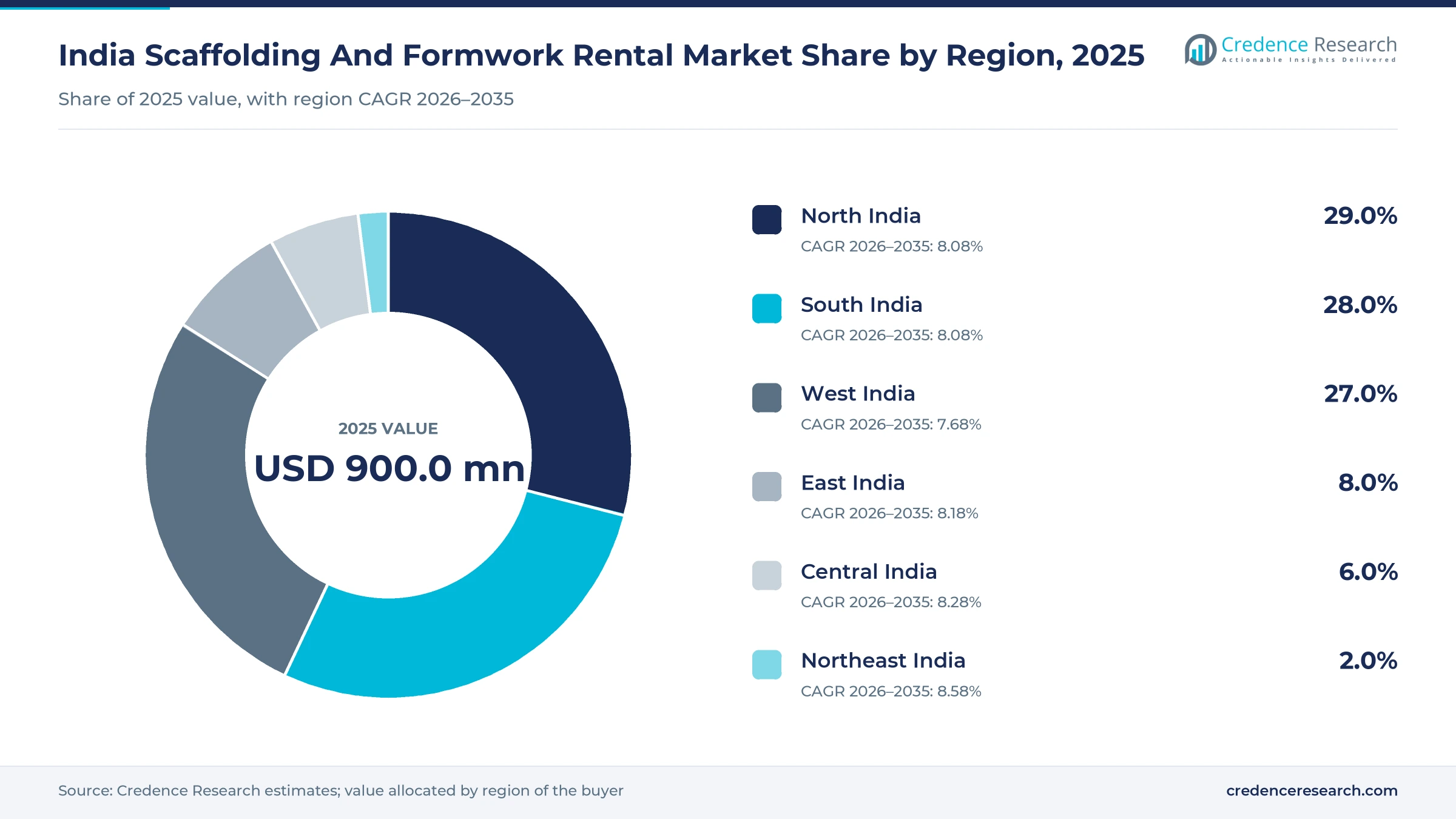
The India scaffolding and formwork rental market was valued at USD 900.0 million in 2025 and is projected to increase from USD 970.0 million in 2026 to USD 1.94 billion by 2035, registering a CAGR of 8.00% during 2026–2035. Contractors hire cuplock, ringlock and engineered forms by the month because bridge pylons, metro stations and repeat-floor towers need them for a fixed period and then release them. North India held the largest regional share, 29.0% in 2025, helped by Uttar Pradesh, which an HDFC Bank analysis reported by ANI in October 2025 ranks first for construction output at 12.5% of the national total. Northeast India is the fastest-growing region at 8.58% a year as railway projects worth about Rs 77,000 crore proceed there. The commercial change to watch is supply, since Technocraft, Knest, TeamTech and Msafe Equipments have all added forming or access capacity since 2024, and that output widens the fleet available to rental yards.
What do Indian contractors hire, and on what terms?
The market counts hire charges and sale-leaseback income on aluminium formwork, steel formwork and cuplock or ringlock scaffolding used on housing, infrastructure and industrial sites. Contractors usually take sets for the length of a project, return them at an agreed rate and pay for damage or loss, while large jobs often add engineering and site support from the supplier.
Outright equipment sales, timber and bamboo supports built by site labor and lifting machines such as boom lifts sit outside the estimate. The value chain runs from steel and extrusion mills to fabricators such as Technocraft and TeamTech, then to distributors and rental yards, and finally to engineering, procurement and construction contractors and builders.
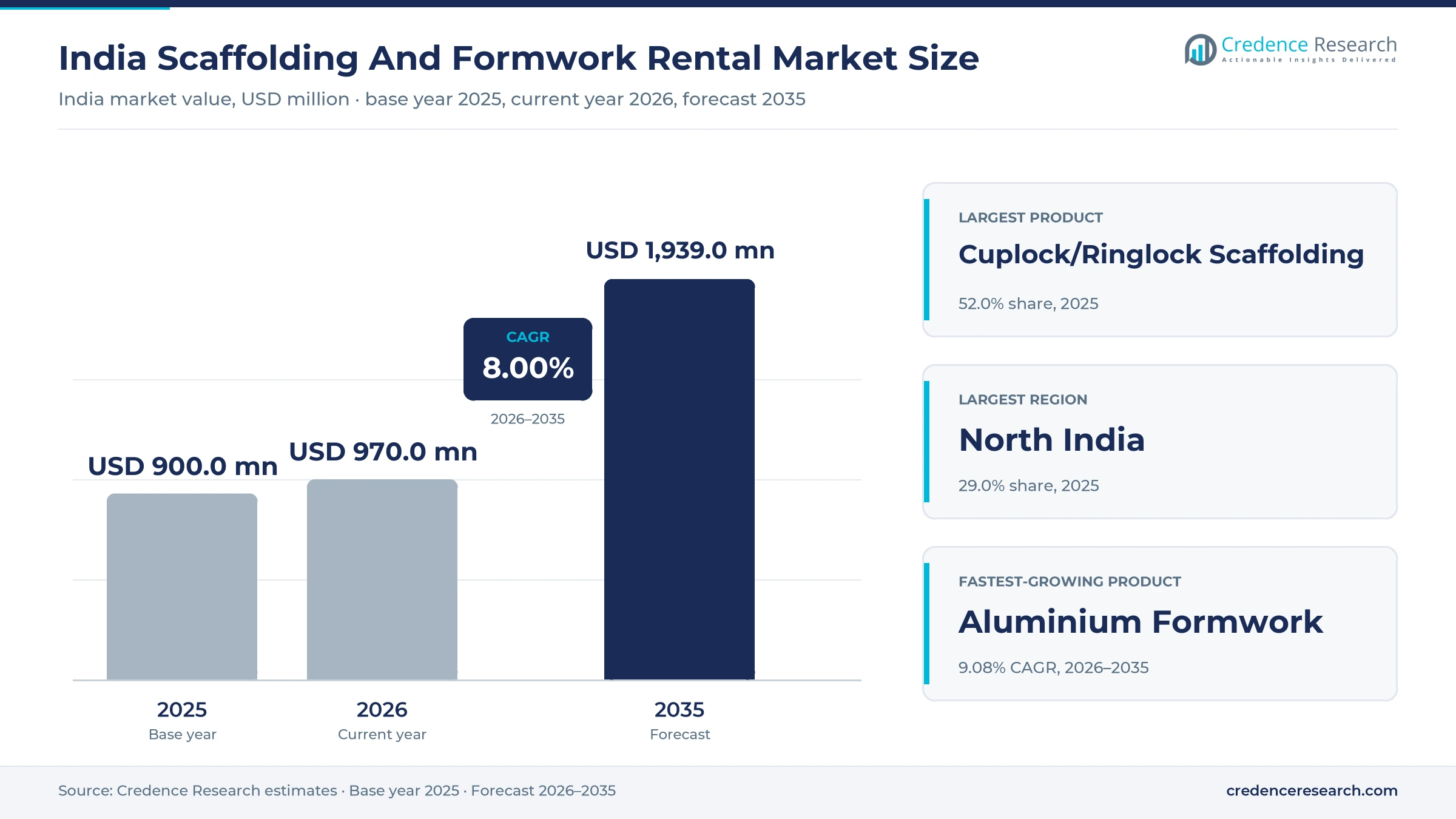
India Scaffolding And Formwork Rental Market Insights
- The market rises from USD 900.0 million in 2025 to USD 1.94 billion by 2035, an 8.00% CAGR over 2026–2035, as central capital spending and repeat-floor housing keep sets on hire.
- North India held 29.0% of 2025 value, with Uttar Pradesh accounting for 12.5% of national construction output in FY2024 according to an HDFC Bank analysis.
- Cuplock/Ringlock Scaffolding held 52.0% of 2025 value because access and shoring are hired on nearly every site, from thermal plants to residential towers.
- Technocraft reported near-full use of its Sambhaji Nagar plant in February 2026, with a worldwide Mach One order book of 350,000 to 400,000 square meters.
- TeamTech Formwork Solutions opened its IPO on May 19, 2026, to fund a plant that lifts capacity from 36,000 to about 104,000 square meters, adding to domestic rental supply.
Cuplock leads while aluminium formwork gains fastest
Why cuplock leads and aluminium formwork grows fastest
Based on product, the market is categorized into aluminium formwork, steel formwork and cuplock/ringlock scaffolding. Cuplock/Ringlock Scaffolding led with 52.0% of 2025 value because access and shoring are hired on nearly every site, and Msafe Equipments alone serves over 2,500 customers from 21 warehouses. Steel formwork stays central to heavy civil work, and TeamTech says its modular steel systems last about 200 cycles on jobs such as the Delhi-Mumbai Expressway. Aluminium Formwork grows fastest at 9.08% a year as repeat-floor towers adopt it, with Technocraft reporting a worldwide Mach One order book of 350,000 to 400,000 square meters in February 2026.
Why infrastructure leads and housing grows fastest
Based on end use, the market is categorized into housing, infrastructure and industrial. Infrastructure led with 41.0% of 2025 value because central projects need engineered sets for long periods, and the PAIMANA report from MoSPI counted 1,137 road projects worth Rs 10.81 trillion in April 2026. Housing grows fastest at 8.46% a year as sanctions under PMAY-U 2.0 reached 2.08 million houses in October 2026, while Cushman & Wakefield counted 75,283 new units across eight cities in the first quarter. Industrial hire follows plant builds such as the Ennore SEZ thermal project, where a 45-meter platform failed in September 2025.
Why rental dominates and sale-leaseback gains share
Based on model, the market is categorized into rental and sale-leaseback. Rental led with 91.0% of 2025 value because contractors pay only for the hire period, and the July 2026 TeamTech presentation lists project-duration hiring alongside panel refurbishment. Sale-Leaseback grows fastest at 9.18% a year from a small base as fleet owners seek cash for expansion, and financiers have a floor value because Msafe Equipments reports that scrap can recover 50% to 70% of manufacturing cost.
| Segment Group | Leading Sub-segment | Share, 2025 | Fastest-growing Sub-segment | CAGR, 2026–2035 |
|---|---|---|---|---|
| By Product | Cuplock/Ringlock Scaffolding | 52.0% | Aluminium Formwork | 9.08% |
| By End Use | Infrastructure | 41.0% | Housing | 8.46% |
| By Model | Rental | 91.0% | Sale-Leaseback | 9.18% |
Request a Free Sample
Fill in your details and we'll send you a free sample report.
- Sample data tables & charts
- Research methodology
Public works and tower cycles keep fleets on hire
Infrastructure and commercial projects lift formwork hire
Public works and building programs keep more formwork on hire because each pour needs engineered sets for a limited period. The Union Budget presented on Feb. 1, 2026, raised central capital expenditure to Rs 12.2 lakh crore, according to IANS. The PAIMANA flash report for April 2026 tracked 1,981 central sector projects worth Rs 42.78 trillion, including 1,137 road and 260 railway projects. NHAI then reported 5,313 km of national highways built in FY2025-26 against a 4,640 km target. In wider building construction, L&T announced an order for seven high-rise towers in Gurugram on April 23, 2026. In the Credence Research model this theme adds about 3.36 percentage points to annual growth to 2035.
Contractors favor renting over owning reusable systems
Renting suits Indian contractors because reusable systems are costly to hold between jobs and lose value through damage. The FY2025-26 management discussion of Msafe Equipments says an aluminum tower set can cost more than Rs 1 lakh before maintenance, storage and inspection, which pushes mid-sized builders toward hire. Technocraft management told investors on Feb. 12, 2026, that it avoids direct rental because of holding costs, low utilization and lost material, leaving that work to distributors. TeamTech Formwork Solutions offers project-duration hiring and panel refurbishment from its Telangana base. Msafe also reports annual rental yields of 60% to 66% on aluminum and 32% to 38% on mild steel, which explains why yards keep adding fleet. In the Credence Research model this adds about 2.08 percentage points to annual growth to 2035.
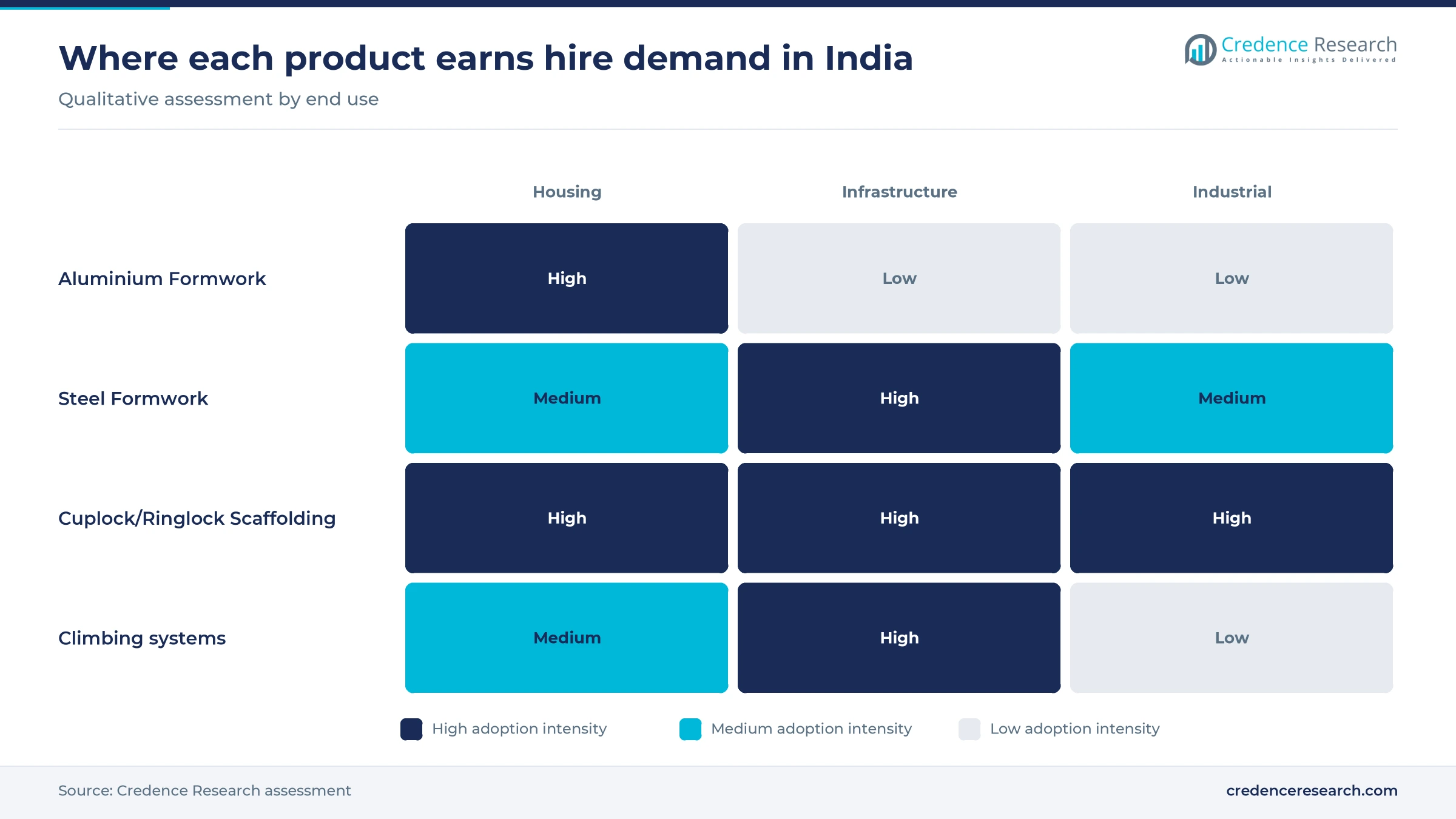
Faster-cycling modular systems support premium rates
Modular systems support higher hire rates because they shorten the floor cycle and reduce labor on repeat work. An industry report published by Msafe Equipments notes that Mumbai high-rise projects cut floor cycles from 15 to 18 days down to 5 to seven days with aluminum formwork, with panels reused more than 500 times. The July 2026 investor presentation from TeamTech compares 6 to 10 cycles for timber with about 200 cycles for its modular steel systems, and it estimates that about 80% of Indian construction still uses timber. Doka reported in July 2025 that its SKE100 plus and Xclimb 60 systems were forming pylons about 182 meters tall on the Missing Link bridge. In the Credence Research model this adds about 1.36 percentage points to annual growth to 2035.
Housing sanctions and tower launches add repeat-floor work
Housing adds volume because repeat-floor plans let a single set of forms move through a tower many times. The tenth sanctioning committee meeting for PMAY-U 2.0, reported by Organiser on Oct. 19, 2026, approved about 193,000 more houses and took the total to 2.08 million. Uttar Pradesh received 73,182 of those new approvals and Bihar 52,866. Cushman & Wakefield counted 75,283 new units in eight cities during the first quarter of 2026, led by Mumbai with 19,775, which supports contractor demand across the real estate cycle. World Bank data show gross fixed capital formation at 31.7% of GDP in 2025, which shows how much of national output is going into fixed assets such as buildings and works.
Domestic capacity and listed yards reshape supply
Shift of aluminum forming capacity to domestic plants
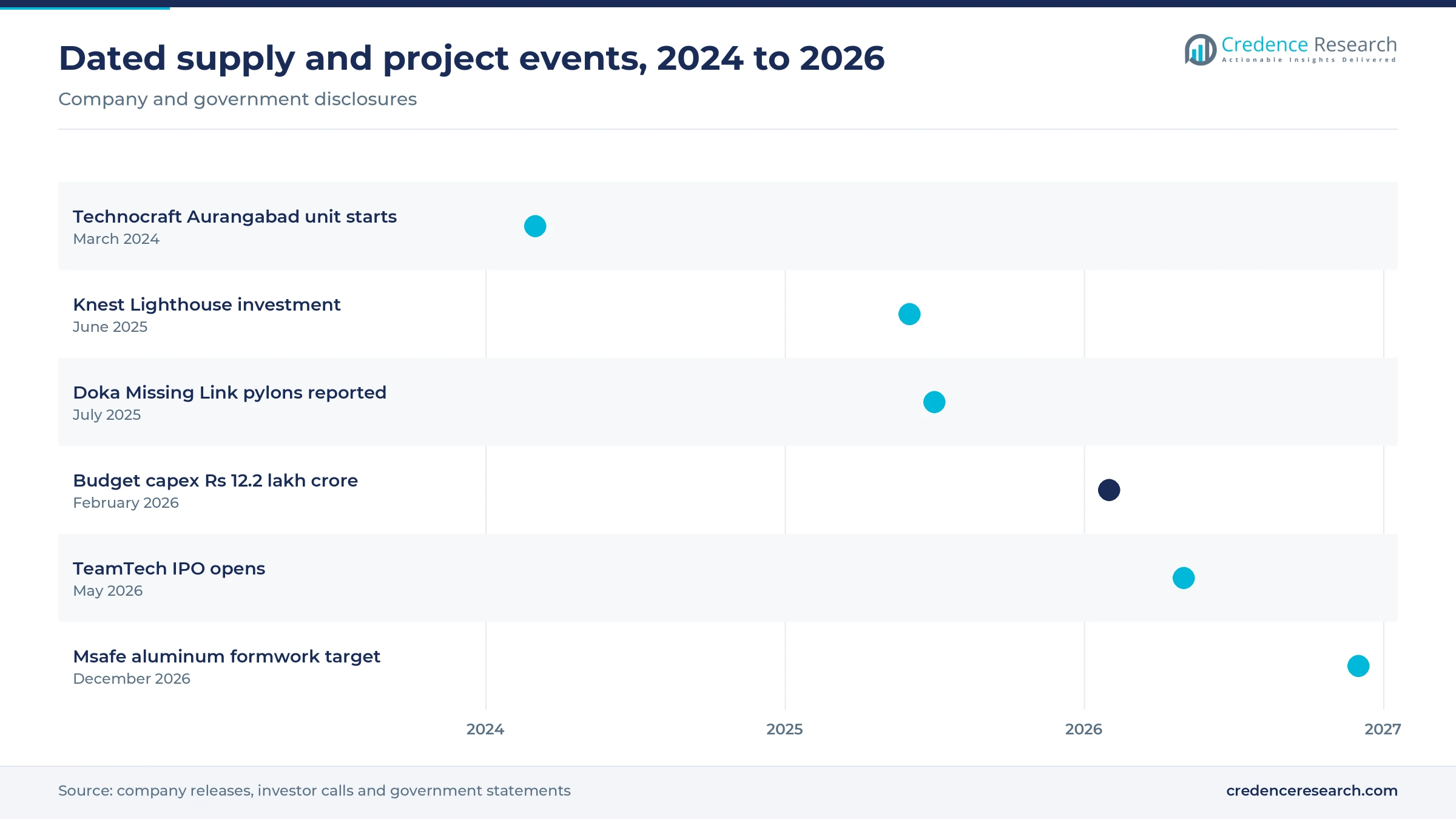
Domestic plants are replacing imported aluminum forms, which shortens lead times for rental yards and their distributors. Technocraft began phased production at a 600,000 square meter fabrication unit in Aurangabad in March 2024, according to AL Circle, and its plant ran near full capacity by February 2026. Its management said Mach One output stood at about 75,000 square meters a month, with a second phase and another aluminum extrusion plant planned. Knest received Rs 300 crore from Lighthouse Funds in June 2025 and makes over 2 million square meters a year at plants in Maharashtra and Gujarat. Msafe Equipments targets 500 tons a year of aluminum formwork capacity from December 2026, so Aluminium Formwork supply should keep pace with its 9.08% growth.
Rise of listed and funded rental fleets
Equity funding is emerging as the route to larger rental fleets, because hire stock ties up capital for years before it pays back. Msafe Equipments listed in FY2025-26 and now runs three manufacturing facilities and 21 warehouses, with an integrated plant targeted for May 2027. TeamTech Formwork Solutions opened its NSE Emerge IPO on May 19, 2026, and its new facility is due to lift capacity from 36,000 to about 104,000 square meters. TeamTech draws 60% to 65% of its business from repeat orders and referrals, according to a May 2026 agency report in Lokmat Times. Technocraft said in February 2026 that it is widening its distributor base, which feeds more stock into the 91.0% share held by rental.
Opportunity in replacing timber and bamboo on smaller sites
Replacing timber and bamboo on mid-size sites is a clear opening for organized yards, because safety pressure now reaches smaller builders. Telangana Today reported on March 5, 2026, that two workers died at Tolichowki in Hyderabad when a wooden support gave way, and police suspected worn bamboo sticks. TeamTech estimates that about 80% of Indian construction still uses timber formwork, which leaves a large base to convert, and it rates timber at 6 to 10 cycles against about 200 for modular steel. Msafe Equipments names Indore and Bhubaneswar among the cities where small contractors are renting. In September 2026, the Supreme Court issued notice on a construction safety petition and suggested linking safety compliance to planning licenses, which would favor certified rental stock if adopted.
Opportunity for rental fleets on rail and metro corridors
Rail and metro corridors offer yards a long run of repeat work because stations and viaducts use standard sets for years. The PAIMANA report added Bangalore Metro Phase Three, at Rs 156.11 billion, to its tracked list in April 2026. Construction World reported in February 2025 that the HCC-TPL joint venture was the lowest bidder at Rs 2,190.91 crore for an Indore package with 8.626 km of underground tunnels and seven stations. PERI delivered about 480 tons of formwork and scaffolding to the BKC station on Mumbai Metro Line 3 by May 2020, which shows the tonnage a single station can absorb. TeamTech also lists the Mumbai-Ahmedabad high-speed rail line among its projects, so Infrastructure work should stay on hire well beyond 2030.
Monsoon idling and site safety squeeze rental yards
Monsoon months leave fleets idle
Seasonal idling is the sharpest cost, because yards pay for storage and finance whether or not stock is out. An industry report published by Msafe Equipments says rental utilization can fall below 40% in Kerala and Maharashtra from June to September. West and South India are therefore most exposed to the gap. Larger fleets respond by moving stock between regions and booking covered industrial work, though freight costs absorb part of that benefit.
Site failures raise liability for suppliers
Site failures raise liability and insurance risk for every party in the chain. On Sept. 30, 2025, nine migrant workers died at the Ennore SEZ thermal project when a platform about 45 meters high gave way, according to The South First, and police booked a contractor. In September 2026, the Supreme Court issued notice on a construction safety petition. Suppliers respond with inspection records and erection training, which adds cost that small yards struggle to recover.
Steel and aluminum costs move fleet prices
Metal costs feed directly into fleet replacement because scaffolding and forms are mostly steel and aluminum. The finance ministry set a safeguard duty on flat steel imports at 12%, 11.5% and 11% across the three years to April 2028, Argus reported on Dec. 31, 2025. Technocraft told investors in February 2026 that its aluminum contracts follow NALCO prices with no fixed rate. Yards that buy at a price peak therefore carry higher costs until hire rates catch up.
Fragmented supply pressures hire rates
Fragmented supply holds down hire rates because many yards compete on price rather than engineering. Technocraft said on Feb. 12, 2026, that some less organized suppliers are entering aluminum formwork, and it expects weaker players to exit within one to two years. Technocraft also named damage and lost material as reasons it avoids rental. Yards that cannot track stock therefore lose margin twice, through low rates and through write-offs, while buyers benefit in the short term.
North India leads as the Northeast grows from a low base
| Region | Value, 2025 (USD million) | Share, 2025 | CAGR, 2026–2035 |
|---|---|---|---|
| North India | 261.0 | 29.0% | 8.08% |
| South India | 252.0 | 28.0% | 8.08% |
| West India | 243.0 | 27.0% | 7.68% |
| East India | 72.0 | 8.0% | 8.18% |
| Central India | 54.0 | 6.0% | 8.28% |
| Northeast India | 18.0 | 2.0% | 8.58% |
North India leads on Uttar Pradesh and NCR towers
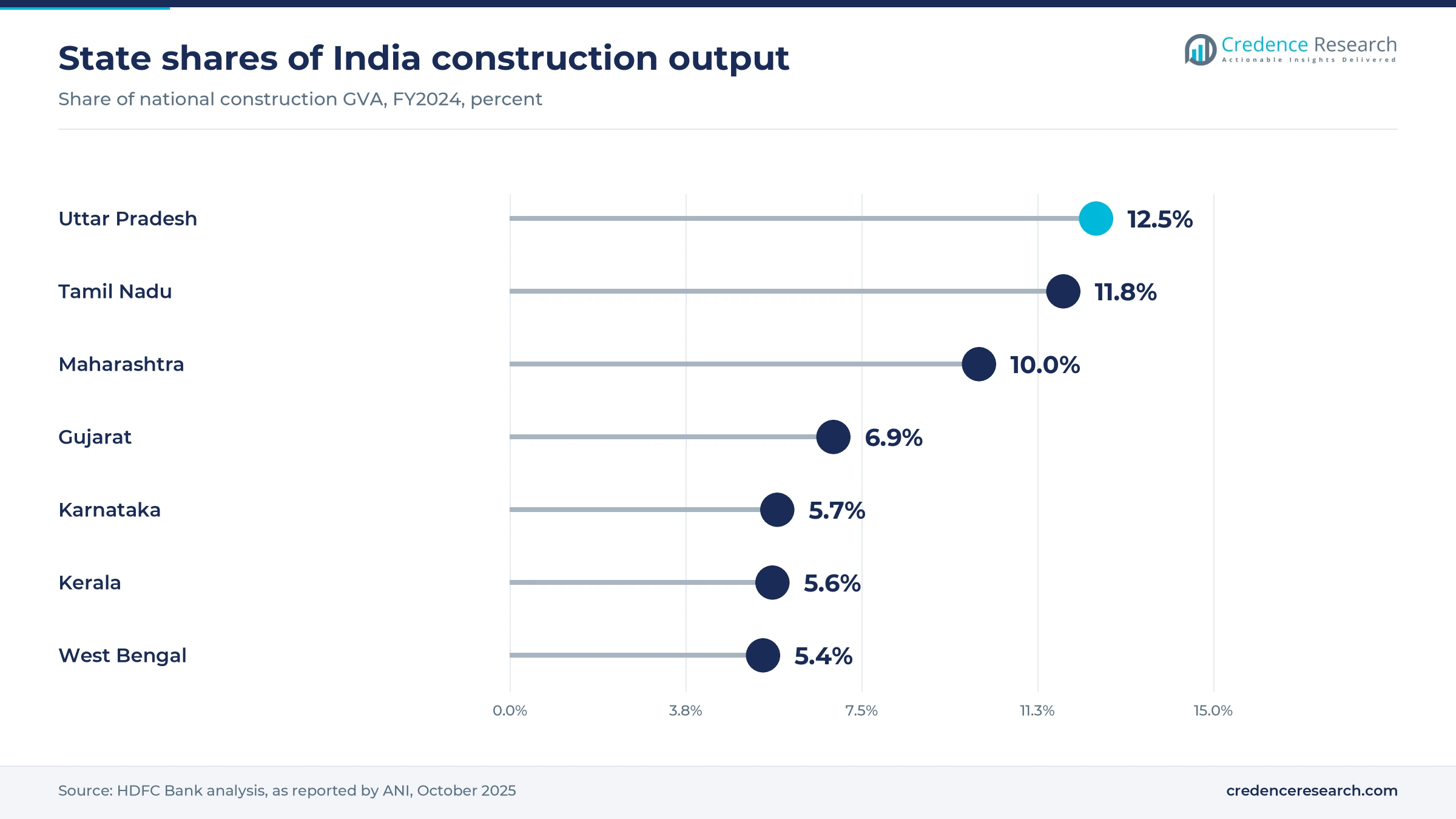
North India held a 29.0% share of 2025 value and grows at 8.08% a year, supported by the largest construction base of any zone. The HDFC Bank analysis reported by ANI placed Uttar Pradesh first with 12.5% of national construction output in FY2024. Uttar Pradesh also received 73,182 of the houses approved under PMAY-U 2.0 in October 2026. In Gurugram, L&T is building seven towers for Oberoi Realty, and Delhi NCR recorded 9,677 launches in the first quarter of 2026.
South India gains from metro work and Bengaluru launches
South India held 28.0% of 2025 value and grows at 8.08% a year, with Tamil Nadu alone at 11.8% of national construction output and Karnataka at 5.7% in FY2024. Bengaluru recorded 12,664 launches and Hyderabad 9,126 in the first quarter of 2026, while Bangalore Metro Phase Three entered the central project list that April. ULMA said in January 2025 that its India work centers on the South and West, and TeamTech builds its modular steel systems in Telangana.
West India anchors high-rise and aluminum supply
West India held 27.0% of 2025 value and grows at 7.68% a year, slightly below the national rate because its fleet base is already mature and monsoon idling is severe. Mumbai recorded 19,775 launches in the first quarter of 2026, its highest in 14 quarters, and Pune added 11,371. The Missing Link project on the Mumbai-Pune Expressway uses Doka climbing systems. Technocraft and Knest also make aluminium formwork in the zone, which shortens delivery to local yards.
East India grows on housing sanctions and Kolkata launches
East India held an 8.0% share of 2025 value and grows at 8.18% a year as public housing reaches states with few organized yards. Bihar received 52,866 of the PMAY-U 2.0 approvals in October 2026, West Bengal 16,559 and Odisha 3,126. Kolkata launches rose 48% from the previous quarter to 2,222 units in early 2026, while West Bengal held 5.4% of national construction output in FY2024. Msafe Equipments names Bhubaneswar among its small contractor rental markets.
Central India rises on Madhya Pradesh metro packages
Central India held a 6.0% share of 2025 value and grows at 8.28% a year, led by metro work in Madhya Pradesh. Construction World reported in February 2025 that the Indore underground package covers 8.626 km of twin tunnels and seven stations, with a lowest bid of Rs 2,190.91 crore. Chhattisgarh also received 4,670 PMAY-U 2.0 approvals in October 2026. Msafe Equipments also names Indore as a growing city for small contractor hire, which supports local yard expansion.
Northeast India grows fastest from a small rail-led base
Northeast India held a 2.0% share of 2025 value and grows at 8.58% a year, the fastest rate of any zone from the smallest base. A Press Information Bureau factsheet lists railway projects worth about Rs 77,000 crore under way, including the 44.96 km Sevok-Rangpo line targeted for December 2027. The 51 km Bairabi-Sairang line in Mizoram cost over Rs 8,070 crore. Distance from the main fabrication clusters in West and South India raises freight on any hired stock.
Plants, listings and pylons mark the past three years
| Development | Status and market relevance |
|---|---|
| In March 2024, Technocraft Formwork began phased aluminum fabrication at a new 600,000 square meter unit in Aurangabad. | Operating, near full use by February 2026 |
| In June 2025, Knest received Rs 300 crore from Lighthouse Funds to support its aluminum formwork plants. | Completed, plants in Maharashtra and Gujarat |
| In July 2025, Doka reported supplying climbing systems for four pylons about 182 meters tall on the Missing Link bridge. | Project ongoing for MSRDC with Afcons |
| In May 2026, TeamTech Formwork Solutions opened its IPO on NSE Emerge from May 19 to May 21. | Proceeds fund a new plant and debt repayment |
| In December 2026, Msafe Equipments is due to start 500 tons a year of aluminum formwork capacity. | Planned, per its FY2025-26 management discussion |
Climbing, modular and panel systems set rental value
- Automatic climbing formwork lifts itself up pylons and core walls, as Doka SKE100 plus does on the Missing Link bridge, which suits long hires on tall structures.
- Aluminum monolithic panels cast walls and slabs together, and Technocraft says real estate developers and construction contractors are its domestic customers.
- Modular steel panels carry heavier pour pressures for civil work, and TeamTech offers its T-formwork system for sale, rental and refurbishment.
- Hydraulic perimeter screens enclose working floors on towers, and ULMA says its HWS screen covers three floors below the working level.
Need a Custom Version of This Report?
Tailor the scope, geography, or segments to your exact requirements.
- Custom geography or segment scope
- Direct access to our analyst team
Global engineers and local yards compete by project
Competition splits between global engineering groups and domestic fabricators and yards. Doka, PERI and ULMA win complex pylons, stations and core walls by pairing equipment with design and site support, as PERI did on the BKC station of Mumbai Metro Line 3. MFE Formwork lists India among its project markets, including Ekana Stadium, while Kumkang Kind holds an Indian subsidiary registered in Pune. Domestic groups compete on delivery and price, and Technocraft sells outright while distributors rent its material. Msafe Equipments and TeamTech Formwork Solutions run their own hire fleets, and they sit alongside many local yards serving small contractors and construction equipment buyers in each city. Engineering depth wins the largest civil jobs, whereas stock availability and transport cost usually decide smaller residential hires.
Who supplies and rents forming systems in India
| Company | Type | Role in the market |
|---|---|---|
| Doka | Global formwork engineer | Climbing and large-area systems for the Missing Link bridge |
| PERI | Global formwork and scaffolding engineer | Supplied the BKC station on Mumbai Metro Line 3 |
| ULMA | Global formwork supplier | Modular and climbing systems for South and West India buildings |
| MFE Formwork | Aluminum formwork specialist | Lists Ekana Stadium among its Indian projects |
| Kumkang Kind | Aluminum form group | Pune-registered Indian subsidiary, incorporated in 2012 |
| Technocraft Industries | Domestic manufacturer | Mach One aluminum forms sold outright; Indian distributors rent its steel formwork and scaffolding |
| Msafe Equipments | Domestic scaffolding rental company | Three facilities and 21 warehouses, adding aluminum forms |
| TeamTech Formwork Solutions | Domestic forming and rental company | Modular steel systems for highway, metro and industrial work |
| Knest | Domestic aluminum formwork maker | Plants in Maharashtra and Gujarat, over 2 million square meters a year |
Fleet utilization will decide rental returns
Credence Research's view is that utilization, not demand, will separate strong rental yards from weak ones. India scaffolding and formwork rental demand rests on 1,981 central projects tracked in April 2026, yet monsoon idling can cut utilization below 40% in Maharashtra and Kerala. New forming capacity from Technocraft, Knest and TeamTech also gives contractors more choice each year. Yards that track every panel, place stock across regions and offer engineering support should hold their rates. Those relying on low prices alone face the shakeout that Technocraft expects within two years.
How fleet, project and housing data built this estimate
The India scaffolding and formwork rental estimate of USD 900.0 million for 2025 comes from the Credence Research model, and the report forecasts values to 2035. Regional, segment and model splits are Credence Research estimates, informed by housing sanctions, central project data and company disclosures. Sources include Indian government statistics and factsheets, World Bank data, company investor presentations, exchange documents, earnings calls and named trade publications. No interviews or surveys were conducted for this edition of the report. The lollipop chart uses an HDFC Bank analysis of state construction output as reported by ANI.
Rail, metro and housing work carry demand to 2035
The India scaffolding and formwork rental market is forecast to grow from USD 970.0 million in 2026 to USD 1.94 billion by 2035, at an 8.00% CAGR over 2026–2035. Rail, metro and highway work should keep infrastructure the largest end use, while PMAY-U 2.0 and tower launches lift housing fastest. Aluminum supply will deepen as Technocraft, Knest and Msafe Equipments add capacity, which may narrow the premium that fast-cycling systems now earn. Safety rules are the main swing factor, because stricter site licensing would move more mid-size work from bamboo and timber to certified hire stock.
Frequently Asked Questions
How big is the India scaffolding and formwork rental market?
Which product leads the market?
Which product grows fastest?
Which end use is the largest?
Which region holds the largest share?
Which region grows fastest?
Why do Indian contractors rent instead of buying?
What is the main challenge for rental yards?
Table of Content
Chapter 1 Market Segmentation
- 1.1 Segmentation Framework
- 1.1.1 Product and Service Classification
- 1.1.2 Application and End-Use Classification
- 1.1.3 Technology and Solution Classification
- 1.1.4 Customer and Distribution Channel Classification
- 1.1.5 Geographic Segmentation
- 1.1.6 Market Segment Definitions and Boundaries
- 1.2 By Product
- 1.2.1 Cuplock/Ringlock Scaffolding
- 1.2.2 Steel Formwork
- 1.2.3 Aluminium Formwork
- 1.3 By End Use
- 1.3.1 Infrastructure
- 1.3.2 Housing
- 1.3.3 Industrial
- 1.4 By Model
- 1.4.1 Rental
- 1.4.2 Sale-Leaseback
Chapter 2 Introduction
- 2.1 Report Objectives and Scope
- 2.2 Product Definition and Industry Terminology
- 2.3 Market Inclusions and Exclusions
- 2.4 Research Process
- 2.4.1 Primary Research and Expert Interviews
- 2.4.2 Secondary Research and Source Review
- 2.4.3 Top-Down and Bottom-Up Estimation
- 2.4.4 Data Triangulation and Verification
- 2.5 Market Size Measurement Basis
- 2.5.1 2025: USD 900.0 million → 2035: USD 1.94 billion
- 2.6 Historical and Forecast Reference Periods
- 2.6.1 Historical Period: 2018-2025
- 2.6.2 Base Year: 2025
- 2.6.3 Forecast Period: 2025-2035
- 2.7 Research Assumptions and Limitations
Chapter 3 Executive Summary
- 3.1 Market Snapshot and Key Findings
- 3.2 Base-Year Market Size, 2025
- 3.3 Forecast Market Size, 2035
- 3.4 Revenue and Volume Growth Outlook
- 3.5 Key Demand and Supply Indicators
- 3.6 Leading Market Segments
- 3.7 Fastest-Growing Market Opportunities
- 3.8 Regional Performance Highlights
- 3.9 Technology and Industry Transformation
- 3.10 Competitive Landscape Summary
- 3.11 Analyst View and Strategic Implications
Chapter 4 India Scaffolding And Formwork Rental Market Trends and Developments
- 4.1 Historical Industry Development, 2018-2025
- 4.2 Recent Market Trends and Developments
- 4.3 Demand and Customer Behavior Trends
- 4.4 Technology and Product Innovation
- 4.5 Artificial Intelligence, Automation and Digitalization
- 4.6 Local Manufacturing and Supply Chain Realignment
- 4.7 Industry Partnerships, Mergers and Acquisitions
- 4.8 Sustainability and Circular Economy Developments
- 4.9 Government and Private Sector Investment Trends
- 4.10 Emerging Business Models and Commercialization
- 4.11 Industry Developments and Announcements
Chapter 5 India Scaffolding And Formwork Rental Market Production, Supply and Demand Analysis
- 5.1 Demand Trend and Consumption Analysis, 2018-2025
- 5.2 Demand Forecast, 2025-2035
- 5.3 Production and Output Trend, 2018-2025
- 5.4 Production and Output Forecast, 2025-2035
- 5.5 Installed Capacity and Capacity Utilization
- 5.6 Company-Wise Production Plants and Statistics
- 5.6.1 Installed Production Capacity
- 5.6.2 Actual Production
- 5.6.3 Planned Capacity and Expansion Targets
- 5.7 Supply Chain Structure and Procurement Trends
- 5.8 Supply-Demand Gap and Bottlenecks
- 5.9 Import Dependence and Sourcing Structure
- 5.10 Contract Manufacturing and Outsourcing
- 5.11 Regional Supply and Demand Concentration
Chapter 6 India Scaffolding And Formwork Rental Market Pricing Analysis
- 6.1 Pricing Structure and Measurement
- 6.2 Historical Pricing Trends, 2018-2025
- 6.3 Pricing Outlook, 2025-2035
- 6.4 Average Selling Price and Unit Economics
- 6.5 Pricing by Product and Market Segment
- 6.6 Geographic Pricing Differences
- 6.7 Key Input, Energy, Labor and Logistics Costs
- 6.8 Contract Pricing and Purchasing Models
- 6.9 Pricing Sensitivity and Competitive Positioning
- 6.10 Price, Margin and Profitability Implications
Chapter 7 India Scaffolding And Formwork Rental Market Dynamics
- 7.1 Market Growth Drivers
- 7.1.1 Demand-Side Drivers
- 7.1.2 Technology and Innovation Drivers
- 7.1.3 Infrastructure and Investment Drivers
- 7.1.4 Regulatory and Policy Drivers
- 7.2 Market Restraints
- 7.2.1 Cost and Affordability Constraints
- 7.2.2 Technology and Adoption Barriers
- 7.2.3 Supply Chain and Operational Constraints
- 7.3 Market Challenges
- 7.3.1 Competitive Pressure and Margin Erosion
- 7.3.2 Skills, Infrastructure and Implementation Gaps
- 7.4 Emerging Market Opportunities
- 7.5 Market Dynamics Impact and Time-Horizon Assessment
Chapter 8 India Scaffolding And Formwork Rental Value Chain Analysis
- 8.1 Industry Value Chain Overview
- 8.2 Upstream Suppliers and Critical Inputs
- 8.3 Technology and Component Providers
- 8.4 Manufacturing or Service Delivery
- 8.5 Distribution, Channel Partners and Integrators
- 8.6 Downstream Applications and End Users
- 8.7 Value Addition and Profit Pools
- 8.8 Vertical Integration and Outsourcing
- 8.9 Supplier Concentration and Risk
- 8.10 Supply Chain Localization and Resilience
Chapter 9 India Scaffolding And Formwork Rental Market Regulations and Policies
- 9.1 Relevant Laws, Standards and Compliance Frameworks
- 9.2 Product, Service, Safety and Quality Requirements
- 9.3 Government Policies, Incentives and Subsidies
- 9.4 Imports, Exports and Trade Barriers
- 9.5 Public Procurement and Local Content Requirements
- 9.6 Environmental and Sustainability Compliance
- 9.7 Upcoming Policy Changes and Market Implications
Chapter 10 India Scaffolding And Formwork Rental Market Hotspots and Opportunities
- 10.1 Market Opportunity Mapping and Growth Hotspots
- 10.2 High-Growth Applications and Customer Groups
- 10.3 Underserved Markets and White-Space Opportunities
- 10.4 Emerging Technology and Product Opportunities
- 10.5 New Capacity and Investment Hotspots
- 10.6 Market Entry and Expansion Opportunities
- 10.7 Distribution and Partnership Opportunities
- 10.8 Near-Term and Long-Term Commercial Potential
- 10.9 Opportunity Attractiveness and Execution Risks
Chapter 11 India Scaffolding And Formwork Rental Market Outlook, 2025-2035
- 11.1 Market Size and Analysis
- 11.1.1 Revenue (Market Measurement: 2025: USD 900.0 million → 2035: USD 1.94 billion)
- 11.1.2 Market Volume and Quantity Sold
- 11.1.3 Historical Market Size, 2018-2025
- 11.1.4 Base-Year Market Size, 2025
- 11.2 Market Forecast, 2025-2035
- 11.2.1 Revenue Forecast to 2035
- 11.2.2 Volume Forecast to 2035
- 11.2.3 CAGR and Year-on-Year Growth
- 11.2.4 Incremental Revenue Opportunity
- 11.3 Forecast Assumptions and Scenario Analysis
- 11.3.1 Base-Case Forecast
- 11.3.2 Optimistic and Conservative Scenarios
- 11.3.3 Technology, Pricing and Policy Sensitivities
- 11.4 Market Attractiveness and Growth Outlook
Chapter 12 India Scaffolding And Formwork Rental Market Segmentation and Outlook
- 12.1 Segmentation Summary and Market Shares, 2025
- 12.2 Largest and Fastest-Growing Segments
- 12.3 By Product - Market Size and Forecast, 2025-2035
- 12.3.1 Segment Definition and Scope
- 12.3.2 Historical Market Size, 2018-2025
- 12.3.3 Revenue Forecast, 2025-2035
- 12.3.4 Volume Forecast, 2025-2035
- 12.3.5 Base-Year Market Share, 2025
- 12.3.6 Segment CAGR and Growth Drivers
- 12.3.7 Subsegment Market Size and Forecast
- 12.3.7.1 Cuplock/Ringlock Scaffolding
- 12.3.7.2 Steel Formwork
- 12.3.7.3 Aluminium Formwork
- 12.3.8 Subsegment Pricing and Adoption Trends
- 12.3.9 Leading Suppliers and Competition
- 12.3.10 Regional Demand and Opportunities
- 12.4 By End Use - Market Size and Forecast, 2025-2035
- 12.4.1 Segment Definition and Scope
- 12.4.2 Historical Market Size, 2018-2025
- 12.4.3 Revenue Forecast, 2025-2035
- 12.4.4 Volume Forecast, 2025-2035
- 12.4.5 Base-Year Market Share, 2025
- 12.4.6 Segment CAGR and Growth Drivers
- 12.4.7 Subsegment Market Size and Forecast
- 12.4.7.1 Infrastructure
- 12.4.7.2 Housing
- 12.4.7.3 Industrial
- 12.4.8 Subsegment Pricing and Adoption Trends
- 12.4.9 Leading Suppliers and Competition
- 12.4.10 Regional Demand and Opportunities
- 12.5 By Model - Market Size and Forecast, 2025-2035
- 12.5.1 Segment Definition and Scope
- 12.5.2 Historical Market Size, 2018-2025
- 12.5.3 Revenue Forecast, 2025-2035
- 12.5.4 Volume Forecast, 2025-2035
- 12.5.5 Base-Year Market Share, 2025
- 12.5.6 Segment CAGR and Growth Drivers
- 12.5.7 Subsegment Market Size and Forecast
- 12.5.7.1 Rental
- 12.5.7.2 Sale-Leaseback
- 12.5.8 Subsegment Pricing and Adoption Trends
- 12.5.9 Leading Suppliers and Competition
- 12.5.10 Regional Demand and Opportunities
- 12.6 Segment Growth Comparison
- 12.7 Segment Attractiveness and Priority Matrix
Chapter 13 India Scaffolding And Formwork Rental End-Use and Application Market Outlook
- 13.1 End-Use Industry and Customer Demand Structure
- 13.2 Leading Applications and Customer Groups
- 13.3 End-Use Market Size, Share and Forecast
- 13.4 Major End-Use Industry Deep Dives
- 13.4.1 Customer Requirements and Use Cases
- 13.4.2 Demand and Replacement Cycles
- 13.4.3 Technical and Regulatory Considerations
- 13.4.4 Purchasing and Procurement Models
- 13.4.5 Leading Vendors and Distribution Channels
- 13.4.6 Forecast and Commercial Opportunities
- 13.5 Emerging Applications and Cross-Segment Demand
- 13.6 End-Use Industry Investment Priorities
Chapter 14 India Scaffolding And Formwork Rental Geographic Market Outlook, 2025-2035
- 14.1 Domestic Market Distribution and Demand Clusters
- 14.2 State- or Province-Wise Market Size and Forecast, 2025-2035
- 14.3 City and Metropolitan Market Outlook
- 14.4 Industrial, Manufacturing and Commercial Clusters
- 14.5 Geographic Concentration of Key End Users
- 14.6 Local Pricing and Purchasing Differences
- 14.7 Domestic Production Facilities and Capacity Map
- 14.8 Local Infrastructure and Project Pipeline
- 14.9 State-Level Policy and Incentive Differences
- 14.10 Subnational Investment Hotspots and Opportunities
- 14.11 Distribution and Logistics Networks
- 14.12 Domestic Competitive Footprint
Chapter 15 India Scaffolding And Formwork Rental Technology, Innovation and Sustainability Outlook
- 15.1 Technology Landscape and Maturity
- 15.2 Product, Process and Service Innovation
- 15.3 AI, Automation and Digital Tools in the Industry
- 15.4 Technology Adoption and Performance Benchmarking
- 15.5 Innovation Pipeline and R&D Investment
- 15.6 Patent and Intellectual Property Trends
- 15.7 Energy Efficiency and Resource Management
- 15.8 Sustainability, Recycling and Circularity
- 15.9 Technology Roadmap, 2025-2035
- 15.10 Risks of Obsolescence and Technology Substitution
Chapter 16 India Scaffolding And Formwork Rental Market Key Strategic Imperatives
- 16.1 Growth and Market Entry Priorities
- 16.2 High-Return Products and Segments
- 16.3 Pricing, Profitability and Cost Optimization
- 16.4 Technology Investment and Product Differentiation
- 16.5 Supply Chain Localization and Resilience
- 16.6 Distribution and Customer Acquisition
- 16.7 Partnership, Acquisition and Capacity Strategy
- 16.8 Regional Expansion Priorities
- 16.9 Short-, Medium- and Long-Term Actions
Chapter 17 Competition Outlook
- 17.1 Industry Competition Characteristics
- 17.2 Market Structure and Concentration
- 17.3 Market Share and Competitive Positioning, 2025
- 17.4 Company-Wise Revenue and Product Benchmarking
- 17.5 Production and Service Capacity Benchmarking
- 17.6 Technology, Pricing and Differentiation
- 17.7 Regional Footprint and Distribution Strength
- 17.8 Mergers, Acquisitions and Strategic Alliances
- 17.9 New Entrants and Competitive Threats
- 17.10 Porter's Five Forces and Industry Attractiveness
- 17.11 Competitive Outlook, 2025-2035
Chapter 18 Company Profiles
- 18.1 Company Coverage and Selection Criteria
- 18.2 Doka
- 18.2.1 Business Description
- 18.2.2 Company Ownership and Geographic Presence
- 18.2.3 Product and Service Portfolio
- 18.2.4 Manufacturing and Operating Footprint
- 18.2.5 Production Capacity and Expansion Plans
- 18.2.6 Financial Performance and Investment
- 18.2.7 Market Share and Competitive Position
- 18.2.8 Technology and Innovation Capabilities
- 18.2.9 Strategic Alliances or Partnerships
- 18.2.10 Recent Developments
- 18.2.11 Growth Strategy and Outlook
- 18.3 PERI
- 18.4 MFE Formwork
- 18.5 ULMA
- 18.6 Kumkang Kind
- 18.7 Technocraft Industries
- 18.8 Msafe Equipments
- 18.9 TeamTech Formwork Solutions
- 18.10 Knest
- 18.11 Other Relevant Market Participants
Note: Every listed company is profiled on the structure shown under the first company. The company list is preliminary and may change based on research findings, market developments, data availability and client requirements.
Chapter 19 Disclaimer
- 19.1 Research and Forecast Disclaimer
- 19.2 Data Source and Estimation Limitations
Note: The depth of individual sections depends on data availability for this market. Volume, capacity, trade and other unit-based metrics are included where applicable.

