
Market Overview
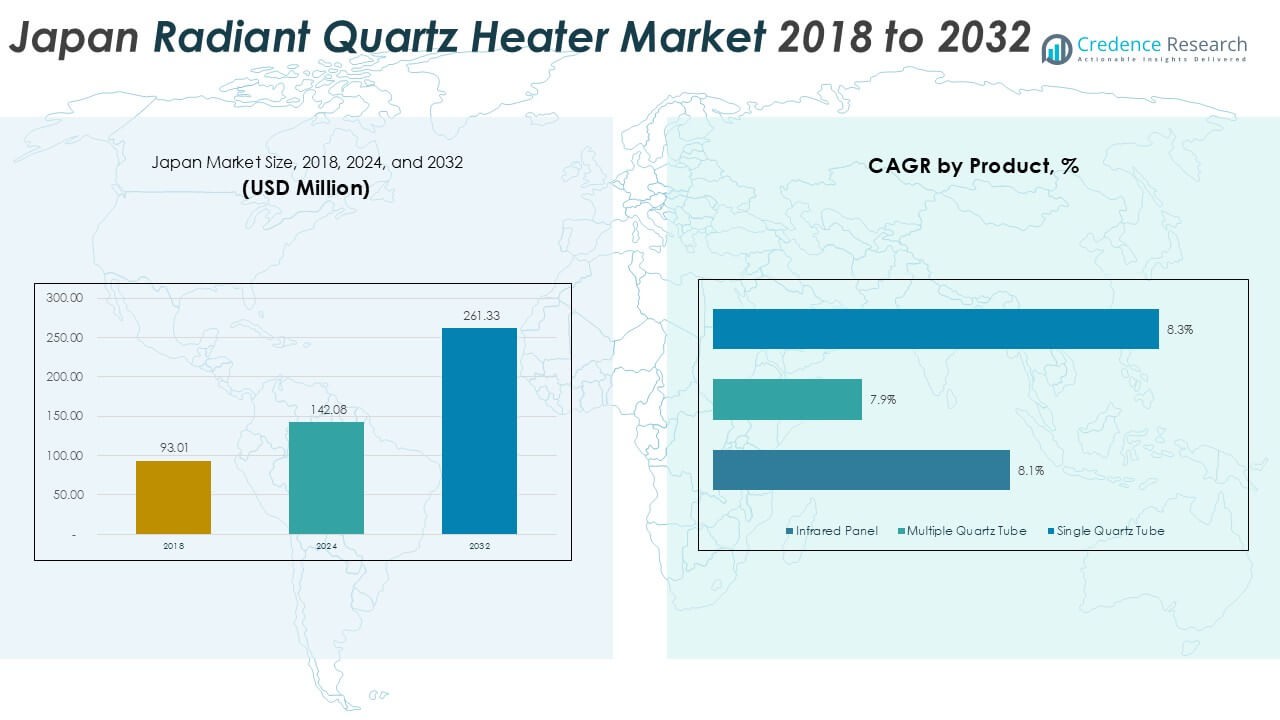
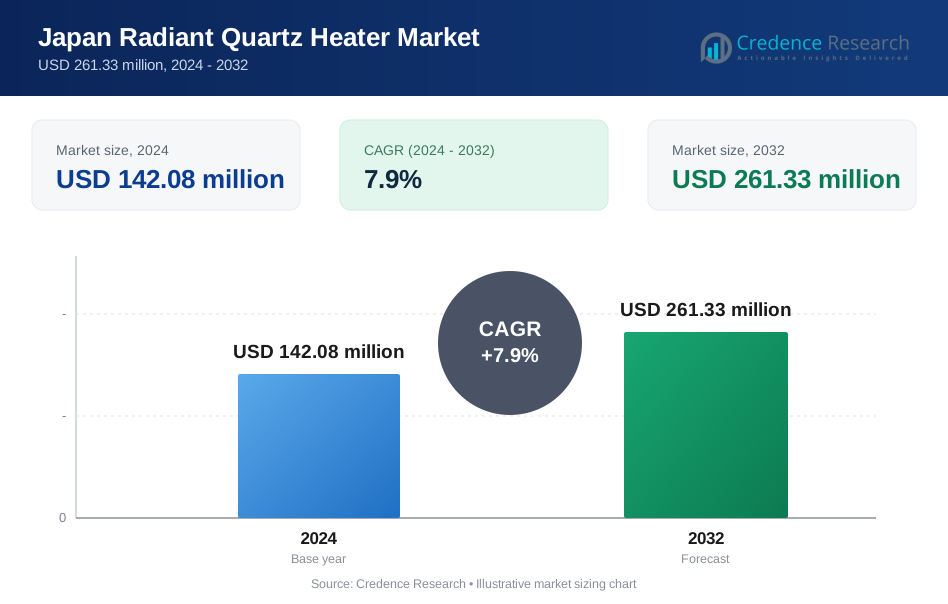
Japan Radiant Quartz Heater market size was valued at USD 93.01 million in 2018 to USD 142.08 million in 2024 and is anticipated to reach USD 261.33 million by 2032, at a CAGR of 7.9% during the forecast period.| REPORT ATTRIBUTE | DETAILS |
|---|---|
| Historical Period | 2020-2023 |
| Base Year | 2024 |
| Forecast Period | 2025-2032 |
| Japan Radiant Quartz Heater Market Size 2024 | USD 142.08 Million |
| Japan Radiant Quartz Heater Market, CAGR | 7.9% |
| Japan Radiant Quartz Heater Market Size 2032 | USD 261.33 Million |
Market Insights
- Japan radiant quartz heater market reached USD 142.08 million in 2024 and is projected to grow at a 7.9% CAGR through 2032, driven by steady residential replacement demand.
- Energy efficiency and instant heating remain key drivers, with multiple quartz tube heaters holding about 42% segment share due to faster heat output and suitability for larger rooms.
- Design-focused, compact, and safety-enhanced models represent a strong trend, while the 1000–1500-watt segment leads with nearly 46% share, balancing comfort and electricity costs.
- The market shows moderate competition, with domestic and global players competing on safety certifications, retail reach, and mid-range pricing, while offline channels dominate with around 61% share.
- Regionally, Kanto leads with about 38% share, followed by Kansai at roughly 24%, while Kyushu and Hokkaido–Tohoku together account for nearly 21%, reflecting climate and housing differences.
Market Segmentation Analysis:
By Product The Japan radiant quartz heater market shows clear product-level segmentation. Multiple quartz tube heaters dominate, holding about 42% market share. Strong demand comes from higher heat output and faster warm-up. These heaters suit larger rooms and semi-commercial spaces. Consumers prefer consistent radiant coverage during cold seasons. Infrared panel heaters follow, driven by slim design and wall-mount options. Single quartz tube models serve budget buyers and small rooms. However, limited heating range restricts wider adoption. Product innovation and safety improvements continue supporting demand across all product categories.- For instance, CORONA Co., Ltd.’s quartz space heater uses three quartz heating tubes, operates at 1,500 watts, and reaches usable heat output in under 20 seconds, supporting living rooms and retail spaces.
- For instance, Dainichi , Ltd.'s electric ceramic fan heater (e.g., the Dainichi EF-P1200H-W model) operates at 1,200 watts (on 'high' mode) and includes multiple heat levels. This type of electric heater is rated for smaller rooms, such as approximately 6 tatami mats in a wooden house or 8 tatami mats in a concrete house (with insulation).
Key Growth Drivers
Rising Demand for Energy-Efficient Heating Energy efficiency remains a primary growth driver in Japan’s radiant quartz heater market. Consumers face high electricity costs and strict energy awareness. Radiant quartz heaters convert power directly into heat. This process reduces wasted energy. Many households prefer localized heating over whole-room systems. Quartz heaters support zone-based heating needs. Compact apartments benefit from targeted warmth. Manufacturers improve reflector design and quartz materials. These upgrades enhance heat output efficiency. Government focus on energy conservation supports adoption. Retailers promote efficiency ratings during winter sales. Energy-conscious consumers favor mid-wattage quartz models. This driver supports steady replacement demand. Long product lifespans also reinforce value perception.- For instance, CORONA Co., Ltd.’s electric quartz heater operates at 1,200 watts, reaches usable heat output in under 15 seconds, and is specified for rooms up to 8 tatami mats, supporting efficient zone heating.
- For instance, a common generic quartz heater might weigh around 1.6 to 2.9 kilograms, operate with settings up to 1,000 watts (e.g., 400W/800W or 500W/1000W options), and include standard safety features like an automatic tip-over shutoff switch and overheat protection, supporting safe indoor use.
Key Trends & Opportunities
Expansion of Smart and Safety-Enhanced Features Smart features create new growth opportunities. Consumers value better control over heating use. Timers and thermostats improve energy management. Remote-control functions add convenience. Some models support smart plugs for automation. Safety remains a critical focus area. Advanced sensors prevent overheating incidents. Child-lock functions attract family households. Japanese buyers prioritize product reliability. Feature-rich models support premium pricing. Retailers upsell smart-enabled heaters during peak seasons. Manufacturers differentiate through safety certifications. This trend supports higher margins. Smart integration will expand steadily.- For instance, CORONA Co., Ltd.’s electric quartz heater includes a 24-hour programmable timer, operates at 1,200 watts, and features automatic overheat shutoff with tip-over detection, enhancing safety for indoor use.
- For instance, Aladdin (Sengoku Aladdin) offers a graphite toaster oven (model AET-GS13C) with a body width of 350 mm, depth of 295 mm, and operating power of 1,270 watts, designed to blend with modern living spaces.
Key Challenges
High Electricity Costs and Usage Sensitivity Electricity pricing remains a major challenge. Japan has relatively high power costs. Consumers monitor appliance energy use closely. High-wattage heaters face adoption resistance. Long operating hours raise cost concerns. This issue limits demand for large-capacity models. Price-sensitive households delay replacements. Manufacturers must emphasize efficiency benefits. Clear labeling helps address concerns. Energy-saving claims require credibility. This challenge pressures pricing strategies. Brands balance performance with consumption limits. Cost sensitivity may slow premium segment growth. Competition from Alternative Heating Technologies Radiant quartz heaters face strong competition. Heat pumps and ceramic heaters gain popularity. Air conditioners with heating modes remain widespread. Oil heaters attract traditional users. Each alternative offers distinct advantages. Consumers compare long-term operating costs. Some alternatives provide whole-room heating. Quartz heaters focus on localized warmth. This positioning limits certain use cases. Manufacturers must clearly communicate benefits. Product education becomes essential. Competitive pressure affects pricing and margins. Differentiation remains critical for growth.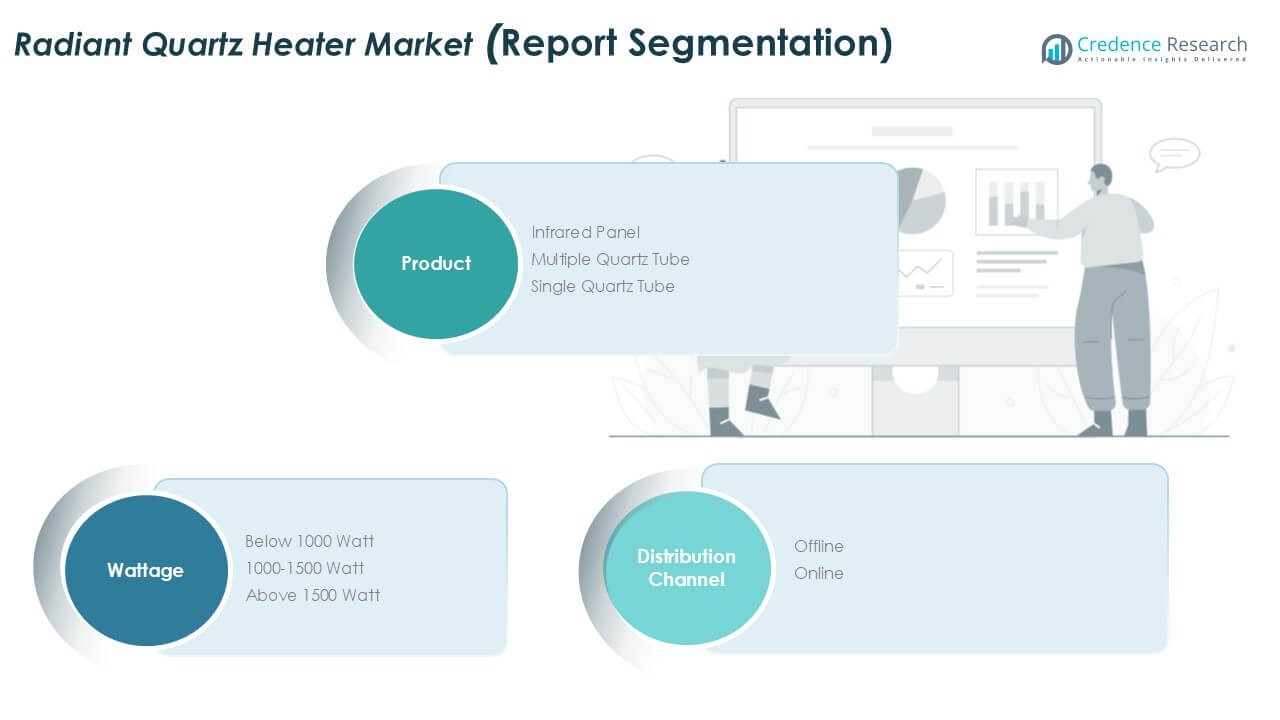
Regional Analysis
Kanto Region The Kanto region leads the Japan radiant quartz heater market with about 38% share. High population density drives strong residential demand. Tokyo apartments favor compact and portable heating solutions. Consumers prefer quick heating for short winter periods. Quartz heaters suit localized warmth needs well. Office spaces and retail outlets also support demand. Higher disposable income supports premium models. Safety-certified products gain faster acceptance. Offline electronics stores dominate regional sales. Online purchases grow among younger households. Seasonal promotions strongly influence buying patterns. Kanto remains the core revenue center. Kansai Region Kansai accounts for nearly 24% market share. Osaka and Kyoto drive steady urban demand. Many homes use supplemental heating during colder months. Radiant quartz heaters serve spot heating needs efficiently. Consumers favor mid-wattage models for energy control. Compact housing supports portable heater adoption. Traditional retail channels remain influential. Price sensitivity is slightly higher than Kanto. Energy efficiency messaging strongly impacts purchase decisions. Hotels and small offices add commercial demand. Stable winter temperatures support consistent seasonal sales. Chubu Region Chubu holds around 17% market share. The region combines urban and industrial demand. Nagoya drives residential consumption. Manufacturing hubs support light commercial usage. Cold winters increase heater penetration. Households prefer durable and mid-priced models. Energy-efficient quartz heaters suit regional needs. Offline sales dominate due to strong retail presence. Online channels grow in suburban areas. Consumers focus on reliability and safety features. Replacement demand supports steady growth. Regional climate conditions sustain winter sales volumes. Kyushu Region Kyushu represents about 11% market share. Milder winters limit overall heating demand. Consumers mainly use heaters for short durations. Radiant quartz heaters suit occasional use patterns. Lower wattage models dominate regional sales. Price sensitivity remains high among households. Compact and portable designs perform well. Offline retail continues to lead distribution. Online channels expand slowly. Energy cost awareness shapes buying decisions. Seasonal demand peaks remain shorter. Growth stays moderate compared to northern regions. Hokkaido and Tohoku Region Hokkaido and Tohoku account for roughly 10% market share. Colder climates drive strong heating needs. However, central heating systems dominate homes. Quartz heaters serve supplemental and spot heating roles. Consumers value fast heat output. High-wattage models see better acceptance here. Safety and durability remain key priorities. Commercial spaces use portable heaters widely. Offline channels dominate due to trust factors. Online adoption remains limited. Seasonal demand intensity remains high during winter months.
Market Segmentations:
By Product- Infrared Panel
- Multiple Quartz Tube
- Single Quartz Tube
- Below 1000 Watt
- 1000–1500 Watt
- Above 1500 Watt
- Offline
- Online
- Kanto Region
- Kansai Region
- Chubu Region
- Kyushu Region
- Hokkaido and Tohoku Region
Competitive Landscape
The Japan radiant quartz heater market shows a moderately fragmented competitive landscape. Domestic and international manufacturers compete on product safety, energy efficiency, and design quality. Established players leverage strong retail networks and seasonal promotions. Japanese consumers favor brands with proven reliability and safety certifications. Companies focus on compact, portable models suited for urban homes. Product differentiation centers on wattage options and heating speed. Mid-range pricing dominates competitive positioning. Global brands bring standardized designs, while local players adapt to regional preferences. Offline channels remain critical for brand visibility. Online platforms support wider reach and price comparison. Innovation in safety features strengthens brand trust. Competitive intensity increases during winter seasons.Key Player Analysis
- Elektraa Corp
- Convectronics
- Tempco Electric Heater Corporation
- Döbeln Elektrowärme GmbH
- Lasko Products, LLC
- TPI Corporation
- MISUMI Corporation
- Duraflame, Inc.
- SPACE-RAY
- Sawhney Industries
Recent Developments
- In June 2023, The European Union revised its overarching Energy Efficiency Directive, and new, stricter Ecodesign standards for local space heaters, including radiant heaters, were adopted in April 2024 and will apply from July 1, 2025.
- In January 2023, Honeywell announced a new line of smart radiant quartz heaters with integrated Wi-Fi capabilities.
Report Coverage
The research report offers an in-depth analysis based on Product, Wattage Segment, Distribution Channel and Geography. It details leading market players, providing an overview of their business, product offerings, investments, revenue streams, and key applications. Additionally, the report includes insights into the competitive environment, SWOT analysis, current market trends, as well as the primary drivers and constraints. Furthermore, it discusses various factors that have driven market expansion in recent years. The report also explores market dynamics, regulatory scenarios, and technological advancements that are shaping the industry. It assesses the impact of external factors and global economic changes on market growth. Lastly, it provides strategic recommendations for new entrants and established companies to navigate the complexities of the market.Future Outlook
- Demand will grow steadily due to urban apartment living and compact housing.
- Energy-efficient quartz heaters will gain stronger consumer preference.
- Mid-wattage models will remain the most widely adopted products.
- Safety-certified heaters will see higher acceptance across households.
- Design-focused and slim-profile models will support premium demand.
- Online sales will expand alongside strong offline retail presence.
- Seasonal replacement demand will continue driving market stability.
- Aging population needs will support long-term residential usage.
- Manufacturers will invest more in smart and safety features.
- Regional demand differences will remain shaped by climate conditions.
Request a Free Sample
Fill in your details and we'll send you a free sample report.
- Sample data tables & charts
- Research methodology
Need a Custom Version of This Report?
Tailor the scope, geography, or segments to your exact requirements.
- Custom geography or segment scope
- Direct access to our analyst team
Frequently Asked Questions
What is the current market size for the Japan Radiant Quartz Heater market, and what is its projected size in 2032?
At what Compound Annual Growth Rate is the Japan Radiant Quartz Heater market projected to grow between 2024 and 2032?
Which Japan Radiant Quartz Heater market segment held the largest share in 2024?
What are the primary factors fueling the growth of the Japan Radiant Quartz Heater market?
Who are the leading companies in the Japan Radiant Quartz Heater market?
Which region commanded the largest share of the Japan Radiant Quartz Heater market in 2024?
Table of Content
Chapter 1. Report Introduction
- 1.1 Report Description & Purpose
- 1.1.1 Report Title & Market Definition
- 1.1.2 Unique Selling Propositions (USP) & Key Differentiators
- 1.1.3 Value Proposition for Stakeholders
- 1.2 Research Objectives
- 1.2.1 Market Sizing Objectives (Volume & Revenue)
- 1.2.2 Segmentation Objectives
- 1.2.3 Competitive Intelligence Objectives
- 1.2.4 Forecast & Scenario Objectives
- 1.3 Report Scope
- 1.3.1 Japan Radiant Quartz Heater Scope – Types & Subtypes Covered
- 1.3.2 Geographic Scope – Regions & Countries Covered
- 1.3.3 Historical Period, Base Year & Forecast Period (2024; forecast to 2032)
- 1.3.4 Inclusions & Exclusions
- 1.4 HS Code & Classification Framework
- 1.5 Currency, Units & Pricing Basis
- 1.6 Target Stakeholders
- 1.7 Limitations & Assumptions
Chapter 2. Executive Summary
- 2.1 Global Japan Radiant Quartz Heater Market Snapshot
- 2.1.1 Market Size – Historical (2024) & Forecast (2024-2032) (2024: USD 142.08 million → 2032: USD 261.33 million)
- 2.1.2 Volume & Revenue – Global Totals
- 2.1.3 Key Market Highlights – Top Five Facts
- 2.2 Japan Radiant Quartz Heater Market Segmentation Snapshot
- 2.2.1 Market Split by Region – 2024 vs. 2032
- 2.3 Competitive Snapshot
- 2.3.1 Top 10 Players by Revenue Share – 2024
- 2.3.2 Top 10 Players by Volume Share – 2024
- 2.3.3 Recent Strategic Developments (18-Month Summary)
- 2.4 Key Investment Highlights & Strategic Conclusions
Chapter 3. Japan Radiant Quartz Heater Market Dynamics & Industry Analysis
- 3.1 Market Overview & Context
- 3.1.1 Japan Radiant Quartz Heater Market Position in the Broader Automotive Value Chain
- 3.1.2 OEM vs. Replacement Market Dynamics
- 3.1.3 Market Maturity & Development Stage by Region
- 3.2 Japan Radiant Quartz Heater Market Drivers
- 3.3 Japan Radiant Quartz Heater Market Restraints & Challenges
- 3.4 Japan Radiant Quartz Heater Market Opportunities
- 3.5 Porter's Five Forces Analysis
- 3.5.1 Threat of New Entrants
- 3.5.2 Bargaining Power of Suppliers
- 3.5.3 Bargaining Power of Buyers
- 3.5.4 Threat of Substitutes
- 3.5.5 Competitive Rivalry – Intensity Assessment
- 3.6 Japan Radiant Quartz Heater Value Chain Analysis
- 3.6.1 Upstream – Raw Material/Input Suppliers
- 3.6.1.1 Raw Material/Input 1
- 3.6.1.2 Raw Material/Input 2
- 3.6.1.3 Raw Material/Input 3
- 3.6.2 Midstream – Production/Manufacturing/Service Delivery
- 3.6.2.1 Production/Process Overview
- 3.6.2.2 Key Facility Locations & Capacity by Manufacturer
- 3.6.3 Downstream – Distribution & End Consumer
- 3.6.3.1 Primary Channel – B2B/OEM
- 3.6.3.2 Secondary Channels – Dealer, Retail, Online, Direct
- 3.6.4 Value Chain Profitability Analysis
- 3.6.1 Upstream – Raw Material/Input Suppliers
- 3.7 PESTEL Analysis
- 3.7.1 Political Factors
- 3.7.2 Economic Factors
- 3.7.3 Social Factors
- 3.7.4 Technological Factors
- 3.7.5 Environmental Factors
- 3.7.6 Legal Factors
- 3.8 Japan Radiant Quartz Heater Supply Chain Analysis
- 3.8.1 Raw Material/Input Supply Risk Assessment
- 3.8.2 Manufacturing Concentration Risk (Geographic Exposure)
- 3.8.3 Trade Disruption Impact Analysis
- 3.9 Regulatory & Policy Landscape
Note: The regulatory and policy landscape section covers regulations based on their applicability to the market, Japan Radiant Quartz Heater category, geography, and scope of the study. Only regulatory frameworks with a material impact on operations, compliance, trade, sustainability, or market access are analyzed in detail.
Chapter 4. Key Investment Pockets & Opportunity Analysis
- 4.1 Japan Radiant Quartz Heater Market Attractiveness Analysis
- 4.1.1 By Region – Investment Attractiveness Matrix (Volume × CAGR)
- 4.2 Absolute Revenue Growth Opportunity
- 4.2.1 By Region – Absolute USD Growth Through 2032
- 4.3 Incremental Volume Opportunity
- 4.3.1 By Region – Incremental Volume Through 2032
- 4.3.2 Segment – Incremental Volume
- 4.4 Emerging Submarket Opportunity Deep Dive (Subject to Applicability)
- 4.5 Emerging Market Opportunity Scorecards
- 4.5.1 United States
- 4.5.2 Europe
- 4.5.3 Asia
- 4.5.4 Middle East & Africa
Note: Emerging Market Opportunity Scorecards will be included based on relevance and strategic importance. Regions listed are indicative and may vary depending on data availability and market dynamics.
Chapter 5. Japan Radiant Quartz Heater Import-Export Analysis & Trade Flows
- 5.1 Global Trade Overview
- 5.1.1 Global Export Value by Country (2024)
- 5.1.2 Global Export Volume by Country (2024)
- 5.1.3 Global Import Value by Country (2024)
- 5.1.4 Global Import Volume by Country (2024)
- 5.1.5 Net Trade Balance by Country (2024)
- 5.2 Export Analysis – Segment
- 5.2.1 Type 1 (HS Code)
- 5.2.2 Type 2 (HS Code)
- 5.2.3 Type 3 (HS Code)
- 5.2.4 Type 4 (HS Code)
- 5.2.5 Type 5 (HS Code)
- 5.3 Import Analysis – Segment
- 5.3.1 Type 1 (HS Code)
- 5.3.2 Type 2 (HS Code)
- 5.3.3 Type 3 (HS Code)
- 5.3.4 Type 4 (HS Code)
- 5.3.5 Type 5 (HS Code)
- 5.4 Average Unit Trade Prices
- 5.4.1 Average Export Price – Segment & Country
- 5.4.2 Average Import Price – Segment & Source Country
- 5.4.3 Price Trends (2024)
- 5.5 Key Trade Route Analysis
- 5.5.1 Trade Route 1
- 5.5.2 Trade Route 2
- 5.5.3 Trade Route 3
- 5.5.4 Trade Route 4
- 5.5.5 Trade Route 5
- 5.6 Trade Policy Impact Assessment
- 5.6.1 US Anti-Dumping & Section 301 Tariffs
- 5.6.2 EU Customs Union Impact
- 5.6.3 Major Free Trade Agreements
- 5.6.4 USMCA Rules of Origin
Note: Trade policy analysis will be included only where relevant to the Japan Radiant Quartz Heater market.
Chapter 6. Competitive Landscape & Company Benchmarking
- 6.1 Japan Radiant Quartz Heater Market Concentration & Structure
- 6.1.1 Herfindahl-Hirschman Index (HHI) – vs. 2024
- 6.1.2 Tier 1, Tier 2 & Tier 3 Market Structure
- 6.1.3 Global, Regional & Local Player Dynamics
- 6.2 Japan Radiant Quartz Heater Market Share Analysis – 2024
- 6.2.1 Global Revenue Share by Company
- 6.2.2 Global Volume Share by Company
- 6.2.3 Regional Revenue Share
- 6.2.4 Market Share Evolution ( vs. 2024)
- 6.2.5 OEM Segment Share by Company
- 6.2.6 Replacement Segment Share by Company
- 6.3 Production/Delivery Capacity & Facility Analysis
- 6.3.1 Global Installed Capacity
- 6.3.2 Capacity Utilization Rates
- 6.3.3 Production/Output Volume
- 6.3.4 Facility Locations & Capacity Map
- 6.3.5 Planned Capacity Additions
- 6.4 Japan Radiant Quartz Heater Competitive Benchmarking Matrix
- 6.4.1 Revenue, Volume, CAGR & Profitability Comparison
- 6.4.2 Channel Revenue Mix
- 6.4.3 Geographic Revenue Exposure
- 6.4.4 R&D Intensity
- 6.4.5 Sustainability Maturity
- 6.5 Strategic Developments in Japan Radiant Quartz Heater (Last 24 Months)
- 6.5.1 Mergers, Acquisitions & Divestments
- 6.5.2 New Japan Radiant Quartz Heater Launches
- 6.5.3 Facility Expansions
- 6.5.4 Strategic Alliances, Joint Ventures & Partnerships
- 6.5.5 Distribution Expansion & Market Entry
- 6.5.6 Sustainability & ESG Initiatives
- 6.6 Competitive Strategy Mapping
- 6.6.1 Leader, Challenger, Follower & Niche Classification
- 6.6.2 Pricing Strategy Comparison
- 6.6.3 Channel Strategy Matrix
Note: Strategic developments are included based on their materiality and the availability of reliable information.
Chapter 7. Global Japan Radiant Quartz Heater Market – By Distribution Channel
- 7.1 Segment Overview
- 7.1.1 Volume & Revenue Split by Channel (2024 & 2032)
- 7.1.2 Channel Mix Evolution (2024-2032)
Chapter 8. Regional Market Analysis – Global Overview
- 8.1 Global Regional Overview
- 8.1.1 Regional Volume Share
- 8.1.2 Regional Revenue Share
- 8.1.3 Regional Volume by Region
- 8.1.4 Regional Revenue by Region
- 8.1.5 Regional Forecast Through 2032
- 8.2 Cross-Regional Segment Analysis
- 8.2.1 By Distribution Channel
- 8.2.2 By Brand/Price Tier
Chapter 9. North America Japan Radiant Quartz Heater Market
- 9.1 United States
- 9.2 Canada
- 9.3 Mexico
Chapter 10. Europe Japan Radiant Quartz Heater Market
- 10.1 Germany
- 10.2 France
- 10.3 Italy
- 10.4 United Kingdom
- 10.5 Spain
- 10.6 Poland
- 10.7 Russia
- 10.8 Netherlands
- 10.9 Belgium
- 10.10 Sweden
- 10.11 Denmark
- 10.12 Norway
- 10.13 Rest of Europe
Chapter 11. Asia Pacific Japan Radiant Quartz Heater Market
- 11.1 China
- 11.2 India
- 11.3 Japan
- 11.4 South Korea
- 11.5 Thailand
- 11.6 Indonesia
- 11.7 Vietnam
- 11.8 Malaysia
- 11.9 Australia
- 11.10 Rest of Asia Pacific
Chapter 12. Latin America Japan Radiant Quartz Heater Market
- 12.1 Brazil
- 12.2 Argentina
- 12.3 Colombia
- 12.4 Chile
- 12.5 Rest of Latin America
Chapter 13. Middle East Japan Radiant Quartz Heater Market
- 13.1 Saudi Arabia
- 13.2 United Arab Emirates
- 13.3 Turkey
- 13.4 Israel
- 13.5 Iran
- 13.6 Rest of the Middle East
Chapter 14. Africa Japan Radiant Quartz Heater Market
- 14.1 South Africa
- 14.2 Egypt
- 14.3 Nigeria
- 14.4 Morocco
- 14.5 Rest of Africa
Chapter 15. Japan Radiant Quartz Heater Company Profiles
- 15.1 [Company 01]
- 15.1.1 Company Overview
- 15.1.2 Key Management Personnel
- 15.1.3 Products & Services Portfolio
- 15.1.4 Financial Performance
- 15.1.5 Key Market Focus & Geographic Presence
- 15.1.6 Recent Developments & Strategic Initiatives
Note: The company profile list is preliminary and may change based on research findings, market developments, data availability, and client requirements.
Chapter 16. Appendices
- Appendix A – List of Abbreviations & Acronyms
- Appendix B – Industry Classification Code Reference – Full Series
- Appendix C – Production & Capacity Data Tables
- Appendix D – End-Use & Demand Base Tables
- Appendix E – Consumption & Replacement Rate Assumptions
- Appendix F – ASP Reference Tables
- Appendix G – Manufacturing & Facility Database
- Appendix H – Import-Export Data Tables
- Appendix I – Regulatory Summary Tables
- Appendix J – Primary Research Participant List (Anonymized)
- Appendix K – Primary Research Questionnaire Framework
- Appendix L – Data Sources & Bibliography
- Appendix M – Market Size Divergence & Source Comparison
Chapter 17. Research Methodology
- 17.1 Research Framework & Philosophy
- 17.2 Secondary Research – Sources, Hierarchy & Data Extraction
- 17.3 Data Modeling – Bottom-Up & Top-Down Market Sizing
- 17.4 Primary Research – Stakeholder Framework, LOI & Sample Sizes
- 17.5 Forecast Methodology – Regression, Scenario & Sensitivity Analysis
- 17.6 Quality Control – Four-Layer Validation Framework
- 17.7 Limitations & Standard Assumptions
- 17.8 Disclaimer
