
Market Overview
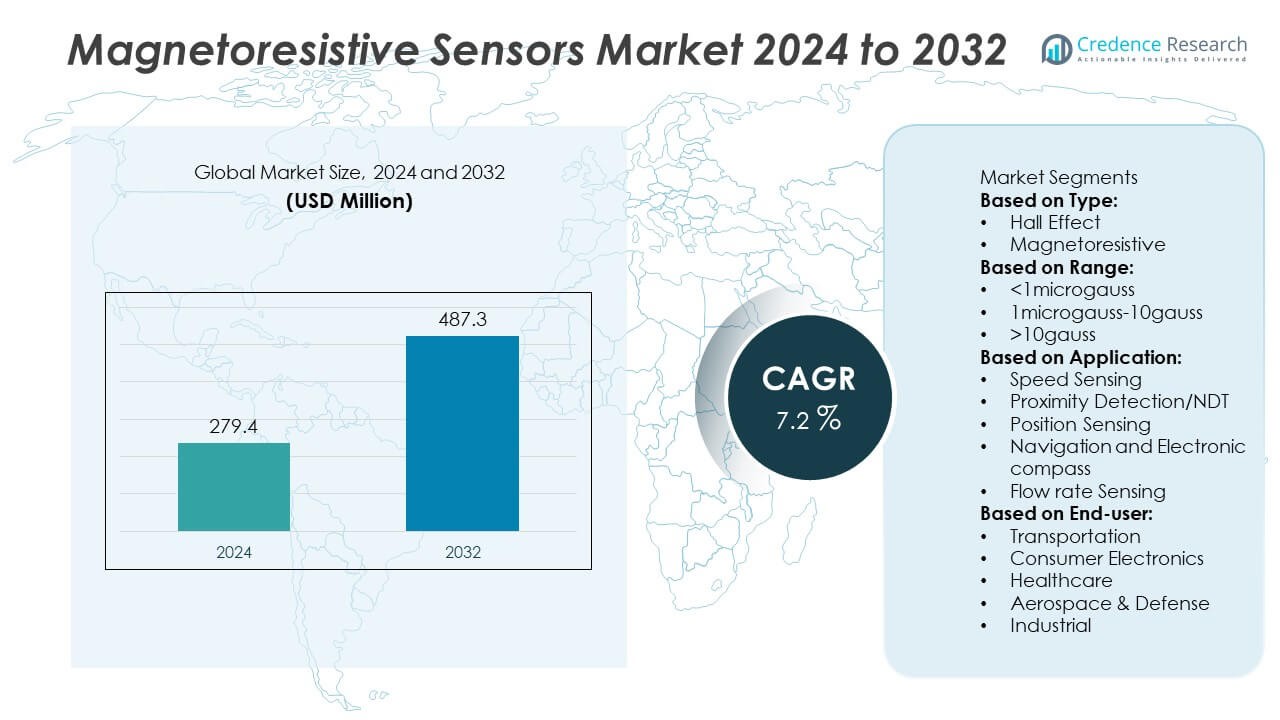
The Magnetoresistive Sensors Market was valued at USD 279.4 million in 2024 and is projected to reach USD 487.3 million by 2032, growing at a CAGR of 7.2% during the forecast period.
| REPORT ATTRIBUTE | DETAILS |
|---|---|
| Historical Period | 2020-2024 |
| Base Year | 2024 |
| Forecast Period | 2025-2032 |
| Magnetoresistive Sensors Market Size 2024 | USD 279.4 Million |
| Magnetoresistive Sensors Market, CAGR | 7.2% |
| Magnetoresistive Sensors Market Size 2032 | USD 487.3 Million |
The Magnetoresistive Sensors Market grows through rising demand in automotive, consumer electronics, and industrial automation, where accuracy, miniaturization, and energy efficiency are critical. Key drivers include their integration into electric vehicles for motor control and battery management.
The Magnetoresistive Sensors Market demonstrates strong geographical presence across North America, Europe, Asia Pacific, Latin America, and the Middle East & Africa, each shaped by distinct industry strengths. North America leads through adoption in automotive, aerospace, and renewable energy projects, supported by advanced R&D ecosystems. Europe emphasizes sustainability and industrial automation, with strong demand from EV manufacturing and precision engineering. Asia Pacific emerges as a high-growth hub driven by large-scale consumer electronics production, robotics, and government-backed EV programs in China, Japan, and South Korea. Latin America and the Middle East & Africa show gradual progress through renewable energy projects and industrial modernization. Key players shaping the market include Infineon Technologies AG, recognized for wide bandgap sensor solutions; Honeywell International Inc., advancing industrial and aerospace sensor technologies; NVE Corporation, specializing in spintronic sensors; and TDK Corporation, leveraging innovations from Micronas and InvenSense for consumer and automotive applications.
Market Insights
- The Magnetoresistive Sensors Market was valued at USD 279.4 million in 2024 and is projected to reach USD 487.3 million by 2032, expanding at a CAGR of 7.2% during the forecast period.
- Rising demand from the automotive sector strengthens adoption, with magnetoresistive sensors used in electric vehicle powertrains, motor control, and battery management systems to enhance efficiency and safety.
- Market trends highlight a decisive shift toward tunnel magnetoresistance (TMR) technology, which delivers higher sensitivity, lower power consumption, and miniaturization for integration in compact devices.
- Competitive dynamics show leading players such as Infineon Technologies AG, NVE Corporation, Honeywell International Inc., Allegro MicroSystems, and TDK Corporation investing in R&D to develop precision sensors for EVs, consumer electronics, and industrial automation.
- Market restraints include high production costs, complex fabrication processes, and performance issues under extreme conditions, which create barriers to large-scale adoption in cost-sensitive industries.
- Regional analysis shows North America leading adoption through aerospace, EV, and renewable applications, Europe advancing through strong automation and clean energy initiatives, and Asia Pacific recording rapid growth supported by large-scale consumer electronics and robotics production.
- Latin America and the Middle East & Africa contribute gradually, with demand fueled by renewable energy projects, industrial upgrades, and early adoption in automotive and healthcare sectors, creating long-term growth opportunities.
Market Drivers
Rising Adoption in Automotive and Electric Vehicles Strengthens Growth
The automotive sector plays a central role in driving demand for magnetoresistive sensors due to their accuracy, durability, and ability to function under harsh conditions. These sensors support critical functions such as position detection, speed monitoring, and current sensing in electric powertrains. The Magnetoresistive Sensors Market benefits from the global shift toward electric vehicles, where precise magnetic field measurement improves motor efficiency and battery management. It also secures relevance in advanced driver-assistance systems that require real-time detection for safe operation. Expanding production of EVs across Asia, Europe, and North America ensures steady demand for these technologies.
- For instance, Allegro MicroSystems supplies over 1 billion magnetic position sensors annually, with its A31315 sensor enabling 360-degree angle measurement for EV traction motor control and battery current sensing.
Expansion of Consumer Electronics and IoT Devices Enhances Market Momentum
Magnetoresistive sensors find increasing use in smartphones, wearables, and IoT devices where compact, energy-efficient sensing solutions are essential. Their ability to deliver high sensitivity while consuming minimal power supports integration into miniature devices. The Magnetoresistive Sensors Market gains traction as consumer demand grows for accurate navigation, orientation detection, and interactive features in electronic devices. It supports innovation in augmented reality and virtual reality applications that depend on precise motion tracking. Growing penetration of connected devices in households and industries further expands the scope for these sensors. This widespread adoption reinforces their strategic value across the consumer technology ecosystem.
- For instance, TDK Corporation, through its InvenSense unit, shipped more than 500 million motion and magnetic sensors used in smartphones and AR/VR systems, with its TMR-based sensors achieving resolutions below 0.05° in compact form factors.
Integration in Industrial Automation and Robotics Creates Strong Demand
Industrial sectors increasingly rely on magnetoresistive sensors to improve accuracy in automation and robotic applications. These sensors provide precise position and angle detection, enabling smooth operation in automated machinery and collaborative robots. The Magnetoresistive Sensors Market strengthens as factories adopt advanced sensing systems to enhance productivity and reduce downtime. It also aligns with Industry 4.0 initiatives that prioritize data-driven operations and predictive maintenance. High reliability and resistance to environmental stress make these sensors suitable for demanding manufacturing environments. Expanding investments in smart factories secure long-term adoption in industrial domains.
Growing Importance in Renewable Energy and Medical Devices Drives Usage
Renewable energy systems and healthcare technologies provide new growth opportunities for magnetoresistive sensors. In wind turbines and solar inverters, these sensors support current measurement and fault detection, improving efficiency and safety. The Magnetoresistive Sensors Market also advances in medical devices where compact sensing solutions enable innovations in imaging, diagnostics, and monitoring equipment. It ensures high sensitivity that supports applications requiring precision and safety compliance. Rising investments in renewable power generation and healthcare infrastructure amplify demand for advanced sensing technologies. This broad application base strengthens the market’s role in enabling critical functions across emerging industries.
Market Trends
Shift Toward Tunnel Magnetoresistance (TMR) Technology Defines Advancements
Tunnel magnetoresistance sensors are gaining preference due to their superior sensitivity, low power consumption, and scalability. The Magnetoresistive Sensors Market evolves as TMR devices replace traditional anisotropic and giant magnetoresistive technologies in high-precision applications. It secures strong traction in consumer electronics, automotive, and industrial automation where accuracy is critical. Manufacturers emphasize research and development to achieve miniaturized TMR solutions for compact devices. The rising integration of TMR in smartphones and wearables demonstrates the technology’s growing dominance. This trend ensures TMR remains a key driver of long-term innovation in the sector.
- For instance, Crocus Technology launched its CT430 and CT431 TMR current sensors in 2023, capable of handling up to 20 A with 1% accuracy, supporting automotive and industrial applications while consuming less than 6 mA of supply current.
Miniaturization and Integration with Semiconductor Processes Expands Applications
Demand for smaller, energy-efficient sensors is accelerating, with magnetoresistive technology aligning closely with semiconductor advancements. The Magnetoresistive Sensors Market benefits from integration into CMOS processes, which reduces cost and simplifies large-scale production. It creates opportunities for adoption in portable consumer electronics, IoT devices, and advanced medical systems. Miniaturization strengthens relevance in applications where space efficiency is crucial. Manufacturers focus on developing chip-level sensor integration to enhance performance while reducing form factor. This alignment supports long-term scalability across industries with growing reliance on compact devices.
- For instance, Infineon Technologies introduced its XENSIV™ TMR sensors, offering ultra-low noise density of 40 nT/√Hz and integration capability in a 1.4 × 1.4 mm package, designed for compact IoT and wearable electronics.
Increased Role in Navigation and Positioning Applications Strengthens Market Evolution
Magnetoresistive sensors are increasingly used in electronic compasses, navigation systems, and autonomous platforms due to their accuracy and reliability. The Magnetoresistive Sensors Market gains traction in drones, robotics, and autonomous vehicles that require precise orientation data. It supports advanced navigation even in environments where GPS signals are limited or unavailable. Rising demand from defense and aerospace further expands adoption in mission-critical applications. Enhanced performance in three-axis magnetic field detection highlights the evolving capabilities of these sensors. This trend reinforces their role as essential components in modern navigation technologies.
Growing Demand for Energy Efficiency and Low-Power Solutions Guides Innovation
Energy efficiency has become a central trend in sensor development, with magnetoresistive devices offering clear advantages over competing technologies. The Magnetoresistive Sensors Market advances through innovations that lower power requirements while maintaining sensitivity. It secures growing relevance in battery-powered devices, including wearables, medical monitors, and portable industrial tools. Vendors develop ultra-low-power designs that extend operational life in energy-constrained environments. This trend ensures sustained demand for sensors that balance precision with energy savings. It positions magnetoresistive solutions as vital enablers of sustainable and efficient device ecosystems.
Market Challenges Analysis
High Production Costs and Complex Manufacturing Processes Restrict Adoption
The Magnetoresistive Sensors Market faces challenges related to high production costs and complex fabrication requirements. Advanced magnetoresistive technologies such as TMR and GMR demand specialized materials and precise manufacturing techniques, raising overall production expenses. It limits large-scale adoption in cost-sensitive markets where alternative sensor technologies are more affordable. Integration with semiconductor processes requires significant investment in equipment and expertise, creating barriers for smaller vendors. Limited standardization across platforms also adds complexity to deployment. These factors slow down widespread commercialization despite strong technological advantages.
Performance Limitations and Environmental Sensitivity Constrain Market Growth
Despite strong benefits, magnetoresistive sensors face performance issues under specific conditions that limit their reliability. The Magnetoresistive Sensors Market encounters challenges from temperature fluctuations, external electromagnetic interference, and material degradation that can affect accuracy. It creates concerns for applications in aerospace, defense, and industrial sectors where consistency is critical. Calibration requirements increase maintenance costs and complicate long-term usage. Competing technologies, such as Hall effect sensors, provide simpler and more robust alternatives in certain environments. These limitations highlight the need for continuous innovation to strengthen sensor durability and reliability.
Market Opportunities
Expanding Applications in Electric Vehicles and Renewable Energy Systems Create Growth Potential
The global transition toward electric mobility and clean energy opens strong opportunities for magnetoresistive sensors. The Magnetoresistive Sensors Market benefits from the use of these devices in battery management systems, motor control, and current sensing for efficient EV performance. It also finds growing demand in renewable energy applications such as wind turbines and solar inverters, where accurate current and position detection improve system reliability. Expanding government support for EV infrastructure and renewable integration accelerates adoption. Strong alignment with sustainability goals ensures rising demand for high-precision and energy-efficient sensor technologies. These developments create long-term growth opportunities for sensor manufacturers across global markets.
Integration in Healthcare Devices and Advanced Consumer Electronics Expands Market Scope
Healthcare and consumer electronics provide emerging avenues for the adoption of magnetoresistive sensors. The Magnetoresistive Sensors Market advances through their integration into medical imaging equipment, diagnostic tools, and wearable health monitors that require compact and highly sensitive sensing solutions. It also secures growth in smartphones, AR/VR headsets, and IoT devices, where accuracy in navigation and orientation detection enhances user experience. Rising investments in miniaturized electronics amplify the role of magnetoresistive technology in next-generation devices. Vendors focusing on ultra-low-power and high-performance solutions will capture significant opportunities in these fast-evolving sectors. The combination of healthcare innovation and consumer demand creates strong momentum for the market’s expansion.
Market Segmentation Analysis:
By Type
The Magnetoresistive Sensors Market divides into anisotropic magnetoresistance (AMR), giant magnetoresistance (GMR), and tunnel magnetoresistance (TMR) sensors. AMR sensors hold strong relevance due to their reliability, low cost, and wide use in automotive and industrial applications. GMR sensors secure traction in data storage, robotics, and current sensing because of their high sensitivity. TMR sensors represent the fastest-growing category, delivering superior performance with lower power consumption and higher precision. It gains adoption in consumer electronics, healthcare devices, and EV systems where miniaturization and efficiency are critical. Vendors increasingly focus on TMR technology to align with long-term demand across advanced industries.
- For instance, Allegro MicroSystems launched its A31315 TMR angle sensor in 2023, delivering 360-degree contactless position measurement with resolution as fine as 0.5°, supporting EV motor control and industrial automation.
By Range
The market is segmented into low-field and high-field magnetoresistive sensors. Low-field sensors dominate applications that require precise magnetic field detection, such as navigation, wearable electronics, and AR/VR devices. It provides high accuracy in compact and battery-powered products where energy efficiency is essential. High-field sensors secure strong adoption in automotive powertrains, industrial automation, and renewable energy systems, where robust field detection ensures reliable operation. The Magnetoresistive Sensors Market benefits from the scalability of both ranges, addressing distinct needs across consumer and industrial domains. Continuous advancements in sensor design enhance performance across both low-field and high-field categories, strengthening versatility and relevance.
- For instance, NVE Corporation released its AA00x-series GMR analog magnetometer sensors in 2023, achieving ultra-low noise of 1.5 nV/√Hz and a best-in-class temperature coefficient of 0.05% per °C, making them suitable for both low-field navigation devices and high-field industrial applications.
By Application
Applications for magnetoresistive sensors span automotive, consumer electronics, industrial automation, aerospace, medical devices, and renewable energy. Automotive remains a leading segment, where sensors support motor control, speed detection, and battery management in EVs. The Magnetoresistive Sensors Market also grows in consumer electronics, as sensors enhance navigation, gaming, and AR/VR experiences. Industrial automation and robotics utilize them for precise angle and position detection, ensuring efficiency in production systems. Aerospace and defense sectors adopt them for navigation in GPS-denied environments, while healthcare integrates them into diagnostic and imaging tools. Renewable energy systems increasingly deploy these sensors to optimize turbine and inverter performance. This broad application base secures strong relevance across multiple high-growth industries.
Segments:
Based on Type:
- Hall Effect
- Magnetoresistive
Based on Range:
- <1microgauss
- 1microgauss-10gauss
- >10gauss
Based on Application:
- Speed Sensing
- Proximity Detection/NDT
- Position Sensing
- Navigation and Electronic compass
- Flow rate Sensing
Based on End-user:
- Transportation
- Consumer Electronics
- Healthcare
- Aerospace & Defense
- Industrial
Based on the Geography:
- North America
- U.S.
- Canada
- Mexico
- Europe
- UK
- France
- Germany
- Italy
- Spain
- Russia
- Belgium
- Netherlands
- Austria
- Sweden
- Poland
- Denmark
- Switzerland
- Rest of Europe
- Asia Pacific
- China
- Japan
- South Korea
- India
- Australia
- Thailand
- Indonesia
- Vietnam
- Malaysia
- Philippines
- Taiwan
- Rest of Asia Pacific
- Latin America
- Brazil
- Argentina
- Peru
- Chile
- Colombia
- Rest of Latin America
- Middle East
- UAE
- KSA
- Israel
- Turkey
- Iran
- Rest of Middle East
- Africa
- Egypt
- Nigeria
- Algeria
- Morocco
- Rest of Africa
Regional Analysis
North America
North America accounts for 34% of the Magnetoresistive Sensors Market, driven by strong adoption in automotive, aerospace, and industrial automation. The U.S. leads with robust demand from electric vehicles, advanced driver-assistance systems, and renewable energy applications. It benefits from large-scale investments in smart mobility and energy-efficient technologies that integrate magnetoresistive sensors for performance optimization. Canada contributes through adoption in renewable energy projects, particularly wind and solar systems, where precise current and position sensing enhance operational efficiency. Mexico strengthens the region’s position with rising manufacturing activity in the automotive and electronics sectors. North America’s well-established R&D ecosystem and leading semiconductor companies create an environment that accelerates innovation and ensures continuous growth for the market.
Europe
Europe holds 28% of the Magnetoresistive Sensors Market, supported by sustainability goals, strong automotive manufacturing, and advances in industrial automation. Germany, France, and the UK dominate demand, with magnetoresistive sensors widely used in EV systems, robotics, and precision machinery. It aligns with the European Union’s decarbonization targets, where these sensors support renewable integration and grid optimization. The aerospace and defense sectors in France and the UK adopt these technologies for navigation and control systems requiring high accuracy. Eastern European countries also expand adoption with growing electronics production and industrial upgrades. Europe’s leadership in engineering standards and emphasis on energy efficiency reinforces long-term demand across its industrial base.
Asia Pacific
Asia Pacific represents 29% of the Magnetoresistive Sensors Market, fueled by rapid industrialization, consumer electronics manufacturing, and large-scale EV production. China dominates regional demand, deploying sensors in automotive systems, smartphones, and renewable energy projects. Japan and South Korea secure strong shares through innovations in consumer electronics and robotics, where magnetoresistive sensors deliver precision and miniaturization. India emerges as a fast-growing market with government programs supporting EV adoption, smart cities, and renewable energy expansion. Southeast Asian nations such as Malaysia, Thailand, and Vietnam increase adoption through electronics assembly and industrial automation. The region also benefits from cost-effective manufacturing capabilities, making Asia Pacific both a major consumer and supplier of magnetoresistive sensor technologies.
Latin America
Latin America accounts for 5% of the Magnetoresistive Sensors Market, with Brazil and Mexico leading adoption. Brazil drives demand through renewable energy, particularly wind projects, where sensors play a role in turbine monitoring and efficiency improvements. Mexico strengthens adoption through its automotive industry, integrating sensors into EV and hybrid vehicles. It also benefits from expanding electronics manufacturing that leverages precise sensing technologies. Other countries such as Chile, Argentina, and Colombia gradually adopt magnetoresistive sensors in industrial automation and consumer electronics. While growth is slower compared to other regions, Latin America shows steady progress through modernization efforts and rising demand for efficient, compact technologies.
Middle East & Africa
The Middle East & Africa hold 4% of the Magnetoresistive Sensors Market, supported by energy diversification initiatives and industrial modernization. Gulf nations such as the UAE and Saudi Arabia lead adoption by investing in renewable energy projects where sensors enhance performance and monitoring systems. Africa sees early traction in South Africa and Nigeria, where demand emerges in industrial equipment, healthcare devices, and telecom systems. It benefits from growing interest in smart city initiatives and utility modernization. Limited infrastructure and higher deployment costs restrict faster adoption, yet ongoing government-backed programs create opportunities for gradual market expansion. The region’s long-term potential lies in combining energy transition with advanced sensing technologies for sustainable growth.
Key Player Analysis
- NVE Corporation
- TE Connectivity Ltd.
- Infineon Technologies AG
- TDK Corporation (Micronas, InvenSense)
- Honeywell International Inc.
- Allegro MicroSystems, Inc.
- Analog Devices, Inc.
- Robert Bosch GmbH
- Sensitec GmbH
- Crocus Technology
Competitive Analysis
The competitive landscape of the Magnetoresistive Sensors Market is defined by a mix of global semiconductor leaders and specialized sensor developers focusing on innovation, miniaturization, and energy efficiency. Key players include NVE Corporation, TE Connectivity Ltd., Infineon Technologies AG, TDK Corporation (Micronas, InvenSense), Honeywell International Inc., Allegro MicroSystems, Inc., Analog Devices, Inc., Robert Bosch GmbH, Sensitec GmbH, and Crocus Technology. Infineon emphasizes advanced magnetoresistive solutions for automotive and industrial automation, while Honeywell leverages its strong aerospace and defense expertise to deliver precision navigation and control systems. NVE Corporation specializes in spintronic sensors, offering high sensitivity for demanding applications such as medical imaging and robotics. TDK builds on its Micronas and InvenSense units to expand its portfolio in consumer electronics and automotive. Allegro MicroSystems and Analog Devices integrate MR technology into power electronics and current sensing for electric vehicles. Bosch and Sensitec focus on industrial automation, robotics, and mobility solutions, while Crocus Technology develops TMR sensors optimized for energy efficiency and compact device integration. TE Connectivity strengthens its portfolio through sensor technologies designed for harsh environments in automotive and industrial sectors. Intense competition is driven by continuous R&D investment, mergers, and strategic collaborations, as companies aim to capture demand across EVs, IoT, renewable energy, and next-generation consumer electronics.
Recent Developments
- In August 2025, NVE Corporation launched the ADT501‑10E off‑axis rotation sensor, based on TMR technology, with sensitivity to just 0.4 mT magnetic fields, ultra‑low power (4 μA at 2.4 V), and a compact 2.5 × 2.5 × 0.8 mm package.
- In August 2025, NVE Corporation further released the improved AA00x‑Series GMR analog magnetometer sensors, achieving a best‑in‑class temperature coefficient of just 0.05 % per °C.
- In July 2025, Infineon Technologies AG unveiled the XENSIV™ magnetic 3D sensor providing high‑precision position detection for automotive, industrial, and consumer applications.
- In February 2025, NVE Corporation introduced the world’s most advanced magnetic switch sensors (ADA-series), offering features such as immunity to double switching artifacts, operation up to 150 °C, and 30 V tolerance with 20 mA drive capability.
Market Concentration & Characteristics
The Magnetoresistive Sensors Market reflects moderate concentration, with competition driven by established semiconductor leaders and specialized sensor manufacturers focusing on precision, miniaturization, and low-power solutions. It features key participants such as Infineon Technologies, Honeywell International, NVE Corporation, TDK, Allegro MicroSystems, and Sensitec, each leveraging unique strengths in automotive, consumer electronics, and industrial applications. It emphasizes tunnel magnetoresistance (TMR) technology, which offers higher sensitivity and lower energy consumption, making it central to long-term adoption. The market is characterized by continuous R&D investments to address challenges of cost, reliability, and environmental stability. It demonstrates strong diversity across applications, from electric vehicles and renewable energy systems to smartphones, AR/VR devices, and aerospace. Vendors differentiate through integration with semiconductor processes, compliance with stringent performance standards, and the ability to scale production for global supply chains. The competitive environment remains intense, supported by rapid technological advancements and growing cross-industry demand for high-precision sensor solutions.
Report Coverage
The research report offers an in-depth analysis based on Type, Range, Application End-User and Geography. It details leading market players, providing an overview of their business, product offerings, investments, revenue streams, and key applications. Additionally, the report includes insights into the competitive environment, SWOT analysis, current market trends, as well as the primary drivers and constraints. Furthermore, it discusses various factors that have driven market expansion in recent years. The report also explores market dynamics, regulatory scenarios, and technological advancements that are shaping the industry. It assesses the impact of external factors and global economic changes on market growth. Lastly, it provides strategic recommendations for new entrants and established companies to navigate the complexities of the market.
Future Outlook
- Demand will rise in electric vehicles for motor control, battery monitoring, and efficient current sensing.
- Consumer electronics will adopt more miniaturized magnetoresistive sensors for smartphones, AR/VR, and IoT devices.
- Tunnel magnetoresistance (TMR) technology will gain wider adoption due to higher sensitivity and lower power needs.
- Healthcare applications will expand with integration in diagnostic devices, imaging tools, and wearable monitors.
- Renewable energy systems will increase deployment of sensors in wind turbines, solar inverters, and grid equipment.
- Aerospace and defense will adopt sensors for navigation, guidance, and magnetic field detection in critical missions.
- Robotics and industrial automation will strengthen reliance on precise angle and position sensing.
- Vendors will invest in R&D to improve temperature stability, durability, and energy efficiency of sensors.
- Partnerships with semiconductor foundries will enhance production scalability for global supply chains.
- Growing digitalization across industries will position magnetoresistive sensors as essential for smart and connected systems.

Request a Free Sample
Fill in your details and we'll send you a free sample report.
- Sample data tables & charts
- Research methodology
Market Dynamics
Rising Adoption in Automotive and Electric Vehicles
Magnetoresistive sensors are increasingly integrated into electric vehicle powertrains, battery management, and advanced driver-assistance systems, where their accuracy and durability enhance efficiency and safety. The global shift toward EVs and smart mobility is fueling sustained demand for these sensors.
Expansion of Consumer Electronics and IoT Devices
The proliferation of smartphones, wearables, and IoT devices requires compact, energy-efficient, and highly sensitive sensors for navigation, orientation, and interactive features. Magnetoresistive sensors' miniaturization and low power consumption make them ideal for next-generation consumer electronics.
Integration in Industrial Automation and Robotics
Industrial automation and robotics rely on magnetoresistive sensors for precise position and angle detection, enabling smoother operation and predictive maintenance. The push for Industry 4.0 and smart factories is driving adoption in manufacturing environments that demand reliability and accuracy.
Growth in Renewable Energy and Medical Devices
Magnetoresistive sensors are increasingly used in wind turbines, solar inverters, and medical devices for current measurement, fault detection, and high-precision monitoring. Investments in renewable energy infrastructure and healthcare innovation are expanding the application base for these sensors.
Shift Toward Tunnel Magnetoresistance (TMR) Technology
TMR sensors offer superior sensitivity, lower power consumption, and better scalability compared to traditional AMR and GMR technologies. The market is experiencing a decisive shift toward TMR, especially in applications requiring miniaturization and high precision, such as consumer electronics and EV systems.
Need a Custom Version of This Report?
Tailor the scope, geography, or segments to your exact requirements.
- Custom geography or segment scope
- Direct access to our analyst team
Frequently Asked Questions
What is the current market size for Magnetoresistive Sensors, and what is its projected size in 2032?
At what Compound Annual Growth Rate is the Magnetoresistive Sensors Market projected to grow between 2025 and 2032?
Which Magnetoresistive Sensors Market segment held the largest share in 2024?
What are the primary factors fueling the growth of the Magnetoresistive Sensors Market?
Who are the leading companies in the Magnetoresistive Sensors Market?
Which region commanded the largest share of the Magnetoresistive Sensors Market in 2024?
Table of Content
Chapter 1 Market Segmentation
- 1.1 Segmentation Framework
- 1.1.1 Product and Service Classification
- 1.1.2 Application and End-Use Classification
- 1.1.3 Technology and Solution Classification
- 1.1.4 Customer and Distribution Channel Classification
- 1.1.5 Geographic Segmentation
- 1.1.6 Market Segment Definitions and Boundaries
- 1.2 By Type
- 1.2.1 Anisotropic Magnetoresistance (AMR)
- 1.2.2 Giant Magnetoresistance (GMR)
- 1.2.3 Tunnel Magnetoresistance (TMR)
- 1.3 By Range
- 1.3.1 Low-field (<1 microgauss)
- 1.3.2 Medium-field (1 microgauss - 10 gauss)
- 1.3.3 High-field (>10 gauss)
- 1.4 By End-user
- 1.4.1 Transportation
- 1.4.2 Consumer Electronics
- 1.4.3 Healthcare
- 1.4.4 Aerospace & Defense
- 1.4.5 Industrial
- 1.5 By Application
- 1.5.1 Speed Sensing
- 1.5.2 Proximity Detection/NDT
- 1.5.3 Position Sensing
- 1.5.4 Navigation and Electronic Compass
- 1.5.5 Flow Rate Sensing
Chapter 2 Introduction
- 2.1 Report Objectives and Scope
- 2.2 Product Definition and Industry Terminology
- 2.3 Market Inclusions and Exclusions
- 2.4 Research Process
- 2.4.1 Primary Research and Expert Interviews
- 2.4.2 Secondary Research and Source Review
- 2.4.3 Top-Down and Bottom-Up Estimation
- 2.4.4 Data Triangulation and Verification
- 2.5 Market Size Measurement Basis
- 2.5.1 2024: USD 279.4 million → 2032: USD 487.3 million
- 2.6 Historical and Forecast Reference Periods
- 2.6.1 Base Year: 2024
- 2.6.2 Forecast Period: 2024-2032
- 2.7 Research Assumptions and Limitations
Chapter 3 Executive Summary
- 3.1 Market Snapshot and Key Findings
- 3.2 Base-Year Market Size, 2024
- 3.3 Forecast Market Size, 2032
- 3.4 Revenue and Volume Growth Outlook
- 3.5 Key Demand and Supply Indicators
- 3.6 Leading Market Segments
- 3.7 Fastest-Growing Market Opportunities
- 3.8 Regional Performance Highlights
- 3.9 Technology and Industry Transformation
- 3.10 Competitive Landscape Summary
- 3.11 Analyst View and Strategic Implications
Chapter 4 Global Magnetoresistive Sensors Market Trends and Developments
- 4.1 Historical Industry Development
- 4.2 Recent Market Trends and Developments
- 4.3 Demand and Customer Behavior Trends
- 4.4 Technology and Product Innovation
- 4.5 Artificial Intelligence, Automation and Digitalization
- 4.6 Local Manufacturing and Supply Chain Realignment
- 4.7 Industry Partnerships, Mergers and Acquisitions
- 4.8 Sustainability and Circular Economy Developments
- 4.9 Government and Private Sector Investment Trends
- 4.10 Emerging Business Models and Commercialization
- 4.11 Industry Developments and Announcements
Chapter 5 Global Magnetoresistive Sensors Market Production, Supply and Demand Analysis
- 5.1 Demand Trend and Consumption Analysis
- 5.2 Demand Forecast, 2024-2032
- 5.3 Production and Output Trend
- 5.4 Production and Output Forecast, 2024-2032
- 5.5 Installed Capacity and Capacity Utilization
- 5.6 Company-Wise Production Plants and Statistics
- 5.6.1 Installed Production Capacity
- 5.6.2 Actual Production
- 5.6.3 Planned Capacity and Expansion Targets
- 5.7 Supply Chain Structure and Procurement Trends
- 5.8 Supply-Demand Gap and Bottlenecks
- 5.9 Import Dependence and Sourcing Structure
- 5.10 Contract Manufacturing and Outsourcing
- 5.11 Regional Supply and Demand Concentration
Chapter 6 Global Magnetoresistive Sensors Market Pricing Analysis
- 6.1 Pricing Structure and Measurement
- 6.2 Historical Pricing Trends
- 6.3 Pricing Outlook, 2024-2032
- 6.4 Average Selling Price and Unit Economics
- 6.5 Pricing by Product and Market Segment
- 6.6 Geographic Pricing Differences
- 6.7 Key Input, Energy, Labor and Logistics Costs
- 6.8 Contract Pricing and Purchasing Models
- 6.9 Pricing Sensitivity and Competitive Positioning
- 6.10 Price, Margin and Profitability Implications
Chapter 7 Global Magnetoresistive Sensors Market Dynamics
- 7.1 Market Growth Drivers
- 7.1.1 Demand-Side Drivers
- 7.1.2 Technology and Innovation Drivers
- 7.1.3 Infrastructure and Investment Drivers
- 7.1.4 Regulatory and Policy Drivers
- 7.2 Market Restraints
- 7.2.1 Cost and Affordability Constraints
- 7.2.2 Technology and Adoption Barriers
- 7.2.3 Supply Chain and Operational Constraints
- 7.3 Market Challenges
- 7.3.1 Competitive Pressure and Margin Erosion
- 7.3.2 Skills, Infrastructure and Implementation Gaps
- 7.4 Emerging Market Opportunities
- 7.5 Market Dynamics Impact and Time-Horizon Assessment
Chapter 8 Global Magnetoresistive Sensors Value Chain Analysis
- 8.1 Industry Value Chain Overview
- 8.2 Upstream Suppliers and Critical Inputs
- 8.3 Technology and Component Providers
- 8.4 Manufacturing or Service Delivery
- 8.5 Distribution, Channel Partners and Integrators
- 8.6 Downstream Applications and End Users
- 8.7 Value Addition and Profit Pools
- 8.8 Vertical Integration and Outsourcing
- 8.9 Supplier Concentration and Risk
- 8.10 Supply Chain Localization and Resilience
Chapter 9 Global Magnetoresistive Sensors Market Regulations and Policies
- 9.1 Relevant Laws, Standards and Compliance Frameworks
- 9.2 Product, Service, Safety and Quality Requirements
- 9.3 Government Policies, Incentives and Subsidies
- 9.4 Imports, Exports and Trade Barriers
- 9.5 Public Procurement and Local Content Requirements
- 9.6 Environmental and Sustainability Compliance
- 9.7 Upcoming Policy Changes and Market Implications
Chapter 10 Global Magnetoresistive Sensors Market Hotspots and Opportunities
- 10.1 Market Opportunity Mapping and Growth Hotspots
- 10.2 High-Growth Applications and Customer Groups
- 10.3 Underserved Markets and White-Space Opportunities
- 10.4 Emerging Technology and Product Opportunities
- 10.5 New Capacity and Investment Hotspots
- 10.6 Market Entry and Expansion Opportunities
- 10.7 Distribution and Partnership Opportunities
- 10.8 Near-Term and Long-Term Commercial Potential
- 10.9 Opportunity Attractiveness and Execution Risks
Chapter 11 Global Magnetoresistive Sensors Market Outlook, 2024-2032
- 11.1 Market Size and Analysis
- 11.1.1 Revenue (Market Measurement: 2024: USD 279.4 million → 2032: USD 487.3 million)
- 11.1.2 Market Volume and Quantity Sold
- 11.1.3 Historical Market Size
- 11.1.4 Base-Year Market Size, 2024
- 11.2 Market Forecast, 2024-2032
- 11.2.1 Revenue Forecast to 2032
- 11.2.2 Volume Forecast to 2032
- 11.2.3 CAGR and Year-on-Year Growth
- 11.2.4 Incremental Revenue Opportunity
- 11.3 Forecast Assumptions and Scenario Analysis
- 11.3.1 Base-Case Forecast
- 11.3.2 Optimistic and Conservative Scenarios
- 11.3.3 Technology, Pricing and Policy Sensitivities
- 11.4 Market Attractiveness and Growth Outlook
Chapter 12 Global Magnetoresistive Sensors Market Segmentation and Outlook
- 12.1 Segmentation Summary and Market Shares, 2024
- 12.2 Largest and Fastest-Growing Segments
- 12.3 By Type - Market Size and Forecast, 2024-2032
- 12.3.1 Segment Definition and Scope
- 12.3.2 Historical Market Size
- 12.3.3 Revenue Forecast, 2024-2032
- 12.3.4 Volume Forecast, 2024-2032
- 12.3.5 Base-Year Market Share, 2024
- 12.3.6 Segment CAGR and Growth Drivers
- 12.3.7 Subsegment Market Size and Forecast
- 12.3.7.1 Anisotropic Magnetoresistance (AMR)
- 12.3.7.2 Giant Magnetoresistance (GMR)
- 12.3.7.3 Tunnel Magnetoresistance (TMR)
- 12.3.8 Subsegment Pricing and Adoption Trends
- 12.3.9 Leading Suppliers and Competition
- 12.3.10 Regional Demand and Opportunities
- 12.4 By Range - Market Size and Forecast, 2024-2032
- 12.4.1 Segment Definition and Scope
- 12.4.2 Historical Market Size
- 12.4.3 Revenue Forecast, 2024-2032
- 12.4.4 Volume Forecast, 2024-2032
- 12.4.5 Base-Year Market Share, 2024
- 12.4.6 Segment CAGR and Growth Drivers
- 12.4.7 Subsegment Market Size and Forecast
- 12.4.7.1 Low-field (<1 microgauss)
- 12.4.7.2 Medium-field (1 microgauss - 10 gauss)
- 12.4.7.3 High-field (>10 gauss)
- 12.4.8 Subsegment Pricing and Adoption Trends
- 12.4.9 Leading Suppliers and Competition
- 12.4.10 Regional Demand and Opportunities
- 12.5 By End-user - Market Size and Forecast, 2024-2032
- 12.5.1 Segment Definition and Scope
- 12.5.2 Historical Market Size
- 12.5.3 Revenue Forecast, 2024-2032
- 12.5.4 Volume Forecast, 2024-2032
- 12.5.5 Base-Year Market Share, 2024
- 12.5.6 Segment CAGR and Growth Drivers
- 12.5.7 Subsegment Market Size and Forecast
- 12.5.7.1 Transportation
- 12.5.7.2 Consumer Electronics
- 12.5.7.3 Healthcare
- 12.5.7.4 Aerospace & Defense
- 12.5.7.5 Industrial
- 12.5.8 Subsegment Pricing and Adoption Trends
- 12.5.9 Leading Suppliers and Competition
- 12.5.10 Regional Demand and Opportunities
- 12.6 By Application - Market Size and Forecast, 2024-2032
- 12.6.1 Segment Definition and Scope
- 12.6.2 Historical Market Size
- 12.6.3 Revenue Forecast, 2024-2032
- 12.6.4 Volume Forecast, 2024-2032
- 12.6.5 Base-Year Market Share, 2024
- 12.6.6 Segment CAGR and Growth Drivers
- 12.6.7 Subsegment Market Size and Forecast
- 12.6.7.1 Speed Sensing
- 12.6.7.2 Proximity Detection/NDT
- 12.6.7.3 Position Sensing
- 12.6.7.4 Navigation and Electronic Compass
- 12.6.7.5 Flow Rate Sensing
- 12.6.8 Subsegment Pricing and Adoption Trends
- 12.6.9 Leading Suppliers and Competition
- 12.6.10 Regional Demand and Opportunities
- 12.7 Segment Growth Comparison
- 12.8 Segment Attractiveness and Priority Matrix
Chapter 13 Global Magnetoresistive Sensors End-Use and Application Market Outlook
- 13.1 End-Use Industry and Customer Demand Structure
- 13.2 Leading Applications and Customer Groups
- 13.3 End-Use Market Size, Share and Forecast
- 13.4 Major End-Use Industry Deep Dives
- 13.4.1 Customer Requirements and Use Cases
- 13.4.2 Demand and Replacement Cycles
- 13.4.3 Technical and Regulatory Considerations
- 13.4.4 Purchasing and Procurement Models
- 13.4.5 Leading Vendors and Distribution Channels
- 13.4.6 Forecast and Commercial Opportunities
- 13.5 Emerging Applications and Cross-Segment Demand
- 13.6 End-Use Industry Investment Priorities
Chapter 14 Global Magnetoresistive Sensors Geographic Market Outlook, 2024-2032
- 14.1 Regional Market Size and Share, 2024
- 14.2 Regional Market Forecast, 2024-2032
- 14.3 Regional Pricing, Production and Demand Differences
- 14.4 North America
- 14.4.1 United States
- 14.4.2 Canada
- 14.4.3 Mexico
- 14.5 Europe
- 14.5.1 Germany
- 14.5.2 France
- 14.5.3 Italy
- 14.5.4 United Kingdom
- 14.5.5 Spain
- 14.5.6 Poland
- 14.5.7 Russia
- 14.5.8 Netherlands
- 14.5.9 Belgium
- 14.5.10 Sweden
- 14.5.11 Denmark
- 14.5.12 Norway
- 14.5.13 Rest of Europe
- 14.6 Asia Pacific
- 14.6.1 China
- 14.6.2 India
- 14.6.3 Japan
- 14.6.4 South Korea
- 14.6.5 Thailand
- 14.6.6 Indonesia
- 14.6.7 Vietnam
- 14.6.8 Malaysia
- 14.6.9 Australia
- 14.6.10 Rest of Asia Pacific
- 14.7 Latin America
- 14.7.1 Brazil
- 14.7.2 Argentina
- 14.7.3 Colombia
- 14.7.4 Chile
- 14.7.5 Rest of Latin America
- 14.8 Middle East
- 14.8.1 Saudi Arabia
- 14.8.2 United Arab Emirates
- 14.8.3 Turkey
- 14.8.4 Israel
- 14.8.5 Iran
- 14.8.6 Rest of the Middle East
- 14.9 Africa
- 14.9.1 South Africa
- 14.9.2 Egypt
- 14.9.3 Nigeria
- 14.9.4 Morocco
- 14.9.5 Rest of Africa
- 14.10 Regional Investment, Policy and Supply Chain Differences
- 14.11 Regional Competitive Landscape
- 14.12 Geographic Growth Hotspots
Chapter 15 Global Magnetoresistive Sensors Technology, Innovation and Sustainability Outlook
- 15.1 Technology Landscape and Maturity
- 15.2 Product, Process and Service Innovation
- 15.3 AI, Automation and Digital Tools in the Industry
- 15.4 Technology Adoption and Performance Benchmarking
- 15.5 Innovation Pipeline and R&D Investment
- 15.6 Patent and Intellectual Property Trends
- 15.7 Energy Efficiency and Resource Management
- 15.8 Sustainability, Recycling and Circularity
- 15.9 Technology Roadmap, 2024-2032
- 15.10 Risks of Obsolescence and Technology Substitution
Chapter 16 Global Magnetoresistive Sensors Market Key Strategic Imperatives
- 16.1 Growth and Market Entry Priorities
- 16.2 High-Return Products and Segments
- 16.3 Pricing, Profitability and Cost Optimization
- 16.4 Technology Investment and Product Differentiation
- 16.5 Supply Chain Localization and Resilience
- 16.6 Distribution and Customer Acquisition
- 16.7 Partnership, Acquisition and Capacity Strategy
- 16.8 Regional Expansion Priorities
- 16.9 Short-, Medium- and Long-Term Actions
Chapter 17 Competition Outlook
- 17.1 Industry Competition Characteristics
- 17.2 Market Structure and Concentration
- 17.3 Market Share and Competitive Positioning, 2024
- 17.4 Company-Wise Revenue and Product Benchmarking
- 17.5 Production and Service Capacity Benchmarking
- 17.6 Technology, Pricing and Differentiation
- 17.7 Regional Footprint and Distribution Strength
- 17.8 Mergers, Acquisitions and Strategic Alliances
- 17.9 New Entrants and Competitive Threats
- 17.10 Porter's Five Forces and Industry Attractiveness
- 17.11 Competitive Outlook, 2024-2032
Chapter 18 Company Profiles
- 18.1 Company Coverage and Selection Criteria
- 18.2 Infineon Technologies AG
- 18.2.1 Business Description
- 18.2.2 Company Ownership and Geographic Presence
- 18.2.3 Product and Service Portfolio
- 18.2.4 Manufacturing and Operating Footprint
- 18.2.5 Production Capacity and Expansion Plans
- 18.2.6 Financial Performance and Investment
- 18.2.7 Market Share and Competitive Position
- 18.2.8 Technology and Innovation Capabilities
- 18.2.9 Strategic Alliances or Partnerships
- 18.2.10 Recent Developments
- 18.2.11 Growth Strategy and Outlook
- 18.3 Honeywell International Inc.
- 18.4 NVE Corporation
- 18.5 TDK Corporation
- 18.6 Allegro MicroSystems, Inc.
- 18.7 Analog Devices, Inc.
- 18.8 Robert Bosch GmbH
- 18.9 Sensitec GmbH
- 18.10 Crocus Technology
- 18.11 TE Connectivity Ltd.
- 18.12 Other Relevant Market Participants
Note: Every listed company is profiled on the structure shown under the first company. The company list is preliminary and may change based on research findings, market developments, data availability and client requirements.
Chapter 19 Disclaimer
- 19.1 Research and Forecast Disclaimer
- 19.2 Data Source and Estimation Limitations
Note: The depth of individual sections depends on data availability for this market. Volume, capacity, trade and other unit-based metrics are included where applicable.

