Automotive Powertrain Market Overview:
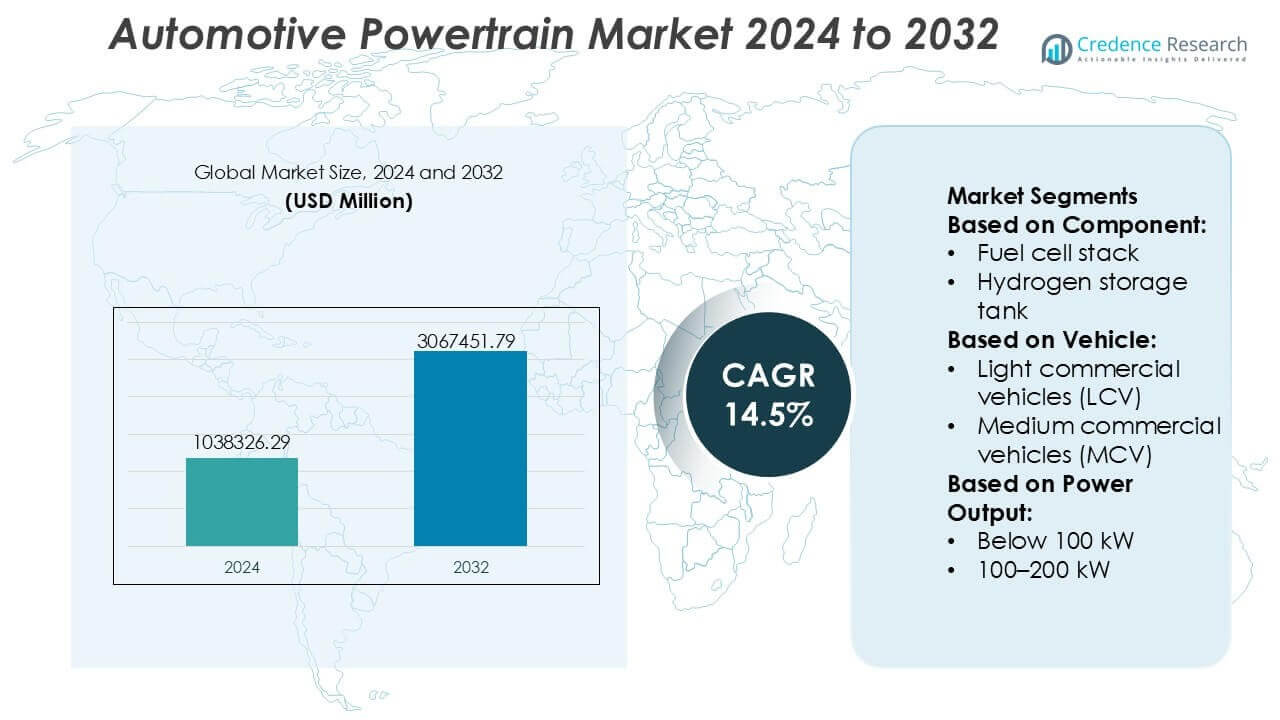
Automotive Powertrain Market size was valued USD 1038326.29 million in 2024 and is anticipated to reach USD 3067451.79 million by 2032, at a CAGR of 14.5% during the forecast period.
| REPORT ATTRIBUTE | DETAILS |
|---|---|
| Historical Period | 2020-2023 |
| Base Year | 2024 |
| Forecast Period | 2025-2032 |
| Automotive Powertrain Market Size 2024 | USD 1038326.29 million |
| Automotive Powertrain Market, CAGR | 14.5% |
| Automotive Powertrain Market Size 2032 | USD 3067451.79 million |
Automotive Powertrain Market Insights
- Market growth is driven by rising adoption of electric and hybrid vehicles, stricter emission regulations, and OEM focus on high-efficiency electric motors, power electronics, and software-integrated powertrain architectures.
- Key trends include the shift toward modular and scalable powertrain platforms, increased integration of power electronics and control software, and strong demand for electric motors, which represent the dominant component segment due to their critical role in electrified drivetrains.
- Competitive dynamics remain intense, with leading manufacturers leveraging advanced engineering, high R&D intensity, and long-term OEM partnerships to strengthen cost efficiency, performance differentiation, and global manufacturing footprints.
- Asia-Pacific leads the market with an exact 41% share, driven by high vehicle production in China, Japan, and India, while electric powertrains hold the leading segment share due to accelerating EV penetration.
Automotive Powertrain Market Segmentation Analysis:
By Component
By component, the battery system represents the dominant sub-segment in the automotive powertrain market, accounting for an estimated 38% market share. Its leadership is driven by rapid electrification across passenger and commercial vehicles, continuous improvements in energy density, and declining lithium-ion battery costs. Battery systems directly influence driving range, charging performance, and total vehicle cost, making them a primary focus for OEM investment. Strong demand for modular battery packs, advanced thermal management, and battery management systems further supports dominance. Electric motors and power control units follow, benefiting from efficiency gains, while fuel cell stacks and hydrogen storage systems remain niche but strategically important.
- For instance, Schaeffler AG has developed high-voltage battery system components and thermal management solutions capable of operating at system voltages up to 800 volts, while its advanced power electronics and mechatronic integration reduce electrical losses by measurable kilowatt-hour levels per vehicle over standardized drive cycles.
By Vehicle
By vehicle, passenger cars dominate the automotive powertrain market with an estimated 64% market share, supported by high global production volumes and faster adoption of electrified powertrains. Within this category, SUVs lead demand due to consumer preference for higher power output, torque, and range, particularly in electric and hybrid configurations. Automakers prioritize advanced powertrain platforms for passenger vehicles to meet emission regulations and performance expectations. Commercial vehicles follow, driven by fleet electrification initiatives, while light commercial vehicles show rising adoption as urban logistics and last-mile delivery increasingly favor electric and hybrid powertrain solutions.
- For instance, Mitsubishi Electric Corporation supplies electric motors and inverters for passenger vehicle powertrains that operate at voltages up to 800 volts and deliver motor outputs exceeding 200 kilowatts, while its silicon-carbide–based power modules reduce switching losses by double-digit kilowatt levels under standardized operating conditions, directly supporting higher efficiency and longer driving range in electric SUVs and premium passenger cars.
By Power Output
By power output, the 100–200 kW segment holds the dominant position with approximately 46% market share, reflecting its broad applicability across mid-size passenger cars, SUVs, and light commercial vehicles. This range offers an optimal balance between performance, efficiency, and cost, making it attractive for both internal combustion and electrified powertrains. OEMs increasingly design platforms around this output band to standardize components and improve scalability. Below 100 kW systems remain relevant for compact and entry-level vehicles, while above 200 kW powertrains cater to premium, performance, and heavy-duty applications with higher torque requirements.
Key Growth Drivers
- Electrification of Vehicle Powertrains
The accelerating shift toward electrified vehicles remains a primary growth driver for the automotive powertrain market. Automakers are rapidly transitioning from internal combustion engines to hybrid and fully electric powertrains to meet tightening emission norms and fuel-efficiency mandates. This transition significantly increases demand for electric motors, power control units, battery systems, and advanced thermal management solutions. OEM investments in dedicated electric platforms and modular powertrain architectures further support large-scale deployment. Additionally, government incentives and expanding charging infrastructure reinforce consumer adoption, sustaining long-term growth in electrified powertrain components across both passenger and commercial vehicle segments.
- For instance, ZF Friedrichshafen AG has industrialized its latest electric axle drives that integrate motor, inverter, and transmission into a single unit delivering continuous outputs up to 210 kilowatts and peak wheel torque of 3,700 newton-meters, while operating on 800-volt electrical architectures with silicon-carbide inverters to improve switching performance and thermal efficiency under high load conditions.
- Stringent Emission and Fuel-Efficiency Regulations
Global regulatory pressure continues to reshape powertrain design and technology adoption. Governments across Europe, North America, and Asia-Pacific enforce progressively stricter CO₂ emission and fuel-economy standards, compelling manufacturers to deploy cleaner, more efficient powertrain systems. This drives innovation in lightweight materials, high-efficiency transmissions, advanced combustion technologies, and hybrid configurations. Compliance requirements also accelerate the phase-out of inefficient legacy systems, prompting fleet upgrades. As regulatory timelines become more aggressive, OEMs increasingly prioritize powertrain efficiency improvements as a core competitive and compliance strategy.
- For instance, VALEO has industrialized its 48-volt mild-hybrid systems capable of delivering electric motor power up to 16 kilowatts and peak torque of 60 newton-meters, while its integrated electric supercharger reaches rotational speeds of 70,000 revolutions per minute, enabling rapid transient response and measurable reductions in fuel consumption and tailpipe emissions under regulated drive cycles.
- Growth in Global Vehicle Production and Parc Size
Rising vehicle production volumes, particularly in emerging economies, support sustained demand for automotive powertrain systems. Expanding middle-class populations, urbanization, and improving road infrastructure contribute to higher passenger and commercial vehicle sales. In parallel, growth in the global vehicle parc increases replacement demand for powertrain components and systems. Commercial vehicle demand linked to e-commerce, construction, and logistics further strengthens the market. This broad-based increase in vehicle manufacturing and utilization underpins steady powertrain demand across multiple propulsion technologies.
Key Trends & Opportunities
- Integration of Advanced Power Electronics and Software
The automotive powertrain market is witnessing a strong trend toward software-defined and electronically controlled systems. Advanced power electronics, embedded software, and AI-enabled control algorithms optimize energy efficiency, torque delivery, and thermal performance. This creates opportunities for suppliers offering integrated motor-inverter-control solutions and predictive diagnostics. Software-centric architectures also enable over-the-air updates and performance optimization throughout the vehicle lifecycle, enhancing value propositions for OEMs and end users while opening recurring revenue opportunities.
- For instance, NIDEC CORPORATION has developed integrated electric traction systems combining motor, inverter, and control software in a single housing, delivering motor speeds up to 18,000 revolutions per minute and continuous power outputs above 200 kilowatts, while its proprietary control algorithms manage inverter switching frequencies above 10 kilohertz to improve thermal stability and power density in electric powertrain applications.
- Expansion of Hybrid and Multi-Energy Powertrains
Hybrid powertrains are gaining traction as a transitional solution between conventional and fully electric vehicles. Automakers increasingly deploy mild, full, and plug-in hybrid systems to balance emission reduction with range flexibility. This trend creates opportunities for scalable powertrain platforms capable of supporting multiple energy sources, including gasoline, electricity, and hydrogen. Markets with limited charging infrastructure particularly favor hybrid adoption, making this segment a critical growth avenue for powertrain suppliers.
- For instance, Magna International Inc. has engineered modular hybrid drive systems that integrate electric motors rated up to 120 kilowatts with multi-speed hybrid transmissions, while its dedicated hybrid dual-clutch transmission supports engine speeds beyond 6,000 revolutions per minute and enables seamless torque blending between electric and combustion sources under real-world driving conditions.
- Lightweight and Modular Powertrain Design
OEMs increasingly focus on lightweight and modular powertrain architectures to improve efficiency and reduce manufacturing complexity. Modular designs allow shared components across multiple vehicle models, lowering development costs and accelerating time to market. Lightweight materials enhance vehicle range and performance, especially in electric vehicles. This trend opens opportunities for suppliers specializing in advanced materials, compact drivetrains, and modular subsystems tailored for both conventional and electrified platforms.
Key Challenges
- High Development and Manufacturing Costs
Developing next-generation powertrain systems requires substantial capital investment in R&D, testing, and manufacturing retooling. Electrified and advanced hybrid powertrains involve costly components such as batteries, power electronics, and precision motors, which pressure OEM margins. Additionally, parallel development of multiple powertrain technologies increases complexity and cost. These financial constraints pose challenges for smaller manufacturers and suppliers, potentially limiting innovation speed and market entry without strategic partnerships or scale advantages.
- Supply Chain Complexity and Raw Material Constraints
The automotive powertrain market faces ongoing challenges related to supply chain disruptions and raw material availability. Electrified powertrains rely heavily on critical materials such as lithium, nickel, and rare earth elements, which are subject to price volatility and geopolitical risks. Semiconductor shortages further impact power electronics production. Managing supplier dependencies, ensuring material traceability, and securing long-term sourcing agreements remain critical challenges that directly affect production stability and cost control across the powertrain value chain.
Regional Analysis
North America
North America holds a significant 28% market share in the automotive powertrain market, supported by strong demand for advanced gasoline, hybrid, and electric powertrain systems. Stringent emission regulations, particularly in the U.S. and Canada, accelerate the adoption of electrified and fuel-efficient powertrains. OEM investments in battery electric vehicles, e-axles, and power electronics strengthen regional competitiveness. The presence of established automotive manufacturers, a mature supplier ecosystem, and high R&D spending further support innovation. Demand from light trucks and SUVs, which require high-performance powertrains, continues to sustain steady growth across the region.
Europe
Europe accounts for approximately 24% market share, driven by aggressive decarbonization targets and strict CO₂ emission norms. The region leads in the adoption of hybrid and fully electric powertrains, supported by government incentives and expanding charging infrastructure. Strong automotive engineering capabilities in Germany, France, and Italy promote innovation in transmissions, electric motors, and integrated drive units. European OEMs increasingly focus on downsized engines, lightweight components, and software-driven powertrain optimization. The transition toward zero-emission mobility, combined with premium vehicle production, positions Europe as a key hub for advanced powertrain technologies.
Asia-Pacific
Asia-Pacific dominates the automotive powertrain market with an estimated 38% market share, fueled by high vehicle production volumes in China, Japan, South Korea, and India. Rapid urbanization, rising disposable incomes, and expanding middle-class populations drive strong demand for passenger vehicles. The region also leads in electric powertrain manufacturing, particularly batteries and electric motors, supported by large-scale investments and government mandates. Cost-competitive manufacturing, extensive supplier networks, and fast adoption of new technologies strengthen regional leadership. Growth in both internal combustion and electric powertrains ensures Asia-Pacific remains the largest and fastest-evolving market.
Latin America
Latin America holds around 6% market share, supported by steady vehicle production in Brazil, Mexico, and Argentina. The market is primarily driven by demand for cost-effective internal combustion engine powertrains, particularly for passenger cars and light commercial vehicles. Gradual improvements in emission standards encourage the adoption of more fuel-efficient engines and advanced transmissions. Mexico’s strong integration with North American automotive supply chains enhances regional manufacturing capabilities. Although electric powertrain penetration remains limited, increasing investments and policy support are expected to gradually improve adoption across key Latin American economies.
Middle East & Africa
The Middle East & Africa region represents approximately 4% market share in the automotive powertrain market. Demand is largely driven by conventional powertrains, supported by affordability considerations, fuel availability, and limited charging infrastructure. Commercial vehicles and SUVs with robust engines dominate due to infrastructure and climatic conditions. However, select Gulf countries are gradually promoting electric and hybrid vehicles through pilot programs and sustainability initiatives. Expanding automotive assembly activities, infrastructure development, and regulatory evolution are expected to support moderate long-term growth in advanced powertrain adoption across the region.
Automotive Powertrain Market Segmentations:
By Component:
- Fuel cell stack
- Hydrogen storage tank
By Vehicle:
- Light commercial vehicles (LCV)
- Medium commercial vehicles (MCV)
By Power Output:
- Below 100 kW
- 100–200 kW
By Geography
- North America
- U.S.
- Canada
- Mexico
- Europe
- Germany
- France
- U.K.
- Italy
- Spain
- Rest of Europe
- Asia Pacific
- China
- Japan
- India
- South Korea
- South-east Asia
- Rest of Asia Pacific
- Latin America
- Brazil
- Argentina
- Rest of Latin America
- Middle East & Africa
- GCC Countries
- South Africa
- Rest of the Middle East and Africa
Competitive Landscape
The automotive powertrain market players such as Schaeffler AG, Mitsubishi Electric Corporation, ZF Friedrichshafen AG, VALEO, NIDEC CORPORATION, Magna International Inc., Marelli Holdings Co., Ltd., Robert Bosch GmbH, BorgWarner Inc., Continental AG. The automotive powertrain market exhibits a consolidated and technology-driven competitive landscape, where suppliers compete on innovation, integration, and scale rather than standalone components. Companies are shifting toward system-level solutions that combine electric motors, power electronics, transmissions, and software into compact, high-efficiency architectures. Continuous investment in electrification, lightweight design, and thermal management enhances performance while meeting increasingly stringent emission regulations. Global manufacturing footprints and localized production strategies support cost efficiency and supply-chain resilience. Strategic partnerships with OEMs, long-term development contracts, and platform standardization strengthen market positioning. Overall, competition is intensifying as the industry transitions from conventional internal combustion systems toward hybrid and fully electric powertrain technologies.
Key Player Analysis
- Schaeffler AG
- Mitsubishi Electric Corporation
- ZF Friedrichshafen AG
- VALEO
- NIDEC CORPORATION
- Magna International Inc.
- Marelli Holdings Co., Ltd.
- Robert Bosch GmbH
- BorgWarner Inc.
- Continental AG
Recent Developments
- In February 2025, Honda unveiled its Next Generation Fuel Cell Module and Fuel Cell Power Generator, eyeing mass production in 2026-2027. This moves underscores Honda's strengthened dedication to advancing fuel cell technology and its diverse applications.
- In January 2025, Skoda launched facelifts for the Enyaq and Enyaq Coupe with updated designs and improved powertrains, including the Enyaq 60, which retained its 63 kWh battery but gained a more powerful 150 kW motor (up from ~132 kW), offering better performance and efficiency with longer range, alongside the new Enyaq 85 and 85x options for more power, featuring the larger 82 kWh battery and increased output.
- In May 2024, Toyota Motor North America (TMNA) today announced that it is renaming the TMNA R&D California office as its new North American Hydrogen Headquarters (H2HQ). Toyota expanded its hydrogen headquarters in North America to accelerate fuel cell technology advancements and market deployment.
Report Coverage
The research report offers an in-depth analysis based on Component, Vehicle Power Output and Geography. It details leading market players, providing an overview of their business, product offerings, investments, revenue streams, and key applications. Additionally, the report includes insights into the competitive environment, SWOT analysis, current market trends, as well as the primary drivers and constraints. Furthermore, it discusses various factors that have driven market expansion in recent years. The report also explores market dynamics, regulatory scenarios, and technological advancements that are shaping the industry. It assesses the impact of external factors and global economic changes on market growth. Lastly, it provides strategic recommendations for new entrants and established companies to navigate the complexities of the market.

Request a Free Sample
Fill in your details and we'll send you a free sample report.
- Sample data tables & charts
- Research methodology
Need a Custom Version of This Report?
Tailor the scope, geography, or segments to your exact requirements.
- Custom geography or segment scope
- Direct access to our analyst team
Frequently Asked Questions
What is the current market size for the Automotive Powertrain Market, and what is its projected size in 2032?
At what Compound Annual Growth Rate is the Automotive Powertrain Market projected to grow between 2024 and 2032?
Which Automotive Powertrain Market segment held the largest share in 2024?
What are the primary factors fueling the growth of the Automotive Powertrain Market?
Who are the leading companies in the Automotive Powertrain Market?
Which region commanded the largest share of the Automotive Powertrain Market in 2024?
Table of Content
Chapter 1 Market Segmentation
- 1.1 Segmentation Framework
- 1.1.1 Product and Service Classification
- 1.1.2 Application and End-Use Classification
- 1.1.3 Technology and Solution Classification
- 1.1.4 Customer and Distribution Channel Classification
- 1.1.5 Geographic Segmentation
- 1.1.6 Market Segment Definitions and Boundaries
Chapter 2 Introduction
- 2.1 Report Objectives and Scope
- 2.2 Product Definition and Industry Terminology
- 2.3 Market Inclusions and Exclusions
- 2.4 Research Process
- 2.4.1 Primary Research and Expert Interviews
- 2.4.2 Secondary Research and Source Review
- 2.4.3 Top-Down and Bottom-Up Estimation
- 2.4.4 Data Triangulation and Verification
- 2.5 Market Size Measurement Basis
- 2.5.1 2024: USD 1,038,326.29 million → 2032: USD 3,067,451.79 million
- 2.6 Historical and Forecast Reference Periods
- 2.6.1 Base Year: 2024
- 2.6.2 Forecast Period: 2024-2032
- 2.7 Research Assumptions and Limitations
Chapter 3 Executive Summary
- 3.1 Market Snapshot and Key Findings
- 3.2 Base-Year Market Size, 2024
- 3.3 Forecast Market Size, 2032
- 3.4 Revenue and Volume Growth Outlook
- 3.5 Key Demand and Supply Indicators
- 3.6 Leading Market Segments
- 3.7 Fastest-Growing Market Opportunities
- 3.8 Regional Performance Highlights
- 3.9 Technology and Industry Transformation
- 3.10 Competitive Landscape Summary
- 3.11 Analyst View and Strategic Implications
Chapter 4 Global Automotive Powertrain Market Trends and Developments
- 4.1 Historical Industry Development
- 4.2 Recent Market Trends and Developments
- 4.3 Demand and Customer Behavior Trends
- 4.4 Technology and Product Innovation
- 4.5 Artificial Intelligence, Automation and Digitalization
- 4.6 Local Manufacturing and Supply Chain Realignment
- 4.7 Industry Partnerships, Mergers and Acquisitions
- 4.8 Sustainability and Circular Economy Developments
- 4.9 Government and Private Sector Investment Trends
- 4.10 Emerging Business Models and Commercialization
- 4.11 Industry Developments and Announcements
Chapter 5 Global Automotive Powertrain Market Production, Supply and Demand Analysis
- 5.1 Demand Trend and Consumption Analysis
- 5.2 Demand Forecast, 2024-2032
- 5.3 Production and Output Trend
- 5.4 Production and Output Forecast, 2024-2032
- 5.5 Installed Capacity and Capacity Utilization
- 5.6 Company-Wise Production Plants and Statistics
- 5.6.1 Installed Production Capacity
- 5.6.2 Actual Production
- 5.6.3 Planned Capacity and Expansion Targets
- 5.7 Supply Chain Structure and Procurement Trends
- 5.8 Supply-Demand Gap and Bottlenecks
- 5.9 Import Dependence and Sourcing Structure
- 5.10 Contract Manufacturing and Outsourcing
- 5.11 Regional Supply and Demand Concentration
Chapter 6 Global Automotive Powertrain Market Pricing Analysis
- 6.1 Pricing Structure and Measurement
- 6.2 Historical Pricing Trends
- 6.3 Pricing Outlook, 2024-2032
- 6.4 Average Selling Price and Unit Economics
- 6.5 Pricing by Product and Market Segment
- 6.6 Geographic Pricing Differences
- 6.7 Key Input, Energy, Labor and Logistics Costs
- 6.8 Contract Pricing and Purchasing Models
- 6.9 Pricing Sensitivity and Competitive Positioning
- 6.10 Price, Margin and Profitability Implications
Chapter 7 Global Automotive Powertrain Market Dynamics
- 7.1 Market Growth Drivers
- 7.1.1 Demand-Side Drivers
- 7.1.2 Technology and Innovation Drivers
- 7.1.3 Infrastructure and Investment Drivers
- 7.1.4 Regulatory and Policy Drivers
- 7.2 Market Restraints
- 7.2.1 Cost and Affordability Constraints
- 7.2.2 Technology and Adoption Barriers
- 7.2.3 Supply Chain and Operational Constraints
- 7.3 Market Challenges
- 7.3.1 Competitive Pressure and Margin Erosion
- 7.3.2 Skills, Infrastructure and Implementation Gaps
- 7.4 Emerging Market Opportunities
- 7.5 Market Dynamics Impact and Time-Horizon Assessment
Chapter 8 Global Automotive Powertrain Value Chain Analysis
- 8.1 Industry Value Chain Overview
- 8.2 Upstream Suppliers and Critical Inputs
- 8.3 Technology and Component Providers
- 8.4 Manufacturing or Service Delivery
- 8.5 Distribution, Channel Partners and Integrators
- 8.6 Downstream Applications and End Users
- 8.7 Value Addition and Profit Pools
- 8.8 Vertical Integration and Outsourcing
- 8.9 Supplier Concentration and Risk
- 8.10 Supply Chain Localization and Resilience
Chapter 9 Global Automotive Powertrain Market Regulations and Policies
- 9.1 Relevant Laws, Standards and Compliance Frameworks
- 9.2 Product, Service, Safety and Quality Requirements
- 9.3 Government Policies, Incentives and Subsidies
- 9.4 Imports, Exports and Trade Barriers
- 9.5 Public Procurement and Local Content Requirements
- 9.6 Environmental and Sustainability Compliance
- 9.7 Upcoming Policy Changes and Market Implications
Chapter 10 Global Automotive Powertrain Market Hotspots and Opportunities
- 10.1 Market Opportunity Mapping and Growth Hotspots
- 10.2 High-Growth Applications and Customer Groups
- 10.3 Underserved Markets and White-Space Opportunities
- 10.4 Emerging Technology and Product Opportunities
- 10.5 New Capacity and Investment Hotspots
- 10.6 Market Entry and Expansion Opportunities
- 10.7 Distribution and Partnership Opportunities
- 10.8 Near-Term and Long-Term Commercial Potential
- 10.9 Opportunity Attractiveness and Execution Risks
Chapter 11 Global Automotive Powertrain Market Outlook, 2024-2032
- 11.1 Market Size and Analysis
- 11.1.1 Revenue (Market Measurement: 2024: USD 1,038,326.29 million → 2032: USD 3,067,451.79 million)
- 11.1.2 Market Volume and Quantity Sold
- 11.1.3 Historical Market Size
- 11.1.4 Base-Year Market Size, 2024
- 11.2 Market Forecast, 2024-2032
- 11.2.1 Revenue Forecast to 2032
- 11.2.2 Volume Forecast to 2032
- 11.2.3 CAGR and Year-on-Year Growth
- 11.2.4 Incremental Revenue Opportunity
- 11.3 Forecast Assumptions and Scenario Analysis
- 11.3.1 Base-Case Forecast
- 11.3.2 Optimistic and Conservative Scenarios
- 11.3.3 Technology, Pricing and Policy Sensitivities
- 11.4 Market Attractiveness and Growth Outlook
Chapter 12 Global Automotive Powertrain Market Segmentation and Outlook
- 12.1 Segmentation Summary and Market Shares, 2024
- 12.2 Largest and Fastest-Growing Segments
- 12.3 Segment Growth Comparison
- 12.4 Segment Attractiveness and Priority Matrix
Chapter 13 Global Automotive Powertrain Geographic Market Outlook, 2024-2032
- 13.1 Regional Market Size and Share, 2024
- 13.2 Regional Market Forecast, 2024-2032
- 13.3 Regional Pricing, Production and Demand Differences
- 13.4 North America
- 13.4.1 United States
- 13.4.2 Canada
- 13.4.3 Mexico
- 13.5 Europe
- 13.5.1 Germany
- 13.5.2 France
- 13.5.3 Italy
- 13.5.4 United Kingdom
- 13.5.5 Spain
- 13.5.6 Poland
- 13.5.7 Russia
- 13.5.8 Netherlands
- 13.5.9 Belgium
- 13.5.10 Sweden
- 13.5.11 Denmark
- 13.5.12 Norway
- 13.5.13 Rest of Europe
- 13.6 Asia Pacific
- 13.6.1 China
- 13.6.2 India
- 13.6.3 Japan
- 13.6.4 South Korea
- 13.6.5 Thailand
- 13.6.6 Indonesia
- 13.6.7 Vietnam
- 13.6.8 Malaysia
- 13.6.9 Australia
- 13.6.10 Rest of Asia Pacific
- 13.7 Latin America
- 13.7.1 Brazil
- 13.7.2 Argentina
- 13.7.3 Colombia
- 13.7.4 Chile
- 13.7.5 Rest of Latin America
- 13.8 Middle East
- 13.8.1 Saudi Arabia
- 13.8.2 United Arab Emirates
- 13.8.3 Turkey
- 13.8.4 Israel
- 13.8.5 Iran
- 13.8.6 Rest of the Middle East
- 13.9 Africa
- 13.9.1 South Africa
- 13.9.2 Egypt
- 13.9.3 Nigeria
- 13.9.4 Morocco
- 13.9.5 Rest of Africa
- 13.10 Regional Investment, Policy and Supply Chain Differences
- 13.11 Regional Competitive Landscape
- 13.12 Geographic Growth Hotspots
Chapter 14 Global Automotive Powertrain Technology, Innovation and Sustainability Outlook
- 14.1 Technology Landscape and Maturity
- 14.2 Product, Process and Service Innovation
- 14.3 AI, Automation and Digital Tools in the Industry
- 14.4 Technology Adoption and Performance Benchmarking
- 14.5 Innovation Pipeline and R&D Investment
- 14.6 Patent and Intellectual Property Trends
- 14.7 Energy Efficiency and Resource Management
- 14.8 Sustainability, Recycling and Circularity
- 14.9 Technology Roadmap, 2024-2032
- 14.10 Risks of Obsolescence and Technology Substitution
Chapter 15 Global Automotive Powertrain Market Key Strategic Imperatives
- 15.1 Growth and Market Entry Priorities
- 15.2 High-Return Products and Segments
- 15.3 Pricing, Profitability and Cost Optimization
- 15.4 Technology Investment and Product Differentiation
- 15.5 Supply Chain Localization and Resilience
- 15.6 Distribution and Customer Acquisition
- 15.7 Partnership, Acquisition and Capacity Strategy
- 15.8 Regional Expansion Priorities
- 15.9 Short-, Medium- and Long-Term Actions
Chapter 16 Competition Outlook
- 16.1 Industry Competition Characteristics
- 16.2 Market Structure and Concentration
- 16.3 Market Share and Competitive Positioning, 2024
- 16.4 Company-Wise Revenue and Product Benchmarking
- 16.5 Production and Service Capacity Benchmarking
- 16.6 Technology, Pricing and Differentiation
- 16.7 Regional Footprint and Distribution Strength
- 16.8 Mergers, Acquisitions and Strategic Alliances
- 16.9 New Entrants and Competitive Threats
- 16.10 Porter's Five Forces and Industry Attractiveness
- 16.11 Competitive Outlook, 2024-2032
Chapter 17 Company Profiles
- 17.1 Company Coverage and Selection Criteria
- 17.2 Leading Market Participants – Standard Profile Structure
- 17.2.1 Business Description
- 17.2.2 Company Ownership and Geographic Presence
- 17.2.3 Product and Service Portfolio
- 17.2.4 Manufacturing and Operating Footprint
- 17.2.5 Production Capacity and Expansion Plans
- 17.2.6 Financial Performance and Investment
- 17.2.7 Market Share and Competitive Position
- 17.2.8 Technology and Innovation Capabilities
- 17.2.9 Strategic Alliances or Partnerships
- 17.2.10 Recent Developments
- 17.2.11 Growth Strategy and Outlook
- 17.3 Other Relevant Market Participants
Note: Every listed company is profiled on the structure shown under the first company. The company list is preliminary and may change based on research findings, market developments, data availability and client requirements.
Chapter 18 Disclaimer
- 18.1 Research and Forecast Disclaimer
- 18.2 Data Source and Estimation Limitations
Note: The depth of individual sections depends on data availability for this market. Volume, capacity, trade and other unit-based metrics are included where applicable.