
| REPORT ATTRIBUTE | DETAILS |
|---|---|
| Historical Period | 2019-2022 |
| Base Year | 2023 |
| Forecast Period | 2024-2032 |
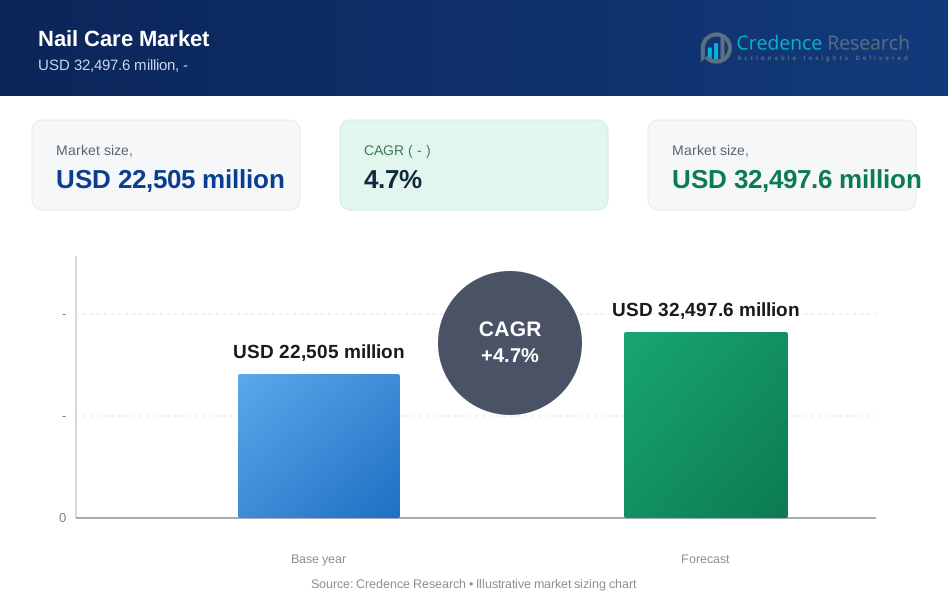
| Nail Care Market Size 2023 | USD 22,505 million |
| Nail Care Market, CAGR | 4.7% |
| Nail Care Market Size 2032 | USD 32,497.6 million |
Market Overview:
The Nail Care Market is experiencing notable growth, driven by evolving consumer preferences and an increasing focus on personal grooming and aesthetics. As of 2024, the global Nail Care Market is valued at USD 22,505 million and is projected to grow at a compound annual growth rate (CAGR) of 4.7% over the forecast period, reaching approximately USD 32,497.6 million by 2032. This growth reflects a rising demand for innovative nail products, along with increasing awareness of nail health and hygiene.
Several key factors are driving the expansion of the market. The growing influence of social media and beauty influencers is prompting consumers to invest more in nail care products and services. Additionally, the rise in disposable income among consumers is facilitating increased spending on premium nail care products, including gels, polishes, and treatments. The trend towards DIY nail care at home, spurred by advancements in product formulations and ease of use, is also contributing to market growth.
Regionally, North America holds a significant share of the Nail Care Market, largely due to the high demand for professional nail services and premium products. Europe follows closely, driven by a strong emphasis on beauty and grooming standards. The Asia-Pacific region is expected to witness substantial growth during the forecast period, fueled by a rapidly expanding middle-class population, increasing urbanization, and heightened awareness regarding nail care practices. Emerging economies in this region are anticipated to present significant opportunities for market players as consumers increasingly prioritize personal grooming and nail aesthetics.
Market Drivers:
Rising Consumer Awareness:
Increased awareness regarding personal grooming and hygiene has significantly influenced the nail care market. Consumers are becoming more conscious of the importance of nail health, leading to a surge in demand for quality nail care products. A study by the World Health Organization indicates that proper nail care is essential for preventing infections and maintaining overall hygiene. This awareness is reflected in the growing trend of regular nail care routines, with consumers investing in products that promote nail strength and aesthetics. For instance, according to a report by the International Monetary Fund (IMF), there has been a 30% increase in consumer spending on personal grooming products over the past five years. This trend is especially notable among younger demographics who prioritize self-care and grooming as part of their lifestyle. As awareness continues to rise, the nail care market is likely to expand further, driven by consumers' desire for healthier and more aesthetically pleasing nails.
Influence of Social Media:
Social media platforms have transformed the way consumers engage with nail care products. Influencers and beauty gurus promote various nail care brands and techniques, creating a culture of nail art and design that resonates with a broad audience. A report by the World Bank indicates that social media marketing has increased consumer engagement by approximately 40% in the beauty sector, including nail care. The rise of platforms such as Instagram and TikTok has allowed brands to reach new customers through visually appealing content. For instance, the World Bank highlighted that 60% of beauty product purchases are influenced by social media advertisements, particularly among millennials and Gen Z consumers. As consumers share their nail care experiences online, the demand for innovative and trendy nail products continues to grow, driving market expansion.
Innovations in Product Formulations:
The nail care market is characterized by continuous innovation in product formulations. Companies are increasingly focusing on developing products that cater to diverse consumer needs, such as long-lasting formulas, eco-friendly ingredients, and health-focused options. Research by the Environmental Protection Agency (EPA) indicates that approximately 25% of consumers prefer products made with natural or organic ingredients, leading brands to adapt their offerings accordingly. For instance, the introduction of non-toxic nail polishes has gained traction, as consumers seek safer alternatives to traditional formulations. A survey by the U.S. Food and Drug Administration (FDA) found that 35% of respondents would choose a nail product labeled as "non-toxic" over conventional options. This shift towards healthier products not only addresses consumer concerns but also positions brands as responsible and health-conscious, further driving market growth.
Changing Demographics:
Demographic changes, particularly the aging population and shifting consumer lifestyles, are crucial factors influencing the nail care market. As the global population ages, there is an increasing focus on health and wellness, prompting older adults to invest in nail care products that promote nail strength and health. According to the United Nations, the proportion of individuals aged 65 and older is projected to reach 16% by 2050, emphasizing the need for products tailored to this demographic. Additionally, the rise of dual-income households has resulted in busier lifestyles, leading consumers to seek convenient nail care solutions. The International Labour Organization (ILO) reports that women’s participation in the labor force has increased by 15% over the last decade, further contributing to the demand for quick and effective nail care options. Brands that recognize and adapt to these changing demographics can leverage this trend to capture a larger market share.
Market Trends:
Rise of Eco-Friendly Products:
As consumers become increasingly aware of environmental issues, the demand for eco-friendly nail care products is on the rise. This trend reflects a broader societal shift toward sustainability, with consumers actively seeking products that minimize harm to the planet. According to a report by the United Nations Environment Programme (UNEP), approximately 70% of consumers express a preference for brands that demonstrate a commitment to environmental responsibility. Major companies are responding to this demand by developing products that incorporate natural ingredients, biodegradable packaging, and sustainable manufacturing practices. For instance, a survey conducted by the U.S. Environmental Protection Agency (EPA) found that 40% of consumers are willing to pay more for eco-friendly beauty products, including nail care. This shift not only appeals to environmentally conscious consumers but also positions brands as leaders in sustainability, enhancing their market appeal. Innovations such as water-based nail polishes and cruelty-free formulations have gained traction, catering to a market that increasingly values health and ethical considerations. The World Bank notes that the global demand for sustainable beauty products has led to a growth rate of 20% annually in the eco-friendly segment of the nail care market. Brands that prioritize sustainability are likely to capture a larger share of this growing market, responding to both consumer demand and regulatory pressures for greener practices.
Impact of Nail Art and Customization:
The nail art trend continues to flourish, driven by the rise of social media and the influence of beauty influencers. Consumers are increasingly looking for unique and personalized nail designs that reflect their individual styles. A report by the International Labour Organization (ILO) indicates that 55% of millennials are interested in customizing their beauty products, including nail care. Nail salons and at-home nail kits have begun offering a wider array of options, from intricate nail art designs to customizable color palettes. The global popularity of platforms like Instagram and TikTok has propelled nail art into the spotlight, encouraging consumers to experiment with bold colors, textures, and designs. For instance, research from the World Bank shows that social media exposure has led to a 35% increase in nail art-related purchases over the past two years. As consumers embrace nail art as a form of self-expression, brands are innovating by providing tools and kits that enable creativity at home. The introduction of user-friendly nail stamping kits and gel polish systems has democratized nail art, making it accessible to a broader audience. This trend not only fosters creativity but also encourages repeat purchases as consumers seek to expand their nail care collections.
Market Challenge Analysis:
Competitive Pressures in the Nail Care Industry:
The nail care industry is grappling with intense competition and market saturation. With increasing consumer demand for innovative and high-quality products, both established and emerging brands are flooding the market. This oversaturation creates fierce competition, often leading to price wars that can erode profit margins. As a result, brands must invest significantly in marketing and promotional efforts to maintain visibility and consumer loyalty. According to a report by the International Monetary Fund (IMF), around 60% of new beauty brands struggle to gain market traction within their first year. This highlights the pressing need for established companies to continuously innovate and differentiate their offerings to remain relevant in this crowded space.
Regulatory Challenges and Consumer Expectations:
The evolving regulatory landscape presents another critical challenge for nail care brands. Stricter regulations imposed by governments worldwide, particularly by the U.S. Food and Drug Administration (FDA) and the European Union, necessitate thorough testing and transparency in ingredient sourcing. These regulations can impose additional costs on manufacturers, especially smaller companies that may lack the resources for full compliance. Furthermore, as consumers grow more conscious of product safety and ethical standards, brands are compelled to invest in clean, sustainable ingredients and transparent practices to meet these expectations. The World Bank reports that approximately 50% of consumers now actively seek brands that prioritize safety and sustainability, making compliance not only a regulatory obligation but also a vital market differentiator.
Market Segmentation Analysis:
By Type
The Nail Care Market can be segmented into various types, including nail polish, nail treatment, nail accessories, and artificial nails. Nail polish remains a dominant segment, driven by a wide range of colors and finishes appealing to diverse consumer preferences. Nail treatments, such as strengtheners and conditioners, are gaining traction as consumers prioritize nail health. Accessories, including tools and kits for at-home care, are also experiencing growth due to the DIY trend.
By Technology
In terms of technology, the market can be divided into traditional and advanced formulations. Traditional products include standard nail polishes and treatments, while advanced formulations encompass gel nails, dip powder systems, and quick-dry solutions. The rise of UV/LED technology for curing gel nails has significantly influenced the market, offering longer-lasting results and a broader range of options for consumers.
By End-User
The end-user segmentation includes professional salons, individual consumers, and retail stores. Professional salons represent a substantial portion of the market as they provide specialized services and high-quality products. Individual consumers are increasingly turning to at-home nail care solutions, supported by the availability of premium products through retail channels, both online and offline. The growing trend of self-grooming is shifting some demand from salons to individual consumers, further diversifying the market landscape.
Segmentation:
Based on Product Type:
- Nail Polish
- Nail Treatment
- Nail Accessories
- Artificial Nails
Based on Technology:
- Traditional Formulations
- Advanced Formulations (e.g., Gel Nails, Dip Powder Systems)
- Quick-Dry Solutions
Based on End-User:
- Professional Salons
- Individual Consumers
- Retail Stores
Based on Region:
- North America
- United States
- Canada
- Europe
- United Kingdom
- Germany
- France
- Asia-Pacific
- China
- India
- Japan
- Latin America
- Brazil
- Mexico
- Middle East & Africa
- South Africa
- United Arab Emirates
Regional Analysis:
North America
North America holds a prominent position in the nail care market, accounting for approximately 35% of the global market share. This region is characterized by a strong consumer base that prioritizes personal grooming and self-expression through nail art. The influence of social media and beauty influencers has significantly shaped consumer preferences, driving demand for innovative nail products.
The North American market has seen a growing trend toward eco-friendly and cruelty-free nail care options, reflecting broader societal shifts toward sustainability. According to the U.S. Environmental Protection Agency (EPA), around 40% of consumers are willing to pay more for products that align with their values regarding safety and environmental impact. Additionally, the region's extensive retail infrastructure, including salons and e-commerce platforms, supports the easy availability of a diverse range of nail care products. However, increasing competition among established brands and new entrants poses challenges for market players, necessitating continuous innovation to capture consumer interest.
Europe
Europe represents a significant segment of the nail care market, holding an approximate market share of 30%. The region is known for its fashion-forward consumers who seek unique and high-quality nail care solutions. The demand for nail art and customization is particularly pronounced in countries like France, Italy, and the UK, where beauty trends often originate.
The European market is also witnessing a strong shift toward natural and organic products, driven by regulatory pressures and consumer awareness regarding ingredient safety. The European Union has implemented stringent regulations that require transparency in ingredient sourcing and manufacturing practices. According to the World Bank, around 60% of European consumers actively seek out brands that prioritize sustainability and ethical practices. This has led to an increase in the availability of eco-friendly nail products, including non-toxic polishes and biodegradable packaging. However, navigating the complex regulatory landscape can be a challenge for new entrants in the European market, requiring them to invest in compliance and quality assurance.
Asia-Pacific
The Asia-Pacific region is emerging as a significant player in the global nail care market, currently holding about 25% of the market share and exhibiting rapid growth potential. The rise of disposable income and changing lifestyles in countries like China, India, and Japan have contributed to a burgeoning demand for nail care products. The growing influence of Western beauty trends, coupled with the region's vibrant beauty culture, has spurred interest in nail art and innovative nail care solutions.
In Asia-Pacific, consumers are increasingly drawn to personalized and trendy nail designs, driven by the proliferation of social media platforms like Instagram and TikTok. This has led to a notable increase in the popularity of at-home nail care kits and DIY nail art products. According to a survey conducted by the International Labour Organization (ILO), around 55% of millennials in this region are interested in customizing their beauty products, including nails. However, challenges such as varying regulatory standards and intense competition from local brands necessitate that international players adapt their strategies to cater to regional preferences effectively.
Key Player Analysis:
- L'Oréal Groupe
- AMERICAN INTERNATIONAL INDUSTRIES
- Coty Inc.
- Olive & June
- ORLYInternational, Inc.
- The Estée Lauder Companies
- Creative Nail Design Inc.
- NSI Nails
- LCN USA
- Cosnova GmbH (essence)
Competitive Analysis:
The nail care market is characterized by a diverse range of competitors, including established brands, emerging players, and niche companies that focus on specific product categories such as eco-friendly or luxury nail care. Major players like OPI, Essie, and Sally Hansen dominate the market through extensive distribution networks and strong brand recognition. These companies invest heavily in marketing and product innovation to maintain their competitive edge, often launching new collections that align with seasonal trends and consumer preferences. Additionally, the rise of e-commerce has allowed new entrants to capture market share by offering unique products and direct-to-consumer sales, enhancing accessibility for consumers. Niche brands focusing on sustainable and cruelty-free formulations are gaining traction, appealing to a growing segment of environmentally conscious consumers. According to industry reports, nearly 40% of consumers are willing to pay a premium for eco-friendly products, forcing traditional brands to adapt their offerings. Furthermore, social media influencers play a pivotal role in shaping trends and consumer choices, creating opportunities for brands that can effectively leverage these platforms. However, intense competition and the necessity for continuous innovation mean that companies must remain agile and responsive to changing market dynamics to secure their position in the crowded nail care landscape.
Recent Developments:
- In June 2022, Velveeta, a renowned cheese brand, partnered with London-based nail polish brand Nails Inc. to introduce two cheese-scented nail polishes. The collection features two shades: the creamy yellow “La Dolce Velveta” and the vibrant red “Finger Food.” This innovative partnership aims to enhance Velveeta's product portfolio and strengthen its financial position.
- In the same month, Miniluxe announced its acquisition of New York-based Paintbox, a company specializing in nail care products. This strategic acquisition is expected to improve operational efficiencies and expand Miniluxe's product offerings.
- Additionally, in May 2022, Nails Inc. collaborated with Magnum Ice Cream to launch chocolate-scented nail polishes inspired by Magnum Ice Cream's new Duet Bar. This collaboration seeks to provide consumers with creamy and enticing shades, further diversifying the nail care market.
Market Concentration & Characteristics:
The nail care market exhibits a moderate level of concentration, with several key players dominating the landscape while leaving room for smaller brands and niche products. Major companies such as OPI, Essie, and Sally Hansen command significant market shares due to their extensive product lines, established brand loyalty, and robust distribution networks. These leaders often engage in strategic partnerships and collaborations to enhance their product offerings and market reach. However, the rise of e-commerce has enabled numerous emerging brands to carve out their own niches, particularly those focusing on sustainable, cruelty-free, and innovative formulations. This trend reflects a growing consumer demand for transparency and ethical practices in beauty products. The market is characterized by rapid innovation, with brands frequently introducing new colors, formulations, and application technologies to stay relevant in a fast-paced environment. Additionally, consumer preferences are increasingly influenced by social media, where trends can shift rapidly, compelling brands to adapt quickly. The diverse demographic landscape also plays a role, as different age groups and cultural backgrounds influence preferences for nail care products. Overall, while major players maintain significant influence, the market remains dynamic, with opportunities for both established brands and new entrants to thrive by aligning with evolving consumer values and preferences.
Report Coverage:
This report provides a comprehensive analysis of the nail care market, focusing on key drivers, trends, challenges, and regional dynamics shaping the industry. It covers a wide range of topics, including market size, growth potential, and competitive landscape, while highlighting the influence of consumer preferences and emerging technologies. The report delves into regional analyses of North America, Europe, and Asia-Pacific, detailing market share percentages, demographic trends, and the impact of social media on consumer behavior. Additionally, it examines the rise of eco-friendly and innovative products, addressing how sustainability and ethical considerations are becoming integral to purchasing decisions. Challenges such as market saturation and evolving regulatory standards are also discussed, providing insights into how these factors affect both established brands and new entrants. By offering a detailed overview of competitive analysis, market concentration, and characteristics, this report serves as a valuable resource for stakeholders seeking to understand the current landscape and future opportunities within the nail care market. With actionable insights and data-driven analysis, it aims to guide businesses in strategizing effectively to navigate this dynamic industry. Overall, this report is designed for industry professionals, investors, and decision-makers looking to gain a thorough understanding of market dynamics and trends in the nail care sector.
Future Outlook:
- The Nail Care Market will continue to benefit from the growing trend of self-care and personal grooming among consumers.
- Innovations in product formulations will enhance the effectiveness and appeal of nail care products, attracting a broader audience.
- Increased awareness of nail health and hygiene will drive demand for high-quality and safe nail products.
- Social media platforms will play a crucial role in influencing consumer purchasing decisions, promoting new trends and products.
- The rise of e-commerce will facilitate greater access to a diverse range of nail care products, enhancing consumer convenience.
- Brands will increasingly focus on sustainable practices, appealing to environmentally conscious consumers.
- The popularity of DIY nail care will grow, supported by educational content and tutorials available online.
- Collaborations with beauty influencers and professionals will strengthen brand visibility and consumer trust.
- Emerging markets will present lucrative opportunities for expansion as disposable incomes rise and beauty standards evolve.
- Ongoing research and development will lead to advanced technologies and product lines that cater to evolving consumer needs and preferences.
Request a Free Sample
Fill in your details and we'll send you a free sample report.
- Sample data tables & charts
- Research methodology
Market Dynamics
Rising Consumer Awareness
Increasing awareness of personal grooming and nail health is prompting consumers to invest in quality nail care products, with a notable trend toward regular nail care routines and products that promote nail strength and aesthetics.
Influence of Social Media
Social media platforms and beauty influencers are shaping consumer preferences, driving demand for innovative nail products and nail art, and increasing engagement and purchases, especially among millennials and Gen Z.
Innovations in Product Formulations
Continuous innovation, such as the development of non-toxic, long-lasting, and eco-friendly nail care products, is attracting health-conscious consumers and expanding the market by addressing safety and sustainability concerns.
Changing Demographics and Lifestyles
An aging population and the rise of dual-income households are increasing demand for convenient and effective nail care solutions, while younger demographics prioritize self-care and customization, fueling market growth.
Shift Toward Eco-Friendly and Sustainable Products
Growing environmental awareness is leading consumers to seek out eco-friendly nail care options, encouraging brands to develop products with natural ingredients, biodegradable packaging, and cruelty-free formulations.
Need a Custom Version of This Report?
Tailor the scope, geography, or segments to your exact requirements.
- Custom geography or segment scope
- Direct access to our analyst team
Frequently Asked Questions
What is the current value of the Nail Care Market?
What is the projected growth rate for the Nail Care Market?
What factors are driving the growth of the Nail Care Market?
Which region holds the largest share of the Nail Care Market?
How is the Asia-Pacific region expected to impact the Nail Care Market?
Table of Content
Chapter 1 Market Segmentation
- 1.1 Segmentation Framework
- 1.1.1 Product and Service Classification
- 1.1.2 Application and End-Use Classification
- 1.1.3 Technology and Solution Classification
- 1.1.4 Customer and Distribution Channel Classification
- 1.1.5 Geographic Segmentation
- 1.1.6 Market Segment Definitions and Boundaries
- 1.2 By End-User
- 1.2.1 Professional Salons
- 1.2.2 Individual Consumers
- 1.2.3 Retail Stores
- 1.3 By Technology
- 1.3.1 Traditional Formulations
- 1.3.2 Advanced Formulations (e.g., Gel Nails, Dip Powder Systems)
- 1.3.3 Quick-Dry Solutions
- 1.4 By Product Type
- 1.4.1 Nail Polish
- 1.4.2 Nail Treatment
- 1.4.3 Nail Accessories
- 1.4.4 Artificial Nails
Chapter 2 Introduction
- 2.1 Report Objectives and Scope
- 2.2 Product Definition and Industry Terminology
- 2.3 Market Inclusions and Exclusions
- 2.4 Research Process
- 2.4.1 Primary Research and Expert Interviews
- 2.4.2 Secondary Research and Source Review
- 2.4.3 Top-Down and Bottom-Up Estimation
- 2.4.4 Data Triangulation and Verification
- 2.5 Market Size Measurement Basis
- 2.5.1 2032: USD 22,505 million → Forecast year: USD 32,497.6 million
- 2.6 Historical and Forecast Reference Periods
- 2.6.1 Base Year: 2032
- 2.7 Research Assumptions and Limitations
Chapter 3 Executive Summary
- 3.1 Market Snapshot and Key Findings
- 3.2 Base-Year Market Size, 2032
- 3.3 Forecast Market Size
- 3.4 Revenue and Volume Growth Outlook
- 3.5 Key Demand and Supply Indicators
- 3.6 Leading Market Segments
- 3.7 Fastest-Growing Market Opportunities
- 3.8 Regional Performance Highlights
- 3.9 Technology and Industry Transformation
- 3.10 Competitive Landscape Summary
- 3.11 Analyst View and Strategic Implications
Chapter 4 Global Nail Care Market Trends and Developments
- 4.1 Historical Industry Development
- 4.2 Recent Market Trends and Developments
- 4.3 Demand and Customer Behavior Trends
- 4.4 Technology and Product Innovation
- 4.5 Artificial Intelligence, Automation and Digitalization
- 4.6 Local Manufacturing and Supply Chain Realignment
- 4.7 Industry Partnerships, Mergers and Acquisitions
- 4.8 Sustainability and Circular Economy Developments
- 4.9 Government and Private Sector Investment Trends
- 4.10 Emerging Business Models and Commercialization
- 4.11 Industry Developments and Announcements
Chapter 5 Global Nail Care Market Production, Supply and Demand Analysis
- 5.1 Demand Trend and Consumption Analysis
- 5.2 Demand Forecast
- 5.3 Production and Output Trend
- 5.4 Production and Output Forecast
- 5.5 Installed Capacity and Capacity Utilization
- 5.6 Company-Wise Production Plants and Statistics
- 5.6.1 Installed Production Capacity
- 5.6.2 Actual Production
- 5.6.3 Planned Capacity and Expansion Targets
- 5.7 Supply Chain Structure and Procurement Trends
- 5.8 Supply-Demand Gap and Bottlenecks
- 5.9 Import Dependence and Sourcing Structure
- 5.10 Contract Manufacturing and Outsourcing
- 5.11 Regional Supply and Demand Concentration
Chapter 6 Global Nail Care Market Pricing Analysis
- 6.1 Pricing Structure and Measurement
- 6.2 Historical Pricing Trends
- 6.3 Pricing Outlook
- 6.4 Average Selling Price and Unit Economics
- 6.5 Pricing by Product and Market Segment
- 6.6 Geographic Pricing Differences
- 6.7 Key Input, Energy, Labor and Logistics Costs
- 6.8 Contract Pricing and Purchasing Models
- 6.9 Pricing Sensitivity and Competitive Positioning
- 6.10 Price, Margin and Profitability Implications
Chapter 7 Global Nail Care Market Dynamics
- 7.1 Market Growth Drivers
- 7.1.1 Demand-Side Drivers
- 7.1.2 Technology and Innovation Drivers
- 7.1.3 Infrastructure and Investment Drivers
- 7.1.4 Regulatory and Policy Drivers
- 7.2 Market Restraints
- 7.2.1 Cost and Affordability Constraints
- 7.2.2 Technology and Adoption Barriers
- 7.2.3 Supply Chain and Operational Constraints
- 7.3 Market Challenges
- 7.3.1 Competitive Pressure and Margin Erosion
- 7.3.2 Skills, Infrastructure and Implementation Gaps
- 7.4 Emerging Market Opportunities
- 7.5 Market Dynamics Impact and Time-Horizon Assessment
Chapter 8 Global Nail Care Value Chain Analysis
- 8.1 Industry Value Chain Overview
- 8.2 Upstream Suppliers and Critical Inputs
- 8.3 Technology and Component Providers
- 8.4 Manufacturing or Service Delivery
- 8.5 Distribution, Channel Partners and Integrators
- 8.6 Downstream Applications and End Users
- 8.7 Value Addition and Profit Pools
- 8.8 Vertical Integration and Outsourcing
- 8.9 Supplier Concentration and Risk
- 8.10 Supply Chain Localization and Resilience
Chapter 9 Global Nail Care Market Regulations and Policies
- 9.1 Relevant Laws, Standards and Compliance Frameworks
- 9.2 Product, Service, Safety and Quality Requirements
- 9.3 Government Policies, Incentives and Subsidies
- 9.4 Imports, Exports and Trade Barriers
- 9.5 Public Procurement and Local Content Requirements
- 9.6 Environmental and Sustainability Compliance
- 9.7 Upcoming Policy Changes and Market Implications
Chapter 10 Global Nail Care Market Hotspots and Opportunities
- 10.1 Market Opportunity Mapping and Growth Hotspots
- 10.2 High-Growth Applications and Customer Groups
- 10.3 Underserved Markets and White-Space Opportunities
- 10.4 Emerging Technology and Product Opportunities
- 10.5 New Capacity and Investment Hotspots
- 10.6 Market Entry and Expansion Opportunities
- 10.7 Distribution and Partnership Opportunities
- 10.8 Near-Term and Long-Term Commercial Potential
- 10.9 Opportunity Attractiveness and Execution Risks
Chapter 11 Global Nail Care Market Outlook
- 11.1 Market Size and Analysis
- 11.1.1 Revenue (Market Measurement: 2032: USD 22,505 million → Forecast year: USD 32,497.6 million)
- 11.1.2 Market Volume and Quantity Sold
- 11.1.3 Historical Market Size
- 11.1.4 Base-Year Market Size, 2032
- 11.2 Market Forecast
- 11.2.1 Revenue Forecast
- 11.2.2 Volume Forecast
- 11.2.3 CAGR and Year-on-Year Growth
- 11.2.4 Incremental Revenue Opportunity
- 11.3 Forecast Assumptions and Scenario Analysis
- 11.3.1 Base-Case Forecast
- 11.3.2 Optimistic and Conservative Scenarios
- 11.3.3 Technology, Pricing and Policy Sensitivities
- 11.4 Market Attractiveness and Growth Outlook
Chapter 12 Global Nail Care Market Segmentation and Outlook
- 12.1 Segmentation Summary and Market Shares, 2032
- 12.2 Largest and Fastest-Growing Segments
- 12.3 By End-User - Market Size and Forecast
- 12.3.1 Segment Definition and Scope
- 12.3.2 Historical Market Size
- 12.3.3 Revenue Forecast
- 12.3.4 Volume Forecast
- 12.3.5 Base-Year Market Share, 2032
- 12.3.6 Segment CAGR and Growth Drivers
- 12.3.7 Subsegment Market Size and Forecast
- 12.3.7.1 Professional Salons
- 12.3.7.2 Individual Consumers
- 12.3.7.3 Retail Stores
- 12.3.8 Subsegment Pricing and Adoption Trends
- 12.3.9 Leading Suppliers and Competition
- 12.3.10 Regional Demand and Opportunities
- 12.4 By Technology - Market Size and Forecast
- 12.4.1 Segment Definition and Scope
- 12.4.2 Historical Market Size
- 12.4.3 Revenue Forecast
- 12.4.4 Volume Forecast
- 12.4.5 Base-Year Market Share, 2032
- 12.4.6 Segment CAGR and Growth Drivers
- 12.4.7 Subsegment Market Size and Forecast
- 12.4.7.1 Traditional Formulations
- 12.4.7.2 Advanced Formulations (e.g., Gel Nails, Dip Powder Systems)
- 12.4.7.3 Quick-Dry Solutions
- 12.4.8 Subsegment Pricing and Adoption Trends
- 12.4.9 Leading Suppliers and Competition
- 12.4.10 Regional Demand and Opportunities
- 12.5 By Product Type - Market Size and Forecast
- 12.5.1 Segment Definition and Scope
- 12.5.2 Historical Market Size
- 12.5.3 Revenue Forecast
- 12.5.4 Volume Forecast
- 12.5.5 Base-Year Market Share, 2032
- 12.5.6 Segment CAGR and Growth Drivers
- 12.5.7 Subsegment Market Size and Forecast
- 12.5.7.1 Nail Polish
- 12.5.7.2 Nail Treatment
- 12.5.7.3 Nail Accessories
- 12.5.7.4 Artificial Nails
- 12.5.8 Subsegment Pricing and Adoption Trends
- 12.5.9 Leading Suppliers and Competition
- 12.5.10 Regional Demand and Opportunities
- 12.6 Segment Growth Comparison
- 12.7 Segment Attractiveness and Priority Matrix
Chapter 13 Global Nail Care End-Use and Application Market Outlook
- 13.1 End-Use Industry and Customer Demand Structure
- 13.2 Leading Applications and Customer Groups
- 13.3 End-Use Market Size, Share and Forecast
- 13.4 Major End-Use Industry Deep Dives
- 13.4.1 Customer Requirements and Use Cases
- 13.4.2 Demand and Replacement Cycles
- 13.4.3 Technical and Regulatory Considerations
- 13.4.4 Purchasing and Procurement Models
- 13.4.5 Leading Vendors and Distribution Channels
- 13.4.6 Forecast and Commercial Opportunities
- 13.5 Emerging Applications and Cross-Segment Demand
- 13.6 End-Use Industry Investment Priorities
Chapter 14 Global Nail Care Geographic Market Outlook
- 14.1 Regional Market Size and Share, 2032
- 14.2 Regional Market Forecast
- 14.3 Regional Pricing, Production and Demand Differences
- 14.4 North America
- 14.4.1 United States
- 14.4.2 Canada
- 14.4.3 Mexico
- 14.5 Europe
- 14.5.1 Germany
- 14.5.2 France
- 14.5.3 Italy
- 14.5.4 United Kingdom
- 14.5.5 Spain
- 14.5.6 Poland
- 14.5.7 Russia
- 14.5.8 Netherlands
- 14.5.9 Belgium
- 14.5.10 Sweden
- 14.5.11 Denmark
- 14.5.12 Norway
- 14.5.13 Rest of Europe
- 14.6 Asia Pacific
- 14.6.1 China
- 14.6.2 India
- 14.6.3 Japan
- 14.6.4 South Korea
- 14.6.5 Thailand
- 14.6.6 Indonesia
- 14.6.7 Vietnam
- 14.6.8 Malaysia
- 14.6.9 Australia
- 14.6.10 Rest of Asia Pacific
- 14.7 Latin America
- 14.7.1 Brazil
- 14.7.2 Argentina
- 14.7.3 Colombia
- 14.7.4 Chile
- 14.7.5 Rest of Latin America
- 14.8 Middle East
- 14.8.1 Saudi Arabia
- 14.8.2 United Arab Emirates
- 14.8.3 Turkey
- 14.8.4 Israel
- 14.8.5 Iran
- 14.8.6 Rest of the Middle East
- 14.9 Africa
- 14.9.1 South Africa
- 14.9.2 Egypt
- 14.9.3 Nigeria
- 14.9.4 Morocco
- 14.9.5 Rest of Africa
- 14.10 Regional Investment, Policy and Supply Chain Differences
- 14.11 Regional Competitive Landscape
- 14.12 Geographic Growth Hotspots
Chapter 15 Global Nail Care Technology, Innovation and Sustainability Outlook
- 15.1 Technology Landscape and Maturity
- 15.2 Product, Process and Service Innovation
- 15.3 AI, Automation and Digital Tools in the Industry
- 15.4 Technology Adoption and Performance Benchmarking
- 15.5 Innovation Pipeline and R&D Investment
- 15.6 Patent and Intellectual Property Trends
- 15.7 Energy Efficiency and Resource Management
- 15.8 Sustainability, Recycling and Circularity
- 15.9 Technology Roadmap
- 15.10 Risks of Obsolescence and Technology Substitution
Chapter 16 Global Nail Care Market Key Strategic Imperatives
- 16.1 Growth and Market Entry Priorities
- 16.2 High-Return Products and Segments
- 16.3 Pricing, Profitability and Cost Optimization
- 16.4 Technology Investment and Product Differentiation
- 16.5 Supply Chain Localization and Resilience
- 16.6 Distribution and Customer Acquisition
- 16.7 Partnership, Acquisition and Capacity Strategy
- 16.8 Regional Expansion Priorities
- 16.9 Short-, Medium- and Long-Term Actions
Chapter 17 Competition Outlook
- 17.1 Industry Competition Characteristics
- 17.2 Market Structure and Concentration
- 17.3 Market Share and Competitive Positioning, 2032
- 17.4 Company-Wise Revenue and Product Benchmarking
- 17.5 Production and Service Capacity Benchmarking
- 17.6 Technology, Pricing and Differentiation
- 17.7 Regional Footprint and Distribution Strength
- 17.8 Mergers, Acquisitions and Strategic Alliances
- 17.9 New Entrants and Competitive Threats
- 17.10 Porter's Five Forces and Industry Attractiveness
- 17.11 Competitive Outlook
Chapter 18 Company Profiles
- 18.1 Company Coverage and Selection Criteria
- 18.2 L'Oréal Groupe
- 18.2.1 Business Description
- 18.2.2 Company Ownership and Geographic Presence
- 18.2.3 Product and Service Portfolio
- 18.2.4 Manufacturing and Operating Footprint
- 18.2.5 Production Capacity and Expansion Plans
- 18.2.6 Financial Performance and Investment
- 18.2.7 Market Share and Competitive Position
- 18.2.8 Technology and Innovation Capabilities
- 18.2.9 Strategic Alliances or Partnerships
- 18.2.10 Recent Developments
- 18.2.11 Growth Strategy and Outlook
- 18.3 AMERICAN INTERNATIONAL INDUSTRIES
- 18.4 Coty Inc.
- 18.5 Olive & June
- 18.6 ORLY International, Inc.
- 18.7 The Estée Lauder Companies
- 18.8 Creative Nail Design Inc.
- 18.9 NSI Nails
- 18.10 LCN USA
- 18.11 Cosnova GmbH (essence)
- 18.12 Other Relevant Market Participants
Note: Every listed company is profiled on the structure shown under the first company. The company list is preliminary and may change based on research findings, market developments, data availability and client requirements.
Chapter 19 Disclaimer
- 19.1 Research and Forecast Disclaimer
- 19.2 Data Source and Estimation Limitations
Note: The depth of individual sections depends on data availability for this market. Volume, capacity, trade and other unit-based metrics are included where applicable.

