
Market Overview:
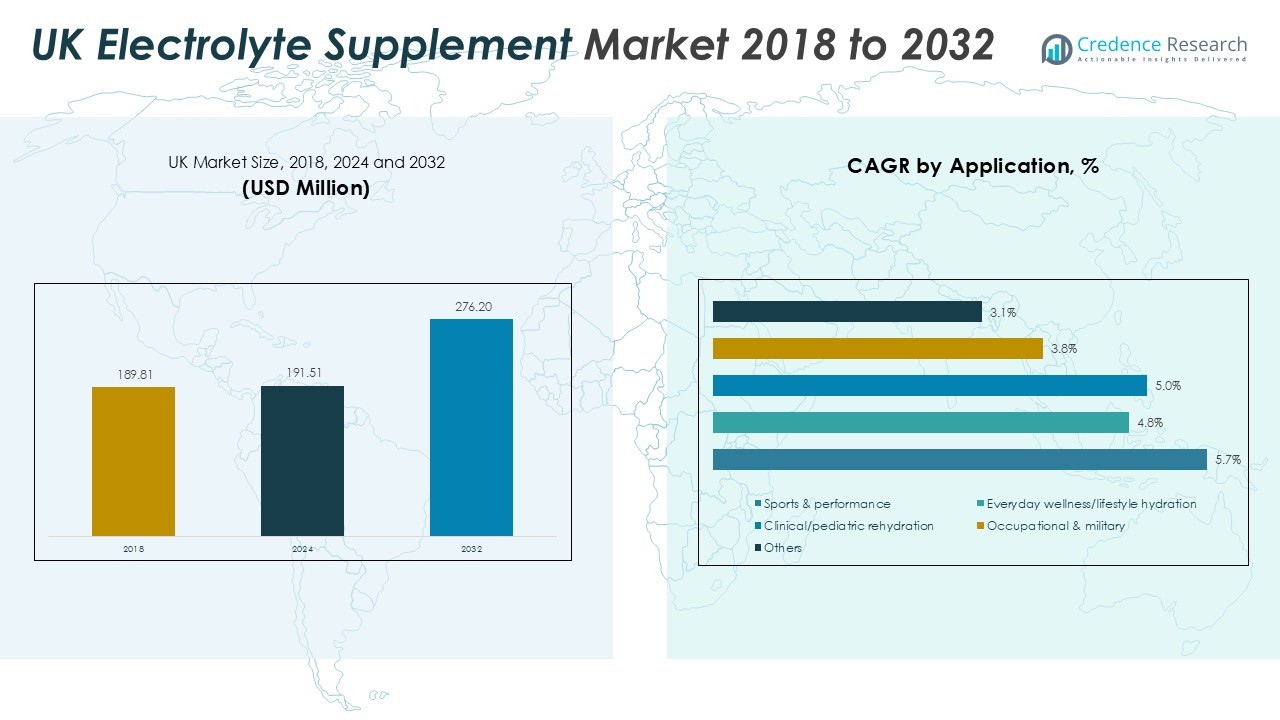
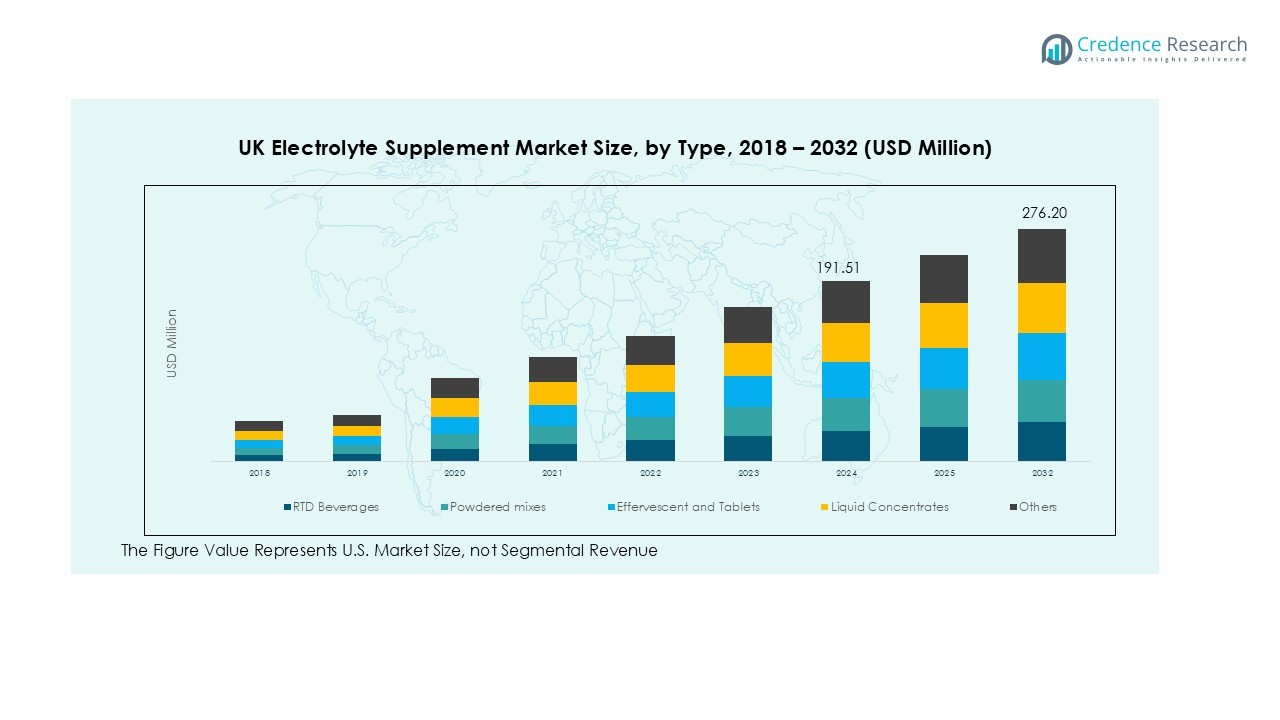
The UK Electrolyte Supplement Market size was valued at USD 189.81 million in 2018 to USD 191.51 million in 2024 and is anticipated to reach USD 276.20 million by 2032, at a CAGR of 4.68% during the forecast period.
| REPORT ATTRIBUTE | DETAILS |
|---|---|
| Historical Period | 2020-2023 |
| Base Year | 2024 |
| Forecast Period | 2025-2032 |
| UK Electrolyte Supplement Market Size 2024 | USD 191.51 Million |
| UK Electrolyte Supplement Market, CAGR | 4.68% |
| UK Electrolyte Supplement Market Size 2032 | USD 276.20 Million |
Key market drivers include rising demand for health and fitness products, especially among athletes and fitness enthusiasts. The growing popularity of sports drinks and powders as a means to replenish electrolytes after physical exertion further contributes to market expansion. Additionally, the increasing prevalence of health conditions such as dehydration and muscle cramps has prompted a surge in electrolyte supplement consumption. The shift toward natural and organic electrolyte supplements also aligns with the broader consumer trend toward clean, functional foods.
In terms of regional distribution, England dominates the market, driven by the concentration of sports and fitness enthusiasts and high awareness of wellness. London, in particular, accounts for a significant share, owing to its large population and active lifestyle trends. The market in Scotland and Wales is also growing steadily, driven by rising consumer demand for fitness and wellness products. Regional growth is further supported by improved availability and accessibility of these supplements across retail and online platforms.
Market Insights:
- The UK Electrolyte Supplement Market, valued at USD 189.81 million in 2018, is expected to reach USD 276.20 million by 2032, with a CAGR of 4.68%.
- Increasing health and fitness awareness has led to higher demand for electrolyte supplements, particularly among athletes and fitness enthusiasts.
- Sports drinks and powders are gaining traction for replenishing electrolytes and improving recovery after exercise, significantly contributing to market growth.
- The rising prevalence of dehydration-related health issues, such as muscle cramps and fatigue, has further boosted the demand for electrolyte supplements.
- Consumers are shifting towards natural and organic electrolyte supplements, aligning with broader trends for clean, functional products.
- England dominates the UK market with a 55% share, driven by urbanization and high fitness and wellness engagement, particularly in London.
- Scotland and Wales account for 28% of the market share, with increasing fitness interest driving steady demand for electrolyte supplements.
Market Drivers:
Increasing Health and Fitness Awareness Driving Demand in the UK Electrolyte Supplement Market
The growing focus on health and fitness in the UK is a primary driver of the electrolyte supplement market. More consumers are turning to fitness regimes that require better hydration and recovery strategies, which electrolyte supplements support. Increased participation in sports, fitness programs, and wellness activities fuels the need for effective hydration solutions. This trend is particularly notable among athletes and individuals who engage in intensive physical activity, encouraging a surge in demand for electrolyte supplements.
- For instance, Styrkr's SLT07 hydration tablets are formulated with a quad-blend of electrolytes, including 500mg of sodium, to mimic the ratio of electrolytes lost in sweat during endurance sports.
Rising Popularity of Sports Drinks and Powders
Sports drinks and electrolyte powders are gaining widespread popularity in the UK, further supporting the market growth. These products are widely used by individuals looking to replenish electrolytes lost during exercise. They provide quick hydration and help in preventing conditions such as dehydration and muscle cramps. With many options available on the market, consumers are increasingly turning to these supplements to enhance their workout performance and recovery, thereby boosting the UK electrolyte supplement market.
Prevalence of Dehydration and Related Health Conditions
The increasing prevalence of dehydration-related health issues is another driver for the UK electrolyte supplement market. Dehydration can lead to various health problems, including fatigue, headaches, and muscle cramps, especially during warmer months or physical exertion. The growing awareness of these conditions encourages individuals to turn to electrolyte supplements to maintain hydration levels and prevent health complications.
- For instance, Lucozade Sport is an isotonic sports drink that provides carbohydrates and electrolytes to enhance hydration, offering approximately 16g of carbohydrates per 250ml serving to help maintain performance during endurance exercise.
Shift Toward Natural and Organic Electrolyte Supplements
Consumers in the UK are increasingly opting for natural and organic electrolyte supplements, which align with the broader trend toward clean and functional foods. The demand for products free from artificial additives and preservatives is growing, as consumers prioritize health-conscious choices. This shift is propelling the electrolyte supplement market toward more natural offerings, such as plant-based powders and organic ingredients, further expanding the market reach.
Market Trends:
Rise in Consumer Preference for Plant-Based and Organic Electrolyte Supplements in the UK Electrolyte Supplement Market
The demand for plant-based and organic electrolyte supplements is growing in the UK, driven by shifting consumer preferences towards clean and natural products. With a heightened focus on health and wellness, consumers are increasingly looking for supplements free from artificial additives, preservatives, and synthetic ingredients. Products derived from natural sources such as coconut water, sea minerals, and organic herbs are gaining popularity, appealing to health-conscious buyers. This trend aligns with the broader movement towards sustainable and eco-friendly products, as consumers seek brands that support both personal health and environmental sustainability. The increasing availability of organic-certified electrolyte powders and drinks further strengthens this trend in the UK electrolyte supplement market. This shift towards plant-based options is expected to continue, shaping future product developments and market dynamics.
- For instance, LMNT's electrolyte drink mix, which is popular in the UK, is formulated without sugar and contains a robust dose of 1,000mg of sodium in each serving to support optimal hydration.
Growth of Online and E-Commerce Channels for Electrolyte Supplements
The rise of online and e-commerce platforms has significantly impacted the UK electrolyte supplement market. More consumers are choosing the convenience of online shopping, allowing them to easily access a wide range of electrolyte supplements. E-commerce platforms provide greater product variety, detailed customer reviews, and the ability to compare prices, enhancing the purchasing experience. This shift towards digital sales channels is especially prominent among younger consumers who prefer to shop online. The accessibility and convenience of online platforms enable brands to reach a broader audience and improve their market penetration. As a result, companies are increasingly focusing on digital marketing strategies and offering direct-to-consumer sales models to capitalize on this growing trend in the UK electrolyte supplement market.
- For instance, Unilever introduced its Liquid I.V. brand to the UK, leveraging the product's status as the #1 powdered hydration brand in the US.
Market Challenges Analysis:
Regulatory Challenges and Product Labeling Compliance in the UK Electrolyte Supplement Market
One of the major challenges in the UK electrolyte supplement market is navigating the regulatory landscape and ensuring compliance with stringent product labeling standards. The market faces evolving regulations from authorities such as the Food Standards Agency (FSA) and the European Food Safety Authority (EFSA) regarding ingredient safety, health claims, and labeling practices. Manufacturers must ensure their products meet these standards to avoid legal issues or product recalls. With growing concerns about consumer health and safety, maintaining transparency in labeling becomes critical, especially as consumers increasingly seek out clean, natural, and organic products. Companies must carefully adhere to these regulations while maintaining consumer trust and meeting demand for functional products.
Intense Competition and Price Sensitivity in the UK Electrolyte Supplement Market
The UK electrolyte supplement market is highly competitive, with numerous brands offering a wide variety of products. This intense competition often leads to price sensitivity, as consumers compare products based on price, quality, and brand reputation. Smaller companies may struggle to differentiate themselves in a crowded market, and larger brands dominate shelf space in retail environments. Moreover, with the rise of e-commerce, price wars have become more pronounced, forcing companies to constantly adjust their pricing strategies. To stand out, brands must innovate with unique formulations or benefits, further intensifying market pressure.
Market Opportunities:
Expansion of Product Range and Innovation in the UK Electrolyte Supplement Market
A key opportunity in the UK electrolyte supplement market lies in expanding the product range to cater to diverse consumer needs. Manufacturers can tap into niche segments such as sugar-free, vegan, or organic electrolyte supplements to meet the growing demand for clean and functional nutrition. Innovations in formulation, such as incorporating probiotics, adaptogens, or added vitamins, can further differentiate products and appeal to health-conscious buyers. The increasing focus on personalized nutrition also opens avenues for creating customized electrolyte supplements tailored to specific needs, such as post-workout recovery or hydration for the elderly. Expanding product offerings will help companies address a broader audience and gain a competitive edge in this evolving market.
Growth of Sports and Wellness Influencer Partnerships in the UK Electrolyte Supplement Market
Collaborations with sports personalities and wellness influencers present a significant opportunity for growth in the UK electrolyte supplement market. Leveraging the influence of athletes and health experts can help brands increase their visibility and credibility, particularly among fitness enthusiasts. Endorsements from well-known figures in the health and sports sectors can drive consumer trust and enhance product adoption. Additionally, these partnerships offer a platform to educate the public on the benefits of electrolyte supplementation in maintaining hydration and improving performance. By aligning with fitness trends, brands can tap into new customer segments and boost market share.
Market Segmentation Analysis:
By Type
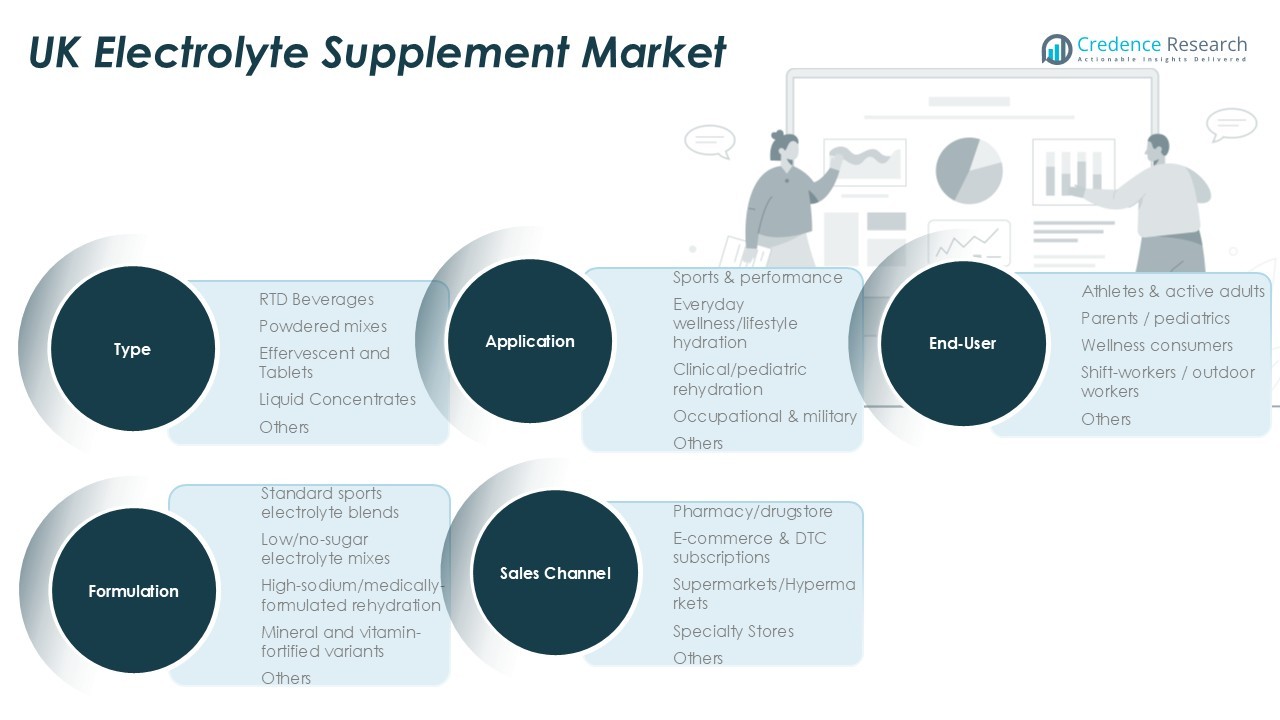
The UK Electrolyte Supplement Market is segmented into various types, including RTD (ready-to-drink) beverages, powdered mixes, effervescent tablets, liquid concentrates, and others. RTD beverages lead the market due to their convenience and on-the-go usage. Powdered mixes and effervescent tablets are popular among consumers seeking portability and ease of use. Liquid concentrates are gaining popularity due to their cost-effectiveness and concentration of electrolytes. Each type addresses the diverse needs of consumers for hydration and performance enhancement.
- For instance, the UK-based company Styrkr developed its SLT07 Hydration Tablets, which provide 1000mg of sodium in a single effervescent tablet to rapidly replenish the primary electrolyte lost through sweat.
By Application
The market is driven by several key applications, with sports and performance taking the lead. Electrolyte supplements are essential for athletes to maintain hydration during physical exertion and to enhance performance. Everyday wellness and lifestyle hydration have seen increasing demand, as consumers look for convenient ways to stay hydrated throughout the day. Clinical and pediatric rehydration is another important segment, particularly for individuals with health conditions requiring electrolyte replenishment. Occupational and military applications are growing, as hydration solutions are vital in harsh working conditions or environments that demand physical endurance.
- For instance, Precision Fuel & Hydration offers its PH 1500 electrolyte drink mix, which is scientifically formulated with 1500mg of sodium per litre to help athletes start hydrated and recover faster after intense exercise.
By End-User
The primary consumers of electrolyte supplements in the UK are athletes and active adults, who rely on them for hydration and recovery. The growing awareness of hydration in children has made parents and pediatric consumers a significant segment. Wellness consumers also represent a large market, driven by their focus on overall health. Shift-workers and outdoor workers, who face dehydration risks due to prolonged activity, form another crucial group, further contributing to the market's expansion.
Segmentations:
By Type
- Overview by Type Segment
- RTD Beverages
- Powdered mixes
- Effervescent and Tablets
- Liquid Concentrates
- Others
- Overview by Application Segment
- Sports & Performance
- Everyday wellness/lifestyle hydration
- Clinical/pediatric rehydration
- Occupational & military
- Others
- Overview by End-user Segment
- Athletes & active adults
- Parents / pediatrics
- Wellness consumers
- Shift-workers / outdoor workers
- Others
- Overview by Formulation Segment
- Standard sports electrolyte blends
- Low/no-sugar electrolyte mixes
- High-sodium/medically-formulated rehydration
- Mineral and vitamin-fortified variants
- Others
- Overview by Sales Channel Segment
- Pharmacy/drugstore
- E-commerce & DTC subscriptions
- Supermarkets/Hypermarkets
- Specialty Stores
- Others
Regional Analysis:
England Holds the Largest Share in the UK Electrolyte Supplement Market
England dominates the UK electrolyte supplement market with a share of 55%. The region's urban centers, particularly London, contribute significantly to market growth, driven by an increasing focus on wellness trends and active lifestyles. Consumers in these areas are highly engaged in fitness activities, such as gym workouts and recreational sports, which drives the demand for electrolyte supplements. Both physical and digital retail channels are well-established, providing convenient access to these products. This urbanization and lifestyle shift strongly support England's leading position in the market.
Scotland and Wales Drive Growing Demand for Electrolyte Supplements
Scotland and Wales collectively hold 28% of the UK electrolyte supplement market share. Both regions are witnessing a rising interest in fitness and wellness, particularly among the younger population. With the increasing number of fitness clubs, sports events, and health-conscious initiatives, the demand for electrolyte supplements continues to grow. Local and international brands are responding by offering products tailored to the preferences of these markets. The emphasis on preventive healthcare in both regions further drives the consumption of electrolyte products, particularly among athletes and outdoor enthusiasts.
Northern Ireland Presents Key Opportunities for Market Growth
Northern Ireland accounts for 17% of the UK electrolyte supplement market share. While smaller than England, the region shows significant growth potential due to a rising awareness of health and hydration. Outdoor activities, such as hiking and cycling, contribute to an increasing need for hydration solutions, including electrolyte supplements. Retailers are expanding their product lines to cater to the local demand, and digital channels provide a means for brands to reach a broader audience. As interest in fitness and health continues to rise, Northern Ireland presents valuable opportunities for market players.
Key Player Analysis:
- Nestlé S.A.
- GlaxoSmithKline plc
- Otsuka Pharmaceutical Co., Ltd.
- GU Energy Labs
- Hammer Nutrition
- SOS Hydration Inc.
- Tailwind Nutrition
- Liquid I.V.
- Denver Bodega LLC
- Sequel Natural LLC
- Kent Corporation
- Roar Organic
- Purity Organic, LLC
Competitive Analysis:
The UK Electrolyte Supplement Market is competitive, with leading players like Nestlé, GlaxoSmithKline, and Otsuka Pharmaceutical dominating through strong brand presence and broad distribution networks. These companies focus on innovation, offering new flavors, formulations, and convenient product formats to meet consumer demand. Smaller brands, emphasizing natural, organic, and sugar-free options, cater to health-conscious consumers, creating a diverse market landscape. E-commerce platforms have further expanded reach, intensifying competition as brands compete on price and differentiation. To maintain or grow market share, companies must continue innovating and adapting to evolving consumer preferences, driving further product diversification and development.
Recent Developments:
- In September 2025, Nestlé's new CEO, Philipp Navratil, in his first public comments, stated his intent for the company to be fast-moving and open to new ideas.
- In May 2025, GSK announced its acquisition of efimosfermin alfa from Boston Pharmaceuticals for a potential total of $2 billion to bolster its pipeline for steatotic liver disease (SLD) treatment.
Report Coverage:
The research report offers an in-depth analysis based on Type, Application, End-User, Formulation and Sales Channel. It details leading market players, providing an overview of their business, product offerings, investments, revenue streams, and key applications. Additionally, the report includes insights into the competitive environment, SWOT analysis, current market trends, as well as the primary drivers and constraints. Furthermore, it discusses various factors that have driven market expansion in recent years. The report also explores market dynamics, regulatory scenarios, and technological advancements that are shaping the industry. It assesses the impact of external factors and global economic changes on market growth. Lastly, it provides strategic recommendations for new entrants and established companies to navigate the complexities of the market.
Future Outlook:
- The UK Electrolyte Supplement Market will continue to see growth driven by increasing awareness of the importance of hydration for overall health and fitness.
- Consumers will increasingly opt for natural, organic, and low-sugar electrolyte products, aligning with broader health trends.
- E-commerce will remain a key sales channel, offering brands greater visibility and a direct connection to consumers.
- Innovative product offerings, including new flavors and formulations, will be critical for brands to stay competitive and meet diverse consumer preferences.
- The demand for electrolyte supplements in sports and performance applications will remain strong, with a growing number of athletes and fitness enthusiasts seeking hydration solutions.
- Everyday wellness and lifestyle hydration will drive product consumption among general consumers looking for convenient hydration options.
- Pediatric and clinical rehydration markets will expand as more people recognize the importance of proper electrolyte balance for children and those with specific health conditions.
- The market will see further expansion in specialized areas, such as hydration solutions for shift-workers and outdoor workers in physically demanding environments.
- Regional growth will be supported by increased product availability and accessibility across both retail and online platforms.
- Strategic partnerships, acquisitions, and regional expansions will be key strategies for brands to strengthen their market position and capture a larger share of the growing market.

Request a Free Sample
Fill in your details and we'll send you a free sample report.
- Sample data tables & charts
- Research methodology
Market Dynamics
Health and Fitness Awareness
Growing consumer focus on health, fitness, and hydration - especially among athletes and active adults - has significantly increased demand for electrolyte supplements as part of daily wellness and sports routines.
Popularity of Sports Drinks and Powders
The widespread adoption of sports drinks and electrolyte powders for rapid hydration and recovery after exercise is fueling market growth, as consumers seek convenient and effective solutions to replenish lost electrolytes.
Rising Prevalence of Dehydration-Related Health Issues
Increasing cases of dehydration, muscle cramps, and fatigue - particularly during physical activity or hot weather - are prompting more consumers to use electrolyte supplements for prevention and recovery.
Shift Toward Natural and Organic Products
Consumer preference is shifting toward clean-label, plant-based, and organic electrolyte supplements, driving innovation and expanding the market as brands respond to demand for products free from artificial additives.
Growth of E-commerce and Online Channels
The expansion of online retail and direct-to-consumer subscription models has made electrolyte supplements more accessible, allowing brands to reach a wider audience and cater to digitally savvy consumers.
Need a Custom Version of This Report?
Tailor the scope, geography, or segments to your exact requirements.
- Custom geography or segment scope
- Direct access to our analyst team
Frequently Asked Questions
What is the current market size for UK Electrolyte Supplement, and what is its projected size in 2032?
At what Compound Annual Growth Rate is the UK Electrolyte Supplement market projected to grow between 2024 and 2032?
Which UK Electrolyte Supplement market segment held the largest share in 2024?
What are the primary factors fueling the growth of the UK Electrolyte Supplement market?
Who are the leading companies in the UK Electrolyte Supplement market?
Which region commanded the largest share of the UK Electrolyte Supplement market in 2024?
Table of Content
Chapter 1 Market Segmentation
- 1.1 Segmentation Framework
- 1.1.1 Product and Service Classification
- 1.1.2 Application and End-Use Classification
- 1.1.3 Technology and Solution Classification
- 1.1.4 Customer and Distribution Channel Classification
- 1.1.5 Geographic Segmentation
- 1.1.6 Market Segment Definitions and Boundaries
- 1.2 By Type
- 1.2.1 RTD Beverages
- 1.2.2 Powdered Mixes
- 1.2.3 Effervescent Tablets
- 1.2.4 Liquid Concentrates
- 1.2.5 Others
- 1.3 By End-User
- 1.3.1 Athletes & Active Adults
- 1.3.2 Parents/Pediatrics
- 1.3.3 Wellness Consumers
- 1.3.4 Shift-Workers/Outdoor Workers
- 1.3.5 Others
- 1.4 By Application
- 1.4.1 Sports & Performance
- 1.4.2 Everyday Wellness/Lifestyle Hydration
- 1.4.3 Clinical/Pediatric Rehydration
- 1.4.4 Occupational & Military
- 1.4.5 Others
- 1.5 By Sales Channel
- 1.5.1 Pharmacy/Drugstore
- 1.5.2 E-commerce & DTC Subscriptions
- 1.5.3 Supermarkets/Hypermarkets
- 1.5.4 Specialty Stores
- 1.5.5 Others
Chapter 2 Introduction
- 2.1 Report Objectives and Scope
- 2.2 Product Definition and Industry Terminology
- 2.3 Market Inclusions and Exclusions
- 2.4 Research Process
- 2.4.1 Primary Research and Expert Interviews
- 2.4.2 Secondary Research and Source Review
- 2.4.3 Top-Down and Bottom-Up Estimation
- 2.4.4 Data Triangulation and Verification
- 2.5 Market Size Measurement Basis
- 2.5.1 2018: USD 189.81 million → 2032: USD 276.20 million
- 2.6 Historical and Forecast Reference Periods
- 2.6.1 Base Year: 2018
- 2.6.2 Forecast Period: 2018-2032
- 2.7 Research Assumptions and Limitations
Chapter 3 Executive Summary
- 3.1 Market Snapshot and Key Findings
- 3.2 Base-Year Market Size, 2018
- 3.3 Forecast Market Size, 2032
- 3.4 Revenue and Volume Growth Outlook
- 3.5 Key Demand and Supply Indicators
- 3.6 Leading Market Segments
- 3.7 Fastest-Growing Market Opportunities
- 3.8 Regional Performance Highlights
- 3.9 Technology and Industry Transformation
- 3.10 Competitive Landscape Summary
- 3.11 Analyst View and Strategic Implications
Chapter 4 UK Electrolyte Supplement Market Trends and Developments
- 4.1 Historical Industry Development
- 4.2 Recent Market Trends and Developments
- 4.3 Demand and Customer Behavior Trends
- 4.4 Technology and Product Innovation
- 4.5 Artificial Intelligence, Automation and Digitalization
- 4.6 Local Manufacturing and Supply Chain Realignment
- 4.7 Industry Partnerships, Mergers and Acquisitions
- 4.8 Sustainability and Circular Economy Developments
- 4.9 Government and Private Sector Investment Trends
- 4.10 Emerging Business Models and Commercialization
- 4.11 Industry Developments and Announcements
Chapter 5 UK Electrolyte Supplement Market Production, Supply and Demand Analysis
- 5.1 Demand Trend and Consumption Analysis
- 5.2 Demand Forecast, 2018-2032
- 5.3 Production and Output Trend
- 5.4 Production and Output Forecast, 2018-2032
- 5.5 Installed Capacity and Capacity Utilization
- 5.6 Company-Wise Production Plants and Statistics
- 5.6.1 Installed Production Capacity
- 5.6.2 Actual Production
- 5.6.3 Planned Capacity and Expansion Targets
- 5.7 Supply Chain Structure and Procurement Trends
- 5.8 Supply-Demand Gap and Bottlenecks
- 5.9 Import Dependence and Sourcing Structure
- 5.10 Contract Manufacturing and Outsourcing
- 5.11 Regional Supply and Demand Concentration
Chapter 6 UK Electrolyte Supplement Market Pricing Analysis
- 6.1 Pricing Structure and Measurement
- 6.2 Historical Pricing Trends
- 6.3 Pricing Outlook, 2018-2032
- 6.4 Average Selling Price and Unit Economics
- 6.5 Pricing by Product and Market Segment
- 6.6 Geographic Pricing Differences
- 6.7 Key Input, Energy, Labor and Logistics Costs
- 6.8 Contract Pricing and Purchasing Models
- 6.9 Pricing Sensitivity and Competitive Positioning
- 6.10 Price, Margin and Profitability Implications
Chapter 7 UK Electrolyte Supplement Market Dynamics
- 7.1 Market Growth Drivers
- 7.1.1 Demand-Side Drivers
- 7.1.2 Technology and Innovation Drivers
- 7.1.3 Infrastructure and Investment Drivers
- 7.1.4 Regulatory and Policy Drivers
- 7.2 Market Restraints
- 7.2.1 Cost and Affordability Constraints
- 7.2.2 Technology and Adoption Barriers
- 7.2.3 Supply Chain and Operational Constraints
- 7.3 Market Challenges
- 7.3.1 Competitive Pressure and Margin Erosion
- 7.3.2 Skills, Infrastructure and Implementation Gaps
- 7.4 Emerging Market Opportunities
- 7.5 Market Dynamics Impact and Time-Horizon Assessment
Chapter 8 UK Electrolyte Supplement Value Chain Analysis
- 8.1 Industry Value Chain Overview
- 8.2 Upstream Suppliers and Critical Inputs
- 8.3 Technology and Component Providers
- 8.4 Manufacturing or Service Delivery
- 8.5 Distribution, Channel Partners and Integrators
- 8.6 Downstream Applications and End Users
- 8.7 Value Addition and Profit Pools
- 8.8 Vertical Integration and Outsourcing
- 8.9 Supplier Concentration and Risk
- 8.10 Supply Chain Localization and Resilience
Chapter 9 UK Electrolyte Supplement Market Regulations and Policies
- 9.1 Relevant Laws, Standards and Compliance Frameworks
- 9.2 Product, Service, Safety and Quality Requirements
- 9.3 Government Policies, Incentives and Subsidies
- 9.4 Imports, Exports and Trade Barriers
- 9.5 Public Procurement and Local Content Requirements
- 9.6 Environmental and Sustainability Compliance
- 9.7 Upcoming Policy Changes and Market Implications
Chapter 10 UK Electrolyte Supplement Market Hotspots and Opportunities
- 10.1 Market Opportunity Mapping and Growth Hotspots
- 10.2 High-Growth Applications and Customer Groups
- 10.3 Underserved Markets and White-Space Opportunities
- 10.4 Emerging Technology and Product Opportunities
- 10.5 New Capacity and Investment Hotspots
- 10.6 Market Entry and Expansion Opportunities
- 10.7 Distribution and Partnership Opportunities
- 10.8 Near-Term and Long-Term Commercial Potential
- 10.9 Opportunity Attractiveness and Execution Risks
Chapter 11 UK Electrolyte Supplement Market Outlook, 2018-2032
- 11.1 Market Size and Analysis
- 11.1.1 Revenue (Market Measurement: 2018: USD 189.81 million → 2032: USD 276.20 million)
- 11.1.2 Market Volume and Quantity Sold
- 11.1.3 Historical Market Size
- 11.1.4 Base-Year Market Size, 2018
- 11.2 Market Forecast, 2018-2032
- 11.2.1 Revenue Forecast to 2032
- 11.2.2 Volume Forecast to 2032
- 11.2.3 CAGR and Year-on-Year Growth
- 11.2.4 Incremental Revenue Opportunity
- 11.3 Forecast Assumptions and Scenario Analysis
- 11.3.1 Base-Case Forecast
- 11.3.2 Optimistic and Conservative Scenarios
- 11.3.3 Technology, Pricing and Policy Sensitivities
- 11.4 Market Attractiveness and Growth Outlook
Chapter 12 UK Electrolyte Supplement Market Segmentation and Outlook
- 12.1 Segmentation Summary and Market Shares, 2018
- 12.2 Largest and Fastest-Growing Segments
- 12.3 By Type - Market Size and Forecast, 2018-2032
- 12.3.1 Segment Definition and Scope
- 12.3.2 Historical Market Size
- 12.3.3 Revenue Forecast, 2018-2032
- 12.3.4 Volume Forecast, 2018-2032
- 12.3.5 Base-Year Market Share, 2018
- 12.3.6 Segment CAGR and Growth Drivers
- 12.3.7 Subsegment Market Size and Forecast
- 12.3.7.1 RTD Beverages
- 12.3.7.2 Powdered Mixes
- 12.3.7.3 Effervescent Tablets
- 12.3.7.4 Liquid Concentrates
- 12.3.7.5 Others
- 12.3.8 Subsegment Pricing and Adoption Trends
- 12.3.9 Leading Suppliers and Competition
- 12.3.10 Regional Demand and Opportunities
- 12.4 By End-User - Market Size and Forecast, 2018-2032
- 12.4.1 Segment Definition and Scope
- 12.4.2 Historical Market Size
- 12.4.3 Revenue Forecast, 2018-2032
- 12.4.4 Volume Forecast, 2018-2032
- 12.4.5 Base-Year Market Share, 2018
- 12.4.6 Segment CAGR and Growth Drivers
- 12.4.7 Subsegment Market Size and Forecast
- 12.4.7.1 Athletes & Active Adults
- 12.4.7.2 Parents/Pediatrics
- 12.4.7.3 Wellness Consumers
- 12.4.7.4 Shift-Workers/Outdoor Workers
- 12.4.7.5 Others
- 12.4.8 Subsegment Pricing and Adoption Trends
- 12.4.9 Leading Suppliers and Competition
- 12.4.10 Regional Demand and Opportunities
- 12.5 By Application - Market Size and Forecast, 2018-2032
- 12.5.1 Segment Definition and Scope
- 12.5.2 Historical Market Size
- 12.5.3 Revenue Forecast, 2018-2032
- 12.5.4 Volume Forecast, 2018-2032
- 12.5.5 Base-Year Market Share, 2018
- 12.5.6 Segment CAGR and Growth Drivers
- 12.5.7 Subsegment Market Size and Forecast
- 12.5.7.1 Sports & Performance
- 12.5.7.2 Everyday Wellness/Lifestyle Hydration
- 12.5.7.3 Clinical/Pediatric Rehydration
- 12.5.7.4 Occupational & Military
- 12.5.7.5 Others
- 12.5.8 Subsegment Pricing and Adoption Trends
- 12.5.9 Leading Suppliers and Competition
- 12.5.10 Regional Demand and Opportunities
- 12.6 By Sales Channel - Market Size and Forecast, 2018-2032
- 12.6.1 Segment Definition and Scope
- 12.6.2 Historical Market Size
- 12.6.3 Revenue Forecast, 2018-2032
- 12.6.4 Volume Forecast, 2018-2032
- 12.6.5 Base-Year Market Share, 2018
- 12.6.6 Segment CAGR and Growth Drivers
- 12.6.7 Subsegment Market Size and Forecast
- 12.6.7.1 Pharmacy/Drugstore
- 12.6.7.2 E-commerce & DTC Subscriptions
- 12.6.7.3 Supermarkets/Hypermarkets
- 12.6.7.4 Specialty Stores
- 12.6.7.5 Others
- 12.6.8 Subsegment Pricing and Adoption Trends
- 12.6.9 Leading Suppliers and Competition
- 12.6.10 Regional Demand and Opportunities
- 12.7 Segment Growth Comparison
- 12.8 Segment Attractiveness and Priority Matrix
Chapter 13 UK Electrolyte Supplement End-Use and Application Market Outlook
- 13.1 End-Use Industry and Customer Demand Structure
- 13.2 Leading Applications and Customer Groups
- 13.3 End-Use Market Size, Share and Forecast
- 13.4 Major End-Use Industry Deep Dives
- 13.4.1 Customer Requirements and Use Cases
- 13.4.2 Demand and Replacement Cycles
- 13.4.3 Technical and Regulatory Considerations
- 13.4.4 Purchasing and Procurement Models
- 13.4.5 Leading Vendors and Distribution Channels
- 13.4.6 Forecast and Commercial Opportunities
- 13.5 Emerging Applications and Cross-Segment Demand
- 13.6 End-Use Industry Investment Priorities
Chapter 14 UK Electrolyte Supplement Geographic Market Outlook, 2018-2032
- 14.1 Domestic Market Distribution and Demand Clusters
- 14.2 State- or Province-Wise Market Size and Forecast, 2018-2032
- 14.3 City and Metropolitan Market Outlook
- 14.4 Industrial, Manufacturing and Commercial Clusters
- 14.5 Geographic Concentration of Key End Users
- 14.6 Local Pricing and Purchasing Differences
- 14.7 Domestic Production Facilities and Capacity Map
- 14.8 Local Infrastructure and Project Pipeline
- 14.9 State-Level Policy and Incentive Differences
- 14.10 Subnational Investment Hotspots and Opportunities
- 14.11 Distribution and Logistics Networks
- 14.12 Domestic Competitive Footprint
Chapter 15 UK Electrolyte Supplement Technology, Innovation and Sustainability Outlook
- 15.1 Technology Landscape and Maturity
- 15.2 Product, Process and Service Innovation
- 15.3 AI, Automation and Digital Tools in the Industry
- 15.4 Technology Adoption and Performance Benchmarking
- 15.5 Innovation Pipeline and R&D Investment
- 15.6 Patent and Intellectual Property Trends
- 15.7 Energy Efficiency and Resource Management
- 15.8 Sustainability, Recycling and Circularity
- 15.9 Technology Roadmap, 2018-2032
- 15.10 Risks of Obsolescence and Technology Substitution
Chapter 16 UK Electrolyte Supplement Market Key Strategic Imperatives
- 16.1 Growth and Market Entry Priorities
- 16.2 High-Return Products and Segments
- 16.3 Pricing, Profitability and Cost Optimization
- 16.4 Technology Investment and Product Differentiation
- 16.5 Supply Chain Localization and Resilience
- 16.6 Distribution and Customer Acquisition
- 16.7 Partnership, Acquisition and Capacity Strategy
- 16.8 Regional Expansion Priorities
- 16.9 Short-, Medium- and Long-Term Actions
Chapter 17 Competition Outlook
- 17.1 Industry Competition Characteristics
- 17.2 Market Structure and Concentration
- 17.3 Market Share and Competitive Positioning, 2018
- 17.4 Company-Wise Revenue and Product Benchmarking
- 17.5 Production and Service Capacity Benchmarking
- 17.6 Technology, Pricing and Differentiation
- 17.7 Regional Footprint and Distribution Strength
- 17.8 Mergers, Acquisitions and Strategic Alliances
- 17.9 New Entrants and Competitive Threats
- 17.10 Porter's Five Forces and Industry Attractiveness
- 17.11 Competitive Outlook, 2018-2032
Chapter 18 Company Profiles
- 18.1 Company Coverage and Selection Criteria
- 18.2 Nestlé S.A.
- 18.2.1 Business Description
- 18.2.2 Company Ownership and Geographic Presence
- 18.2.3 Product and Service Portfolio
- 18.2.4 Manufacturing and Operating Footprint
- 18.2.5 Production Capacity and Expansion Plans
- 18.2.6 Financial Performance and Investment
- 18.2.7 Market Share and Competitive Position
- 18.2.8 Technology and Innovation Capabilities
- 18.2.9 Strategic Alliances or Partnerships
- 18.2.10 Recent Developments
- 18.2.11 Growth Strategy and Outlook
- 18.3 GlaxoSmithKline plc
- 18.4 Otsuka Pharmaceutical Co., Ltd.
- 18.5 GU Energy Labs
- 18.6 Hammer Nutrition
- 18.7 SOS Hydration Inc.
- 18.8 Tailwind Nutrition
- 18.9 Liquid I.V.
- 18.10 Sequel Natural LLC
- 18.11 Roar Organic
- 18.12 Other Relevant Market Participants
Note: Every listed company is profiled on the structure shown under the first company. The company list is preliminary and may change based on research findings, market developments, data availability and client requirements.
Chapter 19 Disclaimer
- 19.1 Research and Forecast Disclaimer
- 19.2 Data Source and Estimation Limitations
Note: The depth of individual sections depends on data availability for this market. Volume, capacity, trade and other unit-based metrics are included where applicable.

