
| REPORT ATTRIBUTE | DETAILS |
|---|---|
| Historical Period | 2020-2023 |
| Base Year | 2024 |
| Forecast Period | 2025-2032 |
| North America 3D bioprinting Market Size 2023 | USD 526.50 million |
| North America 3D bioprinting Market, CGR | 12.32% |
| North America 3D bioprinting Market Size 2032 | USD 1,497.97 million |
Market Overview:
North America 3D bioprinting Market size was valued at USD 526.50 million in 2023 and is anticipated to reach USD 1,497.97 million by 2032, at a CAGR of 12.32% during the forecast period (2023-2032).
Several factors contribute to the accelerated growth of the 3D bioprinting market in North America. The aging population, coupled with a rise in chronic diseases, has intensified the demand for regenerative medicine and organ transplantation solutions. The shortage of organ donors further propels the adoption of bioprinting technologies to create patient-specific tissues and organs. Additionally, substantial investments from both public and private sectors have fostered an environment conducive to innovation. For instance, the U.S. government has allocated significant funding to support research and development in bioprinting technologies, facilitating advancements in drug testing, tissue engineering, and personalized medicine. Furthermore, the presence of leading academic institutions and research organizations in the region accelerates the translation of bioprinting research into clinical applications, enhancing the market's growth prospects.
North America stands as a dominant force in the global 3D bioprinting market, with the United States holding a substantial share. The region's leadership can be attributed to its advanced healthcare infrastructure, favorable regulatory environment, and concentration of key industry players. In 2023, North America accounted for approximately 37.6% of the global market share. The U.S., in particular, benefits from a robust venture capital ecosystem that supports startups and established companies in the bioprinting sector. Moreover, collaborations between industry and academia have led to the development of innovative bioprinting solutions, further solidifying the region's position as a hub for bioprinting advancements. While the U.S. continues to lead, Canada is emerging as a significant player, with increasing investments in research and development and a growing number of bioprinting startups contributing to the region's overall market expansion.
Market Insights:
- The North American 3D bioprinting market was valued at USD 526.50 million in 2023 and is expected to reach USD 1,497.97 million by 2032, growing at a CAGR of 12.32% during the forecast period.
- The global 3D bioprinting market was valued at USD 1,500.00 million in 2023 and is projected to reach USD 4,295.25 million by 2032, growing at a CAGR of 12.4% during the forecast period (2023-2032).
- The aging population and rising chronic diseases are driving demand for regenerative medicine and organ transplantation, accelerating the need for 3D bioprinting technologies.
- Significant advancements in 3D bioprinting technologies, including improved bioinks and enhanced printing resolutions, are expanding the market’s potential in medical applications such as organ creation and drug testing.
- Strong governmental support and funding, particularly from agencies like the NIH and DoD, are fostering innovation in bioprinting and accelerating its integration into clinical applications.
- The increasing demand for personalized medicine is encouraging the use of 3D bioprinting for creating patient-specific tissues and organs, improving treatment outcomes and advancing precision medicine.
- High costs of bioprinting equipment and consumables remain a key challenge, limiting accessibility for many institutions and hindering the scalability of 3D bioprinting technologies.
- Regulatory hurdles and slow approval processes, especially with the FDA, are delaying the widespread adoption of 3D bioprinting technologies, which could impact the market’s growth potential.
Report Scope
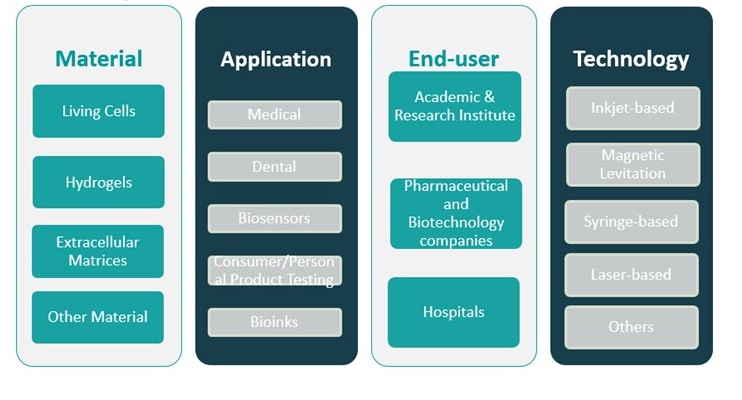
This report segments the North America 3D Bioprinting Market as follow
Market Drivers:
Aging Population and Rise in Chronic Diseases
The increasing aging population in North America is one of the foremost drivers fueling the growth of the 3D bioprinting market. As the elderly population grows, the incidence of age-related diseases such as cardiovascular disorders, diabetes, and osteoarthritis also rises. These chronic diseases demand innovative medical solutions, including advanced bioprinting technologies that can offer personalized treatment options. Bioprinting allows for the creation of customized tissues and organs, which is particularly valuable in addressing the shortage of organ donors. With an aging demographic in both the U.S. and Canada, there is a growing need for regenerative medical solutions to improve patient outcomes and quality of life.
Technological Advancements in Bioprinting
Technological innovations in 3D bioprinting are rapidly transforming the healthcare industry in North America. The development of more precise and efficient printing techniques, such as the use of advanced bioinks and improved printing resolutions, has greatly expanded the potential applications of 3D bioprinting in medicine. For instance, companies like Advanced Solutions have developed the BioAssemblyBot® 400 (BAB400), an intelligent robotic bioprinter with a six-axis robotic arm that automates the production of complex 3D tissue and organoid models, increasing throughput and precision in drug discovery and regenerative medicine. These advancements have enhanced the viability and functionality of printed tissues, enabling researchers and medical professionals to produce more complex and functional biological structures. Furthermore, the integration of artificial intelligence (AI) and machine learning into bioprinting processes has accelerated innovation, improving the precision and speed of bioprinting operations. As a result, the market for 3D bioprinting technologies is experiencing accelerated growth, particularly in drug testing, regenerative medicine, and organ creation.
Supportive Government Policies and Funding
North America benefits from strong governmental support for research and development in 3D bioprinting technologies. In the U.S., the federal government has allocated substantial funds to foster advancements in regenerative medicine and bioprinting. Agencies such as the National Institutes of Health (NIH) and the U.S. Department of Defense (DoD) have been actively involved in funding initiatives that explore the potential of bioprinting for medical applications. For instance, the NIH awarded a $6.25 million grant to establish the Center for Engineering Complex Tissues (CECT), a collaborative initiative involving Rice University, Wake Forest University, and the University of Maryland, focused on advancing bioprinting for tissue engineering and regenerative medicine. Additionally, the U.S. Food and Drug Administration (FDA) has established regulatory frameworks that encourage the safe use of bioprinting technologies in clinical settings. This supportive environment not only accelerates innovation but also ensures that new bioprinting applications are effectively integrated into the healthcare system.
Rising Demand for Personalized Medicine
Another key driver of the North American 3D bioprinting market is the growing demand for personalized medicine. As healthcare becomes increasingly tailored to individual needs, the ability to create patient-specific tissues and organs using 3D bioprinting technologies has immense potential. Personalized bioprinting can lead to better patient outcomes, as treatments can be specifically designed based on the patient's unique genetic makeup, disease progression, and other health factors. This shift toward personalized medicine is further encouraged by advancements in genomics, which allow for better understanding and customization of treatments. As the healthcare industry continues to embrace individualized care, 3D bioprinting technologies are expected to play a pivotal role in delivering precision treatments to patients across North America.
Market Trends:
Advancements in Bioprinting Technologies
The North American 3D bioprinting market is experiencing significant technological advancements that are enhancing the precision and functionality of bioprinted constructs. Innovations in bioprinting technologies, such as extrusion-based, inkjet-based, and laser-assisted bioprinting, have opened avenues for the precise fabrication of complex tissues and organ constructs. These advancements enable the creation of patient-specific tissues and organs, reducing the risk of rejection and eliminating the need for traditional organ donors. The integration of artificial intelligence (AI) into bioprinting processes further improves the accuracy and efficiency of tissue fabrication, facilitating the development of more sophisticated and functional biological structures.
Expansion into Pharmaceutical and Cosmetic Industries
Simultaneously, the increasing integration of 3D bioprinting technology into pharmaceutical enterprises has had a positive effect on the level of detail achievable in tissue and organ construction. For instance, Organovo’s bioprinted liver tissue is used by pharmaceutical companies to replicate disease states and test drug efficacy, reducing reliance on animal models and accelerating drug development. By making use of this pioneering technique, tissues and organs can be formed with precision. With large pharmaceutical enterprises and biotech companies thus gaining advanced capabilities for disease modeling, drug testing, and developing personalized medicines.
Collaborations and Partnerships Driving Innovation
Collaborations between academic institutions, biotechnology companies, and research organizations are accelerating the development and commercialization of 3D bioprinting technologies. For example, Aspect Biosystems, headquartered in Vancouver, Canada, has entered into a $2.6 billion partnership with Novo Nordisk to develop bioprinted tissue therapeutics for diabetes and obesity, and is collaborating with Maastricht University to advance kidney tissue engineering. These partnerships foster the exchange of knowledge and resources, leading to breakthroughs that drive market growth. The synergy between research and industry is facilitating the transition of 3D bioprinting technologies from laboratory settings to clinical applications, thereby expanding their impact on healthcare.
Regulatory Developments Supporting Market Growth
The regulatory landscape for 3D bioprinting in North America is evolving to support the safe and effective use of bioprinted products. Regulatory agencies such as the U.S. Food and Drug Administration (FDA) and Health Canada are establishing guidelines that facilitate the approval process for bioprinted tissues and organs. These developments provide a framework for the validation and approval of bioprinted models and therapies, accelerating their adoption in clinical settings. The establishment of clear regulatory pathways enhances investor confidence and encourages further investment in 3D bioprinting technologies.
Market Challenges Analysis:
High Cost of Bioprinting Equipment and Materials
One of the significant challenges facing the North American 3D bioprinting market is the high cost associated with bioprinting equipment and consumables. The initial investment required for advanced bioprinting systems, as well as the ongoing expenses for specialized bioinks and other materials, can be prohibitively expensive for many research institutions and healthcare providers. These high costs limit the accessibility and scalability of bioprinting technologies, particularly for small and medium-sized enterprises or startups, hindering widespread adoption. The expensive nature of these technologies remains a key restraint to the broader integration of 3D bioprinting into clinical practice and everyday use.
Regulatory Hurdles and Approval Delays
Despite the growing interest in 3D bioprinting, regulatory hurdles remain a challenge. The U.S. Food and Drug Administration (FDA) and other regulatory bodies have yet to establish comprehensive frameworks for the approval of bioprinted tissues and organs, which can result in delays in commercialization and clinical implementation. For example, the FDA’s Center for Biologics Evaluation and Research (CBER) has stated its intent to review regulatory issues associated with bioprinting but has not approved any 3D-bioprinted biological products to date. The slow pace of regulatory approval poses a barrier to the quick adoption of 3D bioprinting technologies in healthcare settings. The uncertainty around regulatory requirements and the approval process also deters investment in bioprinting innovations, as companies remain cautious about entering markets without clear regulatory guidelines.
Technical Limitations in Bioprinting Complex Tissues
Another challenge is the technical limitations in bioprinting highly complex tissues and organs. While significant progress has been made in printing simple structures, creating fully functional, complex tissues with vascular networks and the ability to integrate seamlessly into the human body remains a significant hurdle. Bioprinting technology still faces limitations in terms of cell viability, the creation of multi-layered structures, and the ability to replicate the complexity of human organs. These technical challenges restrict the current applicability of 3D bioprinting to certain types of tissues and applications, limiting its immediate impact on the broader healthcare market.
Market Opportunities:
The North American 3D bioprinting market presents significant opportunities for growth, particularly in the fields of personalized medicine and regenerative healthcare. As advancements in bioprinting technologies continue to evolve, there is an increasing potential for creating customized tissues and organs tailored to individual patients. This offers a promising avenue for improving patient outcomes, particularly in areas such as organ transplants and chronic disease treatment. The ability to print patient-specific tissues can reduce the reliance on organ donors and improve the compatibility and success rates of transplants. Additionally, personalized bioprinting could revolutionize drug development by enabling the creation of more accurate tissue models for testing new pharmaceuticals, paving the way for more targeted and effective therapies.
Furthermore, the growing demand for 3D-printed medical devices and implants presents another substantial market opportunity. As 3D bioprinting technology advances, it becomes increasingly feasible to create complex, highly customized medical implants such as prosthetics, bone replacements, and dental devices. The ability to produce bespoke medical devices not only enhances patient comfort but also reduces the risk of complications associated with mass-produced, standardized implants. Additionally, partnerships between academic institutions, biotechnological companies, and government agencies in North America are likely to spur innovation and accelerate the commercialization of bioprinting solutions, further expanding the market's potential. This collaborative environment positions North America to maintain its leadership in the global 3D bioprinting market.
Market Segmentation Analysis:
The North American 3D bioprinting market is divided into several segments, with materials, applications, end-users, and technologies playing a crucial role in shaping its landscape.
By Material, the market is primarily segmented into living cells, hydrogels, extracellular matrices, and other materials. Living cells dominate the segment due to their essential role in creating functional tissues and organs. Hydrogels, known for their biocompatibility, are also widely used in printing tissues, while extracellular matrices provide the necessary scaffold for cell growth. The other material segment includes a variety of substances used in specific bioprinting applications, contributing to the versatility of 3D bioprinting technologies.
By Application, the North American market is categorized into medical, dental, biosensors, consumer/personal product testing, and bioinks. The medical segment leads the market, driven by applications in regenerative medicine, organ printing, and drug development. Dental applications are also growing, with personalized dental implants and prosthetics being in high demand. The biosensors and consumer/personal product testing segments are emerging as new opportunities, leveraging 3D bioprinting for advanced product testing and development.
By End-User, the key segments are academic and research institutes, pharmaceutical and biotechnology companies, and hospitals. Academic and research institutes play a pivotal role in advancing bioprinting technologies, while pharmaceutical and biotechnology companies are focused on developing applications for drug testing and personalized medicine. Hospitals are increasingly adopting 3D bioprinting for patient-specific treatments and surgical planning.
By Technology, the market includes inkjet-based, magnetic levitation, syringe-based, laser-based, and other methods. Inkjet-based and syringe-based technologies dominate the market due to their widespread use in tissue engineering, while laser-based and magnetic levitation techniques are gaining traction for their precision and ability to print complex structures.
Segmentation:
By Material:
- Living Cells
- Hydrogels
- Extracellular Matrices
- Other Material
By Application:
- Medical
- Dental
- Biosensors
- Consumer/Personal Product Testing
- Bioinks
By End-User:
- Academic & Research Institute
- Pharmaceutical and Biotechnology Companies
- Hospitals
By Technology:
- Inkjet-based
- Magnetic Levitation
- Syringe-based
- Laser-based
- Others
Regional Analysis:
The North American 3D bioprinting market is poised for significant growth, with the United States dominating the market in both market share and technological advancement. As of 2024, the North American region holds approximately 38% of the global 3D bioprinting market share, a reflection of its advanced healthcare infrastructure, robust research environment, and supportive government policies. The market is expected to continue its growth trajectory due to the region’s commitment to fostering innovation and the increasing demand for personalized medicine.
The United States stands as the key contributor to the growth of the North American market, accounting for a substantial portion of the region's market share. The U.S. benefits from its strong biotechnology and pharmaceutical sectors, along with leading academic institutions that are at the forefront of bioprinting research. The country’s government, through agencies such as the National Institutes of Health (NIH) and the Food and Drug Administration (FDA), has been instrumental in providing funding and regulatory frameworks that encourage the development and safe integration of bioprinting technologies in clinical settings. This has facilitated the rapid adoption of 3D bioprinting across various sectors, including medical, pharmaceutical, and healthcare industries. Additionally, the U.S. has seen an increase in collaborations between universities, hospitals, and private companies, further propelling the market forward.
Canada, while a smaller player compared to the U.S., has shown promising growth in the 3D bioprinting market. Canada’s research landscape, bolstered by institutions like the University of Toronto and McGill University, continues to play a significant role in advancing 3D bioprinting technologies. The country has seen an increase in the number of bioprinting startups and collaborations, supported by government initiatives and investments in biotechnology and medical innovations. Canada’s focus on healthcare improvement, coupled with its regulatory efforts, makes it an attractive market for bioprinting technologies, especially in the fields of personalized medicine and medical implants.
Mexico, while still at an emerging stage in 3D bioprinting, is positioning itself as a growing market due to increasing investments in the healthcare and biotechnology sectors. Mexico's participation in the North American market is primarily driven by its manufacturing capabilities and cost-effective production. The country is also witnessing growth in research and development activities, which is expected to expand the adoption of bioprinting technologies in the coming years. The market here is still in the early stages, but the demand for advanced medical treatments and the government’s support for biotechnological innovations create a favorable environment for 3D bioprinting development.
Key Player Analysis:
- Envisiontec, Inc
- Organovo
- Inventia Life Science Pty Ltd
- POIETIS
- VIVAX BIO, LLC
- ALLEVI
- Cyfuse Biomedical K.K.
- 3D Bioprinting Solutions
- CELLINK NORTH AMERICA
- REGEMAT 3D S.L.
Competitive Analysis:
The North American 3D bioprinting market is highly competitive, with several key players leading innovation and market expansion. Companies such as Organovo Holdings, Stratasys Ltd., and 3D Systems Corporation dominate the market, offering cutting-edge 3D bioprinting solutions for tissue engineering and regenerative medicine. Organovo, known for its expertise in developing functional human tissues, continues to push boundaries in bioprinted organ models for drug testing and personalized medicine. Stratasys and 3D Systems provide advanced 3D printing technologies, including biocompatible materials, catering to a wide range of applications, including medical research and custom prosthetics. In addition to these industry leaders, emerging players, including small biotech startups and academic institutions, are entering the market, focusing on innovation and specialized applications in pharmaceuticals, biosensors, and personalized healthcare. Strategic partnerships and collaborations between research organizations and industry players are fostering further market growth, enhancing competitive dynamics.
Recent Developments:
- In February 2025, Organovo announced the acquisition of its FXR program, including the lead asset FXR314, by Eli Lilly and Company. This deal marked a significant milestone for Organovo, as Lilly acquired all commercial and intellectual property rights to the FXR program for worldwide development, with Organovo receiving upfront and milestone payments. The acquisition is expected to advance treatments for inflammatory bowel disease using Organovo’s proprietary 3D human tissue models.
- In August 2024, Inventia Life Science Pty Ltd saw a controlling stake in its core Oral Solid Dosage business acquired by Platinum Equity. This partnership was designed to leverage Inventia’s manufacturing strengths and Platinum’s operational expertise, driving further innovation and growth in pharmaceutical product development. Additionally, Inventia Life Science partnered with Xylyx Bio to develop tissue-specific, digitally printed bioinks for drug discovery, aiming to enhance 3D cell cultures with liver-specific extracellular matrix components for more robust tissue models.
Market Concentration & Characteristics:
The North American 3D bioprinting market is characterized by moderate concentration, with a few key players holding significant market share. Industry leaders such as Organovo Holdings, Stratasys Ltd., and 3D Systems Corporation dominate the market, leveraging advanced technologies and substantial R&D investments to maintain a competitive edge. These companies lead the market in terms of product offerings and technological advancements in bioprinting applications, particularly in regenerative medicine and pharmaceutical research. However, the market also sees increasing participation from small and medium-sized enterprises (SMEs), especially startups focusing on niche applications such as personalized medicine, bioinks, and custom prosthetics. The market is highly innovative, with a strong emphasis on research and development, collaboration between academic institutions, and industry partnerships to drive technological breakthroughs. The market’s growth is further facilitated by supportive government policies and increasing investments in the biotechnology and healthcare sectors.
Report Coverage:
The research report offers an in-depth analysis based on Material, Application, End-User and Technology. It details leading market players, providing an overview of their business, product offerings, investments, revenue streams, and key applications. Additionally, the report includes insights into the competitive environment, SWOT analysis, current market trends, as well as the primary drivers and constraints. Furthermore, it discusses various factors that have driven market expansion in recent years. The report also explores market dynamics, regulatory scenarios, and technological advancements that are shaping the industry. It assesses the impact of external factors and global economic changes on market growth. Lastly, it provides strategic recommendations for new entrants and established companies to navigate the complexities of the market.
Future Outlook:
- The North American 3D bioprinting market is expected to experience rapid growth due to increasing demand for personalized medicine and regenerative therapies.
- Advancements in bioprinting technologies will lead to more efficient and precise tissue and organ printing, further expanding market applications.
- The regulatory landscape will evolve, with clearer guidelines enhancing the adoption of 3D bioprinting in clinical and commercial settings.
- Investment in R&D will continue to drive innovation, improving the scalability and functionality of 3D bioprinting technologies.
- Strategic partnerships between biotech companies, research institutions, and healthcare providers will accelerate the commercialization of bioprinted products.
- The integration of artificial intelligence and machine learning will optimize bioprinting processes, increasing production efficiency and reducing costs.
- Increasing public and private sector funding will support the growth of 3D bioprinting in areas such as drug testing and disease modeling.
- Bioprinting’s role in addressing the organ transplant shortage will become more prominent, leading to significant advancements in organ printing.
- The adoption of 3D bioprinting in dental and prosthetics applications will drive growth in specialized medical sectors.
- North America will maintain its leadership in the global 3D bioprinting market, supported by strong healthcare infrastructure and continuous innovation.

Request a Free Sample
Fill in your details and we'll send you a free sample report.
- Sample data tables & charts
- Research methodology
Market Dynamics
Aging Population and Chronic Disease Prevalence
The growing elderly population in North America is leading to a higher incidence of chronic diseases such as cardiovascular disorders and diabetes, which increases the demand for regenerative medicine and organ transplantation solutions that 3D bioprinting can provide.
Technological Advancements in Bioprinting
Continuous innovation in bioprinting technologies, including improved bioinks, higher printing resolutions, and the integration of AI, is enabling the creation of more complex and functional tissues and organs, expanding the scope of medical and pharmaceutical applications.
Supportive Government Funding and Policies
Significant investments and grants from U.S. agencies like the NIH and DoD, along with evolving regulatory frameworks from the FDA, are accelerating research, development, and clinical adoption of 3D bioprinting technologies.
Rising Demand for Personalized Medicine
The shift toward individualized healthcare is driving the adoption of 3D bioprinting for patient-specific tissues and organs, improving treatment outcomes and supporting the growth of precision medicine in the region.
Collaborations and Industry-Academia Partnerships
Strategic partnerships between biotech companies, academic institutions, and research organizations are fostering innovation, speeding up commercialization, and translating bioprinting research into real-world clinical applications.
Need a Custom Version of This Report?
Tailor the scope, geography, or segments to your exact requirements.
- Custom geography or segment scope
- Direct access to our analyst team
Frequently Asked Questions
What is the current size of the North America 3D bioprinting Market?
What factors are driving the growth of the North America 3D bioprinting Market?
What are some challenges faced by the North America 3D bioprinting Market?
Who are the major players in the North America 3D bioprinting Market?
Table of Content
Chapter 1 Market Segmentation
- 1.1 Segmentation Framework
- 1.1.1 Product and Service Classification
- 1.1.2 Application and End-Use Classification
- 1.1.3 Technology and Solution Classification
- 1.1.4 Customer and Distribution Channel Classification
- 1.1.5 Geographic Segmentation
- 1.1.6 Market Segment Definitions and Boundaries
- 1.2 By End-User
- 1.2.1 Academic & Research Institute
- 1.2.2 Pharmaceutical and Biotechnology Companies
- 1.2.3 Hospitals
- 1.3 By Material
- 1.3.1 Living Cells
- 1.3.2 Hydrogels
- 1.3.3 Extracellular Matrices
- 1.3.4 Other Material
- 1.4 By Technology
- 1.4.1 Inkjet-based
- 1.4.2 Magnetic Levitation
- 1.4.3 Syringe-based
- 1.4.4 Laser-based
- 1.4.5 Others
- 1.5 By Application
- 1.5.1 Medical
- 1.5.2 Dental
- 1.5.3 Biosensors
- 1.5.4 Consumer/Personal Product Testing
- 1.5.5 Bioinks
Chapter 2 Introduction
- 2.1 Report Objectives and Scope
- 2.2 Product Definition and Industry Terminology
- 2.3 Market Inclusions and Exclusions
- 2.4 Research Process
- 2.4.1 Primary Research and Expert Interviews
- 2.4.2 Secondary Research and Source Review
- 2.4.3 Top-Down and Bottom-Up Estimation
- 2.4.4 Data Triangulation and Verification
- 2.5 Market Size Measurement Basis
- 2.5.1 2023: USD 526.50 million → 2032: USD 1,497.97 million
- 2.6 Historical and Forecast Reference Periods
- 2.6.1 Base Year: 2023
- 2.6.2 Forecast Period: 2023-2032
- 2.7 Research Assumptions and Limitations
Chapter 3 Executive Summary
- 3.1 Market Snapshot and Key Findings
- 3.2 Base-Year Market Size, 2023
- 3.3 Forecast Market Size, 2032
- 3.4 Revenue and Volume Growth Outlook
- 3.5 Key Demand and Supply Indicators
- 3.6 Leading Market Segments
- 3.7 Fastest-Growing Market Opportunities
- 3.8 Regional Performance Highlights
- 3.9 Technology and Industry Transformation
- 3.10 Competitive Landscape Summary
- 3.11 Analyst View and Strategic Implications
Chapter 4 North America 3D Bioprinting Market Trends and Developments
- 4.1 Historical Industry Development
- 4.2 Recent Market Trends and Developments
- 4.3 Demand and Customer Behavior Trends
- 4.4 Technology and Product Innovation
- 4.5 Artificial Intelligence, Automation and Digitalization
- 4.6 Local Manufacturing and Supply Chain Realignment
- 4.7 Industry Partnerships, Mergers and Acquisitions
- 4.8 Sustainability and Circular Economy Developments
- 4.9 Government and Private Sector Investment Trends
- 4.10 Emerging Business Models and Commercialization
- 4.11 Industry Developments and Announcements
Chapter 5 North America 3D Bioprinting Market Production, Supply and Demand Analysis
- 5.1 Demand Trend and Consumption Analysis
- 5.2 Demand Forecast, 2023-2032
- 5.3 Production and Output Trend
- 5.4 Production and Output Forecast, 2023-2032
- 5.5 Installed Capacity and Capacity Utilization
- 5.6 Company-Wise Production Plants and Statistics
- 5.6.1 Installed Production Capacity
- 5.6.2 Actual Production
- 5.6.3 Planned Capacity and Expansion Targets
- 5.7 Supply Chain Structure and Procurement Trends
- 5.8 Supply-Demand Gap and Bottlenecks
- 5.9 Import Dependence and Sourcing Structure
- 5.10 Contract Manufacturing and Outsourcing
- 5.11 Regional Supply and Demand Concentration
Chapter 6 North America 3D Bioprinting Market Pricing Analysis
- 6.1 Pricing Structure and Measurement
- 6.2 Historical Pricing Trends
- 6.3 Pricing Outlook, 2023-2032
- 6.4 Average Selling Price and Unit Economics
- 6.5 Pricing by Product and Market Segment
- 6.6 Geographic Pricing Differences
- 6.7 Key Input, Energy, Labor and Logistics Costs
- 6.8 Contract Pricing and Purchasing Models
- 6.9 Pricing Sensitivity and Competitive Positioning
- 6.10 Price, Margin and Profitability Implications
Chapter 7 North America 3D Bioprinting Market Dynamics
- 7.1 Market Growth Drivers
- 7.1.1 Demand-Side Drivers
- 7.1.2 Technology and Innovation Drivers
- 7.1.3 Infrastructure and Investment Drivers
- 7.1.4 Regulatory and Policy Drivers
- 7.2 Market Restraints
- 7.2.1 Cost and Affordability Constraints
- 7.2.2 Technology and Adoption Barriers
- 7.2.3 Supply Chain and Operational Constraints
- 7.3 Market Challenges
- 7.3.1 Competitive Pressure and Margin Erosion
- 7.3.2 Skills, Infrastructure and Implementation Gaps
- 7.4 Emerging Market Opportunities
- 7.5 Market Dynamics Impact and Time-Horizon Assessment
Chapter 8 North America 3D Bioprinting Value Chain Analysis
- 8.1 Industry Value Chain Overview
- 8.2 Upstream Suppliers and Critical Inputs
- 8.3 Technology and Component Providers
- 8.4 Manufacturing or Service Delivery
- 8.5 Distribution, Channel Partners and Integrators
- 8.6 Downstream Applications and End Users
- 8.7 Value Addition and Profit Pools
- 8.8 Vertical Integration and Outsourcing
- 8.9 Supplier Concentration and Risk
- 8.10 Supply Chain Localization and Resilience
Chapter 9 North America 3D Bioprinting Market Regulations and Policies
- 9.1 Relevant Laws, Standards and Compliance Frameworks
- 9.2 Product, Service, Safety and Quality Requirements
- 9.3 Government Policies, Incentives and Subsidies
- 9.4 Imports, Exports and Trade Barriers
- 9.5 Public Procurement and Local Content Requirements
- 9.6 Environmental and Sustainability Compliance
- 9.7 Data Protection, AI and Cybersecurity Compliance
- 9.8 Upcoming Policy Changes and Market Implications
Chapter 10 North America 3D Bioprinting Market Hotspots and Opportunities
- 10.1 Market Opportunity Mapping and Growth Hotspots
- 10.2 High-Growth Applications and Customer Groups
- 10.3 Underserved Markets and White-Space Opportunities
- 10.4 Emerging Technology and Product Opportunities
- 10.5 New Capacity and Investment Hotspots
- 10.6 Market Entry and Expansion Opportunities
- 10.7 Distribution and Partnership Opportunities
- 10.8 Near-Term and Long-Term Commercial Potential
- 10.9 Opportunity Attractiveness and Execution Risks
Chapter 11 North America 3D Bioprinting Market Outlook, 2023-2032
- 11.1 Market Size and Analysis
- 11.1.1 Revenue (Market Measurement: 2023: USD 526.50 million → 2032: USD 1,497.97 million)
- 11.1.2 Market Volume and Quantity Sold
- 11.1.3 Historical Market Size
- 11.1.4 Base-Year Market Size, 2023
- 11.2 Market Forecast, 2023-2032
- 11.2.1 Revenue Forecast to 2032
- 11.2.2 Volume Forecast to 2032
- 11.2.3 CAGR and Year-on-Year Growth
- 11.2.4 Incremental Revenue Opportunity
- 11.3 Forecast Assumptions and Scenario Analysis
- 11.3.1 Base-Case Forecast
- 11.3.2 Optimistic and Conservative Scenarios
- 11.3.3 Technology, Pricing and Policy Sensitivities
- 11.4 Market Attractiveness and Growth Outlook
Chapter 12 North America 3D Bioprinting Market Segmentation and Outlook
- 12.1 Segmentation Summary and Market Shares, 2023
- 12.2 Largest and Fastest-Growing Segments
- 12.3 By End-User - Market Size and Forecast, 2023-2032
- 12.3.1 Segment Definition and Scope
- 12.3.2 Historical Market Size
- 12.3.3 Revenue Forecast, 2023-2032
- 12.3.4 Volume Forecast, 2023-2032
- 12.3.5 Base-Year Market Share, 2023
- 12.3.6 Segment CAGR and Growth Drivers
- 12.3.7 Subsegment Market Size and Forecast
- 12.3.7.1 Academic & Research Institute
- 12.3.7.2 Pharmaceutical and Biotechnology Companies
- 12.3.7.3 Hospitals
- 12.3.8 Subsegment Pricing and Adoption Trends
- 12.3.9 Leading Suppliers and Competition
- 12.3.10 Regional Demand and Opportunities
- 12.4 By Material - Market Size and Forecast, 2023-2032
- 12.4.1 Segment Definition and Scope
- 12.4.2 Historical Market Size
- 12.4.3 Revenue Forecast, 2023-2032
- 12.4.4 Volume Forecast, 2023-2032
- 12.4.5 Base-Year Market Share, 2023
- 12.4.6 Segment CAGR and Growth Drivers
- 12.4.7 Subsegment Market Size and Forecast
- 12.4.7.1 Living Cells
- 12.4.7.2 Hydrogels
- 12.4.7.3 Extracellular Matrices
- 12.4.7.4 Other Material
- 12.4.8 Subsegment Pricing and Adoption Trends
- 12.4.9 Leading Suppliers and Competition
- 12.4.10 Regional Demand and Opportunities
- 12.5 By Technology - Market Size and Forecast, 2023-2032
- 12.5.1 Segment Definition and Scope
- 12.5.2 Historical Market Size
- 12.5.3 Revenue Forecast, 2023-2032
- 12.5.4 Volume Forecast, 2023-2032
- 12.5.5 Base-Year Market Share, 2023
- 12.5.6 Segment CAGR and Growth Drivers
- 12.5.7 Subsegment Market Size and Forecast
- 12.5.7.1 Inkjet-based
- 12.5.7.2 Magnetic Levitation
- 12.5.7.3 Syringe-based
- 12.5.7.4 Laser-based
- 12.5.7.5 Others
- 12.5.8 Subsegment Pricing and Adoption Trends
- 12.5.9 Leading Suppliers and Competition
- 12.5.10 Regional Demand and Opportunities
- 12.6 By Application - Market Size and Forecast, 2023-2032
- 12.6.1 Segment Definition and Scope
- 12.6.2 Historical Market Size
- 12.6.3 Revenue Forecast, 2023-2032
- 12.6.4 Volume Forecast, 2023-2032
- 12.6.5 Base-Year Market Share, 2023
- 12.6.6 Segment CAGR and Growth Drivers
- 12.6.7 Subsegment Market Size and Forecast
- 12.6.7.1 Medical
- 12.6.7.2 Dental
- 12.6.7.3 Biosensors
- 12.6.7.4 Consumer/Personal Product Testing
- 12.6.7.5 Bioinks
- 12.6.8 Subsegment Pricing and Adoption Trends
- 12.6.9 Leading Suppliers and Competition
- 12.6.10 Regional Demand and Opportunities
- 12.7 Segment Growth Comparison
- 12.8 Segment Attractiveness and Priority Matrix
Chapter 13 North America 3D Bioprinting End-Use and Application Market Outlook
- 13.1 End-Use Industry and Customer Demand Structure
- 13.2 Leading Applications and Customer Groups
- 13.3 End-Use Market Size, Share and Forecast
- 13.4 Major End-Use Industry Deep Dives
- 13.4.1 Customer Requirements and Use Cases
- 13.4.2 Demand and Replacement Cycles
- 13.4.3 Technical and Regulatory Considerations
- 13.4.4 Purchasing and Procurement Models
- 13.4.5 Leading Vendors and Distribution Channels
- 13.4.6 Forecast and Commercial Opportunities
- 13.5 Emerging Applications and Cross-Segment Demand
- 13.6 End-Use Industry Investment Priorities
Chapter 14 North America 3D Bioprinting Geographic Market Outlook, 2023-2032
- 14.1 Regional Market Size and Country-Level Shares, 2023
- 14.2 Country Market Size Comparison, 2023
- 14.3 Country Market Forecasts, 2023-2032
- 14.4 Subregional Industrial and Demand Clusters
- 14.5 Intra-Regional Pricing and Cost Differences
- 14.6 Cross-Border Trade and Supply Networks
- 14.7 Regional Supply and Demand Balances
- 14.8 Country Opportunity Comparison and Prioritization
Note: Every listed country is covered on the structure shown under the first country.
Chapter 15 North America 3D Bioprinting Technology, Innovation and Sustainability Outlook
- 15.1 Technology Landscape and Maturity
- 15.2 Product, Process and Service Innovation
- 15.3 AI, Automation and Digital Tools in the Industry
- 15.4 Technology Adoption and Performance Benchmarking
- 15.5 Innovation Pipeline and R&D Investment
- 15.6 Patent and Intellectual Property Trends
- 15.7 Energy Efficiency and Resource Management
- 15.8 Sustainability, Recycling and Circularity
- 15.9 Technology Roadmap, 2023-2032
- 15.10 Risks of Obsolescence and Technology Substitution
Chapter 16 North America 3D Bioprinting Market Key Strategic Imperatives
- 16.1 Growth and Market Entry Priorities
- 16.2 High-Return Products and Segments
- 16.3 Pricing, Profitability and Cost Optimization
- 16.4 Technology Investment and Product Differentiation
- 16.5 Supply Chain Localization and Resilience
- 16.6 Distribution and Customer Acquisition
- 16.7 Partnership, Acquisition and Capacity Strategy
- 16.8 Regional Expansion Priorities
- 16.9 Short-, Medium- and Long-Term Actions
Chapter 17 Competition Outlook
- 17.1 Industry Competition Characteristics
- 17.2 Market Structure and Concentration
- 17.3 Market Share and Competitive Positioning, 2023
- 17.4 Company-Wise Revenue and Product Benchmarking
- 17.5 Production and Service Capacity Benchmarking
- 17.6 Technology, Pricing and Differentiation
- 17.7 Regional Footprint and Distribution Strength
- 17.8 Mergers, Acquisitions and Strategic Alliances
- 17.9 New Entrants and Competitive Threats
- 17.10 Porter's Five Forces and Industry Attractiveness
- 17.11 Competitive Outlook, 2023-2032
Chapter 18 Company Profiles
- 18.1 Company Coverage and Selection Criteria
- 18.2 Organovo
- 18.2.1 Business Description
- 18.2.2 Company Ownership and Geographic Presence
- 18.2.3 Product and Service Portfolio
- 18.2.4 Manufacturing and Operating Footprint
- 18.2.5 Production Capacity and Expansion Plans
- 18.2.6 Financial Performance and Investment
- 18.2.7 Market Share and Competitive Position
- 18.2.8 Technology and Innovation Capabilities
- 18.2.9 Strategic Alliances or Partnerships
- 18.2.10 Recent Developments
- 18.2.11 Growth Strategy and Outlook
- 18.3 Envisiontec, Inc
- 18.4 CELLINK NORTH AMERICA
- 18.5 Stratasys Ltd.
- 18.6 3D Systems Corporation
- 18.7 Inventia Life Science Pty Ltd
- 18.8 ALLEVI
- 18.9 VIVAX BIO, LLC
- 18.10 Aspect Biosystems
- 18.11 POIETIS
- 18.12 Other Relevant Market Participants
Note: Every listed company is profiled on the structure shown under the first company. The company list is preliminary and may change based on research findings, market developments, data availability and client requirements.
Chapter 19 Disclaimer
- 19.1 Research and Forecast Disclaimer
- 19.2 Data Source and Estimation Limitations
Note: The depth of individual sections depends on data availability for this market. Volume, capacity, trade and other unit-based metrics are included where applicable.

