
Market Overview:
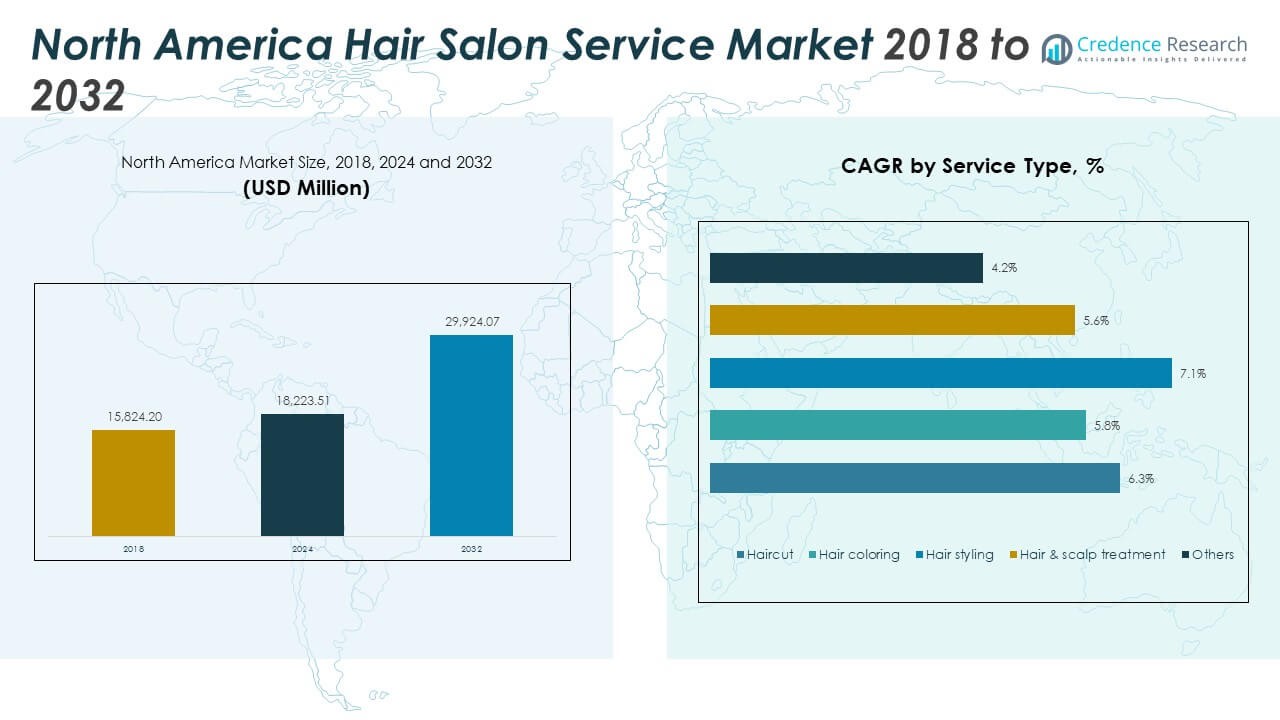
The North America Hair Salon Service Market size was valued at USD 15,824.20 million in 2018 to USD 18,223.51 million in 2024 and is anticipated to reach USD 29,924.07 million by 2032, at a CAGR of 6.50% during the forecast period.
| REPORT ATTRIBUTE | DETAILS |
|---|---|
| Historical Period | 2020-2023 |
| Base Year | 2024 |
| Forecast Period | 2025-2032 |
| North America Hair Salon Service Market Size 2024 | USD 18,223.51 Million |
| North America Hair Salon Service Market, CAGR | 6.50% |
| North America Hair Salon Service Market Size 2032 | USD 29,924.07 Million |
Growth in the North America Hair Salon Service Market is driven by increasing consumer demand for premium and personalized beauty services, rising disposable incomes, and heightened awareness of grooming and wellness routines. The market benefits from innovation in haircare products, digital booking platforms, the integration of health-oriented treatments, and the expansion of both franchise and boutique salons. The growing male grooming segment and the influence of social media trends further accelerate service diversification and brand engagement.
Regionally, the United States dominates the North America Hair Salon Service Market because of its large urban population, high spending on beauty services, and the presence of established salon chains and franchises. Canada exhibits steady growth through urbanization and multicultural demographic shifts, while Mexico emerges quickly, propelled by increasing urban consumer awareness and the adoption of international beauty standards. This diverse regional landscape enables market participants to capitalize on evolving preferences and geographic opportunities.
Market Insights
- The North America Hair Salon Service Market was valued at USD 15,824.20 million in 2018, reached USD 18,223.51 million in 2024, and is projected to attain USD 29,924.07 million by 2032, growing at a CAGR of 6.50%.
- The United States holds the dominant share at about 72%, followed by Canada at 19% and Mexico at 9%, with the U.S. leading due to high urbanization, consumer spending, and chain presence, while Canada’s share is driven by urban growth and Mexico’s by a rising urban young population.
- Mexico is the fastest-growing region in the North America Hair Salon Service Market with a 9% share, propelled by urbanization, demographic shifts, and the adoption of modern salon services.
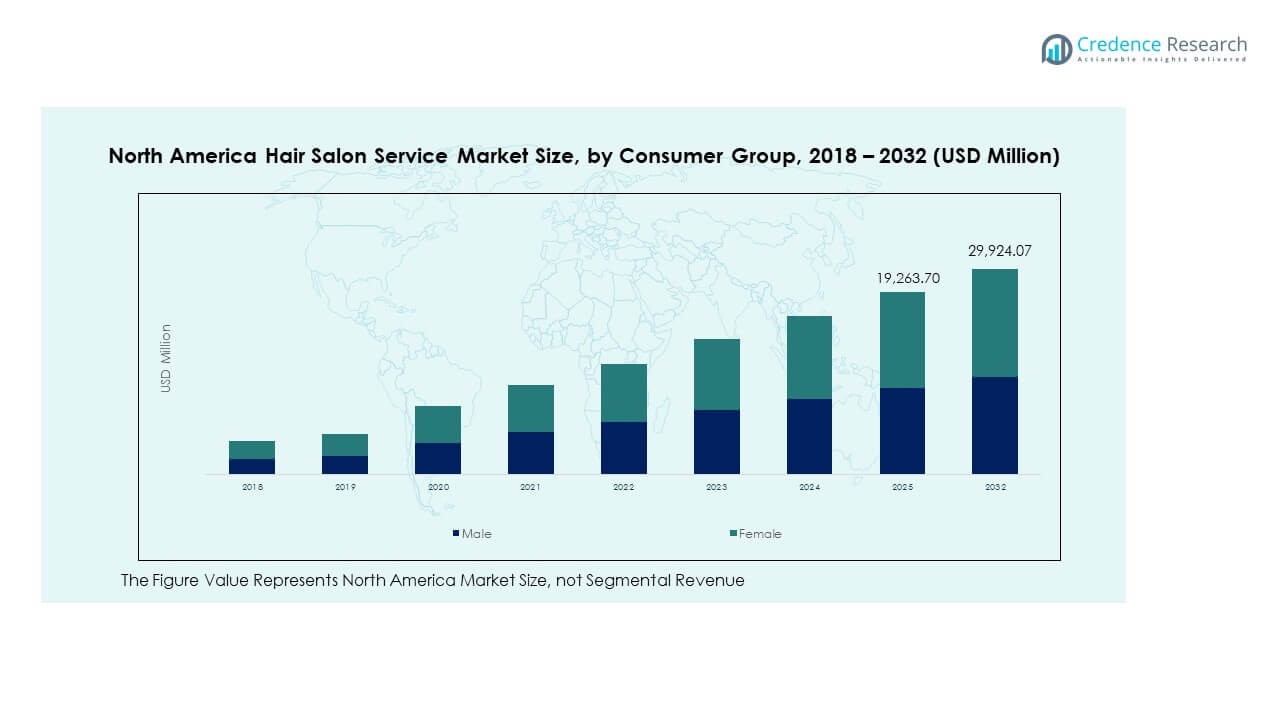
- In 2024, female consumers accounted for approximately 59% of the market revenue in the North America Hair Salon Service Market, reflecting ongoing demand for premium and personalized services.
- Male consumers represented around 41% in 2024, supported by increasing trends in male grooming and expanded barbershop offerings across urban and suburban markets.
 Market Drivers
Evolving Consumer Preferences and Lifestyle Shifts
Growth in the North America Hair Salon Service Market is driven by persistent demand for personal grooming and the rising premiumization of beauty routines. Higher disposable incomes enable frequent salon visits and greater adoption of luxury services, such as scalp care and rejuvenation treatments. Lifestyle changes emphasizing self-care continue to support regular engagement with salons, while standardized franchise models enhance hygiene, professional certification, and consumer trust. Increasing participation by male clients broadens the customer base, and both boutique and chain salons benefit from community-driven and luxury-centric experiences. Urbanization further drives salon traffic in metropolitan clusters, while health-conscious consumers increasingly seek organic, chemical-free treatments as part of holistic wellness spending.
- For example, Great Clips operates over 4,400 salons across the U.S. and Canada, making it one of North America’s largest hair salon chains. The brand emphasizes consistent hygiene and safety practices through its GreatCare Promise, ensuring high standards of service across its franchise network.
Professionalization and Technological Innovation
Technological integration underpins advancement across the North America Hair Salon Service Market. AI-powered consultations, virtual try-on tools, and digital booking systems are redefining consumer engagement. Data analytics helps salons match client preferences with tailored treatments, while advanced management software streamlines workforce scheduling and inventory control. Subscription-based models generate recurring revenue and promote customer loyalty. Inter-brand collaborations create bundled offerings that enhance value and differentiation. Sustainability initiatives such as ethical sourcing, cruelty-free formulations, and eco-conscious packaging align salons with modern consumer expectations, elevating trust and brand positioning.
Social Media Influence and Diverse Product Offerings
Social media and influencer culture exert significant influence, accelerating demand for trend-led and personalized treatments. Modern consumers increasingly seek experiential and tailored salon visits, prompting rapid diversification in service portfolios. Inclusive salons catering to multicultural hair types, colors, and skin concerns are expanding across the U.S. and Canada. Hygiene compliance and transparent regulatory standards boost consumer confidence, while convenience-driven models-such as mobile apps and express services-respond to fast-paced urban lifestyles. The market’s flexibility in adopting new trends and serving varied demographics ensures sustained relevance and growth.
Rise of Unisex, Wellness, and Specialized Salons
The proliferation of unisex and wellness-oriented salons contributes significantly to market expansion. Boutique salons distinguish themselves through luxury branding, sustainable practices, and intimate community engagement. Aging demographics fuel demand for scalp rejuvenation, anti-aging therapies, and restorative treatments, positioning wellness as a core growth pillar. Entrepreneurial activity in metropolitan areas fosters innovation through loyalty programs, flexible scheduling, and comprehensive care packages. This multifaceted ecosystem supports both high-traffic franchises and niche boutique studios, creating a dynamic industry landscape.
- For instance, Aveda offers in-store consultations using a scalp camera that magnifies the scalp by up to 600%, offering evidence-based diagnosis of scalp health, hair density, and pores as part of its personalized wellness-focused salon experiences at flagship North American locations since 2024. This in-store technology, directly described in Aveda’s official service documentation, showcases authentic integration of wellness and diagnostic technology in the modern salon landscape.
Market Trends
Digital Transformation and Service Experience Redefinition
Digitalization is reshaping how salons operate and engage clients. Integrated booking, payment, and CRM platforms streamline operations, while virtual consultations and AI-driven recommendations enhance personalization. Trend-oriented, seasonal services inspired by influencer content keep salons aligned with evolving consumer aesthetics. Subscription memberships are gaining traction, fostering repeat visits and client retention. The market also witnesses diversification in eco-friendly and cruelty-free products, reflecting consumer preference for ethical consumption. Enhanced operational visibility and seamless digital experiences now define the modern salon model.
- For example, Ulta Beauty offers the GLAMlab Virtual Try-On tool, enabling customers to experiment with hair and beauty products digitally. This platform supports remote consultations and enhances Ulta’s omnichannel experience, reflecting the growing role of technology in North America’s hair salon and beauty services market.
Personalization and Tailored Care as Competitive Differentiators
Personalization is emerging as the defining standard across North America’s salon ecosystem. Advanced data tools analyze lifestyle, climate, and hair health to customize treatments. Demand for unique color services, scalp therapies, and restoration programs drives the introduction of bespoke regimens. Chain salons invest in centralized training to ensure consistency, while boutique operators emphasize artisanal care and one-on-one attention. Shared beauty platforms encourage cross-promotion and collaborative marketing, while influencer-driven trends personalize consumer choices further. Customized experiences foster long-term loyalty and sustained competitiveness.
Strategic Partnerships and Franchise Expansion
Strategic alliances among salon chains, product manufacturers, and tech platforms accelerate market penetration. Franchise-based expansion ensures standardized experiences and recognizable quality across regions. Co-branded treatments and collaborative campaigns attract new audiences and reinforce brand engagement. The emergence of hybrid wellness clinics and aesthetic spas expands market scope into results-oriented beauty care. Boutique salons maintain niche positioning through local identity, luxury focus, and sustainability-driven offerings. Together, these dynamics sustain innovation, accessibility, and brand growth across North America.
Sustainability and Alternative Business Models
Eco-conscious practices increasingly define competitive advantage in the North America Hair Salon Service Market. Salons adopt plant-based, cruelty-free, and low-chemical products alongside recyclable packaging and energy-efficient operations. Mobile and home-based salons reshape service delivery with personalized convenience. Independent stylists and freelancers are disrupting traditional salon structures by offering competitive rates and intimate service models. Digital loyalty programs and virtual marketing sustain engagement, while the fusion of sustainability and technology positions the industry as adaptive, ethical, and future-ready.
- For instance, Green Circle Salons, together with partner businesses, diverted 1,358,103 pounds of beauty waste from landfills in 2023 and consistently enables its members to recycle up to 95% of salon waste, earning Zero Waste to Landfill certification. Their audited process and partnership with the Carbon Trust confirm the environmental impact of these sustainability measures.
Market Challenges
Labor and Regulatory Challenges
The sector faces ongoing challenges in skilled labor availability and retention. High demand for experienced stylists and color specialists meets uneven training standards and wage constraints. Pandemic-driven workforce exits have intensified shortages, raising operational costs. Economic fluctuations prompt consumers to downgrade or delay premium services, particularly affecting mid-tier and luxury salons. Regulatory compliance concerning hygiene, licensing, and chemical safety adds further complexity. Ensuring workforce quality and adherence to evolving safety standards remains crucial for sustainable growth.
Competitive Landscape and Entry Barriers
Intense competition from organized and informal players creates high entry barriers for new and smaller operators. Unorganized salons and home-based stylists attract price-sensitive customers, while urban saturation pressures established players to innovate through aesthetics, service design, and product differentiation. Independent stylists using digital platforms amplify disruption, forcing traditional salons to strengthen brand appeal and visibility through digital marketing. Sustained innovation, distinct positioning, and enhanced customer experiences are essential for survival and profitability in this crowded market.
Market Opportunities:
Digitalization and Sustainable Innovation
Significant growth potential lies in integrating digital technology with sustainability. AI-enabled scheduling, personalized loyalty systems, and virtual consultations enhance operational agility. Mobile and at-home service formats meet growing demand for convenience and safety. Brand collaborations with influencers and eco-conscious product lines strengthen customer engagement and ethical appeal. Wellness retreats, anti-aging programs, and customized styling packages diversify revenue streams. These innovations position the North America Hair Salon Service Market for long-term, sustainable expansion.
Entrepreneurial Momentum and Niche Market Development
Entrepreneurial ventures and boutique startups are redefining competitiveness through tailored service menus, multicultural inclusivity, and community-driven branding. Sustainable and wellness-based approaches attract discerning consumers seeking holistic experiences. Co-branded promotions, loyalty incentives, and bespoke treatment offerings strengthen boutique market growth. The industry’s agility in adapting to shifting consumer preferences and wellness trends ensures resilience and continued innovation, cementing North America as a hub for premium, sustainable, and personalized salon experiences.
Market Segmentation Analysis
By Service Type
The North America Hair Salon Service Market is clearly segmented by service type, reflecting consumers’ evolving preferences across haircuts, colouring, styling, and specialized treatments. Haircut services represent the largest segment by volume, driving steady repeat visits and ensuring consistent market stability. Hair colouring and styling services exhibit robust growth as consumers increasingly pursue fashion-forward transformations and personalized aesthetics. Demand for hair and scalp treatments continues to rise among wellness-focused clients, underscoring the growing convergence of beauty and health. Meanwhile, niche offerings including extensions, texture modifications, and specialty treatments constitute a smaller but valuable segment, contributing incremental revenue streams across diverse salon formats.
- For example, Regis Corporation continues advancing its digital transformation through mobile apps and online booking systems integrated across its franchise network. The company leverages platforms like Zenoti to streamline guest engagement, scheduling, and salon operations enhancing customer convenience and operational efficiency across its North American salons.
By Salon Type
Salon type segmentation highlights distinct business models catering to varied customer expectations. Full-service salons deliver comprehensive beauty solutions, appealing to clients who prioritize convenience and luxury. Chain and franchise salons emphasize standardized service quality and brand assurance, driving expansion across both urban and suburban markets. Barbershops have resurged as key players in male grooming, blending traditional barbering with modern styling techniques. Mobile and home-based salons enhance accessibility and flexibility for busy professionals and family clients. Meanwhile, salon-spa hybrids are gaining popularity among wellness-oriented consumers seeking holistic, multi-service experiences that integrate relaxation and rejuvenation.
By Consumer Group
Consumer segmentation illustrates growing inclusivity and diversification within the market. The male client base is expanding rapidly, driven by evolving grooming habits and heightened focus on personal appearance. Barbershops and gender-neutral salons are capitalizing on this momentum through targeted service innovations. The female segment continues to dominate overall market share, sustaining demand for hair colouring, elaborate styling, and advanced treatments through recurring, high-value appointments. Collectively, these consumer dynamics reinforce broad-based market engagement and sustained service demand.
- For example, Sport Clips operates more than 1,800 locations across the United States and Canada, making it one of the largest men’s haircare franchises in North America. Recognized for its sports-themed atmosphere and focus on men’s and boys’ haircuts, the brand maintains a presence in all 50 U.S. states.
By Price Range
Market segmentation by price range demonstrates balanced growth across premium, mid-tier, and value categories. Premium salons differentiate through luxury experiences, high-end product use, and exclusive ambience, attracting clients seeking personalized indulgence. Mid-market salons maintain steady demand by offering reliable quality and affordability, appealing to a wide professional clientele. Value and economy salons serve price-sensitive and high-frequency customers, ensuring accessibility and business resilience during economic fluctuations. This multi-tiered price segmentation underpins the overall stability and inclusivity of the North America Hair Salon Service Market.
Segmentation
By Service Type
- Haircut
- Hair colouring
- Hair styling
- Hair & scalp treatment
- Others
By Salon Type
- Full-Service Salons
- Chain/Franchise Salons
- Barbershops
- Mobile/At-Home Salons
- Salon-Spas
By Consumer Group
- Male
- Female
By Price Range
- Premium
- Mid-Market
- Value/Economy
Regional Analysis
The United States dominates the North America Hair Salon Service Market, accounting for approximately 72% of the regional share in 2025. This leadership is supported by a large urban population, high disposable income levels, and strong consumer preference for premium, personalized grooming services. The market benefits from an extensive salon franchise network, rapid adoption of wellness-oriented treatments, and sustained demand across major metropolitan hubs such as New York, Los Angeles, and Chicago. Strategic alliances between salon operators and professional product brands enhance service quality, innovation, and customer engagement. Additionally, the diversification of clientele-driven by growing male participation, the resurgence of modern barbershops, and the integration of sustainable, eco-conscious offerings-further reinforces the United States’ dominant position in the regional market.
Canada represents nearly 19% of the North America Hair Salon Service Market in 2025, with growth concentrated in major urban centers such as Toronto, Vancouver, and Montreal. Rising living standards, increasing urbanization, and growing consumer willingness to invest in high-quality grooming and wellness experiences fuel market expansion. Canadian salon operators are distinguishing themselves through boutique studios and bespoke service offerings that emphasize holistic beauty and the use of organic, sustainable products. Supportive government initiatives promoting small business development and entrepreneurship within the beauty sector strengthen competitiveness and foster innovation, shaping a resilient and steadily growing salon industry across the country.
Mexico holds an estimated 9% share of the North America Hair Salon Service Market in 2025, emerging as a fast-developing segment within the region. Urbanization, a youthful demographic profile, and increasing exposure to global beauty and fashion standards are driving transformation in the country’s salon landscape. The rapid expansion of modern salon chains, alongside the rise of affordable, value-oriented service outlets, is enhancing accessibility across urban and suburban areas. Mexican consumers are demonstrating heightened interest in advanced haircare and styling services inspired by international trends, prompting local salons to innovate and elevate service quality. This ongoing evolution positions Mexico as an increasingly influential player in the regional salon market.
Key Player Analysis
- Chatters Canada
- Dessange International
- Drybar LLC
- Fantastic Sams
- Great Clips
- Lakme Salon
- MasterCuts
- Ratner Companies
- Regis Corporation
- Seva Beauty
- Sport Clips
- The Lounge Hair Salon
- Toni & Guy
- Ulta Beauty Inc.
Competitive Analysis
The North America Hair Salon Service Market is highly competitive, shaped by the interaction of large franchise networks, mid-tier salons, and independent providers. Franchise chains hold around 44.5% of the market, leveraging strong brand recognition, operational efficiency, and consistent service quality. Major players such as Great Clips, Regis Corporation, and Ulta Beauty expand their presence through extensive outlet networks, digital booking systems, and integrated retail components. Loyalty programs and bundled grooming packages further enhance customer retention and recurring revenue. Independent salons sustain competitiveness by offering personalized services, niche expertise, and strong local relationships. Although challenged by marketing and staffing limitations, they excel in customized experiences that build client loyalty. Boutique and specialized salons cater to wellness-oriented, multicultural, and family-focused segments, while mobile salons and express haircut formats extend accessibility in suburban and remote areas, appealing to convenience-driven consumers. Competitive pressures continue to rise with technology adoption, influencer collaborations, and sustainable service innovation. Salons increasingly incorporate AI-powered consultations, eco-certifications, and subscription-based models to enhance engagement. However, regulatory compliance, licensing demands, and digital infrastructure costs create high entry barriers, favoring established operators.
Recent Developments
- In October 2025, Chatters Hair Salon launched a new national rewards program, aiming to enhance value for clients by allowing them to earn points on every hair and beauty service as well as product purchases, redeemable both in-store and online.
- In August 2025, Chatters Hair Salon also introduced a new service platform called "The Beauty Chair," which provides a curated menu of express treatments such as ear piercing, brow laminations, lash lifts, and waxing designed to let clients access multiple high-quality services within a single visit.
Report Coverage
The research report offers an in-depth analysis based on Service Type, Salon Type, Consumer Group and Price Range. It details leading market players, providing an overview of their business, product offerings, investments, revenue streams, and key applications. Additionally, the report includes insights into the competitive environment, SWOT analysis, current market trends, as well as the primary drivers and constraints. Furthermore, it discusses various factors that have driven market expansion in recent years. The report also explores market dynamics, regulatory scenarios, and technological advancements that are shaping the industry. It assesses the impact of external factors and global economic changes on market growth. Lastly, it provides strategic recommendations for new entrants and established companies to navigate the complexities of the market.
Future Outlook
- The North America Hair Salon Service Market is set for strong growth, driven by rising consumer demand for premium and personalized grooming experiences.
- Eco-friendly and sustainable practices will become central, with salons adopting organic, cruelty-free, and recyclable products to appeal to environmentally conscious clients.
- Digital transformation will reshape operations through integrated booking systems, virtual consultations, and data-driven client management tools.
- Franchise chains and established brands will expand into suburban and rural areas, ensuring standardized service quality and wider market reach.
- Independent and boutique salons will differentiate through niche services, including multicultural hair care, wellness treatments, and event-based styling.
- The male grooming segment will grow rapidly, supported by modern barber experiences and increased male participation in self-care routines.
- Wellness-oriented scalp and hair therapies will gain mainstream popularity, aligning with consumer preferences for holistic and preventive care.
- Heightened competitive pressure will drive innovation through influencer collaborations, experiential branding, and results-focused loyalty programs.
- Stricter regulatory compliance around hygiene, licensing, and health standards will push salons to invest in training and certification.
- Market resilience will be maintained as mid-tier and value salons continue to attract stable demand during economic fluctuations.

Request a Free Sample
Fill in your details and we'll send you a free sample report.
- Sample data tables & charts
- Research methodology
Need a Custom Version of This Report?
Tailor the scope, geography, or segments to your exact requirements.
- Custom geography or segment scope
- Direct access to our analyst team
Frequently Asked Questions
What is the current and projected market size of the North America Hair Salon Service Market?
What is the expected growth rate of the market between 2024 and 2032?
Which segment held the largest market share in 2024?
What are the main factors driving market growth?
Who are the leading companies in the market?
Which country accounted for the largest market share in 2024?
Table of Content
Chapter 1 Market Segmentation
- 1.1 Segmentation Framework
- 1.1.1 Product and Service Classification
- 1.1.2 Application and End-Use Classification
- 1.1.3 Technology and Solution Classification
- 1.1.4 Customer and Distribution Channel Classification
- 1.1.5 Geographic Segmentation
- 1.1.6 Market Segment Definitions and Boundaries
Chapter 2 Introduction
- 2.1 Report Objectives and Scope
- 2.2 Product Definition and Industry Terminology
- 2.3 Market Inclusions and Exclusions
- 2.4 Research Process
- 2.4.1 Primary Research and Expert Interviews
- 2.4.2 Secondary Research and Source Review
- 2.4.3 Top-Down and Bottom-Up Estimation
- 2.4.4 Data Triangulation and Verification
- 2.5 Market Size Measurement Basis
- 2.5.1 2024: USD 18,223.51 million → 2032: USD 29,924.07 million
- 2.6 Historical and Forecast Reference Periods
- 2.6.1 Base Year: 2024
- 2.6.2 Forecast Period: 2024-2032
- 2.7 Research Assumptions and Limitations
Chapter 3 Executive Summary
- 3.1 Market Snapshot and Key Findings
- 3.2 Base-Year Market Size, 2024
- 3.3 Forecast Market Size, 2032
- 3.4 Revenue and Volume Growth Outlook
- 3.5 Key Demand and Supply Indicators
- 3.6 Leading Market Segments
- 3.7 Fastest-Growing Market Opportunities
- 3.8 Regional Performance Highlights
- 3.9 Technology and Industry Transformation
- 3.10 Competitive Landscape Summary
- 3.11 Analyst View and Strategic Implications
Chapter 4 North America Hair Salon Service Market Trends and Developments
- 4.1 Historical Industry Development
- 4.2 Recent Market Trends and Developments
- 4.3 Demand and Customer Behavior Trends
- 4.4 Technology and Product Innovation
- 4.5 Artificial Intelligence, Automation and Digitalization
- 4.6 Local Manufacturing and Supply Chain Realignment
- 4.7 Industry Partnerships, Mergers and Acquisitions
- 4.8 Sustainability and Circular Economy Developments
- 4.9 Government and Private Sector Investment Trends
- 4.10 Emerging Business Models and Commercialization
- 4.11 Industry Developments and Announcements
Chapter 5 North America Hair Salon Service Market Supply and Demand Analysis
- 5.1 Demand Trend and Consumption Analysis
- 5.2 Demand Forecast, 2024-2032
- 5.3 Supply Chain Structure and Procurement Trends
- 5.4 Supply-Demand Gap and Bottlenecks
- 5.5 Import Dependence and Sourcing Structure
- 5.6 Regional Supply and Demand Concentration
Chapter 6 North America Hair Salon Service Market Pricing Analysis
- 6.1 Pricing Structure and Measurement
- 6.2 Historical Pricing Trends
- 6.3 Pricing Outlook, 2024-2032
- 6.4 Pricing by Product and Market Segment
- 6.5 Geographic Pricing Differences
- 6.6 Key Input, Energy, Labor and Logistics Costs
- 6.7 Contract Pricing and Purchasing Models
- 6.8 Pricing Sensitivity and Competitive Positioning
- 6.9 Price, Margin and Profitability Implications
Chapter 7 North America Hair Salon Service Market Dynamics
- 7.1 Market Growth Drivers
- 7.1.1 Demand-Side Drivers
- 7.1.2 Technology and Innovation Drivers
- 7.1.3 Infrastructure and Investment Drivers
- 7.1.4 Regulatory and Policy Drivers
- 7.2 Market Restraints
- 7.2.1 Cost and Affordability Constraints
- 7.2.2 Technology and Adoption Barriers
- 7.2.3 Supply Chain and Operational Constraints
- 7.3 Market Challenges
- 7.3.1 Competitive Pressure and Margin Erosion
- 7.3.2 Skills, Infrastructure and Implementation Gaps
- 7.4 Emerging Market Opportunities
- 7.5 Market Dynamics Impact and Time-Horizon Assessment
Chapter 8 North America Hair Salon Service Value Chain Analysis
- 8.1 Industry Value Chain Overview
- 8.2 Upstream Suppliers and Critical Inputs
- 8.3 Technology and Component Providers
- 8.4 Manufacturing or Service Delivery
- 8.5 Distribution, Channel Partners and Integrators
- 8.6 Downstream Applications and End Users
- 8.7 Value Addition and Profit Pools
- 8.8 Vertical Integration and Outsourcing
- 8.9 Supplier Concentration and Risk
- 8.10 Supply Chain Localization and Resilience
Chapter 9 North America Hair Salon Service Market Regulations and Policies
- 9.1 Relevant Laws, Standards and Compliance Frameworks
- 9.2 Product, Service, Safety and Quality Requirements
- 9.3 Government Policies, Incentives and Subsidies
- 9.4 Imports, Exports and Trade Barriers
- 9.5 Public Procurement and Local Content Requirements
- 9.6 Data Protection, AI and Cybersecurity Compliance
- 9.7 Upcoming Policy Changes and Market Implications
Chapter 10 North America Hair Salon Service Market Hotspots and Opportunities
- 10.1 Market Opportunity Mapping and Growth Hotspots
- 10.2 High-Growth Applications and Customer Groups
- 10.3 Underserved Markets and White-Space Opportunities
- 10.4 Emerging Technology and Product Opportunities
- 10.5 New Capacity and Investment Hotspots
- 10.6 Market Entry and Expansion Opportunities
- 10.7 Distribution and Partnership Opportunities
- 10.8 Near-Term and Long-Term Commercial Potential
- 10.9 Opportunity Attractiveness and Execution Risks
Chapter 11 North America Hair Salon Service Market Outlook, 2024-2032
- 11.1 Market Size and Analysis
- 11.1.1 Revenue (Market Measurement: 2024: USD 18,223.51 million → 2032: USD 29,924.07 million)
- 11.1.2 Historical Market Size
- 11.1.3 Base-Year Market Size, 2024
- 11.2 Market Forecast, 2024-2032
- 11.2.1 Revenue Forecast to 2032
- 11.2.2 CAGR and Year-on-Year Growth
- 11.2.3 Incremental Revenue Opportunity
- 11.3 Forecast Assumptions and Scenario Analysis
- 11.3.1 Base-Case Forecast
- 11.3.2 Optimistic and Conservative Scenarios
- 11.3.3 Technology, Pricing and Policy Sensitivities
- 11.4 Market Attractiveness and Growth Outlook
Chapter 12 North America Hair Salon Service Market Segmentation and Outlook
- 12.1 Segmentation Summary and Market Shares, 2024
- 12.2 Largest and Fastest-Growing Segments
- 12.3 Segment Growth Comparison
- 12.4 Segment Attractiveness and Priority Matrix
Chapter 13 North America Hair Salon Service Geographic Market Outlook, 2024-2032
- 13.1 Regional Market Size and Country-Level Shares, 2024
- 13.2 Country Market Size Comparison, 2024
- 13.3 Country Market Forecasts, 2024-2032
- 13.4 Subregional Industrial and Demand Clusters
- 13.5 Intra-Regional Pricing and Cost Differences
- 13.6 Cross-Border Trade and Supply Networks
- 13.7 Regional Supply and Demand Balances
- 13.8 Country Opportunity Comparison and Prioritization
Note: Every listed country is covered on the structure shown under the first country.
Chapter 14 North America Hair Salon Service Technology, Innovation and Sustainability Outlook
- 14.1 Technology Landscape and Maturity
- 14.2 Product, Process and Service Innovation
- 14.3 AI, Automation and Digital Tools in the Industry
- 14.4 Technology Adoption and Performance Benchmarking
- 14.5 Innovation Pipeline and R&D Investment
- 14.6 Energy Efficiency and Resource Management
- 14.7 Sustainability, Recycling and Circularity
- 14.8 Technology Roadmap, 2024-2032
- 14.9 Risks of Obsolescence and Technology Substitution
Chapter 15 North America Hair Salon Service Market Key Strategic Imperatives
- 15.1 Growth and Market Entry Priorities
- 15.2 High-Return Products and Segments
- 15.3 Pricing, Profitability and Cost Optimization
- 15.4 Technology Investment and Product Differentiation
- 15.5 Supply Chain Localization and Resilience
- 15.6 Distribution and Customer Acquisition
- 15.7 Partnership, Acquisition and Capacity Strategy
- 15.8 Regional Expansion Priorities
- 15.9 Short-, Medium- and Long-Term Actions
Chapter 16 Competition Outlook
- 16.1 Industry Competition Characteristics
- 16.2 Market Structure and Concentration
- 16.3 Market Share and Competitive Positioning, 2024
- 16.4 Company-Wise Revenue and Product Benchmarking
- 16.5 Production and Service Capacity Benchmarking
- 16.6 Technology, Pricing and Differentiation
- 16.7 Regional Footprint and Distribution Strength
- 16.8 Mergers, Acquisitions and Strategic Alliances
- 16.9 New Entrants and Competitive Threats
- 16.10 Porter's Five Forces and Industry Attractiveness
- 16.11 Competitive Outlook, 2024-2032
Chapter 17 Company Profiles
- 17.1 Company Coverage and Selection Criteria
- 17.2 Leading Market Participants – Standard Profile Structure
- 17.2.1 Business Description
- 17.2.2 Company Ownership and Geographic Presence
- 17.2.3 Product and Service Portfolio
- 17.2.4 Manufacturing and Operating Footprint
- 17.2.5 Financial Performance and Investment
- 17.2.6 Market Share and Competitive Position
- 17.2.7 Technology and Innovation Capabilities
- 17.2.8 Strategic Alliances or Partnerships
- 17.2.9 Recent Developments
- 17.2.10 Growth Strategy and Outlook
- 17.3 Other Relevant Market Participants
Note: Every listed company is profiled on the structure shown under the first company. The company list is preliminary and may change based on research findings, market developments, data availability and client requirements.
Chapter 18 Disclaimer
- 18.1 Research and Forecast Disclaimer
- 18.2 Data Source and Estimation Limitations
Note: The depth of individual sections depends on data availability for this market. Volume, capacity, trade and other unit-based metrics are included where applicable.

